TIDY AND VIOLET; OR, THE TWO DONKEYS.
Reading edition
There was once a little boy who was not very strong, and it was thought right that he should be a great deal in the open air, and therefore it was also thought right that he should have a donkey.
The plan was for this little boy to take long rides, and for his mamma to ride on another donkey, and for his papa to walk by the side of both.
The two donkeys that were procured for this purpose had belonged to poor people, and had lived hard lives lately, out upon the common, because the poor people had no employment for them, and so could get no money to give the donkeys better food. They were glad, therefore, when the gentleman said that he wanted to buy a donkey for his little boy, and that he would try these two for a time, and then take the one he liked best.
So the gentleman and the lady and the boy took their excursion day after day with the two donkeys.
Now, one of these was a thin-looking white donkey, and the other was a stout black donkey; and one was called "Violet" and the other "Tidy."
The little boy liked the black donkey best, because he was bigger and handsomer, "I like Tidy," he said; "dear papa, I like Tidy."
"Stop!" said his papa. "Let us wait a bit; let us try them a little longer."
The party did not go out every day; sometimes the gentleman and lady were engaged, and the donkeys remained idly in the gentleman's field.
And then, when they had done eating, they used sometimes to talk.
"Is not this happiness?" said the meek white donkey. "Instead of the dry grass of the common, to have this rich, green, juicy grass, and this clear stream of water, and these shady trees; and then, instead of doing hard work and being beaten, to go out only now and then with a kind lady and gentleman, and a dear little boy, for a quiet walk:—is it not a happy change, Tidy?"
"Yes," said Tidy, flinging his hind-legs high in the air.
"Oh!" said Violet, "I hope you will not do that when the young gentleman is on your back."
"Why not?" said Tidy.
"Because," said Violet, "you may throw him off, and perhaps kill him; and consider how cruel that would be, after all his kindness to us."
"Oh," said Tidy, "people always call us donkeys stupid and lazy and slow, and they praise the horse for being spirited and lively; and so the horses get corn and hay and everything that is good, and we get nothing but grass. But I intend to be lively and spirited and get corn."
"Take care what you do, Tidy," said Violet. "The gentleman wishes to buy a quiet donkey, to carry his little boy gently. If we do not behave ourselves well, he surely will send us back to the common."
But Tidy was foolish and proud, and, the next time he went out, he began to frisk about very gayly.
"I fear," said the gentleman, "that the good grass has spoiled Tidy."
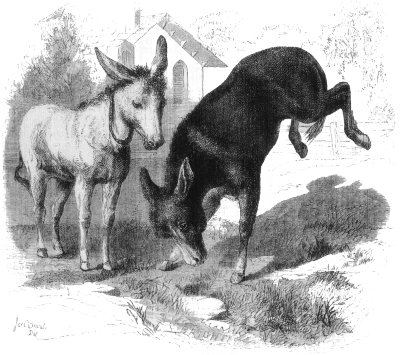
Tidy heard this, but, like other young and foolish things, he would not learn. Soon, the little dog Grip passed by, and Tidy laid his ears back on his neck and rushed at Grip to bite him.
"Really," said the gentleman, "Tidy is getting quite vicious. When we get home, we will send Tidy away, and we will keep Violet."
Tidy, as you may believe, was sorry enough then. But it was too late. He was sent away to the bare common. But Violet still lives in the gentleman's field, eats nice grass, goes easy journeys, and is plump and happy.