JOHNNY.
Reading edition
BY SARGENT FLINT.
Johnny was in disgrace. "Drandma" had set him down uncomfortably hard in his little wooden chair by the fire-place, and told him not to move one inch right or left till she came back; she also told him to think over how naughty he had been all day; but some way it seemed easier just then to think of his grandma's short-comings.
He looked through his tears at the candle in the tall silver candlestick, and by half shutting his eyes he could make three candles, and by blinking a little he could see pretty colors; but amusement tends to dry tears, and Johnny wanted to cry.
He caught the old cat and watched his tears slide off her smooth fur, but when he held her head on one side and let a large round tear run into her ear, she left him in indignation. Then he looked out of the window. The snow was falling fast, as it had been all day.
"Drandma!" he called, but the old lady was busy in the next room, and could not, or would not hear him, so he walked to the door and said: "Drandma, may I sweep a path for drandpa?"
This time "drandma" did hear and see him too. He was brought back and reseated, with marks of flour here and there on his little checked apron.
We must not blame grandma too much; it was a very long time since she was a child, and Johnny, to use her own words, "had almost worn her soul out of her."
When Johnny's mother died, his home was in New York, and while Johnny sat in his little chair by the fire-place, he was thinking of New York, wondering if he ever should see it again,—the great stores with their bright windows,—and, above all, hear the never-ending bustle and hum that would drown the noise of twenty great clocks like grandpa's. Then he thought how he had been deluded in coming to Plowfield; stories of bright green fields, butterflies, hay-carts piled high with hay, and 'way up on the top a little boy named Johnny.
A horse would be there, a cow (wrongly supposed by city people to mean always a plentiful supply of milk), and a blue checked apron; but no one mentioned the apron, and no one said that winter came in Plowfield; not that they meant to deceive Johnny—they couldn't remember everything, but it came all the same, and the bright green fields were brown and bare; then Johnny didn't like them at all, and when the snow came, grandma said if he went out he'd have the croup.
The butterflies forgot Johnny.
He did have one ride on the hay, but grandpa didn't have much hay.
The horse was not such a great comfort after all; he never drove except taking hold of what reins grandpa didn't use, and the cow—yes, Johnny did like the cow—she was a very good cow, but, if Johnny could have expressed himself, he would have said that she was a little monotonous.
Johnny couldn't remember his mother, which was fortunate then, or he would have cried for her. He saw his father only once a month; he was making money very fast in the dingy little office away down town in New York, and spending it almost as fast in a house away up town for Johnny's new mamma, and, with Plowfield so far away, it was no wonder Johnny's father was always on the move. He ought to have been there that very day; the heavy snow perhaps had prevented; that was one reason why Johnny had been so naughty.
He sat quite still after he was brought back. He was too indignant to cry; he felt as if there was no such thing as justice or generosity in grandmothers.
After a while he felt that he had thought of something that would do justice to his feelings.
"Drandma," he cried, "I wish I'd smashed the bowl to-day when I spilt the cream!"
Grandma didn't say anything for fear Johnny would know she was laughing.
He grew more and more indignant; he never in his life had felt so naughty. He thought of all the rebellious things he had ever heard of, and making a few choice selections, mentioned them to his grandmother, and she, laughing, stored them away, to tell grandpa, consoling herself with the idea that if he was bad he wasn't stupid.
Suddenly, among other brilliant ideas, came the thought that sometimes boys ran away; Mike's boy Jerry ran away (Mike was the man who worked for grandpa), and he didn't have any money, and Johnny had fifteen cents; besides, when he got on the cars he could tell the conductor to charge it to his father; of course, he knew his father; he came from New York every month.
He listened till he heard grandma go to the shed for wood, and before she came back her small grandson was some distance from the house in the deep snow, putting on his coat and tying his comforter over his ears.
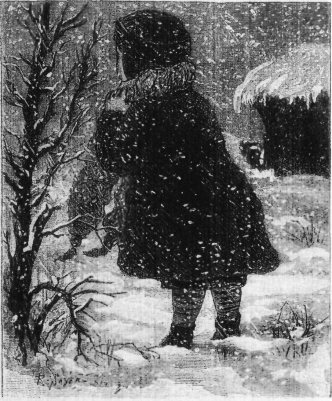
JOHNNY STARTS TO RUN AWAY.
As he looked back and saw the shadow of grandma as she put down the wood, he said: "I guess I'll make her cry pretty soon."
After the wood, grandma seemed to find quite a number of things either to take up or put down, so for a little while Johnny was forgotten. Did you ever notice that grandmothers, and mothers too, are always begging for a little quiet, yet, if they ever get a bit, nothing seems to make them more uneasy?
Grandma thought Johnny was unusually still—she thought, "and is asleep on the lounge." So she was not alarmed when she saw the little empty chair, but when no Johnny appeared on the lounge or anywhere in the room, she felt worried.
"Johnny!" she called all through the house and wood-shed. Then she missed the little coat, cap, and comforter.
"If he has gone to meet his grandpa, he'll freeze to death. Oh, why didn't I amuse him till his grandpa came," she thought. She opened the door and tried to call, but a cloud of snow beat her back. Wrapping herself comfortably, she started down the white road she thought Johnny had taken.
She called and called his name, and in her excitement expected every moment to find him frozen. She promised the wind and snow that, if they would only spare her Johnny, her dead daughter's baby, that in place of his impatient old grandma there should be one as patient as Job!
She had nearly reached the depot. She heard the evening train, she saw the glare of the great lamp on the engine though the glass that covered it was half hidden by the blinding snow. She heard a sleigh coming toward her, and said to herself, "No matter who it is, I will stop him, and he shall help me." The bells came nearer and nearer, and the sleigh stopped. "Where are you going, my good woman? It is a rough night, isn't it, for a woman to be out?"
Any other time, how grandma would have laughed!—grandpa didn't know his own wife!
"Take her in, father," said another voice. Poor grandma! It was Johnny's father who spoke.
"Oh, Johnny's lost!" she cried, as she tottered into the sleigh. "He will freeze before we can find him."
The old lady was taken home, and grandpa and Johnny's father started off, quite naturally in the wrong direction, for Johnny.
For a while, Johnny went on manfully; but soon his little fingers and toes began to beg him to go back. He refused to notice their petition, and wished grandma could see him, as the wind whirled him round and round and almost buried him in the snow. He thought he had gone about ten miles, when he heard bells. He turned to one side for the sleigh to pass, when he heard a voice he knew.
"Oh, Jerry," he cried, "please take me in!"
Jerry stopped, and asked, "Who are ye?"
"I'm Johnny," said our small hero, quite meekly.
"And where may ye be bound to, Johnny?" said Jerry.
"To the depot. I'm going to New York," said Johnny, who thought this a mild way to tell Jerry he was running away.
"This road niver took any one to the depot, Jacky. If I hadn't come this way, yer'd been froze stiff in the mornin'."
Here Jerry rolled his eyes in a dreadful manner, and trembled like one terribly frightened. Johnny would have cried hard, but he remembered how brave Jerry was when he ran away, so he winked hard to keep back the tears, and said:
"Do you think I shall 'froze' now, Jerry?"
Jerry thought not, if he minded him. So he lifted him into the sleigh, and they drove on.
"Is this the depot?" asked Johnny, when they stopped.
"Ye be hard on the depot. This is my house." said Jerry.
As he opened the door, his mother said, "I've looked afther yez since the dark, and what have ye there?" as she saw Johnny.
Mike, Jerry's father, sat by the stove, and there was a baby on the floor. Johnny thought he never had seen such a funny place.
He liked the baby best, although its yellow flannel night-dress was dirty; but it wasn't quite his idea of a baby.
"What shall we do wid him, Mike?" said the lady of the house, as she saw Johnny's head bobbing and his eyes closing.
"I thought ye'd kape him here till the next train for New York," said Jerry, laughing.
Mike laid down his pipe, and began to put on his coat.
"Is it to go out again that yez will, this arful night, Mike?" said Maggie.
"Lay him out on the bed; lave him to slape here to-night, Maggie. I'll go and make it aisy wid the old folks," said Mike.
He found grandma sitting before the fire-place. Bottles of all sizes stood on the table, and blankets hung on chairs by the fire. The old lady's face was pale, and Mike afterward told Maggie, "The hands of her shook like a lafe, and she had the same look on her that she had when they tould her Johnny's mother was dead. And when I tould her the boy was safe wid yez here—Ah, Maggie, she's a leddy!" said Mike, lowering his voice.
"Well, what did she say?" said Maggie.
"She said I betther sit down an' ate some supper, to warm meself," said Mike.
Poor grandma! She declared afterward she didn't know Mike was such a good-looking man, and so kind-hearted, too. But she didn't keep him long to praise him, but hurried him off to find grandpa.
Mike found the brilliant pair, going over and over the same ground. You need not laugh, little reader; that's just what your father would do, if you were lost.
Five minutes after they had learned where Johnny was, they were standing over him in Mike's house—standing over him, and the baby in the yellow flannel night-dress, for they were both in one bed, and Johnny's father saw them about as clearly as Johnny had seen the candle.
The family were thanked individually and collectively, from Mike down to the baby, who, when Johnny left, was covered with sweetmeats and toys, brought from New York to Johnny.
The next morning, at breakfast, Johnny learned many things, among them that it was very wrong to run away, and he must be punished, and grandma should decide how severely.
"I will punish him myself," said grandma, "by removing all temptation to do so again."
Johnny is too young now to appreciate his pleasant sentence, but in after years, when his sins are heavier, he will miss his gentle judge.
He was to leave Plowfield the next day for New York; but he was to come back again with the summer, and many were the promises he made of good behavior.
When the time came for him to go, he clung so to his grandma that his father said:
"You need not go, Johnny, if you would rather stay."
"No," said Johnny, "I want to go; but why don't they have drandmas and fathers live in the same house?"
At last, he was all tucked in the sleigh, and grandpa had started.
"Stop! wait!" said Johnny, "I forgot something."
He jumped out of the sleigh, ran back to grandma, clasped his arms around her neck, and whispered in her ear:
"I'm sorry, drandma, 'cause I spilt the cream, and I'm awfil glad I didn't smash the bowl."