THE BOY IN THE BOX.
Reading edition
BY HELEN C. BARNARD.
"You haven't any more ambition than a snail, Joe Somerby!" said energetic Mrs. Somerby to her husband, as, with sleeves rolled to the elbow, she scoured the kitchen paint.
Joe, who was smoking behind the stove, slowly removed his pipe to reply:
"Wal, if I haint, I haint; and that's the end on 't!"
"What would become of us if I was easy, too?" continued his spicy partner. "Why can't you have a little grit?"
Joe puffed away silently.
"Now, you pretend to carry on the rag business, you spend all your money a-buying and a-storing of 'em away; the back room's full, the attic's full, the barn's full,—I can't stir hand or foot for them rags! Why on earth don't you sell 'em?"
"Waiting for 'em to rise, marm!"
"Always a-waiting!" retorted Mrs. Somerby, thrusting her scrubbing-brush and pail into a closet, and slamming the door upon her finger. "Before you get through, the chance goes by. Joe," in a coaxing tone, "I've had a presentiment."
Joe evinced no interest, but removed his pipe to say:
"Now, wife, don't get uneasy. Let's be comfortable."
"Yes, I feel a presentiment about those rags;" the little woman whisked into a chair beside her lord. "They say the paper manufacturers are giving a big price now, husband. Why can't you take a load to the city to-day? I've been thinking of it all the morning."
"I'll do my own thinking, marm," said Joe, with dignity. He rose, however, and laid his pipe away.
Mrs. Somerby said no more, sure that she had roused him from his torpid condition. She wound Joe up to the starting-point, just as she did her kitchen-clock, and he kept upon his course as steadily as that ancient time-piece. She was just the wife for ease-loving Joe, whom her brisk ways never wounded, for he knew her heart was full of tenderness for him.
An hour later Joe drove into the yard. Mrs. Somerby flew out with a lump of sugar for a jaded-looking horse, bought by Joe to speculate upon, and who ate everything he could get, including his bedding, and never grew fat.
"I'll make a trotter of him in a month, and sell him to some of the grandees!" Joe said, but his system failed or the material was poor,—old Jack slouched along as if each step was likely to be his last. But despite this, Jack had become very dear to the childless couple, and they were as blind as doating parents to his defects.
"Bless his heart!" cried Mrs. Somerby, as Jack whinnied at her approach, and thrust his ugly nose into her hand.
Mr. Somerby felt of Jack's ribs with a professional air, and said:
"I'm trying a new system with this 'ere beast; I think he's picking up a grain."
"He'll pick up the grain, no doubt," playfully retorted his wife. "Now then, I'll help you off. Those paper men'll have all they want if you're not on hand. I'm glad I put you up to sorting the stuff last week."
"You'll 'put me up' till I'm clean gone," said Joe, winking to himself, as he followed his lively wife. "Let them bags alone, marm. You can be putting me up a big lunch."
"It's all ready, under the wagon-seat. By good rights, Joe, you'd ought to have a boy to help you."
"It isn't a woman's work, I know," said he, kindly. "You just sit here and look on."
Joe swung her up on a bale as if she had been a child. Inspired by her bright eyes he worked with a will. The wagon was soon loaded. Mrs. Joe ran for his overcoat and best hat, gave him a wifely kiss, and watched him depart from the low brown door-way.
"She's the best bargain I ever made," thought Joe, as he jogged toward the city. "I'm not quite up to her time, I know," continued he, and there was a tender look in his sleepy eyes. "Howsomedever, I'll make a lucky hit yet!"
The prospect was so cheering that Joe actually snapped the whip at the "trotter" who was meditating with his head between his knees. Jack, however, did not increase his gait, but plodded on. It was bitter cold, and Joe had to exercise himself to keep warm. It was afternoon when the laden cart entered the city. Hungry Jack had stopped twice, and gazed around at his master in dumb reproach. Joe was hungry, too; so he hurried into a square, in the business part of the city, covered his pet with an old quilt, and giving him his food, went to dispose of his cargo. But Joe's purchasers had gone to dinner, so he returned, mounted the cart, and began upon his own lunch.
"Now, if they don't want my stuff, my wife's 'presentiment' 's gone up," said the elegant Joe, "and I've had this cold trip for nothing."
Just here a remarkable event occurred. Jack suddenly threw up his meditative head, shied, and stood upon his hind-legs.
"Hey there!" cried his master, delighted at this token of life. "Yer a trotter, after all?"
"Yer old nag scart, mister?" asked several small boys, who hovered about.
"He's a leetle lively!" said Joe, proudly. "Keep clear of his heels, boys."
Jack subsided, but eyed a pile of boxes in a court on the left.
"What ails ye, Jack?"
"It's the hermit ails him!" cried one, pointing toward a huge box from one side of which somebody's head and shoulders protruded.
"Quit scaring my horse!" cried Joe.
The face was startlingly pale, and the eyes had a troubled, eager look—the look of anxious care; but Joe knew their owner was a boy, although he quickly disappeared in the box. Mr. Somerby resumed his lunch, but kept the reins in case Jack should be startled when the boy came out. But he did not appear; there was no sign of life in the box. Joe thought he was either up to some more mischief or afraid; the latter seemed most likely, as he recalled the white, still face.
Joe got down from his cart and quietly peeped in. He was somewhat astonished at first, for the boy was on his knees. The sight stirred his sympathies strangely. The pallid lips were moving; soon, low words came forth:
"I don't know how to speak to you, dear Lord; but please help me. Mother prayed to you, and you helped her. Oh! help me, I pray, for Jesus' sake. Amen."
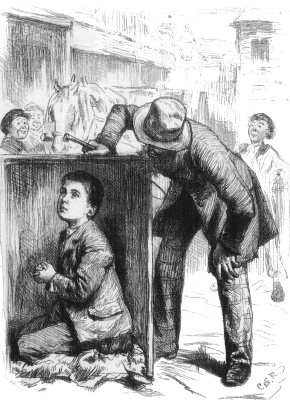
"THE BOY WAS ON HIS KNEES."
The listener drew back to brush the tears from his eyes.
"'Minds me o' Parson Willoughby's sermon—'Help, Lord, or I perish!' I wish my wife was here. I declare I do. The little chap must be in trouble!"
Joe peeped in again. The boy did not see him as he was partly turned from the opening. He threaded a rusty needle, and proceeded to patch his coat. Joe could see the anxious puckers in his face as he bent over the task.
"I do wish she was here!" Joe cried, aloud.
The boy turned quickly.
"Why don't you go home, lad? You'll freeze to death here."
"This is my home."
"Sho! Do you mean to say you live here?"
"Yes." The lad hesitated, then asked, "Are you from the country, sir?"
"Wal, yes, I be. Though folks don't generally mistrust it when I'm slicked up. But I don't stand no quizzing."
The boy appeared surprised at this sudden outburst, and said, with a frank, manly air that appeased Joe:
"I thought if you lived a long way off I wouldn't mind answering your questions. I'm English, and my name's John Harper. I don't mix with the street boys, so they call me the hermit!"
"Don't you 'mix' with your own folks, neither!"
"They were lost at sea in our passage to this country," was the low reply. "Sometimes I wish I'd died with them, and not been saved for such a miserable life. Can't get work, though I've tried hard enough, and I'd rather starve than beg. I can't beg!" he cried, despairingly. "I'm ordered off for a vagrant if I warm myself in the depots, and I don't suppose the city o' Boston'll let me stay here long."
"Don't get down at the mouth—don't!" said honest Joe, in a choking voice, as the extent of this misery dawned upon him.
"There, you know all," said the boy, bitterly. "I scared your horse, or I wouldn't tell so much. Besides, you look kinder than the men I meet. Perhaps they're not so hard on such as me where you live?"
But Joe had gone, his face twitching with suppressed emotion.
"I'll take the hunger out o' them eyes, anyhow!" He grasped the six-quart lunch pail, and, hastening back, cried, as he brandished it about the lad's head, "Just you help a feller eat that, old chap. My wife 'ud rave at me if I brought any of it home. Help ye'self!"
Hunger got the better of John Harper's pride. He ate gladly. There wasn't a crumb left when he returned the pail. The light of hope began to dawn in his sad eyes,—who could be brave while famishing!
Meantime, Joe had been puzzling his wits and wishing his wife was there to devise some plan for the wayfarer.
"I wonder if you'd mind my horse a spell, while I go about my business?"
So the pale hermit crept out of his box, and mounted the wagon, well protected by an extra coat that comfort-loving Joe always carried.
"He'll think he's earned it, if I give him money," was Joe's kind thought. "He's proud, and don't want no favors. I'll give the lad a lift, and then—"
After "the lift," what was before the homeless boy? Somehow he had crept into Joe's sympathies wonderfully. He couldn't bear to look forward to the hour when Jack and he must leave him to his fate. A chance word from the paper manufacturer put a new idea into Joe's brain. He bought all the cargo at a good price, and engaged the stock at home.
"I'll bring it in soon," said Joe, putting his purse in a safe place. "I don't keep no help to sort my stuff, or I'd be on hand to-morrow."
"Ah," said the bland dealer, little thinking what a train of events he was starting. "You are doing a good business; why don't you keep a boy? I know one who is faithful and needy!"
"Yes, yes, he's in my cart, done up in my coat!" cried Joe, suddenly. He beamed upon the bewildered dealer, and rushed for the door, almost crazy with the new idea.
"My wife said I'd ought to have a boy, too," he thought, almost running toward the spot where he had left the cart, Jack, and the solitary figure in the great coat. Joe grasped the boy. "I've got a plan for you, John Harper. I want a boy to help me; the dealer says so, my wife says so, and I say so. You must go home with me to-night. We'll carry this load to the store-house; then pitch in your baggage and start for a better place than this, my lad!"
It was, indeed, "a better place" for "the boy in the box,"—a place where he found rest and food and shelter. After a little, he grew into the hearts of the childless couple that they called him their own. John went to school winters, and helped Mr. Somerby summers, and got ahead so fast in his happy surroundings that ambitious Mrs. Somerby had him educated. He is now a prosperous merchant, and a text for old Joe to enlarge upon when his wife gets too spicy.
"You wan't nowheres around when I found our John," he often says, "and he's the best bargain I ever made, next to you!"