JACK-IN-THE-PULPIT.
Reading edition
Poets have a great deal to answer for, and they should be careful what they say, for they've no idea what an influence they have. Now, I'm told that about one hundred and fifty years ago, one by the name of Thomson (Thomson without a p) sang:
"Hail, gentle Spring! Ethereal mildness, hail!"
and made no end of trouble, of course. March being the first spring month, was the first to hear the command, and so, ever since, she has been trying her best to hail. Failing in this, as she nearly always does, her only recourse is to blow; and blow she does, with a will. So don't blame her, my chicks, if she deals roughly with you this year, blows your hair into your eyes, and nearly takes you off your feet. It's all the fault of that poet Thomson.
I suppose if he had sung to our great American cataract, he would have told it to trickle, or drip, or something of that sort; and then what would have become of all the wedding tours? Mrs. Sigourney, my birds tell me, was a poet of the right sort. She sang, "Roll on, Niagara!"—and it has rolled on ever since.
Talking of fluids, here's a letter telling
HOW CHERRY PLAYED WITH WATER.
A good friend sends Jack this true horse-story:
At my summer home, the very coolest and pleasantest spot to be found on a hot day is a grassy knoll, shaded by a great tree. Close by is the horse-trough, which is supplied with water from the well a few rods off. One sultry day, my little boy and I went to play under the shade of this tree. The trough was full of clean, sparkling water, and I lingered there even after the two horses, "Cherry" and "Dash," had been brought out and tied to the tree; for they, too, had found their house uncomfortable, and had begged with their expressive eyes to be taken out-of-doors.
Now, the water in the trough looked very tempting, and soon my boy Willy put his little hand in, and then rolling up his sleeve, plunged in his arm and began to splash the water, throwing it around, wetting us all, horses included. We left the tree, and were going into the house, when we heard a loud thumping, and splashing; turning round, we saw Cherry, with his fore-leg in the trough, knocking his great iron shoe against the side of it, sending the water flying in all directions, and making the water in the trough all black and muddy. Now, these horses had drunk from this trough three times a day for two months, and spent many a morning under that very tree, and it had never occurred to either of them to play such a trick until they had seen Willy do it.
Willy was so much pleased that he gave Cherry several lumps of sugar to reward him for his naughtiness; but James, the coachman, took a different view, and gave him a sound scolding, and I am afraid whipped him; although I protested that Willy was more to blame than poor Cherry, who had only imitated his little master.
C.C.B.
THREE SPIDERS.
Another enemy to my friends the birds! This time it's a spider. He lives near the Amazon River, they tell me, builds a strong web across a deep hole in a tree, and waits at the back of the hole until a bird or a lizard is caught in the meshes. Then out he pounces, and kills his prey by poison. And yet this dreadful creature has a body only an inch and a half in length!
Then there's a spider named Kara-Kurt, who lives in Turkestan; and, though he is no bigger than a finger-nail, he can jump several feet. He hides in the grass, and his bite is poisonous; but I'm glad to say he doesn't kill birds.
In the same country is a long-legged spider, who has long hair and a body as big as a hen's egg. When he walks he seems as large as a man's double fists. What a fellow to meet on a narrow pathway! I think most people would be polite enough to let him have the whole of the walk. Little Miss Muffett would have been scared out of her senses if such a huge spider had "sat down beside her."
SPECIAL DISPATCH.
The Little Schoolma'am says Thomson didn't say "Hail, gentle Spring!" He said, "Come, gentle Spring!" Dear, dear! I beg his pardon. But, like as not, some other poet said it, if Thomson didn't. Or perhaps they've sung so much about Spring that March, taking it all to herself, thinks she may as well blow her own trumpet, too.
Poor March! In old times she used to be the first month of the year,—and now she is only the third. May be, that is what troubles her. Nobody likes to be put back in that way.
ABOUT PARROTS.
Deacon Green was talking about parrots the other day. He said he once knew a parrot that was not as polite as "Pippity," the one mentioned in a story called "Tower-Mountain." The parrot that he knew would swear whenever he opened his bill. It had been taught by the sailors on board the ship in which it had come from South America. When the deacon knew it, it belonged to the widow of a very strict minister. It had been brought to her by her nephew, a midshipman, as a Christmas present. It was lucky for him, just then, that the old lady was stone deaf. She was very cross with the neighbors when they told her what wicked words the bird used. It was a great pet, and she would not believe anything bad about it. But at last it swore at a visitor who was a bishop, and soon after, it was no more.
Since the Deacon told that story I have had a paragram about another parrot; one that lived in Edinburgh, Scotland, five years ago. This one could laugh, weep, sing songs, make a noise like "smacking the lips," and talk. His talking was not merely by rote; he would speak at the right times, and say what was just right to be said then and there. He spoke the words plainly, bowed, nodded, shook his head, winked, rolled from side to side, or made other motions suited to the sense of what he was saying. His voice was full and clear, and he could pitch it high or low, and make it seem joyful or sad. Many curious tales, are told of him, but the most remarkable thing about him is that he actually lived and really did the things named.
That's what the paragram says. Stop—let me think a moment. May be that parrot himself sent it? But no; he wasn't smart enough for that; I remember, now, the signature was "Chambers."
THE WRITING OF THE PULSE.
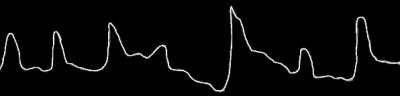
Did you ever hear of a sphygmograph? Of course not. Well, in its present improved state, it is something new and very wonderful. It takes its name from two Greek words, sphugmos, the pulse, and grapho, I describe. It is an implement to be used by physicians, and forces the patient's pulse to tell its own story, or, in other words, make a full confession of all its ups and downs and irregularities. Not only make a confession, my beloveds, but actually write it down in plain black and white!
So you see that a man's pulse in Maine may write a letter to a physician in Mexico, telling him just what it's about, and precisely in what manner its owner's heart beats—how fast or slow, and, in fact, ever so much more.
Now, isn't that queer? Should you like to see some specimens of pulse-writing? Here they are:
1.

2.
3.

4.

No. 1, according to the doctors, writes that he is the pulse of a strong, healthy boy, and that his owner is getting on admirably. No. 2 writes that his proprietor has trouble with his heart. No. 3 tells a sad story of typhoid fever; and No. 4 says that his owner is dying.
I am only a Jack-in-the-Pulpit, you know, quite dependent upon what the birds and other bipeds tell me, so you cannot expect a full description and explanation of the sphygmograph here. Ask your papas and friends about it.
There's a great deal going on in the world that you and I know very little about; but such things as the sphygmograph give us a hint of the achievements of science in its efforts to help God's children out of their many ills and pains.
The deacon says that, wonderful as the sphygmograph is, the pulse itself is more wonderful still—a fact which no good ST. NICHOLAS child will deny.
A PERUVIAN BONANZA.
You've heard, I suppose, that they expect soon to open up a new and wonderfully rich deposit of silver in the mines of Peru? No! Well, then, it's high time you were warned about it. Take your Jack's advice, my youngsters, and be very careful about things. Why, if they go on finding big bonanzas in this reckless way, silver will be too cheap for use as money! And then what will they do? They'll have to use something in place of it, of course; but there's no telling what it will be. Only think, they might choose double-almonds, or something of that kind!
But don't allow yourselves to be cast down about it, my dears. Try to keep up your spirits, and remember that, if the worst comes to the worst, good children will never be so plenty that people will cease to appreciate a good child. That's a bit of solid comfort for you, any way.
LUMBER AND TIMBER.
Which of you can state the exact distinction, if there is any, between lumber and timber, without consulting the dictionary?
QUEER NAMES FOR TOWNS.
Now, what am I to do with this? If the Little Schoolma'am sees it, she may want to give the boys and girls of the Red School-house a new sort of geography lesson, or perhaps a spelling task to her dictation. That would be a little hard on them: so perhaps I'd better turn over the letter to you just as it is, my chicks.
Washington, D.C.
DEAR JACK-IN-THE-PULPIT: Here are the names of some towns in the United States. They are so funny that I send them to you, and I hope you will like it. Do you think the Little Schoolma'am would know where all these places are?
Toby Guzzle, Ouray, Kickapoo, T.B., Ono, O.Z., Doe Gully Run, Omio, Nippenose, Eau Gallie, Need More, Kandiyohi, Nobob, Cob Moo Sa, We Wo Ka, Ty Ty, Osakis, Why Not, Happy Jack, U Bet, Choptack, Fussville, Good Thunder's Ford, Apopka, Burnt Ordinary, Crum Elbow, Busti, Cheektowaga, Yuba Dam, Dycusburgh, Chuckatuck, Ni Wot, Buck Snort, What Cheer, Forks of Little Sandy, Towash, Sopchoppy, Thiry Daems, Vicar's Switch, Omph Ghent, Peculiar.
I have found a great many more, but these are the queerest I could pick out.—Yours truly,
WILLIAM B.
ANSWERS TO RIDDLES.
Here are two answers, out of the three, to the riddles I gave you last month: TOBACCO, and CARES (Caress). The archbishop's puzzle has been too much for you, I'm afraid, my dears. I'll give you until next month. Then we'll see.