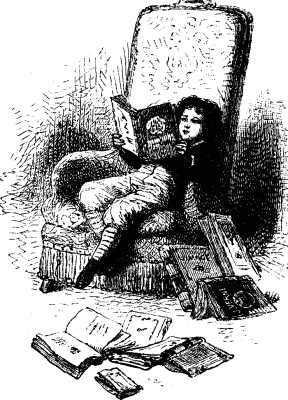
CRUMBS FROM OLDER READING.
Reading edition
II.
BY JULIA E. SARGENT.
IRVING.
Washington Irving has so many things for us, and we have heard so much that is pleasant of him, that a good time with him may be expected; and you would not read far in Irving's books before learning that no one believed in "good times" more than he. The name of his home on the Hudson would tell you that. "Sunnyside" is not the name a gloomy man would choose.
Perhaps you will like best to hear that many of you often stand where Irving stood, and walk the streets he knew so well, for New York City was Irving's birthplace, and there many of the seventy-six years of his life were spent. One of his books is a funny description of his native town in the days of its old Dutch governors. He does not call it Irving's, but "Knickerbocker's History of New York." And as only Irving knew anything of Diedrich Knickerbocker outside this book, we will let him tell you that "the old gentleman died shortly after the publication of his work." Of course, Irving can say what he chooses about Knickerbocker's book, so he gives it as his opinion that, "To tell the truth, it is not a whit better than it should be." But Sir Walter Scott, in a letter to a friend, says of these funny papers of Irving's: "I have been employed these few evenings in reading them aloud to Mrs. S. and two ladies who are our guests, and our sides have been absolutely sore with laughing." All Irving's histories are not "make-believe," and some day you will read Irving's "Life of Columbus," and "Life of Washington," completed just before his death in 1859, without thinking of them as histories. He wrote the "Life of Columbus" in Spain. Can you tell me why that was the best place to write it?
Would you like to know where the boy Irving might often have been seen when he was not devouring the contents of some book of travels? "How wistfully," he wrote, "would I wander about the pier-heads in fine weather? and watch the parting ships, bound to distant climes!"
Not many years after, he wrote from England, "I saw the last blue line of my native land fade away like a cloud in the horizon." He was then in England, where he visited Westminster Abbey, Stratford-on-Avon, and many other grand and famous places. Of these, and much that is neither grand nor famous, he has written in the "Sketch-book," giving this reason for so naming word-paintings: "As it is the fashion for modern tourists to travel pencil in hand and bring home their portfolios filled with sketches, I am disposed to get up a few for the entertainment of my friends." Is it not as good as a picture to hear this man, who had no little ones of his own, tell of "three fine, rosy-cheeked boys," who chanced to be his companions in a stage-coach? This is what he writes:
"They were returning home for the holidays in high glee and promising themselves a world of enjoyment. It was delightful to hear the gigantic plans of the little rogues. * * * They were full of anticipations of the meeting with the family and household, down to the very cat and dog, and of the joy they were to give their little sisters by the presents with which their pockets were crammed; but the meeting to which they seemed to look forward with the greatest impatience was with Bantam, which I found to be a pony." When he had heard what a remarkable animal this pony was said to be, Irving gave his attention to other things until he heard a shout from the little travelers. Let him tell the rest of the story.
"They had been looking out of the coach-windows for the last few miles, recognizing every tree and cottage as they approached home, and now there was a general burst of joy. 'There's John! and there's old Carlo! and there's Bantam!' cried the happy little rogues, clapping their hands. At the end of a lane there was an old, sober-looking servant in livery waiting for them; he was accompanied by a superannuated pointer, and by the redoubtable Bantam, a little old rat of a pony, with a shaggy mane and long, rusty tail, who stood dozing quietly by the roadside, little dreaming of the bustling times that awaited him. Off they set at last, one on the pony, with the dog bounding and barking before him, and the others holding John's hands, both talking at once. * * * We stopped a few moments afterward to water the horses, and on resuming our route a turn of the road brought us in sight of a neat country-seat. I could just distinguish the forms of a lady and two young girls in the portico, and I saw my little comrades with Bantam, Carlo, and old John trooping along the carriage-road. I leaned out of the coach window in hopes of witnessing the happy meeting, but a grove of trees shut it from my sight."
"If ever love, as poets sing, delights to visit a cottage, it must be the cottage of an English peasant," Irving thinks, and goes on to write in his own pleasant fashion of many pleasant things in English country life, saying: "Those who see the Englishman only in town are apt to form an unfavorable opinion of his social character. * * * Wherever he happens to be, he is on the point of going somewhere else; at the moment when he is talking on one subject, his mind is wandering to another; and while he is paying a friendly visit, he is calculating how he shall economize time so as to pay the other visits allotted in the morning."
The "Legend of Sleepy Hollow" is a genuine ghost story. It is not very startling, but very, very funny, when you know what scared poor Ichabod Crane on his midnight ride that last time he went courting Governor Wouter Van Twiller's only daughter.
You must read for yourselves the famous story of Rip Van Winkle and the nap he took. It is too long for me to give in Irving's words, and "Rip Van Winkle" is just such a story as no one but Irving knows how to tell.
In another of his interesting stories in the "Sketch Book," told, he says, by a queer old traveler to as queer a company gathered in a great inn-kitchen, Irving describes the busy making-ready for a wedding. The bride's father, he says, "had in truth nothing exactly to do."
Do you suppose he was content to do nothing "when all the world was in a hurry?"
This is the way in which he helped: "He worried from top to bottom of the castle with an air of infinite anxiety; he continually called the servants from their work to exhort them to be diligent, and buzzed about every hall and chamber as idly restless and importunate as a blue-bottle fly on a warm summer's day." The book of Irving's that some of you will like best of all is "The Alhambra." The Alhambra is the ancient and romantic palace of the Moors. When he was in Spain, Irving spent many dreamy days amid its ruined splendors, whence the last of the Moors was long since driven into exile. We have good reason to be glad that Irving saw the Alhambra, for this book is what came of it. We shall all want to go where Irving went, after reading what he says of the Alhambra by moonlight. "The garden beneath my window is gently lighted up, the orange and citron trees are tipped with silver, the fountain sparkles in the moonbeams, and even the blush of the rose is faintly visible. * * * The whole edifice reminds one of the enchanted palace of an Arabian tale."
These, you know, are only crumbs, and crumbs which show Irving's "warm heart" more, perhaps, than his "fine brain."
To learn of his literary talent and well-deserved fame, of his rich fancy and his wonderful ability for story-telling, you can better afford to wait than to miss knowing how healthy, happy, and truly lovable was this man's nature. Now, with only one of the many sober, earnest thoughts, we must lay aside his books.
"If thou art a child, and hast ever added a sorrow to the soul, or a furrow to the silvered brow of an affectionate parent; if thou art a friend and hast ever wronged in thought, or word, or deed, the spirit that generously confided in thee, then be sure that every unkind look, every ungracious word, every ungentle action, will come thronging back upon thy memory."