THE DIGGER-WASPS AT HOME.
Reading edition
BY E. A. E.
July had come again, and brought with it such warm, sultry days that it almost seemed as if no living creature could stir abroad. Nevertheless, there was a wonderful deal going on in our garden. Through the air and over the flower-beds hastened hundreds of little people. Some lived in the trees and bushes, others in the ground, and all were hard at work.
One morning, especially, there seemed to be something unusual going on; the buzzing, and humming was fairly deafening.
Whirr-r-r! whirr-r-r! What was that great creature that darted past my face? And here came another, and another; why, the garden was full of them!
Big brown-and-yellow wasps these strangers were, and all in a most desperate hurry. Scores of them were already hard at work digging away in the firmly packed sand of the path.
As these new-comers seemed to care very little who watched them at their work, I sat down on an upturned flower-pot in the shade of a friendly lilac, determined to make their acquaintance.
MAKING A HOME.
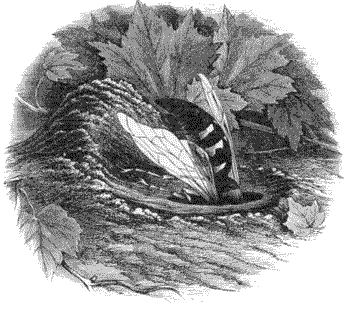
Hardly had I settled myself before one of the wasps approached. She seemed searching for something, for she flew rapidly back and forth, now alighting for a moment—now darting away again. At last she dropped upon the ground close to me and began to bite the earth with her strong jaws. When quite a little heap lay before her she pushed it to one side with her hind feet and then returned to her digging. In five minutes she had an opening big enough to get into; every time she appeared she backed up out of it pushing a huge load of sand as big as herself behind her. Soon all around the hole was a high bank of earth, and she found it necessary to make a path across it, and push her loads over that. Two hours' hard work, and the house was finished. It was very simply planned, and had only one room down at the end of a long, narrow passage. But simple as it was, this little creature had done more work in the two hours than a man could do in a day. That is, of course, taking her size into consideration. And she did not even now stop to rest. Not she! With one last look into the house, to make sure she was leaving all as it should be, she flew away. In a moment her strong wings had taken her quite out of sight but it was not long before she re-appeared. Back and forth she hastened, at one moment flying through the grape-arbor, at the next wheeling above the cabbage-bed. All this time the object of her search, a fat young locust, was quietly sitting on a gate-post, quite forgetting, as even locusts sometimes will, that he had an enemy in the world.
A moment later and the wasp's sharp eyes had found him out; and then, quick as lightning, she darted down upon him, and pierced him with her sting. When the locust lay perfectly still, the wasp seized him and flew off. Arrived at her hole, she tumbled him head foremost in at the door, expecting him, of course, to fall quite to the bottom. But her calculations had been slightly at fault; the locust was too fat to go in, and there he stuck with his head and shoulders in the hole and his body in the air. Here was a dilemma! But my wasp friend was evidently not one to be overcome by difficulties of this sort. She flew off again, and this time returned with two other wasps; they crowded round the hole, and began digging away the earth which pressed close about the locust. In a short time they seemed satisfied, for they stood up and pushed at the object of their toils. Slowly he slid down out of sight, and she who had brought him hurried after. She laid an egg close to him in her house; then, hurrying up, began to carry back the earth she had before taken out, and in a short time the door was securely closed. Then she scraped away, and patted down all the loose earth, till she had made it quite impossible for any evil-minded creature to find any traces of her home.
The wasp knew very well that her egg would soon hatch out; that the little white grub, her chick, would at once begin to feed upon the locust, which would supply food till the young one was full-grown.
The following morning I again visited the garden, to see how the home-making progressed. Soon a handsome wasp came running toward my seat, under the lilac, near which was a newly made hole.
"She knows me! she is no longer afraid!" But no; she stopped short and raised her long, delicate antennæ, evidently on the lookout for danger. She could not be the same wasp I had watched yesterday; but how was I to make sure? They seemed all exactly alike.
I was all this time as motionless as if I had been turned to stone.
She came a step or two nearer, and, at last, quite re-assured, hurried down into her hole. What a long time she stayed! but, at last, on watching the opening intently, I saw something coming toward daylight. It was a great ball of earth, quite filling the hole, that the wasp was forcing up by her hind legs. With one mighty heave the ball rolled out, scattering itself in all directions, as it broke apart.
I noticed at this time, and afterward, that as the depth of the holes increased and it took longer journeys to reach the surface, the wasps always pressed the earth they wished to get rid of into these compact balls, and so managed to bring up a much greater quantity at once than would otherwise be possible. The wasp now walked entirely round the hole, pushing carefully back the loose sand which seemed likely to fall in again. This done, she was up and away. She was in search now of the insect near which to lay her egg, but although she came in sight of several, she could get no nearer.
AFTER THE RAIN-STORM.
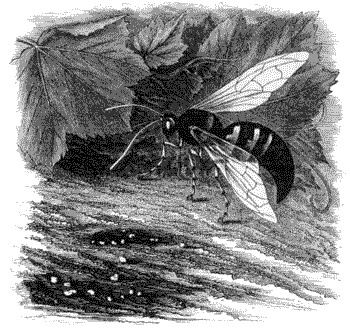
The inhabitants of our garden were learning how dangerous these new settlers might be, and kept well out of her way. At last, as she poised herself high in the air, and rested on her broad, strong wings for an instant, she spied, far beneath her, a small grasshopper. It was the work of only a second to pounce upon him, and to lay him out on his back perfectly insensible.
But now a difficulty arose. How could she, borne down by this heavy weight, manage to rise into the air? The locust of the day before had been caught upon a high post, and in order to carry him the wasp had only to fly down. This was a wholly different case. At last an idea seemed to occur to her: she jumped astride of the grasshopper, seized its head with her fore feet, and ran along the ground.
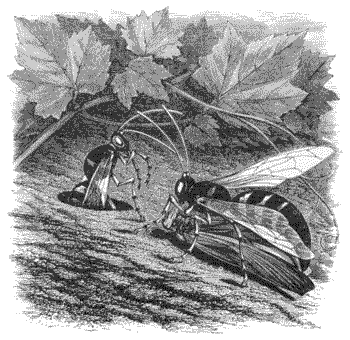
Ha! This was famous; but hard work, nevertheless, and she had often to let go and rest. She entered the broad path in which her house was, but somehow she had become bewildered, and mistook a neighbor's hole for her own. As she dismounted before it, and looked in, the owner angrily darted out, buzzing in a frightful manner. Our poor friend, much abashed, proceeded to the next house, and the next, everywhere meeting with the same reception.
"How stupid of her," I thought, "not to know her own home!" but just then she saw the entrance, ran swiftly toward it, and in another minute she and her burden were both safely in-doors.
Presently she came out and again flew off. She had laid her egg close to the grasshopper, but the amount of provision was not enough, so she had now gone in search of another insect, with which to fill her larder.
As soon as she was out of sight, a tiny creature flew down into the hole. She, too, had her egg to lay, and here was just the opportunity. Inside of the digger-wasp's egg the little ichneumon fly placed another and a very much smaller one, after which she darted away, just in time to escape meeting the returning mother, who, coming back laden with a second grasshopper, placed it close to the first, and set about closing the door. But all her careful work would be of no avail; no child of hers would ever come out of this house a perfect full-grown insect like herself.
This is what happened:
In time the two eggs hatched. The young digger-wasp set to work upon the grasshopper, and the little ichneumon began to eat the wasp-grub. At last the young wasp died, and at that moment there flew out from his body a little fly.
AT THE WRONG HOUSE.
It rested a minute, then turned and pushed its way through the soft earth till it reached daylight. It waved its wings gently up and down a few times, and darted away and out of sight.
The digger-wasps had been living for some weeks in our garden, when, one afternoon, there came up a fearful thunder-storm. The rain poured down in torrents. Where had been shortly before neatly kept paths about our house, we saw now rapid little rivers tearing up sand and gravel as they raced down-hill, and doing all the damage their short lives would allow. But all of a sudden the sun burst out from the clouds, the rain stopped, and the water which had fallen sank into the ground.
I did not waste many minutes in reaching the garden. What a sight met my eyes! The broad path stretched itself out before me smooth and wet; not a single hole remained,—all were buried deep under the sand. Instead of the air being, as was usual, fairly alive with busy, happy creatures, there was now, here and there, a miserable mud-covered insect clinging to a leaf, and wearily trying to clean its heavy wings.
What a sad ending to the gay, bright summer!
The next day, however, I found a few survivors hard at work digging again; but this time every hole was sloping instead of perpendicular. After much thought, I came to the conclusion that these clever little creatures had found the way to prevent such another calamity as had overtaken them the day before. Formerly, the first drops of an unusually hard shower filled the holes instantly, drowning the inmates. Now, this could not happen, especially if the openings were placed, as most of them were, under the shelter of the big grape-leaves which at many points rested on the edge of the path. This all took place two years ago; but each summer since then has brought with it some of our old friends, the digger-wasps.