JACK-IN-THE-PULPIT.
Reading edition
"Warm!" you say?
Don't mention it, but take it good-naturedly.
And, now, let's be quiet and have a talk about
HEARING FLIES WALK.
"Ho, ho; nobody can do that!"
But anybody can do that,—with a microphone.
"And what's a microphone?"
Why, it's a machine by which very low sounds, that don't seem to be sounds at all, may be made to grow so loud and clear that you can easily hear them. If any of you come across one of these things, my dears, just take it to some quiet green spot, and coax it to let you hear the grass grow.
There's one feature of the microphone that is likely to be troublesome; it makes loud noises sound hundreds of times louder. Something must be done, therefore, to prevent the use of these machines on any Fourth of July. That would be what nobody could stand, I should think.
A CRAB THAT MOWS GRASS.
Isn't this dreadful? In India—a long way off, I'm glad to say—there is a kind of crab that eats the juicy stalks of grass, rice, and other plants. He snips off the stalks with his sharp pincers, and, when he has made a big enough sheaf, sidles off home with it to his burrow in the ground, to feast upon it.
Ugh! I hope I shall never hear the cruel click of his pincers anywhere near me!
WASHERWOMEN IN TUBS.
Over here, as I've heard, the clothes to be washed are put in tubs, and the washerwomen or washermen stand outside at work. But I'm told that in some parts of Europe the washerwomen themselves get into the tubs. They do this to keep their feet dry. The tubs or barrels are empty, and are set along the river banks in the water, and each washerwoman stands in her tub and washes the clothes in the river, pounding, and soaping, and rinsing them, on a board, without changing her position.
MICE IN A PIANO.
Chicago, Ill.
Dear Jack: I have long wished to tell you of a little incident that occurred in our family.
About a year ago we bought an upright grand piano, and after we had had it a few months we noticed that one of the keys would stay down when touched, unless struck very quickly and lightly, and the next day another acted in the same way. That evening, after the boys had gone to bed, father and myself were sitting by the grate fire, when we thought we heard a nibbling in the corner of the room where the piano stood. I exclaimed, "Do you think it possible a mouse can be in the piano?" "Oh no!" he said; "it is probably behind it." We moved the piano, and found a little of the carpet gnawed, and a few nut-shells. Then we examined the piano inside, as far as possible, but found no traces there. I played a noisy tune, to frighten the mouse away, and we thought no more about it.
Two or three days after, more of the keys stayed down, and I said, "That piano must be fixed." The tuner came, and the children all stood around him, with curious eyes, as he took the instrument apart. Presently I heard a great shout. What do you think? In one corner, on the key-board, where every touch of the keys must have jarred it, was a mouse's nest, with five young ones in it! Those mice must have been fond of music! The mother mouse sprang out and escaped; but the nest and the little ones were destroyed.
Well, what do you suppose the nest was made of? Bits of felt and soft leather from the hammers and pedal; and the mouse had gnawed in two most of the strips of leather that pull back the hammers! So, when the piano had been fixed, there was a pretty heavy bill for repairs.—Very truly yours,
P. L. S.
RATTLE-BOXES.
You'd hardly believe how old-fashioned rattle-boxes are,—those noisy things that babies love to shake. Why, they are almost as old-fashioned as some of the very first babies would look nowadays. A few very ancient writers mention these toys, but, instead of calling them, simply, "rattle-boxes," they refer to them as "symbols of eternal agitation, which is necessary to life!"
Deacon Green says that this high-sounding saying may have been wise for its times, when the sleepy young world needed shaking, perhaps, to get it awake and keep it lively. "But, in these days," he adds, "the boot is on the other leg. People are a little too go-ahead, if anything, and try to do too much in too short time. Real rest, and plenty of it, is just as necessary to life as agitation can be."
Remember this, my chicks, all through vacation; but don't mistake laziness for rest.
A MOTHER WITH TWO MILLION CHILDREN.
No, not the old woman who lived in a shoe,—though old parties of the kind I mean have been found with their houses fixed to old rubber high-boots,—but a quiet old mother, who never utters a word, and whose house is all door-way, as I'm told. Every year she opens the door and turns two million wee bairns upon the world.
Away they rush, the door snaps shut behind them, and they can never come back any more! They don't seem to mind that very much, however, for they go dancing away in countless armies, without ever jostling, or meeting, or even touching one another.
And how large a ball-room do you suppose a troop of them would need? One drop of water is large enough for thousands upon thousands of them to sport in!
The mother is the oyster, and her children are the little oysters, and a curious family they must be, if all this is true, as I'm led to believe.
A CHINESE FLOATING VILLAGE.
A CHINESE FLOATING VILLAGE.
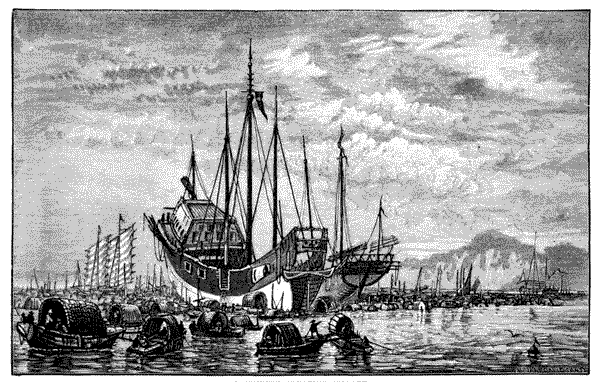
The Little Schoolma'am wishes you a good and lively vacation, and sends you a picture of a Chinese Floating Village,—a cool and pleasant kind of village to live in through the summer, I've no doubt, with plashing water, and fresh breezes, all about you. She goes on to say:
"In China, where there are about four hundred and fifty millions of people, not only the land, but also much of the water, is covered with towns and streets; and, although the Chinese are more than eleven times as numerous as the people of the United States, their country is not half as large as ours,—even leaving Alaska out of the count. So that China is pretty well crowded.
"In the picture, the little boats belong to poor people, but the big ones, called 'junks,' belong to folks who are better off. Sometimes junks are used by rich people for traveling, and then they are built almost as roomy, and fitted up quite as comfortably, as the homes on shore.
"There are no railroads in China worth mentioning, so traveling has to be done by highroad, or by river and canal; and, as this last, though easy, is a very slow way, it is a good thing when, like the snail, a traveler can take his house with him."
INFORMATION WANTED.
Providence, R. I.
Jack-in-the-Pulpit: Sir: I write to ask if any of your little birds ever crossed the Equator; and, when just above it, whereabouts in the sky did they look for the sun at noon?
If you will answer this you will oblige me very much, as I have been wondering for about a month past.
Don't think this foolish.
Edwin S. Thompson.
None of my feathered friends ever told me about this; but, perhaps, some of you smart chicks who have just passed good examinations can answer Edwin's question. If so, I'd be glad to hear from you; especially if you'd let me know, also, what kind of a thing the equator is, and by what marks or signs a bird or anybody might make sure he had pitched upon it?
A BIRD THAT SEWS.
Sandy Spring, Md.
Dear Jack: Have you ever heard of a bird that sews? Perhaps you have, and some of your chicks have not. He is not much larger than the humming-bird, and looks like a ball of yellow worsted flying through the air. For his nest he chooses two leaves on the outside of a tree, and these he sews firmly together, except at the entrance, using a fiber for thread, and his long, sharp bill as a needle. When this is done, he puts in some down plucked from his breast, and his snug home is complete. He is sometimes called the "tailor-bird."—Your friend,
M. B. T.
A BEE "SOLD."
Talk about the instinct of animals! I'm sure my little friends the bees are as bright as any, yet I heard, the other day, a strange thing about one. There was a flower-like sea-anemone, near the top of a little pool of water, when a bee came buzzing along and alighted on the pretty thing, no doubt mistaking it for a blossom. That anemone was an animal, and had no honey. Now, where was the instinct of that bee? That's what I want to know.