HOW TO TRAVEL.
Reading edition
By Susan Anna Brown.
This article does not refer to the journey to Europe, toward which almost all young people are looking. When the opportunity for foreign travel comes, there are plenty of guide-books and letters from abroad which will tell you just what to take with you, and what you ought to do in every situation. This is for short, every-day trips, which people take without much thought; but as there is a right and a wrong way of doing even little things, young folks may as well take care that they receive and give the most pleasure possible in a short journey, and then, when the trip across the ocean comes, they will not be annoying themselves and others by continual mistakes.
As packing a trunk is usually the first preparation for a trip, we will begin with that.
It is a very good way to collect what is most important before you begin, so that you may not leave out any necessary article. Think over what you will be likely to need; for a little care before you start may save you a great deal of inconvenience in the end. Be sure, before you begin, that your trunk is in good order, and that you have the key. And when you shut it for the last time, do not leave the straps sticking out upon the outside. Put your heavy things at the bottom, packing them tightly, so that they will not rattle about when the trunk is reversed. Put the small articles in the tray. Anything which will be likely to be scratched or defaced by rubbing, should be wrapped in a handkerchief and laid among soft things. If you must carry anything breakable, do it up carefully, and put it in the center of the trunk, packing clothing closely about it. Bottles should have the corks tied in with strong twine. Put them near articles which cannot be injured by the contents, if a breakage occurs. Tack on your trunk a card with your permanent address. As this card is to be consulted only if the trunk is lost, it is not necessary to be constantly changing it. Take in the traveling-bag, pins and a needle and thread, so that, in case of any accident to your clothes, they can be repaired without troubling any one else. A postal-card and a pencil and paper take up but little room, and may be very convenient. The best way to carry your lunch is in a pasteboard box, which can be thrown away after you have disposed of the contents.
Put your money in an inner pocket, reserving in your purse only what you will be likely to need on the way, so that you may be able to press your way through a crowd without fear of pickpockets. Your purse should also contain your name and address.
Try to be ready, so that you will not be hurried at the last moment; and this does not mean that it is necessary to be at the station a long time before the train leaves. To be punctual does not mean to be too early, but to be just early enough.
Try to find out, before you start, what train and car you ought to take, and have your trunk properly checked. Put the check in some safe place, but first look at the number, so that you may identify the check if lost by you and found by others. Have your ticket where you can easily get it, and need not be obliged to appear, when the conductor comes, as if it was a perfect surprise to you that he should ask for it.
Of course, you have a right to the best seat which is vacant, and, if there is plenty of room, you can put your bundles beside or opposite you; but remember that you have only paid for one seat, and be ready at once to make room for another passenger, if necessary, without acting as though you were conferring a favor.
If you have several packages, and wish to put any of them in the rack over your head, you will be less likely to forget them, if you put all together, than you will if you keep a part in your hand.
If you must read in the cars, never in any circumstances take a book that has not fair, clear type; and stop reading at the earliest approach of twilight. If, as you read, you hold your ticket, or some other plain piece of paper, under the line you are reading, sliding it down as you proceed, you will find that you can read almost as rapidly, and with much less injury to your eyes. A newspaper is the worst reading you can have, as the print is usually indistinct, and it is impossible to hold it still.
You may not care to read in the cars when in motion, but it is convenient to have a book with you, in case the train should be delayed.
If your friends accompany you to the station, be careful that your last words are not too personal or too loud. Young people are apt to overlook this, and thus sometimes make themselves ridiculous before the other passengers by joking and laughing in a way which might be perfectly proper at home, but which before a company of strangers is not in good taste.
If you meet acquaintances, do not call out their names so distinctly as to introduce them to the other passengers, as it is never pleasant for people to have the attention of strangers called to them in that way. If you are alone, do not be too ready to make acquaintances. Reply politely to any civil remark or offer of assistance, but do not allow yourself to be drawn into conversation, unless it is with some one of whose trustworthiness you are reasonably sure, and even then do not forget that you are talking to a perfect stranger.
If you cannot have everything just as you prefer, remember that you are in a public conveyance, and that the other passengers have as much right to their way as you have to yours. If you find that your open window annoys your neighbor, do not refuse to shut it; and if the case is reversed, do not complain, unless you are really afraid of taking cold, and cannot conveniently change your seat. Above all things, do not get into a dispute about it, like the two women, one of whom declared that she should die if the window was open, and the other responded that she should stifle if it was shut, until one of the passengers requested the conductor to open it a while and kill one, and then shut it and kill the other, that the rest might have peace.
There are few situations where the disposition is more thoroughly shown than it is in traveling. A long journey is considered by some people to be a perfect test of the temper. There are many ways in which an unselfish person will find an opportunity to be obliging. It is surprising to see how people who consider themselves kind and polite members of society can sometimes forget all their good manners in the cars, showing a perfect disregard of the comfort—and even the rights—of others, which would banish them from decent society if shown elsewhere.
To return to particular directions: Do not entertain those who are traveling with you by constant complaints of the dust or the heat or the cold. The others are probably as much annoyed by these things as you are, and fault-finding will only make them the more unpleasant to all. Be careful what you say about those near you, as a thoughtless remark to a friend in too loud a tone may cause a real heartache. Many a weary mother has been pained by hearing complaints of a fretful child, whose crying most probably distresses her more than any one else. Instead of saying, "Why will people travel with babies?" remember that it is sometimes unavoidable, and do not disfigure your face by a frown at the disturbance, but try to do what you can to make the journey pleasant for those around you, at least by a serene and cheerful face. A person who really wishes to be helpful to others, will find plenty of opportunities to "lend a hand" without becoming conspicuous in any way.
Do not ask too many questions of other passengers. Keep your eyes and ears open, and you will know as much as the rest do. If you wish to inquire about anything, let it be of the conductor, whose business it is to answer you, and do not detain him unnecessarily. Remember what he tells you, that you may not be like the woman Gail Hamilton describes, who asked the conductor the same question every time he came around, as if she thought he had undergone a moral change during his absence, and might answer her more truthfully.
If you get out of the car at any station on your way, be sure to observe which car it was, and which train, so that you need not go about inquiring where you belong when you wish to return to your seat.
A large proportion of the accidents which happen every year are caused by carelessness. Young people are afraid of seeming timid and anxious, and will sometimes, in avoiding this, risk their lives very foolishly. They step from the train before it has fairly stopped, or put their heads out of the window when the car is in motion, or rest the elbow on the sill of an open window in such a way that a passing train may cause serious, if not fatal, injury. Sometimes they pass carelessly from one car to another when the train is still, forgetting that it may start at any moment and throw them off their balance. Many similar exposures can be avoided by a little care and thought.
These are very plain, simple rules, which it may be supposed are already known to every one; but a little observation will show that they are not always put in practice.
A great deal has been left unsaid here on the advantages and pleasures of travel; but, without a knowledge of the simple details we have given, one will be sure to miss much of the culture and enjoyment which might otherwise be gained by it.
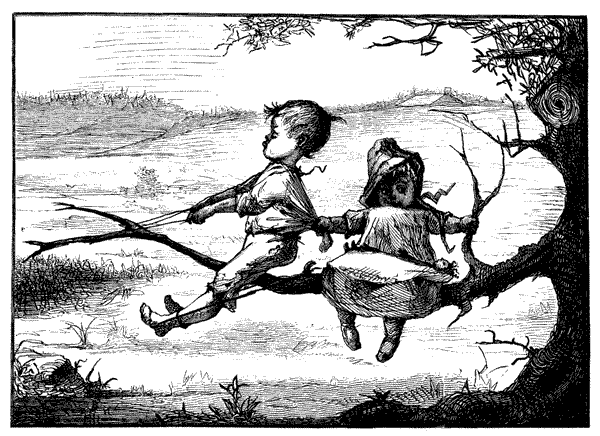
AN EXCITING RIDE.