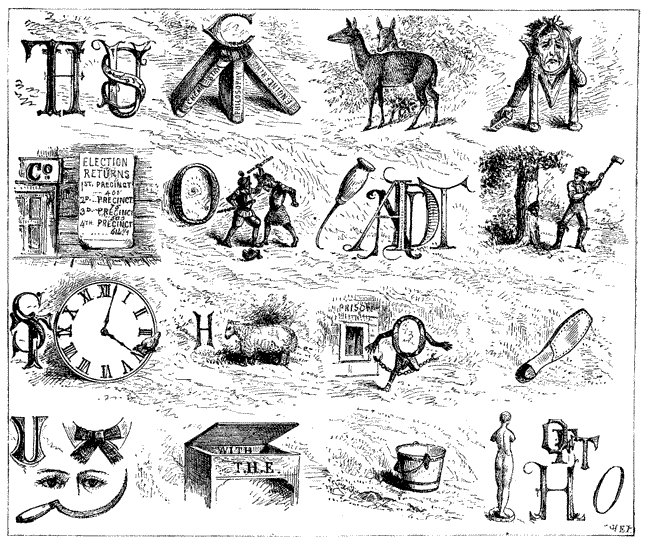
SHAKSPEAREAN REBUS.
Reading edition
A three-line quotation from one of Shakspeare's plays.
GEOGRAPHICAL DOUBLE ACROSTIC.
The initials name a large country of Asia, and the finals a country of Europe renowned for its climate.
1. A country of South America. 2. An ancient name for a narrow strait in South-eastern Europe. 3. A British possession in Asia. 4. A kingdom of Northern Hindostan. 5. A North American mountain system.
Sedgwick.
METAGRAM.
I am a word, with meanings many; To plunge, is just as good as any. With new head, I'm a piece of money; With other head, I'm "sweet as honey." Another still, I'm a projection; One more, I sever all connection. Another change, I'm the teeth to stick in; Another still, I plague your chicken. One more new head, and I'm to taste; One more, and I discharge with haste.
I. W. H.
VERY EASY HIDDEN FURNITURE.
(For Little Folks.)
1. May got a tablet for her Christmas. 2. My father walks so fast! 3. Such air as we breathe in our school-room is hurtful. 4. My brother's tools are always out of place. 5. What? not going to the party to-night? 6. Vic! Ribbons are out of place on school-girls. 7. What spool-cotton is the best to use? 8. Boys, stop that racket! 9. Lily made skips going along to school every day.
C. I. J.
DOUBLE CROSS-WORD ENIGMA.
1. In shelf, but not in seat; 2. In food, but not in meat; 3. In slow, but not in fast; 4. In model, but not in cast; 5. In hovel, but not in hut; 6. In almonds, but not in nut. Read this aright, and you will find Two Yankee poets will come to mind. I. E.
TRANSPOSITIONS.
In each of the following sentences, fill the first blank, or set of blanks, with an appropriate word, or set of words, the letters of which may be transposed to fill the remaining blanks, as often as these blanks occur.
Thus, in No. 1, the first blank may be appropriately filled with the word "warned." The letters of this word, when transposed once, give "warden" for the second blank, and, transposed again, "wander" for the third.
1. Though —— before setting forth, the church —— lost his way and continued to —— helplessly for some time.
2. If a ——, or even a —— had —— at will through that well-kept ——, the plants would have been in great ——.
3. If —— grow in the Levantine island of ——, at least ——and —— are to be found there. This was told me as a —— fact.
4. Neither a precious stone such as a ——, nor a —— —— of pealed willow, nor even a —— of the sweet-pea vine, is of much account to an animal so savage as the ——. W.
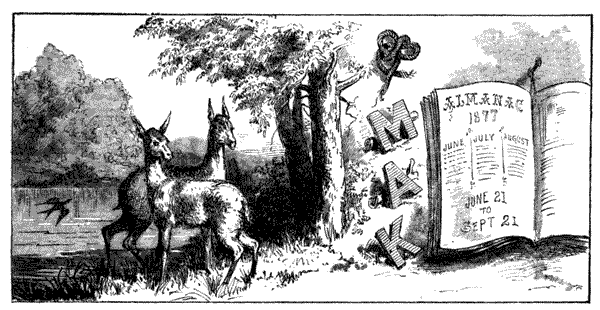
PROVERB REBUS.
CHARADE.
Within my first, by no breeze stirred, My second, mirrored, saw my third, And plucked it, juicy, ripe and red, From a stray branch just overhead. A town in India, owned by France, My whole, might well enrich romance. J. P. B.
HOUR-GLASS PUZZLE.
Central, read downward, an implement formerly used in war and the chase. Horizontals: 1. To sing in solemn measure. 2. Mineral produce. 3. In administrator. 4. A part of a toothed wheel. 5. An arbor.
C. H. S.
CONTRACTIONS.
1. Curtail a color, and leave the forehead. 2. Curtail a joiner's tool, and leave a plot or draught. 3. Curtail a machine tool, and leave an article used in house-building. 4. Curtail a shrub, and leave warmth. 5. Curtail another shrub, and leave fog. 6. Curtail an ornament, and leave a fruit. 7. Curtail a badge of dignity or power, and leave a bird. 8. Curtail a thrust, and leave an organ of the human body. 9. Curtail a number, and leave a building for defense.
I. A.
WORD-SYNCOPATIONS.
In each of the following sentences, remove one of the defined words from the other, and leave a complete word.
1. Take always from a young hare, and leave to allow. 2. Take a tree from random cutting, and leave to throw. 3. Take part of the eye from cuttings, and leave what children often say the kettle does. 4. Take a sty from a workman in wood, and leave a carrier. 5. Take a favorite from floor-coverings, and leave vehicles.
Cyril Deane.