KING CHEESE.
Reading edition
(A Story of the Paris Exhibition of 1867.)
By J. T. Trowbridge.
Where many a cloud-wreathed mountain blanches Eternally in the blue abyss, And tosses its torrents and avalanches Thundering from cliff and precipice, There is the lovely land of the Swiss,— Land of lakes and of icy seas, Of chamois and chalets, And beautiful valleys, Musical boxes, watches, and cheese. Picturesque, with its landscapes green and cool, Sleek cattle standing in shadow or pool, And dairy-maids bearing pail and stool,— That is the quaint little town of Nulle. There, one day, in the old town-hall, Gathered the worthy burghers all, Great and small, Short and tall, At the burgomaster's call. The stout and fat, the lean and lame, From house and shop, and dairy and pasture, In queer old costumes, up they came, Obedient to the burgomaster. He made a speech—"Fellow-citizens: There is To be, as you know, A wonderful show, A Universal Fair, at Paris; Where every country its product carries, Whatever most beautiful, useful, or rare is, To please and surprise, And perhaps win a prize. Now here is the question Which craves your counsel and suggestion— With you it lies: So, after wise And careful consideration of it, Say, what shall we send for our honor and profit?" Some said this thing, some said that; Then up rose a burgher, ruddy and fat, Rounder and redder than all the rest, With a nose like a rose, and an asthmatic chest; And says he, with a wheeze, Like the buzzing of bees: "I propose, if you please, That we send 'em a cheese." Then a lithe little man Took the floor, and began, In a high, squeaky voice: "I approve of the plan; But I wish to amend What's proposed by my friend: A BIG CHEESE, I think, is the thing we should send." Then up jumped a third, To put in a word, And amend the amendment they had just heard; "A ROYAL BIG CHEESE" was the phrase he preferred. The question was moved, Discussed and approved, And the vote was unanimous, that it behooved Their ancient, venerable corporation, To send such a cheese as should honor the nation. So ended the solemn convocation; And, after due deliberation, The burgomaster made proclamation, Inviting people of every station, Each according to his vocation, With patriotic emulation To join in a general jubilation, And get up a cheese for the grand occasion. Then shortly began the preparation.
"PEASANT GIRLS BRINGING THE MILK."
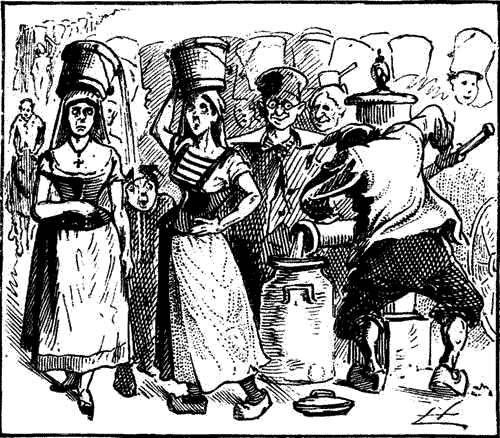
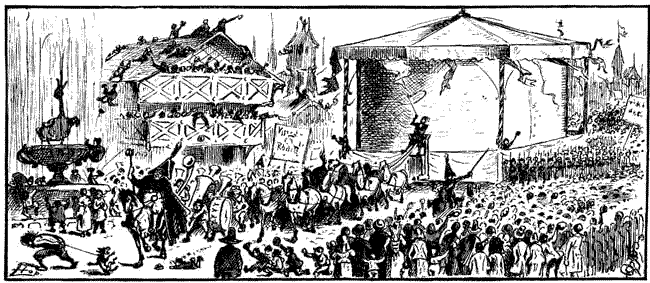
One morning was heard a mighty clamoring, With sounds of sawing and planing and hammering. The painters, forsaking their easels and pallets, Came to look on, or assist in the labor; The joiners were there with their chisels and mallets; Trades of all grades, every man with his neighbor; The carpenters, coopers, And stout iron-hoopers, Erecting a press for the thing to be done in, A tub big enough to put ton after ton in, And gutters for rivers of liquid to run in. March was the month the work was begun in,— If that could be work they saw nothing but fun in; 'Twas finished in April, and long before May Everything was prepared for the curd and the whey. Then the bells were set ringing— The milking began; All over the land went the dairy-maids singing; Boy and man, Cart, pail, and can, And peasant girls, each in her pretty dress, From highway and by-way all round, came bringing, Morning and evening, the milk to the press. Then it took seven wise-heads together to guess Just how much rennet, no more and no less, Should be added, to curdle and thicken the mess. So, having been properly warmed and stirred, The cheese was set; and now, at a word, Ten strong men fell to cutting the curd. Some whey was reheated; The cutting repeated; Each part of the process most carefully treated, For fear they might find, when the whole was completed, Their plan had by some mischance been defeated. Now the weavers come bringing the web they were spinning, A cloth for the curd, of the stoutest of linen. The ten men attack it, And tumble and pack it Within the vast vat in its dripping gray jacket; And the press is set going with clatter and racket. The great screw descends, as the long levers play, And the curd, like some crushed living creature, gives way; It sighs in its troubles— The pressure redoubles! It mutters and sputters, And hisses and bubbles, While down the deep gutters, From every pore spirted, rush torrents of whey. The cheese was pressed, and turned, and cured; And so was made, as I am assured, The rich-odored, great-girdled Emperor Of all the cheeses that ever were. Then, everything ready, what should they have else, In starting His Majesty on his travels, But a great procession up and down Through the streets of the quaint old town? So they made A grand parade, With marching train-band, guild, and trade: The burgomaster in robes arrayed, Gold chain, and mace, and gay cockade, Great keys carried, and flags displayed, Pompous marshal and spruce young aide, Carriage and foot and cavalcade; While big drums thundered and trumpets brayed, And all the bands of the canton played; The fountain spouted lemonade, Children drank of the bright cascade; Spectators of every rank and grade, The young and merry, the grave and staid, Alike with cheers the show surveyed, From street and window and balustrade,— Ladies in jewels and brocade, Gray old grandam, and peasant maid With cap, short skirt, and dangling braid; And youngsters shouted, and horses neighed, And all the curs in concert bayed: 'T was thus with pomp and masquerade, On a broad triumphal chariot laid, Beneath a canopy's moving shade, By eight cream-colored steeds conveyed, To the ringing of bells and cannonade, King Cheese his royal progress made. So to the Paris Exposition, His Majesty went on his famous mission.
"SO THEY MADE A GRAND PARADE."
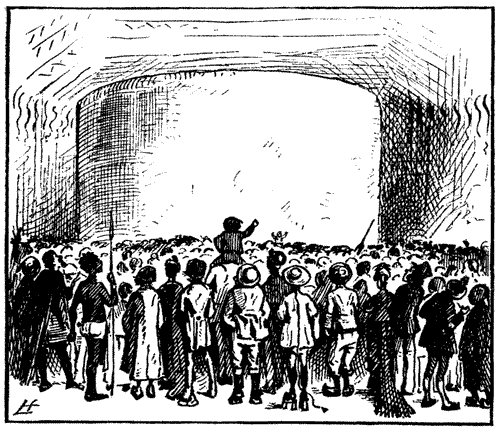
At the great French Fair! Everything under the sun is there, Whatever is made by the hand of man: Silks from China and Hindostan, Grotesque bronzes from Japan; Products of Iceland, Ireland, Scotland, Lapland, Finland, I know not what land— North land, south land, cold land, hot land,— From Liberia, From Siberia,— Every fabric and invention, From every country you can mention: From Algeria and Sardinia; From Ohio and Virginia; Egypt, Siam, Palestine; Lands of the palm-tree, lands of the pine; Lands of tobacco, cotton, and rice, Of iron, of ivory, and of spice, Of gold and silver and diamond,— From the farthest land, and the land beyond. And everybody is there to see: From Mexico and Mozambique; Spaniard, Yankee, Heathen Chinee; Modern Roman and modern Greek; Frenchman and Prussian, Turk and Russian, Foes that have been, or foes to be: Through miles on miles Of spacious aisles, 'Mid the wealth of the world in gorgeous piles, Loiter and flutter the endless files! Encircled all day by a wondering throng, That gathers early and lingers long, Behold where glows, in his golden rind, The marvel the burghers of Nulle designed! There chatters the cheery bourgeoisie; And children are lifted high to see; And "Will it go up in the sky to-night?" Asks little ma'm'selle, in the arms of her mother,— "Rise over the houses and give us light? Is this where it sets when it goes out of sight?" For she takes King Cheese for his elder brother! But now it is night, and the crowds have departed; The vast dim halls are still and deserted; Only the ghost-like watchmen go, Through shimmer and shadow, to and fro; While the moon in the sky, With his half-shut eye, Peers smilingly in at his rival below. At this mysterious hour, what is it That comes to pay the Fair a visit? The gates are all barred, With a faithful guard Without and within; and yet 'tis clear Somebody—or something—is entering here!
"ENCIRCLED ALL DAY BY A WONDERING THRONG."
There is a Paris underground, Where dwells another nation; Where neither lawyer nor priest is found, Nor money nor taxation; And scarce a glimmer, and scarce a sound Reaches those solitudes profound, But silence and darkness close it round,— A horrible habitation! Its streets are the sewers, where rats abound; Where swarms, unstifled, unstarved, undrowned, Their ravenous population. Underground Paris has heard of the Fair; And up from the river, from alley and square, To the wonderful palace the rats repair; And one old forager, grizzled and spare,— The wisest to plan and the boldest to dare, To smell out a prize or to find out a snare,— In some dark corner, beneath some stair (I never learned how, and I never knew where), Has gnawed his way into the grand affair; First one rat, and then a pair, And now a dozen or more are there. They caper and scamper, and blink and stare, While the drowsy watchman nods in his chair. But little a hungry rat will care For the loveliest lacquered or inlaid ware, Jewels most precious, or stuffs most rare;— There's a marvelous smell of cheese in the air! They all make a rush for the delicate fare; But the shrewd old fellow squeaks out, "Beware! 'T is a prize indeed, but I say, forbear! For cats may catch us and men may scare, And a well-set trap is a rat's despair; But if we are wise, and would have our share With perfect safety to hide and hair, Now listen, and we will our plans prepare." The watchman rouses, the rats are gone; On a thousand windows gleams the dawn; And now once more Through every door, With hustle and bustle, the great crowds pour; And nobody hears a soft little sound, As of sawing or gnawing, somewhere underground. At length, the judges, going their round, Awarding the prizes, enter the hall, Where, amid cheeses big and small, Reposes the sovereign of them all. They put their tape round it, and tap it and bore it; And bowing before it, As if to adore it, Like worshipers of the sun, they stand,— Slice in hand, Pleased and bland, While their bosoms glow and their hearts expand. They smell and they taste; And, the rind replaced, The foremost, smacking his lips, says: "Messieurs! Of all fine cheeses at market or fair,— Holland or Rochefort, Stilton or Cheshire, Neufchâtel, Milanese,— There never was cheese, I am free to declare, That at all could compare With this great Gruyère!" In short, so exceedingly well it pleases, They award it a prize over all the cheeses.
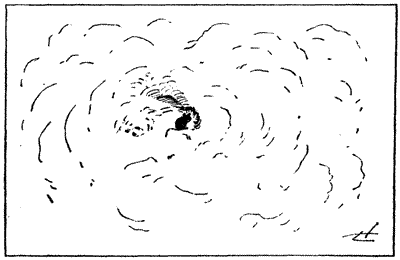
"FIRST, ONE RAT."
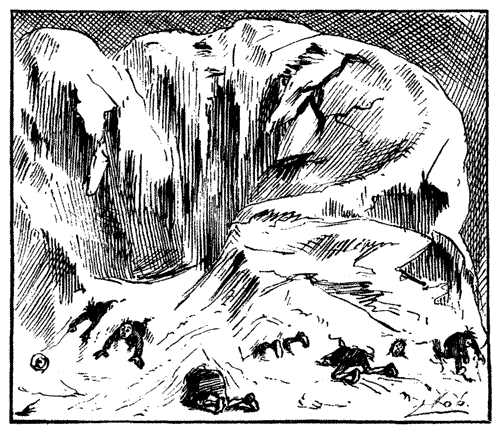
That prize is the pride of the whole Swiss nation; And the town of Nulle, in its exultation, Without a dissenting voice, decrees To the poor of Paris a gift of the cheese. Paris, in grateful recognition Of this munificence, sends a commission— Four stately officials, of high position— To take King Cheese from the Exhibition, And, in behalf of the poor, to thank, With speeches and toasts, the Swiss for their gift. The speeches they made, the toasts they drank; Eight Normandy horses, strong and swift, At the entrance wait For the golden freight; And all the porters are there to lift, Prepared for a long and a strong embrace, In moving His Greatness a little space. They strain at the signal, each man in his place: "Heave, ho!"—when, lo! as light as a feather, Down tumbles, down crumbles, the King of the Cheeses, With seven men, all in a heap together! Up scramble the porters, with laughter and sneezes; While sudden, mighty amazement seizes The high officials, until they find A curious bore In the platform floor, And another to match in the nether rind,— Just one big rat-hole, and no more; By which, as it seemed, had ventured in One rat, at first, and a hundred had followed, And feasted, and left—to the vast chagrin Of the worthy burghers of Nulle—as thin And shabby a shell as ever was hollowed; Now nothing but just A crushed-in crust, A cart-load of scraps and a pungent dust! So the newspapers say; but though they call King Cheese a hoax, he was hardly that. And the poor he fed, as you see, after all; For who is so poor as a Paris rat?
"DOWN TUMBLES, DOWN CRUMBLES, THE KING OF THE CHEESES."