GERTY.
Reading edition
By Margaret W. Hamilton.
Ugh! How cold it was!—sleet driving in your face, wind whistling about your ears, cold penetrating everywhere! "A regular nipper," thought Dick Kelsey, standing in a door-way, kicking his feet in toeless boots to warm them, and blowing his chilled fingers, for in the pockets of his ragged trousers the keen air had stiffened them. He was revolving a weighty question in his mind. Which should he do,—go down to "Ma'am Vesey's" and get one of her hot mutton pies, or stray a little farther up the alley, where an old sailor kept a little coffee-house for the benefit of newsboys and boot-blacks such as he? Should it be coffee or mutton pie?
"I'll toss up for it!" said Dick, finally; and, fumbling in his pockets, the copper was produced ready for the test.
Just then, his attention was suddenly diverted. Close to him sounded a voice, weak and not very melodious, but bravely singing:
"There is a happy land Far, far away, Where saints in glory stand Bright, bright as day!"
Dick listened in silence till the last little quaver had died away, and then said: "Whew! That was purty, anyhow. Where is the piper, I wonder!" He looked about for the musician, but could see no one. He was the only person in the alley.
Again the song began, and this time he traced the voice to the house against which he had been leaning. The window was just at his right, and through one of the broken panes came the notes. Dick's modesty was not a burden to him, so it was the work of only a moment to put his face to the hole in the window and take a view.
A small room, not very nice to see, was what he saw; then, as his eye became used to the dim light, he espied on a low bed in the corner a little girl gazing at him with a pair of big black eyes.
"I say, there! Was it you pipin' away so fine?" began Dick, without the slightest embarrassment.
"If you mean, was I a-singin'?—I was," answered the child from the bed, not seeming at all surprised at this sudden intrusion upon her privacy.
"I say, who are you, anyhow?"
"I'm Gerty, and I stay here all the day while mother is away washing; and she locks the door so no one can't get in," explained the girl.
"My eye!" was Dick's return. "And what are you in bed for?"
"Oh, I have a pain in my back, an' I lie down most of the time," replied Gerty in the most cheerful manner possible, as if a pain in the back were the one desirable thing, while Dick withdrew his head to ponder over this new experience.
A girl locked in a room like that, lying in bed with pain most of the time, with nothing to do, yet cheerful and bright—this was something he could not understand. All at once his face brightened. Back went his eyes to the window.
"I say, got anything to eat in there?"
"Oh yes, some crackers; and to-night maybe mother'll buy some milk."
"Pooh!" said Dick, with scorn. "Crackers and milk! Did you ever eat a mutton pie?"
"A mutton pie," repeated Gerty, slowly. "No, I guess not."
"Oh, they're bully! Hot from Ma'am Vesey's! Tip-top! Wait a minute,"—a needless caution, for Gerty could not possibly have done anything else.
Away ran Dick down the alley and around the corner, halting breathless before Ma'am Vesey.
"Gi'e me one, quick!" he cried. "Hot, too. No, I wont eat it; put it in some paper." The old woman had offered him one from the oven.
"Seems to me we're gettin' mighty fine," she said; for Dick was an old customer, and never before had he waited for a pie to be wrapped up.
"Never you mind, old lady," was his good-natured, if somewhat disrespectful, reply; and, dropping some pennies, he seized his treasure and was off again.
Gerty's eager fingers soon held the pie, which Dick dexterously tossed on the bed, and Dick's eyes fairly shone as he watched the half-starved little one swallow the dainty in rapid mouthfuls.
"Oh, I never in all my life tasted anything half so good! Don't you want some?" questioned the child, whose enjoyment was so keen she feared it hardly could be right.
"No, indeed!"—this with hearty emphasis. "I've had 'em. I'm goin' now," he added, reluctantly, "but I'll come back again 'fore long."
"Oh, do!" said Gerty, "an' I'll sing you some more of 'Happy Land,' if you want me; and I know another song, too. I learned them up to the horspital when I was there. You see, I was peddlin' matches and shoe-strings, and it was 'most dark and awful slippery, and the horses hit me afore I knowed it; and then they picked me up, and I didn't know nothin', and couldn't tell where I lived, and so they took me to the horspital; and the next day I told 'em where mother was, and she came. But the doctors said I had better stay, and p'r'aps they could help me. But they couldn't, you know, cos the pain in my back was too bad. And mother, she washes, and I watch the daylight, and wait for night, and sing; and when the pain aint too bad, the day don't seem so very long."
"My eye!" was all Dick could say, as he beat a hasty retreat, rubbing the much appealed-to member with a corner of his ragged coat.
"Well, them's hard lines, anyhow," he soliloquized, as he went to the printing-office. "An' she's chipper, too. Game as anything," he went on to himself. "Now, I'm just goin' to keep my eye on that little un, and some o' my spare coppers'll help her, I guess."
How he worked that night! His papers fairly flew, he sold them so fast; and when, under a friendly street-lamp, he counted his gains, a prolonged whistle was his first comment.
"More'n any night this week," he pondered. "Did me good to go 'thout the pie. Gerty'll have an orange to-morrow."
So, next morning, when the last journal had been sold, a fruit-stand was grandly patronized.
"The biggest, best orange you got, and never mind what it costs." Then but a few moments to reach Gerty's alley, and Gerty's window.
Yes, there she was, just the same as yesterday, and the pinched face grew bright when she saw her new friend peering at her.
"Oh! you're come, are you?" joyfully. "Mother said you wouldn't, when I told her, but I said you would. She wouldn't leave the door unlocked, cos she didn't know nothing about you; but she said, if you came to-day, you could come back to-night when she was home, and come in."
"Oh, may I?" said Dick, rather gruffly; for he hardly liked the idea of meeting strangers.
"Yes," went on Gerty; "I'll sing lots, if you want; and mother'll be glad to see you, too."
"All right; mebbe I'll come. And say, here's suthin for ye," and the orange shot through the window.
"Oh, my!" she gasped, "how nice! Is it really for me?" And Dick answered, "Yes, eat it now."
Half his pleasure was in watching her eager relish of the fruit; and as Gerty needed no second bidding, the orange rapidly disappeared, she pausing now and again to look across gratefully at Dick and utter indistinct expressions of delight.
"Now shall I sing?" she asked, when the last delicious mouthful was fairly swallowed; for she was anxious to make some return for the pleasure he had given her.
"All right," responded Dick, "I'm ready."
So the thin little voice began again the old refrain; Gerty singing with honest fervor, Dick listening in rapt attention. Following "Happy Land" came "I want to be an angel," "Little drops of water," etc.; and when full justice had been done to these well-worn tunes, Dick suggested a change.
"Don't you sing 'Mulligan Guards'?" he questioned, at the close of one of the hymns.
"No," said Gerty, perplexed. "They didn't sing that up to the horspital."
"Oh, mebbe they don't sing it to the horspital; but I've heard 'em sing it bully to the circus. I say," he went on suddenly, "was you ever there—to the circus, I mean?"
"No," said Gerty, eagerly. "What do they do?"
"Oh, it's beautiful!" was Dick's answer. "All bright, you know, and warm, and the wimmin is dressed awful fine, and the men, too; and the horses prance around; and they have music and tumbling, and—oh, lots of things!"
"My! and you've been there?"
"Oh yes, I've been!" Then, as he watched her sparkling eyes, "Look here, I'll take you. I could carry you, you know, and we'd go early, and I'd put you up against a post, and——Don't you want to go?"
"Want to go?" she repeated with rapture. "Oh, it's too good to be true! I was scared just a-thinkin' of it. Oh, if mother'd let me an' I could! Wouldn't I be too heavy? Mother says I'm light as a feather,—and I wouldn't weigh more'n I could help," she added, wistfully.
"Never you mind," was Dick's hearty reply. "I'll come to-night and see the old lady,—your mother, I mean,—and we'll go next week, if she'll let you."
So it was decided; and when Dick said "good-bye," and ran off, Gerty settled back with a sigh, half of delight and half of anxiety, lest her wild, wonderful hope should never be fulfilled.
But Dick came that night, and Gerty's mother, when she saw Dick's honest, earnest face, and her little girl's eager, pleading eyes, gave consent.
The next Monday night was fixed upon, and this was Thursday. "Four days," counted Gerty on her fingers; and oh, they seemed so long! But even four days will crawl away, and Monday night came at last. By seven o'clock, Dick appeared, his face clean and shining, radiant with delight.
Gerty was dressed in the one dress owned by her mother beside her working one, and the shrunken little figure looked pathetically absurd in its ample proportions. It was much too long for her, of course, but her mother pinned up the skirt. Good old Peggotty Winters, the apple-woman, who lived in the back room, had lent her warm shawl for the occasion, and the little French hair-dresser on the top floor had loaned a knitted hood which had quite an elegant effect. So Gerty considered herself dressed in a style befitting the event; and if she and Dick were satisfied, no one else need criticise.
"Pooh!" was Dick's comment as he lifted her in his arms. "Like a baby, aint you?"
"Oh, I'm so glad you don't think I'm heavy! It's the first time I ever was glad to be thin," sighed Gerty, clinging around his neck.
Then away they went, out through alleys and across side-streets to the main artery of travel, where Dick threaded his way slowly through throngs of gay people. At length, after what seemed miles to Gerty, they halted in front of a brilliantly lighted building, and in another moment were in the dazzling entrance-way.
On went Dick slowly, patiently, with his burden, down the aisle, as near to the front as possible, and—they were there!
Gerty was carefully set down in a corner place, and her shawl opened a little to serve as a pillow; and then she began to look about her, gazing with awe-struck curiosity at the great arena and the mysterious doors.
After a while the house seemed full, the musicians came out and took their places, the gas suddenly blazed more brightly, and the band struck up a gay popular air. Gerty felt as if she must scream with delight and expectation.
Presently, the music stopped, there was a bustle of preparation, a bell tinkled, and the great doors slowly swung open. Gerty saw beautiful ladies, all bright and glittering with spangles, and handsome horses in gorgeous trappings, and great strong men in tights, all the wonders and sights of the circus, and the funny jokes and antics of the clown and pantaloon. And Gerty had never known anything half so fine; and there was riding and jumping and tumbling, and all manner of fun, until the doors shut again.
"Wasn't it lovely?" whispered Gerty. "Is that all?"
"Not half," said Dick; and Gerty leaned back to think it all over and watch for the repetition. But the next scene was different; there came an immense elephant, some little white poodle-dogs, and some mules, and everybody clapped hands and laughed, and was delighted. At last, the climax of ecstasy was reached,—a beautiful procession of all the gayly dressed and glittering performers, with their wonderful steeds, the wise old elephant, the queer little poodles, and the fun-provoking mules; and the band struck up some stirring music, and Gerty was dumb with admiration. But in another minute the arena was empty, the heavy doors had shut out all the life and magnificence, the band was hushed, the lights were dimmed, and Dick told her it was over.
Carefully he folded her in the shawl again, and once more the cold night air blew in her face. Not a word could she say all the way home, but when she sank in her mother's arms it was with the whisper, "I've seen 'Happy Land';" and Dick felt, somehow, as if no other comment were needed.
And the winter days went on, Dick's faithful service and devotion never ceasing. The window was mended, but Dick had a key to the door, and spent many an hour with the sufferer. As spring approached, the two watchers noted a change in the girl. She was weaker, and her pain constant; and when Dick carried her out to the park in the April sunshine, he was shocked to find her weight almost nothing in his arms.
Yes, Gerty was dying, slowly but surely; and Dick grew exceeding sorrowful. By and by, she even could not be carried out-of-doors, but lay all day on her little couch. Then Dick brought flowers and fruit, and talked gayly of the next winter, when, said he, "We'll go every week to the circus, Gerty."
AT THE ENTRANCE TO THE CIRCUS.
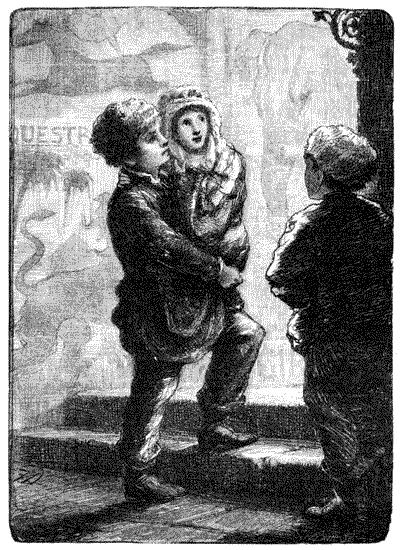
"No, Dick," said the child, quietly, "I shall never go there again. But oh! 't'll be suthin better!"—at which Dick rushed off hastily, and soon after got into a quarrel with a fellow newsboy who had hinted that his eyes were red. Anon he was back with some fresh gift, only to struggle again with the choking grief.
And then came the end—quietly, peacefully. Near the close of a July day, when the setting sun glorified every corner of the room, Gerty left her pain, and, with a farewell sigh, was at rest.
"Oh, Gerty!" sobbed Dick, "don't forget me!"
Ah, Dick, you are held in everlasting remembrance, and more than one angel is glad at thoughts of you, in the "Happy Land!"