Introductory material (continued 8)
Reading edition
The audacity of Gelmirez reached its height in his struggle with the Queen Regent, Urraca of unlovely memory, for the control of the child king, Alfonso VII. This boy was the grandson of Alfonso VI, "Emperor of Spain," who survived all his legitimate children except Urraca. The father of the little Alfonso, Count Raymond of Burgundy, was dead, and Urraca had taken a second husband, Alfonso the Battle-maker. The situation was complicated. The Battle-maker wore the crowns of Aragon and Navarre, Urraca was queen of Leon and Castile, while the child, by his grandfather's will, inherited the lordship of Galicia. The Bishop of Santiago, who baptized the baby, had strenuously opposed Urraca's second marriage. As that lady had, nevertheless, gone her own wilful way, setting at naught the bishop's remonstrance and inciting Galicia to revolt against his tyranny, Gelmirez had kidnapped the royal child, a puzzled little majesty of four summers, and solemnly crowned and anointed him before the High Altar of St. James, declaring himself the protector of the young sovereign. Urraca soon wearied of her Aragonese bridegroom, and, casting him off, took up arms to defend her territories against his invasion. The powerful bishop came to her aid with men and money, but exacted in exchange an oath of faithful friendship, which Urraca gave and broke and gave again. Meanwhile the popular hatred swelled so high against Gelmirez that an open insurrection, in which many of his own clergy took part, drove him and the Queen to seek refuge in one of the cathedral towers, while the rebels burned and pillaged in the church below. The bishop barely escaped with his life, fleeing in disguise from Compostela; but soon the baffled conspirators saw him at his post again, punishing, pardoning, rebuilding—as indomitable as St. James himself. The election of Diego's friend, Calixtus II, to the papacy, gave him his supreme opportunity. Money was the prime requisite, and Gelmirez, not for the first nor second time, borrowed of the Apostle, selling treasures from the sacristy. The sums so raised were carried to the Pope, across the bandit-peopled mountains, by a canon of Santiago masquerading as a beggar, and by a trusty group of particularly ragged pilgrims. This proof of ecclesiastical ripeness overcame all papal scruples, and Calixtus, despite the clamor of enemies and rivals, raised Santiago to the coveted archbishopric.
The first half of his great purpose effected, Gelmirez strove with renewed energy to wrest from Toledo the primacy of Spain. He fortified Galicia, hurled his fleet against Moorish and English pirates, built himself an archiepiscopal palace worthy of his hard-won dignities, stole from Portugal the skeletons of four saints to enhance the potency of Santiago, and made much of the skull of the Apostle James the Less, which Urraca had presented in one of her fits of amity. But this time the reverend robber was not destined to success. The Archbishop of Toledo formed a powerful party against him, Calixtus died, even the king, whom Gelmirez had armed knight in the cathedral of Santiago and had crowned a second time at Leon, grew restive under the dictation of his old tutor. The smouldering hatred of Galicia again flamed out. The aged archbishop once more had to see his church polluted, its treasures plundered, its marvels of carved work, stained glass, and gold-threaded vestments spoiled and wasted by that senseless rabble which had twisted out from under his heavy foot. Faint and bleeding from a wound in his head, too white a head, for all its pride, to be battered with stones, Gelmirez had almost fallen a victim to the mob, when two of his canons snatched him back to the refuge of the High Altar, barring the iron-latticed doors of the Capilla Major against those savage sheep of his pasture. The outrage was so flagrant that, for very shame, pope and king, though both had accepted the bribes of his enemies, responded to his appeal, and assisted him to resume that rigorous sway which lasted, all told, for something like forty years.
Such was the man and such the process that made the shrine of Santiago the third in rank of mediæval Christendom. Under the rule of Gelmirez Compostela had become one of the principal cities of the Peninsula, a seat of arts and sciences where Spanish nobles were proud to build them palaces and to educate their sons. The mighty influx of pilgrims, which went on without abatement century after century, nearly twenty-five hundred licenses being granted, in the single year 1434, to cockle-hatted visitors from England alone, filled the place with business. Inn-keepers, physicians, money-changers, merchants were in flourishing estate, and a number of special industries developed. One street was taken up by booths for the sale of polished shells. Another bears still the name of the jet-workers, whose rosaries, crucifixes, stars, gourds, staffs, and amulets were in high demand. Souvenirs of Santiago, little crosses delicately cut and chased, mimic churches, towers, shrines gave employ to scores of artists in silver and mother-of-pearl. The enormous revenue from the sale of phials of healing oil and from the consecrated candles must needs go to the Apostle, but the cunning craftsmen who loaded their stalls with love-charms had a well-nigh equal patronage.
The finished cathedral was consecrated in 1211, and in 1236 the royal saint, Fernando III, sent to Compostela a train of Mohammedan captives, bringing back on their shoulders the bells Almanzor had taken. These had been hung, inverted, in the beautiful mosque of Cordova to serve as lamps for the infidel worship, but at last St. James had his own again. Thus Santiago trampled on the Moors, and his ashes, or what had passed for his ashes, slept in peace, with nothing to do but work miracles on blind and crippled pilgrims, until, in 1589, an army of English heretics, led by the horrible Drake, landed in Galicia. These Lutheran dogs were not worthy of a miracle. The archbishop and his canons, with the enemy hammering on the gates of Compostela, hastily took up and reburied the three coffins of the original shrine, so secretly that they could not be found again. In 1879, however, a miscellany of brittle bits of bone was brought to light by a party of determined seekers, and these repulsive fragments, after scientific analysis conducted in an ecclesiastical spirit, were declared to be portions of three skeletons which might be ages old. Leo XIII clenched the matter by "authenticating" one of them, apparently chosen at random, as the body of Santiago. But although for us of the perverse sects, the contents of that magnificent silver casket, the centre of the Santiago faith, could arouse no thrill of worship, the Pilgrim City itself and its storied, strange cathedral were the most impressive sights of Spain.
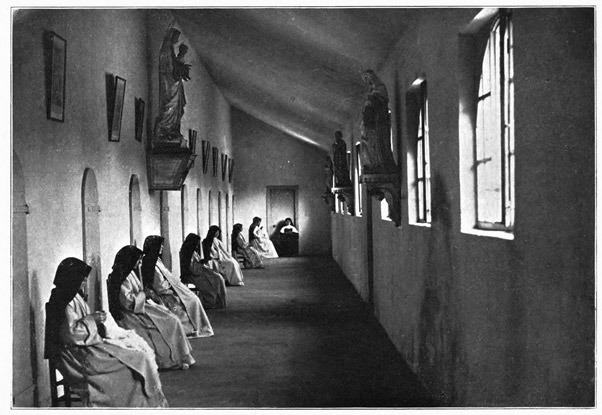
Within the Cloister
XXVI
THE SON OF THUNDER
"Thou shield of that faith which in Spain we revere, Thou scourge of each foeman who dares to draw near, Whom the Son of that God who the elements tames Called child of the thunder, immortal Saint James." —Hymn to Santiago, in George Borrow's translation.
Fatigues of the journey and discomforts of our lodging melted from memory like shadows of the night when we found ourselves, on the morning of July twenty-fourth, before that rich, dark mass of fretted granite, a majestic church standing solitary in the midst of spreading plazas. These are surrounded by stately buildings, the archiepiscopal palace with its memories of Gelmirez, the royal hospital founded by Ferdinand and Isabella for the succor of weary pilgrims, ancient colleges with sculptured façades, marvellous old convents whose holy fathers were long since driven out by royal decree into hungry, homesick exile, and the columned city hall with its frontal relief of the battle of Clavijo and its crowning statue of St. James. The great, paved squares, the magnificent stairways and deeply recessed portals were aglow with all Galicia. Peasants in gala dress, bright as tropic birds, stood in deferential groups about the pilgrims, for there were actual pilgrims on the scene, men and women whose broad hats and round capes were sewn over with scallop-shells, and whose long staffs showed little gourds fastened to the upper end. They wore rosaries and crucifixes in profusion, and their habit was spangled with all manner of charms and amulets, especially the tinsel medals with their favorite device of St. James riding down the Moors. We bought at one of the stalls set up before the doors for sale of holy wares a memento of the famous old jet-work, a tiny black hand, warranted, if hung about the neck, to cure disorders of the eyes. We fell to chatting with a pilgrim who was shod in genuine sandal shoon. A large gourd was tied to his belt, the rim of his hat was turned up at one side and caught there with a rosy-tinted shell, and his long, black ringlets fell loose upon his shoulders, framing a romantic Dürer face. He talked with us in German, saying that he was of Wittemberg, and once a Lutheran, but had been converted to the true faith on a previous visit to Spain. Since then he had footed his penitential way to Jerusalem and other distant shrines. As his simple speech ran on, we seemed to see the mountains round about Santiago crossed by those converging streams of mediæval pilgrims, all dropping on their knees at the first glimpse of the cathedral towers. With that sight the fainting were refreshed, the lame ran, and jubilant songs of praise to Santiago rolled out in many languages upon the air.
"Primus ex apostolis, Martir Jerusolinus, Jacobus egregio, Sacer est martirio."
In those Ages of Faith all the gates of the city were choked with the incoming tide, the hostels and cure-houses overflowed, and the broad plazas about the cathedral were filled with dense throngs of pilgrims, massed nation by nation, flying their national colors, singing their national hymns to the strangely blended music of their national instruments, and watching for the acolyte who summoned them, company by company, into the august presence-chamber of St. James. His shrine they approached only in posture of lowliest reverence. Even now, at the end of the nineteenth century, our first glance, as we entered the lofty, dim, and incense-perfumed nave, fell on a woman-pilgrim dragging herself painfully on her knees up the aisle toward the High Altar, and often falling prostrate to kiss the pavement with groans and tears.
Mediæval pilgrims, when they had thus won their way to the entrance of the Capilla Mayor, and there received three light blows from a priestly rod in token of chastisement, were granted the due indulgences and, in turn, laid their offerings before the great white altar. Still there sits, in a niche above, the thirteenth-century image of St. James, a colossal figure wrought of red granite, with stiffly flowing vestments of elaborately figured gilt. His left hand grasps a silver staff, with gilded gourd atop, and his right, whose index finger points downward to the burial vault, holds a scroll inscribed, "Hic est corpus divi Jacobi Apostoli ac Hispaniarum Patroni." Once he wore a broad-brimmed hat all of pure gold, but this was melted down by Marshal Ney in the French invasion. At that time the sacred vessels were heaped like market produce into great ox-carts, until the cathedral had been plundered of ten hundredweight of treasure. It was "the end of the pilgrimage" to climb the steps behind this statue and kiss its resplendent silver cape, studded with cockle-shells and besprinkled with gems. But the pilgrims of the past had much more to see and worship,—the jewelled crown of the Apostle set upon the altar, his very hat and staff, the very axe that beheaded him, and other relics to which the attention of the modern tourist, at least, is not invited. Yet even we were conducted to the Romanesque crypt beneath the High Altar, where stands another altar of red marble, decorated by a relief of two peacocks drinking from a cup. This altar is surmounted by a bronze pedestal, which bears the sumptuous ark-shaped casket with its enshrined handfuls of dubious dust.
Our latter-day pilgrims seemed well content with the measure of wealth and sanctity which Moorish sack and English piracy, French invasion and Carlist wars, had spared to the cathedral. In the matter of general relics, nevertheless, Santiago suffers by comparison with the neighbor cathedral of Oviedo, which proudly shows a silver-plated old reliquary, believed by the devout to have been brought in the earliest Christian times from Rome. This chest contains, in addition to the usual pieces of the true cross and thorns from the crown, such remarkable mementos as St. Peter's leathern wallet, crumbs left over from the Feeding of the Five Thousand, bits of roast fish and honeycomb from Emmaus, bread from the Last Supper, manna from the wilderness, a portion of Moses' rod and the mantle of Elijah. Oviedo possesses, too, that famous cross which the angels made for Alfonso II, and one of the six water-jars of Cana. But the relic chapel of Santiago makes up in quantity whatever it may lack in quality, holding bones, garments, hair-tresses, and like memorials of a veritable army of martyrs, even to what Ford disrespectfully calls "sundry parcels of the eleven thousand Virgins." Special stress is laid on a Calvary thorn which turns blood-red every Good Friday, and a drop, forever fresh, of the Madonna's milk. If pilgrims are not satisfied with these, they can walk out to Los Angeles, an adjacent village, whose church was built by the angels. Eccentric architects they were in choosing to connect their edifice with the cathedral of Santiago by an underground beam of pure gold, formerly one of the rafters in God's own house.
We had speech of several pilgrims that first morning. One was a middle-aged, sun-browned, stubby little man, whom during the ensuing week we saw again and again in the cathedral, but never begging, with the most of the pilgrims, at the portals, nor taking his ease in the cloisters,—a social promenade where the laity came to gossip and the clergy to puff their cigarettes. This humble worshipper seemed to pass all the days of the festival in enraptured adoration, on his knees now before one shrine, now before another. We found him first facing the supreme architectural feature of the cathedral, that sublime and yet most lovely Portico de la Gloria. He was gazing up at its paradise of sculptured saints and angels, whose plumes and flowing robes still show traces of azure, rose, and gold, with an expression of naive ecstasy. He told us that he came from Astorga, and had been nine days on the way. He spent most of his time upon the road, he added, visiting especially the shrines of the Virgin. "Greatly it pleases me to worship God," he said, with sparkling eyes, and ran on eagerly, as long as we would listen, about the riches and splendors of different cathedrals, and especially the robes and jewels of the Virgen del Pilar. He seemed in his devout affection to make her wealth his own. One of the most touching effects of the scene was the childlike simplicity with which the poor of Galicia, coming from such vile hovels, felt themselves at home in the dwelling of their saint. Not even their sins marred their sense of welcome. In the cloisters we encountered an old woman in the pilgrim dress, her staff wound with gay ribbons, limping from her long jaunt. She told us frankly that she was "only a beggar" in her own village, and had come for the outing as well as to please the priest, who, objecting to certain misdemeanors which she had the discretion not to specify, had prescribed this excursion as penance. She was a lively old soul, and was amusing herself mightily with the Goya tapestries, and others, that adorned the cloisters in honor of the time. "You have a book and can read," she said, "and you will understand it all, but what can I understand? I can see that this is a queen, and she is very fine, and that those are butchers who are killing a fat pig. But we who are poor may understand little in this world except the love of God." Others of the pilgrims were village folk of Portugal, and, taken all together, these modern wearers of the shell were but a sorry handful as representing those noble multitudes who came, in ages past, to bow before the shrine. The fourteen doors of the cathedral then stood open night and day, and the grotesque lions leaning out over the lintels could boast that there was no tongue of Europe which their stone ears had not heard. Three open doors suffice in the feast days now, but with the new flood of faith that has set toward Lourdes, pilgrimages to Santiago, as to other Latin shrines, are beginning to revive.
Mass was over at the late hour of our arrival, but nave and aisles, transepts and cloisters, hummed with greetings of friends, laughter of children, who sported unrebuked about those stately columns, and the admiring exclamations of strangers. We were often accosted in Spanish and in French and asked from what country we came, and if we "loved the beautiful church of the Apostle." When we were occasionally cornered, and driven in truthfulness to say that we were Yankees, our more intelligent interlocutors looked us over with roguish scrutiny, but increased rather than abated their courtesies. As for the peasants, their geography is safely limited. Noticing that our Spanish differed from theirs, they said we must be from Castile, or, at the most, from Portugal. At all events we were strangers to Santiago, and they merrily vied with one another in showing us about and giving us much graphic information not to be found in guide-books.
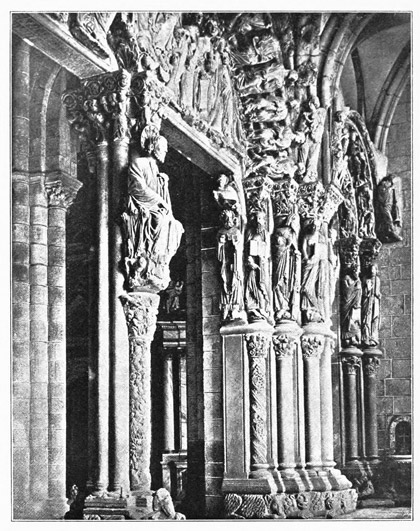
Much of their lore appears to be of their own invention. The superb Puerta de la Gloria, wrought by a then famous architect sent from the king of Leon, but known to us to-day only as Master Mateo, was the fruit of twenty years' labor. This triple porch, which runs across the west end of the nave, being finally completed, Master Mateo seems to have symbolized the dedication of his service to the Apostle in a kneeling statue of himself, facing the east, with back to the richly sculptured pillar of the chief portal. The head of this figure is worn almost as round and expressionless as a stone ball by the caresses of generations of childish hands. The little girls whom we watched that morning as they patted and smoothed the much-enduring pate told us, kissing the marble eyes, that this was a statue of St. Lucia, which it certainly is not. In another moment these restless midgets were assaulting, with fluent phrases of insult, the carven faces of certain fantastic images which form the bases of the clustered columns. The children derisively thrust their feet down the yawning throats, kicked the grotesque ears and noses, and in general so maltreated their Gothic victims that we were moved to remonstrate.
"But why should you abuse them? What are these creatures, to be punished so?"
"They are Jews," hissed our little Christians with an emphasis that threw new light on the Dreyfus affaire. But an instant more, and these vivacious, capricious bits of Spanish womanhood were all absorbed in aiding a blind old peasant who had groped her way to the sacred Portico for its especial privilege of prayer. The central shaft, dividing into two the chief of the three doorways, represents the Tree of Jesse, the patriarchal figures half-enveloped in exquisitely sculptured foliage. The chiselled capital shows the Trinity, Dove and Son and Father, with adoring angels. Above sits a benignant St. James, whose throne is guarded by lions, and over all, in the central tympanum of the sublime doorway, is a colossal figure of our Lord, uplifting His wounded hands. About Him are grouped the four Evangelists, radiant with eternal youth, and eight angels bearing the instruments of the Passion, the pillar of the scourging, whips, the crown of thorns, the nails, the scroll, the sponge, the spear, the cross. Other angels burn incense before Him, and the archivolt above is wrought with an ecstatic multitude of elders, martyrs, and saints, so vivid after all these centuries that one can almost hear the blithe music of their harps. It is the Christ of Paradise, enthroned amid the blest, to whom His presence gives fulness of joy forevermore. Above the lesser doors on either side are figured Purgatory and Hell. The fresh and glowing beauty, so piquant and yet so spiritual, the truly celestial charm of this marvellous Portico which Street did not fear to call "one of the greatest glories of Christian art," was never, during this festal week, without its throng of reverent beholders, the most waiting their turn, like our old blind peasant, to fit thumb and finger into certain curious little hollows on the central shaft, and thus offer prayer which was sure of answer. Minute after minute for unbroken hours, the hands succeeded one another there,—old, knotted, toilworn hands, the small, brown hands of children, jewelled hands of delicate ladies, and often, as now, the groping hand of blindness, with childish fingers helping it to find those mystical depressions in the agate. Some of the bystanders told us that St. James had descended from his seat above the capital, and laid his hand against the column, leaving these traces, but more would have it that the Christ Himself had come down by night from the great tympanum to place His wounded hand upon the shaft. Street records that he observed several such petitioners, after removing the hand, spit into the mouths of the winged dragons that serve as base to the pillar; but that literally dare-devil form of amen must now have gone out of fashion, for we did not see it once.
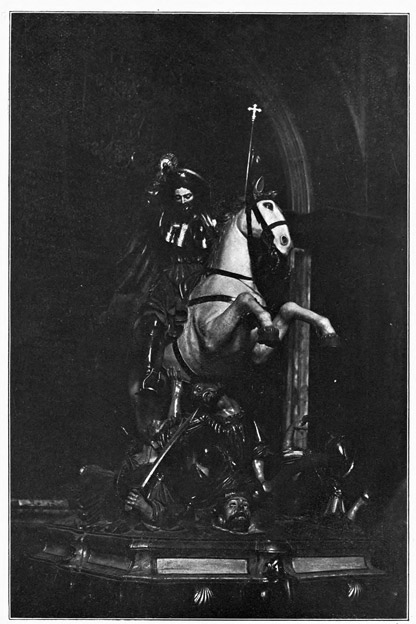
The Trampler of the Moors
Toward noon we strolled out into the grand plaza before the west façade and found it a multitudinous jam of expectant merrymakers. Even nuns were peeping down from a leaf-veiled balcony. We seemed to have been precipitated out of the Middle Ages into an exaggerated Fourth of July. All the city bells were pealing, rockets and Roman candles were sputtering, and grotesque fire-balloons, let off from a parapet of the cathedral, flourished bandy legs and "Sagasta noses" in the resigned old faces of the carven images. And then, amid the acclamations of all the small boys in the square, sallied forth the Santiago giants. These wickerwork monsters, eight all told, are supposed to represent worshippers from foreign lands. They go by couples, two being conventional pilgrims with "cockle-shell and sandal shoon"; two apparently Moors, with black complexions, feather crowns, and much barbaric finery; two nondescripts, possibly the French of feudal date; and two, the leaders and prime favorites, regular Punch caricatures of modern English tourists. John Bull is a stout old gentleman with gray side-whiskers, a vast expanse of broadcloth back, and a single eye-glass secured by a lavender ribbon. The British Matron, in a smart Dolly Varden frock, glares with a shocked expression from under flaxen puffs and an ostrich-feathered hat. The popular attitude of mind toward these absurdities is past all finding out. Not the children alone, but the entire assemblage greeted them with affectionate hilarity. The giants, propelled by men who walked inside them and grinned out on the world from a slit in the enormous waistbands, trundled about the square, followed by the antics of a rival group of dwarfs from the city hall, and then made the round of the principal streets, executing clumsy gambols before the public buildings.
On the morning after, July twenty-fifth, the great day of the feast, anniversary of the Apostle's martyrdom, these same overgrown dolls played a prominent part in the solemn cathedral service. The Chapter passed in stately progress to the archbishop's palace to fetch his Eminence, and later to the ancient portals where the silver-workers once displayed their wares, to greet the Royal Delegate. At their head strutted this absurd array of giants. The High Mass was superb with orchestral music and the most sumptuous robes of the vestiary. The "King of Censers," the splendid botafumeiro of fourteenth-century date, made so large, six feet high, with the view of purifying the cathedral air vitiated by the hordes of pilgrims who were wont to pass the night sleeping and praying on the holy pavements, flashed its majestic curves, a mighty fire bird, from roof to floor and from transept to transept. It is swung from the ceiling by an ingenious iron mechanism, and the leaping, roaring flames, as the huge censer sweeps with ever augmenting speed from vault to vault, tracing its path by a chain of perfumed wreaths, make the spectacle uniquely beautiful. Knights of Santiago, their white raiment marked by crimson sword and dagger, received from the Royal Delegate "a thousand crowns of gold," the annual state donation, instituted by Rameiro, to the patron saint. The Delegate, kneeling before the image of Santiago, prayed fervently that the Apostle would accept this offering of the regent, a queen no less devout than the famous mother of San Fernando, and would raise up Alfonso XIII to be another Fernando, winning back for Spain her ocean isles which the heretics had wrested away, even as Fernando restored to Compostela the cathedral doors and bell which the infidel Moors had stolen. His Eminence, who is said to have accumulated a fortune during his previous archbishopric in Cuba, in turn besought St. James to protect Catholic Spain against "those who invoke no right save brute force, and adore no deity except the golden calf." In most magnificent procession the silver casket was borne around the nave among the kneeling multitudes. And then, to crown these august ceremonies, forth trotted our friends, the giants, into the open space before the Capilla Mayor. Here the six subordinate boobies paused, grouping themselves in a ludicrous semicircle, while pompous John Bull and his ever scandalized British Matron went up into the Holy of Holies and danced, to the music of guitars and tambourines, in front of the High Altar.
Every day of that festal week the cathedral services were attended by devout throngs, yet there was something blithe and social, well-nigh domestic, in the atmosphere of the scene even at the most impressive moments. Kneeling groups of peasant women caught the sunshine on their orange kerchiefs and scarlet-broidered shawls. Here a praying father would gather his little boy, sobbing with weariness, up against his breast; there a tired pilgrim woman slumbered in a corner, her broad hat with its cockle-shells lying on her knees. Rows of kneeling figures waited at the wooden confessionals which were thick set along both aisles and ambulatory. Several times we saw a priest asleep in the confessional, those who would pour out their hearts to him kneeling on in humble patience, not venturing to arouse the holy father. Young officers, leaning against the pillars, smiled upon a school of Spanish girls, who, guarded by veiled nuns, knelt far along the transept. Pilgrims, standing outside the door to gather alms, vied with one another in stories of their travels and the marvels they had seen.
But at night, walking in the illuminated alameda, where thousands of Japanese lanterns and colored cups of flame made a fantastic fairyland, or dancing their country dances, singing their country songs, practising their country sports, and gazing with tireless delight at the fireworks in the spacious Plaza de Alfonso Doce, the worshippers gave themselves up to frankest merriment. Through the days, indeed, there was never any lack of noisy jollity. From dawn to dawn again cannon were booming, drums beating, bagpipes skirling, tambourines clattering, songs and cries resounding through the streets. Four patients in the hospital died the year before, we were told, from the direct effects of this continuous uproar. But the thunder height of the fiesta is attained toward midnight on the twenty-fourth, the "Eve of Santiago," when rockets and fire-balloons are supplemented by such elaborate devices as the burning of "capricious trees" and the destruction of a Moorish façade built for the occasion out from the west front of the cathedral. At the first ignition of the powder there come such terrific crashes and reverberating detonations, such leaps and bursts of flame, that the peasant host sways back and the children scream. An Arabic doorway with ornate columns, flanked on either side by a wall of many arches and surmounted by a blood-red cross, dazzles out into overwhelming brilliancy, all in greens and purples, a glowing, scintillating, ever changing vision. Soon it is lustrous white and then, in perishing, sends up a swift succession of giant rockets. The façade itself is a very Alhambra of fret and arabesque. This, too, with thunder bursts reveals itself as a flame-colored, sky-colored, sea-colored miracle, which pales to gleaming silver and, while we read above it the resplendent words "The Patron of Spain," is blown to atoms as a symbol of Santiago's victory over the Moors. This makes an ideal Spanish holiday, but the cost, borne by the city, is heavy, there is distinct and increasing injury to the cathedral fabric, and all this jubilee for archaic victories over the Moslem seems to be mocked by the hard facts of to-day.
The Santiago festivities, of which the half has not been told, closed on Thursday afternoon, July twenty-seventh, with a procession through the streets. We waited a weary while for it before the doors where the old jet-workers used to set their booths, amusing ourselves meantime by watching the house maids drawing water from the fountain in the square below. These sturdy Galicians were armed with long tin tubes which they dextrously applied to the spouting mouths of the fountain griffins, so directing the stream into the straight, iron-bound pails. Not far away the market women covered the flags with red and golden fruit. A saucy beggar-wench, with the blackest eyes in Spain, demanded alms, and when we had yielded up the usual toll of coppers, loudly prayed to Santiago to pardon us for not having given her more on this his holy festival. At last out sallied the band, followed by those inevitable giants, and amid mad ringing of bells and fizzing of invisible rockets, forth from the venerable portals issued standards, crosses, tapers, priests in white and gold, and platformed effigies of pilgrims, saints, and deities. Then came bishops, cardinals, and archbishop, ranks of military bearing tapers, the alcalde and his associates in the city government with antique escort of bedizened mace-bearers, a sparkling statue of St. James on horseback busily beheading his legions of Moors, a bodyguard of all the pilgrims in attendance on his saintship, and finally the Virgen del Pilar, at whose passing all the concourse fell upon their knees. Churches in the line of march had their own images decked and ready, waiting in the colonnaded porches to fall into the procession. The market women and the maids at the fountain threw kisses to the Christ Child, leaning in blue silk frock and white lace tucker against a cross of roses, but the boys waved their caps for St. Michael, debonair that he was with blowing crimson robe, real feather wings fluttering in the breeze, and his gold foot set on the greenest of dragons.
The procession came home by way of the great west doors, opened only this once in the round year. The setting sun, bringing out all the carven beauty of that dark gray façade, glittered on the golden balls and crosses that tip the noble towers, and on the golden staff of St. James and the golden quill of St. John, where the two sons of thunder stand colossal in their lofty niches. A baby, in yellow kerchief and cherry skirt, toddling alone across the centre of the square, pointed with adoring little hand at the mounted image of Santiago, which halted at the foot of the grand stairway, his lifted sword a line of golden light, while the deep-voiced choir chanted his old triumphal hymn. John Bull and the British Matron, stationing themselves on either side as a guard of honor, stared at him with insular contempt. As the chant ceased, St. James chivalrously made way for the Virgen del Pilar, a slender figure of pure gold poised on an azure tabernacle, to mount the steps before him. The bells pealed out to welcome her as she neared the portals, and an ear-splitting explosion of a monster rocket, with a tempest-rain of sparks, announced the instant of her entrance beneath the chiselled arch. Behind her went the penitents, arduously climbing the long stone flights of that quadruple stairway upon their knees. These, too, were but shadows of those mediæval penitents who of old staggered after this procession, bowed under the weight of crosses, or scourging themselves until they fainted in their own trail of blood. Yet it is still strange and touching to see, long after the inner spaces of the cathedral are dim with evening, those kneeling figures making their painful progress about aisles and ambulatory, sobbing as they go, and falling forward on their faces to kiss the pavement that is bruising them.
Santiago Cathedral
XXVII
VIGO AND AWAY
Hasta la Vista!
Our plan for the summer included a return trip across Spain, via Valladolid, Salamanca, and Saragossa to Barcelona and the Balearic Isles; but the bad food and worse lodging of Galicia, the blazing heat and the incessant, exhausting warfare against vermin, had begun to tell. That Spanish fever with which so many foreigners make too intimate acquaintance was at our doors, and we found ourselves forced at last to sacrifice enthusiasm to hygiene. The most eccentric train which it was ever my fortune to encounter shunted and switched us across country to Vigo in about the time it would have taken to make the journey donkeyback. Here we tarried for a week or so, gathering strength from the Atlantic breezes, and when, one sunny August day, a stately steamboat called for an hour at Vigo harbor on her way from Buenos Ayres to Southampton, we went up over the side. Our shock of astonishment at the cleanliness around us could not, however, divert our attention long from the receding shores of Spain, toward which one of us, at least, still felt a stubborn longing.
They lay bright in the midday sunshine, those green uplands of Galicia, mysterious with that patient peasant life of which we had caught fleeting, baffling glimpses. Still we seemed to see the brown-legged women washing in the brook and spreading their coarse-spun, gay-bordered garments on the heather; children, with the faces of little Pats and little Biddies, tugging a bleating sheep across the stepping-stones, or boosting an indignant goat over the wall; lean pigs poking their noses out of the low, stone doorways, where babies slept on wisps of hay; girls in cream-colored kerchiefs, starred with gold, bearing loads of fragrant brush or corded fagots on their heads. As the evening should come on, and the sea-breeze stir the tassels of the maize, we knew how the fields would be dotted with impromptu groups of dancers, leaping higher and higher and waving their arms in ever wilder merriment,—a scene pastoral down to the pigs, and poetic up to those gushes of song that delight the listener.
"I went to the meadow Day after day, To gather the blossoms Of April and May, And there was Mercedes, Always there, Sweetest white lily That breathes the air." "North-wind, North-wind, Strong as wine! Blow thou, North-wind, Comrade mine!" "The Virgin is spreading handkerchiefs On the rosemary to dry. The little birds are singing, And the brook is running by. "The Virgin washes handkerchiefs, And spreads them in the sun, But St. Joseph, out of mischief, Has stolen every one."
It was only now and then that we had realized a touch of genuine fellowship with these Galician peasants. I remember a little thirteenth-century church, gray crosses topping its low gray towers, one of which was broken off as if a giant hand had snapped it. In the porch a white-headed woman, in a gold-edged blue kerchief and poppy-red skirt, was holding a dame-school. It took her all the morning session, she told us, to get the fifty faces washed, but in the afternoon the children learned to read and knit and play the choral games. She had ten cents a month for every child, when the parents were able to pay. From a convenient hollow in a pillar of Arabic tradition she proudly drew her library,—a shabby primer and a few loose leaves of a book of devotion. As we talked, the midgets grew so restless and inquisitive that she shook her long rod at them with a mighty show of fierceness, and shooed them out of the porch like so many chickens. Then she went on eagerly with the story of her life, telling how she was married at fifteen, how her husband went "to serve the king" in the second Carlist war, and never came back, and how her only daughter had borne nine children, of whom eight died in babyhood, "angelitos al cielo," having known on earth "only the day and the night." The last and youngest had been very ill with the fever, and the afflicted grandmother had promised that noble Roman maiden, the martyr saint of the little gray church, to go around the edifice seven times upon her knees, if only the child might live. The vow had been heard, as the presence of a thin-faced, wistful tot by the old woman's side attested, but so far only three of the seven circuits had been made. "It tires the knees much." But even with the words she knelt again, kissing the sacred threshold, and began the painful, heavy, shuffling journey around the church, while the baby, with wondering gray eyes, trotted beside her, clinging to the wrinkled hand. When at last, with puffs and groanings, the old dame had reached the carven doorway again, she rose wearily, rubbing her knees.
"A sweet saint!" she said, "but ay de mi! such gravel!"
We ought, of course, to have been impressed in Galicia with its debasing ignorance and superstition, and so, to a certain extent, we were. We went to see a romeria, a pilgrimage to a hilltop shrine, on one of our last afternoons in Vigo, and found a double line of dirty, impudent beggars, stripped half naked, and displaying every sort of hideous deformity,—a line that reached all the way from the carriage-road up the rugged ascent to the crest. We had to run the gantlet, and it was like traversing a demoniac sculpture-gallery made up of human mockeries. We had to push our way, moreover, through scene after scene of vulgar barter in things divine, and when at last the summit was achieved, the shrine of the Virgin seemed robbed of its glory by the ugliness, vice, and misery it overlooked. Spain is mediæval, and the modern age can teach her much. But with all her physical foulness and mental folly, there still dwells in her that mediæval grace for which happier countries may be searched in vain.
Yet Spain is far from unhappy. It is beautiful to see out of what scant allowance of that which we call well-being, may be evolved wisdom and joy, poetry and religion. Wearied as we two bookish travellers were with lectures and libraries, we rejoiced in this wild Galician lore that lives on the lips of the people. The written Spanish literature, like other Spanish arts, is of the richest, nor are its laurels limited to the dates of Cervantes and Calderon. The modern Spanish novel, for instance, as Mr. Howells so generously insists, all but leads the line. But Spain herself is poetry. What does one want of books in presence of her storied, haunted vistas,—warrior-trod Asturian crags, opalescent reaches of Castilian plain, orange-scented gardens of Andalusia? A circle of cultivated Spaniards is one of the most charming groups on earth, but Spaniards altogether innocent of formal education may be walking anthologies of old ballads, spicy quatrains, riddles, proverbs, fables, epigrams. The peasant quotes "Don Quixote" without knowing it; the donkey-boy is as lyric as Romeo; the devout shepherd tells a legend of the Madonna that is half the dream of his own lonely days among the hills. Where Spanish life is most stripped of material prosperity, it seems most to abound in suggestions of romance. This despised Galicia, the province of simpletons, is literary in its own way. The hovel has no bookshelf, but the children's ears drink in the grandmother's croon:—
"On a morning of St. John Fell a sailor into the sea. 'What wilt thou give me, sailor, sailor, If I rescue thee?' "'I will give thee all my ships, All my silver, every gem, All my gold,—yea, wife and daughters, I will give thee them.' "'What care I for masted ships, What care I for gold or gem? Keep thy wife and keep thy daughters, What care I for them? "'On the morning of St. John Thou art drowning in the sea. Promise me thy soul at dying, And I'll rescue thee.' "'I commend the sea to God, And my body to the sea, And my soul, Sweet Mother Mary, I commit to thee.'"
And well it was for this bold mariner that he did not take up the Devil's offer, for everybody knows that those who have signed away their souls to the Devil turn black in the moment of dying, and are borne, black and horrible, to the sepulchre.
In this northwestern corner of Spain are many mountain-songs as well as sea-songs. One of the sweetest tells how the blue-robed Virgin met a young shepherdess upon the hills and was so pleased with the maiden's courtesy that she straightway bore her thence to Paradise, not forgetting, this tender Mary of Bethlehem, to lead the flock safely back to the sheepfold. The love of the Galician peasantry for "Our Lady" blends childlike familiarity with impassioned devotion.
"As I was telling my beads, While the dawn was red, The Virgin came to greet me With her arms outspread."
Her rank in their affections is well suggested by another of the popular coplas.
"In the porch of Bethlehem, Sun, Moon, and Star, The Virgin, St. Joseph, And the Christ Child are."
With their saints these Spanish peasants seem almost on a household footing, not afraid of a jest because so sure of the love that underlies it.
"St. John and Mary Magdalen Played hide and seek, the pair, Till St. John threw a shoe at her, Because she didn't play fair."
Yet there is no lack of fear in this rustic religion. There is many a "shalt not" in the Galician decalogue. One must not try to count the stars, lest he come to have as many wrinkles as the number of stars he has counted. Never rock an empty cradle, for the next baby who sleeps in it will die. So often as you name the Devil in life, so often will he appear to you in the hour of death. If you hear another name him, call quickly, before the Devil has time to arrive, "Jesus is here." It is ill to dance alone, casting your shadow on the wall, because that is dancing with the Devil. But the Prince of Darkness is not the only supernatural being whom Galicians dread. There is a bleating demon who makes fun of them, cloudy giants who stir up thunderstorms, and are afraid only of St. Barbara, witches who cast the evil eye, but most of all the "souls in pain." For oftentimes the dead come back to earth for their purgatorial penance. You must never slam a door, nor close a window roughly, nor kick the smallest pebble from your path, because in door or stone or window may be a suffering soul. To see one is to die within the year. If you would not be haunted by your dead, kiss the shoes which the body wears to the burial.
It is well to go early to bed, for at midnight all manner of evil beings prowl up and down the streets. Who has not heard of that unlucky woman, who, after spinning late and long, stepped to the window for a breath of air exactly at twelve o'clock? Far off across the open country she saw a strange procession of shining candles drawing nearer and nearer, although there were no hands to hold them and no sound of holy song. Straight toward her house came those uncanny lights, moving silently through the meadow mists, and halted beneath her window. Then the foremost one of all begged her to take it in and keep it carefully until the midnight following. Scarcely knowing what she did, she closed her fingers on the cold wax and, blowing out the flame, laid away the taper in a trunk, but when, at daybreak, after a sleepless night, she raised the lid, before her lay a corpse. Aghast, she fled to the priest, who lent her all the relics of the sacristy; but their united power only just availed to save her from the fury of the spirits when they returned at midnight to claim the taper, expecting, moreover, to seize upon the woman and "turn her to fire and ashes."
Sometimes a poor soul is permitted to condense the slow ages of Purgatory into one hour of uttermost torment. Galicians tell how a young priest brought his serving-maid to sorrow and how, to escape the latter burning, she shut herself, one day when the priest was engaged in the ceremonial of High Mass, into the red-hot oven. On his return, he called her name and sought her high and low, and when, at last, he opened the oven door, out flew a white dove that soared, a purified and pardoned soul, into the blue of heaven. The science of this simple folk is not divorced from poetry and religion. The rainbow drinks, they say, in the sea and in the rivers. The Milky Way, the Road to Santiago, is trodden every night by pale, dim multitudes who failed to make that blessed pilgrimage, from which no one of us will be excused, in time of life. When the dust stirs in an empty house, good St. Ana is sweeping there. When babies look upward and laugh, they see the cherubs at play. Tuesday is the unlucky day in Spain, whereas children born on Friday receive the gift of second-sight, and those who enter the world on Good Friday are marked by a cross in the roof of the mouth and have the holy touch that cures diseases. It is a fortunate house beneath whose eaves the swallow builds,
"For swallows on Mount Calvary Plucked tenderly away From the brows of Christ two thousand thorns, Such gracious birds are they."
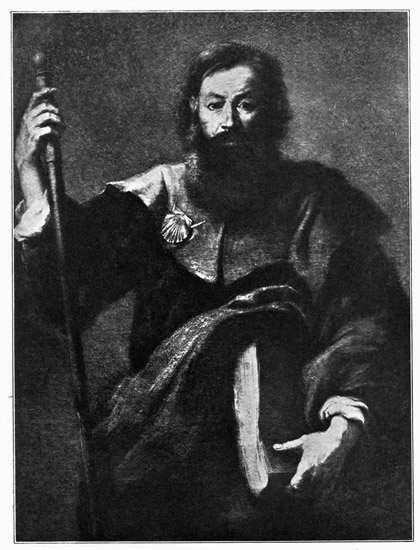
St. James
The Galicians, butt of all Spain for their dulness, are shrewd enough in fact. It is said that those arrant knaves, the gypsies, dare not pass through Galicia for fear of being cheated. Like other unlettered peasants, Gallegos whet their wits on rhyming riddles.
"Who is the little pigeon, Black and white together, That speaks so well without a tongue And flies without a feather?" "A tree with twelve boughs and four nests on a bough, In each nest seven birdlings,—unriddle me now."
In many of their proverbial sayings one gets the Spanish tang at its best. "A well-filled stomach praises God."
"Why to Castile For your fortune go? A man's Castile Is under his hoe."
And I fear if my comrade were to speak, in Spanish phrase, of our return to Galicia, she would bid St. James expect us "on Judgment Day in the afternoon."
Works by Alice Morse Earle
CHILD LIFE IN COLONIAL DAYS
Profusely Illustrated
Crown 8vo. Cloth. Gilt top. $2.50
Commercial Advertiser:
"Once more Mrs. Earle has drawn on her apparently inexhaustible store of colonial lore, and has produced another interesting book of the olden days.... Mrs. Earle's interesting style, the accuracy of her statements, and the attractive illustrations she always supplies for her books make the volume one to be highly prized."
Buffalo Express:
"Mrs. Alice Morse Earle performs a real historical service, and writes an interesting book. It is not a compilation from, or condensation of, previous books, but the fruit of personal and original investigation into the conditions of life in the American colonies."
HOME LIFE IN COLONIAL DAYS
Education:
"Mrs. Earle has made a very careful study of the details of domestic life from the earliest days of the settlement of the country. The book is sumptuously illustrated, and every famed article, such as the spinning-wheel, the foot-stone, the brass knocker on the door, and the old-time cider mill, is here presented to the eye, and faithfully pictured in words. The volume is a fascinating one, and the vast army of admirers and students of the olden days will be grateful to the author for gathering together and putting into permanent form so much accurate information concerning the homes of our ancestors."
Literature:
"Mrs. Earle's fidelity in study and her patient research are evident on every page of this charming book, and her pleasantly colloquial style is frequently assisted by very beautiful illustrations, both of the houses of the colonists, from the primitive cave dug out of the hillside and made to answer for warmth and shelter, to the more comfortable log cabin, the farmstead with its adjacent buildings, and the stately mansion abiding to our own day."
THE MACMILLAN COMPANY
66 FIFTH AVENUE NEW YORK
AMONG ENGLISH HEDGEROWS
By CLIFTON JOHNSON
With an Introduction by HAMILTON W. MABIE
Illustrated. Cr. 8vo. Cloth extra. Gilt top. $2.25
"'Among English Hedgerows' is one of the most beautiful of illustrated books, containing, as it does, a great number of half-tone reproductions of Mr. Johnson's admirable photographs.
"The author, as far as possible, lived the life of the people who figure in these pages, and we have delightful accounts of village characters, and glimpses of quaint old English homes.
"Hamilton W. Mabie, who furnishes the introduction, well summarizes Mr. Johnson's merits as 'a friendly eye, a hearty sympathy, and a very intelligent camera, and that love of his field and of his subject which is the prime characteristic of the successful painter of rural life and country folk.'"—Illustrated Buffalo Express.
ALONG FRENCH BYWAYS
By CLIFTON JOHNSON
Illustrated. Cr. 8vo. Cloth extra. Gilt top. $2.25
"A book of leisurely strolling through one of the most picturesque countries of Europe, enlivened with description and anecdote, and profusely illustrated.... Mr. Johnson is not only a delightful writer, but is one of the best landscape photographers of whom we have knowledge."—Boston Transcript.
"This book shares the merits of Mr. Johnson's 'Among English Hedgerows': simplicity of theme and treatment, sympathy and love of nature."—The Mail and Express.
"A book of strolling, a book of nature, a book of humble peasant life intermingled with the chance experiences of the narrator."—The Worcester Spy.
THE MACMILLAN COMPANY
66 FIFTH AVENUE, NEW YORK