Introductory material (continued 5)
Reading edition
Comedy and tragedy are busy all about us. A newly arrived family plods wearily by in ludicrous procession, headed by a tall father carrying a baby and closed by a short child carrying a cat. A showy man of middle age, playing the gallant to an overdressed brunette, is suddenly confronted by his furious wife in boy's attire, so unluckily well disguised that, before recognizing her, he has replied to her rush of invective with a blow which bids fair to make one of her eyes, at least, blacker than those of her rival. Traditional ballads are trolled, popular songs are echoed from group to group, and, despite bad odors, fleas, and whistles, we are reluctant to leave. But the afternoon grows late, the Arganda and Valdepeñas are beginning to burn in the southern blood, an occasional flourish of cudgels or of fists sends the police scurrying across the field, and, being nothing if not discreet, we pay our parting respects to San Isidro.
Coming home by way of the Prado and passing the proud shaft of yellow-brown granite that towers far above its enclosing cypress trees, as glory above death, we are reminded that this gala month has brought another fiesta to Madrid. Every second of May the capital commemorates with solemn masses, with stately civic processions, and a magnificent military review, the patriots who fell fighting in the streets on that terrible Monday of 1808, El Dos de Mayo, which brought to pass the war of independence. One may read of that fierce carnage in the vivid pages of Galdós or behold it in the lurid paintings of Goya. To see once is to see forever that line of French soldiery, with steady musket at shoulder, but with eyes bent on the ground, while they shoot down squad after squad of their defenceless victims. In pools of blood lie the contorted bodies, with heads and breasts horribly torn by crimson wounds, while of those who wait their turn to fall beside them some cover the eyes, one stupidly gnaws his hands, one kneels and wildly peers from under his shaggy hair into the very muzzle of the gun before him, one flings back his head with a savage grin, half of fright and half of courage, one desperately strips bare his breast and in agony of horror glares upon the guns, but the most are crouching, shuddering, sinking—and all only an item in the awful cost that the Spanish people have paid for Spanish liberties. The celebration of 1899 was no less brilliant than usual, although many of the Madrid papers spoke bitterly of the shadow that the disastrous first of May must henceforth cast on the glorious Second. It is indeed gall and wormwood to all Spain that the Manila defeat so nearly coincides with the proudest day in Spanish annals.
The saint of El Dos de Mayo is Saint Revolution, as democratic in one way as Saint Agriculture in another. When these two patrons of Madrid understand how to work in fellowship, when there comes a Government in Spain that cares chiefly to promote the welfare of the laboring people, the world may discover anew the vitality and noble quality of this long-suffering nation.
We saw the Romeria once more, driving through late in the evening, when the closed booths glimmered white on the silent meadow.
"Yes, it is all a pack of lies," said a thoughtful Catholic, "but what is one to do? A man cannot believe in religion—and yet how to live without it? The more I stay away from mass the more I want and need it. Think of the comfort these peasants take with their San Isidro!"
The moonlight shone serene and beautiful on those patched, shabby tents, transforming them to silver.
XVI
THE FUNERAL OF CASTELAR
"The death of the Republic will be, for you, for us, and for all, the death of liberty. The death of liberty will be the death of the Republic, and as liberty is the only thing in the world that rises from the dead, with liberty shall rise again, in good time, the Republic."—Emilio Castelar: Inaugural Address, 1873.
The present state of Spanish politics was amusingly expounded to me by a spirited young philosopher of Cadiz.
"In the north," he said, "the prevailing sentiment is for Don Carlos. Nocedal is doing all he can to fan it in Andalusia, but it finds its natural home in the northern provinces. To be sure, there is San Sebastian, where the Court summers, which consequently upholds the Queen, and there are Republican groups; but the north of Spain, broadly speaking, is Carlist. The centre favors the reigning family. Possession is a strong argument, and the royal forces hold Madrid. Barcelona is Republican. Those Catalans are always thirsty for a fight. But the middle tract of Spain, as a whole, accepts the existing monarchy. Castilians are too gallant to strike against a woman and a child. The south is Republican. For the best part of the century Cadiz and Malaga have stood for revolution. Where was the army of Isabel II defeated? And why has the Queen never seen the Alhambra?
"But, let me tell you, these Carlists, these Royalists, these Republicans are all fools. If there is anything hopeless in this world, it's Spanish politics. All the uproar of the Revolution ended in murdering our best man and driving out our best king. For myself, I mean to work hard and marry soon, and have a little Spain in my own house that shall express my own convictions. My children shall be good Catholics, but not superstitious bigots. They shall be well educated, if I have to send them to France or England for it. They shall be disciplined, but under the law of liberty. And with that I propose to be content. All my politics are to be kept under my own roof, where I can work my ideas into permanent form. I am sick of the way in which Spain boils with ideas that only destroy one another."
This Sir Oracle was two-and-twenty, with the prettiest of girlish photographs in his vest pocket, and the smallest of savings in the bank, but I remembered his words in the days of mourning for Emilio Castelar.
The illustrious tribune, heavy-hearted with the troubles of his country, had gone to the home of friends, at a village in sunny Murcia, for the rest and comfort that nature always gave him. His almost boyish optimism, "niño grande y grande niño" that he was, had kept him assured of peace even after the destruction of the Maine, and assured of victory even after the battle of Manila. Hence the pressure of fact told on him all the more cruelly. "I die a victim of Spain's agony," he wrote in a personal letter shortly before the end, and his last article for publication, finished on the day of his death, a gloomy discussion of the outlook for the Peace Conference, contains bitter references to the national disasters and to the ravages of the "criminal troop of pirates in the Philippines."
He died on Thursday, the twenty-fifth of May, within hearing of the Mediterranean waves he loved so well, with tender faces bent over him, and the crucifix at his lips. The news of his death aroused this grief-weary nation to a fresh outburst of sorrow. Some lamented him as one of the chief orators of modern Europe, recalling his eloquence in the tempestuous times of the Revolution, when he "intoned mighty hymns in praise of liberty, democracy, and the sacred Fatherland!" Some mourned the patriot, pointing proudly to the honorable poverty in which this holder of many offices, at one time almost absolute dictator, had lived and died. Some wept for the cordial, generous, noble-hearted man, the joy of his friends and idol of his household. His political sympathizers bewailed the loss of the Spanish apostle of democracy, the lifelong champion of liberty. And many not of his following nor of his faith felt that a towering national figure had disappeared and another glory of Spain vanished away.
The first wreath received was from a Republican club that sent the pansies of memory. Among the five hundred telegrams and cablegrams that arrived within a few hours at the country-seat where he had died was one from over seas, which read: "To Castelar: In thy death it seems as if we had lost the last treasure left to us, the voice of the Spanish race. In thy death Spain has become mute. Yet let me believe that thou respondest, 'She will speak again.'"
The coming of the body to the capital was a triumphal progress. A large escort of friends, who had made speed to Murcia from all parts of the Peninsula, accompanied it, and there were crowds at the stations, even in the mid-hours of the night, with tears, handfuls of roses, wreaths, and poems of farewell. There was often something very touching about these offerings. At one of the smaller towns a young girl hastily gathered flowers from the garden attached to the station, broke off a spray from a blossoming tree, tied these with the bright ribbon from her hair, and, clambering up, hung this simple nosegay among the costly tributes that already nearly covered the outer sides of the funeral car. In another crowded station the village priest came hurrying forward, bared his head with deepest reverence before the garlanded coach, as if before the altar, and chanted the prayers for the dead. Again, a group of workmen, allowed to enter the car, fell on their knees before the bier and prayed.
The train was met on its arrival in Madrid by an immense concourse of people. Señor Silvela and other distinguished representatives of the Government were there, church dignitaries, presidents of political societies and literary academies, but, above all, the people. It was the great, surging multitude that gave the Republican leader his grandest welcome.
This poor shell of Castelar, the man said to bear "the soul of a Don Quixote in the body of a Sancho Panza," lay in state through Sunday and a part of Monday in the Palacio del Congreso. The vestibule had been converted into a capilla ardiente. Masses were chanted ceaselessly at the two candle-laden altars, the perfume from the ever increasing heaps of flowers was so oppressive that the guards had to be relieved at short intervals, and the procession of people that filed rapidly past the bier, often weeping as they went, reached out from the Morocco lions of the doorway to the Prado and the Fountain of Neptune. Many of the humblest clad, waiting half the day in line, held pinks or lilies, fast withering in the sun, to drop at the feet of the people's friend. Early on Monday afternoon the doors were closed, and by half-past three the funeral cortège began to form in the Prado for its four-hour march by way of the Calle de Alcalá, Puerta del Sol, Calle Mayor, and Cuesta de la Vega, to the cemetery of San Isidro.
By the never failing Spanish courtesy, I was invited to see the procession from the balcony of a private house in the Alcalá. I found my hostess, a vivacious little old lady, whose daughter had crowned her with glory and honor by marrying into the nobility, much perturbed over the failure of the Queen Regent to show sympathy with the popular grief.
"There were one hundred and forty-nine wreaths sent in. The very number shows that the royal wreath was lacking. I am a Conservative, of course. Canovas was my friend, and has dined here often and often. You see his portrait there beside that of my daughter, la Marquesa. But Canovas loved Castelar, and would not, like Silvela, have grudged him the military honors of a national funeral. As if the dead were Republicans! The dead are Spaniards, and Castelar is a great Spaniard, as this tremendous throng of people proves. There were not nearly so many for Canovas, though the aristocracy made an elegant display; there were not so many for Alfonso XII, though all that Court and State and army could do was done, and the Queen rode in the splendid ebony coach in which Juana the Mad used to carry about the body of that handsome husband of hers.
"But the people know their losses. Never in my life have I seen the Alcalá so full as this. Silvela has had to give way, and the troops will come—at least a few of them. But not a word, not a flower, from the Queen! She sent a magnificent wreath for Canovas, and a beautiful letter to his widow. But for Castelar, her people's hero, nothing. Ah, she is not simpática. She does not know her opportunities. She does not understand the art of winning love. Only a year ago she sent a wreath to the funeral of Frascuelo, the torero. And everybody knows how she hates the bull-fight. But if she could drop her prejudices then to be at one with the feeling of her capital, why not now? They say she has a neuralgic headache to-day. Ay, Dios mio! I should think she might."
Listening to this frank chatter and watching that mighty multitude, I was reminded of one of the Andalusian coplas:—
"The Republic is dead and gone; Bury her out of the rain. But see! There is never a Panteón Can hold the funeral train."
And this, in turn, suggested another of those popular refrains:—
"The moon is a Republican, And the sun with open eye; The earth she is Republican, And Republican am I."
But who can understand this ever baffling Spain? After all, what was the significance of that assembled host? How far was it drawn by devotion to the man, and how far by devotion to the idea for which he stood? How far by idle curiosity, by the Spanish passion for pomps and shows, and, above all, for a crowd, by that strange Spanish delight in mucha gente? So far as eye could tell, this might have been the merriest of fêtes. The wide street was a sea of restless color. Uniforms, liveries, parasols, hats, frocks, pinafores, kerchiefs, blouses, sashes, fans, flecked the sunshine with a thousand hues. Here loitered a messenger boy in vivid scarlet; there passed a waiter with a silver tray gleaming on his head; here a market woman bent beneath her burden of russet sacks bursting with greens; there stood a priest in shovel hat and cassock, smelling a great red rose; here a gallant in violet cape escorted a lady flaming in saffron; there a beaming old peasant, with an azure scarf tied over his white head, threw an orange to attract the attention of a plodding porter, whose forehead was protected from the cords binding the boxes to his back by several folds of purplish carpeting.
Streets and sidewalks, balconies and windows, all were full, and everywhere such eagerness, such animation, and such stir! The children sitting on the curbstone rocked their little bodies back and forth in excitement. Young mothers danced their crying infants, and young fathers shifted the babies of a size or two larger from one shoulder to the other. A boy in a red cap climbed a small locust tree, from whose foliage his head peeped out like an overgrown cherry. The crowd indignantly called the attention of authority to this violation of the city laws. A glittering member of the Civil Guard sonorously ordered the culprit down. The laughing lad refused to budge, inviting this embarrassed arm of the law to reach up and get him. The Guard darkly surveyed the slender stem already swaying with the boy's slight weight. The fickle crowd, whose every face seemed to be upturned toward that defiant cherry, cheered the rebel and tossed him cigarettes and matches, wherewith he proceeded to enjoy a smoke. The Guard caught a few cigarettes in mid-career, pocketed them, smiled benevolently, and walked away. The lad saucily saluted, and the multitude, suddenly impartial, pelted them both with peanuts.
Thus it was that the Madrid populace awaited the last coming of Castelar. Even when the funeral train was passing, the crowd showed scant respect. Not half the men uncovered for the bier, although I was glad to see the cherry cap whisked off. And one picturesque gentleman stood throughout with his back to the procession, making eyes at his novia in the gallery above our own.
The Government, which had finally assumed the charges and care of the obsequies, had been remiss in not providing lines of soldiers to hold an open way for the cortège. As it was, the procession could hardly struggle through the mass of humanity that choked the street. A solitary rider, mounted, like Death, on a white horse, went in advance, threatening the people with his sword. A division of the Civil Guard followed, erect and magnificent as ever, their gold bands glittering across their breasts, but their utmost efforts could not effectually beat back the crowd. Men scoffed at the drawn blades and pushed against the horses with both hands. The empty "coach of respect," black as night, its sable horses tossing high white plumes, pressed after, and then came some half dozen carriages overflowing with wreaths and palms, and all that wealth of floral gifts. The crowd caught at the floating purple ribbons, and called aloud the names upon the cards; a monster design, with velvet canopy, from the well-known daily, El Liberal, a beautiful crown from the widow of Canovas, and, later in the procession, alone upon the coffin, a nosegay of roses and lilies, brought in the morning by a child of four, a little "daughter of the people," and bearing the roughly written words, "Glory to Castelar!—A workingman."
The train of mourners, impeded as it was by the multitude, seemed endless. After the representatives of certain charities there walked, in gala uniform, white-headed veterans of war. A great company of students followed, their young faces serious and calm in that tempting hurly-burly of the street, and after them an overwhelming throng of delegates from all manner of commercial and craft unions. Even the press wondered that Castelar's death should move so profoundly the trading and laboring classes, almost every store and workshop in Madrid closing for the afternoon. Then came the Republican committees, and behind them the representatives of countless literary, scientific, and artistic associations.
At this point in the procession a place had been made for all or any who might wish, as individuals, to follow Castelar to the tomb. Some fifteen hundred had availed themselves of the opportunity—a motley fellowship. The gentlemen preceding, those who had come as delegates from the industrial and learned bodies of all Spain, wore almost without exception the correct black coat and tall silk hat, and paced, when they could, with a steady dignity, or halted, when they must, with a grave patience, that did more to quiet the unruly host of spectators than all the angry charges of the police. But the fifteen hundred showed the popular variety of costume—capes and blouses, broad white hats and the artisan's colored cap. Some of them were smoking, an indecorum which, by a self-denial that counts for much with Spaniards, nowhere else appeared in the long array.
But whatever might be the deficiencies of dress or bearing, here, one felt, was the genuine sorrow, here were the men who believed in Castelar and longed to do him honor. The impulsive onlookers responded to this impression, and more than one rude fellow, who had been skylarking a minute before, elbowed his way into the troop and fell soberly into such step as there was. Music would have worked wonders with that disorderly scene, but the bugles and cornets were all in the far rear. The representatives of the provinces, as they struggled by, were hailed with jokes and personalities. The chanting group of clergy, uplifting the same ebony cross that they had borne for Canovas, did not entirely hush the crowd, nor did even the black-plumed hearse itself, with its solemn burden. For close after came, bearing tapers, a group of political note, closed by Sagasta and Campos, and then the chiefs of army and navy, including Blanco and Weyler. Behind these walked the city fathers, the senators, the diplomats, ex-ministers,—among them Romero, Robledo,—then the archbishop, and, finally, Silvela, with his colleagues.
The procession was closed by a military display and a line of empty coaches, sent, according to Spanish custom, as a mark of respect. The coach sent by Congress, a patriotic blaze of red and yellow, with coachman and footman in red coats and yellow trousers, and horses decked with red and yellow plumes, looked as if it had started for the circus and had missed its way.
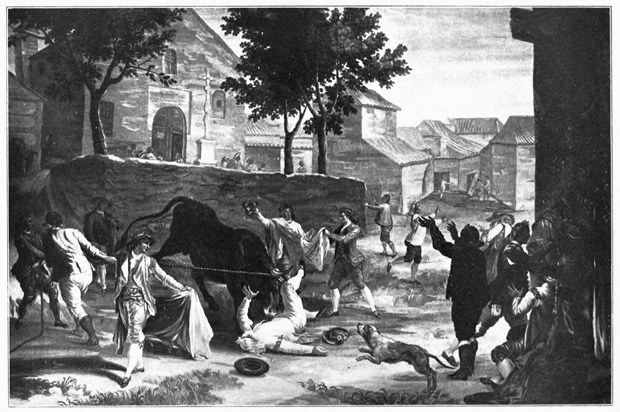
An Old-fashioned Bull-Fight
The sight of the politicians seemed to serve as spark to the Republican fuel. Even while the hearse was passing somebody shouted, "Long live Castelar!" but the crowd corrected the cry to "Long live the glorious memory of Castelar!" Then came a heterogeneous uproar: "Death to the friars!" "Long live the Republican Union!" "Down with Reaction!" "Down with the Jesuits!" "Down with Polavieja!" "Down with the Government!" "Up with the Republic!" "Long live Spain!" "Long live the army!" "Long live Weyler!"
A woman was run over in the confusion and a man was trampled, but the procession, aided as much as possible by the Civil Guards and the police, slowly worked its way through the Alcalá to the Puerta del Sol, where the people poured upon it like an avalanche, with ever louder cries against ministry and clergy, until the scene in front of the Government Building suggested something very like a mob. Silvela bore his silvered head erect and exerted a prudent forbearance. But few arrests were made, and the military force that sallied out from the Government Building merely stood in the gates to awe the rioters. After an hour and a quarter the transit of the square was effected. The disturbances were renewed in the Calle Mayor with such violence that the ministers were advised to withdraw, but they only entered the funeral coaches, and, the Guards exerting themselves to the utmost, a degree of order was at last secured. While the cortège was descending the difficult hill of La Vega, the Queen, standing in one of the palace balconies, opera glass in hand, sent a messenger for a report of the state of affairs in her capital, and was visited and reassured by a member of the Government.
After this stormy journey the cemetery of San Isidro was reached at nightfall, and the silent orator laid to rest in the patio of Santa Maria de la Cabeza, beside his beloved sister, Concha Castelar. Even here Republican vivas were raised, and again, later in the evening, before the house of Weyler, who appeared upon the balcony in answer to repeated calls. This general, more popular with Spaniards than with us, discreetly absented himself on Tuesday from the high mass chanted for Castelar in the Church of San Francisco el Grande, where there was an imposing display of uniforms and decorations.
While the people still talked of their lost leader and proposed monuments and medals in his honor, the Government held firmly on its course. The Royal Progress for the opening of the Cortes on the following Friday was a suggestive contrast to the procession of Monday. Soldiers lined the curbstones all the way from the Royal Palace to the Congress Hall, bands were posted at intervals, the royal escort, splendidly mounted and equipped, was in itself a formidable force, while additional troops, in gala dress, paraded all the city. The balconies along the royal route were handsomely draped, but the people looked on at the gorgeous array of coaches, gilded and emblazoned, each drawn by six or eight choice horses, with sumptuous plumes and trappings, and attended by a story-book pomp of quaintly attired postilions, coachmen, and outriders, in a silence that was variously explained to me as indicating respect, hostility, indifference.
I heard no vivas and saw no hats raised even for the affable Infanta Isabel, riding alone in the tortoise-shell carriage, nor for the Princess of Asturias, girlishly attractive in rose color and white, nor for the bright-faced young King, ready with his military salute as he passed the foreign embassies, nor for the stately Regent, robed as richly as if she were on her way to read a gladder message than that which the opposition journals indignantly declared "no message, but a pious prayer of resignation."
And while Madrid jarred and wrangled, the flowers brought by the little daughter of the workingman drooped on the marble slab above Castelar's repose.
XVII
THE IMMEMORIAL FASHION
"For as many auchours affirme (and mannes accions declare) that man is but his mynde; so it is to bee daily tride, that the bodie is but a mixture of compoundes, knitte together like a fardell of fleashe, and bondell of bones, and united as a heavie lumpe of Leade (without the mynde) in the sillie substance of a shadowe."—Thomas Churchill, Gentleman.
My Spanish hostess, brightest and prettiest of little ladies despite the weight of sorrow upon sorrow, came tripping into my room one afternoon with her black eyes starry bright under the lace mantilla.
"And where have you been to get so nicely rested?"
"To a duelo."
I turned the word over in my mind. Duelo? Surely that must mean the mourning at a house of death, when the men have gone forth to church and the burial, and the women remain behind to weep together, or one of those tearful At Homes kept, day after day, until the mass, by the ladies of the afflicted household for their condoling friends. But such a smiling little señora! I hardly knew what degree of sympathy befitted the occasion.
"Were you acquainted with the—the person?"
"No, I had never seen him. He had been an officer in the Philippines many years, and came home very ill, fifteen days since. I wept because I knew his mother, but I wept much. Women, at least here in Spain, have always cause enough for tears. I thought of my own matters, and had a long, long cry. That is why I feel better. There is so little time to cry at home. I must see about the dinner now."
And she rustled out again, leaving me to meditate on Spanish originality, even in grief.
In any country the usages of death are no less significant than the usages of life. That grim necropolis of Glasgow, with its few shy gowans under its lowering sky, those tender, turf-folded, church-shadowed graveyards of rural England, those trains of mourners, men by themselves and women by themselves, walking behind the bier in mid-street through the mud and rain of wintry Paris to the bedizened Père Lachaise or Montparnasse—such sights interpret a nation as truly as its art and history; but the burial customs of Spain, especially distinctive, are, like most things Spanish, contradictory and baffling to the tourist view. "La Tierra de Vice Versa" is not a country that he who runs may read.
The popular verses and maxims treat of death with due Castilian solemnity and an always unflinching, if often ironic, recognition of the mortal fact. "When the house is finished," says the proverb, "the hearse is at the door." Yet this Spanish hearse is one of the gayest vehicles since Cinderella's coach. If the groundwork is black, there is abundant relief in mountings of brilliant yellow, but the funeral carriage is often cream-white, flourished over with fantastic designs in the bluest of blue or the pinkest of pink. Coffins, too, may be gaudy as candy-boxes. The first coffin we saw in Spain was bright lilac, a baby's casket, placed on gilt trestles in the centre of a great chill church, with chanting priests sprinkling holy water about it to frighten off the demons, and a crowd of black-bearded men waiting to follow it to the grave. Such a little coffin and not a woman near! The poor mother was decently at home, weeping in the midst of a circle of relatives and neighbors, and counting it among her comforts that the family had so many masculine friends to walk in the funeral procession and show sympathy with the household grief. There would be, on the ninth day after and, for several years to come, on the anniversary of the death, as many masses as could be afforded said in the parish church, when, again, the friends would make it a point of duty to attend.
The daily papers abound in these notices, printed in a variety of types, so as to cover from two to ten square inches, heavily bordered with black, and surmounted, in case of adults, with crosses, and with cherubs' heads for children. I take up a copy of La Epocha and read the following, under a cross: "Third Anniversary. Señorita Doña Francisca Fulana y Tal died the twenty-sixth of June, 1896, at twenty-one years of age. R. I. P. Her disconsolate mother and the rest of the family ask their friends and all pious persons to be so good as to commend her to God. All the masses celebrated to-morrow morning in the Church of San Pascual will be applied to the everlasting rest of the soul of the said señorita. Indulgences are granted in the usual form." It is the third anniversary, too, of a titled lady, whose "husband, brothers, brothers-in-law, nephews, uncles, cousins, and all who inherit under her will" have ordered masses in two churches for the entire day to-morrow, and announce, moreover, that the ecclesiastical authorities grant "one hundred and forty days of indulgence to all the faithful for each mass that they hear, sacred communion that they devote, or portion of a rosary that they pray for the soul of this most noble lady."
In the case of another lady of high degree, who died yesterday, "having received the Blessed Sacraments and the benediction of his Holiness," the Nuncio concedes one hundred days of indulgence, the Archbishop of Burgos eighty, and the Bishops of Madrid, Alcalá, Cartagena, Leon, and Santander forty each; while a marquis who died a year ago, "Knight of the Illustrious Order of the Golden Fleece," is to have masses said for his soul in seven churches, not only all through to-morrow, but for the two days following.
May all these rest in peace, and all who mourn for them be comforted! Yet thought drifts away to the poor and lowly, whose grief cannot find solace in procuring this costly intercession of the Church for the souls they love. It seems hard that the inequalities of life should thus reach out into death and purgatory. We used, during our sojourn in Granada, to meet many pathetic little processions on "The Way of the Dead." Over this hollow road, almost a ravine, the fortress walls, with their crumbling towers, keep guard on the one side, and the terraced gardens of the Generalife, with their grand old cypresses, on the other. And here, almost every hour of the day, is climbing a company of four rough men, carrying on their shoulders a cheap coffin, which perhaps a husband follows, or a white-haired father, or, hand in hand, bewildered orphan boys. The road is so steep that often the bearers set their burden down in the shadow of the bank-side, and fling themselves at full length on the ground beside it, thriftily passing from man to man the slow-burning wax match for their paper cigarettes. I remember more than one such smoking group, with a solitary mourner, hat in hand and eyes on the coffin, yet he, too, with cigarette in mouth, standing patiently by. All who pass make the sign of the cross, and even the rudest peasant uncovers his head. Very shortly the bearers may be seen again, coming down the hill at a merry pace, the empty box, with its loose, rattling lid, tilted over the shoulder now of one, now of another; for the children of poverty, who had not chambers of their own nor the dignity of solitude in life, lie huddled in a common pit after death, without coffin-planks to sever dust from dust.
A century ago it was usual to robe the dead in monastic garb, especially in the habit of St. Francis or of the Virgin of Carmen, and within the present generation bodies were borne to the grave on open biers, the bystanders saluting, and bidding them farewell and quiet rest:—
"'Duerme in paz!' dicen los buenos. 'Adios!' dicen los demás."
But now the closed coffin of many colors is in vogue. In the Santiago market we met a cheerful dame with one of these balanced on her head, crying for a purchaser, and up the broad flights of steps to the Bilbao cemetery we saw a stolid-faced young peasant-woman swinging along with a child's white coffin, apparently heavy with the weight of death, poised on the glossy black coils of hair, about which she had twisted a carmine handkerchief.
Very strange is the look of a Spanish cemetery, with its ranges of high, deep walls, wherein the coffins are thrust end-wise, each above each, to the altitude of perhaps a dozen layers. These cells are sometimes purchased outright, sometimes rented for ten years, or five, or one. When the friends of the quiet tenant pay his dues no longer, forth he goes to the general ditch, osario común, and leaves his room for another. Such wall graves are characteristically Spanish, this mode of burial in the Peninsula being of long antiquity. Yet the rich prefer their own pantheons, sculptured like little chapels, or their own vaults, over which rise tall marbles of every device, the shaft, the pyramid, the broken column; while a poor family, or two or three neighboring households, often make shift to pay for one large earth grave, in which their dead may at least find themselves among kith and kin. Spanish cemeteries are truly silent cities, with streets upon streets enclosed between these solemn walls, which open out, at intervals, now for the ornamented patios of the rich, now for the dreary squares peopled by the poor. Here in a most aristocratic quarter, shaded by willows, set with marbles, paved with flower beds, sleeps a duke in stately pantheon, which is carved all over with angels, texts, and sacred symbols, still leaving room for medallions boasting his ancestral dignities. A double row of lamps, with gilded, fantastically moulded stands, and with dangling crystals of all colors, leads to the massive iron door. What enemy has he now to guard against with that array of bolts and bars? Here are a poet's palms petrified to granite, and here a monument all muffled in fresh flowers. Here the magnificent bronze figure of a knight, with sword half drawn, keeps watch beside a tomb, while the grave beyond a rose bush guards as well. And here an imaged Sandalphon holds out open hands, this legend written across his marble scarf, "The tear falleth; the flower fadeth; but God treasureth the prayer."
There is a certain high-bred reserve about these costly sepulchres, but turning to the walls one comes so face to face with grief as to experience a sense of intrusion. Each cell shows on its sealed door of slate or other stone the name and age of its occupant, and perhaps a sentiment, lettered in gilt or black, as these: "We bear our loss—God knows how heavily." "Son of my soul." "For thee, that land of larger love; for me, until I find thee there, only the valley of sorrow and the hard hill of hope."
Most of the cells have, too, a glassed or grated recess in front of this inscription wall, holding tributes or memorials—dried flowers, colored images of saints and angels, crucifixes, and the like. Sometimes the resurrection symbol of the butterfly appears. In the little cemetery at Vigo we noticed that the flower-vases were in form of great blue butterflies with scarlet splashes on their wings. Sometimes there are locks of hair, personal trinkets, and often card or cabinet photographs, whose living look startles the beholder. Out from a wreath of yellow immortelles peeps the plump smile of an old gentleman in modern dress coat; a coquettish lady in tiara and earrings laughs from behind her fan; and a grove of paper shrubbery, where tissue fairies dressed in rose petals dance on the blossoms, half hides the eager face of a Spanish midshipman. Where the photographs have faded and dimmed with time, the effect is less incongruous, if not less pathetic.
The niches of children contain the gayest possible little figures. Here are china angels in blue frocks, with pink sleeves and saffron pantalets, pink-tipped plumes, and even pink bows in their goldy hair. Here is a company of tiny Hamlets, quaint dollikins set up in a circle about a small green grave, each with finger on lip, "The rest is silence." Here are two elegant and lazy cherubs, their alabaster chubbiness comfortably bestowed in toy chairs of crimson velvet on each side of an ivory crucifix. And here is a Bethlehem, and here a Calvary, and here the Good Shepherd bearing the lamb in His bosom; and here, in simple, but artistic wood carving, the Christ with open arms, calling to a child on sick-bed to come unto Him, while the mother, prostrate before the holy feet, kisses their shadow. One cannot look for long. It is well to lift the eyes from the niche graves of Granada to the glory of the Sierra Nevada that soars beyond, and turn from the patios of San Isidro to the cheerful picture of Madrid across the Manzanares, even though, prominent in the vista, rises the cupola of San Francisco el Grande. This is the National Pantheon, and within, beneath the frescoed dome, all aglow with blue and gold, masses are chanted for the dead whom Spain decrees to honor, as, so recently, for Castelar.
Near this church a viaduct, seventy-five feet high, crosses the Calle de Segovia; and, despite the tall crooked railings and a constant police patrol, Madrileños bent on suicide often succeed in leaping over and bruising out their breath on the stones of the street below. It is a desperate exit. The Seine and Thames lure their daily victims with murmuring sound and the soft, enfolding look of water, but Spaniards who spring from this fatal viaduct see beneath them only the cruel pavement. That life should be harder than stone! And yet the best vigilance of Madrid cannot prevent fresh bloodstains on the Calle de Segovia.
Near the cemetery of San Isidro, across the Manzanares, are two other large Catholic burial grounds, and the Cementério Inglés.
"But murderers, atheists, and Protestants are buried way off in the east," said the pretty Spanish girl beside me.
"Oh, let's go there!" I responded, with heretic enthusiasm; but I had reckoned without the cabman, who promptly and emphatically protested.
"That's not a pleasant place for ladies to see. You would better drive in the Prado and Recoletos, or in the Buen Retiro."
We told him laughingly that he was speaking against his own interests, for the Civil Cemetery was much farther off than the parks. He consulted his dignity and decided to laugh in return.
"It is not of the pesetas I think first when I am driving ladies. But" (with suave indulgence) "you shall go just where you like."
So in kindness he gathered up his reins and away we clattered sheer across the city. Presently we had left the fountain-cooled squares and animated streets behind, had passed even the ugly, sinister Plaza de Toros, and outstripped the trolley track; but still the road stretched on, enlivened only by herds of goats and an occasional venta, where drivers of mule trains were pausing to wet their dusty throats. We met few vehicles now save the gay-colored hearses, and few people except groups of returning mourners, walking in bewildered wise, with stumbling feet.
"The Cemetery of the Poor is opposite the Civil Cemetery," said our cabman, "and they have from thirty to fifty burials a day. The keeper is a friend of mine. He shall show you all about."
A bare Castilian ridge rose before us, where a farmer, leaning on his scythe, was outlined against the sky like a silhouette of Death. And at last our cheery driver, humming bars from a popular light opera, checked his mettlesome old mare,—who plunged down hills and scrambled up as if she were running away from the bull-ring, where she must soon fulfil her martyrdom,—between two dismal graveyards. From the larger, on our right, tiptoed out a furtive man and peered into the cab as if he thought we had a coffin under the seat.
He proved a blood-curdling conductor, always speaking in a hoarse whisper and glancing over his shoulder in a way to make the stoutest nerves feel ghosts, but he showed us, under that sunset sky, memorable sights—ranks upon ranks of gritty mounds marked with black, wooden crosses, a scanty grace for which the living often pay the price of their own bread that the dead they love may pass a year or two out of that hideous general fosse. Then the sexton reluctantly led us to the unblessed, untended hollow across the way, where rows of brick sepulchres await the poor babies who die before the holy water touches them, where recumbent marbles press upon the dead who knew no upward reach of hope, and where defiant monuments, erected by popular subscription and often bearing the blazonry of a giant quill, denote the resting-places of freethinkers and the agitators of new ideas. There were some Christian inscriptions, whether for Protestants or not I do not know, but to my two companions there was no distinction of persons in this unhallowed limbo.
Our dusty guide led us hurriedly from plot to plot.
"They say the mothers cheat the priests, and there are babies over yonder that ought to be here, for the breath was out of them before ever they were baptized. They say the priests had this man done to death one night, because he wrote against religion. He was only twenty-two. The club he belonged to put up that stone. They say there are evil words on it. But I don't know myself. I can't read, thanks to God. They say it was through reading and writing that most of these came here."
"But those are not evil words," I answered. "They are, 'Believe in Jesus and thou shalt be saved.'"
He hastily crossed himself, "Do me the favor not to read such words out loud. Here is another, where they say the words are words of hell."
I held my peace this time, musing on that broad marble with its one deep-cut line, "The Death of God."
"And over there," he croaked, pointing with his clay-colored thumb, "is Whiskers."
The señorita, whose black eyes had been getting larger and larger, gave a little scream and fairly ran for the gate.
Spaniards have usually great sympathy for criminals, newspaper accounts of executions often closing with an entreaty for God's mercy on "this poor man's soul," but Whiskers, the Madrid sensation of a fortnight since, was a threefold murderer. Passion-mad, he had shot dead in the open street a neighbor's youthful wife, held the public at bay with his revolver, and mortally wounded two Civil Guards, before he turned the fatal barrel on himself.
"His family wanted him laid over the way," continued that scared undertone at my ear, "but the bishop said no. A murderer like that was just as bad as infidels and Protestants, and should be buried out of grace."
I felt as if Superstition incarnate were walking by my side, and after one more look at that strangely peopled patch of unconsecrated ground, with its few untrimmed cypresses and straggling rose bushes, hillside slopes about and glory-flooded skies above, I gave Superstition a peseta, which he devoutly kissed, and returned to the cab, followed by the carol of a solitary bird.
I remember a similar experience in Cadiz. I had driven out with one of my Spanish hostesses to the large seaside cemetery, a mile beyond the gate. This is arranged in nine successive patios, planted with palms and cypresses. In the niches, seashells play a prominent part. The little angel images, as gay as ever, with their pink girdles and their purple wings, may be seen swinging in shells, sleeping in shells, and balancing on the edge of shells to play their golden flutes. Near by is an English and German cemetery, with green-turfed mounds and a profusion of blossoming shrubs and flower beds. Not sure of the direction, as we were leaving the Catholic enclosure I asked a bandy-legged, leather-visaged old sexton, who might have been the very one that dug Ophelia's grave, if the "Protestant cemetery" was at our right. He laid down his mattock, peered about among the mausolea to see if we were quite alone, winked prodigiously, and, drawing a bunch of keys from the folds of his black sash, started briskly down a by-path and signed to us to follow. He led us through stony passages out beyond the sanctified ground into a dreary, oblong space, a patch of weeds and sand, enclosed by the lofty sepulchral walls, but with a blessed strip of blue sky overhead.
"Here they are!" he chuckled. "They wouldn't confess, they died without the sacraments, and here they are."
Some names lettered on the wall seemed to be those of Dutch and Norwegian sailors, who had perhaps died friendless in this foreign port. There were pebble-strewn graves of Jews, and upright marbles from which the dead still seemed to utter voice: "I refuse the prayers of all the saints, and ask the prayers of honest human souls. I believe in God." And another, "God is knowledge." And another, "God is All that works for Wisdom and for Love."
"Are there burial services for these?" I inquired.
If the Church of England could have seen that crooked old sexton go through his gleeful pantomime!
"There's one that comes with some, and they call him Pastor! And he scrapes up a handful of dirt—so! And he flings it at the coffin—so! And then he stands up straight and says, 'Dust to dust!' I've heard him say it myself."
"God of my soul!" cried the Spanish lady in horror, and to express her detestation of such a heathenish rite, she spat upon the ground.
The monarchs of Spain do not mingle their ashes. Who knows where Roderick sleeps? Or does that deathless culprit still lurk in mountain caverns, as tradition has it, wringing his wasted hands and tearing his white beard in unavailing penitence? The "Catholic kings," Ferdinand and Isabella, lie, not where they had planned, in that beautiful Gothic church of Toledo, San Juan de los Reyes, on whose outer walls yet hang the Moorish chains struck from the limbs of Christian captives, but in Granada, the city of their conquest, where they slumber proudly, although their coffins are of plainest lead and their last royal chamber a small and dusky vault. Pedro the Cruel is thrust away in a narrow wall-grave beneath the Capilla Real of Seville cathedral. His brother, the Master of Santiago, whom he treacherously slew in one of the loveliest halls of the Alcázar, is packed closely in on his left, and Maria de Padilla, for whose sake he cut short the hapless life of Queen Blanche, on his right. Pleasant family discussions they must have at the witching hour of night, when they drag their numb bones out of those pigeon-holes for a brief respite of elbow room! San Fernando, the Castilian conqueror of Castile, canonized "because he carried fagots with his own hands for the burning of heretics," is more commodiously accommodated in a silver sarcophagus in the chapel above, where Alfonso the Learned also has long leisure for thought. Another Alfonso and another Fernando, with another wife of Pedro the Cruel, keep their state in Santiago de Compostela, and still another Alfonso and two Sanchos have their splendid tombs in the Capilla Mayor of Toledo cathedral, while in its Capilla de los Reyes Nuevos, a line descended from that brother whom Pedro murdered, sleeps the first John, with the second and third Henrys.
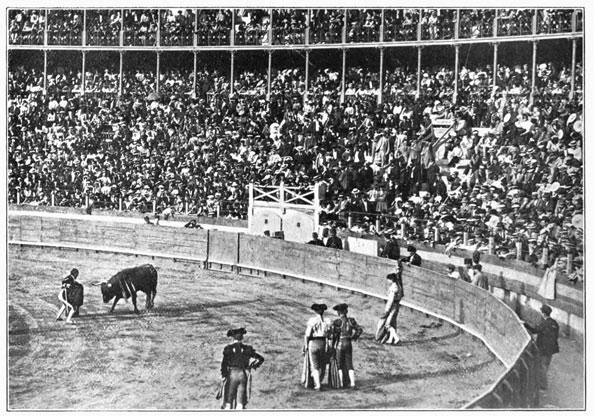
Bull-Fight of To-Day
Cordova cathedral, although this lovely mosque recks little of Christian majesties, has the ordinary equipment of an Alfonso and a Fernando, and the Royal Monastery of Las Huelgas in Burgos shelters Alfonso VIII, with his queen, Eleanor of England. In less noted churches, one continually chances on them, rey or reina, infante or infanta, dreaming the centuries away in rich recesses of fretted marble and alabaster, with the shadow of great arches over them and the deep-voiced chant around.
But since Philip II created, in his own sombre likeness, the monastery of the Escorial, rising in angular austerity from a spur of the bleak Guadarrama Mountains, the royal houses of Austria and Bourbon have sought burial there. The first and chief in the dank series of sepulchral vaults, the celebrated Panteón de los Reyes, is an octagon of black marble, placed precisely under the high altar, and gloomily magnificent with jasper, porphyry, and gold. It has an altar of its own, on whose left are three recesses, each with four long shelves placed one above another for the sarcophagi of the kings of Spain, and on whose right are corresponding recesses for the queens. As the guide holds his torch, we read the successive names of the great Charles I, founder of the Austrian line; the three Philips, in whom his genius dwindled more and more; and the half-witted Charles II, in whom it ignobly perished. The coffin lid of Charles I has twice been lifted, once as late as 1871, in compliment to the visiting Emperor of Brazil, and even then that imperial body lay intact, with blackened face and open, staring eyes. The gilded bronze coffin of Philip II was brought to his bedside for his inspection in his last hour of life. After a critical survey he ordered a white satin lining and more gilt nails—a remarkable sense of detail in a man who had sent some ten thousand heretics to the torture.
Looking for the Bourbons, we miss the first of them all, the melancholy Philip V, who would not lay him down among these Austrians, but sleeps with his second queen, the strong-willed Elizabeth Farnese, in his cloudy retreat of San Ildefonso, within hearing of the fountains of La Granja. His eldest son, Luis the Well-Beloved, who died after a reign of seven months, rests here in the Escorial, but Fernando VI, also the son of Philip's first queen—that gallant little Savoyarde who died so young—was buried in Madrid. Charles III, best and greatest of the Spanish Bourbons, is here, the weak Charles IV, Fernando VII, "The Desired" and the Disgraceful, and Alfonso XII, while a stately sarcophagus is already reserved for Alfonso XIII.
To the cold society of these five Austrian and five Bourbon sovereigns are admitted nine royal ladies. Of these, the first three are in good and regular standing—the queen of Charles I and mother of Philip II, the fourth queen of Philip II and mother of Philip III, the queen of Philip III and mother of Philip IV. But here is an intruder. Philip IV, who had an especial liking for this grewsome vault, and used often to clamber into his own niche to hear mass, insisted on having both his French and Austrian queens interred here, although the first, Isabel of Bourbon, is not the mother of a Spanish king, the promising little Baltasar having died in boyhood. The brave girl-queen of Philip V is here, in double right as mother both of Luis and Fernando VI, and here is the wife of Charles III and mother of Charles IV. But of sorry repute are the last two queens, the wife of Charles IV and mother of Fernando VII, she who came hurrying down those slippery marble stairs in feverish delirium to scratch Luisa with scissors on her selected coffin, and this other, Maria Cristina, wife of Fernando VII and mother of the dethroned Isabel, a daughter who did not mend the story. It will not be long before she returns from her French exile to enter into possession of the sarcophagus that expects her here, even as another sumptuous coffin awaits the present regent. Pity it is for Isabel, whose name is still a byword in the Madrid cafés! But she always enjoyed hearing midnight mass in this dim and dreadful crypt, and will doubtless be glad to come back to her ancestors, such as they were, and take up her royal residence with them in "dust of human nullity and ashes of mortality."
XVIII
CORPUS CHRISTI IN TOLEDO
"A blackened ruin, lonely and forsaken, Already wrapt in winding-sheets of sand, So lies Toledo till the dead awaken, A royal spoil of Time's resistless hand." —Zorrilla: Toledo.
In the thirteenth century the doctrine of transubstantiation assumed especial importance. Miracle plays and cathedral glass told thrilling stories of attacks made by Jews on the sacred Wafer, which bled under their poniards or sprang from their caldrons and ovens in complete figure of the Christ. The festival of Corpus Christi, then established by Rome, was devoutly accepted in Spain and used to be celebrated with supreme magnificence in Madrid. Early in the reign of Philip IV, Prince Charles of England, who, with the adventurous Buckingham, had come in romantic fashion to the Spanish capital, hoping to carry by storm the heart of the Infanta, stood for hours in a balcony of the Alcázar, gazing silently on the glittering procession. How they swept by through the herb-strewn, tapestried streets—musicians, standard-bearers, cross-bearers, files of orphans from the asylums, six and thirty religious brotherhoods, monks of all the orders, barefoot friars, ranks of secular clergy and brothers of charity, the proud military orders of Alcántara, Calatrava, and Santiago, the Councils of the Indies, of Aragon, of Portugal, the Supreme Council of Castile, the City Fathers of Madrid, the Governmental Ministers of Spain and Spanish Italy, the Tribunal of the Holy Office, preceded by a long array of cloaked and hooded Familiars, bishops upon bishops in splendid, gold-enwoven vestments, priests of the royal chapel displaying the royal banner, bearers of the crosier and the sacramental vessels, the Archbishop of Santiago, royal chaplains and royal majordomos, royal pages with tall wax tapers, incense burners, the canopied mystery of the Eucharist, the king, the prince, cardinals, nuncio, the inquisitor general, the Catholic ambassadors, the patriarch of the Indies, the all-powerful Count-Duke Olivares, grandees, lesser nobility, gentlemen, and a display of Spanish and German troops, closed by a great company of archers. So overwhelming was that solemn progress, with its brilliant variety of sacerdotal vestments, knightly habits, robes of state and military trappings, its maces, standards, crosses, the flash of steel, gold, jewels, and finally the sheen of candles, the clouds of incense, the tinkling of silver bells before the Santisimo Corpus, that the heretic prince and his reckless companion fell to their knees. One Spanish author pauses to remark that for these, who could even then reject the open arms of the Mother Church, the assassin's blow and the Whitehall block were naturally waiting.
Such a pomp would have been worth the seeing, but we had arrived at Madrid almost three centuries too late. Catholic friends shrugged shoulder at mention of the Corpus procession, "Vale poco." And as for the famous autos sacramentales, which used to be celebrated at various times during the eight days of the Corpus solemnity, they may be read in musty volumes, but can be seen in the city squares no more. Calderon is said to have written the trifling number of seventy-two, and Lope de Vega, whose fingers must have been tipped with pens, some four hundred.
If only our train, which then would not have been a train, had brought us, who then would not have come, to Madrid in season for a Corpus celebration under the Austrian dynasty, we could have attended an open-air theatre of a very curious sort. All the way to the Plaza, we would have seen festivity at its height, pantomimic dances, merry music, struttings of giants and antics of dwarfs, and perhaps groups of boys insulting cheap effigies of snakes, modelled after the monstrous Tarasca, carried in the Corpus parade in token of Christ's victory over the Devil. At intervals along the route, adorned with flowers and draperies, and reserved for the procession and the dramatic cars, would have been altars hung with rich stuffs from the Alcázar and the aristocratic palaces; silks and cloth of gold, brocades, velvets, and shimmering wefts of the Indies. The one-act play itself might be after the general fashion of the mediæval Miracles,—verse dialogue, tuned to piety with chords of fun, for the setting forth of Biblical stories. Abraham's sacrifice of Isaac, Moses feeding the Israelites with manna, the patience of Job, the trials of Joseph, David, and Daniel, were thus represented.
More frequently, the auto sacramental belonged to the so-called Morality type of early Christian drama, being an allegorical presentation of human experience or exposition of church doctrine. Such were "The Fountain of Grace," "The Journey of the Soul," "The Dance of Death," "The Pilgrim." Sometimes a Gospel parable, as the "Lost Sheep" or the "Prodigal Son," gave the dramatic suggestion. But these Spanish spectacles sought to associate themselves, as closely as might be, with the Corpus worship, and many of them bear directly, in one way or another, upon this sacrament.
If, for instance, we had chanced on the Madrid festival in 1681, we could have witnessed in the decorated Plaza, with its thronged balconies, the entrance of four scenic platforms or cars. The first, painted over with battles, bears a Gothic castle; the second, with pictures of the sea, a gallant ship; the third, a starry globe; the fourth, a grove and garden, whose central fountain is so shaped as to form, above, the semblance of an altar. In the complicated action of the play, when the Soul, besieged in her fortress by the Devil, whose allies are the World and the Flesh, calls upon Christ for succor, the hollow sphere of the third car opens, revealing the Lord enthroned in glory amid cherubim and seraphim; but the climax of the triumph is not yet. That stout old general, the Devil, rallies fresh forces to the attack, such subtle foes as Atheism, Judaism, and Apostasy, and whereas, before, the Senses bore the brunt of the conflict, it is the Understanding that girds on armor now. Yet in the final outcome not the Understanding, but Faith draws the veil from before the altar of the fourth car, and there, in the consecrated vessel for the holding of the Wafer, appears the "Passion Child," the white bread from Heaven, "very flesh and very blood that are the price of the soul's salvation."
That is the way Spain kept her Corpus fiesta in the good old times of Charles the Bewitched; but not now. After the procession, the bull-fight; and after the bull-fight, the latest vaudeville or ballet. Last year it rained on Corpus Thursday, which fell on the first of June, and Madrid gave up the procession altogether. Some of the Opposition papers started the cry that this was shockingly irreligious in Silvela, but when the Government organs haughtily explained that it was the decision of the archbishop and Señor Silvela was not even consulted, the righteous indignation of the Liberals straightway subsided. The procession, which was to have been a matter of kettledrums and clarionets, soldiery, "coaches of respect" from the palace and the city corporation, and a full showing of the parochial clergy, did not seem to be missed by the people. Corpus has long ceased to be a chief event in the Capital.
There are a few cities in Spain, however, where the Corpus fête is maintained with something of the old gayety and splendor. Bustling Barcelona, never too busy for a frolic, keeps it merrily with an elaborate parade from the cathedral all about the city, and—delightful feature!—the distribution of flowers and sweetmeats among the ladies. The procession in Valencia resembles those of Holy Week in Seville. On litters strewn with flowers and thick-set with candle-lights are borne carved groups of sacred figures and richly attired images of Christ and the Virgin. But it is in lyric Andalusia that these pageantries are most at home. Among her popular coplas is one that runs:—
"Thursdays three in the year there be, That shine more bright than the sun's own ray— Holy Thursday, Corpus Christi, And our Lord's Ascension Day."
Cadiz, like Valencia, carries the pasos in the Corpus procession. In Seville, where the street displays of Holy Week are under the charge of the religious brotherhoods, or cofradias, Corpus Christi gives opportunity for the clergy and aristocracy to present a rival exhibition of sanctified luxury and magnificence.
But it is in beautiful belated Granada that the Corpus fête is now at its best. A brilliantly illustrated programme, whose many-hued cover significantly groups a gamboge cathedral very much in the background, and a flower-crowned Andalusian maiden, draped in a Manila shawl, with a prodigious guitar at her feet, very much in the foreground, announces a medley of festivities extending over eleven days. This cheerful booklet promises, together with a constant supply of military music, balcony decorations, and city illuminations, an assortment of pleasures warranted to suit every taste—infantry reviews, cavalry reviews, cadet reviews, masses under roof and masses in the open, claustral processions, parades of giants, dwarfs, and La Tarasca, a charity raffle in the park under the patronage of Granada's most distinguished ladies, the erection of out-of-door altars, the dispensing of six thousand loaves of bread among the poor (from my experience of Granada beggars I should say the supply was insufficient), a solemn Corpus procession passing along white-canopied streets under a rain of flowers, three regular bull-fights with the grand masters Guerrita, Lagartijillo, and Fuentes, followed by a gloriously brutal corrida, with young beasts and inexperienced fighters, cattle fair, booths, puppet shows, climbing of greased poles, exhibition of fine arts and industries, horse racing, polo, pigeon shoot, trapeze, balloon ascensions, gypsy dances, and fireworks galore.
But even faithful Granada shared in the strange catalogue of misfortunes which attended Corpus last year. The rains descended on her Chinese lanterns, and the winds beat against her Arabic arches with their thousands of gas-lights. On the sacred Thursday itself, the Andalusian weather made a most unusual demonstration of hurricane and cloudburst, with interludes of thunder and lightning. Great was the damage in field, vineyard, and orchard, and as for processions, they were in many places out of the question. Even Seville and Cordova had to postpone both parades and bull-fights. But this was not the worst. In Ecija, one of the quaintest cities of Andalusia, an image of the Virgin as the Divine Shepherdess, lovingly arrayed and adorned with no little outlay by the nuns of the Conception, caught fire in the procession from a taper, like Seville's Virgin of Montserrat in the last Semana Santa. The Divina Pastora barely escaped with her jewels. Her elaborate garments, the herbage and foliage of her pasture, and one of her woolly sheep were burned to ashes. In Palma de Mallorca, a romantic town of the Balearic Isles, a balcony, whose occupants were leaning out to watch the procession, broke away, and crashed down into the midst of the throng. A young girl fell upon the bayonet of a soldier marching beneath, and was grievously hurt. Others suffered wounds which, in one case at least, proved fatal. The Opposition journals did not fail to make capital out of these untoward events, serving them up in satiric verse with the irreverent suggestion that, if this was all the favor a reactionary and ultra-Catholic government could secure from Heaven, it was time to go back to Sagasta.
The ecclesiastical Toledo, seat of the Primate of all Spain, is one of the Spanish cities which still observe Corpus Christi as a high solemnity, and Toledo is within easy pilgrimage distance of Madrid. I had already passed two days in that ancient capital of the Visigoths, ridding my conscience of the sightseers' burden, and I both longed and dreaded to return. The longing overcame the dread, and I dropped in at the Estacion del Mediodía for preliminary inquiries. I could discover no bureau of information and no official authorized to instruct the public, but in this lotus-eating land what is nobody's business is everybody's business. There could not be a better-humored people. The keeper of the bookstand abandoned his counter, his would-be customers lighting cigarettes and leaning up against trucks and stacks of luggage to wait for his return, and escorted me the length of the station to find a big yellow poster, which gave the special time-table for Corpus Thursday. The poster was so high upon the wall that our combined efforts could not make it out; whereupon a nimble little porter dropped the trunk he was carrying, and climbed on top of it for a better view. In that commanding position he could see clearly enough, but just when my hopes were at the brightest, he regretfully explained that he had never learned to read. As he clambered down the proprietor of the trunk, who had been looking on with as much serenity as if trains never went and starting bells never rang, mounted in turn. This gentleman, all smiles and bows and tobacco smoke, read off the desired items, which the keeper of the bookstand copied for me in a leisurely, conversational manner, with a pencil lent by one bystander on a card donated by another.
There is really something to be said for the Spanish way of doing business. It takes time, but if time is filled with human kindliness and social courtesies, why not? What is time for? Whenever I observed that I was the only person in a hurry on a Madrid street, I revised my opinion as to the importance of my errand.
As I entered the station again on the first of June at the penitential hour of quarter past six in the morning, I was reflecting complacently on my sagacity as a traveller. Had I not bethought me that, even in the ecclesiastical centre of Spain and on this solemn festival, there might be peril for a stranger's purse? What financial acumen I had shown in calculating that, since my round-trip ticket to Toledo before had cost three dollars, second class, I could probably go first class on this excursion for the same sum, while two dollars more would be ample allowance for balcony hire and extras! And yet how prudent in me to have tucked away a reserve fund in a secret pocket inaccessible even to myself! But why was the station so jammed and crammed with broad-hatted Spaniards? And what was the meaning of that long line of roughs, stretching far out from the third-class ticket office? Bull-fight explained it all. Even reverend Toledo must keep the Corpus holy by the public slaughter of six choice bulls and as many hapless horses as their blind rage might rend. Worse than the pagan altars that reeked with the blood of beasts, Spain's Christian festivals demand torture in addition to butchery.
There were no first-class carriages, it appeared, upon the Corpus train, and my round-trip ticket, second class, cost only a dollar, leaving me with an embarrassment of riches. Pursing the slip of pasteboard which, to my disgust, was stamped in vermilion letters Corrida de Toros, I sped me to the train, where every seat appeared to be taken, although it lacked twenty minutes of the advertised time for departure; but a bald-headed philanthropist called out from a carriage window that they still had room for one. Gratefully climbing up, I found myself in the society of a family party, off for Toledo to celebrate the saint-day of their hazel-eyed eight-year-old by that treat of treats, a child's first bull-fight. When they learned that I was tamely proposing to keep Corpus Christi by seeing the procession and not by "assisting at the function of bulls," their faces clouded; but they decided to make allowance for my foreign idiosyncrasies.
The train, besieged by a multitude of ticket-holders for whom there were no places, was nearly an hour late in getting off. The ladies dozed and chattered; the gentlemen smoked and dozed; little Hazel-eyes constantly drew pictures of bulls with a wet finger on the window glass. Reminded again by my handbag literature that Toledo is a nest of thieves, I would gladly have put away my extra money, but there was never a moment when all the gentlemen were asleep at once.
It was after ten when we reached our destination, the boy wild with rapture because we had actually seen a pasture of grazing bulls. A swarm of noisy, scrambling, savage-looking humanity hailed the arrival of the train, and I had hardly made my way even to the platform before I felt an ominous twitch at my pocket. The light-fingered art must have degenerated in Toledo since the day of that clever cutpurse of the "Exemplary Tales." Turning sharply, I confronted a group of my fellow-worshippers, who, shawled and sashed and daggered, looked as if they had been expressly gotten up for stage bandits. From the shaggy pates, topped by gaudy, twisted handkerchiefs—a headdress not so strange in a city whose stone walls looked for centuries on Moorish turbans—to the bright-edged, stealthy hemp sandals, these were pickpockets to rejoice a kodak. Their black eyes twinkled at me with wicked triumph, while it flashed across my mind that my old hero, the Cid, was probably much of their aspect, and certainly gained his living in very similar ways. There were a full score of these picturesque plunderers, and not a person of the nineteenth century in sight. Since there was nothing to do, I did it, and giving them a parting glance of moral disapproval, to which several of the sauciest responded by blithely touching their forelocks, I pursued my pilgrim course, purged of vainglory. At all events, I was delivered from temptation as to a questionable peseta in my purse—my pretty Paris purse!—and I should not be obliged to travel again on that odious bull-fight ticket.
We were having "fool weather," blowing now hot, now cold, but as at this moment the air was cool, and every possible vehicle seemed packed, thatched, fringed with clinging passengers, I decided, not seeking further reasons, to walk up to the town. And what a town it is! Who could remember dollars? So far from being decently depressed, I was almost glad to have lost something in this colossal monument of losses. It seemed to make connection.
Between deep, rocky, precipitous banks, strongly flows the golden "king of rivers, the venerable Tajo," almost encircling the granite pedestal of the city and spanned by ancient bridges of massy stone, with battlemented, Virgin-niched, fierce old gates. And above, upon its rugged height, crumbling hourly into the gritty dust that stings the eye and scrapes beneath the foot, lies in swirls on floor and pavement, blows on every breeze and sifts through hair and clothing, is the proud, sullen, forsaken fortress of "imperial Toledo." Still it is a vision of turrets, domes, and spires, fretwork, buttresses, façades, but all so desolate, so dreary, isolated in that parched landscape as it is isolated in the living world, that one approaches with strangely blended feelings of awe, repugnance, and delight.
On we go over the Bridge of Alcántara, wrought æons since by a gang of angry Titans—the guidebooks erroneously attribute it to the Moors and Alfonso the Learned—with a shuddering glance out toward the ruins of feudal castles, here a battlemented keep set with mighty towers, there a great, squat, frowning mass of stone, the very sight of which might have crushed a prisoner's heart. Up, straight up, into the grim, gray, labyrinthine city, whose zigzag streets, often narrowing until two laden donkeys, meeting, cannot pass, so twist and turn that it is impossible on entering one to guess at what point of the compass we will come out. These crooked ways, paved with "agony stones," are lined with tall, dark, inhospitable house fronts, whose few windows are heavily grated, and whose huge doors, bristling with iron bosses, are furnished with fantastic knockers and a whole arsenal of bolts and chains.
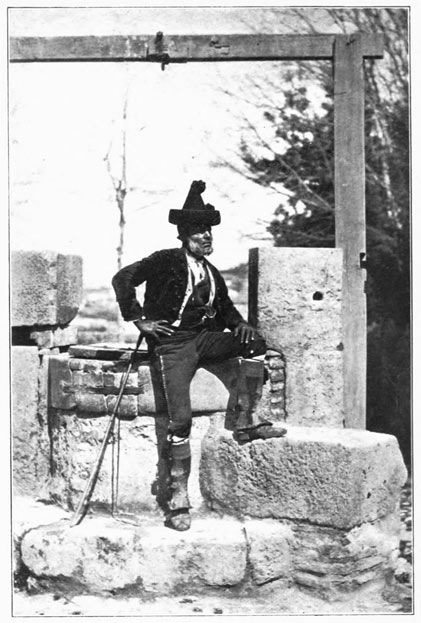
The King of the Gypsies
Gloomy as these ponderous structures are, every step discloses a novelty of beauty,—a chiselled angel, poised for flight, chased escutcheons, bas-reliefs, toothed arches, medallions, weather-eaten groups of saints and apostles gossiping in their scalloped niches about the degeneracy of the times. The Moors, whose architecture, says Becquer, seems the dream of a Moslem warrior sleeping after battle in the shadow of a palm, have left their mark throughout Toledo in the airy elegance of the traceries magically copied from cobwebs and the Milky Way. That tragic race, the Jews, have stamped on the walls of long-desecrated synagogues their own mysterious emblems. And Goths and Christian knights have wrought their very likenesses into the stern, helmeted heads that peer out from the capitals of marvellous columns amid the stone grapes and pomegranates most fit for their heroic nourishment. But all is in decay. Here stands a broken-sceptred statue turning its royal back on a ragged vender of toasted garbanzos. Even the image of Wamba has lost its royal nose.
You may traverse whispering cloisters heaped with fallen crosses, with truant tombstones, and severed heads and limbs of august prophets. Cast aside in dusky vaults lie broken shafts of rose-tinted marbles and fragments of rare carving in whose hollows the birds of the air once built their nests. Through the tangle of flowers and shrubbery that chokes the patios gleam the rims of alabaster urns and basins of jasper fountains. Such radiant wings and faces as still flash out from frieze and arch and column, such laughing looks, fresh with a dewy brightness, as if youth and springtime were enchanted in the stone! And what supreme grace and truth of artistry in all this bewildering detail! On some far-off day of the golden age, when ivory and agate were as wax, when cedar and larch wood yielded like their own soft leaves, the magician must have pressed upon them the olive leaf, the acacia spray, the baby's foot, that have left these perfect traces. And how did mortal hand ever achieve the intricate, curling, unfolding, blossoming marvel of those capitals? And who save kings, Wambas and Rodericks, Sanchos, Alfonsos, and Fernandos, should mount these magnificent stairways? And what have those staring stone faces above that antique doorway looked upon to turn them haggard with horror? City of ghosts! The flesh begins to creep. But here, happily, we are arrived in the Plaza de Zocodovér, where Lazarillo de Tormes used to display his talents as town crier, and in this long-memoried market-place, with its arcaded sides and trampled green, may pause to take our bearings.
Evidently the procession is to pass here, for the balconies, still displaying the yellow fronds of Palm Sunday, are hung with all manner of draperies—clear blue, orange with silver fringes, red with violet bars, white with saffron scallops. Freed from sordid cares about my pocket, I give myself for a little to the spell of that strange scene. Beyond rise the rich-hued towers of the Alcázar, on the site where Romans, Visigoths, Arabs, the Cid, and an illustrious line of Spanish monarchs have fortified themselves in turn; but Time at last is conqueror, and one visits the dismantled castle only to forget all about it in the grandeur of the view. From the east side of the Zocodovér soars the arch on whose summit used to stand the Santisimo Cristo del Sangre, before whom the Corpus train did reverence. And here in the centre blazed that momentous bonfire which was to settle the strife between the old Toledan liturgy and the new ritual of Rome; but the impartial elements honored both the Prayer Books placed upon the fagots, the wind wafting to a place of safety the Roman breviary, while the flames drew back from the other, with the result that the primitive rite is still preserved in an especial chapel of the cathedral.
A glorious plaza, famed by Cervantes, loved by Lope de Vega, but now how dim and shabby! On the house-fronts once so gayly colored, the greens have faded to yellows, the reds to pinks, and the pinks to browns. The awning spread along the route of the procession is fairly checkered with a miscellany of patches. I pass the compliments of the day with a smiling peasant woman, whose husband, a striking color-scheme in maroon blanket, azure trousers, russet stockings, and soiled gray sandals, offers me his seat on the stone bench beside her. But I am bound on my errand, and they bid me "Go with God." I select a trusty face in a shop doorway and ask if I can rent standing room in the balcony above. Mine honest friend puts his price a trifle high to give him a margin for the expected bargaining, but I scorn to haggle on a day when I am short of money, and merely stipulate, with true Spanish propriety, that no gentlemen shall be admitted. This makes an excellent impression on the proprietor, who shows me up a winding stair with almost oppressive politeness. A little company of ladies, with lace mantillas drooping from their graceful heads, welcome me with that courteous cordiality which imparts to the slightest intercourse with the Spanish people (barring pickpockets) a flavor of fine pleasure. Because I am the last arrival and have the least claim, they insist on giving me the best place on the best balcony and are untiring in their explanations of all there is to be seen.
The procession is already passing—civil guards, buglers, drummers, flower wreaths borne aloft, crosses of silver and crosses of gold, silken standards wrought with cunning embroideries. But now there come a sudden darkness, a gust of wind, and dash of rain. The ranks of cofradias try in vain to keep their candles burning, the pupils from the colleges of the friars, with shining medals hung by green cords about their necks, peep roguishly back at the purple-stoled dignitary in a white wig, over whom an anxious friend from the street is trying to hold an umbrella. The Jesuit seminaristas bear themselves more decorously, the tonsures gleaming like silver coins on their young heads. The canons lift their red robes from the wet, and even bishops make some furtive efforts to protect their gold-threaded chasubles. Meanwhile the people, that spectral throng of witches, serfs, feudal retainers, and left-overs from the Arabian Nights, press closer and closer, audaciously wrapping themselves from the rain in the rich old tapestries of France and Flanders, which have been hung along both sides of the route from a queer framework of emerald-bright poles and bars. The dark, wild, superstitious faces, massed and huddled together, peer out more uncannywise than ever from under these precious stuffs which brisk soldiers, with green feather brushes in their caps, as if to enable them to dust themselves off at short notice, are already taking down.
All the church bells of the city are chiming solemnly, and the splendid custodia, "the most beautiful piece of plate in the world," a treasure of filigree gold and jewels, enshrining the Host, draws near. It is preceded by a bevy of lovely children, not dressed, as at Granada, to represent angels, but as knights of chivalry. Their dainty suits of red and blue, slashed and puffed and trimmed with lace, flash through the silvery mist of rain. Motherly voices from the balconies call to them to carry their creamy caps upside down to shield the clustered plumes. Their little white sandals and gaiters splash merrily through the mud.
A flamingo gleam across the slanting rain announces Cardinal Sancha, behind whom acolytes uplift a thronelike chair of crimson velvet and gold. Then follow ranks of taper-bearing soldiers, and my friends in the balcony call proudly down to different officers, a son, a husband, a blushing novio, whom they present to me then and there. The officers bow up and I bow down, while at this very moment comes that tinkling of silver bells which would, I had supposed, strike all Catholic Spaniards to their knees. It is perhaps too much to expect the people below to kneel in the puddles, but the vivacious chatter in the balconies never ceases, and the ladies beside me do not even cross themselves.
The parade proceeds, a gorgeous group in wine-colored costume carrying great silver maces before the civic representation. The governor of the province is pointed out to me as a count of high degree, but in the instant when my awed glance falls upon him he gives a monstrous gape unbecoming even to nobility. The last of the spruce cadets, who close the line, have hardly passed when the thrifty housewife beseeches our aid in taking in out of the rain her scarlet balcony hanging, which proves to be the canopy of her best bed. But the sun is shining forth again when I return to the street to follow the procession into the cathedral.
Already this gleam of fair weather has filled the Calle de Comercio with festive señoritas, arrayed in white mantillas and Manila shawls in honor of the bull-fight. Shops have been promptly opened for a holiday sale of the Toledo specialties—arabesqued swords and daggers, every variety of Damascened wares, and marchpane in form of mimic hams, fish, and serpents. The Toledo steel was famous in Shakespeare's day, even in the mouths of rustic dandies, whose geographical education had been neglected. When the clever rogue, Brainworm, in one of Jonson's comedies, would sell Stephen, the "country gull," a cheap rapier, he urges, "'Tis a most pure Toledo," and Stephen replies according to his folly, "I had rather it were a Spaniard." But onward is the glorious church, with its symmetric tower, whose spire wears a threefold crown of thorns. The exterior walls are hung, on this one day of the year, with wondrous tapestries that Queen Isabella knew. An army of beggars obstructs the crowd, which presses in, wave upon wave, through the deep, rich portals in whose ornamentation whole lifetimes have carved themselves away.
Within this sublime temple, unsurpassed in Gothic art, where every pavement slab is worn by knees more than by footsteps, where every starry window has thrown its jewel lights on generations of believers, one would almost choose to dwell forever. One looks half enviously at recumbent alabaster bishops and kneeling marble knights, even at dim grotesques, who have rested in the heart of that grave beauty, in that atmosphere of prayer and chant, so long. Let these stone figures troop out into the troubled streets and toil awhile, and give the rest of us a chance to dream. But the multitude, which has knelt devoutly while Su Majestad was being borne into the Capilla Mayor, comes pouring down the nave to salute the stone on which—ah me!—on which the Virgin set her blessed foot December 18, 666, when she alighted in Toledo cathedral to present the champion of the Immaculate Conception, St. Ildefonso, with a chasuble of celestial tissue. The gilded, turreted shrine containing that consecrated block towers almost to the height of the nave. A grating guards it from the devout, who can only touch it with their finger tips, which then they kiss. Hundreds, with reverend looks, stand waiting their turn—children, peasants, bull-fighters, decorated officers, refined ladies, men of cultured faces. The sound of kissing comes thick and fast. Heresy begins to beat in my blood.
Not all that heavenward reach of columns and arches, not that multitudinous charm of art, can rid the imagination of a granite weight. I escape for a while to the purer church without, with its window-gold of sunshine and lapis-lazuli roof. When the mighty magnet draws me back again, those majestic aisles are empty, save for a tired sacristan or two, and the silence is broken only by a monotone of alternate chanting, from where, in the Capilla Mayor, two priests keep watch with El Señor.
"He will be here all the afternoon," says the sacristan, "and nothing can be shown; but if you will come back to-morrow I will arrange for you to see even Our Lady's robes and gems."
Come back! I felt myself graying to a shadow already. Of course I longed to see again that marvellous woodwork of the choir stalls, with all the conquest of Granada carved amid columns of jasper and under alabaster canopies, but I was smothered in a multitude of ghosts. They crowded from every side,—nuns, monks, soldiers, tyrants, magnificent archbishops, the martyred Leocadia, passionate Roderick, weeping Florinda, grim Count Julian, "my Cid," Pedro the Cruel, those five thousand Christian nobles and burghers of Toledo, slain, one by one, at the treacherous feast of Abderrahman, those hordes of flaming Jews writhing amid the Inquisition fagots. I had kept my Corpus. I had seen the greatest of all autos sacramentales, Calderon's masterpiece, "Life is a Dream."
"On a single one of the Virgin's gold-wrought mantles," coaxed the sacristan, "are eighty-five thousand large pearls and as many sapphires, amethysts, and diamonds. I will arrange for you to see everything, when Our Lord is gone away."
But no. I am a little particular about treasures. Since Toledo has lost the emerald table of King Solomon and that wondrous copy of the Psalms written upon gold leaf in a fluid made of melted rubies, I will not trouble the seven canons to unlock the seven doors of the cathedral sacristy. Let the Madonna enjoy her wealth alone. I have pesetas enough for my ticket to Madrid.
XIX
THE TERCENTENARY OF VELÁZQUEZ
"It is a sombre and a weeping sky That lowers above thee now, unhappy Spain; Thy 'scutcheon proud is dashed with dimming rain; Uncertain is thy path and deep thy sigh. All that is mortal passes; glories die; This hour thy destiny allots thee pain; But for the worker of thy woes remain Those retributions slowly forged on high. "Put thou thy hope in God; what once thou wert Thou yet shalt be by labor of thy sons Patient and true, with purpose to atone; And though the laurels of the loud-voiced guns Are not with us to-day, this balms our hurt— Cervantes and Velázquez are our own." —Duke of Rivas: For the Tercentenary.
The celebration, as planned, was comparatively simple, but enthusiasm grew with what it fed upon. The Knights of Santiago held the first place upon the programme, for into that high and exclusive order the artist had won entry by special grace of Philip IV. Even Spain has been affected by the modern movement for the destruction of traditions, and certain erudite meddlers, who have been delving in the State archives, declare that there is no truth in the following story, which, nevertheless, everybody has to tell.
The legend runs that Velázquez became a knight of St. James by a royal compliment to the painter of Las Meninas. This picture, which seems no picture, but life itself, eternizes a single instant of time in the palace of Philip IV, that one instant before the fingers of the little Infanta have curved about the cup presented by her kneeling maid, before the great, tawny, half-awakened hound has decided to growl remonstrance under the teasing foot of the dwarf, before the reflected faces of king and queen have glided from the mirror, that fleeting instant while yet the courtier, passing down the gallery into the garden, turns on the threshold for a farewell smile, while yet the green velvet sleeve of the second dwarf, ugliest of all pet monsters, brushes the fair silken skirts of the daintiest of ladies-in-waiting, while yet the artist, so much more royal than royalty, flashes his dark-eyed glance upon the charming group.
But if Velázquez looks prouder than a king, Philip proved himself here no uninspired painter. Asked if he found the work complete, the monarch shook his head, and, catching up the brush, marked the red cross of St. James on the pictured breast of the artist. So says the old wives' tale. At all events, in this way or another, the honor was conferred, with the result that on the three hundredth birthday of Velázquez, June 6, 1899, dukes and counts and marquises flocked to the Church of Las Señoras Comendadoras, where the antique Gregorian mass was chanted for the repose of their comrade's soul.
By the latest theology, the "Master of all Good Workmen" would not have waited for this illustrious requiem before admitting the painter to "an æon or two" of rest, but the Knights of Santiago have not yet accepted Kipling as their Pope.
On the afternoon of the same day the Sala de Velázquez was inaugurated in the Museo del Prado, taking, with additions, the room formerly known as the Sala de la Reina Isabel, long the Salon Carré of Madrid, where Raphaels, Titians, Del Sartos, Dürers, Van Dycks, Correggios, and Rembrandts kept the Spanish Masters company. Portico and halls were adorned in honor of the occasion; the bust of Velázquez, embowered in laurels, myrtles, and roses, was placed midway in the Long Gallery, fronting the door of his own demesne; but the crown of the fiesta consisted in the new and far superior arrangement of his pictures. The royal family and chief nobility, the Ministers of Government, the Diplomatic Corps, and delegations of foreign artists made a brilliant gathering. The address, pronounced by an eminent critic, reviewed what are known as the three styles of Velázquez. Never was art lecture more fortunate, for this Museo, holding as it does more than half the extant works of the great realist, with nearly all his masterpieces, enabled the speaker to illustrate every point from the original paintings. A rain of aristocratic poems followed, for a Spaniard is a lyrist born, and turns from prose to verse as easily as he changes his cuffs. As Monipodio says, in one of Cervantes' "Exemplary Tales": "A man has but to roll up his shirt-sleeves, set well to work, and he may turn off a couple of thousand verses in the snapping of a pair of scissors." These Dukes of Parnassus and Counts of Helicon did homage to the painter in graceful stanzas, not without many an allusion to Spain's troubled present. If only, as one sonneteer suggested, the soldiers of Las Lanzas had marched out from their great gilt frame and gone against the foe! A programme of old-time music was rendered, and therewith the Sala de Velázquez was declared open.
To this, as to all galleries and monuments under State control, the public was invited free of charge for the week to come. The response was appreciative, gentility, soldiery, ragamuffins, bevies of schoolgirls with notebooks, and families of foreigners with opera glasses grouping themselves in picturesque variety, day after day, before the art treasures of Madrid, while beggars sat in joyful squads on the steps of the museums, collecting the fees which the doorkeepers refused.
During these seven days, artistic and social festivals in honor of Velázquez abounded, not only in Madrid, but throughout Spain. Palma must needs get up, with photographs and the like, a Velázquez exposition, and Seville, insisting on her mother rights, must arrange a belated funeral, with mass and sermon and a tomb of laurels and flowers, surmounted by brushes, palette, and the cloak and helmet of the Order of Santiago. In the capital the Circulo de Bellas Artes sumptuously breakfasted the artists from abroad. The dainties were spiced with speeches, guitars, ballet, gypsy songs and dances, congratulatory telegrams, and a letter posted from Parnassus by Don Diego himself. Two valuable new books on Velázquez suddenly appeared in the shop windows, and such periodicals as La Ilustración, Blanco y Negro, La Vida Literaria, and El Nuevo Mundo vied with one another in illustrated numbers, while even the one-cent dailies came out with specials devoted to Velázquez biography and criticism. The Academy of San Fernando rendered a musical programme of Velázquez date, the Queen Regent issued five hundred invitations to an orchestral concert in the Royal Palace, and there was talk, which failed to fructify, of a grand masquerade ball, where the costumes should be copied from the Velázquez paintings and the dances should be those stepped by the court of Philip IV.
The closing ceremony of the week was the unveiling of the new statue of Velázquez. Paris owes to Fremiot an equestrian statue of the painter, who, like Shakespeare in his Paris statue, is made to look very like a Frenchman, but the horse is of the most spirited Spanish type. A younger Velázquez may be seen in Seville, at home among the orange trees, and the Palacio de la Biblioteca y Museos Nacionales in Madrid shows a statue from the hand of Garcia. Still another, an arrogant, striding figure, was standing in the studio of Benlliure, ready for its journey to the Paris exposition. The tercentenary statue, by Marinas, is also true to that haughty look of Velázquez. It represents him seated, brush and palette in hand, the winds lifting from his ears those long, clustering falls of hair, as if to let him hear the praises of posterity. Little he cares for praises! That artist's look sees nothing but his task.
The unveiling took place late on Wednesday afternoon, in front of the Museo del Prado, where the statue stands. A turquoise sky and a light breeze put all the world in happy humor. The long façade of the Museo was hung with beautiful tapestries. Handsome medallions bore the names of painters associated in one way or another with Velázquez—Herrera el Viejo, his first master in Seville; Pacheco, his second Sevillian teacher and his father-in-law; Luis Tristan of Toledo, for whom he had an enthusiastic admiration; El Greco, that startling mannerist, whose penetrating portraiture of faces, even whose extraordinary effects in coloring were not without influence on the younger man; Zurbarán, his almost exact contemporary, enamored no less than Velázquez himself of the new realism emanating from the great and terrible Ribera; Murillo, whose developing genius the favored Court painter, too high-hearted for envy, protected and encouraged, and Alonzo Cano, the impetuous artist of Granada, to whom, too, Velázquez was friend and benefactor.
Spanish colors and escutcheons were everywhere. In decorated tribunes sat the royal family and the choicest of Madrid society, with the members of the Circulo de Bellas Artes, who were the hosts of the day, and with distinguished guests from the provinces and abroad. Romero Robledo, as President of the Society of Fine Arts, welcomed the Queen, closing his brief address with the following words: "Never, señora, will your exalted sentiments be able to blend with those of the Spanish people in nobler hour than this, commemorating him who is forever a living national glory and who receives enthusiastic testimony of admiration from all the civilized world." Their Majesties drew upon the cords, the two silken banners parted, and the statue was revealed to the applauding multitude. While the royal group congratulated the sculptor, the ambassadors of Austria and Germany laid magnificent wreaths, fashioned with a due regard to the colors of their respective nations, at the feet of Velázquez. The eminent French artists, Carolus Duran and Jean Paul Laurens, bore a crown from France and delighted the audience by declaring that "the painter of the Spanish king was himself the king of painters." Nothing since the war had gladdened Spain more than the presence and praises of these two famous Parisians; the reverence of Madrid for Paris is profound. The tributes of Rome and London excited far less enthusiasm. Still more wreaths, and more and more, were deposited by a procession of delegates from the art societies of all Spain, headed by Seville, the bands playing merrily meanwhile, until that stately form of bronze seemed to rise from out a hill of laurels, ribbons, and flowers.