Introductory material (continued 4)
Reading edition
Little as the Spaniards love the Queen Regent, to whom they cannot pardon her two cardinal offences of being a "foreigner" and of disliking the bull-fight, they have a certain affection for Alfonso XIII, "the only child born a king since Christ." Indeed, Spain seems to have been always sympathetic toward childhood in palaces. Enter this wonderful Armería of Madrid, where those plumed and armored kings, on richly caparisoned chargers, whom we have come to know in the paintings of the Museo del Prado, seem to have leapt from the canvases to greet us here in still more lifelike guise, albeit not over graciously, with horse reined back and mighty lance at poise. Any fine morning they may all come clattering out into the Plaza de Armas—and where will the United States be then? Here stands a majestic row of them—Philip II, in a resplendent suit of gold-inlaid plate-armor; Maximilian, whose visor gives him the fierce hooked beak of an eagle; Sebastian of Portugal, with nymphs embossed in cunning work on his rich breastplate; and Charles V, three times over, in varieties of imperial magnificence.
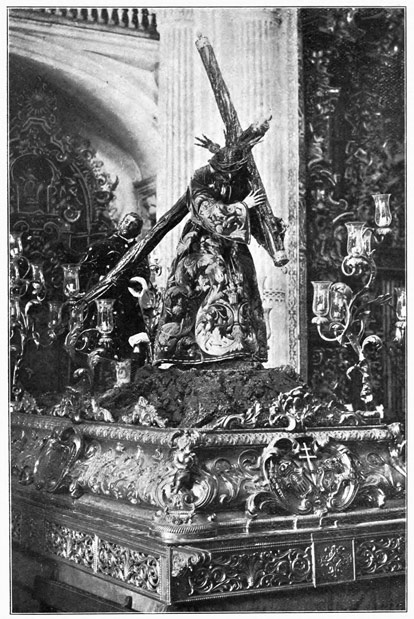
"Jesus of the Passion"
But opposite these stern warriors is a hollow square of boy princes, and of noble niños whose visors hide their identities in long oblivion. The armor of these childish figures is daintily wrought, with tender touches of ruffs and cuffs, scallops and flutings and rosettes. Often only the upper half of the body is incased in steel, the slender legs playing the dandy in puffed trousers of striped velvet—scarlet, green, and buff—silk hose, and satin slippers. Little Philip III proudly displays a diminutive round shield, with a relief of battle scenes in gold. The plate armor of little Philip IV is stamped with lions and castles, eagles and spears. And his little son, Don Baltasar Carlos, bestrides a spirited pony and wears at the back of his helmet a tuft of garnet feathers.
The Prado galleries abound in royal children. This same infante, Don Baltasar, is seen here in the foreground of a lonely landscape, with desolate blue hills beyond and driving clouds above. But all the more bright and winsome glows the form of the six-year-old horseman, the gold-fringed, pink sash that crosses his breast streaming out far behind with the speed of his fearless gallop. Supreme among the Prado children, of course, is the little daughter of Philip IV, the central figure of the world-renowned Las Meninas. All in vain does her charming maid of honor kneel to her with the golden cup; all in vain does the dwarf tease the drowsy dog. The solemn puss, undiverted, will not stir from her pose nor alter the set of her small features until the artist, standing half disdainfully before his easel, gives the word. She has waited for it now hard upon two hundred and fifty years, but the centuries beat in vain against that inflexible bit of propriety.
Even the royal burial vaults beneath the grim Escorial have in their chill grandeur of marble halls an especial Panteon for babies, princely innocents whose lives are reckoned in months more often than in years. Gold and blue and red brighten their great white sepulchre, and above the altar smiles the Christ Child, with the graven words, "Suffer the children to come unto me." But for Alfonso XIII a sombre sarcophagus waits in the haughtiest and gloomiest of all the Panteons, where only kings, and queens who were mothers of kings, may lie.
It is not royal childhood alone that is dear to this strange, romantic, monstrously inconsistent heart of Spain. The cruelty of Spaniards to horses and donkeys sickens even the roughest Englishman, yet almost every voice softens in speaking to a child, and during my six months in Spanish cities I saw nothing of that street brutality toward the little ones which forces itself upon daily notice in Liverpool and London. Spanish children are too often ill-cared for, but despite the abuses of ignorant motherhood and fatherhood, such vivid, vivacious, bewitching little people as they are! Enter a Spanish schoolroom and see how vehemently the small brown hands are wagged in air, how the black eyes dance and the dimples play, what a stir and bustle, what a young exuberance of energy! They race to the blackboards like colts out at pasture. They laugh at everything, these sons of "the grave Spaniard," and even the teacher will duck his head behind the desk for a half-hidden ecstasy over some dunce's blunder or some rogue's detected trick.
But their high spirits never make them unmindful of those courtesies of life in which they have been so carefully trained. There is an old-fashioned exaggeration about their set phrases of politeness. Just as the casual caller kisses the lady's feet, in words, and she reciprocates by a verbal kissing of his hand, so the school children respond to the roll call with a glib: "Your servant, sir." Ask a well-bred boy his name, and he rattles back, "Jesus Herrera y La-Chica, at the service of God and yourself." They learn these amenities of speech with their first lispings. I was much taken aback one day in Seville by a child of eighteen months. Not in the least expecting this infant, whose rosy face was bashfully snuggled into his young aunt's neck, to understand, I said to her, "What a fine little fellow!" Whereupon Master Roly-poly suddenly sat up straight on her arm, ducked his head in my direction, and gravely enunciated, "Es favor que Usted me hace"—"It is a compliment you pay me." I could hardly recover from the shock in time to make the stereotyped rejoinder, "No es favor, es justicia"—"No compliment, but the truth." To this Don Chubbykins sweetly returned, "Mil gracias"—"A thousand thanks," and I closed this uncanny dialogue with the due response, "No las merece"—"It does not merit them."
Servants, neighbors, passers-by, beggars, all prompt the children in these shibboleths of good manners, adorning the precept with example. "Would you like to go with us to the picture gallery this afternoon?" I once asked a laddie of artistic tastes at a boarding-house table. "Si, señora," he replied, whereupon several of the boarders, greatly scandalized, hastened to remind him, but in the gentlest of tones, of the essential addition, "con mucho gusto" to which we were bound to reply, "The pleasure will be ours." The girls, even more than the boys, are bred in these formal fashions of intercourse. Every morning they ask if you have rested well, and express grief or gratification, according to your response. In Mrs. Gulick's school, mere midgets of six and eight, returning from class, will not close the doors of their rooms if you are in sight, though perhaps seated at a reading table in the farther end of the corridor, lest they should appear inhospitable. On our return from Italica, a thirsty child of seven, heated to exhaustion with the sun and fun of that Andalusian picnic, refused to touch the anise-seed water which some good Samaritan had handed up to the dusty carriage, until the glass had been offered to every one else, driver included, leaving, in the sequel, little enough for her. On our midnight return from the Feria, this same niña of gentle memory, staggering and half crying with sleepiness, would nevertheless not precede any of her elders in entering the home door. "After you," she sobbed, with hardly voice enough to add, "And may you all rest well!" "The same to you," chorussed the adults, trooping by, and her faint murmur followed, "Many thanks."
"Shall I give you this fan when I go away," I asked her once, "or would you rather have it now to take to the party?" She wanted it then and there, but what she answered was, "I shall be best pleased to take it when you like best to give it."
You must beware of saying to a little Spanish maid, "What a beautiful rosebud in your hair!" Instantly the hand is busy with the pins. "It is at your disposal." You hastily protest, "A thousand thanks, but no, no, no! It is very well placed where it is." Off comes the flower, notwithstanding, and is fastened into your belt. For when the elder sister has insisted on giving you (until the next ball) those dancing slippers which you so rashly admired, and the sister's novio went home the night before without his cloak, because you had approved its colors (although he sent his man around for it before breakfast), what can the children do but follow suit? Even their form of "Now I Lay Me" is touched with their quaint politeness:—
"Jesus, Joseph, Mary, Your little servant keep, While, with your kind permission, I lay me down to sleep."
The precocity of Spanish children is a recognized fact. An educational expert, a Frenchman who holds a chair in an English university, assured us that beyond a doubt Spanish children, for the first dozen years of life, develop more rapidly than any other children of Europe. Yet, although these clever little Spaniards are so punctiliously taught to put the pleasure of others before their own, they are treated with universal indulgence. Soldiers lining the curbstones on occasion of a royal progress will let the children press in beside them and cling to their valorous legs, until the military array seems variegated with a Kindergarten. My farewell glimpse of Toledo, on Corpus Christi Day, makes a pretty picture in memory. The red-robed cardinal, who had come to the station to take his train, was fairly stormed by all the children within sight, clamoring for his blessing. In vain the attendant priests tried to scatter the throng, and ladies of high degree, planting their chairs in a circle about the prelate, acted as a laughing body-guard. It was all of no avail. The little people danced up and down with eagerness, dodged under arms, and slipped between elbows. They knelt upon the cardinal's very feet, rapturously kissing his red-gloved hand and clasping to their pinafores and blouses the sacred trinkets he distributed. And he, patting the bobbing black pates, wherever he could get a chance, smiled on the little ones and forbade them not.
The affection lavished on children in the household circle is often poetic and passionate. I observed one day a brusque young fellow of twenty-four, whom we had thought rather a hard, catch-penny sort of person, suddenly gather a four-year-old nephew to his heart and cover the dimpled face with kisses, while the look in his own black eyes was the look of a St. Anthony. I stood once in a crowded cathedral and lost all sense of the service in contemplation of an ugly manikin, with coarse features and receding forehead, who held a frail baby boy tight against his breast. This was a blue-eyed, fair-haired wean, with a serious, far-away expression, and from time to time, attracted by the gilt of the ceiling, he raised a tiny pink fore-finger and pointed upward, while the father's animal face, never turned away from the child, became transfigured with love and worship. He took the baby out, when it had fallen asleep upon his shoulder, and it was good to see that dense throng open and make a lane for him, every man, however brutal or frivolous his aspect, being careful not to jostle the drooping, golden head.
But Spanish children, so caressed and so adored, are nevertheless modest in their bearing, and fall shyly back before a stranger. I remember a beaming grandfather displaying to us two blushing little men, bidding them open their eyes wide that we might contrast colors, turn back to back that we might measure heights, and in various ways put their small selves on show, all which they did in mute obedience, but at the word of release flew together, flung their arms about each other's necks, rolled under the nearest table, and curled up into the least possible bunch of bashful agony.
The pictures, frescos, and carvings of Spanish churches often reflect the looks of Spanish childhood. The Holy Family gives a wide range of opportunity, especially in the ministering cherubs. There is a crucifix in one of the twenty-two aisle chapels of Toledo cathedral, where three broken-hearted mites of angels, just three crying babies, are piteously striving to draw out the nails from the Sufferer's hands and feet. Many of the saint-groups admit of child figures, too, as the St. Christopher, which almost invariably appears as a colossal nave painting, "the Goliath of frescos."
It would be strange, indeed, if children were not beloved in the country of Murillo. Spain has let the most of his beggar-boy pictures go to foreign collections, but she has cherished his Holy Families and cherub-peopled Annunciations. Such ecstatic rogues as those Andalusian cherubs are! Their restless ringlets catch azure shadows from the Virgin's mantle; they perch tiptoe on the edges of her crescent moon; they hold up a mirror to her glory and peep over the frame to see themselves; they pelt St. Francis with roses; they play bo-beep from behind the fleecy folds of cloud; they try all manner of aerial gymnastics. But a charm transcending even theirs dwells in those baby Christs that almost spring from the Madonna's arms to ours, in those boy Christs that touch all boyhood with divinity. The son of the Jewish carpenter, happy in his father's workshop with bird and dog; the shepherd lad whose earnest eyes look toward his waiting flock; the lovely playmates, radiant with innocent beauty, who bend together above the water of life—from these alone might Catholic Spain have learned the sacredness of childhood. But Spain first showed Murillo the vision that he rendered back to her.
XIII
THE YOLK OF THE SPANISH EGG
"From Madrid to Heaven, and in Heaven a little window for looking back to Madrid."—Popular Saying.
Few foreigners can understand the sentiment of Spaniards for their capital. Madrid is the crown city of Spain, not by manifest destiny, but by decree of Philip II, who, as his nature was, better loved the harsh Castilian steppe, baked by summer suns and chilled by treacherous winds, than the romantic sierras and gracious river valleys where earlier royal seats had been established. If in Madrid the desert blossoms like the rose, it is a leafless rose, for the city has no suburbs. It lacks both the charm of environment so potent in Granada and Seville and the charm of ancient story, which these share with those other bygone courts—Toledo, Valladolid, Valencia, Saragossa. It is not a vital organ of modern European civilization, like artistic Paris or strenuous London. And yet it is more cosmopolitan, and hence less distinctively Spanish than other cities of the Peninsula. It is devoted to the bull-fight and the lottery, abounds in beggars and prostitutes, does not take naturally to commerce, and is sadly behindhand with popular education. Yet Madrileños cannot be persuaded that the skies behold its equal, and even over the Anglo-Saxon stranger its fascination gradually steals.
In the first place, the mirth of the home life beguiles the serious foreigner. Spanish households have a pleasantness quite their own. All the natural vivacity and kindliness of the people find free play at home, where servants sing and children prattle, ladies chatter and gentlemen jest, all in an atmosphere of ease, leisure, and spontaneous sociability. The father is not preoccupied with business, the mother has never dreamed of belonging to a woman's club, the children have little taste for reading, and few books to read. So talking is the order of the day, and, Sancho Panza! how they talk! Lingering half the morning over the desayuno of thick, cinnamon-flavored chocolate, into which are dipped strips of bread, two-thirds of the afternoon over the almuerzo, a substantial repast of meat and vegetables, fruit and dulces, and all the evening over the comida, where soup and the national dish of puchero are added to the noontide bill of fare, they chatter, chatter, chatter, like the teeth of Harry Gill.
Still, as of old, Spaniards are temperate in food and drink. "It's as rare to see a Spaniard a drunkard as a German sober," wrote Middleton three centuries ago. They use more water than wine, and although they have a grand appetite for sweets, they take them in comparatively simple forms. The national lack of enterprise is conspicuous even here, for dearly as the Spaniard dotes on chocolate and sugar, Madrid does not make her own chocolate creams, but imports them from Paris to sell, when they are too hard to eat, at a price too high to pay.
But smoking and talking are indulgences which Madrileños carry to excess. Lounging on the balcony, a gayly painted case of paper cigarettes at hand, they will pass hours in bantering their wives, whom they worship much as they worship the images of Mary, delighting to dress them in fine clothes and glittering trinkets, and expecting in return, it is said, their pardon for a multitude of sins. And when my lord saunters forth to "rest" in one of the iron chairs that line the promenades, or in a café window, or at an open-air table before one of the frequent stalls of cooling beverages, the women of the house flock together in some airy corner, stitching away on their endless embroideries, and receiving, with "a million kisses" and a chorus of shrill welcomes, the mantilla-veiled ladies who come to call.
If the afternoon is frying hot, it is just possible that the gallivanting don will bethink himself to send home a tray of horchata, a snowy, chilly, puckery refreshment, eaten by aid of wafers in the form of little tubes that look and taste much like wrapping paper. This treat gives fresh animation to the emulous tongues. The slightest neighborhood incident, as recounted in such a group, takes on a poetic vividness and a dramatic intensity, and when it is all told over again at the dinner-table, excitement waxes so high that long after the dishes and cloth have been removed the family may still be found seated around the board, flashing a thousand lights of suggestion and surmise on that dull bit of scandal. The husband cannot cease from discussion long enough to read the evening paper, nor the wife to send the little ones to bed, and midnight may find the three generations, from grandfather to four-year-old, still talking with might and main.
Accustomed guests come at once to the dining room, ready to contribute their share to the lively clash of voices, or to take part in one of the characteristic games of a Spanish family circle, as lottery. In this favorite pastime, victory, including a goodly handful of coppers, falls to him whose checked and numbered square of pasteboard is most quickly filled with beans. These are placed on the squares called by the bag-holder, who draws numbers haphazard from his sibylline sack. When the small hours come in, the company may adjourn to the sala for dancing and music, but conversation under cover of these gushes on more impetuously than ever—the Castilian art of arts.
One of the chief graces of the tertulias consists in their informality—their frank simplicity. Even on a saint day—a day consecrated to the saint whose name some member of the family bears—while all the nearer friends drop in for congratulation, with perhaps a gift of flowers, in case of a lady, or sweetmeats for a child, the tertulia requires no further exercise of hospitality than an open door and a feast of words. There is more blithesomeness, for hay santo en casa (there is a saint in the house), but no more parade, with its preliminary fret and fuss.
The streets of Madrid, too, have a curious fascination. In the morning hours there is the picturesque confusion of the market. The donkeys are unladen here, there, and everywhere, and the sidewalks and squares promptly dotted over with bright little heaps of delicious Toledo cherries, Valencian apricots, Murcian lemons, and all the greens of the season. The peasant women, squatted among their lettuces and cucumbers, seem much more interested in gossiping with their neighbors than in securing customers. Babies tumble about, crushing the pinks and roses, and cabmen good-naturedly pick their way as best they can among these various vegetable and human obstacles. Venders of books, too, like to pave the street with rows of open volumes, whose pages are soon dimmed with dust, and artisans, especially cobblers, set up their benches just outside their doors, and add the click of their hammers to the general din.
In the early afternoon the shady side of the street is lined with the outstretched forms of workingmen, taking the indispensable siesta. Some rest their black pates on arm or folded jacket or bag of tools, but plenty of bronzed laborers slumber peacefully all prone on the hot paving, with not so much as a cabbage leaf for a pillow. Beggars lie along the stone benches of the paseos and parks, cabmen sleep on their cabs, porters over their thresholds, and I once turned away from a church I had come far to visit, not having the hardihood to waken the verger, who, keys in hand, was snoring like an organ, sprawled across half a dozen granite steps.
As the cool of evening approaches, the overcrowded houses of the poor pour forth entire families into the street, where supper is cooked and eaten, and all manner of domestic operations carried on. Before every door is at least one black-eyed baby, in a little wooden cage something like a churn, with rim running under the armpits, so that the child, safe from straying or falling, may be left to his own devices. As darkness deepens, out come the stars and the serenos. These latter, in Madrid, no longer cry fair weather, but they hold the keys of the houses—an arrangement that I never learned to take seriously.
Returning from visit or theatre in the evening, I found it difficult to say with requisite solemnity to the driver, "Would you be so kind as to shout for Celestino?" The driver promptly roars, "Celestino!" and twinkling lights come bobbing toward us from far and near, but no Celestino. "He's in the wineshop," suggests Isidro, whose charge begins three houses above. "He's eating iron," asserts Pedro, in the phrase describing those colloquies which a Spanish suitor carries on with his divinity through the grating. Then we all chorus, "Celestino!" and again, "Celestino!" and again, "Celestino!"
At this a cloaked figure comes running across the square, waving a lantern over his head and vociferating jocund apologies: "I regret it extremely. I am stricken with sorrow. But at the first call I was wetting my lips at the fountain, and at the second I was pausing to exchange four words only with the lady of my soul, and at the third I said Vamos! and at the fourth—look you, I am here." So he unlocks the door and lights the stairway with his lantern until I have ascended the first flight, when he cheerily calls out, "Adios!" and shuts me into darkness which I am expected to illuminate for my further climb by striking matches.
Madrid streets are by no means altogether delectable. Some are broad and well kept, but others are narrow, dirty, and malodorous. Worst of all, to my own thinking, is the Madrid stare, which, hardly less offensive than the Paris stare, is more universal. It is amusing to see how fearlessly a matron of eighteen sallies forth alone, while many Madrid spinsters of fifty would not go a block unattended. Nor are annoyances confined to staring. Even in reputable shops a woman soon learns to be on her guard, when her attention is especially called to book or picture, lest it prove "a silliness."
Madrid is better than the cities of Andalusia, and worse than the cities of northern Spain, in its treatment of women. A young Spanish girl cannot walk alone, however sedately, in Seville, without a running fire of salutations—"Oh, the pretty face!" "What cheeks of rose!" "Blessed be thy mother!" "Give me a little smile!" And even in Madrid, Spanish girls of my acquaintance have broken their fans across the faces of men who tried to catch a kiss in passing.
In Madrid, as almost everywhere in Spain, begging is a leading industry. So many beg from laziness or greed that it is easy to lose patience, the most essential part of a traveller's Spanish outfit. The ear is wearied by the everlasting drone and whine: "Oh, dear lady, for the love of God! All day my children have had no bread. Give me five centimos, only five centimos, and Heaven will pay you back. Lady! lady! lady! lady! Five centimos, in the name of all the saints!" And the eye is offended by the continual obtrusion of ulcers, cripplings, and deformities. No less than Seville and Granada, Madrid abounds with child beggars. There were two jolly little cripples on the Prado, who used to race, each on his one leg, to overtake me before I should reach the Museo steps. Another boy, on whose face I never saw a smile, sat at the corner of a street I daily passed, holding out two shapeless blocks of hands. By the gate of the Buen Retiro was stationed a blind man, with a girl wean on his knee. It was pathetic and amusing to see him feeding her the supper of bread and milk, for the spoon in his groping hand and the pout of her baby mouth often failed to make connection.
The prevalence of eye disease in Spain is probably due to sun, to dust, and to generations of poverty. The pounding of a blind man's stick upon the pavement is one of the most common city sounds. The charitable may often be seen leading the blind across the streets. I tried it myself once with an imperious old woman, who clung to the curbstone some twenty minutes before she could muster courage for the plunge, lecturing me fluently all the time on the dangers of a rash disposition. There are, of course, many cases of fraud—cases where, when the day's work is over, the blind see and the lame walk. One of the popular coplas has its fling at these:—
"The armless man has written a letter; The blind man finds the writing clear; The mute is reading it aloud, And the deaf man runs to hear."
Yet it is certain that among the beggars of Madrid is a heartrending amount of genuine misery. One day I passed an aged ciego, sitting on a doorstep, in the Alcalá, his white head bowed upon his breast in such utter weariness of dejection that I paused to find him a copper. But better charity than mine came to comfort that worn heart. A lame old peanut woman limped up to him, with the pity of the wretched for the wretched. She drew from her apron pocket a coin which I had rarely seen—dos centimos, two-fifths of a cent in value. An Austrian, who had lived in Spain four years, told me he had never once encountered that paltry piece of money. But she could not spare it all. "Hast thou one centimo for change, brother mine?" she asked. And the blind man's sensitive fingers actually found in his lean leather purse that tiny metal bit, which only the poorest of the poor ever see in circulation. He gravely kissed the coin she gave and made with it the sign of the cross on brow and breast, saying, "Blessed be this gift, my sister, which thy mercy has bestowed on a man of many troubles! May our Mother Mary keep for thee a thornless rose!"
"And may God, who sends the cold according to our rags, lighten all thy griefs! Rest thou in peace," she replied.
"Go thou with God," was his answer.
Begging was a recognized and licensed industry in Madrid a year ago, though a bill of reform, whose fate I have failed to learn, was then under consideration. A mother would gather her brood about her and go forth for her day's work. They beg up and down their accustomed beat during the morning, eat as their gains allow, lie down in the dust together for the afternoon siesta, and rise to be diligent in business during the hours of fashionable promenade. They stop pedestrians, chase carriages, press into shops to torment the customers at the counter, and reach beseeching palms through the open windows of cafés. Gentlemen escorting ladies are their peculiar victims, for well they know that many a man who never gives under other circumstances is ashamed to seem ungenerous under survey of starry eyes.
There is only one phrase that will shake off the professional beggar, "May God aid you!" On hearing this he makes it a point of religious honor to fall back. But as I could not use that formula without feeling myself something between a shirk and a hypocrite, I had to get on as best I could with the ineffectual, "Pardon me, my brother," to which should properly be added Por Dios (for God's sake).
The Spanish mendicant knows nothing of the Anglo-Saxon feeling, "To beg I am ashamed." No Rare Ben Jonson has thundered in his ears:—
"Art thou a man? and sham'st thou not to beg? To practise such a servile kind of life? Why, were thy education ne'er so mean, Having thy limbs, a thousand fairer courses Offer themselves to thy election. Either the wars might still supply thy wants Or service of some virtuous gentleman, Or honest labor: nay, what can I name, But would become thee better than to beg?"
From the Spanish point of view, on the contrary, it is manual labor, not beggary, that stains the escutcheon. A German lady of my acquaintance said to a strongly built man who was pleading for alms, "If you will carry my bag up these stairs, I will gladly pay you." Deeply insulted, he folded his cloak about him with hidalgo dignity, saying, "Madame, I am a beggar, not a laborer." Certain monasteries send out brothers, with plates and bags, on a daily begging round—brothers who may belong to the first families of Spain. The Church is often cited as indorsing mendicancy. Extolling almsgiving as a prime virtue, and itself maintaining a vast number of charitable institutions, it has not yet assimilated modern methods of relief.
A favorite story for children, used as supplementary reading in the schools, is called "The Medal of the Virgin." This is, in fact, a Roman Catholic version of "Fortunatus's Purse." Its small heroine, Mary of the Angels, is an orphan, defrauded by a miser of her rich inheritance and treated with barbarity by the uncle and aunt for whom she is an uncomplaining drudge. But once, in festive hour, they give her five centimos, which this generous innocent promptly bestows on a beggar woman, who holds a baby in her ragged arms. In return, the beggar gives the child a queer, old-fashioned mite of a coin, which turns out to have the Wall Street quality of heaving up a little mountain of gold above itself every hour or two.
Mary of the Angels sallies forth for a tour of the country, pouring handfuls of gold into the laps of the beggars who sit at the church doors and city gates, until she is escorted wherever she goes by an army of the halt and blind singing her praises. At last, having given away such Pyrenees of gold that not a beggar could be found in all the land for a century to come, the footsore little philanthropist begs the Virgin to relieve her of the coin. The Madonna descends in a beam of light, the Christ Child smiling from her arms, yet in the radiant group Mary of the Angels recognizes the objects of her earliest charity. "For I," explains the Madonna, "am the holy beggar from heaven. The poor of the earth give me their tears and prayers, and for such alms do I hold out my hand to all the sorrowful."
Yet the progressive element in Spain is all the more ashamed of the beggars because they are not ashamed of themselves, and a few years may see Madrid swept as clear of mendicancy as is San Sebastian to-day.
Madrid is such an easy-going city that one hardly realizes at first how well it performs certain of its functions. Its water supply, for instance, is excellent, although when one sees the picturesque groups, with those same clay water-jars over which Rebecca smiled on Jacob, lingering about the gray stone fountains, one expects a patriarchal flavor in the liquid. The tramway service of Madrid, everything radiating from the Puerta del Sol, is most convenient, although electricity is a little slow in coming to the relief of horse-flesh. The shops, fairly well stocked, gild commerce with Spanish graces. You accept a chair, you pass the courtesies of the day, the gentleman who serves you, often with cigar in mouth, is seldom sure as to just what goods he has on hand, and is still more rarely dogmatic as to their price.
The tug of war, however, comes in getting them delivered. Ten days before quitting Madrid I bought at one of the best of the librerias a number of books, including several illustrated catalogues of the Velázquez sala. These last were pretty trifles bound in white parchment, and as I intended them for gifts, I wanted fresh copies. "You wish them clean, all of them?" asked the proprietor, with an accent of surprise. I replied that I did, and would moreover be obliged if he could fit them with envelopes ready for mailing. Envelopes he had none, but he promised to tie them up in separate parcels. "And books and bill will come without fail this afternoon?" He looked pained to the heart. "This very morning, señora. You will find them awaiting you on your return." On the third day I sent a note, and on the fifth a boy arrived with the bulk of my purchase, but no catalogues nor bill. I explained to the lad, who smilingly besought me to give myself no concern, that I was on the point of leaving the city for good, and preferred not to go away in debt; but the days passed, and my inability to extort that reckoning became the jest of the household. At last, driven to desperate measures, I went through noonday heat to the store, and actually found that procrastinating bookseller scattering cigar ashes over a little heap of catalogues, while he contemplated the pictures of each copy in turn. "Behold, señora," he exclaimed, as serenely as if not ten minutes had elapsed since our parting, "here I have for you immaculate booklets, stainless, faultless, such as will rejoice those fortunate friends to whom you have the amiability to send them. And I am this instant about to prepare them for the post with inviolate security."
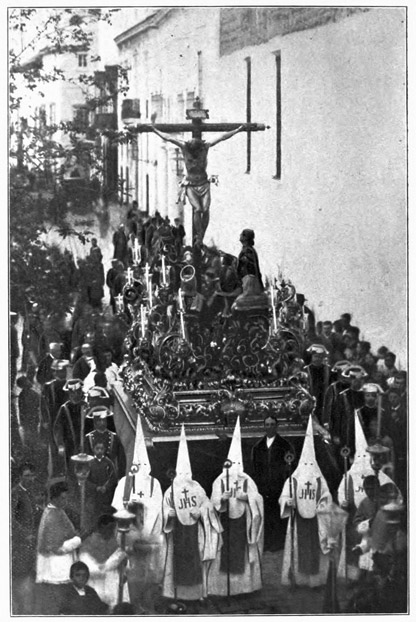
"Christ of the Seven Words"
I expressed my obligations, but entreated him to draw up the account and let me settle it then and there, as I was within twenty-four hours of departure. "And in travelling," I added apologetically, "it is difficult to send back money." At the obnoxious word he flung up hands and eyebrows. "Señora!" I left the shop, feeling vaguely that I had been guilty of a flagrant indelicacy, as well as black ingratitude. The catalogues, very slightly wrapped, arrived on the morrow, just in time to be thrust into my shawl strap, and I paid the bill amid the final agitation, so unfavorable to arithmetic, of porters and farewells.
I had worse fortune in trying to subscribe for a certain popular periodical. I went to the office in the designated business hours, to find that, of the three men who should have been there, one had already gone, one had not arrived, and the third had "stepped out for a little rest." The janitor left in charge, a sympathetic person who could not read nor write, thought if I would return on Sunday at my luncheon hour, there might be somebody there qualified to receive my subscription and address, but, he sagely added, "in this world we are sure of nothing."
Madrid possesses the Biblioteca Nacional with valuable manuscripts and something like one million books, handsomely housed, where arrangements are made for over three hundred readers, but here, as in the other Spanish cities, public libraries in the American sense of libraries largely used by the general public are practically non-existent. The bookstores, too, except for the latest Spanish publications, leave much to be desired. As a rule, one can get only the most meagre information concerning texts and editions of the national classics, and the supply of new French novels or new German plays is far less complete than the stock of Paris gloves and German cutlery. This last, so canny have the honest Teutons grown, is usually engraved Toledo.
In variety of weather, however, Madrid surpasses all expectations, furnishing the sultriest heat, the chilliest cold, the dustiest dust, and the most prodigious crashes of thunder and lumps of hail to be found in the meteorological market, and all these within a few hours of one another. But what with fans, braseros, balconies, horchaterias, an army of street waterers, and, most essential of all, an inexhaustible fund of good humor, the Madrileño contrives to live on friendly terms with his climate, although he dares not lay aside his cloak before "the fortieth of May."
Apart from bull-fights and riots, those rages of excitement that seem to indicate a periodical fevering of the southern blood, the Madrileño takes his pleasures with a dignified simplicity. The city is exceedingly rich in open squares, well-shaded parks, and long reaches of green promenade, and here, with several dozen cigarettes and a few coppers for water and agráz, he wiles the hours away, chatting with friends and admiring the ladies who roll past in spruce landaus. Over the gate of the social paradise of Madrid it must be written, "No admittance except in coaches," for a carriage seems essential to high life. Liveried coachman, rather than powdered butler, is the sine qua non. During the hot season this outdoor parade is in gay career at midnight, and whole families, babies and nurses included, may be seen gathered in festive knots around small refreshment tables, within sound of fountain spray and garden music. There are open-air concerts, and concerts in smoke-beclouded halls, greensward dances, and dances stepped on café tables among disordered clusters of bottles and glasses, and there is always the theatre, on which your Spaniard dotes.
In the winter season there is opportunity to enjoy classic drama at the Teatro Español, where the Bernhardt of Spain, "La Guerrero," supported by her grandee husband, Mendoza, holds sway. When I saw them they were using short farces of Cervantes and Lope de Rueda for curtain raisers to a romantic drama by Tirso de Molina and a modern society play by Echegaray. I saw them, too, in Zorrilla's singular dramatic version of "Don Juan," the only play allowed in Spanish theatres on the night of All Saints.
From March to November, however, the Teatro Español is closed, and there is little doing at the Teatro Real, an aristocratic temple of Italian opera. During the summer season the theatrical opportunities of Madrid are mainly limited to the popular zarzuelas, or operettas, four of which are usually given in an evening. Each theatre offers a new programme of these every night, but there is little of literary interest except, now and then, a taking trifle from the pen of Hartzenbusch or Echegaray.
The Madrid theatre recks naught of early risers. The opening vaudeville is seldom under way before nine o'clock; the house is cleared after each performance, and often the encores and repetitions prolong a popular zarzuela quite beyond the hour limit. On the other hand, if the audience is small, the opening piece may be cut down to the merest outline. I remember one such occasion when the boxes were so empty and the farce so familiar that the orchestra fairly chaffed the actors off the stage. "Enough, enough! Thou mayst withdraw!" chanted the lyric lover to an intruding servant. "And so mayst thou," called out a voice from among the violins. "I've told my passion to the stars," continued the actor in his most mellifluous tenor, making the distant love of the Spanish stage to a lady who was smiling frankly on the audacious fiddler. "Poor stars!" interpolated this worthy so sympathetically that everybody laughed, the singer wound up his transports in the shortest possible order, and the remaining scenes were hardly more than pantomime. But such was the universal good nature and indifference to business exactitudes, that neither artists nor ticket-holders took this curtailment of their rights in umbrage.
Among the excellences of Madrid must be counted her museos. The Armería, with its plumed and steel-clad warriors, all at tourney, is no mere lumber room of wicked old iron, as might have been expected, but a new canto of the "Faery Queene." The Museo Naval still smells of the boundless brine and Isles of Spicery. The Museo Arqueológico Nacional sweeps one, as on the magic carpet of Alhambra legend, through the entire tragedy of Spain. Here are the successive leaves of her strange picture-book—scratched, prehistoric flints, grass-woven Iberian sandals, rudely sculptured shapes in sandstone grasping wine cups that suggest whole Rubaiyats, Phœnician anchors, bronze tables of Roman laws, Moorish arabesques, mediæval altars, modern wares and fineries, while barbaric spoils of Peruvian idols, Mexican feather-shields, sacrificial stones, and figures of forest lords speak to the imagination of that vast colonial empire which rose out of a dream to melt again like very dreamstuff, leaving "not a rack behind." These I have seen, but there are twice as many more Madrid museums which I had not time to see, and which, I am told, are no less rich in rarities and no less effective in pictorial beauty of arrangement.
Of the art galleries, who can say enough? The supreme Museo del Prado so magnetizes pilgrim feet that it is hard to spare even a few hours for the Académia de Bellas Artes, with its grand Murillos and calm Zurbaráns, or the Museo de Arte Moderno, with its succession of canvases depicting scene upon scene of death, decay, murder, execution, starvation, battle, torture, frenzy. Whatever is most horrible in the story of the Peninsula—Juana the Mad staring at her husband's coffin, the bloody fall of the betrayed Torrijos and his band, the nobles of Portugal doing shuddering homage to the exhumed corpse of Inez de Castro, all that moves disgust, distress, dismay, seems flaunted here. The technique is French, but the subjects are Spanish. Many of the pictures have historical dignity and faithfulness, a few reproduce the modern national types, with a preference for bull-fighters and anarchists over fishermen and peasants, but one misses the spiritual beauty that went hand in hand with the spiritual terror of the older art. Do the Spanish painters of to-day derive only from Goya and Ribera?
The old-time popular ceremonies are fast fading out of Europeanized Madrid. Even the Christmas mirth is waning, though still on Noche Buena the Plaza Mayor is close set with booths, and the Infanta Isabel, muy Madrileña that she is, makes a point of driving through and heaping her carriage with fairings. On Twelfth Night, too, there are a few small boys to be seen scampering about the streets, looking for the arrival of the Magi. Every year drops something of the mediæval heritage, and it has fallen to my lot to chronicle the passing of one of Madrid's most ancient and comfortable rites. The principal saint days of June, July, and August are preceded by verbenas, or evening fairs, chief among these being the Verbena de San Juan, on Midsummer Night. Many a baby has a grand frolic this evening, rocked back and forth on his mamma's knees, laughing eyes to laughing eyes, while she dips her head to his and tickles his little neck with kisses in time to the ancient ditty:—
"Recotín, recotón! The bells of St. John! There's a festival on. Recotín, recotín, recotón!"
Far along the Prado gleam the busy fires over which are merrily bubbling the oiliest and brownest of buñuelos. The rows of lighted stalls, which have sprung up like mushrooms on either side of the promenade, present to the revelling, roving, shifting throng an amazing variety of tawdry knickknacks, ingeniously devised to meet no human want. As we drove slowly up and down, enjoying the scene, while beggars ran beside the carriage and hawkers darted out upon us with shrill cries, the "American girl" of our little group strove earnestly to find "something to buy."
The most useful and convenient article for a traveller that could be discovered was a pasteboard bull's head on a long stick, but her chaperon, mindful of trunk dimensions, discouraged this purchase so effectively that Little Boston gracefully made herself amends by presenting us all with images of St. John. These scandalously represented the Baptist as a ballet girl in short cotton-wool skirts and gilt ribbons, waving a banner with one hand and leading a two-legged lamb with the other.
As midnight drew near, carriages and foot-folk all pressed toward the stately Cybele fountain. It seems that there was once, in the Puerta del Sol, a magic spring whose waters, sprinkled at Midsummer Midnight on the most unlikely head, insured a wedding within the year. Trams and cabs, riots and bloodshed, drove the precious charm away to the Prado, even to this same Cybele fountain, which for many generations has continued to work bridal miracles. So recently as 1898, as soon as the clock in the tower of the stately Bank of Spain struck midnight, with wedding cadences lingering in its peal, eager feet went splashing through the broad marble basin, and the enchanted water, thrown by handfuls and cupfuls far out over the crowd, sparkled even on bald pates and wigs.
But alas for Madrid and her Midsummer Night's Dream! Some prosaic person got wet and tattled to the Alcalde. So when in natural agitation, on our only Verbena of St. John, we had persuaded the compassionate coachman to drive as close as close might be to the fountain, we encountered a bristling, unromantic railing, and outside of this a grim circle of police, frowning menace on that disconcerted host. Every moment more carriages, with veiled ladies and rheumatic gentlemen, dashed up, and the indignant crowd surged forward to the very buttons of authority. But midnight chimed in vain. One desperate graybeard vaulted over the railing, only to be hustled back with contumely. In general, however, that great press of people remained as meek as the lions of Cybele's chariot—a lack of spirit only to be accounted for by remembering that this midnight company was made up of the shamefaced and rejected, such an assemblage of blighted beings as, now that the last spell is snapped, earth will never see again. Even the decorous Cybele laughed in her marble sleeve.
So passes the old Madrid; but there is a new Madrid, of which a word still waits to be said.
XIV
A STUDY IN CONTRASTS
"Here you have them, the two Spains, unlike, antagonistic, squared for conflict." —Vida Nueva.
The world-old struggle between conservatism and advance is at its most dramatic point in Spain. The united forces of clericalism and militarism work for the continuance of ancient institutions, methods, ideas, and those leaders who do battle in the name of liberalism are too often nothing more than selfish politicians. But with all these odds against progress, it is making way. The mass of the people, kept so long in the darkness of ignorance and superstition, are looking toward the light. During my last week in Madrid I chanced upon two extreme expressions of these warring principles. The first was a royal and religious ceremony, the second a monster mass meeting,—the one intent on cherishing the past, the other clamoring at the gates of the future.
I was looking over the Imparcial as I took my coffee one morning, when my eye fell on an item to the effect that there would be capilla publica en Palacio at ten o'clock. A traveller learns to jump at opportunity. Public service in the royal chapel promised to be of interest, and half-past nine found me waiting, with a miscellaneous company of gentles and tatterdemalions, natives and foreigners, on the palace side of the Plaza de Armas, the expectant throng streaming far down the paved and covered way. We were well marshalled by soldiers, who kept the crowd in form of a long troop, and banded this by military lines, with gleaming bayonets. These bands, but a few feet apart, were effectual in preventing crowding and disorder, and when at last the doors were thrown open, a double rank of soldiers closed in before the portal as often as the entering file showed any tendency to press and hurry, and thus passed us through by small divisions, so that there was no unseemly struggling on the succession of bare, plain stairways that led to the upper galleries.
For "public service in the royal chapel," I was now to discover, does not mean that the public is admitted to the chapel itself. This is small, but very Spanish, with profusion of gilding, imposing altar, and frescoed saints, the characteristic splendor being tempered with a no less characteristic gloom, an effect enhanced by austere columns of gray marble. On days of public service, which are usually high feast days, three long galleries, forming three sides of a great quadrangle, are traversed by the court in passing from the royal rooms to the chapel door, and it is to these galleries only that the public is admitted. On such occasions the gallery walls are hung with richly colored tapestries from the magnificent collection of eight hundred pieces that enriches the royal Tapiceria.
The instant I crossed the threshold these tapestries blazed upon the eye, so dazzling in their beauty that it was difficult to grasp the general situation. Civil Guards, in gala uniform, each armed with a pike taller than himself, were stationed at intervals of about six feet all along these tapestried walls, holding the carpeted way open for the passage of the royal and ecclesiastical party. The public hastened to fill in the spaces left between the guards, so that when the dignitaries paced the length of the three galleries, they walked between continuous human lines of mingled soldiery and spectators. We were of various ages, sizes, colors, and quite as picturesque, take it all in all, as the slowly stepping group on which our eyes were focussed.
A division of the royal escort, marching with drawn swords, preceded the Queen Regent, a slight and elegant figure in white and heliotrope, her mantilla pinned with diamonds. She walked in royal solitude, with a bearing of majesty and grace, but her face had a hard and almost sour look, which of itself might account for her unpopularity. The King and the younger Infanta did not take part in the day's ceremony, but the Princess of Asturias followed her mother, a fresh-faced girl, charmingly dressed in white and blue, with pearls and turquoises. A respectful step or two in the rear of her niece, yet at her side rather than behind, came in rich green silk adorned with emeralds the stout, gray-puffed, easy-going Infanta Isabel, her broad, florid face beaming with affability. The guards had passed stern word down the line for all hats to be off, but there was no sign of greeting, so far as I saw, from the spectators to the royal party, except as now and then some happy Spaniard bowed him to the dust in acknowledgment of a nod, as familiar as a wink, from this popular Infanta.
The occasion of this stately function was the elevation of the Papal Nuncio to the rank of cardinal. He passed in all priestly magnificence of vestments and jewels, his red hat borne before him on a cushion. He was attended by the chief clerics of Court and capital, but even these gorgeous personages were outshone by the military and naval officers, whose breasts were a mosaic of medals, and whose headgear such erections of vainglory as to hush the crested cockatoo with shame. The Gentlemen of the Palace, too, were such peacocks in their glittering coats of many colors, their plumes and sashes, gold lace and silver lace, that the plump Ladies in Waiting, for all their pride of velvet, satin, and brocade, looked like mere hens in the wake of strutting chanticleers.
The American mind is ill prepared to do homage to the dress parades of European courts, and I laid by the memory to laugh over when I should have reached a place and hour where laughter would be inoffensive. As the Diplomatic Corps, in its varied costumes, came trooping on, twice a whisper ran along the gazing lines. "The Turk!" and the traditional enemy of Spain limped smilingly past, a bent, shrewd-faced old Mussulman, whose Oriental finery was topped by the red fez. "The Yankee!" and Spain's latest adversary strode by in the person of the newly arrived United States Minister, decorously arrayed in dress suit and a Catholic expression.
The chapel doors closed on this haughty train, and we, the invited public, cheerily proceeded to pass a social hour or two in chat and promenade and in contemplation of the tapestries. Even the Civil Guards unbent, dancing their babies, lending their pikes to delighted urchins, and raising forbidden curtains to give their womenkind furtive peeps into the royal apartments. Most astonishing was the maltreatment of those priceless tapestries. Small boys, unrebuked, played at hide and seek under the heavy folds, old men traced the patterns with horny fingers, and the roughest fellows from the streets lounged stupidly against them, rubbing dirty-jacketed shoulders over the superb coloring. The most splendid series displayed was from a master-loom of the Netherlands, illustrating the conquest of Tunis by Charles V—marvellously vivid scenes, where one beholds the spread of mighty camps, the battle shock of great armies and navies, and, like shrill chords of pain in some wild harmony, the countless individual tragedies of war. The scimitar of the Turk flashes down on the Spanish neck, while the upturned eyes are still too fierce for terror; the turbaned chief leans from his gold-wrought saddle to scan the severed heads that two blood-stained sons of the prophet are emulously holding up to his survey, hoping to recognize in those ghastly faces enemies of rank; white-robed women on the strand, their little ones clinging to their knees, reach arms of helpless anguish toward the smitten galley of their lords, who are leaping into the waves for refuge from the Christian cannonade.
I wondered how the Turkish Minister liked those tapestries, as his stooped-back Excellency passed in conference with a Chinese mandarin, who must have studied his costume from a teacup. For we had all been hustled into rows again to make that human lane through which the Royalties and the Reverends returned from their devotions. I was facing a quaint old tapestry of Christ enthroned in glory, with the beasts of the Apocalypse climbing over Him like pet kittens, and this so distracted my attention that I omitted to ask the amiable Infanta Isabel, who would, I am sure, have told anybody anything, what had taken place. But I read it all in the Epocha that evening—how her Majesty with her own august hands had fitted the red hat to the Nuncio's tonsured head, and how the new-made cardinal had addressed her in a grateful oration, praising her virtues as manifested in "the double character of queen and mother, an example rich in those peculiar gifts by which your Royal Grace has won the veneration and love of the noble and chivalrous Spanish people, the especial affection of the Father of the Faithful, and the respect and sympathy of all the world." For her and for the youthful monarch of Spain he invoked the favor of Heaven, and uttered a fervent hope that the cup of bitterness which this most Catholic nation had bowed herself to drink might be blessed to her in a renewal of strength and a reconquest of her ancient preëminence among the peoples of the earth.
The most significant expression of "new Spain" that I encountered in Madrid was a mass meeting—a rare and novel feature in Spanish public life. I blundered upon it as foolishly as one well could. The second day of July was the first anniversary of the founding of a daring Madrid weekly, the Vida Nueva, to which, attracted by its literary values, as well as its political courage, I had subscribed. The sheet is usually issued Sunday, but as I was on the point of going out one Saturday afternoon my Vida Nueva arrived, accompanied by two non-committal tickets. They gave entrance to the Frontón Central, "only that and nothing more." I called one of the pretty señoritas of the household into council, and she sagely decided that these were tickets to pelota, the Basque ball game, played in one or another of the various Madrid halls almost every summer afternoon. It seemed a little too considerate in the Vida Nueva to provide for the recreation of its subscribers, but I was growing accustomed to surprises of Spanish courtesy, and tucked the tickets away in a safe corner. The folded newspaper rustled and whispered, and finally fluttered to my feet, but I was eager to be off, and, after the blind fashion of mortals, put it by.
It was my privilege to dine that day with two compatriots, and one of these, who knows and loves Spain better than many Spaniards do, began at once to tell me of that most unusual occurrence, a Madrid mass meeting, to take place this very evening. Of course we resolved to go, although my friend's husband was not in the city, and no other escort would countenance so harebrained an expedition. For the street to which this valiant lady led the way was choked with a flood of men surging toward an open door. The hall for the "meeting," a word which the Spanish language has fully adopted, was the Frontón Central, and admission was by ticket. Light dawned on my dim wits, and, while my two companions, with dignified and tranquil mien, stood themselves up against the outer wall, I besought a leisurely cabman, who insisted on waiting to pick up a little ragamuffin clamoring for a ride, to drive me in hot haste to my domicile. Here I searched out the tickets, put away only too carefully, and took a fleeting glance at the Vida Nueva, which urged all "men of heart" to celebrate the eve of its anniversary by their presence at this mass meeting.
I had not realized that there were so many men of heart in Madrid. The street on my return was worse than before. The cabman objected strenuously to leaving us in these tempestuous surroundings, and, since there were only two tickets, we two elders of the trio agreed that the American girl was all too young for such an escapade, and forthwith despatched her, under his fatherly care, to the hotel. Then came the tug of war. We saw men fighting fiercely about the door, we heard the loud bandying of angry words, we were warned again and again that we could never get through the jam, we were told that, tickets or no tickets, ladies would not, could not, and should not be admitted; it was darkly hinted that, before the evening was over, there would be wild and bloody work within those walls. But we noticed a few other women in the throng, and decided, from moment to moment, to wait a little longer, and see what happened next. Meanwhile, we were almost unjostled in the midst of that excited, struggling crowd, often catching the words: "Stand back there! Don't press on the ladies! Leave room!" And when it came to the final dash we had well-nigh a clear passage. Our tickets gave access only to the floor of a big, oblong hall, closely packed with a standing mass of some ten thousand men; but a debonair personage in authority conducted us, with more chivalry than justice, to the reserved boxes in the gallery, where we occupied perfect seats,—for which other people probably held tickets,—in the front row, overlooking all the house.
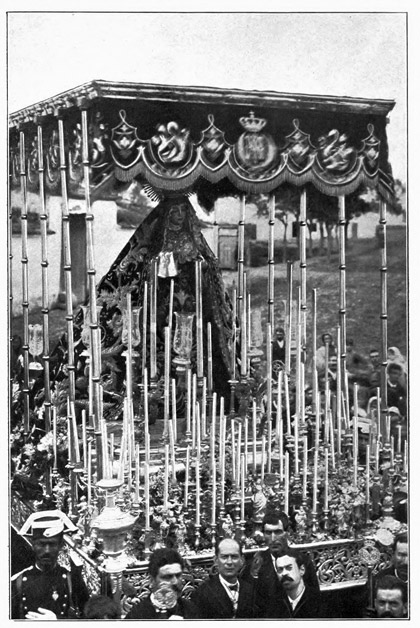
Maria Santisima
So much for Spanish indulgence to audacious womenfolk. But as to the meeting itself, what was it all about? In Spain one word suffices for an answer. Montjuich has become a Liberal rallying cry, although the movement is not bound in by party lines. It is the Dreyfus affaire in a Spanish edition. The Castello de Montjuich is a strong fortress, with large magazines and quarters for ten thousand soldiers. It is built on a commanding height, the old Mountain of the Jews, just outside Barcelona, and has again and again suffered bombardment and storm. But in this latest assault on Montjuich the weapons are words that burn and pens keener than swords. It was on the seventh of June, 1896, that the famous bomb was exploded in Barcelona. It was taken for an Anarchist outrage, and over two hundred men, including teachers, writers, and labor leaders, were arrested on suspicion. Nearly two months passed, and, despite the offer of tempting rewards, no trace of the culprits had been found. In the Fortress of Montjuich the guards deputed to watch the prisoners, acting more or less under superior authority, which itself may have been influenced by Jesuit suggestion, began on the fourth of August to inflict tortures upon the accused for the purpose of extracting evidence. The trials were by military procedure, power sat in the seat of justice, and innocent men, it is believed, were condemned on the strength of those forced confessions—mere assents, wrung from them by bodily agony, to whatever their guards might dictate. But many persisted in denial, and in course of time a number were released, maimed, in certain cases, for life. Others were shot, and a score still lay in prison. The fortress dungeons are deep and dark, but little by little the cries and groans of the "martyrs of Montjuich" penetrated the dull stone and sounded throughout Spain.
On the fourteenth of May, last year, the Vida Nueva, this bold young periodical in the van of the Liberal cause, brought out an illustrated number devoted to "The Torments of Montjuich." Other periodicals sprang to its support and kept the Government busy with denunciations, while they vehemently called for a revision of the judicial process, with the hope of releasing the men still under sentence and clearing the names of those who had perished. Mass meetings to urge such revision, which could be accorded only by vote of the Cortes, were held in Barcelona, Saragossa, Valencia, Santander, and other principal cities, all demanding revision in the sacred names of patriotism, humanity, and justice.
Our Madrid mass meeting was of chief consequence in impressing the Government with the weight of popular opinion. The swaying multitude was called to order at quarter of ten by Señor Canalejas, who introduced a notable array of speakers. There were representatives of labor, of republicanism, of the press, a Catalan charged with a greeting from Barcelona, the champion of Spanish Socialism, Pablo Iglesias by name, and great men of the nation, Azcárate, Moret, and Salmeron. Spanish eloquence at its best thrills the blood to wine, and the swift succession of orators, fourteen all told, played on the vast audience like master artists on a murmurous organ. Yet there was no disorder. A generous and grateful hearing was accorded the Count of Las Almenas, who frankly declared himself a conservative in politics and an apostolic Roman Catholic in religion, but in the name of both these creeds a lover of justice and humanity. Since for these he ever held himself ready to do battle in the Cortes, he gave the meeting his pledge that he would support Azcárate in the motion for revision.
But the wrath and grief of the audience could hardly be controlled when one of the released prisoners took the platform to recount the horrors of Montjuich. He told of dungeons with earth floor and one grated window, of savage guards determined to gain the crosses and pensions promised to those who should extract evidence. He told how the helpless captives, weakened by confinement, were tortured with cords, whips, sleeplessness, hunger, and thirst. Bound as they were, water was held before their parched mouths, with the sinister words, "Confess what we bid you, and you shall drink." When the famished men begged for food, they were answered with the lash, or, more fiendishly, with shreds of salt codfish, which increased their thirst a hundred fold. One man in his desperation sprang to the lamp and quaffed the dirty oil. They licked the moisture from their dungeon walls. They thrust white tongues through the grating to catch the drops of rain. Soon the guards proceeded to more violent torments, wrenching, burning, and probing the quivering flesh with a devilish ingenuity of torture, making a derisive sport of their atrocious work. One of the victims went mad while undergoing torture by compression of the head. Others, on hearing the coming steps of the guards, strove to escape their cruel hands by suicide. One drank a bowl of disinfectant found in his cell, one beat his forehead against the wall, one strove to drive a rusted nail into his heart.
It was a frightful tale to hear. I looked across the hall to where a Spanish flag was hung. Yellow wax is funeral wax, and Alarcón, who sees in yellow a symbol of death and of decay, laments that it is the color of half the Spanish banner. "Ay de la bandera española!" But surely there is hope for Spain, while she has sons who, in grasp of a military tyranny which has rendered such crimes possible, contend in open field for the overthrow of the "black Spain" of the Inquisition, and still bear heart of hope for a white, regenerated Spain, where religion shall include the love of man.
XV
THE PATRON SAINT OF MADRID
"Labré, cultivé, cogí Con piedad, con fe, con celo, Tierras, virtudes y cielo."
Spain seems actually skied over with the wings of guardian angels. The traditional tutelar of the nation, Santiago, counts for less, especially in the south and centre of the Peninsula, than might be expected, and was long since officially superseded by the Virgin; but cities, hamlets, families, individuals, all have their protecting saints. Some are martyrs, some bishops, some apostles, while Cordova rests secure beneath the shining plumes of the angel Raphael. Towns and townlets hold festivals for their celestial patrons, honoring them with fairs, horse-races, processions, dances, and whatsoever else may be appropriate to the season and characteristic of the locality, as ball games, bull-fights, or even a miracle play. Only Seville, mirth-loving Seville, who makes holiday on the slightest provocation, can never invite her two beautiful guardians, Santa Justa and Santa Rufina, to a jubilee. These holy maidens used to keep a pottery booth in Triana, now the gypsy quarter of the city, where, refusing to worship the Roman Venus, they won the crown of martyrdom. But their industrious habits cling to them still, and, by night and by day, while the centuries pass, they uphold the Giralda. An anointed vision, like Murillo's, may see their graceful forms hovering in mid-air on either side of the famous tower, which their strong brown arms hold firm even in tempests. If the ladies should let go, the Giralda would fall, and so the Sevillians are driven to the ungallant course of ignoring these really useful patrons and gadding off to adjacent towns whose saints are at leisure to be entertained.
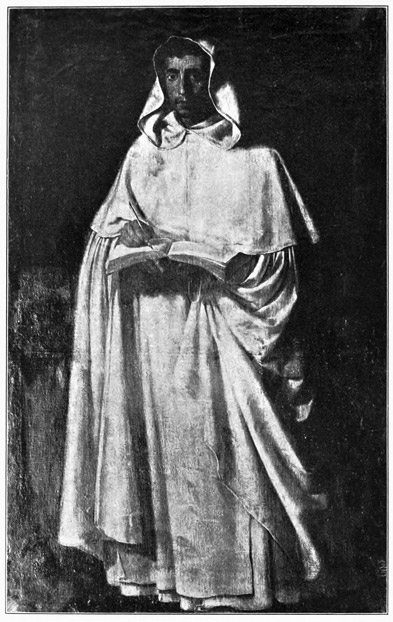
A Spanish Monk
By the eternal contradiction that prevails in all things Spanish, it has come to pass that Madrid, the elegant capital and royal residence, is under the guardianship of a peasant saint. Here, in the eleventh century, Isidro was born, say the priests, of poor but Catholic parents. If not precisely a hewer of wood and a drawer of water, he was next door to that humble estate, being a digger of wells and cellars. He dug with such piety that God aided him by miracles, causing troublesome rocks to melt like wax at the touch of his spade, and springs of healing water to leap in the pits of his fashioning. He was a tiller of the ground, besides, a hireling farm servant, whose agricultural methods, though seemingly irregular, caused his master's granaries to overflow. As he went to the fields in the fresh spring mornings, the young Isidro would scatter handfuls of seed for the birds, saying, "Eat, God's little birds, for when our Lord looks forth in dawn, He looks upon us all." And as he dropped the wheat and barley in the furrows, ever he murmured, "This for God, and this for us; this for the birds, and this for the ants." "For the ants, too?" mockingly asked the rustics who planted beside him, but Isidro steadfastly replied, "For the ants, too, since they are God's ants, and His royal bounty is for all His household." No wonder that the Almighty had Isidro's fields in special charge, sending sun and rain in due season that the harvest might suffice for every claimant. Such divine care was the more necessary, because this dreamy plough-boy spent most of his time in the churches, or on his knees in the shadow of the fruit trees, until his profane companions called him Lazybones.
Isidro was no effective patron of Madrid as yet, but ran away from the Moors, when they invaded the city, finding farm service in a neighboring village. Here he married a maiden whose lovely soul, according to Lope de Vega, shone through her guileless face like a painting through its glass. She was no less devout than her husband, and went every evening to trim the altar in a lonely shrine of the Virgin. There was a stream to be crossed on the way, and in times of freshet Our Lady would appear in person and lead her by the hand over the tops of the waves. Such dainty stepping as it must have been! And once, when Isidro accompanied his wife, they both crossed in a boat suddenly improvised from her mantilla, which was not a thread the worse for the experience.
The miracle-working power that developed in San Isidro was first exercised, as became a farmer, on suffering beasts and bad weather. His early influence over water grew more and more pronounced, rain refreshing the thirsty fields at his bidding, and medicinal fountains gushing from rocks at the stroke of his hoe. And when, one sunshiny morning, his wife let their baby boy slip from her arms into the depths of the well and ran in distress to her husband, the saint, who for once was working on the farm, did not scold her, as the priestly authors seem to think would have been the natural course, but calmly said, "My sister, what is there to cry about?" And when, after a season of prayer, these exemplary parents proceeded to the well, its waters had risen to the brink, lifting the little John, as on a silver-tissue cushion, safe to their embrace. Isidro still retained his youthful peculiarities as a laborer, often praying all day long in the churches, while his yoke of oxen did the ploughing just as well without him. On one occasion, when he arrived too late for mass, the gates of heaven opened to his vision, as he knelt before the closed church door, and he was permitted to witness a celestial mass, where Christ was both priest and wafer, with choirs of angels chanting the holy service. Even his charities cost him little, for when the olla of vegetables and fish, that his wife made every Saturday for the poor, had all been eaten, a word from Isidro was enough to replenish the pot. If he emptied his sack of corn on the snow for a flock of hungry pigeons, the sack was full when he reached the mill; and when he threshed his master's wheat a second and a third time for the beggars, the very chaff turned into golden grain.
His best quality, which almost makes his cult desirable in Spain, continued to be his love for animals, especially for birds. These sang their sweetest songs as he passed by, and often flew down from the poplar branches to brush their little wings against his blouse. And he, who had raised his master's daughter from the dead, did not disdain to work miracles of healing and of life on maltreated horses. Madrid would do well to give her guardian saint a season ticket to the bull-ring. Even the despised and cudgelled ass had a share in his protection. A sacrilegious wolf that thought to make a meal of Isidro's donkey, left to graze outside a church where the saint had gone to pray, was struck dead—perhaps by the donkey's heels. This kindly rustic, who had separated from his wife for greater sanctity, died on St. Andrew's Day and was buried in the cemetery of St. Andrew's Church in Madrid. Such sepulture was not to his liking, and twice his ghost appeared to ask that the body might be removed to the church, as was presently done, all the bells of St. Andrew's ringing of their own accord to give it welcome. The tomb immediately began to work miracles, and Isidro became such a favorite with the people that when, in 1212, a shepherd guided Alfonso VIII, lost with his vanguard in the wild passes of the Sierra Morena, to the great battle of Las Navas de Tolosa, where the armies of the Holy Cross broke forever the dominion of the Moors in Central Spain, nothing would do but the story that this shepherd was Isidro himself. Above the tomb of the saint a chapel was erected, perhaps by Alfonso, perhaps by Isabel la Católica. There seems to be a conflict of authorities here, but all testimonies agree that the angels used to come down and sing in the chapel Saturday afternoons.
Madrid formally accepted Isidro as patron in the summer of 1232, when the labors of the husbandmen, on the point of perishing from drought, were saved by the body of the Holy Peasant, which, borne in priestly procession, called down floods of rain; but it was not until the times of Philip III, some four centuries later, that the actual canonization of Isidro was granted by Rome. On May 15, 1620, the Plaza Mayor, that handsome square which has been the theatre of so many tournaments, executions, and autos de fe, the scene, two years later, of the beatification of Loyola, was inaugurated by a splendid festival in honor of San Isidro. From that day to this his worship has not waned. The miracle-working bones, which were carried to the bitter death-bed of Philip III, and comforted the passing of the great and generous spirit of Charles III, are still held to be more potent than physicians. Churches, oratories, and chapels have been built to him all over the Peninsula, the Franciscan Friars founded a convent of San Isidro in Rome, and his name is a part of our new geography lesson in the Antilles and the Philippines. Only four years ago his urn was borne in penitential procession through Madrid, with double supplications for rain on the parched country, and for a swift and happy ending of the Cuban war. All priestly, military, civic, and governmental pomp went to make up that stately escort, the ladies of Madrid showering the train as it passed beneath their balconies with flowers, poems, and confetti. The saint did what he could. The procession had been so skilfully timed that the rains began that very night, but the Cuban war was a matter out of his province. His dealings had always been with water, not with blood.
There is significance in this devotion of proud Castile to San Isidro. Spain is essentially as democratic as America. Her proverbs tell the story: "Many a man gets to heaven in tow breeches;" "Do what your master bids you, and sit down with him at table;" "Nobody is born learned, and even bishops are made of men;" "Since I am a man I may come to be Pope;" "The corpse of the Pope takes no more ground than that of the sacristan;" "Every man is the son of his own works."
"Said the leaf to the flower: 'O fie! You put on airs indeed! But we sprang, both you and I, From the selfsame little brown seed.'"
Pedler, porter, beggar treat you as social equals and expect a full return of courtesy. It is told in Madrid how a great diplomatic personage not long ago was eating his picnic luncheon in a hired carriage. The driver, lunching also, leaned back from his seat, clinked glasses, and drank the gentleman's health. The dignitary glared with astonishment and wrath. "Man! I am the Imperial Ambassador of Nation So-and-So." "What of it?" returned the driver, taking another bite of his peppery Spanish sausage; "I am the Head Hostler of Stables Such-and-Such."
Again and again, in recent times as in ancient, have the rank and file of the Spanish nation asserted their dignity of manhood. An edict of Charles III, forbidding the Madrileños to muffle themselves in their beloved long cloaks and hide their faces under their big slouch hats, raised a furious riot in the capital. Should a king dictate the fashion of a man's garments? And when the stupid weakness of Charles IV and the baseness of his son Fernando had delivered Spain over to Napoleon, when French armies held her fortresses, and Murat, with twenty-five thousand troops, ruled Madrid by logic of steel and iron, it was the Spanish people who, from Asturias to Andalusia, sprang to the defence of a country abandoned by princes, councils, and grandees. The Spanish people, not the Spanish nobles, preserved the independence of the nation and actually broke the career of the Corsican conqueror. The Italian king, Amadeo, so much better than his fortunes, was welcomed at Valencia in 1871 with simple verses, spoken by a child, that breathe even from their opening stanza this native spirit of democracy:—
"The High Lord of the Heavens Created men one day, All mortal and all equal, All shapen out of clay; For God recked not of nations, Of white and black and brown, But on His human children Impartially looked down."
It is not then so strange as it appears at first hearing that a Piers Plowman should be patron of Madrid.
From Alfonso VIII to Alfonso XIII, a matter of some seven centuries, Isidro has been in high repute with royalty. The "Catholic Kings" made him rich gifts; Philip II, bigot of bigots, cherished an especial veneration for the ghostly protector who had brought his delicate childhood safely through smallpox and epileptic seizures; the passion-wasted Philip IV did him public homage; Charles the Bewitched made a solemn progress to his shrine to thank him for recovery from illness; even the bright young Bourbon, Philip V, had scarcely arrived in Madrid before he hastened to worship the efficacious body of San Isidro. The urn has been opened at intervals to give their successive Majesties of Spain the grewsome joy of gazing on the bones, and it has been the peculiar privilege of Spanish queens, on such occasions, to renew the costly cerements. The devotion of the present regent to these relics keeps pace with that of her predecessors.
Where royalty leads, aristocracy is swift to follow, and Isidro has a gorgeous wardrobe of embroidered standards, palls, canopies, burial cloths, and everything that a skeleton could require, but "for a' that and a' that" the laboring people of Castile never forget that the Canonized Farmer especially belongs to them. His fortnight-long fiesta is the May outing of the rustic population all about Madrid.
We will start on this pilgrimage from the Puerta del Sol, because everything in Madrid starts from the Puerta del Sol. From this great open parallelogram in the centre of the city, surrounded by lofty hotels and Government buildings, bordered with shops and cafés, brightened with fountains, thronged with trams, carriages, people, always humming with voices, always surging with movement, run ten of the principal streets of the capital. The Alcalá, most fashionable of promenades, and San Jerónimo, beloved of wealthy shoppers, conduct to the noble reaches of parks and paseos in the east; the handsome Arenal and historic Calle Mayor lead west to the royal palace, with its extensive gardens known as the Campo del Moro; Montera, with two less elegant avenues, points to the north, where one may find the university, the Protestant churches, and the tragic site of the Quemadero; and three corresponding streets open the way to the south, with its factories, hospitals, old churches, and world-famed Rastro, or rag fair.
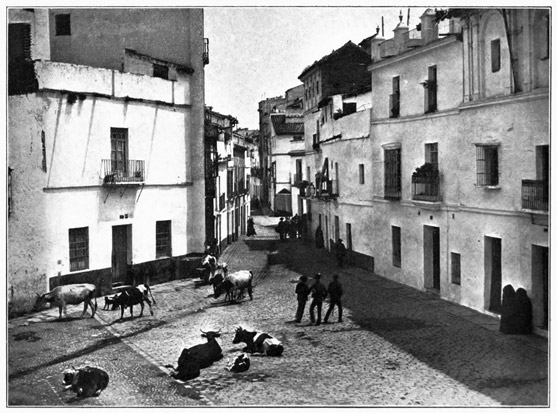
A Seville Street
But during the early days of the Romeria, which begins on May 15, all the throbbing tide of life pours toward the southwest, for the goal of the pilgrimage, the Hermitage of San Isidro, built over one of his miraculous wells by the empress of Charles I, in gratitude for a cure experienced by her august husband after drinking of the waters, stands on the farther bank of the Manzanares. The trams, literally heaped with clinging humanity, pass out by the Calle Mayor and cross the Plaza Mayor. The innumerable 'buses and cabs make a shorter cut, but all varieties of vehicle are soon wedged together in the broad thoroughfare of Toledo. Here we pass the big granite church of San Isidro el Real, once in possession of the Jesuits, but on their expulsion from Spain, in 1767, consecrated to the Santo Labrador. His body was borne thither, with all solemn ceremonial, from the chapel in St. Andrew's; and his poor wife, who had also been sainted, by a courteous Spanish afterthought, under the attractive title of Maria de la Cabeza, Mary of the Head, was allowed to lay her celebrated skull beneath the same roof,—a greater liberty than he had permitted her during the latter half of their earthly lives. The Madrid Cathedral, hard by the royal palace, is still in slow process of building, the work being hampered and delayed for lack of funds, although her Majesty sets a devout example by contributing $300 a month. Meanwhile, San Isidro el Real serves as the cathedral church of the diocese.
This Calle de Toledo, where Isidro dug several of his medicinal wells, is always gay with arcades and booths and drapers' shops; but now, during the Romeria, it is a veritable curbstone market, where oranges, sashes, brooms, mantles, picture frames, saucepans, fiddles, mantillas, china, jackets, umbrellas, fans, dolls, bird-cages, paintings of saints, and photographs of ballet dancers are all cried and exhibited, hawked and held under nose, in one continuous tumult.
As we approach the bare mass of masonry known as the Gate of Toledo, we cast, for all our festival mood, a clouded glance in the direction of the barbarous slaughter-houses of Madrid. Here the stronger beasts are blinded by the thrust of darts, and also hamstrung, to render them helpless under the deliberate butchery of their tormentors, who often amuse themselves by a little bull-fight practice with the agonized creatures before striking the final blow—a place of such atrocious cruelties that even the seasoned nerves of an Austrian surgeon recently visiting it gave way, and he fainted as he looked. There is work for San Isidro here.
The jam of equipages on the Bridge of Toledo gives us abundant time to observe the statue of the Holy Peasant, in a stone niche, lifting his baby from the well, and the companion statue of Mary of the Skull. And there is the Manzanares to look at, that sandy channel along which dribble a few threads of water—threads that the washerwomen of Madrid seek after like veins of silver. Small boys are wading from one bank to the other, hardly troubling themselves to roll up their trousers. It is said that Philip IV, surveying his pompous bridge across the Manzanares, was wickedly advised by one of his courtiers to sell the bridge or else buy a river. It is a curious bit of irony to hold the festival of the Water Saint beside a river bed almost as dry as his bones.
But the crowd has now become so mad and merry that it distracts attention alike from architecture and physical geography. Will all the dexterity of foot-police and mounted guards ever succeed in disentangling this snarl of equipages? Who cares? Everybody is laughing. Everybody, too, is helping, so far as lungs can help. A daring Aragonese, with a blue and white checked handkerchief knotted about his head and a scarlet blanket over his shoulders, tries to dash across the bridge and rejoin his screaming children. He stumbles before a jovial omnibus, whose four horses, adorned with beribboned straw hats, gaze coyly out from under the torn brims like so many metamorphosed Maud Mullers. A distant guard roars a warning. The crowd bellows in sympathy. A liveried coachman rears his spirited pair of bays. A cock-hatted gypsy, with half his tribe packed into his cart, tries to follow suit, and tugs savagely at the stubborn mouths of mules whose heads are liberally festooned with red and green tassels. In front of these safely passes the Aragonese, only to bring up against the great wheel of a picnic wagon, whose occupants, mostly señoritas in the sunrise Philippine shawls, thrust out their pretty heads, all crowned with flowers instead of hats, and rain down saucy salutations. The crowd chimes in with every variety of voluble impudence. He catches at the long gold fringe of the nearest shawl, saves himself from falling at the price of a shriek of wrath from the señorita, plunges desperately on, is struck by a cab horse, the poor beast being half blinded by the tickling plumes that droop over eyes and nose, and amid volleys of ridicule and encouragement reels to the shelter of the sidewalk. But a very precarious shelter it is, so narrow that the lads are positively obliged to fling their arms about the lasses to hold the fluttering skirts back from peril of wheels and hoofs. Everywhere what audacity, what fun, what color, and what noise! Troops on troops of foot travellers, usually in family groups, and often stained with the dust of an all-day tramp! The wives generally carry the hampers, and the husbands sometimes shoulder the babies. Squads of young fellows frolic along, each with his supply of provisions tied up in a gaudy handkerchief. The closer the nudging the better they like it; a slap from a girlish hand is almost as good as a kiss. Isidro knew all about it in his day. But this clownish jollity grows rougher and rougher, and the crack and sting from a coachman's whip tempt a reply with the pilgrim's staff. The guards, hoarse and purple, wipe their dripping brows. It is early afternoon yet, too, and the larking and license are as nothing to what may be expected before midnight.
It is a little better when, at last, the bridge is left behind. Turning to the northwest, the dusty road runs on beside the river and beneath the bluffs lined with rowdyish folk, who shout down greetings to their acquaintances and compliments to the ladies, toward the ermita. A certain Juan de Vargas, riding over this same route one day, lifted his eyes to the uplands to see how his farm-hand, Isidro, was getting on with the ploughing. Blessed Isidro! Before and after went two stalwart young angels, still in shining white, each driving a celestial yoke of oxen.
Times have changed. The sight that greets our eyes is emphatically human—a great country fair, a pandemonium of rude, good-natured revelry. The beggars who have been chasing the carriage, the cripples outstripping the rest, thrust withered arms, ulcerous legs, and all manner of profitable deformities into our very faces as we alight, even clutching at the coins with which we pay the coachman. We make our way, as best we can in the rough press, between two rows of booths toward the church. There is the usual Spanish variety of penny toys on sale—balls, baskets, whips, kites, jumping-jacks, balloons, and every other conceivable trifle admitting of the colors red and yellow. But the great traffic is in those articles especially consecrate to San Isidro—frosted cakes, probably made after the recipe of Maria de la Cabeza, clay vessels of every shape and size for carrying away the healing waters, and, first and foremost, pitos, or whistles. The priests would have us believe that San Isidro was forever droning psalms, but ploughmen know a ploughman's music, and the sacred whistles lead the sales in the Romeria. It is impiety not to purchase at least one of these, and the more devout you are, the more pitos will you buy. The Infanta Isabel, aunt of his Little Majesty, fills her emblazoned coach every year with these shrill pipes in all their variety of queer disguises—fans, birds, puffing grotesques, and, above all, paper flowers. He is no lover worth the having who does not bring his sweetheart a San Isidro rose with a pito for a stem. The ear-torture of an immense fair-ground delighting in an infinity of whistles may be left to the sympathetic imagination. We cling to the memory of Burns, and bear for his bonny sake what we could hardly endure for any such sham laborer as Isidro.
The hearing is not the only sense to do penance in this pilgrimage. The Water Saint has never thought to work a miracle of cleanliness upon his peasant votaries, and the smell that bursts out upon us from the opening doors of the church might put us to flight, were flight still possible. But, caught in the human current, we are swept on into the gilded, candle-lighted, foul-aired oratory, with its effigies of Santo Labrador and Santa Labradora. All day long the imperious ringing of the bell at the shortest of intervals has been calling one company of the faithful after another up the bare brown hill to that unventilated temple. When there is no squeezing room left for even a dwarf from the pygmy show, the doors are closed, the bell is silenced, and the rustics are marshalled in rapid procession before the altar, where they pay a penny each, receive a cheap print of San Isidro, and kiss the mysterious, glass-cased relic which a businesslike young ecclesiastic touches hastily to their lips. The frank sound of the kissing within is accompanied by the tooting of pitos without. We stand at one side, looking at the priests and wondering how their consciences are put together, but half ashamed to watch with heretic eyes the tears of joy, the fervors of prayer, the ecstasies of faith, that are to be seen in many of these simple, passionate faces filing by. Here comes a little girl treading as if on air and clasping her picture of the saint to her lips, brows, and heart with such abandon of delighted adoration as one must go to Spain to see.
Released from the Hermitage, we fill our lungs with sweeter breath, give skirts a vigorous shake in the vain hope that we may not carry away too many deserters from the insect retinue of our recent associates, and turn down toward the river. Our short cut leads us among heaps and heaps of bales packed with the graceful clay jars. How many an anxious mother will trudge her weary miles across this dry Castilian steppe, bearing with all her other burdens a botija of the healing water to some little sufferer at home! Wonderful water, warranted to make whole the lame, the blind, the deaf, the dumb, and put to rout all ills that flesh is heir to, especially fevers, tumors, erysipelas, paralysis, and consumption! It is as potent to-day as when it first gushed from the earth at the bidding of the young Isidro, for did it not work a notable cure, as late as 1884, on the Infanta Doña Paz de Bourbon, sister of Alphonso XII?
We linger a few minutes at the edge of the bluff, looking down upon the animated scene below, from which rises the hum as of an exaggerated beehive. The long green stretch of valley meadow is one wave of restless color. Thickly dotted with booths for refreshment, for sale of the San Isidro wares, for penny shows, farces, wax figures, and all manner of cheap entertainments, it still has space for dancers, wrestlers, pelota players, for swings, stilts, and merry-go-rounds, and, above all, for the multitude of promenaders, sleepers, and feasters. The bright May sunshine gleams and dazzles on the soldiers' helmets, flashes out all the hues and tints of the varied costumes, and even lends a grace to the brown patches on the browner tents. The tossing of limbs in the wild, free dances, the flutter of the red and yellow flags, the picturesque grouping on the grass of families, complete to dog and donkey, around the platter of homely fare and the skin bottle of wine—all this makes a panorama on which one would gladly gaze for hours.
Going down into the heart of the festivity, the interest still grows. We enter one of the cleanest cantinas and invest a peseta in a bottle of sarsaparilla, not for our own drinking, having seen the water in which the glasses are washed, but as a protection against the horde of beggars and the gypsy fortune tellers. It works like a charm. As we respond to the whining appeals with the civilities of social greeting and an offered glass of our innocent beverage, the ragged petitioners are straightway transformed into ladies and gentlemen. They draw themselves erect, quaff the cup to our long life and happiness, discuss in self-respecting tones the weather and the fête, and then, without another hint of solicitation, bid us courteous farewells. We mean to take out a patent on the sarsaparilla treatment of Spanish mendicancy.
The tent itself is, like the rest, shabby and tumbledown, furnished with rough tables and benches, where cadets are playing dominos as they drink, and two country sweethearts are delectably eating what appears to be a sardine omelette off the same cracked plate. A clumsy lantern hangs overhead, racks of bottles are fastened up along the canvas walls, and all about the trampled earth floor stand water jars, great bowls of greens, and baskets of the crusty Spanish bread. A pale young Madrileño drops in for a glass of wine, but before indulging has the shy little rustic who serves him take a sip, languidly begging her, "Do me the favor to sweeten my drink." The yellow cigarette-stains show on his white fingers as he pats her plump bare arm. The child, for she is scarcely more, and as brown as an acorn, responds to these amenities by giving the smiling exquisite alternate bites of her hunk of goat's-milk cheese, while her mother keeps a sharp eye on them both.