Introductory material (continued 6)
Reading edition
This is the first Velázquez celebration which has had universal recognition. The painter was hardly known to Europe at large until the day of Fernando VII, who was induced by his art-loving wife, Isabel of Braganza, to send the pictures from the royal palaces, all those accumulated treasures of the Austrian monarchs, to the empty building, designed for a natural history museum, in the Prado. This long, low edifice is now one of the most glorious shrines of art in the world. It is a collection of masterpieces, showing the splendors that are rather than the processes by which they came to be. There is only one Fra Angelico, but there are ten Raphaels and four times as many Titians. In the Netherlands, no less than in Italy, the Spanish sway gathered rich spoils. There are a score of Van Dycks, threescore of those precious little canvases by Teniers, while as for Rubens, he blazes in some sixty-four Christian saints, heathen goddesses, and human sinners, all with a strong family resemblance. But although the Italian and Flemish schools are so magnificently represented, the wealth of Spanish painting is what overwhelms the visitor. Here are four rooms filled with the works of Goya—whose bones, by the way, arrived in Madrid from France for final sepulture a few days before the celebration. Little more heed was paid to this advent than to that of the United States ambassador, who, it may be noted, was not presented to the Queen until the Velázquez jubilee was well over. But as for Goya, this unnoised entry was appropriate enough, for he, whom De Amicis has called "the last flame-colored flash of Spanish genius," used, during his later life, to make the long journey from Bordeaux to Madrid every week for no other purpose than to gloat upon the Sunday bull-fight, coming and going without speech or handshake, only a pair of fierce, bloodthirsty eyes. This fiery Aragonese painted bull-fights, battles, executions, and Inquisition tortures with blacks that make one shudder and reds that make one sick. He painted the brutal side of pleasure as well as of pain, filling broad canvases with dancing, feasting peasants—canvases that smell of wine and garlic, and all but send out a roar of drunken song and laughter.
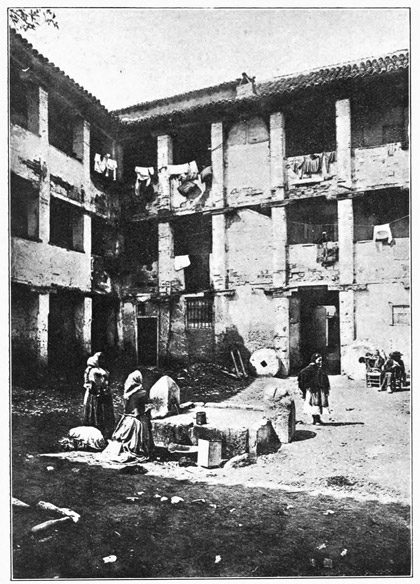
Gypsy Tenants of an Arab Palace
Goya lived in the day of Charles IV, whose court painter he was, and against whom this natural caricaturist must have borne a special grudge, so sarcastic are his portraits of the royal family; but his genius is allied to that of Velázquez's powerful contemporary, Ribera. The Museo del Prado has abundant material for a Ribera sala, since it possesses no less than fifty-eight of his works, but the official put in charge of it would probably go mad. The paintings are mercifully scattered and, well for such of us as may be disposed to flight, can be recognized from afar by their dusks and pallors—ascetic faces gleaming out from sable backgrounds, wasted limbs of naked saints tracing livid lines in the gloom of caverns, and, against an atmosphere dark as the frown of God, the ghastly flesh of tortured martyrs, and dead Christs drooping stiffly to the linen winding-sheet. One is appalled at the entrance of the Long Gallery by the two vast, confronting canvases of Prometheus, less a Titan than a convulsion of Titanic agony, and of Ixion, crushed not only beneath the wheel, but under that cold, tremendous blackness of hell made actual. Far down one side of the hall they stretch, those paintings upon paintings of torment, emaciation, the half-crazed visionary, and the revolting corpse. But there is no escape from Ribera, he who
"tainted His brush with all the blood of all the sainted."
Turning back to the Spanish cabinets that open from the vestibule we come upon a piteous San Sebastian, the blanched young form bound fast and already nailed by arrows to the ebon-hued trunk of a leafless tree. Descending the staircase to the Sala de Alfonso XII, we must pass an attenuated old anchoress, whose sunken face and praying hands have the very tint of the skulls that form the only ornaments, almost the only furniture, of her dreary cave. We may as well brave the terrors of this first half of the Long Gallery, where El Greco's livid greens will at least divert attention, and where, opposite the collection of Riberas, wait the gracious Murillos to comfort and uplift.
Yet Ribera, ruffian though he was, is not solely and exclusively a nightmare artist. He could give sweetest and most tranquil color when he chose, as his "Jacob's Dream" here testifies, with the dim gold of its angel-peopled ladder; and for all the spirit of bigotry that clouds his work, there is Catholic fervor in these pictures and masterly truthfulness up to the point where the senses need the interpretation of the soul. There is more than anatomy, too, in these starved old saints; there is the dread of judgment. Ribera depicts supernatural terror, where Goya shows the animal shock of death.
Another Spanish phase appears in Zurbarán. In his most effective work we have not Goya's blood color, nor Ribera's blacks, nor the celestial violets of Juan de Joanes, but the grays of the monastic renunciation, the twilight that is as far from rapture as from anguish. His gowned, cowled, corded figures pass before the eye in the pale tints of the cloister. The shadow of cathedral walls is over them. The Prado has been strangely indifferent to Zurbarán, who is far more fully represented in the galleries of Andalusia; but it has in its baker's dozen two important and characteristic works, both visions of San Pedro Nolasco. In one the entranced saint, whose figure might be carved in stone,—stone on which ray from stained-glass window never fell,—gazes upon an angel, whose vesture, crossed by a dark green scarf, is flushed with the faintest rose. In the second the sombre cell is illuminated for an instant by the apparition of St. Peter the Apostle, head downward, as in his crucifixion, his naked form dazzling against a vague redness of light like a memory of pain.
One glance at a wall aglow with Madonna blues reminds us that Spanish sacred art does not culminate in Ribera nor in Zurbarán. The Christian faith has had almost as pure, poetic, and spiritual an utterance in the land of the Inquisition as in Italy itself. This is not Murillo's hour; it is the triumph of Velázquez and the realists that Spain is celebrating to-day; but none the less it is a joy of joys to walk by the Murillos on the way to the laurelled bust and the crowded sala. These are the pictures that are rather in heaven than earth. Where Mary, divine in her virginal loveliness, is not upborne among the golden clouds, the radiant-plumed angel kneels on her cottage floor and the wings of the descending dove beat whiteness through the air. Here is realism and more. The Mater Dolorosa has those luminous sea-blue eyes of Andalusia, but they tell of holy tears. The Crucified is no mere sufferer, but the suffering Son of God, and the crown of thorns, while dripping blood, haloes his brows with the redemption of the world.
The genius of Velázquez dwelt not above the earth, but upon it, in the heart of its most brilliant life. He was no dreamer of dreams; he "painted the thing as he saw it," and with what sure eyes he saw, and with what a firm and glowing brush he painted! His sala surrounds us at once with an atmosphere of brightness, beauty, elegance, variety, delight. His work is so superb, so supreme, that, like perfect manners, it puts even the humblest of us at our ease. We are not artists, but we seem to understand Velázquez.
Of course we don't. No knight of the palette would admit it for an instant. What can the rabble know of the mysterious compoundings and touchings from which sprang these splendors of color that outshine the centuries? Young men with streaming hair are continually escorting awed-looking señoras about the room, discoursing with dramatic vehemence on the "periods" of the Master's work. As a youth at Seville, they explain, Velázquez had of necessity taken religious subjects, for the Church was the chief patron of art in Andalusia; but his natural bent even then displayed itself in tavern studies and sketches of popular types, as the "Water-seller of Seville" and the "Old Woman Frying Eggs." Of his early religious pieces the archbishop's palace of Seville keeps "San Ildefonso Receiving the Chasuble from the Hands of the Virgin," and the National Gallery of London secured "Christ in the House of Martha," but "The Adoration of the Kings" hangs here at our right as we enter the Velázquez sala. A little stiff, say these accomplished critics, with a suggestion of the dry manner of his master, Pacheco, but bear you in mind that this is the production of a youth of twenty. It is obvious, too, that Andalusians, not celestial visions, served him as models.
A longing to see the Tintorets and Titians, those starry treasures of the dark Escorial, drew him to Madrid at twenty-three. Here he was fortunate in finding friends, who brought his portraits to the notice of Philip IV, a dissolute boy ruled by the Count-Duke Olivares. Youth inclines to youth. Velázquez was appointed painter to the king at the same salary as that paid to the royal barber, and henceforth he had no care in life but to paint. And how he painted! His first portraits of Philip show a blond young face, with high brow, curled mustache, the long Hapsburg chin, and eyes that hint strange secrets. Again and again and again Velázquez traced those Austrian features, while the years stamped them ever more deeply with lines of pride and sin—a tragic face in the end as it was ill-omened in the beginning. But the masterpiece of Velázquez's twenties is "The Drunkards," a scene of peasant revelry where the young are gloriously tipsy and the old are on the point of maudlin tears. Here it is, Los Borrachos, farther to the right. In looking on it one remembers that a contemporary realist, in the Protestant island which has often been so sharp a thorn in Spain's side, likewise crowned the achievement of his springtime by a group of topers, Prince Hal and Falstaff and their immortal crew.
Not the influence of Rubens, who spent nine months in Spain in 1628-29, painting like the wind, nor a visit to the Holy Land of Raphael and Michael Angelo could make Velázquez other than he was. This "Vulcan's Forge," which we see here, painted in Italy, is mythological only in the title. Back he came at the royal summons, to paint more portraits—Philip over and over, on foot, on horseback, half length, full length, all lengths; the winsome Infante Baltasar, as a toddling baby with his dwarf, as a gallant little soldier, hunter, horseman, and in the princely dignity of fourteen, when he had but three more years to live; the sad French queen, the king's brother, the magnificent Olivares, the sculptor Montañes, counts, dukes, buffoons. Within these twenty years Velázquez produced his two most famous works of religious tenor—"Christ Bound to the Column," a "captain jewel" of the London National Gallery, and that majestic "Crucifixion" before which Spaniards in the Prado bare their heads. But the crown of this period is Las Lanzas, or "The Surrender of Breda," which holds the place of honor on the wall fronting the door. It is vivid past all praise, and nobler than any battle scene in its beauty of generosity. The influence of Italy had told especially on Velázquez's backgrounds. The bright, far landscapes opening out beyond his portrayed figures, especially those on horseback,—and his horses are as lifelike as his dogs,—give to the sala an exhilarating effect of free space and wide horizons.
In 1650 he made his second visit to Rome, where he portrayed Pope Innocent X. Nine years of glorious work in Spain remained to him. Still he painted the king, even at his royal prayers, for which there was full need, and the young Austrian queen, who had succeeded the dead mother of the dead Baltasar. On that happy left-hand wall of the sala shines, in all its vigorous grace, the "Mercury and Argos," but if the hundred eyes of Argos are ready to close, their place is supplied by the terrible scrutiny of a row of portraits, embarrassing the boldest of us out of note-taking. How those pairs of pursuing black eyes, sage and keen and mocking, stare the starers out of countenance! The series of pet dwarfs is here, old Æsop, and Menippus, and the sly buffoon, "Don Juan of Austria." Of these two wonder-works, Las Meninas, "The Maids of Honor," has a room to itself, and thus Las Hilanderas, "The Weavers," becomes the central magnet of this returning wall. A saint picture and even a coronation of the Virgin cannot draw the crowds from before this ultimate triumph of the actual—this factory interior, where a group of peasant women fashion tapestries, while a broad shaft of sunshine works miracles in color.
And this, too, is Spanish. Cervantes is as true a facet of many-sided Spain as Calderon, and Velázquez as Murillo. With all the national propensity to emotion and exaggeration, Spaniards are a truth-seeing people. The popular coplas are more often satiric than sentimental. They like to bite through to the kernel of fact, even when it is bitter. Velázquez, with his rich and noble realism, is of legitimate descent.
XX
CHORAL GAMES OF SPANISH CHILDREN
"Thought and affliction, passion, hell itself, She turns to favor and to prettiness." —Shakespeare: Hamlet.
On one of my last afternoons in Madrid, I visited again my early haunts in the Buen Retiro, for a farewell sight of the children there at play. After all, it is one of the prettiest things to be seen in Spain, these graceful, passionate, dramatic little creatures dancing in tireless circles, and piping those songs that every niña knows, without being able to tell when or where or from whom she learned them. Only very small boys, as a rule, join the girls in these fairy rings, though occasionally I found a troop of urchins marching to a lusty chorus of their own. One, which I heard in Madrid, but whose parrots are more suggestive of Seville, runs something like this:—
"In the street they call Toledo Is a famous school for boys, Chundarata, chundarata, Chundarata, chún-chún; Where all we lads are going With a most heroic noise, Chundarata, chundarata, Chundarata, chún-chún. "And the parrots on their perches, They mock us as we go, Chundarata, chundarata, Chundarata, chún-chún. 'I hate my school,' whines Polly, 'For my master beats me so,' Chundarata, chundarata, Chundarata, chún-chún."
Another, which came to me in fragments, is sung in playing soldier.
"The Catalans are coming, Marching two by two. All who hear the drumming Tiptoe for a view. Ay, ay! Tiptoe for a view. Red and yellow banners, Pennies very few. Ay, ay! Pennies very few. "Red and yellow banners! The Moon comes out to see. If moons had better manners, She'd take me on her knee. Ay, ay! Take me on her knee. She peeps through purple shutters, Would I were tall as she! Ay, ay! Would I were tall as she! "Soldiers need not learn letters, Nor any schooly thing, But unless they mind their betters, In golden chains they'll swing. Ay, ay! In golden chains they'll swing. Or sit in silver fetters, Presents from the King. Ay, ay! Presents from the King."
This ironic touch, so characteristically Spanish, reappears in many of the games, as in A La Limón, known throughout the Peninsula and the Antilles. I should expect to find it, too, in corners of Mexico, South America, the Philippines, wherever the Spanish oppressor has trod and the oppressor's children have sported in the sun. The little players, ranged in two rows, each row hand in hand, dance the one toward the other and retreat, singing responsively. With their last couplet, the children of the first line raise their arms, forming arches, and the children of the second line, letting go hands, dance under these arches as they respond.
1. "A la limón, á la limón! All broken is our bright fountain. 2. "A la limón, á la limón! Give orders to have it mended. 1. "A la limón, á la limón! We haven't a bit of money. 2. "A la limón, á la limón! But we have money in plenty. 1. "A la limón, á la limón! What kind of money may yours be? 2. "A la limón, á la limón! Oh, ours is money of eggshells. 1. "A la limón, á la limón! An arch for the lords and ladies. 2. "A la limón, á la limón! Right merrily we pass under."
Another lyric dialogue, whose fun is spent on the lean purses of students and the happy-go-lucky life of Andalusia, must have originated since the overthrow, in 1892, of the leaning tower of Saragossa. The stanzas are sung alternately by two rows of children, advancing toward each other and retreating with a dancing step.
1. "In Saragossa —Oh, what a pity!— Has fallen the tower, Pride of the city. 2. "Fell it by tempest, Fairies or witches, The students will raise it, For students have riches. 1. "Call on the students, Call louder and louder! They've only two coppers To buy them a chowder. 2. "Chowder of students Is sweeter than honey, But the gay Andalusians Have plenty of money. 1. "The gay Andalusians Have fiddle and ballad, But only two coppers To buy them a salad. 2. "In Saragossa —Oh, what a pity!— Has fallen the tower, Pride of the city."
Unchildlike innuendoes pervade that curious game of many variants in which the priest and abbess play a leading part. Two children are chosen for these dignitaries, while the others call out the names of such flowers, fruits, or vegetables as each may decide to personate. "I'm a cabbage." "I'm a jasmine." "I'm a cherry." Then the little sinners kneel in a circle, crying:—
"Through the door, up the stairs, On the floor, say your prayers!"
and chant some childish gibberish, during which no one must laugh on pain of a forfeit. After this, all sing:—
"The house of the priest it cracked like a cup. Half fell down and half stood up. Sir Priest, Sir Priest, now tell us aright, In whose house did you sleep last night?
Priest.With the rose slept I. Rose.Fie, O fie! I never saw your tonsured head. Priest. Then with whom did you make your bed? Rose. With the Pink. Pink. I should think! I never saw your petals red. Rose. Then with whom did you make your bed? Pink. With the lily. Lily. Don't be silly! I never heard your fragrant tread. Pink. Then with whom did you make your bed? Lily. With the priest. Priest. Little beast! If I went near you, may I fall dead! Lily. Then with whom did you make your bed? Priest. With the abbess, I. Abbess. Oh, you lie!"
But this seems to be the conclusion of the game.
The most of these choral songs, however, are sweet and innocent, concerned with the natural interests of childhood, as this:—
"The shepherdess rose lightly Larán—larán—larito, The shepherdess rose lightly From off her heather seat—O. "Her goats went leaping homeward, Larán—larán—larito, Her goats went leaping homeward On nimble little feet—O. "With strong young hands she milked them, Larán—larán—larito, With strong young hands she milked them And made a cheese for treat—O. "The kitty watched and wondered, Larán—larán—larito, The kitty crept and pondered If it were good to eat—O. "The kitty sprang upon it, Larán—larán—larito, The kitty sprang upon it And made a wreck complete—O. "Scat, scat, you naughty kitty! Larán—larán—larito, Scat, scat, you naughty kitty! Are stolen cheeses sweet—O?"
The baby girls have a song of their own, which, as a blending of doll-play, gymnastics, music, mathematics, and religion, leaves little to be desired.
"Oh, I have a dolly, and she is dressed in blue, With a fluff of satin on her white silk shoe, And a lace mantilla to make my dolly gay, When I take her dancing this way, this way, this way. [Dances Dolly in time to the music. "2 and 2 are 4, 4 and 2 are 6, 6 and 2 are 8, and 8 is 16, And 8 is 24, and 8 is 32! Thirty-two! Thirty-two! Blesséd souls, I kneel to you. [Kneels. "When she goes out walking in her Manila shawl, My Andalusian dolly is quite the queen of all. Gypsies, dukes, and candy-men bow down in a row, While my dolly fans herself so and so and so. [Fans Dolly in time to the music. "2 and 2 are 4, 4 and 2 are 6, 6 and 2 are 8, and 8 is 16, And 8 is 24, and 8 is 24! Twenty-four! Twenty-four! Blesséd souls, I rise once more."
They have a number of bird-games, through which they flit and flutter with an airy grace that wings could hardly better. In one, the children form a circle, with "the little bird Pinta" in the centre. The chorus, dancing lightly around her, sings the first stanza, and Pinta, while passing about the circle to make her choice, sings the rest, with the suggested action. The child chosen becomes Pinta in turn.
Chorus. "The little bird Pinta was poising On a scented green lemon-tree spray. She picked the leaf and the blossom, And chanted a roundelay. Pinta. "Song in the land! While April is yet a newcomer, O mate of my summer, Give to me a hand now, Both hands I seek, O! Take a Spanish kiss, now, On the rosy cheek, O!"
Equally pretty and simple is the Andalusian play of "Little White Pigeons." The children form in two rows, which face each other some ten or twelve yards apart. One row sings the first stanza, dancing forward and slipping under the "golden arches" made by the lifted arms of the second row. The second row sings and dances in turn, passing under the "silver arches" to Granada.
1. "Little white pigeons Are dreaming of Seville, Sun in the palm tree, Roses and revel. Lift up the arches, Gold as the weather. Little white pigeons Come flying together. 2. "Little white pigeons Dream of Granada, Glistening snows on Sierra Nevada. Lift up the arches, Silver as fountains. Little white pigeons Fly to the mountains."
The Spanish form of "Blindman's Buff" begins with "giving the pebble" to determine who shall be the Blind Hen. A child shuts in one hand the pebble and then presents both little fists to the other children passing in file. Each, while all sing the first stanza given below, softly touches first one of the hands, then the other, and finally slaps the one chosen. If this is empty, she passes on. If it holds the pebble, she must take it and be the one to offer the hands. The child who finally remains with the pebble in her possession, after all have passed, is the Blind Hen. As the game goes on, the children tease the Blind Hen, who, of course, is trying to catch them, by singing the second stanza given below.
1 "Pebble, O pebble! Where may it be? Pebble, O pebble! Come not to me! Tell me, my mother, Which hand to choose. This or the other? That I refuse, This hand I choose." 2 "She's lost her thimble, Little Blind Hen. Better be nimble! Try it again! Who'll bring a taper For the Blind Hen? Scamper and caper! Try it again! Try it again!"
Other games as well known to American children as "Blindman's Buff" are played by little Spaniards. They understand how to make the "hand-chair" and "drop the button," only their button is usually a ring. "Hide the Handkerchief" carries with it the familiar cries of hot and cold, but our "Puss in the Corner" becomes "A Cottage to Rent."
"'Cottage to rent?' 'Try the other side, You see that this Is occupied.'"
In religious Seville the dialogue runs:—
"'A candle here?' 'Over there.' 'A candle here?' 'Otherwhere.' "'Candle, a candle!' 'Loss on loss.' 'Where is light?' 'In the Holy Cross.'"
For all these games, common to childhood the world over, have a rhyming element in the Peninsula, where, indeed, the ordinary intercourse of children often carries verses with it. For instance, our youngsters are content with cries of "Tell-tale!" and "Indian-giver!" but under similar provocation the fierce little nurslings of Catholic Spain will sing:—
"Tell-tale! Tell-tale! In hell you'll be served right, All day fed on mouldy bread, And pounded all the night!"
The other baby-curse is to the same effect:—
"He who gives and takes again, Long in hell may he remain! He who gives and takes once more, May we hear him beat on the Devil's door!"
The Spanish form of tag has a touch of mythological grace. One child, chosen by lot, is the Moon, and must keep within the shadow. The others, Morning-stars, are safe only in the lighted spaces. The game is for the Morning-stars to run into the shadow, daring the Moon, who, if successful in catching one, becomes a Morning-star in turn, and passes out into the light, leaving the one caught to act the part of Moon. As the Morning-stars run in and out of the Moon's domain, they sing over and over the following stanza:—
"O the Moon and the Morning-stars! O the Moon and the Morning-stars! Who dares to tread—O Within the shadow?"
Even in swinging, the little girls who push carry on a musical dialogue with the happy holder of the seat.
"'Say good-day, say good-day To Miss Fannie Fly-away! At the door the guests are met, But the table is not set. Put the stew upon the fire. Higher, higher, higher, higher! Now come down, down, down, down, Or the dinner will all burn brown. Soup and bread! soup and bread! I know a plot of roses red, Red as any hero's sword, Or the blood of our Holy Lord. Where art thou, on the wing?' 'No, I'm sitting in the swing.' 'Who're thy playmates way up there?' 'Swallows skimming through the air.' 'Down, come down! The stew will burn. Let the rest of us have a turn.'"
In playing "Hide and Seek," the seeker must first sit in a drooping attitude with covered eyes, while the others stand about and threaten to strike him if he peeps:—
"Oil-cruet! Don't do it! Ras con ras! Pepper-pot? Peep not! Ras con ras!"
The menacing little fists are then suddenly withdrawn.
"No, no! Not a blow! But a pinch on the arm will do no harm. Now let the birdies take alarm!"
And off scamper the hiders to their chosen nooks. When they are safely tucked away, the indispensable Mother, standing by, sings to the seeker that stanza which is his signal for the start:—
"My little birds of the mountain Forth from the cage are flown. My little birds of the mountain Have left me all alone."
Spanish forfeit games are numerous and ingenious. In one of these, called "The Toilet," the players take the names of Mirror, Brush, Comb, Towel, Soap, and other essentials, including Jesus, Devil, and Man Alive, these last for exclamatory purposes. As each is mentioned by the leader of the game, he must rise instantly, on pain of forfeit, no matter how fast the speaker may be rattling on: "Jesus! When will that devil of a maid bring me my powder and perfumes?" Characteristic titles of other forfeit games are, "The Key of Rome," "The Fan," "The Fountain," "I Saw my Love Last Night." The sentences vary from such gentle penalties as "The Caress of Cadiz" to the predicament of putting three feet on the wall at once.
The choral verses are often mere nonsense.
"Pipe away! pipe away! Let us play a little play! What will we play? We'll cut our hands away. Who cut them, who? Rain from out the blue. Where is the rain? Hens drank it up again. Hens? And where are they? Gone their eggs to lay. Who will eat them up? Friars when they sup. What do friars do? Sing 'gori-gori-goo.'"
Watching Spanish children, one may see two little girls, say White Rose and Sweetness, fly out into an open space, where White Rose carefully places the tips of her small shoes in touch with those of Sweetness. Then they clasp hands, fling their little bodies as far back as these conditions permit, and whirl round and round, singing lustily—until they are overcome by giddiness—the following rigmarole, or one of its variants:—
"Titirinela, if you please! Titirinela, bread and cheese: 'What is your father's worshipful name?' 'Sir Red-pepper, who kisses your hands.' 'And how does he call his beautiful dame?' 'Lady Cinnamon, at your commands.' Titirinela, toe to toe! Titirinela, round we go!"
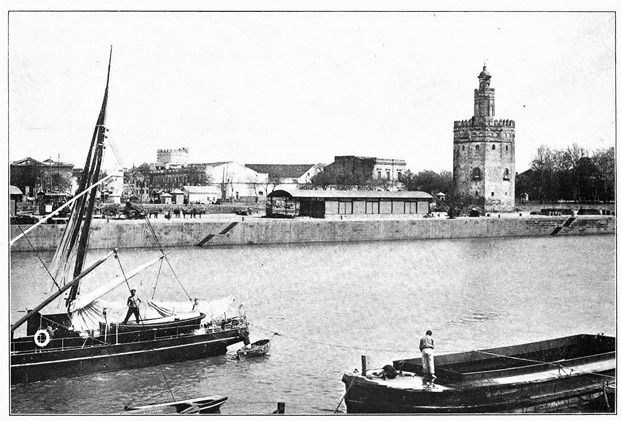
From the Tower of Gold Down the Guadalquivír
Even in some of their prettiest games the verses have a childish incoherence. Some dozen little girls form a circle, for instance, with the Butterfly in the centre. They lift her dress-skirt by the border, and hold it outspread about her. Another child, on the outside, runs around and around the ring, singing:—
"Who are these chatterers? Oh, such a number! Not by day nor by night Do they let me slumber. They're daughters of the Moorish king, Who search the garden-close For lovely Lady Ana, The sweetest thing that grows. She's opening the jasmine And shutting up the rose."
Then the children suddenly lift their hands, which are holding Butterfly's frock, so as to envelop her head in the folds. The little singer outside continues:—
"Butterfly, butterfly, Dressed in rose-petals! Is it on candle-flame Butterfly settles? How many shirts Have you woven of rain? Weave me another Ere I call you again."
These songs are repeated seven times. Then comes another stanza:—
"Now that Lady Ana Walks in garden sweet, Gathering the roses Whose dew is on her feet, Butterfly, butterfly, Can you catch us? Try it, try!"
With this the circle breaks and scatters, while Butterfly, blinded as she is by the folds of her own skirt wrapped about her head, does her best to overtake some one, who shall then become her successor.
Many of the games are simplicity itself. Often the play is merely a circle dance, sometimes ending in a sudden kneeling or sitting on the ground, One of the songs accompanying this dance runs:—
"Potatoes and salt must little folks eat, While the grown-up people dine Off lemons and chestnuts and oranges sweet, With cocoanut milk for wine. On the ground do we take our seat, We're at your feet, we're at your feet."
Sometimes a line of children will form across the street and run, hand in hand, down its length, singing:—
"We have closed the street And no one may pass, Only my grandpa Leading his ass Laden with oranges Fresh from the trees. Tilín! Tilín! Down on our knees! Tilín! Tilín! Tilín! Tilín! The holy bell of San Agustín!"
A play for four weans, training them early to the "eternal Spanish contradiction," consists in holding a handkerchief by its four corners, while one of them sings:—
"Pull and slacken! I've lost my treasure store. Pull and slacken! I'm going to earn some more. Slacken!"
And at this, the other three children must pull, on pain of forfeit, whereas if the word is pull, their business is to slacken.
They have a grasshopper game, where they jump about with their hands clasped under their knees, singing:—
"Grasshopper sent me an invitation To come and share his occupation. Grasshopper dear, how could I say no? Grasshopper, grasshopper, here I go!"
In much the same fashion they play "Turkey," gobbling as they hop.
I never found them "playing house" precisely after the manner of our own little girls, but there are many variants for the dialogue and songs in their game of "Washerwoman." The Mother says: "Mariquilla, I'm going out to the river to wash. While I am gone, you must sweep and tidy up the house."
"Bueno, madre."
But no sooner is the Mother out of sight than naughty Mariquilla begins to frisk for joy, singing:—
"Mother has gone to wash. Mother'll be gone all day. Now can Mariquilla Laugh and dance and play."
But the Mother returns so suddenly that Mariquilla sees her barely in time to begin a vigorous sweeping.
"'What hast been doing, Mary?' 'Sweeping with broom of brier.' 'A friar saw thee playing.' 'He was a lying friar.' 'A holy friar tell a lie!' 'He lied and so do you.' 'Come hither, Mary of my heart, 'And I'll beat thee black and blue.'"
After this lively exercise, the washerwoman goes away again, charging Mariquilla to churn the butter, then to knead the bread, then to set the table, but always with the same disastrous results. The Mother finally condemns her to a dinner of bread and bitters, but Mariquilla makes a point of understanding her to say bread and honey, and shares this sweetness with her sympathetic mates who form the circle. This time the beating is so severe that the children of the ring raise their arms and let Mariquilla dodge freely in and out, while they do all they can to trip and hinder the irate washerwoman in her pursuit.
There is another washing game of more romantic sort, the chorus being:—
"'Bright is the fountain, When skies are blue. Who washed my handkerchief? Tell me true!' 'Three mountain maidens Of laughing look. White went their feet In the running brook. One threw in roses, And jasmine one. One spread thy handkerchief In the sun.'"
Spanish children "play store," of course, but they are such dramatic little creatures that they need no broken ware for their merchandise. A row of them will squat down in the middle of the street, clasp their hands under the hollow of their knees, and crook out their arms for "handles." Then a customer wanders by, asking, "Who sells honey-jars?" The merchant disrespectfully replies, "That do I, Uncle of the Torn Trousers." The shabby customer answers with Castilian dignity, "If my trousers are torn, my wife will mend them." The merchant then opens negotiations. "Will you buy a little jar of honey?" "What's your price?" The merchant is not exorbitant. "A flea and a louse." The probabilities are, unhappily, that the customer has these commodities about him, and he inclines, though cautiously, toward the bargain.
"Your little honey-jars are good?"
"Very good."
"Do they weigh much?"
"Let's see."
So they pick up an hilarious little honey-jar by its handles and tug it away between them, not letting it touch the ground, to the sidewalk. Here the merchant and customer have designated four spaces as Heaven, Limbo, Purgatory, and Hell, but on a preliminary paving-stone—let truth need no apology!—they have done some artistic spitting, with the result that four different figures in saliva are presented to the little honey-jar. These four figures bear a secret relation to the four spaces on the sidewalk, and the prisoner must make his choice. "This!" he ventures. "Hell!" scream the merchant and customer, and drag him, shrieking and struggling, to his doom. The next, perhaps, will have the luck to hit on Heaven, for every little honey-jar must take his chance in this theological lottery.
Sometimes the market becomes a transformation scene. The children hold up their forefingers for candles, but embarrass the merchant by doubling these up whenever the customer is on the point of buying. Just as the bargain is about to be concluded, the little candles vanish and the children roll themselves into bunches of grapes, some proving sweet and others sour. Again, they make themselves over into pitchers, cushions, and all variety of domestic articles, becoming at last a pack of barking dogs which rush out on the customer, snap at his legs, and drive him off the premises.
Again, it is a chicken-market on which the Uncle of the Torn Trousers chances, where one by one he buys all the hens and chickens, but forgets to buy the rooster, and when, by and by, this lordly fowl, waxing lonely, cock-a-doodle-doos, the hens and chickens come scurrying back to him, more to the profit of the merchant than to the satisfaction of the customer.
In another of the chicken games, the Mother leaves Mariquilla in charge of the brood, with directions, if the wolf comes, to fling him the smallest. But he comes so often that, when the Mother returns, there are no chickens left. Then she and Little Mary go hunting them, hop-hop-hop through Flea Street, bow-wow-wow through Dog Street, and so on without success, until it occurs to them to scatter corn. Thereupon with peep-peep-peep and flip-flap-flutter all the chickens appear, but only to fly at the negligent Mother, who left them to the jaws of the wolf, and assail her with such furious pecks that she must run for her life, the indignant chicks racing in wild pursuit.
There is a market-garden game, where one acts as gardener, others as vegetables, and others as customers. Others, still, come creeping up as thieves, but are opposed by a barking dog, which they kill. The gardener summons them before the judge. A trial is held, with much fluent Spanish argument pro and con, and the prisoners are condemned to execution for the murder of the dog. But at the last thrilling moment, when they have confessed their sins to the priests, and been torn from the embraces of their weeping friends, the dog trots cheerfully in, so very much alive that all the criminals are pardoned in a general dance of joy.
The little girls have a favorite shopping game. In this the children are seated, shoulder to shoulder, in two rows that face each other. Every child takes the name of some cloth, silks and satins being preferred. The leader of the game runs around the two rows, singing:—
"Up the counter, down the counter! How can I buy enough? Down the counter, up the counter! I choose this velvet stuff."
Little Velvet immediately jumps to her feet and follows the leader, who continues choosing and calling, choosing and calling, until the stock is exhausted and she can go home with all her purchases most conveniently trooping at her heels.
But the plays dearest to the black-eyed niñas are love plays, of which they have a countless number. Most of these consist of the dancing, singing circle, with a child in the centre who chooses a mate. Some are as simple as this:—
"Milk and rice! I want to marry A maiden nice. I may not tarry. It is not this, Nor this, nor this. 'Tis only this Whom I want to marry."
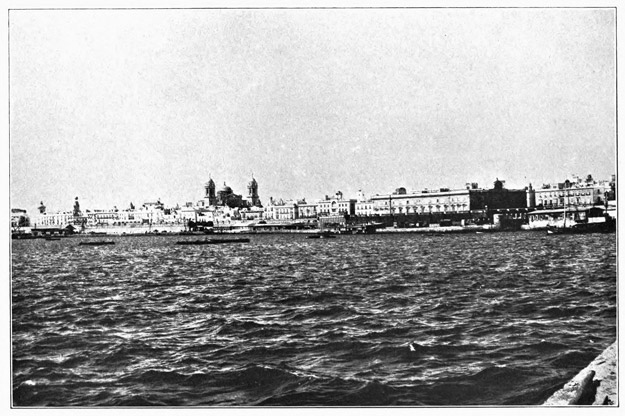
Cadiz from the Sea
Ambó, ató is hardly more elaborate. When in the exchange of question and answer, the child would choose her page and touches one of the circle, the mercenary mites dance on faster than ever, until she offers whatever gift she has, a flower, apple, or any trifle at hand. Then the page runs in and kneels before her. The circle dances about the two, singing the refrain, until the first child slips out and joins them, leaving the second in the centre to begin the game over again.
"Ambó, ató, matarile, rile, rile? Ambó, ató, matarile, rile, ron? 1."What do you want, matarile, rile, rile? What do you want, matarile, rile, ron? 2."I want a page, matarile, rile, rile. I want a page, matarile, rile, ron. 1."Choose whom you will, matarile, rile, rile. Choose whom you will, matarile, rile, ron. 2."I choose Pedro, matarile, rile, rile. I choose Pedro, matarile, rile, ron. 1."What will you give him, matarile, rile, rile? What will you give him, matarile, rile, ron? 2."I'll give him an orange, matarile, rile, rile. I'll give him an orange, matarile, rile, ron. 1."He answers yes, matarile, rile, rile. He answers yes, matarile, rile, ron."
"The Charcoal Woman" requires an odd number of players. The circle dances about a little girl who stands all forlorn in the centre. The chorus sings the first stanza, the child sings the second, which has reference to the fact that Spanish charcoal is often made from laurel wood, and the chorus, in a comforting tone, the third. Then, while the child runs about and about the circle as if seeking, the chorus angrily sings the fourth stanza, accusing her of ambition, and the little charcoal woman retorts with the fifth, making her choice as she sings the last four words. At this the circle breaks, the children quickly choosing mates and dancing by pairs. The one who is left without a partner takes her place in the centre as the next Charcoal Woman.
1. Chorus."Who would say that the charcoal woman, Sooty, sooty charcoal woman, In all the city and all the land Could find a lover to kiss her hand? 2. Charcoal Woman. "The little widow of good Count Laurel Has no one left her for kiss or quarrel. I want a sweetheart and find me none. Charcoal women must bide alone. 3. Chorus."Poor little widow, so sweet thou art, If there's no other to claim thy heart, Take thy pick of us who stand Ready to kiss thy sooty hand. 4. Chorus. "The charcoal woman, the charcoal woman, Proud little black little charcoal woman, Goes seeking up and seeking down To find the Count of Cabratown. 5. Charcoal Woman. "I would not marry the Count of Cabra. Never will marry the Count of Cabra. Count of Cabra! Oh, deary me! I'll not have him,—if you're not he!"
Just such coquettish touches of Spanish spirit and maiden pride appear in many of the songs, as, for instance, in one of their counting-out carols, "The Garden."
"The garden of our house it is The funniest garden yet, For when it rains and rains and rains, The garden it is wet. And now we bow, Skip back and then advance, For who know how to make a bow Know how to dance. AB—C—AB—C DE—FG—HI—J. If your worship does not love me, Then a better body may. AB—C—AB—C, KL—MN—OP—Q. If you think you do not love me, I am sure I don't love you."
Sometimes these dancing midgets lisp a song of worldly wisdom:—
"If any cadet With thee would go, Daughter, instantly Answer no. For how can cadet, This side of Heaven, Keep a wife On his dollars seven? "If any lieutenant Asks a caress, Daughter, instantly Answer yes. For the lieutenant Who kisses thy hand May come to be A general grand."
And, again, these babies may be heard giving warning that men betray.
"The daughters of Ceferino Went to walk—alas! A street above, a street below, Street of San Tomás. The least of all, they lost her. Her father searched—alas! A street above, a street below, Street of San Tomás. And there he found her talking With a cavalier, who said, 'Come home with me, my darling, 'Tis you that I would wed.' "Oh, have you seen the pear tree Upon my grandpa's lawn? Its pears are sweet as honey, But when the pears are gone, A turtle-dove sits moaning, With blood upon her wings, Amid the highest branches, And this is what she sings: 'Ill fares the foolish maiden Who trusts a stranger's fibs. She'd better take a cudgel And break his ugly ribs.'"
The dance for "Elisa of Mambrú" begins merrily, and soon saddens to a funereal pace.
"In Madrid was born a maiden—carabí! Daughter of a general—carabí, hurí, hurá!"
The song goes on to tell of Elisa's beautiful hair, which her aunt dressed so gently for her with a golden comb and crystal curling-pins, and how Elisa died and was carried to church in an elegant coffin, and how a little bird used to perch upon her grave and chirp, pio, pio.
Mambrú himself is the pathetic hero of Spanish childhood. This Mambrú for whom the little ones from Aragon to Andalusia pipe so many simple elegies, the Mambrú sung by Trilby, is not the English Marlborough to them, but, be he lord or peasant, one of their very own.
"Mambrú is gone to serve the king, And comes no more by fall or spring. "We've looked until our eyes are dim. Will no one give us word of him? "You'd know him for his mother's son By peasant dress of Aragon. "You'd know him for my husband dear By broidered kerchief on his spear. "The one I broider now is wet. Oh, may I see him wear it yet!"
At the end of this song, as of the following, the little dancers throw themselves on the ground, as if in despair.
"Mambrú went forth to battle. Long live Love! I listen still for his coming feet. The rose on the rose bush blossoms sweet. "He will come back by Easter. Long live Love! He will come back by Christmas-tide. The rose on the bush has drooped and died. "Down the road a page is riding. Long live Love! 'Oh, what are the tidings that you bear?' The rose on the bush is budding fair. "'Woe is me for my tidings!' Long live Love! 'Mambrú lies cold this many a morn.' Ay, for a rose bush sharp with thorn! "A little bird is chirping. Long live Love! In the withered bush where no more buds blow, The bird is chirping a note of woe."
A game that I often watched blithe young Granadines playing under the gray shadow of Alhambra walls, seems to be a Spanish version of "London Bridge is Falling Down." Two children are chosen to be Rose and Pink. These form an arch with their uplifted arms, through which run the other children in a line, headed by the Mother. A musical dialogue is maintained throughout.
"Rose and Pink. To the viper of love, that hides in flowers, The only way lies here. Mother. Then here I pass and leave behind One little daughter dear. Rose and Pink. Shall the first one or the last Be captive of our chain? Mother. Oh, the first one runs too lightly. 'Tis the last that shall remain. Chorus. Pass on, oho! Pass on, aha! By the gate of Alcalá!"
The last child is caught by the falling arms and is asked whether she will go with Rose or Pink. She shyly whispers her choice, taking her stand behind her elected leader, whom she clasps about the waist. When all the children of the line have been successively caught in the falling arch, and have taken their places behind either Rose or Pink, the game ends in a grand tugging match. Rose and Pink hold hands as long as they can, while the two lines try to drag them apart. All the while, until the very last, the music ripples on:—
"Rose and Pink. Let the young mind make its choice, As young minds chance to think. Now is the Rose your leader, Or go you with the Pink? Let the young heart make its choice By laws the young heart knows. Now is the Pink your leader, Or go you with the Rose? Chorus. Pass on, oho! Pass on, aha! By the gate of Alcalá!"
Another favorite is "Golden Ear-rings." Here the Mother, this time a Queen, sits in a chair, supposedly a throne, and close before her, on the floor, sits the youngest daughter; before this one, the next youngest, and so on, in order of age. Two other children, holding a handkerchief by the corners, walk up and down the line, one on one side and one on the other, so passing the handkerchief above the heads of the seated princesses. Then ensues the musical dialogue between these two suitors and the Queen.
"'We've come from France, my lady, And Portugal afar. We've heard of your fair daughters, And very fair they are.' 'Be they fair or no, señores, It's none of your concern, For God has given me bread for all, And given me hands to earn.' 'Then we depart, proud lady, To find us brides elsewhere. The daughters of the Moorish king Our wedding rings shall wear.' 'Come back, my sweet señores! Bear not so high a crest. You may take my eldest daughter, But leave me all the rest.'"
The dialogue is transferred to one of the suitors and to the princess at the farther end of the line, on whose head the handkerchief now rests.
"'Will you come with me, my Onion?' 'Fie! that's a kitchen smell.' 'Will you come with me, my Rosebud?' 'Ay, gardens please me well.'"
In similar fashion all the daughters are coaxed away until only the youngest remains, but she proves obdurate. They may call her Parsley or Pink; it makes no difference. So the suitors resort to bribes, the last proving irresistible.
"'We'll buy you a French missal.' 'I have a book in Latin.' 'In taffeta we'll dress you.' 'My clothes are all of satin.' 'You shall ride upon a donkey.' 'I ride in coaches here.' 'We'll give you golden ear-rings.' 'Farewell, my mother dear.'"
In some of the many variants of this game, the Queen herself, adequate as she may be to earning her own living, is wooed and won at last.
I have not met with fairy-lore among these children's carols. The only fairy known to Spain appears to be a sort of spiritualistic brownie, who tips over tables and rattles chairs in empty rooms by night. The grown-up men who write of him say he frightens women and children. He can haunt a house as effectually as an old-time ghost, and a Casa del Duende may go begging for other tenants. One poor lady, who went to all the trouble of moving to escape from him, was leaning over the balcony of her new home,—so the story goes,—to see the last cartful of furniture drive up, when a tiny man in scarlet waved a feathered cap to her from the very top of the load and called, "Yes, señora, we are all here. We have moved."
So the childish imagination of Spain, shut out from fairyland, makes friends with the saints in such innocent, familiar way as well might please even Ribera's anchorites. The adventurous small boy about to take a high jump pauses to pray:—
"Saint Magdalene, Don't let me break my thigh! Oh, Saint Thomas, Help this birdie fly!"
The little girls express decided preferences for one saint over another.
"Old San Antón, What has he done? Put us in the corner every one. "San Sebastián Is a nice young man. He takes us to walk and gives us a fan."
Santa Rita is best at finding lost needles, and San Pantaleón is a humorist.
"San Pantaleón, Are twenty and one Children enough for an hour of fun Slippers of iron Donkey must try on. Moors with their pages Ride in gold stages. But if you want a Girdle, Infanta, Cucurucú, 'Bout-face with you!"
At this one of the children dancing in circle whirls around, remaining in her place, but with back turned to the centre and arms crossed over her breast, although her hands still hold those of her nearest neighbors. The rhyme is sung over and over, until all the little figures have thus turned about and the circle is dancing under laughable difficulties.
But the dearest saint of all is San Serení. Two of the best-known games are under his peculiar blessing. One of these is of the genuine Kindergarten type, the children dancing in a circle through the first two lines of each stanza, but then loosing hands to imitate, in time to the music, the suggested action.
"San Serení, The holy—holy-hearted! Thus for thee The shoemakers are cobbling. Thus, thus, thus! Thus it pleases us."
Even so it pleases seamstresses to stitch, laundresses to wash, carpenters to saw, silversmiths to tap, ironsmiths to pound, and little folks to dance, all for "San Serení de la buena, buena vida." In the second game, a gymnastic exercise, whose four movements are indicated in the four stanzas, he is apostrophized as "San Serení del Monte, San Serení cortés."
"San Serení of the Mountain, Our saint of courtesy, I, as a good Christian, Will fall upon my knee. "San Serení of the Mountain, Where the strong winds pass, I, as a good Christian, Will seat me on the grass. "San Serení of the Mountain, Where the white clouds fly, I, as a good Christian, Upon the ground will lie. "San Serení of the Mountain, Where earth and heaven meet, I, as a good Christian, Will spring upon my feet."
With the legend of St. Katharine and her martyrdom childish fancy has played queer caprices.
"In Cadiz was a wean—ah! The gentlest ever seen—ah! Her name was Catalina. Ay, so! Her name was Catalina. "Her father, Moslem cruel, He made her bring in fuel. Her mother fed her gruel. Ay, so! Her mother fed her gruel. "They beat her Tuesday, Wednesday, They beat her Thursday, Friday, They beat her Saturday, Monday. Ay, so! They beat her hardest Sunday. "Once bade her wicked sire She make a wheel most dire, Of scissors, knives, and fire. Ay, so! Of scissors, knives, and fire. "The noble Christian neighbors, In pity of her labors, Brought silver swords and sabres. Ay, so! Brought silver swords and sabres. "By noon her task was ended, And on that wheel all splendid Her little knee she bended. Ay, so! Her little knee she bended. "Then down a stair of amber She saw the cherubs clamber: 'Come rest in our blue chamber.' Ay, so! She rests in their blue chamber."
Little Spaniards are not too intolerant to make a play-fellow of the Devil. In one of their pet games, the children form in line, with the invaluable Mother in charge. To each child she secretly gives the name of a color. Then an Angel comes in with a flying motion and calls, for instance, "Purple!" But there is no Purple in the company. It is then the Devil's turn, who rushes in, usually armed with a table-fork, and roars for "Green." There is a Green in the line, and she has to follow the Demon, while the Angel tries again. All right-minded spectators hope that the Angel will have the longer array at the last.
The Virgin's well-beloved name comes often into the children's songs.
"For studying my lessons, So as not to be a dunce, Papa gave me eight dollars, That I mean to spend at once. Four for my dolly's necklace, Two for a collar fine, And one to buy a candle For Our Lady's shrine."
Even the supreme solemnity of the Wafer borne through the kneeling streets cannot abash the trustful gaze of childhood.
"'Where are you going, dear Jesus, So gallant and so gay?' 'I am going to a dying man To wash his sins away. And if I find him sorry For the evil he has done, Though his sins are more than the sands of the sea, I'll pardon every one.' "'Where are you going, dear Jesus, So gallant and so gay?' 'I'm coming back from a dying man Whose sins are washed away. Because I found him sorry For the evil he had done, Though his sins were more than the sands of the sea, I've pardoned every one.'"
The affairs of State as well as of Church have left their traces on the children's play. As the little ones dance in circle, their piping music tells a confused tale of Spanish history within these latter days.
"In Madrid there is a palace, As bright as polished shell, And in it lives a lady They call Queen Isabel. Not for count nor duke nor marquis Her father would she sell, For not all the gold in Spain could buy The crown of Isabel. "One day when she was feasting Within this palace grand, A lad of Aragon walked in And seized her by the hand. Through street and square he dragged her To a dreary prison cell, And all that weary way she wept, The lady Isabel. "'For whom art weeping, lady? What gives thy spirit pain? If thou weepest for thy brothers, They will not come again. If thou weepest for thy father, He lies 'neath sheet of stone.' 'For these I am not weeping, But for sorrows of mine own. "'I want a golden dagger.' 'A golden dagger! Why?' 'To cut this juicy pear in two. Of thirst I almost die.' We gave the golden dagger. She did not use it well. Ah, no, it was not pears you cut, My lady Isabel."
These dancing circles keep in memory the assassination of Marshal Prim.
"As he came from the Cortes, Men whispered to Prim, 'Be wary, be wary, For life and for limb.' Then answered the General, 'Come blessing, come bane, I live or I die In the service of Spain.' "In the Calle del Turco, Where the starlight was dim, Nine cowardly bullets Gave greeting to Prim. The best of the Spaniards Lay smitten and slain, And the new King he died for Came weeping to Spain."
This new king, Amadeo, is funnily commemorated in another dancing ditty, "Four Sweethearts."
"Maiden, if they ask thee, Maiden, if they ask thee, If thou hast a sweetheart—ha, ha! If thou hast a sweetheart, Answer without blushing, Answer without blushing, 'Four sweethearts are mine—ha, ha! Four sweethearts are mine. "'The first he is the son of— The first he is the son of A confectioner—ha, ha! A confectioner. Sugar-plums he gives me, Sugar-plums he gives me, Caramels and creams—ha, ha! Caramels and creams. "'The second is the son of— The second is the son of An apothecary—ha, ha! An apothecary. Syrups sweet he gives me, Syrups sweet he gives me, For my little cough—hack, hack! For my little cough. "'The third he is the son of— The third he is the son of The barber to the court—ha, ha! The barber to the court. Powders rare he gives me, Powders rare he gives me, And a yellow wig—ha, ha! And a yellow wig. "'The fourth? Oh, 'tis a secret, The fourth? Oh, 'tis a secret. Our new Italian king—ha, ha! Our new Italian king. He gives me silk and satin, He gives me silk and satin, Velvet, gold, and gems—ha, ha! Velvet, gold, and gems.'"
Strangest of all is the dramatic little dialogue, which one with an ear for children's voices may hear any day in Madrid, telling of the death of Queen Mercedes.
"'Whither away, young King Alfonso? (Oh, for pity!) Whither away?' 'I go seeking my queen Mercedes, For I have not seen her since yesterday.' "'But we have seen your queen Mercedes, Seen the queen, though her eyes were hid, While four dukes all gently bore her Through the streets of sad Madrid. "'Oh, how her face was calm as heaven! Oh, how her hands were ivory white! Oh, how she wore the satin slippers That you kissed on the bridal night! "'Dark are the lamps of the lonely palace. Black are the suits the nobles don. In letters of gold on the wall 'tis written: Her Majesty is dead and gone.' "He fainted to hear us, young Alfonso, Drooped like an eagle with broken wing, But the cannon thundered: 'Valor, valor!' And the people shouted: 'Long live the king!'"
Spanish wiseheads say that the children's choral games are already perishing, that the blight of schools and books is passing upon the child-life of the Peninsula, and soon there will be no more time for play. The complaint of the niñas is much to the same effect, yet they wear their rue with a difference:—
"Not even in the Prado Can little maidens play, Because those staring, teasing boys Are always in the way. "They might be romping with us, For they're only children yet, But they won't play at anything Except a cigarette. "Now let me tell you truly: If things go on like this, And midgets care for nothing But to walk and talk and kiss, "No plays will cheer the Prado In future times, for then The little boys of seven Will all be married men."
XXI
"O LA SEÑORITA!"
"Since the English education came into fashion, there is not a maiden left who can feel true love."—Alarcón.
During my stifling night journey from Madrid to the north I had much chat with Castilian and German ladies in the carriage about Spanish girls. Our talk turned especially on their reading, so reminding me of an incident of the past spring. On an Andalusian balcony I once found a little girl curled up in the coolest corner and poring over a shabby, paper-bound book. On my expressing interest in the volume, she presented it at once, according to the code of Spanish manners. "The book is at the disposal of your worship." But as the bundle of tattered leaves was not only so precious to her own small worship, but also greatly in demand among her worshipful young mates, whose constant borrowing seemed a strain even on Andalusian courtesy, I retained it merely long enough to note the title and general character. The next time I entered a book-shop I expended ten cents for this specimen of juvenile literature—"the best-selling book in Seville," if the clerk's word may be taken—and have it before me as I write. On the cover is stamped a picture of two graceful señoritas, perusing, apparently, this very work, "The Book of the Enamored and the Secretary of Lovers," and throughout the two hundred pages are scattered cheap cuts, never indecent, but suggesting violent ardors of passion—embracings, kissings, gazings, pleadings, with hearts, arrows, torches, and other ancient and honorable heraldry of Cupid. The title-page announces that this is a fifth edition of ten thousand copies.
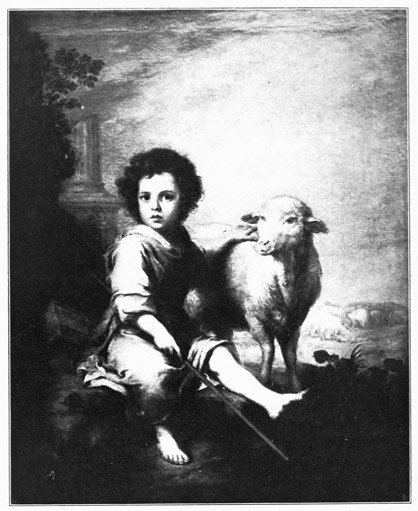
The Divine Shepherd
The opening section is on "Love and Beauty," enumerating, by the way, the "thirty points" essential to a perfect woman. "Three things white—skin, teeth, and hands. Three black—eyes, eyebrows, and eyelashes. Three rosy—lips, cheeks, and nails." But warning is duly given that even the thirty points of beauty do not make up a sum total of perfection without the mystic, all-harmonizing quality of charm.
Next in order are the several sets of directions for winning the affections of maid, wife, and widow, with a collection of edifying sentiments from various saints and wits concerning widows. Descriptions of wedding festivities follow, with a glowing dissertation on kisses, "the banquet-cups of love." After this stands a Castilian translation of an impassioned Arab love-song with the burden, Todo es amor. Maxims on love, culled chiefly from French authorities, are succeeded by an eighteenth-century love-catechism:—
"Question. Art thou a lover? Answer. Yes, by the grace of Cupid. Question. What is a lover? Answer. A lover is one who, having made true and faithful declaration of his passion, seeks the means of gaining the love of her whom he adores."
This is the first lesson. The second treats of the five signs of love, the third of love's duties, the fourth gives the orison of lovers—a startling adaptation of the Lord's Prayer—and their creed: "I believe in Cupid, absolute Lord of Love, who gives to lovers all their joys, and in her whom I love most, for most lovable is she, on whom I think without ceasing, and for whom I would sacrifice gladly my honor and my life."
There is nothing here, it will be noticed, of the Englishman's proud exception:—
"I could not love thee, Dear, so much, Loved I not honor more."
Love has its own beatitudes, too. "Blessed are they who love sincerely. Blessed are they of merry mood. Blessed are lovers who have patience. Blessed are the rich, for love delights to spend."
A "Divination of Dreams," "copied from an ancient manuscript found in the ruins of the convent of San Prudencio, in Clavijo," that famous battle-ground where St. James first trampled the Moors, next engages attention. To dream of a fan is sign of a coming flirtation; of a banner, success in war; of a woman's singing, sorrow and loss; of stars, fair fortune in love; of fire, good luck at cards; of a black cat, trouble from the mother-in-law; of closed eyes, your child in mortal peril; of birds, joy and sweet content; of a ghost, ill health; of scissors, a lover's quarrel; of wine, a cheating Frenchman; of shoes, long journeys; of angels, good tidings from far away. Some of these omens are a surprise to the uninitiated reader. It is bad luck to behold in a dream images of Christ and the Virgin. A church, seen from within, denotes alms; from without, death. To dream of the altar arrayed for high mass betokens grave misfortune. Other omens are significant of Spanish discontents. To dream of a Jesuit brings miseries and betrayals; of a military officer, tyranny and brutality; of a king, danger; of a republic, "abundance, happiness, honors, and work well recompensed." Often these divinations run into rhyme, as:—
"Dream of God at midnight dim, And by day you'll follow Him."
The next section of this Complete Guide is given over to snatches of love-song, which Andalusian children know by heart. These five are fairly representative:—
"Mine is a lover well worth the loving. Under my balcony he cries: 'You have maddened me with your grace of moving, And the beaming of your soft black eyes.'" "Though thou go to the highest heaven, And God's hand draw thee near, The saints will not love thee half so well As I have loved thee here." "If I had a blossom rare, I would twine it in thy hair, Though God should stoop and ask for it To make His heaven more exquisite." "Such love for thee, sent forth from me, Bears on such iron gate That I, used so, no longer know Whether I love or hate." "The learnéd are not wise, The saints are not in bliss; They have not looked into your eyes, Nor felt your burning kiss."
Then comes a "New Dictionary of Love," defining some two hundred doubtful terms in Cupid's lexicon, as forever, no, unselfish. After this we are treated to the language of fan flirtation, of handkerchief flirtation, of flower flirtation, and "the clock of Flora," by which lovers easily make appointments,—one, two, three, being numbered in rose, pink, tulip, and so on. A cut of a youth toiling at a manuscript-laden desk introduces some fifty pages of model love-letters, which seem, to the casual eye, to cover all contingencies. A selection of verses used for adding a grace to birthday and saint-day gifts comes after, and this all-sufficient compendium concludes with a "Lovers' Horoscope."
A single illustration of the sort of reading that Spanish girls find in their way should not, of course, be pressed too far, and yet any one who had seen the pretty group of heads clustered for hours over these very pages on that shaded balcony would not deny the book significance. A taste for the best reading is not cultivated in Spanish girls, even where the treasures of that great Castilian literature are accessible to them. Convent education knows nothing of Calderon. As for books especially adapted to girlhood, we have just examined a sample.
Love and religion are the only subjects with which a señorita is expected to concern herself, and the life of the convent is often a second choice. Even when a Spanish girl wins her crown of wifehood and motherhood, her ignorance and poverty of thought tell heavily against the most essential interests of family life. The Spanish bride is often a child in years. Pacheco's direction for painting the Immaculate Conception ran, "Our Lady is to be pictured in the flower of her age, from twelve to thirteen." This was three centuries ago, but Spain changes slowly. The girl of to-day, nevertheless, marries later than her mother married. I remember one weary woman of forty with eighteen children in their graves and the three who were living physical and mental weaklings. She told us of a friend who married at fourteen and used to leave her household affairs in confusion while she stole away to a corner to play with her dolls. Her husband, a grave lawyer in middle life, would come home to dinner and find his helpmeet romping with the other children in the plaza.
The Spanish girl is every whit as fascinating as her musical, cloaked gallant confides to her iron-grated lattice. Indeed, these amorous serenades hardly do her justice, blending as she does French animation with Italian fervor. In Andalusia she dances with a grace that makes every other use of life seem vain. And when she bargains, there is nothing sordid about it. Her haggling is a social condescension that at once puts the black-eyed young salesman at her mercy.
"But the fan seems to me the least bit dear, señor."
He shrugs his shoulders and flings out his arm in protest.
"Ah, señorita! You see not how beautiful the work is. I am giving it away at six pesetas."
She lifts her eyebrows half incredulously, all bewitchingly.
"At five pesetas, señor."
He runs his hand through his black hair in chivalrous distress.
"But the peerless work, señorita! And this other, too! I sacrifice it at four pesetas."
She touches both fans lightly.
"You will let us have the two at seven pesetas, señor?"
Her eyes dance over his confusion. He catches the gleam, laughs back, throws up his hands.
"Bueno, señorita. At what you please."
It takes a Spaniard to depict a throng of Spanish ladies,—"fiery carnations or starry jasmine in their hair, cheeks like blush roses, eyes black or blue, with lashes quivering like butterflies; cherry lips, a glance as fickle as the light nod of a flower in the wind, and smiles that reveal teeth like pearls; the all-pervading fan with its wordless telegraphy in a thousand colors." In such a throng one sees not only the typical "eyes of midnight," but those "emerald eyes" which Cervantes knew, and veritable pansy-colored eyes dancing with more than pansy mischief. But the voices! In curious contrast to the tones of Spanish men, soft, coaxing, caressing, the voices of the women are too often high and harsh, suggesting, in moments of excitement, the scream of the Andalusian parrot. "O Jesus, what a fetching hat! The feather, the feather, see, see, see, see the feather! Mary Most Pure, but it must have cost four or five pesetas! Ah, my God, don't I wish it were mine!" The speaker who gets the lead in a chattering knot of Spanish women is a prodigy not only of volubility, but of general muscular action. She keeps time to her shrill music with hands, fan, elbows, shoulders, eyebrows, knees. She dashes her sentences with inarticulate whirs and whistles, and countless pious interjections: Gracias á Dios! Santa Maria! O Dios mio! The others, out-screamed and out-gesticulated, clutch at her, shriek at her, fly at her, and still, by some mysterious genius, maintain courtesy, grace, and dignity through it all. Yet it is true that the vulgar-rich variety is especially obnoxious among Spaniards. An overdressed Spanish woman is frightfully overdressed, her voice is maddening, her gusts of mirth and anger are painfully uncontrolled. This, however, is the exception, and refinement the rule.
The legendary Spanish lady is forever sitting at a barred window, or leaning from a balcony, coquetting with a fan and dropping arch responses to the "caramel phrases" of her guitar-tinkling cavalier.
"You're always saying you'd die for me. I doubt it nevertheless; But prove it true by dying, And then I'll answer yes."
For, loving as they are, Spanish sweethearts take naturally to teasing. "When he calls me his Butterfly, I call him my Elephant. Then his eyes are like black fire, for he is ashamed to be so big, but in a twinkling I can make him smile again." The scorn of these dainty creatures for the graces of the ruling sex is not altogether affected. I shall not forget the expression with which a Sevillian belle, an exquisite dancer, watched her novio as, red and perspiring, he flung his stout legs valiantly through the mazes of the jota. "Men are uglier than ever when they are dancing, aren't they?" she remarked to me with all the serenity in the world. And a bewitching maiden in Madrid, as I passed some favorable comment upon the photographs of her two brothers, gave a deprecatory shrug. "Handsome? Ca!" (Which is no many times intensified.) "But they are not so ugly, either,—for men."
The style of compliment addressed by caballeros to señoritas is not like "the quality of mercy," but very much strained indeed. "Your eyes are two runaway stars, that would rather shine in your face than in heaven, but your heart is harder than the columns of Solomon's temple. Your father was a confectioner and rubbed your lips with honey-cakes." Little Consuelo, or Lagrimas, or Milagros, or Dolores, or Peligros laughs it off, "Ah, now you are throwing flowers."
The coplas of the wooer below the balcony are usually sentimental.
"By night I go to the patio, And my tears in the fountain fall, To think that I love you so much, And you love me not at all." "Sweetheart, little Sweetheart! Love, my Love! I can't see thy eyes For the lashes above. Eyes black as midnight, Lashes black as grief! O, my heart is thirsty As a summer leaf." "If I could but be buried In the dimple of your chin, I would wish, Dear, that dying Might at once begin." "If thou wilt be a white dove, I will be a blue. We'll put our bills together And coo, coo, coo."
Sometimes the sentiment is relieved by a realistic touch.
"Very anxious is the flea, Caught between finger and thumb. More anxious I, on watch for thee, Lest thou shouldst not come."
And occasionally the lover, flouted overmuch, retorts in kind.
"Don't blame me that eyes are wet, For I only pay my debt. I've taught you to cry and fret, But first you taught me to forget." "I'll not have you, Little Torment, I don't want you, Little Witch. Let your mother light four candles And stand you in a niche."
The average Spaniard is well satisfied with his señora as she is. He did her extravagant homage as a suitor, he treats her with kindly indulgence as a husband, but he expects of her a life utterly bounded by the casa. "What is a woman?" we heard one say. "A bottle of wine." And those few words tell the story why, with all their charm, home-love, and piety, the Spanish women have not availed to keep the social life of the Peninsula sound and sweet.
"But to admire them as our gallants do, 'Oh, what an eye she hath! Oh, dainty hand! Rare foot and leg!' and leave the mind respectless, This is a plague that in both men and women Makes such pollution of our earthly being."
The life of the convent is attractive to girls of mystic temperament, like the Maria of Valdés, but many of these lively daughters of the sun regard it with frank disfavor. One of the songs found in the mouths of little girls all over the Peninsula is amusingly expressive of the childish aversion to so dull a destiny.
"I wanted to be married To a sprightly barber-lad, But my parents wished to put me In the convent dim and sad. "One afternoon of summer They walked me out in state, And as we turned a corner, I saw the convent gate. "Out poured all the solemn nuns In black from toe to chin, Each with a lighted candle, And made me enter in. "The file was like a funeral; The door shut out the day; They sat me on a marble stool And cut my hair away. "The pendants from my ears they took, And the ring I loved to wear, But the hardest loss of all to brook Was my mat of raven hair. "If I run out to the garden And pluck the roses red, I have to kneel in church until Twice twenty prayers are said. "If I steal up to the tower And clang the convent bell, The holy Abbess utters words I do not choose to tell. "My parents, O my parents, Unkindly have you done, For I was never meant to be A dismal little nun."
I came but slightly in contact with Spanish nuns. Among the figures that stand out clear in memory are a kindly old sister, at Seville, in the Hospital de la Caridad, who paused midway in her exhibition of the famous Murillos there to wipe her eyes and grieve that we were Protestants, and an austere, beautiful woman in La Cuna, or Foundling Asylum of Seville, who caressed a crying baby with the passionate tenderness of motherhood denied. The merriest Spanish hermana of our acquaintance we encountered on the French side of the Pyrenees. At Anglet, halfway between Biarritz and Bayonne, is the Convent of the Bernardines, Silent Sisters. The visitor sees them only from a distance, robed in white flannel, with large white crosses gleaming on the back of their hooded capes. These, too, were originally white, and the hoods so deep that not even the profile of the features could be seen; but the French Government, disturbed by the excessive death-rate in this order, recently had the audacity to interfere and give summary orders that the hoods be cut away, so that the healthful sunshine might visit those pale faces. The mandate was obeyed, but, perhaps in sign of mournful protest, the new hoods and capes are black as night. These women Trappists may recite their prayers aloud, as they work in field or garden, or over their embroidery frames, but they speak for human hearing only once a year, when their closest family friends may visit them and listen through a grating to what their disused voices may yet be able to utter. From all other contact with the world they are shielded by an outpost guard of a few of the Servants of Mary, an industrious, self-supporting sisterhood, whose own convent, half a mile away, is a refuge for unwedded mothers and a home for unfathered children. Hither the pitying sisters brought, a few days before our visit, a wild-eyed girl whom they had found lying on one of the sea rocks, waiting for the rising tide to cover her and her shame together. The chief treasure of this nunnery, one regrets to add, is the polished skull of Mary Magdalene.
That one of the Servants of Mary who showed us over the Trappist convent was a bright-eyed Spanish dame of many winters, as natural a chatterbox as ever gossiped with the neighbors in the sun. Her glee in this little opportunity for conversation was enough to wring the heart of any lover of old ladies. She walked as slowly as possible and detained us on every conceivable pretext, reaching up on her rheumatic tiptoes to pluck us red and white camellias, and pointing out, with a lingering garrulity, the hardness of the cots in the bare, cold little cells, the narrowness of the benches in the austere chapel, and, in the cheerless dining room, the floor of deep sand, in which the Bernardines kneel throughout their Friday dinner of bread and water. Longest of all, she kept us in the cemetery, all spick and span, with close-set rows of nameless graves, each with a cross shaped upon it in white seashells. The dear old soul, in her coarse blue gown, with tidy white kerchief and neatly darned black hood and veil, showed us the grave of her own sister, adding, proudly, that her four remaining sisters were all cloistered in various convents of Spain.
"All six of us nuns," she said, "but my brother—no! He has the dowries of us all and lives the life of the world. Just think! I have two nephews in Toledo. I have never seen them. My sister's grave is pretty, is it not? They let me put flowers there. Oh, there are many families in Spain like ours, where all the daughters are put into convents. Spain is a very religious country. The sons? Not so often. Sometimes, when there is a conscription, many young men become priests to escape military service but it is the women who are most devout in Spain."
And after the rustic gate was shut on the sleeping-place of the Bernardines, scarcely more silent and more dead beneath the sod than above it, she still detained us with whispered hints of distinguished Spanish ladies among those ghostly, far-off figures that, pitchfork or pruning knife in hand, would fall instantly upon their knees at the ringing of the frequent bell for prayers. Spanish ladies, too, had given this French convent many of its most costly treasures. We said good-by to our guide near an elaborate shrine of the Madonna, which a bereaved Spanish mother had erected with the graven request that the nuns pray for the soul of her beloved dead.
"Even we Servants of Mary are not allowed to talk much here," said in parting this most sociable of saints, clinging to us with a toil-roughened, brown old hand. "It is a holy life, but quiet—very quiet. I have been here forty-four years this winter. My name is Sister Solitude."
The nun whom I knew best was an exquisite little sister just back from Manila. During several months I went to her, in a Paris convent, twice or three times a week, for Spanish lessons. The reception room in which I used to await her coming shone not as with soap and water, but as with the very essence of purity. The whiteness of the long, fine curtains had something celestial about it. The only book in sight, a bundle of well-worn leaves bound in crimson plush and placed with precision in the centre of the gleaming mahogany table, was a volume of classic French sermons,—the first two being on Demons, and the next on Penance. Further than this I never read; for very punctually the slight figure, in violet skirt and bodice, with a white cross embroidered upon the breast, swept softly down the hall. A heavy purple cord and a large-beaded rosary depended from the waist. In conversation she often raised her hand to press her ring, sign of her sacred espousals, to her lips. Her type of face I often afterward saw in Spain, but never again so perfect. Her complexion was the richest southern brown, the eyes brightening in excitement to vivid, flashing black. The eyebrows, luxuriant even to heaviness, were nevertheless delicately outlined, and the straight line of the white band emphasized their graceful arch. The nose was massive for a woman's face, and there was a slight shading of hair upon the upper lip. The mouth and chin, though so daintily moulded, were strong. Not the meek, religious droop of the eyelids could mask the fire, vigor, vitality, intensity, that lay stored like so much electricity behind the tranquil convent look.
We would go for the lesson to a severe little chamber, whose only ornament was a crucifix of olive wood fastened against the wall. Then how those velvet eyes would glow and sparkle in the eagerness of rushing speech! The little sister loved to tell of her Manila experience, almost a welcome break, I fancied, in the monotonous peace of cloister life. All that Sunday morning, when the battle was on, the nuns maintained their customary services, hearing above their prayers and chants and the solemn diapason of the organ, the boom, boom, boom of our wicked American cannon. For, according to this naive historian, Catholic Spain, best beloved of Our Lady among the nations of the earth, had labored long in the Philippines to Christianize the heathen, when suddenly, in the midst of those pious labors with which she was too preoccupied to think of fitting out men-of-war and drilling gunners, a pirate fleet bore down upon her and overthrew at once the Spanish banner and the Holy Cross. Tears sparkled through flame as the hermanita told of her beautiful convent home, now half demolished. The sisters did not abandon it until six weeks after the battle, but as the nunnery stood outside the city walls, their superior judged it no safe abode for Spanish ladies, and ordered them away. The French consul arranged for their transport to Hongkong on a dirty little vessel, where they had to stay on deck, the twenty-seven of them, during their week's voyage, suffering from lack of proper shelter and especially from thirst, the water supply running short the second day out. But all this was joy of martyrdom.
"Is not Hongkong a very strange city?" I asked. "Did it seem to you more like Manila than like Paris and Madrid?"
The little sister's voice was touched with prompt rebuke.
"You speak after the fashion of the world. All cities look alike to us. Ours is the life of the convent. It matters nothing where the convent stands."
Stimulated by reproof, I waxed impertinent. "Not even if it stands within range of the guns? Now, truly, truly, were you not the least bit frightened that morning of the battle?"
The sunny southern smile was a fleeting one, and left a reminiscent shadow in the eyes.
"Frightened? Oh, no! There were no guns between us and Paradise. From early dawn we heard the firing, and hour after hour we knelt before the altar and prayed to the Mother of God to comfort the souls of the brave men who were dying for la patria; but we were not frightened."
There were strange jostlings of ideas in that cloistered cell, especially when the dusk had stolen in between our bending faces and the Spanish page.
Once we talked of suicide. That morning it had been a wealthy young Parisian who had paid its daily tribute to the Seine.
"What a horror!" gasped the little sister, clasping her slender hands against her breast. "It is a mortal sin. And how foolish! For if life is hard to bear, surely perdition is harder."
"It does not seem to me so strange in case of the poor," I responded, waiving theology. "But a rich man, though his own happiness fails, has still the power of making others happy."
"Ah, but I understand!" cried Little Manila, her eyes like stars in the dimness. "The devil does not see truth as the blessed spirits do, but sees falsehoods even as the world. And so in his blindness he believes the soul of a rich man more precious than the souls of the poor, and tempts the rich man more than others. Yet when the devil has that soul, will he find it made of gold?"
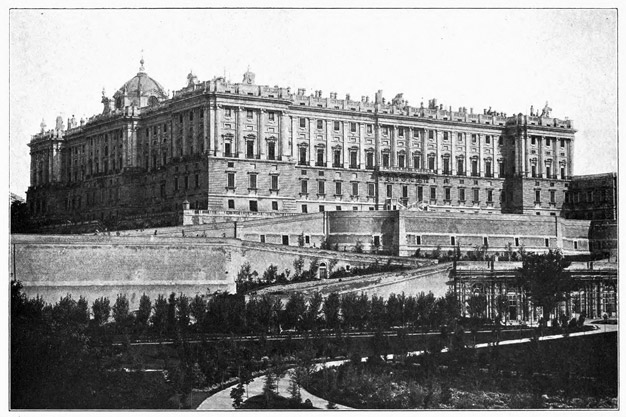
Madrid Royal Palace
One chilly November afternoon, gray with a fog that had utterly swallowed the Eiffel Tower above its first huge uprights, which straddled disconsolately like legs forsaken of their giant, she explained in a sudden rush of words why Spain had been worsted in the war with America.
"Whom the Lord loveth, He chasteneth. As with persons, so with nations. Those that are not of His fold He gives over to their fill of vainglory and greed and power, but the Catholic nations He cleanses again and again in the bitter waters of defeat—ah, in fire and blood! Yet the end is not yet. The rod of His correction is upon Spain at this hour, and the Faithful are glad in the very heart of sorrow, for even so shall her sins be purged away, even so shall her coldness be quickened, even so shall she be made ready for her everlasting recompense."
"And the poor Protestant nations?" I asked, between a smile and a sigh.
The little sister smiled back, but the Catholic eyes, for all their courtly graciousness, were implacable.
She was of a titled family and had passed a petted childhood in Madrid. There she had been taken, on her seventh birthday, to a corrida de toros, but remembered it unpleasantly, not because of the torture inflicted on the horses and bulls, but because she had been frightened by the great beasts, with their tossing horns and furious bellowing. Horns always made her think of the devil, she said. From her babyhood she had been afraid of horns.
One day a mischievous impulse led me to inquire, in connection with a chat about the Escorial, "And how do you like Philip II?"
The black eyes shot one ray of sympathetic merriment, but the Spaniard and the nun were on their guard.
"He was a very good Catholic," she replied demurely.
"So was Isabel la Católica," I responded. "But don't you think she may have been a trifle more agreeable?"
"Perhaps she was a little more simpática," admitted the hermanita, but that was her utmost concession. She would not even allow that Philip had a sorry end.
"If his body groaned, his soul was communing with the Blessed Saints and paid no heed."
At the corner of the street which led under the great garden wall to the heavily barred gate of the convent was a flower-stand. The shrewd, swift-tongued Madame in charge well knew the look of the unwary, and usually succeeded in selling me a cluster of drooping blossoms at twice the value of the fresh, throwing in an extra leaf or stem at the close of the bargain with an air of prodigal benevolence. The handful of flowers would be smilingly accepted by the little sister, but instantly laid aside nor favored with glance or touch until the close of the visit, when they would be lifted again with a winsome word of acknowledgment and carried away, probably to spend their sweetness at the marble feet of the Virgin. In vain I tried to coax from this scorner of God's earth some sign of pleasure in the flowers themselves.
"Don't you care for tea-roses?" "Ah, el mundo pasa. But their color is exquisite."
Yet her eyes did not turn to the poor posy for the two hours following.
"This mignonette has only the grace of sweetness."
"It is a delicate scent, but it will not last. El mundo pasa."
She held the sprays at arm's length for a moment, and then laid them down on a mantel at the farther end of the room.
"I am sorry these violets are not fresher."
"But no! The touch of Time has not yet found them. Still, it is only a question of to-morrow. El mundo pasa."
"Yes, the world passes. But is it not good while it lasts?"
"The world good! No, no, and a thousand times no. Behold it now at the end of the nineteenth century,—wars and sorrows and bitter discontents, evil deeds and evil passions everywhere. Do you see the peace of Christ in the faces on the Paris streets? The blossoms of this earth, the pleasures of this world, the affections of this life, all have the taste of death. But here in God's own garden we live even now His everlasting life."
"You are always glad of your choice? You never miss the friends of your childhood?"
"Glad, glad, glad. Glad of my choice. Glad to see no more the faces of father and mother. And for them, too, it is great joy. For Catholic parents it is supreme delight to give up their children to the Holy Church. The ways of the world are full of slippery places, but when they leave us here, they know that our feet are set on the very threshold of heaven."
Sometimes the slight form shivered in the violet habit, and the dark foreign face looked out with touching weariness from its frame of soft white folds.
"You are cold? You are tired? Will you take my cloak? Were the children troublesome to-day?"
It was always the same answer: "No importa. No importa. It matters not. Our life is not the life of flesh and blood."
And indeed, as I saw her in the Christmas service among the other Spanish sisters, those lovely figures in white and violet making obeisance before the altar until their veiled foreheads almost touched the pavement, bowing and rising again with the music like a field of lilies swaying in the breeze, I felt that she was already a being of another world, before she had known this. Over her had been chanted the prayers for the dead. The strange ceremony of taking the veil had been her burial rite. The convent seemed a ghost land between earth and heaven.
My hermanita belonged to one of the teaching orders, and despite the strange blanks in her knowledge, for secular lore had been, so far as possible, excluded from her education, she was representative of the finer and more intelligent class of Spanish nuns. In Granada I heard of the nuns chiefly as the makers of those delicious dulces, sugared fruits, which were indispensable to a child's saint-day, and there I was taught the scoffing epitaph:—
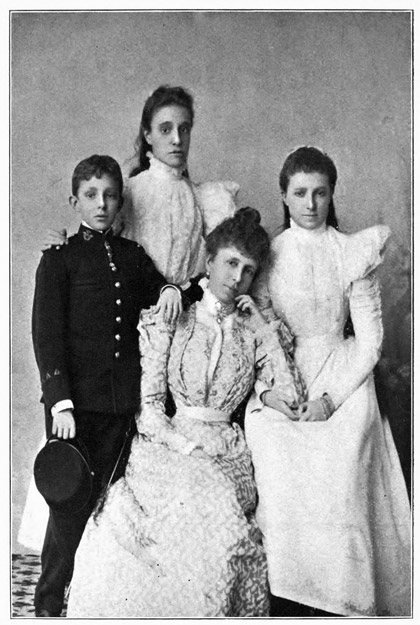
The Royal Family
"Here lies Sister Claribel, Who made sweetmeats very well, And passed her life in pious follies, Such as dressing waxen dollies."
To the spinster outside the nunnery Spain has little to offer. Small heed is paid to her except by St. Elias, who, on one day of Holy Week, walks about all Seville with a pen in his hand, peering up at the balconies and making note of the old maids. Since Andalusia expresses the theory of counterparts by saying, "Every one has somewhere in the world his half orange," the spinster can hardly hope for a well-rounded life. Careers are not open to her. There are "advanced women" in Spain, the most eminent being Emelia Pardo Bazan, novelist, lecturer, editor, who advocates for women equal educational and political privileges with men, but who has not yet succeeded in opening the doors. The voice of Spanish women, nevertheless, is sometimes heard by Spanish statesmen, as when delegation after delegation of señoras who had relatives held as prisoners by the Filipinos invaded the senate-house with petitions until they could no longer be ignored.
A more thorough and liberal education for Spanish women is the pressing need to-day. There is, of course, great lack of primary schooling. A girl in her late teens, wearing the prettiest of embroidered aprons and with the reddest of roses in her hair, once appealed to me in Toledo for help. She had been sent from a confectioner's to deliver a tray of wheaten rolls at a given address, and she could read neither the names of streets nor the numbers of houses. But the higher education will carry the lower with it. Spain is degenerate in this regard. The Moors used to have at Cordova an academy for girls, where science, mathematics, and history were taught. Schools for Spanish girls at present impart little more than reading and writing, needle-work, the catechism, the four rules of arithmetic, and some slight notion of geography. French and music, recognized accomplishments, are learned by daughters of the privileged class from their governesses or in the convents. Missionary work in Spain has largely concerned itself with the educational question, and Mrs. Gulick's project for the establishment of a woman's college in Madrid, a college without distinction of creed, is the fruit of long experience. Little by little she has proven the intellectual ability of Spanish girls. She established the International Institute at San Sebastian, secured State examination for her niñas and State recognition of their eminent success, and even won for a few of them admission to the University of Madrid, where they maintained the highest rank throughout the course. All that Spanish girls need is opportunity.