Introductory material (continued 3)
Reading edition
Spanish legend likes to name the Cid as the first torero.
"Troth it goodly was and pleasant To behold him at their head, All in mail on Bavieca, And to hear the words he said."
In mediæval times the sport was not without chivalric features. Knights fought for honor, where professionals now fight for pesetas. When the great Charles killed a bull with his own lance in honor of the birth of Philip II, the favor of the Austrian dynasty was secured. The Bourbons looked on the sport more coldly, but as royalty and nobility withdrew, the people pressed to the fore. Out of the hardy Spanish multitude rose a series of masters,—Romero the shoemaker, who, in general, gave to the art its modern form; Martincho the shepherd, who, seated in a chair with his feet bound, would await the charging brute; Cándido, who would face the bull in full career and escape by leaping to its forehead and over its back; Costillares, who invented an ingenious way of getting in the death-stroke; the famous Pepe Hillo, who, like Cándido, perished in the ring; a second Romero, said to have killed five thousand six hundred bulls; Montés the brick-layer, and a bloody band of followers. Andalusia is—alas!—the classic soil of the bull-fight, as every peasant knows, and Seville the top of Andalusia.
"I have a handsome lover, Too bold to fear the Devil, And he's the best torero In all the town of Seville."
The extravagance of the popular enthusiasm for these fiestas de toros is often ridiculed on the stage, where dramas dealing with bull-fighting, especially if they bring in the heroes of the arena, Pepe Hillo, Romero, Costillares, are sure to take. One zarzuela represents a rheumatic old aficionado, or devotee of the sport, trying, with ludicrous results, to screw his courage to the point of facing the bull. Another spends its fun on a Madrid barber, who is likewise a brain-turned patron of the ring. Disregarding the shrill protests of his wife, he lavishes all his time, love, and money on the corridas and encourages his daughter's novio, an honest young paper-hanger, to throw over his trade and learn to torear. After two years of the provincial arenas, the aspirant, nicknamed in the ring The Baby, has nothing but torn clothes and bruises to show for his career, and his sweetheart, eager to recall him from the hazardous profession, vows a waxen bull, large as life, to the Virgin, in case he returns to papering, with its humble security and its regularity of wages. Mary hears. On that great occasion, The Baby's début at Madrid, the barber, who has just been lucky in the lottery, rents for him a gorgeous suit of second-hand finery, but in the Plaza de Toros not even a rose-and-silver jacket can shield a quaking heart. The Baby is a coward born, and from the first rush of the first bull comes off with a bloody coxcomb, crying out his shame on the shoulder of his Pilar, who shall henceforth have him all her own.
The little artist and I went into Spain with the firm determination not to patronize the bull-fight. Half our resolution we kept,—her half. Wherever we turned we encountered suggestions of the corrida. Spanish newspapers, even the most serious, devote columns to Los Toros. Bull-fighting has its special publications, as El Toril and El Toreo Cómico, and its special dialect. On the morning after a holy day the newspapers seem actually smeared with the blood of beasts. In the bull-fight season, from Easter to All Saints, corridas are held every Sunday in all the cities of southern and central Spain, while the smaller towns and villages butcher as many bulls as they can possibly afford. The May and June that I passed in the capital gave me a peculiar abhorrence of the Madrid Sunday,—that feverish excitement everywhere; the rattle of all those extra omnibuses and cars with their red-tasselled mules in full gallop for the Plaza de Toros; that sense of furious struggle and mortal agony hanging over the city all through the slow, hot afternoon; those gaping crowds pressing to greet the toreros, a gaudy-suited company, on their triumphal return in open carriages; that eager discussion of the day's tragedy at every street-corner and from seat to seat along the paseos, even at our own dainty dinner table and on our own balconies under the rebuking stars. At this strange Sabbath service the Infanta Isabel, whose mother's birth was celebrated by the slaying of ninety-nine bulls, is a regular attendant, occupying the royal box and wearing the national colors. A French bull-fighter, visiting the Spanish capital, was invited by the Infanta to an audience and presented with a diamond pin. Not even the public mourning for Castelar could induce Madrid to forego the corrida on that Sunday just before his burial. Past the very senate-house where his body lay in state rolled the aristocratic landaus, whose ladies displayed the gala-wear of white mantillas.
But the Sundays were not enough. Every Catholic feast-day called for its sacrifice. Granada could not do fitting honor to Corpus Christi with less than three "magnificas corridas." The royal saint of Aranjuez, Fernando, must have his pious birthday kept by an orgy of blood. At the fiesta of Christ's Ascension all Spain was busy staining his earth with the life-stream of His creatures. Valladolid was, indeed, ashamed to have torn to death only seven horses, but Segovia rejoiced in an expert who sat at his work and killed his bulls with drawing-room ease. Bordeaux improved the occasion, with aid of two celebrated Spanish espadas, by opening a French Plaza de Toros, and Valencia had the excitement of sending to the infirmary one torero with a broken leg and another with a crushed foot. Such accidents are by no means uncommon. A matador was mortally wounded in the Valencia ring that summer, a banderillero was trampled at the Escorial, and those favorite stabbers, Reverte and Bombita, were themselves stabbed by avenging horns.
If there is a temporary dearth of saint days, Spanish ingenuity will nevertheless find excuse for corridas. Bulls must bleed for holy charity,—for hospitals, foundling asylums, the families of workmen out on strike. If the French squadron is at Cadiz, hospitality demands a bull-fight. In the interests of popular education, an historical corrida was arranged, with instructed toreros to display the special styles of bull-killing that have prevailed from the Cid to Guerrita. Again, as a zoölogical by-play, an elephant was pitted against the bulls. This, too, had precedent, for did not Philip IV once keep his birthday by turning in among the horned herd a lion, a tiger, a camel, and a bear, "all Noah's ark and Æsop's fables"? A bull of Xarama vanquished them every one and received the gracious reward of being shot dead by Philip himself.
It was on a Wednesday afternoon, at one of the three grand corridas of the Seville Feria, that I became an accomplice in this Spanish crime. Our friends in Seville, people of cultivation and liberal views, had declared from the first that we could have no conception of Spanish life and character without sharing in the national fiesta. "We ourselves are not enthusiasts," they said. "In fact, we disapprove the bull-fight. We regard it as demoralizing to the community at large. It is, nevertheless, a thing scientific, artistic, heroic, Spanish. Besides, a large portion of the proceeds goes to charity. We do not attend the corridas, except now and then, especially when we have foreign guests who wish to see them. Before going they all regard bull-fighting as you do, as an atrocity, a barbarity, but invariably they return from the Plaza de Toros filled with delight and admiration. They say their previous ideas were all wrong, that it is a noble and splendid spectacle, that they want to see it again and again, that they cannot be too grateful to us for having delivered them from prejudice."
I winced at the word. I have a prejudice against being prejudiced, and to the bull-fight I went.
My yielding came too late for securing places in a box or in any part of the house from which one can make exit during the performance. Our gory-looking tickets admitted us to the uppermost row of high, whitewashed, stone seats of the circus proper, where we were soon inextricably wedged in by the human mass that formed around and below us. The hour of waiting passed merrily enough. The open amphitheatre, jammed to its full capacity of fourteen thousand, lay half in brilliant sunlight and half in creeping shadow. Above us arched the glowing blue sky of Seville, pricked by the rosy Giralda, and from time to time a strong-winged bird flew over. The great arena, strewn with yellow sand, was enclosed by a dark red barrier of wood, about the height of a man. This was encircled, at a little distance, by a more secure and higher wall of stone. The concourse was largely composed of men, both roughs and gentles, but there was no lack of ladies, elegantly dressed, nor of children. Two sweet little girls in white-feathered hats were just in front of us, dancing up and down to relieve the thrills of expectancy. White mantillas, pinned with jewels, bent from the boxes, while the daughters of the people dazzled the eye with their festival display of Manila shawls, some pure white, some with colored figures on a white ground or a black, and some a rainbow maze of capricious needle-work. The rich-hued blossoms of Andalusia were worn in the hair and on the breast. The sunny side of the circus was brightly dotted by parasols, orange, green, vermilion, and fans in all the cardinal colors twinkled like a shivered kaleidoscope. The men's black eyes glittered under those broad sombreros, white or drab, while they puffed their cigarettes with unwonted energy, scattering the ashes in soft gray showers over their neighbors on the seats below. The tumult of voices had a keener note of excitement than I had yet heard in Spain, and was so loud and insistent as often to drown the clashing music of the band. The cries of various venders swelled the mighty volume of noise. Water-sellers in vivid blouses and sashes, a red handkerchief twisted around the neck, on the left shoulder a cushion of folded carpeting for the shapely, yellow-brown jar, and a smart tin tray, holding two glasses, corded to the belt, went pushing through the throng. Criers of oranges, newspapers, crabs, and cockles, almond cakes, fans, and photographs of the toreros, strove with all the might of their lungs against the universal uproar.
"Crece el entusiasmo; Crece la alegría; Todo es algazara; Todo es confusión."
A tempest of applause marked the entrance in a box above of a popular prima donna, who draped a resplendent carmine scarf over the railing before her seat. Immediately the complete circuit of the rail was ablaze with color, cloaks and shawls instantly converting themselves into tapestry.
At last two attendants entered the arena, walked up to a hydrant in the centre, fastened on a hose, and watered the great circle. They pulled out the hydrant and raked sand over the hole. Simple as these actions were, a dreadful quiet fell on all the circus.
A trumpet blared. Mounted alguaciles, or police, tricked out in ancient Spanish costume, on blue saddles, and with tall blue plumes in their hats, rode in and cleared the arena of all stragglers. A door opened, and forth issued the full circus troupe, making a fine show of filigree, and urging their wretched old nags to a last moment of equine pride and spirit. Amid roars of welcome, they flaunted across the sanded enclosure and saluted the presiding officer. He dropped the key of the toril, that dark series of cells into which the bulls had been driven some hours before. An alguacil caught the key and handed it to the torilero, who ran with it toward a second door, ominously surmounted by a great bull's head. Then there was a twinkling of the pink stockings and black sandals. Most of the gay company leaped the barrier, and even the chulos who remained in the ring placed themselves within convenient distance of the rail. Some of the picadores galloped out, but a few awaited the coming charge, their long pikes in rest. The door on which all eyes were bent flew open, and a bellowing red bull rushed in. The fierce, bloodthirsty, horrible yell that greeted him checked his impetuous onset. For a few seconds the creature stood stock-still, glaring at the scene. Heaven knows what he thought of us. He had had five perfect years of life on the banks of the Guadalquivír,—one baby year by his mother's side, one year of sportive roving with his mates, and then had come the trial of his valor. He had found all the herdsmen gathered at the ranch one morning, and, nevertheless, flattered himself that he had evaded those hateful pikes, garrochas, that were always goading him back when he would sally out to explore the great green world. At all events, here he was scampering alone across the plain. But promptly two horsemen were at his heels, and one of these, planting a blunt garrocha on his flank, rolled the youngster over. Up again, panting with surprise and indignation, he felt a homesick impulse to get back to the herd, but the second horseman was full in his path. So much the worse for the horseman! The mettlesome young bull lowered his horns and charged the obstacle, only to be thrown back with a smarting shoulder. If he had yielded then, his would have been the quiet yoke and the long, dull life of labor, but he justified his breed; he charged anew, and so proved himself worthy of the arena. Three more years of the deep, green river-reeds and the sweet Andalusian sunshine, three years of free, far range and glad companionship, and then the end. His days had been exempt from burden only to save his wild young strength for the final tragedy. One summer morning those traitors known as decoy-oxen, with bells about the neck, came trotting into the herd. The noble bulls, now at their best hour of life, the glory of their kind, welcomed these cunning guests with frank delight and interest, and were easily induced to follow them and their tinkling bells across the rich pastures, along rough country roads, even to the city itself and the fatal Plaza de Toros. The herdsmen with their ready pikes galloped behind the drove, and everywhere along the way peasants and townsfolk would fall in for a mile or two to help in urging the excited animals onward to their cruel doom.
In that strange, maddening sea of faces, that hubbub of hostile voices, the bull, as soon as his blinking eyes had effected the change from the darkness of the toril to the glaring light and gaudy colors of the coliseum, caught sight of a horseman with the familiar pike. Here was something that he recognized and hated. Lowering his head, the fiery brute dashed with a bellow at that tinselled figure. Ah, the pike had never been so sharp before! It went deep into his shoulder, but could not hold him back. He plunged his horns, those mighty spears, into the body of the helpless, blindfolded horse, which the picador, whose jacket was well padded and whose legs were cased in iron, deliberately offered to his wrath. The poor horse shrieked, plunged, reeled, and fell, the chulos deftly dragging away the armored rider, while the bull ripped and trampled that quivering carcass, for whose torment no man cared, until it was a crimson, formless heap.
Such sickness swept over me that I did not know what followed. When I looked again, two bloody masses that had once been horses disfigured the arena, and the bull, stuck all over like a hedge-hog with derisive, many-colored darts, had gone down under Guerrita's steel.
My friends, observing with concern that I was not enjoying myself as much as they had promised, tried to divert my attention to the technical features of their ghastly game. It was really, they explained, a drama in three acts. It is the part of the mounted picador to draw off the first rage and vigor of the bull, weakening him, but not slaying him, by successive wounds. Then the jaunty banderilleros, the streamers of whose darts must correspond in color with their costumes, supply a picturesque and amusing element, a comic interlude. Finally an espada, or matador, advances alone to despatch the tortured creature. The death-blow can be dealt only in one of several fashions, established by rule and precedent, and the espada who is startled into an unprofessional thrust reaps a bitter harvest of scoffs and hisses.
A team of gayly-caparisoned mules with jingling bells had meanwhile trundled away the mangled bodies of the slaughtered animals, fresh sand had been thrown over the places slippery with blood, and the band pealed the entrance of the second bull. This was a demon, black as a coal, with a marvellous pride and spirit that availed him nothing. Horse after horse crashed down before his furious rushes, while the circus, drunk with glee, shouted for more victims and more and more. It was a massacre. At last our hideous greed was glutted, and the banderilleros took their turn in baiting the now enfeebled but undaunted bull. Wildly he shook himself, the fore half of his body already a flood of crimson, to throw off the ignominy of those stinging darts. The chulos fretted and fooled him with their waving cloaks of red and yellow, till at last the creature grew hushed and sullen. A strain of music announced that the matador Fuentes was asking beneath the president's box permission to kill the bull. For my part, I gave the bull permission to kill the man. Fuentes, all pranked out in gray and gold, holding his keen blade behind him and flourishing a scarlet square of cloth, swinging from a rod, the muleta, advanced upon the brute. That bleeding body shook with a new access of rage, and the other espadas drew near and stood at watch. But even before a blow was struck the splendid, murdered creature sank to his knees, staggered up once more, sank again with crimson foam upon his mouth, and the music clashed jubilantly while Fuentes drove the weapon home. And again the team of mules, with foolish tossing of their bright-ribboned heads, jerked and jolted their dead kindred off the scene.
The third bull galloped in with a roar that was heard far beyond the Plaza and gored his first two horses so promptly and so frightfully that, while the hapless beasts still struggled in their agony, the amphitheatre howled with delirious joy. Several capas were caught away on those swift, effective horns, and one picador was hurt. But the rain of darts teased and bewildered the bull to the point of stupidity, although he was dangerous yet.
"Dark is his hide on either side, but the blood within doth boil; And the dun hide glows, as if on fire, as he paws to the turmoil. His eyes are jet, and they are set in crystal rings of snow; But now they stare with one red glare of brass upon the foe."
It was the turn of Bombita, a dandy in dark-green suit with silver trimmings; but his comrades, pale and intent, stood not far off and from time to time, by irritating passes, drew the bull's wrath upon themselves, wearying him ever more and more, until at last Bombita had his chance to plant a telling blow.
Would it never end? Again the fatal door swung open, and the fourth bull bounded in to play his tragic rôle. He was of choicest pedigree, but the utter strangeness of the scene turned his taurine wits. He made distracted and aimless rushes hither and thither, unheeding the provocations of the horsemen, until he came upon the spot drenched with his predecessor's life-blood. He pawed away the hasty covering of sand, sniffed at that ominous stain, and then, throwing up his head with a strange bellow, bolted back to the door by which he had entered, and turned tail to the arena. The fourteen thousand, crazy with rage, sprang to their feet, shook their fists, called him cow. The chulos brandished their cloaks about his horns; men leaned over from the barrier and prodded him with staffs. Finally, in desperation, he turned on the nearest horse, rent it and bore it down. The picador, once set up by the chulos upon his stiff, iron-cased legs, his yellow finery streaked with red from his lacerated horse, tugged savagely at the bridle to force that dying creature to a second stand. One attendant wrenched it by the tail, another beat it viciously over the face; the all-enduring beast, his entrails swinging from a crimson gash, struggled to his feet. The picador mounted, drove in the spurs, and the horse, rocking and pitching, accomplished a few blind paces toward those dripping horns that horribly awaited him. But to the amazement and scandal of the aficionados, the circus raised a cry of protest, and the discomfited rider sprang down in the very moment when his horse fell to rise no more. A chulo, at his leisurely convenience, quieted those kicking hoofs by a stab,—the one drop of mercy in that ocean of human outrage.
Straw-colored darts, wine-colored darts, sky-colored darts, were pricking the bull to frenzy. I wished he had any half-dozen of his enemies in a clear pasture. Those glittering dragon-flies were always just out of reach, but he stumbled on the sodden shape of the unhappy horse and tossed it again and again, making the poor carcass fling up its head and arch its neck in ghastly mockery of life. Cowardice avails a bull as little as courage. This sorry fighter had been deeply pierced by the garrochas, and now, as he galloped clumsily about the arena, in unavailing efforts to escape from his tormentors, his violent, foolish plunges made the dark blood flow the faster. It was Guerrita, Guerrita the adored, Guerrita in gold-laced jacket and violet trousers, who struck the ultimate blow, and so cleverly that sombreros and cigarettes, oranges and pocket-flasks, came raining, amid furies of applause, into the arena. This was such a proud moment as he had dreamed of long ago in the Cordova slaughter-house, when, the little son of the slaughter-house porter, he had stolen from his bed at midnight to play al toro with the calves, and then and there had solemnly dedicated himself to the glorious profession. Now the master of his art and the idol of all Spain, easily making his seventy-five thousand dollars a year, earning, in fact, three thousand on that single afternoon, Guerrita little foresaw that with the coming autumn he should go on pilgrimage to La Virgen del Pilar, and before her beloved shrine at Saragossa cut off his bull-fighter's pigtail and renounce the ring.
The fifth bull was black as ebony. He dashed fearlessly into the arena, charged and wheeled and tossed his horns in the splendor of his strength, sending every red-vested chulo scrambling over the wall. Then he backed to the middle of the sanded circle, snorting and pawing the earth. Another instant, and the nearest horse and rider went crashing against the barrier. The picador, with a bruised face, forced up the gasping horse, mounted and rode it, the beast treading out its entrails as it went, to meet a second charge. But the swaying horse fell dead before it reached those lowered horns again. The next picador, too, went down heavily under his jade and received an awkward sprain. He mounted once more, to show that he could, and the circus cheered him, but his horse, torn to death, could not bear his weight. He gave it an angry push with the foot as he left it writhing in its life-blood. This whirlwind of a bull, who shook off all but one of the banderillas, mortified even the matadores. Disregarding the red rag, he rushed at Fuentes himself. The nimble torero leapt aside, but the bull's horn struck his sword and sent it spinning half across the arena. His comrades immediately ran, with waving capas and bright steel, to his aid, but that too intelligent bull, fighting for his life, kept his foes at bay until the circus hissed with impatience. The toreros, visibly nettled, gathered closer and closer, but had to play that death-game cautiously. This bull was dangerous. The coliseum found him tedious. He took too long in dying. Stabbed again and again and again, he yet agonized to his feet and shook those crimsoned horns at his tormentors, who still hung back. It really was dull. The matadores buzzed about him, worrying his dying sight, but he stood sullen in their midst, refusing the charges to which they tempted him, guarding his last drops of strength, and, cardinal offence in a toro, holding his head too high for the professional stroke. His vital force was ebbing. Red foam dripped from his mouth. That weary hoof no longer pawed the earth. The people shouted insults even to their pet Guerrita, but Guerrita, like the rest, stood baffled. At last that formidable figure, no longer black, but a red glaze of blood and sweat and foam, fell in a sudden convulsion. Then his valiant murderers sprang upon him, the stabs came thick and fast, and the jingling mule-team pranced in to form his funeral cortège.
One more,—the sixth. I was long past indignation, past any acuteness of pain, simply sickened through body and soul and unutterably wearied with this hideous monotony of slaughter. The last bull, a white star shining on his black forehead, tore into the arena, raced all about the circle, and struck with amazing rapidity wherever he saw a foe. Three horses were down, were up again, and were forced, all with trailing intestines, to a second charge. The bull flashed like a thunderbolt from one to another, rending and digging with his savage horns, until three mangled bodies writhed on the reddened sand, and stabbers watched their chances to run forward and quiet with the knife the horrible beating of those hoofs in air. The circus yelled delight. It had all been the work of a moment,—a brave bull, a great sensation! For the performers it was rather too much of a good thing. Those disembowelled carcasses cluttered up the arena. The scattered entrails were slippery under foot. The dart-throwers hastened to the next act of the tragedy. Theirs was a subtlety too much for the fury-fuddled wits of that mighty, blundering brute. He galloped to and fro, spending his strength in useless charges and, a score of times, ignoring the men to hook wildly at their brandished strips of colored cloth. The darts had been planted and he was losing blood. The matador went to his work, but the uncivil bull did not make it easy for him. Bombita could not get in a handsome blow. The house began to hoot and taunt. A stentorian voice called to him to "kill that bull to-morrow." Exasperated by the laughter that greeted this sally, Bombita drove his Toledo blade to its mark. While the final scene of general stabbing was going on, boys, men, even women vaulted into the arena, played over again with one another the more memorable incidents, ran to inspect those shapeless carcasses of what God created horses, and escorted the funeral train of the bull, one small boy riding in gleeful triumph on top of the great black body, harmless and still at last. As we passed out by a hallway where the dead animals had been dragged, we had to pick our way through pools of blood and clots of entrails. Thus by the road of the shambles we came forth from hell.
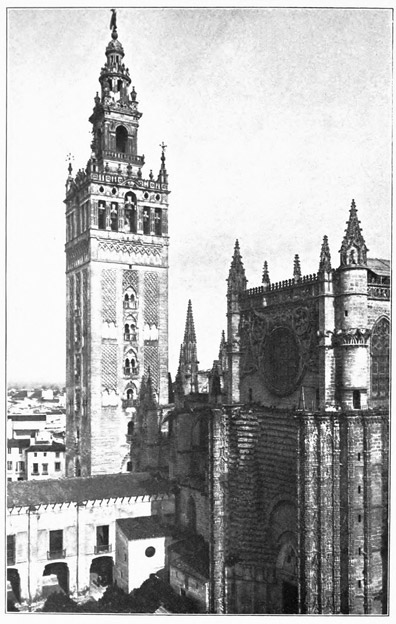
The Giralda
"I do not understand at all," sincerely protested my Spanish host, disconcerted by the continued nausea and horror of red dreams which, justly enough, pursued me for weeks after. "It was a very favorable corrida for a beginner,—no serious accident, no use of the fire-darts, no houghing of the bull with the demi-lune, nothing objectionable. And, after all, animals are only animals; they are not Christians."
"Who were the Christians in that circus?" I asked. "How could devils have been worse than we?"
He half glanced toward the morning paper but was too kindly to speak his thought. It was not necessary. I had read the paper, which gave half a column to a detailed account of a recent lynching, with torture, in the United States.
X
GYPSIES
"'Life is sweet, brother.'
"'Do you think so?'
"'Think so!—There's night and day, brother, both sweet things; sun, moon, and stars, brother, all sweet things; there's likewise a wind on the heath. Life is very sweet, brother; who would wish to die?'
"'I would wish to die.'
"'You talk like a gorgio—which is the same as talking like a fool—were you a Rommany Chal you would talk wiser. Wish to die, indeed!—A Rommany Chal would wish to live forever!'
"'In sickness, Jasper?'
"'There's the sun and stars, brother.'
"'In blindness, Jasper?'
"'There's the wind on the heath, brother; if I could only feel that, I would gladly live forever. Dosta, we'll now go to the tents and put on the gloves; and I'll try to make you feel what a sweet thing it is to be alive, brother!'"
—George Borrow.
No foreigner has known the Zingali better than George Borrow, the linguistic Englishman, who could speak Rommany so well that gypsies all over Europe took him for a brother. In the employ of the English Bible Society, he spent some five adventurous years in Spain, wandering through the wilds and sharing the life of shepherds, muleteers, even the fierce gitanos. As he found the Spanish gypsies half a century ago, so, in essentials, are they still—the men jockeys, tinkers, and blacksmiths, the women fortune tellers and dancers, the children the most shameless little beggars of all the Peninsula. Yet there has been an improvement.
The gitanos are not such ruffians as of old, nor even such arrant thieves, although it would still be unwise to trust them within call of temptation.
"There runs a swine down yonder hill, As fast as e'er he can, And as he runs he crieth still, 'Come, steal me, Gypsyman.'"
Still more compromising is the Christmas carol:—
"Into the porch of Bethlehem Have crept the gypsies wild, And they have stolen the swaddling clothes Of the new-born Holy Child. "Oh, those swarthy gypsies! What won't the rascals dare? They have not left the Christ Child A single shred to wear."
There are wealthy gypsies, whose wives and daughters go arrayed with the utmost elegance of fashion, in several Spanish cities. Seville has her gypsy lawyer, but her gypsy bull-fighter, who died two years ago, was held to reflect even greater credit on the parent stock.
By law the gypsies are now established as Spaniards, with full claim to Spanish rights and privileges—Nuevos Castellanos, as they have been called since the day when Spain bethought her of these Ishmaels as "food for powder" and subjected them to the regular military draft. Even in Granada, where the gypsy community still lives in semi-barbarism, there are hopeful signs. The gitanos drive a sharp trade in donkeys, but their forge fires, gleaming far up the Albaicín in the evening, testify to their industry. The recent opening by the municipality of schools for the gypsy children has already wrought a marked change for the better. Some half-dozen dirty little palms, outstretched for cinco centimos, pester the stranger to-day where scores used to torment him, and the mothers take pride in the literary accomplishments of their tawny broods. On one occasion, when, having, as the Spanish say, "clean pockets," I firmly declined to see a small gypsy girl dance or hear her sing, the mother assured me, as a last greedy expedient, that "the child could pray."
On the Alhambra hill the gypsies, who scent tourists from afar and troop thither, on the track of newly arrived parties, like wolves to their banquet, are picturesque figures enough, the men in peaked hats, spangled jackets, and sashes of red silk, the women with bright handkerchiefs bound over their raven hair, large silver earrings, gay bodices, and short, flounced petticoats.
There is one old gitano, in resplendent attire, who haunts the Alhambra doors and introduces himself to visitors, with bows queerly compounded of condescension and supplication, as the King of the Gypsies, modestly offering his photograph for a peseta. If you turn to your attendant Spaniard and ask, sotto voce, "But is this truly the Gypsy King?" you will receive a prompt affirmative, while the quick-witted old masquerader strikes a royal attitude, rolls his eyes prodigiously, and twirls his three-cornered hat at arm's length above his head, until its tinsel ornaments sparkle like crown jewels. But no sooner is his Majesty well out of hearing than your guide hastens to eat his own words. "No, no, no! He is not the King of the Gypsies, but he is a gypsy, yes, and it is better not to have his ill will."
Whether this hardened pretender could cast the evil eye or not, we never knew, for having bought two of his pictures at the first onset, we suffered ever afterward the sunshine of his favor. In fact we often made a wide detour rather than pass him on the hill, for he would spring to his feet at our remotest approach and stand bowing like an image of perpetual motion, his hat brandished high in air, until our utmost in the way of answering nods and smiles seemed by contrast sheer democratic incivility.
The swarthy faces and glittering eyes of the gypsies meet one everywhere in the Granada streets, but to see them in their own precinct it is necessary to take off your watch, empty your pockets of all but small silver and coppers, and go to the Albaicín. This hill, parted from the Alhambra by the deep ravine of the gold-bearing Darro, was in Moorish times the chosen residence of the aristocracy. Still Arabian arches span the gorge, and many of the toppling old houses that lean over the swift, mountain-born current, shabby as they look to the passer-by, are beautiful within with arabesque and fretwork, carven niches, delicate columns and open patios, where fountains still gush and orange blossoms still shed fragrance. Such degenerate palaces are often occupied by the better class of gypsies, those who traffic in horses, as well as in donkeys, while their women, grouped in the courts and doorways, embroider with rainbow wools, in all fantastic patterns, the stout mantles of the Andalusian mountaineers.
As we climbed the Albaicín, fronting as it does the hill of the Alhambra, the exceeding beauty of the view at first claimed all our power of seeing. Below was the gray sweep of the city and beyond the fruitful plain of Granada, its vivid green shading into a far-off dimness like the sea. Just opposite us rose the fortress of the Alhambra, a proud though broken girdle of walls and towers, while in the background soared the dazzling snow peaks of the Sierra Nevada, glistening with unbearable splendor under the intense blue of the Andalusian sky.
In the midst of our rhapsodies I became aware of a shrill voice at my feet, a persistent tug at my skirts, and reluctantly dropped my eyes on a comely little gypsy lass lying along a sunny ledge and imperiously demanding cinco centimos.
"Now what would you do with cinco centimos if you had them?"
With the universal beggar gesture she pointed to her mouth. "Buy a rusk. I am starving. I am already dead of hunger."
Crossing her hands upon her breast, she closed her eyes in token of her mortal extremity, but instantly flashed them open again to note the effect.
"Your cheeks are not the cheeks of famine."
At a breath the young sorceress sucked them in and succeeded, plump little person though she was, in looking so haggard and so woe-begone that our political economy broke down in laughter, and we gave her the coveted cent in return for her transformation act.
Off she darted, with her wild locks flying in the wind, and was back in a twinkling, a circlet of bread suspended from her arm. She tripped along beside us for the rest of the afternoon, using the rusk sometimes as a hoop, sometimes as a crown, sometimes as a peephole. She tossed it, sang through it, dandled it, stroked it, and occasionally, while the bread approximated more and more in hue to her own gypsy complexion, took an artistic nibble, dotting the surface with a symmetrical curve of bites. It was not mere food to her; it was luxury, it was mirth—like a Lord Mayor's feast or a Delmonico breakfast.
Following the Camino del Sacro Monte, marked by many crosses, our attention was more and more withdrawn from the majestic views spread out before us to the gypsies, whose cave dwellings lined the way. Burrowing into the earth, from the midst of thickets of prickly pear, are these strange abodes, whose chimneys rise abruptly out of the green surface of the hillside. Dens as they are, the best of them possess some decencies. Flaps of cloth serve them for doors, their peering fronts are whitewashed, they are furnished with a stool or two, a box of tools or clothing, a few water-jars, a guitar, and, in the farther end of the lair, a family bedstead, or more often a heap of dirty sheepskins. Cooking tins, bottles, saddles, and coils of rope hang on the rough walls; there may be a shelf of amulets and toys for sale, and the indispensable pot of puchero simmers over a handful of fire.
Out from these savage homes swarmed a whining, coaxing, importunate horde of sly-eyed women and an impish rabble of children. Young and old clutched at us with unclean hands, clung to us with sinewy brown arms, begged, flattered, demanded, and dragged us bodily into their hill. We felt as if we had gone back to German fairy tales and had fallen into the evil grip of the gnomes. Hardly could escort, carriage, and a reckless rain of coppers break the spell. We were forced to taste their repulsive messes, to cross witch palms with silver, to buy even the roadside weeds the urchins gathered before our eyes. We were birds for the plucking, sheep for the shearing. Only when we had turned our pockets inside out to show that we had not a "little dog" left, were we suffered to go free, followed, doubtless, by the curses of Egypt, because we had yielded such poor picking.
In Seville, too, the gypsies have their own quarter, but in proportion as Seville is a gentler city than Granada, so are the looks and manners of her gypsy population more attractive. Crossing the yellow Guadalquivír by the bridge of Isabel Segunda, we come immediately on the picturesque, dark-visaged figures, with their uneffaced suggestion of wildness, of freedom, of traditions apart from the common humdrum of humanity. The boy, clad in one fluttering garment, who is perilously balancing his slender brown body on the iron rail; the bright-kerchiefed young mother, thrusting her tiny black bantling into our faces; the silent, swarthy men who lean along the bridge side, lithe even in their lounging;—all have a latent fierceness in their look. Their eyes are keen as knives—strange eyes, whose glitter masks the depth. But as we go on into the potter's suburb of Triana, into the thick of the gypsy life, we are not more seriously molested than by the continual begging, nor is this the rough, imperious begging of Granada; a flavor of Sevillian grace and fun has passed upon it. Offer this bush-headed lad, pleading starvation, the orange he has just tossed away, and he will double up over the joke and take to his little bare heels. Give to the fawning sibyl who insists on telling your fortune a red rose for her hair, and the chances are that she will rest content. But the time to see the gypsies in their glory is during the three days and nights of the Feria.
On the eighteenth, nineteenth, and twentieth of April Seville annually keeps, on the Prado de San Sebastian, where the Inquisition used to light its fires, the blithest of spring festivals. The Feria is a fair, but much more than a fair. There are droves upon droves of horses, donkeys, cattle, goats, sheep, and pigs. There are rows upon rows of booths with toys, booths with nuts and candies, booths with the gay-handled Albacete knives and daggers. There are baskets upon baskets of rainbow fans, mimic fighting cocks, oranges, and other cheap Sevillian specialties. Cooling drinks are on sale at every turn, but there is no drunkenness. There are thousands and tens of thousands of people in motion, but there is no bustling, no elbowing, no rudeness of pressure. Dainty little children wander alone in that tremendous throng. The order and tranquillity that prevail by day and night in this multitude of merrymakers render it possible for the Feria to be what it is. For during these enchanted April hours even the noblest families of Seville come forth from the proud seclusion of their patios and live in casetas, little rustic houses that are scarcely more than open tents, exposed to the gaze of every passer-by.
A lofty bridge, crossed by two broad flights of stairs and tapering to a tower, stands at the intersection of the three chief Feria avenues. The bridge is brilliantly illuminated by night, and close-set globes of gas, looped on running tubes along both sides of these three festal streets, pour floods of light into the casetas. Chinese lanterns in red and yellow abound, and lines of banner-staffs flaunt the Spanish colors. The casetas are usually constructed of white canvas on a framework of light-brown fretwood, though the materials are sometimes more durable.
Clubhouses are large and elaborate, and individual taste varies the aspect of the private tents. The more important families of Seville own their casetas, but in general these airy abodes are rented from year to year, the price for the three days of the Feria ranging from twenty-five dollars on the central avenue to five dollars for the more remote houselets on the two streets that branch off at right angles. The numerous byways are occupied by cafés, booths, penny shows, and the like, the gypsies having one side of a lane to themselves. The other side is given over to circus-rings, merry-go-rounds, cradle-swings marked "For Havana," "For Manila," "For Madrid," dancing dwarfs, braying bands, caged bulls, and tents provided with peepholes through which one may see "The Glorious Victory of the Spanish Troops at Santiago," and other surprising panoramas of the recent war. These are in high favor with soldiers and small boys, whose black heads bump together at every aperture.
Such attractions are especially potent over the country folk, who come jogging into Seville during fair time, mounted two or three together on jaded horses, sorry mules, and even on indignant little donkeys. Their peasant costumes add richly to the charm of the spectacle, and their simplicity makes them an easy spoil for the canny folk of Egypt. You see them especially in the cool of the early morning, when trade in cattle is at its liveliest. Ten to one they have been fleeced already by the gitanos, who, out in the great meadow where the live-stock is exposed for sale, have their own corner for "dead donkeys," as the Sevillians term the decrepit old beasts that have been magically spruced up for the occasion. Cervantes has his jest at "a gypsy's ass, with quicksilver in its ears."
Then comes the turn of the gitanas, looking their prettiest, with roses in hair, and over the shoulders those captivating black silk shawls embroidered in many-colored patterns of birds and flowers. The younger enchantresses keep watch, each in front of her family tent, before whose parted curtains the more ill-favored women of the household are busy frying the crisp brown buñuelos, a species of doughnut dear to the Spanish tooth.
As you loiter down the lane, be you wide-eyed shepherd from the provinces, or elegant grandee from Madrid, or haughty foreigner from London or Vienna, the sturdy sirens rush upon you, seize you by arm or neck, and by main force tug you into their tented prisons, from which you must gnaw your way out through a heap of hot buñuelos. Or you may compromise on a cup of Spanish chocolate, flavored with cinnamon and thick as flannel, or perhaps win your liberty by gulping down a cupful of warm goat's milk. The prices shock the portliest purses, but at your first faint sign of protest a gathering mob of gypsies presses close with jeers and hisses, and even the frying-pan sputters contempt.
The Feria presents its most quiet aspect during the afternoon. Some twenty or thirty thousand of the promenaders have been drawn off by the superior attraction of the bull-fight, and others have retired for their siestas. Yet there are thousands left. This is a grand time for the children, who disport themselves in the avenues with whistles, swords, balls, kites, and other trophies from the toy booths. These little people are exquisitely dressed, often in the old Andalusian costumes, and tiny lad and tiny lass, of aristocratic look and bearing, may be seen tripping together through one of the graceful national dances in the midst of a sidewalk throng. The toddlers, too, are out, under charge of happy nursemaids.
Even the babies have been brought to the fair, and lie, contentedly sucking their rosy thumbs, in the doorways of the casetas. The lords of these doll-houses are enjoying peaceful smokes together in the background of the open parlors, which are furnished with as many chairs as possible, a piano, and a central stand of flowers; while semicircles of silent ladies, languidly waving the most exquisite of fans, sit nearer the front, watching the ceaseless stream of pedestrians, and beyond these the double procession of carriages, which keep close rank as they advance on one side of the avenue and return on the other. It is bad form not to go to the Feria once at least in a carriage. Large families of limited means hire spacious vehicles resembling omnibuses, and, squeezed together in two opposite rows, drive up and down the three chief streets for hours.
There are crested landaus, with handsome horses, gay donkey-carts, decked out with wreaths and tassels, shabby cabs, sporting red and yellow ribbons on their whips, tooting coaches—every sort and kind of contrivance for relieving humanity of its own weight. There are mounted cavaliers in plenty, and occasionally, under due masculine escort, a fair-haired English girl rides by, or a group of Spanish señoras, who have come into Seville on horseback from their country homes. But all this movement is slow and dreamy, the play of the children being as gentle as the waving of the fans.
Even Gypsy Lane shares in the tranquillity of the drowsy afternoon. We were captured there almost without violence, and, while we trifled with the slightest refreshment we could find, a juvenile entertainment beguiled us of our coppers with pleasurable ease. A coquettish midget of four summers innocently danced for us the dances that are not innocent, and a wee goblin of seven, who could not be induced to perform without a cap, that he might pull it down over his bashful eyes, stamped and kicked, made stealthy approaches and fierce starts of attack through the savage hunting jigs inherited from the ancient life of the wilderness. The women swung their arms and shrilled wild tunes to urge the children on, but a second youngster who attempted one of these barbaric dances for us broke down in mid career, and, amid a chorus of screaming laughter, buried his blushes in his mother's lap. The tent had become crowded with stalwart, black gitanos, but they were in a domestic mood, smiled on the children's antics, and eyed us with grim amusement as the women caught up from rough cradles and thrust into our arms those elfish babies of theirs. Even the infant of five days winked at us with trickery in its jet beads of vision. But so inert was gypsy enterprise that we were suffered to depart with a few pesetas yet in our possession.
In the evening, from eight till one, the Feria is perfect Fairyland. Under the light of those clustered gas globes and butterfly-colored lanterns pass and repass the loveliest women of the world. Beautifully clad as the señoritas have been during morning and afternoon, their evening toilets excel and crown the rest. White-robed, white-sandalled, their brown, bewitching faces peeping out from the lace folds of white mantillas, with white shawls, embroidered in glowing hues, folded over the arm, and delicate white fans in hand, they look the very poetry of maidenhood. Months of saving, weeks of stitching, these costumes may have cost, but the Feria is, above all, a marriage mart, and the Andalusian girl, usually so strictly guarded, so jealously secluded, never allowed to walk or shop alone, is now on exhibition. As these radiant forms glide along the avenues, the men who meet them coolly bend and look full into their faces, scanning line and feature with the critical air of connoisseurs. But well these cavaliers illustrate the Andalusian catch:—
"Because I look thee in the face, Set not for this thy hopes too high, For many go to the market-place To see and not to buy."
The girl's opportunity is in her dancing. Every Andalusian woman, high or low, knows the Sevillana. Some have been trained in it by accredited teachers of the art, but the most learn the dance in childhood, as naturally as they learn to speak and sing. They are never weary of dancing it, morning, noon, and night, two girls together, or a girl and a lad, but such dancing is confined to the Moorish privacy of the Spanish home—except in Fair time. Then the whole world may stand before the casetas and see the choicest daughters of Seville dancing the dance that is very coquetry in motion. Rows of girls awaiting their turn, and of matrons who are chaperoning the spectacle, sit about the three sides of the mimic drawing-room. A dense crowd of men, crying "Ole! Ole!" and commenting as freely on the figures and postures of the dancers as if they were ballet artistes in a café chantant, is gathered close in front. For their view these rhythmic maidens dance on, hour after hour, until their great, dusky eyes are dim with sleep. The tassels of curly ribbon, tinted to match the dainty touches of color in their costumes, seem to droop in exhaustion from the tossing castanets. What matter? For a Spanish girl to reach her twenty-fifth birthday without a novio is a tragedy of failure, and these tired dancers are well aware that caballeros are making the rounds from caseta to caseta, on purpose to select a wife.
In Gypsy Lane there is no sugar coating. The Flamenco dances are directly seductive. The life of the forest animal seems reproduced in the fierceness, the fitfulness, the abandon, of each strange series of abrupt gesticulations. Yet these gypsy women, boldly as they play on the passions of the spectators, care only for Gentile money, and fling off with fiery scorn the addresses that their songs and dances court. Many a flouted gallant could tell the tale of one who
"Like a right gypsy, hath, at fast and loose, Beguiled me to the very heart of loss."
Husbands and lovers look on at the dancers' most extreme poses, even caresses, in nonchalant security. While one gitana after another takes the stage, a crescent of men and women, seated behind, cheer her on with cries and clappings, strummings of the guitar, and frenzied beatings of the floor with staff and stool. Yet their excitement, even at its apparent height, never sweeps them out of their crafty selves. Beyond the dancer they see the audience. Disdain and dislike are in the atmosphere, and never more than when the rain of silver is at its richest. Still they follow the gypsy law, "To cheat and rob the stranger always and ever, and be true only to our own blood."
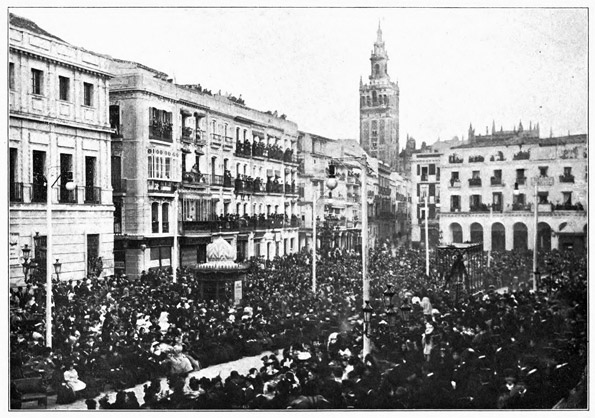
The Passing of the Pageants
XI
THE ROUTE OF THE SILVER FLEETS
"Paul, the Physician, to Cristobal Colombo, greeting. I perceive your magnificent and great desire to find a way to where the spices grow."
"And thus leade they their lyves in fullfilling the holy hunger of golde. But the more they fill their handes with finding, the more increaseth their covetous desire." —Decades in the New Worlde.
I wanted to go from Seville to Cadiz by water. I longed to sail by the "Silver Road" in the wake of the silver fleets. The little artist, as befitted her youth, preferred a Manila shawl to that historic pilgrimage. So I proposed to make this trifling trip alone.
Don José was shocked. Merriest and most indulgent of hosts, he was inclined at this point to play the tyrant. If I must see Cadiz, well and good. He would take me to the morning express and put me under charge of the conductor. At Utrera, an hour farther on, his son would come to the train and see that all was well. At Puerto de Santa Maria, another hour distant, I should be met by a trusted friend of the family, who would transfer me to another train and another conductor, and so speed me for my third hour to Cadiz, where I should be greeted by a relative of mine hostess and conveyed in safety to his home.
I appreciated the kindness involved in this very Andalusian programme, but otherwise it did not appeal to me. That was not the way Columbus went, nor Cortés. And much as I delighted in the Alhambra, and the Mosque of Cordova, and the Alcázar of Seville, I did not feel called upon to bow a New England bonnet beneath the Moorish yoke.
Thus Don José and I found ourselves quietly engaged in an Hispano-American contest. He heartily disapproved of my going, even by train. "Una señora sola! It is not the custom in Andalusia." His plan of campaign consisted in deferring the arrangements from day to day. "Mañana!" Whenever I attempted to set a time for departure he blandly assented, and presently projected some irresistibly attractive excursion for that very date. His household were all with him. His wife had not been able to procure the particular dulces indispensable to a traveller's luncheon. Even my faithless comrade, draped in her flower-garden shawl, practised the steps of a seguidilla to the rattle of the castanets and laughed at my defeats.
At last, grown desperate, I suavely announced at the Sunday dinner table that I was going to Cadiz that week. My host said, "Bueno!" and my hostess, "Muy bien!" But there was no surrender in their tones. On Monday, instead of writing the requisite notes to these relays of protectors along the route, Don José took us himself, on a mimic steamboat, for a judicious distance down the Guadalquivír. Tuesday he put me off with Roman ruins, and Wednesday with a private gallery of Murillos. By Thursday I grew insistent, and, with shrug and sigh, he finally consented to my going by train on Friday. I still urged the boat, but he heaped up a thousand difficulties. There wasn't any; it would be overcrowded; I should be seasick; the boat would arrive, wherever it might arrive, too late for my train, whatever my train might be. Compromise is always becoming, and I agreed to take the nine o'clock express in the morning.
After the extended Spanish farewells, for to kiss on both cheeks and be kissed on both cheeks down a long feminine line, mother, daughters, and maid-servants, is no hasty ceremony, I sallied forth at half-past eight with Don José in attendance. He called a cab, but in Spain the cabbies are men and brothers, and this one, on learning our destination, declared that the train did not start until half-past nine and it was much better for a lady to wait en casa than at the depot. This additional guardianship goaded me to active remonstrance. Why not take the cab for the hour and look up a procession on our way to the station? There are always processions in Seville. This appealed to both the pleasure-loving Spaniards, and we drove into the palmy Plaza de San Fernando, where an array of military bands was serenading some civic dignitary.
The music was of the best, and we fell in with the large and varied retinue that escorted the musicians to the palace of the archbishop. As they were rousing him from his reverend slumbers with La Marcha de Cadiz, I caught a twinkle in Don José's eye. Did he hope to keep me chasing after those bands all the forenoon? I awakened the cabman, whom the music had lulled into the easy Andalusian doze, and we clattered off to the station. Of all silent and forsaken places! I looked suspiciously at Don José, whose swarthy countenance wore an overdone expression of innocent surprise. A solitary official sauntered out.
"Good morning, señor! Is the express gone?" asked the driver.
"Good morning, señor! There isn't any express to-day," was the reply. "The express runs only Tuesdays, Thursdays, and Saturdays."
"What a pity," cooed Don José, contentedly. "You will have to wait till to-morrow."
"Yes, you can go to-morrow," indulgently added the driver, and the official chimed sweetly in, "Mañana por la mañana!"
"But is there no other train to-day?" I asked.
The official admitted that there was one at three o'clock. Don José gave him a reproachful glance.
"But you do not want to go by train," said my ingenious host. "Perhaps to-morrow you can go by steamboat."
"Perhaps I can go by steamboat now," I returned, seizing my opportunity. "When does that boat start?"
Nobody knew. I asked the cabman to drive us to the Golden Tower, off which sea-going vessels usually anchor. Don José fell back in his seat, exhausted.
The cabman drove so fast, for Seville, that we ran into a donkey and made a paralyzed beggar jump, but we reached the river in time to see a small steamer just in the act of swinging loose from the pier. In the excitement of the moment Don José forgot everything save the necessity of properly presenting me to the captain, and I, for my part, was absorbed in the ecstasy of sailing from the foot of the Golden Tower along the Silver Road.
It was not until a rod of water lay between boat and wharf that the captain shouted to Don José, who struck an attitude of utter consternation, that this craft went only to Bonanza, and no connection could be made from there to Cadiz until the following afternoon. And I, mindful of the austere dignity that befitted these critical circumstances, could not even laugh.
It was a dirty little boat, with a malodorous cargo of fish, and for passengers two soldiers, two peasants, and a commercial traveller. But what of that? I was sailing on a treasure ship of the Indies, one of those lofty galleons of Spain, "rowed by thrice one hundred slaves and gay with streamers, banners, music," that had delivered at the Golden Tower her tribute from the hoard of the Incas, and was proudly bearing back to the open roads of Cadiz.
We dropped down past a noble line of deep-sea merchantmen, from Marseilles, Hamburg, and far-away ports of Norway and Sweden. We passed fishing boats casting their nets, and met a stately Spanish bark, the Calderon. On the shores we caught glimpses of orange grove and olive orchard, lines of osiers and white poplars, and we paused at the little town of Coria, famous for its earthen jars, to land one of our peasants, while a jolly priest, whose plain black garb was relieved by a vermilion parasol, tossed down cigars to his friends among the sailors.
Then our galleon pursued her course into the flat and desolate regions of the marismas. These great salt marshes of the Guadalquivír, scarcely more than a bog in winter, serve as pasture for herds of hardy sheep and for those droves of mighty bulls bred in Andalusia to die in the arenas of all Spain. For long stretches the green bank would be lined with the glorious creatures, standing like ebony statues deep amid the reeds, some entirely black, and many black with slight markings of white. The Guadalquivír intersects in triple channel this unpeopled waste, concerning whose profusion of plant life and animal life English hunters tell strange tales. They report flocks of rosy flamingoes, three hundred or five hundred in a column, "glinting in the sunshine like a pink cloud," and muddy islets studded thick with colonies of flamingo nests. Most wonderful of all, the camel, that ancient and serious beast of burden, a figure pertaining in all imaginations to the arid, sandy desert, keeps holiday in these huge swamps. It seems that, in 1829, a herd of camels was brought into the province of Cadiz, from the Canaries, for transport service in road-building and the like, and for trial in agriculture. But the peculiar distaste of horses for these humpy monsters spoiled the scheme, and the camels, increased to some eighty in number, took merrily to the marshes, where, in defiance of all caravan tradition, they thrive in aquatic liberty. The fascination of this wilderness reached even the dingy steamer deck. Gulls, ducks, and all manner of wild fowl flashed in the sunshine, which often made the winding river, as tawny as our James, sparkle like liquid gold.
If only it had been gold indeed, and had kept the traceries of the Roman keels that have traversed it, the Vandal swords whose red it has washed away, the Moorish faces it has mirrored, the Spanish—
"Usted come?"
It might have been Cortes who was offering that bowl of puchero, but no! Cortes would have mixed it in his plumy helmet and stirred it with that thin, keen sword one may see in the Madrid Armería. This was a barefooted cabin boy, in blue linen blouse and patched blue trousers, with a scarlet cloth cap tied over his head by means of an orange-colored handkerchief. The dancing eyes that lit his shy brown face had sea blues in them. He was a winsome little fellow enough, but I did not incline to his cookery. While I was watching river, shores, and herds and chatting with the simpático sailor, who, taking his cue from my look, expressed the deepest abhorrence of the bull-fights, which, I make no doubt, he would sell his dinner, jacket, bed, even his guitar, to see, I had taken secret note of the cuisine. This child, who could not have counted his twelfth birthday, kindled the fire in a flimsy tin pail, lined with broken bricks. He cracked over his knee a few pieces of driftwood, mixed the fragments with bits of coal which he shook out of a sheepskin bottle, doused oil over the whole, and cheerfully applied the match, while the commercial traveller hastily drew up a bucket of water to have on hand for emergencies. Then the boy, with excellent intentions in the way of neatness, whisked his blackened hands across the rough end of a rope and plunged them into the pot of garbanzos, to which he added beans, cabbage, remnants of fried fish, and other sundries at his young discretion. And while the mess was simmering, he squatted down on the deck, with his grimy little feet in his fists, rocking himself back and forth to his own wild Malaga songs, and occasionally disengaging one hand or the other to plunge it into the pot after a tasty morsel.
"Will you eat?" he repeated manfully, reddening under the scrutiny of stranger eyes.
"Many thanks! May it profit yourself!"
I opened my luncheon, and again we exchanged these fixed phrases of Spanish etiquette, although after the refusals enjoined by code of courtesy, the boy was finally induced to relieve me of my more indigestible goodies.
"Did you ever hear of Columbus?" I asked, as we munched chestnut cakes together, leaning on the rail.
"No, señora," he replied, with another blush, "I have heard of nothing. I know little. I am of very small account. I cook and sing. I am good for nothing more."
And is it to this those arrogant Spanish boasts, which rang like trumpets up and down the Guadalquivír, have come at last!
We were in the heart of a perfect sapphire day. The river, often turbulent and unruly, was on this April afternoon, the sailors said, buen muchacho, a good boy. The boat appeared to navigate herself. The captain nodded on his lofty perch, and the engineer was curled up in his own tiny hatchway, trying to read a newspaper, which the fresh breeze blew into horns and balloons. The rough cabin bunks were full of sleeping forms, and the leather wine-bottles, flung down carelessly in the stern, had cuddled each to each in cozy shapes, and seemed to be sleeping, too. The two soldiers, who had been gambling with coppers over innumerable games of dominos, were listening grimly to the oratory of the commercial traveller.
"No fighting for me!" this hero was declaiming. "In strenuous times like these a man ought to cherish his life for the sake of his country. Spain needs her sons right here at home. It is sweet, as the poet says, to die for the patria, but to live for the patria is, in my opinion, just as glorious."
"And more comfortable," grunted one of the soldiers, while the other gave a hitch to those red infantry trousers which look as if they had been wading in blood, and walked forward to view from the bows the little white port of Bonanza.
As the boat went no farther, I had to stain my silver route by a prosaic parenthesis of land. It was some comfort to remember that Magellan waited here for that expedition from Seville which was the first to sail around the globe. I think I travelled the three miles from Bonanza, Good Weather, to San Lúcar de Barrameda in Magellan's own carriage. It was certainly old enough. As I sat on a tipsy chair in the middle of a rude wagon frame mounted on two shrieking wooden wheels, and hooded with broken arches of bamboo, from which flapped shreds of russet oilcloth, I entered into poignant sympathy with Magellan's ups and downs of hope and fear. The jolting was such a torture that, to divert my attention, I questioned the driver as to the uses of this and that appliance in his rickety ark.
"And what are those ropes for, there in the corner?" was my final query.
"Those are to tie the coffins down when I have a fare for the cemetery," he replied, cracking his whip over the incredibly lean mule that was sulkily jerking us along.
"Please let me get out and walk," I entreated. "You may keep the valise and show me the way to the inn, and I can go quite as fast as that mule."
"Now, don't!" he begged, with even intenser pathos. "Strangers always want to walk before they get to the inn, and then the people laugh at me. I know my carriage isn't very handsome, but it's the only one in Bonanza. Just do me the favor to keep your seat a little longer."
I had been lurched out of it only a minute before, but I could not refuse to sacrifice mere bodily ease to the pride of Spanish spirit.
Notwithstanding Don José's dark predictions, this was the only trial of the trip. To realize to the full the honesty, kindliness, and dignity of the everyday Spaniard, one needs to turn off from the sight-seer's route. On the beaten tourist track are exorbitant hotels, greedy guides, cheating merchants, troops of beggars—everywhere "the itching palm." But here in San Lúcar, for instance, where I had to spend twenty-four hours at a genuine Spanish fonda, the proprietor took no advantage of the facts that I was a foreigner, a woman, and practically a prisoner in the place until the Saturday afternoon train went out, but gave me excellent accommodations, most respectful and considerate treatment, and the lowest hotel bill that I had seen in Spain.
San Lúcar has, in early Spanish literature, a very ill name for roguery, but, so far as my brief experience went, Boston could not have been safer and would not have been so genial. I strayed, for instance, into a modest little shop to buy a cake of soap, which its owner declined to sell, insisting that I ought to have a choicer variety than his, and sending his son, a lad of sixteen, to point me out more fashionable counters. This youth showed me the sights of the pleasant seashore town, with its tiers of closely grated windows standing out from the white fronts of the houses, and its sturdy packhorses and orange-laden donkeys streaming along the rough stone streets, and when, at the inn door, I hesitatingly offered him a piece of silver, doffed his cap with smiling ease, and said he did not take pay for a pleasure.
Once off the regular lines of travel, however, speed is out of the question. I might have gone from Seville to Cadiz in three hours; thanks to historic enthusiasms, it took me nearer three days. After escaping from San Lúcar, I had to pass four hours in Jerez, another whitewashed, palm-planted town, whose famous sherry has made it the third city in Spain for wealth. The thing to do at Jerez is to visit the great bodegas and taste the rich white liquors treasured in those monster casks, which bear all manner of names, from Christ and His twelve disciples to Napoleon the Great; but mindful, in the light of Don José's admonitions, that the weak feminine estate is "as water unto wine," I contented myself with seeing the strange storage basin of the mountain aqueduct—an immense, immaculate cellar, where endless vistas of low stone arches stretch away in the silent dusk above the glimmer of a ghostly lake.
The train for Cadiz must needs be two hours late this particular evening, but my cabman drove me to approved shops for the purchase of bread and fruit, and then, of his own motion, drew up our modest equipage in a shady nook opposite the villa of the English consul, that I might enjoy my Arcadian repast with a secure mind. Jehu accepted, after due protestations, a share of the viands, and reciprocated the attention by buying me a glass of water at the nearest stand, much amused at my continued preference for Jerez water over Jerez wine.
One of the Jerez wine merchants, German by birth, shared the railway carriage with me for a while, and after the social wont of Continental travel fell to discussing the war. "The Spaniards deserved to be beaten," he declared, "but the Yankees didn't deserve to beat. They were conceited enough before, heaven knows, and now they expect all Europe to black their shoddy shoes. Your own country was a bit to blame in blocking every effort to keep them in their place."
I felt it time to explain that I was not English, but American. Much disconcerted, he did his best to make amends.
"I wouldn't have said that for the world if I had known you were an American—but it's every syllable true."
He thought over this remark in silence for a moment, his Teutonic spirit sorely strained between kindliness and honesty, and tried again.
"I would like to say something good about the United States, I would indeed,—if there was anything to say."
It seemed to occur to him, after a little, that even this apology left something to be desired, and he brightened up.
"Wouldn't you like some roses? They sell them here at this station. There comes a boy now with a nice, big bunch. One peseta! I think that's too dear, don't you?"
I hastened to assent.
"The lady says that's too dear. Seventy-five centimos? No. The lady can't pay that. Sixty centimos? No. The lady can't afford sixty centimos. Fifty centimos? No. The lady says fifty centimos is too much. She will take them at forty centimos. Here's a half peseta. And you must give me back a fat dog."
The boy held back the penny and tried to substitute a cent.
"Oh, sir, please, sir, forty-five centimos! There are two dozen roses here, and all fresh as the dawn. Give me the puppy-dog over."
But the German, who knew how to put even a sharper edge on the inveterate Spanish bargaining, secured for the value of eight cents, instead of twenty, his great bouquet of really beautiful roses, and presented it with as much of a bow as the carriage limits permitted.
"I meant to pay all the time, you know; but one can always make a better trade, in Spain, if it is done in the name of a lady." And he added, with that sudden tact which innate goodness and delicacy give to the most blundering of us mortals, "If you don't like to take them from a stranger for yourself, you will take them as my peace-offering to your country."
I was reminded again of my native land by another fellow-traveller—a Spaniard of the Spaniards, this time, one of the Conservative and Catholic leaders, greeted at the various stations by priests and monks and friars, whose hands he solemnly kissed. This distinguished personage was absorbed in a voluminous type-written manuscript, from which he occasionally read aloud to the band of political confidants who accompanied him. It was an arraignment of the Liberal Party, and, by way of exposing the errors of the Sagasta government, included a merciless résumé of the Spanish naval and military disasters, with elaborate comparisons of the American and Spanish equipments. He was then on his way to join in a consoling pilgrimage to a certain image of Christ, which had been cudgelled by a grief-maddened priest whose dying mother the image had failed to heal.
These surroundings more or less jostled my sixteenth-century dream, but I held to it so stubbornly that, when pyramids of salt began to glimmer like ghosts along the way, and a sweeping curve of lights warned me of our approach to Cadiz, I made a point of seeing as little as possible. It was midnight, but Spanish hours are luckily so late that Don José's friends were still at the height of evening sociability and regaled me with alternate showers of sweetmeats and questions. Finally, after many exclamations of horror at the audacity of the trip, all the feminine hospitality of the household lighted me to a chamber whose walls were hung with pictures of martyrs and agonizing saints. Among these I counted five colored representations of Christ opening his breast to display the bleeding heart.
The next morning I promptly took boat to Puerto de Santa Maria, embarked on the return steamer, and so at last found myself once more on the Silver Road, entering Cadiz harbor from the sea.
To be sure, the Montserrat was riding proudly in my view, although the warships to which she had been used to curtsy in the open roads of Cadiz would never cut those shining waves again. The waters were as turquoise blue as if they had just come from the brush of an old master, and the towered city rose before us like a crystal castle in the air. Its limited space, built as it is within great sea walls on an outlying rock, which only a rope of sand moors to the mainland, has necessitated narrow streets and high houses, whose miradores, lookouts that everywhere crown the terraced roofs, give this battlemented aspect to the town. One of the most ancient and tragic cities known to time, claiming Hercules for its founder, in turn Phœnician, Carthaginian, Roman, Gothic, Moorish, Spanish, it yet looks fresh as a water-lily. I could have spent another three days in gazing. And this sparkling vision was Spain's Copa de Plata, the Silver Cup which has brimmed with the gold and pearls of America, with blood and flame and glory. Its riches have taken to themselves wings, but its high, free spirit and frank gayety abide. Still the Andalusians sing:—
"Viva Cadiz, Silver Cadiz, Whose walls defy the sea, Cadiz of the pretty girls, Of courtesy and glee! "Good luck to merry Cadiz, As white as ocean spray, And her five and twenty cannon That point Gibraltar way!"
But I am bound to add that the cannon do not look dangerous.
XII
MURILLO'S CHERUBS
"Angels o'er the palm trees flying, Touch their waving fronds to rest. Bid them give no wind replying. Jesus sleeps on Mary's breast. Blesséd angels, hold the peeping Branches still as altar-place, For the Holy Child is sleeping Close beneath His Mother's face." —Lope de Vega.
Spanish love for childhood, and the precocity and winsomeness of Spanish children, impressed me from my first hour in the Peninsula. "There is no road so level as to be without rough places," and the initial days of my Madrid residence, after my artist comrade had gone back to Paris and the spring salons, might have been a trifle lonely save for baby society. I was living in a delightful Spanish household, but the very excess of courtesy reminded me continually that I was a Yankee and a heretic. As time passed, friendship ripened, and it is to-day no empty form of words when I am assured that I have "my house in Madrid." But at the outset I felt myself not only an American alien, but an Andalusian exile. The "only Court" is such a prosaic contrast to Seville that my impulse was to betake myself with books to the great park of the Buen Retiro, the magnificent gift of Olivares to his royal master, and let the Madrid world, at least the adult portion of it, go by. For while the larger Madrileños were busy with their own plays of politics, bull-fights, and flirtation, the little ones had happy afternoons in that historic park of many a tragedy, where convents, palaces, and fortifications have all made way for the children's romping ground. Resting on a rustic seat in the leafy shade, with the rich, thrilling notes of the nightingale answering the bell call of the cuckoo from the deeper groves beyond, I could watch these budding Spaniards to heart's content.
It was well to observe them from a distance, however, for their young voices were of the shrillest. Among the boys, an energetic few were developing muscle by tag and leap-frog; more were flying kites, cracking whips, twirling slings, and brandishing the terrors of pewter swords; while at every turn, beside some flashing fountain or beneath some spreading oak, I would come upon a group of urchins playing al toro with the cheap, gaudy capes of red and yellow manufactured for the children's sport. The girls were skipping rope, rolling hoop, teaching one another the steps of endless dances, and whispering momentous secrets in statue-guarded grottos, or thickets of flowering shrubs, or whatsoever safe, mysterious nook their fluttering search could find.
Here was a school out for its daily airing, a pretty procession of rainbow-clad little damsels, marshalled by the black-veiled figures of graceful nuns, and pacing with all decorum down a crowded avenue; but the moment the troop turned into some sequestered by-path, how it would break into a shimmering confusion of butterflies, darting hither and thither in those jewel-green lights and sea-green shadows, the nuns casting their dignity to the winds and scampering with the swiftest! Wandering after I would come, perhaps, upon an open space where the smaller boys were gathered, delicate little lads riding horse-headed sticks, digging with mimic spades, and tossing big, soft, red and yellow balls, while mothers and nurses sat about in circle on the stone benches, calling out sharp-toned cautions to their respective charges.
And everywhere in the park were toddling babies, clasping dolls, tugging at gay balloons, dragging wooden donkeys on wheels, and tumbling over live puppies. They were pale, engaging, persistent little creatures, with a true Spanish inability to learn from experience. I saw one aristocratic cherub, white as snow from feathered cap to ribboned shoes, take ten successive slappings because he muddied his hands. The angry nurse would make a snatch for the naughty fingers, roughly beat off the dirt, and cuff the culprit soundly. His proud little mouth would tremble; he would wink hard and fast, but there was not a tear to be seen, not a cry to be heard, and no sooner had her peasant clutch released him than back went the baby hands, grubbing deep into the mire. A gorgeous civil guard finally distracted her attention, and the last view I had of the child showed him blissfully squatted in the very middle of a puddle, splashing with arms and legs.
White is almost the universal wear of the prattling age in the Buen Retiro, although now and then some lily fairy would flit by with saffron sash and harmonious saffron stockings, or costume similarly touched by pink or blue. The Scotch plaids, too, were in favor as sashes, and at rare intervals I encountered a tot sensibly attired in stout plaid frock. But the white of this childish multitude was thickly flecked with mourning suits, complete to bits of black gloves and even to jet studs in the collars. Among the sad sights of the Retiro was an epileptic boy, led and half supported between two sweet-faced, youthful ladies, both in widow's crêpe, who screened him with caresses as his fit took him and he foamed and screamed in piteous helplessness. This pathetic trio, ever seeking seclusion, was ever followed by a retinue of idlers, who, for all their intrusive staring, were silent and sympathetic.
The nursemaids formed not the least attractive feature of the kaleidoscopic picture. Most wore white caps, fastened with gilded pins or knots of rose or russet; but the nurses counted the best, from the mountain province of Santander, were distinguished by bright-colored handkerchiefs twisted about the head. Here, as in the Élysées, baby-wagons are seldom seen. The nurses carry in arms the black-eyed infants, who bite away at their coral necklaces quite like little Yankees.
But Spanish traits soon declare themselves. In the centre of the park is an artificial pond, where lads in their first teens, too old for play, lean languidly over the iron railings, and, while they throw crumbs to the flock of forlorn-looking ducks or watch the dip of the red oar-blades that impel the pleasure boats, brag of their amorous adventures and exchange the scandal of the Prado. Sometimes their love chat is of sweeter tenor, for many of these schoolboys have already spoken their betrothal vows, which the Church will not let them lightly break. Spaniards often marry under twenty-one, and even a recent wedding in Madrid, where neither bride nor bridegroom had reached the fifteenth year, was hardly thought amiss, in view of the fact that there was parental money to maintain them.
And why had the stately city of Valladolid been under a reign of terror for half the week just past, with shutters up, doors barred, and women and children kept at home for safety, while bands of young men swayed in bloody struggle through her famous squares and streets, but because a cadet and a student must needs lose heart to the same maid? Cupid, not Santiago, is the patron saint of Spain. And Cupid, for all his mischief, has some very winning ways. Our boyish sentimentalists of the Buen Retiro, for instance, easily fall into song, and the native melodies, always with something wild and Oriental in their beat, ring across the little lake into the woods beyond till the birds take up the challenge and every tree grows vocal.
One afternoon, on my way to the park, I bought from a roadside vender a handful of small, gaudily bound children's books, and had no sooner found what I fondly supposed was a sequestered seat than a tumult of little folks surrounded me, coaxing to hear the stories. These tales, so taken at random, may throw a little light on the literature of Spanish nurseries. There was the life of the Madonna, which we passed over, as the children said they had read it in school and knew it, every word, already. So we turned to the astonishing career of the great soldier, Kill-Bullet, who could easily stop a cannon-ball against his palm, and to an account of that far-off land where it rained gold in such profusion that nobody would work, until finally all the people, weary of a wealth which induced no tailor to stitch and no shoemaker to cobble, no baker to bake and no dairy-maid to churn, rose by common consent and shovelled the gold into the river. We read of hot-tempered little Ambrose, who left the gate of his garden open, so that a hen cackled in and began to scratch under a rose bush, whereupon the angry boy chased her furiously all over the garden-beds until his summer's work was trampled into ruin, and his papa came and explained to him how disastrous a thing is wrath. There was a companion moral tale for little girls, telling how Inez used to make faces until her mamma told her that she would grow up with a twisted mouth and nobody would marry her, whereat did little Inez promptly reform her manners. One favorite volume, with a cover which displayed a wild-whiskered old ogre in a fiery skullcap gloating over a platterful of very pink baby, told how good little Violet saved her bad sisters, Rose and Daisy, from his dreadful gullet, by aid of an ugly monkey, whom her promised kiss transformed into a fairy prince. I was glad to find, in that country where so little is done to train children in the love of animals, the ancient tale of the four musicians, the donkey, the dog, the cat, and the cock, who escaped in their old age from the death that threatened them at the hands of ungrateful masters and, by a free exercise of their musical talents, captured the house of a robber-band, putting its inmates to confusion and flight. Many of the stories, indeed, would have been recognized by young Americans, but the proportion of saint-lore was larger than that of fairy-lore, and, now and then, some familiar property had suffered a Spanish change, as the invisible cap which had become an invisible cape of the sort used for playing bull-fight.
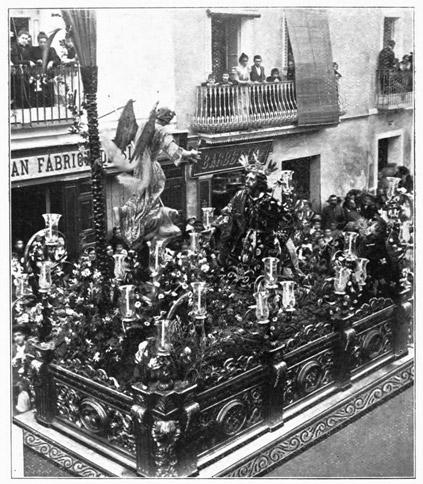
The Pageant of Gethsemane
The nursery rhymes, too, so far as I chanced upon them, were of the universal type with Spanish variations. A Castilian mother plays Peek-a-boo with her baby quite as an English mother does, except that the syllables are Cú? Trás! The father's foot trots the child to a Catholic market.
"Trot, little donkey! Donkey, trot! We must buy honey to please the pet. If San Francisco has it not, We'll go to San Benet."
Baby's toes are counted as the eternal five little pigs, and also thus, with a preliminary tickling of the rosy sole:—
"Here passed a little dove. This one caught it. This one killed it. This one put it on to roast. This one took it off again. And this teeny-teeny-teeny scamp ate it all up!"
Spanish patty-cakes are followed by a Spanish grace.
"Patty-cakes, oh! Patty-cakes, ah! The sweetest cakes are for dear mama. Patty-cakes, oh! Patty-cakes, ah! The hardest pats are for poor papa, "Bread, O God! Bread, dear God, For this little child to-day! Because he's such a baby He cannot pay his way."
The Spanish nursery seems richer in rhymes than ours. Nurse bends Baby's left hand into a rose-leaf purse, for example, and gives it little taps with one finger after another of Baby's right hand, singing:—
"A penny for Baby's purse From papa, mama, and nurse. A penny, a penny to pay! Let no thief steal it away!"
And then the tiny fist is doubled tight.
When the child, again, is first dressed in short clothes, he is propped up in a corner and coaxed to take his first step with the rhyme:—
"One little step, Baby-boy mine! Come, Little Man, step up! And thou shalt have a taste of wine From Godfather's silver cup."
This rhyming fashion the little ones take with them out of babyhood into their later childhood. The urchin admonishes his whistle:—
"Whistle, whistle, Margarita, And you'll get a crust of bread, But if you do not whistle I'll cut off your little head."
The little girl learns the scales in process of rocking her doll to sleep:—
Don't pin-prick my poor old dolly, Do Respect my domestic matters. Re Methinks she grows melancholy, Mi Fast as her sawdust scatters. Fa Sole rose of your mama's posy, Sol Laugh at your mama, so! La Seal up your eyes all cozy. Si La Sol Fa Mi Re Do.
With Spanish children, as with ours, Christmas Eve, or Noche Buena, is a season of gleeful excitement. They do not hang up stockings for Santa Claus, but they put out their shoes on the balcony for the Kings of the East, riding high on camel-back, to fill with sweets and playthings. Considerate children, too, put out a handful of straw for the tired beasts who have journeyed so far over the Milky Way. On some balconies the morning sun beholds rocking-horses and rocking-donkeys, make-believe theatres and bull-rings, with toy images of soldiers, bulls and Holy Families; but if the child has been naughty and displeased the Magi, his poor little shoes will stand empty and ashamed.
The dramatic instinct, so strong in Spaniards, is strikingly manifested in the children's games. These little people are devoted to the theatre, too, and may be seen in force at the matinées in the Apolo, Lara, and Zarzuela. Afternoon performances are given only on Sundays and the other Catholic fiestas, which last, numerous enough, are well within reach of the Puritan conscience. At these matinées more than half the seats in the house are occupied by juvenile ticket-holders, from rows of vociferous urchins in the galleries, to round-eyed babies cooing over their nurses' shoulders. If the play is an extravaganza, abounding in magic and misadventure, the rapture of the childish audience is at its height.
The close attention with which mere three-year-olds follow the action is astonishing. "Bonito!" lisping voices cry after each fantastic ballet, and wee white hands twinkle up and down in time with the merry music. When the clown divests himself, one by one, of a score of waistcoats, or successively pulls thirty or forty smiling dairy-maids out of a churn, little arithmeticians all over the house call out the count and dispute his numbers with him. When the dragon spits his shower of sparks, when chairs sidle away from beneath the unfortunates who would sit down or suddenly rise with them toward the ceiling, when signboards whirl, and dinners frisk up chimney, cigars puff out into tall hats, and umbrellas fire off bullets, the hubbub of wonder and delight drowns the voices of the actors.
The house is never still for one single instant. Babies cry wearily, nurses murmur soothingly, mystified innocents pipe out questions, papas rebuke and explain, exasperated old bachelors hiss for silence, saucy boys hiss back for fun—all together the Madrid matinée affords a far better opportunity to study child life than to hear the comedy upon the boards.
The boy king of Spain is, of course, a fascinating figure to his child subjects. We were told at San Sebastian, where the Queen Regent has a summer palace, that on those red-letter days when the king takes a sea dip, children come running from far and near to see him step into the surf, with two stalwart soldiers gripping the royal little fists. And no sooner has the Court returned to the sumptuous, anxious palace of Madrid, than the boy bathers of San Sebastian delight themselves in playing king, mincing down the beach under the pompous military escort that they take turns in furnishing one another.
In Madrid, too, the sightseeing crowds that gather before the royal palace or at the doors of the Iglesia del Buen Suceso, where the Queen Regent, with her "august children," sometimes attends the Salve on Saturday afternoons, are thickly peppered with little folks, eager to "see the king." They are often disappointed, for the precious life is jealously guarded, especially while the Carlist cloud still broods above the throne. During my stay in Madrid, a man with a revolver under his coat was arrested on suspicion in the vestibule of the theatre known as La Comédia, where the queen was passing the evening. Sceptical Madrid shrugged its shoulders and said: "Stuff and nonsense! When the Ministers want the queen to sign a paper that isn't to her liking, they make a great show of devotion and pounce down on some poor devil as an anarchist, to frighten her into being meek and grateful." And, in fact, the prisoner was almost immediately released for lack of any incriminating evidence. For weeks after, nevertheless, the royal movements were more difficult to forecast, and on the daily drives the kinglet was often missing from the family group.
But, undiscouraged, every afternoon the children would fringe the palace side of the Plaza de Oriente, hoping to see the royal carriage go or come with their young sovereign, whose portrait, a wistful, boyish face above a broad lace collar, is printed in one of their school reading books over the inscription, "To the Head of the State honor and obedience are due." Expectant youngsters, in the all-enveloping black pinafores that remind the eye of Paris, with book satchels made of gay carpeting over the shoulder, would shake out their smudgy handkerchiefs, often stamped with the likenesses of famous toreros, and help themselves to one another's hats in readiness to salute; but the elegant landau, preceded by an escort of two horsemen, dashes by so swiftly that their long waiting would be rewarded only by the briefest glimpse of bowing bonnets and of a small gloved hand touching the military cap that shades a childish face.
It is a pale and sober little face as I have seen it, but Madrileños resent this impression and insist that his youthful Majesty is "sturdy enough," and as merry as need be. They say that the buoyancy which he inherits from his father is crossed by strange fits of brooding, due to his mother's blood, but that he is, in the main, a merry-hearted child. Although he has masters for his studies now, his affection still clings to his Austrian governess, whom, none the less, he dearly loves to tease. When she is honored by an invitation to drive with the Queen Regent, for example, Alphonsito hastens to hide her hat and then joins most solicitously in her fluttered search, until her suspicion darts upon him, and his prank breaks down in peals of laughter. Madrid was especially sensitive about him last year, for he, Alfonso XIII, godson of Pope Leo XIII, was thirteen years of age—an iteration of the unlucky omen that really ought to be satisfied with the loss of the Spanish colonies. His mother, in honor of his birthday, May seventeenth, distributed five thousand dollars among orphan asylums and other charities, and held a grand reception in the Hall of the Ambassadors, where the slight lad in cadet uniform, enthroned beside the Queen Regent between the two great lions of gilded bronze, received the congratulations of a long procession of bowing ministers, admirals, captain generals, prelates, and those haughty grandees of Spain whose ancient privilege it is to wear their hats in the royal presence; but the shrinkage of his realm since his last birthday must have been uppermost in the mind of even the young lord of the festival. Pobrecito! one wonders what thoughts go on behind those serious brows of his, when, for instance, he looks down from his palace windows at the daily ceremony of guard-mounting in the courtyard. It is such a gallant sight; the martial music is so stirring; the cavalry in blue and silver sit their white steeds so proudly, with the sun glistening on their drawn swords and the wind tossing their long, white, horsehair plumes, that all these tales of defeat and loss must puzzle the sore boy heart and cast confusing shadows down the path before him.