Introductory material (continued 7)
Reading edition
But if the señoritas are so charming now, with their roses and their graces and their fans, why not leave them as they are, a page of mediæval poetry in this strenuous modern world? If only they were dolls outright and did not suffer so! When life goes hard with these high-spirited, incapable creatures, it goes terribly hard. I can see yet the tears scorch in the proud eyes of three undowered sisters, slaving at their one art of embroidery from early till late for the miserable pittance that it brought them. "We shall rest when we are dead," said the youngest. The absolute lack of future for these brave, sensitive girls, well-born, well-bred, naturally as keen as the keenest, but more ignorant, in matters of common education, than the children of our lowest grammar grade, is heart-breaking. If such girls were stupid, shallow, coarse, it would be easier; but the Spanish type is finely strung. Once I saw an impulsive beauty fly into that gust of angry passion which Spaniards term the rabia española. A clumsy, well-intentioned young Austrian had said a teasing word, and in the fraction of a second the girl, overwrought with secret toils and anxieties, was in a tempest of tears; but the wrath that blazed across them burned the offender crimson. The poor fellow sent for his case of choice Asturian cider, cooling in the balcony, read the evening news aloud and discoursed on the value of self-control, but not even these tactful attentions could undo, for that evening at least, the work of his blundering jest. The girl flashed away to her chamber, her handkerchief bitten through and through, and the quick fierce sound of her sobs came to me across the hall deep into the night.
Wandering over Spain I found everywhere these winning, vivid, helpless girls, versed in needlework and social graces, but knowing next to nothing of history, literature, science, all that pertains to intellectual culture. Some were hungry to learn. More did not dream of the world of thought as a possible world for them. Among these it was delightful to meet, scattered like precious seed throughout the Peninsula, the graduates of the International Institute. So far as a stranger could see, education had enhanced in them the Spanish radiance and charm, while arming these with wisdom, power, and resource.
XXII
ACROSS THE BASQUE PROVINCES
"The Oak Tree of Guernica Within its foliage green Embraces the bright honor Of all the Basque demesne. For this we count thee holy, Our ancient seal and sign; The fibres of our freedom Are interlaced with thine. "Castile's most haughty tyrants Beneath thy solemn shade Have sworn to keep the charter Our fearless fathers made; For noble on our mountains Is he who yokes the ox, And equal to a monarch The shepherd of the flocks." —National Song of the Basques.
It did not seem to me historically respectful to take leave of Spain without having made a pilgrimage to the shrine of Santiago. A dauntless friend crossed the sea to bear me company. Hygienic pilgrim that she is, she came equipped not with cockle shells and sandal shoon, but with sleeping bags, coffee, and cereals. Many a morning, in traversing those northern provinces, where the scenery was better than the breakfast, we blessed her boxes of "grape nuts," and many a night, doomed to penitential beds, we were thankful to intrench ourselves against the stings and arrows of outrageous insects in those spacious linen bags, that gather close about the neck, or, when dangers thicken, above the head, leaving only a loophole for the breath.
Our point of departure was that city of nature's fancy-work, San Sebastian. Then, in the early half of July, it was all alive with expectancy, looking every day for the coming of the Court. It is reputed to be the cleanest town of the Peninsula, and is, in truth, as bright as a wave-washed pebble. Nevertheless, it is a favorite waltz hall of the fleas, which shamelessly obtrude themselves even into conversation.
The chief summer industry of San Sebastian is sea-bathing. The soldiers begin it at six o'clock in the morning, marching by regiments down to the Concha, clearing for action, and striking out into the gentle surf, all in simultaneous obedience to successive words of command. Some two hours later teams of oxen draw scores of jaunty bathing cars down near the white lip of this opalescent shell of water, and there the long day through all ages, sizes, and ranks of humanity sport in the curling foam or swim far out into the sparkling bay.
San Sebastian is the capital of Guipúzcoa, one of the three Basque provinces. These lie among the Cantabrian mountains, and are delightfully picturesque with wheat-growing valleys and well-wooded heights. As the train wandered on, in its pensive Spanish fashion, we found ourselves now in Scotland, in a beautiful waste of heather and gorse, now amid the English ivy and hawthorn, hearing the song of the English robin, and now in our own New England, with the hilly reaches of apple orchards and the fields upon fields of tasselled Indian maize.
The Basques are a thrifty folk, and have cultivated their scant acres to the utmost. The valleys are planted with corn, the lower hills are ridged and terraced for a variety of crops. Above are walnuts and chestnuts, and the flintiest summits serve for pasturage. It was curious to see men at work on those steep slopes that had been scooped out into a succession of narrow shelves, and more strange yet to catch glimpses of peasants ploughing the very mountain top, picturesque figures against the sky.
The reaping is of the cleanest. The harvest fields have a neat, scoured look, as if the women had been over them with scrubbing brushes. Yet this utilitarian soil admits of oaks and beeches, ferns and clover, morning glories, dandelions, pimpernel, and daisies.
All that sunny morning the train swung us blithely on from one charm of the eyes to another—from a ruined watch-tower, where red-handed Carlists had crouched, to a bright-kerchiefed maiden singing amid her beehives; from a range of abrupt peaks, cleft by deep gorges, to sycamore-shaded byways and poplar-bordered streams; from a village graveyard, the pathetic little parallelogram enclosed in high gray walls and dim with cypress shadows, to a tumbling, madcap torrent spanned by a time-gnawed Roman arch. Shooting the heart of some black hill, the train would run out on a mere ledge above a valley hamlet, and from pure inquisitiveness, apparently, ramble all around the circle, peering down from every point of view on the cluster of great, patriarchal houses, sometimes of timber and plaster, more often of stone, where whole clans dwell together under the same red-tiled roof. Queer old houses these, occasionally topped with blue chimneys, and now and then with a fantastic coat of arms sculptured over the door, or a fresco of saints and devils blazoned all across the front. Sometimes freshly whitewashed, these Basque houses have more often a weather-worn, dingy look, but, however black the timbers, lines of clean linen flutter airily from roofs and balconies.
They are a decent, self-respecting, prosperous people, these Basque mountaineers, of whose history my companion told me stirring tales. They are supposed, though not without dispute, to be the oldest race in Europe, descendants of those original Iberians whom the westward-trooping Aryans drove into the fastnesses of the Pyrenees. They have their own language, of Asiatic type. They themselves believe that it was spoken in the Garden of Eden. There are some twenty-five dialects of the Vascuense, and it is so difficult for foreigners that even George Borrow spoke it "with considerable hesitation," and one exhausted student, abandoning the struggle, declared that the words were all "written Solomon and pronounced Nebuchadnezzar." The Basques attribute their hardy virtues to the crabbedness of their speech, telling how the devil, after slaving over their vocabulary for seven years, had succeeded in learning only three words, and threw up his lesson in a pet, so that to this day he remains unable to meddle with their peasant piety. What little literature there is in the Basque language is naturally of the popular cast—hero songs, dancing songs, dirges, hymns, and folk-lore.
The Basques are noted for their passionate love of liberty. The sturdy peasant is lord of his own rugged farm, and insists on tilling it in his own primitive way, breaking the soil with rude mattock more often than with plough. An English engineer, laying a railroad through Alava, tried his best to make his men abandon their slow, laborious method of carrying the earth in baskets on their heads. He finally had all the baskets removed by night, and wheelbarrows left in their places. But the unalterable Basques set the loaded wheelbarrows on their heads, and staggered about beneath these awkward burdens until, for very shame, he had to give them back their baskets.
The peasant drives over the mountain roads in a ponderous ox-cart, with two clumsy disks of wood for wheels. The platform is wrought of rough-hewn beams, five or seven, the middle one running forward to serve as pole. All the structure, except the iron tires and nails, is of wood, and the solid wooden wheels, as the massive axle to which they are riveted turns over and over, make a most horrible squeaking. It is a sound dear to the peasantry, for they believe the oxen like it, and, moreover, that it frightens away the devil; but once upon a time a town of advanced views voted a fine of five dollars for any man who should bring this musical abomination within its limits. Thereupon a freeborn Basque rose with the dawn, selected his best carved oaken yoke, draped the red-stained sheepskin a trifle more carefully than usual above the patient eyes of his great smooth oxen, and took his way, "squeakity-squeak, squeakity-squeak," straight to the door of the Ayuntamiento, city hall, where he paid his twenty-five pesetas, and then devoted the rest of the day to driving all about the streets, squeaking out his money's worth. This is no servile temper, and it was not until our own generation that the dearly cherished liberties of the Basques were wrested away.
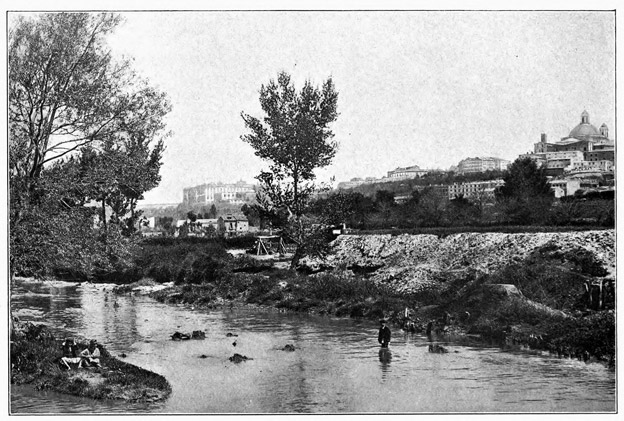
The Manzanares
These warders of the Pyrenees, for the Basques of Navarre and those now known as French Basques must not be forgotten, did good service in helping the Visigoths beat back the northward-pressing Moors and the southward-pressing Franks; but when the Basque provinces of Spain were incorporated with Leon and Navarre, and later with Castile, the mountaineers stood stubbornly for their fuéros, or peculiar rights.
My comrade's lecture had reached this point, when, finding ourselves at Amorebieta, in the Province of Vizcaya, or Biscay, we suddenly descended from the train, and handed our bags to an honest Basque porter, who deposited them on the floor of an open waiting room, in full reach of an honest Basque population. For ourselves, we turned our faces toward the centre of Vizcayan glory, the famous Tree of Guernica. We entered a rustic train, that seemed entirely undecided which way to go. The station agent blew a little tin horn, green meadows and wattled fences began to glide past the car windows, and the interrupted discourse was resumed.
The lawmakers of Vizcaya were duly chosen by their fellow-nobles, for every Basque held the rank of hidalgo, or "son of somebody." The deputies met every two years in the village of Guernica, sitting on stone benches in the open air beneath the sacred oak, and there elected the Señores de Vizcaya. Even the kings of Spain were allowed no grander title, but had to come to the Tree of Guernica, at first in person, later by deputy, and there swear to observe the fuéros. To this green shadow came the peasant from his lonely farm-house, high on the mountainside, to answer before his peers to such charges as might be brought against him; for within the sanctuary of his home the law could lay no hand on him or his.
It was the Carlist wars that changed all this. The fuéros, of which a list dating from 1342 is still extant, granted the Basque provinces a Republican Constitution that almost realized an ideal democracy, with immunity from taxes save for their own needs, and from military service beyond their own boundaries. But when the dynastic strife broke out, the Basques put on the white cap of Don Carlos and bore the brunt of the conflict. We had already passed through Vergara, where, in 1839, Espartero ended the first Carlist war by a treaty which compelled the Basques to lay down their arms. But the cost of this rebellion was paid in blood. Their political status was practically unaffected. At the close of the second Carlist war, in 1876, Alfonso XII signalized his victory by meting out to them a terrible punishment, abrogating the precious fuéros that the Tree of Guernica had guarded for so many centuries. The Government imposed, moreover, its salt and tobacco monopolies, and made the Basques subject to military conscription. At every station we saw Spain's Vizcayan soldiers, red-capped and red-trousered, with blue-belted frock coats, under which beat hearts of doubtful loyalty. The son of Alfonso XII will have to reckon with the Basques, when the third Carlist war shall be declared, but it may be doubted whether the fuéros, which Don Carlos, of course, promises to restore, will ever come home to nest again in the Guernica Oak.
My erudite fellow-vagabond was just pointing out the typical shape of the Basque head, with its broad forehead, long, narrowing face, curved nose, and pointed chin, when we reached Guernica. Such a sweet and tranquil village as it is, set in the beauty of the hills, with the dignity and pathos of its history pervading every hushed, old-fashioned street! The guide, whom two affable ladies, sharers of our carriage in the little picnic train, had taken pains to look up for us at the station, was not, we judged, a favorable specimen of the haughty Basque hidalgo. He was a dull, mumbling, slouchy lad, who sunk his voice to an awed whisper as we passed the escutcheon-carved palace of a count. But he led us by pleasant ways to the modern Casa de Juntas, or Senate House, where we were shown the assembly room, with its altar for mass, the library and other apartments, together with the portraits of the twenty-six first Señores de Vizcaya, from Lope the Pirate, who forced back the invading Galicians in 840, to the Infante Don Juan, under whom the Basque provinces were finally incorporated with Castile.
Close by the Casa de Juntas, which stands in a dreamy bit of park as fresh and trim as an English cathedral close, rises a pillared portico. There, where brown-eyed little Basque girls, their brown braids blowing in the breeze, were dangling green figs above their laughing mouths, used to sit, on those seven stone seats, the grave Basque fathers, making laws, meting out judgment, and regulating all the affairs of this simple mountain republic. The portico, bearing as joint devices the lion and castle of Spain and the three wolves of Vizcaya, was formerly enveloped in the leafy shadow of the Sacred Tree; but what rises behind it now is only the gaunt stem of a patriarchal oak, a very Abraham of plants, all enclosed in glass, as if embalmed in its casket. Before the portico, however, grows a lusty scion, for the Tree of Guernica is of unbroken lineage, shoots being always cherished to succeed in case the centuried predecessor fail.
In presence of this despoiled old trunk, majestic with memories, we felt an honest awe and longed to give it adequate salute. My comrade levelled her kodak and took front views, back views, and side views with such spendthrift enthusiasm that the custodian, deeply impressed, presented her with a dried leaf from the junior, cunningly pricked out so as to suggest the figure of the tree. The national song of the Basques, a matter of some dozen stanzas, written principally in "j's," "rr's," and "tz's," takes its theme, if one may trust the Castilian translation, from this symbolic oak.
The historian wished to do nothing more in Guernica but sit and gaze forever on that spectral trunk, but the reminder that piety was a hardly less marked Basque characteristic than political independence, finally induced her to follow our guide to the church. A Basque church has its distinctive features, including a belfry, a lofty, plain interior, with galleries, and often a votive ship, gayly painted and fully rigged, suspended from the ceiling. The lad bore himself with simple-minded devotion, offering us on stubby finger tips the holy water and making due obeisance before each gilded shrine.
But my attention was soon fascinated by a foot-square relief on a blue ground of Santiago—
"Good Saint James upon the milkwhite steed, Who leaves his bliss to fight for chosen Spain."
I had hardly anticipated such a stalwart, vigorous, not to say violent saint, with his white horse galloping, his gold-sandalled feet gripping the great stirrups, his gold-fringed, crimson robe and azure mantle streaming on the wind, his terrible sword glittering high in air. This was clearly not a person to be trifled with, and I looked about for the historian to tell her that we must be pressing forward on our pilgrimage. But she had stolen out, every sympathetic Basque image of the sculptured doorway conspiring to keep a stony silence and conceal her flight, and had sped back to the Tree of Guernica, from whose contemplation she was torn away only by a fairy-tale of supper.
Of the several Basque churches which we visited, including the bridal church of Louis XIV, far-famed San Juan de Luz, whose sides and west end are portioned off by three tiers of galleries, fairest in memory is the sixteenth-century church of Begoña in Bilbao. It abounds, as coast churches should, in suggestions of that mighty, mysterious neighbor, at once so cruel and so beneficent, the sea. Instead of votive ships, the walls are hung with paintings of vessels in scenes of appalling peril. One is scudding madly before a tropical gale; one has her rigging ragged by hurricane and her decks lashed with tempest; one, careened upon her side, lies at the mercy of the billows, which are sweeping over her and tumbling her crew like ninepins into the deep. But the presence of the pictures, bold dashes of the modern brush amid dim old paintings of saints and martyrs, tells that Our Lady of Begoña succored her sailors in distress, who, on their safe return, came hither to offer thanks for their preservation and to leave these mementos of their danger and her efficient aid.
"Is your Virgin so very powerful?" we asked of a chorister boy while he drew the cords to part the curtains that screened the jewelled image throned in a recess above the high altar.
"I should rather think she was," answered the little fellow in a glow. "Why, let me tell you! Robbers, the accursed ones, came here on a dark midnight to steal her precious stones. They entered by a window, those sons of wretched mothers, and put up a long ladder against the altar wall. The wickedest of them all, señoras, he climbed the ladder and raised his hand to take Our Lady's crown. And in that instant the great bells overhead began to ring, and all the bells of all Bilbao pealed with them, and the people waked and came running to the rescue of Our Lady, and the robbers were put to death."
Our expression did not quite satisfy his boyish ardor, and he pointed convincingly toward a handsome silver plaque. "And this, too, witnesses Our Lady's power. It was given in memory of the cholera time, when people were dying like flies in all the towns about. But after Our Lady was carried in procession through the streets of Bilbao, not one died here, except a sinful man who would not turn his head to look upon her."
"That is a painting of the procession, the large picture over there on the wall?"
"No, no, señoras. That picture commemorates another of Our Lady's wonderful deeds. The floods were threatening the city, but Our Lady, with many censers and candles, was borne down to the river bank, and she ordered the water to go back, and it obeyed her, and all the town was saved."
We retreated to the cloisters, from which one has a superb view of the valley of the Nervion, for Our Lady of Begoña dwells high upon a hilltop. Only the afternoon before we had been in serene Guernica, a strange contrast to this mining capital of Vizcaya, this bustling, noisy, iron-grimed Bilbao, in which the Basques take such delight. It is not a city to gratify the mere tourist, who expects the people of the lands through which he is pleased to pass to devote themselves to looking picturesque. But even Spain is something more than food for the kodak, and this sooty atmosphere of smelting works and factories, traffic and commerce, means life to Spanish lungs. It is little to my credit that I took more interest in the fact that Bilbao used to supply Shakespeare's cronies with rapiers, under the name of "bilboes," than in statistics regarding those millions of tons of ore which its iron mines are now annually exporting to Great Britain. The many English in Bilbao, miners and artisans, with the influence they shed around them, make the streets rougher and uglier than in purely Spanish towns. On the other hand, they bring a spirit of religious independence, so that it is not strange to find the Spanish Protestants of Bilbao a numerous and vigorous body, counting as a pronounced element in the community.
From the idle peace of the Begoña cloisters, as from the old-time world, we looked long on this Spanish city of to-day, seething with manifold activities. We seemed to understand how, to the middle-class Spaniard, hemmed in by all this mediæval encumbrance of barracks, cathedrals, castles, and thrones, such cities as Bilbao and Barcelona, pulsing with industrial energy and enterprise, are "more beautiful than Beauty's self." The Basques, like the Catalans, take readily to business. They set their mountain cascades to turning mill-wheels, they canal their little Nervion till it can give passage to ships of four thousand tons burden, they paint the night with the flare of mighty furnaces. Every year they are building more wharves, more railroads, more electric tramways, and they are so prodigiously proud of their new iron bridge, with its flying ferry, which whisks passengers over from Portugalete to Las Arenas at the rate of two hundred a minute, that they stamp it on their characteristic jewelry. That cunning Eibar work of the Basque provinces displays again and again, on locket, bracelet, brooch, this incongruous design of the Puente Vizcaya beaten on chased steel in gold.
We looked regretfully out over those significant reaches of land which we would have liked to explore to the last hearthstone. The Basque provinces! We had not even set foot in Vitoria, the capital of Alava, where is preserved the grim old machete by which Basque governors were sworn into office. "May my head be cut off with this knife," ran the oath, "if I do not defend the fuéros of my fatherland."
And we longed to attend one of the peasant festivals, to see the lads play pelota and the lasses step Basque dances to the music of the village pipers, to hear the wild old marches and battle tunes that have roused the Roman and the Moor to arms. The mystery plays of the Basques were famous once, and although these naive dramas are now mainly confined to Christmas and Easter, who could say that we might not chance on some saint-day fragment? There was soon to take place, too, in one of the Vizcayan hamlets a "blessing of the fields," a processional harvest rite of pagan antiquity, formerly universal in Spain, but now confined to a few rural districts. We had a hundred reasons for lingering—but what are reasons? Pilgrims of St. James must put fresh peas in their shoes and be off for Compostela.
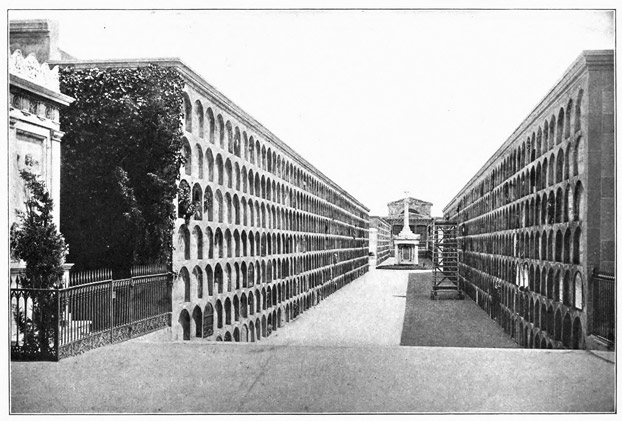
Spanish Cemetery
XXIII
IN OLD CASTILE
"With three thousand men of Leon from the city Bernard goes, To protect the soil Hispanian from the spear of Frankish foes; From the city which is planted in the midst between the seas, To preserve the name and glory of old Pelayo's victories. "The peasant hears upon his field the trumpet of the knight,— He quits his team for spear and shield and garniture of might; The shepherd hears it 'mid the mist,—he flingeth down his crook, And rushes from the mountain like a tempest-troubled brook." —Lockhart: Spanish Ballads.
The journey from Bilbao to Santander is a continuous glory of mountain views. The train runs saucily along under beetling crags, whence the gods of the hills may well look down in wonder and displeasure on this noisy invasion of their solitude. We almost saw those ancient majesties folding themselves grandly in mantles of purple shadow, but hardly less royal in bearing were the muffled figures of the lonely shepherds tending their flocks on the very summits.
The modern Province of Santander is the renowned Montaña, the mountain lair which nourished the chivalry of Old Castile, and from which they made wild sallies to the south, troop after troop, generation after generation, until the Moorish standards were beaten back from the plains about Toledo to the Sierras of Andalusia. Its capital city, Santander, named from St. Andrew, was one of the four coast towns which rendered signal service to Fernando in the conquest of Seville. These towns, lying as they did over against the Cinque Ports of England, came into so frequent conflict with British mariners as to be made in the days of Edward III the subject of a special treaty.
A summer resort, however, is a summer resort the world over, and we found the historic city, which has gracefully fitted itself to the curve of its beautiful bay, crowded with idle people, elaborately dressed, who sat long at the noonday breakfast, and longer yet at the evening dinner, and then longest of all on the benches in the park, where bands clashed and fireworks flared, until the very stars began to blink for sleepiness.
Spaniards have a veritable passion for pyrotechnics, and our dreams until the dawn would be punctuated by the airy report of rockets, as if, so Galdós suggests, "the angels were cracking nuts in the sky." Every now and then in those soft warm nights there rose a shout of song from the street, and peeping down from the balcony, we would see half a dozen lads and lasses leaping along through the middle of the road, all abreast and hand in hand, in one of their boisterous peasant dances.
There are no fewer dangers and sorrows for girls in Spain than in the other Latin lands. In the low-vaulted, mighty-pillared, deep-shadowed crypt under the old cathedral, a crypt that is the very haunt of religious mystery and dread, we came upon a penitent kneeling before the altar, a bit of written paper pinned to her back. In a stir of the chill air this fluttered to the ground, and as she, unconscious of its loss, bowed herself before another shrine, we picked up the paper with a half thought of restoring it; but seeing in the first glance that it was a rudely written prayer, entreating the Virgin's pity and pardon for her lover and herself, we let it fall again at Mary's feet. All manner of thank-offerings, waxen limbs, eyes, and ears, were hung in these candle-lit recesses, little spaces of gold amid the gloom. We had grown accustomed to such fragments of anatomy in the shop-windows, where even votive stomachs are displayed for sale.
Although Santander is a dawdler's paradise, the residents of the city to whom we had letters were no holiday makers, but Spaniards of the earnest, thoughtful, liberal type, busy with large tasks of their own, but never too busy, being Spaniards, to show unstinted kindness to the strangers within their gates. Our brief stay did not admit of a tithe of the excursions they had in mind for us, but my comrade achieved a trip to Santillana del Mar, birthplace of the doughty Gil Blas.
In the latest version of her adventures, she set forth from Santander under the bluest of skies, in company with the most bewitching of señoritas. They left the train at Torrelavega, where the shade of Garci Laso, one of King Pedro's victims, would doubtless have welcomed them, had not their attention been taken up with a picturesque coachman, who was standing dreamily on the station platform. This Adonis proved a complete paragon, who, as they took their romantic course over the hills, delightedly pointed out ivied tower, broken portcullis, and the like, as tidbits for the kodak.
Santillana is the shrine of Santa Juliana, a Roman martyr, whose body is said to have been carried thither in the ninth century. Her devotees among the mountain wilds built her in this green valley, overhung by a rude old fortress, a precious church, a jewel of the early Romanesque, about whose walls a thriving community soon gathered. Santillana was throughout the Middle Ages the most important place between Burgos and Oviedo, and gave name to all that part of the Montaña. The successive Marquises of Santillana were then great personages in Spain, playing a leading part at Court. One of the proudest families of Old Castile, they claimed descent from the Cid, and cherished the memory of another heroic ancestor, who, in 1385, sacrificed his life to save his king.
"'Your horse is faint, my King, my Lord! your gallant horse is sick,— His limbs are torn, his breast is gored, on his eye the film is thick; Mount, mount on mine, O mount apace, I pray thee mount and fly! Or in my arms I'll lift your Grace,—their trampling hoofs are nigh!
"'Nay, never speak; my sires, Lord King, received their land from yours, And joyfully their blood shall spring, so be it thine secures; If I should fly, and thou, my King, be found among the dead, How could I stand 'mong gentlemen, such scorn on my gray head?'
"So spake the brave Montañez, Butrago's lord was he; And turned him to the coming host in steadfastness and glee; He flung himself among them, as they came down the hill,— He died, God wot! but not before his sword had drunk its fill."
The city of Santillana, whose lords once laid claim to the sovereignty of Santander, has shrunk to a forgotten village, and the neglected church is dropping into ruins; but the inhabitants have abated not a jot of that fierce local patriotism which blinds the provincial Spaniard to all defects of his birthplace and to all excellences of rival towns. A graybeard told the stranger ladies that Santillana was the oldest city in Spain and its cathedral the most beautiful. This latter statement they were almost ready to accept, so richly carven was the yellow stone and so harmonious the proportions of nave and aisle. When they arrived at this miniature Durham they found it closed and silent, with three little boys sleeping on the steps. Through the benevolence of the ever present Spanish loafers, the sacristan was sought out and a ragged escort formed for their progress from chapel to chapel, where rare old pictures and frescos glowed across the dusk. Best of all were the venerable cloisters, weed-grown and tumble-down, but lovely as a mediæval dream with mellow-tinted arch and column, and with capitals of marvellous device. This crumbling church still keeps a dazzling hoard of treasures. All the front of the high altar is wrought of solid silver, the reredos is a miracle of art, and the paintings of old masters that moulder here unseen would long since in any other land than Catholic Spain have been the spoils of gallery and museum.
The cathedral stands just outside the town, whose narrow, crooked streets daunted the carriage; but these enthusiastic sightseers were all the better pleased to foot the flagging that many a clinking tread had worn and to touch on either side, with their extended hands, the fortresslike houses built of heavy stone and dimly emblazoned with fierce armorial bearings. These grim dwellings were gladdened by the grace of vine-clad balconies, where children frolicked and women crooned quaint melodies over their needlework.
"Will no one tell me what she sings? Perhaps the plaintive numbers flow For old, unhappy, far-off things And battles long ago."
The inn was merely the customary Spanish venta, rough and poor, the darkness of whose long, low room clouds of tobacco smoke from clumps of gambling muleteers were making blacker yet; but lemonade was served to the ladies in the open porch with a charm of cordial courtesy far beyond Delmonico's.
As they quaffed this modest refreshment and watched the shifting groups about the venta, which seemed the centre of the social life, there suddenly appeared upon the scene a ghost from the modern world, an everyday gentleman in a straw hat, as citified and up to date as if he had that moment stepped out of a Madrid café. All the loungers within and without the venta sprang to their feet, bared their heads, and bowed low to this anachronism with so profound a deference that the tourists began to wonder if the irrepressible Gil Blas had come alive again. Not he! This was the Marquis of Santillana, bearing under his arm instead of a sword a bundle of newspapers. The first Marquis of Santillana had been a famous warrior and troubadour. This latest "inheritor of old renown," seating himself in the midst of his thronging vassals, graciously proceeded, much like a University Extension lecturer, to read aloud, with simple explanations, the news of the day. Such is the final form of noblesse oblige in the feudal valley of Santillana.
We were tempted to hunt out other nooks and eyries in the mountains of Santander, to see something of the famous sardine fisheries, to drive along the many-storied coast all the way to Gijon, paying our respects in passing to a noble oak of Asturias, one of the three largest trees of Europe; but always the uplifted sword of St. James drove us on. If we would reach Compostela in season for the annual fiesta de Santiago, there was no time to lose. So, in default of a nearer railway connection, we started due south for Palencia. Our route ran at first through a land of hills, maize, and stone walls that might have been New England, except for the women scratching away in the hay-fields, and politely saluting the train with a flourish of their pitchforks.
Then more and more the landscape became Spanish. Little stone hamlets dozed in ever shallower valleys, mule trains and solitary horsemen moved slowly down poplar-bordered highways, white as chalk; there was a slumbering peasant for every speck of shade. But while the men took their siestas, often sleeping where the drowsiness had befallen them, with arm thrown about the wooden plough or with head pillowed on the thrashing roller, there were always women at work—figures clad in the very colors of the harvest, red and gold and purple, binding sheaves, sweeping the fields with stout brush brooms, tending flocks and herds by the rivers, following stray sheep over the hills, with only a handkerchief at the most to protect their heads from the terrible noonday sun. As the afternoon wore on, we found ourselves in the melancholy reaches of brown Castilian plain, with the adobe towns, the miserable mud villages, open-air threshing floors, and arid, silent, Oriental look.
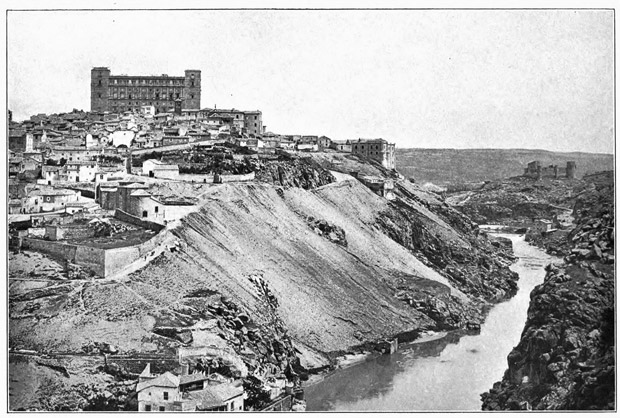
Toledo
The only cloud in sight was that which rested for a moment on my comrade's face. She had so newly come from our clean and wholesome fatherland that certain features of the Spanish inns still shook her high serenity of soul, and she had suddenly discovered that Baedeker significantly characterized the Palencia hotel as "an indifferent Spanish house." In the discreet language of our excellent guidebook this was no less than a note of warning, a signal of alarm. But even Baedeker is fallible, and on arriving at the Gran Hotel Continental, we were met by all the Castilian dignity and grave kindliness of greeting, and led to rooms whose floors shone with oil and scrubbing, whose curtains, towels, and sheeting were white as mountain snow, and whose furnishings were resplendent with two dozen chairs upholstered in orange satin. We seated ourselves in rapture on one saffron throne after another, drank fresh milk from polished glasses, and slept, for this only night of all our Santiago pilgrimage, the sleep of the unbitten. A sweet-voiced sereno intoning the hours set our dreams to music.
The following morning we spent in the cathedral, which, though of plain exterior, except for the many-imaged "Door of the Bishop," is all lightness, grace, and symmetry within. The organ was pealing and women were kneeling for the mass as we went softly down the high-vaulted nave, our spirits played upon now by the dignity of pointed arches and of clustered columns and now by delicate beauties in tracery and carving. Only here and there were we aware of a jarring note, as in chancing upon a great crucifix whose Christ was decked out in two elegant lace petticoats and a white silk crinoline embroidered over with silver thread.
When the chant had died away, an affectionate old sacristan, in a curious red and black coat, delivered us with sundry farewell pats and pinches over to the charge of a subordinate, who proceeded to display the hidden treasures. These are far from overwhelming, after the glittering hoards of Burgos, Seville, and Toledo, but they are as odd an assortment as sacristy ever sheltered. There was an absurd portrait of Charles I, a freak of foreshortening. At first sight it seemed to be the skeleton of a fish, but on viewing it through a peephole the creature had become a human face. Even so, it was hardly a flattering likeness of the founder of the Austrian line; but as it was Charles I who stripped Palencia of her original powers and dignities, one would not expect to find him complimented here.
We turned our attention to the vestments, which, though few, are peculiarly artistic, with devices, stitched in gold thread and in jewel reds and greens, of pomegranates, roses, ecclesiastical coats of arms, angels, Maries, Nativities, and Adorations. These were appropriate enough, but even our reserved conductor, a monastic youth who wore a white, openwork tunic over his black suit, smiled disdainfully as he put before us a time-yellowed ivory box arabesqued with men and lions, the jewel casket of some pet sultana. "But why should it be here?" He shrugged his shoulders. "In truth, it is not holy—a woman's thing! Nor do I know how it came to us, but what we have we keep."
The sacristy certainly seems to have kept more than its share of custodias. Our guide first brought out a dainty structure, where grieving angels uplift the cross, and the Sufferer's halo is wrought of pearls and gems. This was replaced by another, a marvel of goldsmith's craft, turreted and crocketed with fine gold, while all about the base are figured Annunciations, Visitations, and other mysteries. Rich as they were, neither of these could compare with that famous pyx of the Escorial, inlaid with ten thousand precious stones. Then our conductor took us with a mighty turning of monster keys, pulling of rusty bolts, and fall of clanging chains, to see the supreme custodia of all, one great dazzle of silver from fretted base to dome and pinnacle, save as among the Corinthian columns of the first stage glisten golden forms of the Apostles, and of the second, winged shapes of cherubim and seraphim. This shining tower, some three or four centuries old, is beheld by Palencia only on Corpus Christi Day, when, holding at its heart the golden monstrance which holds the Host, it passes as a triumphal car throughout the city. Priests walking on either side make a feint of drawing it by tasselled cords, but "little would it budge for that," said our guide, in high disdain, opening a door in the frame beneath to reveal the benches where strong men sit concealed and toil at a motor crank. He had much more to show us, including precious old tapestries of the Netherlands, and a St. Katharine by Zurbarán, with a light on the kneeling figure as pure and bright as a moonbeam; but we had to press the fee on his Castilian pride, when at last the vulgarity of luncheon summoned us away.
For the historian, basking in this last smile of civilization, the afternoon passed blissfully among the orange chairs, but I sallied forth once more, attended by our benignant landlady. The rays of the sun flashed down like deadly arrows and I had pleaded for a carriage, but longed to beg its pardon when it came, so faded, rheumatic, and yet august was that fat old chariot, groaning and tottering as it rolled, but lowering the pomp of a velvet-carpeted staircase whenever we desired to alight.
Our progress made a grand sensation in those drowsy streets and squares, a retinue soon gathered, and nobody seemed surprised when, after a round of Jesuit and Dominican churches, we drew up before the madhouse. I had wished to look upon this building, because it is reputed to have been a dwelling of the Cid; but the hero of Castile was as unknown to my gentle escort as to the medical priest whom she must needs call forth to meet me, or to the hapless lunatics whom he, in turn, insisted on my seeing. A town which had forgotten its chief citizen naturally fails to keep on sale photographs of its cathedral, so we packed our memories in default of anything more substantial and took the evening train to the northwest.
Four hours of hushed, moonlit plain, and then Leon! This is a name of thrilling memories, and we stepped out into the midnight silence of that once royal capital whose kingdom "stretched from the Atlantic Ocean to the Rhone," so awed that even a rickety 'bus, and a smuggler who tried to hide his trunk behind our honest luggage, hardly broke the spell. My comrade, still new to Spanish ways, had fears that the illustrated card which I had forgotten to stamp would not have reached the hotel. She asked me why I did not telegraph; but some days later, when we sent a telegram at noon, took a way-train at five, and reached our destination at ten, simultaneously with the telegram which I might as well have brought in my pocket, she was set free from New World prejudices. The unstamped card went through without question, a picture of a pretty mountain maid being quite as acceptable to the postal clerks as the portrait of their young king.
We were expected at the hotel, the best in town, but so dirty and malodorous that we would better have camped under the stars. There had been some attempt to sweep the floor of our dingy chamber, as we could see by comparing it with stairs and corridors. Sour milk and sour bread were served with a compensating sweetness of manner, but the experiences of that night belong to oblivion.
The joy of the morning! Guided by a shy little scullery lad, smooched of face and ragged of raiment, but with all the instincts of a cavalier, we stepped out into those stately streets, with their haughty old houses, balconies, coats of arms, arches, and battlements, as into an animated picture book. It was Saturday, and the town was all astir with peasants come to market, every peasant as good as a romance. Such brightness of figured kerchiefs, homespun petticoats, trunk hose, jackets, sashes! The little girls were quaintest of all, dressed precisely like their mammas, even to those brilliant skirts edged with one color and slashed with another. Many of the women were carrying loads of greens, others plucked fowls, and some had indignant chickens, in full possession of chicken faculties, snuggled under the arm.
As the chief city in a far reach of luxuriant plain, Leon becomes the focus, every Saturday, of flocks of sheep, droves of pigs, and herds of cattle, together with innumerable mules and donkeys bringing in grain, fruit, and all manner of garden produce. We chanced upon the market itself in the arcaded Plaza Mayor, under shadow of the towered court-house, with the tapering spire of the cathedral overlooking all. The great square hummed like a beehive and sparkled with shifting color like a field of butterflies. We found ourselves first in the bread market. Under wide umbrellas of canvas set on poles women were perched high on wooden benches, with their gayly shod feet supported on stools. Beside each woman, on her rude seat, was a brightly woven basket heaped with the horny Spanish loaves. Close by was the fruit market, with its piles of red and purple plums, pears, grapes, green peppers, lemons, and, beyond, patches of melons, cucumbers, cabbages, potatoes, beans, and that staff of Spanish life, chick pease, or garbanzos.
The meat market appeared to be itinerant. A man in blue blouse, short brown breeches, and dove-colored hose adorned with green tassels, was leading a cow by its crumpled horn; an old woman, with giant silver hoops in her ears, a lavender shawl knotted about her body, her scarlet skirt well slashed so as to show the gamboge petticoat beneath, and so short for all its purple frill as to display the clockwork of her variegated stockings, was carrying a black lamb, nestled like a baby in her arms; another walking rainbow bore a live turkey; and a lad, whose rosy-hued kerchief, shawl, and sash floated like sunrise clouds about him, balanced on his erect young head an immense basket of eggs. There was a pottery section, too,—square rods of cups, plates, and jars in all manner of russet tints and graceful shapes.
The various divisions were intermingled and blent into one great open-air market, the cheeriest sort of neighborhood picnic, where gossip, jest, and laughter were accompanied by the cackling of fowls, braying of donkeys, and cooing of babies. Here fluttered a colony of bantams cast, their legs well tied, down on the cobble-stones; there stood carts laden with bunches of the yellowish dried heather; here two patient oxen had laid themselves out for a snooze; there a wicked little ass was blinking at the greens; here squatted a damsel in gold kerchief, garnet bodice, and beryl skirt, weighing out fresh figs; there sat a cobbler pegging away at his stall, his patrons waiting with bare feet while he mended their shoes; stands of cheeses, coops of chickens, children sleeping among the sacks of grain, a boy waving a rod on which was strung a gorgeous assortment of garters; loitering soldiers, limping beggars, bargaining ladies attended by their maids, all gave notes to the harmony. Yet with all that trampling, small weeds were growing green amid the slippery stones that pave the square.
The Leon peasantry is said to be the finest in all Spain, and surely no concourse of people could have been more honest, courteous, and dignified than this. The women wore ornamented wallets beneath the skirt, and warned us gravely against carrying money in exposed pockets; but we moved freely among the press with notebook and kodak, always the centre of curious groups, and our purses were not touched. Indeed we found it difficult to spend even a peseta, so modest were the prices. For as large a jar as our little squire could well carry we paid the value of three cents. The men often rebuked the children for staring and questioning, but stood themselves at gaze, and asked us frankly what we were about. When we replied that we had never seen so beautiful a market, and were taking notes and photographs that we might not forget, the peasants smilingly passed the word from one side of the plaza to the other, and all, even to the chief of police, who was strutting about waving an unnecessary staff, were eager to offer information and to point out picturesque subjects.
But the morning was slipping away, and we had almost forgotten the oracle of a Spanish gentleman in Palencia: "Leon has three sights for the visitor, and only three—the Cathedral, San Isidoro, and San Marcos." We proceeded to take these illustrious churches in order. The Leon Cathedral, closely analogous to the Gothic masterpieces of northern France, is far beyond all poor praises of mine. Now in process of repair and stripped of the garish shrines of modern worship, it may be enjoyed purely as architecture—a temple of high beauty. Let artists tell of its towers and finials, flying buttresses, gables, cornices, galleries, piers, façades. Yet one need not be an artist to delight in the glow of its great rose windows, or to spend fascinated hours poring over the chiselled story book of portals, stalls, and cloisters. Such inimitable glass, burning still with the fervors of the mediæval faith! And such a world of divinity and humanity, even down to childish mischief, in those multitudinous carvings! The Passion scenes are repeated over and over, creation and judgment are there, the life, death, and ascension of the Virgin, hero legends, animal fables, and folk-lore. Gothic energy is abundantly manifest. St. George smites the dragon, St. Michael tramples the devil, Samson splits the lion's jaws, and Santiago, carved in ebony on a door in the mellow-hued old cloisters, is riding down the Moors with such contagious fury that the very tail of his horse is twisted into a ferocious quirk. On angel-guarded tombs pictures of ancient battle, murder, vengeance, are graven in the long-remembering stone. But marble birds peck at the marble fruit, the ivory peasant drives his pigs, the alabaster shepherd watches his flock, the lad leads his donkey, the monk feeds the poor at the abbey gates, and plump stone priests, stowed away in shadowy niches, make merry over the wine.
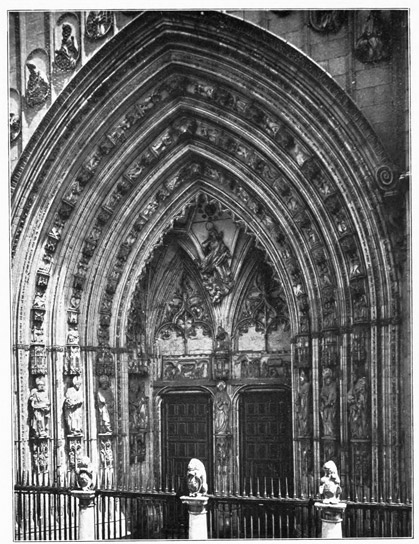
Toledo Cathedral. Door of Lions
If we had revelled overmuch in the art values of the cathedral, San Isidoro administered a prompt corrective. This Romanesque church, dating from the beginning of the eleventh century and a forerunner of the Escorial in that it was founded by the first Fernando of Castile as a royal mausoleum, is excessively holy. Not merely are the bones of the patron saint kept on the high altar, but the Host is on constant exhibition there. Unaware of these especial sanctities, we were quietly walking toward the choir, when an angry clamor from behind caused us to turn, and there, stretching their heads out over the railing of an upper gallery, was a line of furious priests. In vain the sacristan strove to excuse us, "foreigners and ladies," who did not know that we were expected to fall upon our knees on first entering the door. We had been guilty of no irreverence beyond this omission, and even under the hail of priestly wrath did our best to withdraw correctly without turning our backs to the altar. But nothing would appease that scandalized row of gargoyles, whose violent rudeness seemed to us the greater desecration. Thus it was that we did not enter the frescoed chambers of the actual Panteon, said to be imposing yet, although the royal tombs were broken up by the French in 1808. Very wrong in the French, but unless the manners of San Isidoro's bodyguard have degenerated, the soldiers of Napoleon may have had their provocation.
It was now high noon, and the market-place had poured all its peasants out upon the streets. Groups of them were lying at luncheon under the trees, passing the pigskin bottle of wine from mouth to mouth. Beggars were standing by and blessing them in return for scraps of the coarse and scanty fare. "May God repay! May the saints prosper thy harvest!"
A woman riding home, sitting erect on the red-striped donkey-bag, handed a plum to her husband, who trudged beside her in gray linen trunks and green velveteen waistcoat, with a white square of cloth set, for ornament, into the middle of the back. He divided the fruit with a pleading cripple, who called after them as devoutly as a man with half a plum in his cheek well could, "May the Blessed Virgin ride forth with you and gladden all your way!"
We had, because of the increasing heat, conjured up a carriage, a species of invalid stage-coach, and were therefore the envy of little schoolboys in blue pinafores. Their straw satchels bobbed on their backs as they gave chase to our clattering ark and clung to steps and door. This mode of locomotion did not save us time, for our coachman had domestic cares on his mind and drew up to bargain for a chicken, which finally mounted with a squall to the box seat; but in due Spanish season we stopped before the plateresque façade of San Marcos.
This is a still unfinished convent, rich in artistic beauties and historic memories. Here, for instance, is a marvellously human head of St. Francis, a triumph of the polychrome sculpture, and here is the little cell where the poet Quevedo, "colossal genius of satire," was imprisoned for over three years by Philip IV, the patron of Velázquez. It is not so easy to cage a mocking-bird, though the satire-pencilled walls have been well whitewashed.
But San Marcos was originally a hospital for pilgrims on the road to Compostela, and conch shells are the central ornamentation of arch and vault and frieze. We accepted the rebuke; we would loiter no more. Early that afternoon we took train for Coruña, after which some agency other than steam must transport us to the mediæval city of St. James.
XXIV
PILGRIMS OF SAINT JAMES
"In Galice at Seint Jame, and at Coloigne, She koude muchel of wandrynge by the weye." —Chaucer: Canterbury Tales.
"Pilgrimes and palmers plihten hem to-gederes For to seche Seint Jame." —Langland: Piers Plowman.
"I am Saint Jaques' pilgrim, thither gone." —Shakespeare: All's Well that Ends Well.
From Leon to Coruña is a journey of some eighteen hours by rail. Degenerate pilgrims that we were, we had taken a first-class carriage reserved for ladies, not so comfortable as the average third-class carriage on an English road. We hoped for space, at least, and solitude, but people who choose to pry into out-of-the-way corners of Spain need not expect to find any slavish deference to rights of place and property. The conductor had planned to dine and sleep in this particular compartment, which was a shade cleaner than the rest, and removed his kit from the rack with natural disappointment. Why should ladies be going to Galicia? But the general first-class compartment, next to ours, was unoccupied, and he resignedly transferred his belongings thither. The numerous third-class carriages were crowded with raw recruits, who had all jumped down, boy fashion, on the Leon platforms, and came scrambling back at the starting bell in noisiest confusion. Just as the train was puffing out, a station official threw open our door with a smiling, "Only to the next stop, ladies!" and precipitated upon us three belated warriors. We groaned inly with dark foreboding, for third-class occupancy of a first-class carriage is apt to leave lively souvenirs behind. Our three young soldiers, each with his personal effects bundled up in an enormous red and yellow handkerchief, were of the rudest peasant type, hardly lifted above animal and clod. Only one was able to spell out anything of the newspaper we offered. He labored over a large-lettered advertisement with grimy thumb, twisting brows, and muttering lips, but soon gave it up in sheer exhaustion. The hulking fellow beyond him was continually on the point of spitting,—a regular Spanish pastime in travel; but, determined that the carriage should not suffer that offence, I kept strict watch on this chrysalis hero, and embarrassed him into stark paralysis with questions on the landscape whenever he was quite prepared to fire. The third conscript was a ruddy, fair-haired boy of seventeen, who had in rudimentary form the social instincts of a Spaniard, and in his intervals of blue-eyed staring at the tawdry splendors about him hammered our ears with some harsh dialect, his one theme being the indignities and hardships of a Spanish soldier's lot. Yet dull as they were, and ignorant of railway customs, they knew enough to prefer broad cushions, whose variety of stains did not trouble their enviable simplicity, to the rough and narrow benches of the overcrowded third-class carriages, and at the "first stop" they unanimously forgot to change. But they were not unkindly lads, and after I had explained to them a dozen times or so that my friend was suffering from a headache and needed to lie down, and had, furthermore, lawlessly suggested that they could make themselves equally comfortable in the other first-class carriage, which was not "reserved for ladies," they promised to leave us at the second station; but their slow peasant hands fumbled at the door so clumsily that the train was under way again before the latch had yielded. It was not until we had been fellow-travellers for two or three hours that they finally stumbled into the neighboring compartment. From this the conductor, who had been blind and deaf to past proceedings, promptly ejected them, having no mind to let them make acquaintance with his wine bottle, and our poor exiles cast reproachful glances at us as they were hustled off to their own place.
We have sometimes talked enthusiastically of democracy, but we did not discuss such exalted subjects then. Indeed, we had enough to do in guarding our doors, often by frank exercise of muscle, from further intrusion, and in trying to provide ourselves with food and water. A struggling mob of soldier boys besieged the refreshment stalls at every station, and drained the jars of the water-venders long before these could arrive at the car windows. At last, by a union of silver and violence, we succeeded in gaining from an astounded little girl, who was racing after the departing carriages, all her stock in trade, even the great russet jar itself, with its treasure of cold spring water. The historian possesses a special genius for cooking over an alcohol lamp on a rocking mountain train, and having augmented our knapsack stores with scalded milk and knobby bread from a tavern near one of the depots, we lived like feudal barons "of our own" for the rest of that memorable journey.
Reminders of the pilgrims were all along our route. Overflowing as Santiago's young knights were with martial and romantic spirit, when the brigands did not give their steel sufficient sport they would break lances for the love of ladies or on any other conceivable pretext. We passed the bridge of twenty arches, where ten companions in arms once posted themselves for ten successive days, and challenged to the tilt every cavalier who came that way in journey to the Compostela jubilee.
All the afternoon we were climbing into the hill-country. The waste slopes were starred with purple clumps of heather, and crossed by light-footed maids, who balanced great bunches of bracken on their heads. The patches of green valley, walled in by those barren steeps, held each a few tumble-down old houses, while elsewhere we noticed human dwellings that seemed scarcely more than nests of mud plastered to the stone. Yet the soil appeared to be cultivated with the most patient thrift,—wheat and potatoes growing wherever wheat and potatoes might. The view became a bewildering medley of Scottish hills, Italian skies, and Gothic castles, with occasionally a tawny and fantastic rock from the Garden of the Gods. The city of Astorga, whose cathedral was founded, so the pilgrims used to say, by St. James in his missionary tour, greeted us from the midst of the flinty hills. These are the home of a singular clan known as the Maragatos. They wear a distinctive dress, marry only among themselves, and turn a sullen look upon their neighbors.
As night came on, the road grew so rough that we had to cork our precious water-jar with a plump lemon. The historian was sleeping off her headache, except as I woke her at the stations to aid in the defence of our ignoble luxury. We remembered that queen of Portugal who made the pilgrimage to Compostela on foot, begging her way. In the close-packed third-class carriages it must have been a cramped and weary night, and we did not wonder that young socialists occasionally tried to raid our fortress. But we clung stoutly to the door-handles, lustily sounding our war cry of "Ladies only" in lieu of "Santiago," and early in the small hours had the shamefaced pleasure of seeing the herd of drowsy conscripts, with their red and yellow bundles, driven into another train, where they were tumbled two or three deep, the under layer struggling and protesting. One little fellow, nearly smothered in the hurly-burly about the steps, cried out pitifully; but the conductor silenced him with angry sarcasm: "Dost mean to be a soldier, thou? Or shall we put thee in a sugar-bowl and send thee back to mamma?"
There was less need of sentry duty after this, but the night was too beautiful for sleep. We were crossing the wild Asturian mountains, the Alps of Spain, and a full moon was pouring down white lustre on crag, cascade, and gorge. By these perilous ways had streamed the many-bannered pilgrim hosts,—men and women of all countries and all tongues seeking the Jerusalem of the West. Each nation had its own hymn to Santiago, and these, sung to the mingled music of bagpipes, timbrels, bugles, flutes, and harps, must have pealed out strangely on many a silver night. The poor went begging of the rich, and often a mounted crusader cast his purse of broad gold pieces on the heather, trusting Santiago and his own good sword to see him through. Up and down these sheer ravines stumbled the blind and lame, sure of healing if only they could reach the shrine. Deaf and dumb went in the pilgrim ranks, the mad, the broken-hearted, the sin-oppressed; only the troop of lepers held apart. Some of those foot-sore wayfarers, most likely the raggedest of all, carried a secret treasure for the saint. Some staggered under penitential weights of lead and stone, and others bore loads of bars and fetters in token of captivity from which St. James had set them free.
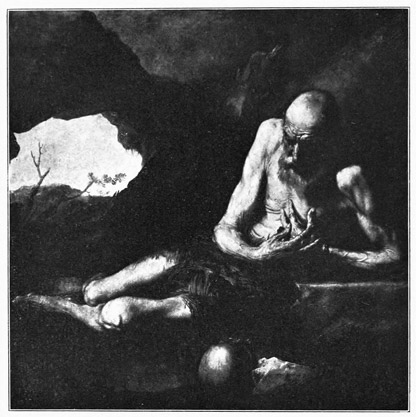
St. Paul, the First Hermit
But these pathetic shapes no longer peopled the moonlight. Since it was the nineteenth century, a first-class passenger might as well lie down and watch the gracious progress of the moon across the heavens,—
"Oft, as if her head she bowed, Stooping through a fleecy cloud."
But the clouds perversely made of themselves wayside crosses, urns, cathedral towers; and just as one sky-creature, "backed like a weasel" but with the face of Santiago, began to puff a monstrous cigarette, I roused my dozing senses and discovered that we were entering Lugo, the capital of Galicia, and once, under Roman rule, of all Spain.
This city of tumultuous history, stormed by one wild race after another, and twice sacked in our own century, first by the French and then by the Carlists, lay very peacefully under the white dawn. While the chivalrous Spanish sun rose unobtrusively, so as not to divert attention from the fading graces of the moon, the historian made sustaining coffee, and we tried to look as if we liked Galicia. This far northwestern province is the Bœotia of Spain; its stupid, patient peasantry are the butt of all the Peninsula, and to be called a Gallego is to be called a fool. The country, as we saw it from the train, was broken and hilly, but the Alpine majesty of Asturias was gone. In the misty drizzle of rain, which soon hushed the pipings of the birds, all the region looked wretchedly poor. It was a wooded, watered, well-tilled land, with tufts of heather brightly fringing every bank; but the houses were mere cabins, where great, gaunt, dark-colored pigs pushed in and out among bedraggled hens and half-clad children. Women were working in the fields by five o'clock in the morning, their saffron and carmine kerchiefs twisted into horns above the forehead. Women were serving as porters at the stations, carrying heavy trunks and loads of valises on their heads. Women were driving the plough, swinging the pickaxe in the quarries, mending the railway tracks. Short, stout, vigorous brownies they were, and most of them looked old.
It was mid-forenoon when we reached Coruña, the seaport whence sailed the Invincible Armada. We had meant to rest there for the afternoon and night before undertaking the forty-mile drive to Santiago, but the hotel was so filthy that, tired as we were, there was nothing for it but to go on. Tarrying only for bath and breakfast, we took our places in a carriage which, setting out at one, promised to bring us into Santiago in time for the eight o'clock dinner.
This conveyance was a species of narrow omnibus, which an Andalusian, an Englishman, a son of Compostela returning home after a long sojourn in foreign parts, his young wife of Jewish features, and our weary selves filled to overflowing. Our Jehu had agreed to transport the six of us, with our effects, for the sum of sixteen dollars; but deep was our disgust when he piled our handbags, shawl straps, and all our lesser properties in upon our wedged and helpless forms, and crammed six rough Gallegos, with a reeling load of trunks and boxes, on the roof. Remonstrance would be futile. The places in the regular diligence were not only taken for the afternoon but engaged for several days ahead, and carriages are rare birds in Galicia. The Spanish gentlemen merely shrugged their shoulders, the Englishman had but that morning landed in Spain and could not speak a word of the vernacular, and feminine protest was clearly out of order. The four puny horses took the top-heavy vehicle at a rattling pace down the granite-paved streets of Coruña, but hardly were we under way when our griefs began.
On our arrival that forenoon, a fluent porter had over-persuaded us to leave our trunk at the station, letting him retain the check in order to have the baggage ready for us when we should pass the depot en route for Santiago. We had been absent scarcely three hours, but meanwhile the trunk had disappeared. A dozen tatterdemalions ran hither and thither, making as much noise as possible, all the top fares shouted contradictory suggestions, and our porter, heaping Ossa-Pelions of execration upon the (absent) railroad officials, declared that they in their most reprobate stupidity had started the trunk on that eighteen-hour journey back to Leon. They were dolts and asses, the sons of imbecile mothers; but we had only to leave the check with him, and in the course of an indefinite number of "to-morrows" he would recover our property. We had grown sadder and wiser during the last five minutes, however, and insisted on taking that soiled inch of paper into our own keeping. At this the porter flew into a Spanish rage, flung back his fee into my lap, and so eloquently expressed himself that we left Coruña with stinging ears.
It was the historian's trunk, stored with supplies for the camera, as well as with sundry alleviations of our pilgrim lot, but she put it in the category of spilled milk, and turned with heroic cheerfulness to enjoy the scenery. The horses had now drooped into the snail's pace which they consistently maintained through the rest of their long, uphill way, for the city of the Apostle stands on a high plateau. As we mounted more and more, Coruña, lying between bay and sea, still shone clear across the widening reach of smiling landscape. Maize and vines were everywhere. So were peasants, who trudged along in family troops toward Compostela. But whether afoot or astride donkeys of antique countenance, they could always outstrip our lumbering coach, and we were an easy prey for the hordes of childish bandits who chase vehicles for miles along the pilgrim road, shrieking for pennies in the name of Santiago.
About two leagues out of Coruña we did pass something,—a group composed of a young Gallego and the most diminutive of donkeys. The peasant, walking beside his beast, was trying to balance across its back an object unwonted to those wilds.
"Strange to see a steamer trunk here!" I remarked, turning to the historian; but she was already leaning out from the window, inspecting that label-speckled box with an eagle gaze.
"It's mine!" she exclaimed, and in a twinkling had startled the driver into pulling up his horses, had leapt from the coach, and was running after the peasant, who, for his part, swerving abruptly from the main road, urged his panting donkey up a steep lane. Nobody believed her. Even I, her fellow-pilgrim, thought her wits were addling with our penitential fasts and vigils, and did not attempt to join in so mad a chase. As for the scandalized Spaniards, inside and out, they shouted angrily that the thing was impossible and the señora was to come back. The coachman roared loudest of all. But on she dashed, ran down her man, and bade him, in inspired Galician, bring that trunk to the omnibus at once. He scratched his head, smiled a child's innocent and trustful smile, and, like a true Gallego, did as he was told. By this time masculine curiosity had been too much for the driver and most of the fares, and they had scrambled after, so that the few of us who kept guard by the carriage presently beheld an imposing procession advancing along the road, consisting of a Galician peasant with a steamer trunk upon his head, a group of crestfallen Spaniards, and a Yankee lady, slightly flushed, attended by an applauding Englishman.
Beyond a doubt it was her trunk. Her name was there, a New York hotel mark, which she had tried to obliterate with a blot of Leon ink, and the number corresponding to the number of our check. "By Jove!" said the Englishman. As for the peasant, he said even less, but in some way gave us to understand that he was taking the trunk to a gentleman from Madrid. Thinking that there might have been a confusion of checks in the station, we gave this childlike native a peseta and a card with our Santiago address in case "the Madrid gentleman" should suspect us of highway robbery. Our fellow-passengers took the tale to Santiago, however; it made a graphic column in the local paper, and none of the several Spaniards who spoke to us of the matter there doubted that the trunk was stolen by collusion between the porter and the peasant.
Our next adventure was more startling yet. The coachman had been heard, at intervals, vehemently expostulating with a roof passenger who wanted to get down. "Man alive! By the staff of Santiago! By your mother's head! By the Virgin of the Pillar!" Whether the malcontent had taken too much wine, whether he was under legal arrest, whether it was merely a crossing of whims, we could not learn from any of the impassioned actors in the drama; but, apparently, he found his opportunity to slip unnoticed off the coach. For suddenly the driver screamed to his horses, and, like a bolt from the blue, a handsome, athletic fellow leapt to the ground and rushed back along the dusty road, brandishing clenched fists and stamping his feet in frenzy. In mid-career he paused, struck a stage attitude, tore open his pink shirt, gasped, and shook with rage. "Irving isn't in it," quoth the Englishman. Then appeared, lurking by the roadside, a slouchy youth, on whom our tragic hero sprang like a tiger, threw him down, and stood panting over him with a gesture as if to stab. An instant later he had seized his victim by the collar, dragged him up, and was running him back to the coach. "You hurt me," wailed the truant, "and I don't want to go." But go he must, being bundled back in short order on the roof, where harmony seemed to be immediately restored. While the men were struggling, a lordly old peasant, stalking by, surveyed them with a peasant's high disdain. We had already noted the Irish look of the Galicians, but this magnificent patriarch, with dark green waistcoat over a light green shirt, old gold knickerbockers and crushed strawberry hose, had as Welsh a face, dark and clean-cut, as Snowdon ever saw.
Long sunset shadows lay across the hills; we had shared with our companions our slight stores of sweet chocolate, bread, and wine, and still we were not halfway to Santiago. It was nine o'clock before our groaning equipage drew up at a wretched little inn, incredibly foul, where it was necessary to bait the exhausted horses. Mine host welcomed the party with pensive dignity, and served us, in the midst of all that squalor, with the manners of a melancholy count. Shutting eyes and noses as far as we could, and blessing eggs for shells and fruit for rind, we ate and gathered strength to bear what St. James might yet have in store for us.
The diligence had resumed its weary jog; we were all more or less asleep, unconsciously using, in our crowded estate, one another as pillows, when an uproar from the box and a wild lurch of the coach brought us promptly to our waking senses. One of the wheel horses was down, and the others, frightened by the dragging harness, were rearing and plunging. Out we tumbled into the misty night, wondering if we were destined, after all, to foot it to Compostela in proper pilgrim fashion. The poor beast was mad with terror, and his struggles soon brought his mate to the ground beside him. The coachman, so pompous and dictatorial at the outset, stood helplessly in the road, at a safe distance, wringing his hands and crying like a baby: "Alas, poor me! Poor little me! O holy Virgin! Santiago!" The top fares, who had made good speed to terra firma, were wailing in unison and shrieking senseless counsels. "Kill thou the horse! Kill thou the horse!" one of them chanted like a Keltic dirge. The coachman supplied the antiphon: "Kill not my horse! Kill not my horse! Ave Maria! Poor little me!" "Fools! Sit on his head," vociferated the Englishman in his vain vernacular. The horses seemed to have as many legs as centipedes, kicking all at once. The coach was toppling, the luggage pitching, and catastrophe appeared inevitable, when Santiago, such an excellent horseman himself, inspired one of the roof passengers to unbuckle a few straps. The effect was magical. First one nag, and then the other, struggled to its feet; the coachman sobbed anew, this time for joy; the Spanish gentlemen, who had been watching the scene with imperturbable passivity, crawled back into the diligence, the silent wife followed with the heavy bag which her husband had let her carry all the way, and the Anglo-Saxon contingent walked on ahead for half an hour to give the spent horses what little relief we might.
The clocks were striking two when we reached the gates of the sacred city, where fresh hindrance met us. The customs officials were on the alert. Who were we that would creep into Compostela de Santiago under cover of night, in an irregular conveyance piled high with trunks and boxes? Smugglers, beyond a doubt! But they would teach us a thing or two. We might wait outside till morning.
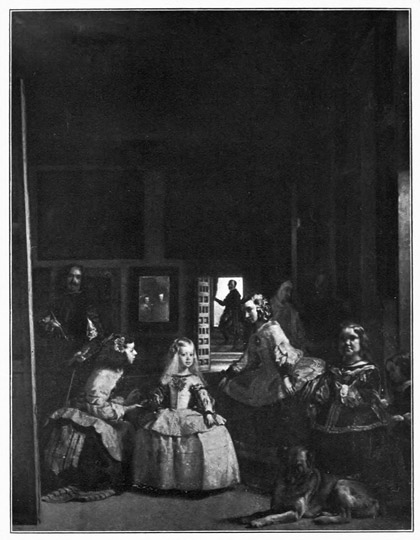
Maids of Honor
Delighted boys from a peasant camp beyond the walls ran up to jeer at our predicament. Our coachman, reverting to his dolorous chant, appealed to all the saints. The top fares shrilled in on the chorus; the Spanish gentlemen lighted cigarettes, and after some twenty minutes of dramatic altercation, a soldier sprang on our top step and mounted guard, while the coach rattled through the gates and on to the aduana. Here we were deposited, bag and baggage, on the pavement, and a drowsy, half-clad old dignitary was brought forth to look at us. The coachman, all his social graces restored, imaginatively presented the three Anglo-Saxons as a French party travelling for pleasure. "But what am I to do with them?" groaned the dignitary, and went back to bed. An appalling group of serenos, in slouch hats and long black capes, with lanterns and with staffs topped by steel axes, escorted us into a sort of luggage room, and told us to sit down on benches. We sat on them for half an hour, which seemed to satisfy the ends of justice, for then the serenos gave place to porters, who said they would bring us our property, which nobody had examined or noticed in the slightest, after daybreak, and would now show us the way to our hotel. Our farewell to the coachman, who came beaming up to shake hands and receive thanks, was cold.
We had engaged rooms by letter a week in advance, but they had been surrendered to earlier arrivals, and we were conducted to a private house next door to the hotel. After the delays incident to waking an entire family, we were taken into a large, untidy room, furnished with dining table, sewing machine, and a half dozen decrepit chairs. There was no water and no sign of toilet apparatus, but in an adjoining dark closet were two narrow cots, from which the four daughters of the house had just been routed. Of those beds which these sleepy children were then, with unruffled sweetness and cheeriness, making ready for us, the less said the better. Our indoor hours in Compostela, an incessant battle against dirt, bad smells, and a most instructive variety of vermin, were a penance that must have met all pilgrim requirements. And yet these people spared no pains to make us comfortable, so far as they understood comfort. At our slightest call, were it only for a match, in would troop the mother, four daughters, maid, dog, and cat, with any of the neighbors who might be visiting, all eager to be of service. The girls were little models of sunny courtesy, and would have been as pretty of face as they were charming in manner, had not skin diseases and eye diseases told the tale of the hideously unsanitary conditions in which their young lives had been passed.
But we had come to the festival of Santiago, and it was worth its price.
XXV
THE BUILDING OF A SHRINE
(A historical chapter, which should be skipped.)
That most Spanish of Spaniards, Alarcón, is pleased in one of his roguish sketches to depict the waywardness of a certain poetaster. "Alonso Alonso was happy because he was thinking of many sad things,—of the past centuries, vanished like smoke, ... of the little span of life and of the absurdities with which it is filled, of the folly of wisdom, of the nothingness of ambition, of all this comedy, in short, which is played upon the earth."
Alonso Alonso would be in his very element in Santiago de Compostela. The "unsubstantial pageant faded" of the mediæval world is more than memory there. It is a ghost that walks at certain seasons, notably from the twentieth to the twenty-eighth of July. The story of the birth, growth, and passing of that once so potent shrine, the Jerusalem of the West, is too significant for oblivion.
The corner-stone of the strange history is priestly legend. The Apostle James the Greater, so runs the tale, after preaching in Damascus and along the Mediterranean coast, came in a Greek ship to Galicia, then under Roman rule, and proclaimed the gospel in its capital city, Iria-Flavia. Here the Virgin appeared to him, veiled, like the mother of Æneas, in a cloud, and bade him build a church. This he did, putting a bishop in charge, and then pursued his mission, not only in the remote parts of Galicia, but in Aragon, Castile, and Andalusia. At Saragossa the Virgin again flashed upon his sight. She was poised, this time, on a marble pillar, which she left behind her to become, what it is to-day, the most sacred object in all Spain. A chip of this columna immobilis is one of the treasures of Toledo. The cathedral of the Virgen del Pilar,—affectionately known as Pilarica,—which James then founded at Saragossa, is still a popular goal of pilgrimage, the marble of the holy column being hollowed, at one unshielded spot, by countless millions of kisses. The Apostle, on his return to Jerusalem after seven years in Spain, was beheaded by Herod. Loyal disciples recovered the body and set sail with it for the Spanish coast. Off Portugal occurred the pointless "miracle of the shells." A gentleman was riding on the shore, when all at once his horse, refusing to obey the bit, leapt into the sea, walking on the crests of the waves toward the boat. Steed and rider suddenly sank, but promptly rose again, all crusted over with shells, which have been ever since regarded as the emblem of St. James in particular, and of pilgrim folk in general.
"How should I your true love know From another one? By his cockle hat and staff And his sandal shoon."
The Santiago "cockle," which thus, as a general pilgrim symbol, outstripped the keys of Rome and the cross of Jerusalem, is otherwise accounted for by a story that the body of St. James was borne overseas to Galicia in a shell of miraculous size, but this is not the version that was told us at the shrine.
The two disciples, Theodore and Athanasius, temporarily interred their master in Padron, two leagues from Iria, until they should have obtained permission from the Roman dame who governed that region to allow St. James the choice of a resting-place. Her pagan heart was moved to graciousness, and she lent the disciples an ox-cart, in which they placed the body, leaving the beasts free to take the Apostle's course. It is hardly miraculous that, under the circumstances, Lady Lupa's oxen plodded straight back to Iria and came to a stop before her summer villa. Since this was so clearly indicated as the choice of the saint, she could do no less than put her house at his disposal. In the villa was a chapel to the war-god Janus, but when the body of Santiago was brought within the doors, this heathen image fell with a crash into a hundred fragments. Here the saint abode, guarded by his faithful disciples, until, in process of time, they slept beside him. The villa had been transformed into a little church, so little that, when the Imperial persecutions stormed over the Spanish provinces, the worshippers hid it under heaps of turf and tangles of brier bushes. Those early Christians of Iria were slain or scattered, and the burial place of St. James was forgotten of all the world.
In the seventh century, a rumor went abroad that the Apostle James had preached the gospel in Spain. The legend grew until, in the year 813, a Galician anchorite beheld from the mouth of his cavern a brilliant star, which shone persistently above a certain bramble-wood in the outskirts of Iria. Moving lights, as of processional tapers, twinkled through the matted screen of shrubbery, and solemn chants arose from the very heart of the boscage. Word of this mystery came to the bishop, who saw with his own eyes "the glow of many candles through the shadows of the night." After three days of fasting, he led all the villagers in procession to the thicket which had grown up, a protecting hedge, about the ruins of the holy house. The three graves were found intact, and on opening the chief of these the bishop looked upon the body of St. James, as was proven not only by severed head and pilgrim staff, but by a Latin scroll. The swiftest horsemen of Galicia bore the glorious tidings to the court of the king, that most Christian monarch, Alfonso II, "very Catholic, a great almsgiver, defender of the Faith." So loved of heaven was this pious king, that once, when he had collected a treasure of gold and precious stones for the making of a cross, two angels, disguised as pilgrims, undertook the work. When, after a few hours, Alfonso came softly to the forge to make sure of their honesty and skill, no artisans were there, but from an exquisitely fashioned cross streamed a celestial glory. So devout a king, on hearing the great tidings from Galicia, lost no time in despatching couriers to his bishops and grandees, and all the pomp and pride of Spain, headed by majesty itself, flocked to the far-off hamlet beyond the Asturian mountains to adore the relics of Santiago.
Now began grand doings in Iria, known henceforth as the Field of the Star, Campus Stellæ, or Compostela. Alfonso had a church of stone and clay built above the sepulchre, and endowed it with an estate of three square miles. The Pope announced the discovery to Christendom. A community of twelve monks, with a presiding abbot, was installed at Compostela to say masses before the shrine. For these beginnings of homage the Apostle made a munificent return. A wild people, living in a wild land at a wild time, these Spaniards of the Middle Ages were shaped and swayed by two sovereign impulses, piety and patriotism. These two were practically one, for patriotism meant the expulsion of the Moor, and piety, Cross above Koran. It was a life-and-death struggle. The dispossessed Christians, beaten back from Andalusia and Castile to the fastnesses of the northern mountains, were fighting against fearful odds. They felt sore need of a leader, for although, when their ranks were wavering, the Virgin had sometimes appeared to cheer them on, hers, after all, was but a woman's arm. It was in the battle of Clavijo, 846, that Santiago first flashed into view, an invincible champion of the cross.
Rameiro, successor to Alfonso II, had taken the field against the terrible Abderrahman of Cordova, who had already overrun Valencia and Barcelona and was demanding from Galicia a yearly tribute of one hundred maidens. This exceedingly Moorish tax, which now amuses Madrid as a rattling farce in the summer theatre of the Buen Retiro, was no jesting matter then. Not only the most famous warriors of the realm, Bernardo del Carpio in their van, but shepherds and ploughmen, priests, monks, even bishops, flocked to the royal standard.
"A cry went through the mountains when the proud Moor drew near, And trooping to Rameiro came every Christian spear; The blesséd Saint Iago, they called upon his name:— That day began our freedom, and wiped away our shame."
The hosts of Cross and Crescent met in battle-shock near Logroño. Only nightfall saved the Christians from utter rout, but in those dark hours of their respite the apparition of Santiago bent above their sleeping king. "Fear not, Rameiro," said the august lips. "The enemy, master of the field, hems you in on every side, but God fights in your ranks." At sunrise, in the very moment when the Moslem host was bowed in prayer, the Christians, scandalized at the spectacle, charged in orthodox fury. Their onset was led by an unknown knight, gleaming in splendid panoply of war. Far in advance, his left hand waving a snowy banner stamped with a crimson cross, he spurred his fierce white horse full on the infidel army. His brandished sword "hurled lightning against the half-moon." At his every sweeping stroke, turbaned heads rolled off by scores to be trampled, as turbaned heads deserve, under the hoofs of that snorting steed. The Son of Thunder had found his function, which was nothing less than to inspirit the Reconquest. Henceforth he could always be counted on to lead a desperate assault, and "Santiago y Cierra España!" was the battle-cry of every hard-fought field. So late as 1212, at the crucial contest of Las Navas de Tolosa, the "Captain of the Spaniards" saved the day.
Whatever may be thought of such bloody prowess on the part of Christ's disciple, the fisherman of Galilee, he could not have taken, in that stormy age, a surer course to make himself respected. All Europe sprang to do honor to a saint who could fight like that. Charlemagne, guided by the Milky Way, visited the shrine, if the famous old Codex Calixtinus may be believed, with its convincing print of the Apostle sitting upright in his coffin and pointing the great Karl to the starry trail. In process of time the Gran Capitan came bustling from Granada. The king of Jerusalem did not find the road too long, nor did the Pope of Rome count it too arduous. England sent her first royal Edward, and France more than one royal Louis. Counts and dukes, lords and barons, rode hundreds of miles to Compostela, at the head of feudal bands which sometimes clashed by the way. Saints of every clime and temper made the glorious pilgrimage,—Gregory, Bridget, Bernard, Francis of Assisi. To the shrine of St. James came the Cid in radiant youth to keep the vigil of arms and receive the honors of knighthood, and again, mounted on his peerless Bavieca, to give thanks for victory over the five Moorish kings. It was on this second journey that he succored the leper, inviting him, with heroic disdain of hygiene, to be his bedfellow "in a great couch with linen very clean and costly."
Dancing the Sevillana
Even in the ninth century such multitudes visited the sepulchre that a society of hidalgos was formed to guard the pilgrims from bandits along that savage route, serve them as money-changers in Compostela, and in all possible ways protect them from robbery and ill-usage. This brotherhood gave birth to the famous Order of Santiago, whose two vows were to defend the pilgrims and fight the Mussulmans. These red-cross knights were as devout as they were valiant, "lambs at the sound of the church-bells and lions at the call of the trumpet." Kings and popes gave liberally to aid their work. Roads were cut through Spain and France, even Italy and Germany, "to Santiago." Forests were cleared, morasses drained, bridges built, and rest-houses instituted, as San Marcos at Leon and the celebrated hostelry of Roncesvalles. Compostela had become a populous city, but a city of inns, hospitals, and all variety of conventual and religious establishments. Even to-day it can count nearly three hundred altars. In the ninth century the modest church of Alfonso II was replaced by an ornate edifice rich in treasures, but in the gloomy tenth century, when Christian energies were arrested by the dread expectation of the end of the world, the Moors overran Galicia and laid the holy city waste. The Moslem general, Almanzor, had meant to shatter the urn of Santiago, but when he entered Compostela with his triumphant troops, he found only one defender there, an aged monk sitting silent on the Apostle's tomb. The magnanimous Moor did not molest him, nor the ashes his feebleness guarded better than strength, but took abundant booty. When Almanzor marched to the south again, four thousand Galician captives bore on their shoulders the treasures of the Apostle, even the church-bells and sculptured doors, to adorn the mosque of Cordova. The fresh courage of the eleventh century began the great Romanesque cathedral of Santiago. Donations poured in from all over Europe. Pilgrims came bowed under the weight of marble and granite blocks for the fabric. Young and old, men and women, beggars and peasants, princes and prelates, had a hand in the building, cutting short their prayers to mix mortar and hew stone. Artists from far-off lands, who had come on pilgrimage, lingered for years, often for lifetimes, in Compostela, making beautiful the dwelling of the saint.
The great epoch of Santiago was the twelfth century, when there succeeded to the bishopric the able and ambitious Diego Gelmirez, who resolved that Compostela should be recognized as the religious centre of Spain, and be joined with Jerusalem and Rome in a trinity of the supreme shrines of Christendom. He was a man of masterly resource, persistence, pluck. Not too scrupulous for success, he found all means good that made toward the accomplishment of his one splendid dream. The clergy of Santiago, who had hitherto borne but dubious repute, he subjected to instruction and to discipline, calling learned priests from France to tutor them, and sending his own, as they developed promise, to sojourn in foreign monasteries. He zealously promoted the work on the cathedral, rearing arches proud as his aspiration, and watch-towers strong as his will. He invested the sacred ceremonies, especially the ecclesiastical processions, with extraordinary pomp, so that the figure of Alfonso VI, conqueror of Toledo, advancing through the basilica in such a solemn progress, appeared less imposing than the bishop himself, crowned with white mitre, sceptred with ivory staff, and treading in his gold-embroidered sandals upon the broad stones that pave the church as if on an imperial palace floor. Gelmirez was indefatigable, too, in building up the city. Eager to swell the flood of pilgrimage, he founded in Compostela, already a cluster of shrines and hostelries, still more churches, inns, asylums, hospitals, together with convents, libraries, schools, and all other recognized citadels of culture. He fought pestilence and dirt, introducing an excellent water supply, and promoting, so far as he knew how, decent and sanitary living. He was even a patron of agriculture, bringing home from his foreign journeys, which took him as far as Rome, packets of new seed slipped in among parcels of jewels and no less precious budgets of saintly molars and knuckle-bones. But these missions abroad, having always for chief object the pressing of his petition upon the Holy See, involved costly presents to influential prelates, especially the red-capped cardinals. The revenue for such bribes he wrung from the Galician peasantry, who gave him a measure of hate with every measure of grain. Gelmirez had so many uses for money that no wonder his taxes cut down to the quick. The lavish offerings sent by sea to the shrine of Santiago, ruby-crusted crucifixes of pure gold, silver reliquaries sparkling with emeralds and jacinths, pontifical vestments of richest tissue and of rarest artistry, well-chased vessels of onyx, pearl, and jasper, all that constant influx of glistening tribute from the length and breadth of Christendom, had drawn Moorish pirates to the Galician waters. To guard the treasure-ships, repel the infidels, and, incidentally, return tit for tat by plundering their galleys, the warrior bishop equipped a formidable fleet, and kept it on patrol off the coast,—a strange development from the little fishing-boat whence James and John trailed nets in the lake of Galilee.