Front matter (continued 2)
Reading edition
The fourth circle, in which the heaven of the fixed stars, reduced to the correct ascent of our times, the signs of the zodiac and the individual degrees of the signs, the months of the year and the single days of the month can be seen, likewise makes its journey around the earth from left to right in 365 terrestrial revolutions, hours 5.48.56.; that is, within a median astronomical year. Above this annual orb, the sun, in its small epicycle, gliding through the 12 signs of the anomaly, within the space of 182 terrestrial revolutions, hours 15.6.58., from left to right, falls from apogee to perigee; and, within the same time, rises from perigee to apogee, and brings with it, the index, namely its central radius, inhering to the axis of the equatorial orb and cutting the four greatest circles from the center.
When the sun has been moved around, Iris shows from six windows the era, that is, the current year. Two winged youths take their place next to Iris, carrying the Julian period: namely, the Roman indiction, the cycle of the sun and the golden number, on a leaf of paper held between them. The imperial eagle stands out on top (as if added to the frontispiece) carrying on its breast the dominating planet and in its talons the ecclesiastical calends (that is, the dominical letter and the epact).
ATTACHMENTS FOR ADJUSTMENT
Two attachments, in the form of small superimposed dials are situated at the base of the dial plate, at either side and immediately below the fourth chapter ring. In his second volume, Father Borghesi stated that they "are not moved from inside the clock, but the one at the right [inscribed concitat and retardat] serves for loosening [accelerating] and tightening [retarding] time; that is, the reins of the perpendicular."
In other words, the purpose of this attachment is for adjusting the pendulum to make the clock operate fast or slow. The second attachment, which appears at the left, and which is inscribed "Claudit" (close) and "Aperit" (open) serves the purpose of "… preparing the mechanism in a moment, as swiftly as you wish, for sustaining the astronomical experiments of which you will hear later; when these things have been done, it restores the mechanism to its natural motion at the same speed."
This adjustment relates to the final section of Father Borghesi's second book, entitled "Chronologo-Astronomicus Usus Authomatis" (Chronological-Astronomical Use of the Automaton), which is translated from the Latin in its entirety:
With one glance at this automaton, you can quickly answer these questions: What hour the sun shows, the moon, any fixed star, the head and tail of the dragon. Is the sea swelling with periodic heat [at high tide?] or is it deflated [low tide], or quiescent? How many days is it from mean new moon or full moon? By how many signs and degrees is the moon distant from the sun, and from its nodes? What sign of the zodiac does the sun occupy, the moon, the head and tail of the dragon? Is the sun or the moon, in apogee or perigee, ascending or descending? What is the apparent speed of the sun and of the moon? What is the apparent magnitude of the solar and lunar diameter, and of the horizontal parallax of the umbra and penumbra of the earth? What is the latitude of the moon? Is it north or south? Does the moon hide [occult eclipse] any of the fixed stars from the earth dwellers, and which of these does it obscure? Is there a true new or full moon? Is the sun in eclipse anywhere on earth? What is the magnitude, and the duration of this eclipse, with respect to the whole earth? Can it be seen in the north or in the south? Is the moon in eclipse? Total or partial? Of what magnitude, etc.? What limb of the moon is obscured? How many years have passed from a given epoch? Is this year a leap year, or a common year—first, second, or third after leap year? What is the current month of the year, and what day of the month and of the week? Which of the planets is dominant? What days of the year do the various feasts fall on, and the movable feasts during the ecclesiastical year? And many other similar questions, which I pass over here for the sake of brevity.
Besides, this device can be so arranged for any time whatsoever, past or future, and for the longitude of any region, and can be so manipulated by hand, that within the space of a very short time there can be provided in their proper order, the various orbits of the luminous bodies, their alternating eclipses, as many as have taken place through the course of many years, or even from the beginning of the world; or those that will be seen as long as the world itself shall last, with all their attendant circumstances (year, month, day, duration, magnitude, etc.). All these can be seen with great satisfaction of curiosity and of learning, and hence with great pleasure to the soul. In the meanwhile, the little bells continually play, at their proper, respective times. So that, all exaggeration aside, a thousand years pass, in the sight of this clock, as one day!
I am aware of your complaints, O star-loving reader—that my description is too meager and too succinct. Lay the blame for this on those cares, hateful both to me and to you, more pressing, which forbid me and deprive you of a methodical explanation of the work.
THE CLOCK MOVEMENT
Father Borghesi specified that the entire mechanism was equal in weight to a seventh part of a Centenarii Germanici, a Germanic hundredweight. This is probably the Austrian centner which is equivalent to 123.4615 pounds. Therefore, the clock mechanism weighs approximately 17.6 pounds.
The clock operated for a hundred days and more at a single winding, according to Father Borghesi, and by means of a pendulum with a leaden bob weighing 60 Viennese pounds, attached at a height of 5 feet. Father Borghesi stated the weight of the pendulum to be 60 librarum Viennensium, but the Viennese libra does not appear among the weights of the Austrian Empire. However, using the average libra, an ancient Roman unit of weight equal to 0.7221 pound, it may be assumed that the driving weight should be approximately 45 pounds.
Father Borghesi, however, does not venture to provide any description whatsoever of the movement of his second clock in his book. He gave the following reasons:
But beyond this, I entirely omit [a description of] the further apparatus of the very many wheels, etc., inside the clock which carry on its functions, lest I become too verbose for some persons. To explain more thoroughly the internal labyrinth of the entire mechanism, from which the movement of the circles or heavens, etc., are derived, would seem to entangle in too many complicated perplexities…. Therefore, that I might not delay longer, and perhaps to no purpose, I have thought it better to leave the whole work to the proportionate calculus of the arithmeticians and the technical skill of mechanics. If they have any desire to construct a similar mechanism, they will follow the aforesaid motions of the heavens, etc., not only by one means alone but by many, more swiftly through thoughtful study than by any amount of instruction.
For whoever is well versed in the theory of calculus and sets to work at any given project, will discover any desired motion by a thousand and more ways, by one or another gearing of wheels; which an industrious mechanic will carry out in actuality and without too much difficulty. Nor is there any reason for anyone to be discouraged, so long as he is not disgusted by the amount of labor for there is nothing truer than the old saying "The favorable gods grant everything to the assiduous laborer."
Nay, further, even this little work itself can be improved on and surpassed by new inventions. Otherwise that other old adage, almost as old as the world, would prove false, "What you have found already done, you can easily repeat, nor is it difficult to add to what has already been invented." Relying on this principle, I have already conceived some new things to be added to the present little work.
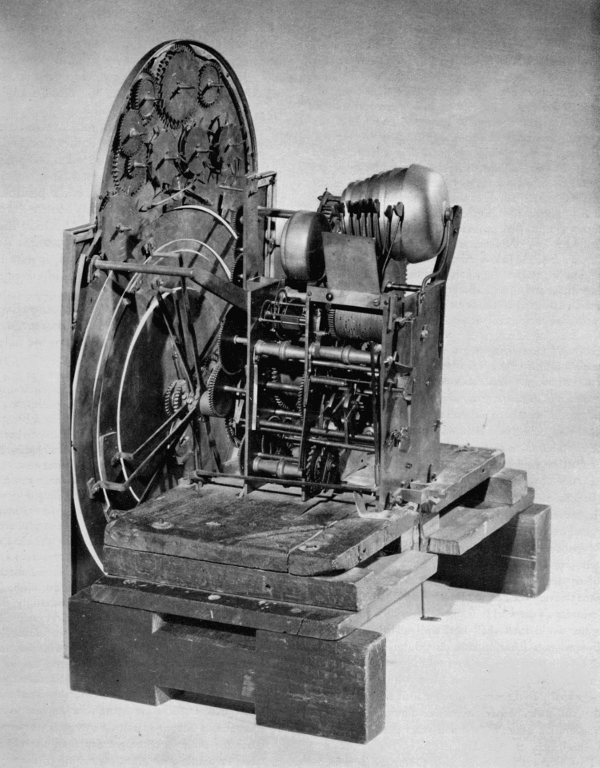
Figure 17.—Movement of Borghesi clock viewed from the right side, with details of chiming mechanism.
THE BELLS
There is a discrepancy between Father Borghesi's written description in his second book of the number of bells and those which currently exist in the clock. At the present time, there are two sets of bells attached to the upper part of the movement. While Father Borghesi indicated that there were two sets of bells in the clock, he described the first set by stating that:
… there are three bells inside the clock: The largest, when struck by a little hammer at each mean new moon, signifies the new moon. The smallest indicates in the same way the full moon at the time of the mean full moon, by automatic sound. When on the equatorial earth, the sun appears anywhere in eclipse, two bells (the largest and the medium) sounding together automatically, announce that eclipse at the time of the mean new moon. (I think it is evident that eclipses of the sun occur at new moons and eclipses of the moon at full moon.)
When the moon is eclipsed, the smallest and the medium bells, simultaneously and automatically, announce the event to the ear at the time of the mean full moon. Besides, at the proper time and automatically, the largest of these bells announces the current solar hour and the smallest bell strikes the quarter hours.
In the clock today, the first set consists of a smaller bell fixed within a larger one. It is presumably these bells that indicate the eclipses and also strike the hours and quarter hours. A pull cord attached to the striking mechanism repeats the current hour and quarter hours at will. The second set consists of nine meshed bells struck with individual hammers operated by means of a pinned cylinder as in a music box. On the hour, the chimes play one of two melodies, which may be changed at will. While not identified, these appear to be Tyrolean folk melodies. The largest of this set of bells is dissimilar to the other chimes, and may be the third bell described by Father Borghesi to signify the new moon.
CHRONOGRAMS
One of the most curious aspects of the second clock produced by Father Borghesi and Bertolla, as well as of the second published volume, is the presence of chronograms which occur repeatedly on the clock dial and throughout the Novissimum Theorico-Practicum Astronomicum Authoma from the title page to the end of the book. Interestingly enough, Father Borghesi did not utilize this device even once in his first little book.
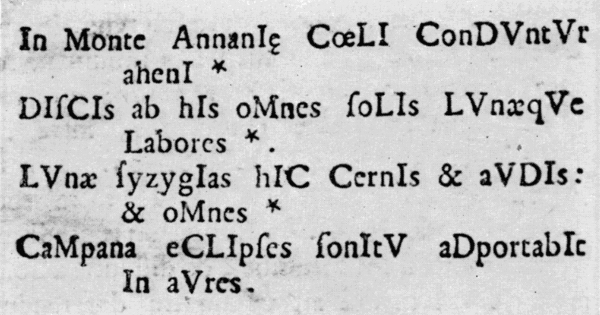
Figure 18.—A chronogram in the text of Father Borghesi's second volume, indicating the year 1764. The poem is translated as: "In the Mount of 'Anáuni,' the inscrutable heavens are led, You learn from these all the labors of the sun and the moon. Here you are shown and hear the conjunction of the moon: And a bell brings to the ears by its sound, all eclipses."
Webster defines a chronogram as an inscription, sentence, or phrase in which certain letters express a date or epoch. The method used by Father Borghesi for forming chronograms was a simple one. He used combinations of uppercase and lowercase letters in two sizes in the inscriptions on the clock dial and in his writings. At first this curious combination in the inscriptions on the dial plate was a source of considerable speculation. The extremely fine quality of the engraving and artistry was such that these combinations could only be deliberate in nature and not the accidental whims or accidents of the engraver. Accordingly, they must be chronographic in intention. Such proved to be the case.
Borghesi used the larger size of uppercase letters to form the chronogram, and each chronogram was complete within a phrase or line. He accomplished this by using for this purpose those letters of the alphabet which form the Roman numerals. The uppercase letters found within words are copied off in the order in which they appear in the inscription or phrase. These are then converted into their numerical equivalents, and totaled. Taking the uppermost inscription on the clock dial as the first example:
FranCIsCVs I sIt pLan. DoMInator aeternVs
The letters which are intended to form the chronogram are:
C I C V I I L D M I V 100 1 100 5 1 1 50 500 1000 1 5
These figures added together total 1764.
The second inscription on the clock dial which forms a chronogram is
LaVs saCrosanCtae TrIaDI VnI Deo, et DeIparae L V C C I D I V I D D I 50 5 100 100 1 500 1 5 1 500 500 1 = 1764.
The third inscription required a little more planning, because of its greater length. Accordingly, Father Borghesi divided it into nine parts, each of which is separated from the other by means of asterisks. Each of the nine parts of the inscription formed a chronogram which, in every instance, totals to the date 1764, the year in which the second clock was completed. The same procedure was followed with the inscriptions in the lower left and the lower right corners of the dial as well as with the maker's inscription within the central disk. This inscription is
BVrghesIo DoCtore, et BertoLLa LIMatore AnnanIensIbVs V I D C L L L I M I I V 5 1 500 100 50 50 50 1 1000 1 1 5 = 1764.
The inscriptions within the chapter ring are not utilized for chronograms, however. It is apparent that Father Borghesi was required to make a most careful selection of the texts for his inscriptions in order that none of the phrases included any additional letters which formed Roman numerals than would total to the date he desired to indicate, namely, 1764. Where it was necessary, he employed an asterisk to separate parts of texts so that each would produce the same total. Any letter that did not form a Roman numeral, even if capitalized or used in a larger size, did not interfere with the formation of the chronograms.
In spite of his ingenuity in designing a text which would include only such of the letters representing the Roman numerals which would provide the chronograms for 1764, Father Borghesi experienced some difficulties, particularly in place names. He accordingly changed them in order to avoid the inclusion of letters that would have disturbed his totals. Examples are MEGGL instead of MECHL, which had an extra C, and RVNNO instead of RVMO, which had an extra M.
PUBLISHED DESCRIPTION OF THE SECOND CLOCK
When the clock had been completed and proved to work successfully, Borghesi once more reduced a description of the clock and its function to published form in a second little volume published by Monauni. This second work was also in Latin, the title of which is translated as The Most Recent Theoretical-Practical Astronomical Clock According to the Equally Most Recent System of the World. As with his first book, Father Borghesi devoted a number of pages to a preface addressed to the reader, which is translated from the Latin:
This mechanical instrument was far from being ready for public notice. A great deal of time and work remained to produce a machine of this new system from the very foundations; then, by a most accurate calculation to bring the motions of many wheels up-to-date with the most recent astronomical observations; and, finally, to fashion it with the craftsman's file, often enough with a weary hand. All this work I had performed eagerly, so that, while in my room, I might contemplate leisurely, both day and night, the true face of the heavens and the seas unobscured by clouds, even though I had no astronomical equipment. But, then I remembered that, in my book on the first clock, I had promised a description of a new (at least, as far as is known to me) clock. Moreover, friends with astronomical interest, who took part in the oft-repeated astronomical experiments concerning this clock, persuaded me that the intellectual world would enjoy having a greater knowledge and a description of this work. However, it was not only the promises nor the desires of many which moved me to write this work, but I also thought it was necessary to set forth, before the description of the clock, an exposition of the astronomical system according to which this clock was constructed, so that the complete work would be evident to all. I was concerned about making this timepiece more acceptable and more understandable to those people who are far distant and unable to see it, so that this present exposition would obtain credulity among all. I could find no better method than to set forth for the reader the theory of the universe which I figured out after many sleepless nights.
In testing this theory day after day, it not only appeared to be complete, and true, but each day it appeared more conformable to reality; it captured my mind in such a way that I finally adhered to it. I desired, while I lived, to erect this work as a monument to the theory. To do this, I digressed a bit from the true-to-life pattern to the mechanical order so that I could transfer all the movements of the heavens, etc. (which I enjoyed thinking about more), to the plane surface of the clock's face. In this way, the ecliptical spectacles of the stars, etc., would appear at their proper times clearly before the eyes of the viewer. I could also avoid many difficulties which otherwise, perhaps, even the hands of the most skillful craftsmen could never solve.
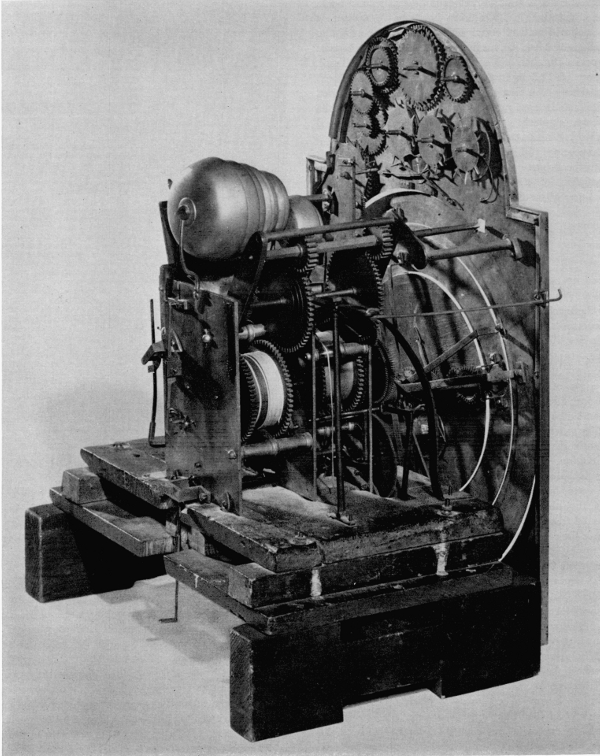
Figure 19.—Movement of the Borghesi clock, viewed from the rear, showing rear of dial plate.
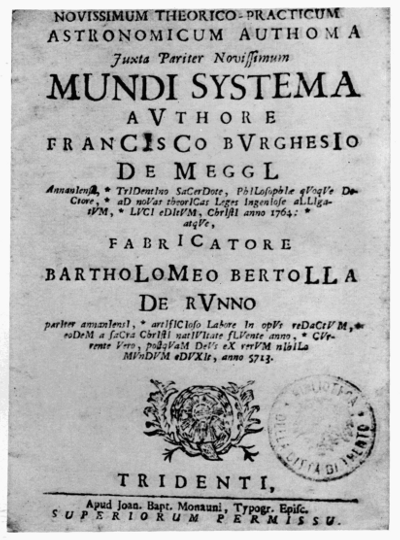
Figure 20.—Title page of Father Borghesi's second book. The translation in its entirety is: "The Most Recent Theoretical-Practical Astronomical Clock According to the Equally Most Recent System of the World. Author: Francesco Borghesi of Mechel of Anáuni * Priest of Trent, Doctor of Philosophy * (The System of the Clock) Ingeniously connected to new theoretical laws published 1764: and the constructor, Bartholomeo Antonio Bertolla of Rumo, similarly from Anáuni * who skillfully produced this work * in this same current year of Our Lord * which is the year 5713 [sic] since God created this earth. (Trent: From the Printshop of Giovanni Battista Monauni, With Permission of the Superiors.)" (Title page reproduced by courtesy of the Biblioteca della Citta di Trento.)
You ought to know, therefore, that as a result of my nightly meditations, I have rejected, after much consideration, all the explanations of the universe thus far published. All other theories of the make-up of the universe, however admirable, and however many there are, turn the sun and earth around in an ecliptic in an annual movement. Thus, Philolaus was the first to move the earth from the center of the universe and move it through the void; afterwards, Aristarchus of Samos and then Copernicus moved the earth with the moon. The Egyptians, as well as Pythagoras, Ptolemy, Tycho, Riciolus, Longomontanus, etc., thought that the sun moved through the degrees of the ecliptic each year. But I attributed this movement to neither earth nor sun for the movement of both is only apparent. I did not vainly surmise the annual equilibrium in all astronomical observations to be from the daily movement of the same axis moved at the poles of the heavens. Nor, in like manner, is there a better way to satisfy physical experiments. To you, then, most cultured reader: If you, perhaps, can make any use or draw pleasure from this most faithful description of my new theory and the mechanical instrument, refer it first to God on High from whom is everything that is best, and then to those avidly awaiting this little work. Lastly, if you find any statement less fitting; in your humanity, do not disdain to excuse it.
Borghesian Theory of the Universe
In Father Borghesi's second volume, there is a separate chapter entitled "An Exposition of the Latest Theory of the Universe." This follows the introduction to the reader, and in it Father Borghesi proposed:
That you might rightly conceive my new system of the world and mechanically, as it were, construct it, imagine for yourself, beneath that most happy seat of the Blessed and above all other heavens, a kind of spherical convexity, everywhere equidistant from the center of the earth, and endowed with absolutely no motion.
On the inside, at two points diametrically opposite each other, this convexity has two most sturdy poles (to speak mechanically), projecting towards the center (which you call the poles of the heavens), and the largest immobile semicircle, in some manner is drawn from the center of one pole to the center of the other. This semicircle in the middle, namely at a point equidistant from each pole, is thought to be secured by some sign, for example, by that "o," for arranging more perceptibly the seat of the sun (as will be shown later). This much must be conceived first.
You must understand that imposed on these poles is the first mobile [Primum Mobile], everywhere convex, and divided, into 12 equal parts [Dodecatemoria], by the 6 greatest circles, intersecting each other at the centers of the poles. Then it is divided by another equally great circle, everywhere equidistant from the poles, into two hemispheres. One hemisphere of 12 parts, proceeding in order from west [setting] to east [rising] should be assigned the respective signs of the zodiac; that is, one to Aries, the next to Taurus, and so on, etc. The circle which cuts those 12 parts transversely in the middle, you call the ecliptic. Then, these capital spaces of the Primum Mobile are subdivided by degrees, minutes, etc., both in longitude and in latitude, so that this heaven represents a kind of great spherical net, extended to capture the longitude and latitude of the stars, and Mobile on the aforementioned poles. Note, however (and this is almost the leading point of the system), in that circle of longitude which divides the sign of Gemini from Cancer and Arcitenens [Sagittarius] from Capricorn, you must conceive two points, directly opposite each other and removed about twenty-three and a half degrees from the poles: Boreal [the northern] between Gemini and Cancer; Austral [the southern] between Sagittarius and Capricorn. These two points by some power (imagine it is magnetic power), equal between them, hold the terraqueous orb suspended in the middle, by acting on the axis of the same orb (imagine it is iron) in such a way that the earth is continually drawn to those two points as to two opposite centers. It is never nearer to one, for as it is about to move towards one, the opposite power is constantly drawing it back. Thus, both those points and the axis of the earth are always held in one common line, wherever those points happen to be carried by the rotation of this heaven.
Again, it is necessary for you to conceive in this heaven, first, two great circles, bisecting each other at right angles in the centers of these two magnets. One of these circles, passing through the first point of Aries and Libra in the ecliptic, is called equinoctial colure: the other circle, passing consequently between the first point of Cancer and Capricorn, is called solstitial colure. Beneath these are likewise imagined many other great circles, in the centers of the magnets dividing crosswise in the shape of an "X." But if, receding from these magnets, you describe circles (parallel to each other and ever greater and greater, up to the greatest circle which you will perceive is called the equator), equidistant from each magnet and obliquely splitting the ecliptic in the equinoctial colure, you can then behold a great, new, woven net in this heaven of the Primum Mobile. This net most beautifully expands to extract the straight ascent and descent of the stars, etc., from the vast ocean of the heavens, catching the straight ascent in the greatest circles and, in other unequal circles, parallel to each other and obliquely cutting across, most safely catching the descent.
GLOSSARY
Anomolia or anomaly, is the angular distance of a planet from its perihelion (that point of the orbit of a planet which is nearest to the sun) as seen from the sun.
Aequinoctium or the equinox, is the time in which days and nights are equal in the space of hours. There are two equinoxes: the spring equinox—c. 8 calends of April in the sign of Aries; and the fall equinox—c. 10 calends of October in the sign of Libra.
Aeras is derived from aera, aerae, which originally meant a given number, usually used in regard to money. The word was later extended to mean a number used in any calculation, and finally it came to mean a certain time from which subsequent times were counted, e.g., Anno Domini, after the Birth of Christ.
Coluri or the Colures, which are two circles in the heavenly sphere, passing through the poles of the world and cutting each other at right angles: the one passes through the equinoctial points of Aries and Libra and is called Colurus Aequinoctiorum or equinoctial colure; the other touches the solstitialia of Cancer and Capricorn and is called Colurus Solstitiorum or solstitial colure. They are called Colurus, which is translated as "mutilated tails," for the part which emerges in the Antarctic is not visible and is quasitruncated.
Ecliptica or the ecliptic, is an imaginary line in the heavens in which the sun was supposed to have performed its annual course.
Epicyclus or epicycle, is a small orb which, being fixed in the deferent of a planet, is carried along with its motion and yet, with its own peculiar motion, carries the body of the planet fastened to it round about its proper center.
Iris or the rainbow. In mythology, Iris was the daughter of Thaumatis and Electra, messenger of Juno of the goddesses and Jove of the gods.
Solstitium or the solstice, is that time when the sun seems to stand still for a short time: when the sign of Cancer enters the month of June (equivalent to the summer solstice, when the sun begins to recede from us); and when the sign of Capricorn enters the month of December (equivalent to the winter solstice, when the sun begins to accede to us).
Immediately below the Primum Mobile place the heaven of the fixed stars (and, that the idea might be clearer), revolving separately on the same poles on which the Primum Mobile revolves. Through this heaven, the filaments of the little nets, etc., seem to the eyes of you on earth as if they shine. In this heaven, you should conceive in their fixed places, the fixed stars, a proportionate, inviolable distance from each other, and, indeed, if you will, the heavenly images, etc., depicted, and all carried along at the same time with their heaven by one motion.
Conceive a straight line running from the center of the earth to that sign "o" noted in the semicircle of the supreme immobile heaven. On this line, greatly below the heaven of the fixed stars, place the center of the solar epicycle, holding an area in common with the ecliptic and subject to absolutely no motions, but at such a distance from the center of the earth that the semidiameter of the earth has little, if any, proportion with the distance of the solar epicycle from the earth. Around the sun, moving continually in this epicycle (its immobile palace) through the degrees of the anomaly, you can revolve, with motions proportionate to the system, the five planets: Mercury and Venus (the nearest barons of the sun), then Mars, Jupiter and, most remote, Saturn, with its respective satellites, etc., eccentrically surrounding the earth itself and the moon in their immense ambit and wandering by their proper motions through the zodiac.
Nevertheless, not far from the earth you should imagine fabricated, as from most refined crystal, the heaven of the moon everywhere equidistant from the center of the earth and revolving separately on the same poles (prolonged even to this place) on which the Primum Mobile and the heaven of the fixed stars revolve. In the middle of this, that is, in some point equally removed from the poles, you place the center of the lunar epicycle, movable also by the common rotation of the lunar heaven. I refrain from the other movements of the moon in latitude, etc., as also those of the five planets, etc., which the theory in no way excludes, lest by a variety of congested motions explained too abundantly, either you might be confused about the fundamental concept of the system or, while adorning the theory and trying to embellish the least things more widely, you might reject also the things which are capital.
Here you already have the whole machine, but still inert and to be animated for the first time by motions accommodated to the system. Nevertheless, before I assign motion to the individual parts of the world, so that the thing might later appear more clearly to you, I arrange all things thus: first, as if by hand, I turn the Primum Mobile until the Boreal magnetic point comes to the level or the area of the semicircle described in the supreme immobile convexity; then I turn the heaven of the fixed stars until, for example, the heel of Castor (a star of the third magnitude), almost in the ecliptic and indeed in our time not far distant from the solstitial colure, likewise falls nearly at the level of the aforesaid semicircle. Later, I turn the lunar heaven until I bring the center of the lunar epicycle to the same level. Then, I turn the earth until some predetermined city, for example, Trent, situated in the northern zone with a latitude of about forty-six degrees, is brought to the oft-mentioned level.
From things arranged in this way and from what has gone before, it is evident (with the motions of the luminaries in epicycles left out, however, lest you be distracted by the explanation) that at Trent, just as in the whole northern hemisphere, it is the summer solstice; and, conversely, in the southern hemisphere, it is the winter solstice. The reason is because the northern magnetic point together with the northern half of the earthly axis is at its highest point towards the sun, immovably residing in a line sent through the level of the highest semicircle; and, conversely, the southern magnetic point with the corresponding half of the axis is most removed from the same. It further follows, that noonday and the new moon coincide, and the heel of Castor almost reaches the summit, etc.
Now, beginning from this hypothetical situation of the whole world as from the root of the motions, I move all things in their circles so that the earth turns on its axis with a revolving motion from west to east in each 24 hours of median time. The lunar heaven completes one circle around its poles likewise from west to east in the time of 29 terrestrial revolutions, hours 12.44.3.13.1. The sphere of the fixed stars on the same poles revolves once from east to west within 365 revolutions of the earth, hours 6.9.29.1. The Primum Mobile on the poles (common to the heaven of the fixed stars and the heaven of the moon), is moved once in the same way from east to west, a little faster, however, than the heaven of the fixed stars, yet within 365 revolutions of the earth, hours 5.48.56; that is, within a median astronomical year.
Now, behold for yourself a new world supported on new poles and provided with new motions and laws. Now you, reader and lover of the stars, turn it, and revolve it as long as it pleases you, and compare it astronomically and physically with the Copernican or the Tychonian systems or with whatever one pleases you more, and judge which one seems more consonant with nature when all things are examined. But if you aren't able to reconcile this theory with some astronomical observations or physical experiments and think it should be eliminated from the group of theories, see that I might know this while life is still my companion, so that I might think with you, if this is possible. Also, so that, in gratitude for the detected or perhaps hidden error, I might speak or write, and you won't have to shout in vain in bold ridicule and with no applause after the fleeing shades of the dead and the mute ashes. But, if you object that the daily motion of the revolving earth and the annual motion of its whirling axis do not sufficiently agree with certain texts of Sacred Scripture, and if those things which the Copernicans and the Longomontanists say do not convince you, then reject my whole system as an old wives' tale.
Last Years
There is a break in the story of Borghesi and Bertolla for the next five years. The second clock may have been the last project on which the priest and the clockmaker worked together, for very good reasons. The two clocks must have represented a considerable financial investment in materials and in time, and neither of the men was in sufficiently affluent circumstances to undertake the luxury of such a hobby without some form of recompense. The publication of the two little volumes must have also been done at Father Borghesi's expense. The income of the parish priest in a small mountain village could not have been equal to the relatively great costs of the projects that had been completed. It seems probable that the priest attempted to sell his clocks to a wealthy patron, perhaps the Baron of Cles, or he may have attempted to obtain some form of recompense for the continuation of his research. However, no records can be found of such patronage if it existed. If Borghesi had received financial assistance while the projects were in progress, he would certainly have made adequate mention of the patron's name and assistance in one or the other of the two volumes which he published. [17]
The next record relating to Borghesi which has been found is the description of a letter written by an anonymous mathematician late in 1768 or early in 1769. It was 28 pages in length, written in Latin, in the form of a reply to the writer's brother, on the subject of the clock invented by Borghesi. It consisted primarily of a criticism launched against Borghesi's first little volume published in 1763.
The anonymous letter is without date, place, or signature. This writer claimed that Father Borghesi had made many errors in his book, presumably in the description of the clock's functions, and in the basic theories upon which the priest had predicated his research. No complete copy of the letter's text has been found for study, although it is described at length in Tovazzi's Biblioteca Tirolese. Tovazzi noted that four copies of the letter existed at that time, and that he personally had filed one in the Biblioteca di Cles in Trent. However, every attempt to locate a copy at the present time has been unsuccessful.
If the anonymous letter was brought to the attention of Father Borghesi, it must have introduced a disturbing note into his life and cost the priest many unhappy moments. He was not, however, dissuaded from his preoccupation with horology. Several years later, in 1773, Father Borghesi was working on yet another astronomical clock, this time presumably without the assistance of Bertolla. This third clock was reported by Tovazzi to have been "of minimum expense but of maximum ingenuity."
No subsequent information relating to it has come to light, and there is no record that it was actually completed.
Again there is a period of silence in the life of Father Borghesi which no amount of research has yet been able to pierce. Whatever the circumstances may have been, it is reported by several of the sources noted that both the first and the second clock did, in fact, become the property of the Empress Maria Theresa in Vienna. The presentation was made sometime during the period between the completion of the second clock in 1764 and the year 1780. There is some discrepancy in the contemporary accounts as to whether Father Borghesi presented one or two clocks to the Empress, but all the sources with but one exception record that both clocks were acquired by the Empress.
It is doubtful that Father Borghesi had originally intended to give his clocks to the Empress at the time that they were made, for he would most certainly have made some mention of such an intention in the two little volumes which he published about them. If he saw the letter published by the anonymous mathematician in late 1768 or 1769, it is possible that he decided to make the presentation in expiation of his sense of guilt for the amount of his time which the creation of the timepieces had consumed. On the other hand, it is just as possible that Father Borghesi may have forwarded copies of his two little volumes to the Imperial Court at Vienna, and that the Empress expressed a desire to acquire the clocks.
Father Tovazzi states that in 1780 "the clock invented by him [Borghesi] was preserved in Vienna, Austria, at the Imperial Court from which the inventor was receiving an annual pension of 400 florins." No records in the Palace archives relating to the clock have yet been found, nor records of payment of an annuity to Father Borghesi. However, a more exhaustive investigation of the Furniture Depository of the Imperial Court may bring forth related records. It was the implication in Father Tovazzi's account that the second clock had been presented to the Empress prior to the publication of the anonymous, critical letter in 1768 or 1769. He believed that it was envy of Father Borghesi's ingenuity, fame and financial benefit that had caused the anonymous mathematician to publish his letter, for Tovazzi asked "Who would have encountered opposition to such a marvel? Envy is not yet dead, and has always reigned."
This last-mentioned theory about the presentation may be the most likely one. Some evidence may be found in the second clock itself which bears out this assumption. The multiple chapter ring, with its many inscriptions, is engraved and silvered in a relatively crude manner, presumably by Bertolla himself. The main dial plate, however, which is of gilt brass, is engraved with the utmost skill by one of the great masters of the art. The inscription below the Imperial Hapsburg eagle relates to Francis I, Emperor of the Holy Roman Empire. It is entirely possible that although Father Borghesi originally had no intention of giving the clock to the Emperor or the Empress at the time that it was made, he later changed his mind. Accordingly, he may have commissioned a master engraver, possibly in Trent or in Vienna itself, to produce a dial plate which would be of such a quality as to be worthy of the Emperor himself. If so, this was done shortly after the clock was completed, for the Emperor died in August of the following year. Perhaps by the time that the clock was ready, the Emperor had already died, and Father Borghesi gave the clock instead to Maria Theresa without revising the inscription.
The acceptance of the clocks by the Empress, and the annuity which was his reward, would have constituted considerable honor even for one of the foremost clockmakers of the Empire, but for a humble parish priest in a little village, such notable Imperial recognition was overwhelming. Possibly as a result of it, a change was noted in Father Borghesi in the next few years. His conscience began to bother him, and he began to question whether he had done right in spending so much of his time and thought on his horological research. He became more and more confused in his own mind. Had he spent too much time in mechanical studies to the neglect of his ecclesiastical duties? If this had been the case, he had committed the most grievous sin.
Exaggerated though these thoughts may appear, they were undoubtedly of the most critical importance to the middle-aged priest. His mental turbulence and confusion increased daily, and it soon became apparent to others around him. By June 1779, he was completely in the grip of his obsession, and his parishioners began to whisper amongst themselves that their pastor was being tortured by the devil. They were unable to help him, and he became more and more preoccupied with his problem. The years passed slowly as the pastor became more vague and more tortured by his conscience. [18]
There probably was continued contact between Father Borghesi and Bertolla for at least some time after the development of his illness. Bertolla had retired from active work, but continued to pursue his interests in his clockshop as much as his health and advanced years permitted. A clock which he made at the age of 80 survives and is described and illustrated in the following section on "The Clocks of Bartolomeo Antonio Bertolla." Finally, on January 15, 1789, Bertolla passed away and Father Borghesi was left alone, deprived of the companionship he had enjoyed with the older man for the past two or three decades. One of Bertolla's nephews continued to work in the master clockmaker's workshop, but there did not appear to be any association between the younger man and Father Borghesi.
At last, in 1794, Father Borghesi lost his sanity completely, and he was forced to relinquish his pastoral duties to a curate. For the remaining eight years of his life, he continued to live in the rectory of the little parish church in Mechel where most of his life had been spent, his needs undoubtedly attended by the parishioners he could no longer serve. During this period, until his death at the age of 79 on June 12, 1802, Father Borghesi lived on, oblivious of those around him. Seemingly, he retired to another world; perhaps to that universe which he had tried to reproduce in his second clock.
The Clocks of Bartolomeo Antonio Bertolla
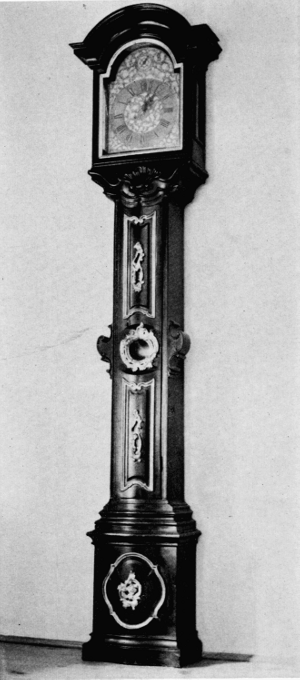
Figure 21.—Tall-case clock by Bertolla in the Episcopal Palace in Trent, made for Bishop Cristoforo Sizzo di Noris. A striking and repeating clock with lunar phases. (Courtesy of Museo Nazionale della Scienza e della Tecnica, Milan.)
The ingenuity displayed in the Borghesi clock by its constructor, Bartolomeo Antonio Bertolla, requires a consideration of the other examples of his work that have survived. The most important of his clocks are probably the one in the Episcopal Palace at Trent and another made for the Baron of Cles.
The one which survives in the Episcopal Palace to the present time, is extremely tall and is housed in an elaborately decorated narrow case of black or ebonized wood approximately 9 to 10 feet in height. The upper part of the case is decorated with elaborately carved and gilt rococo motifs. The movement operates for one year at a winding, indicates and strikes the hours, and shows the lunar phases. It has an alarm, and will repeat the strike at will, indicating the number of the past hour and the quarters. The gilt brass dial is decorated with silver-foliated scrollwork in relief at the corners, inside the chapter ring, and within the broken arch. Featured above the chapter ring is the coat of arms, executed in silver, of the patron for whom the clock was made, Cristoforo Sizzo di Noris. Di Noris was Bishop of Trent for 13 years, from 1763 to 1776.
The clock which Bertolla made for the Baron of Cles is a tall, narrow, case clock of ebony or ebonized pearwood which is approximately 91/2 feet in height. The decoration of the case is considerably more conservative than the one made for Di Noris, but the black wood is decorated with silver trim and carved designs in the wood itself. The dial is decorated with silver scrollwork and spandrels within and around a raised chapter ring. The clock operates for one month at each winding, has an alarm, indicates and strikes the hours, and will repeat the quarters. This handsome timepiece is still in the possession of the descendants of the Baron of Cles.
According to Pippa, [19] certain characteristics become apparent in a study of the surviving clocks by Bertolla. The tall-case clocks are narrow and range in height from 73/4 feet to 101/2 feet. The cases had this excessive height in order to obtain the greatest fall for the month and year movements which Bertolla constructed. For the weight assembly, he substituted a drum wound with a key at the point of the driving wheel in place of the customary pulley. The addition of an intermediate wheel augmented the drop of the weight.
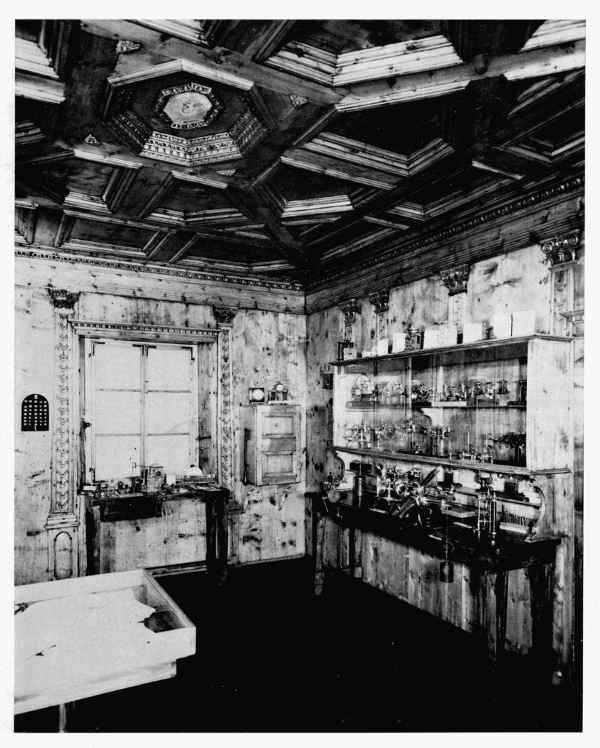
Figure 22.—Interior of Bertolla's workshop, showing detail of ceiling. (Courtesy Museo Nazionale della Scienza e della Tecnica, Milan.)
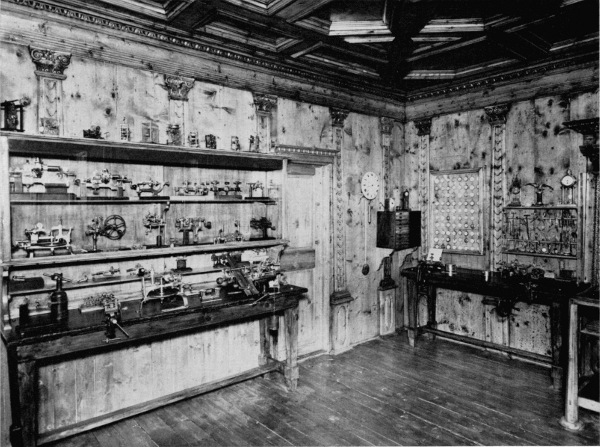
Figure 23.—Interior of Bertolla's workshop, showing the main workbench and the collection of clockmakers' tools. (Courtesy of Museo Nazionale della Scienza e della Tecnica, Milan.)
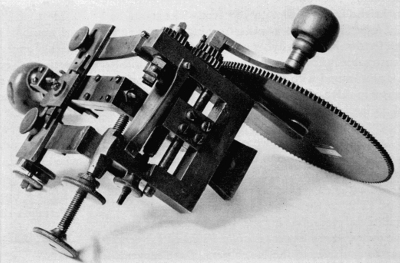
Figure 24.—Fusee cutter used by Bertolla. Now in the collection of the Museo Nazionale della Scienza e della Tecnica, Milan.
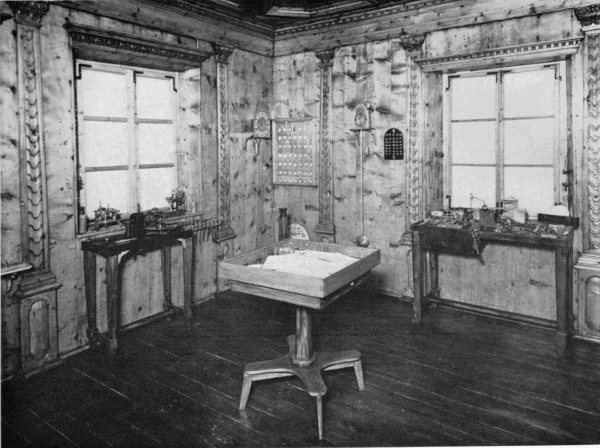
Figure 25.—Interior of Bertolla's workshop, showing details of paneling and floor case with Bertolla manuscripts. (Courtesy of Museo Nazionale della Scienza e della Tecnica, Milan.)
Bertolla's movements were solidly constructed from well-hammered brass and iron. He favored the recoil anchor escapement in his clocks and the Graham dead-beat anchor escapement with a seconds' pendulum. The escapement was not always placed in the traditional location in the upper center between the plates. Bertolla occasionally displaced the pendulum to one side, to the lower part of the movement or placed it entirely between two other small plates. [20]
He utilized every type of striking work, including the music-box cylinder common in the clocks of the Black Forest and the rack and snail. Bertolla most frequently employed the hour strike and grand sonnerie. He often used a single hammer on two bells of different sound with the rack and snail. An example of this type is the clock he produced at the age of 80. To achieve the necessary axis of rotation for the hammer, which is perpendicular to the plate when it strikes the hours, it moves to an oblique position and displaces one of the two long pins in an elongated opening.
Bertolla's dial plates were generally well executed, with a raised or separate chapter ring applied to a brass or copper plate, such as a copper-plate repoussé and gilt with baroque motifs, or upon a smooth brass plate with spandrels of repoussé work usually of silver, in relief and attached. The engraving of the chapter rings was excellent. The hands were well executed in steel or perforated bronze, and occasionally of repoussé copper; gilt was applied to the hands made of forged steel.
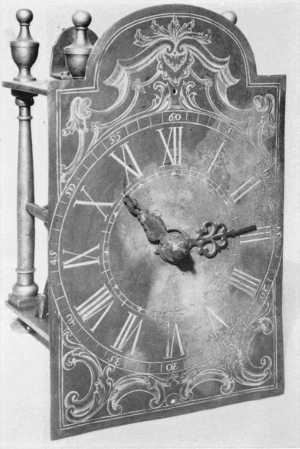
Figure 26.—Dial plate of a brass lantern clock made by Bertolla, found in his workshop after his death. (Courtesy of Museo Nazionale della Scienza e della Tecnica, Milan.)
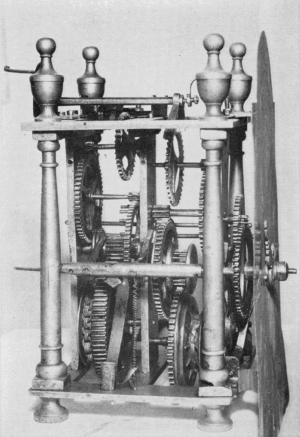
Figure 27.—Movement of a brass lantern clock made by Bertolla. (Courtesy of Museo Nazionale della Scienza e della Tecnica, Milan.)
In the course of time, Bertolla's home workshop passed from one generation to another within the family. Inevitably, it underwent many modifications until the only original part of the building that remained intact from Bertolla's time was his clockshop.
Within the last few years, the workshop room was acquired complete with contents from Bertolla's descendants, and installed in the Museo Nazionale della Scienza e della Tecnica in Milan as an exhibit of a typical 18th-century clockmaker's shop. The original workshop was dismantled in Mocenigo di Rumo and completely rebuilt in the museum, including the walls, ceiling and floor. The paneling and woodwork of the walls and ceiling, which have been preserved intact, are hand-cut fir, with columns, trim and moldings carved by hand. A small painting is featured in the center of the coffered ceiling. The original shop benches and chests of drawers are set around the reconstructed shop and Bertolla's tools and equipment laid out as they had been originally. Other clockmaker's tools and equipment in the museum's collection are also displayed. Approximately 40 percent of the tools are the original items from Bertolla's shop. Parts of clocks and works in progress are on view on the benches as they were in Bertolla's time. [21] Also preserved in the museum are sketches found in Bertolla's manuscripts, some of which are reproduced on the following pages.
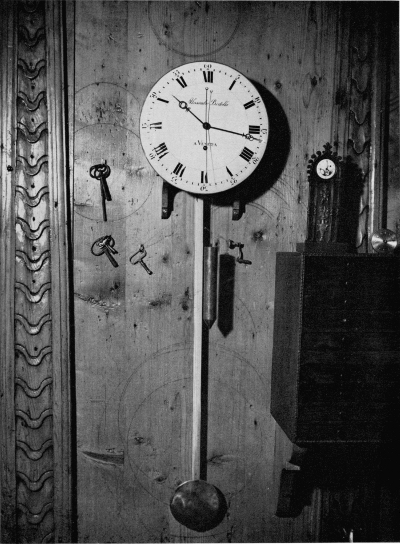
Figure 28.—Detail of wall of Bertolla's workshop, with regulatory clock made by his nephew, Alessandro Bertolla of Venice. Note wheel layouts, etc., scribed in the paneling. (Courtesy of Museo Nazionale della Scienza e della Tecnica, Milan.)
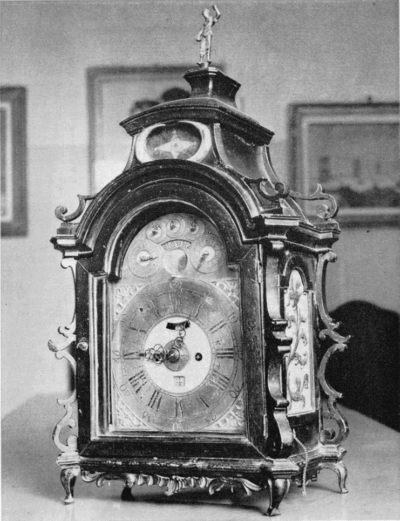
Figure 29.—Table clock by Bertolla in the collection of Doctor Vittorio dal Lago of Bergamo. The dial indicates the days of the week and of the month, the names of the months and lunar phases. The clock strikes the hours and quarters and repeats. (Courtesy of Sig. Luigi Pippa of Milan.)
The shop contains two completed clocks made by Bertolla. One is a weight-driven lantern clock typical of the 18th century, Italian style with brass dial, plates and posts, anchor escapement, and striking work. The dial is engraved in the usual style of Bertolla's baroque design, and the hands are of pierced bronze. Another clock associated with Bertolla and found in the shop, was made by his nephew, Alessandro Bertolla, who worked in Venice after his apprenticeship with his uncle had been completed. This clock is a regulator with a seconds' pendulum and sweep hand on an enameled dial. The original case has not survived.
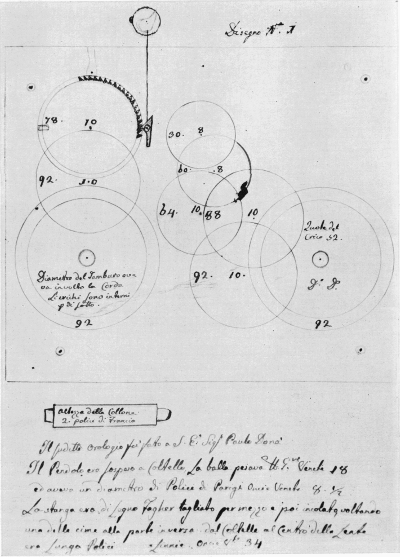
Figure 30.—Layout of the wheelwork of a clock made by Bertolla for His Excellency Paulo Dona, inscribed "Design No. 1." (Courtesy of Museo Nazionale della Scienza e della Tecnica, Milan.)
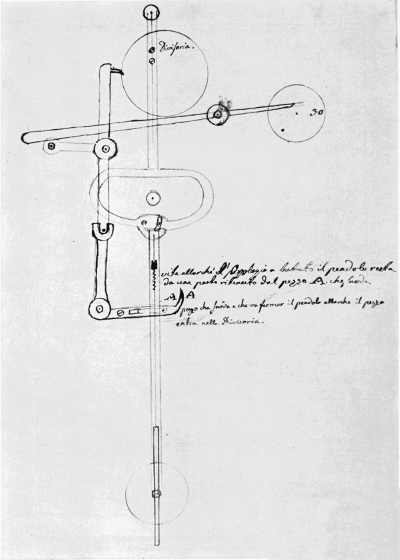
Figure 31.—Pendulum arrangement sketch for an unidentified clock found in Bertolla's workshop. (Courtesy of Museo Nazionale della Scienza e della Tecnica, Milan.)
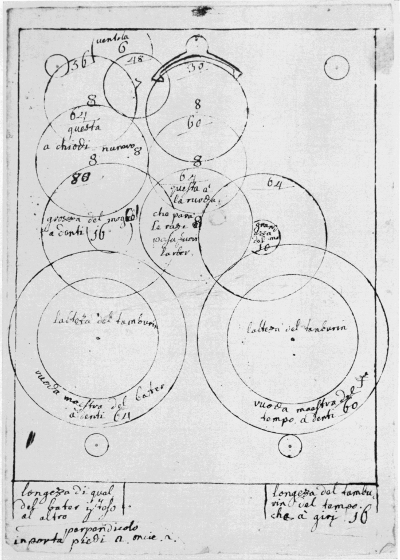
Figure 32.—Striking clock sketch found in Bertolla's manuscripts. (Courtesy of Museo Nazionale della Scienza e della Tecnica, Milan.)
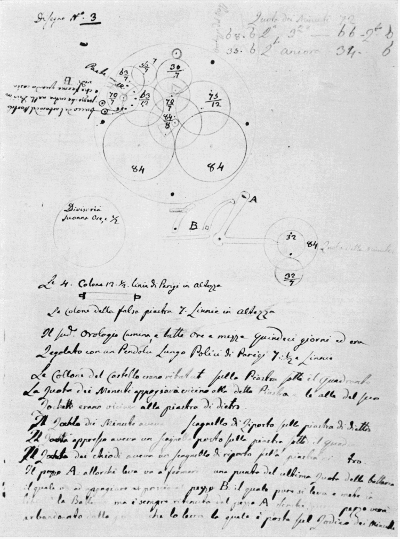
Figure 33.—Fifteen-day striking clock sketch, inscribed "Design No. 3," found in Bertolla's workshop. (Courtesy of Museo Nazionale della Scienza e della Tecnica, Milan.)
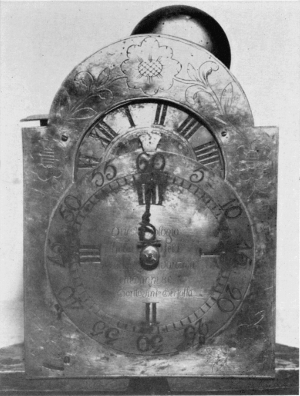
Figure 34.—Dial plate of a brass lantern clock made by Bertolla at the age of 80. (Courtesy of Museo Nazionale della Scienza e della Tecnica, Milan.)
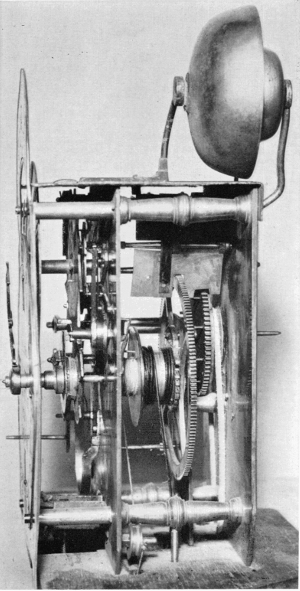
Figure 35.—Movement of brass lantern clock produced by Bertolla at the age of 80, showing details of movement and double bell. (Courtesy of Museo Nazionale della Scienza e della Tecnica, Milan.)
One of the most interesting of Bertolla's clocks, and probably the last one which he produced, was found in his workshop. This timepiece indicates the hours, minutes and quarters by means of a single hand or index. The weight-driven clock strikes the hours and quarters on two bells with a single hammer. The chapter ring, which is soldered to the dial plate, is marked for the minutes on the outer rim and for the four quarters inside it. Over the center of it, is a semicircular opening in the dial plate through which is visible a revolving disk attached behind the dial plate. This disk is marked with the hours and revolves from right to left, the current hour being indicated by a projection from the minute ring. The brass dial plate is engraved with simple floral designs in the corners and around the broken arch. There is no comparison between this crude and simple decoration and the extremely fine quality of the engraving on the dial plate of the Borghesi clock, for instance. In the center of the dial plate is engraved the following:
"Questo orologio l'ideai e lo feci nella mia avanzata età d'anni 80. Barto Anto Bertolla"
(I designed and made this clock at my advanced age of 80 years. Bartolomeo Antonio Bertolla.)
Appendix SYNOPSIS OF THE COMPLETE MECHANICAL WORKS OF THE FIRST CLOCK
[Translated from the section entitled "Synopsis Totius Operis Mechanici" in Francesco Borghesi's first book Novissima Ac Perpetua Astronomica Ephemeris Authomatica Theorico-Practica….]
I
Of three movable indices, the farthest from the center of the dial is fitted with an index on either side and marked with four segments of a circle. Immediately below are five numbers, divided into the days of setting the measure of the mean-synodic age of the moon, and into signs, degrees of the signs, and of the distance of the moon from the sun. These, in each revolution, revolve once around the solar disk superimposed on the mean synodic-lunar disk, and also around the lunar disk. The upper indices, meanwhile, in the two external greatest orbits, measure the time continuously, in the accustomed manner of the Germans—the middle index measuring by hours and the uppermost by the first minutes [of hours].
II
Inside these three circles, perpendicular above their center, is a small index of the seconds of minutes. At each first minute of time, being the fastest of all, it describes the smallest orbit. Next to this are two other slightly larger circles divided into 30 degrees, one [rotating?] from the right, the other from the left. These two indices are arranged in such a fashion that the one rotating from the observer's left completes its period 12 times during one, mean, solar-astronomical year. The one [rotating] from the right likewise completes its cycle 12 times during the period of one mean-synodic moon. In between these, there is placed another small sphere, divided into 40 arbitrary parts, whose dial does not move automatically, but is moved by hand for speeding up or slowing down the course of the time, or of the perpendicular.
III
Diagonally from the sides of the center of the three larger indices, six other indices revolve: three on the left from one center, and three on the right from another. The uppermost of the three which are on the right of the observer [and which are] decorated with a small disk of the sun, runs its cycle once during a mean solar-astronomical year. The second measures the distance of the sun from its apogee. The third revolves 12 times, with each lunar revolution from one node to the same [repeated] node. Under the point of the uppermost index, first lie the months of the year which are inscribed, and the days of each month, but having only 28 days assigned to February; then the signs of the zodiac, and their several degrees. The circle corresponding to the middle index, extending through the first semicircle from apogee to the lower perigee and returning through the second semicircle to the upper locations of apogee, shows the true equation or eccentricity of the sun, joined with the little equation of the moon in syzygy. [These equations are] measured by geometric-astronomic proportion for each distance of the sun from its apogee or perigee in degrees, and in sufficiently small parts of degrees, with the title added above in their proper places, whether an addition is to be made to the mean location of the sun or a subtraction from the same, so that the true longitude of the sun may be calculated. Three circles are assigned to the lowest index, of which 30 degrees of distance of the moon from its nodes comprise the larger. The middle circle is based on the hypothesis of the mean invariable diameters (that is, of the sun, the moon, and the terrestrial shadow), and is divided into hours and quarters of duration. The last circle is divided by the trigonometric laws into the inches of magnitude of lunar eclipses. Lying between these circles, there is another eccentric circle (black with a spot) exhibiting the shadow of the earth, in which the little moon sinks itself, carried by the lowest index. In any ecliptic full moons, the patent number of inches of immersion somehow affects the minds of the cultured, but also the scheme of maximum obscuration affects the eyes of the illiterate themselves.
IV
Of the three indices which revolve from the left, the uppermost completes its cycle within 12 hours, just as the hour index. The middle one with two pointers on diametrically opposite sides, carries the marks of conjunction and opposition of the luminous bodies, with a movement equal to the course of the sun from lunar apogee or perigee. The lowest index, fitted with a single pointer, indicates the motion of the moon from its apogee or perigee. Under these three indices, there is situated a common circle, divided into 12 parts, each of which are further divided into 30 parts through its outer circumference. I have said a common circle, for, with respect to the first index, the division represents 12 hours, and the double subdivision representing the double set of minutes of the hours serves for an excitator for anytime at all, at will. For as often as the little index reaches the twelfth hour, first being moved by hand wherever you prefer, a little hammer strikes the little bell many times. But if you observe the second or the third index, the first division provides the signs, and the subdivision of the signs gives the individual degrees of the distance of the sun from the lunar apogee, or of the moon from its apogee, respectively. To this is added two other interior circles from the same center: to the larger is inserted the equation of the center of the moon in its conjunctions and oppositions; and on the smaller the equation of the same moon in its quarters, astronomically-geometrically proportioned to the distance of the moon from its apogee or perigee. In the first case, the equation is to be subtracted from the mean longitude of the moon, descending from apogee to perigee; in the second case, to be added to the mean longitude of the moon ascending from perigee to apogee; and, in the third semicircle of the index, as the rubric directs, common to both equations, added around the center.
V
Perpendicularly under the center of the machine, two other indices are carried about one and the same center. The one nearer to the observer—bearing in one of two points diametrically opposite the small disk of the sun, in the other the disk of the moon—runs a course equal to the motion of the sun from the head or the tail of the dragon (Draco). The other, of simple construction, marked with a small moon, signifies in like manner the motion of the moon from the head or the tail of the dragon.
Immediately below, there is a larger circle, common [referring] to both these indices, which is divided into 12 parts. Each of these parts in turn, in the outer periphery, is subdivided further into 30 parts, which are the 12 signs of the zodiac and the individual degrees of the signs of distance of the sun and the moon from the head of the dragon.
In the second circle is read the latitude of the moon, measured by degrees, etc., on a trigonometric scale, by signs and degrees of distance of the moon from its nodes, that is, from the head or tail of the dragon. When the second index is descending from the head of the dragon to the tail, the latitude will be to the north of the solar path; that is, the ecliptic. On the other hand, it will be south of the ecliptic when the same index is returning upward from the tail to the head of the dragon as advised by the title inscribed on the third circle.
Finally, on the fourth and last circle are seen more prime minutes of the circle for reducing the orbit of the moon to the ecliptic. That the true longitude of the moon may be obtained more accurately, these must be subtracted from the longitude of the moon already calculated in the first and third quadrant of the circle of the second index. On the other hand, they are to be added to the same in the second and fourth quadrant, as is noted in their respective places, according to the theory of right ascensions.
Here, then, [you have] as finally completed, delineation of the great index which was partially described before in this book.
From two points of that index which perpendicularly correspond to the center of these circles, a pair of compasses, by an unvaried aperture up to the circumference of the first larger circle, has marked off four segments of a circle. The two larger segments, equal among themselves, in one aperture refer to the sun, and the two smaller in the other, likewise equal, refer to the moon. The one pointer is for determining the solar eclipses; the other, for lunar. Both segments of each division, like little wings of the index, stretch to the extent of the degree of distance of the moon from its nodes, and to which that determined latitude corresponds. On one side, that latitude precisely equals the radii of the earth, the sun, and the moon, as the termini of solar eclipses; and, on the other side, precisely equals the radii of the earth's shadow and of the moon, as the confines of lunar eclipses. The apexes of the last index, diametrically limited [opposite], indicate the age of the moon, and its mean distance from the sun; one pointer, upon which the sun sits, measuring the mean days and degrees from the full moon; the other, on which the moon sits, measuring the mean days and degrees from the new moon.
VI
Besides the larger and smaller indices already mentioned, all [of which] revolve within the periphery of the three largest circles, six dials in this clock also revolve within the same circles which are to be seen through six openings of the frontispiece. The first of these, intended to indicate the phases of the moon by an unusual method (completely black, and decorated with the characters of the principal aspects of the moon) continually revolves interiorly around the center of the machine and at the new moon, it completely removes from sight the face of the moon through the round window. It continually recedes through the first half of the circle until, at the time of the full moon, it restores the moon, looking out with a full star. Soon again, too slow to be observed, it returns through the other half of the circle, so that in the next conjunction, the whole face of the moon may have a covering of darkness, once again to be removed.
The other dials are moved by spontaneous advances at stated times. The first of these shows, through a square opening, the day of the month; the second, through another opening, shows the current day of the week with the characters of the seven planets which, according to ancient superstition, preside over each day of the week (now, by a truer form of religion divided by the Church into ferias, etc.); that is, the sun, the moon, Mars, Mercury, Jupiter, Venus and Saturn, to which I have added the numbers of the ferias. These two little dials are advanced daily, by a sudden movement at midnight. The remaining three are changed automatically only once a year on the first of January.
The first of these dials contains five little cells, opening from a common window: in the first cell, at the edge of the dial, is found the dominical letter; in the second, the cycle of the sun; in the third, the character; in the fourth, the sign; and, in the fifth, the house of the planet dominating the year. The second dial shows the epacts, with the golden number. The third, and last of all, shows the Roman cycle.
Finally, as indicated by the epact and the dominical letter in an immovable table added outside, are the feastdays and other movable events of the year; that is, Easter, the four seasons, the Rogation Days, etc.
VII
But lest the various movements of the indices and the various beginnings of the divisions tend to cause some fatigue, the precaution has been taken, that all the indices by common law are moved from the top towards the right of the observer, and from thence all the arithmetic divisions of the circles take their beginning. And lest the multitude of different figures should deceive the eye, the larger divisions of the circles have been marked by Roman numbers, that is, by capital letters of the alphabet; others, in other places, by differently colored numbers. Thus, the movements of the indices, the distribution of the circles and the multitude of numbers not only do not disturb the eyes and the mind, but rather marvelously delight them.
VIII
After having completed briefly the description of the dial and the indices and their motions, I have not without reason delayed in satisfying the desires of many who wish to learn at least the method by which, from this mechanism, may be calculated the true times of new and full moons, and their ecliptics. In order to make these matters clearer, it is necessary that they be explained here at greater length.
With the indices, then, adjusted astronomically-geographically to the longitude of any given region, and to the mean time whether past, present or future, and assuming the clock to be in normal operation (as at present it has been for a whole year and more), then the moon will be in conjunction with the sun in the heavens. When the equations on the mechanism are examined, the sun and moon shall be found to be in the same degree of longitude, and in the same part of a degree. There will also be an ecliptic new moon that is in conjunction with a solar eclipse, or rather with a terrestrial eclipse. This will occur if, at that time, both apexes of the first index, located below the center of the clock, are hidden by the two segments of the circle extending from the center of the mechanism through the lowest index.
And the eclipse will be greater and greater and, consequently, visible in more regions of the earth, the more deeply the two pointers, indicating the distance of the sun from its apogee, are hidden in the center of the segments.
But whether the eclipse takes place in the head or in the tail of the dragon, or whether it is north or south, is indicated by the small disk of the sun attached to one of the two pointers hidden by the segments of the circle. If, at that time, the little disk shall be found in the head of the dragon inscribed on the plane of the dial, then the sun has been snatched from the earth and ingloriously entombed, as it were, in the huge jaw of the dragon. Then, … the heavens themselves will lend aid to the woeful pomp of the senseless funeral in full darkness by suddenly lighting the unhappy lamps of the fixed stars. However, if the little disk occupies the tail of the dragon on the mechanism, then the sun in the heavens also, as if freed from the toils of the immense dragon's tail, will emerge without difficulty.
The center of the eclipse will traverse the hemisphere of the earth north of the solar path, always nearer to the pole of the ecliptic, in proportion to the inclination of the disk to the north. On the other hand, if the little disk inclines to the left semicircle, then the people south of the solar path will enjoy the spectacle of the total central eclipse.
But if the little disk remains neutral (inclining neither way) and remains halfway between the two sections of the circle, then the greatest solar eclipse will take place at the equator and those who live near the poles of the ecliptic will not enjoy a trace of that eclipse. This is because the half of the equatorial diameter enormously outmeasures even the greatest apparent semidiameters of the sun and of the moon, even taking as a norm the smallest horizontal parallax of the moon.
What has been said about the true new moon is to be understood also, proportionately, about the true full moon. For when, with respect to the equations of the centers, the moon shall be distant on the mechanism by a full semicircle from the sun (also in the heavens it will be truly in opposition to the sun) there will be a true full moon. Likewise, the moon in the heavens will be in eclipse if, at the time of opposition, the pointers of the little index (which we mentioned before) situated below the center of the clock are so far away from the belly of the dragon that they are forced to lie under the two smaller segments of the circle which, in all full moons, are always to be moved from the index of the synodic moon to the region of that little index. As a matter of fact, the closer the little pointers approach to the middle of the segments, the more obscured it will be.
You will know, furthermore, that the eclipse of the moon occurs in the head of the dragon if the disk of the little moon, attached to the other point of the little index, is raised to the head of the dragon; conversely, when the little disk of the moon inclines to the tail, the eclipse is taking place in the tail of the dragon.
And, accordingly, when you observe the little moon of the index inclined to one or other section of the circle, so also in the heavens, the eclipse of the moon is only partial and the northern or the southern part of the moon is illuminated.
The current time will indicate whether the lunar eclipse is visible or not. As the new moon ecliptic falls during the day, the eclipse will not be visible, since the earth denies a sight of the moon which is below the horizon. But, conversely, if there are no clouds, the eclipse will be visible anywhere, if the luminous bodies are ecliptically in opposition at night.
Since lunar eclipses appear to all people as being of the same magnitude and duration, and begin and dissipate at the same absolute moment of time, I decided to reveal another facet of this spectacle on the right side of the center of the clock (see chapter III above). There, at the time of the true ecliptic full moon, as the pointer of the third little index shows, you can ascertain the hours, etc., of duration, and the inches of greatest obscuration. The little moon attached to the index is a model of the actual eclipsed moon.
IX
Thus, with the aid of this machine, solar and lunar eclipses of the past can be recalled and future ones can be foreseen. Indeed, if the index of prime minutes is speeded up by hand, whose wheel imparts motion to the other indices and shields, then, the dials and openings will foretell the year, month, day, hour, etc., of any future eclipse. I foresaw that the times would thus be evolved too slowly, and that the clock wheels would be considerably worn by repeated experiments (if, for instance, by the rotation of the index of prime minutes, to whose period only a single hour corresponds, the future new and full moon ecliptics were being investigated). Therefore, I took care that the wheel which immediately communicates motion to the index of the synodic moon should be so fitted internally to the mechanism that by the reversal of any external index, the wheel would be removed from its proper position; whenever desired, it could be quickly and most accurately restored to its proper place.
In this way, since the close meshing of the wheels is released, you can extend the experiment for many years, even for many centuries. You have only to guide with your hand the index of the synodic moon on the circles, always intently observing whether, in the passage which this index makes over the little index, both pointers of the little index are hidden by the segments of the circle. Having observed this, look at the index moved by hand, for if this has carried the solar disk halfway between the two larger segments of the circle to the region of the hidden little index, then you will know that eclipse will be a solar eclipse. On the other hand, you will know that it will be a lunar eclipse, if the index (moved by hand) has carried the moon, situated between the two smaller segments of the circle, to the same region (i.e., the hidden part of the circle). The solar disk and the lunar disk alternately will reveal to you the circumstances of both eclipses. The current year will be given by the Julian period, reducible to any desired epoch, and, contained in the solar cycle, the golden number and the Roman cycle. The month of the year and also the day of the month will be indicated by the pointer of the little index, first on the right side of the clock. And what I have said of future eclipses should be equally understood of past eclipses, so long as the index, which can be moved either way at will, is moved in reverse.
Finally, though 55 wheels were employed to carry so many dials, all are driven by one source of power not exceeding the third part of a Germanic hundred-weight which, suspended at the geometric height of five feet (about the ordinary stature of a man), keeps the whole machine in operation for a hundred days and more.
Although the machine repeats hours and quarter hours at will and, consequently, the number of wheels and the rest of the apparatus necessary for these functions is thereby increased, it has not grown to an unwieldy size, however much one might erroneously imagine it to be. It does not exceed the bulk of ordinary clocks hanging from a wall; indeed, it scarcely equals these.
The entire machine, ready for operation, does not weigh more than 156 ounces, although it is made of steel or brass throughout and further weighted with two bells and a rather large brass dial-plate.
Of course, there are many more things to be said, especially about the mechanical structure of the wheels, but fearing to tire my kind reader unduly by exceeding the bounds of a summary, I am forced to put an end, though unwillingly, to this sufficiently shortened explanation of the work. I have hope of giving satisfaction to many more when I shall have communicated to the learned world another and completely new automatic work, grander than this present one. It is already theoretically completed in all its calculations, but still to be worked out mechanically from the very beginning, if but God, thrice Best and Greatest, bless the undertaking and mercifully grant life and health—to whom be in, and from, and through all things, all honor and glory in eternity and beyond.
BIBLIOGRAPHY
The following works have been used in compiling the material for this paper. They are frequently referred to in the text in shortened form.
Ambrosi, Francesco. Scrittori ed artisti Trentini. Trent: Giovanni Zippel, 1883.
Bonomi, L. Naturalisti, medici e tecnici Trentini. Trent: privately printed, 1930.
Borghesi, Francesco. Novissima ac Perpetua Astronomica Ephemeris Authomatica Theorico-Practica. Trent: Giovanni Battista Monauni, 1763(?).
—— Novissimum Theorico-Practicum Astronomicum Authoma Juxta Pariter Novissimum Mundi Systema. Trent: Giovanni Battista Monauni, 1764.
Engelmann, Max. Philipp Matthäus Hahn. Berlin: Verlag Fischer, 1923.
Esposti, Alfredo degli. La sala 'Innocente Binda' al Museo della Scienza e della Tecnica di Milano. La Clessidra (July 1960), anno 16, no. 7, pp. 18-21.
Franch, Leone. La Valle di Non. Trent, 1953.
Lloyd, H. Alan. Some outstanding clocks over seven hundred years, 1250-1950. London: Leonard Hill, 1958.
Mosna, Ezio. Trento. Trent, 1914.
Perini, Agostino (compilatore). Statistica del Trentino, Biblioteca Communale del Trentino. Vol. 2, p. 57 (cons. 6, carta 9).
Piamonte, Guiseppe. La nauna descritta al viaggiattore. Milan, 1829.
Pippa, Luigi. Antonio Bartolomeo Bertolla. La Clessidra (January 1961), anno 17, no. 1, pp. 22-25.
San Cajetano, David à. Praktische Anleitung für Künstler, alle astronomische Perioden durch brauchbare bisher noch nie gesehene ganz neue Räderwerke mit Leichtigkeit vom Himmel unabweichlich genau auszuführen, sammt Erweiterung der Theorie des neuen Rädergebäudes. Vienna: privately printed, 1793.
Tovazzi, Giangrisostomo. Biblioteca Tirolese. Vol. 2, art. 329, MS. 168, pp. 406-407. Trent, 1780.
Vischer, George F. Beschreibung mechanischer Kunstwerke, welche unter der Direktion und Anweisung M. Philipp Matth. Hahn, Pfarrers in Kornwestheim…. Stuttgart: Mezler, 1774.
Von Bertele, Hans. The development of equation clocks. La Suisse Horologere (1959-1961), parts 1 through 5.
Wenham, Edward. Tall case clocks. The Antiquarian Magazine (May 1927), vol. 8, no. 4, p. 33. [The Borghesi clock is illustrated only from a photograph of the Anderson Art Galleries in New York, and mislabeled "Astronomical Clock made in Jena, 1656, in elaborate mahogany case."]
Paper 35 - Transcriber's Note
Footnotes have been moved to the end of the main section of the paper, and illustrations have been moved to eliminate breaks in paragraphs. Minor punctuation errors have been corrected without note. The following typographical errors have been corrected:
p. 41 … Bertolla apparently wavered in … [Had 'waivered'.] p. 45 … Assidvo proni donant di cvncta labori. [Had 'ronip'.] Footnote 4: Philipp Matthäus Hahn [Had 'Matthaus'.]
Contributions from The Museum of History and Technology: Paper 36 The Engineering Contributions of Wendel Bollman
Robert M. Vogel
EARLY CAREER 80
THE BOLLMAN TRUSS 85
W. BOLLMAN AND COMPANY 91
FINAL USE OF THE BOLLMAN TRUSS 95
KNOWN BOLLMAN WORKS 99
BIBLIOGRAPHY 104
INDEX
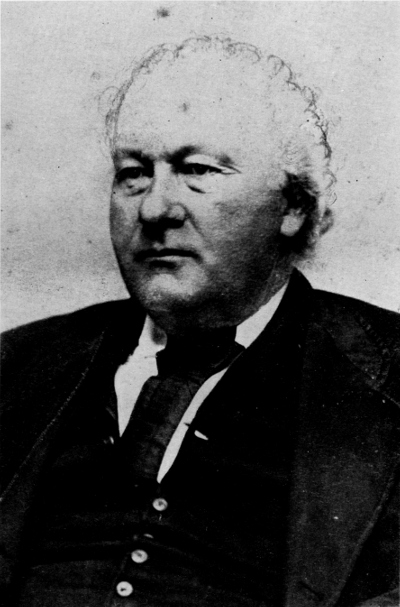
Figure 1.—Wendel Bollman, C.E. (1814-1884). (Photo courtesy of Dr. Stuart Christhilf.)
Robert M. Vogel
THE ENGINEERING CONTRIBUTIONS OF WENDEL BOLLMAN
The development of structural engineering has always been as dependent upon the availability of materials as upon the expansion of theoretical concepts. Perhaps the greatest single step in the history of civil engineering was the introduction of iron as a primary structural material in the 19th century; it quickly released the bridge and the building from the confines of a technology based upon the limited strength of masonry and wood.
Wendel Bollman, self-taught Baltimore civil engineer, was the first to evolve a system of bridging in iron to be consistently used on an American railroad, becoming one of the pioneers who ushered in the modern period of structural engineering.
The Author: Robert M. Vogel is curator of civil engineering in the Smithsonian Institution’s Museum of History and Technology.
Wendel Bollman’s name survives today solely in association with the Bollman truss, and even in this respect is known only to a few older civil and railroad engineers. The Bollman system of trussing, along with those of Whipple and Fink, may be said to have introduced the great age of the metal bridge, and thus, directly, the modern period of civil engineering.
Bollman’s bridge truss, of which the first example was built in 1850, has the very significant distinction of being the first bridging system in the world employing iron in all of its principal structural members that was used consistently on a railroad.
The importance of the transition from wood to iron as a structural and bridge building material is generally recognized, but it may be well to mention certain aspects of this change.
The tradition of masonry bridge construction never attained the great strength in this country which it held in Europe, despite a number of notable exceptions. There were several reasons for this. From the very beginning of colonization, capital was scarce, a condition that prevailed until well into the 19th century and which prohibited the use of masonry because of the extremely high costs of labor and transport. An even more important economic consideration was the rapidity with which it was necessary to extend the construction of railways during their pioneer years. Unlike the early English and European railways, which invariably traversed areas of dense population and industrial activity, and were thus assured of a significant financial return almost from the moment that the first rail was down, the Baltimore and Ohio and its contemporaries were launched upon an entirely different commercial prospect. Their principal business consisted not so much in along-the-line transactions as in haulage between principal terminals separated by great and largely desolate expanses. This meant that income was severely limited until the line was virtually complete from end to end, and it meant that commencement of return upon the initial investment was entirely dependent upon the speed of survey, graduation, tunneling, and bridging.
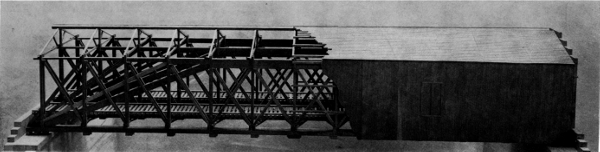
Figure 2.—Model of B. H. Latrobe’s truss, built in 1838, over the Patapsco River at Elysville (now Daniels), Maryland. (Photo courtesy of Baltimore and Ohio Railroad.)
The need for speed, the general attenuation of capital, and the simple fact that all the early railroads traversed thickly forested areas rendered wood the most logical material for bridge and other construction, both temporary and permanent.
The use of wood as a bridge material did not, of course, originate with the railroads, or, for that matter, in this country. The heavily wooded European countries—Switzerland in particular—had a strong tradition of bridge construction in timber from the Renaissance on, and naturally a certain amount of this technique found its way to the New World with the colonials and immigrants.
America’s highway system was meager until about the time the railroad age itself was beginning. However, by 1812 there were, along the eastern seaboard, a number of fine timber bridges of truly remarkable structural sophistication and workmanship.
It was just previous to the advent of the railroads that the erection of highway bridges in this country began to pass from an art to a science. And an art it had been in the hands of the group of skilled but unschooled master carpenters and masons who built largely from an intuitive sense of proportion, stress, and the general “fitness of things.” It passed into an exact science under the guidance of a small number of men trained at first in the scientific and technical schools of Europe, and, after about 1820, in the few institutions then established in America that offered technical instruction.
The increasing number of trained engineers at first affected highway bridge construction not so much in the materials used but in the way they were assembled. In a bridge designed by a self-taught constructor, the cheapness of wood made it entirely feasible to proportion the members by enlarging them to the point where there could be no question as to their structural adequacy. The trained engineer, on the other hand, could design from the standpoint of determining the entire load and then proportioning each element according to the increment of stress upon it and to the unit capacity of the material.
By the time railroads had started expanding to the West there had been sufficient experience with the half dozen practical timber truss systems by then evolved, that there was little difficulty in translating them into bridges capable of supporting the initial light rail traffic.
In spite of its inherent shortcomings, wood was so adaptable that it met almost perfectly the needs of the railroads during the early decades of their intense expansion, and, in fact, still finds limited use in the Northwest.
Early Career
Wendel Bollman was born in Baltimore of German parents in 1814. His father was a baker, who in the same year had aided in the city’s defense against the British. Wendel’s education, until about the age of 11, was more or less conventionally gained in public and private schools in Baltimore. He then entered into informal apprenticeship, first to an apothecary in Sheperdstown, Virginia (now West Virginia), and then to one in Harpers Ferry. In 1826 or 1827 he became ill and returned to Baltimore for cure. From that time on his education was entirely self-acquired.

Figure 3.—Trussed beam.
It is of interest, in light of his later career, to note that on the Fourth of July 1828, he marched with other boys in a procession that was part of the Baltimore and Ohio Railroad’s cornerstone-laying ceremony. Shortly afterward, he apprenticed himself to a carpenter for a brief time, but when the work slacked off he obtained work with the B. & O. The right-of-way had been graded for about five miles by that time, but no rail was down. The boy was at first given manual work, but soon advanced to rodman and rapidly rose as he gained facility with the surveying apparatus. In the fall of 1829 he participated in laying the first track. As his mother was anxious that he continue his education in carpentry, he left the railroad in the spring of 1830 to again enter apprenticeship. He finished, became a journeyman, helped build a planter’s mansion in Natchez, and returned to Baltimore in 1837 to commence his own carpentry business. The next year, while building a house in Harpers Ferry, he was asked to rejoin the B. & O. to rebuild parts of its large timber bridge over the Potomac there, which had fallen victim to various defects after about a year’s use.
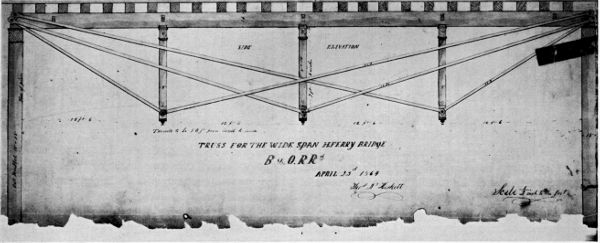
Figure 4.—Simple beam of 50-foot span with three independent trussing systems. Bollman’s use of this method of support led to the development of his bridge truss. This drawing is of a temporary span used after the timber bridge at Harpers Ferry was destroyed during the Civil War. (In Baltimore and Ohio Collection, Museum of History and Technology.)
Shortly after the Harpers Ferry bridge reconstruction, Bollman was made foreman of bridges. It is apparent that, on the basis of his practical ability, enhanced by the theoretical knowledge gained by intense self-study, he eventually came to assist Chief Engineer Benjamin H. Latrobe in bridge design. He later took this work over entirely as Latrobe’s attentions and talents were demanded in the location and extension of the line between Cumberland and Wheeling.
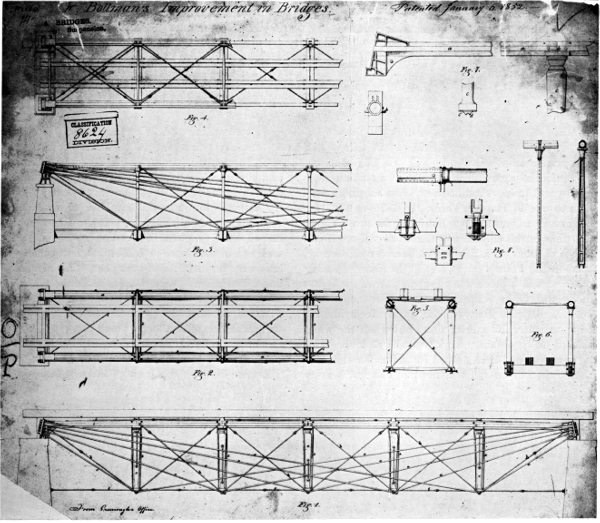
Figure 5.—Bollman’s original patent drawing, 1851. (In National Archives, Washington, D.C.)
The B. & O. did not reach its logical destination, Ohio (actually Wheeling, West Virginia, on the east bank of the Ohio River) until 1853. In the years following Bollman’s return to the railroad, the design of bridges was an occupation of the engineering staff second in importance only to the location of the line itself. During this time Bollman continued to rise and assume greater responsibilities, being appointed master of road by Latrobe in 1848. In this position he was responsible for all railroad property that did not move, principally the right-of-way and its structures, including, of course, bridges.
The recognition of Bollman’s abilities was in the well-established tradition of the B. & O., long known as America’s first “school of engineering,” having sponsored many early experiments in motive power, trackwork, and other fundamental elements of railroad engineering. It furnished the means of expression for such men as Knight, Wright, Whistler, Latrobe, and Winans.
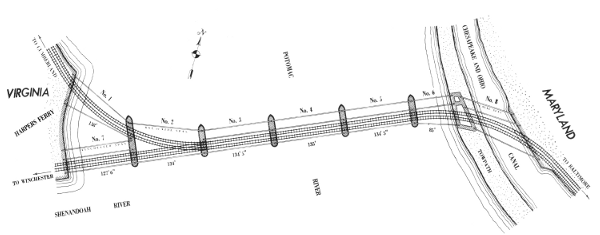
Figure 6.—Plan of Harpers Ferry bridge as built by Latrobe. The second Winchester track was later removed.
Of these pioneer civil and mechanical engineers, some were formally trained but most were self-taught. Bollman’s career on the B. & O. is of particular interest not only because he was perhaps the most successful of the latter class but because he was probably also the last. He may be said to be a true representative of the transitional period between intuitive and exact engineering. Actually, his designing was a composite of the two methods. While making consistent use of mathematical analysis, he was at the same time more or less dependent upon empirical methods. For years, B. & O. employees told stories of his sessions in the tin shop of the railroad’s main repair facility at Mount Clair in Baltimore, where he built models of bridges from scraps of metal and then tested them to destruction to locate weaknesses. It seems most likely, however, that the empirical studies were used solely as checks against the mathematical.
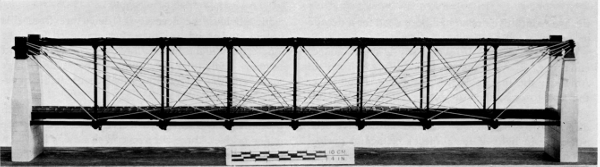
Figure 7.—Recent model of Bollman’s Winchester span. Only two of the three lines of trussing are shown. The model is based on Bollman’s published description and drawings of the structure. (USNM 318171; Smithsonian photo 46941.)
In the period when Bollman began designing—about 1840—there were fewer than ten men in the country designing bridges by scientifically correct analytical methods, Whipple and Roebling the most notable of this group. By 1884, the year of Bollman’s death, the age of intuitive design had been dead for a decade or longer.
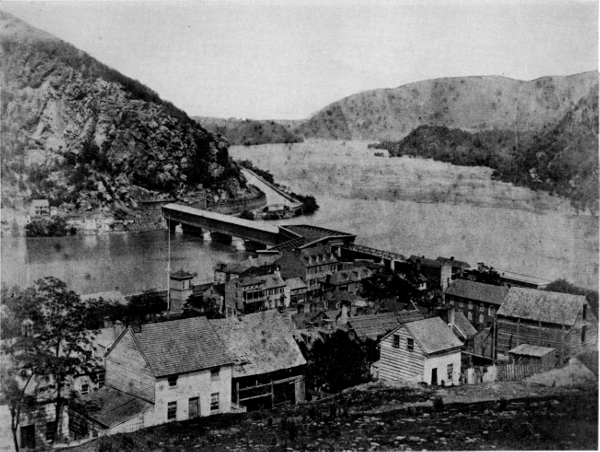
Figure 8.—The Baltimore and Ohio Railroad’s Potomac River crossing at Harpers Ferry, about 1860. Bollman’s iron “Winchester span” of 1851 is seen at the right end of Latrobe’s timber structure of 1836, which forms the body of the bridge. (Photo courtesy of Harpers Ferry National Historical Park.)
The B. & O. was in every way a truly pioneer enterprise. It was the first practical railroad in America; the first to use an American locomotive; the first to cross the Alleghenies. The spirit of innovation had been encouraged by the railroad’s directors from the outset. It could hardly have been otherwise in light of the project’s elemental daring.
The first few major bridges beyond the line’s starting point on Pratt Street, in Baltimore, were of rather elaborate masonry, but this may be explained by the projectors’ consciousness of the railroad’s significance and their desire for permanence. However, the aforementioned economic factors shortly made obvious the necessity of departure from this system, and wood was thereafter employed for most long spans on the line as far as Harpers Ferry and beyond. Only the most minor culverts and short spans, and those only in locations near suitable quarries, were built of stone.
In addition to the economic considerations which prompted the company to revert to timber for the major bridges, there were several situations in which masonry construction was unsuitable for practical reasons. If stone arches were used in locations where the grade of the line was a relatively short distance above the surface of the stream to be crossed, a number of short arches would have been necessary to avoid a very flat single arch. In arch construction, the smaller the segment of a circle represented by the arch (that is, the flatter the arch), the greater the stress in the arch ring and the resulting horizontal thrust on the abutments.
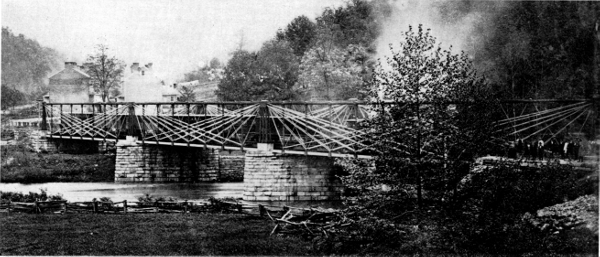
Figure 9.—Bollman skew bridge at Elysville (now Daniels), Maryland, built in 1853-1854. (Photo courtesy of Maryland Historical Society.)
The piers for the numerous arches necessary to permit an optimum amount of rise relative to the span would have presented a dangerous restriction to stream flow in time of flood. By the use of timber trusses such crossings could be made in one or two spans with, at the most, one pier in the stream, thus avoiding the problem.
The principal timber bridges as far west as Cumberland were of Latrobe’s design. These were good, solid structures of composite construction, in which a certain amount of cast iron was used in joints and wrought iron for certain tension members. They were, however, more empirical than efficient and, for the most part, not only grossly overdesigned but of decidedly difficult fabrication and construction.
What is interesting about the Latrobian timber trusses, however, is the effect they appear to have had upon Bollman’s subsequent work in the design of his own truss. This effect is evidenced by the marked analogy between the primary structural elements of the two types. The Latrobe truss at Elysville (fig. 2) was only partially a truss, inasmuch as the greater part of the load was not carried from panel to panel, finally to appear at the abutments as a pure vertical reaction, but was carried from each panel (except the four at the center) directly to the bearing points at the piers by heavy diagonal struts, after the fashion of the famous 18th-century Swiss trusses of the Grubenmanns. It was a legitimate structural device, and the simplest means of extending the capacity of a spanning system. However, it was defective in that the struts applied considerable horizontal thrust to the abutments, requiring heavier masonry than would otherwise have been necessary.
It is quite likely that Latrobe did not have absolute confidence in the various pure truss systems already patented by Town, Long, and others, and preferred for such strategic service a structure in which the panel members acted more or less independently of one another. It will be seen that, similarly, the individual panel loads in Bollman’s truss were carried to the ends of the frame by members acting independently of one another.
The Bollman Truss
There had never been any question about the many serious inadequacies of wood as a bridge material. Decay and fire risk, always present, were the principal ones, involving continuous expenditure for replacement of defective members and for fire watches. It was, in fact, understood by the management and engineering staff of the B. & O. that their timber bridge superstructures, though considered the finest in the country, were more or less expedient and were eventually to be replaced. In this regard it is not surprising that Latrobe, a man of considerable foresight, had, at an early date, given serious thought to the possible application of iron here.
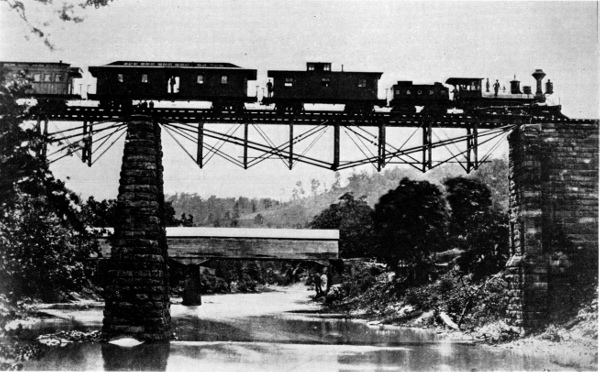
Figure 10.—Potomac River crossing of the Baltimore and Ohio at North Branch, Maryland, built in 1856. There are three Bollman deck trusses. (Photo courtesy of Baltimore and Ohio Railroad.)
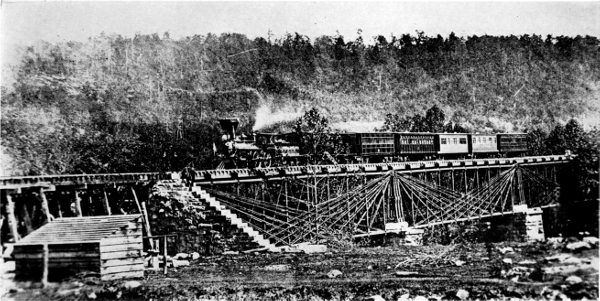
Figure 11.—The Fink truss. (Smithsonian photo 41436.)
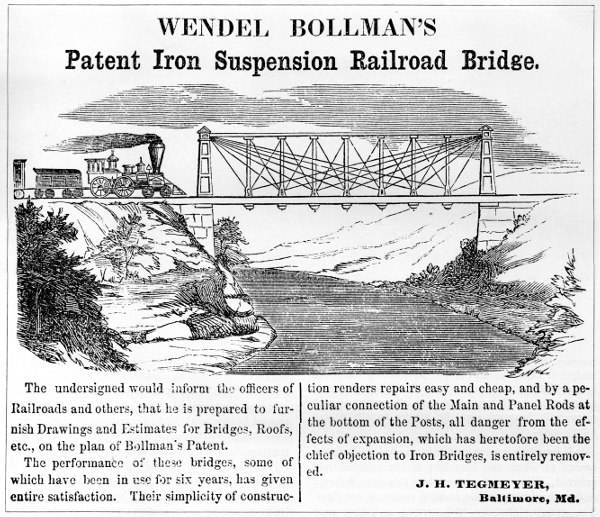
Figure 12.—Advertisement in the Railroad Advocate, August 1855. Click here to read transcription.
The world’s first major iron bridge, the famed cast-iron arch at Coalbrookdale, England, had been constructed in 1779. Its erection was followed by rather sporadic interest in this use of the material. The first significant use of iron in this country was in a series of small trussed highway arches erected by Squire Whipple over the Erie Canal in the early 1840’s, over 60 years later. In these, as in most of the earlier iron structures, an arch of cast iron was the primary support. The thrust of the arches was counteracted by open wrought-iron links with other wrought- and cast-iron members contributing to the truss action.
The Whipple bridges promoted a certain amount of interest in the material. In the B. & O.’s annual report for the fiscal year 1849 appears the first record of Latrobe’s interest in this important matter. In the president’s message is found the following, rather offhand, statement:
$6,183.19 have been expended toward the renewal of the Stone Bridges on the Washington Branch, carried off by the flood of Oct. 7th, 1847. Preparations are made and contracts entered into, for the reconstruction of the large Bridges at Little Patuxent and at Bladensburg which will be executed in a few months…. It is proposed to erect a superstructure of Iron upon stone abutments, at each place—with increased span, for greater security against future floods.