RENDERING LARD (Copyrighted; Reprint Forbidden.)
Reading edition
One of the things much neglected in many butcher shops is the making of Lard. Butchers who do not cut up enough hogs to have fat for making Lard each day, allow the fat to accumulate until they have sufficient so as to make it worth their while to render it. Many butchers do not keep this fat in the ice box, but let it stand anywhere, because they imagine that it does not spoil; then, when they make Lard out of it, they wonder why the Lard is not better.
Lard should always be made as soon as possible, and the fat trimmings should be kept in the cooler and not allowed to remain standing around in a warm place. To make high grade Kettle-Rendered Lard, always cut the rinds off of the fat. The rinds can be put into pickle and stored until a quantity has accumulated and then they can be cooked and utilized in Liver Sausage, Head Cheese or Blood Sausage. When the rind is cooked with the lard, it always causes more or less detriment to the lard.
Before rendering, if one has the machinery, the fat should be run through a regular fat hasher or a Meat Grinder, and it should be ground up into small pieces. The smaller it is ground the better, for if the fatty tissues are thoroughly mangled and disintegrated, the oil will separate more readily when the heat is applied. Those butchers not having a machine in which they can cut up the fat should cut it into small pieces by hand.
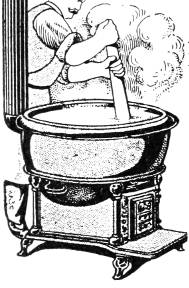
For making Kettle-Rendered Lard a steam jacket kettle is the best, but if one does not have steam, a common caldron will answer, but great care must be taken not to scorch the lard or allow it to become too hot when a caldron is used.