IF ONE HAS A LARD SETTLING TANK, AS HERE ILLUSTRATED, HANDLE THE LARD AS FOLLOWS: (Copyrighted; Reprint Forbidden.)
Reading edition
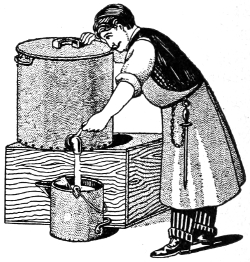
SETTLING TANK
After treating the Lard as directed, with Lard Purifier and water, and after the Lard has been treated enough to make it foam, and the foam has been skimmed off, dip the Lard and water out of the kettle, run it through a piece of cheese cloth into the settling tank. A settling tank is simply a galvanized iron tank with a large faucet at the bottom. The bottom can be made to taper to the center and the faucet placed in the center, so all the water can be drained off, or the bottom can be made flat with the faucet close to the bottom, and the tank can be set slanting, so the water or Lard will all drain out.
After the Lard is in the settling tank, let it settle for one or two hours, according to the size of the tank and quantity of Lard in it. Then drain off all the water and the impurities which have settled to the bottom. After these are drawn off, the Lard is ready to be run into buckets, which should be placed in the ice box to cool.
A better way is to let the Lard settle in the settling tank and, after the water is drawn off, stir the Lard with a large paddle until it is thick and creamy, and then it should be put into buckets. By letting it cool in the settling tank and stirring it until it is thick and creamy, Lard will have a much better appearance when cold than Lard that is run into buckets hot.