VII MAGIC AND TALISMANIC RINGS
Reading edition
From their close contact with the person as well as from their symbolic form, the significance of many designs engraved upon them, and the supposed virtues of stones set in them, some rings have enjoyed the repute of possessing magic powers, both in ancient and mediæval times, and even much later. In a number of cases, we can find some clue to the attribution of a special virtue to a magic ring; in other cases, however, the circumstances leading to this are no longer to be ascertained, and we must content ourselves with the fact that such and such a ring, or type of rings, has been thought to have such and such a mysterious influence.
No ancient talisman enjoyed a greater repute in mediæval legend than the “Ring of Solomon” or “Solomon’s Seal” as it was often called. An Arab legend tells that by means of the power inherent in his ring, the Hebrew King was able to succeed in all his undertakings. However, for the space of forty years he was deprived of its aid, as he once thoughtlessly took it off his hand when he was in the bath and it was carried away by a malevolent genius. At the end of the forty years it was found again in the body of a fish served on the monarch’s table. In Rabbinical legend this ring is said to have been set with a marvellous precious stone, perhaps a diamond, which served as a magic mirror wherein Solomon was able to see reflected the image of any distant place or of any persons in regard to whom he wished to be informed.[471]
A variant of the legend we have just given is found in another Arabian tradition, which recounts that Solomon was so much infatuated with a female prisoner, the daughter of a Gentile prince, and named Aminah, that he entrusted to her care his precious signet, given to him by the four angels that presided over the four elements. A mighty Jinn succeeded in gaining possession of the ring, and, by its power, assumed Solomon’s form, at the same time changing that unhappy monarch’s appearance to such an extent that his courtiers no longer recognized him, and drove him from his kingdom. However, one of Solomon’s ministers was shrewd enough to see through the disguise of the Jinn, and proceeded to exorcise the evil spirit by reciting certain verses of the Law. The Jinn fled affrighted, and dropped the ring into the sea. Here it was swallowed by a fish, and in due time this fish was caught by Solomon, who had entered the employ of a fisherman. Once again in possession of his ring, Solomon soon regained his kingdom.[472]
The great Persian poet Hafiz of Shiraz thus uses Solomon’s Seal to point a moral:[473]
Matters of beauty other there be, beside sweet speech, And Solomon-hood by a seal-ring alone is not begot.
The legend of the mystic ring of Gyges is related by Plato in his Republic.[474] According to this recital the ring was found under very extraordinary circumstances by “an ancester of Gyges the Lydian,” but the text seems to be corrupt, and Gyges himself was probably said to have been the finder. Gyges (or his ancestor) was at the time a shepherd in the service of the Lydian King. One day a violent storm occurred, followed by an earthquake which opened up a deep chasm in the earth, near the place where this shepherd was feeding his flock. Moved by curiosity, he descended into the chasm and saw therein a hollow, brazen horse, with openings at the sides; bending down and looking through these openings, he discerned within the horse the body of a man of immense size. A golden ring glittered on the finger of the corpse. This the shepherd removed, and climbing out of the chasm, straightway took his departure. When, a few days later, all the shepherds assembled to prepare their monthly reports to the king, the man who had found the ring was of their number. As he sat with the others he carelessly turned and twisted the ring which he had placed on his finger, until, by chance, he turned the bezel toward the inside of his hand. Immediately he became invisible, and heard the other shepherds talking of him as though he were absent; but when he turned the ring around again, so that the bezel was outside, he reappeared. He repeated this experiment several times until he had assured himself of the strange virtue of the ring. Realizing then the extraordinary opportunities that this power afforded him, the shepherd asked and obtained the privilege of bearing the reports to the king, and soon found means to seduce the queen, and, by her aid, to slay the king and gain possession of the kingdom.
Although the legend does not expressly state that the ring was set with a stone, the use of the term “bezel” (σφενδόνη) suggests that some precious stone was the seat of the magic power the ring possessed. The traditions current at a later period with regard to the opal, which was reputed to render the wearer invisible, make it not improbable that, in the original legend, the ring of Gyges was represented to have been set with an opal, or rather perhaps with one of the rainbow-hued specimens of iridescent quartz. Plato may well have omitted this detail, for he was making a didactic use of the story and would naturally treat his material very freely.
An old author conjectures that the stone set in the ring of Gyges was a serpent-stone from India. In that land brilliant and exceedingly beautiful stones were said to be found in the heads of certain crested snakes that abode in the mountains. If such a stone were set in a gold or silver ring, at the time when the planetary or stellar control of the stone was in the ascendant, the wearer of the ring was sure to have the fullest possible benefit from its powers.[475] The idea that serpents were endowed with supernatural wisdom was held by many ancient peoples, and in India legend assigned to these mysterious and dreaded reptiles the guardianship over diamonds, and also over the corundum gems, chief among which are the fair sapphire and the glowing ruby.
The gold ring of Minos, King of Crete, although of course purely mythical, is usually ranked among the magic rings. It is said to have been used by the Cretan, who claimed Jupiter as his father, to test whether Neptune were really the father of Theseus. Taking his ring off his finger, Minos cast it into the sea, and commanded Theseus to bring it back to him, if the latter wished people to believe Neptune to be his father. He himself, Minos, could easily furnish proof of his descent from Jove by praying for a celestial sign. This he did, and immediately a loud thunder-clap resounded in the heavens. Not to be outdone, Theseus, not even stopping to make any supplication, threw himself into the sea to seek the ring. On this, there appeared a multitude of dolphins, and Theseus was softly borne away to the Nereides, who gave him the ring so that he might restore it to Minos.[476]
The legendary ring of Helen of Troy is said to have borne as its setting an astroites or star-gem taken from the head of a mysterious fish called pan, because in appearance it resembled the god Pan. Perhaps the gem was simply one of the head-stones existing in certain fishes of other species. This stone, which emitted rays of flame, was conceived to be a most potent love-charm, drawing to its wearer the love of anyone he, or she, might wish to fascinate, and the particular specimen of this strange gem which Helen wore was a signet, engraved with the image of the god by whose name the fish was called.[477]
Among the rings miraculously found after they have apparently been irrevocably lost, was one of iron given to Seleucus I, Nicator (365–281 B.C.), whose wide dominions stretched from the western seaboard of Asia Minor to India. This prized ring was lost by chance near the river Euphrates, but was later recovered at the very spot where the ruler’s mother had predicted it would be found.[478] Whether this was revealed to her in dream or trance the recital does not state.[479]
A talismanic bronze ring in the British Museum is set with an amethyst on which has been engraved a human eye, evidently a charm against the Evil Eye. This dread influence was also combated by a peculiar type of ring having gold nails or studs inserted in them. This is a Græco-Roman type of about 500 to 200 B.C., and does not appear to have gained favor with the Romans. In a large and massive gold ring of the late Roman period, the entire bezel has been given the form of an eye. This ring weighs 975 grains, or over two ounces; it was found in Tarsus, and belongs to the third Christian century.[480]
In a few ancient rings gold and silver have been combined, as shown by a striking example in the British Museum, where the upper part of the hoop is of gold and the lower half of silver. This has been conjectured to have been designed to render the ring a talisman, the joining of gold and silver having a similar effect to that obtained by inserting a gold nail in the bezel of a silver ring. The bezel of the massive ring we have noted is set with a sard engraved in intaglio with the design of a shepherd seated on a rock.[481]
The wearing, at certain religious ceremonies, of a ring set with a gem on which was engraved a design having some fancied connection with the ceremony, appears not to have been uncommon in the Roman world. An instance of this is given by the historian Suetonius, who states that when Nero was about to take the auspices (the bird-augury), Sporus gave him a ring the gem of which represented the carrying off of Proserpina, goddess of the infernal regions.[482] The finding of a ring with a particular design was also looked upon as a harbinger of good fortune. Shortly after the choice of Galba as emperor (68 A.D.), there was found in building the fortifications of a city, on the spot the emperor had selected for a military exercising ground, a ring of antique workmanship engraved with the figure of a Victory with a trophy. This was accepted as a happy presage.[483]
Josephus tells us of a magic ring which was used by a Jew named Eleazar. In the presence of the emperor Vespasian, of his son, and of his court, this man cured those suffering from demoniacal possession. His method was to introduce into the nose of the patient a ring having beneath its device an herb designated by Solomon. The evil spirit was attracted by the odor of the herb and immediately passed out of the man’s body. After this Eleazar exorcised it by chanting certain “psalms of Solomon.” Furthermore, in order to convince the spectators of the presence of the evil spirit, he used to place on the ground a vase filled with water, and command the demon to upset it. As the text of Josephus indicates that this experiment was successful, Eleazer must have had recourse to some clever deception in the matter.[484] This tale shows that rings somewhat similar to those described in the Cyrianides (a work written in Alexandria about the third or fourth century of our era) were used in the first century. It is true that Josephus does not say that the ring was set with a stone, but merely states that it bore a device.
The god Mercury was popularly regarded as a bestower of magic rings, to judge from the words Lucian, the greatest humorist of ancient times, puts into the mouth of one of his characters. Timolaus, in “The Ship,” expresses the wish that Mercury would grant him a number of wonder-working rings; one of these should preserve his health and protect him from wounds and other injuries; another should make him invisible as did the ring of Gyges; a third should give him the strength of ten thousand men; a fourth was to give him the power to fly through the air, and a fifth, the power to sleep at will, and the privilege of seeing all doors open before him. The crowning gift, however, would be a ring possessing the virtue of attracting the love of all fair women, and the affection and respect of his fellow men.[485] We might infer from this that rings engraved with the figure of Mercury were supposed to be especially propitious; very possibly the story of the magic rings of Apollonius of Tyana, later embodied in the life of this strange personality written by Philostratus, was known to Lucian, and suggested this description of the various and wonderful powers inherent in rings of this kind.
The same author mentions a magic ring used to frighten away ghosts.[486] This was made, by an Arab, out of an iron nail from a cross, and the virtue ascribed to it recalls that attributed to a piece of wood from a gallows. In each case an object that was associated with a violent and ignominious death was believed to have the power of exorcising unwelcome visitants from the grave.
The Church father Clemens Alexandrinus, born about 150 A.D., says, giving Aristotle as his authority, that a certain Execestus, a tyrant of Phocis, owned and wore two magic rings, and by means of the stones set in these rings he had knowledge of future events. They seem to have done him but little service, however, for he met his death by assassination, although it is stated that the gems gave him warning of this.[487]
Flavius Philostratus, who flourished under Septimius Severus (193–211 A.D.) and later, wrote at the request of the Empress Julia Domna, a remarkable life of Apollonius of Tyana in which he laid special stress upon the miracles ascribed to this pagan saint. The work was used later to oppose the teachings of the Christians. Here we read that Apollonius possessed seven enchanted rings corresponding to the seven planets, the gift of the Hindu prince Iarchas. These he wore, one by one, in the order of the week days; “for it is said that he revered them as divine, so that he changed them each day and made them partakers of his greatest secrets.”[488]
The Leyden Papyrus (No. V), of the third century of our era, contains a number of directions, in Greek and Demotic Egyptian, for the preparation of amulets and talismans, and gives two formulas for the making of magic rings. The text of one is defective in part, but can be rendered as follows:[489]
“A ring for constant use and for prosperity ... very efficacious for kings and emperors. Take an azure jasper, engrave on it a dragon in the form of a circle, the tail in the mouth, and in the midst of the dragon (an animal) having two stars on its two horns, and the sun above (with the name) Abrasax, and place as an inscription upon the stone the same name, Abrasax, and on the ... engrave the great and supreme appelation, Iao Sabaoth. Wear the stone in a gold ring. May it be always useful for you, existing pure and ... for whatever you may desire. Consecrate the ring and the gem which projects above it. The design upon the gold, which has been described above, has the same virtue.”
The names Abrasax and Iao Sabaoth indicate that this ring was probably designed to be a talisman for adherents of the Marcian form of Gnosticism.
A second formula runs thus:
“Ring to obtain (a wish) a favor and success; it renders glorious, great, admirable and rich; it insures love. It is proper and excellent to be worn on all occasions, this incomparable ring. It bears the wonderful name of the sun, cut in a heliotrope, and is fashioned as follows: A complete serpent, like a circle, holding its tail in its mouth; on the inside is a scarab, sacred and radiant. As to the name, thou shalt engrave this in sacred characters on the reverse side of the gem, as is taught by the prophets, and thou shalt wear the ring in all purity. Having it with thee, all thy wishes will be fulfilled; the hatred of kings and emperors toward thee will be appeased; when thou wearest it all that thou sayest to others will be believed, all will favor thee, all doors will be open to thee. Thou wilt rend the bonds and break the stone-walls, if thou takest out the stone, that is the gem, and pronouncest the name inscribed beneath it. This ring is equally useful for demoniacs, give it to them, and on the instant the demon will flee.”
Dreams of rings set with precious stones have a special significance, and Achametis tells us, from his Hindu sources, that if anyone should dream of receiving a ring set with a red stone, the splendor of the stone signified great authority and much joy to the dreamer. If, however, a man had a dream of a ring set with a yellow stone, the vision portended that his wife would be liable to illness and chagrin.[490]
An Anglo-Saxon dream-book from the time before the Norman Conquest, gives the significance of various dreams about rings. Thus, for example, merely to see a ring betokened a desired place; should one dream of receiving a ring as a gift, however, this denoted freedom from care. If the dreamer fancied himself to be the owner of a gold ring, this indicated that great honor was going to be his portion. Lastly, the dream that a gem had been lost from a ring was a very bad omen and portended some serious accident.[491]
Three subjects of the Eastern Emperor Valens (364–378 A.D.), believing that he had incurred the public hatred to such a degree that he would soon perish at the hands of his enemies, sought the aid of the diviners Hilarius and Patricius to learn what would be his fate and who would succeed him. The diviners, having engraved around the edge of a basin the characters of the Greek alphabet, suspended above it an enchanted ring, which, by its vibrations marked in turn the letters that composed the words of the response of the oracle. It was conceived in the following terms: “The successor of Valens will be an accomplished prince. The curiosity of those who have consulted the oracle will be destruction to them, but their murderers will themselves incur the vengeance of the Gods.” As the oracle had failed to designate the prince clearly, the inquirers demanded his name. Thereupon the ring struck successively at the letters T. H. E. O. D., and one of those present exclaimed that the Gods named Theodore. The others all accepted this view and the matter appeared so evident that no further attempt at research was made.[492]
A curious type of magic ring is vouched for by St. Augustine, in the fourth century, who notes as a superstitious practice the wearing of a ring (or “fingerband” ansula) made from the bone of an ostrich.[493] Whether the attribution of a magic quality resulted from the rarity of the bird for the Romans, or from some analogy with its habits, is left to our imagination to determine.
A talismanic ring of the late Roman times, about the fifth century A.D., was found by Lieut. Scheibel, in 1896, embedded in sand that had been dredged from the bed of the Save River, near Vincovce, Slavonia, Austria. The hoop is divided by ridges into eleven compartments in which are engraved the Greek letters Ζ Η ΓΑΙΣ ΑΡΙΩΝ (equivalent to “Long live Arion”). This ring is in the Albert Figdor Collection, Vienna.[494]
Among the legends which gathered about the personality of Charlemagne, none is more interesting than that which tells of a precious stone which exercised a magic power over him. This legend is of German origin and probably localized in Aix-la-Chapelle; it does not appear in any of the numerous French chansons de geste treating of Charlemagne and his times. It seems to have originated about the thirteenth century, although it may have been current at an earlier date, and we have two principle versions, one given by Brandwaldius,[495] and the other by Petrarch.
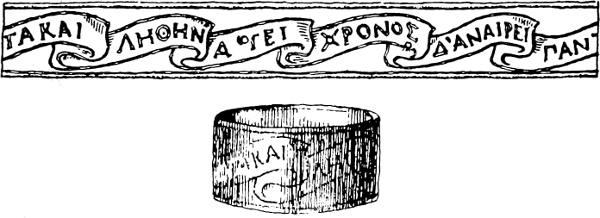
Silver-gilt ring with Greek inscription ΧΡΟΝΟΣ Δ’ΑΝΑΙΡΕΙ ΠΑΝΤΑ ΚΑΙ ΩΗΘΗΝ ΑΓΕΙ (Time removes all things and brings forgetfulness). In the interior a sun-dial. Sixteenth Century
Albert Figdor Collection, Vienna
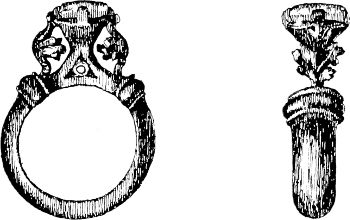
Ring of gilt bronze, set with a square table-cut rock crystal
Albert Figdor Collection, Vienna
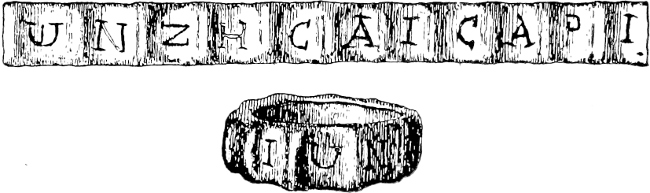
Gold ring. The hoop has eleven ridges between which are the Greek letters ZΗΣΑΙΣ ΑΡΙΩΝ (Long live Arion). Found by Lieutenant Scheibel, in 1896, in sand dredged from the bed of Save River, near Vincovce, Slavonia, Austria. Late Roman, about Fifth Century
Albert Figdor Collection, Vienna
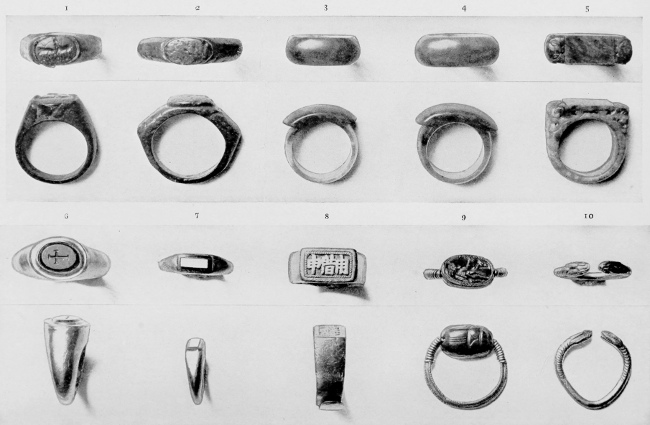
1, copper ring, with glass paste. First Century A.D. Syria. 2, bronze ring, shape of finger. Found in grave in Syria. First Century A.D. 3, 4, jadeite finger rings. Body of the ring pale white jade; top, intense emerald green. Chinese, Twentieth Century. 5, Chinese signet ring, made of Burmese jadeite. Top, intense green; sides, pale green. Twentieth Century. 6, antique Christian hollow ring of fine gold with Greek Cross engraved on garnet. Second Century A.D. 7, antique ring of fine gold with Nicolo. Black band surrounding white oblong. 8, Chinese ring of fine gold, with motto. Shank of ring is in two parts, all fine gold, so they can be made to fit any finger. 9, ancient Greek ring of twisted gold. Sard engraved with figure of man. 10, ring of Egyptian gold, carved. Second Century B.C.
The first-named version describes the acquisition of the stone in much the same terms as are employed in the story from the Gesta Romanorum regarding the stone brought by a serpent to the blind Theodosius;[496] indeed, the resemblance is so close that one of these tales must be derived from the other. Here also the serpent rings a bell outside the palace gates, and finally succeeds in obtaining justice against a toad which has secured possession of its nest. Grateful for this service, the serpent appears before Charlemagne, when he is seated at meat, crawls up on the table and, lifting the cover of a beaker, drops therein a precious stone. From this point we have the specifically Carolingian legend. The stone possessed a strange, hidden power, by means of which it attracted the affections of the first owner to any one who subsequently acquired it. Charlemagne gave it to his wife and immediately all his thoughts became centered in her. Naturally enough she in no wise objected to this, but when she was taken dangerously ill she could not endure the thought that some other woman should acquire the stone, and take her place in Charlemagne’s heart; therefore, when at the point of death, she slipped it beneath her tongue and soon thereafter expired. The power of the charm over Charlemagne’s mind was so great that after his wife’s body had been interred he caused it to be exhumed, and spent his days and nights with it. This state of things continued for no less than eighteen years, until, finally, one of Charlemagne’s ministers discovered the cause of the enchantment and removed the stone from beneath the tongue of the corpse. Instantly the spell was broken, but all the emperor’s regard was now directed toward his minister, whose presence became indispensable to him. Marking this, and fearing that the gem might fall into unworthy hands, the minister threw it into a spring, which chanced to be that of Aix-la-Chapelle. Even here the stone did not lose its power, and the place became the favorite resort of Charlemagne, who established himself there and built a church and a palace near the resting place of the charmed stone.
A somewhat different version of this tale is given by Petrarch,[497] who states that he had it from the priests of Aix-la-Chapelle. There is here no mention of a serpent bringing a stone, and the object of Charlemagne’s love is not his wife but a woman who possesses a magic ring. The emperor is so thoroughly infatuated that when she dies he has the body decked out with gorgeous apparel, adorns it with precious stones and refuses to leave it. Anxious to relieve his sovereign from this obsession, the Bishop of Cologne prays to God for a solution of the mystery, and is told, in a vision, that the cause lies beneath the tongue of the corpse. He searches in the place indicated and finds there a gem set in a slender ring. When this is removed Charlemagne regains his normal state, and gazes with surprise and horror upon the object of his love. The story then proceeds in much the same way as in the older German version.
The remains of Charlemagne, and presumably whatever ornaments may have been buried with him, were disinterred at Aachen (Aix-la-Chapelle) in 1000, by order of the German emperor Otto III. The bare fact of the discovery of Charlemagne’s bones is recorded in the early chronicle,[498] but according to legends of a later time, when the imperial crypt was opened, the emperor was to be seen seated on a marble throne and adorned with imperial vesture and ornaments. Such had been his persistent vitality that his finger-nails had continued to grow after his death, and had pierced through the gloves on his hands.[499]
The magic ring of the Nibelungen was given by the Asar Loki to Hreidmar, as wergeld for the murder of Hreidmar’s son Otr, whom Loki had killed. As Otr had assumed the shape of an otter when he met his death at Loki’s hands, the latter was required to furnish enough blood-ransom to fill the otter’s skin. This he obtained by capturing the dwarf Andvari and forcing him to give up his riches to ransom his life. His other treasures Andvari yielded with much hesitation, but he was extremely loath to part with his ring, and when finally forced so to do, he pronounced a curse upon all who should ever come into possession of it. This curse was fulfilled by the successive violent deaths of Hreidmar, killed by his son Fafner who wished to rob him of his treasure; of Fafner, who in the snake or dragon form he had assumed was slain by Sigurd; of the hero Sigurd himself and of Brunhilde upon whom he bestowed the fatal ring.[500] This is the legend as related in the Volsung Saga, composed in the fourteenth century from older traditions.
Caxton’s English version of the tale of Reynard the Fox, derived from the eleventh century “Roman de Renard,” contains a detailed description of a magic ring.[501]
A rynge of fyn gold, and within the rynge next the fyngre were wreton letters enameld wyth sable and asure, and there were thre Hebrews names therein. I coude not my self rede ne spelle them, for I understonde not that langage, but moister Abrion of Tryer, he is a wyse man, he understandeth wel al maner of herbes ... And yet he bileveth not on God, he is a Jewe, the wysest in conynge, and especially he knoweth the vertue of stones. I shewde hym this ryng, he saide that they were the thre names that Seth brought out of Paradys, when he brought to his fadre Adam the oyle of mercy. And who somever bereth on hym thise thre names, he shal never be hurte by thondre, ne by lyghtnyng, ne no witchecraft shal have power over hym, ne be tempted to doo synne. And also he shall never take harm by colde, thaugh he laye thre wynters nyghtis in the feelde, thaugh it snowed, stormed, or froze never so sore, so grete myght have thise wordes.
This wonder-working ring was set with a stone “of three maner colours,” red, white and green. The red part had the fabled quality of the ruby for “the shynyng of the stone made and gaf as grete a lyghte as it had been mydday.” The white portion was a remedy for diseases of the eye, for headache, and, indeed, for almost all ills, “sauf only the very deth,” if the part affected were stroked with the stone, or, when the malady was internal, if the patient drank of water in which the stone had been placed. The third color was “grene lyke glas,” with some small spots of purple. This procured love and friendship for the wearer and also victory in battle; even should he be “al naked in the felde agayn an hondred armed men,” he would escape with honour. However, the ring must only be worn by one of gentle birth.
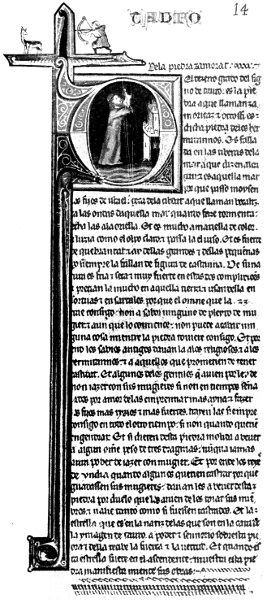
THE “HERMIT STONE,” A TALISMAN OF CHASTITY WHEN WORN SET IN A RING
Lapidario del Rey D. Alfonso X, Codice Original, Madrid, 1881, fol. 14
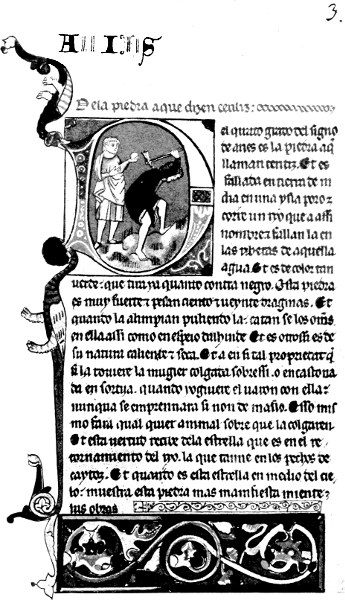
FINDING OF STONE WHICH WHEN SET IN A RING ASSURES MALE OFFSPRING TO THE WOMAN WHO WEARS IT
Lapidario del Rey D. Alfonso X, Codice Original, Madrid, 1881, fol. 3
The “Lapidario,” an astrological treatise on stones, written at the instance of the Castilian King, Alfonso X, the Wise, (1221–1284), ostensibly a translation from a “Chaldee” original, but probably mainly based on Arabic lore, gives, under the obscure name ceritiz, an account of an Indian stone found on the banks of the river of the same name. It was of a very dark green hue, was exceedingly tough and its weight is fixed at 120 drachmas. When cleaned and polished it cast a reflection like that of a fine mirror. A piece of this stone set in a ring and worn by a woman would assure her a series of boy babies.
Another ring-stone, one having a different effect, was that called the “hermit’s stone,” which was washed up by the waves on the shore of the Red Sea. Its color was yellow, transparent, and had a sheen like that of pure oil; possibly this may have been chrysolite. It was eminently and rigidly a stone of chastity. The lapis lazuli was dedicated to Venus, and any man who wore one set in a ring, while Venus was in the ascendant, would attract the love of women, especially of those with blue-gray eyes. On a woman’s hand, it had a corresponding effect upon the opposite sex.[502]
An old German lay tells of a magic gold ring set with a diamond. Should the woman wearing this ring prove unfaithful in love, the gold turned to dross, and the diamond became glass. The Latin name of the diamond, adamas, is the form used in this poem.[503] This word, which primarily signified an exceedingly hard metal, finally came to mean the diamond, or at least what was believed to be a diamond, although it might in reality be only a colorless corundum, much less hard than the genuine diamond, but harder than any of the other precious stones except the colored corundums, ruby, sapphire, etc.
The thirteenth century German romance, “Wolfdietrich,” celebrates a ring given by the empress to the hero of the poem. This ring was set with a stone destined to double the strength of the wearer, and to protect him from the sheets of flame ejected by the fearful dragon he was about to combat. However, before his encounter with this fabulous monster, Wolfdietrich determines to return the ring, and sends it back to the empress, whereupon she bursts into tears, exclaiming: “I let it down from the battlements with my own hand. Does he value it so lightly, that he sends it back to me?”[504]
In a satirical and malicious life of Pope Boniface VIII (ca. 1228–1303), the bitter opponent of the French king Philippe le Bel (1268–1314), written by, or at the instance of his royal enemy, it is related that when this pope was dying and was told that he must prepare his soul for the great change, he cast his eyes upon a stone set in a ring he was wearing, and exclaimed “O you tricky spirits imprisoned in this stone, why have you deceived me to abandon me now in my extremity?” And so speaking he snatched off the ring and threw it away.[505]
One of the old monkish tales from mediæval times, collected under the title of “Gesta Romanorum,” runs as follows:
Frediricus, who reigned in a Roman city, had been a long time without offspring. Finally, by the advice of wise counsellors, he married a beautiful girl in parts far distant and lived with her in an unknown land and had offspring. After this, he wished to return to his realm but could not obtain his wife’s consent; indeed, she always repeated that if he abandoned her she would kill herself. Hearing this, the emperor caused two splendid rings to be made, and had engraved upon two gems images of the following efficacy: one of remembrance and the other of forgetfulness. Having set these in their appropriate rings he gave one—that of forgetfulness—to his wife, and kept the other for himself ... The wife began straightway to forget the love of her husband, and the emperor, noting this, journeyed back to his realm with great joy, and never returned to his wife. He ended his life in peace.[506]
Welsh legend offers us parallels to the ring of Gyges and to that set with the “Stone of Remembrance” told of in the Gesta Romanorum. In the old Welsh epic, the Mabinogion, the following directions are given by a damsel to her lover in regard to a ring of the former type: “Take this ring and put it on thy finger with the stone within thy hand; and close thy hand upon the stone, and as long as thou concealest it, it will conceal thee.” This Stone of Invisibility was regarded as one of the thirteen rarities of the ancient British regalia, formerly treasured up in Caerleon, Monmouthshire, and in another Welsh legendary cycle (the Triads) it is said to have “liberated Owen, the son of Urien, from between the portcullis and the wall.” Whoever concealed the stone would be concealed by it. Here indeed the similarity with the story told of the ring of Gyges is so close that it is apparent we only have to do with an adaptation of the classic tale. As to the stone of Remembrance, however, the Welsh tradition seems to be essentially an independent one. The Mabinogion makes Iddawe say to Rhonabwy: “Dost thou see this ring with a stone set in it upon the Emperor’s hand? It is one of the properties of that stone to enable thee to remember that thou seest here to-night, and hadst thou not seen the stone, thou wouldst never have been able to remember aught thereof.” This refers to a dream or vision accorded to Rhonabwy while he lay upon an enchanted calf-skin.[507]
Dactylomancy, as it was called, was resorted to in the Middle Ages by those who sought to probe the mysteries of the future. This art was practiced by the use of a ring (sometimes bearing the figure of one of the constellations), which was suspended by a thread in the middle of a glass or metal vessel. The number and quality of the strokes it made against the sides of the vessel as it swung free on the thread, were interpreted by the magician according to a secret formula, and were explained by him to signify that some expected or dreaded event would or would not take place.[508]
Among the Sagan Kerens of southeastern Asia there is a curious superstitious use of a ring in connection with funeral feasts. On such occasions a metal ring is suspended from a support just over a brass basin. One by one the relatives of the deceased person approach and strike a succession of quick taps on the edge of the basin with a piece of bamboo. When it comes to the turn of the one who was most beloved by the departed, the spirit is believed to answer the call by making the string twist about and lengthen, so that, finally, it either parts and permits the ring to fall into the basin, or else swings and lengthens sufficiently to cause the ring to strike the basin edge.[509]
A magic ring is introduced by Sir Thomas Malory in his “Morte d’Arthur,” written in 1469 or 1470, the tale being of course borrowed from some one of the numerous sources he used in this compilation of the story of King Arthur and the Knights of the Round Table. The ring was given by Dame Liness to Sir Gareth, who wished to hide his personality while competing in a tournament. The dame assured the Knight that this ring had such virtue that it would turn green to red, blue to white, and vice versa, and so through all the range of colors. The lady required, however, a solemn promise that her ring would be returned to her at the close of the tournament, for in addition to its other virtues, it possessed marvellous cosmetic powers, increasing her beauty to an extraordinary degree.
In the tourney, the baffling changes of color in Sir Gareth’s arms and equipment confused his assailants and rendered him more easily victorious than he would otherwise have been, good knight that he was. Having ridden for a moment out of the press of knights to adjust his helmet, which had become loosened, a dwarf approached him, offering a cup of wine to quench the knight’s thirst, at the same time asking to hold the ring lest Sir Gareth should let it slip from his finger while drinking. The knight gave it to him, but in his eagerness to join again in the affray, forgot to take it back. But now his armor retained its normal yellow tint, and, fearing recognition, for it was important for him to conceal his personality at this time, he noted that his ring was not on his hand. He quickly sought the dwarf and obliged him to surrender the magic ring. No sooner was it on his finger than his armor changed color, and he was able to avoid a threatened pursuit, as all were in search of the Yellow Knight.
A ring having magic power to protect the wearer from danger appears in the mediæval romance of Sir Eglamore. The tale appears to have been known to Shakespeare, to judge from the line: “What think’st thou of the fair Sir Eglamore,” which occurs in Two Gentlemen of Verona. This ring was given to the gallant knight by his lady love:[510]
Then said Arnada, that sweete thing “Have here of me a gold ring With a precyous stone; Where-soe you bee on water or Land And this ring upon your hand Nothing may you slone.”[511]
Sometimes the virtues of the ring are conceived in a poetic spirit and are associated intimately with the giver, as we find in the romance of Ywaine and Gawin. Here the stone set in the ring given by Ywaine protects the wearer from imprisonment, illness, loss of blood, and danger in battle, but the lady tells her lover that this virtue exists in the ring “while you it have and think on me,” that is, only so long as his love endures.[512]
That the magic virtues of the images and talismans were liable to wane and pass away, was taught by Albertus Magnus, who likened these powers to those of animate objects which were also transitory. When the period fixed by heaven had come to an end, the power of the image would be broken and it would be useless, cold and dead. This, in his opinion, accounted for the fact that many talismanic figures failed to display any efficacy, although they had done so in ancient times.[513]
In the “Book of Thetel,” as quoted by Konrad von Megenberg,[514] one of the engraved gems is described as follows:
A man seated upon a footstool, crowned, and stretching forth his hands to the heavens. Beneath him are four men appearing to support the stool. Take mastic and terebinth (turpentine) and put them under the stone in a silver finger-ring, having twelve times the weight of the stone in the ring. If this be placed beneath the head of a sleeping person, he dreams of what he longed for when awake.
The curious statement that the metal ring was to weigh twelve times as much as the stone, seems to indicate an influence of the superstition in regard to the number twelve.
The Londesborough Collection contains a ring which represents a toad swallowing a serpent. This was evidently used as an amulet and the design seems to have some connection with the curious superstition that a serpent, to become a dragon, must swallow a serpent. A Greek proverb, found in Suidas (ab. the tenth century A.D.), is aptly rendered by Dryden (Edipus, Act III, sc. 1) as follows:
A serpent ne’er becomes a flying dragon till he has eat a serpent.
Hence this ring combined the curative or talismanic powers attributed to the toad, the serpent and the dragon.[515]
The ring of St. Mark, said to have been long preserved in the treasury of St. Mark’s cathedral at Venice, was believed to have been acquired in a miraculous way. In the time of Henry III (1216–1272) the body of the saint, which had been taken to the cathedral, was suddenly missed and no trace of it could be found. Resort was then had to prayers and supplications, and these appear to have been answered, for one day the sacristan, while traversing the nave, saw an arm emerge from one of the pillars. He hastened to report this wonderful thing to the Doge and the cathedral clergy, who on reaching the building became witnesses of the miracle. As they were kneeling reverently before the column the hand of the apparition opened and let fall a ring, which was picked up by the Bishop of Olivolo. At the same instant, hand and arm disappeared, and the column opened, revealing in its interior an iron casket in which were the lost remains of St. Mark.
Not many years later this ring served to give proof of an appearance of the saint. One February day a fearful storm arose, piling up the waters of the lagoons and threatening the destruction of Venice. In the midst of the tempest, a man approached one of the gondoliers on the Riva dei Schiavoni, near the cathedral, and asked to be rowed across the canal to San Giorgio Maggiore. It was in vain that the gondolier protested he could not make head against the storm; he was at last forced to yield to the importunities of his would-be passenger. But what was his surprise to find that his boat proceeded as easily as though no storm were raging. On their arrival at San Giorgio Maggiore they were joined by another man, and the gondolier was now directed to proceed to the Lido. This time his reluctance was less difficult to overcome, although the storm was growing worse, for he felt encouraged by the ease with which he had already made part of the journey. And sure enough his long row to the Lido was equally uneventful. Here a third man joined the party, and the gondolier was told to row out between the castles on either side of the entrance into the open Adriatic. Feeling that he could now refuse nothing, the gondolier undertook to accomplish this apparently impossible task, and succeeded in reaching the sea. Here there arose before them a ship manned by the demons of the storm, who were steering their way in toward Venice, bringing utter destruction with them. And now the three men in the little boat stood up and pronounced an exorcism of such power that the ship foundered, and the demons, howling fearfully, were swallowed up in the deep. Immediately the tempest was stilled and the waves died down. The gondolier was now ordered to take his passengers back to the places where they embarked, and when the last of them, the first one he had picked up, stepped on to the Riva dei Schiavoni, he announced himself to be Mark, the Evangelist, and dropped a ring worth five ducats into the gondolier’s hand, telling him to show it to the authorities and say that it was St. Mark’s ring, in proof of which they would find that its carefully locked receptacle in the cathedral was empty.[516] This proved to be true, and the gondolier received a liberal pension as a reward for having aided, however humbly, in the preservation of Venice by St. Mark.[517]
The marvellous ring of Gyges may have suggested to Abbot Tritheim, or Trithemius, of Spandau (1462–1516) the idea of fabricating a ring which would give the wearer the power of becoming invisible at will. The Abbot asserts that he had made such a ring out of the material called electrum, a natural alloy of gold and silver, having the color of amber. To possess the requisite power, the ring must be cast at the hour at which the person designing to use it was born, and it should be inscribed with the word “Tetragrammaton” signifying the four letters composing the Ineffable Name. When this ring was placed upon the thumb of the left hand, the wearer immediately became invisible. Besides this virtue, when worn on any finger, the ring preserved the wearer from poison and betrayed the presence of enemies by changing color.[518]
Rings bearing the Latin inscription “Jesus autem transiens per medium illorum” (Jesus, however, passing through their midst),[519] were thought to confer invisibility upon the wearer. This inscription occurs on the hoop of a gold ring set with an uncut diamond, shown at the Special Exhibition at the South Kensington Museum, June, 1862.
This motto, “Jesus autem transiens,” etc., was in mediæval times regarded as a great charm against the dangers that menaced a traveller on his journeys. In his quaint old English, Sir John Mandeville says of this that these words were sometimes pronounced by “some men when thei dreden them of thefes on any way, or of enemyes, in token and mynde that our Lord passed through out of the Jews’ crueltie and scaped safely fro hem.” On the gold noble which Edward III had struck in commemoration of his victory in the naval battle of Helvoet Sluys in 1340, and of his escape from the perils he underwent therein, this motto appears as the legend.[520]
Lambeccius narrates that he once told Emperor Leopold I (1657–1675) of a magic gold ring, said to have been long preserved in the Austrian treasury, and whose special virtue was that it could be used as an oracle to foretell the results of an approaching battle. If victory was to crown the Austrian army, this ring would shine with an unwonted splendor. It was said to be made from the gold offered by the Magi to the Infant Jesus. While, however, sacred ceremonies were being performed before the Emperor Frederick, grandson of Rudolph I., just before his departure for a disastrous battle with Louis of Bavaria, the ring vanished from the eyes of man. Later, it was said to have been recovered and Lambeccius suggested that a ring he had recently observed in the treasury, bearing certain characters difficult of interpretation, might be the ring made from the offering of the Magi.[521] The omen of victory observable in this ring must have been suggested by what Josephus writes of the high-priest’s breastplate. According to his story “God announced victory in battle” by means of the twelve stones set in this breastplate, and he proceeds “such a splendour shone from them when the army was not yet in motion, that all the people knew God himself was present to aid them.”
A magic ring was made in the seventeenth century by a Florentine monk, named Nicolaus; this was designed to drive away gnats. It bore a charmed figure executed during the ascendency of the planet Saturn. The charm is said to have worked successfully. Since Saturn was usually regarded as a bearer of ill-luck, the operation of the magic figure must have depended upon sympathetic magic, the enlisting of the help of an evil power to combat a nature-plague.[522]
It is related that long ago in the Principality of Anhalt, a princess had the habit of going to the window after dinner and shaking out the crumbs from her napkin. Intention or chance induced a great toad to station itself under this window so as to eat up the precious crumbs. In due time the princess was wedded, and one night, shortly before the birth of a child, she saw a maid enter the room with a lighted candle in her hand. Approaching the bedside she handed a gold ring to the princess, telling her at the same time that it was sent by the toad, out of gratitude for the food she had given it, with the earnest warning to guard the ring carefully, as the fortunes of Anhalt were bound up with it. Moreover, every precaution was to be taken on Christmas Eve to guard against fire.[523] It is stated that this ring was still to be seen in Dessau in 1722, and that it was customary to put out all the fires in the palace on Christmas Eve, and to have watchmen patrol the building all through the night.[524]
A luminous ring is poetically described in Titus Andronicus, a play somewhat doubtfully attributed to Shakespeare who probably merely revised and embellished, in or about 1590, an original from some other hand. In any case, the lines referring to the luminous stone are highly expressive. After the murder of Bassianus, Martius searches in the depths of a dark pit for the dead body and suddenly cries out to his companion, Quintus, that he has discovered the bloody corpse. As the interior of the pit is pitch-dark, Quintus can scarcely believe what he hears, and asks Martius how the latter could possibly see what he has described. The answer is given in the following lines:
Martius, Upon his bloody finger he doth wear A precious ring, that lightens all the hole, Which like a taper in some monument, Doth shine upon the dead man’s earthy cheek, And show the ragged entrails of this pit. Titus Andronicus, Act II, Sc. 4.
For the superstitious among certain Oriental peoples any injury to an amulet-ring was looked upon as a sure presage of coming misfortune. It is related of a Turk in the town of Jablanica, Bosnia, that having broken his amulet-ring, he started out forthwith on an arduous ten-hours’ journey to Mostar, the nearest place where his ring could be repaired, and he no doubt pursued his way in fear and trembling lest the threatened ill-fortune should befall him ere he reached the goldsmith who could mend his ring and thus restore its virtue.[525] In the National Hungarian Museum at Budapest is a silver ring set with a carnelian, on which are engraved Oriental characters. This was found, in 1812, in the garden of the royal palace at Budapest. Rings of a similar kind are often worn by Turks and Arabs, and are greatly valued as talismans, as they are believed to afford the wearers protection in battle, in the chase, and when indulging in dissipation.[526]
The ring with its smooth circle, having neither beginning nor end, is a fit symbol of eternity, and is often figured in this connection; and yet its material substance is transitory. This aspect is illustrated by the Eastern story that a wise man and favorite of a king once gave him a ring on which was the inscription: “Even this shall pass away.” In bestowing it upon the king, the sage said: “When in dire distress your soul is weighed down with trouble, look at this ring! When in the midst of festivities, joy and wild hilarity, look at this ring! Even this shall pass away.”[527]
In an illustrated work on ancient jades, in two quarto volumes, published in 1889 by the well-known scholar and statesman, Wu Ta-cheng (b. 1833), this writer conjectures that archer’s rings of white jade were reserved for the emperor’s use. At the present day rings of this type are made in Peking from the antler of a species of elk. The Catholic missionary, Father Zi, states that the rings most highly valued are those made out of jade of the Han period (Han yü), of a white gray with red veining and green stripes. Rings found in the graves of students who have passed the military examinations are of reddish hue, and the opinion prevails that they afford protection against malevolent spirits.[528]
In the symbolism of the ring, the complete circle is regarded by the Chinese as denoting the combination of all divine principles, as these are supposed to move in an everlasting and unbroken circle, having neither beginning nor end. An evil significance, however, attaches to an incomplete or half-ring, called küeh, a sound that means “to cut off, to slay; to pass sentence; to decide, to settle.” An early instance of the use of such a ring to signify banishment is related of the Prince Shên-shêng whose father sent him on a fatal military expedition in 659 B.C., at the instigation of one of his concubines. This ring, which was attached to a girdle, was equivalent to a formal decree that the prince was cast off and should never return. In consequence of the ambiguity of Chinese spoken and written words, a half-ring or at least one not describing a closed circle is said to have been worn at one time by Chinese scholars, because one of the meanings of the sound küeh is “to decide,” as has been noted above.[529] The Chinese writer Pan Ku (d. 92 A.D.) says that those who cultivated moral conduct without end, wore a complete ring suspended from the girdle, while those able to decide questions of aversion and doubt, wore half-rings, this being again a symbolic use of the double meaning of küeh.
As the Chinese word signifying “a jade-ring” has the same sound (huan) as the word meaning “to return, to repay,” and is expressed with the same phonetic symbol, the sending of such a ring by an emperor to an exiled official was a symbolic summons for the official to return. However, a jade-ring could also be a signal for besieging a city, since the syllable huan can mean “an enclosing wall.”[530] As an illustration, the word “ring,” a ring; and “ring,” imperative of “to ring,” might make the sending of a ring to a bell-ringer signify that he should let his bells peal forth.
Quite a number of finely-executed gold rings, with or without settings, as well as other pieces of jewelry, are made by Chinese goldsmiths in San Francisco. Silver is never used. Seal rings are occasionally made; the favorite setting is jade, next to which comes the opal; diamonds are also used for this purpose. No wedding rings are given, although the bestowal of a ring as a gift is highly appreciated. The prices range from $6 for a plain gold ring to from $20 to $200 for one of mandarin-style, set with a piece of jade. Sometimes short inscriptions are engraved on rings, such as “Long Life,” or “Beautiful.”[531] In the plate representing the interior of a Chinese jeweller’s shop in San Francisco, the proprietor of the place is shown seated in the background. None of the artisans, however, were willing to face the camera, either from superstitious dread of having their pictures taken, or perhaps through fear of being molested in some way by the Government.
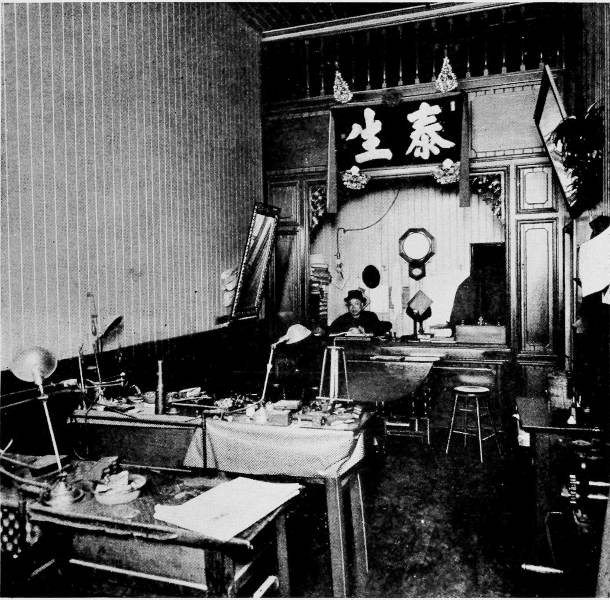
Photograph by Cardinell-Vincent Co., San Francisco
SHOP OF A CHINESE SILVERSMITH IN SAN FRANCISCO
As the workers were unwilling to have their pictures taken, the only figure is that of the proprietor
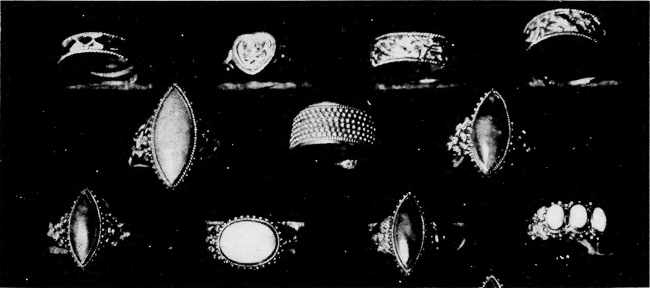
MODERN CHINESE RINGS
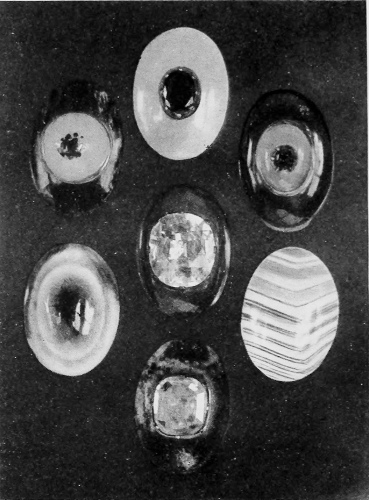
Inset ring stones. 1, moss agate in dark gray jasper; 2, garnet in chalcedony; 3, almandine garnet in brownish chalcedony; 4, aquamarine in red jasper; 5, sardonyx; 6, topaz in lapis-lazuli; 7, banded agate. Part of a collection of rings that all fit in one setting. See page 65
American Museum of Natural History
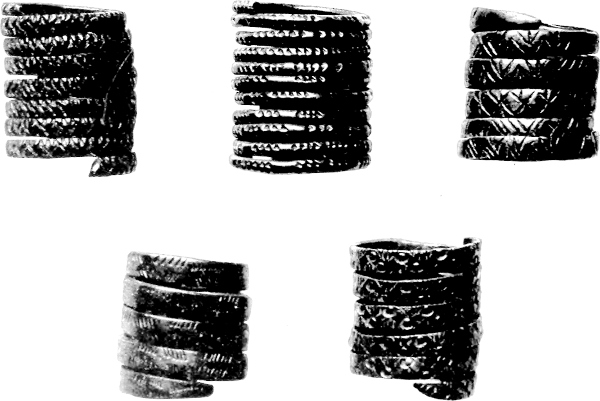
Spiral brass rings made in the Philippine Islands
American Museum of Natural History, New York City
When the nine gems of the great Hindu charm, the naoratna, are set in rings, the Burmese usage is to place the ruby in the centre, and group around it the eight other stones. Rings of this description were worn by Burmese kings and nobles as preventives of disease or danger. Sometimes an incantation is recited over these nine stones, which are then immersed in water, the belief being that whoever drinks of this water will secure immunity from all evil.[532]
In the masterpiece of Hindu dramatic literature, the Çakuntalâ of the poet Kâlidâsa, written about the sixth century of our era, a ring plays a most important part. The heroine, the daughter of the nymph Menakâ and the sage Viçvamitra, has had it foretold to her that the man who loves and marries her will entirely forget her, until his love and memory are revived by a ring. In due time she is beloved of the King Dushyanta, who marries her, but soon leaves her, to return to his court. When she follows him thither he fails to recognize her. Thereupon she remembers what had been predicted in regard to a ring, but finds to her dismay that the one the King gave her has been lost. In the next act of the play a fisherman is dragged in by guards who charge him with having in his possession the royal signet-ring and with having invented the tale that he found it inside a fish. The king, however, admits the truth of the story, rewards the fisherman, and gladly receives the ring. As soon as he places it on his finger he recognizes his bride and his love for her is renewed.[533]
The Khedive Tewfik Pasha related, about 1880, his experience with a certain Ahmed Agha, a Turk, who possessed a magic ring. It was a plain hoop of gold set with a red stone (probably a carnelian), and was said to have come from Mecca. The Turk claimed that by its help visions could be seen, and the Khedive consented to make a test of the ring’s virtue. Ahmed said that he required for the experiment the assistance of a child under ten years of age, whereupon the Khedive summoned a little girl from the harem to act as assistant, or we might rather say principal. The Turk attached to this girl’s head a silver plate on which a verse of the Koran was engraved, and placed in her hand the mystic ring with the red stone which, he declared, would change from red to white if the experiment was to be successful. A few moments after the preparation had been made, the girl cried out: “The stone has changed to white.” Hereupon the Khedive asked her to describe a number of persons she had never seen, and she invariably gave correct answers. Tewfik was so much impressed by the experiment that he exclaimed: “I can believe it, and yet I cannot understand it.” A few days later he sent word to the Turk that he wished to borrow the ring, but the man besought him not to take it away. An offer of £100 from a court noble was also refused. Finally, Ahmed was summoned to the court and the Khedive again urged him to surrender the ring, but when he repeated his prayers that it should not be taken from him the Khedive lost patience and said to him: “You are mistaken in thinking that I believe in the power of your ring or in things of that kind. I wish you good morning.” Poor Ahmed was only too glad to get off so easily and he left Cairo never to return there.[534]
In this case, as in many others, a change of color is asserted to take place in the stone, an indication that the mineral substance responds to some impression from without. It is as though part of the virtue of the stone had left it, for with a colored stone we might say, in a poetic sense, that its color is its life and soul. Hence in this particular instance the loss of color was probably thought to indicate that some in-dwelling spirit had passed from the stone to the little girl and dictated her responses; possibly if the ring were arranged with some mechanical or hollow space a colored foil could be pressed under the white stone, or a liquid passed under it, giving the delusion of the change from white to red and red to white.
In Scandinavia, carnelians were used as ring-stones in very early times; a fine specimen of such a ring was found in Ysted, in the province of Scania, and another at Verdalen, Norway. That these were credited with power as amulets seems highly probable, for some of the early Norse rings were so highly valued by their owners that they were designated by individual names. Thus we are told of a gold ring named Hnited, “The Welded,” which was given as a precious gift by Ulf the Red to King Olaf. This particular ring was welded together from seven pieces of exceptionally pure gold, the number of pieces evidently having a mystic significance.[535]
There is or was a superstition among the Swedish Lapps that at times, on the lonely moorlands, might be seen visionary herds of reindeer, packs of dogs, or even apparitions having the form of Laplanders. When one who sees any such objects goes in pursuit of them, they disappear before they can be reached; if, however, while they are still visible a steel or brass ring is thrown at them, they immediately become real living creatures. Popular legend even has to tell of men or women who in this way have secured wives or husbands, respectively, in reality changelings, trolls, apparently or really transformed into human beings.[536]
An onyx ring is made the cause of a series of wonderful transmigrations in an old-fashioned tale written about 1840 by John Sterling, of whom Thomas Carlyle has left us a most interesting biography.[537] In this story, the hero, a young barrister discouraged in his profession and disappointed in love, finds himself one night in an exceptionally depressed frame of mind. Opening, at chance, an old necromantic work, he is fascinated, perhaps hypnotized, by the vaguely mystic sentences, and is scarcely astonished to perceive, standing before him in his deserted room, what appears to be the figure of an aged man, who in the most-approved magician fashion offers him an onyx ring, engraved with the head of Apollonius of Tyana, and of such virtue that if he puts it on the forefinger of his right hand, he will be able to transfer himself into the body of any existing personage. His identification with the new personality will indeed be so complete, that his old existence will be entirely forgotten. This is to last for a week, at the expiration of which his memory will suddenly be revived for a short time, and he will have the choice to remain as he is, to change his fleshly tabernacle again, or to return to his own body. In the last-named case, however, his special power will be taken from him, and he must continue in his own form.
The offer is accepted and a series of transmigrations begins, in the course of which the hero becomes in turn a baronet, a farmer, a traveler, a divine, a poet, a political reformer and an old basket-maker. In this last avatar he is involuntarily forced to return to his own body, for the basket-maker dies before the week is up. The various characters through whose lives he passes belong to his immediate neighborhood, and the slight plot of the story can thus be carried forward without interruption. When at last the barrister comes to himself, he has just recovered from a long period of unconsciousness, and there is a little intentional uncertainty whether the vision and its consequences really took place, or were only the products of a fevered mind. Among the old basket-maker’s effects is found an onyx ring enclosed in an old box and engraved with a man’s head.
The greater part of the splendid precious stones in the collection of the English banker Henry Philip Hope were set in rings. One of the finest and most interesting of these gems was the beautiful sapphire often called “Le Saphire Merveilleux,” the title of a story written by Mme. de Genlis, who had seen the stone when it formed part of the collection of the Duke of Orleans. Its peculiar charm is that its color changes when seen by artificial light. In daylight it is a beautiful sapphire blue, but by candle light, or other yellow light it acquires an amethystine hue.[538] This fine sapphire, interesting both for its rare dichroism and its historic associations, was sold about 1898 for £700 ($3500). It weighs 19⅛ metric carats. Another attractive gem in the Hope Collection is a cabochon-cut amethyst, engraved in intaglio with the figure of a Bacchante carrying a thyrsus. At the back of the stone are two strata of different colors, one a whitish gray, the other showing brown spots on a velvet ground. This peculiarity has been skilfully utilized by the engraver, who has cut on the stone the form of a panther in relief.[539]
The so-called “Pennsylvania Dutch,” largely Germans from the southern parts of Germany, made, in the early days, rings out of horseshoe nails.[540] The good-luck supposed to be inherent in the horseshoe was probably believed to extend to the detachable nails also, so that these rings might have been looked upon as endowed with magic or talismanic virtue.
Lord Bacon (1561–1626) in his “Sylva Sylvarum,” published in 1626, suggests a curious test of telepathy. This is that two parties to an agreement or contract, should exchange rings, each wearing the other’s ring, and they are then to note whether, in case the contract or promise should be broken by one of the parties, the other would become sensible of this by means of an influence transmitted through the ring. He adds that it has been regarded as a help to the continuance of love to wear a ring or a bracelet of the loved one, but he believes that “this may proceed from exciting the magnetism, which, perhaps, a glove, or other like favour, might do as well.”
The peculiar inherent virtue of a ring given by, or exchanged with, a loved person, renders it far more prized than a merely beautiful or costly ring. While we may regard as superstition any fancy that the material ring possesses any magic quality, that lent to it by association or by memory is none the less real though it is only in the brain or heart of the wearer. The effect of this association of a ring or other jewel with a person is also to be seen in the case of rings bestowed by royal personages as tokens of gratitude or favor. In olden times they were often regarded as amulets and believed to transfer something of the power or genius of the bestower to the recipient. Indeed the qualities were conceived to have embodied themselves in the ornament, which was therefore handed down from generation to generation as a precious heritage, one sure to bring good fortune to the wearer. In the case of lovers the token served as a connecting link, transmitting and transfusing the love sentiment.[541]
Besides the zodiacal, or natal rings, there were also made in mediæval times a number of planetary rings, the metal supposed to be especially under the guardianship of the Sun, Moon or five planets known to the ancient world, being in each case chosen as the material for the ring of the special planet. These rings were frequently set with the precious stone assigned to the planet, and thus a series was obtained of seven rings, each of a different metal and set with a different stone. The sun-ring was of gold with diamond or sapphire; the silver moon-ring bore a rock crystal or a moonstone; the ring of Mars was of iron set with an emerald; for Mercury, the ring was of quicksilver and bore a piece of magnetic iron; Jupiter’s was of tin, the setting being a carnelian; copper was, of course, the material of the Venus-ring (cyprium, copper, being sacred to the Cyprian goddess), and the stone was an amethyst; lastly, the Saturnian ring was of lead and had for setting a turquoise.
Some of the appropriate rings and stones to be worn by those who hope to attract to themselves the favorable influences of Sun, Moon, and planets, are given in the Syro-Arabic work of the eighth or ninth century on the mystic potencies of stones, put forth under the name of Aristotle. For the Sun the stone is rock crystal, which must be set in a gold ring; Mercury’s influence is secured by wearing a piece of magnetite in an electrum setting, and for those wishing the help of the Moon, one of the varieties of onyx is recommended, silver being the metal in which it is to be set.[542]
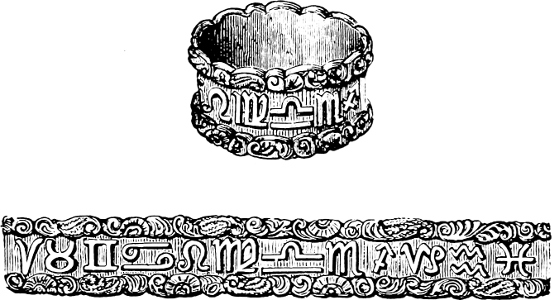
GOLD ZODIAC RING, PROBABLY MADE ON THE WEST COAST OF AFRICA IN THE NINETEENTH CENTURY
British Museum
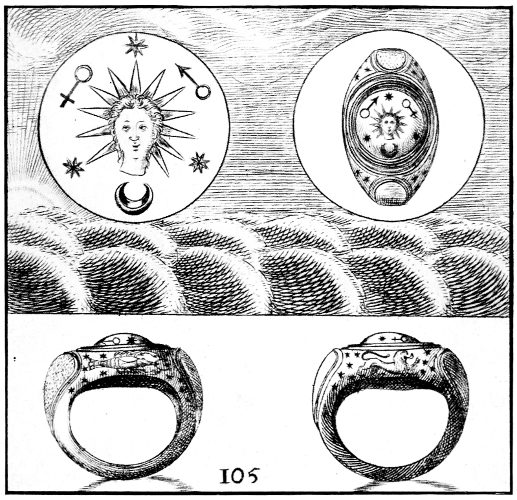
ZODIACAL RING OF SILVER; FOUR VIEWS. SET WITH AN ENGRAVED ONYX. ON THE SIDES ARE CHASED THE SIGNS LEO AND CANCER, AND THE SHOULDERS OF THE HOOP ARE INLAID WITH BRASS AND IRON, RESPECTIVELY
Gorlæus, Dactyliotheca, Delphis Bat., 1601
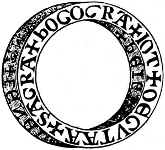
Amulet ring of Twelfth Century, engraved with cabalistic characters
Edwards’ “History and Poetry of Finger Rings”
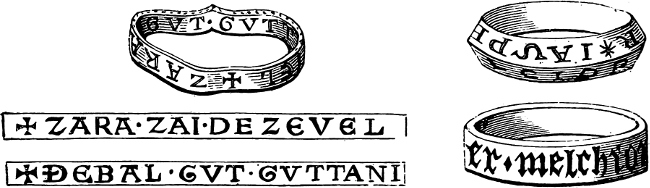
Talismanic ring, with cabalistic inscription. Found on coast of Glamorganshire, Wales
Rings inscribed with names of Three Kings, or Magi: Melchior, Jasper and Balthazar. Worn as talismanic rings
Fairholt’s “Rambles of an Artist”
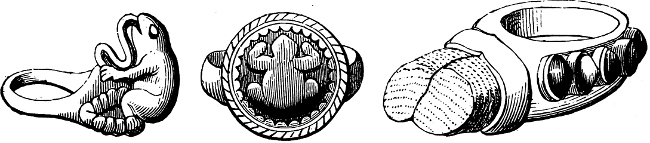
1, toad swallowing a serpent; 2, toadstone with embossed figure of toad; 3, massive thumb-ring set with teeth of an animal
Londesborough Collection
Fairbolt’s “Rambles of an Artist”
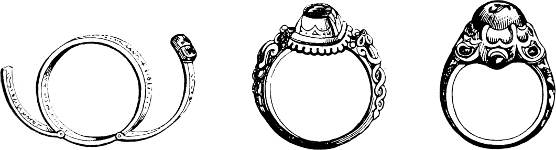
1, talismanic ring that opens when the stone setting (ruby and amethyst) is pressed down, releasing a spring. Hoop inscribed with names of spirits and magic signs; 2, ring set with a ruby; 3, gold enameled ring said to have belonged to Frederick the Great
Fairholt’s “Rambles of an Artist”
For some reason or other zodiac rings, that is rings bearing zodiacal symbols, seem to be especially favored by the modern goldsmiths of the Portuguese island Madeira. Occasionally a ring of this type from earlier times may be seen there; one of these, of crude workmanship and much the worse for wear, has been attributed to the time of a twelfth-century duke of Burgundy, whose crusading expedition did not extend much beyond the frontiers of Portugal.[543] More than likely Moorish influence, or that of the Orient at least, was a determining factor, for the study of zodiacal influences was eagerly pursued in Spain in the thirteenth century and earlier, as is witnessed by the curious Lapidario of Alfonso X, the Wise, composed in the latter half of that century. The survivance of this style in Madeira depends quite probably upon one of those rather inexplicable chances that cause the production of a certain class of jewels or ornaments, when a curious or unusual example strikes some tourist’s fancy, and he shows it to friends at home; these in their turn will ask for it when they go to the same place, thus creating a demand and a local fashion. Rings of this kind are brought from Madeira by sailors and travelling jewellers, and are found at a number of places, including the west coast of Africa.
Many gold zodiac rings of a simple type are made on the Gold Coast and brought thence to Europe. The hoop is a flat band, on which the conventional symbols of the zodiacal signs are soldered, scroll borders also being applied in the same way.[544] While these rings are totally lacking in artistic quality, their production on the Gold Coast may indicate that long ago some better work of the class was done here, probably under Portuguese influence.
Rings holding truly “celestial stones,” gems from the heavens as they are called, are those in which have been set small, but perfectly cut chrysolites (peridots) from crystals found in meteorites. One of these was of the pallasite type, from Brenham, Kiowa County, Kansas[545] and gems were also cut out of chrysolite from the meteorite of Glorietta Mountain, Santa Fé County, New Mexico.[546]
A most attractive kind of natal ring is that having the birth stone in the centre between the stones of the guardian angel and of the apostle of the month. While this particular arrangement of the settings is followed in the greater number of cases, it sometimes happens that a better artistic effect is obtained, a better harmony of color, by making either the stone of the angel or that of the apostle the central gem. The essential thing is that the three particular stones assigned to the given month shall be grouped together. The following table renders it easy to find the proper combination for each month, or each zodiacal sign:
Month Zodiacal Sign Natal Stone Guardian Angel Angel’s Gem Apostle of Month Apostle’s Gem Flower of Month
January Aquarius Garnet Gabriel Onyx Peter Jasper Snowdrop
February Pisces Amethyst Barchiel Jasper Andrew Carbuncle Primrose
March Aries Bloodstone Malchediel Ruby James and John Emerald Violet
April Taurus Diamond or Sapphire Ashmodel Topaz Philip Carnelian Daisy
May Gemini Emerald Amriel Carbuncle Bartholomew Chrysolite Hawthorne
June Cancer Agate Muriel Emerald Thomas Beryl Honeysuckle
July Leo Turquoise Verchiel Sapphire Matthew Topaz Water Lily
August Virgo Carnelian Hamatiel Diamond James the Less Sardonyx Poppy
September Libra Chrysolite Tsuriel Jacinth Thaddeus Chrysoprase Morning Glory
October Scorpio Beryl Bariel Agate Simon Jacinth Hops
November Sagittarius Topaz Adnachiel Amethyst Matthias Amethyst Chrysanthemum
December Capricornus Ruby Humiel Beryl Paul Sapphire Holly
If, like Apollonius of Tyana,[547] anyone should wish to wear on each week day a ring set with the stones especially appropriate to the day, the following list gives for the successive days the pair of stones whose combination was believed to unite the most favorable planetary and celestial influences:
Gem of the Day Talismanic Gem Astral Control
Sunday Diamond Pearl Sun
Monday Pearl Emerald Moon
Tuesday Ruby Topaz Mars
Wednesday Amethyst Turquoise Mercury
Thursday Carnelian Sapphire Jupiter
Friday Emerald Ruby Venus
Saturday Turquoise Tourmaline Saturn
The use of fraternity rings is often connected with a certain amount of sentiment or even superstition concerning their emblematic value. The most important of this type of rings are those worn by the Free Masons.
The greater number of Masonic rings are intended for those Masons who have attained the two highest degrees, the thirty-second and the thirty-third; some, however, are appropriate to those of the lower degrees. The bezels of the Blue Lodge, or Master Mason rings, frequently have the square compasses and the latter G in gold on a background of blue enamel; occasionally emblems and paraphernalia used in the Lodge are enamelled in blue on the gold hoops of the ring. Sometimes, instead of enamel, the background is formed of sapphire, bloodstone, or some other stone on which the emblems are encrusted in gold. An example of the ring of a Past Master bears a raised gold sun-face. In a ring for the Chapter of Royal Arch Masons, the keystone is usually enameled white with a black circle and white centre. Shrine Rings are distinctly Oriental in type, the prevailing design showing a simitar passed between the horns of a crescent moon. In rings of the Knights Templar the design is usually a cross passed through a crown, with the motto of Constantine the Great: In hoc Signo vinces. The cross will be of black enamel (occasionally of red enamel) and the crown is gold. A special ring for this order has a Blue Lodge emblem on one shoulder and the Chapter emblem on the other, and is arranged for a diamond to be set in the centre of the bezel. On a fourteenth degree ring (Lodge of Perfection) appears the initial Hebrew letter (yod) of the Tetragrammaton, or Ineffable Name, now approximately sounded Yahweh. Sometimes the symbols of more than one degree appear on the ring, one example bearing those of the fourteenth, sixteenth, eighteenth, thirtieth and thirty-second; this is one of the Consistory rings, as those for thirty-second degree Masons are denominated. These usually have the double eagle on the bezel.
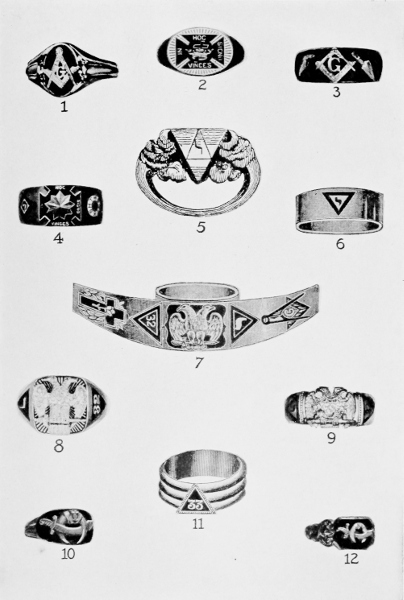
MASONIC RINGS
1, 3, Master Mason or Blue Lodge; 2, 4, Knights Templar; 5, “The Signet of Zerubbabel,” adopted as one of the Royal Arch symbols. Explained as the “Signet of Truth.” See Haggai, ii, 2–3; 6, 14th Degree, or Lodge of Perfection; 7, Emblem of 14th Degree on one side, of 32d Degree on the other; 8, 9, 32d Degree; 10, 12, Mystic Shrine rings; 11, 33d Degree]
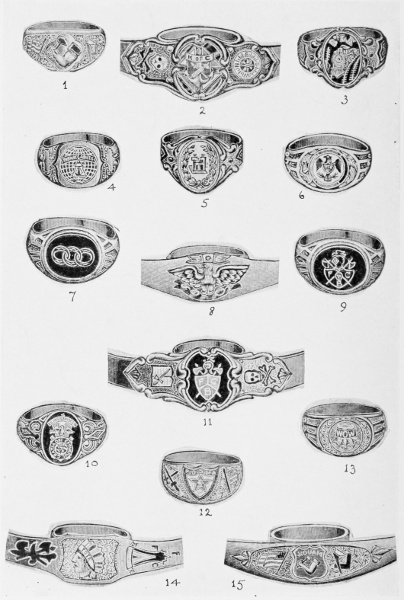
RINGS OF ORDERS AND SOCIETIES
1, Senior Order United American Mechanics; 2, Knights of Columbus. Raised centre emblem on black enamel; 3, Brotherhood of Locomotive Engineers; 4, Knights of the Maccabees; 5, Order of Railroad Telegraphers; 6, Improved Order of Red Men; 7, Independent Order of Odd Fellows (encrusted sardonyx); 8, Fraternal Order of Eagles; 9, Knights of Pythias (encrusted sardonyx); 10, Sons of Veterans; 11, Knights of Pythias (raised centre emblem on black enamel); 12, Patriotic Order Sons of America; 13, Woodmen of the World; 14, Improved Order of Red Men (raised centre); 15, Junior Order United American Mechanics
The variety of types of fraternity rings is manifold, most of the orders having a half-dozen or more different ring-designs, although certain distinctive elements run through all, as with the wide-spread Benevolent Protective Order of Elks, for instance, on whose rings the elk-head is always conspicuously present. For rings of the Knights of Columbus, the anvil, sword and battleaxe are never-failing marks. The Brotherhood of Locomotive Engineers, a labor organization of the highest type, has for its device a locomotive running on a railway track, with a telegraph pole at one side. The Loyal Order of Moose has the head of the patron animal, less graceful than the elk, but better suggesting the aggressive quality of this order. A considerable variety of designs are represented among the rings worn by the Knights of Pythias; in most cases a helmet and battleaxes are combined with a shield. Last, but not least, the Independent Order of Odd Fellows has many rings rich in symbols, the all-seeing eye, the open hand with a heart in it, a death’s-head and cross-bones, and everywhere, the three interlinked rings characteristic of the order. These are only a few of the innumerable ingenious designs that American factories have produced to satisfy an overwhelming demand for fraternity rings. For the leading schools also, many special rings have been executed to be used as prizes, or else to meet the wants of school fraternities or sororities. Of course, the numerous college fraternities also frequently use specially designed rings as distinguishing emblems.
The immense number of rings that must have been produced for members of the largest societies becomes apparent when we consider that the Independent Order of Odd Fellows, whose English foundation dates back to about 1745, now has a membership of over 1,500,000, in the United States and more than 160,000 in other countries. To this must be added the membership of the Daughters of Rebekah, a coördinate body of women numbering about 700,000. Another society, the Knights of Pythias, though of comparatively recent organization, having been founded in Washington, D. C., in 1864, has over 700,000 members in the United States and Canada. This order has a branch exclusively for the colored race, denominated the Knights of Pythias of North and South America, Europe, Asia and Africa; its members number 50,000. The Benevolent and Protective Order of Elks counts 410,000 members in 1309 lodges and the Knights of Columbus, a fraternal and benevolent society founded in New Haven in 1882, had, on July 1, 1914, 326,858 members.
The membership of the Greek-letter fraternities of the universities and colleges in the United States is enormous. In 1914 there were 38 leading fraternities distributed in 1228 active chapters and counting 2,656,817 members, with 979 fraternity houses. The oldest Greek-letter society, Phi Beta Kappa, was organized at William and Mary College, Virginia, in 1776; Kappa Alpha was founded at Union College, in 1827, this being the first fraternity to be organized according to the system at present prevailing. The first sorority was Kappa Alpha Theta, established at De Pauw in 1870. The sororities now have about 50,000 members in 395 chapters.
A gem representing one of the States is often set in a talismanic ring. The following is a list of the stones of the various States in the United States,—a precious or semi-precious stone having been found in every State:
Alabama Beryl
Arizona Turquoise
Arkansas Diamond
California Kunzite
Colorado Aquamarine
Connecticut Beryl
Delaware Pearl
Florida Chalcedony
Georgia Ruby
Idaho Opal
Illinois Pearl
Indiana Pearl
Iowa Fossil Coral
Kansas Chalcedony
Kentucky Pearl
Louisiana Chalcedony
Maine Topaz
Maryland Orthoclase
Massachusetts Beryl
Michigan Agate
Minnesota Chlorastrolite or Agate
Mississippi Pearl
Missouri Pyrite
Montana Sapphire
Nebraska Chalcedony
Nevada Gold Quartz
New Hampshire Garnet
New Jersey Prehnite
New Mexico Garnet or Peridot
New York Beryl
North Carolina Emerald
North Dakota Agate
Ohio Chalcedony
Oklahoma Smoky Quartz
Oregon Agate
Pennsylvania Sunstone or Moonstone
Rhode Island Amethyst
South Carolina Beryl
South Dakota Agate
Tennessee Pearl
Texas Agate
Utah Topaz
Vermont Beryl
Virginia Spessartite
Washington Agate
West Virginia Rock-crystal
Wisconsin Pearl
Wyoming Moss Agate
For fuller information concerning natal stones, stones of the month, stones of the day, stones of the week, stones of sentiment, stones for posy rings, for wedding anniversaries and similar occasions, see George Frederick Kunz, “The Curious Lore of Precious Stones,” J. B. Lippincott Company, Philadelphia and London, 1913, xiv + 406 pp., 58 pl. (8 in color), many text cuts.