VI THE RELIGIOUS USE OF RINGS
Reading edition
The adornment of rings with religious emblems, and their use as insignia of office for the higher ecclesiastics and for the priests of the ancient ethnic religions will be considered in the present chapter. Of special interest are the rings used by Roman Catholic popes, cardinals and bishops, the usage in this direction having varied considerably in the different periods. With regard to the engravings on many ancient rings it may often be difficult, however, to know whether a religious symbol, or the conventional figure of a divinity, has been used in a strictly religious sense, or merely for ornamental purposes.
The employment of rings as religious symbols is often bound up with their use in some other way, as in the case of many seal rings for instance. This was undoubtedly the case with a large number of the ancient rings noted in earlier chapters. Here we have endeavored to group together those which were more exclusively religious in their character, the ecclesiastical rings, especially those worn by Roman Catholic popes, cardinals and bishops, constituting of course a large part of these. A very few examples will serve as brief illustrations of the religious use of rings in pagan times.
There is in the Louvre, among the Egyptian antiquities, a gold ring engraved with figures of two horses. The symbol of the Sun-God which it bears is believed to signify the gratitude of Rameses II—to whom this ring is attributed—for the aid of the divinity in securing the king’s victory over the Khetas in one of his Asiatic campaigns. Unquestionably many of the engraved scarabs set in Egyptian rings had a specifically religious significance, and the same is true of the engravings on the chatons of gold rings, as, for example, in the case of that worn by the priest in charge of the Pyramid of Cheops (Khufu). Some of these have already been described in the chapter on signets, the essential use of these rings being for sealing. In many other cases the presence of a divine name as a component of the royal name, or in a royal title, probably had not much more of a distinctly religious meaning than the “Dei Gratia” on the coins of European rulers.
The rings worn by the high priests of Jupiter (flamines Diales), who had, ex-officio, the rank of senators, were made hollow and of openwork. This particular form is said to have been chosen for mystic and symbolic reasons, as showing that everything indicating hardness or severity, the restriction of liberty, or arduous labor, was to be held aloof from this flamen, who, with those of Mars and Quirinus (Romulus), belonged to the group of greater priests selected from the patrician order.[399] The conjecture that we should seek here the origin of Christian episcopal rings is very far-fetched, the general symbolism of the ring as an emblem of eternity, and its bestowal as a mark of rank, having been probably sufficient determining factors.
No one, man or woman, was permitted to enter the sanctuary of the “Mistress” at Lycosura, wearing a ring on any finger; only rings destined for dedication might be brought into the temple.[400] This is attested by an inscription from the second century B.C.; the regulation must, however, date from an earlier period. The same prohibition as to wearing rings was decreed in the case of all those who wished to seek for enlightenment from the oracle of Faunus, and the petitioners were also required to abstain from meat and to preserve their chastity. The ring was supposed to interfere with the freedom of the spirit to receive the divine grace or counsel.[401]
Of rings apparently dedicated to some deity, the rich British Museum collection has several examples. A bronze ring, having a thin rounded hoop, to the ends of which a transverse oval plate has been soldered, bears an inscription in Greek letters signifying “Great is the name of Serapis”; this ring is late Roman, from a time when the worship of Serapis was wide-spread in the Roman world. An octagonal ring of solid gold may have been dedicated to Apollo, as it is engraved with the name of this divinity; the two sides of the octagon flanking the central one bear, respectively, engravings of a crescent and of a star. An inscription found in Delos records several rings dedicated to the Delian temple by Stratonice, wife of Seleucos I, Nicator (365–281 B.C.). One of these was a gold ring, set with a sard on which was engraved the image of Apollo, the temple god; a gold ring dedicated to both Apollo and Artemis, and having the image of a Victory; and another gold ring, set with a stone on which was engraved an inscription signifying that it was dedicated by Queen Stratonice, daughter of Demetrius, to the Artemis of Delos.[402]
In a list of jewels dedicated to Isis, engraved on the base of an ancient statue of that goddess at Alicante, Spain, four rings are noted. Two of them had emerald settings, while the other two, placed on the little finger of the statue, were set with diamonds. This inscription contains the name of the donor, Fabia Fabiana, and the statement that the gift was made on behalf of her granddaughter Avita. The statue has disappeared, but the inscription still calls to mind the honor it received in long past time and the brilliancy of the jewel decoration, for beside the rings, a pearl and emerald earring was inserted in either ear; about the neck was a necklace of four rows of emeralds and pearls; two circlets composed of eleven beryls and two emeralds clasped the ankles, and two bracelets set with eight emeralds and eight pearls spanned the wrists.[403]
There does not appear to have been any “Rabbi’s Ring” worn as an insignia of office, although many rabbis owned and wore engraved rings, perhaps using them as signets. Of this class may be an old ring referred to the time of Judah Hanasi (175–247 A.D.), now in the Albertinus Home in Dresden, Saxony. It is set with an amethyst on which has been engraved the seven-branched candlestick, one of the adornments of the Temple and figured on the Arch of Titus, in Rome, as among the treasures borne off by the victorious Romans after the fall of Jerusalem in 70 A.D. Rabbi Judah ben Ezekiel (220–299 A.D.) had a ring showing the figure of a man’s head. The design on a ring of Rabba bar Rabbi Huna (ca. 300 A.D.) depicted a palm, while on a fifth century ring worn by another Rabbi Judah Hanasi was engraved the figure of a fish.[404]
The following principal symbolic or typical designs have been observed upon early Christian rings:[405]
The lyre, rare.
A ship, denoting the life-voyage of the Christian to the port of salvation.
An anchor, emblem of constancy and of hope.
A dove, symbolical of innocence and typical of the Holy Spirit.
Alpha and Omega, the Greek characters, first and last of the alphabet. Symbol of Christ, as in Rev. i, 8: “I am Alpha and Omega, the beginning and the ending, saith the Lord.”
The Monogram of Christ formed of the first two Greek letters of the name Christos, the so-called Chrisma combining the X (Ch) and the P (r).
The Good Shepherd, with the lost sheep on his shoulder.
Scenes from the life of Christ.
Episodes of the story of Jonah, as Jesus cited this story when speaking of the Resurrection.
Daniel in the Lion’s Den, a triumph of faith which must have appealed strongly to the Christians in time of persecution, when those of the faith were often given as prey to wild beasts.
Elijah borne to heaven, probably typical of the resurrection.
Orpheus playing on the lyre. This pagan design was given a Christian meaning, mainly because of certain spurious Orphic poems foreshadowing the birth of Christ.
Fall of Adam and Eve. Here the meaning is quite obvious: “As in Adam all died so in Christ shall all be made alive,” as the apostle Paul wrote.
The Ark of Noah; God’s promise to save mankind.
A lion, evidently signifying the Lion of the Tribe of Judah, applied to Christ.
A lamb, typical of Christ and of Christians. In the Gospel of John, ii, 36, John the Baptist exclaimed on seeing Jesus: “Behold the Lamb of God.”
A hare. This may denote the dangers which so often menaced the early Christians, who had to be constantly apprehensive, as a hare is of the hunters.
A phœnix; naturally figuring the Resurrection.
A peacock. This has a similar meaning, for the peacock, Juno’s bird, had been used by the Romans as an emblem of the apotheosis of an empress.
A cock, as awakener of grace, and typical of the awakening of mankind to the true faith.
A serpent. This may seem strange as a Christian symbol, but it denotes foresight, and recalls the Gospel monition, “Be ye wise as serpents and harmless as doves.” A Christian gem evidences this interpretation, for on either side of the serpent is figured a dove.
The vine; suggested by the words of Christ: “I am the vine and ye are the branches.”
A blade of wheat. The harvest of souls?
The symbolic design of a ship traversing the sea was used in early Christian funeral sculptures, and also in pagan Rome, to denote the course of life. For the Christians the tempest-tossed vessel of life found its port and resting place in death. This idea is rudely figured in a design on a sepulchral stone, in memory of a certain Firmia Victoria, from one of the early Christian cemeteries of Rome. On it appears a ship riding the waves, and in the background a four-storied tower from which rises a flame, the lighthouse marking the final port toward which the vessel bends its course.[406]
Of the few designs engraved upon Græco-Roman rings which were permitted to the early Christians, the dove, as has been noted, symbolized the Holy Spirit; a fish became a Christian symbol because the Greek word for fish (ichthus) gave the initial letters of Iesus Christos, Theou huios, Soter (Jesus Christ, The Son of God, the Saviour). An anchor, or the representation of a fisherman, recalls to mind the Fisherman’s Ring of the Roman pontiff.
The fish symbol appears on an engraved Gnostic gem bearing the head of Christ surrounded with the Greek letters of his name. This offers one of the types current in the third and fourth Christian centuries. We have the testimony of St. Augustine that the diversity of types in his time was very great, and that no record remained of what Christ’s physical appearance really was.[407] The oldest portrait is believed to be that on the ceiling of a chapel in the cemetery of St. Calixtus at Rome, and the type presented here is that which has persisted essentially to the present day.
The ring of the Christian martyr Saturus was a precious memorial of his death for the faith. When he had already received his death-blow, he took off his ring and moistening it with the blood that was flowing from his wound, handed it to the Roman soldier, Pudeus, who was present at his death, but was a secret convert to the Christian faith, charging the soldier to guard it as a heritage and a reminder that true faith was rather confirmed than weakened by the martyr’s death.[408]
A tender and beautiful allusion to a religious ring is contained in the account of the life and death of St. Marcina the Younger (ca. 330–379 A.D.), by her brother St. Gregory Nyassa. When, after the death of this pious daughter of Basil the Great, her body was being prepared for burial, there was found, suspended by a cord from her neck and resting just over her heart, an iron ring. On its chaton was engraved a cross, and in a hollow space beneath was secreted a small fragment of the True Cross. This ring the brother removed, declaring that it should be his precious heritage, the more sacred that it recalled the cross of Christ, not only by its engraved design, but still more by the priceless memento placed beneath this.[409]
An antique ivory ring found at Arles in France bears inscriptions denoting that it had been designed for use as a Gnostic amulet, and illustrating the peculiar eclecticism of Gnostic belief. The monogram of Christ appears here between the two Greek letters Α and Ω, symbolizing the beginning and the end[410]; added to this is the name ABRAΣAX (Abrasax, Abraxas), the favorite designation of the Creative Energy among the Gnostics.[411]
A Christian talismanic ring in the British Museum is set with a red jasper upon which is engraved, in Greek characters: IHCOYC OEOY YIOC THPE, “Jesus son of God, preserve (me).”[412] To jasper at all times has been accorded a high rank among talismanic stones, more especially to the green and red varieties, the latter being particularly favored where protection was sought against death from wounds or hemorrhage.
Oriental Christian rings include many unusual types. The British Museum has one of gold, with engraved and nielloed ornament; on the flat octagonal hoop is depicted the Annunciation, in the rigid, hieratic style of Byzantine art. The Virgin is seated on a high-backed chair; before her stands the archangel Gabriel. The hoop bears as inscription the first words of the angel’s greeting, in Greek characters Χἄιρε κεχαριτωμένη ό Κύριος μετἀ σὸυ (Luke i, 28: “Hail thou that art highly favoured, the Lord is with thee.”). This ring is believed to belong to the seventh century A.D., and is a very characteristic example of the type.[413]
Three Merovingian rings found in August, 1885, on the skeleton finger of a woman, at Aigusy, dept. Aisne, offer proof that in this period many rings were sometimes worn on a single finger. The upper and lower are plain silver rings, but the central one, of bronze, has a circular bezel on which is engraved a cross, with, at its angles, the nails of the Passion. Another ring, from the same locality, with a cross of simpler form engraved on the chaton was found attached to a chain. Both ring and chain are of bronze, the ring, presumably a signet, having been worn suspended by the owner, instead of on the hand. A silver ring from the same French department, bears the Latin inscription V I V A S, and in six compartments the following symbolic figures: a dove holding a branch; a lamb, above which is a star; an upright palm; a stag; a fantastic animal figure, and a hare. These symbols, most of which are characteristically Christian, and the Latin invocation “mayst thou live,” vivas, usually followed by the words “in Deo” (in God), point clearly to the religious faith of the owner of the ring. It is true that the presence of a gold solidus of Valentinian II (375–392) in the mouth of the deceased person, as “Charon’s toll,” might be thought to indicate that we had here to do with a pagan, were it not well known that this custom was maintained to some extent after the decisive triumph of Christianity.[414]
According to Mercato a toadstone set in a silver ring was preserved in the Monastery of Saint Anne in Rome. The popular belief was that this ring had belonged to the Virgin Mary, and it was considered to be a cure for fistulas, if the stone were rubbed around them twelve times.[415]
The ring known as the betrothal ring of the Virgin Mary, now in the cathedral of Perugia, has had a long and eventful history. The following details are taken from a monograph written by Abbot Adamo Rossi. According to the legend, this ring was given by Mary to St. John, the “beloved disciple,” and was taken by him to Rome in 95 A.D. Here it seems to have come into the possession of the Romans, and about 275 A.D. it was in the hands of Mostiola, a cousin of Marcus Aurelius Claudius, and a convert to Christianity. In the reign of Aurelian began what was known as the eighth persecution of the Christians, and Mostiola was obliged to flee from Rome. She sought refuge in Clusium, the ancient capital of the Etruscans, the Chuisi of a later time, but she was seized by the Roman authorities and died a martyr’s death. In the eighth century a church was erected at the spot where she was buried and the ring was guarded therein as a precious relic.
About the middle of the thirteenth century this ring was transferred, for greater security, from the Church of St. Mostiola, which lay outside the city, to the cathedral, where it was seen, April 17, 1355, by Emperor Charles IV, on his return from his coronation. In 1420, by order of the bishop, the ring was taken to the Church of St. Francesco. There was a belief that a mysterious virtue emanated from it which acted miraculously upon the sight of those who gazed upon it. Learning of this, Filippo Maria, Duke of Milan, who suffered from a disease of the eye, requested, in 1445, that the ring might be brought to him. Although Pope Eugene IV supported his request, the historian inclines to the belief that nothing came of the matter, for the Duke became completely blind a year later.
Among the Franciscan friars who had the care of the ring was a certain “Fra Vinterio” (Winter), called “the German,” from the land of his birth. Possibly because he was a foreigner, he became an object of dislike, and upon the occurrence of a robbery of some articles of value, his fellow monks eagerly seized upon the occasion to fix the guilt upon the unfortunate Winter. He was cast into prison and subjected to the most cruel tortures, but as no avowal could be wrung from him, he was finally released and resumed his life in the community. However, although outwardly calm, the cruelties to which he had been subjected burned into his soul, and aroused thoughts of vengeance. He could think of but one way to punish his tormentors effectively, and that was by taking away the precious ring. If this were lost, the Chiusans would place the blame upon its careless guardians and would perhaps drive them from the city. Winter succeeded in taking wax impressions of the keys of the chamber where the ring was kept and of the case wherein it lay. He had duplicate keys made from these impressions, and, on the night of July 23, 1473, he secured possession of the ring. Of course he was no longer safe in Chiusi and he made all haste to Perugia, where he determined to rid himself of his treasure and curry favor with the Perugians by conferring it upon them. His offer was accepted without hesitation, and when the Chiusans energetically demanded the return of the ring, the Perugians refused compliance.
The matter was brought before the Roman court and was the subject of prolonged controversy. For a time it seemed as though resort would be had to arms, but finally, in 1486, a decision was reached to the effect that the ring should remain in Perugia. Here it has been preserved ever since, and many wonderful stories are told of its miraculous virtue. In seasons of prolonged drought and also when the land was deluged by superabundant rains, the betrothal ring of the Virgin was solemnly borne from the chapel of St. Joseph, where it was kept, to the high altar, and the result was always fortunate.
Whatever may be thought of the credibility of the legend, there can be no question that this ring is one of the most highly prized relics. It is of chalcedony, and its form seems to indicate that it was at one time set with a precious stone. On only four days in the year, March 19, the second Sunday in July, July 30, and August 2, can this unique ring be seen by the public.
The betrothal ring of the Virgin is in the Capella del Santo Anello, in the left aisle of the Cathedral, where the celebrated painting by Perugino, the Spozalizio, now at Caen in Normandy, was preserved until 1797, when it was taken off by the French invaders. The ornate tabernaculum was executed by the goldsmith Cesarino del Roscetto in 1519.
The espousal ring of St. Anne, mother of the Virgin Mary, was preserved in the monastery of St. Sylvester, at Rome. It is of unwrought silver, with a clear crystal set in the middle, surrounded by black spots and opaque at the back, so that it reflects images, just as does a mirror. On the festival of the betrothal of St. Anne, the eyes of those whose sight was weak were touched with the ring.[416] The curative results of this application were doubtless all that could be desired, more especially as weak sight is often caused by nervous depression, or nervous derangements.
The body of St. Caius, martyred in 296 A.D., was exhumed from the Cemetery of Calixtus, in Rome, on the anniversary of the sainted pope’s birth, April 21, 1622, in the reign of Pope Gregory XV. Within the sepulchre were found three coins of Diocletian, in whose reign St. Caius (283–296 A.D.) received the papal crown, and also the pope’s ring, probably his signet, although no exact description of it has reached us.[417] In the succeeding century there is notice of another ecclesiastical signet-ring, for in a letter of St. Augustine (354–430) to Victorinus, the Church Father concludes with the words: “I have sent this epistle sealed with a ring which shows the profile-head of a man.”[418] As in the case of all the very early bishops’ rings, this one of St. Augustine was merely his personal signet and had no direct connection with his sacred office.
A massive ring of Pope Pius II (Aeneas Sylvius Piccolomini, 1457–1464) has on the sides of the hoop the coats-of-arms of the Piccolomini and Tiara families; below the bezel are figures symbolical of the Four Evangelists. This interesting papal ring is in the collection of Dr. Albert Figdor, Vienna.[419]
The “Fisherman’s Ring,” or Annulus Piscatoris, is the gold seal ring of the pope, a new one being made for each successive pontiff. As testified to by early records, the custom of breaking the ring on the death of a pope has long obtained. After the attending physicians have pronounced him to be dead, the Cardinal Camerlengo, or Papal Chamberlain, approaches the body, and taps it thrice with a golden hammer, each time calling on the pope by name. The ring is then handed by him to the papal master of ceremonies, who breaks it; he is permitted, or perhaps required, to keep the fragments. The design on the seal depicts St. Peter seated in a bark and holding a net in each hand, the name of the reigning pope being inscribed above. The ring takes its name from the words of Christ to Peter, after the latter made the miraculous draught of fishes (Luke, v, 10): “From henceforth thou shalt catch men.” In Mark i, 17, a similar announcement is made to both Simon (Peter) and his brother Andrew: “Come ye after me, and I will make you to become fishers of men.”
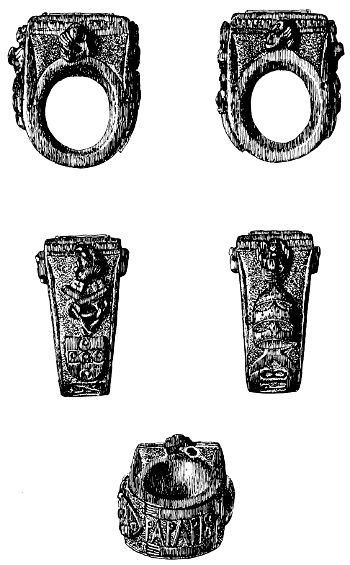
FIVE VIEWS OF THE RING OF POPE PIUS II (ÆNEAS SYLVIUS PICCOLOMINI, 1457–1464)
On the sides of the hoop are the coats-of-arms of the Piccolomini and Tiara families, and below the bezel are figures symbolical of the Four Evangelists
Albert Figdor Collection, Vienna

“Ring of the fisherman”
Fairholt’s “Rambles of an Artist”
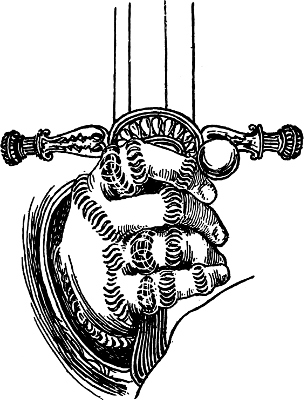
Hand of “Judith” from picture by Lucas Cranach: Rings beneath glove-fingers slit to give them room
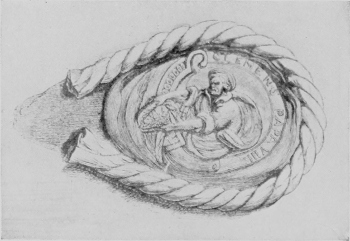
Impression of the Annulus Piscatoris (Ring of the Fisherman) of Pope Clement VIII (1592–1605)
Archæologia, vol. xl, p. 140
The ring is broken to prevent the sealing of any pontifical document during the vacancy of the papal see. When the army of the French Republic occupied Rome in 1798, the Republican emissary Haller, after informing Pius VI that he would be taken from Rome, demanded all his papal rings. After surrendering the others, the pope pleaded that he might be allowed to keep the Fisherman’s Ring, but as the Frenchman sternly insisted that this also must be given up, the pope reluctantly yielded. However, when on examination, the ring was found to be of small value, it was restored to the pontiff.
The earliest existing mention of the Fisherman’s Ring seems to be in a letter addressed by Pope Clement IV, in 1265, to his nephew Pietro Grossi of St. Gilles, in which he states that in addressing members of his family he used the Sigillum Piscatoris, the private seal of the popes.[420] It was not until the fifteenth century that this originally private seal came to be generally used for the papal Briefs. An impression of the Fisherman’s Ring of Clement VIII made in 1598, in the sixth year of the pope’s reign, is surrounded with a bit of twisted vellum. A comparison of this seal with the one used by Pius IX, shows the modifications of the established design due to the preferences of the engravers of successive rings. The ring of Pius IX was of plain gold, weighing about an ounce and a half, the design was engraved on an oval plate. It is said to have been made out of the gold constituting the Fisherman’s Ring of his predecessor, Gregory XVI.[421]
It is thought probable that the custom of breaking the Fisherman’s Ring on the demise of a pope was first instituted at the death of Leo X in 1521. The papal engravers are believed to have kept a new ring ready in case of sudden need, leaving a blank space for the new pope’s name. When his election has been confirmed, the Cardinal Camerlengo places the ring on his hand, asking him at the same time by what name he elects to be called. The ring is then removed and given to the engraver for the addition of this name. In later times it has been kept permanently in the guardianship of the Cardinal Chamberlain, and has not been generally used for stamping documents, an iron die of like design being employed for this purpose.
In at least one instance this ring was not destroyed at a pope’s death. When Pius VI expired at Valence, Aug. 29, 1799, his Fisherman’s Ring was left unbroken and, with a new inscription, served for his successor, Pius VII. When this latter pope fell into disgrace with Napoleon in 1809, because he refused to nullify the marriage of Jerome, Napoleon’s brother, to Miss Patterson, he was carried off from Rome to France, and obliged to surrender his Annulus Piscatoris to General Radet. Before relinquishing it, however, he took the precaution of having it cut down the middle. Later when he was restored to the Roman See, a substitute ring was made, as the original, given back by Louis XVIII after Napoleon’s downfall, could no longer be used because of its mutilation.[422]
Besides the Fisherman’s Ring, the popes now have two others, the papal ring which they habitually wear, and the pontifical ring, which is only assumed for the pontifical ceremonies. The pontifical ring of Pius IX was worth more than $6,000. It is of gold, of remarkably fine workmanship, and is set with a magnificent oblong brilliant. This ring could be made smaller or larger at will, so that it might serve for future popes.[423]
By a special privilege the ring ordinarily worn by a pope may bear a cameo, that usually worn by Pius IX showed an image of the Virgin Mary. The Fisherman’s Ring is but rarely worn. When after a pope’s death, the ring has been broken, as we have noted, a cheap facsimile, or the broken ring, is sometimes buried with the pope.[424]
Of the three main classes of ecclesiastical rings, the pontifical ring with its single precious stone, worn over a glove and exclusively at pontifical ceremonies, is so large that its stone setting covers the first phalanx of the fourth finger of the right hand, on which it is worn. The “gemmed ring,” a mark of distinction, may have but one stone, or a central stone surrounded by brilliants, just as the regulations provide. A third class of ecclesiastical rings are those of plain gold, commonly with a smooth chaton; sometimes, however, this may be engraved with armorial bearings, so that the ring can be used as a signet. In Rome those who have received the degree of doctor of divinity have the word ROMA engraved upon the chaton of the ring.[425]
One of the earliest notices of a bishop’s ring, not however in the strictly ecclesiastical sense, but of one worn by a bishop, is given in a letter written by St. Avit, Archbishop of Vienne (494–525), to his colleague, Apollinaris, Bishop of Valencia (ca. 520): “The ring you have been kind enough to offer me should be made as follows: In the middle of a very thin iron hoop, representing two dolphins facing each other, a double seal should be set by means of two pivots, so that either side may be shown or hidden at will and in turn, and offer, alternately, to the eyes a green stone or a pale electrum. Let not this metal be as I have sometimes seen it, easily tarnished in the cleanest hands, and similar to the impure mixture of gold that has not been exposed to the fire; let it not resemble the alloy which formerly the king of the Goths introduced into his coinage, an emblem of his downfall. Let my electrum be of a medium color, having at once the tawny hue of gold and the whiteness of silver, precious by their union and enhancing the brilliant green of the emerald when it appears. Let my monogram be engraved on the seal surrounded by my name, so that it may be read. Opposite the setting, the middle of the ring shall be formed by the tails of the dolphins; to set between these an oblong stone shall be sought, pointed at the extremities.”[426] It will be noted that this was not a gold ring, but an iron one, and thus essentially different from the recognized episcopal rings.
The oldest formula used at the conferring of the pontifical ring upon a bishop, is found in the Sacramental of St. Gregory, 590 A.D. and, translated into English, runs as follows: “Receive this ring of distinction and honor, a symbol of faith, that thou mayst seal what is to be sealed, and reveal what is to be revealed, and that to believers baptized into the faith, who have fallen but are penitent, thou mayst by the mystery of reconciliation open the gates of the Kingdom of Heaven.” A much shorter formula is that in the Pontifical of Ecgberht, Archbishop of York; it reads: “Receive the ring of the pontifical honor that thou mayst be endowed with sound faith.” At present the following simple formula is used: “Receive the ring of faith as a sign that thou wilt guard the Bride of God, Holy Church, with undaunted faith.”
A very early mention of the true episcopal rings is to be found in the writings of Isidore, Archbishop of Seville from 601 to 636 A.D.[427] He definitely states that the ring was one of the canonical insignia of the episcopate and terms it “a sign of pontifical honor, or a seal of secrets,” adding that priests must keep many secrets confided to them hidden in their breasts as though beneath a seal.[428] At about the same time a decree of Pope Boniface IV, promulgated in the third council of Rome, in 610, mentions a pontifical ring, and in the fourth council of Toledo, in December, 633, a canon treating of the restitution to his office of an unjustly deposed bishop, directs that he be given anew his stole, his ring, and his pastoral staff.[429]
The liturgical kissing of a bishop’s hand usually means a kiss impressed upon the ring he is wearing at the ceremony. That in the works of Rabanus Maurus, Archbishop of Mainz (786–856), and in those of others of his time, no mention is made of episcopal rings of investiture, cannot be taken to prove that none were worn in this period, but only that they were not yet in general use.[430] The distinct evidence contained in the canon of the Council of Toledo, over which Isidore of Seville presided in 633, and the still earlier formula of investiture in the Sacramental of Gregory, 590 A.D., must be accepted as conclusive evidence that such rings were conferred.
Until after the eleventh century, almost all the Episcopal rings were used as signets and the Sacramental of St. Gregory alludes to this use. The ring was generally worn on the index finger of the right hand, the middle of the three fingers uplifted in conferring a blessing; but, when celebrating mass, the bishop transferred it from the index finger to the annular. At the present day it is always worn on this latter finger. The removal of the ring from the index is explained by Garanti,[431] as being an act of humility, since the ring was regarded as a kind of crown upon the index, “for sages say that the ring is the crown of the hand,” and this crown should be removed in the presence of Christ. In our day bishops wear but one ring, but in old pictures and effigies they are shown wearing several, and sometimes even a thumb ring. The celebrated portrait of Leo X, by Raphael, represents the pope wearing no less than six rings, and the hands of Julius II in Raphael’s portrait are adorned with rings of equal number.

PORTRAIT OF POPE CLEMENT IX (1667–1670) BY CARLO MARATTA
Ring with square-cut, beveled stone on fourth finger of right hand
Metropolitan Museum of Art, New York. Gift of Archer M. Huntington, Esq.

PORTRAIT OF POPE JULIUS II (1503–1513) BY RAFAEL
Six rings, three on each hand; on index, fourth and little fingers
Uffizi Palace. Florence.
While the sapphire eventually became the stone especially assigned for use in episcopal rings, the older specimens which have been preserved for us show that, in early times, many other precious stones were employed for this purpose. Indeed, the emerald, or some green stone, seems to have been given the preference at one time, if we can judge from the letter sent by Avitus, Archbishop of Vienne to Apollinaris, Bishop of Valencia. Besides rubies and emeralds, balas-rubies, turquoises, chalcedonies and even the opal were used, while pearls and garnets, also appear occasionally.
Possibly the earliest known specimen of an episcopal ring is in the treasury of the cathedral of Metz. It is believed to have belonged to Arnulphus, who was consecrated Bishop of Metz in 614. This ring, which has been sometimes ascribed to the fourth century, is set with an opaque milk-white carnelian.
An episcopal ring found at Oxford and now in the Waterton Collection, Victoria and Albert Museum, is a curious specimen of the adaptation of antique gems to Christian uses. The gold circlet is set with an antique plasma engraved with the bust of a female, the pagan original doing duty for some Christian saint, or perhaps for the Virgin Mary.[432] An intaglio of Jupiter-Serapis was provided by the monks of Durham with an inscription designating it to be a portrait of St. Oswald. Cameos were also used, on occasion, as we read in the enumeration of the precious stones and rings donated by Henry III to the shrine of St. Edward in Westminster Abbey,[433] the following entry: “j chamah in uno annulo pontificali.”
Occasionally a stone was taken from some antique ornament and set in an episcopal ring. Of this kind is the pierced sapphire in Mr. Waterton’s collection, and probably another ring described in the Wardrobe Books of Edward I and which belonged to Robert, Bishop of Coventry and Lichfield, who died in 1295. The old description calls this “a golden ring with a perforated ruby.”[434] The same records mention a gold ring with a sapphire, the ornament being, as was supposed, the work of St. Dunstan, who is reputed to have been a skilful worker in metals.
A letter written in 867 by Charles the Bald to Pope Nicholas I, mentions a ring sent to Ebbo, Bishop of Rheims, by Judith, the mother of Charles the Bald. This ring was given by the empress at the time of the birth of her son, so that Ebbo, who had been made bishop because of his piety and sanctity, should remember the child in his prayers. In later years, whenever the good bishop was in trouble, he used to send his ring to the empress with an humble petition for aid, and the letter of Emperor Charles was written as a result of a most earnest appeal of Bishop Ebbo, after he had been deposed from his office and subjected to persecution.[435]
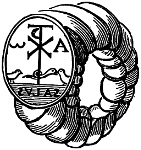
Christian ring of glass. Design shows snake and doves, a cross, the Greek letters alpha and omega and the Latin word Salus. Bosio.
“Roma Sotterranea,” Roma, 1650
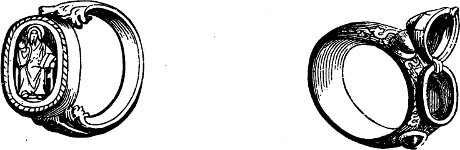
1, Venetian ring. Bezel with engraved figure of St. Mark is hollowed to enclose relics. 2, poison ring set with a diamond and two rubies. The poison was concealed beneath the bezel. See pages 36–39
Fairholt’s “Rambles of an Artist”
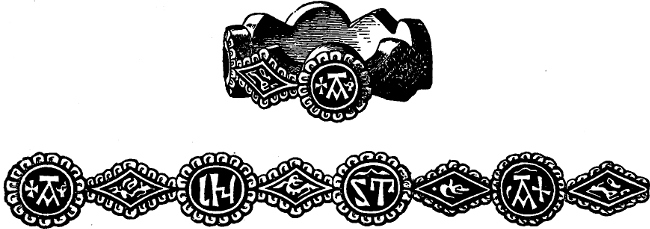
Gold ring of Ahlstan, Bishop of Sherborne (824–860 A.D.)
Archæological Journal, vol. xx, p. 226, 1863
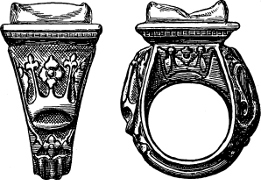
Bishop’s ring of investiture. Bezel set with flat crystal; two views. Said to have belonged to Robert of Anjou, King of Naples (1309–1343 A.D.)
British Museum

Lady’s memorial ring of enameled gold inscribed “R. C. Not lost but gone before,” in gilt letters on a white enamel ground. English, about 1800
Albert Figdor Collection, Vienna
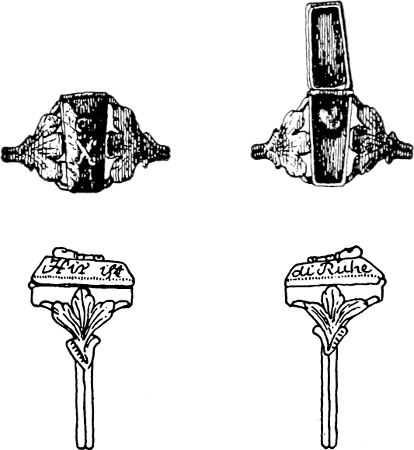
Mourning ring of gold. The head has the form of a coffin with skull and cross-bones on the lid. When this is lifted a heart is disclosed within. The hoop has two wires. On the sides of the coffin is inscribed: “Hier ist die Ruhe” (Here is rest). German. Eighteenth Century
Albert Figdor Collection, Vienna

Massive silver mourning ring inscribed in Old French, dort couat (rest in peace). Found at Huy near Statte, Belgium. French. Fifteenth Century
Albert Figdor Collection, Vienna
It is said that only one episcopal ring from Anglo-Saxon times has been preserved in England. This relic forms part of the Waterton Collection in the Victoria and Albert Museum; it is of gold, nielloed, and shows the letters of the name Ahlstan. This name was borne by a Bishop of Sherborne who held the office from 824 to 867 A.D., his death occurring four years before the accession of Alfred the Great.[436]
Niello is a mixture of silver, copper, lead, crude sulphur, and borax; frequently a little antimony is added. The mixture is fused and pressed into the design engraved upon a silver plate; when it has cooled off it forms a deep black, brilliant, and tough, though not hard, substance, like an enamel. The antimony on cooling, spreads slightly, thus obviating any danger of undue contraction of the alloy, which might fail to fill out the design exactly; occasionally, however, the antimony expands unequally, producing some slight irregularities of outline or surface. Sometimes the alloy is applied to the silver background of the design, instead of to the design itself, so that the latter appears white against a rich dark foundation. This variety of enamelling was already used in Roman times; in our day it is most extensively employed in Russia, where very beautiful work of the kind is done, the lines being of hair-like fineness and delicacy.
In 886, at the degradation of two bishops who had been consecrated without the consent of their metropolitan, their episcopal vestments were rent, their croziers broken on their heads, and their episcopal rings rudely snatched from their fingers. Here, as in cases of military degradation, the ignominious removal of the insignia of rank served to give public emphasis to the sentence passed upon the condemned.[437]
The Cathedral of Chichester has yielded a number of fine specimens of mediæval episcopal rings. Notable among these as a curiosity is one that belonged to Bishop Seffrid who died in 1151, for it is set with a Gnostic gem showing the well-known cock-headed figure generally cut to represent the divine principle the Gnostics called Abrasax (or Abraxas). This is an intaglio on jasper, and the ring was found in the bishop’s tomb. The fact that he was willing to wear it shows either that he was ignorant of its being a Gnostic, and hence an heretical design, or else that he was more than usually tolerant. Another of the Chichester rings came from the tomb of Bishop Hilary (1146–1169); it is of massive gold and is set with a sapphire. When the tomb was opened the ring was on the thumb of the skeleton. In a stone coffin on which were cut the letters Episcopus, with no personal name, there was found a ring adorned with an octagonal sapphire, on four sides of which was set a small emerald. As the sarcophagus contained a pastoral staff and remains of a vestment, this was undoubtedly an episcopal ring. It will have been remarked that of these rings two were set with sapphires, but the ring of Archbishop Sewall (d. 1258), found in his tomb in the Cathedral of York, and that from the tomb of Archbishop Greenfield (d. 1315), were each set with a ruby.[438]

Gold ring with inscription. “Buredruth” is probably a personal name, and the Greek characters alpha and omega should have a religious significance. Late Saxon
British Museum
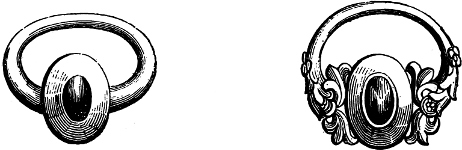
Episcopal rings. 1, found in York Minster, tomb of Archbishop Sewall (d. 1256); 2, found in tomb of Archbishop Greenfield (d. 1315)
Fairholt’s “Rambles of an Artist”
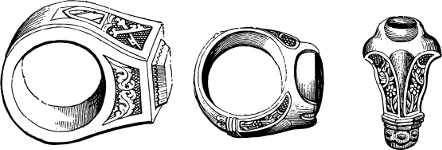
1, Papal ring set with large crystal, Londesborough Collection; 2, ring of Bishop Stanbury of Hereford (1452–1474). Found in his tomb, 1843; two views
Fairholt’s “Rambles of an Artist”
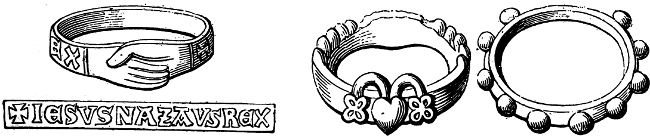
1, silver ring, two clasped hands; inscription signifies Jesus Nazarenus Rex. 2 and 3, rosary rings, with bosses used to count the prayers recited
Londesborough Collection.
Fairholt’s “Rambles of an Artist”
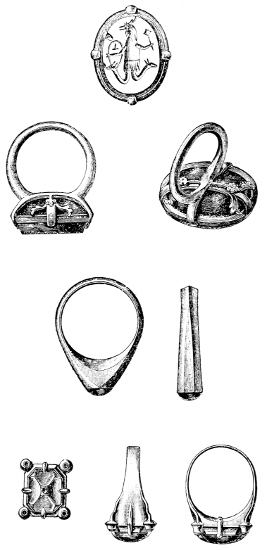
1, gold ring set with Gnostic intaglio on jasper. Found in tomb of Seffrid, Bishop of Chichester (1125–1151); three views. 2, gold ring set with a sapphire. Found in tomb of Hilary, Bishop of Chichester (1146–1169); two views. 3, gold ring set with a sapphire and four emeralds. Found in tomb of unknown bishop
Archæological Journal, vol. xx. pl. opp. p. 235; 1863
The mystic significance of the episcopal ring as typifying the union of Christ with his Church was expressed by Innocent III (1198–1216) in these words: “The ring is a sacrament of faith, by which Christ endows his spouse the Holy Church.”[439] This can be taken as confirmatory of the theory that the episcopal rings were directly derived from the betrothal rings, and were not merely attributes of ecclesiastical rank. So closely was the Bishop bound to his see, that his abandonment of it to go to another was regarded by some as equivalent to the commission of adultery.
A fine example of a sapphire-set episcopal ring was found in 1844, during some alterations to the chapel of Notre Dame in the Cathedral of Troyes. Several stone coffins were discovered, among them that containing the remains of Hervée, Bishop of Troyes, consecrated in 1206. The body was clothed in full episcopal vestments. The ring had fallen from the hand but was found at the left side of the body. It had a diameter of 2 cm. (about ⅘ inch) and was set with a fine oblong sapphire held in place by four claws.[440] The opening of the tomb of Pope Boniface VIII (1294–1303) revealed the presence, on the gloved hand of the dead pope, of a splendid gold ring, set with a sapphire of quite exceptional size and beauty.[441]
In 1804, at the opening of a thirteenth-century archbishop’s sepulchre in the Cathedral of Mainz, believed to be that of Archbishop Sigfroi III, 1249, a fine pontifical ring was found; it is set with a large ruby.[442] The bezel is of disproportionate size in comparison with the dimensions of the rather slender circlet.[443] This ring is large enough to be worn over a glove in accord with liturgical requirements. It has been noted that in process of time the width and thickness of the circlet were gradually increased, at first to make it harmonize better with a large bezel; gradually, however, both bezel and hoop were made so large as to render the ring a burden to the wearer, and even difficult to keep from slipping off the finger. Indeed, it was sometimes necessary to wear a second, closer-fitting ring under it as a guard.[444]
The treasury of Canterbury Cathedral contained in 1315, according to an inventory of the “Ornamenta Ecclesiastica,” a very rich and elaborate pontifical ring. It is described as a large square ring, set with an oblong emerald, four plasmas (leek-green quartz), and four garnets. The other episcopal rings listed on this inventory were set with sapphires bordered with small gems, one of them having a “black sapphire” set à jour, and held in place by claws. While at this period great latitude was exercised regarding the particular stone to be chosen for the chief adornment of the ring, it was required that it should be one of the more precious stones.[445]
The color of the stones chosen for the adornment of episcopal rings always had a symbolical significance. The glowing red of the ruby indicated glory, the clear blue of the sapphire, chastity and happiness, the pure white of the rock-crystal, guilelessness, while the hue of the amethyst called to mind the color of the wine used in the Holy Eucharist. The emerald, as is well known, signified by its green color the virtue of hope and also the Resurrection.
The general rule, expressed or understood, that a sapphire should be set in an episcopal ring, seems to have been more commonly observed in England in the earlier centuries than it was on the Continent. Undoubtedly many of these stones were obtained at the time of the Crusades. As English examples, Mr. O. M. Dalton cites the rings of three early bishops,[446] namely, those of Flambard (1099–1128), Geoffrey Rufus (1133–40) and William de St. Barbara (1143–52), now in the Durham Chapter Library; all have sapphires. The same stone serves as setting for the ring of William of Wykeham, a massive plain gold hoop, exhibited by the Dean of Winchester at South Kensington in 1862, to which the cathedral also contributed a thirteenth-century episcopal ring set with a large sapphire cut en cabochon.[447] There is as well the ring of William Wytlesey, Archbishop of Canterbury (d. 1374) in the possession of Sir Arthur Evans and that of John Stanbery, Bishop of Hereford (d. 1474). The inventory of 28 Edward I lists sapphire-set rings of the archbishops of Dublin and York as well as of the bishops of Salisbury and St. Asaph. The rebel Piers Gaveston, favorite of Edward II, carried off with him, among other royal jewels, sapphire rings that had belonged to the Bishop of Bath and Wells and to the Abbot of Abingdon. In the inventory of Elizabeth’s favorite ecclesiastic, Archbishop Parker of Canterbury, is listed “a ringe with a blewe sapphire,” valued at four pounds sterling.
Old records show that even in the fourteenth century, the sapphire, although greatly favored for prelates’ rings, did not yet enjoy any exclusive preference.
For example, during the reigns of Clement V, and John XXII, in Avignon (1307–1334), the papal registers for 1317 note, in one case, “seven gold rings with various stones for new cardinals, 68 gold florins.” This, however, is followed by another entry recording “four gold rings with Oriental sapphires for the consecration of prelates, 26 gold florins,” and again “a gold ring with an Oriental sapphire for Cardinal A, 23 florins.” Three years later, in 1320, we have “seven rings for the seven new cardinals, three set with Oriental sapphires, three others with Oriental emeralds, and one with a balas-ruby, the total cost being 106 gold florins.”[448]
That the topaz at one time shared with the sapphire the honor of being especially fitted for use in ecclesiastical rings is shown by a passage in a rare fourteenth-century manuscript written in Italy. Here we are informed that the topaz was the most honorable of stones “above all other stones,” and that for this reason the great prelates wore it on their fingers.[449]
The green variety of tourmaline found in Brazil, and often called “Brazilian emerald,” was for a long time and is now used quite freely in Brazil as a setting of episcopal rings.[450] While this is a departure from the general usage of selecting a blue stone, preferably sapphire, for this purpose, it nevertheless finds a parallel in the employment of emeralds for bishops’ rings in quite ancient times, as is the case with one of the earliest of these rings, that described, or we should rather say proposed, in the letter of St. Avitus, Bishop of Vienne in France.
When a prelate has been raised to the rank of cardinal, he has to resign any ring he may have been entitled to wear previously, and awaits the bestowal of the special cardinal’s ring by the pope. It is conferred by the pope personally at the consistory wherein he assigns a title to the newly-chosen cardinal. This ring is made by a pontifical jeweller; it is of gold, with a sapphire in the bezel and, on the inside, the arms of the Sovereign Pontiff. Withal it is rather inexpensive, the average cost having been put at about $32, although each cardinal is obliged to pay into the Congregation of the Propaganda the sum of $642 (3,210 francs) as a “ring tax.” This payment, however, gives him the valuable right of bequeathing his property as he pleases by testament; otherwise everything would go to the Church.[451]
As in many portraits of cardinals and high church dignitaries they are depicted as wearing two or more rings, it has been erroneously conjectured that each ring represented a separate benefice, there being thus as many rings as benefices. The ceremonial regulations, however, clearly indicate that the wearing of many rings is simply a matter of taste, all except that on the annular finger of the right hand being purely ornamental.[452]
A ring on the fourth finger of the right hand is shown in Carlo Maratta’s portrait of Pope Clement IX (1667–1670), given to the Metropolitan Museum of Art, New York, by Archer M. Huntington, Esq., in 1891. The ring bears no design, the setting being a large, square, beveled stone. The beard and mustache of the pontiff are of the type familiar to us in portraits of Cardinal Richelieu, who died in 1642.
A splendid example of the cardinal’s ring was recently made for Cardinal Farley. It is set with an exceptionally large and fine sapphire, of rounded oval form and an inch in length; the color is rich and deep; the stone weighs 18½ carats and is a Cinghalese sapphire. A bordering consisting of twenty-eight diamonds surrounds the central stone and serves to render more strikingly beautiful the rich blue of the sapphire, often called the “cardinal’s stone” because it is the one used for cardinal’s rings. This is noteworthy, as red is pre-eminently the cardinal’s color, as is shown in his robes, hat, etc.; hence we might rather expect that the ruddy ruby would have the preference. However, the fact that the sapphire denotes chastity and celestial purity has caused this stone to be chosen for the adornment of the rings worn by those who, from their exalted ecclesiastical rank, are more especially called upon to set a high example to the priesthood. The shank of Cardinal Farley’s ring is one of the most beautiful examples of American goldsmithing in existence. The chasing of the circlet shows on one side the ample facade and the lofty spires of St. Patrick’s Cathedral in New York, and on the other side emblems of the cardinalate. It was the gift of a priest who has known the Cardinal for many years.[453]
When the Right Rev. David H. Greer was consecrated Bishop of New York, some of his friends presented him with a very handsome amethyst signet, but unfortunately this tribute was stolen from his home by burglars, two or three years ago. When necessity arises of making an official signature he uses a steel impression stamp of the seal of the diocese. He has a facsimile impression stamp of the seal which was stolen, but he seldom or never uses this.[454]
The amethyst seal of Bishop Greer bore for its motto, “Crux Mihi Grata Quies” (The Cross is for me a grateful rest). This is the motto of Mrs. Greer’s family. On the shield is the monogram of the bishop’s initials, D. H. G.; above are two keys in saltire; on the lower part of the shield just beneath the monogram, is the coat-of-arms of New Amsterdam; as crest is an episcopal mitre. This was not, however, a seal ring.
The so-called “mitred abbots”, those who governed the larger monasteries, or whose notable services in the cause of the Church were thought to merit some special mark of honor, were sometimes given the right of wearing the episcopal ring at solemn ceremonies. We are told that at the deposition of Abbot Rainaldus, head of the great Benedictine Abbey of Monte Casino, not far from Naples, he publicly laid his staff and his ring upon the shrine containing the body of St. Benedict.[455]
The energy with which some of the leading theologians of the twelfth century protested against the use of episcopal rings by abbots, merits illustration by an extract from the writings of St. Bernard, who in a tractate addressed to Henri, Archbishop of Sens, writes:[456]
“Several have clearly enough indicated where were their thoughts when, having obtained apostolic privileges by many intrigues and by bribery, they appropriated to themselves and use, in virtue of these concessions, the mitre, the ring and the sandals, just as do the pontiffs themselves.... Oh, Monks, whither will this lead you? Have you banished all fear from your souls? Can the blush of shame no longer rise to your cheeks?”
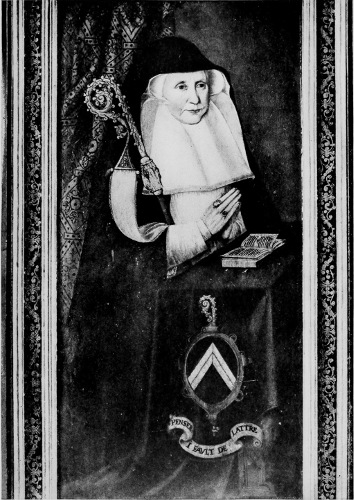
ABBESS PRAYING. FRENCH SCHOOL
Seal ring on index of right hand; ring with precious stone setting on fourth finger of the same hand
Musée du Louvre

PORTRAIT OF A LADY, BY CONINXBO
Two rings on index of right hand and two on index of left hand; smaller one on fourth finger of left hand
Musée de Bruxelles
Not only abbots, but abbesses also, are represented on their monuments as wearing rings, as for example Agnes Jordan, Abbess of the Bridgetine Convent of Syon, whose brass figure at Denham, Bucks County, England,[457] shows a ring on her finger. However, in 1572, the year of his accession to the papal throne, Gregory XIII abolished this custom; how long it had endured has not been determined.[458]
Certain other prelates of lesser rank than bishops have the right to wear rings, such as the protonotaries, for example, but as a rule they are not permitted to wear them while celebrating an ordinary mass, low or high; only when officiating pontifically may they wear pontifical rings. The ring commonly worn is much smaller than that accorded to a bishop and is set with a single stone, as is expressly ordained in the constitution Apostolicæ Sedis of Pius IX, dated in 1872.[459]
That the canons of a cathedral should generally be allowed to wear rings has been repeatedly decided adversely in the Roman Catholic Church, a recent instance being when the Bishop of Nicaragua submitted this question to the Sacred Congregation of Rites in Rome, because the practice had become common in Nicaragua. In reply he was informed that this must not be tolerated, except in case of a special indulgence from the pope, and the bishop was required to suppress the abuse. The reply was dated August 20, 1870, just a month before the entry of the Italian army into Rome and the cessation of the papal rule over the city.[460]
In a letter written December, 1751, Pope Benedict XIV relates the finding of a gold ring so small that it would fit the finger of a three-months’ old babe, and bearing certain characters indicating a priestly quality of the infant. This the pope understood not as signifying that it had been made a deacon, but that its parents had consecrated it to the service of the church, so that it should later become a monk or priest.[461]
His Grace, the Most Reverend Archbishop Evdokim, the highest dignitary of the Russian Church in the United States, has stated that neither the Metropolitan, nor the Archbishops nor clergy of the Russian Church wear rings of any kind. They use seals but these are not in the form of signets. In this respect, the usage differs from that in many other churches.
The ring given to the King of England at his coronation bears a close relationship to the episcopal ring, and emphasizes the religious authority of the sovereign. This appears very clearly in the English ceremonial, where the Archbishop of Canterbury pronounces the following prayer of consecration:
Bless, O Lord, and sanctify this Ring, that Thy servant, wearing it, may be sealed with the ring of faith, and by the power of the Highest be preserved from sin; and let all the blessings which are found in Holy Scriptures plentifully descend upon him, that whatsoever he may sanctify may be holy, and whatsoever he may bless may be blessed. Amen.[462]
The Coronation Ring of the English kings is of pure gold and is usually set with a large table ruby of a violet hue, the flat surface engraved with the figure of a St. George’s cross. About the ruby are set twenty-six diamonds. As the ring is designed to serve for successive coronations, the circlet is jointed so as to fit a larger or smaller finger. A queen consort is given at the ceremony of coronation a ring of pure gold also bearing a ruby, but unengraved; about the stone are sixteen smaller rubies, so graded as to size that the largest are placed nearest to the central stone, the size diminishing as the distance increases. The ruby has been chosen as emblematic of faithfulness. These rings are put on the fourth finger of king and queen, and the king’s ring is called by some writers “The Wedding-Ring of England,” the sovereign being regarded as espoused to the nation over whose welfare he is to watch.[463]
The coronation ring of William IV of England, although scarcely a notable example of the jeweller’s art, is striking enough in its way. In many earlier coronation rings, for which the ruby (or a spinel) was the stone traditionally favored, a St. George’s cross was engraved on the ruby, but in the case of William IV’s ring the cross is formed of five rubies, a square central stone and four oblong ones for the arms of the cross, all set over a large cabochon-cut sapphire, this affording a blue background for the red cross, similar to the blue field of the cross of St. Andrew. There is also a bordering of brilliants. This ring while effective enough in the sharp contrast of color, is lacking in harmony and taste.[464]
The insignia of the Prince of Wales include most of the emblems belonging to royal insignia, and each of them has its especial and peculiar significance. Unity is typified by the ring; the coronet is an emblem of friendship. The staff in conjunction with the ring suggests the religious side of the princely or royal office, for these emblems form an important part of the episcopal insignia. A special local association results from the fact that Welsh gold, mined by Welshmen in the Merionethshire mines, is used in the manufacture of these ornaments. A gold medal bearing the head of the Prince of Wales on the obverse, and on the reverse a representation of the Eagle Tower of Carnarvon Castle, was struck for the present holder of the title.
At the coronation ceremonies of the kings of France, the officiating ecclesiastic said to the sovereign in handing him the Coronation Ring: “Receive this ring, a symbol of holy faith and of the stability of the Kingdom, a sign of power, by which thou shalt be able to defeat all enemies with triumphant power, to destroy all heresies, to unite all subjects and to maintain them constantly bound together by the Catholic faith.” This formula dates back at least as far as 986 A.D., and was probably in use at an even earlier date.[465] The close union of Church and State is strongly emphasized, as well as the necessity for uniformity of belief, this having been a source of strength for the State when voluntarily present, but a cause of manifold and dreadful misfortunes when the religious convictions of the subjects became discordant.
When a nun is consecrated the priest places a ring on her finger, reciting the following words from the Roman pontifical:
I espouse thee to Jesus Christ, Son of the Supreme Father, who will preserve thee from all ill. Accept, therefore, this ring of faith, a symbol of the Holy Spirit, that thou mayst be called a spouse of God, and be crowned for ever.
Before the rings are bestowed they are heaped up on the altar and are collectively blessed by the officiating priest. As the formula used defines the character and quality of the ring more closely than do the simple words of presentation, it is here given as follows, this formula already appearing in the pontifical of Pierre, Bishop of Senlis, 1350:[466]
Creator and preserver of the human race, grantor of spiritual grace and bestower of bodily health, O God, send forth thy blessing upon these rings that those who may wear them, shall possess celestial virtue, perfect faith and true fidelity, shall maintain, as spouses of Christ, their vow of virginity, and shall persevere in constant chastity. By Christ Our Lord.
A pretty usage was observed at the reception into the order of the Augustinian nuns of Saint Thomas, at Villeneueve. On taking the vow, a ring was placed on the nun’s finger by a poor little girl, who said at the same time: “Remember, dear sister, that you have become this day the spouse of Jesus Christ and the servant of the poor.” The sister, after having respectfully accepted the gift made her by one who represented the Lord, kisses the child who has reminded her of the poor to whose service she is consecrated.[467]
According to an old recital, a miraculous ring was once found by a pious nun in the convent garden. One day when she was engaged in tending a bed of flowers, there came over her the ardent wish to receive a divine sign in the shape of a ring, testifying to the reality of her espousal with Christ. The Lord answered the fervent aspiration of his handmaiden, for suddenly there appeared before her in the flower bed an actual ring, no deception of the senses, but a material body. This story is related by Johann Nider in his Latin work, “Formicarius,” published in Strassburg in 1517, and the writer asseverates that he saw the ring, which was of a white substance resembling pure silver.[468]
A Ring of Widowhood, sealing a widow’s vow to remain faithful to the memory of her dead husband, was not rarely bestowed, three or four centuries ago, to serve as a mark of the solemn vow. A noteworthy instance is that of Katherine Rippelingham, who, in her will dated February 8, 1473, describes herself as “advowes” (“vowed”), and expresses the wish to be interred in “Baynardes Castell of London.” In a codicil she leaves to her granddaughter, Alice St. John, “her gold ring with a diamante therein wherewith she was sacrid,” or consecrated. In another will, that of William Herbert, Lord Pembroke, the wife is enjoined to remember her promise that she will take the order of widowhood, so that, as the testator continues, “ye may be the better maistres of your owen, to perform my will, and to help my children, as I love and trust you.”[469]
In view of the bad results of a second marriage when a widow falls into the hands of some designing man, to the destruction of her children’s welfare, this usage, so long discontinued, of binding herself by a solemn vow, had something to recommend it in times far past, when more stress was laid upon the sanctions and prohibitions of religion than is generally the case in our day.
At a solemn ceremony of this kind, held at the Priory of Campsey, in 1382, during the reign of Richard II, Isabella, Countess of Suffolk, took the vow in the presence of the Earl of Warwick, Lords Willoughby and Scales, and other nobles. The old Norman French form of her pledge has been preserved and may be given here for its historic interest: “Jeo Isabella, jadys la femme William de Ufford, Count de Suffolk, vowe à Dieu, en presence de tres reverentz piers en Dieu, évesques de Ely et de Norwiz, qe jeo doi estre chaste d’ors en avant ma vie durante.” (I, Isabella, formerly the wife of William de Ufford, Count of Suffolk, vow to God in presence of the very reverend fathers in God, the bishops of Ely and of Norwich, that I shall remain chaste from now on during my entire life.)[470]