III SIGNET RINGS
Reading edition
If we pass over the scene between Judah and his daughter-in-law Tamar, related in Gen. xxxvii, 12–26, where the patriarch leaves his signet (not necessarily a signet ring) his bracelets and his staff, as pledges for a promised gift, the earliest Hebrew notice of a ring is in Genesis xlii, 42, where we read that in return for the interpretation of his dream and for the valuable counsel as to laying up a stock of grain in Egypt to forestall a coming famine, the Pharaoh of the time “took off his ring from his hand, and put it upon Joseph’s hand.” This might refer to a period about 1600 B.C., or possibly somewhat earlier, always providing the tradition be accepted as in a certain sense exact. Centuries later, in the Desert, when the Lord commanded offerings for the Tabernacle, the Ark of the Covenant, and for the ephod and breastplate, among the gifts proffered are enumerated “bracelets, earrings, and rings” (Exodus, xxxv, 22). The Book of Daniel, written not earlier than the sixth century before Christ, and more probably, in its present form, a work of the second century B.C., relating the imprisonment of Daniel in the lions’ den, states that when at the reluctant command of King Darius he was shut up therein, “a stone was brought, and laid upon the mouth of the den; and the king sealed it with his own signet, and with the signet of his lords” (Dan. vi, 17). Still, these might have been of the well-known Babylonian type of “rolling seals” and not rings.
The Book of Esther, however, of later date than Daniel, makes definite mention of the signet ring of the Persian monarch called Ahasuerus (Artaxerxes) in the Biblical text, and while the recital can scarcely be accepted as historical in any sense, the details of custom and adornment are probably quite trustworthy. On investing Haman with a great authority, Ahasuerus “took his ring from his hand and gave it unto Haman,” whereupon the latter summoned the king’s scribes and had them write letters to the provincial governors—instructing the latter to kill all the Jews in the kingdom on the thirteenth day of the month Adar; each of these letters was “sealed with the king’s ring.” Before this dire disaster could be consummated, the royal favor was gently swayed in an opposite direction by the grace and charm of Esther, the Hebrew favorite of the sovereign, and the wicked Haman was hanged on the tall gallows he had set up for Mordecai, Esther’s guardian, on whom the ring stript from Haman’s hand was bestowed. In spite of the somewhat confused recital, one point is always strongly brought out, that the impression of the royal signet imparted to letters or documents the quality of royal ordinances.
In Persia the power and authority attributed to the ring of the sovereign is noted by the Persian poet Unsuri (fl. 1000 A.D.), and in the legends of that land the famous though fabulous hero-king, Jemshid, is said to have had a magic ring of wondrous power. Among the Persians, as in many other Oriental countries, the signet-ring was long considered to be a symbol of authority.[189]
The gold ring of Queen Hâtshepset (about 1500 B.C.), consort of Thothmes II, whose prenomen, Maât-ka-Ra, signifies “flesh and blood of Amen Ra,” is set with a lapis lazuli scarab inscribed with the above words.[190] Another ring with lapis lazuli setting is that of Thothmes III, whose titles, Beautiful God, Conqueror of All Lands, Men-kheper-Ra, are inscribed on one side of the rectangular stone above a design representing a man-headed lion in the act of crushing a prostrate foe with his paw.[191] A steatite scarab, set in a gold ring, bears the name of Ptah-mes, a high priest of Memphis.[192] Another steatite ring-scarab is inscribed with the name and title of Shashank I, the Shishak of the Bible, who reigned about 966 B.C.[193]
The gold signet ring of Aah-hotep I, queen of Seqenenra III (1610–1597 B.C.) of the XVII Dynasty, was found with a wealth of other jewels at Draa-abul-Nega, the northern and most ancient part of the Theban necropolis. This queen had an unusually long and eventful life. The records clearly indicate that she must have been one hundred years old, or very nearly that age, at the time of her death, and while her youth was passed at the end of the period of the oppressive rule of the foreign Hyksos kings, she lived to witness the glorious revival of native Egyptian rule under her husband, son and grandson. This ring is now in the Louvre Museum.[194]
An interesting Egyptian signet bears the cartouche of Khufu, the second ruler of the IV Dynasty (ab. 3969–3908), the Cheops of the Greeks (Manetho’s Suphis), in whose reign the greatest of the pyramids was built. The worship of Khufu continued to a late period of Egyptian history, and this signet belonged to a Ra-nefer-ab, priest or keeper of the pyramid under the XXVI Dynasty, 664–525 B.C.[195] The ring is of fine gold, and weighs nearly ¾ ounce; it was found at Ghizeh by Colonel Vyse, in a tomb known as Campbell’s Tomb, and was acquired in Egypt by Dr. Abbott, who gathered together a choice collection of Egyptian antiquities during a residence of twenty years in Egypt. In 1860, this collection was given to the New York Historical Society through the liberality of citizens of New York.[196]
The rings of the Minoan and Mycenæan periods from about 1700 B.C. to 1000 B.C. offer a great variety of engraved designs, some in relief and others in intaglio, but all destined it seems for use as signets. Undoubtedly these rings derive in the last instance from Egyptian influence, their especial characteristics, however, are early Greek, but rarely Egyptian, as in the case of a bronze ring with a sphinx in relief found in the necropolis of Zafer Papoura near Knossos in Crete.
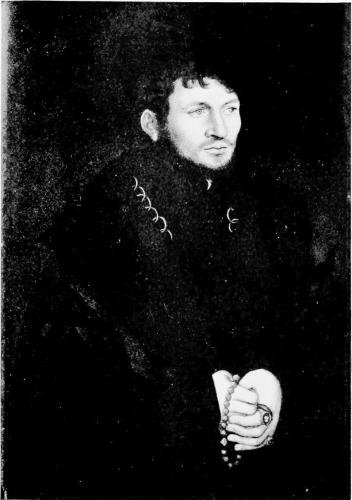
PORTRAIT OF A MAN, BY LUCAS CRANACH THE ELDER (1472–1553)
Seal ring on index of left hand with plain ring beneath it; ring with precious stone setting on little finger of the same hand
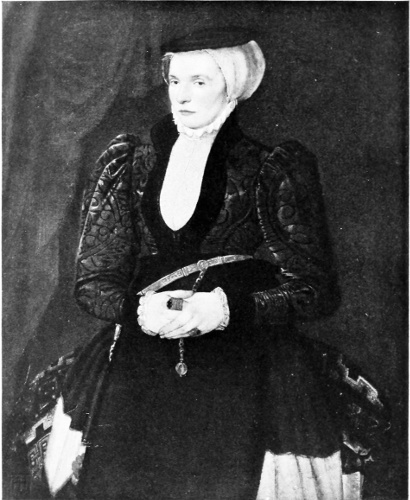
PORTRAIT OF KATHARINA AEDER, WIFE OF MELCHOW HANLOCHER, BY HANS BOCK THE ELDER
Gem and serpent ring on right forefinger, and three rings on left fourth finger
Art Gallery at Basel, Switzerland
Many of the Mycenæan engraved rings were evidently not intended to be used for sealing, as the intaglio is frequently very shallow, and as the proper position of the parts of the body would not be rightly shown in an impression. Hence these rings must have been designed simply for wear as ornaments. The hoop is often astonishingly small, so much so that it will not pass down onto the third finger-joint of an average man’s hand, and would only fit the very slender finger of a woman.[197]
Some remarkably fine rings are in the Cesnola Collection of Cypriote Antiquities in the Metropolitan Museum of Art, New York. Among them two serpentine rings of gold are well worth noting. In one of these the coil has six turns which are brazed together; at either end is a ram’s head. The other ring shows a serpent of two full coils, with erect head and curved neck and tail; scales are marked at the ends. The bands of the ring are smooth and plain.[198] Many of the rings are of the swivel type and are set with artistically engraved scarabs. In one of these the scarab is of green plasma, translucent but somewhat clouded; the cutting is well executed. The bottom shows two wrestlers, each entirely nude with the exception of a short ribbed apron about the loins. Behind each is an erect uræus (the serpent emblem of Egyptian divinities and kings), with wings like those of the goddess Mut, extended in protection. Between the wrestlers, on the ground, is an object resembling a wolf’s head. The bow and collet of this signet are of gold. The plasma scarab in another of these swivel rings has been pronounced to be a perfect example of this form. The stone is a pure green and the scarab has been decorated with two seated, winged androsphinxes (with man’s head and lion’s body), the paws raised before the sacred tree between them; the symbol of lordship, neb, is placed below. The hoop is a plain, thin wire.[199]
Two massive ivory rings were found in the course of excavations at Salamis, on the island of Cyprus. One was set with an oval disk of green glass, and was of the type used for sealing amphoræ of wine. The other bears the head of a woman in bas-relief; this is probably a cameo of Arsinoë.[200]
The story of the ring of Polycrates, tyrant of Samos (d. 522 B.C.), is related by Herodotus[201] (b. 484 B.C.), who, writing less than a century after the death of Polycrates, may probably give us the main facts with reasonable accuracy. According to this account, Polycrates had formed an alliance with Amasis, King of Egypt, and the latter began to fear that the unbroken good fortune of the Samian ruler would arouse the jealousy of the gods; he therefore counselled Polycrates to throw away his most prized treasure. This was a splendid emerald, set in a gold ring, and engraved by Theodorus of Samos, the supreme master of the art of gem engraving in that age. Acceding to the request of Amasis, Polycrates sailed out to sea on one of his ships and cast the precious ring into the waters. However, the gods refused the gift, for not long afterward the tyrant’s chief cook brought him back the ring, which had just been found in cutting up a fish. News of this occurrence was sent to Amasis, who immediately broke off the alliance, since he believed that the gods were implacable, and would visit Polycrates with downfall and destruction. This, indeed, proved to be the case, as a few years later the tyrant was inveigled into the power of Orœtes, a Persian satrap, and was put to death by crucifixion.
The design engraved upon this ring was a lyre, if we can trust the statement to this effect made centuries later by Clemens Alexandrinus.[202] Strange to say Pliny, who relates the story quite fully, asserts that in the Temple of Concord there was shown the supposed gem of the famous ring of Polycrates. This was an unengraved sardonyx, set in a golden cornucopia, and had been dedicated to the temple by Augustus. Pliny is careful to write “if we may believe,” in reporting this almost certainly spurious treasure of the Temple of Concord. Probably the attribution was nothing more than an invention of the custodians to enlist the interest of visitors.
A corroboration to a certain extent of the tradition that the seal of Polycrates was cut on an emerald is given by the existence of a small engraved emerald of about this period, found in Cyprus, and evidently of Phœnician workmanship. It bears the figure of a sovereign holding a sceptre in one hand and an axe in the other; on his head is a high tiara and the arrangement of hair and beard, as well as the dress and other details, are of Ægypto-Syrian type. This gem formed part of the Tyszkiewicz Collection.[203]
In a recently published work, M. Salomon Reinach, of the National Museum at St. Germain-en-Laye, an archæologist of the highest repute, makes a curious conjecture in regard to the real significance of the story related by Herodotus regarding this signet. M. Reinach holds that when Polycrates sailed out to sea to cast away his ring, he was engaged in the performance of a ceremony similar to that performed annually by the Doges of Venice, when they wedded the Adriatic by casting a ring into its waters. Polycrates, as a “thalassocrat,” or ruler of the sea, celebrated in this way his mastery over this element, and M. Reinach believes that this act, told as an isolated happening by Herodotus, was really a ceremony repeated each year. The conjecture is an ingenious one, although it may not be generally accepted.[204]
The signet of the Persian sovereign, Xerxes, is said to have borne the nude figure of a woman with disheveled hair.[205] This depicted Anahita, the Persian goddess of fertilization and also of war, a divinity closely resembling the Assyrian Ishtar in her attributes and functions. According to other ancient authorities, however, the design was either a portrait of Xerxes himself, that of Cyrus the Great, or else a representation of the horse whose neighing legend states to have been received as an omen determining the choice of Darius Hystaspes, father of Xerxes, as King of Persia.
In Græco-Roman times, a certain Eurates is represented to be the owner of a ring set with an engraved signet bearing the head of the Pythian Apollo, and to have boasted that the ring literally “spoke” to him. Of course, the satirist Lucian, who tells this tale, only offers it as a specimen of the lies told by Eurates, still the recital indicates that such fables were credited in the second century of our era.[206]
Another superstitious use of signet rings was to throw a number of them into a heap and pull out one at random, the design engraved on the signet being interpreted as a favorable or unfavorable omen, which foretold the outcome of any contemplated action. An instance of this appears in Plutarch’s life of Timoleon (d. 337 B.C.), the Greek general who freed Syracuse from the tyrant Dionysius. In one of his campaigns the enemy had taken up a strong position behind a river, which the troops of Timoleon were forced to ford. A noble rivalry sprang up among the officers as to who should be the first to enter the river, and Timoleon, fearing that confusion would result from the dispute, decided to settle the question by lot. Therefore he took from each of the officers his signet ring, cast them into his own cloak, shook them together, and drew out one, which fortunately bore the figure of a trophy. This was hailed as a good omen, the quarrel was forgotten, and the stream was forded so impetuously, and the attack was so vigorous that the enemy was overwhelmed.[207]
After his Persian conquests, in 331 B.C., Alexander the Great sealed the letters he sent to Europe with his old seal, while for those sent to functionaries in his new Asiatic domains he used the seal of Darius III, Codomannus (reigned 336–330 B.C.), whose daughter Statira he afterwards wedded. Quintus Curtius regards this as emblematic of the idea that a single mind was not wide enough to embrace two such destinies,[208] but the true reason was undoubtedly that the Asiatic officials were already familiar with the Persian sovereign’s seal and were accustomed to render it due obedience.
The emblem of the anchor used by the Seleucidæ, the dynasty founded in Syria by Seleucus Nicator, one of Alexander’s generals, is said to have originated in a strange dream of Laodicea, mother of Seleucus and wife of Antiochus. One night she dreamt that she was visited by the God Apollo, and that he bestowed upon her a ring set with a stone on which an anchor was engraved. This was to be given to the son she was to bear. As such a ring was found in the room the next morning, the dream seemed to be thoroughly corroborated, and, moreover, when Seleucus was born, he had on his thigh the birthmark of an anchor. Subsequent to Alexander’s death in 323 B.C., Seleucus founded, in 312 B.C. the kingdom of Syria, which was transmitted to a long series of his descendants, each of whom in turn is said to have borne a similar birthmark.[209]
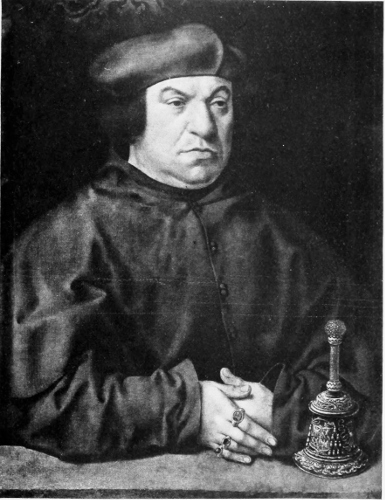
CARDINAL OF BRANDENBURG, BY THE MASTER OF THE DEATH OF MARY
Seal ring on index of right hand; rings set with precious stones on fourth and little fingers of the same hand
Reale Galleria Nazionale, Rome

PORTRAIT OF A MOTHER AND HER DAUGHTER, BY BARTHOLOMEW BRUYN
Three rings on right hand, one with a pointed diamond; also three rings on left hand, two on index finger; the one on the fourth finger set with two pearls
Imperial Hermitage, Petrograd
In the Hellenistic period (ca. 300 B.C.-ca. 100 B.C.) signet rings entirely of metal largely gave place to those in which the seal was engraved on a stone set in a metal ring. Chalcedony continued to be freely used for this purpose, but the employment of the choicer and harder precious stones from India, transparent and brilliant, and of deeper coloring, characterizes this period. In the front rank is the jacinth, unknown in earlier times, with its wonderful ruddy hues. This is the favorite stone of the time. Usually the gem is given a strongly convex form in order to bring out better the play of color. Scarcely less favored than the jacinths were the garnets, also cut in a convex shape; in many cases the under side was cut slightly concave to enhance the effect. Evidently, however, garnets were less prized than jacinths, for the engravings on the former are almost without exception much inferior to those on the latter. Sometimes, in this period, unengraved garnets, cut convex, are used for ring adornment. Another precious stone that makes its first appearance in the Hellenistic epoch is the beryl, which, because of its costliness, is more rarely met with than those we have already mentioned. It is only used for the very finest work, as is also the case with the topaz. The amethyst, which had almost gone out of fashion in the preceding periods, was now restored to favor, principally because of its beautiful color; like the other stones, it was cut convex. Rock crystal was still used, as were also carnelian and sardonyx.[210]
That cruel persecutor of the Jews, Antiochus IV, Epiphanes (175–164 B.C.), on his death-bed, confided to his most trusted councillor, Philip, the signet ring from his finger, that it might be held in trust for his son, a child but nine years old, until the latter should come of age and exercise the royal authority. In the meanwhile, the grant of the signet was equivalent to the bestowal of the regency upon Philip, as he had the power to affix the royal seal upon all edicts or ordinances. The son did not, however, live to receive the ring, as he only survived his father two years, although he was a nominal successor under the title, Antiochus V, Eupator.[211]
Two Greek epigrams in the Anthology, on engraved amethysts in signet rings, express the prevailing superstition regarding the sobering effect of this precious stone; these have been very well Englished by Rev. C. W. King.[212] One, by Antipater, concerns a signet of Cleopatra and runs in King’s version as follows:
A Mœnad wild, on amethyst I stand, The engraving truly of a skilful hand; A subject foreign to the sober stone, But Cleopatra claims it for her own; And hallow’d by her touch, the nymph so free Must quit her drunken mood, and sober be.
That this was really a ring-stone is proved by the Greek words “on the queen’s hand,” which King has not literally translated. The image was that of Methe, goddess of intoxication. The other epigram is shorter but to the same point:
On wineless gem, I, toper Bacchus, reign; Learn, stone, to drink, or teach me to abstain.
That admiration of a work of art on the part of an unscrupulous official is sometimes fraught with danger for the rightful ownership of the object, was illustrated in the case of a seal ring belonging to a Roman citizen of Agrigentum in Sicily. The arch-pilferer Verres, Roman governor of the island from 73 to 71 B.C., being on one occasion struck by the beauty of a seal impression on a letter just handed to his interpreter Vitellius, asked whence the letter came and who was the sender. The information was of course quickly given, and thereupon Verres, then in Syracuse, dictated a letter to his representative in Agrigentum, requiring that the seal ring should be forwarded to Syracuse without delay, and the owner, a certain Lucius Titius, was forced to give it up to the unscrupulous Roman governor.[213] The injustice of this act must have been felt all the more keenly that the special and peculiar design on a seal was then regarded as something closely linked with the personality of the owner.
A strong appeal to the memories aroused by a signet bearing the effigy of a renowned ancestor, was made by Cicero in one of his orations against Catilina. He declared that when he submitted to Publius Lentulus Sura, who was involved in the great Catilinian conspiracy, an incriminating letter believed to be his, asking him whether he did not acknowledge the seal with which it was stamped, Lentulus nodded assent. Thereupon Cicero addressed him in these words: “In effect the seal is well known, it is the image of your ancestor, whose sole love was for his country and his fellow-citizens. Mute as it is, this image should have sufficed to hold you aloof from such a crime.”[214]
When, after the decisive battle of Pharsala, Julius Cæsar came to Egypt in pursuit of his defeated adversary, Pompey, he learned that the latter had been treacherously assassinated by the Egyptians, who hoped thereby to gain favor with the conqueror. As proof of Pompey’s death, his head was brought to Cæsar, who turned away in aversion from the messenger of death. At the same time, Pompey’s signet ring was given to the victor, on receiving which tears rose to his eyes,[215] for no memento could be more potent than such a ring. Cæsar’s manifestation of grief was absolutely free from hypocrisy for he was “of a noble generous nature,” and had long had the most friendly relations with Pompey, to whom he gave his daughter Julia in marriage, until the inevitable rivalry for the control of Rome brought them into enmity. The death of Julia is said to have contributed not a little to the termination of the friendship between Cæsar and Pompey.
St. Ambrose answering the self-posed query, whether anyone having an image of a tyrant was liable to punishment, asserts that he remembered to have read that certain persons who wore rings bearing the effigies of Brutus and Cassius, the assassins of Cæsar, had been condemned to capital punishment.[216] Of course, the wearing of such a ring would imply not only an admiration of the person figured, but also devotion to his cause.
The imprint of a proprietor’s seal was frequently made upon his trees, and served to establish his ownership, so that strangers could have no excuse for cutting them down, or in case of fruit trees, for plucking the fruit. The degree of confidence reposed in the seal impression is strikingly illustrated by the account that when Pompey learned that some of his soldiers were committing atrocities on the march, he ordered that all their swords should be sealed, and no one should remove the impression without having obtained permission to do so.[217]
The symbols used as mint-marks on ancient coins are often reproductions of the seals of the chief magistrate of the city or district, or else of the mint-master. Among these may be noted such types as: a locust, a calf’s head, a dancing Satyr, a young male head, a culex (gnat), etc.[218] A ring as a mint-mark on early English coins is a clear indication that such coins were struck in one of the ecclesiastical mints. On a penny of Stephen’s reign (1135–1154), from the Archbishop of York’s mint, this mint-mark has been made by converting the left leaf of the fleur-de-lys surmounting the sceptre into a small annulet. The ring-mark appears on the coins of York from the earliest times, and is assumed to have been especially favored for the English Primate’s mint in reference to the Ring of St. Peter, or the Fisherman’s Ring. A penny, probably coined after the installation of Archbishop William in 1141, appears to be one of the earliest of this type. The reverse gives Ulf as the name of the coiner or moneyer.[219]
While none of the signet rings of Roman emperors, or even of Romans prominent in the social or political life of the centuries immediately preceding and succeeding the beginning of the Christian Era, have been preserved, it is possible to learn from literary sources the devices engraved on many of them. Scipio Africanus, the conqueror of Hannibal, had his father’s portrait engraved on his signet, and his son followed the father’s example in this respect. The idea seems to be an excellent one, as both family honor and filial love could thus find expression. The gifted, but dissolute Sylla, in the first design he had cut upon his signet, sought to perpetuate the memory of his victory over Jugurtha in 107 B.C., the Mauritanian king Bocchus being depicted in the act of surrendering Jugurtha. Later on Sylla used a signet with three trophies, and finally selected one with a portrait of Alexander the Great. For Lucullus, the great gourmet and master of all the arts of Roman luxury, the head of Ptolemy, King of Egypt, seemed the design best fitted for his signet.
The two great rivals, Pompey and Cæsar, chose widely divergent symbols. The former wore a signet engraved with a lion bearing a sword, while on Cæsar’s ring was cut an armed Venus, the Venus Victrix, from whom the gens Julia claimed descent, and for whose statue Cæsar is said to have brought pearls from Britain to be set on the statue’s breastplate. The first choice made by Augustus was a sphinx, in symbolical allusion to his taciturnity; later in his reign he wore a signet with Alexander the Great’s head engraved thereon, and finally, moved perhaps by the flatteries of his adulators, he substituted his own image for that of the great Macedonian. The famous literary patron of the Augustan Age, Mæcenas (d. 8 A.D.), who was at the same time a very able statesman, chose the singular emblem of a frog. That the bloodthirsty Nero should select a design figuring a martyrdom seems very appropriate, and in the flaying of Marsyas by Apollo cut on his ring, he undoubtedly identified himself with the sun god and leader of the muses who took vengeance upon his would-be rival in the musical art. For Nero was a most devoted amateur of the arts as he understood them, and had sung—in a strained, high-pitched voice it is said—in the theatres of Greece, earning applause enough from the wily Greeks we may be sure. Actuated by jealousy, he is said to have had the singer Menedemus whipped, and to have warmly applauded his “melodious” cries of agony, evidently rejoicing in having forced him to “sing another song.”
Galba (3–69 B.C.), Nero’s immediate successor, is said to have used successively three signets, the first depicting a dog bending its head beneath the prow of a ship; this was followed by a ring showing a Victory with a trophy, and lastly came one bearing the effigies of his ancestors. As his reign of less than a year seems too short for us to suppose that all these changes were made in that time, perhaps only the last-mentioned ring was the one he used as emperor. Commodus (161–192 A.D.), the unworthy son of the philosopher-emperor, Marcus Aurelius, had the figure of an Amazon engraved for his signet, this choice having been made, so it is said, because of the pleasure he took in seeing his mistress Martia dressed in this way.
Augustus Cæsar reposed such unlimited confidence in his son-in-law, Agrippa, and in his friend and finance minister, Mæcenas, that he was in the habit of confiding his letters to them for correction, and gave them permission to send off the corrected letters, bearing the stamp of his signet which he had deposited in their charge, without submitting them again to him. Similar trust was reposed by Vespasian in Mutianus.[220]
The seal was stamped on a linen band passed around the closed tablets on the inside surfaces of which the letter had been written. The impression, made when the ends of the band were joined, was either upon wax, soft viscous earth, or even on a mixture of chalk; this was commonly moistened with saliva before the signet was used, so that the engraved stone might not adhere to the imprint and could be easily taken off. The bearer of such a letter fully realized his responsibility for its delivery with unbroken seal, and generally took pains to have this duly recognized by the person to whom it was addressed.[221] The personal seal was also impressed, both in Roman times and later, upon all documents private or public. In the case of private documents the strictly guarded individuality of the seal really afforded a very considerable guarantee of the genuineness of a document. A survival of this is the common little red seal attached now-a-days to legal documents, necessary to their validity it is true, but giving no possible confirmation of the signature. This latter was in fact represented by the design of the old signets.
The “Dream Book” of Artemidorus relates as an especially direful vision, that of one who dreamed his signet ring had dropped from his finger, and that the engraved stone set therein had broken into many fragments, the result of this being that he could transact no business for forty-five days,[222] presumably until he could have a new signet engraved. For the impression of the individual signet was indispensable to give validity to any order or agreement.
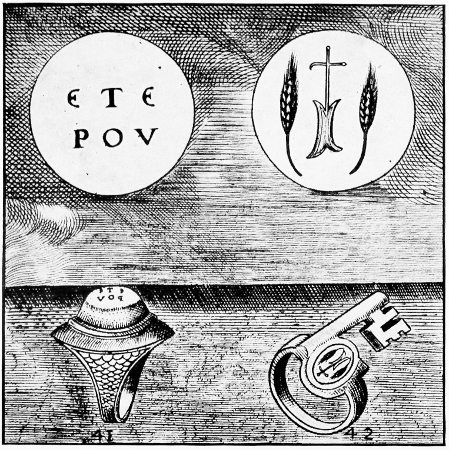
Two brass rings. Roman. 1, set with an inscribed agate,; 2, key-ring, set with an engraved onyx
Gorlæus, Dactyliotheca, Delphis Bat., 1601
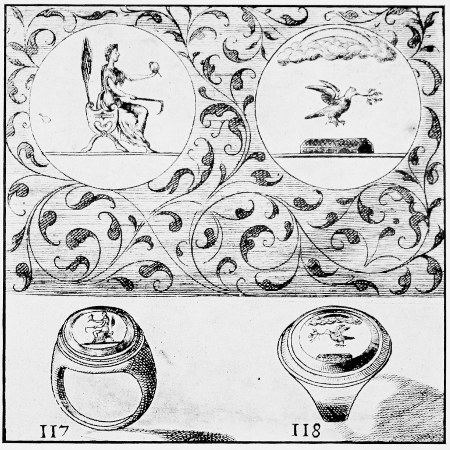
Two gold rings, with onyx gems. Roman. 1, engraved with seated figure of Ceres; 2, design of dove bringing back the olive branch to the Ark
Gorlæus, Dactyliotheca, Delphis Bat., 1601
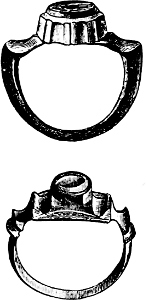
Two bronze rings excavated at the Borough Field, Chesterford, Essex, 1848. Late Roman.
British Museum
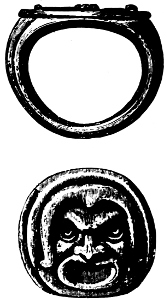
Bone ring with grotesque mask carved on bezel. Found near the amphitheatre at Lyons, France. Roman.
British Museum
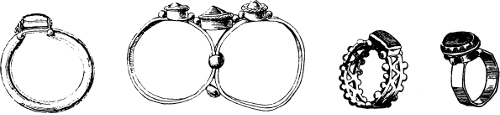
Roman gold rings of the Fourth Century A.D. 1, set with plasma bead; 2, double ring, set with garnets; 3, gold hoop composed of a plain band on either side of a wavy band; set with a convex plasma; 4. set with convex almandine intaglio
British Museum
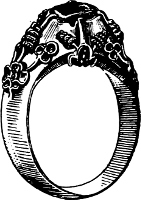
Ornamental gold ring from Wiston, Sussex, England, set with a dark amethyst
British Museum
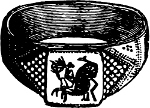
Silver ring. On bezel engraved design of a bird approaching a fallen stag. About Fifth Century A.D.
British Museum
The Jewish historian Josephus cites, as an example of absent-mindedness, that when the Roman senator Cneius Sentius Saturninus arose in the senate and pronounced a fiery harangue on the death of Caligula, urging the senators to regain their former liberties of which they had been robbed, he quite forgot that he wore on his hand a ring set with a stone on which the head of the detested tyrant was cut. His fellow senator, Trebellius Maximus, remarking it, however, snatched it from his finger, and the stone was crushed to pieces.[223]
How common in ancient Rome was the use of a signet ring to seal up the provision rooms in a household, is shown by a passage in the “Casina” of the comic poet Plautus, written about 200 B.C., where Cleopatra on leaving her home to visit a neighbor, directs her slaves to seal these rooms and bring her ring back to her.[224]
Of the betrothal ring, Clemens Alexandrinus says that it was not given as an ornament, but for sealing objects in the conjugal domicile. As the husband’s signet ring was often used in a similar way, it was quite customary to bequeath it to a wife or a daughter. An example of this appears in the case of Emperor Aurelian (214–275 A.D.) who left his seal ring to his wife and daughter jointly, the Latin historian adding that in so doing he was acting “just like a private citizen.”[225]
A curious subject was chosen for his signet-ring by a native of Intercatia in Spain. His father had been killed in a single combat by the Roman leader Scipio Æmilius, and it was this scene that the son had engraved upon his ring. When Stilo Preconinus related this fact in Rome he laughingly demanded of his hearers what they supposed the Spaniard would have done if his father had killed Scipio instead of being killed by him.[226]
In the Roman world the custom of removing the rings in case of death is noted by Pliny, who says that they were taken from the fingers of those in the comatose state of the dying; the rings were often replaced after death.[227] An instance in point is noted by Suetonius, who reports that when Tiberius became unconscious, and was believed to be about to die, his seal ring was slipped from his finger, but on regaining consciousness the emperor demanded that it should be replaced.[228] To have a ring drop from the finger was regarded as a bad omen, and when an accident of this kind happened to Emperor Hadrian, he is said to have exclaimed: “This is a sign of death.” The ring which fell from his finger bore a gem engraved with his own image.
The elegy of Propertius (49–15? B.C.) on the “Shade of Cynthia,” gives proof that a valuable ring was often left on the hand of the corpse when it was burned on the funeral pyre. The Latin verses describing the apparition may be thus rendered in prose:[229]
“She still had the same eyes and hair as when on the funeral couch; but her garments had been burned away. The flame had destroyed the beryl which used to grace her finger, and the infernal stream had discolored her lips.”
The sense of intimate connection between a valued ring and the wearer, finds expression in Shakespeare’s lines (Cymbeline Act I, sc. 5):
My ring I hold dear as my finger; ’tis part of it.
And if we go back 2200 years to a far distant quarter of the globe we meet with the same feeling of intimate connection in the inspired words of the Hebrew prophet Jeremiah (xxii, 24):
As I live, saith the Lord, though Coniah the son of Jehoiakim King of Judah were the signet upon my right hand, yet would I pluck thee hence.
The prophet Haggai (chap. ii, verse 23) uses the designation signet to indicate a specially chosen instrument, in the following words:
In that day, saith the Lord of hosts, will I take thee, O Zerubbabel, my servant, the son of Shealtiel, saith the Lord, and will make thee as a signet: for I have chosen thee, saith the Lord of hosts.
The Freemasons have adopted the signet of Zerubbabel as one of the symbols of the Royal Arch, the seventh masonic degree.[230]
The monogram of Christ appears on a signet made for a Christian lady of Roman times, Ælia Valeria. Of this sacred symbol St. John Chrysostom wrote that the Christians of his time always inscribed it at the beginning of their letters, and he gives as a reason for this that wherever the name of God appeared there was nothing but happiness. Undoubtedly the shape of the Greek X (Ch), forming part of this monogram, suggested a form of the cross, and gave an added significance to the monogram, especially in view of Chrysostom’s statement that the Christians of his time painted or engraved a cross on their houses and made the sign of the cross over their foreheads and their hearts.[231]
Clemens Alexandrinus in the second century tells us that men were required to wear the seal ring on the little finger, as worn in this way it would interfere least with the use of the hand, and would be best protected from injury and loss.[232] While, however, fashion must have dictated to a great extent the finger on which a seal ring was to be worn, we should bear in mind that any particular custom in this matter was not constant, and that individual preferences must often have determined the finger chosen to bear the seal ring. This diversity is attested by the differing statements of the old writers, as well as by the rare examples offered by ancient statues and paintings.
One of the rare ivory rings in the British Museum is a signet the bezel of which bears an engraved design of Christ on the Cross, with the Virgin and St. John on either side. The legend is the motto of Constantine the Great: In hoc signo vinces. The hoop of this ring, which was found in Suffolk, has been restored at the back. The figures are very rudely engraved for a production of the sixteenth century.[233]
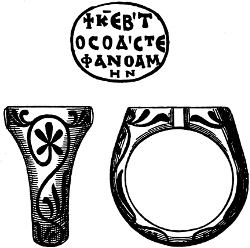
Bronze signet-ring, Byzantine, two views and impression. The abbreviated Greek inscription reads: “May the Lord help his servant Stephan”
British Museum
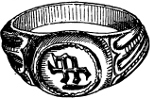
Bronze signet ring. European. Fifteenth Century
British Museum
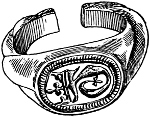
Silver ring, broken at the back. Bezel bears letter “T” crowned. Fifteenth Century
British Museum
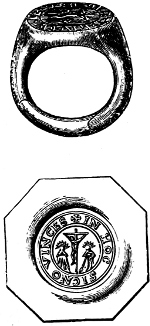
Ivory signet ring, with impression. On the carved bezel, the Crucifixion, between the Virgin and St. John; legend: “In hoc signo vinces,” motto of the Emperor Constantine
British Museum
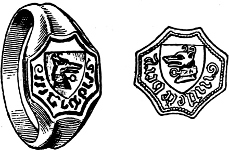
Bronze signet. The octagonal bezel is engraved with a greyhound’s head, and a rather obscure inscription. Ring and impression of signet. Fifteenth Century
British Museum
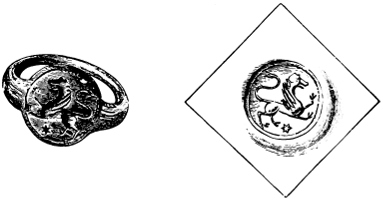
Gold signet ring, engraved with a lion rampant; beneath, a star. Ring and impression. Sixteenth Century
British Museum
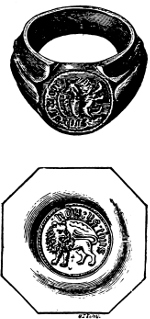
Massive gold ring; bezel engraved with a lion passant regardant, and the legend: “Now is thus.” English, late Fifteenth Century. Ring and impression of signet
British Museum
It appears to have been an ancient usage in some parts of the Christian world to use two signet rings in connection with the baptismal ceremonies. One of these was employed to seal up the font, or else the baptistry, while the other was used to affix a seal upon the profession of faith made by the neophyte, this profession being later entered on a public register. Some of the ecclesiastical writers saw the origin of the first-named ring in the text (Cant. iv, 12):
A garden enclosed is my sister, my spouse; a spring shut up, a fountain sealed.[234]
A recognition that at the beginning of the sixth century A.D. bishops were in possession of signet rings is offered by a circular letter addressed by Clovis I, in 511 A.D., after his victory over the Visigoths at Vouglé, to the bishops of the many cities that came under his domination as the fruits of this success. He informs the bishops that he will free all prisoners, either clerical or lay, for whom this favor shall be asked in letters “sealed with your ring.” This, however, only confirms the other testimony to the effect that the bishops had signets, but does not suffice to establish the existence at this time of rings given to them at their consecration as symbols of their office.[235]
The French kings of the Merovingian age stamped upon their royal documents the design engraved on their signet rings, the accompanying formula being frequently as follows: “By the impress of our ring we corroborate (roborari fecimus)”; slightly different forms appear sometimes. The following list gives, with the dates, a number of seal impressions that have been found on such documents:[236]
Childebert I, 528 A.D.
Sigebert I, 545, A.D.
Childeric I, 583 A.D.
Dagobert I, 629, 631–632, 635 A.D.
Childeric II, 664 A.D.
Thierry III, 673 A.D.
Dagobert II, 675 A.D.
Charles Martel (mayor of the palace), 724 A.D.
Pepin le Bref (mayor of the palace), 748 and 751 A.D.
Pepin le Bref, king, 755 and 768 A.D.
In the Carolingian period, Charlemagne and his successors continued the use of the same formulas.
The possession of signet rings by well-born women, although not usual in Roman times, became quite common in the early Middle Ages, under the influence of the Germanic peoples, which accorded to woman a much more important station than did the Romans or Gallo-Romans. Among the relics of the Merovingian period that have been preserved to our day, is the ring of Berteildis, one of the wives of Dagobert I (602?-638).[237] It is of silver and is inscribed with the name of the queen and the monogram of the word regina.[238] A document from the time of Childeric II, dated in 637, shows impressions of two queenly signets, one that of Emnechildis, wife of Sigebert II, King of Austrasia and guardian of Childeric, and the other belonging to Blichildis, Childeric’s wife.
In the tomb of the Frankish king Childeric I (458–481 A.D.), accidentally discovered at Tournai in 1653, in an ancient cemetery of the parish church of St. Brica, were found a number of valuable relics of this sovereign, among them his signet ring. After having been taken to Vienna by Archduke Leopold Wilhelm, then governor of the Low Countries, the treasure came, after his death, into the Imperial Cabinet there. In 1665 the Archbishop of Mayence secured from Emperor Leopold I permission to offer it to Louis XIV. In July of this year the precious objects were transmitted to the French king and were deposited in the Cabinet de Médailles, recently constituted in the Louvre. Shortly afterward, they were transferred to the Bibliothèque du Roi, and were safely preserved in this institution, under its changing names, until 1831, when the ring and other of the Childeric relics, as well as a number of other historic objects, were stolen from the library. The ring was never recovered. Fortunately there exists a very exact description and a figuration of the ring in an account of the treasure published in 1655, at Antwerp, by Jean Jacques Chifflet, first physician of the Archduke.[239] The ring, which is of massive gold, bears a large oval bezel on which is engraved the bust, full face. The sovereign is beardless, with long hair parted in the middle and hanging down to his shoulders. The bust is garbed in Roman style; on the tunic may be seen a decorative plaque. The king’s right hand holds a lance which rests on his shoulder, as may be observed in the imperial medals of Constantine II, Theodosius II, and their successors. The legend, in the genitive case, Childerici Regis, presupposes the word signum or sigillum, as the ring was unquestionably a signet. M. Deloche considers it probable that it was made on the occasion of Childeric’s marriage with Basnia, Queen of Thuringia, who had abandoned her native land and her husband to wed the Frankish sovereign. Clovis I (481–511) was the offspring of this union. Although the original has been lost there has fortunately been preserved an imprint from it on the margin of a manuscript in the Bibliothèque de Sainte Geneviève; of the entire ring there is the carefully executed drawing made for Chifflet’s work.[240]
In many cases the Carolingian monarchs rendered their signets, set with antique gems, significant of their own personality by having their names engraved around the setting. In this way Carloman (741–747) utilized an antique gem showing a female bust with hair tied in a knot, while Charlemagne’s choice was a gem engraved with the head of Marcus Aurelius; at a later time he substituted for this one bearing the head of the Alexandrian god Serapis. It is noteworthy that there is a great likeness between the portraits of Antoninus Pius and the type chosen for Serapis. Louis I, le Debonnaire (814–840), selected a portrait of Antoninus Pius, and his son, Lothaire, Roman emperor, 840–855 A.D., a gem with Caracalla’s head, the choice being no inappropriate one in view of Lothaire’s weak and treacherous character. Rev. C. W. King conjectures that the selection of the particular head may have depended upon its resemblance, more or less close, to the features of the monarch, as even though the likeness should not be very exact, the work would surpass anything that the unskilful gem-cutters of this age could produce.[241]
Of the seal of the Prophet Mohammed, we are told by Ibn Kaldoun that when he was about to send a letter to the Emperor Heraclius, his attention was called to the fact that no letter would be received by a foreign potentate unless it bore the impression of the Prophet’s seal. Mohammed therefore had a seal made of silver, bearing the inscription “Mohammed rasûl Allah,” “Mohammed the Apostle of God”; these three words, according to Al-Bokhari, were disposed in three lines. The Prophet made use of this seal and forbade the making of any one like it. After his death it was employed by his successors, Abu Bekr, Omar and Othman, but the last-named unluckily let it fall from his hand into the well of Aris, whose depth it had never been possible to measure. A duplicate was executed to replace the original, but its loss was greatly deplored, and was looked upon as a possible presage of ill-fortune.[242] The title inscribed upon it was prouder in its simplicity than that assumed by any other ruler, not excepting those who claimed for themselves a divine ancestry, or divine attributes. These could at most pretend to rank as divinities of a lower order, while Mohammed claimed to be the mouthpiece of the one and only God.
Burton writes that it is “a tradition of the Prophet” that the carnelian is the best stone for a signet ring, and this is still the usage among Mohammedans in the Orient. In the Arabian tale entitled “History of Al Hajjaj ben Yusuf and the Young Sayyed,” we read that the signet should be of carnelian because the stone was a guard against poverty.[243]
Some Arabic signets bore peculiarly apt inscriptions. One of these reads: “Correspondence is only a half-joy,” a delicate piece of flattery for the recipient of a letter bearing this seal. Another signet gives the following very necessary warning to the person to whom the letter is addressed, should it happen to contain something which ought not to be revealed. “If more than two know it, the secret is out.”[244] Such inscriptions are certainly more significant than a motto of less special meaning.
In an essay on Arabic signets, Hammer-Purgstall[245] calls attention to a fundamental distinction between talismans and signets. With the former, the inscription is engraved so that it may be read as it stands, while with the latter the characters are reversed so that only the impression gives them in their proper order. Besides this, the talismans rarely contain the wearer’s name, which is the most essential part of the signet. Nevertheless, there can be little doubt that in many cases the signet was at the same time a talisman.
That lovers—even Mohammedan lovers—in the seventeenth century, had romantic designs engraved upon seal rings, is illustrated by what Garzoni relates concerning the seal ring of “Mahometh Bassa.” This bore the figure of a silk-worm upon a mulberry leaf, the design commemorating the wearer’s love for a Moorish girl, and signifying that he drew his life from her as did the silk-worm from the leaf.[246]
Tavernier relates that in his time, the last half of the seventeenth century, the secret treasure of the Sultans in Constantinople was guarded in an innermost treasure-chamber of the Serail. This chamber was only opened at intervals to receive the surplus gold that had been collected from the Empire or received in any way, when the total sum had reached 18,000,000 livres (over $7,000,000] according to the value of the livre in Tavernier’s day). The gold was contained in sacks, each of which held 15,000 ducats. When an addition to the treasure was to be deposited, the Sultan himself led the way to the treasure-chamber and stamped his seal, with his own hand, on red wax spread over the knot of the cord with which the sack was secured. This seal was engraved on the bezel of a gold ring and constituted no design, but simply the name of the reigning sovereign, the characters being probably intricately combined in the elaborate and cryptic manner used in the case of the imperial name and titles.[247]
A Byzantine signet ring of the sixth or seventh century of our era, in the British Museum, shows the head of Christ, beneath which bending figures of two angels in profound adoration are depicted. Angel-figures almost exactly similar may be seen in Byzantine ivory carvings of this later period, the type evidently being one of those rigidly defined in the hieratic art of the school. With this ring were found coins of Heraclius (610–641), the Greek emperor in whose reign fell the death of Mohammed (June 8, 632) and the overthrow of the Sassanian Persian monarchy by the Mohammedans.[248]
How important the possession of a royal seal-ring was considered to be, as proving the title of a successor, appears in the story that at the death-bed of Alexius Comnenus (1084–1118), Emperor of the East, when the son and rightful successor, John Comnenus, perceived that his mother Irene was working to exclude him from the throne and to seat thereon his blue-stocking sister Anna, he took off the imperial ring from the hand of his dying father and thus ensured for himself the title to the Eastern Empire.[249]
Saint Bernard of Clairvaux (1091–1153), the enthusiastic preacher of the Second Crusade in 1147, excuses himself in some of his letters that he has failed to seal them, because he could not lay his hand on his signet. In a letter to Pope Eugene III, the saint complains that several spurious letters bearing his name have been circulated, sealed with a counterfeit seal; he also notifies the pontiff that from this time his letters will bear a new seal, on which will be his portrait and his name.[250]
Well-to-do merchants of mediæval times, not entitled to armorial bearings, often had special individual marks or symbols engraved upon their signets. This custom obtained on the continent as well as in England, and allusion is made in the Old English poem of the fourteenth century, “Piers Plowman,” to “merchantes merkes ymedeled in glasse.”[251] Probably emblems of this kind came to have a certain association with the business which in many cases descended from father to son through a number of generations.
A royal signet ring once believed to be that of Saint Louis (Louis IX, 1214–1270) and long preserved in the treasury of St. Denis, as an object of reverent care, is now in the Louvre Museum. The fact that the crescent is introduced as a symbol fails to connect the ring with the Crusader St. Louis, as this symbol was not used by the Saracens of his time, but was only adopted as a Mohammedan device after the Turks captured Constantinople, the crescent having been a recognised symbol in ancient times in Byzantium long before the city came to be called Constantinople.[252]
The engraved stone in the ring is a table-cut sapphire, the monarch being figured standing, with a nimbus around his head; he is crowned and bears a sceptre. The letters S L on the stone have been interpreted to mean rather sigillum Ludovici than Sanctus Ludovicus, and one critic suggests the possibility that it may have been executed in Constantinople, in Byzantine times, for Louis VII, who was there in 1147, and was received with high honors by Manuel Comnenus, the Greek emperor’s courtesy being rather bred of fear of French aggression than of affection for the French crusader. As we have good evidence that gem-cutting was not practised at this time in France, it seems plausible enough that Louis VII should have availed himself of this opportunity to have a signet engraved for him by a Greek gem-cutter.[253]
The signet ring of King Charles V of France (1337–1380) was set with an Oriental ruby on which was engraved “the bearded head of a king.” This signet was used by King Charles to seal the letters written by his own hand. The somewhat vague description in the inventory suggests that this may have been an antique gem, the supposedly royal head being that of some Greek divinity. The art of engraving on such hard stones as the ruby does not seem to have been practised in the thirteenth or fourteenth centuries, the revival of this art belonging to a later period. Evidently the head was not that of Charles himself or of any of his predecessors, for, had this been the case the inventory would hardly fail to note the fact.[254]
When a certain Bratilos was sent as a messenger by the eastern emperor Cantacuzene (1341–1355) to his empress Irene, to announce the outbreak of a dangerous revolt, he bore a sealed letter from the emperor.[255] While on his journey, however, he began to fear that he might be waylaid and robbed of the important document. This peril he effectively provided against by memorizing the letter and then destroying it, after he had removed the wax impression of the imperial signet, which he could safely guard in his mouth, and which served to accredit him when he came before the empress.[256] Not long afterward Cantacuzene was defeated and deposed by John V, Palæologus, and retired to a monastery, where he lived until 1411, composing a history of his own times in his leisure moments; his wife also took the religious vows under the name of Eugenia.
Much has been written about the ring or rather the engraved seal of Michelangelo. This gem enjoyed such high esteem that it was very often copied, the copies sometimes acquiring the repute of being originals. Four of them, two in paste, one in amethyst, and one in carnelian, exist in Denmark, the two latter having the dimensions of the original gem. The copy in carnelian—the stone in which the original was cut—is exceptionally well executed.[257] The original seal is now in the Bibliothêque Nationale in Paris and came into the possession of Louis XIV in 1680. The king wore it set in a ring.
It was brought to France in 1600 by a Sieur Bigarris, director of the Mint, and its history was at the time traced back to Agosto Tassi, goldsmith in Bologna, to whom Michelangelo had bequeathed it. The gem was the work of Pier Maria di Pescia, and bears his symbolic signature, a boy fishing (pescia, fishing). The dimensions are given as 15 mm. by 11 mm., the form being oval, and in this restricted space is a design embracing twelve human figures, two genii, a horse, a goat and a tree. Two of the figures appear to have been copied from a detail of Michelangelo’s Sistine Chapel frescoes: a woman helping another woman to place a basket of grapes upon her head. Watelet and Levesque in their “Dictionnaire des Arts” published in 1791, characterize this seal as “the most beautiful engraved gem known.”
The Royal Collection at Windsor Castle contains a gold ring set with a cameo portrait of Louis XII, of France (1498–1515), cut in a pale ruby of clear lustre. The work is believed to have been executed during the lifetime of the king, and was considered by Rev. C. W. King to be the earliest Renaissance portrait cut on a stone of the hardness of a ruby. He regarded it as a work of the famous Renaissance gem-cutter Domenico dei Camei, this artist having engraved a portrait of the Milanese duke Ludovico Sforza, surnamed Il Moro, on the same hard material. The gold plate at the back of the bezel holding the gem bears the inscription “Loys XIIme Roy de France décéda I Janvier, 1515,” the stone having been set in the ring at some time after the monarch’s death.[258]
This collection also contains an imperfect specimen of a squirt-ring. The hoop is of enamelled gold set with a garnet engraved in relief with a mask or bacchic head finely executed by a sixteenth-century artist. The hole at the base of the hoop, with its internal screw-worm, indicates that it was once provided with a squirt for projecting perfumed liquids.[259]
A sixteenth-century portrait by the German painter, Conrad Faber, depicts a well-to-do burgher, possibly a burgomaster, who wears a seal ring on the index finger of his left hand and a ring with a precious stone setting on the fourth finger of the same hand. In this hand he holds something which may be a staff of office; it is surmounted by an octagonal block of ebony in which is inlaid a medallion figuring St. George and the Dragon. The city, as carefully delineated in the background as in the finest of engravings, appears to be one of the historic Rhine cities, and is evidently that with which the sitter was identified.
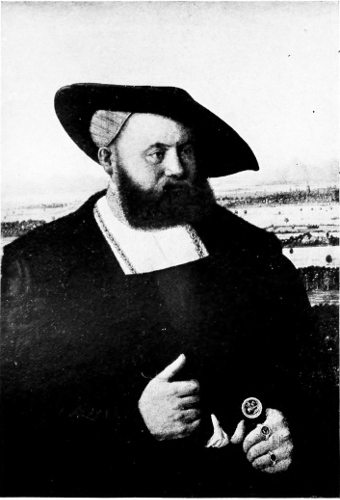
PORTRAIT OF A MAN, BY THE SIXTEENTH-CENTURY GERMAN PAINTER, CONRAD FABER
Seal ring on index of left hand, sapphire-set ring on fourth finger of this hand, which holds what seems to be a wand or staff of office, surmounted by an octagonal ebony block, with inserted medallion of St. George and the Dragon
Metropolitan Museum of Art, New York, Kennedy Fund, 1912
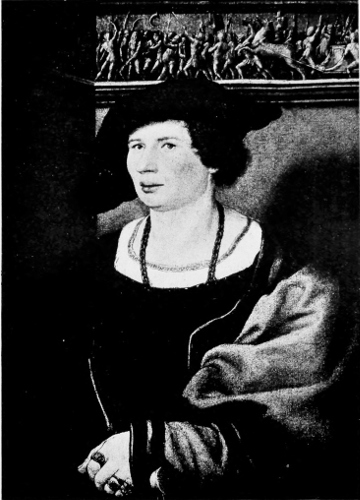
PORTRAIT OF BENEDIKT VON HERTENSTEIN, BY HANS HOLBEIN
Showing seal ring on index finger, two rings on third finger, and three on little finger of left hand
Metropolitan Museum of Art, New York City
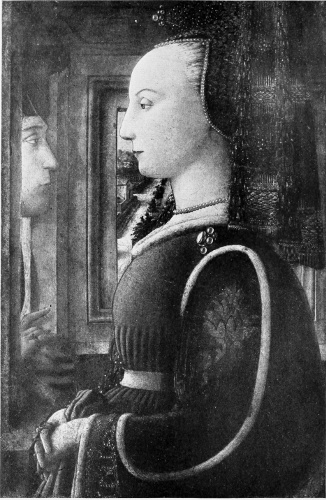
MAN AND WOMAN AT A CASEMENT
The woman wears three rings (sapphire, ruby and some other stone) on the index of right hand, and two on the middle finger of this hand, one of them on the second joint. The young man has a large oval topaz on the little finger of his left hand. Florentine, Fifteenth Century
Metropolitan Museum of Art, New York
For signet rings, antique gems continued to be those most favored until the Renaissance period, and even to a considerable extent during this period. However, the development and elaboration of the science of heraldry and the great importance accorded to the possession of armorial bearings soon induced the engraving of these upon the signets, in preference to using antique gems or copying their types. In Elizabeth’s reign and in those of her immediate successors, it is believed that scarcely a gentleman was to be found who did not own and wear a signet ring on which appeared his coat-of-arms. Those not fortunate enough to have the right to display armorial bearings, sometimes sought to make their signets individual by using as designs rebuses expressing more or less well the pronunciation of their names.[260]
Arms were sometimes blazoned on rings by enamel applied to the base of a setting; thus the arms engraved on a rock-crystal or a white sapphire, would appear with their proper hues, the colors showing through the transparent stone, and their effect being heightened by the brilliant medium. A fine example of this kind of ring is one made for Jean Sans-Peur, Duke of Burgundy (1401–1419); another is the signet ring of Mary, Queen of Scots, now in the British Museum.[261]
Bequests of signets to near relatives occur not infrequently in wills of the fifteenth and sixteenth centuries, as for example in that of John Horton, dated 1565, wherein appears the following: “Item, I give unto my brother Anthony Horton, for a token, my golde ringe wth the seale of myne armes, desirenge him to be good to my wiffe and my childringe as my trust is in him.” Besides this seal ring, the testator willed “a golde ringe wth a turkes [turquoise] in it” to his “singular good Lord the Lord Eueerye,” with a plea for friendship toward his wife and children. A ring set with a diamond was bequeathed in 1427 by Elizabeth, Lady Fitzhugh to her son William.[262] This was almost certainly one of the uncut, pointed diamonds used for settings at this early time.
The signet ring of Mary Stuart is one of the chief treasures in the ring collection of the British Museum. It was made for her use after her betrothal to the French Dauphin, later, for a few months, King of France as Francis II (1543–1560), just before her marriage, as after that time the arms of France would have been combined with those of Scotland. The following description is given of this ring in the exceedingly valuable catalogue of the Franks Bequest by O. M. Dalton[263]:
316. Gold; the shoulders ornamented with flowers and leaves once enamelled; oval bezel containing a chalcedony engraved with the achievement of Mary, Queen of Scots. The shield is that of Scotland surrounded by the collar of the Thistle, with the badge, and supported by two unicorns chained and ducally gorged; the crest, on a helmet with mantlings and ensigned with a crown, is a lion sejant affronté, crowned and holding in the dexter paw a naked sword; in the sinister a sceptre, both bendwise. Legend: In Defens, and the letters M R. On the dexter side is a banner with the arms of Scotland; on the sinister side, another, with three bars and over all a saltire. The metals and tinctures appear through the crystal on a field of blue. Within the hoop at the back of the bezel is engraved a cipher in a circular band and surmounted by a crown, once enamelled. The cipher is formed of the Greek letter φ and M, for the names Francis and Mary.
In this example of sixteenth-century French goldsmithing, the colors of the arms have been applied beneath the crystal so that they would not be effaced in using the signet for sealing. In 1792 this ring was in the possession of Queen Charlotte, wife of George III. After her death it became the property of the Duke of York, and when his plate and jewels were sold at Christie’s, in London, March, 1827, it was bought by Mr. Richard Greene, F.S.A., and was acquired from him in 1856 by the British Museum.
A signet ring believed by many to be that of the immortal Shakespeare, was found on March 16, 1810. It was picked up on the surface of the mill-close that adjoins Stratford churchyard; the finder was the wife of a poor laborer. How lightly it was esteemed at the outset is shown by the low price at which it was acquired by Mr. R. B. Wheeler, who paid only thirty-six shillings ($9.00), considered to be the value of the fifteen pennyweights of gold in the ring. In fact, the only circumstances seeming to connect it with Shakespeare are the initials W. S., and the facts that the ring appears to be of Elizabethan workmanship and that it was found at Stratford-on-Avon, Shakespeare’s home.[264] The initial letters are bound together with a design composed of an ornamental band with tassels, so arranged as to outline a heart. A queer coincidence, if the report be true, is that a certain William Shakespeare was at work nearby when the ring was found.[265]
One of the somewhat less well-known Shakespeare portraits depicts the poet wearing a thumb ring on his left hand. This is the work of Gerald Soest, who was born twenty-one years after Shakespeare’s death; its inspiration is probably to be sought in the Chandos portrait of which it is an amplification and re-arrangement. The face, however, wholly lacks the dignity and expression of the Chandos, being exceedingly weak and commonplace. The hands give the effect of having been copied from those in some other portrait, and, of course, under all these circumstances we would scarcely be justified in assuming that Shakespeare wore a thumb ring, although he may well have done so, in view of the fact that the fashion was common enough in his time. Queen Elizabeth, even, is depicted as wearing one in Zucchero’s portrait of her at Hampton Court.[266]
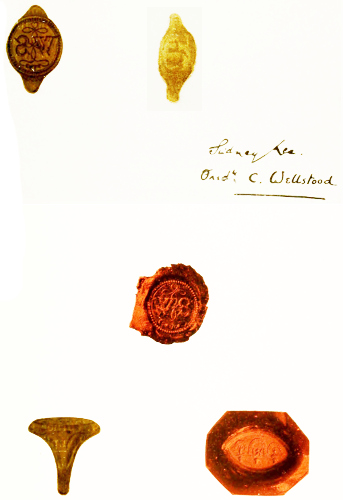
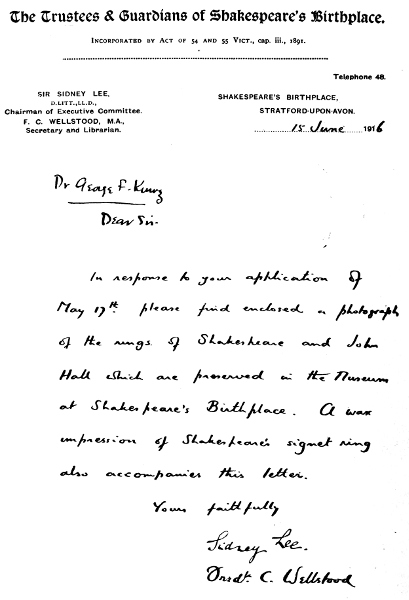
1, Shakespeare’s gold signet ring, found in Stratford-upon-Avon, March 16, 1810. 2, brass signet supposed to be that of the physician, John Hall, Shakespeare’s son-in-law. 3, wax impression from Shakespeare’s ring. (Photographed expressly for this book as attested by signatures of Sir Sidney Lee, Chairman of the Executive Committee of “Shakespeare’s Birthplace,” and of the Librarian, F. C. Wellstood.) 4 and 5, gold signet ring owned by Lord Byron, with impression from it. The seal shows the crests and mottoes of three families. Photographed for this book. In the possession of Judge Peter T. Barlow, New York
Another English poet, that master of impassioned verse, Byron, had in his possession a most interesting bloodstone signet ring, engraved with the following three family mottoes: “Tout prest” (Quite ready), motto of the families Monk, Murray and Younger; “Confido, conquiesco” (I trust and am contented), motto of the Dysart, Hodgett, Maroy, Tollmache and Turner families; “Pour y parvenir” (In order to accomplish, or succeed), motto of the families Manners and Manners-Sutton. This ring was owned by Sir Walter Scott, and at the dispersal sale of his personal effects at Abbotsford it was acquired by the late Samuel Latham Mitchell Barlow, the great art connoisseur and collector, by whose son, Judge Peter T. Barlow, of New York, it has been inherited, in whose possession it now is, and through whose courtesy it is here reproduced.
Many interesting facts in regard to the history of the diamond engraved for Queen Henrietta Maria, wife of Charles I, have been presented by Mr. C. Drury Fortnum, who purchased the diamond from the collection of the Duke of Brunswick in 1879.[267] In the catalogue of the Duke’s collection this stone is described as the signet of Mary, Queen of Scots, an attribution which had been current for many years; but Mr. Fortnum has shown that the initials on the diamond should be read MR, the cross-bar in the first character representing the letter H, and the whole signifying Maria Henrietta Regina.
Fortunately we have the original of the treasury order given by Charles I, under date of January 16, 1629, directing the payment of a sum of money to the engraver for his work. As this is probably the only case in which the original record of payment for engraving an historical diamond has been preserved, it is reproduced here from Mr. Fortnum’s paper in Archæologia.[268]
Charles by the grace of God King of England, Scotland, France, and Ireland, Defender of the Faith, &c.
To the Trēr and Undertrēr of or Exchecqr for the time being greeting:
Wee doe hereby will and com̄and you out of or treasure remaining in the Receipt of or Exchecqr forthwith to pay or cause to be paid unto Francis Walwyn or his assignes the some of two hundred three-score and seven pounds for engraving, polishing, Dyamond boart and divers other materialls for the Cutting and furnishing of or Armes in a Dyamond with l’res of the name of or deerest Consort the queene on each side, And these or l’res shal be yor sufficient warrt and discharge in this behalfe.
Given under or privy Seal att or pallace of Westmr the sixteenth day of January in the fourth yeare of or Raigne.
Jo: Packer.
As a general rule a signet ring was one of the last objects of value that an owner would part with, but we know that after Charles’ execution Henrietta Maria was reduced to dire straits and was obliged to sell all her possessions in order to procure the bare necessaries of life. In Tavernier’s account of his travels in the East he states that in 1664, he showed to the representative of the Shah of Persia a ring engraved with the royal arms of England, and which had belonged “to the late King of England.” As letters and papers have been preserved, dating from 1656 to 1673, and sealed by Charles II with the diamond signet used by his father, we have proof that Charles II had that signet in his possession in 1664, and Mr. Fortnum’s conjecture that the engraved diamond in Tavernier’s hands was that of Henrietta Maria is plausible enough.
The Shah of Persia sent the diamond back to Tavernier, requesting information as to what was engraved upon it, but the French jeweller, fearing possible complications, did not venture to go beyond the vague statement that the stone bore the arms of a “European prince.” The Shah does not appear to have bought this diamond; probably he did not care much for historic souvenirs of European royalties, and possibly he doubted whether Tavernier had the right to offer for sale what might be the signet of a European monarch. However, the Shah’s minister did not fail to express his admiration of the skill shown by the “Franks” in the art of diamond-engraving.[269]
Already, in the Vetusta Monumenta of Astle, published by him in 1792, the seal is figured as that of Mary Queen of Scots, and is said to have been in the possession of Louis XIV. If this statement be correct, the signet might have been among the diamonds sold by Tavernier to Louis XIV, on the former’s return to Europe. It seems to have shared the fate of a large number of the jewels belonging to the French crown and to the royal family, and next appears in a sale held in London June 19, 1817, being described in the catalogue as “the engraved diamond ring of Mary, Queen of Scots, upon which are engraved the arms of England, Scotland and Ireland, quartered,” and authenticated by a communication from “that correct and learned antiquary the late Robert Gough, Esq.” to the following effect:
That it descended from Mary to her grandchild Charles I, who gave it on the scaffold to Arch Bishop Juxon for his son Charles II, who in his troubles pawned it in Holland for £300, where it was bought by Governor Yale and sold at his sale for £320, supposed for the Pretender. Afterwards it came into the possession of the Earl of Ilay, Duke of Argyle, and probably from him to Mr. Blashford.
In these statements there is probably a confusion between the diamond of Henrietta Maria, known later as that of Mary, Queen of Scots, and a diamond signet of Charles I, for such a signet is said to have been given to Bishop Juxon by Charles just before his execution. We have every reason to believe that Henrietta Maria bore her own signet with her when she left England.
The ring containing this historic diamond was purchased at the sale of June 19, 1817, by Dr. Curry (probably James Curry, M.D., physician at Guy’s Hospital) for the sum of £90 6s ($450), although a contemporary letter states that the sum was £86, and adds that the stone itself was worth but £10. The ring was subsequently acquired by an agent, Van Prague, and after passing through several hands came into the possession of Mr. Leverson, a diamond dealer of Paris, who sold it to the Duke of Brunswick. At one time it was owned by the Earl of Buchan, and it was exhibited at Holyrood in 1843, when several rock crystal models were made of it. One of these served Mr. Fortnum as a standard of comparison for the identification of the Duke of Brunswick’s diamond.
The stone is a table diamond and is engraved with the arms of England and France in the first and fourth quarters, with those of Scotland in the second quarter, and those of Ireland in the third. In 1887, on the occasion of Queen Victoria’s Jubilee, this signet was presented to the queen by Mr. Drury Fortnum, and it is now in the royal collection at Windsor Castle.[270]
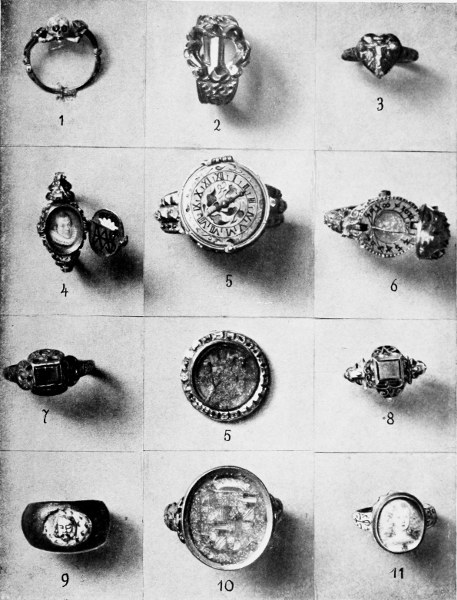
RINGS FROM THE COLLECTION OF THE IMPERIAL KUNSTGEWERBE MUSEUM, VIENNA
1 and 3, rings of Empress Eleonora, wife of Ferdinand III (1608–1657); enameled gold; Seventeenth Century. 2, gold ring said to have belonged to Mary of Burgundy, daughter of Charles the Bold, and wife of Maximilian I., Emperor of Germany. Bears an M formed of black diamonds and has twice on the inner side the monogram of Maria in Gothic capitals. 4, ring with miniature portraits of Emperor Mathias and his wife Empress Anne; enameled gold; 1612–1619. 5, (a) ring with watch by Johann Putz of Augsburg, and (b) lid made of an emerald on which the Austrian double-eagle is engraved; Seventeenth Century. 6, ring with a sun-dial, the lid representing a hedgehog studded with black diamond lozenges; Seventeenth Century. 7 and 8, two rings set with topaz; enameled gold; Sixteenth and Seventeenth Century. 9, bronze ring, with head of Christ in white enamel on blue ground, the hair being of gold; Seventeenth Century. 10, ring set with a rock crystal, engraved with the arms of an Austrian archduke. On the inner side is a sun-dial; Seventeenth century. 11, ring with a miniature portrait of Empress Claudia Felicitas; enameled gold.
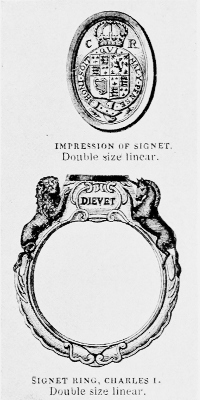
IMPRESSION OF SIGNET.
Double size linear.
SIGNET RING, CHARLES I.
Double size linear.
SIGNET RING OF CHARLES I
The richly ornamented gold hoop has on its shoulders a lion and a unicorn of chiseled steel. On the bezel is a steel plate engraved with the Royal arms, those of France and England in the first and fourth quarters; in the second, the arms of Scotland; and in the third, the Irish harp. On the sides of the gold base of the bezel is the inscription: “Dieu et mon droit,” inserted in steel letters
One of the most interesting engraved diamonds is the signet of Charles I of England, when Prince of Wales.[271] This is a large shield-shaped diamond engraved in intaglio with the Prince of Wales’ feathers between the letters C.P. and issuing from a coronet; on a ribbon beneath appears the motto ICH DIEN. The stone is set in a ring of enamelled gold. The engraving is finely executed and deeply cut. This signet has often been regarded as that of Charles II, but all doubt as to the original owner is set at rest by the existence of an autograph letter of Charles I, in the possession of M. Labouchère of Paris, bearing its impress.
The Royal Collection at Windsor Castle also contains the signet used by Charles I, as King. It has a richly ornamented hoop, to which are attached, at the shoulders, chiseled steel figures of a lion and a unicorn. The gold bezel has a steel facing constituting the seal. This is engraved with the royal arms; in the first and fourth quarters, the arms of England and of France; in the second quarter, those of Scotland; in the fourth quarter, the Irish harp. On the gold base of the bezel is the motto: Dieu et mon Droit, inserted in letters of steel. This constitutes an exceptionally fine example of composite metal-work. The archæologist, Rev. C. W. King, suggests that it may be the work of the “Inimitable Simon,” as he was called, who later engraved dies for the coinage of the Lord Protector, Oliver Cromwell, although he admits that it may have been executed by Vanderdoort, who was commanded in 1625 to make pattern pieces for the coinage of Charles I, at the beginning of the King’s reign.[272]
A signet ring used by Kaiser William II is set with a reddish-white onyx, on which has been engraved a shield bearing the German eagle, and surmounted by a crown and the letters, W. II. I. R., Wilhelm der Zweite, Imperator Rex. This signet belonged to the present Kaiser’s grandfather William I, and has been adapted to the present monarch’s use.
Signet rings were very popular in the latter part of the eighteenth century and into the nineteenth century. Then, later on, they were revived in the latter part of the nineteenth century, this revival continuing into the twentieth century. In the earlier period it was customary to engrave the crest and motto, or the full arms and motto, on the ring stone, which was generally bloodstone or carnelian, occasionally white chalcedony, more rarely lapis lazuli, in contradistinction to the large seal fobs, in which the favorite stones were amethyst, rock crystal, smoky topaz (quartz variety), pale chalcedony or some lighter colored material. Many signet rings were engraved upon gold, the sides of the rings being also engraved, as a general rule.
Since the year 1900, great interest has been aroused in seal rings, many of the designs of which are incised in gold or in platinum, the entire ring being of gold or platinum, or having a platinum disk set in a gold hoop. The entire variety of fancy stones is used: pale amethyst, ruby, beryl, aquamarine, zircon, garnet, sard which has been stained brown, carnelian (rarely), bloodstone, and jade—both the nephrite variety from New Zealand and Russia and the jadeite variety found at Bahmo, Burma. Occasionally the seals of rings are made of fine sapphires, emeralds, or rubies, and sell for from $1,000 to $10,000, or even more.
Seal rings were extensively worn in the period from about 1865 to 1885. Frequently these had absolutely nothing engraved upon them. The setting was often an oblong, rectangular onyx, sometimes one inch or one and a quarter inches long. Occasionally upon this was inset a rose diamond initial; or else the initial was cut upon the stone—when the onyx was black on top—rarely a crest. In many cases the stone was white above and pink below, a sardonyx, and the initial was cut through the light layer. Or else it was white or pale gray on a black ground. The general effect was thus gray, the gem being of the type known as nicolo.
Then came the cameo rings, with designs either black on white or brown on white, sardonyx; or white on green, chrysonyx. Later again taste developed for intaglio rings. In this instance, instead of stones of a brownish or whitish gray,—chalcedony,—those of a pale brown or a dark brown were chosen and these were called sard. Because of the brown hue, the term onyx was also applied to them. This must not be confused with the antique sard which resulted from burning a stone of a different hue, as in the case of the antique carnelian also. The translucent or opaque varieties, with rich red or dark brown top, were called sard, whereas the paler translucent and almost transparent varieties,—when pale red, yellowish red or almost yellow,—were called carnelian.
While the natal gem in a simple but effective setting is the most appropriate ring for a girl or boy, a small seal ring for the boy, when he is about 12 years old is not unfitting, the seal being so well-executed that it may serve him when he has reached manhood. For very young children, no stone can be given the preference over the turquoise, which in its delicacy and beauty of color cannot be excelled. Small pearls are also used, or tiny brilliant rubies.[273]
In a brightly-written tale for children, the style of which is rather pronouncedly “up-to-date,” a sapphire signet is an important element of the story. Long years ago, in the island of Bermuda, in the Revolutionary period, this heirloom was surreptitiously secured by a young girl, to whom it was destined on her coming of age, but who was childishly impatient to gain possession of it before the time. The little heroine comes to New York and under the stress of a weird Tory plot, hides away her signet in the false bottom of an old trunk, stored away in the garret of the Charlton Street house in which she has lived. Here, more than a century later, a group of bright children find a diary of the long-dead heroine written in cipher. One of them is clever enough to unravel this mystery and they finally succeed in finding the hidden signet.[274]
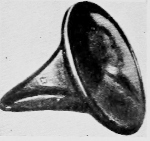
Gold ring with miniature portrait, given by Washington to Lafayette on the latter’s return to France. See pages 191 and 192. It is now in the possession of Mr. Gösta Frölén of Falun, Sweden
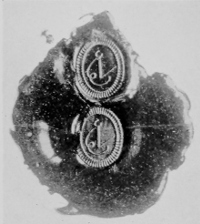
Photograph of two impressions in sealing wax, made by President Woodrow Wilson, of his seal ring, the inscription reading “Woodrow Wilson,” in Pitmanic shorthand. 1916
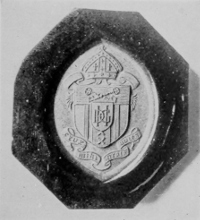
Episcopal seal of Right Rev. David H. Greer, Bishop of New York. Motto: Crux mihi grata quies (The Cross is my grateful rest). The shield bears the monogram of the bishop’s name, above which are two keys in saltire; below is the coat-of-arms of New Amsterdam. As crest is an Episcopal mitre
Two characteristic Oriental seal rings are owned by Miss Joan St. Michael Peters and Miss Katherine Harrower, both of New York City. The gems with which they are set were bought by the Rev. Dr. John P. Peters from an Arab, in the Kut-el-Amara region, where the British invaders of Mesopotamia underwent such a disastrous defeat. They are engraved carnelians. Miss Peters’ ring offers the design of a winged figure. The excellence of the cutting might seem to indicate that it was done some time between 500 B.C. and the beginning of our era, but a later date has been assigned to it by Prof. A. V. Williams Jackson of Columbia University, who pronounces it to be a Sassanian gem, and hence not older than the third Christian century. The other ring, that belonging to Miss Harrower, appears to be of the Seleucidan period, and may be dated from 300 to 200 B.C. The inscription, difficult to decipher, should be read “Khan” in Prof. Jackson’s opinion.
One of the most intrinsically valuable of ancient signets is that engraved for Constantius II (317–361 A.D.). This is of sapphire, the stone weighing 53 of the older carats (54.40 metric carats). The design shows the emperor in the act of spearing an enormous wild boar on the plains of Cæsarea, the Greek inscription xiphius denoting the sword-like tusks of the animal. The exploit is performed before a reclining female figure, a personification of the city Cæsarea of Cappadocia. A Latin inscription CONSTANTIUS. AUG is considered to prove that this is veritably the emperor’s signet. This remarkable gem is in the collection of Prince Trivulzio of Milan.[275]
A novel idea finds expression in the ring of President Wilson, on which he has had engraved his name in stenographic symbols. This is in thorough agreement with his aim to utilize business methods in the administration of national affairs, to do away with routine and take the most direct route to the solution of national problems. One of our two ex-Presidents, William H. Taft, sent us this reply: “I never wear a finger ring and never have done so. For that reason, I cannot comply with your request.”[276]