I THE ORIGIN, PURPOSES AND METHODS OF RING WEARING (continued 2)
Reading edition
While the Greeks and Romans did not usually wear rings on the middle finger, the Gauls and Britons adorned it in this way. In the sixteenth century it was customary to assign rings as follows, according to the quality of the wearer:[101]
To the thumb for doctors.
To the index finger for merchants.
To the middle finger for fools.
To the annular finger for students.
To the auricular finger for lovers.
There is a curious Hindu superstition to the effect that anyone who wears a ring on the middle finger will probably be attacked and bitten by a scorpion. For this reason the Hindus are said to avoid wearing any rings on this finger, although the others are laden with them, each finger-joint having its special adornment.[102] In the Græco-Roman world also there was a prejudice against decorating the middle finger with a ring.
Regarding the liberality with which the Greeks and Romans of the second century of our era used ring adornments for their fingers, the great Greek humorist Lucian gives testimony. In his writing entitled “The Cock,” he makes a character relate a dream in which the dreamer thought that a rich man had just died and had left him his fortune. Thereupon, in his dream, he saw himself arrayed in splendid raiment and wearing sixteen rings on his fingers.[103]
Of the affectations practiced in ring wearing by some nouveau-riches foreigners in Roman times, Juvenal says: When one sees an Egyptian plebeian, not long before a slave in Canopus, carelessly throwing back over his shoulder a mantle of Tyrian purple, and seeking to cool his perspiring fingers by wearing summer-rings of openwork gold, as he cannot bear the weight of gemmed rings, how can one fail to write it down in a satire?[104]
Indeed, to judge from the weight and size of some of the rings that have been preserved from ancient times, this practice was not quite so foolish as it may seem, for in the moist heat of the dog-day in Rome such heavy rings may well have been a burden. With the Roman ladies rings bearing images of the animals worshipped by the Egyptians came into fashion in Imperial times, favored no doubt by the enthusiastic worship of Isis and Serapis. Such rings are said to have been worn almost exclusively by women up to the reign of Vespasian, when men began to wear them also.[105]
In ancient Rome it was not unusual for the admirer of a philosopher or a poet to wear his portrait engraved on a ring-stone. One of the elegies of Ovid[106] (b. 43 B.C.), written during his banishment from Rome, by order of Augustus, alludes feelingly to this custom. The poem is addressed to a faithful friend, who wears the poet’s portrait in his ring, and Ovid says: “In casting your eye upon this, perhaps you sometimes say, ‘how far away is poor Ovid now!’” He died in exile in 18 A.D.
So huge were the proportions of the Roman emperor Maximinus (d. 238 A.D.), who rose from the ranks to the imperial dignity, that he is said to have used his wife’s bracelet for a thumb-ring.[107] The great size of some of the Roman rings to be seen in collections indicates that they could only have been worn on the thumb.
One of the fingers of a bronze statue in the British Museum, a Roman work of the third or fourth century, A.D., has a ring on its second joint. We are fortunate enough to be able to reproduce here a full-size drawing of this, courteously made for the present book by Sir Charles Hercules Read, Curator of the Department of British and Mediæval Antiquities and Ethnography in the Museum.
In a letter to M. Deloche, the German archæologist Lindenschmit states that in only one instance was he able to ascertain definitely on which finger the rings of the early mediæval period were worn. This concerned a female skeleton, exceptionally well preserved, owing to favorable conditions of sepulture; on the fourth finger of the right hand there was a bronze ring. This sepulchre was found at Obermorlen, in Hessen-Darmstadt. Researches in France have furnished confirmation of this. In the Merovingian cemetery of Yeulle (dept. Pas-de-Calais) a woman’s ring was found on the right hand of the skeleton, as was also the case with two rings in the Visigothic and Merovingian cemetery at Herpes (dept. Charente), and this proved to be the case with almost all the early medieval rings found in this region. On the contrary, M. Albert Béquet, Curator of the Archæological Museum of Namur, and the French archæologist, M. L. Pilloy, report the discovery of rings placed upon the left hand. As a possible explanation of these contradictory results, the opinion has been advanced that the rings on the right hand were wedding rings, and those on the left, rings worn for ornament, as there is good evidence that at an early period among the Gauls the betrothal ring was put on the right hand, not on the left.[108]
The portrait by Coello of Maria of Austria, daughter of Charles V of Germany, shows on the fourth finger of the left hand a ring set with a large table-cut stone, which may be a ruby, or else a rather dark-hued spinel. The right hand is gloved, the parts of the glove covering the index and fourth fingers having slits so as to give space for the rings on those fingers. There is an elaborate girdle of table-cut stones, a richly worked cross with three pendent pear-shaped pearls is suspended from a gauze scarf about the neck, splendid pearl earrings hang from the ears, and the coiffure is surmounted by a head ornament set with precious stones and pearls.
In a three-quarter length portrait of Henry VIII, painted by Hans Holbein in 1540, when the king was in his forty-sixth year, he is represented wearing three rings on his hands, two of these, set with square-cut stones, are on the index fingers of the right and left hand, respectively. The third and smaller ring, also set with a square-cut stone, is on the little finger of the king’s left hand. There is an intentional harmony in the jewelling, for stones of the same form, alternating with pearls, adorn the collar suspended from Henry’s neck and serve also as decoration for the sleeve-guards. This portrait is in the Reale Galleria d’Arte Antica, Rome.
Princess Mary, daughter of Henry VIII and Catherine of Aragon, and afterwards Queen of England (1553–1558), is portrayed in a painting in the University Galleries, Oxford, by an unknown artist, as wearing, in addition to many fine pearls both round and pear-shaped, three rings, one on the index, another on the middle finger, and the third on the fourth finger of the left hand. That on the middle finger is set with a pearl, and the ring-adornment of this finger is quite worthy of note because of the comparative rarity of this setting.
A large pear-shaped pearl, figured on a portrait of “Bloody Mary,” was given to her by Philip of Spain, who afterward took it back to Spain with him. It later came into the possession of Jerome Bonaparte, who gave it to Queen Hortense. She gave it to the young prince, who later became Napoleon III, and he, in turn, disposed of it to the Duke of Abercorn, in whose possession it now remains. Allison V. Armour, Esq., to whom it was shown in Ireland by the Duke, at the time of an expected visit from King Edward, told the author it was very interesting to note that it had apparently preserved all its original lustre.

PORTRAIT OF A LADY, BY ANTON VAN DYKE (1599–1641)
The thumb ring on the right hand, and the ring on the index of the left hand, are both set with square-cut stones, the last-named probably a ruby
Metropolitan Museum of Art, New York. Marquand Gift, 1888

PRINCESS HATZFELD, BY ANTONIO PESARO (1684–1757)
Large pearl cluster on little finger of right hand
Catholina Lambert Collection sold at American Art Galleries, New York, February, 1916]
The adornment with a ring of the second phalanx of the right-hand middle finger, appears in the fine portrait, said to be that of Mary Stuart, in the Prado Gallery, Madrid; the little finger of the same hand shows a stone-set ring, worn as usual. Over the elaborately embroidered bodice hangs a neck-ornament, at the different sections of which are groups of three pearls, and there are pearl earrings in the ears, as well as groups of pearls in the head-ornament. The portrait is listed as a production of the French School, but is of doubtful authenticity as a likeness of the unhappy queen.
The Italian fashion of ring-wearing in the sixteenth century is illustrated by the portrait of a noblewoman by Lorenzo Lotto, in the Galleria Carrara at Bergamo, Italy. On the right hand are two rings, on the fourth and little finger respectively; the left hand bears three, one on the index, apparently set with an engraved gem, and two on the fourth finger, the larger of which seems to have as setting a pointed diamond, while the smaller one, possibly bearing a little facetted diamond, is on the second phalanx of the finger, a fashion sometimes followed instead of wearing the two rings together, one directly over the other, on the third phalanx.
A fine example of a pearl-cluster ring is to be seen in the portrait of Princess Hatzfeldt by the artist Antonio Pesaro (1684–1757). The ring, worn on the little finger, has a large centre-pearl surrounded by five smaller ones, the whole constituting a rather inconveniently large jewel, although unquestionably a very beautiful one. It appears to be the only ring worn by the fair princess when posing for her portrait.
Finger rings were sometimes worn suspended from the neck, usually strung on a chain. This custom is testified to by several old portraits, among them by one of the Elector John Constans of Saxony, in the Collection of Prince George of Saxony, Dresden, and also in several of Lucas Cranach’s portraits. In one of the latter, depicting an elderly and hard-featured Dutch lady, eight rings are to be seen strung on a chain or band below the collar. As the sitter’s hands are adorned with five rings, her object may rather have been to display all her choicest rings, than to wear them as amulets, although this superstitious use is generally believed to be the true explanation of wearing finger-rings suspended from the neck. Sometimes a single ring was hung from the neck on a long string, and rings were occasionally worn attached to a hat or cap, as shown in the portrait of Bernhard IV, Margrave of Baden (1474–1536), by Hans Baldung Grien, in the Pinakothek, Munich.[109]
The painting of hands adorned with one or more rings, was not favored by several of the portraitists of the seventeenth century. Few if any rings, for example, can be found on the delicately shaped hands of any of Sir Peter Lyly’s beauties, hands undoubtedly lacking in individuality and conforming to a preconceived type. Vandyke’s usage in this respect varied, probably, with the taste of the respective sitters, although the frequent absence of rings might lead to the inference that he did not favor them in portraits. The great masters of the sixteenth century certainly gave no evidence of any such prejudice, their realism and their fondness for rich ornament and color causing them to adorn the hands of their subjects, both men and women, with valuable and finely wrought rings. With eighteenth century painters, the tendency to discard rings was very pronounced, as indicated by their sparing appearance in portraits of this period.
It may be interesting to note the distribution of the rings in seventeen portraits of the Blakeslee Collection, disposed of in New York City, March, 1916, and representing a kind of average for the period from the latter part of the sixteenth century to the beginning of the nineteenth century:
Right Hand Left Hand
Index finger, 7 Index finger, 4
Middle finger, 1 Middle finger, 0
Fourth finger, 7 Fourth finger, 7
Little finger, 1 Little finger, 6
Thus the index and fourth fingers of the right hand and the fourth and little fingers of the left hand are almost equally favored.
An oil-portrait of the Mahârânî of Sikkim, painted in 1908 by Damodar Dutt, a Bengali artist, shows this queen decked out with all her favorite jewel adornments; among them are two gold rings, one set with a turquoise and the other with a coral, on the middle and fourth fingers of the left hand (see Frontispiece). The right hand is concealed in a fold of her mantle, but had there been any rings on it, it would probably have been displayed, to judge from the variety of the ornaments she was pleased to wear at the sittings. She is a full-blooded Tibetan princess, was born in 1864, and became the second wife of the King of Sikkim in 1882, so that she was forty-four years old when the portrait was painted. At this time she and her husband had been held in captivity by the British since 1893. The singular crown is the one adopted by the queens of Sikkim. It is composed of broad bandeaux of pearl, turquoise and coral; the gold earrings are inlaid with turquoise in concentric rings; the necklace has large amber balls, and suspended from it is a gau or charm-box, set with rubies, lapis lazuli and turquoise; on the wrist is a triple bracelet of corals.[110]
In the opinion of J. Alden Wier, President of the Academy of Design, New York City, rings can scarcely be regarded as in any sense important accessories of a good portrait, as this does not depend upon the elaboration of such detail. With Popes and Doges, and with some of the higher ecclesiastics, however, rings are significant as insignia of office, and are therefore depicted as marks of individuality.[111]
A fifteenth century example of a thumb ring was found in England at Saxon’s Lode, a little south of Upton. The material was of silver, either considerably alloyed, or else plated with a baser metal. In seventeenth century times in England the wearing of such rings was favored by many of the richer, or more prominent citizens, so that they served to differentiate the wearer from those less well-to-do, although he might not have the right to a crest or coat-of-arms. A character in one of the Lord Mayor’s shows given in the reign of Charles II (1664), is described as “habited like a grave citizen,—gold girdle and gloves hung thereon, rings on his fingers, and a seal ring on his thumb,” like Falstaff’s alderman.[112]
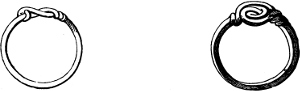
Two wire rings from a tumulus near Canterbury, Kent, England, one with a bezel effect
Fairholt’s “Rambles of an Artist”
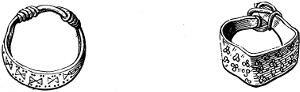
Two Anglo-Saxon rings found near Preston, Lancashire, England, in 1840
Fairholt’s “Rambles of an Artist”
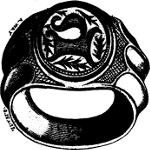
Silver thumb ring found at Saxon’s Lode, England. “Fifteenth Century Archæologia,” vol. iii, p. 268]
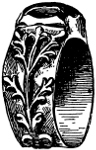
Silver-gilt ring, with broad, flat hoop, and rectangular bezel set with a carbuncle
British Museum
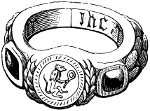
Ring of mixed metal set with engraved stone showing a monkey looking into a mirror
Fairholt’s “Rambles of an Artist”
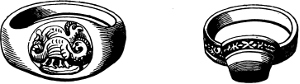
1, thumb-ring; two cockatrices engraved in relief on agate. 2, ring set with Gnostic gem
Fairholt’s “Rambles of an Artist”
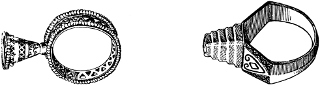
Two gold rings. 1, with high circular bezel; Frankish (?); Sixth or Seventh Century; 2, with pyramidal bezel; Lombardic (?); Seventh Century
British Museum
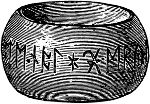
Agate ring with a Runic inscription. Late Saxon
British Museum
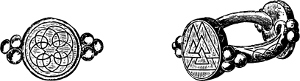
Massive gold ring with two bezels, one engraved with circular design of interlacing curves, the other with three interlaced triangles. Late Saxon
British Museum
Even native African potentates could boast of fine jewelled rings in the seventeenth century. When an embassy of Hollanders came to visit the christianized King of the Congo in 1642, and were ushered into his presence, they found him vested in a coat and drawers of gold-cloth, and adorned with three heavy gold chains. On his right thumb was “a very large Granate or Ruby Ring, and on his left hand two great Emeralds.”[113] The red stone was almost certainly a large cabochon-cut garnet, and it is very doubtful that the green stones were genuine emeralds.
Under the strict discipline of the Catholic rulers of Poland the wearing of rings was for a long time forbidden to the Jews. This restriction was removed in the reign of Sigismund Augustus (1506–1548), but the permissive decree required that a Jewish ring must bear the distinguishing inscription “Sabbation,” or “Jerusalem.” The Jews themselves sometimes enacted rigid sumptuary laws as to rings, for instance in Bologna, where a convocation of rabbis decided that men should be confined to one ring, while women were not to be allowed to wear more than three.[114] At a later period a Frankfort convocation decreed that no young girl should be permitted to wear a ring. Not improbably the natural fondness of the Hebrew women for rich jewels, a fondness already emphasized by the prophet Isaiah (chap. iii, vs. 16–26) in the case of the Daughters of Jerusalem in the eighth century B.C., may have led to an excessive use of fine rings. Indeed any strict sumptuary regulation always implies the existence of an undue degree of luxury in the usages that are subjected to legal restraint.
A unique collection of ring stones may be seen in the American Museum of Natural History, New York. These are oval, domed stones, about one inch long, and are all cut so as to fit a single setting. They were gathered together by an old gentleman in the seventeenth century, so that without changing the gold ring to which he was accustomed, he could vary the color of the precious stones, thus bringing them into harmony with that of the waistcoat he was wearing. As there are two hundred and forty of these specially-cut stones, the waistcoats must have represented the whole gamut of colors and shades. A few of the stones are capped with a different gem. This collection was presented to the Museum in January, 1873, by the late Samuel P. Avery, Esq.
There is also in the Museum a remarkable collection of rings begun in the eighteenth century by a Viennese imperial and royal jeweller named Türk, and continued by his grandson up to 1860. It was later acquired by J. Pierpont Morgan, Esq. The settings of the seventy rings comprise a variety of colored diamonds, as well as emeralds, sapphires, and a number of uncommon stones.