II FORMS OF RINGS AND MATERIALS OF WHICH THEY ARE MADE
Reading edition
Among ancient gold rings, one of Egyptian workmanship is especially noteworthy for its size and weight as well as for its design. It is ½ inch in its largest diameter, and bears an oblong plinth, which turns on a pivot; it measures 6/10 inch at its greatest, and 4/10 inch at its least breadth. On one of the four faces is the name of the successor of Amenhotep III, Amenhotep IV (Akhenaten), who lived about 1400 B.C.; on another is figured a lion, with the inscription “lord of strength”; the two remaining sides show a scorpion and a crocodile respectively. The weight of this massive ring is stated to be about five ounces and its intrinsic gold value nearly a hundred dollars.[115]
Some remarkably fine finger-rings were among the ornaments found by Ferlini, an Italian physician, when he unearthed the treasure of one of the queens of Meroë. These rings are now in the Berlin Royal Museum. Some of them are plain hoops to which movable plates are attached; others are signet rings. In a few specimens of the first-named class the plate is so large as to extend over three fingers, the inconvenience to which this could give rise being partly obviated by joints in the plate, so that the fingers might be moved with greater facility. We hardly think that a design of this type is ever likely to become popular in our times.
Scarabs strung on wire so as to be worn on the finger were found at Dahshur by De Morgan. These belonged to the Twelfth Dynasty, to the time from Usertasen III to Amenemhat III (ab. 2660–2578 B.C.). Stronger wire was used at a later time, the ends being thrust into perforations on the sides of the scarabs. In all these cases the scarab and the circlet, more or less well formed, were separate parts loosely put together. It was not until the Golden Age of the ancient Egyptian civilization that complete metal rings were made, in which both circlet and chaton formed one piece. Rings of the Egyptian type, although strongly modified by Ionic or Phœnician art, were introduced into Etruria at a very early period, and probably thence into Latium.[116] At an even earlier date, at least 1200 B.C., scarab rings were worn in Cyprus, several examples having been found in sepulchres there, the scarab being made of porcelain strung on a gold-wire hoop.
The ancient rings in the British Museum offer examples of nearly all the different types favored in early times.[117] Some, from the Mycenæan period, exhibit a long shield-shaped bezel, convex above and concave beneath, across the direction of the hoop; others have a flat band decorated with plaited or twisted wire on which is set a bezel holding a paste. Phœnician rings of the period from 700 to 500 B.C. present a variety of forms, some being swivel rings, the extremities of the rounded hoops passing into beads, in which are inserted the pivots of a scarab-setting; another type has elliptical hoops, either plain or ornamental, the scarab being in a filigree-decorated bezel; in still another, the lower part of the hoop is twisted into a loop, so that the ring can be worn suspended; there are also some plain, flat or rounded hoops, sometimes with the ends overlapping.
The Greek and Hellenistic periods, from the sixth to the second century B.C., furnish a large variety of forms, some copied or adapted from earlier ones and then independently developed. A rounded hoop tapering upward, with ornamental extremities, occasionally appears in fine examples, the ends of the hoop representing the lions’ masks; the bezels are frequently of oval shape, and the shoulders of the hoop are often nearly straight; in another type while the outside of the hoop is rounded, the inside is facetted; sometimes there is a high convex bezel, bevelled underneath. There are still a few swivel rings with scaraboids. In the Hellenistic period appear massive gold rings with square-cut shoulders and raised oval settings, in which a convex stone is placed. Still another type is an expanding hoop formed of two overlapping ribbons and with a convex bezel.
Etruscan rings assume various characteristic and peculiar forms, many of which are found among the Roman rings of a later period, indicating the derivation from the Etruscans of ring-wearing among the Romans. One of these in the British Museum has a broad hoop ending in convex shields, a scarab being pivoted in the terminals; in others, the hoop is hollow, terminating in cylindrical ornaments, between these a scarab revolves on a wire swivel. A peculiar example has a grooved hoop, the ends being convex disks, in which is pivoted a scarab. One of these Etruscan rings has a very large convex oval bezel, around the slope of which run a series of embossed figures.
As an example of Roman art found in Egypt, we have a spiral ring of serpent form, either extremity terminating in a bust, of Isis and Serapis respectively. The conjecture has been made that this ring, and others of the type, may have been intended to figure the reigning emperor and empress of Rome under the types of Isis and of Serapis, the latter a Græco-Egyptian divinity as worshipped in Alexandria and in the Roman world, though having a distinctly Egyptian form in the national pantheon as Asar-Hapi, or Osiris-Apis. The rings of the type described have the advantage of being easily adapted to a finger of any size, since pressure at both extremities would enlarge the girth of the single spiral.[118]
In his Etymologiæ, Isidore of Seville defines three of the types of rings worn in ancient times, the ungulus, the Samothracius and the thynnius.[119] The ungulus was set with a gem and owed its designation to the fancy that the stone was as closely attached to the gold of the ring as a human nail (ungulus) was to the flesh of the finger. The Samothracian ring was of gold, but had an iron setting. Lucretius in the sixth book of his great philosophic and scientific poem, “De Natura Rerum,” in speaking of the magnet to which he attributes negative and positive powers, of repulsion and of attraction, relates that when, in an experiment, Samothracian rings were placed in a brazen dish beneath which a piece of magnetic iron was moved to and fro, he had seen the rings leap up, as though to flee from an enemy. The third type of ring was the thynnius, the name indicating, according to Isidore, that it was made in Bithynia, called at an earlier time, Thynna. Horace writes, in one of his odes, of rings “chased by a Thynnian graver.”
Of the key-shaped rings, several specimens of which have been preserved from Roman times, it has been suggested that the key projection was intended to serve as a guard for an exceptionally long finger-nail, similar to the finger-guards the Chinese wear for a like purpose. The fact that many of these key-rings are evidently too large to have been worn on the finger, makes it not improbable that the ring form was arbitrarily chosen, and that they may have been carried suspended from a girdle. Some of them, however, might have fitted on a very stout thumb, and a few of the rings of this type do not exceed the ordinary finger-ring in diameter.[120]
One of the large and unwieldly Roman rings, or at least a ring made on this model, bears a bust said to be that of Plotina, the wife of Trajan. This was in the collection of Monsignor Piccolomini. The extraordinarily elaborate coiffure shows three rows of facetted gems, and this alone may be considered to testify against the antiquity of the ring. Still, even as a production of the Renaissance period, the fact that it at least figures an ancient form makes it an object of interest and of a certain archæological value.[121]
It was in the late Republican, and especially in the Imperial age in Rome, that the greatest variety of ring forms were produced, originally influenced by the earlier Etruscan art, and later largely by the extraordinary eclectic art of Alexandria, where the combination of Egyptian, Oriental and Greek elements brought forth many peculiar forms, some of which are noted elsewhere. A Romano-Egyptian ring has a flat hoop, sub-angular on the outside, the large circular bezel being engraved with three figures of divinities. Then there are the composite rings, sometimes having as many as four hoops, joined together at the back of the bezel. A striking type is the penannular ring in the form of a coiled serpent, or else having at each extremity the head of a serpent. In another form the bezel is lozenge-shaped.
There are also massive rings with an elliptical hoop and thick projecting shoulders, the setting being depressed; sometimes the shoulders slope sharply up to the bezel, forming a decided angle on the hoop. Hoops polygonal on the outside and circular within also occur. Some twin rings were made adapted to fit on two fingers of the hand; in one of these are three cup settings holding garnets, one on the top of each hoop and one between the hoops. In some instances the hoops of these twin rings were not closely joined to each other, but connected by a short gold chain, so that the rings could either be worn on a single finger, or on two fingers.
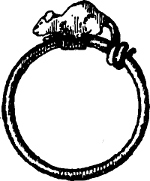
Gold ring with plain hoop on which is freely looped a little mouse wrought in gold and white enamel. It slips around the hoop. About 1600
Albert Figdor Collection, Vienna
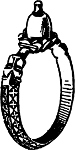
Gold ring of Venetian workmanship. The ends of the hoop form monsters’ heads, supporting a bezel formed like the petal of a flower. XIV Cent.
British Museum
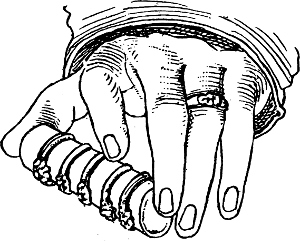
HAND OF A JEWELER, HOLDING A BACULA WITH FIVE RINGS
British Museum
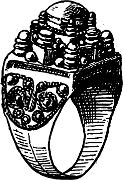
Gold ring set with an amethyst. Found at Lorsch, Grand Duchy of Hesse-Darmstadt, and hence called the “Lorscher Ring.” German; end of Tenth or beginning of Eleventh Century.
Grossherzoglich-Hessisches Museum, Darmstadt
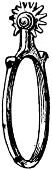
Silver ring having projecting bezel in form of a spur with revolving rowel. Italian (?), Fourteenth or Fifteenth Century
British Museum
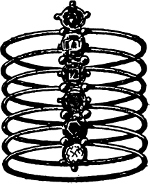
“Regard ring,” with seven hoops. The initials of the six stones spell the word “regard”
British Museum
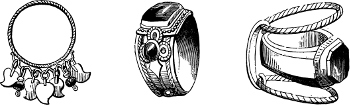
Rings of modern Egyptian type. 1, woman’s ring; hoop of twisted gold; 2, man’s ring made by silversmith of Mecca, with stone setting; 3, cast silver ring; stone setting; with guards
Fairholt’s “Rambles of an Artist”
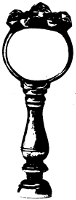
Pipe stopper ring. A silver ring on which are set three Indian, rose-cut zircons. This ring was placed on the finger and the tobacco in the bowl of the pipe was pressed down with it. French; about 1750. A similar ring was figured by Hogarth in one of his illustrations
Field Museum, Chicago
Many of the hoops of the later Roman rings were elaborately decorated, either in openwork, with spirals in wire, or with beads on the shoulders; this latter type is, however, more probably of Merovingian times. A Roman polygonal hoop, with a high-set bezel, has on the side of this loops for carrying a string of pearls suspended from the ring. In one of the rings specially designed for insetting with engraved gems, the hoop, rounded on the outer side, has shoulders ending in curling leaves. A curious specimen is a plain hoop broadening in an oval bezel; in this has been inserted an intaglio head in sard, the shape of the stone following the exact outline of the head, without any margin.
A Burgundian ring of a form that M. Deloche believes to be unique, has an open hoop. At one extremity is a nail-shaped attachment which can be passed through the other extremity, thus closing the ring. A bronze ring, also Burgundian, of a rare or unique type has at the bezel a high, oblong projection. Both these rings are of the Merovingian period which closed in 752 A.D.[122]
In no period were a greater number of ring forms produced than in the Middle Ages. The major part of these mediæval rings were made as insignia of office or rank, for sealing official documents, or for ceremonial use. One of the earliest is that known as the Lorscher Ring.[123] It is considered to belong to the end of the tenth, or the beginning of the eleventh century, and to be a product of German workmanship under the influence of the Byzantine art of the Merovingian period. The artistic and finely executed design of the bezel is especially worthy of admiration. The stone set therein is a light-colored amethyst cut en cabochon and without foil. This ring is now in the Grossherzoglich-Hessisches Museum in Darmstadt.
The Besborough Collection of Gems, shown in June, 1861, by the Archæological Institute of London, was interesting for the high artistic excellence of the rings in which many of the gems were set. A number of them rank among the finest examples of Renaissance work in this direction. One, set with a sard in which a head of Lucilla has been engraved, shows, carved in flat relief on the gold hoop, two nude figures bearing in their hands torches, the design continuing completely around the hoop; about the figures are doves and flowers. This beautiful specimen of goldsmiths’ work belongs to the first half of the sixteenth century. The pose of the small figures has been wonderfully adapted to the curve of the ring.[124]
To a special class has been given the name “iconographic rings,” this designates those bearing, either on the bezel or the sides, images of the Virgin and Child or of the saints. These rings, which date from a period running from 1390 to about 1520, are peculiar to England and Scotland. The material is either gold or silver, those of the latter metal showing much ruder workmanship than was devoted to the gold rings.[125]
What must have been regarded in its time as an exceptionally ornate ring is listed in an inventory of 1416. It is described as a gold ring having a helmet and a shield made of a sapphire, the shield bearing the arms of “Monseigneur.” As supports of the shield were an emerald bear and a swan made of a white chalcedony.[126]
An ornate though tasteless type of Italian rings were those called “giardinetti,” showing flower baskets, jardiniêres, or nosegays, the flowers being figured by precious stones and pearls, with stems and leaves of gold. As the aim was purely decorative, the stones and pearls were usually small and inexpensive ones. Very few such rings have been made in recent times, but from the sixteenth to the eighteenth century they were much favored and a number of fine specimens have been preserved from that period.[127]
A ring-setting consisting of a turquoise surrounded by small diamonds appears to have been favored in England in the seventeenth century, for Samuel Pepys in his “Diary,” under date of February 18, 1668, writes that he had been shown a “ring of a Turkey-stone, set with little sparks of diamonds.”
A “Trinity Ring,” that is a ring consisting of three intertwined circlets, was shown in February, 1857, to the Society of Antiquaries in London by Mr. Octavius Morgan. This specimen, carved, or turned out of a circular band of ivory, was believed to be one of three executed by the German ivory carver, Stephan Zick (1639–1715), who is said to have been the first to make a ring of this type out of ivory, although they may have been made of gold—no exceptionally difficult task—before Zick executed his ivory rings.[128] This ring, or one similar to it, is now in the British Museum, Franks Bequest.
While the rings of the Louis Quinze period were generally of delicate and beautiful form, the tendency to exaggeration in fashions that characterized the succeeding Louis Seize period found expression in rings of disproportionate size. At the same time both the number of rings in a fine lady’s jewel casket, and the number she would wear at the same time upon her hand, greatly increased over what was customary in the preceding reign. Thus Bachaument, in his “Mémoires Secrets,” states that at the sale of Mlle. de Beauvoisin’s jewels, which took place November 22, 1784, there were 200 rings rivalling one another in magnificence. Another French author of this time, M. Mercier, wrote in 1782 “when one takes the hand of a pretty woman, one only has the sensation of holding a quantity of rings and angular stones, and it would be necessary first to strip these off the hand before we could perceive its form and delicacy.”
The enthusiasm of the early days of the Revolution brought into vogue rings set with a little fragment of the stone-work of the recently demolished Bastille; at the same time wedding-rings were enamelled in red, white and blue, the new Republican colors. At the outset the young royalists, as a protest, wore rings of tortoise-shell, with the motto, Domine salvum fac regem, “God save the King.”
A type of ring that became popular during the darkest days of the French Revolution, the period of the dreadful Reign of Terror, was that of a large silver hoop with a plain gold bezel on which was graven the head of some one of the leading spirits of the time, such as Marat, De Chalier, or De Lepelletier St.-Fargeau.
There are several significant French proverbs regarding rings, of which we may here note the following: “Ne mets pas ton doigt en anneau trop étroit” (Do not put your finger in too small a ring); “Anneau en main, honneur vain” (A ring on the finger is an empty honor); “Bague d’amie porte envie” (The ring of a lady friend arouses envy).
Portrait rings were very popular at the time of the French Revolution, as they afforded an opportunity for the expression of the ardent devotion to particular personalities characteristic of that troublous period. Many Washington rings and Robespierre rings were to be seen, bearing the enamelled portrait of the respective hero, but the most popular were the Franklin rings, for Franklin’s personal influence, born of his sterling qualities of insight and common sense, and perhaps strengthened by the contrast of his cool-headedness with the feverish excitement of the Paris of that time, was wide and far-reaching.
Hindu tradition tells of the wearing of rings in India in very ancient times. The earliest forms used by the Brahmans in their forest life, were woven of kusa-grass (Saccharum spontaneum), and even in our time rings of this kind are worn by those assisting at a religious ceremony, as otherwise the water offered to gods or to the spirits of ancestors will not be accepted. As to metal rings, Hindu law assigns those of gold to the index finger and silver rings to the fourth finger.
A story related in the Hindu epic “Mahabharata” alludes to a trick or magic practice with rings, denominated ishika. A ring was thrown into a deep well and then recovered in some mysterious way after it had seemed to be irrevocably lost. The “Mahabharata” in its present form may date from about 500 A.D. The other great Hindu epic, the Ramayana of Valmiki, written perhaps as early as 500 B.C. even mentions engraved rings. When Sita, wife of Rama, the hero of the poem, is abducted by Rávana, the ten-headed Cinghalese giant, Rama sends a monkey called Hanumán to seek for her, giving him a seal ring as a token. As soon as the monkey succeeds in finding Sita, he approaches her holding out the ring and saying, “Gracious Lady, I am the messenger of Rama. Look, here is his ring engraved with his name.”
In Sanskrit books the following types and kinds of rings are mentioned:[129]
Dwi-hirak (double diamond).—Rings with a diamond on either side and a sapphire in the centre.
Vajra (diamond, thunderbolt).—A triangular finger ornament, with a diamond in the centre and other stones on the sides.
Ravimandal.—A ring with diamonds on the sides and other stones in the middle.
Nandyávarrta.—A four-sided finger ornament studded with precious stones.
Nava-ratna or Navagraha.—A ring on which the nine most precious stones have been set. The nine precious stones in Sanskrit are called: Hirak, Nánikya, Baiduryya, Muktá, Gomed, Bidrum or Prabál, Marakata, Pushpa-rág, and Indranil; or the Diamond, Ruby, Cat’s-eye, Pearl, Zircon, Coral, Emerald, Topaz, and Sapphire.
Bajra-beshtak.—Ring of which the upper circumference is set with diamonds.
Trihirak (triple diamond).—Ring with two small diamonds on the sides and a big one in the centre.
Sukti-mudriká.—Ring made like the hood of a cobra snake, with diamonds and precious stones on the upper surface.
Mudrá or Anguli-mudrá.—Ring with name engraved upon it.
These are some of the principal names for finger rings in modern India:
Angushtri.—A ring set with stones, called also Mundri or Anguthi.
Chhallá.—The chhallá is a quite plain hoop or whole hoop ring (with or without stones), being gold or silver, but the same all round. Worn also on the toes.
Angushtárá or Anguthá.—A big ring with a broad face, worn on the great toe.
Khari panjángla.—A set of finger rings of ordinary shape.
Sháhálami or Khári.—A ring of long oval shape.
Birhamgand.—A broad ring.
In Bombay, the local designations for finger rings are: Angthi, Salle, Mohorechi Angthi and Khadyachya angthya; toe-rings are named: Ranajodvi, Jodvi, Phule, Gend, and Masolia.[130]
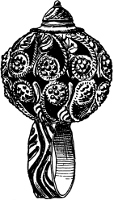
Oriental gold ring, large globular bezel with leaves and flowers in openwork. Said to have belonged to Chief Samory
British Museum
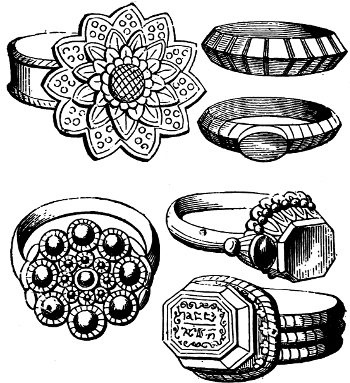
Oriental rings. 1, of cast silver; 2, of brass; 3, of silver; 4–6, Moorish rings; 4, set with turquoise and rubies; 5, with octagonal bloodstone and turquoise; 6, signet-ring bearing name of owner on a carnelian
Fairholt’s “Rambles of an Artist”
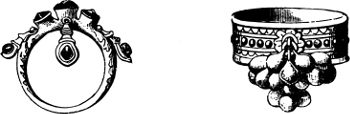
1, ring with pendent garnets; 2, silver ring. East Indian. The loose-hung silver drops jingle as the hand moves
Fairholt’s “Rambles of an Artist”
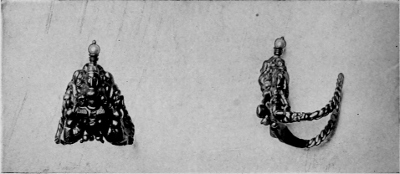
Elaborate East Indian ring, with figure of Buddha. Hoop of peculiar shape to keep the ring from falling off the finger
Courtesy of Miss Helen Bainbridge
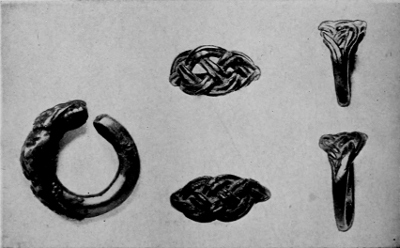
Rings made by Siamese Bonza, or Priest, from metal lying about among the idols at Ongchor, Old Cambodia, in 1871
Courtesy of Mr. Walter C. Wyman
Rings, necklaces, armlets and Sirpech (or tiaras) are made at Bikánir, and exquisitely light and fine rings of gold and silver are produced at Jhánsi in the Gwalior territory. An unusual form of ring ornamentation appears in a silver ring of Indian workmanship, dated in the fourteenth or fifteenth century. This has a projecting bezel in the form of a spur, with a revolving swivel. A ring of similar design, believed to be Venetian, now in the Ashmolean Museum, Oxford, was brought from Chalis.[131]
The rings made by the Hindu goldsmiths are in many cases very elaborately chased and ornamented, in the ornate style characteristic of Indian jewellery. The women of the Deccan almost universally wear rings; they are usually of gold, a silver ring being looked upon as showing meanness on the part of the wearer. There does not appear to be any preference of one finger over the other for decoration with rings. One of the most attractive types is a closely-fitting ring to which is affixed a little mirror, about the size of a silver quarter-dollar; this may be mounted either in gold or silver, and undoubtedly Hindu female vanity finds this thumb mirror of some practical use. With its rich ornamentation a ring of this kind is in itself a pretty jewel, but would hardly suit Occidental taste on account of its size and the inconvenience of wearing it. A rather singular fact is that mirror-rings are sometimes worn on the great toe, where they would seem to be quite useless; but it has been suggested that as the Hindu women of the better class commonly have their feet nearly or quite bare when in their apartments, and have acquired the power to move and use their feet much more freely than is the case with Occidentals, a toe mirror might possibly be of some slight utility; still, it seems probable that they are purely ornamental and came into fashion in imitation of the thumb-mirrors. Many varieties of toe-rings are made, a special type being that for wear on the middle toe.[132]
A ring of an unusual form is worn on the great toe of the left foot by some Hindu married women, as a distinguishing mark of the married state. Men frequently wear a ring on the big toe for curative purposes, or to augment their masculine vigor. These toe-rings of the men are not generally closed circles, but open hoops, so that they can be easily removed when this is desirable.[133]
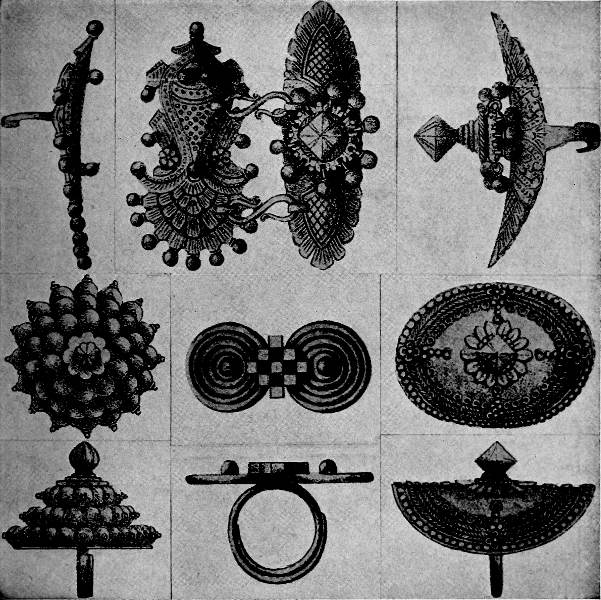
INDIAN TOE RINGS OF SILVER, MADRAS PRESIDENCY
1, three views of ring worn on second and third toes of the left foot; the conventional fish is an emblem of Siva 2, 3, 4, other toe rings
Journal of Indian Art and Industry, vol. v, 1894
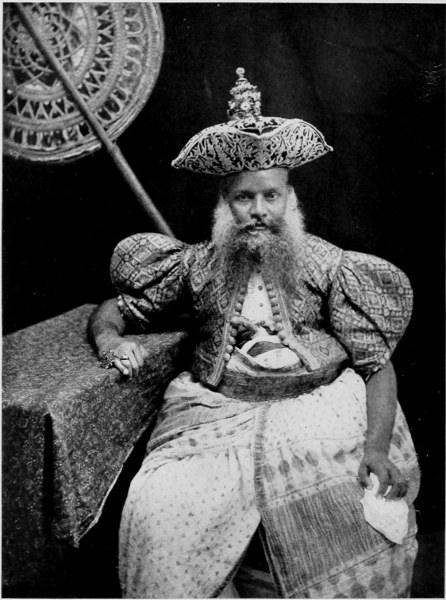
RICH CINGHALESE MERCHANT, IN GALA DRESS
The immense, round ring on the little finger of his right hand is a favorite adornment in Ceylon; smaller rings are on the fourth finger of right hand, and on the little finger of left hand
The art of the Persian goldsmith in the fifteenth century is displayed in a ring belonging to one of the splendid collections of the Metropolitan Museum of Art, in New York. It is of massive form with an immense bezel, richly decorated in openwork; the hoop is also elaborately chased. The flat surface of the bezel is adorned with a design in keeping with the ornamentation of its sides and of the hoop. For a large and massive ring this one is remarkably well-proportioned and harmonious in design.
A good specimen of the rings worn on state occasions by East Indian princes was sold in February, 1913, at the American Art Galleries. It is of gold, but bears no precious stones; the circlet is ornamented with white enamelled crocodiles, and also with a minute enamelled figure, within a temple and incased in glass; the bezel of this ring is decorated in blue, green and red enamel.
While the simpler Chinese rings as a general rule are unset, usually consisting merely of a plain silver band on which are engraved designs of various objects, or else coated with ornaments in enamel, the rings of the Tibetans display a considerable variety of settings, turquoise, coral, agate, mother-of-pearl, mica and similar stones being used. Few or none of the true precious stones are to be found in the rings of these countries. The Field Museum of Natural History in Chicago has a large number of specimens some of which are figured in the accompanying plate.[134]
A collection of some two dozen rings of artistic Siamese workmanship were sent to the Chicago Exhibition of 1893, in charge of Prince Surrya, later Siamese ambassador to France. These rings were of nearly pure gold, and were ornamented with designs in red, green, and white enamel, representing animals, fish, and other forms, but never human figures. They were believed to be of considerable age and historic value; indeed, they were so highly prized that they were not publicly exhibited but were kept locked up in a safe, and only rarely displayed to some especially favored visitor. After the close of the Exhibition they were safely returned to Siam.
An American traveller in Cambodia, in 1871, succeeded in having a few rings made for him by a native Buddhist bonza, the material being old metal found lying about among the idols of a temple at Ongchor. The work of the priest gives evidence of a considerable degree of skill in design, doubtless derived from examination and study of native and Indian types of rings. The type having an intertwined bezel prevails; one massive ring is penannular.[135] An elaborate Burmese ring has the hoop in the form of a serpent, whose open mouth displays the death-dealing fangs. Along the body runs a continuous band of rubies placed in oval settings. The rest of the surface is adorned with green, red and white enamel—mouth, nose, tail and scales being brought out in this way. Of two red stones which originally marked the serpent’s eyes, one has fallen out; on either side of the head is a small sapphire. This fine ring is in the British Museum.[136]
While fifty years ago in Japan the women of the better classes did not favor the wearing of finger-rings, it was not infrequently the case that kitchenmaids and housemaids would wear silver or brass rings. They are believed to have been influenced by the example of Dutch women in Nagasaki.[137] At the present day American and European influence is very slow in making itself felt in the direction of ring-wearing.
In the large oval bezel of a fine Syrian ring is set a paste representing a topaz. The shoulders expand to form the bezel. This ring, the lower half of which has been broken off, shows an exceptionally fine patina; it was of large size and must have been a striking ornament on the wearer’s hand. As the broad oval extends across the hoop, not at right angles with it, it must have interfered slightly with a free use of the fingers near the one on which the ring was worn.
In the Philippine Islands a type of ring that is made by the natives has a number of spiral twists, from five to as many as a dozen coils appearing in these rings. The serpentine form is accentuated by a pattern of dots or cross-marking, with sometimes the indication of a conventional flower design. While rather clumsy for wear, these rings still possess a certain artistic quality. Fine examples are in the Ethnological Department of the American Museum of Natural History, New York City.
The ancient city of refuge, Machu Picchu, probably built by the Incas nearly 2000 years ago on a Peruvian mountain top, was uncovered by the National Geographic Society—Yale University Peruvian Expedition of 1912, of which Dr. Hiram Bingham was the director. Among the many interesting relics found on this unique site were some silver rings, one being of the twisted type, with the ends free, so as to suit the size of any finger, while another has been welded or hammered into a closed circlet. While it is impossible to date these rings with any approach to exactness, they are undoubtedly examples of the art of native Peruvian silversmiths prior to the Spanish Conquest.[138]
Rings in great variety are worn in the Congo region and in every part of Bantu and Negro Africa. There are heavy rings and light ones, simple hoops and spirals, and they are worn on neck, arm, leg, finger and toe. They are made of brass, copper, ivory, iron, elephant foot-pad, and several other materials. At Akkra, and in Liberia, there is quite a manufacture of gold rings, and, to a lesser extent, of silver rings also.[139]
An example of the exceptionally large rings sometimes made to commemorate special occasions, rather than for possible wear, is one donated to President Pierce by some Californian admirers in 1852. This somewhat ambitious production scarcely answers the requirements of a high standard of art, but its decoration offers a great variety of appropriate designs illustrating life in the Far West in the middle of the past century. The ring is of solid gold and weighs something over a pound, thus having a mere metal value of about $250. On square surfaces cut on the circlet are a series of designs intended to present an epitome of California’s early history; the native animals in a wild state, the Indian warrior armed with bow and arrow, and a native mountaineer; then comes a Californian, riding a horse at full speed and casting his lasso; to him succeeds the miner with pick and shovel. The bezel is engraved with the arms of California; it is hinged and when opened reveals a kind of box having nine compartments divided by golden bars. In each compartment is a characteristic specimen of one of the principal ores found in California. Inside the circlet has been engraved the inscription: “Presented to Franklin Pierce, the Fourteenth President of the United States.”[140] What may be called a presidential ring is that depicted in the effigy of Abigail Power Fillmore, wife of President Fillmore (1850–1853), a quaint wax figure in the Wives of Presidents series, shown in the United States National Museum, Washington D. C. In this she is shown wearing a handkerchief ring.
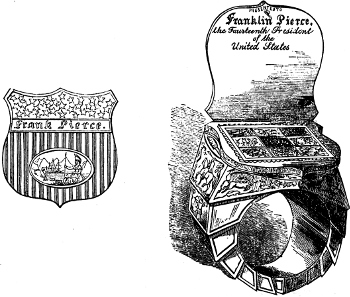
Ring given to President Franklin Pierce in 1852 by citizens of California
“Gleason’s Pictorial Magazine,” December 25, 1852
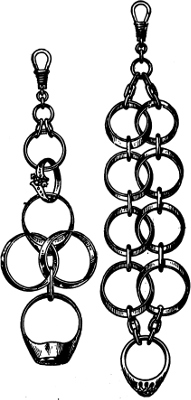
Series of old rings worked up to form a pendant
Jewelers’ Circular-Weekly, December 8, 1909
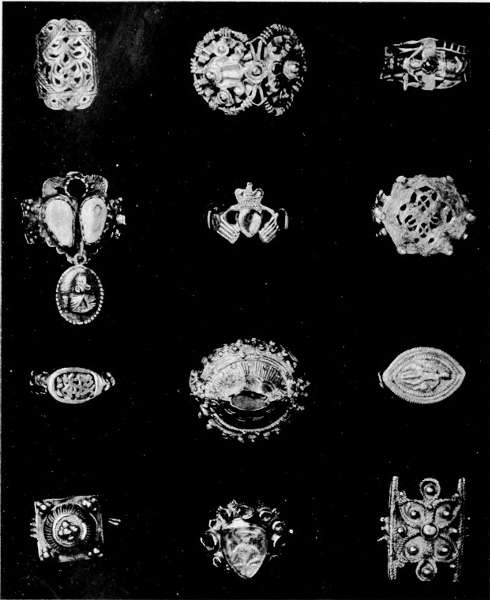
RINGS FROM THE ALEXANDER W. DRAKE COLLECTION, SOLD AT THE AMERICAN ART GALLERIES IN MARCH, 1913
1, silver ring of East Indian workmanship. 2, massive Tartar finger ring of fine gold. 3, copy in silver of the betrothal ring of Martin Luther, a gift of Richard Watson Gilder. 4, finger ring with precious stone setting and two irregularly-shaped pearls. Pendant shows the bust of a bearded man in armor. 5, gold betrothal ring. Two hands holding a crowned heart. Type used by Galway fisherman from the Thirteenth Century and called a “Claddugh Ring.” 6, openwork gold ring. 7, old Chinese gold ring—oval with Chinese characters, on either side a chiseled bat. 8, Moorish finger ring of fine gold. Large shield with characteristic ornamentation. 9, gold ring with intaglio of a shepherd and goat cut on a light sard. 10, square gold ring, with bead groups in centre and at corners, the central part in raised openwork. 11, gold ring. French. Heart-shaped bezel set with Watteau figure in repousse, under crystal, and surrounded with bits of green and white crystal between small flowers of gold. 12, silver finger ring. Two hoops linked together by true-lovers’ knot.
An unusually large ring was worn by the well-known theatrical manager, Sheridan Shook. It was set with an amethyst an inch long by three-quarters of an inch broad and half an inch deep, and weighing two and a half ounces. The letter S was engraved in the stone and inlaid with small diamonds. This immense ring with its massive gold setting can hardly be termed a great work of art, but it is unique in its way and was greatly valued by its owner, who only ceased to wear it when ill-health and weakness made it too much of a burden.
The extensive and remarkable collections of the late Alexander Wilson Drake, which were disposed of at the American Art Galleries in New York, March 10th to 17th, 1913, comprised a fine collection of finger rings, illustrating a large variety of forms and periods. There were in all nearly 800 examples, set and unset. There were betrothal rings, memorials rings, gimmal rings, puzzle rings, rings of Roman, French, German, Italian, Spanish, Russian, Irish, Scandinavian, English and American workmanship, and many Oriental rings, Sassanian, Indian, Japanese, Chinese, Hebrew, Gypsy and Moorish, one of the latter being a gold circlet with the twelve signs of the zodiac engraved in high relief around it.
The personality of the collector added greatly to the charm of this collection for all who had known him. As art editor of the Century Magazine, and in a thousand other ways, no one had labored more enthusiastically and successfully in the cause of art encouragement and art education, and his death constituted a real loss for the progress of art in America.
The valuable and carefully chosen collection of gem stones set in rings, which was made by the late Sir Arthur Herbert Church (1834–1915), has been presented by his widow, Lady Church, to the trustees of the British Museum and is shown in the Natural History building.[141]
Of the 18 examples in the British Museum collection of the interesting class of rings cut out of a single stone, The collection comprises 169 specimens, 45 of them zircons, fully illustrating the wide range of color to be found in this gem-stone; two of them are of a beautiful sky-blue. The following list gives the number of rings for each mineral species:
Corundum 12
Spinel 17
Chrysoberyl 8
Quartz (amethyst, tiger-eye, chrysoprase) 3
Peridot 1
Spodumene 1
Labradorite 1
Beryl 4
Andalusite 1
Tourmaline 20
Opal (precious, fire, black and milk) 10
Zircon 45
Phenacite 5
Enstalite 1
Moonstone 2
Garnet 19
Topaz 8
Cordierite 2
Sphene 1
Turquoise 1
Only three of the rings are set with more than a single stone.
Several belonged to the collection of Sir Hans Sloane in 1753, five of them being archers’ thumb-rings, of agate, carnelian, mocha-stone, or jasper. A green jasper ring of this type is thus entered in the Sloane Manuscript catalogue: “A thumb piece for defending it from being hurt by the bowstring, from Turkey.”
A remarkable, though decidedly eccentric ring of the art nouveau style of René Lalique shows in the long, irregularly oval bezel, a full-length, nude female figure cut in very high relief out of a bluish rock-crystal; set at one side about the middle of the figure is a round pearl, apparently of immense proportions as compared with those of the human body.[142]
Not only are there the watch-bracelets which have been so extensively worn of late years, but minute ornamental watches have been set in finger-rings, where they can be consulted with even greater ease than when worn on the wrist. The watch-face is surrounded by a bordering of small jewels. Apart from their practical value, the “watch-rings” are pretty and dainty objects in themselves, and lend a new element of variety to the long list of ring forms.[143]
There is in the collection of the Imperial Kunstgewerbe Museum, Vienna, an exceptionally fine example of the watch-ring, made by Johann Putz, of Augsburg, in the seventeenth century. It has a detachable cover, cut from an emerald, on which the Austrian double-eagle has been engraved. In the same collection are two sun-dial rings; one, made in the seventeenth century, has a lid figuring a hedgehog, studded with black diamond lozenges; the other, a sixteenth century ring, bears a Greek inscription to the effect that “time removes all things and brings forgetfulness;” the sun-dial is on the inner side of this ring, which is of silver gilt. There is also a gold astrolabe ring, which when closed looks like an ordinary one; but when the connected circles are opened up, the ring constitutes a veritable astrolabe.[144]
A gold “sphere-ring” in the British Museum collection has an outer hoop in two parts, working like a gimmal, and three interior hoops which are almost concealed when the ring is closed. The exterior hoop is chased; on the inner surfaces, concealed from view when the ring is closed, appears in sections the following inscription in black enamel: Verbo Dei celi firmati sunt. Dixit et creata sunt, ipse mandavit et creata sunt. (The heavens are founded in the word of God. He spoke and they were created; he commanded and they were created.) After “firmati sunt,” is the date 1555. The three interior hoops bear, enameled in black, the signs of the zodiac, stars, and other astral figures. This ring is of German workmanship.[145]
In the collection of works of art bequeathed to the British Museum in 1898 by Baron Ferdinand Rothschild, and designated as the Waddesdon Bequest, there are several characteristic rings. Of these perhaps the most notable is a large finger ring of gold, enameled and set with jewels, a sixteenth century example of German workmanship. The bezel is in the form of a clasped book; on the cover is a skull, about which are four stones, sapphire, ruby, emerald, and diamond, and two toads and snakes in enamel. When the book cover is thrown back there appears a loose plate of gold, on which is enameled a recumbent figure with skull and hour-glass; on the under side of the cover is inscribed in black enamel (in capitals): SIVE VIVIMUS, SIVE MORIMUR, DOMINI SUMUS. COMMENDA DOMINO VIAM TUAM, ET SPERA IN EUM ET IPSE FACIET (Whether we live or whether we die we are the Lord’s. Commit thy way unto the Lord and trust in Him, and He shall bring it to pass). This combines the text, Romans xiv, 8 with Psalm xxxvii, 5. On the shoulders of the ring are two groups in enamel, the Fall and the Expulsion from Eden.[146]
Sixteenth century ring-making, so rich in its variety of eccentric types, evolved whistle-rings, one of which is in the British Museum. This is of bronze gilt; the large oval bezel is engraved with a shield of arms; the hoop is slender at the back. The shoulders are engraved with strap-work, one of them having a tubular whistle.[147]
An enameled gold ring of striking and original design is owned by Dr. Albert Figdor, Vienna. The bezel has a lid on which is enameled a head wearing a half-mask; the eyes are of small lozenge-shaped diamonds, and there is a bordering of seventeen rubies. On lifting the lid there appears beneath an oval surface, on which is enameled a heart with the motto: “Pour vous seule” (For you alone). The inner side of the lid is hollowed out so as to serve as a receptacle for hair. The hoop, of a ribbon-like form, bears the significant inscription: “Sous le masque la vérité” (Beneath the mask is truth). This ring, which belonged to the famous Viennese tragedienne, Charlotte Wolter, is of French workmanship and dates from about 1800. A whimsical gold ring in the collection has a plain hoop, to which the figure of a little mouse, wrought in gold, is looped by the tail so that it slips around the circlet. Another gold ring of singular design is one having a diamond in a silver setting about which are three rubies in gold settings; between the rubies are three playing cards in enamel. The hoop is of openwork with two playing cards and two ovals; a section of reddish gold that has been added to it, indicates that the ring was enlarged at some time from its original size.[148]
A decoration of a somewhat unusual type appears in a ring to be seen in the Cleveland Museum of Art, the gift of Mr. and Mrs. J. Homer Wade. It has for its adornment a minute landscape painting, in place of a precious stone or seal decoration.[149] This might be a suggestion to those who may wish to bear with them a pretty reminder of their favorite country home, or else of some scene that is associated with exceptionally happy memories.
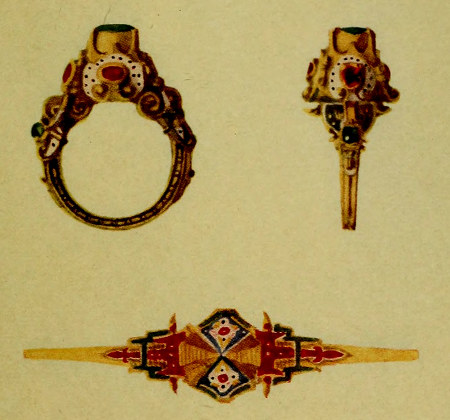
GOLD RING, RICHLY ENAMELED
The hoop has white, red and black enameling, and is studded with little emeralds and rubies. The high bezel is set with an emerald and with a small ruby on each of the four sides. Second half of Sixteenth Century
Albert Figdor Collection, Vienna
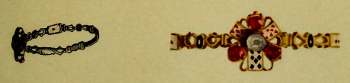
GOLD RING, WITH HEAD IN FORM OF A ROSE KNOT
The setting consists of a diamond in a silver bezel, and three rubies in gold bezels; between the rubies are three enameled playing cards. The hoop is of openwork interspersed with two playing cards and two ovals in enamel; a section of reddish gold indicates an enlargement of this ring. Eighteenth Century
Albert Figdor Collection, Vienna
A symbolic ring recently designed and executed in New York artfully combines a number of significant elements, each of which has a distinct bearing upon the history, the fortunes, or the taste of the prospective wearer. At the head of the ring is set his birth-stone, the sard, about which are engraved his family crest and motto, and the initials of his name. On the shank are two relief representations, one of a lion, “the king of beasts,” typifying royal descent, the other showing the wearer’s patron saint, Michael; at the left of this figure is set an emerald as the talismanic gem. Surmounting the head of the ring are a series of light gothic arches, indicating the religious character of this jewel. On the smooth inner side of the head is engraved a mystic design, consisting of a double triangle, interlaced to form a six-pointed star, and enclosed by a circle; within the triangles appears in blue emerald the “mystic number” 15, that of the wearer, blue being his astral color; the triangles symbolize the inseparability of the Holy Trinity, and the circle typifies Eternity, this word being engraved above, as well as the date of the wearer’s birth, and a legend commemorating the gift of the ring. It is made of fine gold, so that it may the better denote absolute purity.
In one type of serpent ring, one of the ends is inserted loose into the mouth of the serpent’s head terminating the other end, so that by a little careful bending, the trifling difference in the diameter of the hoop necessary to adjust it perfectly to a finger can be easily attained. This form already appears among ancient rings.[150]
Two finely wrought serpent rings are shown on the Plate.[151] In one of these (No. 2), with three coils, the erect head of the snake with distended jaws is vividly portrayed, making the ring a work of art indeed, but arousing an instinctive repulsion in the beholder. The other serpent ring constitutes a simple circlet, the head of the snake overlapping the tail. As an example of artistic workmanship it fully equals the larger ring, and may be considered better adapted for the adornment of the hand, since the serpent nature is not so aggressively presented.
Rings of a quite unique type, that owes its origin to the great war and to French skill and taste in adapting the most unpromising means to an artistic end, are those made by French soldiers out of aluminum fuses taken from the bombs which their German foes have so liberally rained upon them. At the outset the disks were first worked with scissors to make rude rings for men’s big fingers. Later on the well-furnished tool-box of the machine-gun squad was called into requisition. This early primitive type was soon abandoned, and in order to make rings of the proper dimensions the metal from the German shells was fused and run into ingots; the crucible was frequently one of the new iron helmets, which was set on a wood fire that was kept going by a bellows improvised from a bayonet sheath. However, the soldiers finally became so reckless in their search for material that it was found necessary to put a stop to this, after several had been shot by the enemy.
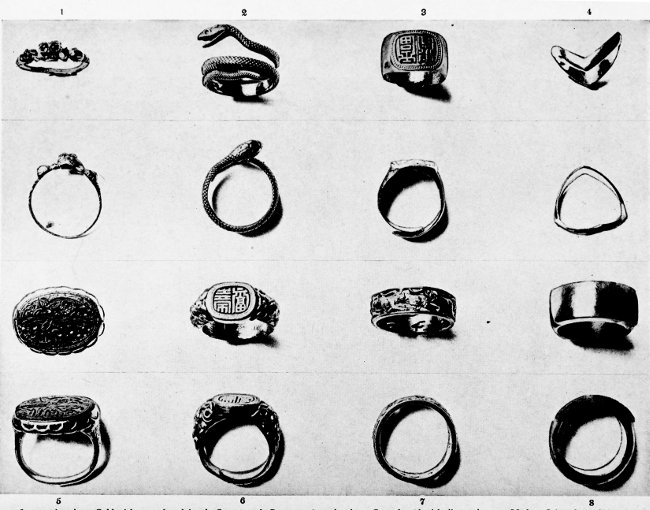
1, mourning ring. Gold with enamel and jewels, Seventeenth Century. 2, snake ring. Carved gold with diamond eyes. Modern Oriental. 3, Chinese ring. Native gold with seal reading, “Riches and public honors.” Overlapping back. Nineteenth Century. 4, wish-bone ring. Copy of an African one in gold. 5, Persian ring. Gold and silver, set with a carnelian having seal characters of owner’s name. Metal engraved inside. Eighteenth Century. 6, Chinese ring. Native gold with seal reading, “Long life and riches.” Overlapping back. Eighteenth Century. 7, animal ring. Carved gold in two colors with continuous procession of tigers. Modern French. 8, Chinese ring. Of greenish jadeite in one piece. Eighteenth Century.
Rings from the Collection of W. Gedney Beatty
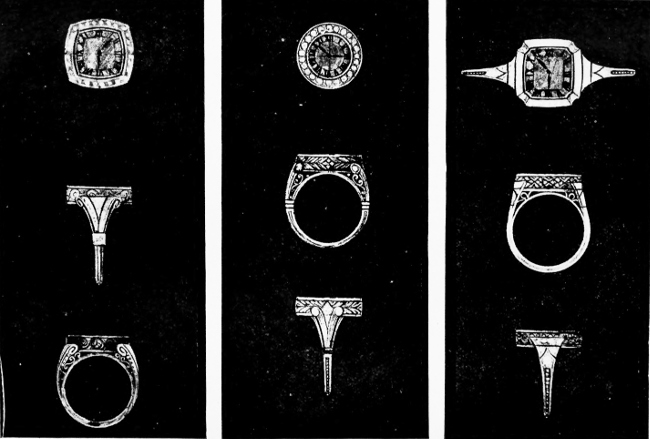
THREE TYPES OF WATCH RING
Front, side and end views
The first models for the rings were made of wood or soft limestone. At a more advanced stage, round bars were made, which were cut into sections by means of the jagged edge of an old trench-spade. The smoothing off was done with a knife, and for making the ring apertures a pick was commonly used. They were then polished with a piece of hard wood, moistened from time to time to soften it.
This still primitive form failed to satisfy the amateur ring-makers, and soon some of them began to engrave their rings with the point of a pocket-knife, and others, more ambitious, encrusted them with small pieces of copper, either mortised or rivetted in. Although many of the rings were undoubtedly the work of entirely unpracticed hands, of course in any of the great modern national armies men of all trades and professions are represented, and hence the really fine examples of these war-time rings have been the work of those familiar with the jewellers’ art. So eagerly did some of the soldiers pursue this avocation, that when their aluminum threatened to give out, they would look impatiently for a bombardment to get a new supply.[152]
The “add-a-link” ring is made up of a series of small links which all snap one in the other. The purchaser buys one with the number of links requisite to fit the finger exactly. If he wishes to have a stone in it he buys a link with a stone inserted therein. A plain link is snapped out of the ring and the link with the stone is snapped in. Sometimes these rings are made up of a variety of stones and then again with only one stone. It is possible in this way for the purchaser to obtain, at a moderate cost, a variety of settings, changeable at will. Moreover, a ring of this type can be enlarged as the finger grows larger.
Among a number of ring-types designed for the practical convenience of the owner and only worn temporarily to serve a particular purpose, we may note the cigarette ring, provided with a straight sliding rod the end of which clasps the middle of a cigarette, so that when a whiff has been taken, the hand may be freely used without laying aside or dropping the cigarette. Another smokers’ ring is one provided with a projection for stopping a pipe, rendering it possible for the ardent pipe-smoker to keep his pipe-bowl well filled and well packed without soiling the tips of his fingers. These pipe-stopping rings are sometimes of rich materials, in one instance the stopper was of a beautiful white zircon, finely contrasting with the rich yellow gold of the ring proper. Rings of this kind were very much in vogue in the eighteenth century, and one appears on the hand of a gentleman in one of Hogarth’s engravings.
The name “swivel ring” is applied when the head of the ring is loose, and is loosely secured by a bar to the band or circlet, so that the ring will swing around. This type is frequently used in scarab rings, or where there is a double intaglio, a double miniature, or other double object, or where the ring is what is known as a concealed seal ring, the outside part being a gold ornament or a stone.
One of the “surprise rings” in which a hinged outer section of the hoop can be made to detach itself, on a spring being pressed, so that a concealed surface appears, shows on its hidden surface a number of magical signs and the names of the angels or spirits Ashmodel, Nachiel, Zamiel, and others. Wearing a ring of this kind, the adept could reveal his belief in the magic arts to others of his sect or fraternity, thus bearing about with him a secret passport admitting him to their confidence.[153]
A pretty way of utilizing old and cherished rings for the production of an attractive ornament is to link them together so as to form a chatelaine. By this means a large number of family memorial rings, either those of more or less remote ancestors or of persons whom the owner has known and loved, may be combined in a single beautiful chain. This can be done in several ways. After opening the rings at the joint, they are strung one below the other, the monotony of the effect being varied by one or more double rings, the terminal of the chain being a seal-ring with the bezel downward. Another method is to have a series of double rings, each one of which is joined to the member of the pair immediately below, by means of a small ring made for this purpose; here again the terminal will be either a seal-ring, or one set with a large precious stone. Such ornaments are not only things of beauty in themselves, but unique in the memories they serve to perpetuate in the hearts of the wearers.
THE MATERIALS OF RINGS
Ring whittling or carving is a favorite occupation of sailors and young boys. Many interesting rings have been carved by them out of peach pits, flexible ivory, cocoanut shells, gutta percha, walrus ivory, boxwood, whale’s teeth and many other substances. These are frequently incised with the initials of the wearer or the one to whom the ring is to be presented. Then again, pins are cut off and the upper part driven into the hoop, in such a way that the head of the pin appears as a beading; often metallic points are added. Other rings are carved with hearts, folded hands and other symbols of sentiment.
As a ring is necessary in marriage it has occasionally happened when no precious metal was available in hasty marriages, or out of economy, that a curtain ring, taken from the church curtain, has been used.
Memory rings, of threads wound around the finger, have often been employed. Sometimes these are made of cord or yarn, and each ring is supposed to represent one object to be remembered, and to be purchased, or delivered at the final place of destination. The writer distinctly remembers seeing an old man nearly 90 years of age, wearing a waistcoat older than himself, and with at least twenty strings of different colors and variety on his fingers. He trudged a distance of six miles to the nearest village and had been instructed not to return until he had purchased or obtained the object meant by each string. This memorizing by cords or strands has been practised by many primitive peoples who had not developed any system of writing, a well-known instance being the wampum records of some of our North American Indian tribes.
To the famous episode of the descent of the life-goddess Ishtar to the infernal regions, forming part of the great Babylonian poem known as the “Gilgamesh Epic,” have been appended a few lines suggesting an idea distantly resembling that in the Greek myth of Orpheus and Eurydice. A mourner who seeks to release a loved one from the Realm of Death, is told to address himself to Tammuz (= Adonis). A festival garment is to be put on the god’s statue to induce him “to play on the flute of lapis-lazuli,” with a ring of porphyry. This divine music was believed to arouse the dead and call them to inhale the fragrance of the incense offering prepared for them.[154] The “porphyry ring” for playing the musical instrument might seem to indicate that it was some form of lyre, on which the ring could be used as a kind of plectrum, rather than a flute or other wind-instrument.
Rings made entirely of a precious stone substance were not uncommon in the time of Rameses III (1202–1170 B.C.) and later Egyptian sovereigns, but there is no evidence of their having been made at a more remote period. The prejudice against burying rings with the dead does not seem to have affected the Egyptians, for in a number of cases rings have been found on the fingers of mummies.[155]
The sardonyx was a favorite stone with the Romans of the Imperial Age, as is proved by the frequent allusions to it by the poets of this time. Of a celebrated player on the lyre, Juvenal (50–130 A.D.) says that as his hand passed over the strings the whole instrument was lighted up by the sheen of his many sardonyx rings.[156] Such a ring was regarded as a most appropriate birthday gift.[157] Another passage relates that the advocate Paulus, in order to render his address before the court more impressive, wore upon his hand a fine onyx ring which he had borrowed from a friend especially for this occasion.[158] Indeed, so highly was the stone prized that it was called the first of gems (gemma princeps sardonychus) and ivory caskets were regarded as fit receptacles for sardonyxes.[159] The value of rings set with them is shown by the fact that in Hadrian’s (76–138 A.D.) time, they were expressly associated with the gems of greatest value, such being strictly differentiated from those worth but four gold pieces each.[160]
Several rings of the Later Roman period in the British Museum are set with small diamonds. Of these the following are believed to represent original settings:[161]
No. 779. Plain solid hoop with sides cut flat. It is set with a small pointed diamond. Castellani Coll., 1872.
No. 785. Thin rounded hoop, slightly expanding upwards. Pointed diamond in raised oblong setting. From Tartûs. Franks Bequest, 1897.
No. 787. Angular hoop, projecting sharply below the shoulders, which are in the form of hollow leaves within a triangular frame. The bezel is square and contains an octahedral diamond; the sides are open and form a kind of wave pattern. Castellani Coll., 1872. 3rd century, A.D.
No. 788. Type akin to last. On either shoulder is an openwork triangle. The bezel is square and contains an octahedral diamond; on either side of the bezel is a small openwork triangle.
No. 789. Type akin to last. The lower part of the hoop has a groove running along its middle; either shoulder is cut away in a slight curve. The bezel is square, with a triangular space left open in each side and with a round opening below. It contains a diamond of octahedral form. Franks Bequest, 1897.
No. 790. Type akin to last. The hoop is rounded without; the curved excision of the shoulders is more pronounced. Two double pyramid-shaped (octahedral) diamonds are set in the bezel. A triangle is cut out of either shoulder, and two smaller triangles on either side of the bezel. Underneath the stone are two lozenge-shaped openings. Franks Bequest, 1897.

PORTRAIT OF AN UNKNOWN MAN IN THE COSTUME OF THE FIFTEENTH CENTURY, BY ANTONIO DEL POLLAIOLO
He holds between the thumb and index of his left hand a ring set with a naturally pointed diamond crystal
Galleria Corsini, Florence

PORTRAIT OF A VENETIAN SENATOR, BY A. DA SOLARIO
Seal ring on thumb of left hand
National Gallery, London
In all these cases the diamond is a small natural crystal of octahedral form suggesting the “diamond, a point of a stone,” of which the astronomer Manilius wrote in the first century, and, perhaps, the diamond in Berenice’s ring mentioned in the same period by the satirist Juvenal. Another ring in the British Museum, however, is set with two facetted diamonds, as well as with two other stones (No. 778 of catalogue, Plate xx, same number). Here the diamonds have unquestionably been set at a time long posterior to the making of the ring, which is believed to belong, approximately, to the same period as the others we have listed. The diamonds were probably inserted to replace two of the original stones that had fallen out of their settings.
Sir Charles Hercules Read pronounces the instances of diamond settings in ancient rings to be exceeding rare. He states that the examples above noted are the only ones of which he knows, and considers that they belong to the third or fourth century of our era.[162]
The famous Marlborough collection of gems includes a thumb ring entirely of sapphire. To give this stone ring the necessary resisting power, it has been lined with a thick hoop of gold. The engraving it bears, a head of the Elder Faustina, the wife of Antoninus Pius (86–161 A.D.), is believed to replace an original Arabic inscription that fitted this ring for use as a seal.[163]
Rings entirely of precious-stone material, or “hololith” rings, have been found at Mycenæ, one of jasper and another of rock-crystal, and a carnelian ring was discovered in a tomb in southern Russia. Each of these bears an engraved design. Two carnelian rings are in the British Museum.
Chalcedony rings, that is, rings entirely formed of this stone, while quite rare, are represented by a few specimens. We describe elsewhere the so-called betrothal ring of the Virgin at Perugia,[164] and the British Museum has a large example of a chalcedony ring, with the hoop rounded on the outer side, and a raised bezel that has been roughly cut so as to indicate a human head, some scratches marking the hair. The work is late Roman and the inscription shows that it was made for some adherent of the Gnostic sect.[165]
A large ring, entirely of rock crystal, shows on the oval flattened surface of the upper part a curious combination of the “Tau Cross,” with superposed “chrisma,” and with a serpent twined about it, recalling the brazen serpent of Moses, the view of which restored health to the diseased; the Greek letters, alpha and omega, “the beginning and the end,” complete this interlacing of Old and New Testament emblems; the doves facing the cross are the faithful to whom the Cross of Christ brings salvation.[166] Another entire crystal ring bears on its flat face a design of somewhat similar import, with, however, the curious difference that the lower end of the cross is supported on a little Cupid, on either side of which figure is a dove.[167]
The jewels of the Mogul emperors were the most splendid in the world, but few have survived intact to our time, as nearly all were broken up by the spoilers of the Mogul Empire. However, one of the few that have been preserved for us is a most interesting illustration of the type of ring favored in that age and region. This is one made for Jehangir Shah, the father of Shah Jehan, for whom was erected the wonderful Taj Mahal at Agra, a memorial of his dearly beloved wife, Mumtaz Mahal, who died in 1629. It is about 1¼ inches in diameter and is cut out of a solid emerald of exceptional purity and beauty of color; from the ring proper depend two fine emerald drops, while set in two collets are rose diamonds with ruby bordering. Jehangir’s name is engraved on the hoop. This ring was probably carried off by Nadir Shah at the looting of Delhi in 1739, and after remaining in the Persian treasury for a few years found its way, with other gems and jewels plundered from the Moguls, into the hands of the Afghan chiefs. One of these, the unfortunate Shah Shujah, in the course of his wanderings after he had been blinded and deprived of his throne by a brother, finally sought and found refuge under the protection of the British East India Company, and as a token of gratitude, or as a slight quid pro quo, he gave this historic ring to the company. After having been acquired by Lord Auckland, it passed into the hands of the Hon. Miss Eden. This is probably the very finest specimen of the rare type of hololith rings, or rings entirely consisting of a single precious-stone material.[168]
For those who believed in the magic virtues of precious stones, a ring of this kind would possess much greater efficacy than would a metal ring set with the stone, as in the former case the substance when worn would always be in direct contact with the skin of the wearer. Jehangir also owned an entire ruby ring given him by Shaikh Farid-i-Bukhari, and valued at 25,000 rupees (about $12,500). In modern times, the Burmese ambassador to the court of Persia is said to have brought with him, as a gift to the Shah, a ring cut out of a solid ruby of the finest color.[169]
One of the most remarkable archers’ rings was engraved out of a single piece of emerald. It is an example of the type which is narrow at one end, tapering to a broad edge at the other. It is of a beautiful green emerald and very handsomely engraved. This ring was probably made for the Mogul Emperor Shah Jehan, about 1650. It was part of Nadir Shah’s share of the booty from the sack of Delhi in 1739, and this Persian adventurer had the following inscription engraved upon it in Persian characters: “For a bow for the King of Kings, Nadir, Lord of the Conjunction, at the subjugation of India, from the Jewel-house [at Delhi] it was selected 1152 [1739 A.D.]”. The luckless Shah Shuja gave it to Runjit Singh, the Lion of the Panjab, in 1813, when he took refuge at the latter’s court at Lahore. At the end of the second Sikh war in 1849 it was found with the regalia in the royal treasury of Lahore. This splendid ring once owned by Lord Dalhousie, was sold at Edinburgh in 1898; it came into the possession of W. H. Broun, Esq., and is now one of the gems of a private collection in Philadelphia.[170]
In past times the Shahs of Persia have passed ordinances restricting the exportation of turquoise. Regarding this precious stone as peculiarly Persian and for the furthering of Persian goldsmiths, it was enacted that no unset turquoises should be exported; as a rule the settings were in rings, these being easily transported, since a great number of them could be strung together. Sometimes a prospective purchaser was permitted to test the quality of a string of turquoise rings by wearing a bunch of them for a while under his arm-pit, to see whether the stones would change color. Although some failed to endure this rather severe test, many withstood it successfully.
The entire circlet of certain of the finest turquoise rings was of pierced gold enriched with rose diamonds; other, less valuable turquoises have been set in fine gold rings, carved or plain, and those of the next lower value, in ornamented silver. The cheaper sort ranged in price all the way from one cent to a few dollars, and were often set in rings made of tin, or of tinned iron, the hoop costing but two cents. The stones were always cut irregularly en cabochon, the form being frequently quite pleasing; if the turquoise were thin the back was coated with pitch to bring out the color, and on the surface was engraved some short formula from the Koran, such as “Allah be praised!” or “Allah is great!” Occasionally the Shah’s portrait was the subject.
In the Roman world entire rings of yellow amber were sometimes formed, and in a few instances figures or heads have been engraved in relief upon the chaton. Their execution need not have presented any greater difficulty than did the carving of the many small amber figures which have come down to us from ancient times. A carved amber ring in the Franks Bequest of the British Museum is beautifully formed with full-relief figures of Venus and of Cupid on either side. It is cut out of a single piece of amber, and is considered to be the finest example extant of Roman carving in that material,[171] but unfortunately is considerably damaged.
Pliny declares that in his time amber ornaments were almost exclusively for women’s wear; indeed, a few years later, Artemidorus, in his “Oneirocritica,” an interpretation of dreams, after saying that amber and ivory rings were only appropriate for women, proceeds to assert that this was true of all kinds of rings.[172] There are but a very few ivory rings in the British Museum, although the collection includes several bone rings, probably for wear on the thumb. The relief-carving of masks has been thought to make it likely that they were actors’ rings.[173]
Not only have entire emerald and ruby rings been formed, but even the intractable diamond has lately been cut in this form. An entire diamond ring, the work of the diamond-cutter Antoine, of Antwerp, was shown in the exposition held in Antwerp in 1894.[174] Another such ring has since been executed by Bart Brouwer of Amsterdam. In this latter ring the facets are all triangular.
The unrivalled Heber R. Bishop Collection of Jades, now in the Metropolitan Museum of Art, New York City, contains an ancient thumb-ring (pan chih), entirely of jade, from the time of the Han Dynasty (206 B.C.-220 A.D.). Its major and minor diameters are 1.16 inches and 1.03 inches, respectively, and it weighs .809 ounce. The material is the nephrite variety of jade, the color being clouded gray with very dark brown veinings. The rings of this type were worn on the thumb of the left hand to protect it from injury by the bowstring after the discharge of the arrow. The dark veining results from the filling of the fissures in the material with some brownish-black substance; it is an excellent example of the amphibolic alteration of jadeite, which is shown by chemical analysis to be present here to the amount of 4.15 per cent. (No. 330 of the collection).
A recent type of archer’s thumb ring in this collection, of the Ch’ien-Lung period (1736–1795 A.D.), is of cylindrical form, the thick solid side bevelled inward at the base so as to adjust the ring to the hand; the convex top slopes downward from the middle. This is of a beautiful light emerald-green jadeite, clouded here and there with shades of greenish gray. It has diameters of 1.06 inches and 1.25 inches, and weighs about 1⅔ ounces. The specific gravity and hardness are those of the jadeite variety of jade, a silicate of aluminum, while nephrite is a silicate of magnesium (No. 508).
The Bishop Collection also contains two archers’ rings of the original type, with a wide flange on the lower side. These are entirely of carnelian, and are representative of the kind really used by archers. The greater part of the thumb-rings, many of them called more or less loosely “archers’ rings,” were never designed for any such special use, but constitute a modification of the original form to suit them for habitual wear. Indeed, in many cases the more ornate were rather used as pretty toys to handle, as Orientals are fond of handling gems or small jewels, than for wear. Of course the gradual disuse of archery in military operations contributed greatly to the change of fashion.
In this collection may be seen a finger-ring (chih-huan) of white jade (nephrite) set with jewels. Its shape resembles that of an archer’s ring and it is decorated with floral designs, the effect enhanced by sixty precious stones, comprising twenty-four rubies, thirty-two emeralds and four diamonds. This ring is of Indian workmanship, those made in China scarcely ever having any precious-stone adornment. In the floral ornamentation a row of rubies and emeralds cut en cabochon are outlined in gold so as to represent flowers, while in the field are four conventionalized upright sprays, each composed of three flowers, the upper one a facetted diamond, while the lateral pair are facetted emeralds. On the upper rim an undulating floral scroll has stem and leaves of gold, and flowers set alternately with rubies and emeralds.[175]
At the time a Corean embassy visited the United States in 1883, one of its leading members was Min Yonk Ik, a princely personage, closely related to the queen of the country, who brought with him two thumb-rings, which he wore, alternately, on his right hand thumb. In the case of one of these rings the Corean must have been imposed upon by the seller, for he supposed it to be jade, while the present writer’s examination of it showed that the material was merely serpentine. Its outside diameter was 34 mm. (1⅓ in.), the inside diameter being 22 mm. (about ⅞ in.), the length, or height, was 28.5 mm. (1⅛ in.). This ring was described by the writer in 1884, in Science; in the succeeding year he had occasion to correct a statement that it was an archer’s ring.[176] The Corean women commonly wear two rings, always exactly similar in every respect. As a rule they are perfectly plain, of oval form, the material being gold, silver, amber or coral. The coral was usually imported from China.
The Chinese ambassador, Wu Ting Fang, wore a jade ring in which was a thick plate of gold to reduce the size. Some of the more beautiful are of the pale green jade, known by the Chinese as fei ts’ui, or “kingfisher-plumes.” Many of these rings are exceedingly costly; when made of some piece of jade possessing very exceptional qualities of color and surface, a thumb-ring may cost as much as $10,000, or even $15,000. Incidentally, it should be noted that Wu Ting Fang is an excellent judge of precious stones.
Archers’ rings are made by Chinese and Manchus, Turks and Persians, who release the arrow according to Asiatic style, the bowstring being held by the bent thumb. In China they eventually became the insignia of military rank, and were of jade, or a glass imitation of jade; the latter are the kind usually to be found in curio shops. The Japanese did not use them, the archers wearing a glove with a horn thumb-piece. This type of glove was, however, not used by the Japanese swordsmen, as the stiff thumb-piece would have hindered the free use of the hand.[177]
An engraved finger ring entirely of milk-white jade is in the Berlin Mineralogical Museum, and in the collection of Dr. David Wiser, of Zurich, there is a jade ring-setting on which is engraved a scorpion. This image was believed to lend to the object so engraved a talismanic virtue. A slab of jade in the Freiburg Museum bears the carefully engraved figure of a scorpion and is considered to be an amulet. The source of this specimen and the place and time in which it was engraved have not been accurately ascertained.[178]
The Pueblo Bonito ruins in New Mexico have furnished us with a fragment of a jet ring. The portion remaining of this ring shows that it must have had a diameter of about 2.3 centimetres, the width of the band being 1.4 centimetres. Apparently some accident befell the original ring, causing part of the brittle material to chip off, for in the section that has been preserved a piece of jet, as wide as the band and 9 millimetres across, has been inlaid in the body of the ring. This was cut away to a depth of a millimetre, and the concave-convex inlay was then glued on.[179]
The gold-plating of bronze rings dates back to the Mycenæan period, and Ionic silver rings with gold plating were made in the sixth century B.C.; Cypriote bronze rings of about the third century B.C. have also been found. Where, as in many cases, mere gilding has been resorted to, only traces of this may remain after the lapse of centuries.[180] We note elsewhere the gold-plated iron rings worn by some Roman slaves to evade the penalty imposed upon those who illegally wore gold rings.
Glass rings are frequently made at Murano and other places in Italy of the so-called “gold stone,” aventurine, or Venice gold stone. They are very inexpensive and are generally worn by children or young girls. Mosaic rings are those in which the upper part of the ring contains either a Byzantine mosaic made up of colored glass or other material, or a Florentine mosaic, in which shell, marble and other materials are set in slate or marble settings.
Bohemian garnet rings are generally made of facetted, rose cut, or cabochon cut garnets, set usually in 8 to 14 carat gold. They are made in Prague and other cities in Bohemia, the garnet material, of the pyrope variety, coming largely from the mines at Meronitz, Bohemia.
Among the cheap materials that have been used on occasion for making rings, are horseshoe nails, which may perhaps be supposed to possess some of the wonderful talismanic power accorded by popular fancy to the horseshoe. The nails are more or less skilfully twisted into a ring form, and are at least as durable as other forms of iron rings.
An extraordinary material combination for the substance of rings, is that of dynamite and pewter. At present when the war-fever has seized upon almost all civilized peoples, we might accord to the dynamite in this composition a symbolic martial meaning. What risk there might be of the painful results of war befalling the wearer of a dynamite ring through its detonating unexpectedly because of some powerful shock, is perhaps too slight to deter those who are in eager pursuit of novelties.
The pale alloy of gold, known as electrum,[181] was favored for ring-making in Oriental Greece, and is termed “white gold” in ancient inventories. Thus in an inventory of the temple treasures of Eleusis, made in 332 B.C., there is mention of “two plain gold rings of white gold.”[182] Some Ionic rings of the fifth century, B.C. from Cyprus are also of this metallic composition. Of gold rings set with stones, a Parthenon inventory of 422 B.C. lists one with an onyx, perhaps a scaraboid, and in a Delos inventory of 279 B.C., there is one with an anthrax, probably a garnet. The variation of the phrasing in these two mentions, the former naming an onyx having a ring of gold, while the latter speaks of a “gold ring having a garnet,” might be taken to indicate that the onyx was a large object compared with the hoop, and the garnet a relatively small one.[183]
In the masterpiece of ancient Greek romantic prose literature, the Æthiopica of Heliodorus (fl. ab. 400 A.D.), perhaps Heliodorus Bishop of Tricca, the writer describes a splendid ring given by Kalasiris to Nausikles. This was one of the royal jewels of the King of Ethiopia. The hoop was of electrum, and in the bezel was set a beautiful amethyst engraved with a design showing a shepherd pasturing his flock.[184] Heliodorus especially dwells upon the fact that this was an Ethiopian (probably an Indian) amethyst, this variety far surpassing those from Iberia (the Spanish Peninsula) and Britain. In the very successful rendering of this Greek passage by Rev. C. W. King, the contrast between the former and the latter is thus gracefully expressed:[185]
For the latter blushes with a feeble hue, and is like a rose just unfolding its leaves from out of the bud, and beginning to be tinged with red by the sunbeams. But in the Ethiopian Amethyst, out of its depth flames forth like a torch a pure and as it were Spring-like beauty; and if you turn it about as you hold it, it shoots out a golden lustre, not dazzling the sight by its fierceness, but resplendent with cheerfulness. Moreover, a more genuine nature is inherent in it than is possessed by any brought from the West, for it does not belie its appellation, but proves in reality to the wearer an antidote against intoxication, preserving him sober in the midst of drinking-bouts.
In his “Rape of the Lock,” Pope writes of Belinda’s golden hair-bodkin, that the metal had originally been worked up into rings and then into a gold buckle, thus the gold was
The same, his ancient personage to deck Her great-great-grandsire wore about his neck In three seal-rings, which, after melted down, Formed one huge buckle for his widow’s gown.
Besides the precious metals many other materials were used in ancient times for rings. Thus a few leaden rings have been preserved, a number of them having been unearthed in a tomb at Beneventum. The casting has been roughly done, without finishing touches. It has been suggested that in view of the rarity of leaden rings, the large number found in this tomb may be taken to indicate that the deceased had been a manufacturer of rings of this kind. From Tanagra comes a leaden ring of great size; as it is too large for wear, it might be regarded as a votive offering to a shrine or temple. Glass rings were also used at times for this purpose by the poorer classes, an example of such a ring being listed among the possessions of the temple of Asklepios at Athens as early as the fourth century B.C. The manufacture of glass rings was quite extensively carried on in Alexandria. In one case the bezel had been adorned with a painting of a woman’s head, over which was placed a translucent glass plate. This was found at the Rosetta Gate, Alexandria.[186]
An ivory ring of Roman times, later provided with a band of silver, is noted in the descriptive catalogue of the Royal Museum at Budapest. It is of oval form and artistically engraved with the seated figure of a military leader clothed with a mantle, the left hand extended as though delivering a speech; in his right hand he holds a spear. Behind him is a trophy, and before him stands a Roman soldier fully armed. Engraved ivory rings from Greek or Roman times are rare, just as are engraved amber rings. The trophy emblem denotes that this ring commemorated some triumph, or victory.[187]
A “St. Martin’s ring” had become, in the seventeenth century, a name for a brummagem ring, as is shown among other examples by the following satirical passage from a book entitled “Whimsies, or a new Cast of Characters,” published in London in 1631: “St. Martin’s Rings and counterfeit bracelets are commodities of infinite consequence; they will passe current at a may-pole, and purchase favor from their May Marian.” A rare tract called “The Captain’s Commonwealth” (1617) says that kindness was not like alchemy or a St. Martin’s ring, “that are faire to the eye and have a rich outside; but if a man should breake them asunders, and looke into them, they are nothing but brasse and copper.” The makers, or vendors of these rings lived within the precincts of the collegiate church St. Martin’s-le-Grand, and had long enjoyed a certain immunity from prosecution under the laws prohibiting the manufacture of ornaments made in imitation of genuine gold or silver ones. The gilding or silvering of brooches or rings made of copper or latten, is prohibited by an ordinance of Henry IV (1404), and another of Edward IV (in 1464), which, while pronouncing it to be unlawful to import rings of gilded copper or latten, expressly declared that the act should not be construed as meaning anything prejudicial to one Robert Styllington, clerk, dean of the King’s free chapel of “St. Martin le Graund de Londres” or to any person or persons dwelling within this sanctuary or precincts, or who might in after time dwell there, or more especially in St. Martin’s Lane.[188]
Rings set with precious stones, other than turquoises and pearls, can be safely cleaned with warm water, white soap and a trifle of ammonia. The wash should be applied with a soft old tooth-brush, so as to cleanse the spaces between the filling and the stone-setting. A little polishing off with a soft chamois will thoroughly restore the brilliancy of the stone. Turquoise or pearl rings, however, need more careful treatment and the above directions do not apply in their case.