V BETROTHAL (ENGAGEMENT) RINGS, WEDDING (NUPTIAL) RINGS, AND LOVE TOKENS
Reading edition
Special wedding-rings, as we understand them, were not used at an early period, the espousal ring being employed at the wedding ceremony also. At a later time, a signet was set in the anulus pronubus, or betrothal ring, to signify that the spouse was to have the right of sealing up the household goods, and occasionally a small key formed part of the ring, with a similar significance. We have a testimony to this view in the words of the marriage ceremony: “With all my worldly goods I thee endow.” The wives of our day are quite disposed to accept this passage in its literal sense, although some may incline to a more liberal interpretation of the promise to love, honor and obey their husbands. The ring as a pledge of love is said to be first mentioned in Roman literature by Plautus in his “Miles Gloriosus” (Act IV, sc. i, v. 11); this passage, however, does not refer to a nuptial ring, but rather to a love token.
Somewhat distantly related to the betrothal or wedding rings were those given by lovers to the objects of their affection. Of such a ring the Roman poet Ovid writes, apostrophizing it as “a ring soon destined to encircle the finger of a beauteous girl, a ring having no worth except the love of the giver.” It was to be a gift to the poet’s ladylove Corinna.[334] The ring sent by a fair lady, as a token of love to a handsome soldier, in the “Miles Gloriosus” of Plautus was also of this class.
The custom of placing the betrothal or wedding ring upon the fourth finger seems undoubtedly to owe its origin to the fancy that a special nerve, or vein, ran directly from this finger to the heart. Macrobius, in his Saturnalia,[335] alludes to the belief in the following words: “Because of this nerve, the newly betrothed places the ring on this finger of his spouse, as though it were a representation of the heart.” Macrobius asserts that he derived his information from an Egyptian priest.
It has been conjectured that this was not the real source of the custom, but that in the church service it was usual for the Christian priest to touch three fingers successively with the ring while saying: “In the name of the Father, of the Son and of the Holy Ghost,” and then to place it upon the last finger touched. We know that this was the usage in the bestowal of episcopal rings, and later with wedding rings, but the express statement cited from the pagan writer Macrobius shows that in the earlier marriage or betrothal ceremony this custom must have had an entirely different origin.
During the reign of George I of England it was not unusual to wear the wedding ring on the thumb, although it had been placed on the fourth finger at the marriage ceremony. Possibly this custom may have arisen because exceptionally large wedding rings were favored by fashion at that time. That wedding rings were often worn on the thumb in the middle of the seventeenth century is proved by the lines from Samuel Butler’s Hudibras quoted on another page.[336]
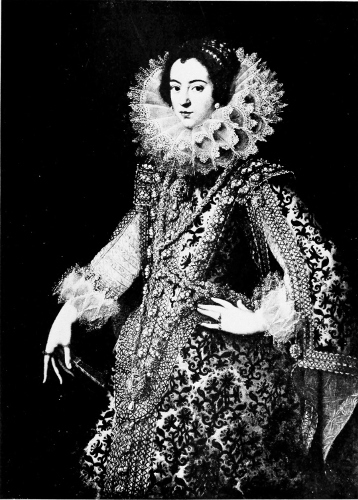
PORTRAIT OF AN UNKNOWN WOMAN BY PANTOJA DE LA CRUZ
Rings on thumb and index of right hand, and on fourth and little fingers of left hand Museo del Prado, Madrid
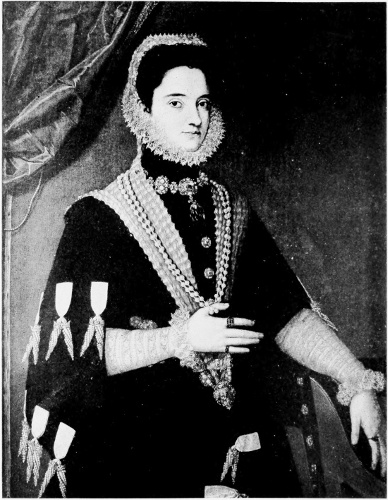
PORTRAIT OF THE EMPRESS MARY, DAUGHTER OF CHARLES V AND WIFE OF MAXIMILIAN II, BY JUAN PANTOJA DE LA CRUZ
Two rings on index and one on little finger of right hand; one on index of left hand; all set with precious stones Museo del Prado, Madrid
Ecclesiastical rituals in France from the eleventh to the fifteenth century prove, with but few exceptions, that the nuptial ring was to be placed on the right hand of the bride, in most of the dioceses upon the middle finger of this hand, but in the diocese of Liége on the fourth finger. As Isidore of Seville, writing in the early part of the seventh century, declares that the betrothal ring was put on the fourth finger, and repeats the Roman fancy as to the vein intimately connecting this particular finger with the heart,[337] it seems likely that this rule was generally followed in the Roman Empire up to its end, and even later in some parts of what had once been Roman provinces, while the early French rules were derived from a Gallic usage which had never been supplanted by the Roman one.[338] That the Gauls and Britons of the first century wore their rings on the middle finger is already noted by Pliny.[339]
A gold ring, a unique relic of Anglo-Saxon times in England, was found in an ancient burial place at Harnham Hill, near Salisbury.[340] It was on a finger bone of the left hand of a skeleton, and resembles exactly our wedding-ring of to-day. In the same cemetery was unearthed a twisted ring of silver, a mere band twice encircling the finger; a section of the finger-bone remains within the ring. These relics are believed to date from the seventh century. On or near the skeleton with which this silver ring was found were several amber beads; the remains were evidently those of an elderly person, although of one not over 55 years of age, according to Professor Owen.
That part of the Order of Matrimony relating to the marriage vows and to the wedding ring, in the Sarum Rite or Use current in England in pre-Reformation times, runs as follows, after the bride and groom have clasped hands:[341]
Ich N. take the N. to my wedded wyf, to haven and to holden fro this day forward, for betre for wors, for rychere for porere, in syknesse and in helthe, til deth us departe, and theerto y plith the my trewthe.
Then the woman:
Ich N. take the N. to my wedded hosebund, to haven and to holden fro this day forward, for betre and for wors, for rychere and for porere, to be boneyre and buxum ... and at borde, till dethe us departe and thereto y plith the my trewthe.
Then let the man lay gold, silver, and a ring on a dish or book; and let the Priest ask if the ring hath been blessed already; if it be answered not, then let the Priest bless the ring.
Bless, O Lord, this ring (looking at it) which we hallow in Thy Holy Name, that whosoever she be that shall wear it may be steadfast in Thy peace and abide in Thy will, and live, increase, and grow old in Thy love, and let the length of her days be multiplied.
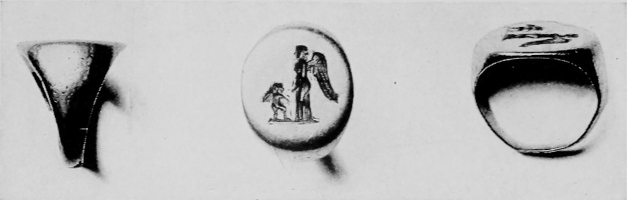
Gold ring in which are inserted representations of two winged figures cut in intaglio in a brown chalcedony. Antique workmanship. See page 363
Collection of B. G. Fairchild, Esq., New York City
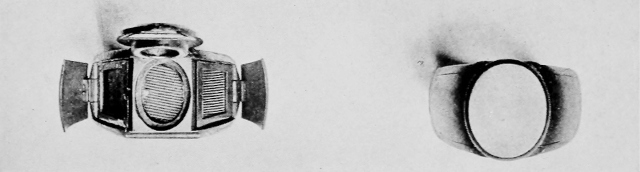
Locket ring, opening at the bezel and on the sides, leaving room for the introduction of hair, or tiny portraits. When closed the ring appears to be plain and smooth
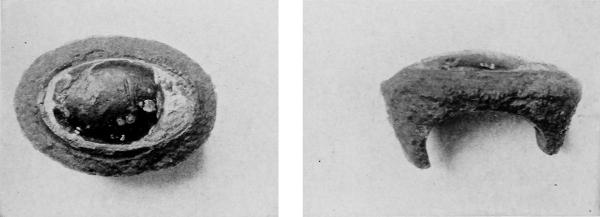
Antique Syrian ring of bronze, set with a yellowish green paste. Half of the circlet has broken away
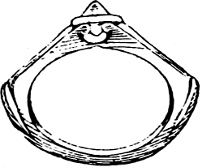
Gold ring set with octahedral diamond. Late Roman. British Museum
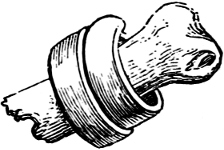
Twisted hoop of silver on the bone of a finger. From an ancient sepulchre at Harnham Hill, England. Saxon, 7th century
Archæologia, vol. xxxv, pl. opp. p. 278
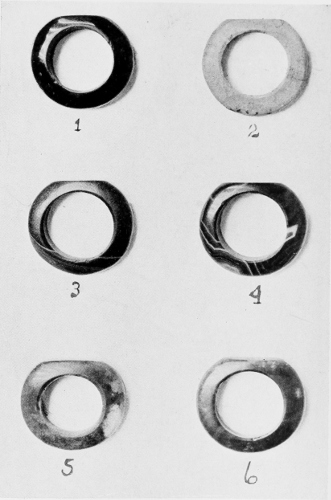
WEDDING RINGS FROM SYRIAN TOMBS OF CHALCEDONY, AGATE, AND BANDED AGATE
But if the ring shall have been already blessed, then, as soon as the man have laid it on the book, let the Priest take the ring and deliver it to the man; and let the man receive it in his right hand, with the first three fingers, holding the right hand of the Bride with his left hand, and say, after the Priest:
With this ryng ich the wedde, and with my body ich the honoure and with al my gold ich the dowere.
And then let the bridegroom put the ring on the thumb of the Bride, saying—
In the Name of the Father; (on the first finger) and of the Son; (on the second finger) and of the Holy Ghost; (on the third finger). Amen.
And there let him leave it, because in that finger there is a certain vein which reaches to the heart; and by the purity of the silver is signified the inward affection which ought ever to be fresh between them.
In the modern Protestant Episcopal service, the bestowal of the ring is ordered as follows:
Then shall they again loose their hands; and the Man shall give unto the Woman a Ring. And the Minister, taking the Ring, shall deliver it unto the Man, to put it upon the fourth finger of the Woman’s left hand. And the Man holding the Ring there, and taught by the Minister, shall say:
With this Ring I thee wed, and with all my worldly goods I thee endow: In the Name of the Father, and of the Son and of the Holy Ghost. Amen.
It will be noted that the ring is first given by the man to the woman, then taken from her by the priest who returns it to the man, upon which the latter puts it on the fourth finger of the woman’s left hand.
Four fine specimens of later Byzantine work in ring-making are in the British Museum. These are all marriage-rings of massive gold, the designs being similar, with certain variations. The bezels bear engraved figures of Christ alone, or of Christ and the Virgin, bestowing a blessing upon the newly wedded pair; beneath is the Greek word ὸμονόια (or ὸμόνυαι), signifying their spiritual union. All but one have on the hoop in Greek characters the inscription: “My peace I give unto you” (John, xiv, 27). On the remaining ring there is on the hoop a decoration in niello, depicting very roughly scenes from the Gospel. The character of the work indicates that it probably belongs to the tenth century.[342] A massive gold ring found not long since in Mainz, bears a Greek inscription showing that it was executed for the nuptials of King Stephen Radislav of Servia (1228–1234) with Anna Comnena, daughter of Emperor Theodore Angélus Comnenus, Duke of Thessalonica, the region of the Saloniki of to-day. The inscription on this early thirteenth century ring of Byzantine workmanship is nielloed on the gold.[343]
Some interesting inscriptions appear on certain of the Greek betrothal rings in the collection of the British Museum. A gold ring of about the fourth century B.C. bears a Greek inscription which may be rendered as follows: “To her who excells not only in virtue and prudence, but also in wisdom.” In marked contrast to this rather elaborate dedication is the inscription on another ring, which bears the single word μὲλι “Honey.” It strikes us strangely enough to find this particular term of endearment, so freely used by the Negroes, on a ring from classic times. Perhaps the most beautiful of all these inscriptions is on a late Greek ring and runs: “I rejoice in the gift because of the affection of the giver.”[344]
The custom of bestowing a ring upon the betrothed bride has been traced back in Rome to the second century B.C. Plain iron rings were first used for this purpose and they were still favored even when the wearing of gold rings had become general among certain classes of the Roman citizens. However, in the course of the second century of our era, and perhaps earlier, gold rings came into use in the ceremony of betrothal. Pliny’s assertion that the bride wore an unset iron ring has been interpreted to mean no more than that, in the case of those entitled to wear gold rings, the bridegroom after having given the bride a gold ring, later bestowed upon her one of iron for wear within doors. For it appears to have been a rather general usage, in or before Pliny’s time, to wear gold rings only when in public, and within the house iron rings. That the nuptial ring was of gold, in the second century at least, is plain from the statement of St. Clement of Alexandria, who declares that this ring was not bestowed upon the spouse as an ornament, but that she might seal up whatever was worthy of special care in the household.[345]
Perhaps the earliest allusion in Christian literature to the betrothal ring appears in one of Tertullian’s writings, dated from the end of the second century A.D., wherein he says: “Among our women the time-honored rules of their ancestors, which enjoined modesty and sobriety, have died out. In former times women knew nothing of gold except the single betrothal ring, which was placed on one of their fingers by the fiancé.”[346] That this usage had endured for many years is clearly apparent from the allusion to times long past. In a curious passage,[347] St. Augustine, in the fourth century, writes: “No priest shall hesitate to wed a couple who present themselves before the altar, if the bride and bridegroom are not able, because of poverty, to give rings to each other; for the (offering of) the earnest-money is a matter of decorum, not of necessity.”
One of the rare marriage rings or love tokens of the early Christian centuries, bears incised on its circular, button-shaped chaton, a male and a female bust, the faces turned toward each other. Above is a cross, the lower part of its upright shaft much longer than the upper part or the arms. This ring is of Byzantine workmanship and has been approximately dated about 440 A.D. It is a good example of the so-called bi-cephalic rings, rings bearing two heads, and weighs 3⅝ dwt., or 87 grains.[348]
This usage was introduced among the ancient Germans by the Romans. The significance of the betrothal ring is noted in a law of the Visigoths, promulgated by Chindaswinthe (642–643 A.D.). There had evidently been a disposition to treat lightly the obligations of betrothal, for we read: “Since there are many who, forgetful of their plighted faith, defer the fulfillment of their nuptial contracts, this license should be suppressed.” Therefore, it was provided that when a solemn declaration had been made before witnesses and the espousal ring had been given and accepted as representing earnest-money, the marriage ceremony must follow, if either of the parties should fail to agree to a rupture of the engagement; that is, it could only be broken by mutual consent.
A celebrated betrothal ring was that sent by Clovis I (465–511 A.D.) to Clothilda in 493. The following account is given of the bestowal of this ring:
“Aurelian pursued his journey from these parts [of Burgundy], bearing with him the ring of Chlodwig that he might gain the better credence thereby. When he arrived at the city where Chrotechilda resided with her aunt, Aurelian presented himself and said: ‘Chlodwig, King of the Franks, hath sent me to thee; if such be the will of God, he wishes to associate thee with himself in his majesty, as spouse. That thou mayst be assured of this, he hath sent thee this ring.’ Accepting the ring, she was filled with great joy, and answered: ‘Take a hundred solidi as a reward for thy labor. Return quickly to thy lord and say to him: ‘If thou desirest to associate me with thyself in matrimony, send envoys straightway to my paternal uncle Gundobard, and ask him for my hand.’”[349] The money gift was a considerable one for the time, as the solidus was worth intrinsically about $3 of our money, and six or eight times as much in purchasing power in that age.
A most interesting ancient wedding ring, presumably of the Gallo-Roman period, was unearthed toward 1850 in the neighborhood of Mulsanne, dept. Sarthe, France. It is of massive gold and weighs 24 grams, 20 centigrams, or over ¾ ounce. On the bezel, which is square, are rudely engraved two figures, that of a warrior resting on his lance and that of a woman holding out her arms to him. On the shoulders, toward the bezel, is a foliated ornamentation, and along the edge of the bezel are engraved the two names “Dromacius” and “Betta,” the characters being filled in with the black enamel called niello. This ring is believed to date from the fifth century A.D.[350]
The religious aspect of the ring in the ritual of the Greek Church finds an exponent in Symeon, Archbishop of Thessalonica, who wrote about a half-century before the capture of Constantinople by the Turks in 1453. In his description of a typical marriage ceremony he states that the officiating priest laid upon the altar two rings, an iron one symbolic of masculine force, and a gold one typical of the less hardy but purer feminine constitution. These rings he consecrated. After bestowing his benediction upon the bride and bridegroom and offering a prayer for them, he gave the woman the iron ring, as from the man, and to the man the gold ring on the part of the woman, and changed them three times, in adoration of the Holy Trinity, the perfecter and sustainer of all things. Hereupon he joined the right hands of the spouses, demonstrating their unity in Christ and that the man had received the woman from the hand of the Church. The rings also signified the agreement and sealing of the marriage contract.[351]
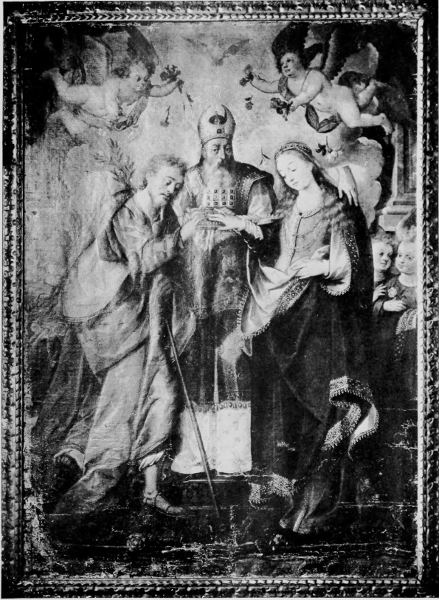
BETROTHAL OF JOSEPH AND MARY, BY JUAN RODRIGUEZ JUAREZ (OR XUAREZ), MEXICO CITY, (1666–1734) CALLED THE “MEXICAN CARRACCA”
In the possession of the author
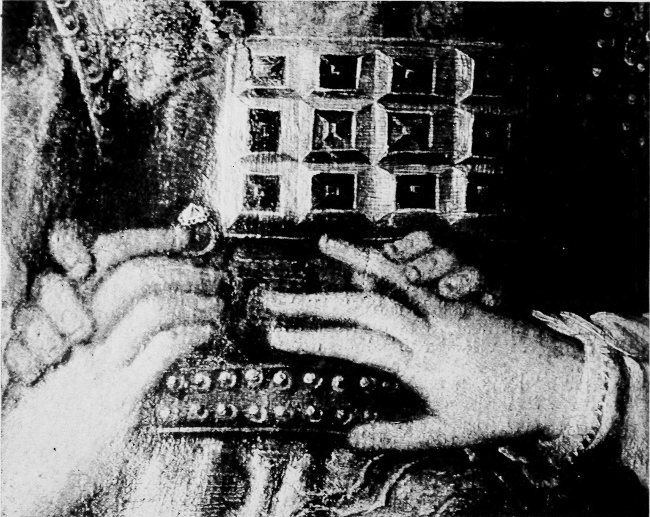
Right hand of the Virgin, right hand of St. Joseph, and hands of the high-priest, showing the manner of placing the wedding ring at Hebrew marriages as depicted in the picture of Rodriguez Juarez [Xuarez]. The ring contains an octahedral diamond crystal set in gold
According to Buxtorf (De sponsal. et divort.), the Jews did not place the betrothal ring upon the annular finger, but upon the index. As to this there is a curious statement in the “Opus aureus contra Judæos,”[352] by Victor de Carben, a converted Jew. He states that, at the betrothal ceremony, care should be taken that the fiancée extends her index finger to receive the ring, lest it should be put, by mistake, upon the middle finger, for it was on this finger that Joseph placed the ring when he betrothed Mary. Buxtorf adds that he has never been able to find this statement in Jewish writings.
One of Ghirlandajo’s frescoes in the church of Santa Croce, in Florence, depicts the betrothal of the Virgin. Here the ring is placed by Joseph on the fourth finger of the Virgin’s right hand, and the famous Sposalizio by Rafael in the Brera Gallery in Milan illustrates the same usage. Possibly the ring was transferred to the left hand at the actual marriage ceremony.
The custom of the Greek church at the present day in relation to betrothal or wedding rings differs in some respects from that observed in other Christian churches, for the priest places a ring on the fourth finger of each of the contracting parties, who then proceed to exchange them with each other.
The old custom of exchanging rings and betrothal vows obtains in the Russian branch of the Eastern Church. For the succeeding marriage ceremony, or “crowning,” the same rings are again used. The rubric states that the bride’s ring should be of silver to show that she is the less honorable vessel, while the bridegroom’s ring is of gold to signify the superiority of the man. The brides, however, have shown a disposition to resent this inequality, and, in modern times at least, they are given gold rings also. The old Russian custom is for the husband to wear his ring on his forefinger.[353]
In the Greek and Russian churches, the rings—of gold for the man, of silver for the woman—are bestowed at the betrothal ceremony, when also a contract between the parties is made. The later nuptial ceremony is generally designated as “the crowning,” a crown being placed on the heads of bride and bridegroom by the officiating priest.
The question was often raised whether the mere fact of giving or accepting a ring constituted a definite promise of marriage. The best authorities decided the question in the negative. In reference to this matter Peter Müller writes: “If when a ring is given there is no promise of marriage, the ring shall not be regarded as a betrothal ring, but as a simple gift. Whence it may be inferred that a contract of marriage cannot be proved by a ring alone, since mere donations, bestowed through liberality, do not produce any obligation.”[354]
The connection between the wedding ring and the bestowal of earnest-money is clearly indicated in the marriage service as given in the Prayer-Book of Edward VI. Here, after the words “with this ring I thee wed,” there is added: “This gold and silver I give thee”; and at these words the bridegroom usually placed in the bride’s hands a purse containing a sum of money. There can, indeed, be little doubt that the espousal ring was rather the type of a valuable consideration offered at the consummation of the marriage contract, than a symbol of the bondage and subjection of the spouse as many have maintained.
That the ring was sometimes given conditionally is shown by a curious old German formula to the following effect: “I give you this ring as a sign of the marriage which has been promised between us, provided your father gives with you a marriage portion of 1000 reichsthalers.”[355]
It is not possible to indicate with any precision at what date the betrothal ring became the wedding ring, but this change seems to have taken place in England about the time of the Reformation. This did not, however, entail the abandonment of the betrothal ring, but rather the substitution of another, and frequently less simple ring, to mark the betrothal. Of course, the change was gradual and the usage varied in different countries, since the employment of a separate marriage ring was rather a matter of custom than of ecclesiastical ordinance.
The Manx usages and customs are so strange in many cases that the ring traditions of the Isle of Man also present certain peculiarities. Thus if a man was found guilty of having done injury to a maiden, the latter was given a sword, a rope and a ring, signifying that she could either have him beheaded, or hung, or else could force him to wed her. That the last-mentioned choice was the one most frequently made is very probable, as the rehabilitation of her good name thus attained might well outweigh any satisfaction to be gained from the exercise of revenge.[356]
The use of rush-rings in England, in 1217, for mock marriages, is vouched for in the “Constitutiones”[357] of Richard, Bishop of Salisbury. It is provided that whoever places a rush-ring, or a ring of cheap or precious material, in sport and jest upon a woman’s hand, that she shall the more willingly become friendly with him, although imagining himself to be joking will be constrained to marry. Another authority declares that when the ecclesiastical court enforced matrimony as a penalty or a reparation for bad conduct, a rush ring or a ring of straw was used at the ceremony.[358]
There are several passages in English poetry of the Elizabethan age and later, referring to this use of a “rush ring.” In his “Two Noble Kinsmen,” Fletcher writes:
Rings she made Of rushes that grew by, and to ’em spoke The prettiest posies; Thus our true loves ty’d; This you may loose, not me, and many a one.
In the seventeenth century Sir William Davenant (1605–1668) speaks in the following mocking strain of such a ring:
I’ll crown thee with a garland of straw then And I’ll marry thee with a rush ring.
The ballad called the Winchester Wedding has these lines:
Pert Strephon was kind to Betty, And blithe as a bird in the spring; And Tommy was so to Katy, And wedded her with a rush ring.
The “rush ring” is touched on in an old English ballad of Shakespeare’s time, in which occur the lines:[359]
Then on my finger I’ll have a ring Not one of rush, but a golden thing; And I shall be glad as a bird in spring, Because I am married o’ Sunday.
A purely spiritual view of the meaning of a wedding-ring is expressed by Guillaume Durant, Bishop of Mende (died 1296). For him it was the symbol of the mutual love of the espoused, at once a pledge and a symbol of the union of their hearts. However, the more mercenary significance of the ring, as a sign of the marriage gift to be bestowed upon the bride by the bridegroom before the wedding, is quite clearly brought out in the old French Rituals, wherein its composition and meaning are defined. A simplification of the ring itself seems to have taken place from about the thirteenth century when gold rings adorned with precious stones were generally worn. The metal used at a later time varied in different dioceses. While in that of Limoges the ring was of gold, the rituals of the dioceses of Auxerre, Lyons and Paris prescribe a silver ring. In the Manual of the priests belonging to the diocese of Paris, it is strictly enjoined that there shall be no inscription or figure upon the ring, and that no precious stone shall be set therein. The officiating priest receives it from the bridegroom together with one or more pieces of money “as sign of the constituted endowment.” The Manuel de Beauvais, published in 1637, also prescribes that the nuptial ring shall be severely plain and entirely without inscription. The ritual of the Abbey of St. Victor is even more definite, for here the blessing of the ring is preceded by the reading of the endowment on account of marriage (dotalitium propter nuptias). Hence the “dower” was not given with the wife, but was bestowed upon her by the husband.[360] This has been erroneously looked upon by some as a survival of the primitive custom of wife-purchase; it differs, however, essentially from this in that the wife receives the endowment for her own use and as her own property. A curious superstition is condemned by the Ritual of Evreux. As the ring was handed to the bride by the bridegroom, the former would let it fall on the ground to conjure a possible evil spell.
It has been remarked by Jacob Grimm (1785–1863) the great lexicographer and student of German archæology, that in early times, among the christianized Germans, the fiancé gave the ring to the young woman, who was thenceforth bound to carry out the marriage contract. On the other hand, according to the poetical recitals of the thirteenth century, the fiancée gives a ring to her future husband, without receiving one from him. The same writer regards the usage of betrothal rings as one introduced among the Germans by Christian influence, not one that can be looked upon as properly Germanic.[361]
The contracting parties often exchanged rings at the betrothal ceremony, which in many cases was celebrated in the church with all due solemnity. Shakespeare’s “Two Gentlemen of Verona” contains an allusion to a more informal exchange of rings:
Julia: Keep this remembrance for your Julia’s sake. Proteus: Why then we’ll make exchange; here take you this. (Giving a ring.) Julia: And seal the bargain with a holy kiss.
In our own time, in Germany, two rings, one for the bride and the other for the bridegroom, are given at the marriage ceremony, and these rings are called “Trauringe,” a name which designates the ring as an emblem of faith and trust, just as does the Italian name for the betrothal ring, fede, or faith.
From the almost innumerable poesies inscribed upon espousal rings we select a few of the more noteworthy. An antique Roman ring has the words: “Pignus amoris habes” (Thou hast a pledge of love);[362] another shows the simple form “Proteros Ugiæ” (Proteros to Ugia), the names being inscribed between two clasped hands.[363] A sentiment given by one who was no believer in unrequited love reads: “Love me, I will love thee.” A massive gold ring of early date, found in 1823 at Thetford, in Suffolk, gives us the following inscription in Old French: “Deus me octroye de vous servir a gree com moun couer desire” (God grant me to serve thee acceptably as my heart desires).[364] On a ring in the collection of the late Sir John Evans we have the following graceful inscription: “Je suis ici en lieu d’ami” (I am here in the place of a friend).
An elaborate wedding-ring, probably executed in Germany, in the latter half of the fifteenth century, is in the fine collection of the court jeweler Koch, of Frankfort-on-the-Main. Out of richly ornamental foliage work arise the figures of the wedded pair, evidently carefully rendered portraits. Although somewhat lacking in purely artistic harmony, this production of the ring-maker’s art is an excellent illustration of the quality of the best German goldsmith work of the time in the smaller objects.
The Figdor Collection in Vienna contains a fifteenth century betrothal ring made in France. It is of gold and bears the inscriptions: “Il est dit” (in small letters) and “ELLE ME TIENT” (in capitals), literally: “It is said (spoken)” and “She holds me.” A betrothal ring in the form of a so-called “Puzzle Ring,” has six connecting hoops. Three of these are enameled, two others bear closed hands, and the last shows a key and the head of a winged angel. This is of seventeenth century workmanship.[365]
A wedding-ring of simple Gothic design formed part of a grave treasure, the characteristic inscription: “In Mir Ist Treue” (In me is fidelity), leaving no doubt as to the use to which the ring had been put. This plain triangular band is in the Germanic Museum in Nuremberg and is assigned to the thirteenth century. Another most interesting ring from the same period was found in the territory formerly known as the Fürstenbergerhof, at the southwest end of the city of Mainz; it is now owned by the family Heerdt of that city. The clasped hands engraved on the lower part of the hoop designate this clearly as a betrothal or wedding-ring.
An English ring of the early part of the fifteenth century bears this couplet:
Most in mynd and yn myn herrt Lothest from thee ferto deparrt.
In seventeenth century rings the religious sentiment predominates: “I have obtaind whom God ordaind”; “God unites our hearts aright”; “Knitt in one by Christ alone”; “Wee join our love in God above.” A little more human, if less devotional, are the mottoes: “United hearts death only parts”; “A faithfull wife preserveth life,” and “Love and live happily.”
There have been many types of betrothal rings from the simplest up to the most elaborate and ornate. One having a graceful symbolism was found near Wassy, dept. Haute Marne, France, in June, 1868. The hoop is of yellow gold, alloyed sufficiently to give it consistence. Instead of one chaton, it has two placed close to one another and each set with a small, cabochon-cut emerald. The choice of this stone is a good indication that we have to do here with a betrothal rather than a wedding ring, for the emerald was emblematic of hope, of unfulfilled desire and of virginity. Around the setting runs the following inscription in Old French, beginning with the sign of the cross: CE QUE DESIR HOM DONE UN BIEN. This may be rendered: “What one desires brings happiness,” the idea being perhaps that so beautifully expressed by St. Thomas Aquinas: “The soul dwells with the loved one rather than in the body it animates.”[366] While the letters of the French inscription are so much worn as to make the decipherment of two words a little uncertain, the general sense is clear enough, and constitutes a very fine motto for such a ring.[367]
The ring which had been used by Louis IX (St. Louis) at his betrothal to Marguerite de Provence, in 1231, was so greatly prized by him that on his death-bed he expressed the wish that it should be interred with his body. On its gold hoop he had caused to be engraved the lilies of France and certain military emblems.[368]
A graceful thought is expressed in the following Old French inscription on a ring found near Poitiers:
Mon cuer se est resioui aussi doit il si maist Dieux. A mon gre ne puis mieux aueir choisi.
“My heart is rejoiced, and so should it be, if God aid me. For I feel I could not have chosen better.”
A shorter motto, but one full of significance, appears on a ring in the museum of Poitiers; it consists merely of the two words: “Sans Partir.” This could mean either “we shall never separate,” or else that the donor would never abandon his love. Another brief motto, found on a ring in the Louvre dating from the reign of Francis I, runs “Riens sans amour,” or “Love is all in all.”[369]
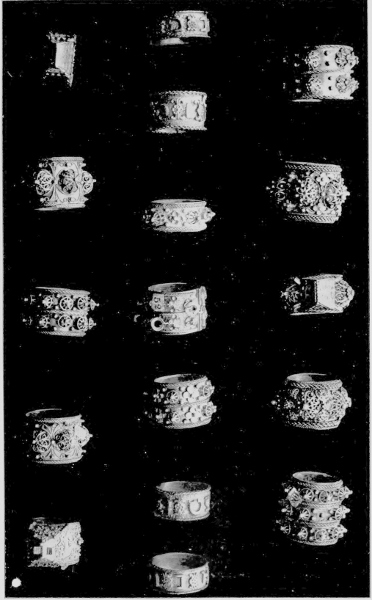
JEWISH BETROTHAL RINGS IN GOLD, SET WITH PRECIOUS STONES
Musèe de Cluny, Paris
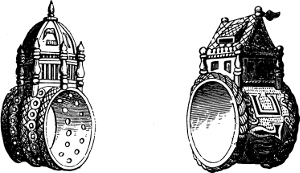
Jewish wedding rings, one with Temple dome, the other with slant-roofed structure. Each bears the Hebrew words Mazzel Tob, or “Good Luck”
Fairholt’s “Rambles of an Artist”
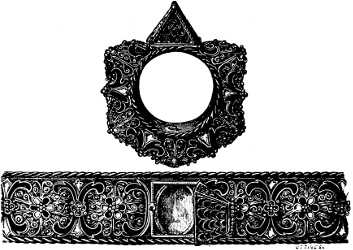
Jewish wedding ring, with five bosses and as bezel a projecting figure. This is hinged and covers a gold plate. On the inside Mazzel Tob or “Good Luck”
British Museum
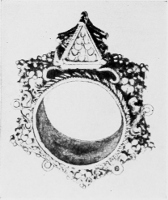
Jewish marriage ring. Gold hoop with five bosses of filigree enriched with flowers in pale blue, green and white enamel, and a gable-like projection with two small windows. Nürnberg. Sixteenth Century
British Museum
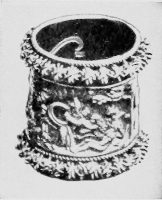
Jewish wedding ring; broad gold hoop, the sides showing the Creation of Eve, the Fall, and the Expulsion from Eden. German. Sixteenth Century
British Museum
At weddings in Spain and also in some parts of France, in connection with the bestowal of a ring, the curious usage has been observed of giving thirteen pieces of money to the bride. This gift, called in French a treizain, has its origin, as the name indicates, in the ancient custom of giving to the purchaser of a dozen articles, an extra one, ostensibly as a testimonial of good will, but really to induce further purchases. This old usage is said to have been observed at the marriage of King Alfonso XIII of Spain in 1906.
The Hebrew betrothal rings were elaborate and somewhat clumsy productions, frequently of massive gold. The broad hoop was surmounted by the representation of a temple, sometimes with a Moorish dome, but usually with a slanting roof. This is a curiously conventionalized figuration of Solomon’s Temple, similar to that found upon certain spurious Hebrew coins. Upon the temple or else around the ring, are generally the Hebrew words FIO ERG, equivalent to “Good Fortune.”[370] Several such rings are described in the privately printed catalogue of the Londesborough Collection (London, 1853, p. 4). A more artistic specimen, also in the Londesborough Collection, bears the figures of Adam and Eve in Paradise, accompanied by representations of animals, all in high relief.[371] The specimens described belong to the sixteenth century. The learned Jesuit, Athanasius Kircher, cites a statement to the effect that the inscription mazzel tob, engraved upon many Hebrew betrothal rings, referred to the planet Jupiter as the “good star.”[372] This planet was, indeed, called by the Hebrews cocab zedeq, “star of righteousness” or “justice,” but there is little doubt that mazzel tob should be rendered “good fortune” or “propitious fate.”
The earliest Jewish wedding-rings are said to have been plain golden circlets, without setting, indeed a silver substitute or even one of a cheaper metal was not forbidden. Pearls, favorite gems with the Jews, were sometimes used for settings at a later period. The purely ceremonial or symbolic significance of the Jewish wedding ring in early times is exemplified in its great size, the major part of these rings being much too large for wear. Sometimes, at the wedding feast, rings of this type were used as holders of myrtle-branches. The circlet surmounted with the temple figure was occasionally formed of two cherubim.[373]
A ring supposed to have been the wedding ring of the Roman Tribune, Cola di Rienzi (ca. 1313–1354), is of silver, with an octagonal bezel; the hoop bears the names: “Catarina” and “Nicola,” those of Rienzi and of Catarina di Raselli, his bride. The letters have been placed in sharp relief by cutting away the background and filling it up with niello. Between the names are two stars. As Rienzi chose a star as his emblem on the coins he struck during his brief rule in Rome, this device coupled with the names makes the attribution of the ring not without some good foundation.[374] This ring was bought by Mr. Waterton in Rome for a trifling sum. It had been pledged in a Monte di Pietà, and was disposed of at one of the periodical clearing sales.
In the fifteenth century the betrothal ceremony was usually performed in the presence of a notary public, not of a priest, and this continued to be the usage until after the Council of Trent, which ended in 1563. At the betrothal, by proxy, of Lucrezia Borgia with Giovanni Sforza, February 2, 1493, twin gold rings set with precious stones were given, one to be put on the fourth finger of the fiancée’s left hand, “whose vein leads to the heart” as the record specifies, while the other was to be placed on the bridegroom’s little finger.[375]
In one of the very risqué tales forming the “Cent Nouvelles Nouvelles,” the authorship of which has been attributed to King Louis XI of France (1461–1483), it is related that a lady, while bathing, lost a diamond ring; the narrator adds: “This was one her liege lord had given her on the day of her espousal, and she prized it the more highly on this account.” Although diamond rings were not common at this time, the recently invented art of facetting the diamond was rapidly bringing these stones into fashion and favor. There is, indeed, a record, or at least a family tradition, that one of the three large diamonds cut in facets by Lodowyk van Berken of Bruges, about 1476, at the order of Duke Charles the Bold of Burgundy, was set in a ring and given by the duke to Louis XI, with whom he was then seeking to get on a friendly footing. This diamond is described as having been cut as a “triangle and a heart.” This possibly means that the triangular shape was slightly modified into a heart shape.[376]
A Scotch legend relates that a married woman by ill-chance let her wedding ring fall into the river Clyde. On her return home her husband noted its absence and, believing she had given it to a lover, became furiously jealous, used the harshest language to her and even threatened her life. In her despair the innocent wife went and cast herself at the feet of St. Kentigern, Bishop of Glasgow, supplicating him to render her faithfulness manifest. The bishop had compassion upon her, and uttered a prayer that the ring might be restored. His prayer was answered, for ere a few hours had passed a fisherman came to him bearing as a gift a large salmon he had just caught, and in the mouth of the fish was found the lost ring. The husband, convinced of his injustice, was kinder to his wife than ever before, so as to make good the wrong he had done her. To the story given in this legend are ascribed the figures of a salmon with a ring in its mouth on the coat-of-arms of the city of Glasgow, as well as on the armorial bearings of several of the bishops of that city from the time of Bishop Wishert, who lived under Edward II of England (1307–1327).[377]
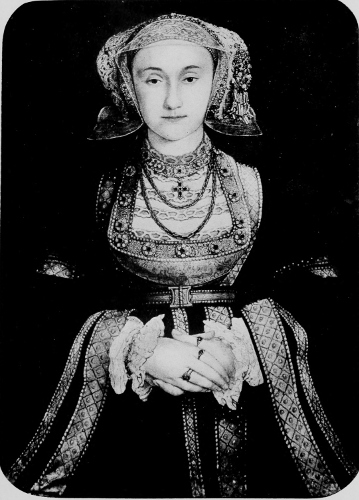
PORTRAIT OF ANNE OF CLEVES (1515–1557), FOURTH WIFE OF HENRY VIII, BY HANS HOLBEIN
Thumb-ring on left hand, one ring on index finger, and two on fourth finger of right hand. This portrait, when shown to Henry, pleased him so well that he agreed to the marriage, but he expressed sore disappointment when he at last saw the new queen
Musée du Louvre, Paris
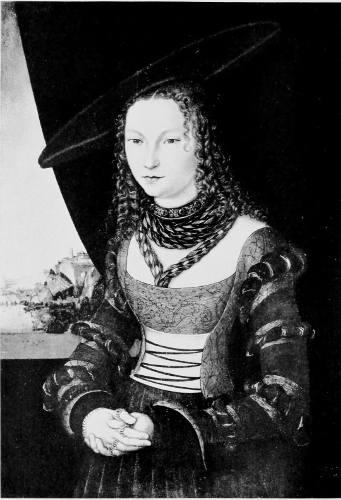
PORTRAIT OF JUDITH, AFTER LUCAS CRANACH
Rings worn beneath gloves, which have slits to relieve the pressure and to show the rings. Right hand has four rings, on thumb, index, fourth finger, and little finger, respectively
Kaiserliche Gemälde-Galerie, Vienna
Among historic wedding rings especially worthy of note is that commemorating the marriage of Martin Luther to Catharina von Bora, June 13, 1525.[378] Both Luther and his wife had taken the vow of celibacy in the Roman Catholic church, and he was bitterly reproached by Roman Catholics for contracting this marriage. Replying to his accusers, he is declared to have said that he married “to please himself, to tease the Pope, and to spite the Devil.” The inscription on this ring is: “D. Martino Luthero Catharina v. Boren, 13 Jun. 1525.” This probably indicates that the ring was given to Luther by his wife in memory of the wedding. It is stated to have belonged to a family in Leipsic as late as 1817. A copy of the ring is in the writer’s possession. It was given him by Mrs. Edith True Drake, as a memento of her husband Alexander W. Drake, of whose collection it had formed part. The original ring is set with a small ruby, and bears in high relief representations of the crucifixion, and of the instruments of the Passion; the pillar, scourge, spear, etc.
A pendant to this is a ring given either to Luther or his wife, as a memento of his marriage, by some friend. This is of the type of gimmal rings, divisible but not separable. On one hoop the setting is a diamond, on the other a ruby. The bezel separates into two halves when the ring is opened, and reveals on the two hidden sides the initials C V D and M L D, for Catharina von Bora and Martin Luther, Doctor. On the inner side of the conjoined hoops is the inscription: “Was Got zusamen fiegt sol kein mensch scheiden” (Those whom God hath joined, shall no man put asunder), in the old German spelling.[379] The diamond is on the Luther side of the divided bezel, and signifies power, durability and fidelity; the ruby on the side marked with the wife’s initials is taken to mean exalted love. Both this ring and the one already described are believed to have been designed by the artist, Lucas Cranach, who was a friend of Luther’s and assisted at his marriage. The ring is in the Grossherzogliches Museum at Brunswick.
A very noteworthy ring, in the Waterton Collection at the Victoria and Albert Museum, London, belonged to Henry, Lord Darnley, and commemorated his marriage with Mary, Queen of Scots. On the bezel are the initials M H, entwined with a true-love knot, and within the hoop is engraved HENRI L. DARNLEY, and the date, 1565. Between the two groups of letters constituting the inscription, is figured a lion rampant on a carved shield. This ring is said to have been found in the ruins of Fotheringay Castle, where Mary Stuart was executed.[380]
A peculiar class of rings bears the name of “gimmal rings.” This designation is derived from the Latin gemelli, “twins,” and indicates the form of the ornament. Two rings are joined together by a pivot so that when united they constitute a single ring, although they can be easily separated. On each circlet there is a band, so disposed that when both are brought together the hands are clasped and hold the separate rings in place. Occasionally, there are three or more rings combined in the same way, the designation “gimmal ring” being used for these also. The following lines by Herrick refer to this latter type:
“Thou sent’st to me a true-love knot; but I Return a Ring of jimmals to imply Thy love had one knot, mine a triple tye.”
A specimen of this type of ring is given in the privately-printed catalogue of Lady Londesborough’s collection (London, 1853, p. 17). This is described as “a triple gimmal, the first and third circlet having each a hand, so that, when joined, the two hands are clasped together and serve to conceal two united hearts on the third ring. Of German workmanship.” It was customary to separate the conjoined rings at the betrothal ceremony and to give the upper and lower to each of the betrothed, respectively, while the middle ring was given to an intimate friend of the lady. When the marriage was solemnized, the rings were reunited and bestowed upon the bride. As a general rule all rings bearing clasped hands were termed gimmal rings, although the designation properly belonged to two or more separate rings joined together.
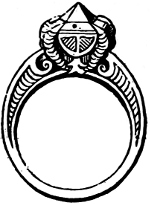
Ring with pointed diamond used for writing on glass
Fairholt’s “Rambles of an Artist”
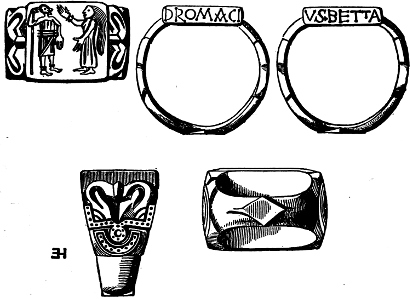
Massive gold Gallo-Roman ring. Found near Mulsanne, dept. Sarthe, France, about 1850. Believed to be a wedding ring; five views. Fifth Century. See page 202
Abbe Barraud, “Des Bagues de Toutes les Epoques,” Paris, 1864
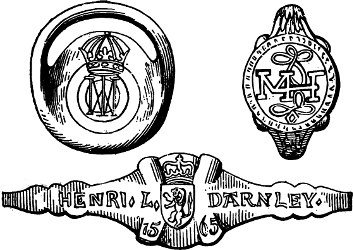
Rings of Mary Stuart. 1, signet ring; 2, wedding ring of Mary and Darnley, with date of marriage, 1565; two views
Fairholt’s “Rambles of an Artist”
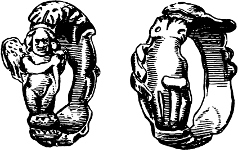
Gold betrothal ring, bezel in form of clasped hands, hoop shaped as two amoretti. Sixteenth Century
British Museum
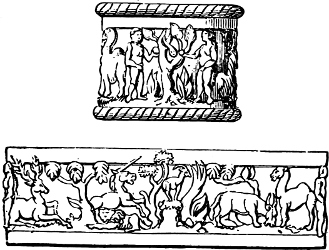
Hebrew wedding ring. Adam and Eve in Paradise
Fairholt’s “Rambles of an Artist”
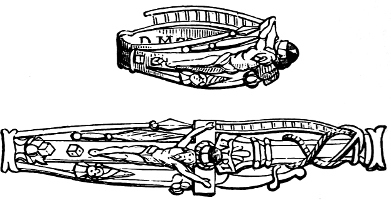
Wedding ring of Martin Luther, two views. Original had a small ruby in the centre
Fairholt’s “Rambles of an Artist”
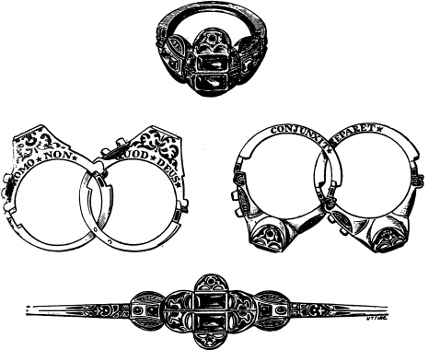
Wedding ring of gimmal type. German, Sixteenth Century. Set with a ruby and an aquamarine. Inscription visible when ring is separated: Quod Deus conjunxit homo non separet (Let man not separate what God hath joined together). The betrothal or wedding ring of Sir Thomas Gresham (1519–1579) is of similar design
British Museum
The following lines from Don Sebastian, a play written by Dryden (1690), explains quite fully the character and use of a gimmal ring:
A curious artist wrought ’em With joynts so close as not to be perceiv’d; Yet are they both each other’s counterpart. (Her part had Juan inscrib’d, and his had Zayda, You know these names were theirs:) and in the midst A heart divided in two halves was plac’d. Now if the rivets of those Rings inclos’d Fit not each other, I have forg’d this lye: But if they join, you must for ever part.
In Burgon’s life of Sir Thomas Gresham, the merchant prince of Queen Elizabeth’s time and founder of the Royal Exchange, we are shown his wedding ring. This is a gimmal ring composed of two hoops, one bearing the inscription “Quod Deus conjunxit” (What God hath joined together) and the other: “Homo non separet” (Let not man put asunder).[381] The two hoops are set with a red and a white stone, respectively.
A curious development of the gimmal-ring was the so-called “puzzle-ring” consisting of pieces of gold wire ingeniously bent and intertwined so that they appeared to form a single indivisible ring, although by a certain clever twist they could easily be separated into several independent hoops. This type was derived from the East.
On a gimmal ring belonging to the first half of the fifteenth century, in the Londesborough Collection, is an engraved head of Lucretia; at the back appear two hands clasped. This type seems to have been common in Shakespeare’s time, for in Twelfth Night (Act II, sc. 5), Malvolio exclaims, after examining the seal on a letter: “By your leave, wax. Soft!—and the impressure her Lucrece with which she uses to seal.”[382] The choice of this image for a betrothal ring must have been intended either as a tribute to the lady’s chastity, or else as a kind of amulet to protect her from attacks on her virtue.
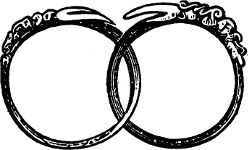
Gimmal ring, open
Edward’s “History and Poetry of Finger Rings”
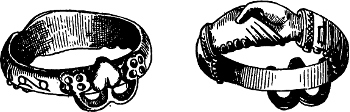
Silver betrothal ring; two views. On the shoulder appears the legend: “God Help.” English, Fifteenth Century
British Museum
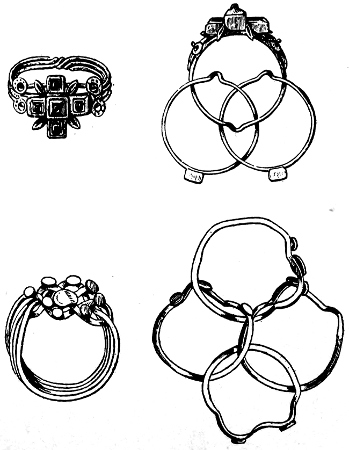
Gold puzzle rings. 1, three hoops, cruciform bezel: 2, with four hoops. Two views of each, closed and open. Seventeenth Century
British Museum
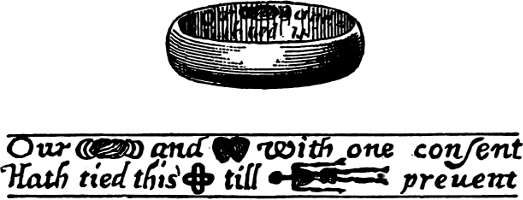
Curious old posy ring. The motto is to be read: Our hands and hearts with one consent, Hath tied this knot till death prevent
British Museum

Wedding rings with “posies.” English, Seventeenth Century
Fairholt’s “Rambles of an Artist”
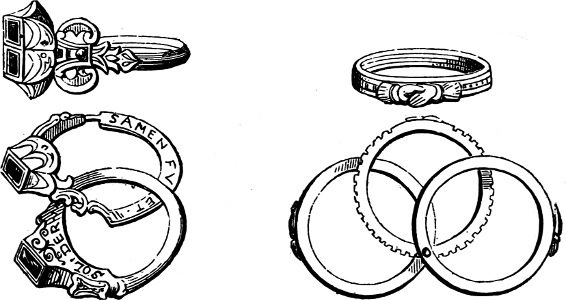
Two Gimmal rings, one double, the other triple. Betrothal or wedding rings
Fairholt’s “Rambles of an Artist”
The talismanic quality of the turquoise is noted by Edward Fenton, in his “Secrets of Nature” (1569), wherein he says: “The Turkeys doth move when there is any perill prepared to him that weareth it.” In his commentary on Shakespeare’s Othello, Steevens remarks that the poet probably had the mystic virtues of this stone in mind when he made Shylock mourn the loss of the turquoise his wife Leah had given him before their marriage.[383] In the original text of this passage the name is spelled “turkie,” and this old spelling is interesting as showing the identity of the name given to the stone with that bestowed upon the fowl known to us as a turkey. In this latter case the spelling and pronunciation have been retained, while in the former we have the modified form turquoise, both names indicating an association of the respective objects with Turkey, as the land from whence they were erroneously believed to come. As Shylock’s turquoise seems to have been set in a betrothal ring, it is singular to note that at the present day the turquoise is a favorite stone for betrothal rings in Germany.
In Shakespeare’s Cymbeline, where the diamond is so often mentioned in connection with a ring given as a sign of faithfulness, a passage occurs denoting that this stone was sometimes set in a betrothal ring in Shakespeare’s time. The line runs (Act I, sc. 4):
This diamond was my mother’s: take it, heart; But keep it till you woo another wife.
The preciousness and dazzling lustre of diamonds are also alluded to in this play. It is worthy of note that while in all of Shakespeare’s plays the diamond is only mentioned twenty-one times, seven of these mentions are in his Cymbeline.
An emblematic wedding-ring with a deep, and perhaps somewhat ambiguous significance, was bestowed upon his spouse by Bishop Cokes. Upon it was engraved a hand, a heart, a mitre, and a death’s head, the inscription reading:
These three I give to thee Till the fourth set me free.[384]
A frankly humorous inscription was that placed upon the wedding-ring of Lady Cathcard when, in 1713, she wedded her fourth husband, Hugh Maguire. This was as follows:
If I survive I will have five
A similar poesy is said to have been used at a later date by John Thomas, Bishop of London, on the ring which he used at his fourth marriage:
If I survive I’ll make them five.[385]
The Puritan reaction in England during the Commonwealth, against the customs of the English Church, extended to the use of the wedding-ring, and Samuel Butler in his Hudibras alludes to this tendency in the following lines:
Others were for abolishing That tool of matrimony, a ring With which the unsanctify’ed bridegroom Is marry’d only to a thumb.
There is a possibility that this curious custom of wearing a wedding ring on the thumb may have had some connection with the old fancy that the second joint of the thumb was dedicated to the Virgin Mary, whose supposed espousal ring is preserved in the Cathedral of Perugia. It is true that this ought rather to apply to a betrothal ring than a wedding ring. The following list gives the religious dedication of the various finger-joints: In the right hand the upper joint of the thumb was dedicated to God, the lower joint to the Virgin; the first joint of the index to St. Barnabas, the second to St. John, the third to St. Paul; the first joint of the middle finger to St. Simon Cleophas, the second to St. Thaddæus, the third to St. Joseph; the first joint of the annular to St. Zacchæus, the second to St. Stephen, the third to St. Luke; the first joint of the little finger to St. Leatus, the second to St. Mark, the third to St. Nicodemus. The dedication of the left hand fingers was: First joint of thumb, to Christ, second joint to the Virgin; first joint of the index to St. James, the second to St. John the Evangelist, the third to St. Peter; first joint of the middle finger to St. Simon, the second to St. Matthew, the third to St. James the Greater; first joint of the annular to St. Jude, the second to St. Bartholomew, the third to St. Andrew; first joint of the little finger to St. Matthaias, the second to St. Thomas, the third to St. Philip.[386]
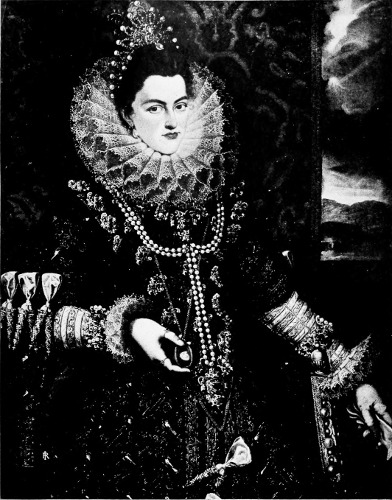
PORTRAIT OF CLARA EUGENIA, DAUGHTER OF PHILIP II OF SPAIN, BY GONZALES
Rings on thumb and index of right hand, which holds a miniature of Philip. Elaborately jewelled dress and splendid pearl necklace and head-ornament
Museo del Prado, Madrid
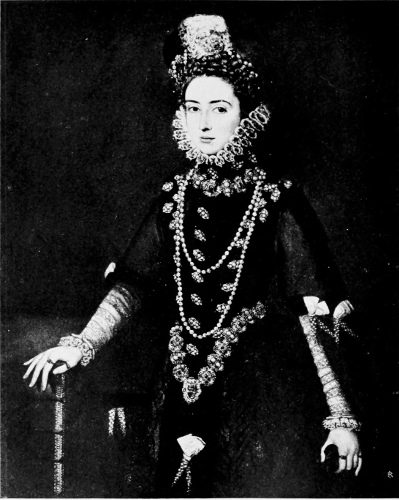
PORTRAIT OF CATARINA MICHELA, DAUGHTER OF PHILIP II OF SPAIN, BY COELLO SANCHEZ
Thumb ring on right hand and ring on index of same hand; both with precious-stone settings. Similar rings on index and little fingers of left hand
Museo del Prado, Madrid
As in Europe a couple of centuries ago, so in the India of to-day, a wedding ring is often worn on the thumb. This is of gold, about an inch wide. It is only worn, however, for a short period, sometimes only during the several days devoted to the celebration of the wedding ceremonies; in other cases, it is worn for six months, or occasionally even for twelve months after marriage. Eventually it is melted down, the precious metal being then worked up into some other ornament.[387]
The great lexicographer, Dr. Samuel Johnson, was devotedly attached to his wife, although the alliance can scarcely be looked upon as a love match on the learned doctor’s side. His patient devotion to his sickly and rather ugly wife goes to show how wide is the divergence between theory and practice, for in his dictionary Johnson defines a ring as: “a circular instrument placed upon the noses of hogs and the fingers of women to restrain them and bring them into subjection.” After his wife’s death Dr. Johnson preserved her wedding-ring in a box bearing the following inscription:
“Eheu! Eliza Johnson, Nupta July 9o 1736, Mortua, eheu! Mart. 17o 1752.”
That the betrothal ring was occasionally worn on the index finger is shown in two celebrated seventeenth century pictures, the “Betrothal of Marie de’ Medici,” by Rubens, and the “Betrothal of St. Catherine,” by Murillo. Sometimes, however, the little finger was chosen for this honor and an interesting example of this custom is given by a document in the Hohenzollern Museum in Berlin. Here is exhibited a list of the rings worn by Queen Louisa of Prussia on the day of her death, written down by her husband, King Friedrich Wilhelm III, and the first entry reads: “Our betrothal ring, on the little finger of the right hand.” The list closes with the following simple and touching words in the King’s handwriting: “At Hohenzieritz, on the most unhappy day of my life, July 19, 1810,” this being the day of Queen Louisa’s death. It may be noted that at the present day, while the usual custom in South Germany is to wear the wedding ring on the fourth finger of the left hand, in North Germany the right hand is generally given the preference. This applies both to men and women.
King George IV of England is said to have had two rings made, each provided with a secret spring which, on being pressed, opened a panel and revealed the king’s portrait and that of Mrs. Fitzherbert, respectively. The ring containing the king’s portrait was bestowed by him upon Mrs. Fitzherbert, whom he is said to have married in 1785, and that with her portrait was kept by him, and, before his death, entrusted to the Duke of Wellington, the latter promising solemnly that he would place it upon his royal master’s breast when his remains were in the coffin. Mrs. Fitzherbert left her ring to Miss Dawson Damer.[388] Another ring given by George IV to Mrs. Fitzherbert was exhibited in the Victoria Exhibition, at the New Gallery, London, and is described as being a gimmal, the two hoops closely fitting together, with the inscription “Geo. Adolph. Frederick” on the inside of one and “Maria Anne” on that of the other.[389]
In former times rings used to be presented to the chief guests at a wedding, and at the marriage of Queen Victoria with Prince Albert, six dozen such rings were bestowed, each one having a profile portrait of the bride engraved upon it, with the inscription, “Victoria Regina.” The revival of this graceful custom would serve to perpetuate among the wedding guests the memory of the ceremony at which they had assisted.
Wedding rings figuring two clasped hands are still used by the peasants of Normandy, and in Galway also rings bearing two hands clasping a heart have been passed down from generation to generation, from the mother to the eldest daughter. This illustrates the general rule that long after a custom or a form of personal adornment has ceased to be in favor with the higher classes it continues to be popular with the peasantry.
The inscriptions on rings occasionally seen, which appear to be a medley of meaningless letters, are often the makeup of two names interlocked, such as “George” and “Sophia”:
gAeIoHrPgOeS
the one name reading to the right and the other to the left.
In some parts of Ireland the belief in the special virtue of a gold wedding ring is so strong that when the bridegroom is too poor to buy one he will hire it for the occasion, and it is reported that a shopkeeper of Munster realized quite a little sum annually by renting rings for weddings, to be brought back to him after the ceremony. Strange to say, there is said to have been a superstitious fancy in Yorkshire, England, that to wed with a borrowed ring would bring good luck.[390]
A Scottish tradition in regard to a ring used at a wedding is imbued with the gloomy superstition so characteristic of Scotland. The heir of a noble family was about to be married to a Dutch lady of rank, but when the wedding-day came was so apathetic, or so preoccupied, that he forgot the hour of the ceremony, and had to be hurried from his breakfast to the church. In his haste he had forgotten all about the wedding-ring, and was obliged to use a ring offered to him by a bystander when the ceremony reached the point where one had to be put on the bride’s finger. What was her terror, however, when she saw that it was a mourning-ring that had been placed upon her hand, one bearing the sinister design of a skull and cross-bones. This she felt to be an omen that death would soon overtake her, and she brooded so much over the happening that she sank into a decline, and died before a year had passed. The effect of the mind upon the body is so great, especially in highly nervous organisms, that such a tragic result of a mere piece of carelessness is far from being impossible.
In modern times betrothal rings are often of the type called “regard rings,” where the letters of a word are indicated by the initial letters of the stones set in the ring, as, for example:
R uby
E merald
G arnet
A methyst
R uby
D iamond
In a similar way the Christian name of either of the betrothed may be indicated, as, for instance:
S apphire
O pal
P eridot
H yalite
I olite
A methyst
Although a diamond ring is the one most appropriate as an engagement ring, it has long been recognized that for a wedding ring nothing can replace the simple hoop of precious metal, which may, indeed, be rendered a trifle less plain by some very chaste and beautiful engraving. A reason for the preference given to the ring without setting is offered by Fuller in his “Holy State,” where he says: “Marriage with a diamond ring foreshadowed evil, because the interruption of the circle augured that the reciprocal regard of the spouse might not be perpetual.”[391]
An attempt is being made in Germany to introduce the use of wedding-rings with moderate ornamentation and appropriate mottoes patterned on those of former times, in place of the severely plain gold hoop that has for a long time been decreed to be the only proper form of wedding-ring. If the tendency to over-ornamentation is kept strictly within bounds and if the mottoes are well chosen, there is some reason to think that the innovation, or rather revival, may meet with some success, as it will afford scope for individuality of taste to assert itself, and for the expression of sentiment in a way that has not been possible under present conditions.
A wedding ring of iron and gold artistically combined has gained some favor of late, as symbolizing the union of strength and beauty, of the more solid with the more brilliant qualities. The uncompromising plainness of the plain gold ring, which represented a reaction to primitive forms from the over-ornamentation of the Rococo period, will probably give place to certain simple and chaste designs which can be made to symbolize some of the thoughts and sentiments connected with the marriage ceremony. But the unstable, oxidizing quality of the iron will not recommend this metal for durability.
The recurrence of a great national crisis will often cause the revival of some custom or usage of an earlier one. Thus it is that in the present War of Nations, Germans have revived the practice of exchanging gold rings for iron ones that was resorted to in the dark time of Napoleonic supremacy in Germany. The total value of the metal secured in this way is of course relatively small, though not entirely negligible, but the spirit of devotion to the Vaterland finds both a real and a symbolic expression in the deposition of many a valued heirloom on the country’s altar. To avoid a rust stain on the finger these iron rings—which usually bear the figure of the Iron Cross—are frequently lined with a thin layer of gold. Not only rings but gold and silver objects of all kinds and valuable jewels have been brought in by patriotic Germans, to such an extent, indeed, that the Viennese jewellers are urging that the metals should be immediately melted, as in case the objects or ornaments should be put on the market, they would compete disastrously with the jewellers’ shops. It is stated that up to the middle of September, 1915, as many as five thousand wedding rings were donated in the single Prussian province of Posen, and the estimate has been made that about one million dollars will be realized from the total offerings throughout the Germanic countries.
The ancients and the alchemists called gold the metal of the sun and silver the metal of the moon, but within the past two centuries the world has become familiar with platinum, a metal of equal dignity with gold, but with the pure whiteness of the somewhat tarnishable silver.
Platinum, because of its durability and purity, may well be called the metal of Heaven, and within the past century we have added to our list of metals aluminum, a metal which constitutes a fair percentage of the earth’s surface. This can be appropriately termed the metal of the earth. These two metals, platinum and aluminum, have been used to a great extent; platinum for the purpose of mounting jewels—the stars of Heaven, as it were, in their heavenly setting—and aluminum, the metal of earth, for a great variety of purposes.
Surely platinum, the metal of Heaven, is a most appropriate material for a wedding ring, and as gold has always been termed the metal of man, so platinum, the metal of Heaven, might be dedicated to woman, the fairest gift of Heaven, and an alliance ring made of these two metals would be an ideal matrimonial ring.
Many of those who were married before platinum was used for wedding rings have recourse to an ingenious device by which a plate of platinum is spun or turned over the entire part of the setting which is visible, so that the gold ring will appear to be of platinum, either plain, carved or chased. Great ingenuity is required in this mounting, because it is in most cases impossible to permit the metal to do more than touch the inner part of the ring. Otherwise, the size of the circlet would be reduced. Alliance rings are sometimes made one side gold and one side platinum.
At the present time many platinum wedding rings are made perfectly plain, others are engraved with a laurel wreath, as a peace or anti-divorce symbol, with oak leaves for strength, ivy for clinging devotion, and some other symbolic devices. Many alliance rings are made of two parts, one bearing the names of the engaged couple, the other the date of the engagement. Narrow gold rings with diamond settings are also used, closely resembling the type of diamond ring that has been worn as a guard-ring for many years.
That men should be forced to wear wedding rings is a proposition recently agitated in London. Public attention was called to this question by newspaper reports to the effect that a young lady had testified at a divorce suit that she had innocently encouraged the attentions of a married man, because she had no means of knowing that he was married. In many continental countries married men are always expected to wear such rings, although there is of course no legal compulsion to do so, any more than in the case of a wife. We can hardly deny that anything serving to fix the status of both men and women in the matter of their marital relations is eminently desirable.
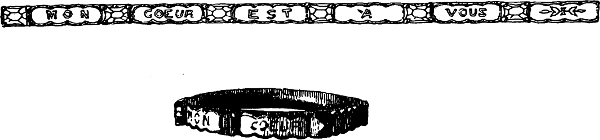
Lady’s gold ring, with French motto: “Mon cœur est à vous” (My heart is yours)
Albert Figdor Collection, Vienna
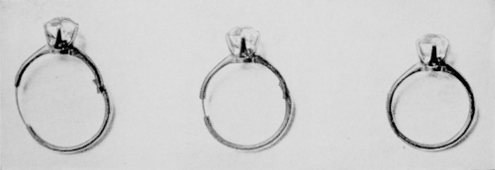
Engagement ring with adjustable hoop; fully open; half-open; and closed]
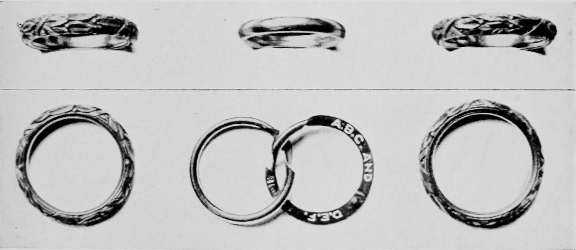
Ornamental wedding rings, and separable alliance wedding ring of “gimmal” type closed and open
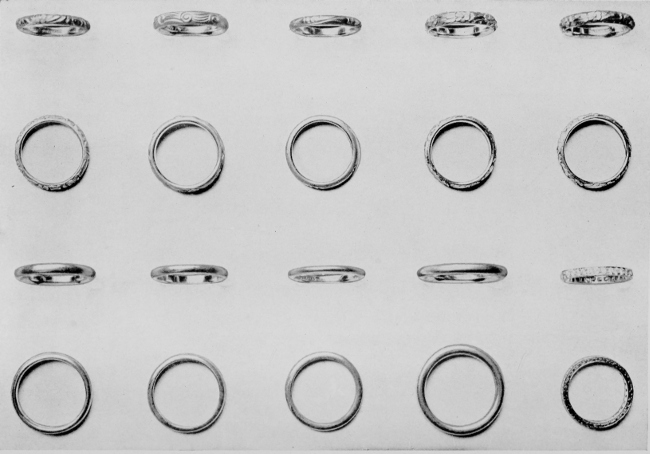
WEDDING RINGS. PLAIN GOLD, PLATINUM AND CHASED
Apropos of wedding rings, the notice of a special marriage ceremony performed for a man and woman who were both ardent advocates of woman suffrage, suggests that such unions might be signalized by the use of a ring of a characteristic type. In this case the parties to the marriage contract were careful to emphasize the fact that the union was one between equals, each of whom made the same pledge of fidelity and love to the other. Perhaps a ring enamelled with the suffragette colors might be acceptable to the pioneers of the new era. As in many old-fashioned marriages the woman was accorded a de facto primacy, the man who willingly accepts the doctrine of the equality of the sexes may be rather a gainer than a loser by his adherence to the new faith.
In England, it is said that a movement has been initiated to abolish the use of the wedding-ring, possibly in some sense as a war measure, to constitute a slight check on the use of gold for ornamental purposes. It is, however, conjectured that its real source is rather to be sought in the general movement for the complete independence of women, the wedding-ring being looked upon by some extremists as an antiquated badge of slavery. It is hardly probable that such a movement will meet with any considerable measure of success, for the idea that the ring is a symbol of faith has become too deeply rooted in the popular mind to warrant the rejection of the time-honored usage.
Perhaps the objection of the extreme advocates of “woman’s rights” might be satisfied by the introduction of an interchange of rings both at engagements and marriages. This exchange of rings is an acknowledgment of the mutuality of the relation, and it has been practiced, and still is practiced in many countries on the European continent. Moreover, the introduction of this usage in England and the United States would afford scope for a broadening of the symbolism connected with these rings, by differentiating them in some way, so that they might signify the special virtues each of the contracting parties bring to their mutual relation. This differentiation would in no wise imply any subjection, but would merely emphasize those fundamental distinctions, without which the true progress of the world would be checked. Real equality consists in the untrammeled development of the characteristic excellences, not in any arbitrary reduction of all to some preconceived standard.
Of all the marriage-medals that have been struck none can be said to equal in beauty of design and tenderness of sentiment that designed in 1895 by the great French medallist Oscar Roty (1846–1911). The obverse shows the bridegroom about to place the wedding-ring on the bride’s hand, but in the very act of doing so, he is impelled to look upward, as though calling for Heaven’s blessing upon his marriage. The girlish bride has her head slightly bent down in token of assent. The scene is in the open country; the figures are seated opposite to one another on plain stone seats, and the landscape background is Rafaelesque in its delicate beauty. Beneath, in the exergue, is the single word “Semper,” an earnest that the solemn contract so gladly and so religiously entered into will be kept for this world and for the great future. The reverse shows a statue of Cupid on a fountain pedestal; alongside rises the trunk of a sturdy oak. On the right is ample space for a dedicatory inscription. The companion-piece, Roty’s second marriage medal, executed ten or more years later, although a noble work, falls something short of his first effort. Here the bridegroom, who displays no ring, kneels before the bride with uplifted head, the French motto reading “A Elle Toujours” (“Forever Hers”); on the reverse is a church altar. Under this is a plaque, enclosing which are roses, oak-leaves and acorns.
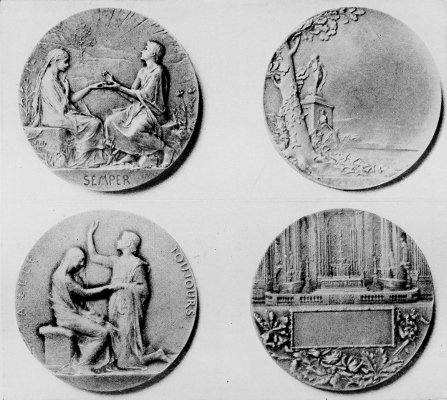
MARRIAGE MEDALS BY THE GREAT FRENCH MEDALLIST, OSCAR ROTY (1846–1911)
The upper medal shows the putting on of the wedding ring
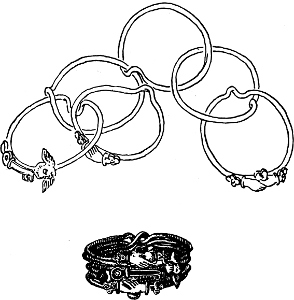
BETROTHAL RING OF GOLD IN FORM OF SO-CALLED “PUZZLE RING”
Six connecting hoops, three of them enameled, two others with clasped hands, and the sixth with a key and a winged angel’s head. Seventeenth Century.
Albert Figdor Collection, Vienna
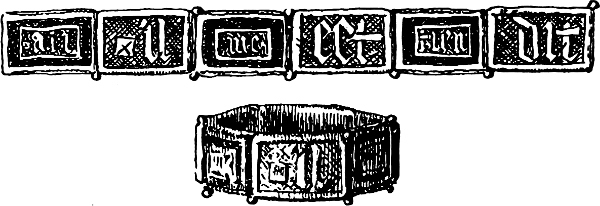
BETROTHAL RING OF GOLD
Inscribed in Old French “Il est dit” and “Elle me tien” (literally “It is said (spoken)” and “She (or it) holds me”). French. Fifteenth Century.
Albert Figdor Collection, Vienna
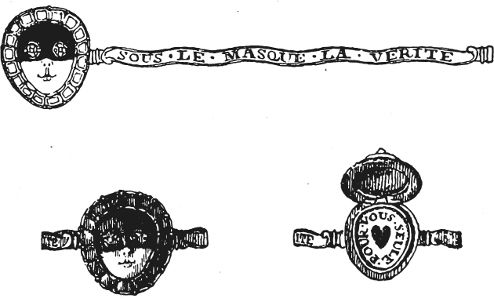
LOVE RING OF GOLD, ENAMELED AND SET WITH PRECIOUS STONES
The bezel has a lid on which is enameled a head wearing a domino mask; it is framed by seventeen rubies. When the lid is raised there appears beneath an oval, enameled with a heart, around which is the motto: “Pour vous seule” (For you alone). The interior of the lid is hollowed out to serve as a receptacle for hair. On the ribbon-like hoop is the inscription: “Sous le masque la vérité” (Beneath the mask is truth). About 1800. Formerly belonged to the great Viennese tragic actress Charlotte Wolter.]
A type of ring of occasional use, not distantly related to the wedding ring, comprises the so-called “pacifying,” or teething rings, generally made of ivory, rubber or celluloid, and large enough for one or two fingers of a child. Diagonally on the hoop is a flat, circular piece of the same material as that of which the ring is made, and which prevents it from slipping into the mouth of the child. Upon this flat piece is mounted a small bit of rubber or ivory for the child to suck or bite upon, to develop its teeth, or at least to keep it quiet.
What might be called a “Latitude and Longitude Ring,” would be an attractive memento of engagement and marriage. There would be a narrow band showing, around it, a degree of latitude marked with longitudes, and having a small star at the place where the parties became engaged, and a double star at the spot where they were married.
A few appropriate inscriptions on modern engagement rings are as follows: “Our engagement”; “My love to thine”; “To her who merits all my love”; “To my Pet”; “To my ‘Chiquita’ from Bill,” this last in Spanish. In a more serious vein we have: “Time-Eternity,” and “Perfect love casteth out fear.” Occasionally there is a note of sadness, as appears in the inscription: “Faithful, but unhappy.” A ring bearing the words “Stick to me, my darling” may show that the fiancé was a trifle distrustful of his lady love’s constancy; another who sets in his ring “Firm and True” makes us infer that he had more faith. The three words “Bessie sweet sixteen” show that early engagements sometimes occur even in our sophisticated age. On ornaments other than rings, bestowed in connection with either engagement or marriage, we read: “My heart I take not back from thee. H. B. L.” and “Thine own wish, wish I thee. A. B. T. & R. V. P.” A curious inscription runs: “A nasty cold face and metal eye,” and we have: “For my sake wear this, it is a manacle of love.” Modern wedding rings are often inscribed with pious sentiments, such, for instance, as: “All for Jesus”; “Each for the other, both for God”; “Our unity is Christ”; “Mercifully ordain that we may grow old together”; “In Christ and in Thee my comfort shall be”; “God gave thee to me”; “Through weal and through woe, to each other on earth, to God in Heaven. Always true to Bertha.” A somewhat philosophic sentiment appears in the words: “Ultimate Good, not present pleasure.” Latin inscriptions are now quite rare, but here is one: “Si Deus nobiscum, quis contra nos?” (If God be with us, who can be against us?)
In other cases the legend is more worldly: “Love for Love” and “He that taketh a wife hath a good thing.” Let us hope that this optimist was not mistaken in his confidence. Another bridegroom declares that he, at least, has a “good thing,” for he places in his ring the simple motto: “Carrie suits.” If she suits him, that is enough. Lastly, we have the most satisfactory inscription of all, since it testifies to the result of one fortunate experiment; this reads: “In token of 30 years fidelity as Wife and Mother.”
The use of a diamond ring for betrothals seems to have been general toward the end of the fifteenth century, for royal personages at least, to judge from a letter written from Ghent on July 30, 1477, by Dr. Wilhelm Moroltinger to Archduke (later Emperor) Maximilian, just before his betrothal to Mary of Burgundy, daughter of Charles the Bold. This letter runs: “At the betrothal your Grace must have a ring set with a diamond and also a gold ring. Moreover, in the morning your Grace must bestow upon the bride some costly jewels.”[392]
From time immemorial we have had wedding-rings, but it seems that in view of the great number of divorces now granted we might well introduce the custom of giving “divorce-rings,” for at no time in the history of the Christian world have there been more divorces than at the present day. This divorce-ring might be differentiated from the old-fashioned wedding-ring by substituting the inscription A B C from D B F for A B C and D E F.
A novel idea in divorce-rings is reported from Chicago, where a fashionable divorcée had her wedding-ring made smaller so that she could wear it on the little finger of her left hand as a divorce-ring. However, we fear that if this idea should be generally adopted, the little finger would scarcely offer room for the series of rings that some of our theatrical stars would have to wear. Perhaps in some cases this wearing of the wedding-ring, even in a modified form, after a divorce, might be intended to indicate that the old love had not wholly vanished, and that some day those who had been put asunder could be rejoined, as occasionally happens now-a-days.
At weddings in Tunis, the Arabs have the custom of placing the wedding-ring upon the first finger of the left hand, and the finger and toe-nails of the bride receive an especially rich coloring of henna on this occasion, staining them a deep red; her eyebrows also are heavily pencilled and joined across the nose so that they form a single bar over the eyes. In order to make the home-coming as auspicious as possible, a gilded pair of horns are set above the portal of the house, along with the favorite charm known as “the hand of Fatima,” believed to afford safety from the malign influence of the Evil Eye, so much dreaded in the East and in some Occidental lands also.[393]
An interesting incident in which a ring plays an important part is related in connection with the visit of Secretary, afterward President Taft, accompanied by a number of prominent Americans, to the Sulu Islands a few years ago. Mrs. Longworth, then Miss Alice Roosevelt, was one of the party, and the Sultan of Sulu, Jamalul Kiram II, expressed a great desire to be introduced to her. The favor was readily accorded, and on the day set for the interview the Sultan and several Sulu dattos, or chiefs, duly presented themselves. One of the dattos was a mortal enemy of the Sultan, but naturally on this occasion all personal or political feuds were forgotten for the time being. After the Sultan had been presented to Miss Roosevelt, came the turn of the rebellious datto, who approached the sprightly young American girl, greeted her, and presented to her a native pearl of great beauty, which was graciously accepted.
The chagrin of the Sultan may easily be imagined, for he had forgotten to provide himself with a suitable gift, and now his mortal enemy was basking in the sunshine of favor, while he himself, the lord paramount, was neglected. Suddenly his eye fell upon a ring set with a magnificent pearl which he wore on his left hand. He immediately took off this ring, and again approaching Miss Roosevelt, gave it to her. As the Sultan’s pearl far exceeded in beauty and value that given by the datto, the former’s dignity was cleared of all reproach and the situation was saved. A curious sequel to this incident was the circulation of a report in the press to the effect that the Sultan of Sulu had made an offer of marriage to Miss Roosevelt. This proved how closely the gift of a ring is associated with the idea of engagement or marriage.
A Pennsylvania (U. S. A.) court has been called upon to decide whether the gift of an engagement ring bestowed by a man just prior to a declaration of bankruptcy, should be looked upon as a transfer of assets to the prejudice of the creditors. The fact that in this case the fair recipient of the ring was a jeweller’s daughter might be thought to render it likely that this particular engagement ring was of substantial intrinsic value. The court reserved its decision.
A choice of pretty “posies” for rings was offered to seventeenth century readers in a London publication entitled “Love’s Garland; or Posies for Rings, Handkerchiefs and Gloves, and Such Pretty Tokens as Lovers Send Their Loves.” Unyielding constancy found expression in the couplets:
Where once I choose I ne’er refuse. Hearts content Can ne’er repent.
Another verse makes a very modest claim for an expression of gratitude on the part of the recipient:
The sight of this Deserves a kiss.
The warmth of reciprocated love is thus asserted:
In thee a flame In me the same.
Another lover wishes to proclaim that his love will rise superior to all offenses:
No bitter smart Can change my heart.
A more serious and trusting posy runs:
To me till death As dear as breath.
A ring mentioned in an old English record dating from 1473, offers apparently an early example of a so-called “posy” ring. It is here termed a “hope rynge with scrytorio” (inscription); this, together with a brooch adorned with the figure of a “jyntylle woman,” was pledged with a certain Richard Walker to secure a small loan of £4 8d.[394]
A good example of a “ring posie” is given by Ben Jonson in his play “The Magnetic Lady, or Humours Reconciled,” first licensed for performance in 1632, during the reign of Charles I, and but five years before Jonson’s death. Here, when bride and groom come before the parson to be wedded, he asks the bridegroom:
Have you a wedding ring?
To which the latter replies:
Ay, and a posie: Annulus hic nobis, quod sic uterque, dabit.
This the parson quickly renders as follows:
This ring will give you what you both desire; I’ll make the whole house shout it, and the parish.
On other pages a number of characteristic and striking ring-inscriptions are given, but in view of the wide range of these “posies” (poesies) and mottoes, a fairly full list of them, compiled from various sources, may be of interest here.[395] The French mottoes are nearly all in Old French, and the English spellings of those of the seventeenth century are delightfully irregular.
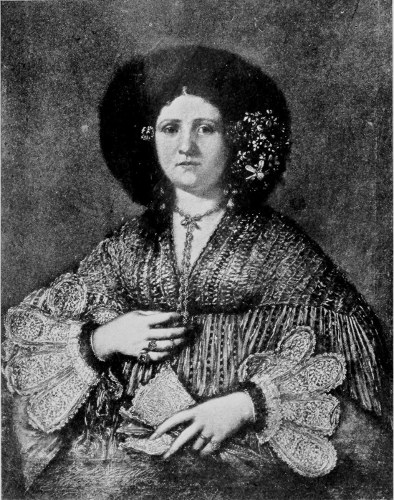
PORTRAIT OF YOUNG WOMAN. DUTCH SCHOOL
Large rings on little finders of right and left hands; large ring on third joint of left-hand fourth finger, and smaller one on second joint of the same finger; plain gold ring (wedding ring?) on fourth finger of left hand
Kaiserliche Gemälde-Galerie, Vienna
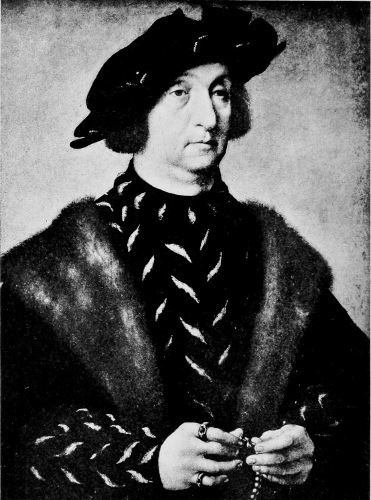
PORTRAIT OF A MAN, BY THE ARTIST KNOWN AS THE “MASTER OF THE DEATH OF MARY,” FROM HIS MOST NOTED PICTURE
Rings on index and little fingers of right hand
Königliche Gemälde-Galerie, Cassel
Till death divide. Nemo nisi mors. (No one but Death). Tout pour bein feyre. (All to do well). In bone fay. (In good faith). Sans mal desyr. (Without evil wish). Amor vincit om. (Love conquers all things). Till my life’s end. Erunt duo in carne una. (They shall be two in one flesh). Semper amemus. (May we love forever). In Christ and thee my comfort be. Honeur et joye. (Honor and joy). Let reason rule affection. God continue to love us. Mon cur avez. (You have my heart). Deux corps ung cuer. (Two bodies and one heart). Amour et constance. (Love and constancy). God unite our hearts aright. Knit in one by Christ alone. God’s providence is our inheritance. Our contract was heaven’s act. In thee, my choice, do I rejoice. God above increase our love. My heart and I, until I dye. Not two, but one, till life be gone. When this you see, remember me. Julia is mine own peculiar. I cannot show the love I O. We strangely met, and so do many, But now as true as ever any. 1658. As we begun, so let’s continue. My beloved is mine, and I am hers. True blue will never stain. 1653. Against thou goest, I will provide another. 1658. In loving thee, I love myself. 1658. Let him never take a wife, That will not love her as his life. A heart content cannot repent. I do not repent I gave consent. No gift can show the love I owe. What the heart saw the love hath chosen. Love one little, but love one long. Love him who gave thee this ring of gold, ’Tis he must kiss thee when thou art old. This circle, though but small about, The devil, jealousy, will keep out. If I think my wife is fair, What need other people care? 1653. God’s appointment is my contentment. Love, I like thee; sweet, requite me. With heart and hand at your command. My heart in silence speaks to thee, Though absence barrs tongue’s liberty. Faithful ever: deceitful never. I like, I love as turtle dove. As gold is pure, so love is sure. Despise not mee: yt joyes in thee. If you deny, then sure I dye. Your right is my delight. As true, bee just. No better smart shall change my heart. This ring is a token I give to thee, That thou no tokens do change for me. My dearest Betty is good and pretty. 1658. I did commit no act of folly, When I married my sweet Molly. 1658. ’Tis fit no man should be alone, Which made Tom to marry Joan. 1658. Sue is bonny, blythe, and brown; This ring hath made her now my own. 1658. Like Phillis there is none: She truly loves her Choridon. 1658. My life is done when thou art gone. 1653. This hath no end, my sweetest friend: Our loves be so, no ending know. God send her me my wife to be. As God decreed so we agreed. Take hand and heart, I’ll ne’er depart. Love and dye in constancy. A virtuous wife that serveth life. As long as life yr loving wife. I will be yours while breath endures. Love is sure where faith is pure. A virtuous wife doth banish strife. God did forsee we should agree. Love me, and be happy. None can prevent the Lord’s intent. Virtue surpasses riches. Let virtue rest within thy breast. Time lesseneth not my love. Joye without end. Let lykinge last. This and giver are thine for ever. Think on mee. Let love increase. Thou art my star, be not irregular. 1653.[396] Without thy love I backward move. 1613. Thine eyes so bright are my chief delight. 1653. This intimates true lovers’ states. 1653. Thou wert not handsome, wise, but rich; ’Twas that which did my eyes bewitch. 1658.[397] As we begun, so let’s continue. 1658. What the eye saw the heart hath chosen. 1658. More faithful than fortunate. 1658. Constancy and heaven are round, And in this the emblem’s found. As God hath knit our hearts in one, Let nothing part but death alone. God our love continue ever, That we in heaven may live together. Weare me out, love shall not waste, Love beyond lyvie still is placed. Weare this text, and when you looke Uppon your finger, sweare by th’ booke. There is no other, and I am he, That loves no other, and thou art she. Eye doth find, heart doth choose, Faith doth bind, death doth loose. As God hath made my chyce in thee, So move thy heart to comfort me. God yt hath kept thy heart for mee, Grant that our love may faithful bee. Fear ye the Lord then rest content, So shall we live and not repent. Divinely knit by grace are wee, Late two, now one, ye pledge here see. 1657. Breake not thy vow to please the eye, But keepe thy love, so live and dye. Love thy chast wife beyond thy life. 1601. I love the rod and thee and God. 1646. Pray to love; love to pray. 1649. More weare—more wear. 1652. Endless as this shall be our bliss. 1719. Be truly wise lest death surprise. Live in love and fear the Lord. Godly love will not remove. United hearts death only partes. You and I will lovers die. We joyn our love in Christ above. God gives increase to love and peace. God did decree our unitie. Heart content cannot repent. Live, love, and be happie. Noe heart more true than mine to you. In thee I find content of mind. A blessing we do hope to see. In love divine we love to joine. Hearts united live contented. In love and joy I will live and die. In thy breast my heart shall rest. The love is true that I.O.U. My love is fixed I will not range. I like my choice too well to change. This is the thing I wish to win. My promise past shall ever last. Well projected if accepted. God thought fit this knott to knitt. Thy Desart hath won my heart. True love is the bond of peace. Let our contest be who loves best. Thine eyes so bright are my chief delight. Our loves be so no ending know. My pledge I prove of mutuall love. Gift and giver, your servants ever. Lel ami avet. (Thou hast a loyal friend). Remember Him who died for thee, And after that remember me. Take hand and heart, ile ne’er depart. Breake not thy vow to please the eye, But keepe thy love, so live and dye. I will be yours while breath endures. I am sent to salute you from a faithfull friend. This and my heart. Too light to requite. Your sight, my delight. For a kiss, take this. My heart you have and yours I crave. The want of thee is grief to mee. Privata di te moriró. (Deprived of thee I shall die). Mon esprit est partout, Mon cœur est avec vous. (My mind is everywhere, My heart is with you). Faithfull ever, deceitfull never. God’s blessing be on thee and me. Love him in heart whose joy thou art. A loving wife prolongeth life. Desire hath set my heart on fire. Both or neither, chuse you whether. Parting is vayne when love doth remayne. I fancy none but thee alone. God sent her me my wife to be. This is your will, to save or kill. If you deny, then sure I dye. Your sight, my delight. Joyfull love this ring do prove. In thee I prove the joy of love. Silence ends strife with man and wife. This ring doth binde body and minde. Death never parts such loving hearts. Body and mind in thee I finde. Ryches be unstable And beauty will dekay, But faithful love will ever last Till death dryve it away.
One of those posies might seem to refer covertly to the length of the foregoing list:
This hath no end, my sweetest friend. 1653.
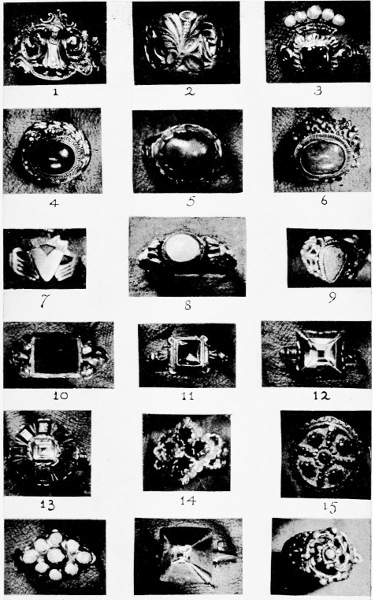
SOME RINGS IN THE MUSEUM OF FINE ARTS, BOSTON
1, silver and gilt; pierced with scrolls and the “Little Monk” of Munich. Modern. Bavarian. 2, Tyrolese. Peasant’s engagement ring of silver with design of two hearts and scrolls. 3, French (?). Said to have belonged to a collateral branch of the Montmorency family. Gold, large garnet with emerald each side; the crown composed of pearls and small diamonds. Bought in London. 4, Chinese ornament. 5, heavy silver, set with malachite. 6, Chinese ornament. 7, Italian (?). Peasant’s engagement ring of silver. 8, Italian. Gold, set with a turquoise, a horse’s head in white enamel at either side. 9, Tyrolese. Silver, set with a chamois tooth for good luck. 10, French. Bishop’s ring of gold and silver. Enameled bezel set with an almandine and diamonds. Bought in Geneva. 11, Italian. Sixteenth Century style. Gold set with a garnet. 12, Italian (?). Silver, set with a large crystal (?). Black and white enamel on bezel. 13, Italian. Gold, set with a cluster of red and green stones alternating; a crystal in the centre. 14, gilt, set with red glass (?). 15, bronze, decoration in relief. 16, Italian. Gold set with turquoises. 17, French (?). Gold, set with a brilliant. 18, Laplandish. Silver-gilt with pierced design.
JACQUES GUAY, COURT GEM ENGRAVER OF LOUIS XV, ENGRAVING GEMS IN HIS WORKROOM AT THE LOUVRE
Mariette, “Traité des Pierres Gravées,” Paris, 1750
The sacred and peculiar quality of a ring that has been given to a man by his wife as a memorial of marriage is expressed in strong terms in Shakespeare’s Merchant of Venice (Act v, sc. 1). One of these rings was given by Nerissa to Gratiano, the other by Portia to Bassanio. When Gratiano is charged with having parted with his ring, he defends himself by making light of it but is rebuked for this by Nerissa. The verses run as follows:
Gratiano: ... a hoop of gold, a paltry ring That she did give me, whose posy was For all the world like cutler’s poetry Upon a knife, “Love me, and leave me not.” Nerissa: What talk you of the posy or the value? You swore to me, when I did give it you, That you would wear it till your hour of death, And that it should be with you in your grave. Portia, joining in Nerissa’s feigned rebuke, says: You are to blame, I must be plain with you, To part so lightly with your wife’s first gift; A thing stuck on with oaths upon your finger And so riveted with faith unto your flesh. I gave my love a ring and made him swear Never to part with it; and here he stands; I dare be sworn for him he would not leave it, Nor pluck it from his finger, for the wealth That the world masters.
Bassanio, however, is forced to confess that he, too, has relinquished his ring. Of course, as all readers of Shakespeare know, both Portia and Nerissa have these rings in their own possession, since they themselves were, in disguise, the judge and the clerk to whom Bassanio and Gratiano unwillingly yielded them.
While the finger-ring was known to the Chinese from a very early period, it never seems to have enjoyed great favor with them. According to primitive court etiquette in that land, the Emperor’s “leading lady”—for the time being—had to wear a silver ring at court. In case she presented her sovereign with a descendant, she was rewarded by the gift of a gold ring, which she wore on one of the fingers of her left hand. About the mid-period of the Han dynasty (206 B.C.-221 A.D.) nephrite (jade) rings were known as well as those with stone setting but they were only rarely used as ornaments.[398]