Chapter IV · THE PLANT FORMATION Methods of Investigation and Record (continued 4)
Reading edition
338. Radial zonation is regularly characteristic of elevations and depressions. From the form of the earth, it reaches its larger expression in the girdles of vegetation corresponding to the zones of temperature. The zones of mountain peaks are likewise due largely to temperature, though humidity is a very important factor also. Mountain zones are normally quite perfect. The zonation of islands, hills, etc., is due to water-content. In the former, the zones are usually quite regular and complete; in the latter, they are often incomplete or obscured. Prairies and steppes are not zoned as units, but are complexes of more or less zonal hills and ridges. Ponds, lakes, and seas regularly exhibit complete zones, except in those shallow ponds where the depth is so slight that what is ordinarily a marginal zone is able to extend over the entire bottom. The line between an elevation and a depression, i. e., the edge of the water level, is the most sharply defined of all ecotones. It separates two series of zones, each of which constitutes a formation. One of these is regularly hydrophytic, the other is usually mesophytic. The line between the two can rarely be drawn at the water’s edge, as this is not a constant, owing to waves, tides, or periodical rise and fall. There is in consequence a more or less variable transition zone of amphibious plants, which are, however, to be referred to the hydrophytic formation. Nearly all forest formations serve as a center about which are arranged several somewhat complete zones. As a rule, these merge into a single heterogeneous zone of thickets.
339. Bilateral zonation differs from radial only in as much as it deals with linear elevations and depressions instead of circular ones. With this difference, the zones of ranges and ridges correspond exactly to those of peaks and hills, while the same relation is evident between the zones of streams, and of lakes and ponds. The ecotones are identical except as to form; they are linear in the one and circular in the other. Incompleteness is more frequently found in bilateral zonation, though this is a question of distance or extent, rather than one of symmetry.
340. Vertical zonation is peculiar in that there is no primary ecotone present, on either side of which zones arrange themselves with reference to 281the factor concerned. This arises from the fact that the controlling factor is light, which impinges upon the habitat in such manner as to shade out in but one direction, i. e., downward. Vertical zones appear in bodies of water, on account of the absorption of light by the water. In a general way, it is possible to distinguish bottom, plancton, and surface zones, consisting almost wholly of algae. There is little question that minor zones exist, especially in lakes and seas, but these await further investigation. The most characteristic vertical zones occur in forests, where the primary layer of trees acts as a screen. The density of this screen determines the number of zones found beneath it. In extreme cases the foliage is so dense that the light beneath is insufficient even for mosses and lichens. As a rule, however, there will be one or more zones present. In an ordinary deciduous forest, the layers below the facies are five or six in number: (1) a secondary layer of small trees and shrubs, (2) a tertiary layer of bushes, (3) an upper herbaceous layer of tall herbs, (4) a middle herbaceous layer, (5) a lower herbaceous layer, (6) a ground layer of mosses, lichens, other fungi, and algae. The upper layers are often discontinuous, the lower ones are more and more continuous. As a forest becomes denser, its layers disappear from the upper downward, the ground layer always being the last to disappear because of its ability to grow in very diffuse light. A vertically zoned formation shows a complex series of reactions. The primary layer determines the amount of heat, light, water, wind, etc., for the subordinate layers in general. Each of these layers then further determines the amount for those below it, the ground layer being subject in some degree to the control of every layer above it. This accounts probably for the definiteness and permanence of this layer. The degree to which the lower layers influence the upper by reacting upon the habitat is not known. It is evident that this influence must be considerable by virtue of their control of the water supply in the upper soil strata, by virtue of their transpiration, their decomposition, etc.
The ecotone between two formations is never a sharp line, but it is an area of varying width. The edge of this area which is contiguous to one formation marks the limit for species of the other. Both formations disappear in this transition zone, but in opposite directions. The overlapping which produces such zones arises from the fact that the physical factors tend to approach each other at the line of contact between formations, and that many species are more or less adjustable to conditions not too dissimilar.
341. Vegetation zones. As a fundamental expression of progressive change in the amount of heat and water, zonation is the most important feature of vegetation. It constitutes the sole basis for the division of continental as well as insular vegetation. The continent of North America 282furnishes striking proof of the truth of this. Conforming to the gradual decrease of temperature and water-content northward, three primary belts of vegetation stretch across the continent from east to west. These are forest, grassland, and polar desert. The first is further divided into the secondary zones of broad-leaved evergreen, deciduous, and needle-leaved forests. At right angles to this temperature-water symmetry lies a symmetry due to water alone, in accordance with which forest belts touch the oceans, but give way in the interior to grasslands, and these to deserts. It is at once evident that the mutual interruption of these two series of zones has produced the primary features of North America vegetation, i. e., tropical forests where heat and water are excessive, deserts where either is unusually deficient, grassland when one is low, the other moderate, and deciduous and coniferous forests, where the water-content is as least moderate and the temperature not too low. Such a simple yet fundamental division has been modified, however, by the disturbing effect which three continental mountain systems have had upon humidity and upon temperature symmetry. The two are intimately interwoven. The lowering of temperature due to altitude produces the precipitation of the wind-borne moisture upon those slopes which look toward the quarter from which the prevailing winds blow. A mountain range thus makes an abrupt change in the symmetry, and renders impossible the gradual change from forest to grassland and desert. The Appalachian system is not sufficiently high to produce a pronounced effect, and forests extend far beyond it into the interior before passing into prairies and plains. On the other hand, the influence of the Rocky mountains and the Sierra Nevada is very marked. The latter rise to a great height relatively near the coast, and condense upon their western slopes nearly all of the moisture brought from the Pacific. The Rocky mountains have the same effect upon the much drier winds that blow from the east, and the two systems in consequence enclose a parched desert. This series of major zones thus becomes, starting at the east, forest, grassland, desert, and forest, instead of the more symmetrical series, forest, grassland, desert, grassland, forest, which would prevail were it not for these barriers. This actual series of major zones undergoes further interruption by the action of these mountain systems in deflecting northern isotherms far to the south. This action is greatest in the high ranges, the Rocky mountains and the Sierras, and least in the lower Appalachians. Its result is to carry the polar deserts of the north far southward along the crests of the mountains, and to extend the boreal coniferous forests much further south along their slopes. In the Appalachians, this means no more than the extension of a long tongue of conifers into the mass of deciduous forests, and the occasional appearance of an isolated peak. In the western ranges, it produces two symmetrical 283series of minor mountain zones, forest, alpine grassland or desert, and forest, to say nothing of the foot-hill and timber-line zones of thicket.
There seems to be no good reason for distinguishing the zones of mountains as regions. The term itself is inapplicable, as it has no reference to zonation, and is used much more frequently as a term of general application. Its use tends to obscure also the essential identity of the so-called vertical zones of mountains with the major continental zones, an identity which can not be insisted upon too strongly. For the sake of clearness, it is important to distinguish all belts of vegetation as zones, though it is evident that these are not all of the same rank. The following division of the vegetation of North America is based upon the fundamental principles of continental symmetry and the community of continental and mountain zones.
I.
Polar-niveal zone—zona polari-nivalis
II.
Arctic-alpine zone—zona arctici-alpina Arctic province—provincia arctica Alpine province—provincia alpina
III.
Boreal-subalpine zone—zona boreali-subalpina Alaska province—provincia alaskana Cordilleran province—provincia cordillerana Ontario province—provincia ontariensis
IV.
Temperate zone—zona temperata Atlantic province—provincia atlantica Appalachian province—provincia appalachiana Nebraska province—provincia nebraskensis Utah province—provincia utahensis Coast province—provincia litoralis Pacific province—provincia pacifica
V.
Subtropical zone—zona subtropicalis Florida province—provincia floridana Mexican province—provincia mexicana
VI.
Tropical zone—zona tropicalis Antilles province—provincia antilleana Andean province—provincia andeana
ALTERNATION
342. Concept. The term alternation is used to designate that phenomenon of vegetation, in which a formation recurs at different places in a 284region, or a species at separate points in a formation. Although it is a fundamental feature of vegetation, it has been recognized but recently.[41]
Alternation is the response of vegetation to the heterogeneity of the surface of the earth. It is in sharp contrast to zonation, inasmuch as it is directly caused by asymmetry in the topography. In consequence, it deals with the subdivisions of zones, arising from physical differences within the symmetrical area. It deals with vegetation areas of every rank below that of major zone, with the habitat and geographical areas of species, and, in a certain way, with the correspondence of vicarious genera. The breaking up of vegetation into formations is a striking example of alternation. The same phenomenon occurs in every formation, producing consocies and minor plant groups, and everywhere giving variation to its surface and structure. The essential idea involved in this principle is the recurrence of like formations, consocies, or groups, which are more or less separated by formations, consocies, or groups differing from them. It is an exact expression of the primary law of association that heterogeneity of structure varies directly as the extent and complexity of the habitat, or the series of habitats. Vegetation is made up of what are superficially homogeneous formations, but upon analysis these are seen to contain consocies. The latter, though more uniform than formations, break up into groups, each of which still shows a characteristic heterogeneity arising from the varying number and arrangement of its constituent species.
343. Causes. The primary cause of alternation is physical asymmetry, which is everywhere present within the symmetrical areas which produce zones. This is influenced so strongly, however, by migration and plant competition (phyteris) that the consideration of this subject will gain in clearness if these are treated as separate causes. The essential relation between them must not be lost sight of, however. Migration carries disseminules into all, or only some of the different areas of a formation, or into different formations, with little respect to the physical nature of these. The physical character of these asymmetrical areas determines that some of these plants shall be established in one series of places, and some in another, while the competition between the individuals in the various areas determines the numerical value of each species as well as its persistence. These three causes are invariably present in the production of alternating areas, and originally, i. e., in new or denuded soils, the sequence is constant, viz., migration, ecesis in asymmetrical areas, and competition.
285With respect to the different portions of an asymmetrical area, migration will have one of three effects: (1) it will carry disseminules into both favorable and unfavorable areas, (2) into favorable ones only, or (3) into unfavorable ones alone. From the radial nature of migration, the first case is far the most frequent; it is typical of sporostrotes, and the highly specialized spermatostrotes and carpostrotes. The effect of migration is uniform here, and alternation arises in consequence of the selective power of ecesis. It is evident that migration does not have an even indirect effect, when the disseminules are carried into none but unfavorable situations. Where the movement is into favorable places alone, alternation is the immediate result. The intermittent operation of migration and the presence of barriers are responsible for the absence of plants in situations favorable to them, and in consequence bring about a certain alternation between corresponding species.
The selective operation of physical factors upon the disseminules carried into the different parts of an asymmetrical area is the usual cause of alternation. Asymmetry alone is universal within the more conspicuous structures termed zones, down to the smallest areas which a group of plants can occupy. The difference between contiguous areas, particularly within the same habitat, is often small. It sometimes seems inefficient in the initial stages of a succession when a single species is present, but even in extreme cases its effect will be recognizable in the size and density of the individuals. Asymmetry is clearly evident in vegetation where two symmetrical series cross each other, or when a symmetry is interrupted by barrier-like elevations or depressions. Within formations, it arises from differences, often very slight, in slope, exposure, elevation, from irregularities of surface, differences in soil structure, or composition, in the amount of cover, and in the reactions of the living plants. At the last point, it is in direct connection with plant competition.
344. Competition. Much uncertainty, as well as diversity of opinion, seems still to exist in regard to the precise nature of the competition between plants that occupy the same area. It has long been admitted that the phrase, “struggle for existence,” is true of this relation only in the most figurative sense, but the feeling still prevails that, since plants live in associations, there must be something mysterious and vitalistic in their relation. No one has been able to discover anything of this nature, but nevertheless the impression remains. Such a direct relation exists only between parasites, epiphytes, and lianes, and the plants which serve to nourish or support them. In the case of plants growing on the same stratum, actual competition between plant and plant does not occur. One individual can affect another only in as much as it changes the physical factors that influence the latter. Competition is a question of the reaction of a plant upon the physical factors which encompass it, and of the effect of these modified 286factors upon the adjacent plants. In the exact sense, two plants do not compete with each other as long as the water-content and nutrition, the heat and light are in excess of the needs of both. The moment, however, that the roots of one enter the area from which the other draws its water supply, or the foliage of one begins to overshade the leaves of the other, the reaction of the former modifies unfavorably the factors controlling the latter, and competition is at once initiated. The same relation exists throughout the process; the stronger, taller, the more branched, or the better rooted plant reacts upon the habitat, and the latter immediately exerts an unfavorable effect upon the weaker, shorter, less branched, or more poorly rooted plant. This action of plant upon habitat and of habitat upon plant is cumulative, however. An increase in the leaf surface of a plant not merely reduces the amount of light and heat available for the plant near it or beneath it, but it also renders necessary the absorption of more water and other nutritive material, and correspondingly decreases the amount available. The inevitable result is that the successful individual prospers more and more, while the less successful one loses ground in the same degree. As a consequence, the latter disappears entirely, or it is handicapped to such an extent that it fails to produce seeds, or these are reduced in number or vitality.
Competition in vegetation furnishes few instances as simple as the above, but this will serve to make clear the simplest case of ordinary competition, i. e., that in which the individuals belong to a single species. The various individuals of one species which grow together in a patch show relatively slight differences, in height, width, leaf expanse, or root surface. Still, some will have the largest surfaces for the impact of water, heat, and light, while others will have the smallest; the majority, perhaps, will occupy different places between the extremes. The former will receive more than their share of one or more factors. The reaction thus produced will operate upon the plants subject to it inversely as the amount of surface impinged upon. The usual expression of such competition is seen in the great variation in height, branching, etc., of the different individuals, and in the inability of many to produce flowers. This is particularly true of annuals, and of perennials of the same generation. In the competition between parents and offspring of the same perennial species, the former usually have so much the advantage that the younger plants are often unable to thrive or even germinate, and disappear, leaving a free space beneath and about the stronger parents. This illustrates the primary law of competition, viz., that this is closest when the individuals are most similar. Similar individuals make nearly the same demands upon the habitat, and adjust themselves least readily to their mutual reactions. The more unlike plants are, the greater the difference in their needs, and some are able to adjust themselves to the reactions of others with little or no disadvantage.
287In accordance with the above principles, the competition is closer between species of like form than between those that are dissimilar. This similarity must be one of vegetation or habitat form, not one of systematic position. The latter is in fact of no significance, except where there is a certain correspondence between the two. Leaf, stem, and root characters determine the outcome, and those species most alike in these features will be in close competition, regardless of their taxonomic similarity or dissimilarity. This is as conclusive of the competition between the species of the same genus as it is between those belonging to genera of widely separated families. From this may be deduced a second principle of competition, viz., the closeness of the competition between the individuals of different species varies directly with their similarity in vegetation or habitat form. This principle is of primary importance in the competition which arises between occupants and invaders in the different stages of succession. Those invading species that show the greatest resemblance to occupants in leaf, stem, and root form experience the greatest difficulty in establishing themselves. The species, on the contrary, which are so unlike the occupants that they come in at a clear advantage or disadvantage, establish themselves readily, in the one case as a result of the reaction, in the other by taking a subordinate position. This principle lies at the base of the changes in succession which give a peculiar stamp to each stage. A reaction sufficient to bring about the disappearance of one stage can be produced only by the entrance of invaders so different in form as to materially or entirely change the impress of the formation. Stabilization results when the entrance of invaders of such form as to exert an efficient reaction is no longer possible. In forests, while many vegetation forms can still enter, none of these produce a reaction sufficient to place the trees at a disadvantage, and the ultimate forest stage, though it may change in composition, can not be displaced by another.
It is obvious that the vegetation forms and habitat forms of associated species are of fundamental importance in determining the course and result of competition. Identity of vegetation form regularly produces close competition, and the consequent numerical reduction or disappearance of one or more species. Dissimilarity, on the other hand, tends to eliminate competition, and to preserve the advantage of the superior form. Species of trees compete sharply with each other when found together; the same is true of shrubs, or rosettes, etc. The relation of the shrubs to the trees, or of the rosettes to the shrubs of a formation is one of subordination rather than of competition. The matter of height and width often enters here also to such a degree that the tallest herbs compete with the bushes and shrubs, and rosettes with mats or grasses. The amount and disposition of the leaf surface are decisive factors in the competition between species of the same 288vegetation form, in so far as this is governed by light. In those plants in which the leaves are usually erect, notably the grasses and sedges, the competition between the aerial parts is relatively slight, and the result is determined by the reactions of the underground stems and roots.
The position of the competing individuals is of the greatest importance. The distance between the plants affects directly the degree of competition, while their arrangement, whether in groups according to species or singly, exerts a marked influence by determining that the contest shall be between like forms, or unlike forms. Position is controlled primarily by the relation existing between seed-production and dissemination. It is of course influenced in large measure by the initial position taken by the invaders into a nudate area, but this is itself a result of the same phenomena. The individuals of species with great seed-production and little or no mobility usually occur in dense stands. In these, the competition is fierce, for the two reasons of similarity and density, and the result is that the plants fall far below the normal in height and width. This is an extreme example of the group arrangement. When the seed-production is small, the mobility may be great or little without seriously affecting the result. The individuals of a species of this kind will be scattered among those of other species, and the closeness of competition will depend largely upon the similarity existing between the two. The arrangement in such cases is sparse. A species with great seed-production and great mobility usually shows both kinds of arrangement, the position of the individuals and the competition between them varying accordingly. This is due to the intermittent action of distributing agents, making it possible for the seeds to fall directly to the ground during the times that winds, etc., are absent. The three types of arrangement indicated above are termed gregarious, copious, and gregario-copious. They furnish the basis for the investigation of abundance which deals essentially with the number and arrangement of the individuals of competing species. The effect of distance, i. e., the interval between individuals, upon competition is fundamental. The competition increases as the interval diminishes, and the reverse.
The view here advanced, i. e., that competition is purely physical in nature, renders untenable the current conceptions of vegetation pressure, occupation, etc. Masses of vegetation are thought to force the weaker species toward the edge, thus initiating an outward or forward pressure. As has been shown above, no such phenomenon occurs in vegetation. This movement is nothing but simple migration, followed by ecesis, and has no connection with “weaker” species, or the development of a vital pressure. The direction taken by the migrating disseminules is essentially indeterminate. Migration seems to be outward, or away from the mass, merely because the 289ecesis is greater at the edge, where the increased dissimilarity between plant forms diminishes the competition. The actual movement is outward, but it takes place through the normal operation of competition. In this connection, it should be pointed out that the common view that plants require room is inexact, if not erroneous. This is difficult of proof, as it is impossible to distinguish room as such from the factors normally present, light, heat, water, and nutrient salts, but it seems obvious that the available amounts of these will determine the space occupied by a plant, irrespective of the room adjacent plants may allow it. The explanation of competition upon physical grounds likewise invalidates the view that plants possess spheres of influence other than the areas within which they exert a demonstrable reaction upon the physical factors present.
Competition plays a very important role in alternation. It produces minor examples of alternation in the physical units of an asymmetrical series. Its greatest influence, however, is exerted in modifying the effects of asymmetry. The reaction of occupants emphasizes or reduces the effect of asymmetry, and has a corresponding action upon alternation. This result of competition is typical of succession, in which the sequence of stages arises from the interaction of occupant and invader.
345. Kinds of alternation. Alternation involves two ideas, viz., the alternation of different species or formations with each other, and the alternation of the same species or formation in similar but separate situations. This is the evident result of asymmetry, in response to which contiguous areas are dissimilar and remote ones often similar. Individuals of the same species or examples of the same formation may be said to alternate between two or more similar situations, while different species or formations are said to alternate with each other, occurring usually in situations different in character. From the nature of alternation, the two phenomena are invariably found together.
It is possible to distinguish three kinds of alternation: (1) of a formation, consocies, layer, facies, or species in similar situations; (2) of similar or corresponding formations, species, etc., in similar situations; (3) of facies and other species with respect to number. The last two are merely variations of the first, arising out of slight differences in the physical factors of the alternating areas, the adjacent flora, or the course of competition. The alternation of different examples of the same formation is a significant feature of greatly diversified areas, such as mountains. It is naturally much less characteristic of lands physiographically more uniform. A xerophytic formation will alternate from ridge to ridge, a mesophytic formation between the intermediate valleys; aquatic vegetation will alternate from pond to pond, 290or stream to stream. The appearance of new or denuded soils upon which successions establish themselves is the most important cause of the alternation of formations. The weathering of rocks in different areas of the same region produces in each a sequence of similar or identical formations. The same statement is true in general of other causes of succession, such as erosion, flooding, burning, cultivation, etc., wherever they operate upon areas physically similar and surrounded by the same type of vegetation. The areas of more or less heterogeneous formations characterized by major physical differences are occupied by consocies. In an extensive formation, the same consocies alternates from one to another of these areas that are similar. When the formation is interrupted and occurs here and there in separate examples, a consocies often alternates from one to another of these. A consocies regularly derives its character from the fact that one or more of the facies of the formation is more intimately connected with certain areas of the latter than with others. This explains why the alternations of consocies and facies are usually identical. Layers sometimes alternate between different examples of the same forest or thicket formation, when they are suppressed in some by the diffuseness of the light.
The alternation of species is a typical feature of formations; it is absent only in those rare cases where the latter consist of a single species. The areas of a habitat which show minor physical or historical (i. e., competitive) differences are occupied by groups of individuals belonging to one or more species responsive to these differences. Each of these groups will recur in all areas essentially similar, the intervals being occupied of course by slightly different groups. Such groups are constituted by gregarious or copious species of restricted adjustability. Sparse plants likewise alternate, but they necessarily play a much less conspicuous part. In habitats not too heterogeneous, a large number of species are sufficiently adjustable to the slight differences so that they occur throughout the formation. Often, to be sure, they show a characteristic response, expressed in the size or number. This is illustrated by the facies and many of the principal species of the prairie formation. Festuca, Koelera, Panicum, and Andropogon occur throughout, except in the moist ravines which are practically meadows. Astragalus, Psoralea, Erigeron, and Aster grow everywhere on slopes and crests, but they are much more abundant in certain situations. Other plants, Lomatium, Meriolix, Anemone, Pentstemon, etc., recur in similar or identical situations upon different hills. Lomatium alternates between sandy or sandstone crests, Meriolix and Pentstemon occur together upon dry upper slopes, while Anemone alternates between dry slopes and crests.
Owing to the accidents of migration and competition, similar areas within a habitat are not occupied by the same species, or group of species. A species 291found in one area will be replaced in another by a different one of the same or a different genus. The controlling factors of the area render imperative an essential identity of vegetation and habitat form, though in systematic position the plants may be very diverse. Such genera and species may be termed corresponding. The relation between such plants is essentially alternation; it should, perhaps, be distinguished from alternation proper as corresponsive. The prairie formation furnishes a good example of this on exposed sandy crests, upon which Lomatium, Comandra, and Pentstemon alternate. Formations exhibit a similar correspondence.
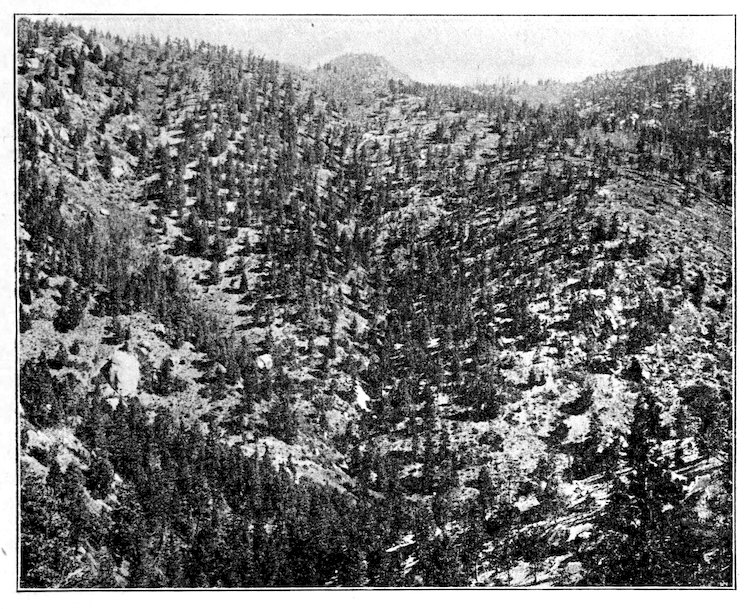
Fig. 74. Numerical alternation of Pinus and Pseudotsuga upon east and west slopes.
All species that alternate show a variation in abundance from one area to another. Frequently, the difference is slight, and may be ignored, except in determining abundance. Very often, however, the variation is so great that a facies may be reduced, numerically, to the rank of a principal species, or one of the latter to a secondary species. This phenomenon is distinguished as numerical alternation. It arises from the fact that the similar areas are sufficiently different to affect the abundance, without producing complete suppression. It is probable that this result is due almost entirely to competition. Astragalus crassicarpus grows on all the slopes of the prairie formation, but on some it has the abundance of a facies, while on others it is represented 292by a few scattered individuals. This difference is much more striking in separate examples of the same formation, particularly when a normal facies is reduced to the numerical value of a secondary species. This is a matter of great importance in the study of formations, for it has doubtless often resulted in mistaking a consocies for a formation.
Alternation furnishes the logical basis for what may be called comparative phytogeography. The latter is of much broader scope than the old subject of geographical distribution, for it treats not only of the distribution of formations and associations as well as of species, but it also seeks to explain this by means of principles drawn from the relation between habitat and vegetation. When the latter come to be fully based upon physical factor investigations, and upon the effects of migration and competition as shown in alternation, the comparative study of formations will represent the highest type of phytogeographical activity.
THE FORMATION IN DETAIL
346. The rank of the formation. There have been as many different opinions in regard to the application of the term formation as there are concerning the group which is to be called a species. In taxonomy, however, the concept of the species is purely arbitrary, and agreement can not be hoped for. In vegetation, on the contrary, the connection between formation and habitat is so close that any application of the term to a division greater or smaller than the habitat is both illogical and unfortunate. As effect and cause, it is inevitable that the unit of the vegetative covering, the formation, should correspond to the unit of the earth’s surface, the habitat. This places the formation upon a basis which can be accurately determined. It is imperative, however, to have a clear understanding of what constitutes the difference between habitats. A society is in entire correspondence with the physical factors of its area, and the same is true of the vegetation of a province. Nevertheless, many societies usually occur in a single habitat, and a province contains many habitats. The final test of a habitat is an efficient difference in one or more of the direct factors, water-content, humidity, and light, by virtue of which the plant covering differs in structure and in species from the areas contiguous to it. A balsam-spruce forest shows within itself certain differences of physical factors and of structure. The water-content will range from 20–25 per cent, and the light from .02–.003. One portion may consist chiefly of Pseudotsuga mucronata, another of Picea engelmannii, and a third of Picea parryana, or these species may be intermingled. If, however, this forest is compared with the gravel slide, which touches it on one side, and the meadow thicket, which meets it on another, 293the physical factors and the species both demonstrate that it is the forest, and not its parts, which corresponds to a distinct physical entity, the habitat. This test of a formation is superfluous in a great many cases, where the physiognomy of the contiguous areas is conclusive evidence of their difference. It is evident also that remote regions which are floristically distinct, such as the prairies and the steppes, may possess areas physically almost identical and yet be covered by different formations. This point is further discussed under classification.
The existing confusion in the matter of formations is due to two causes. The first arises from the fact that much ecological work has been hasty. Little or no attention has been given to development, and in consequence rudimentary and transitory stages of succession have often been described as formations. Mixed areas in particular have caused trouble. In the second place, there has been a marked tendency to minimize the need of thoroughness and training by calling every slightly different area a formation. A failure to recognize the primary value of alternation has also contributed materially to this. Alternating facies, and principal species, when separated from each other, have often been mistaken for formations. This is a danger that must be fully appreciated and guarded against. In practically all regions, the same formation is represented by numerous scattered areas, all showing greater or less differences arising from alternation. This is especially true of thickly populated regions where virgin areas are rare. The fact that twenty-five miles intervene to-day between two small stretches of primitive prairie is permitted to unduly emphasize their differences. It requires the study of a number of such examples to counteract this tendency, and to cause one to see clearly that they must have been at one time merely so many bits of the prairie formation.
In this connection, the lichen and moss groups which are found on rocks constitute an interesting problem. It is clear that Peltigera and Cladonia, which grow on the forest floor, and Evernia, Ramalina, and Physcia, which are found on the trees, are merely constituent species of the forest formation. The same is true of Cladonia, Urceolaria, and Parmelia, which are found among the sedges and grasses of alpine meadows. The physical conditions are essentially those of the formation, and the lichens themselves are more or less peculiar to it. This is particularly true of the forest, in which the two strata, bark and moist shaded soil, are present because of the trees. In the case of granitic rocks, the circumstances are very different. The species of lichens found on the rocks are not peculiar to the formation, but they also occur elsewhere. In the forest, Parmelia, Placodium, Physcia, Rinodina, Urceolaria, Lecanora, Lecidea, etc., occur on the rocks. In the alpine meadows, the rock groups are composed of Parmelia, Gyrophora, 294Cetraria, Acarospora, Lecanora, Lecidea, Buellia, etc. The stratum itself is physically very different and constitutes a distinct habitat. These groups are really small formations, which are quite distinct from the surrounding forest or meadow. This is proven conclusively in many places in the mountains where areas of the characteristic lichen formations of cliffs are carried by the fall of rock fragments into forest and meadow, where they persist without modification. This also shows clearly that the groups on scattered rocks in the same area are to be regarded as examples of the same cliff formation, except where the differences are evidently to be ascribed to development and not to alternation. Where these rock formations can not be traced to cliffs or magmata with certainty, they must be considered as antedating the vegetation in which they occur. Often, indeed, especially in igneous areas, they are relicts of the initial stage of a primary succession. Finally, they prove their independence of the forest or meadow formation by initiating a distinct succession within these. Crustaceous groups or formations yield to foliose ones, and these in turn give way to formations of mosses, particularly in the forest where the effect of the diffuse light is felt. From the above, the following rule of formational limitation is obtained: any area, which shows an essential difference in physical character, composition, or development from the surrounding formation is a distinct formation.
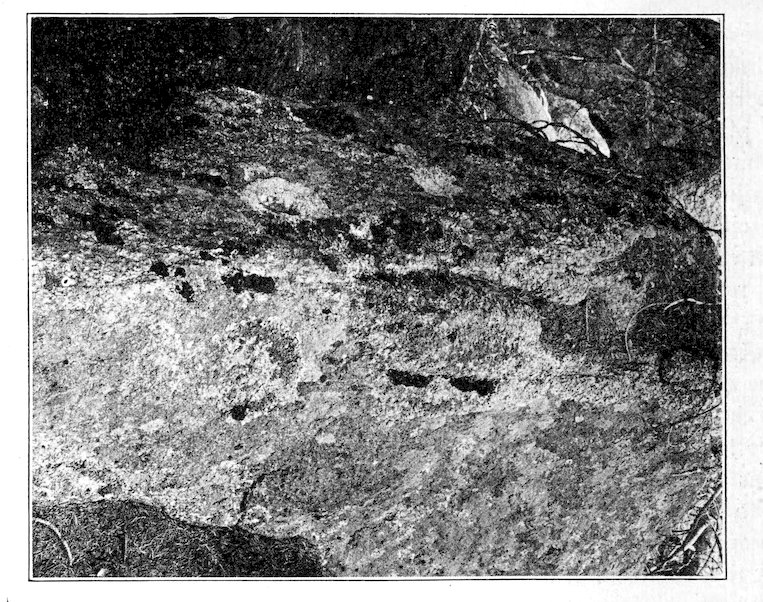
Fig. 75. Relict lichen formation in a spruce forest, invaded by rock mosses.
295347. The parts of a formation. All the parts which make up the structure of a formation are directly referable to zonation and alternation, alone or together, or to the interaction of the two. The principles which underlie this have already been discussed under the phenomena concerned. It is necessary to point out further that the structure may be produced in several ways: (1) by zonation alone, (2) by alternation alone, (3) by zonation as primary and alternation as secondary, (4) by primary alternation and secondary zonation, (5) by the interaction of the two, as in layered formations. Though all these methods occur, the first two are relatively rare, and the resulting structure comparatively imperfect. The typical structure of formations can best be made clear by the consideration of a prairie which belongs to the fourth group, and a forest which represents the last.
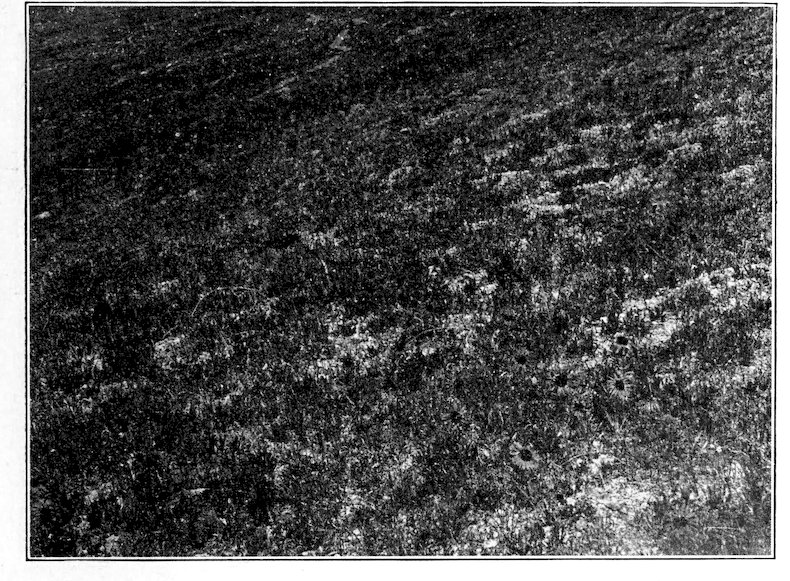
Fig. 76. Early (prior) aspect of the alpine meadow formation (Carex-Campanula-coryphium), characterized by Rydbergia grandiflora.
The major divisions of prairie and forest formations are regularly due to alternation. There is an inherent tendency to the segregation of facies, arising out of physical or historical reasons, or from a combination of both. Not all formations show this, but it is characteristic of the great majority of them. The primary areas which thus arise have been called associations: they are naturally subordinate to the formation. To avoid the confusion which inevitably results from using the word association in two different 296senses, it is proposed to term this primary division of the formation, a consociation, or better, a consocies. This term is applied only to an area characterized by a facies, or less frequently, by two or more facies uniformly commingled. The consocies of grassland are determined by grasses, those of forests by trees, etc. From the different position of the facies in these two types of vegetation such areas are readily seen at all times in the forest, but they are often concealed in grassland by the tall-growing principal species of the various aspects. When definite consocies are present, they are often found to mingle where they touch, producing miniature transition areas, and, very rarely, they sometimes leave gaps in which no facies appears.
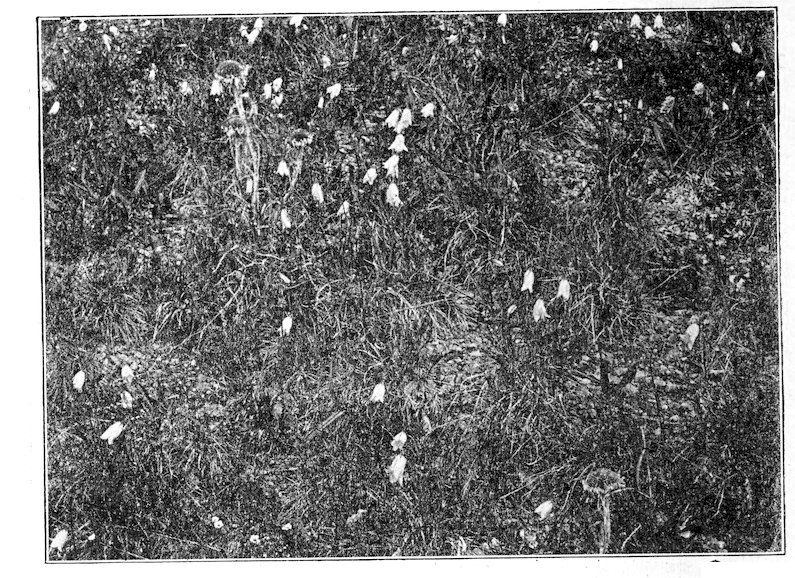
Fig. 77. Late (serotinal) aspect of the alpine meadow, characterized by Campanula petiolata, Rydbergia in fruit.
The seasonal changes of a formation, which are called aspects, are indicated by changes in composition or structure, which ordinarily correspond to the three seasons, spring, summer, and autumn. The latter affect the facies relatively little, especially those of woody vegetation, but they influence the principal species profoundly, causing a grouping typical of each aspect. For these areas controlled by principal species, but changing from aspect to aspect, the term society is proposed. They are prominent features of the majority of herbaceous formations, where they are often more striking than the facies. In forests, they occur in the shrubby and herbaceous layers, and 297are consequently much less conspicuous than the facies. A close inspection of the societies formed by principal species shows that they are far from uniform. Since they usually fail to exhibit distinct parts, it becomes necessary to approach the question of their structure from a new standpoint. Such is afforded by aggregation, which yields the simplest group in vegetation, i. e., that of parent and offspring. This is so exactly a family in the ordinary sense that there seems to be ample warrant for violating a canon of terminology by using the word for this group, in spite of its very different application in taxonomy. It has already been shown that aggregation further produces a grouping of families, which may properly be called a community. As they are used here, family and community become equally applicable to the association of plants, animals, or man. Both families and communities occur regularly in each society of the formation, and they represent its two structures. In some cases, all the families are grouped in communities, two or more of which then form the society. Very frequently, however, families occur singly, without reference to a community, and the two then constitute independent parts of the same area. This is typically the case wherever gregarious species are present, since these are merely family groups produced by aggregation.
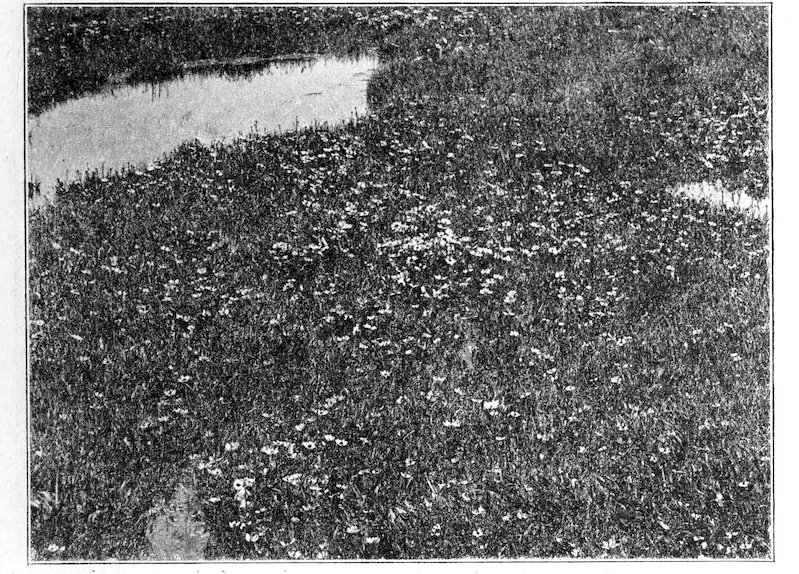
Fig. 78. Calthetum (Caltha leptosepala), a consocies of the alpine bog formation.
298
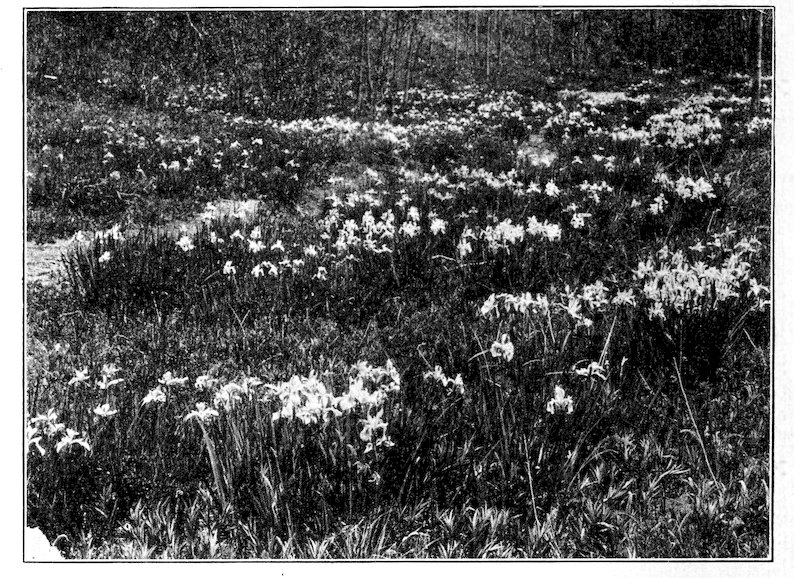
Fig. 79. Iridile (Iris missouriensis), a society of the aspen formation.
Objection may be made that this analysis of formational structure has been carried too far, and that some of the structures recognized are mere interpretations, and not actual facts. Such a criticism will not come from one who has got beyond the superficial study of formations, for he will at once recognize that certain probable features of structure have not been considered. On the other hand, the ecologist or the botanist who has not made a careful investigation from the standpoints of development and structure will naturally refrain from expressing an opinion, until he has obtained an acquaintance at first hand with the facts. Over-refinement is the usual penalty of intensive work. The unbiased investigator, however, will not be misled by the suddenness with which new concepts appear. It seems plausible that the structure of a formation, if not as definite, is at least nearly as complex as that of an individual plant. Few botanists will insist that the refinement of tissues and tissue systems has been carried further than the differentiation of the plant warrants. Yet, if these had been defined within a period of a few years rather than slowly recognized during more than a century, they would have been called seriously in question. As a matter of fact, the consocies, under the term association, and the society, under various names, have been recognized by ecologists for several years. They are definite 299phenomena of alternation which can be found anywhere. The family and the community, though the latter is less distinct in outline, are equally valid structures, the proof of which anyone can obtain by thorough methods of study.
348. Nomenclature of the divisions. The suffix -etum is used to designate a consocies of a formation, e. g., Picetum, Caricetum, etc. When two or more species characterize the area, the most important, or more rarely, the two are used. The termination used to designate a society is -ile, as Asterile, Sedile, Rosile. The suffix which denotes the community is -are, and for the family, it is -on, viz., Giliare, Bromare, Bidenton, Helianthon, etc. Layers are indicated by the affix -anum, as Opulasteranum, Verbesina-Rudbeckianum, etc. It is evident that these suffixes, like the terms to which they refer, must be used always for the proper divisions if they are to have any value at all. There has been a marked tendency, for example, to use -etum in connection with the names of groups of very different rank. It is hardly necessary to point out that such a practice does not promote clearness. The following tabular statement will illustrate the application of both terms and suffixes:
Picea-Pseudotsuga-hylium formation (-ium) Paronychia-Silene-chalicium
Picetum consocies (-etum) Paronychietum
Opulaster-Ribesanum layer (-anum)
Opulasterile society (-ile) Androsacile
Thalictrare community (-are) Festucare
Pirolon family (-on) Arenarion
349. The investigation of a particular formation. A comprehensive and thorough study of a formation should be based upon as many examples of it as are accessible. The example which is at once the most typical and the most accessible is made the base area. This plan saves time and energy, reduces the number of instruments that are absolutely necessary, and establishes a common basis for comparison. The inquiry should be made along four lines, all fundamental to a proper knowledge of the formation. These lines are: (1) the determination of the factors of the habitat, (2) a quadrat and a transect study of the structure of the formation, (3) a similar investigation of development, (4) a floristic study of the contiguous formation, with special reference to migration. The sequence indicated has proven to be the most satisfactory, and is to be regarded as all but absolutely essential. Naturally, this applies only to the order in which the various lines are to be taken up, as they are carried on together when the work is fully under way. Since instrument and quadrat methods have already been given in detail, it 300is unnecessary that they be repeated. Similarly, the questions which pertain to structure and development and to the surrounding vegetation are considered in detail in the pages which precede.
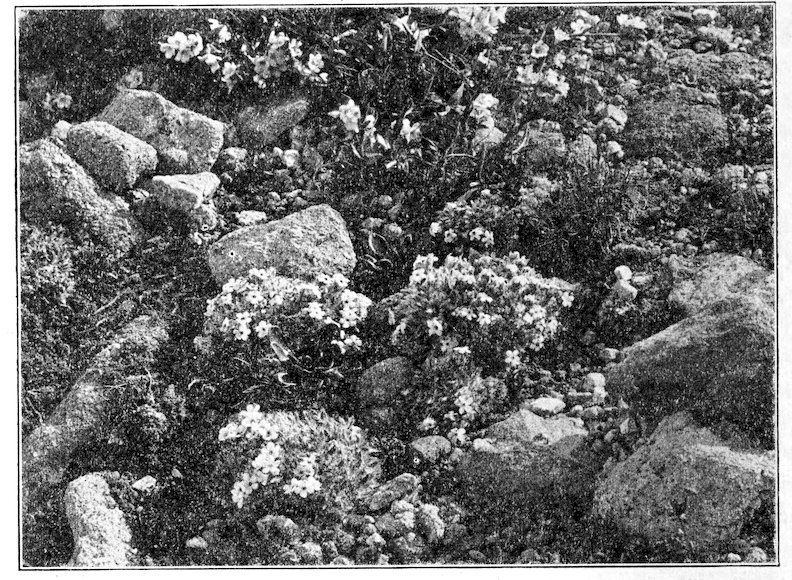
Fig. 80. Eritrichiare (Eritrichium aretioides), a community of the alpine meadow formation.
CLASSIFICATION AND RELATIONSHIP
350. Bases. Formations may be grouped with reference to habitat or kind, development or position. Classification upon the basis of habitat places together formations which are similar in physiognomy and structure. Developmental classification is based upon the fact that the stages of a particular succession are organically connected or related, though they are normally different in both physiognomy and structure. Grouping with respect to position is made solely upon occurrence in the same division of vegetation. The formations thus brought together usually possess neither similarity of kind or structure, nor do they have any necessary developmental connection. Habitat and developmental classification are of fundamental value; regional arrangement is more superficial in character. All serve, however, to emphasize different relations, and, while the developmental system expresses the most, they should all be used to exhibit the vegetation of a region, province, or zone.
301
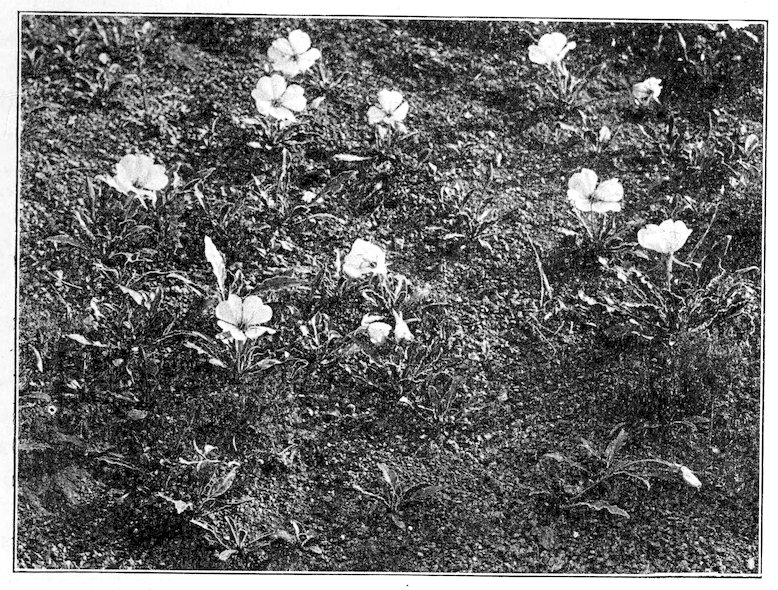
Fig. 81. Pachylophon (Pachylophus caespitosus), a family of the gravel slide formation.
351. Habitat classification. In arranging formations with reference to habitats, the direct factors, water and light, can alone be used to advantage. Such a system is fundamental, because it is founded upon similarity of habitat and of structure. Proposed groupings based upon nutrition-content, or upon the division of factors into climatic and edaphic, have elsewhere[42] been shown to be altogether of secondary importance, if not actually erroneous. The basis of the habitat grouping is water-content, which is supplemented by light whenever the factor is decisive. The primary divisions thus obtained are water, forest, grassland, and desert, which are characterized respectively by associations of hydrophytes, mesophytes, hylophytes, poophytes, and xerophytes respectively. Within these, formations are arranged according to the type of habitat, i. e., pond, meadow, forest, dune, etc. These divisions comprise all formations which belong to the type by virtue of their physiognomy and structure. Such formations differ from each other very considerably or completely in the matter of floristic, i. e., component species, but they still belong to the same type. A dune formation in the interior and one on the coast may not have a single species in common, and yet they are essentially alike in habitat, development, and structure.
302352. Nomenclature. The names of formations are taken from the habitats which they occupy. Each formation should have a vernacular and a scientific name. The latter is especially important since it ensures brevity and uniformity, and obviates the obscurity and confusion that arise from vernacular terms in many tongues. Scientific names have been made uniformly from Greek words of proper meaning by the addition of the suffix -ium (εῖον), which denotes place.[43] The following list gives the English and the scientific name of the various habitats, and their corresponding formations, and indicates the primary divisions into which these fall.
I.
Hydrophytia: water plant formations 1. ocean: oceanium: oceanad,[44] oceanophilous, etc. 2. sea: thalassium surface of the sea: pelagium deep sea: pontium 3. lake: limnium, limnad 4. pond, pool, tiphium, tiphad 5. stagnant water: stasium: stasad 6. salt marsh: limnodium, limnodad 7. fresh marsh: helium 8. wet meadow: telmatium 9. river: potamium 10. creek: rhoium 11. brook: namatium 12. torrent: rhyacium 13. spring: crenium 14. warm spring: thermium 15. ditch: taphrium 16. sewer: laurium 17. swamp forest: helohylium 18. swamp open woodland: helodium 19. meadow thicket: helodrium 20. bank: ochthium rock bank: petrochthium sand bank: ammochthium mud bank: pelochthium 21. rocky seashore: actium 22. sandy seashore: agium 23. sandbar: cheradium 24. tank: phretium
II.
Mesophytia: middle plant formations a. Sciophytia: shade plant formations 26. forest: hylium 27. grove: alsium 28. orchard: dendrium 29. canyon: ancium 303 30. open woodland: orgadium 31. thicket: lochmium b. Heliophytia: sun plant formations 32. meadow: poium 33. pasture: nomium 34. culture land: agrium 35. waste place: chledium
III.
Xerophytia: dry plant formations 36. desert: eremium 37. sand-hills, sandy plain: amathium 38. prairie, plains: psilium 39. dry, open woodland: hylodium 40. dry thicket: driodium 41. dry forest: xerohylium 42. gravel slide: chalicium 43. sandbar: syrtidium 44. sand draw: enaulium 45. blowout: anemium 46. strand: psamathium 47. dune: thinium 48. badlands: tirium 49. hill, ridge: lophium 50. cliff: cremnium 51. rock field: phellium 52. boulder field: petrodium 53. rock, stone: petrium 54. humus marsh: oxodium 55. alkali area: drimium 56. heath, dry meadow: xeropoium 57. moor: sterrhium 58. alpine meadow: coryphium 59. polar barrens: crymium 60. snow: chionium 61. wastes: chersium
Particular formations are indicated by means of floristic distinctions. Thus, Populus-hylium is the aspen forest as distinguished from the Picea-Pseudotsuga-hylium, or the balsam-spruce forest; and the Bulbilis-psilium, or buffalo-grass prairie, from the Bouteloua-Andropogon-psilium, or grama-bluestem prairie. Similarly, the aspen formation of the Old World and of the New may be distinguished as Populus-tremula-hylium and Populus-tremuloides-hylium, respectively. In all formational names, the facies alone should be used. Frequently, a single facies will suffice for clearness. As a rule, however, the two most important facies should be employed; in rare cases only is it necessary to use the names of three. When it is desirable to refer to two or more examples of the same formation, a geographical term is added, e. g., (1) Populus-hylium (Crystal Park), (2) Populus-hylium (Cabin Canyon).
353. Developmental classification. This is based upon succession as the record of development. Upon the basis of development, all the formations which belong to the same succession are classed together. They are arranged within each group in the sequence found in the particular succession. From its nature, developmental classification is of primary importance in exhibiting the history of vegetational changes. It has less value than the 304habitat system for summarizing the essential structure of a vegetation, inasmuch as it places the emphasis upon historical rather than structural features. It is evident that both deal with the same formations, and that the difference is merely one of viewpoint. The habitat classification is simpler in that it considers only those formations actually on the ground, while development has regularly to take into account stages which have disappeared. The groups of the developmental system, and the arrangement of formations within them have already been indicated under the nomenclature of succession (sections 326 and 327).
354. Regional classification. The grouping of formations with respect to the divisions of vegetations is chiefly of geographical value. It indicates a certain general relationship, but its principal use is to summarize the structure of the vegetative covering of a region. The arrangement of formations in the various divisions is made with reference to the outline of North American vegetation (section 341). This is naturally based upon the identity of altitude and latitude zones. In the study of mountain countries, it is often desirable to group formations with reference to altitude alone. In this case, the grouping is based upon the following divisions: (1) bathyphytia, lowland plant formations; (2) mesiophytia, midland formations; (3) pediophytia, upland formations; (4) pagophytia, foot-hill formations; (5) orophytia, subalpine formations; (6) acrophytia, alpine formations; (7) chionophytia, niveal formations.
355. Mixed formations. These are mixtures of two, rarely more, adjacent formations, or of two consecutive stages of the same succession. Mixed formations are really transitions in space or in time between two distinct formations. Theoretically, they are to be referred to one or the other, according to the preponderance of species. Actually, however, they often persist in an intermediate condition for many years, and it becomes necessary to devote considerable attention to them. In some cases, there is good reason to think that the species of two contiguous formations have become permanently associated, and thus constitute a new formation. This is often apparently true in succession, when the change from one stage to the next requires a long term of years, but it is really true only of the very rare cases in which a succession becomes stabilized in a transition stage. When the mixture is due to development, the formations concerned are often quite dissimilar, e. g., grassland and thicket, thicket and forest. If it is the result of position, the formations are usually similar, i. e., both are grassland, thicket, or forest, since the plants of the lower level are regularly assimilated or destroyed, when invasion occurs at two levels. The term mictium (μικτόν, 305mixture) is here proposed for the designation of all mixed formations, whether they arise from succession or from juxtaposition. Thus, the Mentzelia-Elymus-mictium is the transition between the Mentzelia-Pseudocymopterus-chalicium and the Elymus-Muhlenbergia-chalicium. Similarly, the Populus-Picea-mictium and the Pinus-Pseudotsuga-mictium are transition stages in the development of the Picea-hylium. On the other hand, the Andropogon-Bulbilis-mictium is a mixture produced by the mingling of two contiguous prairie formations. In the future development of this subject, it will probably become desirable to name mixed formations on the basis of origin, but at present this is unnecessary. Both in classification and in description they should be considered between the formations which give rise to them, and this will at once indicate their origin.
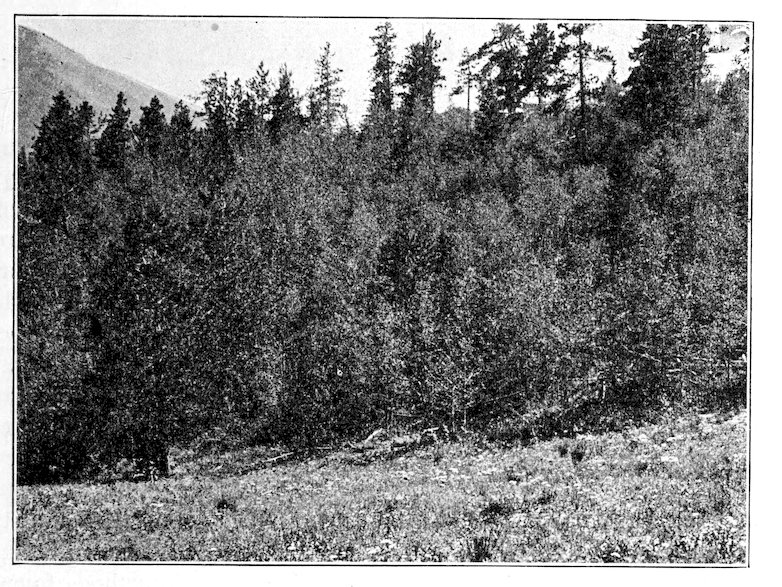
Fig. 82. A mixed formation of aspens and spruces (Populus-Picea-mictium), preceding the final spruce forest of a burn succession.
Puzzling cases of mixture resulting from position occur toward the limits of facies which occupy extensive areas. Bouteloua oligostachya, and Andropogon scoparius extend from the prairies through the sand-hills and plains, and into the foot-hills of the Rocky mountains. Their abundance at once raises a question as to the validity of the prairie, sand-hill, plain, and foot-hill formations. If these two grasses were controlling, and equally characteristic throughout, then the entire stretch would have to be regarded as a 306single formation. Since they are often absent, or mixed with other facies of greater importance, they can not be considered the sole tests of the formation. This view is reinforced by the fact that prairie, sand-hill, plains, and foot-hill all have their characteristic principal and secondary species, in addition to facies that are more or less typical. In certain formations, doubtless, Bouteloua and Andropogon are relicts, in others invaders, while in the formations actually constituted by them they are dominant. The final solution of such problems is quite impossible, however, until the comparative study of large areas can be based upon the accurate detailed investigation of the component formations.
Experimental Vegetation
356. Scope and methods. The experimental study of the formation as a complex organism rests upon methods essentially similar to those discussed under experimental evolution. The scope of the two fields is practically the same, moreover, in that both deal with the experimental development of an organism and the structures that result. The actual problems are naturally very different, since the formation is a complex of individual plants, but the fundamental basis of habitat, function, and structure is common to both. However, the functions now to be considered are aggregation, invasion, competition, etc., and the structures, zones, consocies, societies, communities, and families. The latter may properly be regarded as adaptations called forth by the adjustment, i. e., aggregation, migration, ecesis, etc., of the formation to the physical factors of the habitat. As consequences of measured factors, formational adjustment and adaptation must themselves be carefully measured and recorded. For these purposes, the methods of quadrat and transect, of chart, photograph, and formation herbarium are used. Invaluable as they are for any scientific inquiry into vegetation, such methods form the very foundation of experimental study in which accuracy is the first desideratum.
It has already been shown that nature’s own experiments in the production of new forms furnish the best material for experimental evolution. This statement is equally true of experimental vegetation. The formation of new habitats by weathering and transport, and the denuding of old ones, yield experimental plots of the greatest value. This is likewise the case in the great majority of formations, where invasion or competition is active. These are the phenomena that must be considered in any careful study of vegetation, but in taking them up from the experimental standpoint, greater attention must be paid to detail, and the changes must be followed closely for a longer time. The method that makes use of existing changes in vegetation 307is designated the method of natural habitats. In contrast with this is the method of artificial habitats, in which the habitat itself is definitely modified, or a group of species actually transferred to a different habitat. Many problems of vegetation can be attacked with greater success under control than in the field. This is particularly true of competition, in which results can be obtained most readily by means of the method of control habitats, as carried on in the plant house.
METHOD OF NATURAL HABITATS
357. Natural experiments. Every family as well as every community constitutes an experiment in competition; the same statement necessarily holds for the larger groups, society, consocies, and formation, which are composed of families and communities. The last also make it possible to study competition in two typical instances, viz., in the family, where the individuals are of one kind, and in the community, where they belong to two or more different species. The community, moreover, is a product of invasion, and it furnishes material for the study of this function, as well as for that of aggregation and competition. Practically every formation shows some invasion, but as a rule stable formations contain so few invaders that they are relatively unimportant in this connection. Invasion is most active in transition areas and in mixed formations, whether produced by juxtaposition or by succession, and its study in these places yields by far the largest number of valuable results.
As typical complete invasion, a succession is the best of all natural experiments in aggregation, migration, ecesis, and competition. This is especially true of the initial stages in which changes in the number and position are most readily followed. The methods used in studying successions have been given elsewhere. In addition, it should be pointed out that one of the first tasks in taking up the ecological investigation of a region is to make a careful search for all new and denuded areas, as well as for those in which succession is taking place. The phenomena in these areas can not be explained until the habitats and formations have been worked over critically, but the facts must be collected at the earliest possible moment, since the stages of the succession are constantly changing, while the stable formations are not.
METHOD OF ARTIFICIAL HABITATS
358. Modification of habitat. As the final factors in ecesis and competition, water, light, and temperature control the grouping of plants into vegetation. An efficient change in one of these, or in all of them, brings about a visible adjustment in the structure of the plant group concerned. Modifications 308of water-content and light are readily produced in the field by drainage, irrigation, shading, clearing, etc. In fact, all the changes of habitat indicated under experimental evolution serve equally well to initiate experiments in experimental vegetation; indeed, the same experiment covers both fields. It is impracticable, however, to modify the temperature of a habitat without changing its water-content or light, and consequently the influence of temperature can not be determined through experiment by modification. The extent of the area modified should be as large as convenience will permit, in order that the number of individuals may be large enough to indicate clearly the resulting adjustment in position and arrangement. The best results can be obtained where a small separate area of a formation can be modified, e. g., where a small swamp can be drained, or a depression flooded. In the case of light, however, it is usually impossible to clear or to shade a large area, and the study must be restricted to a relatively small group of plants. In regions where lumbering is actively carried on, the consequent clearing initiates invaluable experiments over large areas, and this is likewise true of forest plantations. Modification of a large area has decided advantages in bringing out the changes in the more prominent structural features, but the causes and the details of the adjustment can be worked out much more satisfactorily in a small area.
359. Denuding. The modification of the habitat by denuding is the sole method of initiating succession by experiment. It is consequently of the most fundamental importance in investigating aggregation, ecesis, and competition, as well as the reactions exerted by the invaders of the different stages. The possibilities of denuding an entire habitat or an extensive area are not great, and the investigator must content himself with denuded quadrats, transects, and migration circles, which are small enough to permit a critical study of all the factors in succession. It is of course unnecessary that the denuding be done by the ecologist himself, provided he is able to follow the succession from the very beginning. Accordingly, it becomes possible for him to make the very best use of all those changes wrought by man in which the vegetation is destroyed over considerable areas. These are essentially natural experiments, and at this point the methods of natural and artificial habitats merge.
The manner of denuding depends in a degree upon the nature of vegetation, but, when time, convenience, and safety are all taken into account, the actual removal of the vegetation as indicated under the denuded quadrat is by far the most satisfactory. Under certain conditions, flooding or burning can be used to advantage, but cases of this kind are infrequent. The purpose of the experiment determines the kind of area to be denuded. 309Quadrat, transact, and migration circle are equally valuable for ecesis and competition. The quadrat is best adapted to work in a homogeneous area, while the transect is suited to a heterogeneous one characterized by zones, societies, or communities. It is an advantage to replace the denuded transect by a series of denuded quadrats, one for each zone or society, when the transect would be too long for convenience. The denuded migration circle is invaluable for aggregation and ecesis, since it makes possible the study of migration as a distinct function. A series of denuded quadrats, consisting of one or more in the different stages of a succession, furnishes important evidence concerning the development of each stage. By far the best method, however, for making a comparative study of the stages of a succession is the quadrat sequence. A quadrat is denuded each year, thus yielding a complete sequence of miniature stages through the whole course of succession. This method is especially valuable when a succession is represented by a single example, and there is no opportunity of reconstructing it by the comparison of various stages. A quadrat sequence is naturally of the greatest value if begun at the time when the first invaders appear.
360. Modification of the formation by transfer. The study of partial and intermittent invasion into an established vegetation is made through the transfer of a species or group of species by means of seeding or planting. The process differs in no way from that described for experimental evolution, except in so far that an endeavor is made to establish a family or a community, and not merely a few individuals. Transfer makes possible the critical investigation of ecesis under conditions of intense competition, as well as the study of aggregation and the origin of plant groups under these conditions. Perhaps its greatest value is in the experimental study of alternation and zonation, especially the former. It is practically impossible to determine whether alternation, especially when corresponsive, is due to physical or historical causes, i. e., migration and competition, except by means of the reciprocal transfer of the species concerned.
Field cultures for the careful study of ecesis and competition are made by transferring seeds or plants to new or denuded soils. This is practically a combination of the methods of modification and transfer. It has a unique value in making it possible to initiate artificial successions of almost any character that is desired, and to carry them out with the reactions more or less under control. This opens up an extremely important field of experimental inquiry, which promises to put the study of succession upon a much more exact basis. Competition cultures in the field are not essentially different from those under control, and they will be considered under the next method.
310
METHOD OF CONTROL HABITATS
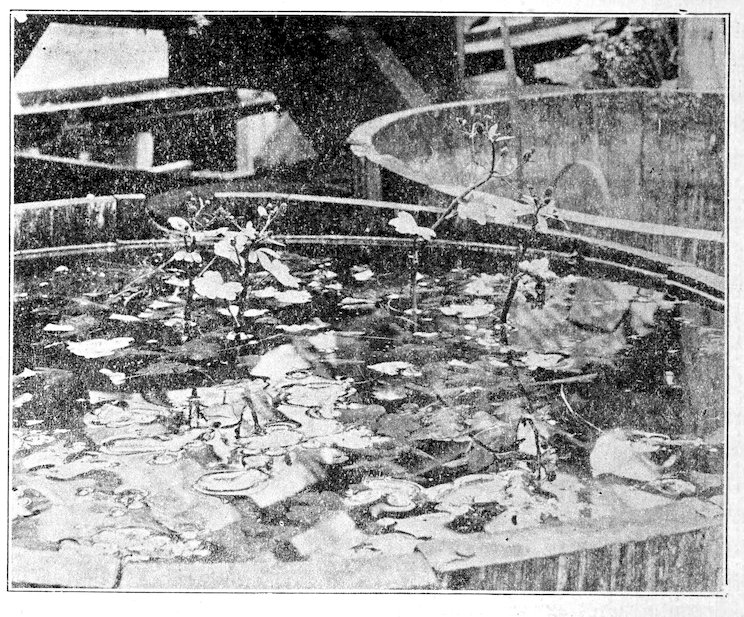
Fig. 83. Simple culture of floating ecads of Ranunculus sceleratus.
361. Competition cultures. Although it is quite possible to carry on experiments in invasion and succession in the planthouse, the limited space usually available makes this undesirable, except in a few problems where control is necessary. Competition cultures, on the other hand, yield better results in the planthouse than in the field, since the physical factors and the appearance of unwelcome migrants are much more easily controlled. The possibilities of the culture method in the study of competition seem inexhaustible, and the author has found it necessary to confine his own investigations to a few of the fundamental problems. In this work, he has distinguished several kinds of cultures, based chiefly upon the species concerned and the arrangement of the individuals. Simple cultures are those in which a single species is used. The resulting group is a family, and the competition is between like individuals. In such cultures, the problem of the factors in competition is reduced to its simplest terms. Mixed cultures are based upon two or more species, and the problem is correspondingly complicated. As a rule, all the seeds have been sown at the same time in both simple and mixed cultures, but it has been found desirable to make some heterochronous cultures, in which seeds are also sown after the plants have appeared. Mixed cultures are distinguished as layered cultures, when 311the species are of very different height. Thus, rosettes have been grown with stemmed plants, tall slender forms with low branching ones, erect plants with twining and climbing plants, etc. Further evidence as to the nature of competition has been sought by means of ecad cultures, and factor cultures. In the former, plants of different response to water and light are grown together under the same conditions, in order to evaluate the part played by the nature of the plant. In a factor culture, the area is divided into two or more parts which are given different amounts of water or of light, in order to determine the influence of slight variations upon the same competitors. In somewhat similar fashion, an attempt has been made to ascertain the bearing of biotic factors upon competition. Cultures are easily made in which Cuscuta or parasitic fungi are used to place certain species at a disadvantage. Permanent cultures are obtained by allowing the plants to ripen and drop their seeds for several generations, just as in nature. They are indispensable for determining the final outcome of the competition between different species.
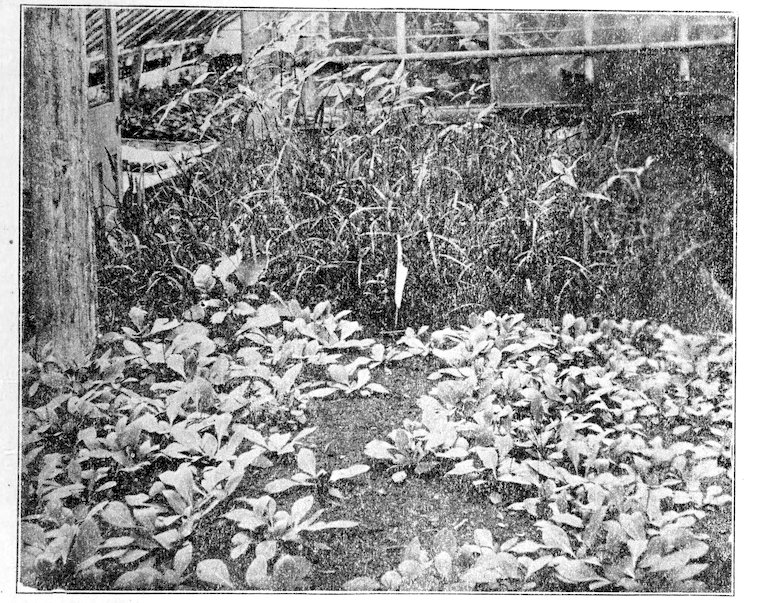
Fig. 84. Mixed culture of Solidago rigida and Onagra biennis.
362. Details of culture methods. All competition cultures have been made 1 meter square. In other words, they are quadrats, and they are treated exactly as denuded quadrats in the field with respect to factor readings, charts, and photographs. In the writer’s studies, germination 312tests were made of a large number of species, and those selected which showed a high per cent of germinability. Since this was the first experimental study of competition, this test was deemed necessary, but it is quite evident that no such selection is made in nature. Consequently, when the seeds used are known to be fresh, a germination test is usually superfluous. Considerable care was taken also to select species known to be vigorous growers, with the result that practically all the species used for experiment were ruderal or subruderal. The species employed, and the kinds of cultures in which they were grouped were as follows:
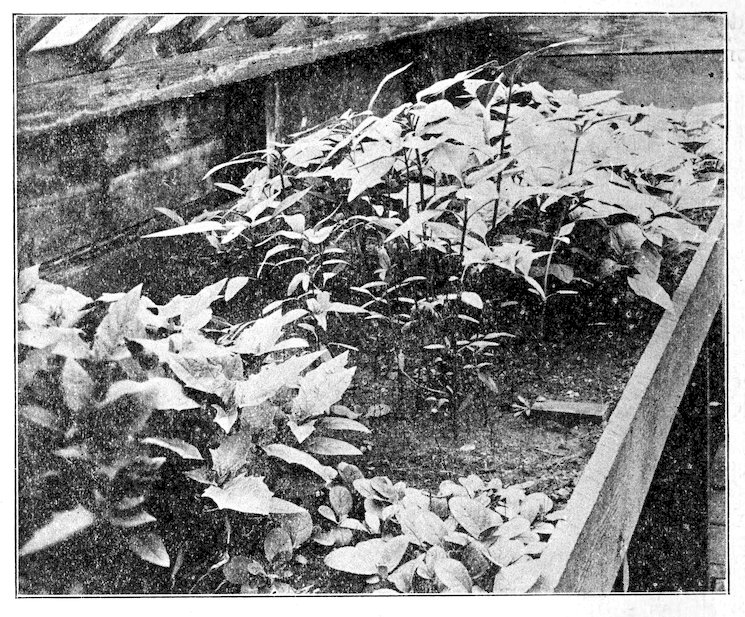
Fig. 85. Heterochronous culture of Helianthus annuus and Datura stramonium. Family culture of Datura, Verbascum, etc., in the foreground.
1. Simple culture of Helianthus annuus. The culture plot was divided into four equal parts; 12 seeds were planted in one, 25 in another, 50 in the third, and 100 in the fourth.
2. Mixed culture of Helianthus annuus, Panicum virgatum, and Elymus canadensis. Twenty-five seeds each of Helianthus and Panicum were planted alternately at equal distances in one-half of the plot, while the other half was planted similarly with Helianthus and Elymus.
3. Mixed culture of Solidago rigida and Onagra biennis. Over one-half of the plot were scattered 50 seeds of Solidago and 100 of Onagra; over the other, 100 and 200 seeds respectively.
3134. Layered culture of Laciniaria punctata, Bidens frondosa, Salvia pitcheri, Cassia chamaecrista and Kuhnia glutinosa. Fifty seeds of each species were scattered more or less uniformly over the entire plot.
5. Layered culture of Silphium laciniatum, Datura stramonium and Lactuca ludoviciana. Fifty seeds of Datura and Lactuca, and 25 of Silphium were sown uniformly in one-half of the plot. In the other half, 25 holes were made at equal intervals, and one seed of each of the three planted in each hole.
6. Ecad culture of Oenothera rhombipetala (xerophytic), Verbascum thapsus (mesophytic), and Penthorum sedoides (hydrophytic). One hundred seeds of Oenothera and 200 each of Verbascum and Penthorum were scattered over the plot.
7. Heterochronous culture of Helianthus annuus and Datura stramonium. One hundred seeds of Helianthus were scattered over one half, and the same number of Datura seeds over the other half of the plot. In both, also, 50 seeds were sown in one 4–inch circle, and 25 seeds in a second circle at some distance. A month later, 100 seeds of Helianthus were sown in the Datura plot, and vice versa.
8. Family culture of Helianthus, Kuhnia, Panicum, Bidens, Onagra, Datura, Penthorum, Solidago and Verbascum. The plot was divided into 9 squares and in each were sown 50 seeds of one of these plants.
9. Community culture. The sowing was made exactly as for the family culture, except that 20 seeds of each plant were used. In the middle of each square, 5 seeds of a different species were planted. For the Helianthus, Kuhnia, and Panicum groups, Onagra was used; for Bidens, Onagra, and Datura, Helianthus was used, and for Penthorum, Solidago, and Verbascum, Panicum.
At the time the cultures were started, check plants were sown in pots. The most vigorous seedlings were transplanted singly to large pots, and grown under conditions of water, light, and soil as similar as possible to those of the competition plots. Photographs of check plants and plots were made at the proper intervals, and the plots were charted in quadrats to show the course of competition. The factors which control competition were sought in a critical study of water-content and light values, which is still in process. This work has gone far enough to indicate the correctness of the view[45] that competition is purely physical in character. It has, moreover, been demonstrated that “room” in competition is merely a loose expression for the relation between the number of individuals in a given space, and the amount of water, light, and temperature available in the same space.
314