Chapter IV · THE PLANT FORMATION Methods of Investigation and Record (continued 2)
Reading edition
249. Functions and structures. The functions of a formation are association, invasion, and succession: the second may be resolved into migration and ecesis, and the third, perhaps, into reaction and competition. Formational structures comprise zones, layers, consocies, societies, etc., all of which may be referred to zonation, or to alternation. The term association 200has been used in both an active and a passive sense. In the former, it applies to the inevitable grouping together of plants, by means of reproduction and immobility. Passively, it refers to the actual groupings which result in this way, and in this sense it is practically synonymous with vegetation. Invasion is the function of movement, and of occupying or taking possession; with association, it constitutes the two fundamental activities of vegetation. It is the essential part of succession, but the latter is so distinctive, because of the intimate relation of competition and reaction, that clearness is gained by treating it as a separate function which is especially concerned with development. Association, zonation, and alternation are structural phenomena, which are in large part the immediate product of habitat and function, and in a considerable degree, also, the result of ancestral or historical facts. It is a difficult matter to determine in what measure the last factor enters, but it is one that must always be taken into account, particularly when the physical factors of the habitat are inadequate to explain the structures observed. Structurally, association regularly includes both zonation and alternation. As there are certain typical instances in which it exhibits neither, the treatment will be clearer if each is considered separately.
ASSOCIATION
250. Concept. The principle of association is the fundamental law of vegetation. Indeed, association is vegetation, for the individual passes into vegetation, strictly speaking, at the moment when other individuals of the same kind or of different kinds become grouped with it. It is then (and the same statement necessarily holds for vegetation) the coming together and the staying together of individuals and, ultimately, of species. A concrete instance will illustrate this fact. In the development of the blowout formation of the Nebraska sand-hills (Redfieldia-Muhlenbergia-anemium), association begins only when the first plant of Redfieldia flexuosa is joined by other plants that have sprung from it, or have wandered in over the margin of the blowout. Henceforth, whatever changes the blowout formation may undergo, association is a settled characteristic of it until some new and overwhelming physical catastrophe shall destroy the associated individuals. It will readily be seen that association does not depend upon particular individuals, for these pass and others take their place, but that it does depend essentially upon number of individuals.
Association involves the idea of the relation of plants to the soil, as well as that of plants to each other. It is synonymous with vegetation only when the two relations are represented, since there may be association such 201as that of a parasite with its host, which does not constitute vegetation. But it will be seen that the relation of the parasite to the host is practically identical with the relation of the plant to the soil or stratum, and the two concepts mentioned above become merged in such a case. From this it follows that association results in vegetation only when the two ideas are distinct. The concept of association contains a fact that is everywhere significant of vegetation, namely, the likeness or unlikeness of the individuals which are associated. In the case of parasite and host, this unlikeness is marked; in vegetation, all degrees of similarity obtain. As will be evident when the causes which lead to association are considered, alternate similarity and dissimilarity of the constituent individuals or species is subordinate as a feature of vegetation only to the primary fact of association.
Since association contains two distinct, though related, ideas, it is of necessity ambiguous. It is very desirable that this be avoided, in order that each concept may be clearly delimited. For this reason, the act or process of grouping individuals is termed aggregation, while the word association is restricted to the condition or state of being grouped together. In a word, aggregation is functional, association is structural; the one is the result of the other. This distinction makes clear the difference between association in the active and passive sense, and falls in with the need of keeping function and structure in the foreground.
251. Causes. In considering the causes which produce association, it is necessary to call in evidence the primary facts of the process in concrete examples of this principle. These facts are so bound up in the nature of vegetal organisms that they are the veriest axioms. Reproduction gives rise immediately to potential, and ultimately, in the great majority of cases, to actual association. The degree and permanence of the association are then determined by the immobility of the individuals as expressed in terms of attachment to each other or to the stratum, such as sheath, thallus, haustoria, holdfasts, rhizoids, roots, etc. The range of immobility is very great. In terrestrial plants, mobility is confined almost entirely to the period when the individual lies dormant in the seed, spore, or propagative part, which is alone mobile. In aquatic spermatophytes, the same is true of all attached forms, while free floating plants such as Lemna are mobile in a high degree, especially during the vegetative period. Among the algae and hydrophilous fungi, attached forms are mobile only in the spore or propagative condition, while the motile forms of the plancton typify the extreme development of mobility. The immediate result of reproduction in an immobile species is to produce association of like individuals, while in the case of a mobile species reproduction may or may not lead immediately 202to association. We may lay down the general principle that immobility tends to maintain the association of the individuals of the same generation, i. e., the association of like forms, while mobility tends to separate the similar individuals of one generation and to bring unlike forms together. With the mobile algae, separation of the members of each generation is the rule, unless the individuals come to be associated in a thallus, or are grouped in contact with the substratum. Flowering plants that are relatively immobile, especially in the seed state, drop their seeds beneath and about the parent plants, and in consequence dense association of the new plants is the rule. In very many cases, however, this primitive tendency is largely or completely negatived by the presence of special dissemination contrivances, which are nearly, if not quite, as effective for many terrestrial plants as the free floating habit is for algae. From this point, the whole question of mobility belongs to migration, just as the adjustment between the parent plants and their offspring, or between plants established and the mobile plants to be established, belongs to competition.
If association were determined by reproduction and immobility alone, it would exhibit areas dissimilar in the mass of individuals, as well as areas dissimilar in the kinds of individuals. Some areas would be occupied by plants of a single species, others by plants of several or many species. This tendency of association to show differences is, however, greatly emphasized by the fact that vegetation is fundamentally attached to and dependent upon a surface that exhibits the most extreme physical differences. For this reason, new differences in association appear, due not only to the morphological differentiation of vegetation forms, but also to the changes in the degree and manner of association produced directly by the different habitats. Association might then be defined as a grouping together of plant individuals, of parents and progeny, which is initiated by reproduction and immobility, and determined by environment. It is a resultant of differences and similarities. In consequence, association in its largest expression, vegetation, is essentially heterogeneous, while in those areas which possess physical or biological definiteness, habitats and vegetation centers, it is relatively homogeneous. This fundamental peculiarity has given us the concept of the formation, an area of vegetation, or a particular association, which is homogeneous within itself, and at the same time essentially different from contiguous areas, though falling into a phylogenetic series with some and a biological series with others. From its nature, the plant formation is to be considered the logical unit of vegetation, though it is not, of course, the simplest example of association.
203252. Aggregation. As indicated under the causes of association, the process by which groups of individuals are formed depends entirely upon reproduction and migration. In short, aggregation is merely a corollary of movement. The simplest example of this process occurs in forms like Gloeocapsa, Tetraspora, and others, where the plants resulting from fission are held together by means of a sheath. Though called a colony, such a group of individuals is a family in the ordinary sense. Practically the same grouping results in the case of terrestrial plants, especially spermatophytes, when the seeds of a plant mature and fall to the ground about it. The relation in both instances is essentially that of parent and offspring, although the parent soon disappears in the case of annuals, while among the algae its existence is regularly terminated by fission. The size and the density of the family group are determined by the number of seeds produced, and by their mobility. These are further affected by the height and branching of the plant, and by the position of the seeds upon it. The disseminules of immobile species fall directly beneath the parent, and the resulting group is both uniform and definite. A similar arrangement is caused likewise by offshoots. An increase in mobility brings about a decrease of aggregation, since the disseminules are carried away from the parent plant. Perfectly mobile forms rarely produce family groups for this reason. It is evident, however, that mobile perennials sometimes arrange themselves in similar fashion in consequence of propagation by underground parts. Consequently, it is possible to state the law of single aggregation, viz., that immobility promotes the grouping of parent and offspring, and mobility hinders it.
If all species were immobile, the family group would be characteristic of vegetation. Since the great majority are more or less mobile, aggregates of this sort are the exception rather than the rule. Mobility not only decreases the number of offspring in the family group, but it also spreads disseminules broadcast to enter dissimilar groups. It leads directly to mixed aggregation, by which individuals of one or more species invade the family group. Once established, the newcomers tend also to produce simple groups, thus causing an arrangement corresponding essentially to a community. Such collections of family groups are extremely variable in size and definition. This arises in part from the nature of simple aggregation, and in part from the varying mobility of different species. Mobility alone often produces similar communities by bringing together the disseminules of different plants, each of which then becomes the center of a mixed group. In the case of permobile species, several disseminules of each may be brought together. The resulting area, though larger, is practically the same. At present, it is difficult to formulate the law for this method of grouping. It may be stated provisionally as follows: mixed aggregation is the direct result of mobility, and the greater the mobility the more heterogeneous the mixture.
204The constitution of all the major areas of a formation is to be explained upon the basis of aggregation by the two methods described. The relative importance of family groups and communities differs for every formation, and the exact procedure in each can be obtained only by the detailed study of quadrats. The problem is further complicated by competition and reaction, particularly in closed vegetation. For this reason, aggregation can be studied most satisfactorily in a new or denuded area, where these processes are not yet in evidence.
Kinds of Association
253. Categories. In the analysis of association, it must be kept clearly in mind that the concrete examples from which all generalizations must be drawn are often in very different stages of development, and are of correspondingly different ages. For this reason it has seemed best to consider the primary relations of association in general in this place, leaving the treatment of the effects of invasion, succession, alternation, and zonation to be taken up under these topics.
Various categories of association may be distinguished, according to the dominant physical factor concerned or the point of view taken. These will fall into two series, as we consider the relation of plant to plant with reference to some object or characteristic, or the grouping of plants together in response to some dominant factor. In the first series may be placed association with reference to substratum, to the ground (occupation), and to invasion; in the second belong light and water-content association. It should be noted that these are all actual associations in nature, and not concepts such as the vegetation form, within which plants from widely different associations may be classified. Naturally, it does not follow that it is not logical or valuable to group together those plants, such as hydrophytes, sciophytes, hysterophytes, etc., which have a common relation to some factor, but belong to different formations.
254. Stratum association. Plants manifest independent or dependent association with reference to the stratum to which they are attached and from which they derive food or support. Independent association is exhibited by those holophytic species of a formation which are entirely independent of each other with respect to mechanical support or nutrition. It is characteristic of the greater number of the constituent species of formations. Dependent association is manifested in the relation between host and parasite, stratum and epiphyte, support and liane. Warming[24] has distinguished six 205kinds of associations: parasitism, helotism, mutualism, epiphytism, lianism, and commensalism. Commensalism corresponds to the primary principle of association which has given rise to vegetation. Homogeneous commensalism is the term applied to social exclusive plants, in which the patch is composed of a single species. Such association is extremely rare in nature, and if the most minute forms be considered, probably never occurs. On the other hand, heterogeneous commensalism, in which individuals of more than one species are present, is everywhere typical of vegetation. Warming regards saprophytism merely as a specialized kind of parasitism, an opinion that may well be defended. Helotism, however, is also a mere modification of parasitism, if it is not indeed parasitism pure and simple. Mutualism is an altogether vague concept, including parasites, epiphytes, and endophytes of doubtful physiological relation. Pound and Clements[25] treated lianes, parasites, and saprophytes as vegetation forms, relating herbaceous creepers and twiners to the lianes, and dividing the fungi and lichens into nine groups. Whatever the value of these divisions may be from the standpoint of vegetation forms, they represent the same relation between plant and nutritive stratum, and with respect to association should be merged in one group. Schimper[26] was the first to perceive the essential similarity of all such groups from the standpoint of association. He terms these plant societies (Genossenschaften), retaining the four groups already established, lianae, epiphyta, saprophyta, and parasiticae. It is evident that dependent association comprises extremely divergent forms, from the slightly clinging herb, such as Galium, to the most intense parasite. The distinction, however, is a clear one, if restricted to that relation between plants in which one acts as a mechanical support or stratum or as a nutritive host for the other.
255. Ground association. The first division of formations into open and closed was made by Engler and Drude.[27] Open formations were defined as those having incomplete stability and heterogeneous composition, while closed formations have a more definite uniform stamp. What is true of formations is equally true of vegetation, so that association may be regarded as open or closed with reference to the density and thoroughness with which the plants occupy the ground. In open association, the ground is slightly or partially occupied, readily permitting the entrance of new plants without the displacement of those already present. Such an arrangement is characteristic of the early stages of a formation, or of a succession of formations. It produces unstable open formations, which arise, usually 206after denudation, in sand-hills, blowouts, gravel slides, dunes, flood plains, burned areas, etc. In closed association, occupation of the ground is complete, and the invasion of new species can occur only through displacement. Closed association results in stable, closed formations, such as forest, thicket, meadow, and prairie. As open association characterizes the early stages of a succession of formations, so closed association is peculiar to the later or last stages of all such successions. In short, open formations represent certain phases of the development of vegetation, while closed formations correspond to the relatively final structural conditions. It is a fundamental principle of association that every succession from denudation, or from newly formed soils, begins with open formations and ends with a closed formation. The causes leading up to open and closed association are intimately connected with development, and hence are considered under invasion and succession.
256. Species guild association. Drude has distinguished a kind of association peculiar to invasion, in which there is a successive or concomitant movement of certain species of a formation into another formation or region, resulting in species guilds (Artengenossenschaften). The association in this case is largely one of community of origin or area, and of concomitant migration. It is especially characteristic of areas adjacent to formational and regional limits. Fundamentally, it is merely the grouping of plants which are invading at the same time, and consequently it differs only in degree from what occurs in every invasion where more than a single individual is concerned. Accordingly, this type of association has little more than historical interest. This must not be construed to mean that it does not occur, but that it differs in no essential from the ordinary grouping of invaders.
257. Light association. The constituent species of formations show two fundamentally different groupings with respect to light. In the one case, the individuals are on the same level, or nearly so, in such a way that each has direct access to sunlight. Such an arrangement is characteristic of most grassland and herbaceous formations. In the case of desert formations, there is often considerable difference in the height of the plants, but the distance between them is so great as to admit of direct illumination of all. This arrangement may be termed coordinate association. In forests, thickets, and many herbaceous wastes, the height and density of certain species enable them to dominate the formation. In a dense forest, the trees receive practically all the light incident upon the formation, and the shrubs, herbs, fungi, and algae of lower habit and inferior position must adapt themselves to the diffuse light which passes through or between the leaves. The same 207is equally true of dense thickets and wastes, except that the vertical distance is less, and the diffuseness of the light is correspondingly modified. In these formations, the dominant trees, shrubs, or herbs, the facies, constitute a primary or superior layer. The degree of subordinate association, as a result of which inferior layers will arise, is entirely determined by the density of the facies. In open woodlands, which are really mixed formations of woodland and grassland, the intervals, and usually the spaces beneath the trees also, are covered with poophytes, showing an absence of subordination due to light. This is the prevailing condition in the pine formation (Pinus ponderosa-xerohylium) of the ridges and foot-hills of western Nebraska. When, however, the trees stand sufficiently close that their shadows meet or overlap throughout the day, the increasing diffuseness begins to cause modification and rearrangement of the individuals. By photometric methods, the light in a forest is found to be least diffuse just below the facies, while the diffuseness increases markedly in passing to the ground. The taller, stronger individuals are consequently in a position to assimilate more vigorously, and to become still taller and stronger as a result. Just as these have taken up a position inferior to that of the facies, so the shorter or weaker species must come to occupy a still more subordinate position. This results, not only because the light is primarily weaker nearer the ground, but also because the taller plants interpose as a second screen. The complete working out of this arrangement with reference to light produces typical subordinate association, which finds its characteristic expression in the layering of forests and thickets. Layers tend to appear as soon as open woodland or thicket begins to pass into denser conditions, and up to a certain point, at which they disappear, they become the more numerous and the more marked, the denser the forest.
In the Otowanie woods near Lincoln (Quercus-Hicoria-hylium), layering usually begins at a light value of .1 (1 = normal sunshine in the open). Thornber[28] has found the same value to obtain in the thickets of the Missouri bluffs. In these, again, layers disappear at a value of .005, the extreme diffuseness making assimilation impossible except for occasional mosses and algae. A number of herbaceous plants are present in the spring, but these are all prevernal or vernal bloomers, which are safely past flowering before shade conditions become extreme. In the Fraxinus-Catalpa-alsium, all inferior holophytic vegetation disappears between the light value of .004 and that of .003. The spruce-pine formation (Picea-Pinus-hylium) of the Rocky mountains, with a light value of .01, usually contains but a few scattered herbs, mostly evergreen; in some cases there are no subordinate plants 208other than mosses and hysterophytes. The lodge-pole pine formation (Pinus murrayana-hylium), with light values often less than .005, is nearly or quite destitute of all but hysterophytic undergrowth. Such extremely dense formations are examples of coordinate association merely, since the formation is reduced to a single superior layer, in which the individuals of the facies bear the same spatial relation to incident light. In layered formations, in addition to the subordinate relation of other species to the facies, there is, of course, a kind of coordinate association manifested in each layer.
258. Water-content association. Schouw[29] was the first to give definite expression to the value of the water-content of the soil for the grouping of plants. He established four groups: (1) water plants, (2) swamp plants, (3) plants of moist meadows, (4) plants of dry soils. The first he termed hydrophytes, introducing the term halophytes to include all saline plants. Thurmann[30] recognized the fundamental influence of water-content upon association, and further perceived that the amount of water present was determined primarily by the physical nature of the soil. He distinguished plants which grow in soils that retain water as hygrophilous, and those found upon soils that lose water readily as xerophilous. Those which seemed to grow indifferently upon either were termed ubiquitous. The latter correspond in some measure to mesophytes, but they are really plants possessing a considerable range of adaptability, and do not properly constitute a natural group. Warming[31] proposed the term mesophytes to include all the plants intermediate between hydrophytes and xerophytes. He recognized the paramount value of water-content association as the basis of ecology, and upon this made a logical and systematic treatise out of the scattered results of many workers. Schimper[32] placed the study of vegetation upon a new basis by drawing a distinction between physical and physiological water-content, and by pointing out that the last alone is to be taken into account in the study of plant life, and hence of plant geography. Accepting the easily demonstrable fact that an excess of salts in the soil water, as well as cold, tends greatly to diminish the available water of the soil, i. e., the chresard, it is at once seen why saline and arctic plants are as truly xerophytic as those that grow on rocks or in desert sands. An anomalous case which, however, physical factor records have explained fully, is presented by many plants growing in alpine gravel slides, strands, blowouts, sandbars, etc., in which the water-content is considerable, but the water loss excessive, on account 209of extreme heat or reduced air pressure. The effect of these conditions is to produce a plant xerophytic as to its aerial parts, and mesophytic or even hydrophytic as to subterranean parts. Such plants may, from their twofold nature, be termed dissophytes; they are especially characteristic of dysgeogenous soils in alpine regions where transpiration reaches a maximum, but are doubtless to be found in all gravel and sand habitats with high water-content. With these corrections, the concept of water-content association, which owes much to both Warming and Schimper, but is largely to be credited to Thurmann, becomes completely and fundamentally applicable to all vegetation.
Up to the present time, the general character of the habitat, together with the gross appearance of the plant itself, has been thought sufficient to determine the proper position of a plant or a formation in the water-content classification. Such a method is adequate, however, only for plants and formations which bear a distinct impress. For an accurate classification into the three categories, hydrophytes, mesophytes, and xerophytes, it is necessary to make exact determinations of the normal holard and chresard of the habitat, and to supplement this, in some degree at least, by histological studies. Except in the case of saline, acid, and frozen soils, the holard alone will be a fairly accurate index, especially in habitats of similar soil composition. For an exact and comprehensive classification, however, and particularly in comparative work, the chresard must constitute the sole criterion. As the latter has been ascertained for very few formations, and in Nebraska and Colorado alone, the present characterization of many plants and formations as hydrophytic, mesophytic, or xerophytic must be regarded as largely tentative, and the final classification will be possible only after the thorough quantitative investigation of their habitats.
The water-content groups, hydrophytia, mesophytia, and xerophytia, include all formations found upon the globe. The exactness with which this classification applies to vegetation is made somewhat more evident by dividing mesophytia into forest and grassland. This is based primarily upon light association, but it also reflects water-content differences in a large degree. The groups thus constituted represent the fundamental zonation of the vegetative covering with respect to water-content. Ocean, forest, grassland, and desert correspond exactly to hydrophytia, hylophytia, poophytia, and xerophytia. The difference is merely one of terminology: the first series takes into account the physiognomy of the vegetation itself, while the other emphasizes the causative factors.
210
THE DEVELOPMENT OF THE FORMATION
259. A strict account of development should trace the results of the various activities of vegetation in their proper sequence. This is aggregation, migration, ecesis, reaction, and competition. These functions are so intimately and often so inextricably associated that it is hardly feasible to discuss development by treating each one separately. In consequence, the two fundamental phenomena, invasion and succession, which they produce, are taken as the basis of the discussion. These, moreover, are different only in degree; succession is merely complete, periodic invasion. Nevertheless, the subject gains in clearness by a separate treatment of each.
INVASION
260. By invasion is understood the movement of plants from an area of a certain character into one of a different character, and their colonization in the latter. This movement may concern an individual, a species, or a group of species. From the nature of invasion, which contains the double idea of going into and taking possession of, it usually operates between contiguous formations, but it also takes place between formational zones and patches. More rarely and less noticeably, there may be invasion into a remote vegetation, as a result of long carriage by wind, water, birds, railroads, or vessels. Movement or migration, however, represents but one of the two ideas involved in invasion. Migration merely carries the spore, seed, or propagule into the area to be invaded. In ecesis, the spores or seeds germinate and grow, after more or less adjustment, and in case the latter becomes sufficiently complete, the new plants reproduce and finally become established. With all terrestrial plants, invasion is possible only when migration is followed by ecesis, because of the inherent differences of formations or of areas of the same formation. In the case of surface floating forms, such as Lemnaceae, and of the plancton, ecesis is of much less importance, on account of the uniformity of the medium and the lack of attachment, and migration is often practically synonymous with invasion.
MIGRATION
261. Migration has been sometimes used loosely as a synonym for invasion, but it is here employed in its proper sense of removal or departure, i. e., movement, and is contrasted with ecesis, the making of a home, the two ideas being combined in invasion, which is a moving into and a taking possession of. An analysis of migration reveals the presence of four factors, mobility, agency, proximity, and topography. Not all of these are present 211in every instance of migration, as for example in the simple elongation of a rootstalk, but in the great majority of cases each plays its proper part. Mobility represents the inherent capacity of a plant for migration, and in its highest expression, motility, is in itself productive of movement. As a general rule, however, modifications for securing mobility are ineffective in the absence of proper agents, and the effective operation of the two will be profoundly influenced by distance and topography.
262. Mobility denotes potentiality of migration as represented by modifications for this purpose. It corresponds, in a sense, to dissemination, though seed production also enters into it. Its most perfect expression is found in those plants which are themselves motile, Bacteriaceae, Oscillatoria, Volvocaceae, and Bacillariaceae, or possess motile propagules, such as most Phycophyta. On the other hand, it is entirely undeveloped in many plants with heavy unspecialized seeds and fruits. Between these two extremes lie by far the greater number of plants, exhibiting the most various degrees of mobility, from the motile though almost immobile offshoots of many Liliaceae to the immotile but very mobile spores of fungi. It is thus seen that motility plays a relatively small part in migration, being practically absent in terrestrial forms, and that it bears a very uncertain relation to mobility. In analyzing the latter, contrivances for dissemination are seen to determine primarily the degree of mobility, while the number of seeds produced will have an important effect in increasing or decreasing it. A third factor of considerable importance is also involved, namely, position with reference to the distributive agent, but any exact knowledge of its importance must await systematic experiment somewhat after the methods of Dingler, but with air-currents, etc., of known velocity and direction. The time is not distant when by such methods it will be possible to establish a coefficient of mobility, derived from terms of position, weight, resistant surface, and trajectory for definite wind velocities or for particular propulsive mechanisms.
263. Organs for dissemination. Plants exhibit considerable diversity with reference to the part or organ modified, or at least utilized, for dissemination. This modification, though usually affecting the particular product of reproduction, may, in fact, operate on any part of the plant, and in certain cases upon the entire plant itself. In the majority of plants characterized by alternation of generations, the same individual may be disseminated in one generation by a reproductive body, and in the other by a propagative one, as is the case in the oogones and conidia of Peronospora, the spores and gemmae of Marchantia, the fruits and runners of Fragaria, etc. Special modifications have, as a rule, been developed in direct connection with spores 212and seeds, and mobility reaches its highest expression in these. It is, on the other hand, greatly restricted in offshoots and plant bodies, at least in terrestrial forms, though it will now and then attain a marked development in these, as shown by the rosettes of Sempervivum and the tumbling plants of Cycloloma. For the sake of convenience, in analyzing migration, all plants may be arranged in the following groups with reference to the organ or part distributed.
1. Spore-distributed, sporostrotes. This includes all plants possessing structures which go by the name of spore, such as the acinetes of Nostoc and Protococcus, the zoogonidia of Ulothrix, Ectocarpus, etc., the conidia, ascospores, and basidiospores of fungi, the tetraspores of red seaweeds, and the gemmae and spores proper of liverworts, mosses, and ferns. These are almost always without especial contrivances for dissemination, but their extreme minuteness results in great mobility.
2. Seed-distributed, spermatostrotes. This group comprises all flowering plants in which the seed is the part modified or at least disseminated. The mobility of seeds is relatively small, except in the case of minute, winged or comate seeds.
3. Fruit-distributed, carpostrotes. The modifications of the fruit for distribution exceed in number and variety all other modifications of this sort. All achenes, perigynia, utricles, etc., properly belong here.
4. Offshoot-distributed, thallostrotes. To this class are referred those plants, almost exclusively cormophytes, which produce lateral, branch-like propagules, such as root-sprouts, rhizomes, runners, stolons, rosettes, etc. Migration with such plants is extremely slow, but correspondingly effective, since it is almost invariably followed by ecesis.
5. Plant-distributed, phytostrotes. This group includes all plancton and surface forms, whether motile or non-motile, and those terrestrial plants in which the whole plant, or at least the aerial part, is distributed, as in tumbleweeds and in many grasses.
264. Contrivances for dissemination. Any investigation of migration to be exact must confine itself to fixed forms. For these the degree of perfection shown by dissemination contrivances corresponds almost exactly to the degree of mobility. Because of the difficulty of ascertaining the effect of ecesis, it is impossible to determine the actual effectiveness in nature of different modifications, and the best that can be done at present is to regard mobility, together with the occurrence and forcefulness of distributive agents, as an approximate measure of migration. The general accuracy of such a measure will be more or less evident from the following. Of 118 species common to the foot-hill and sand-hill regions of Nebraska, regions which are 213sufficiently diverse to indicate that these common species must have entered either one by migration from the other, 83 exhibit modifications for dissemination, while 8 others, though without special contrivances, are readily distributed by water, and 4 more are mobile because of minuteness of spore or seed. Some degree of mobility is present in 73 per cent of the species common to these regions, while of the total number of species in which the mode of migration is evident, viz., 95, 66 per cent are wind-distributed, 20 per cent animal-distributed, and 14 per cent are water-distributed. It need hardly be noted that this accords fully with the prevalence and forcefulness of winds in these regions. Of the species peculiar to the foot-hill region, many are doubtless indigenous, though a majority have come from the montane regions to the westward. The number of mobile species is 121, or 60 per cent of the entire number, while the number of wind-distributed ones is 85, or 70 per cent of those that are mobile. Among the 25 species found in the widely separated wooded bluff and foot-hill regions, 2 only, Amorpha nana and Roripa nasturtium, are relatively immobile, but the minute seeds of the latter, however, are readily distributed, and the former is altogether infrequent.
The following groups of plants may be distinguished according to the character of the contrivance by which dissemination is secured:
1. Saccate, saccospores. Here are to be placed a variety of fruits, all of which agree, however, in having a membranous envelope or an impervious, air-containing pericarp. In Ostrya, Physalis, Staphylea, the modification is for wind-distribution, while in Carex, Nymphaea, etc., it is for water-transport.
2. Winged, pterospores. This group includes all winged, margined, and flattened fruits and seeds, such as are found in Acer, Betula, Rumex, many Umbelliferae, Graminaceae, etc.
3. Comate, comospores. To this group belong those fruits and seeds with long silky hairs, Gossypium, Anemone, Asclepias, etc., and those with straight capillary hairs or bristles not confined to one end, Typha, Salix, etc.
4. Parachute, petasospores. The highly developed members of this group, Taraxacum, Lactuca, and other Liguliflorae are connected through Senecio and Eriophorum with the preceding. These represent the highest development of mobility attained by special modification.
5. Chaffy-pappose, carphospores. In this group are placed those achenes with a more or less scaly or chaffy pappus with slight mobility, as in Rudbeckia, Brauneria, Helianthus, etc.
6. Plumed, lophospores. In the fruits of this class, the style is the part usually modified into a long plumose organ, possessing a high degree of mobility, as in Pulsatilla, Sieversia, and Clematis.
2147. Awned, ascospores. These are almost exclusively grasses, in which the awns serve for distribution by wind, water, or animals, and even, according to Kerner, by hygroscopic creeping movements. The mobility in many cases is great.
8. Spiny, centrospores. This group contains a few representatives which possess a moderate degree of mobility by attachment, as in Tribulus and Cenchrus.
9. Hooked, oncospores. The members of this group are extremely numerous, and the degree of mobility as a rule is very high. All exhibit in common the development of hooks or barbs, by which they are disseminated in consequence of attachment, though the number, size, and disposition of the hooks vary exceedingly.
10. Viscid, gloeospores. In these, the inflorescence is more or less covered with a viscid substance, as in species of Silene, or the fruit is beset with glandular hairs, as in Cerastium, Salvia, etc.
11. Fleshy, sarcospores. These are intended for dissemination by deglutition, largely by birds; the effectiveness of the modification depends in a large degree upon the resistance of the seed envelope to digestion. The mobility varies greatly, but the area over which migration may be effected is large.
12. Nut-fruited, creatospores. This group includes those plants with nut fruits which are carried away and secreted by animals for food.
13. Flagellate, mastigospores. These are plants with ciliate or flagellate propagative cells, i. e., zoogonidia, as in Protococcus, Ulothrix, Oedogonium, Ectocarpus, etc., or with plant bodies similarly motile, Bacteriaceae and Volvocaceae.
265. Position of disseminule. The position on the plant of the organ to be disseminated, i. e., its exposure to the distributing agent, plays a considerable part in determining the degree of mobility. In the majority of plants, the position of the inflorescence itself results in maximum exposure, but in a large number of forms special modifications have been developed for placing the spores or seeds in a more favorable position. In both cases, there are often present also devices for bringing about the abscission of the seed or fruit. It is, moreover, self-evident that the height of the inflorescence above ground or above the surrounding vegetation is likewise of considerable importance in increasing the trajectory. It is yet too early to make a complete classification of contrivances for placing disseminules in the most favorable exposure, but the following will serve as a basis for future arrangements.
1. In all operculate Discomycetes, and especially in the Ascobolaceae, where the asci project above the hymenium, the spores are raised above the 215surface by tensions within the apothecium. This might be regarded as dissemination by expulsion, if it were not for the fact that the spores fall back into the cup, unless carried away by the wind.
2. In Gasteromycetes and in certain Hepaticae, the spores are not only elevated slightly above the sporophore by the expanding capillitium or by the mass of elaters, but they are also held apart in such a way that the wind blows them out much more readily.
3. In Bryophyta, the sporophore regularly dehisces by a slit, or is provided with a peristome. Both structures are for the purpose of sifting the spores out into the wind; by reason of their hygroscopicity, they also insure that the spores will not be shaken out in wet weather.
4. In a few grasses, such as Stipa and Aristida, the twisting and intertwining of the awns lift the floret out of the glumes, and at the same time constitute a contrivance readily blown away by the wind or carried by attachment.
5. In certain Compositae, the involucral scales are reflexed at maturity, and at the same time the disk becomes more or less convex, serving to loosen the achenes. This result is also secured in certain species by the drying and spreading of the pappus hairs.
6. The scapose Liguliflorae, Taraxacum, Agoseris, etc., are characterized by the elongation of the scape after anthesis, with the result that the head is raised to a considerable height by the time the achenes are mature.
7. Carpotropic movements, though primarily for another purpose, often serve to bring seeds and fruits into a better position for dissemination.
266. Seed production. The relation of spore or seed-production to mobility is obvious in the case of mobile species; in the case of immobile ones, it is just as evident that it has no effect, though it may still have considerable influence in increasing migration. In the case of two species with equally effective dissemination contrivances, the one with the largest seed-production will be the more mobile. On the basis of the relation of seeds to flower, two groups of plants may be distinguished, one, Polyanthae, in which the flowers are many and the seeds few or single, as in Compositae, and the other, Polyspermatae, Portulaca, Yucca, etc., in which the number of seeds to each flower is large. So far as the actual number of seeds produced is concerned, polyanthous plants may not differ from polyspermatous ones, but, as a rule, they are much more highly specialized for dissemination and are more mobile. The number of fertile seeds is also much greater, a fact which is of great importance in ecesis, and which, taken in connection with mobility, partially explains the supremacy of the composites. Among the fungi and algae, the amount of spore-production in a large degree determines the mobility, since these forms are intrinsically permobile.
216267. Agents of migration. In the last analysis, however, the possibility of migration depends upon the action of distributive agents; in the absence of these, even the most perfect contrivance is valueless, while their presence brings about the distribution of the most immobile form. In short, migration depends much more upon such agents than upon mobility, however perfect the latter may be. It is, moreover, evident that the amount and extent of migration will be determined primarily by the permanence and forcefulness of the agent, as indicated by its ability to bring about transportation. Finally, as will be shown later, the direction and rapidity of migration depend directly upon the direction and intensity of the agent.
Migration results when spores, seeds, fruits, offshoots, or plants are moved out of their home by water, wind, animals, man, gravity, glaciers, growth, or mechanical propulsion. Corresponding to these agents, there may be recognized the following groups:
1. Water, hydrochores. These comprise all plants distributed exclusively by water, whether the latter acts as ocean currents, tides, streams, or surface run-off. In the case of streams and run-off, especially, mobility plays little part, provided the disseminules are impervious or little subject to injury by water. Motile plants, or those with motile cells, which belong entirely to this group, may be distinguished as autochores, which correspond closely to mastigospores.
2. Wind, anemochores. This group includes the majority of all permobile terrestrial plants, i. e., those in which modifications for increasing surface have been carried to the extreme, or those which are already permobile by reason of the minuteness of the spore or seed. Saccate, winged, comate, parachute, pappose, plumed, and, to a certain extent, awned seeds and fruits represent the various types of modifications for wind-distribution.
3. Animals, zoochores. Among terrestrial plants, dissemination by attachment represents essentially the same degree of specialization as is found in wind-distributed plants. The three types of contrivances for this purpose are found in spinose, hooked, and glandular fruits. Dissemination by deglutition and by carriage, either intentional or unintentional, though of less value, play a striking part on account of the great distance to which the seeds may be carried. Dissemination by deglutition is characteristic of sarcospores, and distribution by carriage of creatospores.
4. Man, brotochores. Dissemination by man has practically no connection with mobility. It operates through great distances and over immense areas as well as near at hand. It may be intentional, as in the case of cultivated species, or unintentional, as in thousands of native or exotic species. No other disseminating agent is comparable with man in respect to universal and obvious migration.
2175. Gravity, clitochores. The members of this group are exclusively colline, montane, and alpine plants, growing on rocks, cliffs, and gravel slides (talus), etc., in which the seeds reach lower positions merely by falling, or more frequently by the breaking away and rolling down of rock or soil masses and particles. Dissemination by this method is relatively insignificant, though it plays an important part in the rock fields and gravel slides of mountain regions, particularly in the case of immobile species.
6. Glaciers, crystallochores. At the present time, transport by glaciers is of slight importance, because of the restriction of the latter to alpine and polar regions, where the flora is poorly developed. In the consideration of migrations during the glacial epoch, however, it plays an important point.
7. Growth, blastochores. The mobility of species disseminated by offshoots is extremely slight, and the annual movement relatively insignificant. The certainty of migration and of ecesis, is, however, so great, and the presence of offshoots so generally the rule in terrestrial plants that growth plays an important part in migration, especially within formations.
8. Propulsion, bolochores. Like growth, dissemination by mechanical propulsion, though operating through insignificant distances, exerts an important effect in consequence of its cumulative action. The number of plants, however, with contrivances for propulsion is very much smaller than the number of blastochores. All bolochorous species agree in having modifications by means of which a tension is established. At maturity, this tension suddenly overcomes the resistance of sporangium or fruit, and throws the enclosed spores or seeds to some distance from the parent plant. In accordance with the manner in which the tension is produced, sling-fruits may be classified as follows:
(a) Hygroscopicity, pladoboles. These include the ferns with annulate sporangia, in which the expansion of the annulus by the absorption of moisture bursts the sporangium more or less suddenly, though the actual propulsion of the spores seems to come later as a result of dessication.
(b) Turgescence, edoboles. Dissemination by turgescence is highly developed in Pilobolus and in Discomycetes, though in the latter turgescence results rather in placing the spores in a position to be readily carried by the wind. Impatiens and Oxalis furnish familiar examples of fruits which dehisce in consequence of increased turgidity.
(c) Dessication, xerioboles. The number of fruits which dehisce upon drying is very large, but only a small portion of these expel their seeds forcibly. Geranium, Viola, Erysimum, and Lotus illustrate the different ways in which dessication effects the sudden splitting of fruits.
(d) Resilience, tonoboles. In some plants, especially composites, labiates, and borages, the achenes or nutlets are so placed in the persistent calyx or 218involucre that the latter serves as a sort of mortar for projection, when the stem of the plant is bent to one side by any force, such as the wind or an animal. It will be noticed that two separate agents are actually concerned in dissemination of this sort.
Frequently, two or more agents will act upon the same disseminule, usually in succession. The possibility of such combinations in nature is large, but actual cases seem to be infrequent, except where the activities of man enter into the question. Some parts, moreover, such as awned inflorescences, are carried almost equally well by wind or animals, and may often be disseminated by the cooperation of these two agents. The wind also often blows seeds and fruits into streams by which they are carried away, but here again, parts adapted to wind-dissemination are injured as a rule by immersion in water, and the number of plants capable of being scattered by the successive action of wind and water is small.
In the present state of our knowledge of migration, it is impossible to establish any definite correspondence between dissemination-contrivance, agent, and habitat. As a general rule, plants growing in or near the water, in so far as they are modified for this purpose at all, are adapted to water-carriage. Species which grow in exposed grassy or barren habitats are for the most part anemochores, while those that are found in the shelter of forests and thickets are usually zoochorous, though the taller trees and shrubs, being exposed to the upper air currents, are generally wind-distributed. There is then a fair degree of correspondence, inasmuch as most hydrophytes are hydrochorous, most hylophytes, zoochorous, and the majority of poophytes and xerophytes, anemochorous. Definite conclusions can be reached, however, only by the statistical study of representative formations.
With respect to their activity, agents may be distinguished as constant, as in the case of currents, streams, winds, slope, growth, and propulsion, or intermittent, animals and man. In the former, the direction is more or less determinate, and migration takes place year by year, i. e., it is continuous, while in the latter dissemination is largely an accidental affair, indeterminate in direction, and recurring only at indefinite intervals. The effective conversion of migration into invasion is greatest when the movement is continuous, and least when it is discontinuous, since, in the latter, species are usually carried not only out of their particular habitat but even far beyond their geographical area, and the migration, instead of being an annual one with the possibility of gradual adjustment, may not recur for several years, or may, indeed, never take place again. The rapidity of migration is greatest in the case of intermittent agents, while the distance of migration is variable, being great chiefly in the case of man, ocean currents, 219and wind, and slight when the movement is due to slope, growth, or propulsion. Disregarding the great distances over which artificial transport may operate, seeds may be carried half way across the continent in a week by strong-flying birds, while the possibilities of migration by growth or expulsion are limited to a few inches, or at most to a few feet per year. This slowness, however, is more than counterbalanced by the enormously greater number of disseminules, and their much greater chance of becoming established.
268. The direction of migration is determinate, except in the case of those distributive agents which act constantly in the same direction. The general tendency is, of course, forward, the lines of movement radiating in all directions from the parent area. This is well illustrated by the operation of winds which blow from any quarter. In the case of the constant winds, migration takes a more or less definite direction, the latter being determined to a large degree by the fruiting period of any particular species. In this connection, it must be kept clearly in mind that the position of new areas with reference to the original home of a species does not necessarily indicate the direction of migration, as the disseminules may have been carried to numerous other places in which ecesis was impossible. The local distribution of zoochorous species is of necessity indeterminate, though distant migration follows the pathways of migratory birds and animals. In so far as dissemination by man takes place along great commercial routes, or along highways, it is determinate. In ponds, lakes, and other bodies of standing water, migration may occur in all directions, but in ocean currents, streams, etc., the movement is determinate, except in the case of motile species. The dissemination of plants by slopes, glaciers, etc., is local and definite, while propulsion is in the highest degree indeterminate. Migration by growth is equally indefinite, with the exception that hydrotropism and chemotropism result in a radiate movement away from the mass, while propulsion throws seeds indifferently into or away from the species-mass. From the above it will be seen that distant migration may take place by means of water, wind, animals or man, and, since all these agents act in a more or less definite direction over great distances, that it will be in some degree determinate. On the other hand, local migration will as regularly be indeterminate, except in the case of streams and slopes. The direction of migration, then, is controlled by these distributive agents, and the limit of migration is determined by the intensity and duration of the agent, as well as by the character of the space through which the latter operates.
220
ECESIS
269. Concept. By the term ecesis is designated the series of phenomena exhibited by an invading disseminule from the time it enters a new formation until it becomes thoroughly established there. In a word, ecesis is the adjustment of a plant to a new habitat. It comprises the whole process covered more or less incompletely by acclimatization, naturalization, accommodation, etc. It is the decisive factor in invasion, inasmuch as migration is entirely ineffective without it, and is of great value in indicating the presence and direction of migration in a great number of species where the disseminule is too minute to be detected or too little specialized to be recognizable.
The relation of migration to ecesis is a most intimate one: the latter depends in a large measure upon the time, direction, rapidity, distance, and amount of migration. In addition, there is an essential alternation between the two, inasmuch as migration is followed by ecesis, and the latter then establishes a new center from which further migration is possible, and so on. The time of year in which fruits mature and distributive agents act has a marked influence upon the establishment of a species. Disseminules designed to pass through a resting period are often brought into conditions where they germinate at once, and in which they perish because of unfavorable physical factors, or because competing species are too far advanced. On the other hand, spores and propagules designed for immediate germination may be scattered abroad at a time when conditions make growth impossible. The direction of movement is decisive in that the seed or spore is carried into a habitat sufficiently like that of the parent to secure establishment, or into one so dissimilar that germination is impossible, or at least is not followed by growth and reproduction. The rapidity and distance of migration have little influence, except upon the less resistant disseminules, conidia, gemmae, etc. Finally, the amount of migration, i. e., the number of migrants, is of the very greatest importance, affecting directly the chances that vigorous disseminules will be carried into places where ecesis is possible.
Normally, ecesis consists of three essential processes, germination, growth, and reproduction. This is the rule among terrestrial plants, in which migration regularly takes place by means of a resting part. In free aquatic forms, however, the growing plant or part is usually disseminated, and ecesis consists merely in being able to continue growth and to insure reproduction. Here establishment is practically certain, on account of the slight differences in aquatic habitats, excepting of course the extremes, fresh water and salt water. The ease indeed with which migration and ecesis are effected in the water often makes it impossible to speak properly of invasion in this connection, since aquatics are to such a large extent cosmopolitan. 221In dissemination by offshoots, the conditions are somewhat similar. Here, also, ecesis comprises the sequence of growth and reproduction, and invasion, in the sense of passing from one habitat to another, is of rare occurrence, as the offshoot grows regularly under the same conditions as the parent plant. The adjustment of growing plants and parts is so slight, and their establishment so certain on account of their inability to migrate into very remote or different habitats, that they may be ignored in the following discussion.
In accordance with the above, it would be possible to distinguish three groups of terrestrial plants: (1) those migrants which germinate and disappear, (2) those which germinate and grow but never reproduce, (3) those which reproduce, either by propagation or generation, or both. Such a classification has little value, however, since the same species may behave in all three fashions, depending upon the habitat to which it has migrated, and since invasion does not occur unless the plant actually takes possession, i. e., reproduces. From the latter statement, it follows that invasion occurs only when a species migrates to a new place, in which it germinates, matures, and reproduces. Maintenance by annual invasion simply, in which the plants of each year disappear completely, can not then be regarded as invasion proper. On the other hand, though such instances are rare, it is not necessary that the invaders produce fruit, provided they are able to maintain themselves, or to increase by propagation. Furthermore, if a plant germinate, grow, and reproduce, it is relatively immaterial whether it persist for a few years or for many, since, as we shall see under Succession, the plants of one invasion are displaced by those of the next, the interval between invasions increasing with the stabilization.
270. Germination of the seed. The germination of seed or spore is determined by its viability and by the nature of the habitat. Viability depends upon the structural characters of fruit, seed-coat, and endosperm, and to a degree upon the nature of the protoplasm or embryo. The first three affect the last directly, by protecting the embryo against dryness, against injury due to carriage by water, or by deglutition, and probably in some cases against excessive heat or cold. Marloth[33] has investigated the structure of seed coats, establishing the following groups, which are summarized here somewhat fully because of their bearing upon ecesis: (1) seed coats without protective elements, endosperm absent or rudimentary, Epilobium, Impatiens, Parnassia, Sagittaria, etc.; (2) protective elements lacking or few, endosperm highly developed with thick-walled cells, 222Liliaceae, Primulaceae, Rubiaceae, etc.; (3) protective cells present in the seed coats, endosperm little or none, Boraginaceae, Crassulaceae, Cruciferae, Labiatae, Papilionaceae, etc.; (4) protective elements present, Asclepias, Campanula, Gentiana, Silene, Saxifraga, etc.; (5) protective cells present, endosperm thick-walled, Euonymus, Helianthemum, Ribes. The protective cells are of various kinds: (1) epidermal cells strongly cuticularized, Caryophyllaceae, Crassulaceae, Fumariaceae, Saxifragaceae; (2) parenchyma thick-walled, several-layered, Aesculus, Castanea, Fagus; (3) parenchyma cells with the inner or radial walls thickened, Campanula, Erythraea, Gentiana; (4) epidermal cells cup-shaped, thick-walled, Cruciferae, Ribes, Vaccinium; (5) parenchyma with thickened, cellulose walls, Geranium, Viburnum; (6) a single row of stone-cells, Labiatae; (7) tissue of stone-cells, Hippuris, Naias, Potamogeton; (8) elongate stone-cells, Coniferae, Cupuliferae, Euphorbia, Linum, Malva, Viola; (9) short, columnar, thick-walled branched cells, Cucurbitaceae, Datura, Hypericum; (10) prosenchyma with cellulose walls, Clematis; (11) prosenchyma with lignified walls, Fraxinus, Rhamnus, Ranunculus. The seed coats have a certain influence in determining germination at the proper time, inasmuch as they make it difficult for the seed to germinate under the stimulus of a quantity of warmth and moisture insufficient to support the seedling. The effect of the endosperm, as well as that of other food supply in the seed, upon germination and the establishment of the seedling is obvious.
The behavior of seed or spore with respect to germination depends in a large degree upon the character of the protoplasm or embryo, though in just what way is at present a matter of conjecture. It is evident that many seeds are not viable because fertilization has not been effected, and in consequence no embryo has developed. This is the usual explanation of the low germinating power of the seeds of some species, especially polyspermatous ones. But even in viable seeds the behavior is always more or less irregular. The seeds of some species will grow immediately after ripening, while others germinate only after a resting period of uncertain duration. The same is true of spores. Even in the case of seeds from the same parent, under apparently similar conditions, while the majority will germinate the first year, some will lie dormant for one or more years. The precise reason why many seeds and spores germinate more readily after being frozen is equally obscure. The period of time for which disseminules may remain viable is extremely diverse, though, as would be expected, it is much longer as a rule for seeds than for spores. The greater vitality of seeds in the case of ruderal plants suggests that this diversity may be due simply to variation in the vigor of the embryos. It would seem that under proper conditions seeds may retain their viability for an indefinite period.
223The influence of habitat upon germination is of primary importance, though the manner in which its influence is exerted is by no means as evident as might be supposed. In the case of seeds sown in the planthouse, it is almost universally the case that germination is less than in nature, notwithstanding the fact that temperature and moisture appear to be optimum. In nature, the seeds of the species may be carried into a number of different formations, any one or all of which may present conditions unfavorable to germination. With respect to probability of germination, habitats are of two sorts: those which are denuded and those which bear vegetation. It is impossible to lay down general propositions with respect to either group, since germination will vary with the character of the invading species, the annual distribution of heat and moisture in the habitat, etc. In a general way, however, it may be stated that the chances for germination are greater in vegetation than in denuded areas, chiefly because the latter are usually xerophytic. On the other hand, the lack of competition in the denuded area tends to make ultimate establishment much more certain. Here, as elsewhere when exact statistical results are desired, the use of the quadrat, and especially of the permanent quadrat, is necessary to determine the comparative germination of the invading species in relation to denudation and vegetation.
271. Adjustment to the habitat. The seedling once established by germination, the probability of its growing and maturing will depend upon its habitat form, plasticity, and vegetation form. Even though it may germinate under opposite conditions, a typical hylophyte, such as Impatiens for example, will not thrive in an open meadow, nor will characteristic poophytes, such as most grasses, grow in deep shade. In the same way, xerophytes do not adapt themselves to hydrophytic habitats, nor hydrophytes to xerophytic conditions. Many mesophytes, however, possess to a certain degree the ability to adjust themselves to somewhat xerophytic or hydrophytic situations, while woodland plants often invade either forest or meadow. This capability for adjustment, i. e., plasticity, is greatest in intermediate species, those that grow in habitats not characterized by great excess or deficiency of some factor, and it is least in forms highly specialized in respect to water-content, shade, etc. It may then be established as a fundamental rule that ecesis is determined very largely by the essential physical similarity of the old and the new habitat, except in the case of plastic forms, which admit of a wider range of accommodation. The plasticity of a plant is not necessarily indicated by structural modification, though such adjustment is usually typical of plastic species, but it may sometimes arise from a functional adaptation, which for some reason does not produce 224concomitant structural changes. The former explains such various habitat forms of the same species as are found in Galium boreale, Gentiana acuta, etc., and the latter the morphological constancy of plants like Chamaenerium, which grow in very diverse habitats.
The vegetation form of the invading species is often of the greatest importance in determining whether it will become established. The vegetation form represents those modifications which, produced in the original home by competition, i. e., the struggle for existence, are primarily of value in securing and maintaining a foothold. These comprise all structures by means of which the plant occupies a definite space in the air, through which the necessary light and heat reach it, and in the soil, from which it draws its food supply. These structures are all organs of duration or of perennation, such as root, rootstalk, bulb, tuber, woody stem, etc., which find their greatest development among trees and shrubs, and their least among annual herbs. But while the invaders are aided in securing possession by the proper vegetation form, the occupation of the plant already in possession is increased by the same means, and the outcome is then largely determined by other factors. To avoid repetition, the bearing of occupation upon invasion will be considered under succession.
BARRIERS
272. Concept. DeCandolle[34] seems to have been the first to use the term barrier and to distinguish the various kinds, though Hedenberg[35] clearly saw that stations of one kind were insurmountable obstacles to plants belonging to a very different type. De Candolle pointed out that the natural barriers to continuous invasion (“transport de proche en proche”) are: (1) seas, which decrease invasion almost in inverse proportion to their extent; (2) deserts; (3) mountain ranges, which are less absolute on account of passes, valleys, etc.; (4) vegetation, marshes being barriers to dry land plants, forests to those that fear the shade, etc. Grisebach[36], in discussing the effect of barriers upon the constitution of vegetation, laid down the fundamental rule that: “The supreme law which serves as the basis of the permanent establishment of natural floras is to be recognized in the barriers which have hindered or completely prevented invasion.”
Any feature of the topography, whether physical or biological, that restricts or prevents invasion, is a barrier. Such features are usually permanent and produce permanent barriers, though the latter may often be temporary, existing for a few years only, or even for a single season. In 225this last case, however, they are as a rule recurrent. Barriers may furthermore be distinguished as complete or incomplete with respect to the thoroughness with which they limit invasion. Finally, the consideration of this subject gains clearness if it be recognized that there are barriers to migration as well as to ecesis, and if we distinguish barriers as physical or biological with reference to the character of the feature concerned.
273. Physical barriers are those in which limitation is produced by some marked physiographic feature, such as the ocean or some other large body of water, large rivers, mountain ranges and deserts (including ice and snow fields). All of these are effective by virtue of their dominant physical factors; hence they are barriers to the ecesis of species coming from very different habitats, but they act as conductors for species from similar vegetation, especially in the case of water currents. A body of water, representing maximum water-content, is a barrier to mesophytic and xerophytic species, but a conductor for hydrophytic ones; deserts set a limit to the spread of mesophytic and hydrophytic plants, while they offer conditions favorable to the invasion of xerophytes; and a high mountain range, because of the reduction of temperature, restricts the extension of macrothermal and mesothermal plants. A mountain range, unlike other physical barriers, is also an obstacle to migration, inasmuch as natural distributive agents rarely act through it or over it.
274. Biological barriers include vegetation, man and animals, and plant parasites. The limiting effect of vegetation is exhibited in two ways. In the first place, a formation acts as a barrier to the ecesis of species invading it from the formations of another type, on account of the physical differences of the habitats. Whether such a barrier be complete or partial will depend upon the degree of dissimilarity existing between the formations. Hylophytes are unable to invade a prairie, though open thicket plants may do so to a certain degree. In the same way, a forest formation on account of its diffuse light is a barrier to poophytes; and a swamp, because of the amount and character of the water-content, sets a limit to both hylophytes and poophytes. Formations, such as forests, thickets, etc., sometimes act also as direct obstacles to migration, as in the case of tumbleweeds and other anemochores, clitochores, etc. A marked effect of vegetation in decreasing invasion arises from the closed association typical of stable formations and of social exclusive species. In these, the occupation is so thorough and the struggle for existence so intense that the invaders, though fitted to grow under the physical factors present, are unable to compete with the species in possession for the requisite amount of some necessary 226factor. Closed associations usually act as complete barriers, while open ones restrict invasion in direct proportion to the degree of occupation. To this fact may be traced a fundamental law of succession, viz., the number of stages in a succession is determined largely by the increasing difficulty of invasion as the habitat becomes stabilized. Man and animals affect migration directly, though not obviously, by the destruction of disseminules. They operate as a pronounced barrier to ecesis wherever they alter conditions in such a way as to make them unfavorable to invading species, or when, by direct action upon the latter, such as grazing, tramping, parasitism, etc., they turn the scale in the struggle for existence. The absence of insects adapted to insure fertilization is sometimes a serious barrier to the establishment of adventitious or introduced plants. The presence of parasitic fungi, in so far as they destroy the seeds of plants, acts as an obstacle to migration, and restricts or prevents ecesis in so far as the fungi destroy the invaders, or place them at a disadvantage in the struggle for existence.
275. Influence of barriers. Physical barriers are typically permanent in character, while biological ones are either permanent or temporary, depending upon the permanence of the formation and the constancy of the physical factors which determine it. A stable formation, such as a forest or meadow, which acts as a decided barrier to invasion from adjacent vegetation, may disappear completely, as a result of a landslide, flood, or burn, or through the activity of man, and may leave an area into which invaders crowd from every point. Often, without undergoing marked change, a formation which has presented conditions unfavorable to the ecesis of species of mesophytic character may, by reason of a temporary change in climate, become sufficiently modified to permit the invasion of mesophytes. On the other hand, a meadow ceases to be a barrier to prairie xerophytes during a period of unusually dry years. A peculiar example of the modification of a barrier is afforded by the defoliation of aspen forests in the mountains as a result of which poophytes have been enabled to invade them. Nearly all xerophytic stretches of sand and gravel, dunes, blowouts, gravel slides, etc., and even prairies to a certain degree, exhibit a recurrent seasonal change in spring, as a result of which the hot, dry surface becomes sufficiently moist to permit the germination and growth of invaders, which are entirely barred out during the remainder of the year. In an absolute sense, no barrier is complete, since the coldest as well as the driest portions of the earth’s surface are capable, at times at least, of supporting the lowest types of vegetation. Relatively, however, in connection with the natural spread of terrestrial plants, it is possible to distinguish partial barriers from complete ones. Such a distinction is of importance in the consideration of invasions from 227a definite region, as it is only in this restricted sense that complete barriers have produced endemism.
Distance, though hardly to be considered a barrier in the strict sense of the word, unquestionably plays an important part in determining the amount of invasion. The effect of distance is best seen in the case of migration, as it influences ecesis only in those rare cases where viability is affected. The importance of distance, or take the converse, of proximity, is readily ascertained by the study of any succession from denudation. It has been established that the contiguous vegetation furnishes 75–90 per cent of the constituent species of the initial formation, and in mountainous regions, where ruderal plants are extremely rare, the percentage is even higher. The reason for this is to be found not only in the fact that the adjacent species have a much shorter distance to go, and hence will be carried in much greater quantity, but also in that the species of the formations beyond must pass through or over the adjacent ones. In the latter case, the number of disseminules is relatively small on account of the distance, while invasion through the intermediate vegetation, if not entirely impossible, is extremely slow, so that plants coming in by this route reach the denuded area only to find it already occupied. It is as yet impossible to give a definite numerical value to proximity in the various invasions that mark any particular succession. This will not be feasible until a satisfactory method has been found for determining a coefficient of mobility, but, this once done, it will be a relatively simple matter, not merely to trace the exact evolution of any succession of formations, but actually to ascertain from the adjacent vegetation the probable constitution of a particular future stage.
From what has been said, it follows that the primary effect of barriers upon vegetation is obstruction. Where the barrier is in the pathway of migration, however, it causes deflection of the migrant as a rule, and sets up migration in a new direction. This is often the case when the strong winds of the plains carry disseminules towards the mountains and, being unable to cross the range, drop them at the base, or, being deflected, carry them away at right angles to the original direction. The same thing happens when resistant fruits and seeds borne by the wind fall into streams of water or into ocean currents. The direction of migration is changed, and what is normally a barrier serves as an agent of dissemination.
ENDEMISM
276. Concept. Since its first use by DeCandolle, the term endemic has been employed quite consistently by phytogeographers with the meaning of “peculiar to a certain region.” Some confusion, however, has arisen from the fact that a few authors have made it more or less synonymous 228with indigenous and autochthonous, while others have regarded it as an antonym of exotic. In its proper sense, endemic refers to distribution, and not to origin. Its exact opposite will be found then in Fenzl’s term polydemic, dwelling in several regions. Indigenous (autochthonous) and exotic, on the contrary, denote origin, and are antonyms, indigenous signifying native, and exotic foreign. As Drude has shown, endemic plants may be either indigenous, as in the case of those species that have never moved out of the original habitat, or exotic, as in the much rarer instances where a polydemic species has disappeared from its original home and from all regions into which it has migrated except one. It is understood that not all indigenous or exotic species are endemic. The proportion of endemic to polydemic species is a variable and somewhat artificial one, depending upon the size of the divisions employed.
277. Causes. The primary causes of endemism are two, lack of migration and presence of barriers. Since distributive agents are practically universal, lack of migration corresponds essentially to immobility, a fact which decreases the difficulty of ascertaining the immediate causes of endemism in any particular species. Either immobility or a barrier may produce endemism; extremely immobile plants, for example, liliaceous species propagating almost wholly by underground parts, are as a rule endemic, while alpine plants and those of oceanic islands are endemic in the highest degree, regardless of their mobility. When the two conditions act concomitantly upon a species, endemism is almost inevitable. It can not be supposed, however, that immobility or natural barriers alone, or the concomitance of the two, must invariably give rise to endemic species; the most immobile plant may be carried into another region by unusual or accidental agencies, or the most formidable barrier to migration may be overcome by the intensity of an agent or through the action of man. Endemism is also brought about by the modification of species; new or nascent species are as a rule endemic. Whether they will remain endemic or not will depend upon the perfection of their contrivances for dissemination and upon the presence of barriers to migration or ecesis. Finally, as Drude was the first to point out, the disappearance of a polydemic species in all regions but one, owing to the struggle for existence or to changed physical conditions, will result in endemism.
278. Significance. Endemism is readily recognized by methods of distributional statistics, applied to areas limited by natural barriers to migration or ecesis. For political areas, it has no significance whatever, unless the boundaries of these coincide with barriers. It determines in the 229first degree the validity of regions, though the latter are often recognized also by the presence of barriers and by the character of the vegetation. Endemism may occur in areas of vegetation of any rank from a formation to a zone. When the term is not qualified, however, it should be used of species with reference to formations alone. Comparisons to be of value, however, can be instituted only between areas of the same order, i. e., between two or more formations, two or more regions, provinces, etc. In the same way, taxonomic groups of the same rank should be used in such comparisons, i. e., species should be contrasted with species, genera with genera, and families with families, except when it is desired to obtain some measure of the age of the vegetation by the differentiation of the endemic phyla within it. There will be seen to exist a fundamental correspondence between the rank of the floral division and the taxonomic group, though the apparent exceptions to this are still too numerous to warrant its expression in a general law. As a rule, however, formations most frequently show endemic habitat forms and species, more rarely endemic genera; regions and provinces commonly exhibit endemic species and genera, rarely endemic families; while zones and hemispheres contain endemic orders as well as families. This correspondence is readily seen to depend primarily upon the fact that increased differentiation in the taxonomic sense is a concomitant of the increased invasion of endemic species, measured in terms of distance and difference in habitat.
It is too early to decide satisfactorily whether it is proper to speak of formations as endemic. At first thought it would seem that all formations, with the exception of ruderal ones, were endemic, but a study of almost any transition area between regions would seem to point to the opposite conclusion, viz., that no formations are properly endemic. It is equally impossible at present to distinguish different types of endemics, such as relictae, etc., as any such classification must await the elaboration of a method for determining the phylogeny of a natural group of species by an investigation of their comparative differentiation in connection with their migration in all directions from the vegetation center into new habitats. In short, it will not be possible to make a thorough study of endemism and to postulate its laws until modern methods of research have been extended to a much larger portion of the vegetation of the globe. The final task of phytogeography is the division of the earth’s vegetation into natural areas. It will be at once evident that most plants can not properly be called endemic until the natural regions in which they are found have been accurately defined, a work which has barely begun. In the much simpler matter of distribution, upon which the accuracy of statistical methods depends directly, there are few regions sufficiently well known at the present time to yield anything like permanent results.
230
POLYPHYLESIS AND POLYGENESIS
279. Concept. The idea of polyphylesis, as advanced by Engler, contains two distinct concepts: (1) that a species may arise in two different places or at two different times from the same species, and (2) that a genus or higher group may arise at different places or times by the convergence of two or more lines of origin. It is here proposed to restrict polyphylesis, as its meaning would indicate, to the second concept, and to employ for the first the term polygenesis,[37] first suggested by Huxley in the sense of polyphylesis. The term polyphylesis is extended, however, to cover the origin of those species which arise at different places or times from the convergence of two or more different species, a logical extension of the idea underlying polyphyletic genera, though it may seem at first thought to be absurd. Polygenesis may be formally defined as the origin of one species from another species at two or more distinct places on the earth’s surface, at the same time or at different times, or its origin in the same place at different times. Polyphylesis, on the contrary, is the origin of one species from two or more different species at different places, at the same time or at different times. It is evident that what is true of species in this connection will hold equally well of genera and higher groups. Opposed to polygenesis is monogenesis, in which a species arises but once from another species; with polyphylesis is to be contrasted monophylesis, in which the species arises from a single other species. It will be noticed at once that these two concepts are closely related. The following diagrams will serve to make the above distinctions more evident:
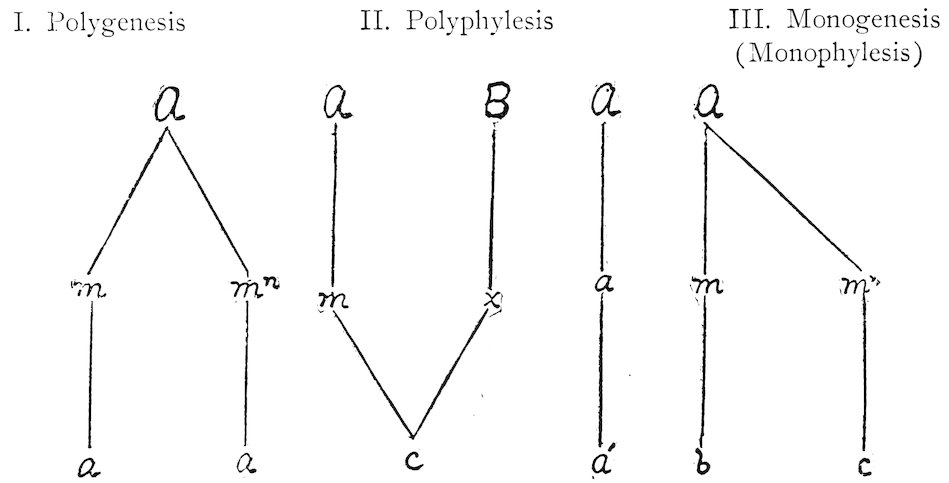
I. Polygenesis II. Polyphylesis III. Monogenesis (Monophylesis)
231In I, a species A, becomes scattered over a large area in a series of places, m ... mn, with the same physical factors, in any or all of which may arise the new species a. In II, a species with xerophytic tendency, A, and one with mesophytic tendency, B, in the course of migration find themselves respectively in a more mesophytic habitat, m, and a more xerophytic one, x, in which either may give rise to the new form, c, which is more or less intermediate between A and B. In III, the method of origin is of the simplest type, in which a species is modified directly into another one, or is split up into several.
280. Proofs of polygenesis. In affirming the probability of a polygenetic origin of species, there is no intention of asserting that all species originate in this way. It seems evident that a very large number of species of restricted range are certainly monogenetic, at least as far as origin in space is concerned. It is possible that any species may arise at two or more distinct times. Polygenesis can occur readily only in species of more or less extensive area, in which recur instances of the same or similar habitat. The relative frequence and importance of the two methods can hardly be conjectured as yet, but origin by monogenesis would seem to be the rule.
The arguments adduced by Engler in support of polygenesis are in themselves conclusive, but the investigations of the past decade have brought to light additional proofs, especially from the experimental side. In determining the physical factors of prairie and mountain formations, and especially by methods of experimental ecology, the author has found that habitats are much less complex than they are ordinarily thought to be, since water-content and humidity, and to a less degree light, constitute the only factors which produce direct modification. In addition, it has been ascertained that the minimum difference of water-content, humidity, or light, necessary to produce a distinguishable morphological adjustment is much greater than the unit differences recorded by the instruments. In short, the differences of habitats, as ascertained by thermograph, psychrometer and photometer, are much greater than their efficient differences, and, with respect to their ability to produce modification, habitats fall into relatively few categories. A striking illustration of this is seen in the superficially very different habitats, desert, strand, alkali plain, alpine moor, and arctic tundra, all of which are capable of producing the same type of xerophyte. It follows from this that many more or less plastic species of extensive 232geographical area will find themselves in similar or identical situations, measured in terms of efficient differences, and will be modified in the same way in two or more of these. In mountain regions, where interruption of the surface and consequent alternation are great, the mutual invasion of contiguous formations is of frequent occurrence, often resulting in habitat forms. The spots in which these nascent species, such as Galium boreale hylocolum, Aster levis lochmocolus, etc., are found, are often so related to the area of the parent species as to demonstrate conclusively that these forms are the result of polygenesis and not of migration. Naturally, what is true of a small area will hold equally well of a large region, and the recurrence of the same habitat form may be accepted as conclusive proof of polygenesis. The most convincing evidences of multiple origin, however, are to be found in what De Vries has called “mutations.” It makes little difference whether we accept mutations in the exact sense of this author, or regard them as forms characterized by latent variability. The evidence is conclusive that the same form may arise in nature or in cultivation, in Holland or in America, not merely once, but several or many times. In the presence of such confirmation, it is unnecessary to accumulate proofs. Polygenesis throws a new light upon many difficult problems of invasion and distribution, and, as a working principle, admits of repeated tests in the field. It obviates, moreover, the almost insuperable difficulties in the way of explaining the distribution of many polygenetic species on the basis of migration alone.
281. Origin by polyphylesis. In 1898, the author first advanced a tentative hypothesis to the effect that a species homogeneous morphologically may arise from two distinct though related species. During subsequent years of formational study, the conviction has grown in regard to the probability of such a method of origin. Since the appearance of Engler’s work, a polyphyletic origin for certain genera has been very generally accepted by botanists, but all have ignored the fact that the polyphylesis of genera carries with it the admission of such origin for species, since the former are merely groups of the latter. I can not, however, agree with Engler, that polyphyletic genera, and hence species also, are necessarily unnatural. If the convergence of the lines of polyphylesis has been great, resulting in essential morphological harmony, the genus is a natural one, even though the ancestral phyla may be recognizable. If, on the other hand, the convergence is more or less imperfect, resulting in subgroups of species more nearly related within the groups than between them, the genus can hardly be termed natural. This condition may, however, prevail in a monophyletic genus with manifest divergence and still not be an indication that it is artificial.
233Darwin[38], in speaking of convergence, has said: “If two species, belonging to two distinct though allied genera, had both produced a large number of new and divergent forms, it is conceivable that these might approach each other so closely that they would have all to be classified under the same genus; and thus the descendants of two distinct genera would converge into one.” The application of this statement to species would at once show the possibility of polyphylesis in the latter, and a further examination of the matter will demonstrate its probability. It is perfectly evident that a species may be split into two or more forms by varying the conditions, let us say of water-content, and that the descendants of these forms may again be changed into the parent type by reversing the process. This has, in fact, been done experimentally. Since it is admittedly impossible to draw any absolute line between forms, varieties, and species, it is at once clear that two distinct though related species, especially if they are plastic, may be caused to converge in such a way that the variants may constitute a new and homogeneous species. This may be illustrated by a concrete case at present under investigation. Kuhnistera purpurea differs from K. candida in being smaller, in having fewer, smaller, and more narrow leaflets, and a globoid spike of purple flowers in place of an elongated one of white flowers; in a word, it is more xerophytic. This conclusion is completely corroborated by its occurrence. On dozens of slopes examined, Kuhnistera purpurea has never been found mingling with K. candida on lower slopes, except where an accident of the surface has resulted in a local decrease of water-content. The experiment as conducted is a simple one, consisting merely in sowing seed of each in the zone of the other, and in growing K. purpurea under controlled mesophytic conditions, and K. candida under similarly measured xerophytic conditions in the planthouse.
While the polyphyletic origin of species is in a fair way to be decided by experiment, it receives support from several well-known phenomena. The striking similarity in the plant body of families taxonomically so distinct as the Cactaceae, Stapeliaceae, and Euphorbiaceae, or Cyperaceae and Juncaceae, indicates that a vegetation form may be polyphyletic. On the other hand, the local appearance of zygomorphy, of symphysis, and of aphanisis in the floral types of phylogeneticallv distinct families is a proof of the operation of convergence in reproductive characters. To be sure, the convergence is never so great as to produce more than superficial similarity, but this is because the groups are markedly different in so many fundamental characters. The same tendency in closely related species would easily result 234in identity. As in the case of polygenesis, the relatively small number of typically distinct habitats makes it clear that two different species of wide distribution, bearing to each other the relations of xerophyte to mesophyte, of hydrophyte to mesophyte, or of poophyte to hylophyte, might often find themselves in reciprocal situations, with the result that they would give rise to the same new form. The final proof of the polyphylesis of species is afforded by the experiments of De Vries in mutation. De Vries found that Oenothera nanella arose from O. Lamarckiana, O. laevifolia, and O. scintillans; Oenothera scintillans arose from O. lata and O. Lamarckiana; Oenothera rubrinervis from O. Lamarckiana, O. laevifolia, O. lata, O. oblonga, O. nanella, and O. scintillans, etc. Whatever may be the rank assigned to these mutations, whether form, variety, or species, there can be no question of their polyphyletic origin, nor, in consequence of the connection of mutations with variations through such inconstant forms as O. scintillans, O. elliptica, and O. sublinearis, of the possibility of polyphylesis in any two distinct though related species or genera.
KINDS OF INVASION
282. Continuous and intermittent invasion. With respect to the frequency of migration, we may distinguish invasion as continuous, or intermittent. Continuous invasion, which is indeed usually mutual, occurs between contiguous formations of more or less similar character, in which there is an annual movement from one into the other, and at the same time a forward movement through each, resulting from the invaders established the preceding year. By far the greater amount of invasion is of this sort, as may readily be seen from the fact that migration varies inversely as the distance, and ecesis may decrease even more rapidly than the distance increases. The significant feature of continuous invasion is that an outpost may be reinforced every year, thus making probable the establishment of new outposts from this as a center, and the ultimate extension of the species over a wide area. The comparatively short distance and the regular alternation of migration and ecesis render invasion of this sort very effective. An excellent illustration of this is seen in transition areas and regions, which are due directly to continuous and usually to mutual invasion. Intermittent invasion results commonly from distant carriage, though it may occur very rarely between dissimilar adjacent formations, when a temporary swing in the physical factors makes ecesis possible for a time. It is characterized by the fact that the succession of factors which have brought about the invasion is more or less accidental and may never recur. Intermittent invasion is relatively rare, and from the small number of disseminules affected, it is of little importance in modifying vegetation quantitatively. On the other 235hand, since a species may often be carried far from its geographical area, it is frequently of great significance in distribution.
283. Complete and partial invasion. When the movement of invaders into a formation is so great that the original occupants are finally driven out, the invasion may be termed complete. Such invasion is found regularly in the case of many ruderal formations, and is typical of the later stages of many successions. It is ordinarily the result of continuous invasion. If the number of invaders is sufficiently small that they may be adopted into the formation without radically changing the latter, the invasion is partial. This is doubtless true of the greater number of invasions, though these are regularly much less striking and important than instances of complete invasion.
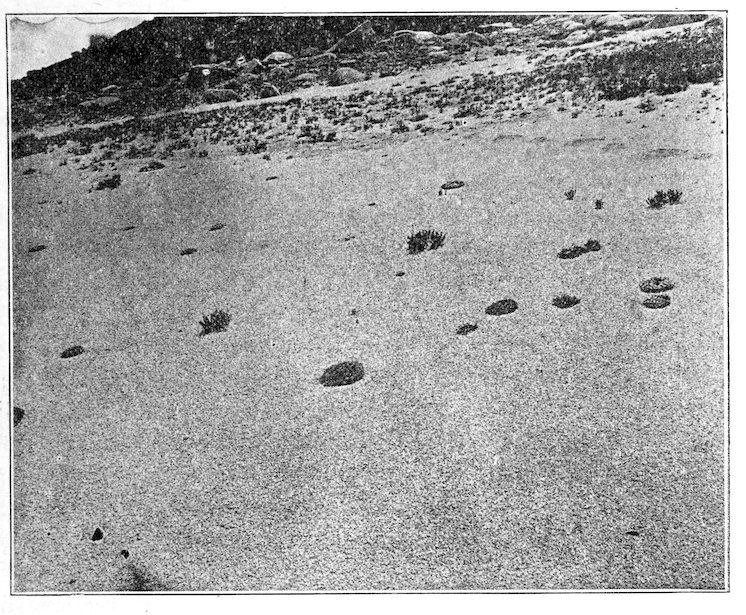
Fig. 59. Continuous invasion into a new area; mats of Arenaria sajanensis. Silene acaulis and Sieversia turbinata invading an alpine gravel slide.
284. Permanent and temporary invasion. The permanence of invasion depends upon the success attending ecesis, and upon the stability of the formation. It has already been noticed that under certain conditions plants may germinate and grow, and if they are perennials, even become established, 236and still ecesis be so imperfect that reproduction is impossible. Others may find the conditions sufficiently favorable for propagation, but unfavorable for the formation of flowers and fruits. Finally there are plants which seem to be perfectly established for a few years, only to disappear completely. The latter are examples of temporary invasion. It is necessary to draw clearly the line between complete and partial invasion in this connection. The former is temporary in the initial or intermediate stages of nearly all successions, as compared with the ultimate stages, though it is in a large degree permanent in comparison with the partial invasion of species which are able to maintain themselves for a few years. In a sense, there is a real distinction between the two, inasmuch as a particular stage of succession is permanent as long as the habitat remains essentially the same. A critical study of the species of such stages shows, however, that they manifest very different degrees of permanence. Species which invade stable vegetation temporarily have been termed adventive by A. DeCandolle. Permanent invasion occurs when a species becomes permanently established in a more or less stable formation. It is characteristic of the great majority of invaders found in the grassland and forest stages of successions.
Plants which have arisen within a formation or have been a constituent part of it since its origin are indigenous. Contrasted with these are the species which have invaded the formation since it received its distinctive impress: these are derived. The determination of the indigenous and derived species of a formation or larger division is of the utmost importance, as it enables us to retrace the steps by which the formation has reached its present structure, and to reconstruct formations long since disappeared. To render it less difficult, it is necessary to scrutinize the derived elements closely, first, because it is easiest to recognize the indigenous species by eliminating the derived, and second, because this analysis will show that not all derived species have entered the formation at the same time and from the same sources. Derived species may be termed vicine, when they are fully established invaders from adjacent formations or regions, and adventitious, when they have come from distant formations and have succeeded in establishing themselves. Finally, those derived species which are unable to establish themselves permanently are adventive.