Chapter II · THE HABITAT
Reading edition
Concept and Analysis
27. Definition of the habitat. The habitat is the sum of all the forces or factors present in a given area. It is the exact equivalent of the term environment, though the latter is commonly used in a more general sense. As an ecological concept, the habitat refers to an area much more definite in character, and more sharply limited in extent than the habitat of species as indicated in the manuals. Since the careful study of habitats has scarcely begun, it is impossible to recognize and delimit them in an absolute sense. Visible topographic boundaries often exist, but in many cases, the limit, though actual, is not readily perceived. Contiguous habitats may be sharply limited, or they may pass into each other so gradually that no real line of demarcation can be drawn. Whatever variations they may show, however, all habitats agree in the possession of certain essential factors, which are universally present. On the other hand, a few factors are merely incidental and may be present or absent. The relative value and amount of these is probably similar for no two habitats, though the latter readily fall into groups with reference to the amount of some particular factor.
28. Factors. The factors of a habitat are water-content, humidity, light, temperature, soil, wind, precipitation, pressure, altitude, exposure, slope, surface (cover), and animals. To these should be added gravity and polarity, which are practically uniform for all habitats, and may, in consequence, be ignored in this treatise. Length of season, while it plays an important part in vegetation, is clearly a complex and is to be treated under its constituents. Of the factors given, all are regularly found in each habitat, though some are not constantly present. The first five, water-content, humidity, light, temperature, and soil are the most important, and any one may well serve as a basis for grouping habitats into particular classes with reference to quantity. As will be pointed out later, however, water-content and light furnish the most striking differences between habitats, and offer the best means of classification. As habitats are inseparable from the formations which they bear, the discussion of the kinds of habitats is reserved for chapter IV.
19
Classification of Factors
29. The nature of factors. The factors of a habitat are arranged in two groups according to their nature: (1) physical, (2) biotic. In the strict sense, the physical factors constitute the habitat proper, and are the real causative forces. No habitat escapes the influence of biotic factors, however, as the formation always reacts upon it, and the influence of animals is usually felt in some measure. Physical factors are further grouped into (1) climatic and (2) edaphic, with respect to source, or, better, the medium in which they are found. Climatic, or atmospheric factors are humidity, light, temperature, wind, pressure, and precipitation. Axiomatically, the stimuli which they produce are especially related to the leaf. Edaphic or soil factors are confined to the soil, as the term denotes, and are immediately concerned with the functions of the root. Water-content is by far the most important of these; the others are soil composition (nutrient-content), soil temperature, altitude, slope, exposure, and surface. The last four are of a more general character than the others, and are usually referred to as physiographic factors. Cover, when dead, might well be placed among these also, but as it is little different from the living cover in effect, it seems most logical to refer it to biotic factors.
30. The influence of factors. While the above classification is both obvious and convenient, a more logical and intimate grouping may be made upon the influence which the factor exerts. On this basis, factors are divided into (1) direct, (2) indirect, and (3) remote. Direct factors are those which act directly upon an important function of the plant and produce a formative effect: for example, an increase in humidity produces an immediate decrease in transpiration. They are water-content, humidity, and light. Other factors have a direct action: thus temperature has an immediate influence upon respiration and probably assimilation also, but it is not structurally formative. Wind has a direct mechanical effect upon woody plants, but it does not fall within our definition. Indirect factors are those that affect a formative function of the plant through another factor; thus a change in temperature causes a change in humidity and this in turn calls forth a change in transpiration; or, a change in soil texture increases the water-content, and this affects the imbibition of the root-hairs. Indirect factors, then, are temperature, wind, pressure, precipitation, and soil composition. Remote factors are, for the most part, physiographic and biotic: they require at least two other factors to act as middlemen. Altitude affects plants through pressure, which modifies humidity, and hence transpiration. Slope determines in large degree the run-off during a rainstorm, thus 20affecting water-content and the amount of water absorbed. Earthworms and plant parts change the texture of the soil, and thereby the water-content. Indirect factors often exert a remote influence also, as may be seen in the effect which temperature and wind have in increasing evaporation from the soil, and thus reducing the water-content. This distinction between factors may seem insufficiently grounded. In this event, it should be noted that it centers the effects of all factors upon the three direct ones, water-content, humidity, and light. If it further be recalled that these are the only factors which produce qualitative structural changes, and that the classification of ecads and formations is based upon them, the validity of the distinction is clear.
The Determination of Factors
31. The need of exact measurement. Any serious endeavor to find in the habitat those causes which are producing modification in the plant and in vegetation can not stop with the factors merely. The next step is to determine the quantity of each. It is not sufficient to hazard a guess at this, or to make a rough estimate of it. Habitats differ in all degrees, and it is impossible to institute comparisons between them without an exact measure of each factor. Similarly, one can not trace the adaptations of species to their proper causes unless the quantity of each factor is known. It is of little value to know the general effect of a factor, unless it is known to what degree this effect is exerted. For this purpose it becomes necessary to appeal to instruments, in order to determine the exact amount of each factor that is present in a particular habitat, and hence to determine the ratio between the stimulus and the amount of structural adjustment which results. The employment of instruments of precision is clearly indispensable for the task which we have set for ecology, and every student that intends to strike at the root of the subject, and to make lasting contributions to it, must familiarize himself with instrumental methods. One great benefit will accrue to ecology as soon as this fact is generally recognized. The use of instruments and the application of results obtained from them demand much patience and seriousness of purpose upon the part of the student. As a consequence, there will be a general exodus from ecology of those that have been attracted to it as the latest botanical fad, and have done so much to bring it into disrepute.
32. The value of meteorological methods. At the outset there must be a very clear understanding that weather records and readings have only a very general value. This is in spite of the fact that the instruments employed are of standard precision. An important reason for this lack of 21value is that readings are not made in a particular habitat; as a rule, indeed, they are made in towns and cities, and hence are far removed from masses of vegetation. They are usually taken at considerable heights, and give but a general indication of the conditions at the level of vegetation. The chief difficulty, however, is that the factors observed at weather stations—temperature, pressure, wind, and precipitation—are those which have the least value for the ecologist. It is true that a knowledge of the temperature and rainfall of a great region will afford some idea of the general character of its vegetation. A proper understanding of such a vegetation is, however, to be gained only through the exact study of its component formations. Ecology has already incurred sufficient censure as a subject composed of very general ideas, and the use of meteorological data, which can never be connected definitely with anything in the plant or the formation, should be discontinued. This must not be understood to mean that meteorological instruments can not be used in the proper place and manner, i. e., in the habitat.
33. Habitat determination. It is self-evident that determinations of factors by instruments can only be of value in the habitat where they are made. In other words, a habitat is a unit for purposes of measuring its factors, and measures of one habitat have no exact value in another. This fact can not be overstated. Thus, while it is perfectly legitimate, and indeed highly desirable, to locate thermographs in different mountain zones for ascertaining the rate at which temperature decreases with altitude, the data obtained in this way are not directly applicable in explanation of plant or formation changes, except when the same species occurs at different altitudes. Special methods are valuable and often absolutely necessary, but in view of the fact that the plant as well as the formation is the definite product of a definite habitat, the fundamental rule in instrumentation is that complete readings must be made within a habitat for that habitat alone. This necessarily presupposes a certain preliminary acquaintance with the habitat to be investigated, as it is imperative that the station for making readings be located well within the formation, in order to avoid transition conditions. In vegetation, there are as many habitats as formations, and in addition a large number of new and denuded habitats upon which successions have not yet started; a knowledge of each formation or succession must rest ultimately upon the factors of its particular habitat.
34. Determinable and efficient differences. The instruments employed in studying habitats can not be too exact, as there is no adequate knowledge as yet concerning the real differences which exist between related or contiguous formations. This is particularly true of differences which are 22efficient in producing a recognizable structural change in plant or formation. Investigations made by the writer have shewn that standard instruments will measure differences of quantity quite too small to produce a visible reaction. Efficient differences are not the same for different factors, and perhaps also for the same factor when found in various combinations. They vary widely for different species, being in direct relation to the plasticity of the latter. The point necessary to bear in mind in formulating methods for habitat investigation and in making use of instruments is that standard instruments should be used for the very reason that we do not yet know the relation between determinable and efficient differences. On the other hand, it is unnecessary to insist upon absolute exactness as soon as it is found that the determinable difference lies well within the efficient one. This by no means indicates that instruments are not to be carefully standardized and frequently checked, or that accurate readings should not be made. It means that a slight margin of error may be permitted in a machine which registers well within the efficient difference for that factor, and that instruments that read to the last degree of nicety are not absolutely necessary. In the fundamental work of determining efficient differences, however, instruments can not have too great precision. Moreover, these differences must be based upon the most plastic species of a formation, and the readings must be made under normal conditions.
Instrumentation
35. Methods. In the field use of instruments two methods have been developed. The first in point of time was the method of simple instruments, devised especially for class work, and capable of being used only where a number of trained students are available. The method of automatic instruments was an immediate outgrowth of this, due to the necessity which confronts the solitary investigator of being in different habitats at the same time. In the gradual evolution of this subject, it has become possible to combine the two methods in such a way as to retain all the advantages of the automatic method, and most of those of the method of simple instruments.
36. Method of simple instruments. By simple instruments are denoted those that do not record, but must be read by the observer at the time. They are standard instruments of precision, but possess the disadvantage of requiring an observer for each one. They are well illustrated by the thermometers and psychrometers used by the Weather Bureau. In the hands of trained observers the results obtained are unimpeachable; in fact, standard simple instruments must be constantly employed to check automatic 23ones. As physical factors vary greatly through the day and through the year, it is all-important that the readings in habitats which are being compared should be made at the same instant. This requires a number of observers; as many as twelve stations have been read at one time, and there is of course no limit to the number. It is very important, also, that observers be carefully trained in the handling of instruments, and in reading them accurately and intelligently at the proper moment. In practice it has been found impossible to do such work in elementary classes, and, even in using small advanced classes, prolonged drill has been necessary before trustworthy results could be obtained. When a class has once been thoroughly trained in making accurate simultaneous readings, there is practically no limit, other than that set by time, to the valuable work that can be done, both in instruction and investigation.
37. Method of automatic instruments. The solitary investigator must replace trained helpers by automatic instruments or ecographs. These have the very great advantages of giving continuous simultaneous records for long periods, and of having no personal equation. They must be regulated and checked, to be sure, but as this is all done by the same person, the error is negligible. There is nothing more satisfactory in resident investigation than a series of accurate recording instruments in various habitats. Ecographs have two disadvantages. The chief perhaps is cost. The expense of a single “battery” which will record light, water-content, humidity, and temperature is about $250. Another difficulty is that they can be used only within a few miles of the base, since they require attention every week for regulation, change of record, etc. While this means that ecographs in their present form are not adapted to reconnaissance, this is not a real disadvantage, as the scattered observations possible on such a journey can best be made by simple instruments.
38. Combined methods. The best results by far are to be obtained by the combined use of simple and automatic instruments. This is particularly true in research, but it applies also to class instruction. The ecographs afford a continuous, accurate basal record, to which a single reading made at any time or place can be readily referred for comparison. On the other hand, it is an easy matter to carry a full complement of simple instruments on the daily field trips, and to make accurate readings in a score or more of formations in a single day. An isolated reading, especially of a climatic factor, has little or no value in itself, but when it can be compared with a reading made at the same time in the base station by an ecograph, it is the equivalent of an automatic reading. This method renders a set of simple instruments 24more desirable for a long trip or reconnaissance than a battery of automatic ones. It is practically impossible to carry the latter into the field, and in any event a continuous record is out of the question. As there are other tasks at such times also, it becomes evident that the taking of single readings which can be compared with a continuous record offers the most satisfactory solution.
Construction and Use of Instruments
39. The selection of instruments. In selecting and devising instruments for the investigation of physical factors, emphasis has first been laid upon accuracy. This is the result of a feeling that it is better to have instruments that read too minutely than those which do not make distinctions that are sufficiently close, particularly until more has been learned about efficient differences. On the other hand, no hesitation has been felt in employing instruments which are not absolutely accurate, when it was clear that the error was less than the efficient difference. Similarly, the margin of error practically eliminates itself in the case of simultaneous comparative readings, when the instruments have been checked to the same standard. Simplicity of construction and operation are of great importance, especially in saving time where a large number of instruments are in operation. Expense is likewise to be carefully considered. It is impossible to have too many instruments, but cost practically determines the number that can be obtained. It is further necessary to secure or invent both simple and automatic instruments for all factors, except such invariable ones as altitude, slope, etc. Simple instruments must be of a kind that can be easily carried, and so constructed that they can be used at a minimum of risk. The sling psychrometer, for example, is very readily broken in field use, and it has been replaced by a protected modification, the rotating form.
In describing the construction and operation of the many factor instruments, there has been no attempt to make the treatment exhaustive. Those instruments which the author has found of greatest value in his own work are given precedence, and the manner of using them is described in detail. Other instruments of value are also considered, though with greater brevity. Some of the most complex and expensive ones have been ignored, as it is altogether improbable that they can come into general use in their present form. While the conviction is felt that the methods described below will enable the most advanced investigators to carry on thorough work, it is hoped that they will be seen to be so fundamental, and so attractive, that they will appeal to all who are planning serious ecological study.
25
WATER-CONTENT
40. Value of different instruments. The paramount importance of water-content as a direct factor in the modification of plant form and distribution gives a fundamental value to the methods used for its determination. Automatic instruments for ascertaining the water in the soil are costly, in addition to being complicated, and often inaccurate. For these reasons, much attention has been given to developing the simpler but more reliable methods in which a soil borer or geotome is used. The latter is simple, inexpensive, and accurate. It can be carried easily upon daily trips or upon longer reconnaissances, and is always ready for instant use. In the determination of physiological water-content, it is practically indispensable. Indeed, the readiness with which geotome determinations of water-content can be made should hasten the universal recognition of the fact that it is the available, and not the total amount of water in the soil, which determines the effect upon the plant.
Geotome Methods
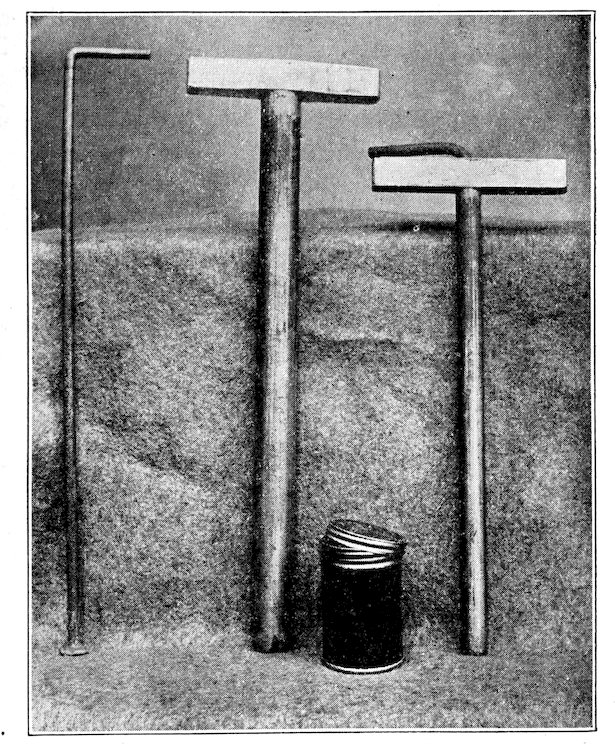
Fig. 1. Geotomes and soil can.
41. The geotome. In its simplest form, the geotome is merely a stout iron tube with a sharp cutting edge at one end and a firmly attached handle at the other. The length is variable and is primarily determined by the location of the active root surface of the plant. In xerophytic habitats, generally a longer tube is necessary than in mesophytic ones. The bore is largely determined by the character of the soil; for example, a larger one is necessary for gravel than for loam. Tubes of small bore also tend to pack the soil below them, and to give a correspondingly incomplete core. The best results have been obtained with geotomes of ½–1 inch tube. Each geotome 26has a removable rod, flattened into a disk at one end, and bent at the other, for forcing out the core after it has been cut from the soil. Sets of geotomes have been made in lengths of 5, 10, 12, 15, 20, and 25 inches. The 12– and 15–inch forms have been commonly used for herbaceous formations and layers. They are marked in inches so that a sample of any lesser depth may be readily taken. Such a device is very necessary for gravel soils and in mountain regions, where the subsoil of rock lies close to the surface.

Fig. 2. Fraenkel soil borer.
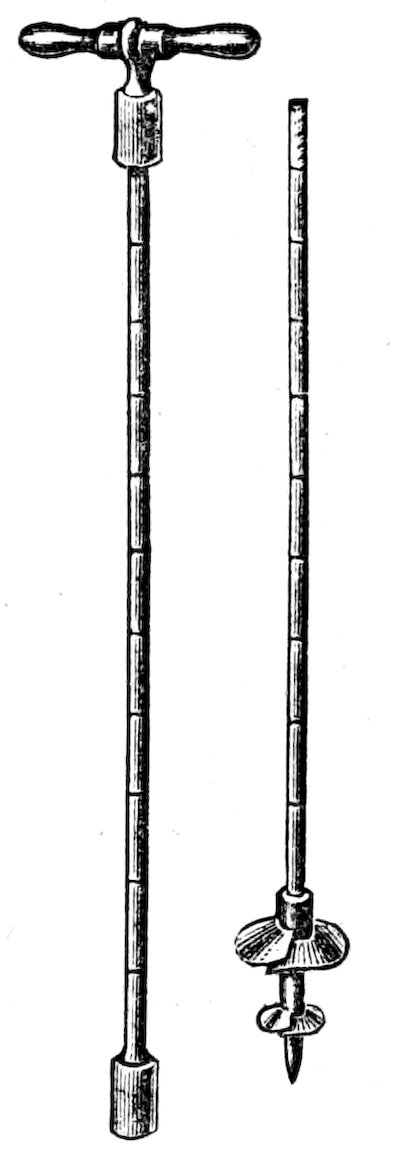
Fig. 3. American soil borer.
42. Soil borers. There is a large variety of soil borers to choose from, but none have been found as simple and satisfactory for relatively shallow readings as the geotome just described. For deep-rooted plants, many xerophytes, shrubs, and trees, borers of the auger type are necessary. These are large and heavy, and of necessity slow in operation. They can not well be carried in an ordinary outfit of instruments, and the size of the soil sample itself precludes the use of such instruments far from the base station, except on trips made expressly for obtaining samples from deep-seated layers. For depths from two to eight feet, the Fraenkel borer is perhaps the most satisfactory, except for the coarser gravels: it costs $14 or $20 according to the length. For greater depths, or when a larger core is desirable, the Bausch & Lomb borer, number 16536, which costs $5.25, should be made use of. This is a ponderous affair and can be employed only on special occasions. On account of the size of samples obtained by these borers, it is usually most satisfactory to take a small sample from the core at different depths. Frequently, indeed, a hand trowel may be readily used to obtain a good sample at a particular depth.
43. Taking samples of soil. In obtaining soil samples, the usual practice is to remove the air-dried surface, noting its depth, and to sink the geotome with a slow, gentle, boring movement, in order to avoid packing the soil. This difficulty is further obviated by deep notches with sharp, beveled edges which are cut at the lower end. In obtaining a fifteen-inch core, there is also less compression if it be cut five inches at a time. Repeated tests have shown, however, that the single compressed sample is practically as trustworthy as the one made in sections. The water-content of the former constantly fell within .5 per cent of that of the latter, and both varied less 27than 1 per cent from the dug sample used as a check. As soon as dug, the core is pressed out of the geotome by the plunger directly into an air-tight soil can. Bottles may be used as containers, but tin cans are lighter and more durable. Aluminum cans have been devised for this purpose, but on account of the expense, “Antikamnia” cans have been used instead. These are tested, and those that are not water-tight are rejected, although it has been found that, even in these, ordinary soils do not lose an appreciable amount of water in twenty-four hours. The lid should be screwed on as quickly as possible, and, as an added precaution, the cans are kept in a close case until they have been weighed. The cans are numbered consecutively on both lid and side in such a way that the number may be read at a glance. The numbers are painted, as a label wears off too rapidly, and scratched numbers are not quickly discerned.
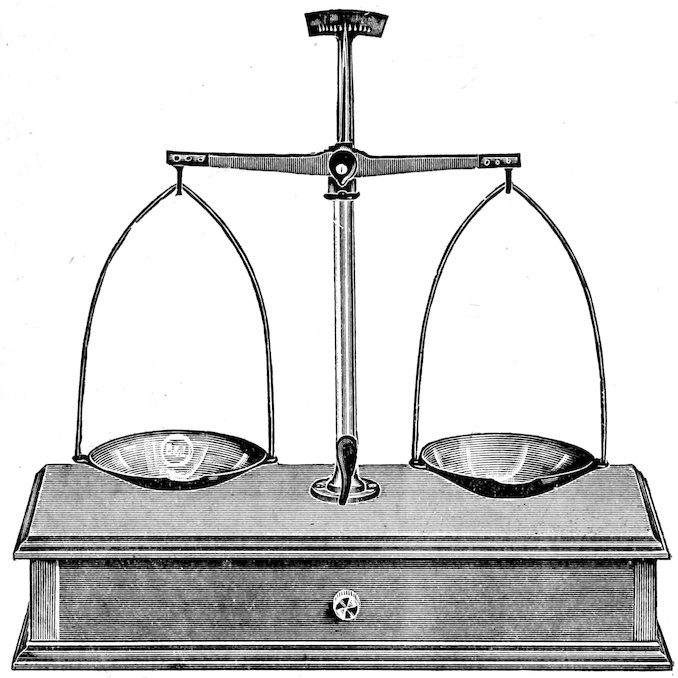
Fig. 4. Field balance.
44. Weighing. Although soil samples have been kept in tight cans outside of cases for several days without losing a milligram of moisture, the safest plan is to make it a rule to weigh cans as quickly as possible after bringing them in from the field. Moreover, when delicate balances are available, it is a good practice to weigh to the milligram. At remote bases, however, and particularly in the field, and on reconnaissance, where delicate, expensive instruments are out of place, coarser balances, which weigh accurately to one centigram, give satisfactory results. The study of efficient water-content values has already gone far enough to indicate that differences less than 1 per cent are negligible. Indeed, the soil variation in a single square meter is often as great as this. The greatest difference possible in the third place, i. e., that of 9 milligrams, does not produce a difference of .1 of 1 per cent in the water-content value. In consequence, such strong portable balances as Bausch & Lomb 12308 ($2), which can be carried anywhere, give entirely 28reliable results. The best procedure is to weigh the soil with the can. Turning the soil out upon the pan or upon paper obviates one weighing, but there is always some slight loss, and the chances of serious mishap are many. After weighing, the sample is dried as rapidly as possible in a water bath or oven. At a temperature of 100° C. this is accomplished ordinarily in twenty-four hours; the most tenacious clays require a longer time, or a higher temperature. High temperatures should be avoided, however, for soils that contain much leaf mould or other organic matter, in order that this may not be destroyed. When it is necessary on trips, soil samples can be dried in the sun or even in the air. This usually takes several days, however, and a test weighing is generally required before one can be certain that the moisture is entirely gone. The weighing of the dried soil is made as before, and the can is carefully brushed out and weighed. The weight of aluminum cans may be determined once for all, but with painted cans it has been the practice to weigh them each time.
45. Computation. The most direct method of expressing the water-content is by per cents figured upon the moist soil as a basis. The ideal way would be to determine the actual amount of water per unit volume, but as this would necessitate weighing one unit volume at least in every habitat studied, as a preliminary step, it is not practicable. The actual process of computation is extremely simple. The weight of the dried sample, w1, is subtracted from the weight of the original sample, w, and the weight of the can, w2, is likewise subtracted from w. The first result is then divided by the second, giving the per cent of water, or the physical water-content. The formula is: (w − w1)/(w − w2) = W. The result is expressed preferably in grams per hundred grams of moist soil; thus ²⁰⁄₁₀₀, from which the per cent of water-content may readily be figured on the basis of dry or moist soil.
46. Time and location of readings. Owing to the daily change in the amount of soil water due to evaporation, gravity, and rainfall, an isolated determination of water-content has very little value. It is a primary requisite that a basis for comparison be established by making (1) a series of readings in the same place, (2) a series at practically the same time in a number of different places or habitats, or (3) by combining the two methods, and following the daily changes of a series of stations throughout an entire season, or at least for a period sufficient to determine the approximate maximum and minimum. The last procedure can hardly be carried out except at a base station, but here it is practically indispensable. It has been followed both at Lincoln and at Minnehaha, resulting in a basal series for each place that is of the greatest importance. When such a 29base already exists, or, better, while it is being established, scattered readings may be used somewhat profitably. As a practical working rule, however, it is most convenient and satisfactory to make all determinations consecutively, i. e., in a series of stations or of successive days. Under ordinary conditions, the time of day at which a particular sample is taken is of little importance, as the variation during a day is usually slight. This does not hold for exposed wet soils, and especially for soils which have just been wetted by rains. In all comparative series, however, the samples should be taken at the same hour whenever possible. This is particularly necessary when it is desired to ascertain the daily decrease of water-content in the same spot. In the case of a series of stations, these should be read always in the same order, at the same time of day, and as rapidly as possible. When a daily station series is being run, i. e., a series by days and stations both, the daily reading for each place should fall at the same time. While there are certain advantages in making readings either early or late in the day, they may be made at any time if the above precautions are followed.
47. Location of readings. Samples should invariably be taken in spots which are both typical and normal, especially when they are to be used as representative of a particular area or habitat. A slight change in slope, soil composition, in the amount of dead or living cover, etc., will produce considerable change in the amount of water present. Where habitat and formation are uniform, fewer precautions are necessary. This is a rare circumstance, and as a rule determinations must be made wherever appreciable differences are in evidence. The problem is simpler when readings are taken with reference to the structure or modifications of a particular species, but even here, check readings in several places are of great value. The variation of water in a spot apparently uniform has been found to be slight in the prairies and the mountains. In taking three samples in spots a few inches to several feet apart, the difference in the amount of water has rarely exceeded 1 per cent, which is practically negligible. Gardner[2] found that 16 samples taken to a depth of 3 inches, in as many different portions of a carefully prepared, denuded soil plot, showed a variation of 7½ per cent. This is partially explained by the shallowness of the samples, but even then the results of the two investigations are in serious conflict and indicate that the question needs especial study. It should be further pointed out that all readings should be made well within a particular area, and not near its edge, and that, in the case of large diversified habitats, it is the consocies and the society which indicate the obvious variations in the structure of the habitat.
3048. Depth of samples. The general rule is that the depth of soil samples is determined by the layer to which the roots penetrate. The practice is to remove the air-dried surface in which no roots are found, and to take a sample to the proper depth. This method is open to some objection, as the actively absorbing root surfaces are often localized. There is no practical way of taking account of this as yet, except in the case of deep-rooted xerophytes and woody plants. It is practicable to determine the location of the active root area of a particular plant and hence the water-content of the soil layer, but in most formations, roots penetrate to such different depths that a sample which includes the greater part of the distance concerned is satisfactory. Some knowledge of the soil of a formation is also necessary, since shallow soils do not require as deep samples as others. The same is true of shaded soils without reference to their depth, and, in large measure, of soils supplied with telluric water. In all cases, it is highly desirable to have numerous control-samples at different depths. The normal cores are 12 or 15 inches; control-samples are taken every 5 inches to the depth desired, and in some cases 3–inch sections are made. It has been found a great saving of time to combine these methods. A 5–inch sample is taken and placed in one can, then a second one, and a third in like manner. In this way the water-content of each 5–inch layer is determined, and from the combined weight the total content is readily ascertained.
49. Check and control instruments. A number of instruments throw much light upon the general relations of soil water. The rain-gauge, or ombrometer, measures the periodical replenishment of the water supply, and has a direct bearing upon seasonal variation. The atmometer affords a clue to the daily decrease of water by evaporation, and thus supplements the rain-gauge. The run-off gauge enables one to establish a direct connection between water-content and the slope and character of the surface. The amount and rapidity of absorption are determined by means of a simple instrument termed a rhoptometer. The gravitation water of a soil is ascertained by a hizometer, and some clue to the hygroscopic and capillary water may be obtained by an artificial osmotic cell. All of these are of importance because they serve to explain the water-content of a particular soil with especial reference to the other factors of the habitat. It is evident that none of them can actually be used in exact determinations of the amount of water, and they will be considered under the factors with which, they are more immediately concerned.
Physical and Physiological Water
50. The availability of soil water. The amount of water present in a soil is no real index to the influence of water-content as a factor of the 31habitat. All soils contain more water than can be absorbed by the plants which grow in them. This residual water, which is not available for use, varies for different soils. It is greatest in the compact soils, such as clay and loam, and least in the loose ones, as sand and gravel. It differs, but to a much less degree, from one species to another. A plant of xerophytic tendency is naturally able to remove more water from the same soil than one of mesophytic or hydrophytic character. As the species of a particular formation owe their association chiefly to their common relation to the water-content of the habitat, this difference is of little importance in the field. In comparing the structure of formations, and especially that of the plants which are found in them, the need to distinguish the available water from the total amount is imperative. Thus, water-contents of 15 per cent in gravel and in clay are in no wise comparable. A coarse gravel containing 15 per cent of water is practically saturated. The plants which grow upon it are mesophytes of a strong hydrophytic tendency, and they are able to use 14½ or all but .5 out of the 15 per cent of water. In a compact clay, only 3½ of the 15 per cent are available, and the plants growing in it are marked xerophytes. It is evident that a knowledge merely of the physical water-content is actually misleading in such cases, and this holds true of comparisons of any soils which differ considerably in texture. After one has determined the physiological water for the great groups of soils, it is more or less possible to estimate the amounts in the various types of each. As an analysis is necessary to show how close soils are in texture, this is little better than a guess, and for accurate work it is indispensable that the available water be determined for each habitat. Within the same formation, however, after this has once been carefully ascertained, it is perfectly satisfactory to convert physical water-content into available by subtracting the non-available water, which under normal conditions in the field remains practically the same.
The importance of knowing the available water is even greater in those habitats in which salts, acids, cold, or other factors than the molecular attraction of soil particles increase the amount of water which the plant can not absorb. Few careful investigations of such soils have yet been made, and the relation of available to non-available water in them is almost entirely unknown. It is probable that the phenomena in some of these will be found to be produced by other factors.
51. Terms. The terms, physiological water-content, and physical water-content, are awkward and not altogether clear in their application. It is here proposed to replace them by short words which will refer directly to the availability of the soil water for absorption by the plant. Accordingly, 32the total amount of water in the soil is divided into the available and the non-available water-content. The terms suggested for these are respectively, holard (ὅλos, whole, ἅpδov, water), chresard (χοῆςις, use), and echard (ἕχω, to withhold).
52. Chresard determinations under control. The determination of the chresard in the field is attended with peculiar difficulties. In consequence, the method of obtaining it under control will first be described. The inquiry may be made with reference to soils in general or to the soil of a particular formation. In the last case, if the plants used are from the same formation, the results will have almost the value of a field determination. When no definite habitat is the subject of investigation, an actual soil, and not an artificial mixture, should be used, and the plants employed should be mesophytes. The individual plants are grown from seeds in the proper soils, and are repotted sufficiently often to keep the roots away from the surface. The last transfer is made to a pot large enough to permit the plant to become full-grown without crowding the roots. The pot should be glazed inside and out in order to prevent the escape of moisture. This interferes slightly with the aeration of the soil, but it will not cause any real difficulty. The plant is watered in such a way as to make the growth as normal as possible. After it has become well established, three soil samples are taken in such a manner that they will give the variation in different parts of the pot. One is taken near the plant, the second midway between the plant and the edge of the pot, and the third near the edge. The depth is determined by the size of the pot and the position of the roots. The holard is determined for these in the usual way, but the result is expressed with reference to 100 grams of dry soil; the average is taken as representative. The soil is then allowed to dry out slowly, as sudden drouth will sometimes impair the power of absorption and a plant will wilt although considerable available water remains. Plants often wilt in the field daily for several successive hot dry days, and become completely turgid again during the night. If the drying out takes place slowly, the plant will not recover after it has once begun to wilt. The proper time to make the second reading is indicated by the pronounced wilting of the leaves and shoots. Complete wilting occurs, as a rule, only after the younger parts have drawn for some time upon the watery tissues of the stem and root, by which time evaporation has considerably deceased the water in the soil. It is a well-known fact that young leaves do not wilt easily, especially in watery or succulent plants. Three samples are again taken and the average water-content determined as above. This is the non-available water or the echard. The latter is then computed on the basis of 100 grams of dry soil, and this result is subtracted 33from the holard to give the chresard in grams for each 100 grams of dry weight. The chresard may also be expressed with respect to 100 grams of moist soil. As a final precaution in basal work, it is advisable to determine the chresard for six individuals of the same species under as nearly the same conditions as possible. When it is desired, however, to find the average chresard for a particular soil, it is necessary to employ various species representing diverse phyads and ecads. Such an investigation is necessarily very complicated, and must be made the subject of special inquiry.
53. Chresard readings in the field. The especial difficulties which must be overcome in the field are the exclusion of rain and dew and the cutting off of the capillary water. It is evident, of course, that experiments of this sort must also be entirely free from outside disturbance. The choice of an area depends upon the scope of the study. If the chresard is sought for a particular consocies, the block of soil to be studied should show several species which are fairly representative. In case the chresard of a certain species is to be obtained, this species alone need be present, but it should be represented by several individuals. Check plots are desirable in either event, and at least two or three which are as nearly uniform as possible should be chosen. The size and depth of the soil block depends upon the plants concerned. It must be large enough that the roots of the particular individuals under investigation are not disturbed. There is a limit to the size of the mass that can be handled readily, and in consequence the test plants must not be too large or too deeply rooted. The task of cutting out the soil block requires a spade with a long sharp blade. After ascertaining the spread and depth of the roots, the block is cut so that a margin of several inches free from the roots concerned is left on the sides and bottom. If the block is to be lifted out of place, so that the sides are exposed to evaporation, this allowance should be greater. In some cases, it may be found more convenient to dig the plant up, place it in a large pot, and put the latter back in the hole. As a general practice, however, this is much less satisfactory.
After the block has been cut, it may be moved if the soil is sufficiently compact, and then allowed to dry out in its own formation or elsewhere. The results are most valuable in the first case, though it is often an advantage to remove blocks cut from shade or wet formations to dry, sunny stations where they will dry more rapidly. The most satisfactory and natural method, however, is to leave the block in place, and to prevent the reestablishment of capillary action by enclosing it within plates. This is accomplished by slipping thin sheet-iron plates into position along the cut surfaces. 34The plate for the bottom should be somewhat wider than the block, and is slipped into place by raising the block if the soil is not too loose; in the latter event, it is carefully driven in. The side plates are then pushed down to meet the former. The size of the plates depends upon the block; in general, plates of 1, 2, and 3 feet square, with the bottom plates a trifle larger, are the most serviceable. Access of rain and dew is prevented by an awning of heavy canvas which projects far enough beyond each side of the block to prevent wetting. The height will depend of course upon the size of the plants. The awning must be used only when rain or heavy dew is threatened, as the shade which it produces changes the power of the plant to draw water from the soil.
The time necessary to cause wilting varies with the habitat and the weather. When the block is large and in position, two or three weeks are required. This period of drying incidentally furnishes an excellent opportunity for determining the rate at which the particular soil loses water. The holard sample is taken daily for several days before the block is cut out, in order to obtain an average, care being taken of course to avoid a period of extreme weather. The echard samples are taken as soon as the wilting is sufficient to indicate that the limit of available water is reached. The air-dry soil above the roots is first removed. The treatment of the samples and the computation of the chresard are as previously indicated.
54. Chresard values of different soils. The following table gives the water-content values of six representative soils. The per cents of holard (at saturation) and of echard are those determined by Hedgcock[3] with six mesophytes as test plants for each soil. The chresard has been computed directly from these.
HOLARD ECHARD CHRESARD
Sand 14.3 12.6 .3 .25 14 12.3
Clay 47.4 32.5 9.3 6.3 38.1 26.2
Loess 59.3 37.1 10.1 6.4 49.2 30.7
Loam 64.1 39.1 10.9 6.6 53.2 32.5
Humus 65.3 39.6 11.9 7.2 53.4 32.4
Saline 68.5 40.8 16.2 9.6 52.3 31.2
The first column indicates the per cent based upon the dry weight, the second upon the weight of the moist soil.
While these can not be considered absolute for a particular soil other than the ones investigated, they are found to correspond somewhat closely to the results obtained for other soils of the respective groups. For accurate 35research, the chresard must of course be ascertained for each formation with respect to its peculiar plants and soil. The influence of the ecad in more or less determining the echard is also shown by Hedgcock, who found that floating plants wilt at 25 per cent, amphibious ones at 15–20 per cent, mesophytes at 6–12 per cent, and mesophytic xerophytes at 3–6 per cent. The echard is also somewhat higher for shade plants than for heliophytes.
Records and Results
55. The field record. It is superfluous to point out that a definite form for field records saves much time and prevents many mistakes. The exact form may be left to personal taste, but there are certain features which are essential. Many of these are evident, while others may seem unnecessary; all, however, have been proved by experience to have some value in saving time or in preventing confusion. The two fundamental maxims of field work are that nothing is too trivial to be of importance, and that no detail should be entrusted to the memory. The field record should contain in unmistakable terms all that the field has yielded. These statements apply with especial force to water-content, in many senses the most important of physical factors. The precise character of the record depends upon the way in which the readings are made, whether scattered or in series. As the day-station series is of the greatest importance, the record is adapted for it especially, but it will also serve for all readings. The record is chronological, since this is the only convenient method for the field. A proper form for a field record of water-content is the following:
Can No. Date Formation Station Community Soil Sample HOLARD ECHARD Chresard NOTES
Weighings % Weighings % Sky Rainfall
1st 2d Can 1st 2d Can
10 2/8/04 Spruce forest Jack Brook Mertensiare Loam 10 58.7 50.1 25.52 2 58.7 53.41 25.52 10 16 Cloudy 0
17 „ Spruce forest Milky Way Gentianare ¼ mold ¾ gravel 10:2 64.25 57.5 21.35 16 64.25 59.6 21.35 5 11 Cloudy 0
40 „ Gravel slide. Hiawatha Asterare Gravel 2:10 78.55 74.3 22.85 8 78.55 74.85 22.85 1 7 Cloudy 0
A general designation of the soil composition is a material aid, especially where there is a difference in the core. For example, in a mountain forest or meadow, the upper layer will usually be mold, the lower sand or gravel. A careful estimate of the relation between the two throws much light upon the chresard. Under “sample” the number taken to reach the desired depth, if more than one, is indicated by placing the number before the depth, thus 2:10. When two or more full cores are included in the same sample for a 36check, the order is 10:2. It has already been shown, however, that these precautions are not necessary for ordinary purposes. In computing the holard and echard, there is no need to show the figuring, if the process is checked and then proved. Notes upon sky conditions aid in explaining the daily decrease in water-content. The amount of rain and the period during which it falls are of great importance in understanding the fluctuations of the holard. Under community it is highly desirable to have a list of all the species, but it is impossible to include this in the table, and a glance at the formation list will show them. The form indicated above serves for a day-station series, a daily series in one station for any number of check series in one spot, and for scattered readings. In many cases the echard will not be determined, but on account of its primary importance, there should be a space for it, especially since it may be desirable to determine it at some later time.
56. The permanent record. This should be kept by formation, or if the latter exhibits well-defined associations, the formational record may be divided accordingly. This may seem an unnecessary expenditure of time, but a slight experience in finding the water-content values of a particular habitat, when scattered through a chronological field record, will be convincing. The form of permanent record is the same as for the field, except that the column for the formation and that for the society are often unnecessary.
57. Sums and means. From the great difficulty of determining the absolute water-content, and of obtaining a standard of comparison between soils on account of the varying ratio between bulk and weight, water-content sums are impracticable. For the same reasons, means of actual water-content are practically impossible, and the mean water-content must be expressed in per cents. Daily readings are not essential to a satisfactory mean. In fact, a single reading at each extreme enables one to approximate the real mean very closely; thus, the average of 26 readings in the prairie formation is 18 per cent. The extremes are 5 per cent and 28 per cent, and their average 16.5 per cent. A few readings properly scattered through moist and dry periods will give a reliable mean, as will also a series of daily readings from one heavy rain through a long dry period. The one difficulty with the last method is that such periods can not well be determined beforehand. Means permit ready comparison between habitats, but in connecting the modifications of a species with water-content as a cause, the extremes are significant as indicating the range of conditions. Furthermore, the extremes, i. e., 5 per cent and 28 per cent, make it possible to approximate 37the mean, 18 per cent, while the latter gives little or no clue to the extremes. It is hardly necessary to state that means and extremes should be determined for a certain habitat, or particular area of it, and that the results may be expressed with reference to holard and chresard.
58. Curves. The value of graphic methods and the details of plotting curves are reserved for a particular section. It will suffice in this place to indicate the water-content curves that are of especial value. Simple curves are made with regard to time, place, or depth. The day curve shows the fluctuations of the water-content of one station from day to day or from time to time. The station curve indicates the variation in water from station to station, while the depth curve represents the different values at various depths in the same station. These may be combined on the same sheet in such a way that the station curves of each day may be compared directly. Similar combinations may be used for comparing the day curves, or the depth curves of different stations, but these are of less importance. A combination of curves which is of the greatest value is one which admits of direct comparison between the station curves of saturation, holard, chresard, and echard.
HUMIDITY
59. Instruments. As a direct factor, humidity is intimately connected with water-content in determining the structure and distribution of plants. The one is in control of water loss; the other regulates water supply. Humidity as a climatic factor undergoes greater fluctuation in the same habitat, and the efficient difference is correspondingly greater. Accordingly, simple instruments are less valuable than automatic ones, since a continuous record is essential to a proper understanding of the real influence of humidity. As is the rule, however, the use of simple instruments, when they can be referred to an ecographic basis, greatly extends the field which can be studied. In investigation, both psychrometer and psychrograph have their proper place. In the consideration of simple instruments for obtaining humidity values, an arbitrary distinction is made between psychrometers and hygrometers. The former consist of a wet and a dry bulb thermometer, while the latter make use of a hygroscopic awn, hair, or other object.
Psychrometers
60. Kinds. There are three kinds of psychrometer, the sling, the cog, and the stationary. All consist of a wet bulb and a dry bulb thermometer set in a case; the first two are designed to be moved or whirled in the air. The same principle is applied in each, viz., that evaporation produces a 38decrease in temperature proportional to the amount of moisture in the air. The dry bulb thermometer is an ordinary thermometer, while the wet bulb is covered with a cloth that can be moistened. The former indicates the normal temperature of the air, the latter gives the reduced temperature due to evaporation. The relative humidity of the air is ascertained by means of the proper tables, from two terms, i. e., the air temperature and the amount of reduction shown by the wet bulb. The sling and the cog psychrometers alone are in general use. The stationary form has been found to be unreliable, because the moisture, as it evaporates from the wet bulb, is not removed, and, in consequence, hinders evaporation to the proper degree.

Fig. 5. Sling psychrometer.
61. The sling psychrometer. The standard form of this is shown in the illustration, and is the one used by the Weather Bureau. This instrument can be obtained from H. J. Green, 1191 Bedford Ave., Brooklyn, or Julien P. Friez, 107 E. German St., Baltimore, at a cost of $5. It consists of a metal frame to which are firmly attached two accurately standardized thermometers, reading usually from –30° to 130°. The frame is attached at the uppermost end to a handle in such fashion that it swings freely. The wet bulb thermometer is placed lower, chiefly to aid in wetting the cloth more readily. The cloth for the wet bulb should be always of the same texture and quality; the standard used by the Weather Bureau can be obtained from the instrument makers. A slight difference in texture makes no appreciable error, but the results obtained with different instruments and by different observers will be more trustworthy and comparable if the same cloth be used in all cases. The jacket for the wet bulb may be sewed in the form of a close-fitting bag, which soon shrinks and clings tightly. It may be made in the field by wrapping the cloth so that the edges just overlap, and tying it tightly above and below the bulb. In either case, a single layer of cloth alone must be used. The cloth becomes soiled or thin after a few months’ constant use and should be replaced. It is a wise precaution to carry a small piece of psychrometer cloth in the field outfit.
39
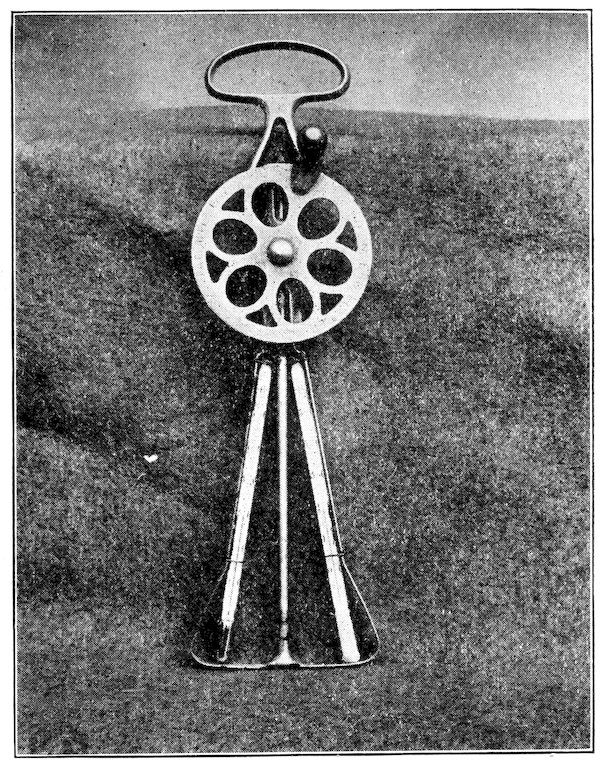
Fig. 6. Cog psychrometer.
62. Readings. All observations should be made facing the wind, and the observer should move one or two steps during the reading to prevent the possibility of error. The cloth of the wet bulb is moistened with water by means of a brush, or, much better, it is dipped directly into a bottle of water. Distilled water is preferable, as it contains no dissolved material to accumulate in the cloth. Tap-water and the water of streams may be used without appreciable error, if the cloth is changed somewhat more frequently. The temperature of the water is practically negligible under ordinary conditions. Readings can be made more quickly, however, when the temperature is not too far from that of the air. The psychrometer is held firmly and swung rapidly through the air when the space is not too confined. Where there is danger of breakage, it is swung back and forth through a short arc, pendulum-fashion. As the reading must be made when the mercury of the wet bulb reaches the lowest point, the instrument is stopped from time to time and the position of the column noted. The lowest point is often indicated by the tendency of the mercury to remain stationary; as a rule it can be noted with certainty when the next glance shows a rise in the column. In following the movement, and especially in noting the final reading, great care must be taken to make the latter before the mercury begins to rise. For this reason it is desirable to shade the psychrometer with the body when looking at it, and to take pains not to breathe upon the bulbs nor to bring them too near the body. At the moment when the wet bulb registers the lowest point, the dry bulb should be read and the results recorded.
63. Cog psychrometer. This instrument, commonly called the “egg-beater” psychrometer, has been devised to obviate certain disadvantages of 40the sling psychrometer in field work, and has entirely supplanted the latter in the writer’s own studies. It is smaller, more compact, and the danger of breaking in carriage or in use is almost nil. It has the great advantage of making it possible to take readings in a layer of air less than two inches in thickness, and in any position. Fairly accurate results can even be obtained from transpiring leaves. The instrument can readily be made by a good mechanic, at a cost for materials of $1.75, which is less than half the price for the sling form. A single drawback exists in the use of short, Centigrade thermometers, inasmuch as tables of relative humidity are usually expressed in Fahrenheit. It is a simple matter, however, to convert Centigrade degrees into Fahrenheit, mentally, or the difficulty may be avoided by the conversion table shown on page 47, or by constructing a Centigrade series of humidity tables. The fact that the wet and dry bulbs revolve in the same path has raised a doubt concerning the accuracy of the results obtained with this instrument. Repeated comparisons with the sling psychrometer have not only removed this doubt completely, but have also proved that the standardization of the thermometers has been efficient.
64. Construction and use. A convenient form of egg-beater is the Lyon (Albany, New York), in which the revolving plates can be readily removed, leaving the axis and the frame. The thermometers used are of the short Centigrade type. They are 4½ inches long and read from –5° to 50°. Eimer and Amend, 205 Third Ave., New York city, furnish them at 75 cents each. The thermometers are carefully standardized and compared, and then grouped in pairs that read together. Each pair is used to construct a particular psychrometer. Each thermometer is strongly wired to one side of the frame, pieces of felt being used to protect the tube and increase the contact. The frame is also bent at the base angles to permit free circulation of air about the thermometer bulbs. The bulb of one thermometer is covered with the proper cloth, and the psychrometer is finished. Since the frame revolves with the thermometers, it is necessary to pour the water on the wet bulb, or to employ a pipette or brush. The thermometer bulbs are placed in the layer to be studied, and the frame rotated at an even rate and with moderate rapidity. The observation is further made as in the case of the sling psychrometer. As the circle of rotation is less than three inches in diameter, and the layer less than an inch, in place of nearly three feet for the sling form, the instrument should not be moved at all for extremely localized readings, but it must be moved considerably, a foot or more, if it is desirable to obtain a more general reading.
65. Hygrometers. While there are instruments designed to indicate the humidity by means of a hygroscopic substance, not one of them seems to 41be of sufficient accuracy for use in ecological study. The difficulty is that the hygroscopic reaction is inconstant, rather than that the instruments are not sufficiently sensitive. A number of hygrometers have been tested, and in all the error has been found to be great, varying usually from 10–20 per cent. In the middle of the scale they sometimes read more accurately, but toward either extreme they are very inexact. It seems probable that an accurate hygrometer can be constructed only after the model of the Draper psychrograph. Its weight and bulk would make it an impossible instrument for field trips, and the expense of one would provide a dozen psychrometers. In consequence, it does not seem too sweeping to say that no hygrometer can furnish trustworthy results. Of simple instruments for humidity, the psychrometer alone can be trusted to give reliable readings. Crova’s hygrometer, used by Hesselmann, is not a hygrometer in the sense indicated. As it is much less convenient to handle and to operate than the cog psychrometer, it is not necessary to describe it.
Psychrographs
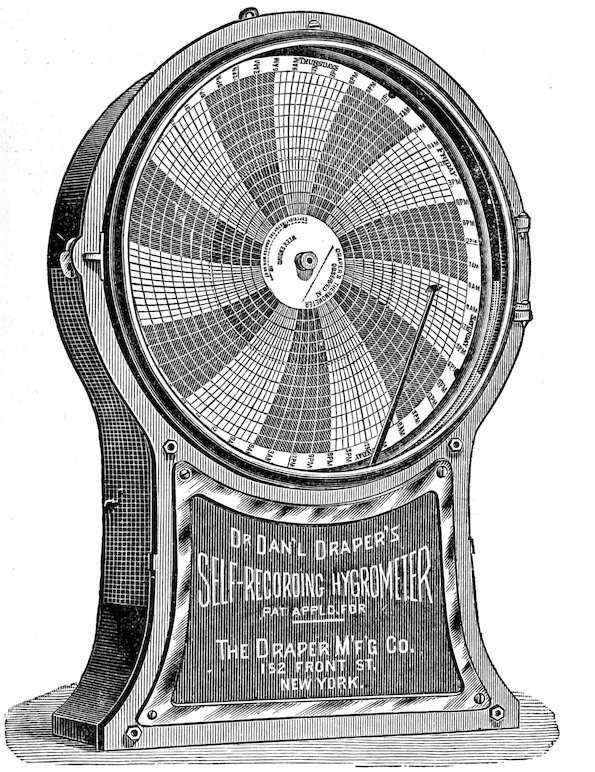
Fig. 7. Draper psychrograph.
66. The Draper psychrograph. A year’s trial of the Draper psychrograph in field and planthouse has left little question of its accuracy and its great usefulness. Essentially, it consists of a band of fine catgut strings, which are sensitive to changes in the moisture-content of the air. The variations in the length of the band are communicated to a long pointer carrying an inking pen. The latter traces the record in per cent of relative humidity on a graduated paper disk, which is practically the face of an eight-day clock. The whole is enclosed in a metal case with a glass front. A glance at the illustration will show the general 42structure of the instrument. Continued psychrometric tests demonstrate that the margin of error is well within the efficient difference for humidity, which is taken to be 5 per cent. In the field tests of the past summer, two psychrographs placed side by side in the same habitat did not vary 1 per cent from each other. The same instruments when in different habitats did not deviate more than 1 per cent from the psychrometric values, except when the air approached saturation. For humidities above 90 per cent, the deviation is considerable, but as these are temporary and incident upon rainfall, the error is not serious. For humidities varying from 10–85 per cent, the psychrograph is practically as accurate as the psychrometer. Per cents below 10 are rare, and no tests have been made for them.
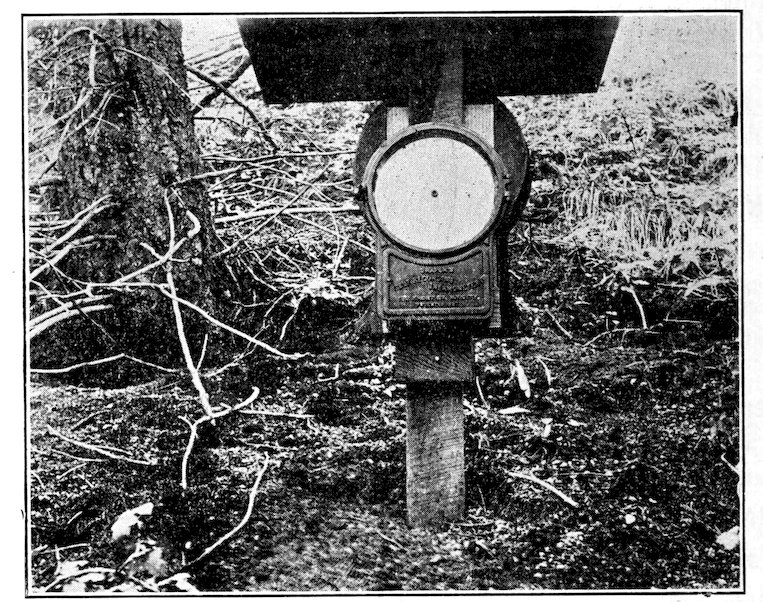
Fig. 8. Instrument shelter, showing thermograph and psychrograph in position.
67. Placing the instrument. The psychrograph should be located in a place where the circulation of the air is typical of the station observed. A satisfactory shelter will screen the instrument from sun and rain, and at the same time permit the air to pass freely through the perforations of the metal case. The form shown in figure 8 meets both of these conditions. A desirable modification is effected by fastening a strip about the cover of such depth as to prevent the sun’s rays from striking the case except when the sun is near the horizon. A cross block is fastened on the 43post of the shelter after being exactly leveled. The psychrograph rests upon this block, which is three feet above the ground in order to avoid the influence of radiation. The instrument is held in position by slipping the eye over a small-headed nail driven obliquely. It does not hang from the latter, but must rest firmly upon the cross block. The post is set to a depth that prevents oscillation in the wind, which is liable to obscure the record. In shallow mountain soils stability is attained by fastening a broad board at the base of the post before setting it. When two or more psychrographs are established in different habitats, great pains are taken to set them up in exactly the same way. The shelters are alike, the height above the soil the same, and the instruments all face the south.
68. Regulating and operating the instrument. When two or more psychrographs are to be used in series, they must be compared with each other in the same spot for several days until they run exactly together with respect to per cent of humidity and to time. During this comparison they are checked by the psychrometer and so regulated that they register the proper humidity. When a single instrument is used alone as the basis to which simple readings may be referred, all regulating may well be done after the instrument is in position. This is a simple process; it is accomplished by obtaining the relative humidity beneath the shelter and at the proper height by a psychrometer. The pen hand is then moved to the proper line on the disk by means of the screws at its base. These are reached by removing the lettered glass face. The thumbscrew on the side opposite the direction in which the pen is to move is released, and the opposite screw simultaneously tightened, until the pen remains upon the proper line. Experience has proved that the record sheet should be correctly labeled and dated before being placed on the disk. In the press of field duties, records labeled after removal are liable to be confused. It is likewise a great saving of time to write the date of the month in the margin of each segment. Care is taken to place the sheet on the disk in the same position each time; this can easily be done by seeing that the sharp point on the disk penetrates the same spot on the paper. A single drop of ink in the pen will usually give the most satisfactory line. A thin line is read most accurately. If the pen point is too fine, however, the ink does not flow readily, and the point should be slightly blunted by means of a file. More often the line is too broad and the pen must be carefully pointed. Occasionally the pen does not touch the sheet, and it becomes necessary to bend the hand slightly. This is a frequent difficulty if the records are folded or wrinkled, and consequently the sheets should always be kept flat.
4469. The weekly visit. Psychrographs must be visited, checked, rewound, and inked every week. Whenever possible this should be done regularly at a specified day and hour. This is especially desirable if the same record sheet is used for more than one week. Time and energy are saved by a fixed order for the various tasks to be done at each visit. After opening the instrument the disk is removed, and the clock wound, and, if need be, regulated. The record sheet is replaced, the disk again put on the clock arbor, and the pen replenished with a drop of ink. A psychrometer reading is made, and the results in terms of relative humidity noted at the proper place on the disk sheet. If the psychrograph vary more than 1 per cent, it is adjusted to read accurately. In practice it has been found a great convenience to keep each record sheet in position for three weeks, and the time may easily be extended to four. In this event, the pen is carefully cleaned with blotting paper at each visit, and is then refilled with an ink of different color. To prevent confusion, the three different colored inks are always used in the same order, red for the first week, blue for the second, and green for the third. The advantages of this plan are obvious: fewer records are used and less time is spent in changing them. The records of several weeks are side by side instead of on separate sheets, and in working over the season’s results, it is necessary to handle but a third as many sheets.
The Draper psychrograph is made by the Draper Manufacturing Company, 152 Front St., New York city. The price is $30. A few record sheets and a bottle of red ink are furnished with it. Additional records can be obtained at 3 cents each. The inks are 25–50 cents per bottle, depending upon the color.
Humidity Readings and Records
70. The time of readings. If simple instruments alone are used for determining humidity, readings are practically without value unless made simultaneously through several stations, or successively at one. When it is possible to combine these, and to make psychrometer readings at different habitats for each hour of the day, or at the same hour for several days, the series is of very great value. Single readings are unreliable on account of the hourly and daily variations of humidity, but when these changes are recorded by a psychrograph, such readings at once become of use, whether made in the same habitat with the recording instrument or elsewhere. In the latter case, one reading will tell little about the normal humidity of the habitat, but several make a close estimate possible. When a series of psychrographs is in use, accurate observations can be made to advantage anywhere at any time. As a rule, however, it has been found most convenient 45to make simple readings at 6:00 A.M., 1:00 P.M., and 6:00 P.M., as these hours afford much evidence in regard to the daily range. A good time also is that at which the temperature maximum occurs each day, but this is movable and in the press of field work can rarely be taken advantage of. A very fair idea of the daily mean humidity is obtainable by averaging the readings made at the hours already indicated. The comparison of single readings with the psychrograph record should not be made at a time when a rapid change is occurring, as the automatic instrument does not respond immediately. Such a condition is usually represented by a sudden rain, and is naturally not a satisfactory time for single readings in any event.
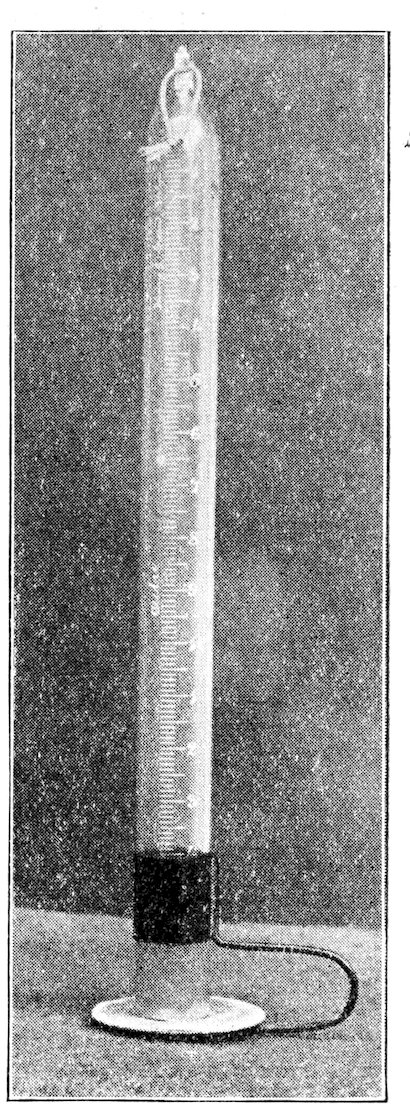
Fig. 9. Atmometer.
71. Place and height. As stated above, the psychrograph is placed three feet above the surface of the ground in making readings for the comparison of stations. In low, herbaceous formations, the instrument is usually placed within a few inches of the soil in order to record the humidity of the air in which the plants are growing. In forest formations, the moisture often varies considerably in the different layers. This variation is easily determined by simultaneous psychrometer readings in the several layers, or, if occasion warrants, a series of psychrographs may be used. In field work the rule has been to make observations with the psychrometer at 6 feet, 3 feet, and the surface of the soil, but the reading at the height of 3 feet is ordinarily sufficient. Humidity varies so easily that several readings in different parts of one formation are often desirable. In comparing different formations, the readings should be made in corresponding situations, for example, in the densest portion of each.
72. Check instruments. Humidity is so readily affected by temperature, wind, and pressure, that a knowledge of these factors is essential to an understanding of its fluctuations. Pressure, disregarding daily variation, is taken account of in the tables for ascertaining relative humidity, and is determined once for all when the altitude of a station has been carefully established. The temperature is obtained directly from the dry bulb reading. Its value is fundamental, as the amount of moisture in a given space is directly affected by it; like pressure, it also is taken account of in the formula. The movement of the air has an immediate influence 46upon moisture by mixing the air of different habitats and layers. So far as the plant is concerned, it has practically the effect of increasing or decreasing the humidity by the removal of the air above it. Thus, while the anemometer can furnish no direct evidence as to the amount of variation, it is of aid in explaining the reason for it. Likewise, the rate of evaporation as indicated by a series of atmometers, affords a ready method of estimating the comparative effect of humidity in different habitats. Potometers and other instruments for measuring transpiration throw much light upon humidity values. Since they are concerned with the response of the plant to humidity, they are considered in the following chapter.
73. Humidity tables. To ascertain the relative humidity, the difference between the wet and dry bulb readings is obtained. This, with the dry bulb temperature, is referred to the tables, where the corresponding humidity is found. A variation in temperature has less effect than a variation in the difference; in consequence, the dry bulb reading is expressed in the nearest unit, and the difference reckoned to the nearest .5. The humidity varies with the air pressure. Hence, the altitude must be determined for the base station, and for all others that show much change in elevation. Within the ordinary range of growing-period temperatures, the effect of pressure is not great. For all ordinary cases, it suffices to compute tables for pressures of 30, 29, 27, 25, and 23 inches. The following table indicates the decrease in pressure which is due to altitude.
ALTITUDE PRESSURE
Feet Meters Inches Centimeters
0 0 30 76
910 277 29 73.5
1850 574 28 71
2820 860 27 68.5
3820 1165 26 66
4850 1477 25 63.5
5910 1792 24 61
7010 2138 23 58.5
8150 2485 22 56
9330 2845 21 53.5
10550 3217 20 51
13170 4016 18 46
16000 4880 16 41
The fluctuations of pressure due to weather are usually so slight that their influence may be disregarded. An excellent series of tables of relative humidity is found in Marvin’s Psychrometric Tables, published by the U. S. Weather Bureau, and to be obtained from the Division of Publications, Washington, D. C., for 10 cents. A convenient field form is made by removing the portion containing the tables of relative humidity, and binding it in stiff oilcloth.
47
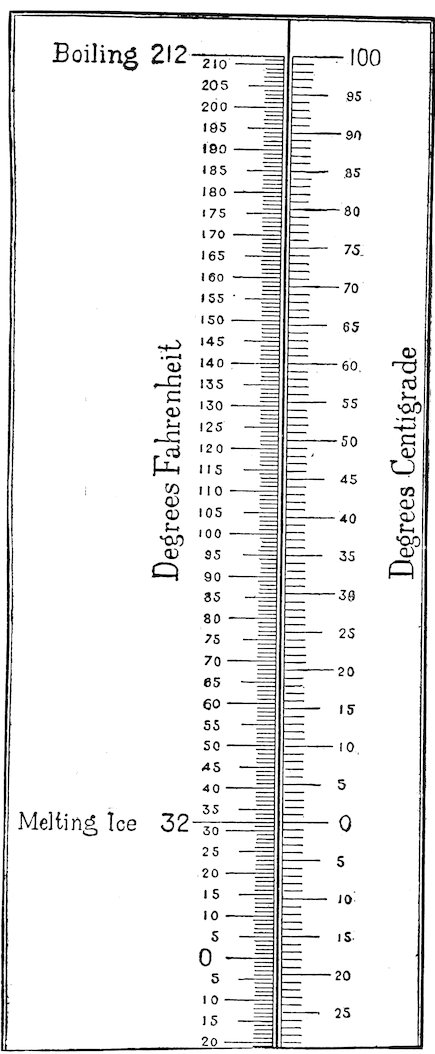
Fig. 10. Conversion scale for temperatures.
74. Sums, means, and curves. An approximate humidity sum can be obtained by adding the absolute humidities for each of the twenty-four hours, and expressing the results in grains per cubic foot. It is possible to establish a general ratio between this sum and the transpiration sum of the plant, but its value is not great at present. Means of absolute and of relative humidity are readily determinable from the psychrograph records; the latter are the most useful. The mean of relative humidity for the twenty-four hours of a day is the average of the twenty-four hour humidities. From these means the seasonal mean is computed in the same manner. A close approximation, usually within 1 degree, may be obtained in either case by averaging the maximum and minimum for the period concerned. Various kinds of curves are of value in representing variation in humidity. Obviously, these must be derived from the psychrograph, or from the psychrometer when the series is sufficiently complete. The level curve indicates the variation in different stations at the same time. 48These may be combined in a series for the comparison of readings made at various heights in the stations. The day or point curve shows the fluctuations during the day of one point, and the station curve the variation at different heights in the same station. The curves of successive days or of different stations may of course be combined on the same sheet for comparison. Level and station curves based upon mean relative humidities are especially valuable.
75. Records. A field form is obviously unnecessary for the psychrograph. The record sheets constitute both a field and permanent record. The altitude and other constant features of the station and the list of species, etc., are entered on the back of the first record sheet, or, better, they are noted in the permanent formation record. For psychrometer readings, whether single or in series, the following record form is employed:
Date Hour Formation Station Altitude Community Height of reading Dry bulb Wet bulb Diff. Rel. Hum. Base Hum. Abs. Hum. NOTES
Sky Rain Wind
15/8/’04 6:20 A.M. Spruce Brook bank 2500 m Mertensiare 1 ft. 51° 46° 5 72% 63% 2.9 Clear 0 0
„ „ Half gravel Hiawatha „ Asterare „ 56° 49° 7 64% 63% 3.0 „ 0 0
„ 6:45 P.M. Spruce Brook bank „ Mertensiare „ 54° 52° 2 89% 69% 4.2 „ 2 cc. 0
„ „ Half gravel Hiawatha „ Asterare „ 56° 52° 4 79% 69% 4.0 „ 2 cc. 0
On page 47 is given a table for the conversion of Centigrade into Fahrenheit temperatures. This may be done mentally by means of the formula F = C/5 × 9 + 32°.
LIGHT
76. Methods. All methods for measuring light intensity, which have been at all satisfactory, are based upon the fact that silver salts blacken in the light. The first photographic method was proposed by Bunsen and Roscoe in 1862; this has been taken up by Wiesner and variously modified. After considerable experiment by the writer, however, it seemed desirable to abandon all methods which require the use of “normal paper” and “normal black” and to develop a simpler one. As space is lacking for a satisfactory discussion of the Bunsen-Roscoe-Wiesner methods, the reader is referred to the works cited below.[4] Simple photometers for making light readings simultaneously 49or in series were constructed in 1900, and have been in constant use since that time. An automatic instrument capable of making accurate continuous records proved to be a more difficult problem. A sunshine recorder was ultimately found which yields valuable results, and very recently a recording photometer which promises to be perfectly satisfactory has been devised. Since the hourly and daily variations of sunlight in the same habitat are relatively small, automatic photometers are perhaps a convenience rather than a necessity.
The Photometer
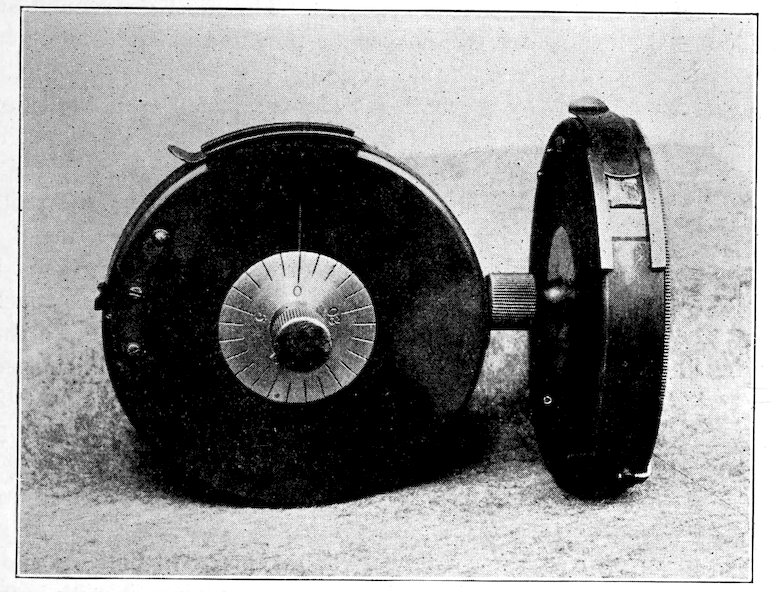
Fig. 11. Photometer, showing front and side view.
77. Construction. The simple form of photometer shown in the illustration is a light-tight metal box with a central wheel upon which a strip of photographic paper is fastened. This wheel is revolved by the thumbscrew past an opening 6 mm. square which is closed by means of a slide working closely between two flanges. At the edge of the opening, and beneath the slide is a hollow for the reception of a permanent light standard. The disk of the thumbscrew is graduated into twenty-five parts, and these are numbered. A line just beneath the opening coincides with 50the successive lines on the disk, and indicates the number of the exposure. The wheel contains twenty-five hollows in which the click works, thus moving each exposure just beyond the opening. The metal case is made in two parts, so that the bottom may be readily removed, and the photographic strip placed in position. The water-photometer is similar except that the opening is always covered with a transparent strip and the whole instrument is water-tight. These instruments have been made especially for measuring light by the C. H. Stoelting Co., 31 W. Randolph street, Chicago, Ill. The price is $5.
78. Filling the photometer. The photographic paper called “solio” which is made by the Eastman Kodak Company, Rochester, N. Y., has proved to be much the best for photometric readings. The most convenient size is that of the 8 × 10 inch sheet, which can be obtained at any supply house in packages of a dozen sheets for 60 cents. New “emulsions,” i. e., new lots of paper, are received by the dealers every week, but each emulsion can be preserved for three to six months without harm if kept in a cool, light-tight place. Furthermore, all emulsions are made in exactly the same way, and it has been impossible to detect any difference in them. To fill the photometer, a strip exactly 6 mm. wide is cut lengthwise from the 8 × 10 sheet. This must be done in the dark room, or at night in very weak light. The strip is placed on the wheel, extreme care being taken not to touch the coated surface, and fixed in position by forcing the free ends into the slit of the wheel by a piece of cork 8–9 mm. long. The wheel is replaced in the case, turned until the zero is opposite the index line, and the instrument is ready for use.
79. Making readings. An exposure is made by moving the slide quickly in such a way as to uncover the entire opening, and the standard if the exposure is to be very short. Care must be taken not to pull the slide entirely out of the groove, as it will be impossible to replace it with sufficient quickness. The time of exposure can be determined by any watch after a little practice. It is somewhat awkward for one person to manage the slide properly when his attention is fixed upon a second hand. This is obviated by having one observer handle the watch and another the photometer, but here the reaction time is a source of considerable error. The most satisfactory method is to use a stop-watch. This can be held in the left hand and started and stopped by the index finger. The photometer is held against it in the right hand in such a way that the two movements of stopping the watch and closing the slide may be made at the same instant. The length of exposure is that necessary to bring the tint of the paper to that of the 51standard beside it. A second method which is equally advantageous and sometimes preferable does away with the permanent standard in the field and the need for a stop-watch. In this event, the strip is exposed until a medium color is obtained, since very light or very deep prints are harder to match. This is later compared with the multiple standard. In both cases, the date, time of day, station, number of instrument and of exposure, and the length of the latter in seconds are carefully noted. The instrument is held with the edge toward the south at the level to be read, and the opening uppermost in the usual position of the leaf. When special readings are desired, as for isophotic leaves, reflected light, etc., the position is naturally changed to correspond. In practice, it is made an invariable rule to move the strip for the next exposure as soon as the slide is closed. Otherwise double exposures are liable to occur. When a strip is completely exposed it is removed in the dark, and a new one put in place. The former is carefully labeled and dated on the back, and put away in a light-tight box in a cool place.
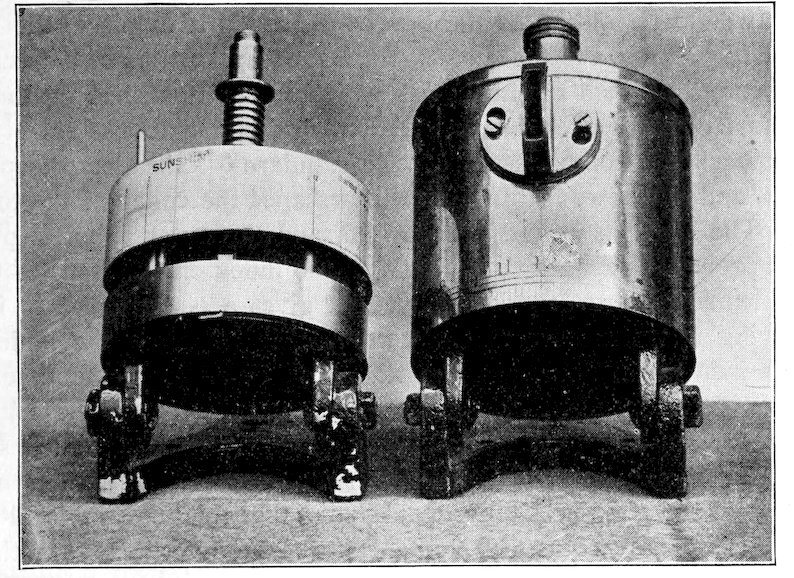
Fig. 12. Dawson-Lander sun recorder.
80. The Dawson-Lander sun recorder. “The instrument consists of a small outer cylinder of copper which revolves with the sun, and through the side of which is cut a narrow slit to allow the sunshine to impinge on a strip of sensitive paper, wound round a drum which fits closely inside the outer cylinder, but is held by a pin so that it can not rotate. By means of 52a screw fixed to the lid of the outer cylinder, the drum holding the sensitive paper is made to travel endwise down the outer tube, one-eighth of an inch daily, so that a fresh portion of the sensitive surface is brought into position to receive the record.” The instrument is driven by an eight-day clock placed in the base below the drum. The slit is covered by means of a flattened funnel-shaped hood, and the photographic strip is protected from rain by a perfectly transparent sheet of celluloid. The detailed structure of the instrument is shown in figure 12. This instrument may be obtained from Lander and Smith, Canterbury, England, for $35.
In setting up the sunshine recorder, the axis should be placed in such a position that the angle which it makes with the base is the same as the altitude of the place where the observations are made. This is readily done by loosening the bolts at either side. The drum is removed, the celluloid sheet unwound by means of the key which holds it in place, the sensitive strip put in position, and the sheet again wound up. Strips of a special sensitive paper upon which the hours are indicated are furnished by the makers of the instrument, but it has been found preferable to use solio strips in order to facilitate comparison with the standards. The drum is placed on the axis, and is screwed up until it just escapes the collar at the top of the spiral. The clock is wound and started, and the outer cylinder put on so that the proper hour mark coincides with the index on the front of the base.
As a sunshine recorder, the instrument gives a perfect record, in which the varying intensities are readily recognizable. Since the cylinder moves one-half inch in an hour, and the slit is .01 of an inch, the time of each exposure is 72 seconds. This gives a very deep color on the solio paper, which results in a serious error in making comparisons with the standard. On account of the hood, diffuse light is not recorded when it is too weak to cast a distinct shadow. It seems probable that this difficulty will be overcome by the use of a flat disk containing the proper slit, and in this event the instrument will become of especial value for measuring the diffuse light of layered formations. The celluloid sheet constitutes a source of error in sunlight on account of the reflection which it causes. This can be prevented by using the instrument only on sunny days, when the protection of the sheet can be dispensed with.
81. The selagraph. This instrument is at present under construction, and can only be described in a general way. In principle it is a simple photometer operating automatically. It consists of a light-tight box preferably of metal, which contains an eight-day lever clock. Attached to the arbor of the latter is a disk 7 inches in diameter bearing on its circumference a solio strip 1 cm. wide and 59 cm. long. The opening in the box 53for exposure is 6 mm. square and is controlled by a photographic shutter. The latter is constructed so that it may be set for 5, 10, or 20 seconds, since a single period of exposure can not serve for both sun and shade. The shutter is tripped once every two hours, by means of a special wheel revolving once a day. Each exposure is 6 mm. square, and is separated by a small space from the next one. Twelve exposures are made every 24 hours, and 84 during the week, though, naturally, the daytime exposures alone are recorded. Comparisons with the multiple standard are made exactly as in the case of the simple photometer. The selagraph is made by the C. H. Stoelting Co., Chicago, Illinois.
Standards
82. Use. The light value of each exposure is determined by reference to a standard. When the photometer carries a permanent standard, each exposure is brought to the tint of the latter, and its value is indicated by the time ratio between them. Thus, if the standard is the result of a 5–second exposure to full sunlight at meridian, and a reading which corresponds in color requires 100 seconds in the habitat concerned, the light of the latter is twenty times weaker or more diffuse. Usually, the standard is regarded as unity, and light values figured with reference to it, as .05. With the selagraph such a use of the standard is impossible, and often, also, with the photometer it is unnecessary or not desirable. The value of each exposure in such case is obtained by matching it with a multiple standard, after the entire strip has been exposed. The further steps are those already indicated. After the exact tint in the standard has been found, the length of the reading in seconds is divided by the time of the proper standard, and the result expressed as above.
83. Making a standard. Standards are obtained by exposing the photometer at meridian on a typically clear day, and in the field where there is the least dust and smoke. Exception to the latter may be made, of course, in obtaining standards for plant houses located in cities, though it is far better to have the same one for both field and control experiment. Usable standards can be obtained on any bright day at the base station. Indeed, valuable results are often secured by immediate successive sun and shade readings in adjacent habitats, where the sun reading series is the sole standard. Preferably, standards should be made at the solstices or equinoxes, and at a representative station. The June solstice is much to be preferred, as it represents the maximum light values of the year. Lincoln has been taken as the base station for the plains and mountains. It is desirable, however, 54that a national or international station be ultimately selected for this purpose, in order that light values taken in different parts of the world may be readily compared.
84. Kinds of standards. The base standard is the one taken at Lincoln (latitude 41° N.) at meridian June 20–22. This is properly the unit to which all exposures are referred, but it has been found convenient to employ the Minnehaha standard as the base for the Colorado mountains, in order to avoid reducing each time. Relative standards are frequently used for temporary purposes. Thus, in comparing the light intensities of a series of formations, one to five standards are exposed on the solio strip before beginning the series of readings. Proof standards are the exposed solio strips, which fade in the light, and can, in consequence, be kept only a few weeks without possibility of error. The fading can be prevented by “toning” the strip, but in this event the exposures must be fixed in like manner before they can be compared. This process is inconvenient and time-consuming. It is also open to considerable error, as the time of treatment, strength of solution, etc., must be exactly equivalent in all instances. Permanent standards are accurate water-color copies of the originals obtained by the photometer. These have the apparent disadvantage of requiring a double comparison or matching, but after a little practice it is possible to reproduce the solio tints so that the copy is practically indistinguishable from the original. The most satisfactory method is to make a long stroke of color on a pure white paper, since a broad wash is not quite homogeneous, and then to reject such parts of the stroke as do not match exactly. Permanent standards fade after a few month’s use, and must be replaced by parts of the original stroke. Single standards are made by one exposure, while multiple ones have a series of exposures filling a whole light strip. These are regularly obtained by making the exposures from 1–10 seconds respectively, and then increasing the length of each successive exposure by 2 seconds. Single exposures of 1–5 seconds as desired usually serve as the basis for permanent standards, but a multiple standard may also be copied in permanent form. Exposures for securing standards must be made only under the most favorable conditions, and the length in seconds must be exact. The use of the stop-watch is imperative, except where access may be had to an astronomical clock with a large second hand, which is even more satisfactory. The length of time necessary for the series desired is reckoned beforehand, and the exposures begun so that the meridian falls in the middle of the process.
Single standards are exceedingly convenient in photometer readings, but they are open to one objection. In the sunshine it is necessary to make instant decision upon the accuracy of the match, or the exposure becomes too 55deep. In the shade where the action is slower, this difficulty is not felt. For this reason it is usually desirable to check the results by a multiple standard, and in the case of selagraph records, where the various exposures show a wide range of tint, light values are obtainable only by direct comparison with the multiple standard. The exact matching of exposure and standard requires great accuracy, but with a little practice this may be done with slight chance of error by merely moving the exposure along the various tints of the standard until the proper shade is found. The requisite skill is soon acquired by running over a strip of exposures several times until the comparisons always yield the same results for each. The margin of error is practically negligible when the same person makes all the comparisons, and in the case of two or three working on the same reading the results diverge little or not at all. The efficient difference for light is much more of a variable than is the case with water-content. It has been determined so far only for a few species, all of which seem to indicate that appreciable modification in the form or structure of a leaf does not occur until the reduction in intensity reaches .1 of the meridian sunlight at the June solstice. The error of comparison is far less than this, and consequently may be ignored, even in the most painstaking inquiry.
Readings
85. Time. The intensity of the light incident upon a habitat varies periodically with the hour and the day, and changes in accord with the changing conditions of the sky. The light variations on cloudy days can only be determined by the photometer. While these can not be ignored, proper comparisons can be instituted only between the readings taken on normal days of sunshine. The sunlight varies with the altitude of the sun, i. e., the angle which its rays make with the surface at a given latitude. This angle reaches a daily maximum at meridian. The yearly maximum falls on June 22, and the angle decreases in both directions through the year to a minimum on December 22. At equal distances from either solstice, the angle is the same, e. g., on March 21 and September 23. At Lincoln (41° N. latitude) the extremes at meridian are 73° and 26°; at Minnehaha (39°) they are 75° and 28°. The extremes for any latitude may be found by subtracting its distance in degrees north of the two tropics from 90. Thus, the 50th parallel is 26.5° north of the tropic of Cancer, and the maximum altitude of the sun at a place upon it is 63.5°. It is 73.5° north of the tropic of Capricorn, and the minimum meridional altitude is 16.5°.
The changes in the amount of light due to the altitude of the sun are produced by the earth’s atmosphere. The absorption of light rays is greatest near the horizon, where their pathway through the atmosphere is longest, 56and it is least at the zenith. The absorption, and, consequently, the relative intensity of sunlight, can be determined at a given place for each hour of any sunshiny day by the use of chart 13. This chart has been constructed for Lincoln, and will serve for all places within a few degrees of the 40th parallel. The curves which show the altitude of the sun at the various times of the day and the year have been constructed by measurements upon the celestial globe. Each interval between the horizontal lines represents 2 degrees of the sun’s altitude. The vertical lines indicate time before or after the apparent noon, the intervals corresponding to 10 minutes. If the relative intensity at Lincoln on March 12 at 3:00 P.M. is desired, the apparent noon for this day must first be determined. A glance at the table shows that the sun crosses the meridian on this day at 9 minutes 53 seconds past noon at the 90th meridian. The apparent noon at Lincoln is found by adding 26 minutes 49 seconds, the difference in time between Lincoln and a point on the 90th meridian. When the sun is fast, the proper number of minutes is taken from 26 minutes 49 seconds. The apparent noon on March 12 is thus found to fall at 12:37 P.M., and 3:00 P.M. is 2 hours and 23 minutes later. The sun’s altitude is accordingly 36°. If the intensity of the light which reaches the earth’s surface when the sun is at zenith is taken as 1, the table of the sun’s altitudes gives the intensity at 3:00 P.M. on March 12 as .85.