Front matter
Reading edition
QUEENS OF THE FRENCH STAGE
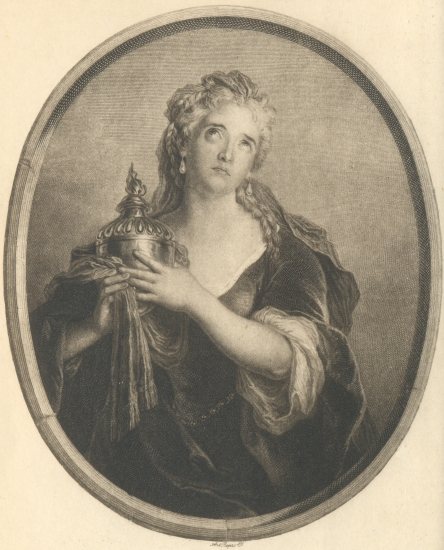
Adrienne Lecouvreur. After the painting by Charles Coypel
QU E E N S O F T H E F R E N C H S T A G E
BY H. NOEL WILLIAMS AUTHOR OF "MADAME RÉCAMIER AND HER FRIENDS," "MADAME DE POMPADOUR," "MADAME DE MONTESPAN," "MADAME DU BARRY," ETC. NEW YORK CHARLES SCRIBNER'S SONS 153-157 FIFTH AVENUE 1905
CONTENTS
PAGE
I.THE WIFE OF MOLIÈRE1
II.MARIE DE CHAMPMESLÉ87
III.ADRIENNE LECOUVREUR127
IV.MADEMOISELLE DE CAMARGO 197
V.JUSTINE FAVART223
VI.MADEMOISELLE CLAIRON273
INDEX: A, B, C, D, E, F, G, H, I, J, K, L, M, N, O, P, Q, R, S, T, V, W, X, Z 353
LIST OF ILLUSTRATIONS
Adrienne Lecouvreur. (Photogravure)Frontispiece
After the painting by Charles Coypel
Armande Béjartto face page24
After a contemporary drawing in the collection of M. Henry Houssaye, of the Academia Française
Jean Racine" 96
From an engraving by Vertue
Maurice de Saxe"168
After the painting by Hyacinthe Rigaud
Mademoiselle Prévost"200
After the painting by Jean Raoux, in the Music of Tours
Mademoiselle de Camargo"208
From the painting by Lancret, in the Wallace Collection at Hertford House
Justine Favart"240
After the drawing by Charles Nicolas Cochin fils
Mademoiselle Clairon"296
After the painting by Carle Van Loo
Elizabeth Berkeley, Countess of Craven (afterwards Margravine of Anspach)"344
After the drawing by Sir Joshua Reynolds
QUEENS OF THE FRENCH STAGE
I THE WIFE OF MOLIÈRE
FEW women in French history have been the subject of more discussion than the young girl whom Molière married, at the church of Saint-Germain l'Auxerrois, on February 20, 1662.
Armande Grésinde Claire Elisabeth Béjart, for that was the bride's name, is described in the marriage deed as the daughter of the late Joseph Béjart, écuyer, sieur de Belleville, and of his widow, Marie Hervé. Joseph Béjart, it should be stated, had died shortly before, or shortly after, Armande's birth.
The Béjarts were very poor, for the only means which Joseph seems to have possessed wherewith to maintain his pretensions to nobility were derived from a small government appointment (huissier ordinaire du roy ès eaux et forêts de France), and his wife had presented him with "at least eleven children." They lived in the Marais, then the theatrical quarter of Paris. On its northern outskirts, near the Halles, in the Rue Mauconseil, stood the old Hôtel de Bourgogne, the first home of the regular drama; in the centre, in the Rue Vieille-du-Temple, was the theatre which took its name from the quarter, the Théâtre du Marais, where Corneille's Cid was first performed; while nearer the Seine, the playgoer could make choice between the Italian troupes, the Trois Farceurs, Gaultier-Garguille, Gros-Guillaume, and Turlupin,[1] and open-air entertainments on the Pont-au-Change, the Pont-Neuf, and the Place Dauphine. It is, therefore, not surprising that the little Béjarts should have been in the habit of varying the monotony of their poverty-stricken lives by occasional visits to one or other of these spectacles, or that, dazzled by those well-known attractions, which were doubtless as potent in the seventeenth century as they are to-day, the two eldest, Joseph and Madeleine, should have decided, while still very young, to make the stage their profession.
What theatre witnessed their débuts we do not know. The majority of authors are of opinion that they joined a company of strolling players which was at this time exploiting Languedoc; M. Larroumet hesitates between one of the unlicensed playhouses of the fairs in the neighbourhood of Paris and a troupe of amateurs, several of which were to be found in the capital; while another of Madeleine's biographers, M. Henri Chardon, thinks that she obtained admission to the Théâtre du Marais, though it appears very improbable that a young and inexperienced actress could have met with such good fortune.
However that may be, Madeleine seems to have prospered in her profession from the very outset, as on January 10, 1636, supported by her curateur, one Simon Courtin, her father, a paternal uncle, a "chef du gobelet du roi," and divers other relatives and friends, she appears before the Civil Lieutenant of Paris[2] to request permission to contract a loan of 2000 livres, wherewith to supplement a like sum of her own and enable her to acquire a little house and garden situated in the Cul-de-Sac Thorigny.
Two and a half years later (July 11, 1638), we hear of her again, under circumstances which perhaps explain her desire to secure a residence of her own—a desire, it must be admitted, not a little singular in a young lady of eighteen—for on that day is baptized at Saint-Eustache "Françoise, daughter of Esprit Raymond, chevalier, seigneur de Modène and other places, chamberlain of the affairs of Monseigneur, only brother of the King, and of the demoiselle Madeleine Béjart."
M. de Modène and Madeleine were not married; indeed, there was already a Madame de Modène, residing at Le Mans, who did not die until 1649. But this trifling accident, as it was regarded in those days, did not prevent the son of the former (by proxy)[3] and the mother of the latter (in person) standing as sponsors to the little Françoise, whose birth was fated to be the cause of much trouble, not to her guilty parents, but to two perfectly innocent persons, one of whom was as yet unborn.
A few words must here be said of the father of Madeleine Béjart's child.
Esprit Raymond de Mormoiron, Comte de Modène, who was then about thirty years of age, came of an old family in the Venaissin. His father, François Raymond de Mormoiron, had at one time held the office of Grand Provost of France and had also been employed on several diplomatic missions. Appointed page to Gaston d'Orléans, brother of Louis XIII., he became later one of the chamberlains of that prince, and seems to have done his best to imitate him in his dissipated and turbulent conduct. He early ranged himself among the enemies of Richelieu, joined the famous league "for the universal peace of Christendom," and fought on its behalf at the battle of La Marfée, at the head of a body of cavalry which he had raised at his own expense. In consequence of this, he was condemned to death, by a decree of the Parliament of Paris (September 6, 1641), but took refuge in Flanders, with the Duc de Guise, against whom a similar sentence had been pronounced, and remained there until the death of Richelieu, followed by that of Louis XIII., left him at liberty to return to France. When, in 1647, Guise went to Naples, to endeavour to exploit the revolt of Masaniello to his own advantage, Modène accompanied him and greatly distinguished himself. He was eventually, however, taken prisoner by the Spaniards and held captive until 1650. On his return to France, he meddled no more with public affairs, but occupied himself with the care of his neglected estates and in the compilation of a valuable history of the revolution in Naples, reprinted, in 1826, under the title of Mémoires du Comte de Modène. It is to be noted here that from the early autumn of 1641 until the summer of 1643 the Comte de Modène was absent from France.
Some time in the early weeks of the year 1643, probably either in the last week in February or the first in March, Madeleine's father, Joseph Béjart the elder, died; and on March 10, Marie Hervé, his widow, presented herself before the Civil Lieutenant of Paris, where, in the name, and as guardian, of Joseph, Madeleine, Geneviève, Louis, and "a little girl not yet baptized," children under age (i.e. under twenty-five) of the said deceased and herself, she represented that "the inheritance of her deceased husband being charged with heavy debts without any property wherewith to acquit them, she feared that it would be more burdensome than profitable," and, accordingly, declared her intention of renouncing it. Her request was supported by her brother-in-law, Pierre Béjart, procureur to the Châtelet, and other relatives, and on June 10 of the same year she was permitted to make the renunciation she desired.
Now who was this "little unbaptized girl"? Without a shadow of doubt, Armande Béjart, the future wife of Molière; on this point all the poet's biographers are unanimous. Was she, as represented, the daughter of Marie Hervé? That is the question which has afforded material for a controversy which has already lasted for nearly two hundred and fifty years and seems not unlikely to continue till the end of all things, for the most fantastic theories, for a small library of books and pamphlets, and for review and newspaper articles without number. For some see in this little girl a sister, others a daughter of Madeleine Béjart, and the truth is of the most vital importance to the honour of the great man whose wife Armande became.
That the latter impression was almost universal amongst Molière's contemporaries is beyond question, nor is the fact one that need occasion any surprise. Every one, that is to say, every one connected with, or interested in, the theatrical world, was aware that, early in life, Madeleine Béjart had had a little girl; while, on the other hand, the birth of Marie Hervé's child, which was of no public interest, and which, moreover, probably took place not in Paris, but in one of the adjacent villages,[4] was known to very few. A young girl grew up with Madeleine, who was tenderly attached to her; it was Armande; but gossip confounded her with the child Francoise, of whom all trace seems to have been lost, and the wiseacres smiled the smile begotten of superior knowledge when any stranger to Paris chanced to refer to the girl as Madeleine's sister.
For over a century and a half this belief remained unchallenged. Hostile or sympathetic, all who wrote of Molière—La Grange, Grimarest, Breuze de la Martinière, Bayle, Donneau de Visé—shared the common opinion in regard to the origin of Armande Béjart. In 1821, however, there was quite a flutter of excitement in literary circles, for in that year Beffara discovered Molière's acte de mariage, in which Armande is spoken of as the daughter of Joseph Béjart and his widow, Marie Hervé. Forty-two years later, the old scandal, which in the interim had been partly revived by M. Fournier (Études sur la vie et les œuvres de Molière) and M. Bazin (Notes historiques sur Molière), received another severe blow by Eudore Soulié's discovery of the deed of March 10, 1643, already mentioned, wherein Marie Hervé requested permission to renounce the succession to her husband's property, and which confirmed the statement made in the acte de mariage. Such evidence, one would naturally suppose, would have been accepted as conclusive, and the matter set at rest once and for all. But tradition dies hard; not a few Molièristes refused to renounce an opinion sanctioned by so many generations, and M. Jules Loiseleur, a writer who enjoyed a considerable, and not undeserved, reputation as an unraveller of historical mysteries, propounded, on behalf of his fellow-sceptics, the following theory.
The declarations made by Marie Hervé, in the deed of March 10, 1643, and again in the acte de mariage, that Armande was her child, were, he maintains, deliberate falsehoods, conceived in the interests of her daughter, Madeleine. At the beginning of the year 1643, Madeleine was about to become a mother, for the second time, not, of course, by the Comte de Modène, who had been in exile for nearly two years, but by some new lover. Fearing that if Modène returned and learned the fact, he would refuse to resume the liaison, which she hoped might one day be regularised (M. Loiseleur was under the impression that Madame de Modène was dead, whereas she lived until 1649), she begged her mother to recognise the child as her own; a request to which that complacent old lady, whose husband was just dead, or on the point of death, readily consented.
Now this ingenious theory is based on the advanced age of Marie Hervé—she was then about fifty-three—and the belief that she had not had a child since the birth of Louis Béjart, afterwards a prominent member of Molière's troupe, who was born on November 14 or 15, 1630, that is to say, more than twelve years earlier, which facts rendered it highly improbable that she could have been the mother of Armande; and M. Loiseleur supports his contention by pointing out that the two eldest children, Joseph and Madeleine, described in the deed of March 10, 1643, as minors, were over twenty-five, and that their age was purposely understated to make their mother appear younger than she was, and so facilitate the fraud. This point has been contested by Mr. Andrew Lang, in his admirable article on Molière in the Encyclopædia Britannica, but is really of no importance, as if M. Loiseleur had exercised a little more care, he would have found that so far from more than twelve years having elapsed between the birth of the last of Marie Hervé's children and that of Armande, she had had a little girl less than three and a half years before (November 30, 1639), baptized, in the parish of Saint-Sauveur, by the name of Bénigne Madeleine, the second name being doubtless intended as a compliment to Madeleine Béjart, who acted as marraine.[5] Whereby M. Loiseleur's argument disappears, and his theory with it.
Nevertheless, the fact remains that Armande's contemporaries saw in her not a sister, but a daughter of Madeleine Béjart, and, with this belief, they held another, to wit, that Molière had been, previous to his marriage with the younger sister, the lover of the elder. From which two suppositions sprang one of the most hideous accusations that has ever sullied the reputation of a great man.
Molière, like most successful men, had a good many enemies, and was accustomed to give and receive very hard knocks. With the company of the Théâtre du Marais he appears to have been on tolerably amicable terms; but with the actors of the third great theatre, the Hôtel de Bourgogne, his relations were decidedly strained, and whenever an opportunity arose of turning one or other of them into ridicule, he seldom failed to avail himself of it, though he made an exception in the case of Floridor, who was too great a favourite with the public for them to tolerate any attacks upon him. In his Impromptu de Versailles, played before the Court in October 1663, Molière satirised several actors of the Hôtel de Bourgogne, and, among them, one named Montfleury,[6] whose ponderous style of declamation he imitated with great success. To this, Montfleury's son, Antoine Montfleury, who was a prolific and successful dramatist, replied with another play, called l'Impromptu de l'hôtel de Condé, in which he endeavoured to turn the tables on Molière; but the vengeance of the father took a very different form.
In December 1663, Racine wrote to the Abbé Le Vasseur: "Montfleury has drawn up a memorial and presented it to the King. He accuses him [Molière] of having married the daughter [Armande], and of having formerly lived with the mother [Madeleine]. But Montfleury is not listened to at Court."[7] From this passage it is evident that Montfleury intended Louis XIV. to believe that Molière had married his own daughter; which is the starting-point of the abominable calumny which so long weighed, and which still weighs, on the memory of the great dramatist.
Beyond what Racine tells us, we have no information about this memorial of Montfleury. That he advanced any proofs in support of his accusation is extremely improbable; although it is quite possible that he would have endeavoured to substantiate it had he received any encouragement from the King. Any way, Louis XIV. appears to have satisfied himself that the charge was merely the outcome of jealousy and spite, and when, in the following February, Molière's first child was baptized at Saint-Germain l'Auxerrois, he and his sister-in-law, the ill-fated Henrietta of England, stood sponsors. Than which the poet could have desired no more complete reparation.
Thirteen years later, in 1676, that is to say, three years after Molière's death, Montfleury's accusation was repeated. A man of the name of Guichard, a sort of entrepreneur for fêtes and plays, coveted Lulli's post as director of the recently-established Opera, and, seeing no likelihood of realising his ambition by any legitimate means, had recourse to poison, the fashionable expedient for ridding oneself of professional rivals and other inconvenient persons at this period. One Sebastian Aubry, a connection of the Béjarts, was entrusted with the commission; but, instead of executing it, he informed Lulli, who promptly invoked the protection of the law. An inquiry was held and numerous witnesses called for the prosecution, among whom was the widow of Molière. In order to discredit the testimony of these witnesses, Guichard drew up a memorial, in which, besides making the most infamous charges against Armande's moral character, of which we shall speak later, he alluded to her as "the orphan of her husband" and "the widow of her father." Unlike Montfleury, however, who was an old and respected member of his profession, Guichard appears to have been a consummate scoundrel, capable of any villainy to serve his ends; and we can hardly believe that a charge made by such a person could have excited any feelings, save those of indignation and disgust.
However, unhappily, other pens were not wanting to keep alive this hideous calumny. It is true that there are no further direct accusations; but there are allusions, which, as they appear in works that enjoyed, in their day, a considerable circulation, must have answered much the same purpose. In 1770, seven years after Montfleury had set the ball rolling, a certain Le Boulanger de Chalussay, of whom little or nothing seems to be known, attacked Molière in a play called Élomire hypocondre, ou les Médicins vengés—Élomire being, of course, an anagram of Molière. This play, intended as a reply to the great dramatist's repeated attacks on the medical profession, was a fatuous production, dull, confused, and encumbered with an absurd number of characters; and the company of the Hôtel de Bourgogne, to whom it was submitted, very prudently declined to accept it, notwithstanding which the author caused it to be printed and circulated. In one scene, Élomire speaks of the care he is taking to train up his wife in the way he would have her go, in order to avoid all risk of finding himself numbered among deceived husbands. Thereupon, his confidant reminds him of the fate which befell Arnolphe in the École des femmes, in spite of all his precautions.[8] But Élomire replies that he is better advised than Arnolphe:—
"Arnolphe commença trop tard à la forger;
C'est avant le berceau qu'il y devoit songer,
Comme quelqu'un l'a fait."
Molière demanded and obtained the suppression of Élomire hypocondre; but this only had the effect of stimulating its circulation, as, in the following year, a new edition was clandestinely printed in the provinces, and, in 1672, a third was produced by the Elzevirs, in Holland.
Another allusion occurs in a scandalous work entitled La Fameuse Comédienne, published anonymously in 1688, of which we shall have a good deal to say hereafter: "She [Armande] was the daughter of the deceased Béjart, a provincial actress, who was making the bonne fortune of numbers of young gentlemen in Languedoc at the time of the auspicious birth of her daughter. That is why it is very difficult, in the face of such promiscuous gallantry, to say who was the father." And the writer concludes: "She is believed to be the daughter of Molière, notwithstanding the fact that he afterwards became her husband; however, one does not really know the truth."
It appears to be the tendency among modern writers, while indignantly repudiating the accusation of Montfleury, to accept with complacency the opinion of Molière's contemporaries that his relations with Madeleine Béjart had been, at one time, on a closer footing than that of friendship. In this they show a singular want of consistency, for, as M. Gustave Larroumet, than whom Molière has no more ardent admirer, very justly observes, the two suppositions are inseparable, and those who admit the probability of the second cannot well deny the possibility of the first, provided, of course, that they hold, with M. Loiseleur, that Marie Hervé had been guilty of fraud in the documents discovered by Beffara and Eudore Soulié, and that Armande was the daughter of Madeleine.[9]
Let us, however, look at the facts as briefly as may be, since the subject is not one upon which it profits greatly to dwell.
Molière's connection with the Béjart family is commonly believed to have begun some time in 1641 or 1642. In June 1643, Madeleine Béjart, with her younger sister Géneviève, and her brothers, Joseph and Louis, joined Molière and several others in founding the Illustre Théâtre. She remained faithful to Molière's fortunes during those disastrous two years, when the receipts of the new theatre did not suffice to discharge the ordinary working expenses, and its chief was, on one occasion, imprisoned in the Châtelet, until the bill of an importunate candle-merchant had been settled. When the company left Paris, in the spring of 1646, on its twelve years' wanderings through the provinces, she accompanied it, and, in addition to playing in nearly every piece, appears to have superintended the costumes and scenery, and regulated the expenses, at least so far as concerned Molière and the three other Béjarts. Finally, when Molière returned to Paris, in 1658, and the company was installed, first, at the Petit-Bourbon and, afterwards, at the Palais-Royal, she retained her place and continued to play regularly down to the time of her death on February 17, 1678, exactly a year before that of Molière himself.
An admirable actress, one of the best of her time, according to Tallemant des Réaux, ready to undertake almost any rôle in either tragedy or comedy, she excelled in depicting smartly-attired maids, who ridicule the follies of their employers with equal wit, impudence, and good sense, and, but for her, Molière might never have created his inimitable soubrettes.[10] She was, moreover, remarkably handsome, tall and graceful, with hair of a peculiarly beautiful blonde hue, and La Fontaine, Loret, and other contemporaries speak of her in terms of unfeigned admiration; while she seems to have possessed some literary ability, having, when a girl of eighteen, addressed a quatrain to Rotrou, who had just produced his Hercule mourant at the Hôtel de Bourgogne—which so delighted the dramatist that he published it in an edition of his work—and also adapted an old comedy, which was performed by the Illustre Théâtre in the provinces.
That a very warm friendship and regard existed between Madeleine and Molière is certain, nor does what we know of the latter's relations with other ladies of his troupe render a closer connection improbable. In 1653, at Lyons, the Illustre Théâtre was strengthened by the accession of two actresses, Mlle. du Parc and Mlle. de Brie,[11] both destined to rise to eminence in their profession. Molière promptly fell in love with the former, who, however, rejected his addresses, as she subsequently did those of Pierre Corneille and La Fontaine, upon which the mortified dramatist transferred his attentions to the less attractive, but more sympathetic, Mlle. de Brie, and formed with her a liaison which appears to have lasted until his marriage, and was resumed at a later date.
Under these circumstances, it is scarcely surprising that contemporary gossip should have coupled the names of Molière and Madeleine together—"M. Despréaux [Boileau] told me," writes Brossette, "that Molière had been in love with the actress Béjart, whose daughter he espoused,"—or that many modern writers should have taken the same view. M. Larroumet, we may observe, is of the contrary opinion, but, though generally so correct, he appears in this instance to be arguing from a false premise. He assumes that the Comte de Modène returned to Paris in the summer of 1643 and resumed his former relations with Madeleine, which fact, he says, makes a liaison between her and Molière altogether improbable. But the count's biographer, M. Chardon, asserts that at the time when M. Larroumet believes Modène to have been in Paris, he was residing on his estates in the Venaissin, and that he did not visit the capital until the autumn of 1646, that is to say, after the Illustre Théâtre had left for the provinces. Shortly after this, the count set out with the Duc de Guise for Italy, where, as we have mentioned, he remained until 1650.[12]
But, after all, the nature of Molière's relations with Madeleine Béjart subsequent to the birth of Armande is of very secondary importance; it is on the degree of intimacy existing between them prior to that event that the whole question hinges. That they were at that time anything more than friends—possibly only acquaintances—there is not a shred of evidence to prove; for the rumours we have spoken of relate mainly to the early years of the Illustre Théâtre. Indeed, so little is known about their movements previous to the establishment of that institution that it is impossible to say with any degree of certainty whether their paths in life lay together or far apart at a particular date, much less to hazard an opinion upon so very delicate a matter as the one under discussion.
M. Larroumet says that from July 1638, when her little daughter, Françoise, was born, until June 1643, when the Illustre Théâtre was founded, we lose all trace of Madeleine. This is not quite correct, as on November 30, 1639, she appears as marraine at the baptism of her little sister, Bénigne Madeleine, in the parish of Saint-Sauveur, and, six months later (June 5, 1640), we find her discharging the same duty to a child of one Robert de la Voypierre, described as a valet-de-chambre at the Church of Saint-Sulpice.[13] After that, it is true, nothing more is heard of her for three years. Now, where was she during these three years? M. Chardon thinks that she was in Paris until the early summer of 1641, and during the remainder of the time—that is to say, for the eighteen months or more preceding Armande's birth—in the provinces, with a company of strolling players; and this is the reason he gives for his supposition.
In May 1641, a friend of the Comte de Modène, Jean Baptiste de l'Hermite, brother of Tristan de l'Hermite, author of the tragedy of Mariamne, together with his wife and a servant of the count, were arrested and imprisoned in the Château of Vincennes, apparently on a charge of treasonable correspondence with Modène. Thereupon, Madeleine, apprehensive of sharing their fate, her connection with Modène being well known, leaves Paris and joins a company in the provinces, and does not show her face in the capital again until Richelieu and Louis XIII. are both dead, and all danger for the Count and his friends removed.[14]
As for Molière, he is commonly believed to have spent the year 1642 in Paris, with the exception of the months of May, June, and July, when M. Loiseleur is of opinion that he replaced his father as tapissier valet-de-chambre to the King, who was then returning by easy stages from the conquest of Roussillon.
Now, if these two theories are correct, as they probably are, it is obvious that, whoever was the father of Madeleine Béjart's child, supposing her to have been the mother of Armande, which few now will be found to maintain, it could not have been Molière, unless Madeleine was a member of a troupe of strolling players, which performed several times before the Court at Montfrin, during its stay there in the latter part of June, a contingency so remote as to be hardly worth taking into account. With which observations, we hasten to take leave of this most unpleasant subject, and begin our history of Armande Béjart.
When the Illustre Théâtre quitted Paris, in the spring of 1646, Marie Hervé and her little daughter accompanied it. It does not appear probable, however, as some writers have supposed, that Armande's early years were passed on the high roads. From what we know of her accomplishments, she must have received a far superior education to that which a little Bohemian could have obtained. According to one account, she lived for some years in Languedoc, "with a lady of distinguished rank in that province," and did not return to her family until 1653, when the company, relatively more stable, had made Lyons its headquarters. Thenceforward Armande's education was carried on under the immediate supervision of Molière himself, who, as time went on, began to take something more than a friendly interest in the progress of his pupil, and ended by falling passionately in love with her.
Nearly all the biographers of Molière and Armande agree that Madeleine Béjart was much occupied by this marriage, though they differ widely in the part they assign to her, some asserting that she laboured strenuously to prevent it, others that she did her utmost to bring it about. According to Grimarest, one of the oldest of the poet's biographers—who believed Madeleine to have been Molière's mistress, and that she was, moreover, the mother of Armande, though he does not go so far as to attribute the girl's paternity to Molière—Madeleine behaved en femme furieuse, threatened to ruin him, her daughter, and herself, if he persisted in his intention, and that in consequence the lovers were compelled to contract a secret marriage.
On the other hand, the anonymous author of La Fameuse Comédienne, who wrote nearer the event, gives a wholly different version of the affair. According to him—or more probably her—it is Madeleine who prepared and concluded the marriage, by a series of patient and tortuous intrigues, her object being to recover, through Armande, the influence over Molière of which Mlle. de Brie had deprived her. "She did not fail to exaggerate to Molière the satisfaction he would derive from educating for himself a child whose heart he was sure of possessing, and whose disposition was known to him, and assured him that it was only at that innocent age that one could hope to meet with that sincerity which was found but rarely among persons who had seen the great world. These arguments she often repeated to Molière, at the same time, adroitly calling his attention to that natural delight which her daughter showed whenever she observed him enter the room, and her blind obedience to his wishes. In a word, she conducted the affair so skilfully that he decided that he could not do better than marry the girl."
These two accounts, remarks M. Larroumet, would appear, at first sight, to be equally unworthy of belief, since they are in direct contradiction to one another. But when we come to examine them more closely, we shall find that, though the worthlessness of Grimarest's version is clearly demonstrated by the fact that Molière's marriage had nothing secret about it, being indeed celebrated publicly in the presence of his family and Armande's, that of the author of La Fameuse Comédienne has a basis of truth. Madeleine did, no doubt, play an important part in bringing about the marriage, but the reason which prompted her to do so was very different from that stated by the author. Sincerely attached to both her sister and Molière, she honestly believed that a marriage between them would be to their common advantage, securing to the one an excellent settlement in life, and to the other a means of escape from the gallantries which served but to add fresh annoyances to the cares imposed upon him by his triple rôle of playwright, actor, and manager. She committed a grievous mistake, it is true; but that she was animated by perfectly disinterested motives, and did everything in her power to make the marriage a happy one, there can be no question.[15]
With the exception of the drawing reproduced in this volume, there does not appear to be any portrait of Armande, painted or engraved, the authenticity of which is beyond dispute. But, as some atonement for this, several excellent pen-portraits have come down to us. The most interesting of these is, of course, the one traced by Molière's own hand in that exquisite little scene between Cléonte and Covielle in the third act of the Bourgeois gentilhomme, where Armande plays the part of the charming Lucile. Cléonte, incensed by Lucile's seeming indifference, determines to break with her, and calls upon the valet to "assist him in his resentment and sustain his resolution against every remnant of affection that may yet plead for her. 'Say, I entreat you, all the harm that you can of her. Make of her person a picture that shall render her contemptible in my sight, and, to disgust me with her, point out all the faults that you can see in her.'"
Smarting under the rebuff just administered to him by Lucile's waiting-woman, Nicole, who follows the example of her mistress, Covielle readily obeys, and proceeds to draw a most unflattering portrait of the young lady. But no sooner does the valet point out some fault in Lucile than his love-lorn master straightway transforms it into a trait of beauty, with an ever-increasing anger and impatience.
Covielle.—"To begin with, her eyes are small."
Cléonte.—"That is true; her eyes are small, but then they are full of fire—the most brilliant, the most piercing in the world, the tenderest that one can possibly see."
Covielle.—"She has a large mouth."
Cléonte.—"Yes; but one finds there charms which one does not find in other mouths; and that mouth, when one beholds it, inspires desire; it is the most attractive, the most adorable in the world."
Covielle.—"As for her figure, she is not tall."
Cléonte.—"No; but she is supple and well-proportioned."
Covielle.—"She affects a carelessness in her speech and deportment."
Cléonte.—"It is true, but there is grace in all; and her manners are engaging and have a nameless charm which insinuates itself into our hearts."
Covielle.—"As to her wit——"
Cléonte.—"Ah! she has that, Covielle; the finest and most delicate kind."
Covielle.—"Her conversation——"
Cléonte.—"Her conversation is charming."
Covielle.—"It is always serious."
Cléonte.—"Would you have unrestrained liveliness and boisterous gaiety? Is there anything more annoying than women who laugh at every word that is spoken?"
Covielle.—"But, after all, she is as capricious as any person you can find."
Cléonte.—"Yes, she is capricious; there I agree with you; but everything is becoming to, and must be borne with from, the fair."
ARMANDE BÉJART From an etching by J. HANRIOT, after a contemporary drawing in the collection of M. HENRY HOUSSAYE, of the Académie Française
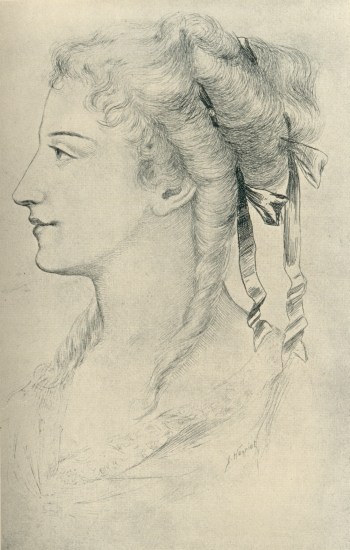
The fidelity of the aforegoing portrait is confirmed by other contemporary evidence. Examined in detail, it would appear that Armande's features were far from perfect, but that the ensemble was fascinating to a very remarkable degree. Mlle. Poisson, in a Lettre sur la vie et les œuvres de Molière et les comédiens de son temps, which she contributed to the Mercure of 1740, describes her as "of middle height," with "very small eyes," and "a large flat mouth"; but adds that she had "an engaging air," and "performed every action with grace." The elder Grandval is in accord with Mlle. Poisson: "Without being beautiful, she was piquant and capable of inspiring a grande passion." While a bitter enemy of Armande, the anonymous author of La Fameuse Comédienne, while denying her "aucun trait de beauté" is fain to admit that her appearance and manners rendered her very amiable in the opinion of many people, and that she was "very affecting when she wished to please."
That Armande should have triumphed so completely over physical deficiencies was probably due, to some extent, to the perfection of her toilettes. "No one," the brothers Parfaict tell us, in their Histoire du Théâtre Français, "knew better than she how to enhance the beauty of her face by the arrangement of her coiffure, or of her figure by the fashion of her costume." And Mlle. Poisson records that she "showed most remarkable taste and invariably opposed to the mode of the time." She seems indeed to have had some claim to be considered the arbitrix of feminine taste in dress, for the Mercure galant of 1673 ascribes to her the credit of a radical reform in ladies' toilettes, nothing less than the substitution of gowns, "tout unis sur le corps, de la manière que la taille parait plus belle," for the majestic but somewhat heavy costume hitherto in vogue, which concealed beneath its too ample folds the graceful lines of the figure.
If Armande, as a woman, was an object of admiration to her contemporaries, as an actress, she aroused in them something very like enthusiasm. It would indeed have been a matter for surprise had it been otherwise, since she enjoyed advantages which fall to the lot of very few. She came of a family which had already contributed several finished performers to the French stage, and "had in her blood the passion and instinct of the theatre." With her charm of manner and exquisite taste in dress, she combined many accomplishments: "she had a very pretty voice, sang with great taste in both French and Italian, and danced ravishingly." She had received a long and careful training from one who was perhaps an even better teacher than he was an actor, and who was as ambitious for her success as for his own. And, finally, nearly all her parts—certainly all her more important parts—were written by Molière with the express object of enabling her to display her abilities to the best advantage.
Lacking the dignity and strength required to give adequate expression to the greater passions, she wisely refrained from attempting any important rôles in tragedy, and in Racine's Alexandre and the Attila of Corneille we find her allotted only minor parts. But at the Palais-Royal comedy was, of course, the staple fare, and in "la rôles de femmes coquettes et satiriques," which accorded so well with her own temperament, and also in those of ingénues, Armande had no superior in her day and probably very few since. Her acting is said to have been characterised by great judgment, while her by-play was remarkably effective. "If she but retouches her hair, or rearranges her ribbons or her jewellery, these little fashions conceal a satire judicious and natural, and throw ridicule upon the women she wishes to represent." Moreover, she had the rare gift of being able to change at will the character of her voice, and "had a different tone for every part she undertook."
Molière's wise reluctance to allow his young wife to challenge the verdict of the public until he had done everything in his power to ensure her success, delayed Armande's first appearance on the stage for fifteen months after her marriage, when she made her début as Élise in the Critique de l'École des femmes (June 1, 1663), a reply to the attacks of Donneau de Visé and other critics upon the play produced at the Palais-Royal the previous December. The part allotted to her, which is that of a self-possessed young woman, with a good deal of shrewd common-sense, a turn for irony of a rather caustic brand, and not too much consideration for the feelings of others, suited her admirably—perhaps rather more so than poor Molière at that time imagined—and secured her a somewhat similar rôle in the delightful Impromptu de Versailles, played before the Court in the following October, where she figures in the cast as a "satirical wit." She did not play in the Mariage forcé (January 29, 1664), as, ten days earlier, she had borne Molière a son, to whom, as we have mentioned, Louis XIV. and Henrietta of England stood sponsors; but in the following spring we find her in the first of her long list of important rôles.
At the beginning of May 1664, Louis XIV. entertained the Queen-mother, Anne of Austria, and his own consort, Maria Theresa, with a brilliant and sumptuous fête, or rather succession of fêtes, at Versailles, which was then, of course, still only the little country-house built by Louis XIII., occupying to-day the bottom of the Cour de Marbre. The fêtes, which were denominated Les Plaisirs de l'Ile enchantée, as the plan adopted was suggested by the sixth and seventh cantos of Ariosto's Orlando Furioso, which describe the sojourn of Rogero (impersonated by the King) in the isle and palace of the enchantress Alcena, began on the 7th of the month and lasted a week; stately processions, tilting, displays of fireworks, balls, and magnificent banquets alternating with theatrical performances. On the 8th, Molière's troupe gave a comedy ballet, called the Princesse d'Élide, composed for the occasion, by their chief, at the special request of the King, and the rôle of the princess was taken by Armande. The play, the subject of which was borrowed from the Spanish dramatist Moreto's El Desden con el Desden (Scorn for Scorn), is the story of a fair princess, who until then had professed to despise love and had driven her innumerable suitors to despair, but who suddenly finds herself wounded to the heart by the skilfully feigned indifference to her charms shown by Euryale, Prince of Ithaca, who ultimately succeeds in winning her hand. Though far from being one of Molière's happiest efforts, as it was hastily strung together—the first act and the commencement of the first scene of the second are in verse, and the rest in prose—while the author's natural flow of wit and humour was checked by the necessity of accommodating himself to courtly conventions, it met with a very favourable reception, and, moreover, served to establish Armande's reputation as an actress. This was, no doubt, Molière's intention, as the whole play appears to have been conceived expressly to bring into relief the young lady's various accomplishments—her taste in dress, her charming voice, and her graceful dancing—and the enamoured Euryale declaims in her honour a portrait of the most flattering description: "She is, in truth, adorable at all times; but at that moment she was more so than ever, and new charms redoubled the splendour of her beauty. Never was her face adorned with more lovely colours; never were her eyes armed with swifter or more piercing shafts. The sweetness of her voice showed itself in the perfectly charming air which she deigned to sing; and the marvellous tones she uttered penetrated to the very depth of my soul and held all my senses in a rapture from which they were powerless to escape. She next showed a disposition altogether divine; her lovely feet on the enamel of the soft turf danced delightful steps, which carried me quite beyond myself and bound me by irresistible bonds to the easy and accurate movements with which her whole body followed those harmonious motions."
On the three concluding days of the fêtes, the Fâcheux, the first three acts of Tartuffe, and the Mariage forcé were in turn represented. It is uncertain what parts were allotted Armande in the first and third of these plays, but in the much discussed Tartuffe, now played for the first time, she again filled the leading feminine rôle. How she fared on this occasion we have unfortunately no information; but when, in February 1669, the interdict under which Tartuffe had so long lain was at length withdrawn and the piece produced at the Palais-Royal, the rhyming chronicle of Robinet speaks in eulogistic terms of her performance of Elmire.
In the meanwhile, she had successfully created other important parts: Lucinde in the Medecin malgré lui, Angélique in George Dandin, and Elise in l'Avare, and, on June 4, 1666, the greatest of all her triumphs—the rôle of Célimène in the famous comedy of the Misanthrope.
"Célimène," says M. Larroumet, "is the type of woman the most original and the most complete which the genius of Molière has evolved. Eternal temptation of actresses, those who have attempted it may be called legion, those who have succeeded in making themselves mistresses of it form a select group, admired, envied. Such an actress of genius as Rachel failed here miserably, and a true Célimène, like Mlle. Mars, is sure of transmitting her name to posterity. One has noted, however, the tones and gestures of the great interpreters of the part; tradition preserves them, and they point out the way. But an intelligent pupil will readily make herself acquainted with all that can be learned; if she does not evolve from her own resources the sentiment of the character, she will only swell the alarming number of vain attempts which theatrical history records. Célimène is twenty years of age, and her experience is that of a woman of forty. Coquettish and feline with Alceste, frivolous and back-biting with the little marquises, cruelly ironical with Arsinoé, in each act, in each scene, she shows herself under a different aspect. Contemporary, or very nearly so, of Mesdames de Châtillon, de Luynes, de Monaco, de Soubise, and the nieces of Mazarin, she ought to awaken a vague memory of these great names; she is the exquisite and rare product of an aristocratic civilisation in the full splendour of its development, and often she speaks a language of almost plebeian candour and acerbity. In the salon where she reigns, she ought to convey the idea of perfect ease and supreme distinction; and in the dénouement she submits to a cruel humiliation without the possibility of revenge; she makes her exit vanquished at all points, and, even then, she ought to lose nothing of her haughty bearing and her tranquil smile."[16]
It will thus be readily understood that an actress who could be trusted to create such a part must have truly been a great artist, and Armande secured a brilliant triumph. Her performance was "a charm" and "an ecstasy," Robinet tells us; and though Robinet was in the habit of dealing somewhat freely in such expressions, we have no reason to doubt that on this occasion he faithfully reflects the opinion of the audience.
But, after all, we can hardly wonder at the young actress's success, since she had only to be perfectly natural to realise the author's whole idea of his heroine. For what is Célimène but a finished portrait of Armande herself? Célimène is "la grande coquette par excellence," surrounded by a crowd of admirers wherever she goes. Armande, unhappily for Molière's peace of mind, seems to have enjoyed very much the same reputation. Célimène depends for her fascination not so much on beauty of face or form as on her expression, her smile, her manners, her conversation; "elle a l'art de me plaire," says the infatuated Alceste. Armande possessed the same kind of attractions, and was "very affecting when she wished to please." Célimène is haughty and imperious. "It is my wish; it is my wish," she cries when Alceste hesitates to comply with her demands. "Armande," says a contemporary, "could not brook contradiction, and pretended that a lover ought to be as submissive as a slave." In fact, so perfect is the resemblance that even if the circumstances, of which we shall presently speak, did not preclude all reasonable doubt about the matter, few would be found to deny that the heroine of the Misanthrope was drawn from life.
Among Armande's other rôles may be mentioned the capricious and charming Lucile of the Bourgeois gentilhomme, in which Molière drew the well-known portrait of his wife which we have already cited; the title-part in the famous "tragedy-ballet" of Psyché, one of the most remarkable instances of collaboration in dramatic history,[17] in which she appeared in a different costume in each of its five acts—a very unusual extravagance in those days—and is described by the enthusiastic Robinet as "marvellous" and "playing divinely"; Henriette in the Femmes savantes, "the model of an honest, sensible, and well-brought-up young lady;" and finally, Angélique in Molière's swan-song, the Malade imaginaire, perhaps, next to Célimène, her most finished impersonation.
But great as were the dramatic talents of Armande Béjart, they count for comparatively little in the curiosity which her name arouses. It is her moral character, her private life, her relations with her famous husband, which have exercised the minds of the biographers of Molière for upwards of two centuries. On these matters even more ink has been expended than on the vexed question of her birth, and with far less satisfactory results. To the great majority of writers Armande was an unworthy wife, who repaid the kindness and affection lavished upon her by the great man whose name she bore with ingratitude and contumely; while there are not wanting those who go so far as to accuse her of the grossest infidelity, and to assert that her misconduct was in some measure responsible for the dramatist's untimely death. When, however, we come to sift the evidence against her, we shall find that these extreme views are based on very insufficient or very suspicious testimony, and that one thing only has been clearly established, namely, that she rendered Molière's later years very unhappy. But what was the true cause of his unhappiness, whether occasioned by actual misconduct on the part of Armande, or merely by an ever present dread that such must be the inevitable termination of one or other of the very imprudent flirtations in which she appears to have been continually indulging, is very difficult, nay, well-nigh impossible, to determine.
It has always been a favourite practice with biographers of Molière and historians of the French theatre to affect to discover more or less direct allusions to the dramatist's relations with his wife in several of his plays: the École des femmes, the Impromptu de Versailles, the Mariage forcé, George Dandin, and, of course, the Misanthrope. That this is true of the last-named play cannot, we think, be disputed; but in regard to the others, we are inclined to believe that the significance of the passages and episodes on which their contention rests have been a good deal exaggerated.
Let us begin with the École des femmes, the first in chronological order. Here, as in the École des maris, Molière turns to the ethics of marriage for his materials. Arnolphe, a middle-aged bachelor, disgusted by the lack of fidelity among the married women he sees around him, comes to the conclusion that the only safeguard of a wife's honour is extreme ignorance. No young woman should know anything beyond her household and religious duties; her reading is to be confined to the Bible and the Maxims of Marriage; her only objects in life are to be the salvation of her soul and the comfort and happiness of her husband. In order to put his theory to the test, he adopts a little girl called Agnès, and has her carefully brought up in the most complete seclusion, with the intention of making her his wife when she shall have reached a suitable age. But, unfortunately for him—for he falls genuinely in love with his ward—the damsel's very simplicity proves his undoing; she bestows her affections upon a young gallant, Horace by name, and poor Arnolphe is left lamenting the downfall of his hopes.
We have outlined this plot of the play, which is doubtless familiar to many, as several writers have assumed that Molière has depicted himself in the role of Arnolphe and Armande in that of Agnès; but beyond the fact that both Molière and his hero themselves supervised the education of their intended wives, there does not seem to be the slightest ground for such a supposition. In the first place, Molière espoused the woman of his choice; while Arnolphe sees his cherished scheme come to nothing, through the appearance on the scene of the youthful Horace. In the second, the brilliant and witty Armande bears as little resemblance to the unsophisticated Agnès as does her liberal-minded husband to the tyrannical guardian. And, lastly, to ask us to believe that only ten months after his marriage, with the glamour of the honeymoon still upon him, Molière could have intended an unsympathetic character like Agnès to represent his wife, is to make too great a call upon our credulity.
In the Impromptu de Versailles a good deal has been made of the little quarrel between the author and his wife, which the former introduces at the beginning of the play. The company is supposed to be rehearsing a new comedy, commanded by the King at two hours' notice, and to be causing its chief no little trouble.
Mademoiselle Molière.—"Shall I tell you what it is? You ought to have written a play which you could have acted all alone."
Molière.—"Be silent, wife; you are a fool."
Mademoiselle Molière.—"Thank you, my lord and husband; that just shows what it is to be married, and how strangely wedlock alters people. You would not have said that eighteen months ago."
Molière.—"Pray be silent."
Mademoiselle Molière.—"It is an odd thing that a trifling ceremony should be capable of depriving us of all our good qualities, and that a husband and a lover should regard the same person with such different eyes."
Molière.—"What loquacity!"
Mademoiselle Molière.—"'Faith! if I were to write a play, it would be upon that subject. I would justify women in many things of which they are accused, and I would make husbands afraid of the contrast between their abrupt manners and the courtesy of lovers."
Here, we are told by certain critics, the inference is unmistakable; Molière clearly foresees the fate which awaits him. In our opinion, they are wrong. In the Impromptu de Versailles Molière and his wife do not, as in an ordinary play, represent fictitious characters; they appear under their own names. In these circumstances, it is surely inconceivable that the dramatist should have introduced this dialogue, if he had for one moment imagined it applicable to his own affairs! The very fact that he was so ready to jest upon such a subject seems to us a conclusive proof that up to that time, at least, Armande's conduct had given him but scant cause for uneasiness.
The Mariage forcé and George Dandin, the former produced early in the year 1664, when the difference of age and of character between Molière and his wife was no doubt beginning to produce its fatal consequences, and the latter in the summer of 1667, after their separation, of which we shall speak in due course, had actually taken place, contain more direct allusions to their author's ménage. Sganarelle, like Molière, had believed himself "le plus content des hommes," only to be roughly disillusioned when the carefully brought up Dorimène frankly avows her passion for "toutes les choses de plaisir"—play, visiting, assemblies, entertainments, and so forth—at the same time expressing a hope that he does not intend to be one of those inconvenient husbands who desire their wives to live "comme des loup-garous," since solitude drives her to despair, but that they may dwell together as a pair "qui savent leur monde." Angélique, in her turn, complains to George Dandin of the tyranny exercised by husbands "who wish their wives to be dead to all amusements, and to live only for them." She has no desire, she tells him, to die young, but "intends to enjoy, under his good pleasure, some of the glad days that youth has to offer her, to take advantage of the sweet liberties that the age permits her, to see a little of the beau monde, and to taste the pleasure of hearing her praises sung."
All this is certainly reminiscent of Armande, who, according to Grimarest, was no sooner married than she "believed herself a duchess," affected a coquettish manner with the idle gallants who flocked to pay court to her, and turned a deaf ear to the warnings of her husband, whose lessons appeared to her "too severe for a young person who, besides, had nothing wherewith to reproach herself." But the resemblance in the situations goes no further. If Dorimène, in her craving for "toutes les chases de plaisir" and Angélique, in her imperious temper and cold irony, bear some relation to Armande, the foolish and cowardly Sganarelle, who allows himself to be cudgelled by Dorimène's brother, Lycidas, into a marriage which he knows must bring him unhappiness, has nothing, save his age, in common with Molière; while the aspiring farmer, George Dandin, marrying not for love, but for social position, and deservedly punished for his snobbishness, is as far removed from his creator as Tartuffe or Monsieur Jourdain.
When we come to the Misanthrope, the similarity between fiction and reality is too striking to admit of any doubt as to the author's intentions. It is true that a distinguished English critic[18] professes to see in this play, as in Don Garcie de Navarre—Molière's one failure, produced the year before his marriage, and withdrawn after a run of five nights—the outcome of the actor-dramatist's "desire of indulging his humour of seriousness and a determination to example his elocutionary theories in verse that, without being actually tragic and heroic, should have something in it of the tragic and heroic quality." But, though the large number of verses from Don Garcie which Molière has incorporated with his role of Alceste would seem to lend some confirmation to this theory, the fact remains that writers are practically unanimous in regarding the Misanthrope as, primarily, a pathetic autobiography of its author under the cloak of fiction. "This Célimène, so frivolous and so charming, so dangerous and so seductive, this incorrigible coquette, who does not understand what a noble heart she is wounding even unto death: is not this Armande Béjart, embellished by all the love and all the genius of Molière? And Alceste; who is he? At the first representations people believed that they recognised the Duc de Montausier, and the Duc de Montausier remarked, with good reason: 'I thank you; it is a great honour.' But we, for our part, recognise Molière. This misanthrope is something more than an honourable gentleman at odds with the world. He is a great genius misunderstood, who endures and waits; he is a passionate sage, an honest man with a great and excellent heart."[19]
In the Misanthrope, Molière has given to Célimène all the coquetry, the egoism, and the caustic wit which belonged to Armande; to his own rôle all the weakness of a high-minded man struggling vainly against his passion for an unworthy object. "The love I bear for her," says Alceste—
"Ne ferme point mes yeux aux défauts qu'on lui trouve;
Et je suis, quelque ardeur qu'elle m'ait pu donner,
Le premier à les voirs, comme à les condamner.
Mais, avec tout cela, quoi que je puis faire,
Je confesse mon foible; elle a l'art de me plaire;
J'ai beau voir ses défauts, et j'ai beau l'en blâmer,
En dépit qu'on en ait, elle se fait aimer;
Sa grâce est la plus forte, et, sans doute, ma flamme
De ces vices du temps pourra purger son âme."
There are moments indeed in the play when it almost ceases to belong to the realm of fiction. The scene, for instance, in the fourth act, when Alceste, holding in his hand the proof of Célimène's perfidy, the letter written by her to his rival, Oronte, calls upon her "to justify herself at least of a crime that overwhelms him," and to do her best to appear faithful, while he, on his side, will do his best to believe her such; and Célimène tartly refuses—
"Allez, vous êtes fou, dans vos transports jaloux,
Et ne méritez pas l'amour qu'on a pour vous.
. . . . .
Allez, de tels soupçons méritent ma colère,
Et vous ne valez pas que l'on vous considère:
Je suis sotte, et veux mal à ma simplicité,
De conserver, encor, pour vous, quelque bonté;
Je devrois, autre part, attacher mon estime
Et vous faire un sujet de plainte légitime,"
may well have had its parallel in their own lives. And few, again, can doubt the sincerity with which the lover must have uttered the lines,—
"Je fais tout mon possible
À rompre de ce cœur l'attachement terrible;
Mais mes plus grands efforts n'ont rien fait jusqu'ici,
Et c'est pour mes péchés que je vous aime ainsi."
"We might well say without exaggeration of this Célimène," remarks August Wilhelm von Schlegel,[20] "that there is not a single good point in her whole composition." This may be so; but, as M. Larroumet is careful to point out, there is really nothing in the Misanthrope which gives us the right to assume that Armande was anything worse than an incorrigible coquette. "Célimène is impeccable; she has neither heart nor feeling."[21] Nor do the remainder of Molière's plays furnish any fresh proof against Armande; they, on the contrary, strengthen the impression that, while he suffered much from his wife's character, he never believed her to have been guilty of anything which might affect his honour.
This impression seems to have been that of the poet's contemporaries. Molière had, as we know, many enemies—unscrupulous enemies, who did not hesitate to launch against him the most hideous of accusations. We can hardly doubt that had there been any reasonable ground for believing Armande guilty of something more than coquetry, the Montfleurys, Le Boulanger de Chalussay and the rest, would have been only too ready to avail themselves of such an opportunity of humiliating the man whom they so bitterly hated. Yet though, like all the rest of the world, they were aware of Molière's jealous nature, and made this weakness the object of their unsparing ridicule, none of them went so far as to accuse him of being that which he appears to have been in incessant dread of becoming. At most, their works contain only vague hints and insinuations, to which little or no attention seems to have been paid; and it is probable that Armande's name would have gone down to posterity without any very serious stain upon it, had she not chanced to be made the victim of one of the most audacious and malignant libels ever penned.
Among the swarm of scurrilous brochures, fictitious histories, and stupid romances in the French language which issued from the foreign press during the decade which followed the Protestant emigration of 1685, was a little book, or rather pamphlet, written for the delectation of those persons who are always ready to welcome anything calculated to gratify their curiosity about the private affairs of stage celebrities. This book, published anonymously at Frankfort, in 1688, by one Rottenberg, a bookseller who made a speciality of such sensational works,[22] bore the title of La Fameuse Comédienne, ou Histoire de la Guérin, Guérin being the name of Armande Béjart's second husband, whom she married in 1677. Although the demand for it was considerable, and five editions were printed within ten years of the date of its publication, the charges against Armande which it contained do not appear to have been taken very seriously, except among the class of readers for whom it was written, until, in 1697, it occurred to Bayle, who had a weakness for piquant anecdotes about notable persons, to include certain passages in his famous Dictionary, since which few of the biographers of Molière have failed to borrow more or less freely from its pages, with most unfortunate results to the reputation of the dramatist's wife.
The authorship of the Fameuse Comédienne remains a mystery to this day, though contemporary gossip, or historians in search of some new sensation, have attributed it successively to a number of persons: La Fontaine, Racine, Chapelle, Blot, the chansonnier of the Fronde, Rosimont, an actor of the Rue Guénégaud, Mlle. Guyot, a member of the same company, and Mlle. Boudin, a provincial actress, who would appear to have been at one time on terms of intimacy with Armande. With regard to the first five of these suppositions, we will merely remark that neither La Fontaine, Racine, nor Chapelle were capable of committing such an infamy; that Blot had been in his grave more than thirty years at the time of the publication of the libel ascribed to him, and that the chief argument advanced by M. Charles Livet, the editor of the latest edition of the Fameuse Comédienne, in favour of Rosimont, namely, a resemblance between the style of the book and a theological work entitled La Vie des Saints, which he published in 1680, seems to us too fanciful to merit any serious consideration. In the cases of Mesdemoiselles Guyot and Boudin, there is again a total absence of anything like adequate proof; nevertheless, though they are both in all probability guiltless, strong grounds exist for believing the book to be the work of one of Armande's professional rivals, as the intimate acquaintance with theatrical life which it reveals precludes all doubt as to the vocation of the writer; while the preponderating place it allots to women, the manner in which it speaks of men, the jealous hatred which inspires it, the finesse of some of its remarks, its style and method, all denote a feminine hand.[23]
Atrocious libel though the Fameuse Comédienne undoubtedly is, it is very far from destitute of that literary merit in which even the works of the most obscure writers of the great epoch of French prose are seldom lacking, and, moreover, contains not a little interesting and authentic information about the public career of Molière and his wife. But that is all that can be said in its favour. "Possessed," remarks M. Larroumet, "by a ferocious hatred against Armande, hatred of the woman and the actress, the writer has only one object—to render her odious. What she knows of the actions of her enemy she perverts or, at any rate, exaggerates; what she does not know she invents. He who wishes to injure a man attributes to him acts of indecency or cowardice; he who wishes to injure a woman gives her lovers; these are the surest means. Thus our author makes of Armande a Messalina, and a Messalina of the baser sort, one who sells her favours."
Unfortunately for the object which the libeller has in view, she does not content herself with general charges; she makes formal accusations, which she endeavours to substantiate, and the book abounds in letters, conversations, details about matters which could not possibly have been known, save to the parties immediately concerned, with the result that her attack fails miserably, and the judicious reader very speedily perceives that the work is nothing but a collection of scandalous anecdotes, which, when not controverted by positive facts, sin grievously against probability.
However, as all readers are not judicious, and as the book has imposed on several historians of deservedly high reputation,[24] it may be as well for us, in the interests of truth, to follow the example of M. Bazin and M. Larroumet, and devote some little space to an examination of the charges which have brought so much unmerited odium upon the memory of Armande Béjart.
The first lover attributed to Armande is the Abbé de Richelieu, great-nephew of the famous cardinal, a gentleman of a very gallant disposition, with a marked predilection for actresses: "There was no one at the Court who did not endeavour to gain her favours. The Abbé de Richelieu was one of the first who determined to make her his mistress. As he was very liberal, while the young lady was very fond of expenditure, the matter was soon concluded. It was agreed that he should give her four pistoles (about forty francs) a day, without counting clothes and entertainments. The abbé did not fail to send her every morning, by a page, the pledge of their treaty, and to go and visit her every afternoon."
Now, as M. Larroumet points out, if this story is to be accepted, we must either believe Molière to have been ignorant of the comings and goings of the page and the abbé, or that he was aware of and tolerated them: two suppositions equally inadmissible. Moreover, if we consult the dates, the improbability becomes an impossibility. Armande was married on February 20, 1662, and on January 19, 1664, she bore Molière a son. The intrigue must then have taken place between these two periods—which is to make her infidelity begin at a very early date—since M. Bazin tells us that the Abbé de Richelieu left France in March 1664 with the expedition organised to defend Hungary against the Turks, and died at Venice on January 9, 1665. That, however, does not prevent the Fameuse Comédienne from making his liaison with Mlle. Molière last until the production of the Princesse d' Élide; a play which was not performed until May 8, 1664, some weeks after his departure.
On to the supposed intrigue between Armande and the abbé, the anonymous author next proceeds to graft a new and double adventure: "This affair lasted for some months without trouble; but Molière having written the Princesse d' Élide, in which the Molière played the princess, which was the first important rôle she had filled, because Mademoiselle du Parc played them all and was the heroine of the theatre, she created such a sensation that Molière had cause to repent of having exhibited her in the midst of the brilliant young men of the Court. For scarcely had she arrived at Chambord, where the King gave this entertainment, than she became infatuated with the Comte de Guiche,[25] while the Comte de Lauzun[26] became infatuated with her. The latter spared no effort to obtain her good graces, but the Molière, who had quite lost her head over her hero, would listen to no proposition, and contented herself with visiting Du Parc and weeping over the indifference of the Comte de Guiche. The Comte de Lauzun, however, did not abandon hope, experience having taught him that nothing could resist him. He knew, moreover, that the Comte de Guiche was one who set but little store by woman's love, for which reason he doubted not that his indifference would end by repulsing the Molière, and that his own star would then produce in her heart what it had produced in those of all the women whom he had sought to please. He was not deceived, for the Molière, irritated by the coldness of the Comte de Guiche, threw herself into the arms of the Comte de Lauzun, as if desirous of seeking protection against further suffering at the hands of a man who failed to appreciate her."
Here again we have an impossibility and an improbability. In May 1664 the Comte de Guiche was at Warsaw, having been exiled the previous year, on account of his complicity in the "Spanish letter" plot against Mlle. de la Vallière, and, therefore, could not have been making love—or being made love to—at Versailles. As for Lauzun, no mention of him is to be found among the persons who assisted at the fêtes where the Princesse d'Élide was performed, while even if he were present, it is very unlikely that he had any attention to spare for Mlle. Molière, as he was at this time desperately in love with the Princesse de Monaco, who afterwards jilted him for the King himself. The fact is that the malicious chronicler, having decided to give her victim some grands seigneurs as lovers, not unnaturally selected those most celebrated for their gallantry, in the belief that, among their numerous mistresses, one more would pass without difficulty; but she had little acquaintance with the Court, and her ignorance has betrayed her.
Although the Abbé de Richelieu had, as we have mentioned, departed for Hungary, the Fameuse Comédienne retains him on the stage and makes him play a particularly odious rôle. He intercepts a very tender letter written by Armande to the Comte de Guiche, and, furious at the lady's duplicity, "does not amuse himself by uttering reproaches, which never serve any good purpose; but, congratulating himself on having engaged her only by the day, resolves to break with her from that moment, which he does, after calling Molière's attention to the fact that the great care he took to please the public left him no time for examining the conduct of his own wife, and that while he worked to divert every one, every one worked to divert her."
A bitter matrimonial quarrel naturally follows this confidence. Armande sheds floods of tears, confesses her tendresse for Guiche, but protests that she is guilty in intention only, carefully refrains from saying a word about Lauzun, entreats her deluded husband's pardon, which she obtains with very little difficulty, and profits by his credulity to continue her intrigues "with more éclat than ever." Wearying of sentimental or quasi-sentimental attachments, she resolves to profit by her charms, at the same time making a great pretence of chastity and "causing to sigh for her an infinity of fools who imagine her to be of unexampled virtue." However, in due course, Molière is advised of her proceedings, and another painful scene takes place between husband and wife. Molière falls into a violent passion and threatens to have her shut up in a convent. Armande weeps, swoons away, and appears to be on the point of expiring; but eventually revives and, instead of entreating pardon, as on the previous occasion, takes a high tone, accuses her husband of keeping up his intimacy with Mlle. de Brie, who, by a singular arrangement, still continued to reside under the same roof as her former lover,[27] and also with Madeleine Béjart, declares that she "no longer has the courage to live with him, that she would rather die, and that everything between them must come to an end." In vain her family, that of Molière, and their common friends endeavour to appease her. "She conceives henceforth a terrible aversion for her husband, she treats him with the utmost contempt; finally, she carries matters to such an extremity that Molière, beginning to perceive her evil propensities, consents to the rupture which, since their quarrel, she has never ceased to demand; and, accordingly, without any decree of the Parliament, they agree that they will no longer live together."
Here, at last, the author of the Fameuse Comédienne is on sure ground; for we know, on unimpeachable authority, that an "amicable" separation did actually take place between Molière and his wife. Its precise date is a matter of some uncertainty, but it must have been subsequent to the month of April 1665, when Armande presented her husband with a second child, a daughter, to whom Madeleine Béjart and the Comte de Modène stood sponsors. "If," says M. Larroumet, "we admit that the Misanthrope reflects something of the poet's state of mind and of his feelings towards his wife, the separation perhaps belongs to the moment when this play was produced, in June 1666, or later, about the month of August, after the Médecin malgré lui." M. Larroumet sees in the circumstance that the leading feminine parts in the three plays which followed the Médecin malgré lui: Mélicerte, Le Sicilien, and Amphitryon, were allotted to Mlle. de Brie, and not to Armande—a distribution which must have been peculiarly galling to the latter, who had so long filled the most important or the most flattering rôles—a natural effect of her husband's resentment.
From the moment of their rupture until their reconciliation, some five years later, husband and wife met no more, except at the theatre. Armande remained in Paris, with her mother and sister; while Molière passed most of his rare leisure at a little country-house which he rented at Auteuil, then, as now, one of the most beautiful suburbs of Paris. One day, according to the Fameuse Comédienne, he was sitting in his garden, musing sadly upon his lost happiness, when his friend Chapelle broke in upon his solitude, and, finding him in a more than usually despondent mood, began to reproach him with betraying a weakness which he had so often turned to ridicule upon the stage.
"For my part," said he, "if I were unfortunate enough to find myself in like case to you, and that the person I loved granted favours to others, I should feel such a contempt for her as would infallibly cure me of my passion. Moreover, there is a satisfaction open to you, which would be denied you if she were only your mistress; and that vengeance which commonly takes the place of love in an outraged heart can compensate you for all the mortifications your wife occasions you, since you can at once have her shut up in a convent. This would, indeed, be a sure means of placing your mind at rest."
Molière, who had listened quietly to his friend, here interrupted him to inquire whether he himself had never loved.
"Yes," replied Chapelle, "I have been in love as a man of sense ought to be, but I should never have found any difficulty in following what honour prescribed; and I blush to find you in such a state of indecision in regard to this matter."
"I see well," rejoined Molière, "that you have never truly loved. You take the semblance of love for love itself. I might give you many examples which would demonstrate to you the strength of this passion; but I will merely give you a faithful account of my own trouble, that you may understand how little we are masters of ourselves when once it has acquired dominion over us. As for the consummate knowledge of the human heart which you say the portraits I am constantly offering to the public prove me to possess, I will acknowledge that I have endeavoured to understand its weakness. But, if my science has taught me that danger should be avoided, my experience convinces me but too thoroughly that to escape it is impossible. I judge daily by my own case.
"I am by nature of an excessively tender disposition, and all my efforts have never enabled me to overcome my inclinations towards love. I sought to render myself happy, that is to say, so far as might be with a sensitive heart. I was convinced that few women are deserving of sincere affection; that interest, ambition, and vanity are at the root of all their intrigues. I thought, however, to secure my happiness by the innocence of my choice. I took my wife, so to speak, from the cradle. I educated her with the care which has given rise to the rumours which have doubtless reached your ears. I had persuaded myself that I could inspire her by habit with sentiments that time alone could destroy, and I neglected nothing whereby this end could be attained. As she was still young when I married her, I was unaware of her evil propensities, and deemed myself a little less unfortunate than the majority of those who contract such engagements. Thus marriage did not lessen my affection; but she treated me with such indifference that I began to perceive that all my precautions had been unavailing, and that her feelings towards me were very far removed from what I desired for my happiness. I reproached myself with a sensitiveness which seemed ridiculous in a husband, ascribing to her disposition that which was really due to her want of affection for me. But I had but too many opportunities of perceiving my error; and the mad passion which she contracted soon afterwards for the Comte de Guiche occasioned too much commotion to leave me even this appearance of tranquillity. I spared no endeavour, so soon as I knew the truth, to conquer myself, finding it impossible to change her. I employed all the strength of mind that I could command. I summoned to my aid everything that could help to console me. I considered her as a person whose sole merit had lain in her innocence, and whose unfaithfulness robbed her of all her charms. I resolved henceforth to live with her as an honourable man whose wife is a coquette, and who is well persuaded that, whatever may be said, his reputation is not affected by the misconduct of his spouse. But I had the mortification to discover that a woman without great beauty, who owed what little intelligence she possessed to the education which I had given her, could, in an instant, destroy all my philosophy. Her presence made me forget all my resolutions; the first words she said in her defence left me so convinced that my suspicions were ill-founded that I asked pardon of her for having been so credulous.
"However, my kindness effected no change in her, and, in the end, I determined to live with her as if she were not my wife; but if you knew what I suffer you would pity me. My passion has reached such a point as to cause me to sympathise with her; and when I reflect upon the impossibility of suppressing what I feel for her, I tell myself, at the same time, that she has perhaps a similar difficulty in overcoming her inclination towards coquetry, and I find myself more disposed to pity than to blame her.
"No doubt you will tell me that one must be a poet to love in this manner, but, for my part, I hold that there is only one kind of love, and that those who have not felt such tenderness have never truly loved. Everything in this world is associated in my mind with her. So entirely are my thoughts occupied by her that in her absence nothing can give me pleasure. When I behold her, an emotion, transports which may be felt but not expressed, deprive me of all power of reflection. I have no longer eyes for her faults, but see only her lovable qualities. Is not this the last extremity of folly? And do you not marvel that all my reason serves only to convince me of my weakness without giving me the strength to master it?"
Quite a number of writers, including several who are inclined to place but little confidence in the rest of the Fameuse Comédienne, pronounce unhesitatingly for the genuineness of the above conversation. M. Edouard Fournier thinks that a letter from Molière to Chapelle has been worked into the text,[28] while Mr. Gegg Markheim, in his very interesting preface to the Clarendon Press edition of the Misanthrope, is of opinion that a conversation between the two poets was repeated by Chapelle, "either thoughtlessly or to clear his friend from certain slanders," and reached the ears of the author. Mr. Markheim adduces two circumstances as proofs of the genuineness of the Auteuil confession: first, that the substance of it is confirmed by a similar conversation between Molière and his friends, the physician Rohault, and Mignard, the celebrated painter, cited by Grimarest, in his biography of the dramatist; secondly, the very remarkable resemblance, not only in thought but in language, between certain passages in the Fameuse Comédienne and the Misanthrope, in which play Molière is generally believed to have, in some measure, taken his audience into his confidence in regard to his domestic affairs. Thus—to cite only one instance of several which Mr. Markheim gives—in the book Molière says: "Je n'ai plus d'yeux pour ses défauts, il m'en reste seulement pour ce qu'elle a d'aimable;" while in the play Alceste makes the same confession in almost the same words:—
"J'ai beau voir ses défauts, et j'ai beau l'en blâmer,
En dépit qu'on en ait, elle se fait aimer."
Mr. Markheim's first argument may, we think, be dismissed, as the conversation in Grimarest would appear to be nothing more than a not too skilful imitation of that in the Fameuse Comédienne; but the second is deserving of more attention. The similarity between the several passages Mr. Markheim cites is certainly too striking to be explained away on the ground of mere coincidence; yet, so far from proving his contention, it makes, in our opinion, for a diametrically opposite conclusion. Let us listen to what M. Larroumet, the best-informed and most impartial of all the recent biographers of Molière, has to say upon the matter: "If we admit that the Fameuse Comédienne, in spite of its detestable inspiration, is not the work of a beginner, but of an actress endowed with the talent of a natural style, the simplest course would be to admit further that this fragment is as much her work as the rest of the book. Trained to the practice of the theatre, she combines certain portions of her story with as many little plays. Here she will have perceived the scene to construct and the pathetic tirade to write. Is not the situation one to inspire and stimulate? Sustained then by her recollections of the Misanthrope, her imagination stirred by the passionate complaints of Alceste, her hatred of Armande coming to her assistance, she has been successful in the scene and the tirade."[29]
In a word, the whole Auteuil episode is pure fiction; yet fiction of such a kind—"one of the choicest morsels of French prose in its most glorious epoch"—as may well arouse a regret that the writer did not turn her undoubted talents to some worthier purpose than the composition of scandalous libels.
In the isolation in which he now found himself, Molière, who was one of those who cannot live without woman's affection, turned for comfort to Mlle. de Brie, his former providence, who, it may be mentioned, had in the Misanthrope played the part of Éliante, the lady who endeavours to console Alceste for the caprices of Célimène. Her intervention, however, was of a less irreproachable kind than Éliante's, and she appears to have passed a considerable portion of her time at Auteuil. The poet's friends remonstrated, pointing out that, by renewing his intimacy with Mlle. de Brie, he was giving his wife but too much excuse for her own conduct, and endeavoured to persuade him to break with her. "Is it for virtue, beauty, or intelligence that you love this woman?" one of them is said to have asked him. "You know that Florimont and Le Barre are her lovers, that she is not beautiful, that she is a perfect skeleton, and that she has no common sense." "I know all that," replied Molière; "but I am accustomed to her faults; for me to accommodate myself to the imperfections of another would be a task beyond my powers; I have neither the time nor the patience."
But Molière adored his wife: about this all his contemporaries are agreed. Bold and courageous in his works, ever ready to castigate vice and ridicule folly, without troubling himself about the possibility of reprisals, he showed himself in regard to her feeble and irresolute to the last degree. His relations with Mlle. de Brie and other women were after all but passing caprices; his passion for Armande was the one serious love of his life; a love which survived indifference, ingratitude, it may be even infidelity, and to which he always returned, in spite of vows and good resolutions.
Under these circumstances, a reconciliation could be only a matter of time, and, thanks to the good offices of their common friends, Chapelle and the Marquis de Jonzac, it took place towards the end of the year 1671. The author of the Fameuse Comédienne is discreetly silent about this, fearing that it might weaken her indictment; and, between whiles, places a new intrigue of Armande; this time with a member of her husband's troupe.
Some years before, Molière had rescued a little boy named Michel Baron from the hands of some strolling players, and, perceiving in him the makings of an excellent actor, had attached him to himself and trained him for the stage. His confidence was justified, for Baron became in later years the greatest actor of his time and also a successful dramatist. Armande, however, was far from sharing Molière's liking for the boy; she detested him for his precocity and impertinent airs, and still more for the influence which she suspected him of exercising over her husband; and one day, during a rehearsal of Mélicerte, in which Baron had been cast for the title-part, carried her resentment to the point of dealing him a sound box on the ear. In high dudgeon, Baron forthwith took himself off and joined a strolling company; nor was it until four years later that, at the urgent entreaty of Molière, he consented to return. He was then a tall lad of seventeen, exceedingly handsome, full of assurance, and "already in great request among the ladies of the theatre and also among certain ladies of the fashionable world." It did not appear at first, says the author of the Fameuse Comédienne, that time had greatly modified the hostility with which Mlle. Molière and he regarded one another. But when they appeared together in Psyché, at the carnival of 1671, Armande in the title-part, Baron as Love, there came a change. "The common praises that they received compelled them to examine one another more attentively, and even with some degree of pleasure. He was the first to break the silence by complimenting her on the good fortune that had befallen him in being chosen to represent her lover, and observing that he owed the approbation of the public to this happy chance, and that it was not difficult to play the part of a person whose feelings one could so well understand. The Molière replied that the praises bestowed on a man like himself were the reward of merit, and that she had no share in them; but that gallantry on the part of one who was said to have so many mistresses did not surprise her, and that he must be as accomplished an actor outside the theatre as he was on the stage.
"Baron, to whom these kind of reproaches were not displeasing, told her that he had indeed some habits that one might call bonnes fortunes, but that he was prepared to sacrifice all for her, and that he would set more value on the smallest of her favours than on any which the ladies who had smiled upon him were able to bestow. And he mentioned their names, with a discretion which was natural to him."
Armande is, of course, enchanted by this proof of devotion, and, to cut a long story short, they resolve to continue their respective rôles off the stage.
We have related this supposed intrigue at far greater length than it deserves, since it furnishes a fair sample of the materials upon which M. Loiseleur and other historians have based their judgments of Armande. But, in point of fact, it is no more worthy of belief than the stories about Lauzun, Guiche, and the Abbé de Richelieu. Although the insufferable coxcomb whom La Bruyère has depicted under the name of Roscius, and who is said to have depicted himself in his comedy, L'Homme à bonnes fortunes, was not the kind of person to be deterred by any honourable scruples from making love to the wife of his benefactor, had he been so minded, we can hardly suppose that an intrigue between Armande and a member of his own troupe could have been carried on without Molière becoming aware of it, or that, when aware of it, he would have permitted Baron to retain his place in the company. Moreover, apart from the statement in the Fameuse Comédienne, there is no reason to believe that the old antipathy between Armande and Baron ever ceased to exist, far less that they became lovers. What is certain, is that no sooner was Molière dead than Baron quitted the Palais-Royal and went over to the Hôtel de Bourgogne, at a moment when Armande, become chief of the troupe, was urgently in need of his services. This, it must be admitted, was hardly the conduct of a friend, to say nothing of a lover.
By the side of these intrigues, apocryphal or doubtful, it is pleasant to be able to record a friendship of an altogether unexceptional nature. The great Corneille, in spite of his affection for his wife, Marie de Lemperière, whose hand Cardinal de Richelieu is said to have obtained for him, after her father had sent the poet about his business, was of a very gallant disposition and in the habit of offering incense at the shrine of any goddess of the theatre who was inclined to accept his devotion. At Rouen, in 1758, he had, like Molière at an earlier date, fallen desperately in love with Mlle. du Parc, but had fared no better at the hands of that haughty beauty than the chief of the Illustre Théâtre. This rebuff, which drew from the chagrined poet the well-known Stances à une marquise, seems to have brought home to Corneille the fact that he was no longer young, and to have somewhat damped his amorous ardour. At any rate, when Armande appeared upon the scene, he contented himself with offering her a platonic admiration, charmingly expressed in the third act of Psyché.
Psyché.—"Can one be jealous of the affection of relatives?"
Amour.—"I am so, my Psyché; I am so of all nature. The sun's rays kiss you too often; your tresses suffer too many caresses from the wind. The moment it toys with them, I murmur at it. The very air you breathe with too much pleasure passes between your lips. And, so soon as you sigh, I know not what affrights me, and makes me fear, among your sighs, some errant ones."
Not content with this tribute to the lady's charms, the old poet conceived the idea of writing for Armande a play in which she might impersonate the heroine, and he might portray himself in the character of a chivalrous old man in love with her. He, accordingly, composed his Pulchérie, which, as Molière, for some reason, could not see his way to accept it for the Palais-Royal, was produced at the Marais on November 2, 1672. It was a poor play, the dramatist having failed to endow either the plot with interest, or the characters, apart from the amorous old senator Martian, with any special individuality; and even Corneille's devoted admirer, Madame de Sévigné, was compelled to admit that "Pulchérie was not a success." Nevertheless the terms in which Martian speaks of the heroine were so very flattering that Armande must have regretted that circumstances had prevented her undertaking the latter part.
The reconciliation between Molière and Armande was in all likelihood facilitated by a serious illness with which the latter was seized in the early autumn of 1671, during the run of Psyché. Under such circumstances the most legitimate grievances are apt to be forgotten, and it must have needed but very little persuasion on the part of their common friends to induce Molière, with all his love for his wife revived at the sight of her suffering, to hasten her convalescence by an assurance of his full forgiveness. In the following February, Madeleine Béjart died, leaving the bulk of her property to Armande, and, towards the middle of that year, Molière removed from the Place du Palais-Royal, where he had lived for so long with the Béjarts and Mlle. de Brie, to a large house in the Rue de Richelieu, near the Académie des Peintres, which he furnished very sumptuously. Here, on September 15, Armande gave birth to her third child—a son—baptized as Pierre Jean Baptiste Armand on October 1, Boileau-Puimorin, brother of Boileau-Despréaux, and Mlle. Mignard, daughter of the celebrated painter, acting as sponsors. The little boy, however, only survived this ceremony a few days, thus preceding his illustrious father to the grave by rather less than four months.