Front matter (continued 2)
Reading edition
The reconciliation with his wife, indeed, in itself so happy, was destined to prove fatal to Molière, and was undoubtedly one of the causes of his premature death. For some years, the poet had suffered from a chest affection, very possibly due to frequent exposure during his provincial tours. In the winter of 1665-1666, we learn from Robinet that he had had an illness which all but terminated fatally, and in the spring of 1667 he was again "tout proche d'entrer dans la bière," was absent from the theatre for two months, and was compelled to restrict himself to a milk diet, and speak as little as possible when not on the stage. The retired life he had led during his breach with Armande had, of course, favoured the adoption of this regimen, and under it his health had so much improved that, believing himself cured, and unwilling to impose on his wife the cheerless society of a valetudinarian, he abandoned his abstemious habits, entertained largely, and, in short, resumed his former mode of life. The result was a rapid aggravation of his complaint; his nights were sleepless, he was racked by a terrible cough, and, at the beginning of the year 1673, it became evident that his days were numbered. In this condition, by the irony of Fate, it fell to him to represent the folly of a man in perfect health who, imagining himself the victim of all manner of fell diseases, is ready to submit to any and every remedy that may be suggested to him,—that is to say, the exact counterpart of his own state. On February 10, the Malade imaginaire, a happy conception in the composition of which the author had doubtless contrived to find some relief from his sufferings, both of body and mind—for there is some reason to believe that his relations with his wife were again becoming strained—was produced at the Palais-Royal, and played for three nights to crowded houses. On the morning of the fourth performance, February 17,[30] Molière was so weak that Armande and Baron united in urging him not to play, but their efforts were unavailing. "How," he asked, "can I refuse to appear when so many persons' bread depends upon it? I should reproach myself for the distress I might cause them, as I have sufficient strength to prevent it." This speech is often quoted as a proof of Molière's consideration for others, but though the great writer's unselfishness and generosity are happily beyond dispute, it would appear more probable that his plea was merely an excuse for disregarding the advice of his wife and friend, as he was sufficiently well off to have been able to compensate those who would have suffered by the temporary closing of the theatre without any very serious inconvenience.[31] No; Molière knew that his end was near, and, like the brave man he was, he preferred to die in harness, rather than, by taking to his bed, prolong his sufferings a few days longer.
Accordingly, when the play began at four o'clock, he again appeared in the high-backed arm-chair of the imaginary invalid, and acted the part with as much whimsical humour as on the three previous occasions, though it was obvious to those on the stage that every speech and movement cost him a terrible effort; and in the burlesque ceremony where Argan takes the oath as a new doctor, swearing to adhere to the remedies prescribed by antiquity and to ignore modern discovery, he was seized with a convulsion, which he endeavoured vainly to disguise by forcing a laugh. When the curtain fell, he made his way to Baron's dressing-room and complained that he was "perishing of cold." A chair was obtained, and the dying man conveyed to his home, where he was put to bed. Feeling that his last hour was at hand, he asked for the consolations of religion, and Armande and Baron hurried off to Saint-Eustache, where, however, the two priests in attendance, learning who it was who required their help, declined to leave the church. The next priest applied to had a better sense of his duty, and consented to administer the Sacraments. But, in the meanwhile, much precious time had been wasted, and when he reached the house, Molière had no further need of his services. He had died at ten o'clock, in the arms of two Sisters of Charity, to whom he had long given shelter during their Lenten visits to Paris, and who had but that day arrived in the capital.
Notwithstanding the assistance of these two nuns, and the fact that a priest had been summoned to his death-bed, Molière was none the less regarded as having died without the consolations of religion, and M. Merlin, the curé of Saint-Eustache, refused ecclesiastical burial to his remains.
Armande at once addressed a petition to the Archbishop of Paris, Harlay de Chanvalon, explaining the circumstances of the case, and laying stress upon the fact of her husband having communicated at the previous Easter. It has been stated that the archbishop's reply was an absolute refusal. This is incorrect; he confined himself to referring the petition to an official whose duty it was to inquire into such matters.
However, Armande, dreading an unfavourable answer, determined to seek the intervention of the King, and, accompanied by the curé of Auteuil, a liberal-minded ecclesiastic and a personal friend of Molière, she set off for Saint-Germain, where the Court then was. Even her enemies are compelled to admit that, in these trying circumstances, she showed both dignity and courage. "If," she exclaimed, when the King demurred to granting her request, "if my husband was a criminal, his crimes were authorised by your Majesty in person." This was certainly true, though to remind his Majesty of the fact was hardly calculated to further her cause, nor did the curé of Auteuil improve matters by embarking on a theological argument, apparently with the view of anticipating an attack upon his orthodoxy by his more bigoted brethren. Nevertheless, Louis XIV., though obviously much annoyed at such outspokenness, behaved with that tact which is one of his best claims to our respect. He dismissed the widow and the curé, telling them that the matter was one which concerned the archbishop and not himself; but, at the same time, he wrote to the prelate, bidding him "take steps to avoid éclat and scandal."
The archbishop, as became a good courtier, bowed to the royal commands, but, in order to save appearances, compromised the matter. He permitted "the curé of Saint-Eustache to give ecclesiastical burial to the body of the deceased in the cemetery of the parish, on condition, nevertheless, that it should take place without any ostentation, with two priests only, and after dusk had fallen; that there should be no solemn service on his behalf, either in the said parish of Saint-Eustache or even in any church of the regular clergy, and that our present permission shall be without prejudice to the rules of the ritual of our Church, which we desire shall be observed according to their form and tenor."[32]
Much has been written on the refusal of the curé of Saint-Eustache to accord Molière Christian burial, and on the conditions imposed by the Archbishop of Paris after the official intervention of the king; and the bigotry and inhumanity of both priest and prelate have been denounced in scathing terms. But the majority of those who have treated of the incident were better acquainted with the theatre than the Sorbonne, for, though the souvenirs of Tartuffe and Don Juan no doubt counted for much in the matter, Harlay de Chanvalon and his subordinate were, after all, only putting into force a rule of the Church which had existed for centuries, though in recent times it had, happily, been more honoured in the breach than the observance. As, however, the question is of great interest, and one, also, to which we shall have occasion to return more than once in the course of the present volume, it may be as well for us to give here a brief sketch of the doctrine of the Church in regard to the actor.
The hostility of the Christian Church to the theatre may be traced back to very early times. The Fathers of the Church—Tertullian, Saint-Cyprian, Saint-Chrysostome, and others—had been unsparing in their condemnation of the actor,[33] whilst Saint-Salvien, a priest of the fourth century, went so far as to declare that "comedy was worse than blasphemy, theft, homicide, and all other crimes, and that the spectator was the accomplice of the performer." Nor was this hostility by any means confined to treatises and sermons. The Council of Elvira, in 305, enacted that no actor was to be received into the Church unless he had solemnly engaged to renounce his profession; if he failed to keep his promise, he was to be immediately excommunicated. At the Council of Arles, held five years later, all circus-performers and actors were excluded from the Sacraments, so long as they exercised their profession; and the third Council of Carthage (A.D. 397) denied them baptism or absolution. Henceforth, the Church regarded actors as beyond her pale, and, imitating the severity of the Roman Law, placed them on the same footing as prostitutes. She refused them baptism; she refused them absolution; she refused to marry them; she refused to accept them as sponsors at the baptism of the children of their relatives and friends; she refused them the Holy Communion, in public or in private, in life or on their death-beds; finally, she refused them even Christian burial.
Extravagantly severe as all these canons may, at first sight, appear, they were none the less perfectly logical. It was indeed only natural that the early Church should insist that actors who desired to participate in her Sacraments should forthwith abjure their profession, when we pause to consider the exceedingly licentious character of the Roman theatre and the powerful influence it exercised in perpetuating the memory of Paganism. It is to be remarked, however, that the censures pronounced against the actor emanated not from any Pope or ecumenical council, but from provincial synods, and when, in process of time, Paganism disappeared and practically the whole of civilised Europe became Christian, they naturally ceased to be enforced—though they were never formally abrogated—in every country, save one. The exception was France, where the old anathemas remained in force, as a natural consequence of the independent attitude adopted by the French clergy towards the Holy See.
In order to protect themselves against the encroachments of the Popes, and to resist the changes which they were incessantly striving to introduce into the discipline of the Church, the French bishops laid the foundations of Gallicanism, by declaring immutable all the canons promulgated by the early councils up to the eighth century which had passed into the customs of the Church of France. The adoption of these canons was a very serious matter for the theatrical profession in France, for among them was that of the Council of Arles, already mentioned, which expressly excluded the actor from the Sacraments, so long as he followed his calling. However, it was clearly understood that the penalties pronounced should not be applied to the regular actor, but only to mountebanks and other persons whose performances might serve to recall those of Paganism; and indeed down to the time of the Reformation, when the Catholic clergy, unwilling to show less austerity than those of the Reformed faith, began to proscribe severely all kinds of amusements, even these seem to have been treated with great indulgence.[34]
In 1624, the bigoted Jean de Gondy, Archbishop of Paris, declared in a pastoral letter that actors ought to be deprived of the Sacraments and ecclesiastical burial, and stigmatized their profession as "infamous and one unworthy of a Christian." Nevertheless, until the latter part of the seventeenth century, thanks in a great measure, no doubt, to the patronage bestowed on the stage by Richelieu and Mazarin, in practice the greatest tolerance prevailed, and the clergy accorded to the actor the same treatment as to all other good Catholics. Thus, on January 6, 1654, we find Molière appearing as godfather at a church at Montpellier, and, in 1670 and again in 1672, discharging the same duty at churches in Paris, while his marriage, in February 1662, at Saint-Germain-l'Auxerrois, was celebrated without the least difficulty being raised.
Strange as it may appear, it was the protection accorded the theatre, and the extreme indulgence shown to all connected with it, by a great party in the Church itself that was directly responsible for the termination of this happy state of affairs and the violent reaction, of which the conduct of Harlay de Chanvalon and the curé of Saint-Eustache towards Molière was but the beginning.
For some time, the Jesuits seem to have regarded the theatre with disfavour; but towards the middle of the seventeenth century, perceiving that it might very readily be made to serve as a vehicle for the propagation of their own ideas, their attitude changed, and they not only permitted all who came under their influence to attend the play, but even encouraged the pupils in their colleges to perform theological comedies, in which their enemies, the Jansenists, were held up to ridicule. This, naturally, had the effect of exasperating the zealots of Port-Royal and their numerous adherents, who, always hostile to the drama, quickly became bitterly antagonistic and required but very slight provocation to declare open war.
This provocation was not long in coming. In 1665, the clever but eccentric playwright Desmarets de Saint-Sorlin, the author of Les Visionnaires, having passed "à la devotion la plus outrée," espoused the cause of the Jesuits, and, believing that he had received a call from Heaven to combat the heretics—that is to say, the Jansenists—made a violent attack upon them. The Jansenists replied by the pen of their famous publicist, Nicole, who stigmatized those who wrote for the theatre as "public poisoners, not of bodies, but of souls." Racine, believing his honour touched, joined in the fray and ridiculed the bigotry of Port-Royal. Nicole rejoined with a Traité de la Comédie, wherein, relying on the teaching of the Fathers of the Church, he condemned not only dramatic authors, but those who interpreted them. "The playhouse," said he, "is a school of Vice. The profession of an actor is an employment unworthy of a Christian," and much more to the same effect. Armand de Bourbon, Prince de Conti, formerly a generous patron of the drama and of Molière, but now, for some time past, a Jansenist of the most advanced type, published a similar work, and gave it as his opinion that a troupe of actors was "a troupe of devils," and to amuse oneself at the play was to "delight the demon." So the war went on.
The attacks of Nicole and the Prince de Conti were not without their effect; they aroused the zeal of all who disliked the theatre and believed it prejudicial to morality; and a regular campaign was organised. All unconsciously, Molière himself forged a terrible weapon for the enemies of his profession. The production of Tartuffe aroused a perfect storm of indignation among all sections of the clergy; Jesuit and Jansenist united in denouncing the play, its author, and his calling. A curé of Paris, one Père Roullé, demanded that the writer, "this demon clothed with flesh and habited as a man, the most notorious blasphemer and libertine that has appeared for centuries past, should be delivered to the flames, the forerunners of those of hell;" Bourdaloue preached against it; Bossuet declared the works of the poet to be a tissue of buffooneries, blasphemies, infamies, and obscenities; and Hardouin de Péréfixe, the then Archbishop of Paris, issued an order forbidding people "to represent, read or hear Tartuffe recited under pain of excommunication."
All the old prejudices of the Church against the theatre awoke with redoubled force. All the old anathemas against the hapless actor, which had been allowed to slumber for centuries, were dug up by industrious theologians, and the clergy waited eagerly for opportunities of applying them. In 1671, Floridor, the famous tragedian of the Hôtel de Bourgogne, fell dangerously ill and sent for the curé of Saint-Eustache to give him absolution. The curé flatly refused, save on condition that the actor would engage, in the event of his recovery, never again to set foot on the stage. Floridor gave the required promise; nevertheless, when he died, he was buried without ecclesiastical rites. Molière himself, as we have just seen, was the next victim of priestly intolerance.
The funeral took place on February 21, at nine o'clock in the evening, in conformity with the orders of Chanvalon. By that hour, an immense crowd had gathered in front of the house, drawn thither, no doubt, merely by curiosity. Armande, however, "unable to penetrate its intention," became much alarmed, fearing that the enemies of her husband were organising a riot, and that some indignity to his remains was intended. She accordingly determined to endeavour to appease it, and going to a window, threw out handfuls of silver to the amount of one thousand livres, "at the same time, imploring the assembled people to give their prayers to her husband, in terms so touching that there was not one among those persons who did not pray to God with all his heart."
The body of Molière was not taken into the church, but conveyed direct to the cemetery of Saint-Joseph; the coffin, covered by a large pall, being preceded by two priests and six enfants bleus carrying lighted tapers in silver sconces, and followed by a considerable number of people, many of whom bore torches. Among the mourners were Boileau, La Fontaine, Chapelle, and the players of the Palais-Royal.
When the cortège reached the cemetery, which was situated in the Rue Montmartre, a long delay occurred, as the gate was closed and the keys had been forgotten. While awaiting their arrival, the mourners were able to read, by the light of the blazing torches, a placard posted on the wall, which bore the following verses:—
"Il est passé ce Molière
Du Théâtre à la bière;
Le pauvre homme a fait un faux bond;
Et ce tant renommé bouffon
N'a jamais su si bien faire
Le Malade imaginaire
Qu'il a fait la mort pour tout de bon."
At last, the keys arrived, and the ceremony was concluded without further incident. Molière was interred in the middle of the cemetery, at the foot of the cross. Not a word was spoken over his grave.[35]
Above the last resting-place of her husband Armande placed a large tombstone, which was still to be seen in 1745, when the brothers Parfaict published their Histoire du Théâtre Français. "This stone," writes Titon du Tillet, "is cracked down the middle, which was occasioned by a very noble and very remarkable action on the part of his widow. Two or three years after Molière's death, there was a very severe winter, and she ordered to be conveyed to the cemetery a hundred loads of wood, which were burned on her husband's tomb, to warm all the poor of the quarter; the great heat of the fire caused this stone to crack in two."
It is, as we have said elsewhere, an exceedingly difficult task to arrive at a definite conclusion in regard to the conduct of Armande. That she was the abandoned woman that the Fameuse Comédienne and the writers who follow it have depicted her we entirely decline to believe. If she had been, is it conceivable that Molière would have lived with her so long, or that, once having broken with her, he would ever have been brought to consent to a reconciliation? On the other hand, to pretend that she was an irreproachable wife seems as hazardous as to affirm her misconduct. There is no smoke without fire, and the separation between her and her husband—a separation lasting for five years—is a highly suspicious circumstance. Its immediate cause may, of course, have been merely incompatibility of temper—for the account of the matter given by the Fameuse Comédienne is utterly unreliable—but, at the same time, it may very well have been occasioned by a far graver reason. On the whole, the wisest course would appear to be to adopt a middle position, and, while refusing to accept the statements of her detractors, to be equally diffident about associating ourselves with the somewhat violent reaction in the lady's favour which has set in within recent years.
Whatever may have been Armande's sins or shortcomings, however, we should, in justice to her, remember that the responsibility for Molière's unhappiness did not rest entirely with her. If she was selfish, vain, and frivolous, greedy for pleasure, and impatient of contradiction, Molière possessed the nervousness and irritability so frequently associated with genius in a very marked degree, and which, in his case, were aggravated by ill-health and overwork. The servant of a public ever exacting and eager for novelties, the strain to which he was subjected, always very great, must, at times, have been well-nigh unbearable; for we must remember that he was not only a dramatist, but an actor, not only an actor, but a manager. The financial affairs of the troupe, it is true, were in the capable hands of La Grange; but Molière made himself responsible for its efficiency, and though the Impromptu de Versailles no doubt conveys an exaggerated idea of his difficulties in this direction, they were probably considerable. The jealousy between the two principal actresses, Armande and Mlle. de Brie, must have been alone a fruitful source of trouble. In these circumstances, it is not difficult to understand that the little trials of domestic life, which in the majority of men arouse but a passing feeling of annoyance, should have presented themselves to him as intolerable vexations, and that the sudden gusts of passion in which, we are told, he was wont to indulge on the most trifling provocation, should have widened the breach between himself and Armande, whose narrow mind was incapable of comprehending that in such outbursts men of her husband's temperament oft-times seek relief for long weeks of mental strain and anxiety. Add to all this the fact that Molière was of an excessively jealous disposition, and it becomes obvious that the marriage was doomed to failure from the very first; in fact, the only thing to occasion surprise is that the inevitable rupture did not take place at a much earlier date, and that it was ever healed.
Molière, as we have seen, had been buried on February 21, and three days later the theatre of the Palais-Royal reopened with a performance of the Misanthrope, Armande playing Célimène. Her conduct in thus resuming her place in the company so soon after her husband's death was commented upon very unfavourably;[36] but it would appear to have been dictated by stern necessity. In the face of the formidable competition of the Hôtel de Bourgogne, the troupe of Molière, already terribly weakened by the death of its chief, could not possibly have afforded to lose its leading actress for even a brief period; and Armande, therefore, decided to sacrifice her own feelings to the interests of her colleagues.
Indeed, as matters stood, the continued existence of the "Comédiens du Roi" as a separate company was soon in imminent peril. During the Easter recess, the Hôtel de Bourgogne intrigued vigorously against them, with the result that four of the best players, with Baron at their head, resigned their places and passed over to the older theatre; while, shortly afterwards, Lulli obtained the king's permission to make the theatre of the Palais-Royal the home of French opera, and the unfortunate Moliéristes found themselves without a stage to act upon. This was a crushing blow; and when, very reluctantly, the troupe had made overtures to their old rivals in the Rue Mauconseil, with a view to an amalgamation, and had been met by a curt refusal, the position seemed almost desperate.
Well indeed was it for Armande and her colleagues that they numbered among them, in the person of La Grange, one of the shrewdest and most capable men of business who ever trod the boards of a theatre. Born, about 1640, at Amiens, of respectable Picard stock, La Grange, after two or three years' experience in the provinces as a strolling player, joined his fortunes to those of Molière; and, in May 1659, on the death of Joseph Béjart, stepped into his shoes as the jeune premier of the troupe. As an actor, he appears to have been altogether admirable, the type of the perfect lover, as understood in those days, and, according to the anonymous author of the Entretiens galants, to see him play with Armande in such a piece as the Malade imaginaire was a sight not easily forgotten: "Their acting continues still, even when their part is concluded; they are never useless on the stage; they play almost as well when they listen as when they speak. Their glances are never wasted; their eyes do not wander round the boxes; they know that the theatre is full, but they speak and act as if they see only those who are concerned in their rôle and action."
But, excellent actor as was La Grange, he was even better as an "orator"[37] and manager, posts which, at the time of Molière's death, he had occupied for some six years; and there can be no doubt that much of the success which had attended the troupe was due to his skill in gauging the public taste, his untiring energy, and his personal popularity. To him, too, we owe that wonderful Registre, a perfect mine of accurate and detailed information about the doings of Molière's troupe, the Hôtel Guénégaud, and the early years of the Comédie-Française; while it was under his auspices that the first complete edition of his old chief's works was given to the world.
On the advice of La Grange, Armande now resolved on a bold stroke. Some years before, a play-loving nobleman, the Marquis de Sourdéac, had built a theatre in a tennis-court in the Rue Mazarine, near the Luxembourg, where opera had been performed, until, in March 1672, the intriguing Lulli had succeeded in securing for himself the exclusive right of representing musical pieces. It was a fine house, fitted up with every convenience, "with a stage," says Samuel Chappuzeau, in his work on the Paris theatres of the time, "large enough to allow the most elaborate machinery to be worked." La Grange proposed that the troupe should acquire this theatre, and himself undertook the negotiations, which resulted in the Marquis de Sourdéac and his partner, a M. de Champeron, ceding to Armande their lease of the property for the sum of 30,000 livres, of which 14,000 was to be paid in cash and the balance by fifty livres on each performance given there.
An event of great importance was the immediate outcome of the acquisition of this theatre. For some years past, the popularity of the Théâtre du Marais had been steadily declining, a circumstance which seems to have been attributable rather to the mediocrity of the plays produced there and the fact that the district in which it was situated was no longer the centre of Parisian life, as it had been during the first half of the century, than to any lack of talent on the part of the company, which, indeed, comprised several excellent performers of both sexes; and the establishment of the Opera threatened to reduce its already diminished receipts still further. Accordingly, Louis XIV. decided that it should join forces with Mlle. Molière's troupe, and, on June 23, 1673, an ordinance issued by Colbert closed the old playhouse in the Rue Vieille-du-Temple, which had survived the theatrical vicissitudes of nearly eighty years, and granted permission to the two united companies henceforth to be known as the "Troupe du Roi," to perform comedies and other divertissements honnêtes in the Rue Mazarine.
The new theatre, which was usually called the Théâtre Guénégaud, the street of that name being close at hand, opened its doors on July 9 with a performance of Tartuffe. At first, it met with but indifferent success, and between that date and Easter 1674, the share of each player only amounted to 1481 livres, a striking contrast to the takings at the Palais-Royal during the last year of Molière's life; while, on one occasion, at the beginning of the second season, l'Avare was played to a house of 88 livres! However, matters steadily improved; by the following Easter the success of the company was assured, and the season of 1679-1680 was worth 1100 livres more to each of the old Moliéristes than the great and profitable year of Tartuffe itself.
Although the perennial comedies of Molière naturally figured frequently in the bills, Armande and La Grange had a keen eye for novelties, and did not disdain to tickle the public with melodramas and spectacular plays; and it was from these indeed that the theatre derived the greater part of its revenue. Thus Circé, a tragedy by Thomas Corneille, with changes of scenery, and music by Charpentier, brought in 24,000 livres in nine performances; while the Devineresse, a comic-melodrama, by the same playwright and Donneau de Visé, on the adventures of La Voisin, the poisoner, was played for forty-seven consecutive nights, almost a record for those days. Another success was achieved when Thomas Corneille turned Molière's Don Juan into verse, "eliminating the speeches which offended the scrupulous." Donneau de Visé, to whose "puffing" in the Mercure the Théâtre Guénégaud was probably indebted for not a little of its popularity, declared that in the process of transition the play "had acquired new beauties without losing any of the old," and though few will be found to agree with this pronouncement, the new version proved exceedingly popular.
The first of the above-mentioned plays, in which Armande secured a great personal triumph in the part of the beautiful sorceress, was associated with a singular incident.
One evening, a well-dressed man, who occupied a seat upon the stage, approached the actress, as she was standing in the wings awaiting her turn to go on, and addressed her in the manner of an ardent and favoured lover. "Never," said he, "have I seen you look so beautiful. Were it not that I am already your slave, I should be so from this moment."
Armande, who had never seen the gentleman before, turned haughtily away, without making any reply. But when the play was over, the stranger followed her to her dressing-room, and, having reproached her with her previous coldness, inquired why she had not kept an appointment which she had given him that afternoon. The lady, in profound astonishment, disclaimed all knowledge of her visitor, and angrily ordered him to leave the room. The stranger refused, insisting that she had given him "a score of rendezvous," and demanding how she could have the audacity to treat him thus after such an intimacy as had existed between them. Armande thereupon sent her maid to summon some of her colleagues, who arrived to find their leader and the stranger almost beside themselves with passion. As well as her outraged feelings would permit, the actress explained the situation to her friends, declaring that she had never set eyes on the gentleman before her in her life; while he, on his side, asserted in the most positive manner that he knew her intimately, and that she had repeatedly met him at a house of somewhat questionable repute. "Why," cried he, "the very necklace she is now wearing is one of the presents I have made her!" and he snatched it from her. Armande immediately sent for the guards attached to the theatre, who seized the stranger and held him until the arrival of a commissary of police, when he was conducted to prison.
His statement to the authorities served but to deepen the mystery. It transpired that he was a M. Lescot, a president of the Parliament of Grenoble, who was on a visit to Paris. He had fallen in love with Armande after seeing her play at the Théâtre Guénégaud, but, lacking courage to declare his passion directly, and having failed to secure an introduction in the ordinary way, had had recourse to the good offices of a woman called Ledoux, "dont le métier ordinaire était de faire plaisir au public," and promised her a liberal reward, if she could arrange a rendezvous. In this she had been successful; Mlle. Molière had accepted his proposals, and they had met repeatedly at Ledoux's house. The actress had, however, strictly forbidden him, for prudential reasons, to address, or even approach, her at the theatre, which instructions he had faithfully observed until that evening, when, as she had failed to keep an appointment to meet him after dinner, he had determined to ascertain the reason, thinking that "a little display of passion" might not be altogether displeasing to her. As for the necklace, which, it should be mentioned, was one of a common pattern, he had purchased it at a jeweller's shop on the Quai des Orfévres, the lady being with him at the time. Let them question the jeweller, who would, no doubt, be prepared to corroborate his statement.
Matters now began to look very unpleasant for Armande, and when the jeweller of the Quai des Orfévres, without a moment's hesitation, identified her as the lady who had accompanied the president to his shop, and Ledoux was found to have left the city, she was in despair. However, a few days later the affair was cleared up. Hunted down by the police, Ledoux confessed that she had palmed off on the credulous Lescot a young woman called Tourelle, who bore so extraordinary a resemblance to Mlle. Molière, both in appearance and voice, that it was almost impossible for any one not personally acquainted with the latter to tell one from the other, and who had already succeeded in duping quite a number of persons. This woman was also arrested, and a decree of the Parliament of Paris, dated October 17, 1675, sentenced the two delinquents "to be flogged, naked, with rods, before the principal gate of the Châtelet and the house of Mlle. Molière," and to be afterwards banished from Paris for three years. Président Lescot was condemned to pay a fine of two hundred crowns, and to make "verbal reparation," that is to say, he had to declare in court, in the presence of Mlle. Molière and any four persons whom she might select, that he had "raised his hand against her and used the insulting language mentioned in the indictment through error and inadvertence." Which done, we may presume, he lost no time in returning to Grenoble, a sadder and a wiser man.
"One is struck," observes M. Larroumet, "by the singular resemblance that this affair presents to that of the Diamond Necklace, which, in 1785, involved the name of Marie Antoinette in so resounding a scandal. After a lapse of a hundred years, the same rôles are resumed, that of Armande by the queen, that of the entremetteuse Ledoux by the Comtesse de la Motte, that of the woman Tourelle by the girl Oliva, finally, that of Président Lescot by the Cardinal de Rohan. And that nothing may be wanting to the parallel, just as the queen was bespattered by the infamous libel of Madame de la Motte, Armande had to submit to La Fameuse Comédienne."
Less than a year afterwards, Armande was the victim of another scandal, even more painful than the one recorded above. The scoundrelly Guichard, the attempted poisoner of Lulli, of whom we have already spoken, did not confine his attack upon the widow of Molière to repeating the hideous accusation of Montfleury: he calumniated her in the most shameful manner. "The Molière," he wrote, "is infamous both in law (i.e. by profession) and in deed. Previous to her marriage, she lived continually in wholesale prostitution; during her married life, continually in public adultery. In short, the Molière is the most infamous of all infamous women." The obvious extravagance of these charges, and the fact that Guichard assailed with equal violence the characters of most of the other witnesses for the prosecution, no doubt robbed them of much of their sting.[38] Nevertheless, they can hardly have failed to occasion the unfortunate woman great annoyance, and, following as they did so closely upon the affaire Lescot, had probably not a little influence upon a step which she took some months later.
In May 1677, Armande exchanged the glorious name of Molière for that of Guérin d'Estriché, one of her colleagues of the Théâtre Guénégaud, and, in earlier years, a member of the now defunct Théâtre du Marais. For this second marriage she was severely blamed by her contemporaries,[39] while it is the fashion among modern writers to refer to it as if it had been a species of sacrilege. In this, we are inclined to think, an injustice had been done Armande. Molière, as one of his recent biographers reminds us, was not, during the years which followed his death, regarded as the mighty genius which he is now admitted to have been. Save to a few, like Boileau, who fully comprehended the extent of the loss which literature had sustained, he was merely an amusing actor and an excellent author, whose premature death they deplored, but whom they never dreamed of apotheosizing.[40] As for Armande, she was still young and retained all her fascination; she had not been happy in her first marriage, and may very well have felt that life owed her some compensation. Besides, a second marriage would free her from the attentions of unwelcome admirers, of whom, we may be sure, the luckless Président Lescot was only one among many, and would provide her with a counsellor in business matters whose interests would be identical with her own, and of whom she must have long felt the need.
With Guérin, Armande appears to have lived very happily, and even the author of La Fameuse Comédienne is compelled to recognise that her conduct was exemplary, though she hastens to qualify this reluctant admission by declaring that her second husband was a veritable tyrant, who brooked no opposition to his will and did not hesitate to enforce obedience by blows. All disinterested witnesses, however, concur in representing Guérin as an excellent man, and we see no reason to believe that the anonymous author comes anywhere nearer the truth here than in other portions of her history.
At Easter 1679, Armande and La Grange succeeded in persuading the famous tragédienne Mlle. de Champmeslé, who had been for nineteen years the mainstay of the Hôtel de Bourgogne, to transfer her services to the Théâtre Guénégaud, Armande, with rare self-denial, ceding to the illustrious recruit the place which she herself had so long occupied. The defection of their great actress was a paralysing blow for the players of the Rue Mauconseil, and, coupled with the death of La Thorillière, which occurred shortly afterwards, rendered their position so precarious that, by a lettre de cachet dated October 21, 1680, Louis XIV. directed that they should join forces with the Théâtre Guénégaud; and the Comédie-Française was founded. Thus, of the three great troupes in existence at the time of Molière's death, his own alone survived, fortified by the ruin of their rivals.
Armande continued her career as an actress for some years longer, perhaps her most successful impersonation being that of a young Italian girl in a play called Le Parisien, written by the husband of Mlle. de Champmeslé. At the Easter recess of 1694, she retired from the stage, with a pension of one thousand livres. From that time we hear but little of her. She appears to have lived a very quiet and uneventful life, for the most part, at a charming country-house which she owned at Meudon, and which still exists, very much as the actress left it.[41] She died at Paris, in the Rue du Touraine, on November 30, 1700, at the age of fifty-eight.
Of Armande's three children by Molière only one survived their father, a daughter, Madeleine, who, at the age of twenty, much to her mother's disgust, eloped with a M. de Montalant, a middle-aged widower with several children. Making a virtue of necessity, Madame Guérin gave her consent to her daughter's marriage, and Madeleine and her husband subsequently resided at Auteuil, where the former died in 1723. She left no children.
By Guérin, Armande had a son, to whom she seems to have been intensely devoted. In 1698, at the age of twenty, this young man published an edition of the Mélicerte of Molière, which he had rendered into verse, preceded by an introduction, in which he mentioned that in the Guérin household the memory of the dramatist was held "in respect and veneration."
Armande's death certificate naturally contained no mention of the great man whose name she had once borne and whose works she had both inspired and interpreted. Nevertheless, posterity has decided to ignore her connection with the worthy Guérin, and, for us, she must always remain the "Wife of Molière."
II MARIE DE CHAMPMESLÉ
"THE name of the Champmeslé is inseparable from both the immortality and the frailties of the life of Racine."[42]
Marie Desmares, the actress of whom these words were written, was born at Rouen, the birthplace of the two Corneilles and other prominent figures in the dramatic history of the seventeenth century, in February 1642. Her father, Guillaume Desmares, though not, as several biographical dictionaries and works of reference state, the son of a President of the Parliament of Normandy, appears to have been a person of some social position, as his name is preceded by a Monsieur, a title which in those days was generally confined to the noblesse and professional classes, while her mother, Marie Marc, was also respectably connected, one of her brothers being an official of the Parliament.
Of Marie's childhood and youth we know scarcely anything. In 1653 she lost her father, very probably in an epidemic which broke out at Rouen that year; and, not long afterwards, her mother married again, her second husband being one Antoine La Guérault or Laguérault, a well-to-do landed proprietor in the neighbourhood. The girl and her brother Nicolas, who was also to achieve distinction on the boards, seem to have received a fair education; but, either because she was unhappy in the home of her stepfather, or because she saw but little chance of the indispensable dot being forthcoming, at the age of twenty-three, Marie decided to tempt fortune on the stage.
At this period, there was no regular theatre at Rouen; indeed, buildings reserved exclusively for dramatic performances were hardly known outside the capital. There were, however, two large tennis-courts, one situated in the Rue des Charrettes, the other in the Rue Saint-Éloi, the proprietors of which were always ready, at a few hours' notice, to convert them into temples of Thespis for the accommodation of any travelling company which happened to be visiting the town. M. Noury, the lady's latest biographer, thinks that it was in the second of these, called the Feu de Paume des Braques, where Molière's troupe had played in 1643, and again in 1658, that Marie Desmares made her début.
By Marie's side, a young actor from Paris, Charles Chevillet by name, made his bow to the public. This young man, who was a few months younger than his fair colleague, was the son of a worthy silk-merchant of the Rue Saint-Honoré.[43] Chevillet père, being of a practical turn of mind, had endeavoured to inspire his son with a taste for his own trade. But, as ill-luck would have it, the theatre of the Petit-Bourbon, where Molière's troupe was then established, was situated within easy distance of his shop, and, after attending the performances for some little time, Charles came to the conclusion that measuring and matching silks was altogether too prosaic a calling for him. Accordingly, one fine day he disappeared from Paris and made his way to Rouen, where, according to the custom of the time, in mounting the boards, he added to his own patronymic an aristocratic pseudonym, and became Charles Chevillet, Sieur de Champmeslé.
M. de Champmeslé, who is described as "a handsome man, with a distinguished air and extremely polished manners," "witty and possessed of all that is required to please and to command love," made a very favourable impression upon Mlle. Desmares. He, on his side, admired her greatly, and very possibly foresaw something of the great career which awaited her. They, therefore, determined to share each other's fortunes, and the young man, having paid a visit to Paris to obtain his parents' consent, they were married on January 9, 1666, at the church of Saint-Éloi, at Rouen.
In view of what we have already said about the practice of the Church in regard to the theatrical profession, it is not without interest to note that the acte de mariage states that the parties "practised the vocation of players," and that the banns had been published, "notwithstanding the fact that they had no intention of abandoning the exercise of their profession at lawful times."
The young couple continued playing in Rouen and the neighbourhood until the summer of 1668, when, alarmed, apparently by the plague, which was devastating Normandy, they removed to Paris. Here Champmeslé, who was by this time a very capable actor, was soon invited to join the company of the Théâtre du Marais; and, at the beginning of the following year, his wife was offered a place in the same troupe.
Mlle. de Champmeslé made her first appearance on the Paris stage on February 15, 1669, in La Fête de Vénus, an insipid pastoral, by the Abbé Boyer, in which she impersonated the goddess and was much applauded. In the early months of 1670 she secured two other triumphs. The first was in an "heroic comedy," called Polycrate, also by Boyer; and it spoke volumes for the talent and charm of the young actress that the audience should have been content to sit through and applaud five acts of what appears to have been an almost worthless play. Her second success was gained in Les Amours de Vénus et Adonis, a tragedy by Donneau de Visé, in which she again represented the goddess, and Robinet chanted her praises:—
"La belle déesse Vénus,
Et dans ce rôle cette actrice
Est une parfaite enchantrice."
But Mlle. de Champmeslé was but half satisfied with such successes. She was ambitious, and felt that at the Marais her talents had not sufficient scope. The old theatre, as we have said elsewhere, had now fallen on evil days; the pieces represented there seemed sorry stuff indeed in comparison with the comedies of Molière and the tragedies of Racine; it was the Palais-Royal and the Hôtel de Bourgogne which divided the suffrages of the playgoing public; the salle in the Rue Vieille-du-Temple was at times well-nigh deserted. She knew that her true vocation was in tragedy; not in tragedy such as the third-class dramatists who wrote for the Théâtre du Marais penned, but in plays like the Cid and Polyeucte, Alexandre and Andromaque. On first arriving in Paris, she had had the good sense to recognise that her talents were as yet insufficiently developed to allow of her attempting the great rôles of Corneille and Racine; but now circumstances had changed. Her acting had had the good fortune to attract the attention of a member of the Marais troupe named Laroque, whose acquaintance she had made at Rouen. Laroque, as is not infrequently the case, though only a moderate performer, was an admirable instructor; and, perceiving in his young colleague great possibilities, had devoted much time and care to perfecting her in her art, and with the happiest results. Accordingly, at Easter 1670, Mlle. Champmeslé and her husband quitted the Rue Vieille-du-Temple for the Hôtel de Bourgogne. "Here she met Racine and glory."
The Hôtel de Bourgogne reopened after the Easter recess with a revival of Racine's Andromaque which three years before had aroused an enthusiasm the like of which had not been witnessed since the days of the Cid. The part of Hermione was to have been taken by Mlle. Des Œillets, who had created it; but she was lying ill of a malady from which she died not long afterwards, and it was in consequence decided to entrust it to Mlle. Champmeslé. Racine, who knew nothing of the new recruit, and feared that such a difficult role might suffer in the hands of an actress who had never interpreted anything more important than the insipid heroines of Boyer and Visé, refused at first to attend the performance, and, though he ultimately consented to be present, did so with evident reluctance. His apprehensions were groundless. "Mlle. de Champmeslé's rendering of the first two acts was very weak," relates the Abbé de Laporte in his Annales dramatiques. "These acts, where Hermione is in turn attracted and repelled by Pyrrhus, require a profound knowledge of the stage and great finesse. But in the last acts, where she is a frenzied lover, with whom jealousy carries all before it and to whom a supreme betrayal leaves nothing but vengeance to live for, she retrieved her ground so completely, threw so much fire into her acting, and rendered the passions with such real fervour that she was enthusiastically applauded."
At the conclusion of the play, Racine, enraptured with the young actress's rendering of his heroine, hurried to her dressing-room, and, falling on his knees, overwhelmed her with compliments and thanks. A few days later, Mlle. Des Œillets was sufficiently recovered to pay a visit to the theatre to witness the performance of the new star; and, when the curtain fell, was seen to throw up her hands and exclaim sorrowfully: "Des Œillets is no more!"—words which, coming from an actress who sees herself dethroned by an understudy, are more eloquent than the most exhaustive commentary.
Overjoyed at finding that such an actress had arisen, Racine gave his new interpreter lessons in elocution, "at the same time studying her natural peculiarities, with a view to making them serviceable in any character he might wish her to represent." According to the poet's son, Louis Racine, Mlle. de Champmeslé owed her subsequent successes entirely to his father's teaching. "As he had formed Baron," he says, "he formed the Champmeslé, but with far more trouble. He made her understand the verses which she had to recite, showed her the gestures which were appropriate to each passage, and dictated to her the emphasis which she must employ." There can be no doubt that Mlle. de Champmeslé owed much to Racine's tuition, but it is equally certain that she had great natural gifts as an actress, the chief of which were a peculiar grace of movement and the greatest of all theatrical seductions, a most enchanting voice, which moved La Fontaine to write:—
"Est-il quelqu'un que votre voix n'enchante?
S'en trouve-t-il une aussi touchante,
Un autre allant si droit au cœur?"
The flexibility of her voice appears to have been quite extraordinary. Melodious, soft, and caressing in rôles like Iphigénie or Monime, it became so powerful and sonorous in such parts as Phèdre, Roxane, and Hermione that, it is said, when the door of the box at the end of the salle happened to be open, it could be heard at the Café Procope, over the way. "The recitation of actors in tragedy," says the anonymous author of the Entretiens galants, "is a kind of chant, and you will readily admit that the Champmeslé would not please you so much, if her voice were less agreeable. But she has learned to modulate it with so much skill, and she lends to her words such natural tones, that it would seem that she really has in her heart the passions she expresses with her mouth." In pathetic passages, we are told, she drew tears from the eyes of the most hardened playgoers. "It was amusing to watch the ladies sighing and drying their eyes and the men laughing at them, while they themselves were hard put to restrain their emotion."
There seems to be some difference of opinion as to whether Mlle. de Champmeslé was strictly beautiful. According to the Brothers Parfaict, "her skin was not clear, and her eyes were very small and round." On the other hand, she was "of a fine shape, well made and noble," and "her defects were, so to speak, counterbalanced by the natural graces spread over her whole person." Louis Racine, though he denies her talent, admits that she was handsome; while Madame de Sévigné tells us that she was "almost plain," but "adorable upon the stage." However that may be, she did not lack for admirers, and Racine, who, two years before, had lost his mistress, the beautiful Mlle. du Parc—the actress who had in turn rejected the addresses of Molière, Pierre Corneille, and La Fontaine—speedily fell in love with her, and installed her in the vacant place in his affections, M. de Champmeslé accepting his dishonour with fashionable complacency. Henceforth, as Molière had written for his wife, Racine wrote for his mistress, who created all his great heroines, and "investing them with her own charm, became in truth the collaboratrice of the poet."
"Bénissons de l'amour l'influence divine,
C'est à toi, Champmeslé, que nous devons Racine,
Il écrivait pour toi, de te plaire occupé,
Son vers coulait plus doux de son cœur échappé."
JEAN RACINE From an engraving by VERTUE
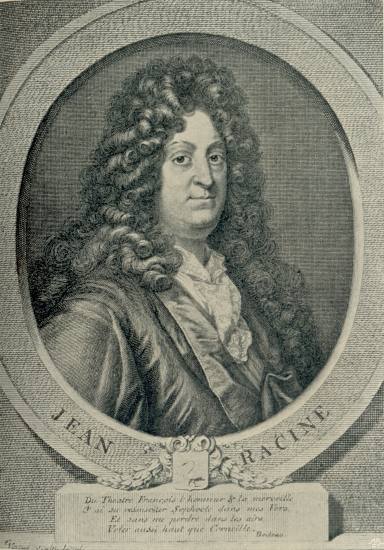
In the early spring of 1670, Louis XIV.'s sister-in-law, the ill-fated Henrietta of England, daughter of Charles I., persuaded Corneille and Racine to write each a tragedy on the story of Titus and Berenice, without each other's knowledge, and consequently without the knowledge of any one else. Her object in so doing was, in all probability, merely to bring the relative merits of the two great dramatists to a decisive test, though rumour assigned a romantic reason for her choice of the subject, to wit, a desire to see upon the stage a little story analogous to that of her one-time relations with Louis XIV. Madame's death, famous for its disputed causes and Bossuet's funeral oration, occurred in the following June; but this did not interfere with the completion of the plays, which were produced within a few days of one another, the secret having been so well kept that until then neither of the poets had the faintest conception that they had been simultaneously engaged on the same subject.
Racine was the first in the field, his Bérénice being produced at the Hôtel de Bourgogne on November 21, Floridor playing Titus, and Mlle. de Champmeslé the beautiful Jewess. Corneille's Tite et Bérénice appeared at the Palais-Royal, eight days later, with La Thorillière and Mlle. Molière in the title-parts.
The result of the duel to which the two dramatists found themselves, all unwittingly, committed was wholly in favour of the younger, Corneille's play, notwithstanding some fine passages, being unworthy of his reputation.[44] It was probably to this fact and to the admirable acting of Mlle. de Champmeslé, rather than to any special merits of his own, that Racine was indebted for his easy triumph. Approved by the king and applauded by the public, his Bérénice remained in the bills until after the thirtieth performance; but it did not please the critics, Boileau declaring that had he been consulted he would have endeavoured to dissuade his friend from undertaking so poor a theme; while Chapelle, when asked by Racine for his opinion, replied in two verses of an old song:—
"Marion pleure, Marion crie,
Marion veut qu'on la marie."
An answer which nearly caused a quarrel between him and the poet.
To Bérénice, early in the following January, succeeded Baiazet, Mlle. de Champmeslé playing the part of Roxane. Madame de Sévigné attended the fifth performance, and next day writes to Madame de Grignan: "We have been to see the new play by Racine, and thought it admirable. My daughter-in-law[45] is, in my opinion, the best performer I ever saw. She is a hundred leagues in front of Des Œillets, and I, who am supposed to have some talent for acting, am not worthy to light the candles when she appears.... I wish you had been with me that afternoon; I am sure you would not have thought your time ill spent. You would have dropped a tear or two, for I myself shed twenty; besides, you would have greatly admired your sister-in-law."[46] Bajazet printed, the Marchioness sent her daughter a copy: "If I could send Champmeslé with it, you would find the tragedy among the best; without her, it loses half its value. Racine's plays are written for Champmeslé, and not for posterity. Whenever he grows old and ceases to be in love, it will be seen whether or not I am mistaken."[47]
Mlle. de Champmeslé did not by any means confine her creations to her lover's heroines; the répertoire of the Hôtel de Bourgogne was a rich one. Thus, in March of that same year, she appeared in the title-part in Ariane, a new tragedy by her fellow-townsman, Thomas Corneille. This play was praised by some critics, but, in all probability, owed its success almost entirely to her impersonation of the heroine, "which drew the public as the light draws the moth." Madame de Sévigné was again among the audience, and wrote of the actress in terms of enthusiasm: "The Champmeslé is something so extraordinary that in your life you never saw any one like her. It is the actress that people flock to see, not the play. I went to Ariane entirely for the sake of seeing her. The tragedy is insipid; the rest of the players wretched. But when the Champmeslé appears, every one is enthralled, and the tears of the audience flow at her despair."[48]
When, seven years later, Mlle. de Champmeslé migrated to the Théâtre Guénégaud, it was in Ariane that she secured her first triumph. "Ariane," wrote Donneau de Visé in the Mercure, "has been extremely well attended. Mlle. de Champmeslé, that inimitable actress, has drawn tears from the majority of the audience." The natural manner of her acting and her pathetic rendering of the hapless heroine gave indeed to the play a new lease of life.
Another brilliant success awaited her in the part of Monime, in Racine's Mithridate, produced on January 13, 1673, the day after its author's reception at the Academy. The play was received with enthusiasm; and Madame de Coulanges wrote to Madame de Sévigné, then on a visit to her daughter, in Provence: "Mithridate is charming; you see it thirty times, and the thirtieth it seems finer than the first."[49] On March 4, it was played at Saint-Cloud, before Monsieur (the Duc d'Orléans), the Duke of Monmouth, Madame de Guise, the Princesse de Monaco, and other distinguished persons; and, in the following August, at Saint-Ouen, where Boisfranc, Surintendant des Finances to Monsieur, was entertaining a party from the Court. For her rôle, which was a most exacting one—Mlle. Clairon confesses in her Mémoires, that she had never succeeded in playing it entirely to her satisfaction—Mlle. de Champmeslé appears to have received very careful instruction from Racine; and the critics were agreed that seldom had anything more expressive and charming than her acting been seen. She was particularly admirable in the scene in the third act, where Monime inadvertently confesses to the jealous Mithridate her love for his son Xiphanès. "Her cry of anguish when she sees that she has betrayed the secret of her heart, sent a shudder through every vein of the spectators and transported them with emotion." Brossette tells us that one day, when dining with Boileau, the conversation turned on the subject of declamation, whereupon the poet repeated this passage in the tone of Mlle. de Champmeslé, as a perfect example of the art.
While Mlle. de Champmeslé continued her successes, Racine completed his eighth tragedy, Iphigénie en Aulide, which was produced at Versailles (August 17, 1674), on the occasion of the magnificent divertissements which Louis XIV. gave to his Court on his return from the conquest of Franche-Comté. This time the performance was given in the open air, in the gardens of the château. "The scenery," says Andre Félibien, in his account of the fêtes, "represented a long alley of verdure; on either side were the basins of fountains, and, at intervals, grottoes of rustic workmanship, but very delicately finished. On their entablature rose a balustrade, on which were arranged vases of porcelain filled with flowers. The basins of the fountains were of white marble supported by gilded tritons, and in these basins one saw others of greater height, which bore tall statues of gold. The alley terminated at the back of the theatre in awnings, which were connected with those covering the orchestra, and beyond appeared a long alley, which was the alley of the Orangery itself, bordered on both sides by tall orange-and pomegranate-trees, interspersed with several vases of porcelain containing various kinds of flowers. Between each tree were large candelabra and stands of gold and azure, which supported girandoles of crystal lighted by several candles. This alley terminated in a marble portico; the pilasters which supported the cornice were of lapis, and the door was all of gold work."[50]
In writing Iphigénie, Racine had departed considerably from his Greek model, discarding the catastrophe in favour of the legend as recorded by Pausanias, wherein it is discovered, at the eleventh hour, that not the daughter of Agamemnon and Clytemnestra, but another princess is the victim intended by the gods. Inferior to the noble tragedy of Euripides, the play was, nevertheless, generally acknowledged to be an advance on anything that Racine had yet attempted, and was a brilliant and unanimous success; a success of emotion, to which Mlle. de Champmeslé's pathetic impersonation of the young Greek virgin probably contributed as much as the subject itself, and inspired Boileau to the lines:—
"Jamais Iphigénie en Aulide immolée,
N'a conté tant de pleurs à la Grèce assemblée,
Que dans l'heureux spectacle à nos yeux étalé
En a fait, sous son nom, verser la Champmêlé."
The capital witnessed the new play in the early days of January 1675, and confirmed the judgment of the Court: indeed, for once, criticism appears to have been almost silenced, and the worst that Barbier d'Aucour, a bitter detractor of the poet, could find to say, was that Iphigénie had caused a rise in the price of handkerchiefs.
After Iphigénie, Mlle. de Champmeslé became the idol of the playgoing public, and "all Paris" flocked to the Hôtel de Bourgogne, seemingly indifferent to the bill, provided they could see the now famous actress. For nearly two years, however, no rôle at all commensurate with her abilities appears to have fallen to her lot; for Racine was at work on a new tragedy, which, had he never written anything else, would have sufficed to ensure him a high place among tragic dramatists. The story goes that one day, in Madame La Fayette's salon, Racine contended that it was within the power of a great poet to make the darkest crimes appear more or less excusable—nay, to arouse compassion for the criminals themselves. In his opinion, even Medea and Phædra might become objects of pity rather than abhorrence upon the stage. From this view his hearers dissented strongly, showing indeed some inclination to turn it into ridicule; whereupon, in order to convince them of their error, the dramatist determined to measure his strength once more against that of Euripides, and to make the fatal passion of Phædra for her stepson the subject of a tragedy.[51]
But alas! Phèdre et Hippolyte was not destined to take its place as the greatest tragedy of the French classical school without bringing cruel mortification to its author. Racine, by his success, had made many enemies and many more by the caustic wit which he was in the habit of exercising at the expense of any one who happened to incur his displeasure. Among those whom he had contrived to offend were the Duchesse de Bouillon, the fourth of the famous Mancini sisters, and Madame Deshoulières, a clever but pretentious poetess, whose verses Racine had, perhaps unduly, depreciated. No sooner did the two ladies in question ascertain the subject of the forthcoming play than they engaged a young and conceited poet named Pradon, author of a couple of indifferent tragedies, to enter the lists against the famous dramatist and compose a rival Phèdre, to be produced at the Théâtre Guénégaud simultaneously with the appearance of Racine's at the Hôtel de Bourgogne. Pradon had only three months allowed him; but, nothing daunted, he set to work and completed his task within the allotted time and to his own entire satisfaction. In his vanity, he made no secret of his intention of measuring swords with Racine; and Boileau represented to his friend that it would be more in keeping with his dignity to decline the challenge and postpone the production of his play. But the latter, stung to the quick by the conspiracy which had been formed against him, and urged on by Mlle. de Champmeslé, "who had learned her part and wanted money," decided that it should appear on the date originally fixed.
The play was accordingly produced on New Year's Day 1677, Mlle. de Champmeslé, of course, impersonating the heroine. Pradon's tragedy was to have appeared on the same evening; but the difficulty of finding an actress willing to undertake the principal rôle—it was refused by both Mlle. de Brie and Mlle. Molière—necessitated a postponement of two days, when Mlle. du Pin, a capable, but by no means brilliant, performer, played Phèdre. Pradon ascribed the refusals of the two leading actresses of the company to the machinations of Racine and his friends; but, though Racine was certainly not over-scrupulous in his dealings with his professional rivals, it is more probable that the ladies in question were, not unnaturally, reluctant to challenge comparison with the all-conquering Mlle. de Champmeslé, in a part which was obviously so much better suited to her talents than to theirs.
All went well at the Hôtel de Bourgogne the first evening. M. de Champmeslé himself took possession of the box-office, and when any of the leaders of the rival faction appeared, courteously informed them that every seat in the front part of the house was already occupied; the result being that Racine's admirers had the theatre to themselves, and the play was accorded a reception which could not fail to satisfy the most exacting dramatist. The following evening, however, matters were very different; to the chagrin of the author and the astonishment of the company, every box on the first tier was empty! The same thing occurred the next evening and the next after that, while, to increase the mystery and the poet's mortification, the boxes at the Théâtre Guénégaud were reported as crowded with applauding spectators. The explanation was that the Duchesse de Bouillon, in her determination to secure the success of her protégé's play and the ruin of her enemy's, had adopted the ingenious device of engaging in advance all the front seats at both houses, filling those at the Théâtre Guénégaud with her friends and leaving the others empty.
Racine was in despair; for that not inconsiderable section of the public which judges of the merits of a play solely by results was beginning to declare that his tragedy was a complete failure and Pradon's a brilliant success. After, however, the trick had been played for three more nights, he triumphed. Perhaps Madame de Bouillon had begun to find her amusement, which is said to have cost her 15,000 francs, the equivalent of five times as much to-day, somewhat too costly a one; or possibly Racine, discovering the tactics of his enemies, had appealed to the king for protection, and the duchess had received a hint from his Majesty that such practices were highly displeasing to him. Any way, the lady retired from the field, and, with her withdrawal, the rival Phèdres speedily found their respective levels. Nevertheless, in spite of his ultimate success, Racine never forgot the mortification to which he had been subjected, and there can be no doubt that this had not a little to do with his decision to renounce writing for the stage.
When Phèdre was played before the Court, Mlle. de Champmeslé, fearing that Madame de Montespan might take the lines afterwards addressed on a memorable occasion by Adrienne Lecouvreur to the Duchesse de Bouillon:—
"Je suis mes perfidies
Œnone, et ne suis pas de ces femmes hardies
Qui, gôutant dans la crime une tranquille paix,
Ont su se faire un front qui ne rougit jamais"—
to apply to herself, begged Racine to alter or erase them. The poet, however, though he yielded the palm to no one as a flatterer of royalty, and was, moreover, under considerable obligations to the king's mistress, indignantly refused to mutilate his play. Several of those present remarked upon the verses; but Madame de Montespan had too much good sense to complain.
As Phèdre, the declamation of which, according to the Abbé du Bois, Racine "had taught her verse by verse," Mlle. de Champmeslé seems to have put the comble upon her fame as a tragédienne. Of all her creations, it is the one that La Fontaine names first in the frontispiece of Belphégor:—
"Qui ne connaît l'inimitable actrice
Représentant Phèdre ou Bérénice,
Chimène en pleurs ou Camille en fureur?
Est-il quelqu'un qui cette voix n'enchante?"
So inimitable was she in this character, affording her as it did an opportunity for the display of all the resources of her art, that Phèdre was the play selected to consecrate the birth of the Comédie-Française on Sunday, August 25, 1680; and it was Phèdre again, with Mlle. de Champmeslé in the title-part, which inaugurated the new playhouse in the Rue des Fossés-Saint-Germain, on April 16, 1689.[52]
The popularity of Mlle. Champmeslé was not confined to the theatre. Her house was "the rendezvous of all persons of distinction of the Court and the town, as well as of the most celebrated writers of the time." Among the former were Charles de Sévigné, Madame de Sévigné's troublesome son, the Marquis de la Fare, the author of the curious and all-too-brief memoirs, and the Comtes de Revel and Clermont-Tonnerre. The latter, besides Racine, included Boileau, Valincourt, Racine's successor at the Academy, Chapelle, and La Fontaine, "who very much regretted that he was only a friend" of his charming hostess. The utmost cordiality and an entire absence of the restraints of etiquette characterised these gatherings, and noblemen and writers met on a footing of perfect equality. "Permit me to address you," writes Boileau to the Comte de Revel, in April 1701, "in the familiar tone to which you formerly accustomed me at the house of the famous Champmeslé."
The actress's liaison with Racine was not only public but accepted by the easy morality of the day; Madame de Sévigné jests about it in her letters, and La Fontaine, writing to Mlle. de Champmeslé, mentions it as the most natural thing in the world. Many years afterwards, Boileau reminds Racine of the numerous bottles of champagne which were drunk by the lady's accommodating husband. "You know," adds he, "at whose expense."
According to M. Larroumet, Racine's latest biographer, the poet's passion for the interpreter of his heroines was of a less defensible kind than that which he had felt for her predecessor in his affections, Mlle. du Parc, "with whom he had experienced a sentiment which had the dignity of love." M. Larroumet is of opinion that "he only loved her with the facile love which the professionals of gallantry frequently inspire."
However that may be, the lady appears to have been very far from faithful to the poet. An epigram by Boileau, which is rather too gai for us to transcribe, speaks of "six lovers" (including the husband), and of M. de Champmeslé living on the best of terms with the others and his wife. The favoured gentlemen appear to have been Racine and the four noblemen mentioned above. But the only one of the four about whose relations with the actress we have any details is Charles de Sévigné.
This young gentleman seems to have had something of the Oriental in his temperament; for, at the time that he was paying court to the actress, he was "wearing the chains of Ninon, this same Ninon who corrupted the morals of his father."[53] The celebrated Ninon de Lenclos, it may be mentioned, was then in her fifty-sixth year, but still retained much of her former fascination; indeed, if tradition is to be believed, she had lovers when she was over eighty!
Madame de Sévigné was much distressed by the conduct of her son. "Madame de la Fayette and I are using every effort to wean him from so dangerous an attachment," she writes to her daughter. "Besides, he has a little actress (Mlle. de Champmeslé) and all the Despréaux and the Racines. There are delicious suppers—that is to say, diableries." Then, on March 18: "Your brother is at Saint-Germain. He divides his time between Ninon and a little actress, and, to crown all, Despréaux. We lead him a sad life. Ye gods, what folly! Ye gods, what folly!"
From the above passages, it would appear that Racine and his friend Boileau were not exactly in the odour of sanctity with their contemporaries; indeed, both were evidently regarded as corrupters of youth by anxious mothers like Madame de Sévigné.
Three weeks later, we learn that M. de Sévigné is not prospering in his love-affairs; Ninon has dismissed him, and Mlle. de Champmeslé is on the point of following her example: "A word or two concerning your brother. Ninon has given him his congé. She is tired of loving without being loved in return; she has insisted upon his returning her letters, which he has accordingly done. I was not a little pleased at the separation. I gave him a hint of the duty he owed to God, reminded him of his former good sentiments, and entreated him not to stifle all notion of religion in his breast. But this is not all; when one side fails us, we think to repair it with the other, and are deceived. The young Merveille (Mlle. de Champmeslé) has not broken with him, but she will soon, I believe.... The poor Chimène says she sees plainly that he no longer loves her, and has applied himself elsewhere. In short, this affair makes me laugh; but I wish sincerely it may be the means of weaning him from a state so offensive to God and hurtful to his own soul. Ninon told him that he was a pompion fricasseed in snow. See what it is to keep good company! One learns such elegant expressions."
Then, on April 17, Madame de Sévigné informs her daughter that the young gentleman's health has broken down under the strain of "the abandoned life he had led during Holy Week," and that he can "scarcely bear a woman in his presence." Profiting by his remorse, his fond mother becomes his confessor: "I took the opportunity to preach him a little sermon on the subject, and we both indulged in some Christian reflections. He seems to approve my sentiments, particularly now that his disgust is at its height. He showed me some letters that he had recovered from his actress. I never read anything so warm, so passionate; he wept, he died; he believed it all while he was writing it, and laughed at it a moment afterwards. I assure you that he is worth his weight in gold."
Finally, on April 22, the marchioness writes that all is at an end between her son and Mlle. de Champmeslé, and that she has been instrumental in preventing the young man from playing a singularly mean trick upon his former enchantress: "He has left his actress at last, after having followed her everywhere. When he saw her, he was in earnest; a moment later, he would make the greatest game of her. Ninon has completely discarded him; he was miserable while she loved him, and now that she loves him no longer, he is in absolute despair. She wished him, the other day, to give her the letters he had received from his actress, which he did. You must know that she was jealous of that princess, and wanted to show them to a lover of hers, in the hope of procuring her a few blows with a belt. He came and told me, when I pointed out to him how shameful it was to treat this little creature so badly, merely for having loved him; that she had not shown people his letters, as some would have him believe, but, on the contrary, had returned them to him again; that such treacherous conduct was unworthy of a man of quality, and that there was a degree of honour to be observed, even in things dishonourable in themselves. He acquiesced in the justice of my remarks, hurried at once to Ninon's house, and, partly by strategy and partly by force, got the poor devil's letters out of her hands. I made him burn them. You see by this what a regard I have for the reputation of an actress."
According to M. Gueullette (Acteurs et Actrices du temps passé), Racine, though deeply in love with Mlle. de Champmeslé, supported patiently the numerous infidelities of the lady, "so long as he believed them to be passing fancies and that he was still beloved." But when the actress embarked upon a more serious love-affair with the Comte de Clermont-Tonnerre, and a wit wrote—
"À la plus tendre amour elle fut destinée
Qui prit longtemps Racine dans son cœur:
Mais, par un insigne malheur,
Le Tonnerre est venu, qui l'a déracinée"—
he was so bitterly mortified that he left her never to return.
The brothers Parfaict and d'Allainval assert that disgust at his treatment at the hands of Mlle. de Champmeslé was the immediate cause of Racine's retirement from dramatic authorship, at the age of thirty-eight, at the height of his talent, in the heyday of his success; for after Phèdre he wrote but two more plays, Esther and Athalie, which were performed by the young girls of Saint-Cyr, and were not seen upon the Paris stage until many years after his death. This, however, is very unlikely, and it is quite possible, as M. Larroumet suggests, that Racine, instead of abandoning the theatre, because Mlle. de Champmeslé had discarded him, discarded the actress, because he had abandoned the theatre. The poet's retirement indeed seems to have been attributable to several different motives: disgust at the shameful cabal against Phèdre and the various annoyances to which it gave rise; the fear that a repetition of such tactics might jeopardise his position as the greatest tragic dramatist of his time; weariness of a dissipated life, and, above all, the awakening, after a sleep of many years, of the religious sentiments with which his old teachers of Port-Royal had inspired him in youth. Indignation at Mlle. Champmeslé's conduct may, of course, have had something to do with the positive antipathy to the theatre which he manifested in his last years;[54] but to assert that it was the cause of his renunciation of a profession which had brought him fame and fortune is to credit him with a capacity for sincere affection which he certainly never possessed.
With Racine departed not a little of the immense popularity which the theatre had enjoyed during the past half-century, for though of capable actors there was, fortunately, no lack, dramatists of even moderate ability were few and far between. In place of Andromaques and Iphigénies and Phèdres, Mlle. de Champmeslé had to resign herself to appear in such deservedly-forgotten plays as the Achille of Thomas Corneille, the Argélie of the Abbé Abeille, and the Troade of Pradon. Nevertheless, despite the barrenness of the field in which she laboured, she contrived to gather fresh laurels, and her masterly impersonation of Queen Elizabeth in Thomas Corneille's Comte d'Essex (January 1678) was enthusiastically received, and secured for a mediocre play a success out of all proportion to its merits. "One might have said of her," remarks M. Noury, "as a critic said of Adrienne Lecouvreur, after seeing her in the same part, 'I have seen a queen among actors.' She possessed, in fact, majesty."
At Easter 1679, in consequence of some dissensions with their colleagues, Mlle. de Champmeslé and her husband quitted the Hôtel de Bourgogne, where they had played for nineteen years, for the Théâtre Guénégaud, which, by a contract dated April 12, awarded them, "in gratitude," in addition to a full share of the profits, an annual allowance of one thousand livres. All her contemporaries are agreed that this defection was the principal cause of the fusion of the two troupes in the following year. Deprived of the services of the famous actress, the Hôtel de Bourgogne was no longer able to cope with its powerful rivals in the Rue Mazarine.
On the formation of the new company, the Champmeslés figured at the head of the list of the twenty-seven players nominated by Louis XIV., and Mlle. Champmeslé was at once recognised as the mainstay of the theatre in tragedy, as Mlle. Molière—or rather Mlle. Guérin, as she had now become—was in comedy. Her husband, too, proved himself well worthy of his place, not only as an actor, but as a playwright. His Parisien (produced February 5, 1682), as we have said elsewhere, provided Mlle. Guérin with one of her greatest triumphs, and he secured another success in his Fragments de Molière, an amusing piece, in which various characters from Molière's plays were introduced.
Mlle. de Champmeslé's successes did not make her forget her relatives. Her brother, Nicolas Desmares, was at this time acting at Copenhagen, in the troupe subsidised by Christian V. That monarch held the actor and his wife, Anne d'Ennebaut, in high esteem, and, in 1682, in imitation of Louis XIV.'s conduct in regard to Molière, he and his queen stood sponsors to their little daughter, Christine Antoinette Charlotte Desmares, destined, in years to come, to emulate the triumphs of her famous aunt. Three years later, Mlle. de Champmeslé persuaded her brother to return to France, and obtained from the King permission for him to be received into the Comédie-Française, "sans début." For an actor to be admitted a member of so famous a company without being required to give proofs of his capabilities, was a privilege which had never yet been accorded, and the playgoing public was up in arms at what it was pleased to consider a scandalous piece of nepotism. So great was the indignation that when Desmares made his first appearance, on May 7, 1685, in Téramène, an angry scene was apprehended; but the new sociétaire's acting was so admirable that the hisses were soon drowned in a storm of applause.
When, in 1689, the Comédie-Française, ousted from the Rue Mazarine, migrated to its new home in the Rue Neuve-des-Fossés-Saint-Germain, Mlle. de Champmeslé, in spite of advancing years, continued her triumphant career, her remarkable talents and enthusiasm enabling her to secure some measure of success for even the most insipid tragedy. Apart from revivals of the great masterpieces of Corneille and Racine, perhaps her most notable success was gained in the part of Judith in the Abbé Boyer's tragedy of that name, produced in March 1795, when she was in her fifty-fourth year. This play had a singular history. For some time it created a perfect furore, and the theatre could with difficulty accommodate the crowds which presented themselves nightly at the doors. "The seats on the stage," says Le Sage, "had to be given up by the men to the women, whose handkerchiefs were spread upon their knees, to wipe away the tears to be called forth by touching passages. The usual occupants of the seats had to be content with the wings. In the fourth act, there was a scene which proved particularly moving, and, for that reason, was called the 'scène des mouchoirs.' The pit, where laughers are always to be found, made itself merry at the expense of these impressionable ladies, instead of weeping with them."
Intoxicated by his success, the Gascon poet, in an evil hour for himself, determined to allow his work to be printed, and it was published during the Easter recess. It was, of course, eagerly bought, but no sooner did people begin to read the book, than they made the discovery that this tragedy, which the author's indiscreet admirers had been comparing to Polyeucte and Phèdre, was, in truth, a most mediocre play, which clearly owed its phenomenal success to the religious nature of the subject and Mlle. de Champmeslé's brilliant impersonation of the Judæan heroine. The indignation of the public against the unhappy abbé, who, it seemed to consider, had perpetrated a kind of fraud at its expense, knew no bounds, and it was forthwith decided that Judith must be driven with ignominy from the boards. Accordingly, when the curtain rose on Quasimodo Sunday—the usual evening for the reopening of the theatre—the players, whose appearance for so many nights had been the signal for prolonged applause, were received with a storm of hisses and derisive laughter. "Then," continues Le Sage, "Mlle. de Champmeslé, actress worthy of eternal remembrance, astonished to hear such a symphony, when her ears were accustomed only to applause, addressed the pit as follows: 'Gentlemen, we are rather surprised that you should receive so badly to-day a play which you applauded during Lent.' To which a voice replied: 'The hisses were at Versailles, at the sermons of the Abbé Boileau.'"[55]
Mlle. de Champmeslé continued on the stage until the end of her life, for, with her, acting would seem to have been not only a profession, but a passion and a delight. As she grew old, however, she naturally began to feel the strain of such constant exertion, and the efforts she was called upon to make in order to secure the success of Longpierre's Médée, in February 1694, brought on a somewhat severe illness. She recovered and resumed her place in the company; but, four years later, during the run of the Oreste et Pilade of La Grange-Chancel, which the author modestly asserts "drew as many tears as the Iphigénie of M. Racine," she was taken seriously ill and ordered by the doctors a complete rest. She retired to Auteuil, which was "already sprinkled with fine houses and noted among suburban villages for the purity of its atmosphere." Here Boileau had a villa, with a delightful garden attached, in which he was in the habit of entertaining all the literary celebrities of the day, from Racine to Madame Deshoulières; and in summer the village was a favourite health resort of those Parisians whose means did not permit of a visit to Dieppe.
The air of Auteuil, however, was powerless to cure Mlle. de Champmeslé. She grew gradually worse, and early in May, it was seen that her end was near. Then arose the question of the administration of the last Sacraments; but before speaking of this, it may be as well for us to glance back and see what had been the practice of the Church in regard to the theatrical profession during the quarter of a century which had elapsed since the death of Molière.
If any hopes had existed that the distressing incidents which had accompanied the death of the great actor-dramatist had been merely the outcome of the hostility of the Church towards a particular individual, and, as such, were unlikely to be repeated, they were speedily doomed to disappointment. Henceforth, the penalties denounced against the profession by the early councils were no longer suffered to remain a dead letter, but were enforced with the most merciless severity. The actor found himself excommunicated both in life and death. Marriage, absolution, the Holy Sacrament, baptism, all were denied him; and he was even refused Christian burial. In one way, and in one way only, could he escape this infamous proscription, which was publicly proclaimed every Sunday from every pulpit in Paris, namely, by renouncing his profession, surrendering his means of livelihood, forfeiting, in the case of a member of the Comédie-Française, the pension to which he was entitled after twenty years' service.
In 1684, Brécourt, an actor of the Comédie-Française, died. On his death-bed he sent for the curé of Saint-Sulpice; but that priest refused to administer the Sacraments until the actor had executed a deed formally renouncing his profession, which was signed by him and four ecclesiastics.[56] Shortly afterwards, two other players, Raisin and Sallé, were compelled to subscribe to similar documents, in the presence of a notary.
Two years later, Rosimont died suddenly without having had time to abjure his errors. Notwithstanding a fondness for good liquor, he was a sincerely religious man, having published a translation of the Psalms in verse, and also written, or collaborated in, a Vie des saints pour tous les jours de l'année. This fact, however, was not permitted to have any weight with the bigoted curé of Saint-Sulpice, and the remains of poor Rosimont were interred, without any ceremony, in a part of the cemetery reserved for unbaptized children.
It must not be supposed that, outside the capital, the proscription of the actor was general. In the provinces it varied, according to the views of the different bishops and the particular ritual observed, and in some dioceses the penalties were not enforced at all. Moreover, even among the clergy themselves, men of liberal opinions were not wanting to protest vigorously against the folly and injustice of reviving superannuated anathemas, intended to apply to the sanguinary games of the circus and the scandalous performances of the Roman theatre, against the interpreters of the tragedies of Corneille and Racine and the comedies of Molière. In 1694, a Theatine monk, one Père Caffaro by name, published, under the cloak of anonymity, a very able letter, entitled Lettre d'un Théologien, wherein he asserted that "the theatre, as it then existed in France, contained only lessons of virtue, humanity, and morality, and nothing to which the most chaste ear could not give its attention." He further pointed out that the highest dignitaries of the Church—bishops, cardinals, and nuncios—had no scruples about visiting the theatre, and, therefore, if it was to be condemned, they must be condemned also, "since they authorised it by their presence"; and concluded by eulogising the exemplary life led by so many members of the proscribed profession, and their abounding charity, "to which magistrates and the superiors of convents could bear ample testimony."
This letter made a great stir, and brought Bossuet—then regarded as the mouthpiece of the Gallican Church—into the field to crush the imprudent Theatine. The bishop called upon the monk to retract his statements, and published a treatise called Maximes et réflexions sur la comédie, in which, after denouncing the plays most in vogue, and in particular the comedies of Molière, which he stigmatised as full of "impieties and obscenities unfit for the ears of a Christian," he maintained that it was not only "the idolatry and the scandalous indecency" of the theatre that the Fathers of the Church had condemned, but "its uselessness, its prodigious dissipation, the passions which it excited, and the vanity and love of display which it aroused." According to him, the Church would excommunicate all Christians who frequented the theatre, were the number of offenders not so great.
Bossuet also asserted that actors had always been excommunicated. "The constant practice of the Church," he wrote, "is to deprive those who perform plays of the Sacraments, both in life and death, unless they renounce their art; and to repulse them from the Holy Table as public sinners." This statement, as M. Maugras points out, in his able and interesting work, Les Comédiens hors la loi, was quite untrue. Up to the time of Tartuffe, the Church had shown the greatest indulgence towards the theatrical profession, and the old canons had remained a dead-letter.
Bossuet was followed in his campaign against the theatre by all the most eminent of the French clergy. Massillon, Fléchier, Bourdaloue, and Fénelon vied with one another in denouncing the unhappy actor in their sermons and writings.[57] Père Caffaro was compelled by the Archbishop of Paris to publicly disavow his letter, which, in fear and trembling, he now protested had been extracted from a work of his, written "in the levity of youth," and published without his knowledge or consent; and the persecution, encouraged by the fact that the gloomy bigotry of the old King had led him to withdraw his protection from the theatre, grew more rigorous than ever.
Strangely enough, at the same time that the Church was mercilessly proscribing the French actors, it received with open arms the Italian players, who had definitely established themselves in Paris in 1660, admitted them to the Sacraments, allowed them to be married in church, and buried them in holy ground. This distinction appears the more inexplicable, as the French theatre was at this period as reserved and decent as the Italian was the reverse. The licence of the foreigners, indeed, knew no bounds, and finally their plays assumed so objectionable a character that, in 1697, they were expelled from France.[58] The probable explanation is, that the Gallican Church did not dare to proscribe the same persons whom the sovereign pontiffs tolerated in their realm, and whose performances were freely patronised by the Roman prelates and clergy.[59]
By another inconsistency, the indulgence shown to the Italian players was extended to the singers and dancers of the Opera. The reason given for this exemption was that the members of the Opera were not actors, as they did not bear the name. But, as we have seen, the canons of the early councils, upon which the bigots relied for their authority, made no distinction whatever between the different classes of public performers: actors, singers, dancers, mountebanks, jugglers, and circus performers were all included in one common anathema.[60]
Mlle. de Champmeslé had been greatly distressed at having to renounce her triumphs and the adulation of the public. Proud of the profession to which she owed her fame, she revolted from the idea of repudiating it, and for some time opposed a steady resistance to the solicitations of the curé of Auteuil, who besought her to make her peace with Heaven, or rather with the Church. Finally, however, she yielded, and the curé of Saint-Sulpice, to whose parish she belonged, was summoned to receive her renunciation. Under ordinary circumstances, as we have seen, the unfortunate actor or actress was compelled to give this undertaking in writing duly attested before a notary; but when the priest arrived the poor woman was at the point of death, and he was therefore compelled to content himself with a verbal declaration. This formality concluded, the curé of Auteuil gave the dying actress absolution and administered the last Sacraments; and on May 15, 1698, she passed quietly away, at the age of fifty-six.
On the morrow her body was brought to Paris, and interred at Saint-Sulpice, in the presence of the whole of the Comédie-Française.