Front matter (continued 5)
Reading edition
As will be gathered from the aforegoing letter, Justine's flight had been very badly received by the commander of the army. Grimm relates the following anecdote, which would seem hardly credible, did we not know Maurice to be capable of any extravagance when his passions were thwarted:—
"The night of their escape was apparently very stormy, since the bridges of communication between the Marshal's army and Löwendal's corps, which was on the other side of the river, were carried away, and it was feared that the enemy might take advantage of the circumstance to fall upon this corps and crush it. M. Dumesnil, who was called at that time 'the handsome Dumesnil,'[134] came to the Marshal's quarters early in the morning, and found him seated on his bed, his hair dishevelled, and a prey to the most bitter grief. Dumesnil attempted to console him. 'The misfortune is undoubtedly very great,' said he,' but it may be repaired.' 'Ah, my friend!' replied the Marshal, 'there is no remedy; I am undone!' Dumesnil continued his efforts to reanimate his courage and to reassure him in regard to the accident of the previous night. 'It will not, perhaps, have the results that you fear,' said he. But the Marshal continued a prey to despair, and to regard himself as a man at the end of his resources. At length, after about a quarter of an hour had passed in this way, he perceived that all that Dumesnil had said referred only to the broken bridges, upon which he exclaimed: 'What! who could have supposed that you were talking only of those broken bridges? That is an inconvenience which may be repaired in three hours. But the Chantilly has been taken from me!'"[135]
Furious though he was at the escape of his prey, Maurice, much to poor Favart's relief, took no steps to execute the threats which he had uttered in the heat of passion, and the performances of the troupe went on as before, save for the absence of Justine, who continued her flight to Paris, where she gave birth to a son. But Maurice was not the man to calmly accept defeat, in love any more than in war, and no sooner was peace signed, in the autumn of the following year, and he found himself at leisure to attend to his private affairs, than he embarked upon a determined persecution of the luckless pair who had dared to thwart him—a persecution which was the more difficult for them to escape, since, for a long time, they seem to have entertained not the slightest suspicion as to its real promoter.
Favart was the first to feel the weight of the Marshal's vengeance. The rent of the Grand Theatre at Brussels, which he had leased since the spring of 1745, had been fixed at five hundred ducats per annum, and this sum had been regularly paid, so long as Brabant remained in possession of the French troops. When, however, by the terms of the Peace of Aix-la-Chapelle, the conquered territory was returned to Austria, Favart found himself in a most unpleasant situation; for the proprietors of the theatre, two ladies of the name of Myesses, without giving him an opportunity to enter a defence, obtained from the re-established Courts an order for his arrest and the sequestration of his theatrical stock, on the ground that he owed them a further sum of 26,000 francs. To avoid being thrown into prison, Favart was compelled to escape across the frontier; but so little did he suspect the share that the Marshal had in the misfortunes that had come upon him, that he actually wrote to him imploring his protection.
Maurice promised him all the assistance in his power, having previously assured himself that his interference was likely to do Favart more harm than good with the Brussels judges in their present state of feeling against the recent invaders of their country. The poet's appeal against the unjust decision failed, and, to make matters worse, the proprietors of the theatre, secretly instigated by the Marshal, applied to the Paris Courts for permission to execute the order for Favart's arrest on French territory.
While these events were taking place in Flanders, Justine was in Paris, where, if we are to credit the evidence of Meusnier, the Marshal had succeeded in persuading her to return to him, and had established her in a house belonging to a Madame de Lesseville, which had been specially furnished for her benefit by Ossere, a fashionable upholsterer of the Pont Notre-Dame. Here—we are still following Meusnier—she lived "in a species of captivity," all communication with her husband being most strictly interdicted. In defiance of this prohibition, however, she admitted him into the house at night, when he contrived to so work upon her feelings that she resolved to defy the Marshal a second time. "Accordingly, one fine night, when the latter was at Chambord, the Chantilly packed her belongings, carried off everything that she could, and retired with her husband to her mother-in-law's house in the Rue de Verrerie. From there she wrote to the Marshal, informing him that it was no longer possible for her to live in sin, and that her salvation was dearer to her than all the fortunes in the world; notwithstanding which, she would retain for him eternal esteem and gratitude." Meusnier adds that the Marshal, though naturally much surprised at such conduct on the lady's part, succeeded in controlling his indignation, and "sought to avenge himself only by new benefits."[136]
The first of these "benefits" was to make strong representations to the authorities on behalf of the proprietors of the Brussels theatre, who, as we have mentioned, were endeavouring to get Favart extradited, and to succeed in obtaining a promise that the necessary warrant should be duly granted. He then wrote to Justine as follows:—
"I am informed, Mademoiselle, that the Demoiselles Myesses (the proprietors of the Brussels theatre) intend to prosecute Favart, in virtue of the decree which they obtained against him at Brussels. I think that it will be advisable for you to go away, and, as you are not happily situated, I offer you an allowance of 500 livres, which will be paid you every month, until your affairs have taken a favourable turn.
"Have the kindness to inform me of your decision in this matter, and the place that you or Favart have chosen for your retreat.
"You are aware, Mademoiselle, of my sentiments for you."
Favart took upon himself the task of answering the Marshal's letter. He tendered him his very humble thanks for his offer, which, however, he declined, as he had done nothing to merit such generosity, and it would be disgraceful for him to accept it. At the same time, all unsuspicious of Maurice's duplicity, he implored his protection against the Demoiselles Myesses, and went to his house to seek his advice.
Maurice advised him to make his escape while there was yet time; and old Madame Favart, having succeeded in borrowing fifty louis for her son, from Mlle. Lamotte of the Comédie-Française, the unfortunate poet fled to Strasburg the same night, where he remained for four months in hiding. He had effected his escape none too soon, for the very next day (June 10, 1749), a lettre de cachet for his arrest was issued.
A day or two after Favart's flight, Maurice left Paris on a visit to Dresden, whence he wrote to the poet's mother, offering to find her son "honourable employment," and "a secure asylum, so long as he might require one," and assuring her of his desire to render him every service that lay in his power. Favart, however, seems to have grown a little suspicious of the Marshal's protestations of friendship, for, when the offer was communicated to him he declined it, and elected to continue in hiding at Strasburg.
The misfortunes which had befallen Favart had left his family without resources, and, but for the generosity of Mlle. Lamotte of the Comédie-Française, they would have found themselves in sore straits. Justine, however, took advantage of the Marshal's absence from Paris to enter into negotiations with the Comédie-Italienne, and, on August 6, 1749, made her début there, as Marianne in the Épreuve of Marivaux. Her success was astonishing. "The pit loudly demanded that she should be received into the company," writes Collé, who was among the audience; "and, whereas it was the rule not to admit French into the Italian troupes, or Italians into the French, it was altogether different in her case; there was a cabal in her favour, and the public had only to make a noise for the regulation to be set aside." Collé expresses his opinion that the habitués of the pit, particularly of the Comédie-Italienne, were becoming "childish and imbecile," and "ought to be placed under restraint."[137]
Poor Justine's delight at her success ("I have made all Paris rush to the theatre," she wrote to Favart) was not of long duration. The Marshal returned from Dresden "more in love with her than ever, notwithstanding all the reasons he had to complain of her." According to Meusnier, it had been largely due to his influence with the Gentlemen of the Chamber that the difficulty in regard to her admission to the Comédie-Italienne had been so speedily overcome; but, when he asked for his reward, the lady would have nothing to say to him. "Far from showing the least sensibility of the Marshal's kindness, she coldly informed him that she was firmly resolved to live as an honest woman, and to labour for her salvation. This last example of ingratitude and bad faith confounded the Marshal."[138]
On September 1 Justine wrote to the fugitive at Strasburg:—
"The Marshal is still furious against me; but I am quite indifferent to that. He has just written a letter to Bercaville (his secretary), wherein he charges him to tell our mother (Madame Favart) that, if you come to Paris, and if she has any affection for you, of which he has no doubt, she must send you away instantly; and that this counsel was a last mark of his kindness for her.
"That, as for Mlle. Chantilly, she is deserving of no consideration at his hands, a fact which ought not to occasion you any vexation.
"Your friends are under the impression that you are travelling in France for your own diversion. If you wish it, I will consign my début to all the devils and set out at once to join you. Let me know your wishes, and I will follow them implicitly.... The house is always crowded on the nights on which I appear. I have been playing the part of the dancer in Je ne sais quoi, and of Fanchon in La Triomphe de l'intérêt. The ballet of La Marmotte is still being played with success. Your couplets are always received with applause. The duet which I sing with Richard is also your work; the mere fact that it is yours ensures my singing it well. I am threatened with much evil, but I laugh at it; I will come with all my heart to beg with you.
"I have just learned from your mother and sister that the Marshal wishes to replace the little Rivière;[139] and, for that purpose, has sent word to me that he loves me more than ever. Henceforth, it will be no longer advisable for me to go and pay my court to him.
"If it be not possible for us to remain here, we will go away and end our days tranquilly in some foreign country. I am for ever your wife and sweetheart."
When this letter was written, Justine had been for some weeks under strict surveillance. "On July 16, 1749," writes Meusnier, "I received orders to keep her under observation, in such a way as to be able to render an account of all her actions and movements, while the Marshal, on his side, worked to thwart all her plans." He then relates how he bribed a servant of the Favarts, named Jacques, to keep watch and ward over his mistress within doors, while he himself followed her when she left the house. This kind of thing went on until the beginning of September, apparently without much result, and then the Marshal "brought another battery into action."
We have mentioned that Justine's father, M. Duronceray, had not been present at her marriage with Favart, but had given his consent in writing. For the past two years he had been confined as a dipsomaniac in the convent of the Frères de la Charité, at Senlis, apparently on the application of his daughter, against whom he was, in consequence, much incensed. The Marshal now determined to make use of this unfortunate man for his own ends, and, accordingly, obtained his release from the convent at Sens and had him brought to Paris, where he lost no time in seeking an interview with the Lieutenant of Police and formally accusing his daughter of having contracted an illegal marriage, inasmuch as he had never given his consent to her union with Favart, and the document purporting to contain it had been a barefaced forgery. This, of course, was a very serious offence indeed, and, supported by the Marshal, the worthy M. Duronceray had no difficulty in obtaining a lettre de cachet for the arrest and imprisonment of Justine, whose fate was now entirely in the hands of her terrible admirer.
The lettre de cachet was granted on September 3; but it was not the Marshal's intention to allow it to be executed at once. Three days later, the police-agent, Meusnier, acting under his instructions, conducted the unconscious instrument of his employer's villainy to a café adjoining the Comédie-Italienne, where Justine was at that moment performing. Here, having been well primed with his favourite vintage, the wretched old man proceeded to regale all whom he could persuade to listen to him with a harrowing account of his daughter's wickedness and the terrible things he had suffered at her hands. Finally, he succeeded in working himself into such a frenzy of indignation that he could with difficulty be dissuaded from rushing into the theatre and making a public demonstration against her. "This manœuvre," writes Meusnier cynically, "was merely intended to induce the public to believe that the Marshal had no share in the coup which he was planning, namely, to cause the Chantilly to be shut up."
Next day, accompanied by a priest, who was well known as a frequenter of the Jesuit College in the Rue Saint-Jacques, M. Duronceray called upon the leading members of the Comédie-Italienne, to whom he related his sad experiences. Mlle. Coraline, Justine's rival in the affections of the public, was so touched by his account of her colleague's perfidy that she could not restrain her emotion, whereupon all who were present followed her example, and the room resounded with lamentations.
Justine would not appear to have been greatly disconcerted by the manœuvres of M. Duronceray and his sympathisers; secure in the favour of a public always very indulgent towards the moral shortcomings of its idols, she probably felt that she could afford to ignore the gossip of the coulisses. The Marshal, however, pretending to have forgiven her for her recent rebuff, now sent to warn her that her father was endeavouring to obtain a lettre de cachet to have her shut up, and advised her to leave Paris until the storm had blown over. His object was to induce her to rejoin her husband, when he intended to have them both arrested. In this, as we shall see, he was only partially successful.
At the beginning of October, the troupe of the Comédie-Italienne set out for Fontainebleau, to give a series of performances before the Court. Justine obtained leave of absence, and, having written to Favart to meet her at Lunéville, left Paris, on October 7, accompanied by her sister-in-law, Marguerite Favart, and followed, at a discreet interval, by Meusnier and a detachment of police, with orders not to interfere with the actress until they had secured the person of her husband. The latter, however, succeeded in evading them, in spite of all their vigilance, and they had to be content with the rather barren honour of arresting poor Justine; which they did in a very ungallant manner, in the middle of night, at her inn at Lunéville, nearly frightening her and her sister-in-law to death in consequence.
Next morning Meusnier and his captives started for Meaux, where the ladies were separated; Marguerite Favart being permitted to return to Paris, while Justine, after being kept for some days at Meaux, was conducted to the Ursuline convent at Les Grands-Andelys, on the borders of Normandy. On October 20 she wrote to her husband:—
"They have brought me to the convent of Les Grands-Andelys, to the Ursulines, situated twenty-two leagues from Paris. I have seen the lettre de cachet; it is my father who has caused me to be placed here. Do not lose an instant; send all our papers [i.e. the papers connected with their marriage] to the Minister, M. d'Argenson, and especially my father's consent, signed with his own hand; it is in the keeping of the curé of Saint-Pierre-aux-Bœufs. Collect our witnesses, and take them with you to the Minister. If it is my father who is persecuting us in this manner, the truth will be revealed, and we shall speedily have justice done us. If this trouble is due to some of our enemies, they may do as they please; their influence may perhaps be sufficient to separate us for life, but they can never prevent us loving one another, nor break the sacred and honourable tie which binds our hearts together.
"I have just written to the Maréchal de Saxe about what has befallen us; he has always shown much friendship for us. I am sure that he will be willing to interest himself in our affairs and render us assistance on this occasion.
"P.S.—Do not commit the folly of coming to seek me here."
A week later, she writes again:—
"I am in a good convent, where they pay me every imaginable attention. Spare no pains to justify our marriage with the Minister. You must write to M. de Paumi;[140] he can do us a service with my father. You need not write to the Maréchal de Saxe to ask his protection; he has rendered us too many services to refuse to assist us on the present occasion.
"If I had wished, I might have escaped what has befallen me; I had only to accept the retreat which a person[141] who warned me of the lettre de cachet obtained against me offered me; but I had no desire to do so."
A few days after the first of these letters was written, Justine received a letter from the Marshal, in answer to one which she had sent him from Commercy, on her way to Lunéville. In this he attributed her misfortunes to the action of the leaders of the dévots, or devout party, at the Court, who were always eager to punish persons who contravened the marriage laws, and "did not easily let go their prey." "Favart," he adds, "ought to feel highly flattered that you should sacrifice for him fortune, pleasure, glory, everything, in short, that might have made the happiness of your life. I hope that he will be able to compensate you for it, and that you will never feel the sacrifice which you are making.... You would not make my happiness and your own. Perhaps you will make your own unhappiness and that of Favart. I do not wish it, but I fear it.—Farewell."
At the same time, the hypocritical Marshal wrote to the actress Mlle. Fleury, who had exchanged the rôle of mistress for that of confidante, expressing the grief he felt on hearing of the arrest of the "little fairy," whom he had "imagined out of danger." "How I pity that poor mother [Madame Favart], who is a courageous and sensible woman! I have been her friend since the first time I spoke to her. Tell her that I will do my best, and as she and Favart have not a sou, beg her to accept fifty louis, for which you will find an order enclosed. That will help them for the present, and I promise them assistance in every way for the future." He then declares his opinion that the person responsible for the trouble is the priest who had accompanied Justine's father on his visits to the leading members of the Comédie-Italienne, and that every effort should be made to discover him, if necessary, by bribing Meusnier to reveal his whereabouts.
The money offered by the Marshal was refused by Favart, nor could the old lady and her daughter be prevailed upon to accept it.
Early in November, Justine was removed from Les Grands-Andelys to a convent at Angers. Her new residence was one of the regular couvents de force, or houses of detention, where the most rigorous discipline prevailed, and she was treated "like a State criminal." This, as the worthy Marshal had of course foreseen, rendered her supremely miserable, and all the more eager to recover her liberty. To do her justice, however, she would appear to have been far more exercised over the fate of her husband and his mother and sister, left, through his misfortune, almost entirely without resources, than over her own troubles; for, on November 6, we find Maurice writing from Chambord:—
"The great attachment that you entertain for Favart and his relatives is very praiseworthy; but I doubt whether it is advisable to manifest it so clearly, since it is certain that it is this same great attachment which has placed you in the vexatious position in which you now find yourself. I leave to your good sense to judge of the value of what I take the liberty of observing in regard to this matter.... What is certain, is that he has not been arrested, and that he is well, and that none of his relatives are in danger of dying, as you appear to fear. They are all very tranquil, and have not taken any steps to secure your liberation. I do not comprehend their reasons."
As time went on, the captive became a prey to the deepest despair. "Life is a burden to me; I loathe it," she writes to Maurice, dating her letter "December 40th," doubtless to express more forcibly the length and dreariness of her days. "I desire to die, in order that every one may be satisfied; I am living in a state of despair. Never can I recover from the blow that has brought all this upon me."
On his side, the Marshal advised patience, assuring her that he was doing everything in his power to procure her release, but that the difficulties with which he had to contend were very great, inasmuch as it appeared that her father had acted at the instigation of a band of religious fanatics, whose names he had not yet been able to ascertain. If he could find M. Duronceray, he might wring the truth from him, but, unfortunately, up to the present, all attempts to discover his whereabouts had proved fruitless. M. Duronceray, it may be mentioned, was at this time at Ormeaux, near Vincennes, in charge of one of Maurice's agents!
In the same letter, he tells her that Favart—the poor man was then hiding in a cellar in the house of a village priest in Lorraine—had paid a visit to Paris, and been seen by several persons; that he was informed that no steps would be taken against him by the police, so long as he remained quiet, and that he had appeared very far from inconsolable at his wife's captivity: "The race of poets does not take things so much to heart. Voltaire has produced two tragedies since the death of Madame du Châtelet, though it was said that he was dead also, because he was believed to be much attached to that lady. But to die, malpeste! an author's feelings do not carry him as far as that: they are too familiar with fiction to love reality up to that point."[142]
At length, about the middle of December, when the Marshal considered that his victim had had enough of conventual life to induce her to become amenable to reason, he informed her that, thanks to his untiring efforts on her behalf, she would, in all probability, be shortly released and exiled a certain distance from Paris. He was as yet, he said, in ignorance of the place to which she was to be sent, but was hopeful that it would be within easy distance of the capital, so that he might be able to assist her "de toutes les choses agréables et utiles." Justine, overjoyed at the prospect of a speedy end to her captivity, replied, begging him "in God's name not to deceive her," and declaring that she was suffering torments from uncertainty. "I await news from day to day with the utmost impatience since you have given me hope of being able to leave this villainous house. Every time that the bell rings, I have terrible palpitation of the heart. I believe that it is some one come to fetch me. I bound to the door, and, when I find that it is not I whom they seek, I return, covered with confusion, to shut myself up in my little cell and weep, like a little child who has been beaten for ten or twelve days. That is the life I am leading. When I leave here, I shall imagine that I am seeing daylight for the first time. I do not thank you for all your kindness, nor for all the obligations under which you have placed me; they are numberless, and I should never make an end. I know that you do not care for compliments, and I will therefore merely tell you that, so long as I live, I shall use every endeavour to prove to you my gratitude and appreciation of all that you are doing for us. Monseigneur, I implore you in mercy to take me from this place; you will be performing a work of mercy in releasing a poor little prisoner who has never deserved to be one. I eagerly await this good news from you."
In the closing days of the year, Justine received another letter from the Marshal, written from his château at Piples, near Boissy-Saint-Léger, in which he informed her that orders had been given for her release, and only awaited the signature of the Comte d'Argenson, the Minister for Paris, who was, at that moment, too ill to attend to any matters not of the first importance. The letter concluded with the following very significant words, in a woman's handwriting, probably that of the Marshal's ex-mistress and confidante, Mlle. Fleury: "Your friends do not forget you, my dear Jantillesse,[143] and love you always; but, in God's name, become reasonable; think of your own happiness and that of those dear to you."
On the other hand, Justine's sister-in-law, Marguerite Favart, who had evidently discovered the secret of the persecution which the luckless couple were undergoing, wrote to the captive, apparently in answer to a letter from Angers, entreating her to be firm, and to refuse to purchase liberty at the price which would no doubt be set upon it:—
"If you think, as you show you do, my dear sister-in-law, I do not see how you can hesitate as to the course you ought to take, since you are in a position to do as you please. It was not necessary to ask the advice of my brother. You ought to know him well enough to be sure that he would not give you any counsel different from that which he has always given. He knows of no arrangement that can be made with infamy; the most cruel punishments would not terrify him, nor could he be seduced by the most brilliant advantages. He escaped, for a time, from the rest of the evils prepared for him, and did not do so for his own sake. The loss of you had rendered his life odious to him; but he yielded to our alarms; he feared the despair of a mother and a sister already afflicted by the misfortunes which had overtaken him. His son, ourselves, and yourself are the only objects of his hopes and fears. That is all that can interest him now. He has lost, through these continual persecutions, his friends, his protectors, his property, his talents, his health, and all his resources. Nevertheless, he will consider all atoned for when he finds in you sentiments worthy of him. He does not ask to be their object: honour alone must determine you. Content with loving you, he demands nothing in return; knowing, by sad experience, that the heart is not to be commanded. If it be true that you have been detained by force, now that you are free, you will find with us a poor but honourable asylum. Although everything has been done to cast upon my brother and upon us part of the disgrace in which you have been immersed, no one has been deceived, save ill-informed or ignorant persons. Our poverty, our sufferings, justify us in the eyes of sensible people; for which reason our condition has become dear to us: by contenting yourself with it, you can justify yourself also. Such are the sentiments of my brother and ourselves. I inform you of them by my mother's orders. Adieu, my good friend; your affectionate sister embraces and awaits you. Adieu."[144]
Several historians are of opinion that Justine followed her sister-in-law's advice, and that Maurice, in despair of bending her to his will, placed no further obstacles in the way of her release. Such, unfortunately, was not the case. Early in January 1750, the actress was released from the convent at Angers, and exiled to Issoudun, in Berri. On February 10, she obtained permission from Berryer, the Lieutenant of Police, to absent herself for a month from her place of exile, a permission which was renewed at the expiration of that period. Where did she spend the time? The answer is to be found in the report of Meusnier:—
"But as M. de Loewdahl [Marshal Löwendal, the lieutenant and friend of Maurice] is visiting the Marquis de Castelnau in the vicinity of Issoudun, the Marshal has caused the Chantilly to be sent to Chambord, and thence to Piples, where she has been about six weeks, under the charge of Mouret, wife of the concierge of Chambord."[145]
The evidence of Meusnier is confirmed by the Abbé de Voisenon, than whom no one was better acquainted with the private affairs of the Favarts:—
"The Marshal, angered by her resistance, caused her to be carried off, and threatened to have Favart killed, if she refused to surrender herself to him. She was terrified, and, through love for her husband, was unfaithful to him.... The Marshal died; and, as the Chantilly mingled with the favours that were snatched from her the most cruel reproaches, she scarcely obtained any advantage besides her freedom."[146]
Towards the end of the following June, the lettres de cachet against Justine and her husband were revoked, and they were permitted to return to Paris. Poor Favart had been reduced to terrible straits. Almost penniless and firmly convinced that all the police in the realm were at his heels, he had for some months past, as we have mentioned, been hiding in a cellar in the house of a compassionate village priest in Lorraine, earning a precarious livelihood by painting fans by the light of a lamp. The cruel treatment he had received had impaired his health and broken his spirit, and he received the news that his trials were at an end with feelings of positive indifference. "It seems," wrote he to a friend who had sheltered him at Strasburg, "that they are tired of persecuting me; my exile is over, but I am none the happier for that; my sorrows are of a kind that can end only with my life."
Three months after this letter was written (November 30, 1750), Maurice de Saxe died at Chambord,[147] and poor Favart could breathe freely once more. The poet might have been pardoned had he sought consolation for his sufferings in some biting epigram at the expense of the man who had wronged him so cruelly. But his kindly and inoffensive nature was incapable of malice, and he behaved with a moderation almost amounting to magnanimity. "I think," he wrote to one of his friends, "that I may be allowed to say on the death of this illustrious man of war, what the father of our theatre said of Cardinal de Richelieu:—
"Qu'on parle bien ou mal du fameux maréchal,
Ma prose ni mes vers n'en diront jamais rien:
Il m'a fait trop de bien pour en dire du mal;
Il m'a fait de mal pour en dire du bien."
The Marshal was dead, but his death could not undo the evil he had done. Favart, who had loved his wife with all the strength of his nature, was generous enough to pardon a past in which circumstances had been so terribly against her. Instead of reproaching her, he preferred to forget, and in so doing acted wisely; for in Justine, as long as she lived, he found a devoted friend and a sure counsellor, on whose sympathy and advice he was always able to rely, and a companion whose irrepressible gaiety was proof against all the troubles and anxieties of both family and professional life. But his generosity went no further. If friendship had survived Justine's last infidelity, love had not. "Fly from love as from the greatest of all evils," he wrote to his friend at Strasburg; and, incredible as it may appear, when, not long afterwards, Justine, piqued, we may presume, by her husband's indifference, formed a liaison with the eccentric little Abbé de Voisenon, Favart's friend and reputed collaborator, the poet—this man whom we have seen prefer persecution, exile, and misery to dishonour—so far from endeavouring to put a stop to an affair which amounted to a serious scandal, appears to have regarded it with the utmost complacency.
The removal of their persecutor left the Favarts free to resume their respective professions, and, on May 3, 1751, Justine reappeared on the stage of the Comédie-Italienne, in a piece entitled Les Amants inquiets, of which her husband was the author. At the beginning of the following year, on the death of Riccoboni's wife, she was allotted a full part in the company, to which she remained a tower of strength for nearly twenty years; her talents as an actress and a singer being rivalled by those which she displayed as a dancer, "turning the heads of the public and securing even the support of the women." Her versatility seems to have been truly amazing. "Soubrettes, heroines, country girls, simple parts, character parts, all became her," says Favart in his Mémoires; "in a word, she multiplied herself indefinitely, and one was astonished to see her play the same day, in four different pieces, parts of the most opposite character." Her powers of mimicry, too, particularly of the different dialects of France, have seldom been surpassed. Provincials whose accents she had borrowed could with difficulty be persuaded that she did not come from the same part of the country as themselves.
Possessed of exquisite taste in theatrical matters, Justine laboured strenuously for a reform in stage costume, and was "not afraid to sacrifice the charms of her countenance to truthfulness of representation." Before her time, actresses who played the parts of soubrettes and peasant-girls wore immense paniers, with diamonds in their hair and long gloves reaching to the elbow. But when, in August 1753, she created the rôle of Bastienne in Les Amours de Bastien et Bastienne, a parody of Jean Jacques Rousseau's Devin du village, which she had composed herself in collaboration with Harny, she appeared on the stage wearing a simple woollen gown, with her hair flat on her head, a cross of gold on her neck, bare arms, and wooden shoes. The sabots offended some critics in the pit, and murmurs of disapprobation were heard. The Abbé de Voisenon, however, saved the situation by a happy mot. "Messieurs," he cried, "ces sabots-là donneront des souliers aux comédiens." The pit, appreciating the abbé's wit, broke into laughter and applause; the malcontents were silenced, and the piece had so great a vogue that the players grew tired of acting it long before the attendances showed any signs of diminishing.[148]
Justine, indeed, neglected nothing to arrive at theatrical truth. In Les Trois Sultanes, the plot of which was derived, like several other of Favart's vaudevilles, from the Contes moraux of Marmontel, she played the part of Roxelane in a dress "made at Constantinople with the materials of the country." This was the first occasion on which the costume of Turkish ladies had been seen upon the French stage, and though Favart himself declares that it was "at once decent and voluptuous," it was objected to; and when soon afterwards another play in which the action passed in the Orient was represented before the Court, Justine's reforming zeal received an abrupt check by an order from the Gentlemen of the Chamber to confine herself to the ridiculous and fantastic costume established by custom.
Les Trois Sultanes, it may be mentioned, in spite of the unfavourable comments passed upon Roxelane's attire, was extraordinarily successful; and the audience, we are assured, were transported with enthusiasm. A peasant in the pit, "rendu fou d'admiration," demanded of his neighbour the name of the author, and on being told that it was Favart, exclaimed: "Morbleu! I would that I had that man here; I would embrace him until I had kissed the skin off his cheeks!"
Justine's passion for local colour was again in evidence when the interlude called Les Chinois was represented. "She appeared, as did also the other actors, dressed exactly in the Chinese fashion. The dresses which she had procured had been made in China, while the designs for the scenery and properties had in like manner been made on the spot."
Among other pieces in which Justine appeared with success may be mentioned La Servante Maîtresse, Ninette à la Cour, Annette et Lubin, of which she herself was part author, Les Moissonneurs, and La Fée Urgèle, "in which," says Voisenon, "she played the part of the old woman in a manner impossible to imitate." According to the same authority, Favart was largely indebted for the success of more than one of his productions to suggestions made by his wife, notably in Ninette à la Cour, in which, too, she was responsible for many of the airs.
It would perhaps have been better for Justine's professional reputation had circumstances compelled her to retire from the stage some time earlier than was the case. During her later years, the critics declared that her voice had become thin and disagreeable, and that her acting had lost the naïveté which had been its principal charm. She had become, too, extremely stout, and Madame Necker, then Mlle. Churchod, writing, in 1764, to Madame de Brenles, mentions that she had seen her playing Annette, "with a figure twelve feet broad and two high."[149] The public were more indulgent than the critics; but on December 14, 1769, when she appeared in a vaudeville by her husband called La Rosière de Salency, she was very coldly received. The poor actress, believing herself abandoned by the public whose idol she had so long been, and suffering already from the disease of which she eventually died, played from that time less frequently, and, at the end of the year 1771, ceased to appear altogether. On Twelfth-day she was compelled to take to her bed, and sent for the notaries to make her will. She lingered for four months, enduring terrible sufferings, during which she continued to occupy herself with the management of her household, while her gaiety and insouciance never failed her for a single moment. "One day," says Grimm, "on recovering from a long swoon, she perceived, among those whom her danger had hurriedly assembled around her, one of her neighbours rather grotesquely attired, whereupon she began to smile and remarked that she believed she saw 'the clown of Death'; a characteristic mot in the mouth of a dying girl of the theatre."
Almost to the last Justine seems to have cherished a vague hope that she would ultimately recover, and, for a long time, refused to pronounce the renunciation of her profession which the curé of her parish demanded, according to custom, before administering the last Sacraments. Nor was it until, through the influence of Voisenon, she had obtained a promise from the Gentlemen of the Chamber that her salary should be preserved to her, under the form of a pension, in case of retirement, that she yielded, and exclaimed, smiling: "Oh! for the moment, I renounce it." She then received the Sacraments and, profiting by a short respite from pain, composed her own epitaph, which she set to music. She died on April 21, 1772, at four o'clock in the morning, in her forty-sixth year, and was buried the same day in the church of Saint-Eustache.
Favart survived his talented wife just twenty years, and died in May 1792. Towards the end of his life, he became almost blind, notwithstanding which he continued to work for the theatre, besides keeping up an active correspondence with the Italian dramatist Goldoni, who came to Paris to visit him in 1791. The most successful of his later pieces was La Belle Arsène, music by Monsigny, produced in 1775.
Of his children by Justine, the only one to call for notice here is his second son, Charles Nicolas Joseph Favart. Born in 1749, at the age of twenty-one he was admitted a sociétaire of the Comédie-Française, where he remained for fifteen years. Though but a moderate actor, he was a successful dramatist; his best works were Le Diable boiteux, ou la Chose impossible (1782); Les Trois Folies (1786); Le Mariage singulier (1787); and La Vieillesse d'Annette et Lubin (1791), the last in collaboration with his father. His son, Antoine Pierre Charles Favart (1780-1867), entered the Diplomatic Service, where he gained some little distinction. He assisted Dumolard in editing the Mémoires of his grandfather, collaborated in a couple of plays, and was an amateur painter of some talent.
VI MADEMOISELLE CLAIRON
FOR more than seven years after the death of Adrienne Lecouvreur, her place as a tragic actress remained unfilled. During these years, several capable tragédiennes appeared, notably Jeanne Gaussin, a beautiful brunette with a rich and sympathetic voice, who created the part of Zaïre in Voltaire's tragedy of that name (August 13, 1732), and moved the delighted poet to address her in the following verses:—
"Jeanne Gaussin, reçois mon tendre hommage;
Reçois mes vers au théâtre applaudis;
Protège-les: Zaïre est ton ouvrage;
Il est à toi, puisque tu l'embellis.
Ce sont tes yeux, ces yeux, si pleins de charmes,
Qui du critique ont fait tomber les armes."[150]
But beautiful as Mlle. Gaussin undoubtedly was, and excellent as was her acting in Zaïre and other pathetic parts, she fell very far short of the standard to which her gifted predecessor had attained; nor was it until August 1737 that an actress worthy to assume the mantle of Adrienne arose.
This was Marie Françoise Dumesnil, who, like Adrienne, had begun her career at theatres in the East of France, and, like her, singularly enough, had received her invitation to Paris while playing at Strasburg. Her style, which was marked by a high degree of truth to Nature, refinement, and technical skill, combined with a real enthusiasm for her art, excited general admiration, and her début was brilliantly successful. In the classic répertoire her most celebrated rôles were Cléopâtre, Clytemnestre, and Phèdre; while her most successful creation was Mérope (February 20, 1743), when, according to Voltaire, she kept the audience in tears for three successive acts.[151]
After this triumph—the greatest of her career—it may well have been supposed that Mlle. Dumesnil was destined to maintain her supremacy for many years to come. Nevertheless, ere six months had passed, she found her proud position challenged by a most formidable rival.
Claire Joseph Lerys—for that was the name of this rival, and of the greatest, or, at least, the most celebrated tragic actress of the eighteenth century, though she styled herself Claire Josèphe Hippolyte Lerys de Latude-Clairon, and is known to fame under the last of these names—was born at Condé, a little town of Hainaut, on January 25, 1723. Her father was one François Joseph Desiré Lerys, a sergeant in the Régiment de Mailly; her mother, a working-woman, Marie Claire Scanapiecq by name; and she was a natural child, a fact which she omits to mention in the French edition of her Mémoires, though she is more candid in the German edition.[152]
The circumstances attending her birth, which she has herself recounted, were, it must be admitted, highly significant of her future career:—
"It was the custom of the little town in which I was born for all persons to assemble during the carnival time at the houses of the wealthiest citizens, in order to pass the entire day in dancing and other amusements. Far from disapproving of these recreations, the curé partook of them and travestied himself with the rest. During one of the fête days, my mother, who was but seven months advanced in pregnancy, suddenly brought me into the world, between two and three o'clock in the afternoon. I was so feeble that every one imagined a few moments would terminate my career. My grandmother, a woman of eminent piety, was anxious that I should be carried out at once to the church, in order that I might there receive the rite of baptism. Not a living soul was to be discovered either at the church or at the curé's house. A neighbour having informed the party that all the town was at a carnival entertainment at the house of a certain wealthy citizen, thither was I carried with all expedition. Monsieur le Curé, attired as Arlequin, and his vicar, disguised as Gille, imagining, from my appearance, that there was not a moment to be lost, hurriedly arranged upon a sideboard everything necessary for the ceremony, stopped the fiddle for a moment, muttered over me the consecrated words, and sent me back to my mother a Christian—at least in name."[153]
When the little girl was twelve years old, she and her mother left Condé, and, after a short stay at Valenciennes, settled in Paris, where the latter found employment as a sempstress. The future queen of tragedy was at this time, according to her own account, a delicate, sensitive child, with a confirmed dislike to needlework, in consequence of which she spent the greater part of her days "trembling beneath the blows and threats of her mother," whom she describes, rather undutifully, as "a violent, ignorant, and superstitious woman."
However, at length Fate took pity on her. Her mother, yielding to the remonstrances of the neighbours, who had been "affected by the appearance of languor to which her misfortunes had reduced her, and her beauty, voice, intelligence, and the sweetness of her temper when she was not forced to work at the needle," ceased to belabour her, and, by way of punishment, took to shutting her up in a room overlooking the street. Now, it happened that the house immediately opposite the Scanapiecqs was occupied by the mother of Mlle. Dangeville, the famous soubrette of the Comédie-Française, and, one day, little Claire, having mounted a chair to survey the neighbourhood, beheld the idol of the pit taking a dancing-lesson in the midst of an admiring circle of relatives and friends. "She was distinguished," she tells us, "for every charm which Nature and youth could unite in the same person. My very being came into my eyes; not one of her movements escaped me. She was surrounded by her family, and when the lesson was over, every one applauded her, while her mother embraced her. The difference between her condition and my own penetrated me with the deepest grief; my tears would not permit me to see anything more. I descended from my chair, and, when the throbbing of my heart had subsided sufficiently for me to remount it, all had disappeared."[154]
From that day, little Claire had only one desire: to be placed en pénitence at the hour at which Mlle. Dangeville was in the habit of taking her lesson; and, the moment she was alone, she would climb to her perch and remain there, a motionless and silent, but enthusiastic spectator of the movements of her fair neighbour. Soon, at first almost unconsciously, the girl began to imitate what she had seen, and with such success that those who came to her mother's house thought that she had been provided with masters. "My manner of entering a room," she says, "of saluting the company, of seating myself, was no longer the same; and the improvement I had acquired, added to the graces of my deportment, obtained for me even the favour of my mother."
At length, unable any longer to keep her secret to herself, and seized with an intense curiosity to ascertain who this wonderful Mlle. Dangeville might be, she decided to take into her confidence one of her mother's friends, who had always treated her a little less as a child than the majority of visitors to the house. This proved a fortunate step, for the person in question, pleased with the little girl's intelligence, not only gave her a good deal of information about Mlle. Dangeville and the profession which she adorned, but obtained from her mother—not without considerable difficulty, for the sempstress "saw in theatrical performances only the road to eternal damnation"—permission to take her to the Comédie-Française to witness a representation of the Comte d'Essex and Les Folies amoureuses.
Mlle. Clairon, in her Mémoires, confesses her inability to give any account of that never-to-be-forgotten evening. She only recollects that, during the whole of the performance, her absorption was such as to prevent her uttering a single word, and that, on returning home, she neither saw nor heard any one. Angrily dismissed to her room by her mother, instead of going to sleep, she spent the whole night in recalling and repeating everything that had been said by the performers at the theatre, and every one was astonished the next day to hear her repeat, with scarcely a mistake, a hundred verses of the tragedy and two-thirds of the after-piece. But this feat of memory was less surprising than the extraordinary way in which the little girl had contrived to assimilate the peculiarities of every actor whom she had seen. She lisped like Grandval, she stammered like Poisson, she mimicked to a nicety the coquettish airs of Mlle. Dangeville, and the cold and dignified manner of Mlle. Balicourt;[155] in short, she tells us, she was looked upon as a prodigy by every one, save her mother, who, frowning angrily, declared that she would rather see her make a gown or a petticoat than waste her time over such unprofitable nonsense. Claire, however, fortified by the praises which she had received, boldly declared her intention of becoming an actress, and, when the enraged sempstress threatened to starve her into submission, or "break her arms and legs," retorted, with the air of a tragedy queen: "Ah, well! you had better kill me at once, since otherwise I am determined to go upon the stage."
Marie Scanapiecq did not, it is hardly necessary to remark, attempt to put her threats into execution; nevertheless, for some two months, she subjected her unfortunate little daughter to a course of such rigorous discipline, in the hope of breaking her spirit, that Claire's health became seriously affected. Then the stern mother began to relent, and, on the advice of one of her customers, to whom she had confided her trouble, finally decided to let the girl have her way, and took her to see the lady in question, who had promised to use her influence to further her ambitions. The lady presented Claire to Desheys, a prominent actor of the Comédie-Italienne, who was so favourably impressed with the little aspirant's abilities that he presented her, in his turn, to his colleagues, and, after a course of instruction in dancing and music, she made her début at the "Italians" on January 8, 1736, in a small part in Marivaux's Isle des Esclaves, under the name of Clairon, a variation of her Christian name of Claire.
Although not yet thirteen, she appears to have acquitted herself with credit, while the progress she made in her profession was remarkable. "My industry, my enthusiasm, my memory," says the actress, "confounded my instructors. I retained everything, I devoured everything." Nevertheless, whether on account of her youth, her diminutive stature—she was very short, even for her age—or, more probably, because her precocious talents had excited the apprehensions of the famous Arlequin, Thomassin, who had daughters of his own to bring forward, she did not remain long at the Comédie-Italienne, and, at the end of a year, found herself obliged to seek her fortune in the provinces.
It was to Rouen that she went—Rouen, the nursery of the Paris theatres—Rouen, which had witnessed the first efforts of Marie de Champmeslé, whose triumphs in tragedy this young girl was one day to eclipse. The principal theatre there was at this time under the joint-management of La Noue, author of La Coquette corrigée, and Mlle. Gautier, both, in after years, prominent members of the Comédie-Française; and Mlle. Clairon was engaged to dance in the ballet, sing in comic opera, and act in a few parts suited to her age, at a salary of 100 pistoles, or about 1000 livres. As some compensation for this meagre remuneration, Marie Scanapiecq, who had accompanied her daughter, and whose views with regard to the morality of dramatic performances had undergone a most surprising alteration since she had discovered that there was money to be made, was installed superintendent of the box-office.
At Rouen, little Clairon soon became a general favourite, and improved so rapidly in her acting that, by the time she was sixteen, she was pronounced to be the most charming soubrette the Norman capital had ever possessed. The Rouen ladies were very far from sharing the prejudices of most provincial dames, who believed themselves degraded if they so much as spoke to an actress, and the girl was invited everywhere. A certain Madame de Bimorel, wife of a president of the Parliament of Normandy, and an old flame of the poet Fontenelle, was particularly kind, and remained her firm friend for more than forty years.
A gay town was Rouen in those days; a place where a young and pretty actress could count on receiving almost as much admiration as in the capital itself. At the theatre they still talked of the cause célèbre arising out of an affray between the Marquis de Cony and the Président de Folleville, which had taken place some years before; how the marquis, encountering the president at the house of a certain danseuse whose heart he had until that moment fondly imagined to be his alone, had addressed him by an opprobrious name; how the president had retorted by a blow directed at the nose of the marquis, and how the infuriated nobleman had thereupon thrown his adversary into the fireplace, with such violence as to incapacitate him from administering justice for many a long day to come. Whence arose the lawsuit in question, bringing with it much glory and fame for the damsel who had been the cause of the dispute and the profession in general.
As was only to be expected, the charming impersonator of soubrettes had no lack of adorers, and she is reported to have been not altogether insensible to the devotion of a M. du Rouvray, a handsome youth of good family, whom she met at Madame de Bimorel's house, and to the more business-like attentions of a certain rich merchant, named Dubuisson. She had also a third soupirant, whose passion was to occasion her much tribulation.
Following the example of many actresses' mothers at this period, Marie Scanapiecq, "whose rigid morals," says her dutiful daughter, "were now discarded for gaiety and pleasure, and who spoke of her former mode of life with derision," had converted her house at Rouen into a kind of pension, where gambling and even more questionable practices were freely permitted, if not actually encouraged. Among those who frequented the establishment was an actor named Gaillard de la Bataille, "a poor, rather amusing devil," who possessed that almost indispensable qualification for a vainqueur de dames in the eighteenth century, the art of celebrating their charms in verse. To Mlle. Clairon he consecrated his muse, and every day chanted her praises in couplet or in quatrain, wherein he vowed that Venus and Vesta were unworthy to be compared with this adorable, this divine young actress. But alas! he was not content with this innocent homage; he dared to love her, "and all the while that he extolled her charms and her virtue, plotted to possess himself of the first and to destroy the other."
One summer morning, when her mother happened to be away from home, Mlle. Clairon was studying her part in bed, all unconscious of evil. Suddenly the door flew open, and her lovelorn poet, who had bribed one of the servants of the house to admit him, appeared upon the threshold, and, casting himself on his knees before her, besought her, in impassioned accents, to reciprocate the flame which was devouring him. His divinity's only response to this appeal was to call loudly for assistance; servants and lodgers, alarmed by her cries, were quickly on the scene, and "with brooms and shovels drove the wretch into the street." "When my mother returned home," continues the actress, "it was resolved that we should lodge a complaint against him; he was reprimanded by the magistrate, had ballads made about him, and was for ever banished our house. But rage succeeded to his love and his desires, and he composed that atrocious libel which has been read all over Europe."
Gaillard did indeed take a cruel revenge for the ignominious treatment he had received, for his pamphlet, which was entitled Histoire de Mademoiselle Cronel, dite Frétillon, actrice de la Comédie de Rouen, écrite par elle-même, aided by the subsequent celebrity of its victim, ran through several editions, and the sobriquet "Frétillon" stuck to her for life. Mlle. Clairon was at Havre when the libel appeared, and "her anguish was beyond all power of expression." She returned to Rouen in fear and trembling, "imagining that every door would be barred against her, and not daring to look any one in the face." However, the play-loving Rouennais, who were very indulgent towards the moral failings of the ladies of the theatre, appear to have been more diverted than scandalised, and she "found the same public and the same friends."
Soon, however, trouble arose in another quarter. The troupe of La Noue and Mlle. Gautier, driven from Rouen by the competition of an opera company, went to try its fortune in Flanders. Mlle. Clairon's mother accompanied her, and, while the troupe was performing at Lille, took advantage of the fact of her daughter being now separated from Madame de Bimorel and her other friends, to endeavour to coerce her into a marriage with one of her comrades, whom the girl cordially detested. In a curious passage in her Mémoires, Mlle. Clairon attributes to this persecution the loss of her innocence:—
"The orders of my mother, her violence, which she carried so far as to present a pistol to me, in order to obtain my consent, made me at last sensible of the necessity of having a protector, who, without appealing to the laws, might be able to restrain those about me and defend me against them. Actuated by despair alone, without any base, mercenary motive, without love, without desires, I offered and surrendered myself, on the sole condition of being protected from the marriage and death that threatened me at the same time. That moment, which, at first sight, conveys only an impression of licentiousness, is perhaps the most noble, the most interesting, the most striking of my life."
Unhappily, the sympathy which this passage might otherwise arouse in the lady's readers is somewhat discounted by the perusal of the following extract from an official report which the police-inspector, La Janière, sent to Berryer, the Lieutenant of Police, some years later, from which it appears that so violent and persistent was the persecution to which the unfortunate young actress was subjected by her mother and her unwelcome admirer, that not one, but three protectors were necessary for her safety:—
"After some years, having accepted an engagement with the director of the theatre at Lille, she (Clairon) appeared on the stage in that town, and did not remain long without making conquests. The Comte de Bergheick, colonel of the Regiment Royal-Wallon, the Chevalier de By, lieutenant-colonel of the same regiment, and M. Desplace, major of cavalry, were her three chief protectors.
"People are at first alarmed at the sight of three rival warriors contending for the heart of this girl, but let them be reassured, everything will pass off tranquilly. The Clairon was a careful girl, and, besides, adroit enough to keep in play half-a-dozen lovers. Thus everything worked smoothly, and all were satisfied."[156]
In the spring of 1742, La Noue, whose tenancy of the Rouen theatre had not been attended with the success he had anticipated, and whom the outbreak of the Austrian Succession War had compelled to relinquish a project of taking a company to Berlin, returned to Paris, to make his début at the Comédie-Française. His troupe was in consequence dispersed, and Mlle. Clairon, finding herself without employment, joined a travelling company which had been engaged to perform at Ghent, then the headquarters of the English army. Here, she tells us, she was received with enthusiastic applause, and "my lord" Marlborough[157] laid his immense fortune at her feet. But Mlle. Clairon was, above all things, a patriot, and "my lord" and his immense fortune had no attractions for her. "The contempt which the English nation affected for mine," she says, "rendered every individual belonging to it insupportable to me. It was impossible for me to listen to them without expressing my dislike." So strong indeed was her aversion to the enemies of her country that it was only with the greatest difficulty that she could be prevailed upon to contribute to their entertainment. Finally, she could endure the situation no longer, and, in spite of the efforts of her comrades to detain her, procured a passport and escaped to Dunquerque.
After a short stay at Dunquerque, Mlle. Clairon proceeded to Paris. According to her own account, she had while there received an order from the Gentlemen of the Chamber directing her to make her début at the Opera. From La Janière's report, however, it appears that "conscious that her talents were too sublime for the provinces, and that she was destined to shine in a greater sphere," she came on her own initiative to the capital, where she was for some months without employment. Ultimately, continues the report, she "accepted the propositions" of the wealthy farmer-general, La Popelinière, who posed as a patron of the arts, and, through his influence, mounted the stage of the Palais-Royal.
However that may be, to the Opera she was admitted, and there, in March 1743, made her début in the rôle of Venus, in Hésione. In her Mémoires, she admits that though she had "a prodigious extent of voice," she was but an indifferent musician, and notwithstanding the fact that the Mercure of the following May contained a poem in which the writer declared that, so long as Clairon remained on earth, he was content to renounce his hopes of Heaven, her reception by the public seems to have left a good deal to be desired. We also gather that she was dissatisfied with the treatment she received from her colleagues—a fact which can hardly occasion surprise if there be any truth in the story that, immediately upon entering the Opera, she had publicly announced her intention of soundly boxing the ears of any lady who dared to address her by the odious name of "Frétillon,"—and soon determined to seek fame and fortune on another stage. "I had," she says, "the good fortune to succeed, but I found that so little talent was required in this theatre, in order to appear possessed of the highest abilities, there seemed to me to be so little merit in merely following the modulations of the musicians, the manners of the performers were so distasteful to me, and the smallness of the salary was so absolutely degrading, that, at the end of four months, I signified my intention of resigning."
From the Opera, Mlle. Clairon passed to the Comédie-Française, but not without encountering many obstacles by the way. Virtue counted for very little at the Académie Royale de Musique, except as a marketable commodity; it counted for a very great deal among the Comédiens du Roi, or rather they chose to pretend that it did, which came to much the same thing where the admission of a damsel of questionable reputation was concerned. Led by her old employer, La Noue, and Mlle. Gaussin, several members of the troupe banded themselves together to oppose the admission of the now notorious "Frétillon" by every means in their power. The latter, on her side, did not lack for supporters, and, for some weeks, a war of pamphlets raged, in which the characters of the different combatants were torn to shreds, to the great delight of the town. Finally, the King's new mistress, Madame de Châteauroux, and her sister, Madame de Lauraguais, intervened on behalf of the young actress, who made so favourable an impression upon the old Duc de Gesvres, at an interview which, in his capacity as First Gentleman of the Chamber, he had very reluctantly accorded her, that, a few days later, she received the coveted ordre de début:—
"We, Duc de Gesvres, pair de France, First Gentleman of the King's Chamber, direct the troupe of his Majesty's French players to cause the demoiselle Clairon to forthwith make her début in order that we may be able to judge of her abilities as an actress.
"(Signed) The Duc de Gesvres.
"Executed at Versailles, September 10, 1743."[158]
In the provinces, Mlle. Clairon's emploi had been that of a soubrette, and her experience of tragedy was as yet very slight; for, though she was acquainted with some half-dozen of the leading tragic rôles, she had never played any of them more than twice. The semainiers, as a number of players who governed the Comédie in rotation were called, were, therefore, not a little surprised when the young lady informed them that it was her intention to make her first appearance as a votary of Melpomene. But their surprise gave way to profound astonishment, when, after they had consented and suggested to her the parts of Constance in Inès de Castro or Aricie in Phèdre, the débutante replied, with a smile of disdain, that such parts were too small for her, and that it was her wish to play Phèdre herself—Phèdre, the most difficult character in the whole tragic répertoire; Phèdre, one of the most celebrated rôles of Mlle. Dumesnil!
"My proposal," she tells us, "made every one smile; they assured me that the public would not suffer me to finish the first act. I became hot with indignation, but pride sustained me, and I replied as quietly and as majestically as I could: 'Messieurs, you will allow me to play it, or you will not. I have the right to make my choice. I will either play Phèdre or nothing.'"
In the end, she was permitted to have her way. According to her own account, she disdained to rehearse her part, and, on the fateful evening, September 19, 1743, did not arrive at the theatre until just before the curtain rose. The house was crowded, chiefly with persons who had come thither in the confident anticipation of enjoying a hearty laugh at what they were pleased to consider the absurd pretensions of little "Frétillon." They came to laugh and perhaps to hiss; they remained to applaud, and to applaud enthusiastically, for, long before the first act was over, it was apparent to all that a great tragédienne was before them. "It was Phèdre herself in all her sovereign splendour, in all the majesty of passion," and seldom indeed has that immortal queen of sorrow met with so worthy a representative. "The 19th of this month," says the Mercure, "the players have revived at the theatre Racine's tragedy of Phèdre, in which Mlle. Clairon, a new actress, has made her début. She represented the principal personage amidst general applause. She is a young woman of much intelligence, who expresses with a very charming voice the sentiments which she has the art to understand. One may say that Nature has lavished upon her talents of the happiest order to enable her to fill all the characters suited to her youth, the agreeableness of her person, and her voice."
A little brochure, entitled Lettre à Madame la Marquise V. de G—— sur le début de Mademoiselle Clairon à la Comédie-Française, supplies us with an interesting portrait of the actress:—
"Mademoiselle Clairon is about twenty-two or twenty-three years of age. She is exceedingly fair; her head is well set. Her eyes are fine, full of fire, and sparkle with voluptuousness. Her mouth is furnished with beautiful teeth; her bosom is well formed. One gains in examining her a pleasure which the other senses share with the sight. Her figure is shapely, she carries herself very gracefully. A modest and pleasing manner interests one in her favour. Although she is not a finished beauty, one must resemble her to be charming. Her wit is sparkling, her conversation sweet and engaging. Musician and actress, lover of the arts and their pupil, she is qualified for everything, and, without making any effort, she becomes naturally whatever she wishes to be."[159]
Mlle. Clairon continued her débuts with success. On the following evening, she gave an admirable rendering of the part of Zénobie, and this was succeeded by further triumphs as Ariane, Électre, and the Atalide of Bajazet. She played also several important rôles in comedy, among them the Dorine of Tartuffe. But her acting here was distinctly inferior to her performances in tragedy; a circumstance which is not a little singular when we remember that the reputation she had brought with her from the provinces had been gained entirely in the former genre. Possibly, recognising that her true vocation was tragedy, she was now somewhat careless of the impression she might make in other rôles.
On October 29, 1743, an order from the Duc de Gesvres conferred on the young débutante a demi-part in the troupe of the Comédie-Française. In the following December, she was accorded a further quarter share, and, exactly a year later, obtained a full part.
The middle of the eighteenth century was the golden era of the Comédie-Française. What a galaxy of talent do we find there! Mesdemoiselles Clairon, Dumesnil, Gaussin, and Dangeville; Grandval, Molé, Lekain, Préville, and Brizard! Never before and never since have so many celebrated players appeared together upon one stage. And of this brilliant band, Mlle. Clairon was the ruler; ruling not so much by force of talent, for Mlle. Dumesnil had greater natural talent, nor by beauty, for Mlle. Gaussin was more beautiful, but by her remarkable intelligence, her unwearying industry, and her strength of will. Only Mlle. Dumesnil could compare with her upon the stage; off it, Mlle. Clairon reigned supreme.
For nearly twenty-two years, Mlle. Clairon disputed the dramatic sceptre with her celebrated rival, inferior to the latter in parts which required the combination of tragic force with pathos and tenderness, but incomparably her superior in characters of the sterner type, especially those into which dignity and an element of lofty and inflexible pride entered.[160] The methods of the two great actresses could hardly have been more dissimilar. "The one was all temperament," says Edmond de Goncourt, "the other all study and art." Mlle. Dumesnil frequently came upon the stage with no very definite idea as to the tone or attitude she would assume in certain passages, trusting to a happy inspiration, which, it must be acknowledged, seldom failed her.[161] With Mlle. Clairon, who made her art the subject of the most profound and unremitting study, every tone and every gesture had been carefully rehearsed beforehand, and the character elaborated in its minutest details. So numerous indeed were her private rehearsals that she insensibly carried with her her theatrical air into private life, and her friends laughingly declared that she called for her fan and her coach in the tone of Agrippina, and spoke to her lackey like a queen addressing the captain of her guards.[162] But this artificiality was so dexterously concealed, she possessed in such a supreme degree the art of concealing art, so dignified and graceful were her movements, and so marvellous her command of facial expression, that even the warmest admirers of Mlle. Dumesnil and her school of acting and the most captious of critics were compelled to acknowledge her charm, while the ordinary playgoer was "transported with enthusiasm."
Tributes to her genius came from all quarters, from friend and foe, from her compatriots and from foreigners alike. Voltaire, when she performed in his little theatre at Ferney, went quite wild with enthusiasm, and declared that, for the first time in his life, he had seen perfection in any kind.[163] Favart, though severely reprobating the extravagance of the admirers who had medals struck in the lady's honour,[164] cherished for her the most profound admiration. "Mlle. Clairon," he writes to the Count Durazzo, "is raised so far above criticism by the superiority of her talents that all the remarks of the most punctilious censor can but serve to convince me that she has attained the last degree of perfection. It seems as if she owed only to Nature all that she has acquired by assiduous study. Every day we are struck with some new admiration."
Collé, who disliked her heartily, partly no doubt on account of her friendship with the philosophers, writing in 1750, considers her inferior to Mlle. Dumesnil in sentimental scenes, but acknowledges her immense superiority to the latter "in parts requiring little energy and much dignity," such as the heroines of Corneille and the Fulvie of Crébillon's Catilina. He, however, severely criticises her delivery, which he describes as "artificial and inflated to the last extreme."
But, five years later, when Mlle. Clairon had adopted the more natural method of speaking and acting of which we shall presently speak, the dramatist is all admiration:—
"I have seen L'Orphelin [Voltaire's L'Orphelin de la Chine], and wept at the second and fifth acts. Mlle. Clairon appears to merit even more praise than she has received. It is the actress, and not the play, that has moved me. This tragedy is bad, and I do not retract a single word of what I have said about it; but the actress is admirable. She improves every day; she is ridding herself little by little of her declamatory style, and making great strides towards natural acting. If she continues, she will attain to the art of the Lecouvreur. The progress which she has made is too marked and too astonishing for us not to expect still further improvement; perhaps we may even hope for perfection."[165]
The Réflexions sur la déclamation of Hérault de Séchelles contain a striking testimony to that wonderful command of expression, the result of a profound study of physiognomy, which enabled her, without opening her lips, to convey to her audience an exact impression of the different phases of emotion through which her mind happened to be passing.
"One day, Mlle. Clairon seated herself in an arm-chair, and, without uttering a single word, she painted, with her countenance alone, all the passions: hatred, rage, indignation, indifference, melancholy, grief, love, pity, gaiety. She painted not only the passions themselves, but all the shades and differences which characterise them. In terror, for example, she expressed dismay, fear, embarrassment, surprise, uneasiness. When we expressed our admiration, she replied that she had made a special study of anatomy, and knew what muscles it was necessary to call into play."
And listen to Oliver Goldsmith's tribute, which appeared in the second number of The Bee:—
"Mlle. Clairon, a celebrated actress at Paris, seems to me the most perfect female figure I have ever seen on any stage. Her first appearance is excessively engaging; she never comes in staring round upon the company, as if she intended to count the benefits of the house, or, at least, to see as well as to be seen. Her eyes are always at first intently fixed upon the persons of the drama, and then she lifts them by degrees, with enchanting diffidence, upon the spectators. Her first speech, or at least the first part of it, is delivered with scarce any motion of the arm; her hands and her tongue never set out together, but one prepares for the other.... By this simple beginning, she gives herself a power of rising to the passion of the scene. As she proceeds, every gesture, every look, acquires new violence; till at last, transported, she fills the whole vehemence of the play and the whole idea of the poet. Her hands are not alternately stretched out and then drawn in again, as with the singing women at Sadler's Wells; they are employed with graceful variety, and every moment please with new and unexpected eloquence. Add to this, that their motion is generally from the shoulder; she never flourishes her hands while the upper part of the arm is motionless; nor has she the ridiculous appearance as if her elbows were pinned to her hips."
But perhaps the most interesting of all eulogies of the actress is contained in a letter to Garrick by his Danish correspondent, Sturtz—a really masterly description, which suffers but little from the fact of the writer being a foreigner, and which we, therefore, need make no apology for producing at length:—
"In such a representing nation, I had a great opinion of their stage, and yet I was disappointed. It seems the quality has forestalled the best parts for them alone, for I saw but an indifferent medley of plays.
"There is, indeed, Mme. Clairon, standing alone amidst the ruins of the Republic, shooting for the last rays of a departing star. I have gazed on her when she trod the stage as Queen of Carthage,[166] worthy that rank and above the mob of queens; she inspired every sentiment; she displays every passion, and, I dare say, she felt none: all the storm was on the surface, waves ran high, and the bottom was calm; her despair and her grief rose and died at the end of her tongue.
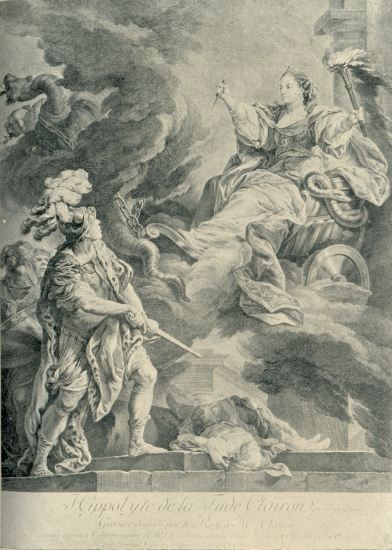
MADEMOISELLE CLAIRON From an engraving by LAURENT CARS and JACQUES BEAUVARLET, after the painting by CARLE VAN LOO
" ...She goes through a number of opposite feelings: soft melancholy, despair, languid tenderness, raving fury, scorn, and melting love; there is not one passion absent. She is wonderful in those transitions where an inferior actress, from an intense grief, would, at some lucky event, jump on a sudden to a giddy, wanton joy. Mme. Clairon, though exulting at her new-born hope that Æneas might stay, keeps always the dark colour of sorrow; when her eye brightens through her tears, she looks, as Ossian expresses it, 'like the moon through a watery cloud.' Her characteristic perfection is the scornful, the commanding part; then is nobility spread about her as a glory round the head of a saint; and yet she never puts off the woman; in the midst of violent rage she is always the tender female, and a nuance of love softens the hard colour into harmony.
" ...Nature has done a good deal in favour of Madame Clairon; her voice is melody, of a vast extent, and capable of numberless inflexions; however, I was sometimes unwillingly disturbed by a disagreeable shrill cry, rather expressing physical pain. As to her figure, it is not a very elegant one, her head being rather too big and her whole person too little; and yet she is great, towering amongst the crowd in the height of action;[167] so as you see by the enchantment of art a colossal head of Jupiter in a cameo the size of sixpence. Were I in a temper to find fault with her, I might mention her too articulate declamation, the cadence of every motion; but then I might as well charge Raphael with having too carefully marked his contours, which are the admiration and the models of every age. True it is that compound of excellence is a mere compound of art; were it possible to note action, as music, then she would show a fortnight before every mien, the measure of every tone, the tension of every march on paper. She is else quite free from that disagreeable tragical hiccup so epidemical in France, and so awkwardly returning at the end of every verse; she never shakes so affectedly her head, as some others, in what you call the graceful style, forsooth; and she alone may venture some bold strokes, which would never do else with so well-bred, so elegant an audience.
"So when she heard that all was lost, that Æneas was gone, then, in the rage of despair, with her two hands across, she beat her forehead with such a gloomy, death-threatening look that we all stood aghast, and her cry raised horror in every breast. I cannot say that she killed herself well, though, but she died well; her weakening voice was not a childish, whining tone, but imminent dissolution altered it, convulsion raised it, and so it vanished into the air as a vapour. There, then, I have brought her to the highest pitch of glory of your tribe, self-murder; may she now quietly repose!"[168]
And Garrick replies, laying his finger, with unerring instinct, upon the one weak spot in Mlle. Clairon's acting:—
"What shall I say to you, my dear friend, about 'the Clairon.' Your dissection of her is as accurate as if you had opened her alive; she has everything that art and a good understanding, with great natural spirit, can give her. But there I fear (and I only tell you my fears and open my soul to you) the heart has none of those instantaneous feelings, that life-blood, that keen sensibility, that bursts at once from genius, and, like electrical fire, shoots through the veins, marrow, bones, and all, of every spectator. Madame Clairon is so conscious and so certain of what she can do, that she never, I believe, had the feelings of the instant come upon her unexpectedly; but I pronounce that the greatest strokes of genius have been unknown to the actor himself till circumstances and the warmth of the scene has sprung the mine, as it were, as much to his own surprise as to that of the audience. Thus I make a great difference between a great genius and a good actor. The first will always realise the feelings of his character, and be transported beyond himself; while the other, with great powers and good sense, will give great pleasure to an audience, but never
——"'Pectus inaniter angit,
Irritat, mulcet, falsis terroribus implet,
Ut magus.'
"I have with great freedom communicated my ideas of acting, but you must not betray me, my good friend; the Clairon would never forgive me, though I called her an excellent actress, if I did not swear by all the gods that she was the greatest genius too."[169]
Space forbids us to give more than a brief account of the many triumphs of this superb tragédienne, who, besides worthily sustaining all the chief characters of the classic répertoire, created forty-three rôles, in not one of which did she fail to uphold her reputation, while the great majority were brilliantly successful. Among the former, she was probably seen to most advantage in Médée—in which character Carle Van Loo painted her in his celebrated portrait—Phèdre, Hermione, Zénobie, Didon, and Cléopâtre. Among the latter, taking them in chronological order, should be mentioned Arétie in the Denys le Tyran of Marmontel; Fulvie in Crébillon's Catalina; Azéma in the Sémiramis of Voltaire; Électre in the Oreste of the same writer; Cassandre in Chateaubrun's play, Les Troyennes; Idamé in Voltaire's Orphelin de la Chine; Astarbé in the tragedy of that name, by Colardeau; Aménaïde in the Tancrède of Voltaire; and Aliénor in De Belloy's Siège de Calais, during the run of which last play occurred the unfortunate incident which led to her retirement from the stage.
The almost fanatical admiration which Voltaire cherished for the actress was no doubt, in part, due to the fact that she had contributed so largely to the success of his plays. If Collé is to be believed, she "made" his Orphelin de la Chine, while as the tender and fiery Aménaïde of Tancrède (September 3, 1760), she appears to have held the audience absolutely enthralled. "Ah! mon cher maître," writes Diderot to the exile of Ferney, "if you could see her crossing the stage, half-leaning upon the executioners who surround her, her knees giving way beneath her, her eyes closed, her arms hanging down, as though in death; if you could hear her cry on recognising Tancrède, you would be convinced, more than ever, that silence and pantomime have sometimes a pathos which all the resources of oratory cannot attain. Open your portfolios and look at Poussin's Esther paraissant devant l'Assuérus: it is Clairon on her way to execution."[170]
The Mercure—the staid Mercure, so chary of its praise—can find no word to describe her acting but that of sublime. The advocate Barbier, voicing the opinion of the average playgoer, declares that "Mlle. Clairon carried the talent of tragic declamation to a point which had never been witnessed before"; while d'Alembert writes: "Mlle. Clairon has been incomparable and beyond anything that she has yet attained to."
To the great disappointment of the public, the health of Mlle. Clairon necessitated the temporary withdrawal of the play after the thirteenth performance, and, when it was revived in the following January, the enthusiasm with which it was received was almost indescribable.
Simultaneously with her celebrity as an actress, Mlle. Clairon enjoyed a celebrity of another, and far less enviable, kind. "Love," she remarks, in her Mémoires, "is one of Nature's needs; and I satisfied it." She did indeed. "Hardly had she appeared on the [Paris] stage," writes La Janière to the Lieutenant of Police, in the report to which we have already had occasion to refer, "than every one began to fight for her, and the crowd of lovers was so great that, in spite of her inclination towards gallantry, she was embarrassed to choose among them." There were princes and dukes; there were marquises, and barons, and counts; there were impecunious chevaliers and wealthy farmer-generals; there were dashing cavalry-officers and sober presidents of the Parliament; there were actors and men of letters. And few indeed—that is to say, few who possessed any passport to her favour: high rank, a handsome presence, a pretty wit, or, best of all, a well-lined purse and a disposition to empty it at her feet,[171] seemed to have sighed in vain.
Poor M. de la Popelinière, to whose good offices Mlle. Clairon had owed her admission to the Opera, did not long retain his proud position of amant en tître. He was speedily abandoned for the Prince de Soubise, who, however, was only accorded a fourth share of the lady's heart, the remainder of that priceless organ being divided between three other high and puissant seigneurs, the Ducs de Luxembourg and de Bouteville and the Marquis de Bissy. Next Mlle. de Camargo's old lover, the Président de Rieux, succeeded in securing a monopoly of the tragédienne's affections, only to lose them, however, the moment he showed a disinclination to loosen his purse-strings. Then came an assortment of admirers, drawn from the nobility, the Parliament, financial circles, the stage, the army, and foreign visitors to Paris, and including the "Baron de Kervert," who is described as a rich Englishman, but whom we have failed to identify; a Polish nobleman, the Comte de Brotok, "who made a brave show before he became acquainted with her, but, in less than four months, had lost coach, diamonds, and snuff-box, and was obliged to pretend that he was in mourning for one of his relations, in order to appear without shame in a black coat;" the actor Grandval, who had had more bonnes fortunes than he could count, but who proved so accommodating an admirer that, after a few months of the lady's society, "his colleagues had to accord him a benefit performance in order to reestablish his affairs, which had fallen into a disastrous condition;" and, finally, the Baron de Besenval, whose reputation for gallantry was, in later years, to compromise Marie Antoinette, and "with whom," says La Janière, "she became infatuated."[172]
For Besenval indeed, with whom she had had a previous liaison during her career in the provinces, Mlle. Clairon, to judge by her letters, appears to have entertained a genuine affection. In one epistle, "she conjures him to love her for ever"; in another, she informs him that a letter which she has just received from him has "restored her to life," and that, however much he may love her, his passion must of necessity be inferior to hers; and, in a third, declares that the devotion she feels for him has "spoiled her taste" for other admirers, and that she "experiences more pleasure in being true to him, whether he desires it or not, than she formerly had in being unfaithful."[173]
But let us listen to some of the reports of the Arguseyed agents of the Lieutenant of Police, which prove what an important personage a fashionable actress was in those days:—
"SAINT-MARC to BERRYER.
"June 14, 1748.
"I have the honour to report to you that the trustworthy person whom I introduced into Mlle. Clairon's house assures me that the Prince de Monaco, since his return to his regiment, has not allowed a single day to pass without writing to Clairon; he shows much affection for her, and, among other things, he begs her constantly not to return to the stage until her health is perfectly re-established, and to remember that she has promised to take every care of her life, in order to prolong his....
"D'Hugues de Giversac, who is very much in love with Clairon, and is reputed to have enjoyed her favours, has made all sorts of attempts to gain admission to the house, but I am assured that there is no possibility of his succeeding, and that Clairon's door is closed to him. It has been remarked that, since the departure of the prince, she has not received any one, except actors and actresses and, frequently, an old attorney, who is a friend of Clairon's father. Moreover, she does not go out, except to Mass, and, since her illness, it does not appear that the prince has any rivals. It has been said that D'Hugues was one, but the demoiselle's conduct for some time past renders that improbable.
"It has been remarked that Clairon only goes out with her father and sister, or some actors. She always makes great cheer and spends large sums on her table. She is daily expecting the arrival of the prince and his money. I continue the precautions necessary to enable me to operate successfully the moment the prince appears."
"SAINT-MARC to BERRYER.
"June 23, 1748.
"I have the honour to report to you that Mlle. Clairon received yesterday evening a letter from the Prince de Monaco, in which he informs her that he will arrive without fail at the end of next week. But Clairon considers that this is a feint on his part, and that he will arrive sooner, in order to surprise her. Apart from that, nothing of importance has happened at this house. The demoiselle does not go out, nor does she receive any one, save the members of her troupe and the old person of whom I have spoken."
"SAINT-MARC to BERRYER.
"August 10, 1748.
"I have the honour to report to you that nothing likely to be of interest to you is taking place at the house of the demoiselle Clairon. She often sees her comrades of the Comédie, with whom she always makes good cheer.
"There is a foreigner whose name I have not been able to ascertain, who has employed a woman called Caron, formerly an entremetteuse, to speak in his favour. This foreigner, although he is not acquainted with her, has sent to Clairon a piece of Indian taffeta, a great quantity of chocolate and champagne, and a service of porcelain encrusted with gold, which presents were entrusted to one of Clairon's servants, with a letter from the foreigner, promising her a considerable allowance, if she will become his mistress. The story goes that she wrote to the Prince de Monaco, to inform him of the advantageous proposal she had received from this foreigner. The prince despatched, on the instant, an old confidential servant, with instructions, in writing, enjoining on the demoiselle Clairon to return everything which she had received from this foreigner. The demoiselle found herself in an exceedingly embarrassing position, inasmuch as she had disposed of more than half the presents, having converted them into cash. Since then, the prince's confidential servant has remained in Paris, to keep an eye upon her behaviour, until the moment of the arrival of his master, who has been very impatiently expected for more than a month."[174]
"MEUNIER to BERRYER.
"September 18, 1748.
"The demoiselle Clairon has for a long time been the mistress of [the Marquis] de Cindré. At the end of the month of August, she asked him for a sum of 2000 livres,[175] of which she stood in pressing need. He gave her this sum.
"Some days later, she demanded of M. de Cindré a country-house. He could refuse her nothing, and rented one for her at Pantin, which he furnished magnificently.
"M. de Cindré went to visit her one evening, and, to give her an agreeable surprise, entered by a back door, and found the demoiselle Clairon with a young man.... He withdrew, without speaking to any one, and without his presence being discovered. The following day, he sent and removed the furniture which he had placed in the house, and abandoned Mlle. Clairon.
"The young man in question is M. de Jaucourt, an officer of dragoons, who, about two months ago, was arrested for being absent from his regiment without leave."