Front matter (continued 4)
Reading edition
"The Lecouvreur told him that, for the safety of both, the whole affair must be denounced to the Lieutenant of Police. The abbé replied that he feared that, if he were to do this, he might make himself enemies too powerful for him to resist; but that, if she believed this precaution necessary for her safety, he would not hesitate to maintain what he had told her. The Lecouvreur took him in her coach to M. Hérault (the Lieutenant of Police), who, on the facts being laid before him, asked the abbé for the lozenges and threw them to a dog, who died a quarter of an hour afterwards. He next inquired of him which of the two Bouillons[86] had given him this commission, and, when the abbé replied that it was the duchess, showed no surprise. M. Hérault continued to question him, and asked if he would venture to support this accusation publicly; to which the abbé replied that he could put him in prison and afterwards confront him with Madame de Bouillon.
"The Lieutenant of Police sent him away, and informed the cardinal (de Fleury) of this adventure. The cardinal was very indignant, and desired in the first instance that the affair should be most strictly investigated. But the relatives and friends of the Bouillon family persuaded the cardinal not to give publicity to so scandalous an affair, and succeeded in appeasing him. Some months later, no one knows how, the adventure was made public and caused a terrible commotion. Madame de Bouillon's brother-in-law spoke of it to his brother, and told him that it was absolutely imperative that his wife should clear herself from such a suspicion, and that he ought to ask for a lettre de cachet to shut the abbé up. There was no difficulty in obtaining this lettre de cachet, and the poor wretch was arrested and taken to the Bastille. He was examined, and maintained with firmness all that he had said. Many promises and threats were used to induce him to retract. All kinds of expedients were suggested to him, as, for instance, madness or a passion for the Lecouvreur, which had prompted him to invent this fable, in order to please her. Nothing, however, could move him; he never varied in his answers, and was kept in prison.
"The Lecouvreur wrote to the abbé's father, who lived in the country and was unaware of his son's misfortune. The poor man came at once to Paris, and demanded that his son should either be formally brought to trial or set at liberty. He addressed himself to the cardinal, who inquired of Madame de Bouillon whether she wished the affair to be tried, as otherwise the abbé could not be kept in prison. Madame de Bouillon, dreading publicity and unable to get the abbé assassinated in the Bastille, consented to his liberation. During the two months that the father remained in Paris nothing happened to the son. But when the father had returned to the country, the abbé, having had the imprudence to stay in Paris, suddenly disappeared. No one knows whether he is dead or not, but nothing is heard of him."[87]
Incredible as this story may appear, it, nevertheless, accords in all important details with the documents which M. Monval has extracted from the Archives of the Bastille, preserved in the Bibliothèque de l'Arsenal. The interview at the Tuileries, the conversation with the Duchesse de Bouillon, the suspicious lozenges—all that is true. The Abbé Bouret, imprisoned at Saint-Lazare, confirmed it in a series of examinations to which he was subjected.[88]
Bouret had been arrested on July 29, 1729, and he was kept in prison for three months. During his confinement Adrienne wrote to him, entreating him to withdraw his charge against the Duchesse de Bouillon, if it were untrue, and promising, in that event, to obtain his pardon. She also sent him money, clothes, and books, and did all she could to lighten his imprisonment.
Thanks to the efforts of his father, who, though ill, had hastened to Paris so soon as he was informed of his son's arrest, Bouret was released on October 23, when Adrienne advised him to leave Paris at once, pointing out that the affair had now become common knowledge, and that, if he lingered, the Bouillon family would certainly cause him to be rearrested.
Well would it have been for Bouret had he followed the actress's advice; but, unfortunately, his father's illness took so serious a turn that it was impossible for him to undertake the journey to Lorraine, and the abbé remained to nurse him. Meanwhile, the scandal had assumed such dimensions that the Duc de Bouillon obtained a new lettre de cachet, by virtue of which, on January 23, 1730, Bouret was again arrested and conveyed first to For l'Évêque and afterwards back to Saint-Lazare, on a charge of "poisoning or giving false information to the celebrated actress Lecouvreur."
The public interest in the affair had, not improbably, been stimulated by a singular incident which had occurred at the Comédie-Française during the previous autumn. On October 18, Adrienne was playing the part of Phèdre, when, perceiving the Duchesse de Bouillon complacently watching her performance from one of the boxes on the first tier, her feelings overcame her, and, turning in the direction of her enemy, she repeated with unmistakable emphasis the indignant lines:—
"Je sais mes perfidies,
Œnone, et ne suis pas de ces femmes hardies
Qui, goûtant dans les crimes une tranquille paix,
Ont su se faire un front qui ne rougit jamais."
The pit, whose sympathies were entirely on the side of the actress, burst into loud applause, amidst which the duchess angrily quitted the theatre.[89]
Adrienne did not play again until the evening of November 10, owing to ill-health, when she again appeared as Phèdre. The accounts of the Comédie-Française show that, on the following day, a sum of 1 livre, 10 sols was paid for a coach "to go to the Hôtel de Bouillon, on the matter of the footmen," and similar entries occur on the 20th and 30th of the same month. From this M. Monval supposes that the duchess, in order to avenge the affront she had received, had sent her lackeys to create a disturbance and hiss Adrienne.[90]
Early in the following March, Bouret was removed to the Bastille, where he persistently adhered to the statements he had made before Hérault and at Saint-Lazare; and on May 18, Père de Couvrigny, the Jesuit confessor attached to the prison, wrote to the Lieutenant of Police the following significant note:—
"I have visited and had a long conversation with the young abbé brought from Saint-Lazare, and have made strong representations to him on the baseness of the calumny of which he has been guilty. He appears very firm in maintaining that he has done no wrong to others, but that he cannot wrong himself. The matter is very terrible and serious."
Terrible and serious it most certainly was, for Adrienne had died two months before, after a very short illness; and the firmness with which Bouret continued to adhere to his accusation against the Duchesse de Bouillon gave the affair a still more sinister complexion. On July 8, he wrote to Hérault:—
"Permit me to cast myself at your feet to implore your protection. I believe that you will not refuse it to me, inasmuch as you are the protector of the innocent. Alas! cast a pitying glance on my misfortunes. It is a sad spectacle for you; you will see nothing but tears, groans, and fears; in a word, all that an agitated mind can exhibit. That is the sad state to which I have been reduced for a whole year. The fury of my enemies ought to be satisfied. You are my only hope; in you I have placed my trust; decide upon my fate, Monseigneur; I will subscribe to everything that I am able to; but, as for my departing from what I have deposed to, were death with all its terrors to appear before my eyes, I would prefer it to calumniating myself."
But, six weeks later, Bouret completely alters his tone, and on August 24 writes again to Hérault:—
"As you have done me the honour to order me to speak the truth touching the Duchesse de Bouillon, I obey your commands. Here it is. The desire that I had to become acquainted with the Lecouvreur induced me to invent a pretext for gaining admission to her house.... I declare to you that the duchess is innocent of everything of which I have accused her. Pardon a wretched man, whose only crimes are a fevered brain and much imprudence."[91]
After this recantation, the unfortunate youth remained a prisoner for nine months longer, when he was finally set at liberty (June 3, 1731). From that date nothing more is heard of him, though there is no reason to assume, with Mlle. Aïssé, that he was the victim of foul play. He probably lost not a moment in returning to Lorraine, heartily glad to turn his back upon the city in which he had suffered so much.
That Adrienne Lecouvreur had been the object of an attempt at poisoning on the part of Madame de Bouillon admits, we think, of very little doubt. Barely half a century had passed since the famous Poison Trials, in which many a high-born dame, including, by the way, another Duchesse de Bouillon,[92] had been compromised. What had occurred with terrible frequency in 1680 was not impossible in 1730; nor does the passionate, vindictive, and unscrupulous character of the duchess render her culpability any the less probable. Again, although Bouret ultimately withdrew his accusation, he persisted in it for many months after his second arrest, in spite of the prospect that a recantation would ensure his release. Thirdly, the official investigation of the affair was very incomplete, and the authorities appear to have had no other object in view than to obtain Bouret's recantation and hush the matter up. Finally, if the duchess were innocent, why, we may well ask, did she not take steps to clear her reputation by prosecuting her accuser before the courts? Why did she prefer to remain under the shadow of so hideous a suspicion to the end of her life?
But even if the charge against Madame de Bouillon is to be considered proved, it seems to us in the highest degree improbable that the attempt against Adrienne was renewed, and that the actress fell a victim to it, as so many persons asserted at the time, and as some writers, including M. Monval, still believe. Let us, however, listen to Mlle. Aïssé's version of the circumstances connected with Adrienne's death:—
"Since then (Bouret's denunciation of the duchess), the Lecouvreur has been on her guard. One day, at the theatre, after the principal piece, Madame de Bouillon sent to ask her to come to her box. The Lecouvreur was extremely surprised, and answered that her toilette was not finished, and it was impossible for her to present herself. The duchess sent a second time, and was told, in reply to her invitation, that the Lecouvreur was about to appear on the stage, but that she would obey her commands when she quitted it. Madame de Bouillon begged her not to fail her, and, as she was making her exit, met her, bestowed upon her all sorts of caresses, complimented her highly on her acting, and assured her that to see her give so finished a rendering of the part which she had just played had afforded her infinite pleasure. Some time afterwards, the Lecouvreur became so ill in the middle of a piece that she was unable to finish it. When the "orator" came forward to make the announcement, the whole pit eagerly demanded news of her condition. Since that day, her health declined and she grew thin and feeble. On the last occasion on which she performed, she took the part of Jocaste in the Œdipe of Voltaire. The rôle is a somewhat trying one. Before the play began, she was seized with a violent attack of dysentery.... It was pitiful to see her exhaustion and weakness. Although I was in ignorance of her indisposition, I remarked two or three times to Madame de Parabère[93] that I felt very distressed on her account. Between the two pieces we were informed of the nature of her illness, and were astonished when she reappeared in the afterpiece, Le Florentin, and undertook a very long and difficult part,[94] which, however, she played to perfection, and, to all appearance, as if it gave her pleasure. The audience showed that they greatly appreciated her decision to continue playing, and it was no longer said, as it had been previously, that she was suffering from the effects of poison. The poor creature returned home, and, four days later, at one o'clock in the afternoon, when she was believed to be out of danger, she died. She had convulsions, which never happens in cases of dysentery,[95] and went out like a candle. The body was opened, and the bowels were found to be ulcerated.... If the suspected lady had appeared at the theatre under these circumstances, she would have been driven from the house. She had the effrontery to send every day to the Lecouvreur's house to inquire as to her condition."[96]
If, as Sainte-Beuve and M. Larroumet point out, the Duchesse de Bouillon had really intended to poison Adrienne, the moment chosen for her attempt was singularly inopportune. Suspected by the public of a previous attempt upon the actress's life, with Bouret still in prison and an investigation of the affair hanging over her head, the most ordinary prudence must have dictated to her, if determined on the crime, the advisability of deferring her horrible design at least until she had cleared herself from the charge under which she then lay. The daily inquiries she caused to be made during Adrienne's illness, of which Mlle. Aïssé speaks with such indignation, were no doubt actuated by a sincere desire for the actress's recovery; not, of course, for the poor woman's own sake, but because she foresaw that her death at such a time would render her own position even more unpleasant than it already was.
But there is a far stronger argument in the duchess's favour than the one which we have just stated. Adrienne's correspondence, published by M. Monval, shows that for some years past she had been in very delicate health. "I have not had twelve hours' health since I last saw you," she writes to d'Argental, during the latter's visit to England; while in other letters she complains of being always "insupportably fatigued," and of being "in despair in regard to her health." Moreover—and this is a point of the greatest importance—she was subject to a chronic affection of the intestines, and, in the winter of 1725-1726, had had an attack of dysentery, which all but proved fatal; the very malady of which she eventually died.
It would therefore appear that, however strongly facts may point to Madame de Bouillon's guilt in regard to the charge brought against her by Bouret, it would be manifestly unjust to saddle her with any responsibility for Adrienne's death. Everything, indeed, seems to indicate natural causes; nothing confirms the theory of poison.
Adrienne was taken ill on Tuesday, March 14, and she died on the following Monday, the 20th inst. Maurice de Saxe, Voltaire, and a surgeon named Faget were with her when the end came; and the faithful d'Argental, who had been hurriedly summoned, reached the house a few minutes after she had breathed her last. Neither of her three friends, however, though each possessed influence in his way, was able to save the remains of the celebrated actress from the worst indignity ever offered to those of a member of the theatrical profession in France.
Adrienne's house was situated in the parish of Saint-Sulpice, the curé of which, Languet de Gergy, was one of the most bigoted and obstinate priests in Paris. When the end was seen to be near, he was sent for to receive the usual renunciation and administer the last Sacraments, but accounts differ as to what occurred. Some writers declare that when he arrived the actress was already dead, or at least on the point of death; others that she firmly refused to renounce her profession, and, on the curé continuing to exhort her to repentance, pointed with out-stretched hand to a bust of Maurice de Saxe which stood near her bed, and exclaimed:—
"Voilà mon univers, mon espoir, et mes dieux!"
What is certain, is that Adrienne died without the Sacraments, and that Languet de Gergy refused her not only Christian burial (this, as we have seen, had been the invariable practice of the Paris clergy in regard to members of her profession who had died under similar circumstances, ever since the time of Molière), but interment in the cemetery at all, even in that portion of it which was reserved for heretics and unbaptized children—a refusal absolutely without precedent in the history of the theatre.
In the morning of March 21, an autopsy was performed on the body of the deceased actress (according to Voltaire, on his application), when the doctors decided that Adrienne had died a natural death, an opinion to which the poet himself subscribes.[97] Later in the day, Maurepas, in his capacity of Minister for Paris, wrote to the Lieutenant of Police, informing him that it was the intention of Cardinal de Fleury not to interfere in the matter of ecclesiastical burial, but to leave it entirely to the discretion of the Archbishop of Paris and the curé of Saint-Sulpice. "If," he added, "they persist in refusing it to her, as they appear inclined to do, she must be taken away to-night and interred with as little scandal as possible."[98]
At midnight, accordingly, the mortal remains of poor Adrienne were placed in a hackney-coach, and, preceded by two street porters bearing torches, and escorted by a squad of the watch and a M. de Laubinière—whom Sainte-Beuve supposes to have been a friend of the actress, but who, M. Monval thinks, was a representative of the Lieutenant of Police—conveyed to a piece of waste land near the Seine, and there buried, quicklime being thrown over the body, and no stone or mark of any kind being placed to indicate where it lay.[99]
The refusal of admission to the unconsecrated portion of the cemetery—a circumstance, as we have already observed, absolutely without precedent[100]—the secret removal, the presence of the representatives of the Lieutenant of Police at the interment, the precautions taken to destroy the corpse by quicklime and to conceal the grave, all point to an intention on the part of the authorities to render a second autopsy impossible. But the most scandalous part of the whole affair is the conduct of Languet de Gergy and his superior, the Archbishop of Paris, in lending themselves to a deliberate attempt to defeat the ends of justice in the interests of Madame de Bouillon and her powerful friends.
A question which has naturally given rise to a good deal of conjecture is the conduct of Maurice de Saxe on this occasion. Egotist and libertine though he was, he was a sincere friend and capable of generous impulses; moreover, even at this period, he possessed no little influence at Court, where he was feared even more than he was respected. Such being the case, it seems almost inconceivable that he should, so far as is known, have made not the slightest effort to save the remains of the woman who had loved him so long and so tenderly from so gross an indignity. In our opinion, the most probable, as well as the most charitable, explanation of the matter is, that Maurice was taken completely by surprise; that the arrangements of the police were carried out with such secrecy and despatch that no inkling of their intentions was permitted to reach him until it was too late for him to intervene.
Another of Adrienne's friends, though, like Maurice, powerless to prevent the barbarous treatment to which she had been subjected, protested against it with all the strength of his generous nature. On the morrow of her burial, Voltaire addressed to Falkener a letter in verse, in which he recalled the honours recently paid to two English actresses, and drew an eloquent comparison between their pompous obsequies and those of poor Adrienne, who had been denied even the privilege of "two tapers and a coffin." But the justly indignant poet went much further than this. On the same day, a meeting of the members of the Comédie-Française was held at the theatre. Voltaire attended, and, in an eloquent speech, called upon the actors to refuse to exercise their profession "until they had secured for the pensioners of the King the rights which were accorded to those who had not the honour of serving his Majesty." His hearers promised to follow his advice, but they did nothing in the matter. The age of strikes had not yet arrived, and they preferred opprobrium with a little money to honour and an empty treasury.
Shortly afterwards, Voltaire composed his fine poem on the death of Adrienne, in which he gave full vent to the feelings of indignation and contempt which consumed him:—
"Que direz-vous, race future,
Lorsque vous apprendrez, la flétrissante injure
Qu'à ces arts désolés font des hommes cruel!
Ils privent de la sépulture
Celle qui dans la Gréce aurait eu des autels.
Quand elle était au monde, ils soupiraient pour elle;
Je les ai vu soumis, autour d'elle empressés:
Sitôt qu'elle n'est plus, elle est donc criminelle!
Elle a charmé le monde et vous l'en punissez!"
The annual closing of the theatre took place on March 24, when Grandval, as the youngest sociétaire, pronounced, according to custom, before the assembled company, an éloge upon their deceased colleague. This éloge had been written by Voltaire himself, and with it we may appropriately conclude our sketch of this celebrated actress, who was not only a great artist, but a noble, high-souled, and cultured woman, who had all the feminine virtues, save one, for the lack of which, when we pause to consider the temptations of her profession, the moral standard of the age in which she lived, and the generosity and devotion she displayed towards those who had won her heart, we shall find it difficult not to pardon her:—
"I feel, Messieurs, that your regrets recall that inimitable actress, who might almost be said to have invented the art of speaking to the heart and of presenting sentiment and truth where once had been shown little but artificiality and declamation.
"Mlle. Lecouvreur—permit us the consolation of naming her—made one feel in every character which she impersonated all the delicacy, all the soul, all the decorum that one could desire: she was worthy to speak before you, Messieurs. Among those who deign to listen to me are several who honoured her by their friendship; they are aware that she was the ornament of society, as well as of the theatre; while those who knew her only as the actress can readily judge, from the degree of perfection to which she had attained, that not only had she an abundance of wit, but that she further possessed the art of rendering wit amiable.
"You are too just, Messieurs, not to regard this tribute of praise as a duty: I dare even to say that, in regretting her, I am merely your interpreter."[101]
IV MADEMOISELLE DE CAMARGO
THE Abbé d'Allainval, in his Lettre à Mylord ... sur Baron et la demoiselle Lecouvreur, reminds his mythical correspondent that he had found in Paris four wonders: (1) The Tuileries. (2) The acting of the demoiselle Lecouvreur. (3) The dancing of the demoiselle Camargo. (4) The voice of the demoiselle Lemaure. It is of the third of these wonders that we are now about to speak.
Marie-Anne de Cupis de Camargo, the most celebrated danseuse of her time, whose talents have been exalted by the chroniclers, sung by the poets, celebrated in every way in both prose and verse, and immortalised by Voltaire, was born at Brussels on April 10, 1710. On her father's side, she was descended from "one of the noblest families in Rome," which had given to the Church a cardinal, an archbishop, and various minor dignitaries. Through her grandmother, she was related to the Spanish house of Camargo, and it was under this name that she pirouetted into fame.
The means of Marie-Anne's father, Ferdinand Joseph de Cupis, "seigneur de Renoussart," were, unfortunately, very far from equal to his birth and connections; nor was his position rendered any easier by the fact that he had been imprudent enough to espouse a lady as high-born and as poor as himself, who, in default of a dot, had presented him with seven pledges of her affection. He lived at Brussels, "on the crumbs which fell from the table of the Prince de Ligne," and the fees he received from giving music and dancing lessons, and gallantly endeavoured to bring his children up in a manner befitting those of a gentleman "who could prove sixteen quarterings on both his father and mother's side."
Such a treasure as Marie-Anne promised to become, however, was worthy of any sacrifice. "Hercules in his cradle," says Castil-Blaze, "strangled the serpents who came to devour him. The talent of Mlle. de Camargo was not less precocious. While she was in the arms of her nurse, the sound of a violin reached her ears, and inspired her to gestures and movements so animated, so gay, so perfectly harmonious that it was at once perceived that this virtuoso of six months would one day be one of the first danseuses in Europe."[102] The delighted M. de Cupis thenceforth devoted every moment he could spare to the instruction of his little daughter, and at the age of ten Marie-Anne danced so charmingly in the salons of Brussels, that every one vowed that it would be nothing less than a crime to withhold from her the applause of the public. Accordingly, the noble dancing-master's consent having been obtained, the Princesse de Ligne and some other ladies of the Court clubbed together, and sent her at their own expense to Paris, to take lessons from Mlle. Prévost, then the queen of the Opera.
MADEMOISELLE PRÉVOST From the painting by JEAN RAOUX, in the Musée of Tours
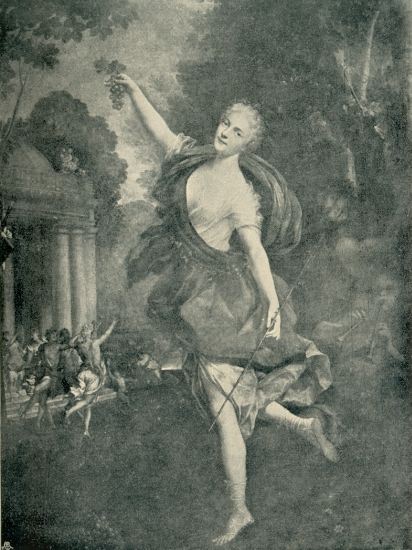
After remaining in Paris for some months, and learning all that Mlle. Prévost could teach her, the little girl returned to Brussels, and made her début at the theatre with such astonishing success that, in spite of her youth, she was appointed première danseuse. This position she held for three years, when Pélissier, director of the Rouen theatre, offered her an engagement. Marie-Anne wished to accept the offer; Rouen, ever since the days of Molière, had been regarded as the conservatoire of the Paris theatres; its playgoers were not only the most enthusiastic, but the most critical in France, and the actor, singer, or danseuse who was fortunate enough to secure their suffrages might reckon with certainty on a favourable reception in the capital. M. de Cupis, however, demurred; he did not wish to allow his daughter to go alone to Rouen, neither did he see his way to leave his pupils at Brussels; and it was not until Pélissier offered him the post of ballet-master, and his eldest son, Françoise, a place in the orchestra that he gave his consent, and the whole Cupis family set out for Normandy.
Poor M. de Cupis would not have been so ready to turn his back on Brussels had he been aware that Pélissier was hovering on the verge of bankruptcy, and that his engagement of Marie-Anne was merely intended to stave off the evil day a little longer. For a time, however, all went well; Marie-Anne's dancing delighted the critical Rouennais, even more than it had the indulgent Flemings, and the theatre was crowded every night with applauding spectators. But her triumphs came too late to save Pélissier; and one fine spring morning, in 1726, that gentleman failed, and danseuse, ballet-master, and musician found themselves out of employment.
Matters looked serious indeed for the seigneur de Renoussart and his seven children; but, happily, at that moment Fortune knocked at their door, in the shape of Francine, who was about to become Director of the Paris Opera. The fame of the little prodigy had, it appeared, reached the capital, and Francine had journeyed to Rouen to offer her a début at the Académie Royale de Musique.
The offer, as may be supposed, was joyfully accepted and Marie-Anne, with her family in her train, migrated to Paris. Here she decided to abandon her patronymic in favour of that of her grandmother, which had a more artistic sound; and on May 5, 1726, made her début under the name of Mlle. de Camargo.
Mlle. Prévost, already jealous of her former pupil, perhaps from a presentiment, had treacherously advised her to make her début in a ballet called Les Caractères de la danse, in a step so difficult that none but the most celebrated dancers ever dared to attempt it. But, to her intense mortification, Mlle. de Camargo not only performed every movement correctly, but with a brilliancy, a verve, a vivacity which far surpassed all her predecessors. "Never," says a contemporary writer, "had the auditorium resounded with such applause as that which greeted the débutante. Such was the enthusiasm of the public that nothing else was talked about but the young Camargo." All the new fashions were named after her: coiffures à la Camargo, gowns à la Camargo, sleeves à la Camargo, shoes à la Camargo.[103] On the second night on which she appeared, there were twenty duels and quarrels without number at the doors of the Opera; all Paris was determined to get in, even at the sword-point.
Mlle. de Camargo was not beautiful; indeed some of her contemporaries go so far as to assert that she was positively ugly: "a real monster, like her predecessor Mlle. Prévost," says one ungallant critic; while Noverre declares that "Nature had denied her every imaginable grace," and that she was "neither tall, nor pretty, nor well-formed." But whatever may have been her defects of face or figure, they did not interfere with her professional success. "The moment she began to dance people forgot her face. Besides, no one had time to see whether she was ugly or beautiful, so light and rapid were her movements. Her skips and twirls bewildered the audience. Then her countenance was changed, transfigured. 'Then her black eyes were full of smiles and provocations, while her laughing lips revealed her ivory teeth.' She did not seem to dance for the public, but for herself, for her own pleasure. Never had one imagined so many seductions, so many caprices, so much gaiety. 'It would be vain,' says Cahusac, 'to seek a playfulness more frank, a vivacity more natural.'"[104]
Not the least important factor in the success of the young danseuse seems to have been the fashion of her skirt, which she had curtailed to a point which the most daring of her predecessors had never even dreamed of. This innovation was extremely popular with the younger patrons of the Opera, but, on the other hand, alarmed the modesty of many of the more conservative playgoers.
"Camargo," says Grimm, "was the first who ventured to abbreviate her skirts. This useful invention, which gave amateurs an opportunity of passing judgment upon the nether limbs of a danseuse, has since been generally adopted, though, at the time, it promised to occasion a very dangerous schism. The Jansenists in the pit cried out heresy and scandal, and refused to tolerate the shortened skirts. The Molinists, on the contrary, maintained that this innovation brought us nearer to the spirit of the primitive Church, which objected to seeing pirouettes and gargouillades hampered by the length of the petticoats. The Sorbonne of the Opera held a great many sittings before it could decide which of the contending parties adhered to the orthodox doctrine. Finally, it pronounced in favour of the shortened skirts, but declared, at the same time, as an article of faith, that no danseuse should appear on the stage sans caleçon. This decision has since become a fundamental article of discipline, by the general consent of all the ruling powers of the Opera and of all the faithful who frequent these holy places."[105]
The regulation respecting the wearing of a caleçon seems to have been the result of a disaster which befell a young ballerina named Mariette, who had the misfortune to have her habiliments torn away by a piece of projecting framework, "et posa pour l'ensemble devant toute la salle, pendant une bonne minute au moins." There was considerable difference of opinion, Grimm tells us, as to whether Mlle. de Camargo conformed to this order, which would have interfered with her freedom of movement, and bets were freely made on the subject. But when, in order to decide these wagers, some one ventured to question the danseuse, the lady replied, "with a beautiful blush and her eyes modestly lowered," that without such a "precaution" she would never have ventured to appear in public. Henceforth at the Opera the caleçon was known by the name of "precaution."
In the meanwhile the triumphs of Mlle. de Camargo had begun to seriously alarm Mlle. Prévost, who not only saw her professional pre-eminence threatened by her former pupil, but had reason to fear that the dancing-master, Blondi, hitherto her slave, regarded the young débutante with a rather more than friendly interest. Perceiving that to attempt to eclipse her on the stage would only be to court certain defeat, she had recourse to intrigue. She refused to continue the lessons by which, she considered, the girl had already too greatly profited; she relegated her to small and obscure parts, in which she had no opportunity of displaying her talents, and even declined to allow her to appear in a dance in which the Duchesse de Berri had expressed a desire to see the young danseuse. Finally, she succeeded in banishing her to the back row of the chorus.
With so powerful and unscrupulous an enemy to contend against, poor Camargo might have remained "lost in the vulgar crowd of filles d'Opéra" for the rest of her days, had not a fortunate accident enabled her to assert her superiority again, and this time in a manner which it was impossible for the ruling powers of the Opera to ignore.
One evening she had to appear amid a group of demons, on whose entrance the dancer Dumoulin was to execute a pas de seul. The demons trooped in, and the orchestra struck up the opening bars of Dumoulin's solo; but the dancer, for some reason, did not appear. Mlle. de Camargo saved the situation. Leaving the other figurantes, she sprang to the middle of the stage, improvised the step of the absent Dumoulin, and danced so magnificently as to send all the spectators into transports of enthusiasm. Mlle. Prévost, beside herself with passion, vowed that she would ruin her youthful rival, but it was too late; "Terpsichore was dethroned, and Mlle. de Camargo crowned queen of the Opera."
"Yesterday," writes Adrienne Lecouvreur to one of her friends, "they played Roland (an opera by Quinault and Lulli). Mlle. Prévost, although she surpassed herself, obtained very meagre applause in comparison with a new danseuse named Camargo, whom the public idolise, and whose great merit is youth and vigour. I doubt whether you have seen her. Mlle. Prévost protected her at first, but Blondi has fallen in love with her, and she is consequently annoyed. She appeared jealous and discontented at the applause of the public, which has now reached such a pitch of enthusiasm that the Prévost will be foolish if she does not make up her mind to retire."
Mlle. Prévost did, in fact, retire shortly after this letter was written, and Mlle. de Camargo, left mistress of the field, used her victory to such good purpose that in two years' time she had completely revolutionised the ballet. No longer did the spectators sit bored or indifferent through the languishing attitudes and mechanical gestures which composed the old ballet—that solemn ceremony in which le Grand Monarque and the lords and ladies of his Court had occasionally deigned to take part. "With disdainful foot she thrust into the abyss of oblivion minuet, saraband, and courant, and replaced by rapidity, agility, and lightness all the antics that had been admired before her time, but which appeared no longer endurable once one had seen her."[106] Yet she owed much to her teachers—to Mlle. Prévost, to Blondi, and to Dupré—and the style of dancing which she now brought into fashion seems to have been a combination of all that was best in their different methods, joined to a vivacity and piquancy entirely her own. She excelled in gavottes, rigaudons, and in all of what were known as the "grands airs," and also in the graceful Basque dances, which she substituted for the gargouillade, judging the latter to be unsuitable for women. But her greatest triumph was a certain minuet step which she executed along the edge of the footlights, first from right to left, and then back again. "The public awaited it with impatience, watched it with intense interest, and applauded it rapturously." Many persons would come to the Opera solely to witness this performance, and leave as soon as it was over.
The prestige of Mlle. de Camargo was at this time so great that the ovations she received were not confined to the theatre. One evening, while walking in the Tuileries Gardens, she was addressed by the wife of Maréchal de Villars, who engaged her in conversation "for a good quarter of an hour." Meanwhile, all who happened to be promenading in the gardens flocked to the spot, formed a circle round the two ladies, and began to clap their hands, "as much to testify their admiration for the danseuse, as to show Madame de Villars how highly they approved of her affability."
Like the famous Arlequin, Dominique, Mlle. de Camargo was very gay while on the stage and very reserved and quiet the moment she had quitted it. While dancing, one of her admirers declares, she seemed "the very priestess of pleasure and of love." But no sooner had she retired into the wings, than she became "melancholy and even sad," while her countenance was "expressive of the most profound ennui." To her colleagues she seldom spoke, unless they happened to address her, when she responded with dignified courtesy, as became the collateral descendant of a cardinal, the niece of a Grand Inquisitor,[107] and the possessor of thirty-two quarterings. However, as she was good-natured and obliging, her comrades treated the queenly airs it pleased her to assume with amused indulgence, and she was not unpopular among them.
Although, as we have mentioned, the young danseuse had no pretensions to beauty, she was nevertheless capable of arousing grandes passions, and her adorers were many. For two years, however, after her first appearance at the Opera, the "frigid dignity" of her demeanour and the unsleeping vigilance of the worthy M. de Cupis kept them at a distance, until all, save one, perceiving that their efforts were fruitless, had retired from the field. The exception was Jean Alexandre Théodose, Comte de Melun, who loved the lady with a passion which no rebuffs could extinguish, no difficulties subdue. His persistence was rewarded; Mlle. de Camargo took pity upon him, and granted him a rendezvous, which was followed by others; and, finally, one fine night, in the month of May 1728, the amorous nobleman made off with both her and her sister Sophie, aged thirteen, who also danced at the Opera, and conveyed them to his hotel in the Rue des Coutures Saint-Gervais. Sophie, it appeared, had refused to be separated from her sister, and had threatened to raise an alarm, if she were not eloped with too.
MADEMOISELLE DE CAMARGO From the painting by LANCRET, in the Wallace Collection, at Hertford House
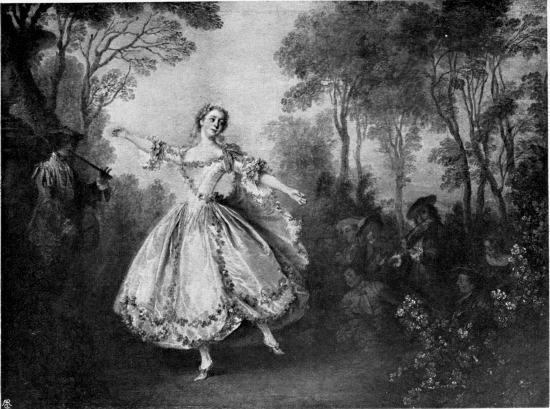
This affair caused an immense sensation; poor M. de Cupis was furious; so odious an act of violence, he considered, justified an appeal for redress to the very highest authority in the land, and, sitting down at his desk, he forthwith indited to the Prime Minister, Cardinal de Fleury, the following eloquent petition:—
"TO HIS EMINENCE, MONSEIGNEUR LE CARDINAL DE FLEURY
"Monseigneur,—Ferdinand Joseph de Cupis, alias Camargo, écuyer, seigneur de Renoussart, represents with the deepest respect to Your Eminence, that, descended from one of the noblest families of Rome, which has given to the Roman Church an Archbishop of Trani, a Bishop of Ostia, and a Cardinal with the title of Saint-John ante Portam Latinam, doyen of the Sacred College, in the year 1577, under the pontificate of Leo X., and finding himself deprived of means, by the misfortunes, the lawsuits, and the ravages of war which his fathers had experienced, he avoided with more care than death anything derogatory to his birth and his ancestors, in whose nobility there has never been any change, not even through alliances, the petitioner being in a position to prove sixteen quarterings on both his father and mother's side, since the family of Cupis quitted Rome....
"Unable to maintain his rank, and burdened with seven children, he has sighed, yet without murmuring, against his lot. He has striven to develop the different talents of his children, and to instruct them in those liberal arts which might enable them, without derogating from their birth, to supply the needs of life and escape from want, while awaiting more prosperous days. One he has had instructed in music, others in painting, and others again in dancing. Among the last, there are two girls, now aged eighteen and thirteen years respectively.
"As the late King, of glorious memory, decreed that any one might be connected with the Opera without loss of dignity, the petitioner, having been persuaded and even constrained by persons who had perceived the great talents of the elder, could not refuse his consent to their entering the Opera, although on condition that either he or his wife should conduct them thither, and, in like manner, resume charge of them at the conclusion of each performance. In short, the elder, who has now performed for three years,[108] has always behaved with perfect propriety, and this conduct has been as universally admired as her dancing.
"But, for the last three years, M. le Comte de Melun has had recourse to the arts of seduction and of methods alike unworthy of himself and of the petitioner.... He dared to propose to the petitioner that he should be a consenting party to his daughter's dishonour, in return for which he offered to surrender to him the salary which she received at the Opera. The petitioner, having treated such a proposition as it deserved, the count found means to introduce himself, on several nights, into his daughters' apartment, and, finally, on the night of the 10th to 11th of the month of May, he carried them both off, and, at this moment, retains them at his hôtel in Paris, Rue de la Couture Saint-Gervais (sic).
"The petitioner, thus dishonoured no less than his daughters, would have taken proceedings in the ordinary way, if the ravisher had been a private individual; and the laws established by his Majesty and his august predecessors provide that abduction should be punished with death. It is a double crime. Two sisters are carried off, aged respectively eighteen and thirteen years.
"But the petitioner, having to deal with a person of the rank of the Comte de Melun, is obliged to have recourse to the maker of the laws, and trusts that the King in his bounty will see that he has justice, and will command the Comte de Melun to espouse the elder daughter of the petitioner and to furnish the younger with a dowry.
"In no other way can he make reparation for so terrible an outrage."[109]
The only effect the recital of the noble dancing-master's wrongs produced on the Cardinal seems to have been one of amusement; and, though, a week later, Mlle. Sophie returned to her indignant father, the elder sister, whom the rules of the Opera emancipated from parental control, remained at the Comte de Melun's hôtel. That nobleman, however, did not long enjoy a monopoly of the lady's favours, while her extravagance annoyed as much as it astonished him. He therefore secured to her an income of 1500 livres, and courteously intimated that they must part.
The notorious Duc de Richelieu, who regarded himself as the principal cause of the ballerina's rupture with Melun, and desired to make amends, took the count's place; to be, in his turn, succeeded by the Marquis de Sourdis, for whom Mlle. de Camargo is said to have conceived "une belle passion." The marquis's predilection for the ladies of the Opera had already made serious inroads on his patrimony; but this did not prevent him from lavishing the most costly presents upon his inamorata. Before, however, he had succeeded in quite ruining himself, he was confronted by a rival whose pretensions it was impossible for him to oppose.
The rival in question was a Prince of the Blood, Louis de Bourbon, Comte de Clermont, third son of Louis III. of that name and Mlle. de Nantes, legitimated daughter of le Grand Monarque and Madame de Montespan. Born in 1709 and destined for the Church, or, more strictly speaking, for the emoluments thereof, he had been tonsured in infancy and loaded with benefices. Before he had completed his eighth year, he found himself in possession of the revenues of the rich abbey of Bec-Hellouin, in Normandy, to which by the summer of 1733, the date when he made Mlle. de Camargo's acquaintance, had been added some half-dozen others, with an aggregate income of over 200,000 livres.
A curious figure was this descendant of the Great Condé; "moitié plumet, moitié rabat," monk by profession and soldier by choice; "owing two million livres in Paris and changing his mistress every day"; now regulating the affairs of one of his abbeys, now scandalising the devout by some liaison with Opera girl or courtesan, anon distinguishing himself in battle; witty, affable, generous, brave, magnificent in his pleasures, and a lover and patron of literature; the only prince of his house then living in whom could be traced a resemblance to their illustrious ancestor.
Mlle. de Camargo had by this time acquired the reputation of being a somewhat expensive luxury, even for a prince. Accordingly, before "taking her into his service," the count-abbé desired to rid himself of two other ladies, both of whom had claims upon his attention and his purse. One was the Duchesse de Bouillon, poor Adrienne Lecouvreur's enemy; the other, a siren of humble birth, named Quoniam, with whom he had carried on an intermittent liaison since he was sixteen. On the principle that exchange is no robbery, it was arranged that the duchess and the Marquis de Sourdis should console each other; while Clermont experienced but little difficulty in persuading his nephew, the Prince de Conti, a promising young gentleman of seventeen, to take Mlle. Quoniam off his hands. The latter arrangement led to much unpleasantness in high circles, for the Prince de Conti had two years before taken unto himself a wife, in the person of Mlle. de Chartres, daughter of the late Regent and sister of the devout Duc d'Orléans. The duke and his mother, the dowager-duchess, were furious, and it was rumoured that they had obtained a lettre de cachet, in virtue of which Mlle. Quoniam had been spirited away to a convent. "This news," writes Barbier in his Journal, "was general in the fashionable world; however, it is not true. On Sunday, August 5, Mlle. Quoniam went to the Opera and took a seat in a box. So soon as the young men in the pit caught sight of her, they clapped their hands to show how delighted the public were to find that the rumour was unfounded. In the evening, she went to the Tuileries. All the princesses of the House of Condé were there, which caused the people to form themselves into two lines as they passed by. They did the same for Mlle. Quoniam, and congratulated her by their gestures."[110]
With the Comte de Clermont, Mlle. de Camargo reached the highest point of her fortunes. Her lover could refuse her nothing. When his monastic revenues proved inadequate to satisfy her caprices, he ran into debt, and when his credit was exhausted, he had recourse to stratagems to obtain money from his mother. The Duchesse de Bourbon, having promised to settle the claims of some of his most clamorous creditors, the count instructed his steward, Moncrif, the Academician, to make out a statement showing a total liability of 80,000 livres, whereas the debts in question did not amount to much more than half that sum. The balance he was to remit to Mlle. de Camargo with his Highness's compliments. Moncrif, however, fearing the consequences to himself should the duchess ever discover the trick which had been played her, revealed the plot to the old lady, and so the ballerina never got the money. As for the steward, he was promptly dismissed "for having abused his master's confidence."
Such was the count's infatuation for his enchantress that he was "even jealous of the pleasure which the public shared with him in seeing her dance," and, in 1736, insisted on her quitting the Opera, to the despair of all Paris. If we are to credit a report drawn up many years later by the Police-Inspector Meusnier, for the edification of Madame de Pompadour, "his passion tyrannised even over the quarter where she resided, so that the neighbours did not dare to show themselves at their windows or to glance in the direction of the Camargo's house."[111]
In July 1737, the abbey of Saint-Germain-des-Prés, with an annual revenue of 160,000 livres, became vacant, by the death of old Cardinal de Bissy. The Comte de Clermont had long had a covetous eye upon this rich prize, and a substantial addition to his income was imperatively needed, as Mlle. de Camargo's extravagance had reduced him to such straits that, in the previous December, he had been forced to sell his duchy of Châteauroux to Louis XV., who, some years later, conferred it on his mistress, Madame de la Tournelle. Deeming, however, that, under the circumstances, some concession to public opinion might be advisable, he counterfeited a fit of devotion, separated from his mistress, who, on a sudden, disappeared from Paris, and caused a report to be circulated that she had been imprisoned by order of the King in Sainte-Pélagie. No sooner, however, had the coveted abbey been conferred upon him, than Mdlle. de Camargo reappeared upon the scene, and went to do the honours of the Château de Berny, a charming country-house situated two leagues from Paris, on the road to Orléans, which had been acquired by the monks of Saint-Germain-des-Prés in 1686, with the price of the lands which they had ceded to Louis XIV. for the enlargement of the park of Versailles.
At Berny, Clermont erected a private theatre, upon whose stage the fair châtelaine, we may presume, occasionally condescended to appear, though Gaboriau is indebted to his imagination for the statement that she was in the habit of dancing "pour la plus grande joie des moines ravis,"[112] as the château was the private residence of the abbot, to which his subordinates were never admitted. If they desired to see their superior on business connected with the abbey, they had to present themselves at his hôtel in the Rue de Richelieu.
Mlle. de Camargo presided over the Château of Berny for some four years, when an obscure figurante of the Opera, Mlle. Le Duc by name, "a creature without intelligence, without manners, without principles, without a soul,"[113] stole away the heart of the Comte de Clermont. Mlle. Le Duc was the property of Président de Rieux, son of the celebrated financier, Samuel Bernard, who, having purchased the lady's affections at a great price, was naturally reluctant to surrender them. To oppose himself to a Prince of the Blood in an affair of such importance was more, however, than he had the courage to do; and so, one day, while the president was dispensing justice in the Cour des Enquêtes, Mlle. Le Duc bade farewell to the luxurious nest which the luckless judge had furnished for her, and transferred herself and her belongings to Berny.
Henceforth, the president lived only for revenge, and racked his brains to discover some means whereby he might humble the pride of the Comte de Clermont, and make the faithless Le Duc bitterly rue the day on which she had so basely betrayed him. At length, he resolved upon the following plan of campaign: he would invite Mlle. de Camargo to occupy the vacant place in his affections, and surround her with such luxury, array her in such toilettes, load her with such presents as would cause Mlle. Le Duc to die of envy, and her monkish lover to gnaw his fingers with vexation. He accordingly made overtures to the deserted ballerina, which were promptly accepted; and one morning all Paris was talking of the magnificent generosity of the Président de Rieux, who had sent his new mistress a chastely-wrought bowl of solid gold, filled to the brim with double louis.
The Comte de Clermont heard of the president's gift, and hastened to accept the challenge. In the Journal de Police, under date March 1742, we read:—
"On Thursday, March 22, 1742, the Demoiselle Le Duc, formerly mistress of the Président de Rieux, drove to the Tenebrae at Longchamps[114] in a calèche of cane painted blue, with all the chains of silver, drawn by six ponies no bigger than dogs, ridden by a little postilion and a little hussar, the first in a red waistcoat all galooned with silver, and with a blue plume in his hat; the other in a blue tunic, with his sabre and cap decorated with plaques of silver. The Le Duc held the horses' reins, and was escorted by two footmen.
"This luxurious equipage was a gallantry of the Comte de Clermont, Abbé of Saint-Germain, to flatter the vanity of the Le Duc, who occupies the post of his favourite sultana, which the Camargo enjoyed up to the end of the year 1741.
"The goddess of the fête responded to this magnificent gallantry by attire still richer and more elegant, of blue and silver; she had for companions in her calèche her sister and the Cartou.[115] A number of other actresses filled three coaches in the suite of Madame l'Abbesse, and wore her colours of blue and silver.
"All the people at Longchamps, on horseback, in coaches, or in calèches, formed a procession in the rear of this troupe of vestals, through curiosity or for the sake of amusement....
"Jests and songs at the expense of the Comte de Clermont have not been wanting, and the King has intimated to him that he is displeased and scandalised.
"Here is a placard which has been composed on the matter:—
'"THE TRIUMPH OF VICE At the Theatre of Longchamps, By MLLE. LE DUC. '"The first representation given on Holy Wednesday, March 21. On Friday the Theatre will be closed."'[116]
The duel between the abbé and the judge and their respective sultanas continued until both gentlemen were nearly ruined; but victory ultimately rested with the Church, as Mlle. de Camargo and the Président de Rieux soon grew tired of one another and agreed to separate, the latter making the ballerina a present of 40,000 crowns out of what was left of his fortune. After this adventure, according to the report drawn up by Meusnier, of which we have already spoken, Mlle. de Camargo's old inclination for the Marquis de Sourdis revived and they resumed their interrupted liaison. Their respective positions were now, however, reversed, as the Marquis had fallen on evil days, and become so poor that his mistress had to pledge her earrings and necklace to enable him to live in a manner befitting his rank.
In the meanwhile, the danseuse had returned to the Opera, where she, of course, met with an enthusiastic reception.
"Légère et forte en sa souplesse, La vive Camargo sautait,"
wrote Voltaire. Nevertheless, she had now to be content with a divided empire. During her long absence, a new star had arisen, in the person of a Mlle. Sallé, with whom the Camargo had henceforth to share the applause of the public and the praises of the poets. Mlle. Sallé's style of dancing differed widely from that of her celebrated rival. Whereas the latter danced with astonishing rapidity and rose so high from the stage that "it seemed as if she were going to touch the friezes," Mlle. Sallé danced slowly and with the minimum of exertion, relying for effect upon grace of movement and voluptuous poses.
The rivalry between the two stars was very bitter, and all attempts to promote a better understanding proved fruitless, although Voltaire himself intervened, and addressed to the ladies some graceful lines, in which he adroitly divided his praises between them:—
"Ah! Camargo, que vous êtes brillante!
Mais que Sallé, grands dieux! est ravissante!
Que vos pas sont légers, et que les siens sont doux!
Elle est inimitable et vous êtes nouvelle.
Les Nymphes sautent comme vous,
Et les Grâces dansent comme elle."
In spite of the rivalry of Mlle. Sallé, the fame of the elder ballerina was still sufficient to have satisfied a less exacting artiste. An air to which she danced in the first act of Pyramé et Thisbé excited such enthusiasm that it became the vogue of the salons, first, as a song, and, later, as a dance, which was called after the danseuse, the "Camargo," and by that name was still known a century later.
Her triumphs in the dance encouraged Mlle. de Camargo to tempt fortune in another emploi, and, in an opera called Les Talents lyriques, she accordingly made her début as a singer. She had a very pretty voice, and was much applauded; but, for some reason, did not repeat the experiment.
At the age of forty-one, conscious that she no longer possessed the "souplesse forte et légère," which Voltaire had once celebrated, Mlle. de Camargo decided to retire, and, at Easter 1751, quitted the scene of her many triumphs, never to return. Her popularity had endured to the last, for Casanova, who saw her dance some months earlier, declares that the public applauded her "with a kind of frenzy."
On her retirement, she received a pension of 1500 livres, instead of the usual 1000, and another pension of a like amount from the King. She had, however, little need of such assistance, as, more prudent than most of her colleagues, she had found secure investments for a considerable portion of the sums which her various admirers had lavished upon her; while, if Meusnier is correct, she was in receipt of an annual allowance of 12,000 livres from the Comte de Clermont, which would have been materially increased, but for the interference of Mlle. Le Duc.
Henceforth she ceased to interest the town. In 1753, we learn that she has taken unto herself another impecunious lover, a certain Chevalier de la Guerché, "who lived with her, and the whole of whose expenses she defrayed," after which we hear no more of her until the chroniclers record her death, which took place on April 28, 1770, at the age of sixty. She was then living in the Rue Saint-Honoré, "like a respectable bourgeoise, very assiduous in visiting the poor of her parish, and always surrounded by a dozen dogs, to whom she was much attached." She was nursed in her last illness by the widow of François Boucher, the famous painter.
The best-known portrait of Mlle. de Camargo is that by Lancret, in the Wallace Collection, at Hertford House. An original repetition of this portrait, with a marked variation in the colour scheme, is in the Museum at Nantes. The Neues Palais at Potsdam contains another portrait by Lancret, entitled La Camargo avec son danseur, which shows the ballerina in the act of executing a pas de deux with a male dancer.[117]
V JUSTINE FAVART
TOWARDS the end of the reign of Louis XIV., there lived in the Rue de la Verrerie, in Paris, a pastry-cook named Charles Paul Favart. No ordinary pastry-cook was Charles Paul; he was a man of parts and a poet; but a poet of an unusually practical turn of mind, inasmuch as, instead of contributing sonnets to the Mercure, he was in the habit of utilising his talent to advertise the excellence of his wares, with the result that his buns[118] and cakes were famed throughout the length and breadth of Paris.
The enterprising pastry-cook might have amassed a comfortable fortune, had he been content with the profits of his trade. But, unhappily, he became involved in the craze for speculating in Mississippi stock; and, on his death, his wife and two children found themselves almost unprovided for. The eldest of these children, a boy named Charles Simon, who had inherited the paternal turn for verses, was at this time pursuing his studies at the famous college of Louis-le-Grand, where he had already gained some little distinction. Forced to abandon the cultivation of the Muses to take charge of his father's business, which, though burdened with debt, still remained to them, he nevertheless contrived, in the intervals of making pastry, to compose a poem on La France délivrée par la pucelle d'Orléans, which, in 1733, was awarded the prize of the Académie des Jeux Floraux. He had already, in collaboration with another young poet, written a piece called Polinchinelle, comte de Paonfier, performed at the Fair of Saint-Germain; and, in the following year, he submitted to the Opéra-Comique a vaudeville, entitled Les Deux Jumelles, which was produced on March 22, and met with a very favourable reception.
Next day, while Favart, girt with his apron, his shirt-sleeves rolled up to the elbow, a square cap on his head, and a larding-pin in his hand, was working in his shop in the Rue de la Verrerie, a coach drove up to the door, out of which stepped an elderly gentleman, very richly dressed, who inquired for M. Favart, the author of Les Deux Jumelles. Poor Favart, ashamed for the moment of revealing his identity, replied that he would go and summon him, and, running up to his bedroom, hastily removed the signs of his trade, rolled down his shirt-sleeves, donned his best coat, and returned to the shop to greet his amused visitor.
The latter, it transpired, was a wealthy farmer-general,[119] who had a fancy for playing the part of Mæcenas. He had been present at the performance at the Opéra-Comique, the previous evening, and had been so charmed with the piece that he had made inquiries concerning its author, and, on learning that he was a young man without means of his own, had resolved to offer him his protection. "I have myself," said he, "been on bad terms with Fortune; but she has ended by caressing me, and I find no better way of using her favours than to employ them to the advantage of the arts and literature."
Thanks to the assistance of the generous financier, Favart was enabled to relinquish his business and devote himself entirely to play-writing. In the course of the next few years, he provided the lesser theatres with more than a score of pieces, one of which, La Chercheuse d'esprit, played at the Opéra-Comique, in 1741, met with extraordinary success. Up to this time, Favart's pieces had appeared anonymously, but, encouraged by the enthusiastic reception accorded to the play in question, he now decided to emerge from his shell, and, in accordance with this resolution, gave a dinner to some of the most noted beaux esprits and authors of the time. Among those present was Crébillon père, who received, with his invitation, a delicate specimen of the dramatist's culinary skill, an attention which he acknowledged by the following quatrain:—
"Il est un auteur en crédit,
Dont la muse a le don de plaire:
Il fit la Chercheuse d'esprit,
Il n'en chercha point pour la faire."
Towards the end of the year 1744, Favart was entrusted by the director of the Opera, of which the Opéra-Comique was a dependency, with the management of the latter theatre; and it was while occupying this post that an incident occurred which was to be the starting-point of some very surprising adventures.
One day, in the following January, Favart received a letter from a lady at Lunéville, soliciting for her daughter an engagement at the Opéra-Comique as singer and dancer. The writer of the letter was a certain Madame Duronceray, the wife of one of the musicians of the chapel of Stanislaus Leczinski, ex-King of Poland, to which she herself was attached. The daughter on whose behalf she wrote, Marie Justine-Benoîte Duronceray, was, it appeared, now in her eighteenth year, had been educated by the most skilful masters, under the personal supervision of King Stanislaus himself, and, to judge from the fond mother's letter, was a perfect little prodigy, who united in her person every imaginable accomplishment.
The director returned an encouraging answer, and the two ladies, having obtained the necessary leave of absence from the King, started for Paris, and, on their arrival, lost no time in presenting themselves at Favart's house.
The result of the interview proved that Madame Duronceray had not exaggerated her daughter's talents. As actress, singer, and dancer, the girl showed remarkable promise, while she was as charming as she was accomplished.[120] A very brief examination sufficed to assure Favart that he had discovered a most valuable acquisition to his troupe; and it was at once arranged that Mlle. Chantilly, as Justine had decided to call herself, out of deference for a branch of the Duronceray family which lived in Paris and might conceivably have taken umbrage at one of their name appearing on the stage, should make her début in a piece from Favart's own pen, which he was then writing, in celebration of the approaching marriage of the Dauphin with the Infanta Maria Theresa. The title of this vaudeville, Les Fêtes publiques, has alone come down to us; but, whatever its merits may have been, it was highly successful, the new actress's piquant beauty and grace, no less than her vocal and dramatic talents, being loudly acclaimed by a succession of crowded houses.
The charms of Justine had already made a deep impression upon Favart, and, after her triumph in Les Fêtes publiques, he became so deeply in love with the fair débutante that he declared his passion, which the young lady was pleased to reciprocate. An honest and excellent man, Favart did not attempt to take advantage of their respective positions,[121] but offered to make her his wife; and, on December 12, 1745, they were married at the Church of Saint-Pierre-aux-Bœufs, a little church generally patronised by persons who wished to keep their marriages secret for a while, in the presence of only the necessary witnesses.
In view of what we shall presently relate, it is important to note that M. Duronceray, Justine's father, was not present at the ceremony, although he had given the required consent to his daughter's marriage, in writing.
The marriage took place under very inauspicious circumstances. The vogue that Favart by his operas and Justine by her singing and acting had obtained for the Opéra-Comique had aroused the jealousy of the Théâtre-Français and the Comédie-Italienne; and, in the autumn of 1745, they solicited and obtained its suppression. The severity of this measure was somewhat mitigated by the permission which Favart received to open a theatre at the Fair of Saint-Laurent, whither he transferred his company, and presented, among other pieces, a pantomime, entitled Les Vendanges de Tempé, of which the success was assured by the charming acting of Justine. This privilege, however, was only accorded him for a very short time, with the object of allowing the troupe of the Opéra-Comique leisure to make other arrangements, and, on its withdrawal, Favart and his colleagues found themselves in a very embarrassing situation; and matters must have gone hardly with them, had not the poet had the good fortune to find a protector as powerful as he was unexpected.
It happened that some little time before the suppression of the Opéra-Comique, Favart had met at the house of one of those leaders of the fashionable world whose whim it was to patronise actors and men of letters, Maurice de Saxe, now become the greatest soldier of his age, Maréchal de France, and "general-in-chief of all the armies of the King." Maurice, who was as enthusiastic a patron of the drama as he had been in the days of poor Adrienne Lecouvreur, was followed in his campaigns by a troupe of actors, which gave performances wherever the army happened to be quartered, sometimes in a regular theatre, sometimes in an improvised one; and he now suggested to Favart that he should organise a second troupe and accompany him to Flanders for the campaign which was about to open.
The offer seemed like a fortune to poor Favart, in the state of poverty and uncertainty to which he was then reduced; nevertheless, he hesitated to accept it, pointing out that the formation of a second company might be regarded by the troupe already in existence as an encroachment on its privileges, and that its leader—one Parmentier, an arrogant and unscrupulous person, with whom Favart was by no means anxious to enter into competition—would be sure to throw obstacles in his way. The Marshal, however, solved the difficulty by promising to transfer the Parmentier troupe to the division of the army commanded by Maréchal Löwendal, and attach Favart's company to his own person; and, under these conditions, the poet gratefully accepted his offer.
Here are the terms in which the Marshal announced his appointment to Favart, and, at the same time, informed him of what was expected of him:—
"The favourable report that has been made to me about you, Monsieur, has induced me to choose you, in preference to all others, in order to give you the exclusive management of my comedy company. I am persuaded that you will use every endeavour to ensure its success; but do not imagine that I look upon it merely as an object of amusement; it enters into my political views and into the plan of my military operations. I will advise you what you will have to do in this respect when occasion arises, and, in the meanwhile, I count upon your discretion and punctuality. You are from this moment at liberty to make all your arrangements for opening your theatre at Brussels, in the month of April next."
As there was but little time at his disposal, Favart started at once for Brussels, where he obtained a lease of the Grand Theatre in the Rue de la Monnaie. Then he returned to Paris, and, having selected his company, which comprised all the best artistes of the deceased Opéra-Comique, he and Justine set out for Flanders.
Two days after their arrival in Brussels, Maurice de Saxe made his entry into the city. The excitement was intense; an enormous crowd lined the streets through which the procession was to pass; while the windows, and even the roofs of the houses, were thronged with spectators eager to catch a glimpse of the famous general. The weather, however, was unfavourable for a public ceremony; a storm was brewing, and, as the Marshal reached the Hôtel de Ville, where all the fair ladies of Brussels had congregated to receive him, a terrific peal of thunder was heard. Many persons no doubt saw in this an omen of evil for the hitherto all-conquering warrior; but Favart chose to regard it far differently, and forthwith improvised the following verses:—
"Est-ce là notre général
Que ramène Bellone?
—Eh! oui, c'est ce grand maréchal,
C'est lui-même en personne.
—Non; je le vois à ses regards,
C'est le Dieu de la guerre,
Et Jupiter annonce Mars
Par un coup de tonnerre."
Copies of these verses were printed and circulated everywhere; and the Marshal, having had his attention drawn to them, as he was sitting down to dinner with his general officers, sent for the writer and complimented him upon them. One of the officers present, who did not share his chiefs passion for the theatre, asked Favart of what use a poet like himself could be to the army. "To celebrate the exploits of our warriors and satirise the enemy," was the prompt reply, and the questioner proceeded no further.
During the afternoon, apparently at the request of some of the ladies of the city, the Marshal gave orders that part of the troops should be paraded in front of the Hôtel de Ville and put through various evolutions. One of the corps selected was a contingent of Jacobite Highlanders, "who, in changing their country, had not thought it necessary to change their costume." The scantiness of the gallant Scotsmen's attire, Favart tells us, greatly shocked the Brussels ladies, to the intense amusement of the Marshal and his officers. In the evening, Favart's company gave their first performance, which was so well received as to remove all doubt as to the success of their enterprise.
Although Brussels was the centre of the Marshal's operations, and Favart had secured a lease of the Grand Theatre, the terms of his engagement obliged him to follow the army into the field, a necessity which involved him and his company in many hardships and privations. Once Favart passed three days and three nights without sleep, except such as he could obtain leaning against a tree, with his feet in water. Often provisions ran short; bread sold at fifteen sous the pound, and sometimes the unfortunate actors were nearly starving. Nor were dangers of an even more alarming kind wanting. The country swarmed with the irregular cavalry of the enemy, who intercepted convoys, cut off stragglers, and burned and pillaged to within musket-shot of the French lines. Neither age nor sex was sacred to these Croats and Pandours. A luckless troupe of actors on their way from Brussels to Cologne, to fulfil an engagement at the Elector's Court, was surprised by a body of these marauders and robbed of everything they possessed, with the exception of their theatrical costumes, in which they were compelled to trudge to Louvain, their woe-begone countenances contrasting oddly with the gay habiliments of Arlequin, Scaramouche, and the rest. Maurice de Saxe had granted Favart's company an escort of thirty men of the Régiment de Septimanie; but this force was insufficient to secure them from molestation. One day, while passing through some wooded country between Louvain and Indiogne, they were attacked by a body of hussars, who outnumbered their little escort by as many as four to one. A sanguinary hand-to-hand conflict ensued, for the marauders were as brave as they were ruthless, while their excesses had exasperated the French to the last degree. Twice the hussars were beaten back, and, at length, reinforcements arriving for the defenders, they drew off, leaving, however, only six of the gallant escort alive, the least wounded of whom had received four sabre cuts. Favart, in a letter to his mother giving an account of this adventure, speaks with admiration of the conduct of this soldier: "Never did I see a man of such courage. He was covered with blood, which he was losing in abundance, and yet would not permit his comrades to give a thought to him until the combat was over. Then, in order to speak, he was obliged to hold up his nose and a portion of his cheek, which had been separated from the rest of his countenance by a sabre cut, and had fallen down over his mouth!"
To compensate the Favarts for the hardships and perils they were compelled to undergo, Maurice de Saxe treated them with the greatest kindness; in fact, presents were simply showered upon them. On one occasion, we find him sending them three fine horses to draw their coach; on another, "a camp-bed of red satin"; on a third, twenty-five bottles of Hungarian wine. Moreover, he gave Favart to understand that he might draw upon him freely in case of necessity, and protected him against the attacks of the jealous Parmentier, the leader of the other troupe of actors, who, not without some cause, regarded Favart as a rival, and did all in his power to annoy and discredit him. The simple-minded poet, who had as yet no suspicion as to the real object of the Marshal's attentions, seems to have been under the impression that they were intended as tributes to his literary and dramatic talents, and, in his letters to his mother, waxes quite enthusiastic over his patron's kindness and generosity.
The Marshal, in engaging Favart's services, had told him that he regarded the troupe which followed his army as something more than a means of amusement, and that it "entered into the plan of his military operations." M. Léon Gozlan makes merry over this letter, which, he thinks, was written merely to flatter the poet's vanity, and lure him and his wife to Flanders;[122] but there can be no doubt that Maurice did attach considerable importance to the provision of such entertainments for those under his command. In the first place, they served to occupy not a little of the time which would otherwise be employed in more doubtful pleasures, particularly play, which, in spite of stringent prohibitions, was very prevalent in the army among all ranks, and had a most disastrous effect on the morale of the troops, causing the officers to gamble away their pay and the men their rations, and leading to frequent quarrels and much ill-feeling. In the second place, the Marshal's knowledge of the French character had taught him that a happy couplet de circonstance sung to a lively air often had more effect upon the soldiers than the most eloquent of harangues. An anecdote celebrated in the history of this campaign will show how accurately the great commander had gauged the spirit of his troops.
In the autumn of 1746, the French, after capturing Namur, had occupied Tongres, in the market-place of which Favart had constructed a theatre. The allied army, under Prince Charles of Lorraine, was close at hand, and a decisive engagement was daily expected; but this did not prevent the improvised playhouse from being crowded every evening. Early in the afternoon of October 9, the Marshal sent for Favart to come to his quarters, and, on his arrival, dismissed the officers who were with him, and, turning to the poet, said: "To-morrow I shall give battle. As yet I have issued no orders to that effect. Announce it this evening at the conclusion of the performance, in couplets suitable to the occasion. Until that moment let nothing transpire."
Favart obeyed, and composed the following verses, which were sung by a young and pretty actress between the two pieces of which the performance consisted:—
"Nous avons rempli notre tâche,
Demain nous donnerons relâche;
Guerriers, Mars va guider vos pas;
Que votre ardeur se renouvelle:
A des intrépides soldats
La Victoire est toujours fidèle.
"Demain bataille, jour de gloire;
Que dans les fastes de l'histoire
Triomphe encore le nom français
Digne d'eternelle mémoire!
Revenez après vos succès,
Jouir des fruits de la victoire."
These verses caused the most unbounded astonishment. It was at first supposed that the poet had lost his head; a battle announced between two comic operas, the order of the day to the air of a popular song, seemed too absurd! Officers hastened to the Marshal's box to inquire if Favart had had any authority for his announcement; but Maurice smilingly replied that he had acted under his orders. Thereupon the astonishment changed to enthusiasm, and the theatre resounded with applause. "On all sides," writes Favart, "but two words were heard: 'Demain, bataille! demain, bataille!' The intoxication passed rapidly from officers to men, and was so intense that one could not fail to see therein a presage of victory."[123]
The battle so eagerly anticipated did not take place next day, but on October 11, when Maurice attacked the allies at Roucoux, a little to the north of Liège, and completely defeated them, though the English, who, as usual, bore the brunt of the engagement, fought right valiantly, and the victory was in consequence very dearly purchased.
In celebration of his compatriots' triumph, Favart, on the morrow of the battle, hurriedly composed two or three scenes full of happy allusions to the events of the preceding day. These were performed the same night, and were, of course, received with enthusiasm. He did not confine himself, he tells us, to chanting the praises of the victors, but paid a generous tribute to the courage of the vanquished, one of his couplets concluding thus:—
"Anglais chéris de la victoire
Vous ne cédez qu'aux seuls Français;
Vous n'en avez pas moins de gloire."
The victory of Roucoux concluded the campaign of that year, and Favart and his company returned to Brussels, heartily thankful to be quit, for a time, of war's alarms. "I prefer," he wrote to his mother, "moderate profits with safety to a large fortune purchased by continual fear and danger." However, he had no reason to be dissatisfied with his winter season in the Belgian capital, which was indeed successful beyond his most sanguine anticipations, the profits at each performance averaging as much as six hundred livres. To add to his good fortune, he was able to rid himself of his rival Parmentier, who, finding that the Marshal had taken Favart definitely under his protection, and that all attempts to oust him were likely to prove abortive, retired in disgust, leaving the poet master of the field. The future now presented itself to Favart in the most smiling colours; but alas! the poor man was living all the while in a fool's paradise, from which he was soon destined to be very rudely ejected.
Though now in his fiftieth year, Maurice de Saxe was still as susceptible to feminine charms as in the days when he had wrought such havoc among the ladies of Lithuania and Courland. If the record of his gallantries did not equal those of his royal father, it was probably because his military occupations absorbed so large a portion of his time. His tastes, particularly where the theatre was concerned, were catholic. "Whom did he not love? To what actress or opera-girl's skirts was he not attached? All the actresses of his campaigns in Flanders succeeded one another in that inflammable heart and disputed there an ephemeral reign: Mlles. Darimattes, Fleury, Amand, Verrières,[124] Bline, Auguste, and Beaumenard. For the Saxon hero, the troupe which he caused to follow him was a seraglio, in which the last comers were the most honoured."[125]
Upon the susceptible Marshal it was only to be expected that the fresh beauty and grace of Justine should make a favourable impression, nor was his admiration for the young lady by any means diminished by the fact that—to borrow his own curious expression—she was "possessed by the demon of conjugal love,"[126] and, therefore, unlikely to afford him an easy conquest. M. Léon Gozlan asserts that Justine had attracted Maurice's notice in Paris, and that his invitation to Favart to accompany him to Flanders was nothing but a pretext for getting the poet's wife into his power. Of this there is some doubt; but, on the other hand, there can be no question that, before the end of the year 1746, Maurice had fallen desperately in love with the young actress, and had determined to make her, bon gré, mal gré, his mistress.
"Mlle. de Chantilly," he writes, "I take leave of you; you are an enchantress more dangerous than the late Madame Armide. Whether as Pierrot, whether under the guise of Love, or even as a simple shepherdess, you are so excellent that you enchant us all. I have seen myself on the point of succumbing—I, whose fatal art affrights the world. What a triumph for you, had you been able to make me submit to your laws! I thank you for not having used all your powers; you might well pass for a young sorceress, with your shepherd's crook, which is nothing else than the magic wand with which that poor prince of the French, whom, I fancy, they called Renaud, was struck. Already I have seen myself surrounded with flowers and fleurettes, fatal equipment for all the favourites of Mars. I shudder at it; and what would the King of France and Navarre have said if, in place of the torch of his vengeance, he had found me with a garland in my hand? In spite of the danger to which you have exposed me, I have not the heart to blame you for my weakness; it is a charming one! But it is only by flying from it that one is able to escape a peril so great.
JUSTINE FAVART From an engraving by J. J. FLIPART, after the drawing by CHARLES NICOLAS Cochin fils
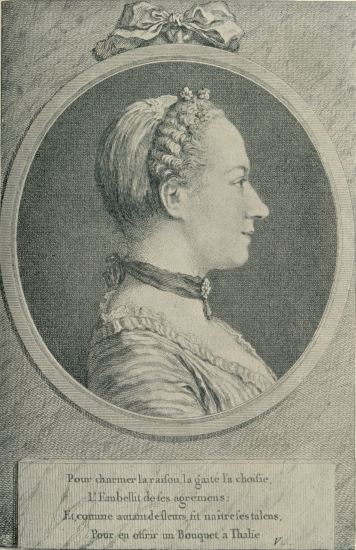
"Adieu, divinité du parterre adorée;
Faites le bien d'un seul et les désirs de tous;
Et puissent vos amours égaler la durée
De la tendre amitié que mon cœur a pour vous!
"Pardon, Mademoiselle, to the remains of intoxication this rhymed prose to which your talents inspire me;[127] the effects of the liquor of which I have drunk endures, they say, often longer than one thinks."
From this letter, which is undated, but was no doubt written in the late autumn of 1746, as Maurice was on the point of setting out for Paris, where he spent the following winter, it would appear that the Marshal had already commenced the siege of the lady's heart. Whether his operations were crowned with success at this period is a point upon which there is a considerable difference of opinion. Dumolard, the editor of Favart's Mémoires et Correspondance, published in 1808, makes of Justine a perfect paragon of virtue, whose resistance the Marshal did not succeed in overcoming for some years, and then only under pressure of the most cruel persecution. M. Saint-Réne Taillandier, one of the most conscientious of Maurice's biographers, adopts the same view, and is very severe upon his hero's conduct in this matter; while he shows us Justine "despising alike threats and promises, the victim of disgraceful intrigues, persecuted, thrown into the depths of a dungeon, guarding pure and intact the dignity of her art, her honour, and her name: a rare lesson for an actress to give to a corrupt society." Sainte-Beuve[128] and Desnoiresterres, however, take a different view, and, much as we should wish to believe in the lady's innocence, we are compelled to admit that the evidence which they adduce leaves no room for doubt upon the matter. The former points to the report of the police-inspector, Meusnier, who declares that at Brussels Justine had ousted all the other enchantresses of the Marshal, and obtained so great an influence over her lover that no one could obtain any favour from him, except through her good offices,[129] and to Maurice's letter to the Princess of Holstein; while the latter cites a letter of Justine to the Marshal, written during her confinement in the Ursuline convent at Les Grands Andelys, in 1749, and which, in his opinion, amounts to a confession of her fault.[130]
But if Justine succumbed, as so many had succumbed before her, to this impetuous wooer, her fall would appear to have been due to a very different cause from that of any of her predecessors in the Marshal's affections. It is certain that her heart was not concerned in the matter, while it is very improbable that she was influenced by a desire to participate in the favours which Maurice was in the habit of heaping upon his enchantresses, though she subsequently admitted to having "availed herself of his benefits and assistance," doubtless being of opinion that, since the mischief was done, she was justified in making the best of the situation. The poor young woman, indeed, appears to have regarded the Marshal with feelings of positive aversion, and there can be little doubt, in view of what follows, that she was intimidated into surrender through fear of the consequences to herself and her husband of thwarting the man in whose power they had placed themselves; a fear which, as we shall presently see, was but too well justified.
Under these circumstances, it is scarcely surprising that the liaison should have been a brief one. Tortured by remorse, loving her unsuspecting husband the more now that she knew herself unworthy of his affection and confidence, still possessed, in fact, by "the demon of conjugal love," in spite of all Maurice's efforts to exorcise him, Justine only waited for a favourable opportunity to break her chains. Maurice's absence in Paris during the winter of 1746-1747 apparently gave her the necessary courage, and, on his return to Flanders, she refused, to his intense indignation, to resume her relations with him, and persisted in her resolution, notwithstanding all his threats and entreaties. Such was the position of affairs when hostilities were renewed in the spring, and the Favarts and their troupe quitted Brussels to join the army.
Favart's letters to his mother contain some interesting details of that campaign. He was present at the taking of the Fort Saint-Philippe, and speaks with righteous indignation of the barbarous execution of the garrison, which he stigmatises as "a disgrace to humanity." He also sends her a lively account of the battle of Lawfeld (July 2):—
"My dear Mother,—I am in good health. The battle is won; the prediction I made to you has been verified. The action took place between Maestricht, Tongres, and Saint-Tron. The left of the enemy's army, composed of English, Hanoverians, and Hessians, was attacked in the morning; they defended themselves all day and fought desperately; but the issue is no longer in doubt. The enemy's right did not await our fire, but sought safety in flight; the Dutch and Austrians were routed without having fired a shot. The rest of the English, to the number of ten thousand, after defending themselves for three hours in a village into which they had been driven, endeavoured to escape across the marshes; but, meeting Clermont's army, which they had not expected, were annihilated.
"A simple carabinier took the English general, Ligonier, prisoner; he is to them what Maréchal de Saxe is to us, if such a comparison were possible. The soldier conducted him to the King, together with a standard; a moment later, the Duke of Cumberland was himself taken.[131] I have related all this very badly, because I am writing to you in haste; it is the warmth of my French blood which guides my pen. Victory! great victory! everything is summed up in these last words. I am one of the first to write. The action still continues to our advantage, we have finished conquering, I say more, we have finished destroying. Pardon me if I say we; through frequenting the society of heroes, I adopt their language. Show my letter to all our friends; they have French hearts, and this success will interest them."[132]
Up to the time of the battle of Lawfeld, the repentant Justine would appear to have been left in comparative peace by her persecutor, military occupations presumably allowing Maurice but scant leisure for love-making. But, the allies disposed of, for the time being, the Marshal turned his attention to other matters, and showed himself so determined to recover his prey, that Justine saw that her only way of escape was to confess all to her still unsuspecting husband, implore his forgiveness, and demand his protection. The worthy Favart, though much shocked at such a revelation, had the good sense to perceive that his young wife had been the victim of circumstances, and that he himself was greatly to blame for not having foreseen the danger which threatened her, and interfered to prevent it. He comforted her by an assurance of his full forgiveness, but pointed out that it would be impossible for her to escape the Marshal's unwelcome attentions so long as she remained with the army, and that her best course was to fly to Brussels and throw herself upon the protection of the Duchesse de Chevreuse, who had shown them much kindness during the preceding winter. Justine readily agreed to his proposal, and, that same night, without allowing any of their colleagues to suspect their intention, they set out for Brussels, where Favart placed his wife in safety with some of his friends, and then returned to the army to face the spiteful comments of his companions and the fury of the Marshal. A day or two after his arrival, he writes to the fugitive at Brussels:—
"I have arrived in good health, my dear little buffoon; your own occasions me much uneasiness. Send me the surgeon's certificate, that I may show it to the Marshal. The gossip of the troupe has caused a report to be circulated that your illness is only an awkwardly devised piece of trickery to conceal your fears and my jealousy. I replied that there was no cause for jealousy, and that to suspect you was to insult you. M. de la Grolet[133] is to be consulted as to whether you are in a fit state to rejoin the army, and a threat has been conveyed to me that you shall be brought here forcibly by grenadiers, and that I shall be punished for having invented the story of your illness. For myself, I care little for their threats; but I cannot forgive myself for having brought you to a country where you are exposed to such tyranny. We are very uncomfortable here; I have not yet succeeded in finding a lodging, and, since leaving you, have slept on straw under the stars. If any attempt be made to send you back, implore assistance of the Duchesse de Chevreuse; she has too keen a sense of justice to refuse you her protection in a matter of such importance, and the kindness with which she has honoured us is a sure proof of that. She can tell M. de la Grolet that your health does not permit of your undertaking so trying a journey. Against such testimony nothing can prevail. Finally, my dearest, although your presence is necessary here for the sake of the performances, and I am burning with impatience to see you once more, your health, more precious than all our other interests, more dear to me than life itself, must be preferred to everything. Send news of yourself as soon as possible to your affectionate husband."