Front matter (continued 6)
Reading edition
Under date October 23, 1748, we come to an entry of considerable interest:—
"The demoiselle Clairon has dismissed the Marquis de Thibouville. She has replaced him by the sieur Marmontel, author of Denis le Tyran. He is not recognisable since he has devoted himself to amusing this girl."[176]
The beginning of the liaison between Mlle. Clairon and the author of the Contes moraux, which the latter relates, with much complacency, in his ever-delightful Mémoires, written, by the way, "for the instruction of his children," is distinctly amusing.
Marmontel had been in love with a certain Mlle. Navarre, whose heart he had stolen away from Maurice de Saxe, much to the indignation of the famous Marshal,[177] and who had made of him "the happiest of lovers and the most miserable of slaves." One day, he learned that his enchantress had jilted him, in his turn, for the Chevalier de Mirabeau, upon which he went home, "fell down like a sacrificed victim," and was for some time alarmingly ill. Mlle. Clairon came to console him, when the following conversation took place:—
"'My friend,' said she, 'your heart needs some object of love; you feel listless, because it is empty. You must interest; you must fill it. Is there not a woman in the world whom you can think agreeable?'
"'I know,' said I, 'only one who could comfort me if she chose, but would she be so generous.'
"'We must see as to that,' replied she, with a smile. 'Am I acquainted with her? I will endeavour to assist you.'
"'Yes, you know her, and have great influence over her.'
"'Well, what is her name? I will speak to her in your favour; I will say that you love with ardour and sincerity; that you can be faithful and constant; that she is sure of being happy in your love.'
"'So you really believe all this?'
"'Yes; I am fully persuaded of it.'
"'Be so good as to say it to yourself.'
"'To myself, my friend?'
"'To yourself.'
"'Ah! then it shall be my pride to comfort you.'"[178]
A connection was thus formed, which, though it did not last very long—at least the love-affair did not[179]—was not without its influence upon the professional careers of both. Marmontel tells us that his passion for the actress had the effect of "rekindling his poetical ardour"; while, on her side, Mlle. Clairon was induced by the representations of the young author to adopt a more natural style of acting, which may be said to have given the finishing touch to an art which came nearer perfection than anything yet seen on the French stage, and, moreover, opened the door for a reform the importance of which can scarcely be over-estimated.
Marmontel had repeatedly urged upon the tragédienne the advisability of aiming at greater simplicity, pointing out that her acting was "too splendid, too impetuous," and was wanting in suppleness and truth. "You possess," said he, "every means of excelling in your art, and yet, great as you are, you might easily rise above yourself, purely by using more temperately those powers of which you are so prodigal. You cite to me your own brilliant successes and those which you have gained for me; you cite the opinion and the advice of your friends; you cite the opinion of M. de Voltaire, who himself recites his lines with emphasis, and who pretends that declamation requires the same pomp as style; while I, in return, can only urge an irresistible feeling that declamation, like style, may be dignified, majestic, tragic, and yet simple; that tones, in order to be animated and deeply affecting, require gradations, shades, unforeseen and sudden transitions, which they can never have when strained and laboured."
Mlle. Clairon laughingly replied that she saw plainly that he would never let her alone until she had adopted a tone and manner more suited to comedy than to tragedy. To which Marmontel rejoined that this she could never do, since her voice, her look, her pronunciation, her gestures, her attitudes, were all instinctively dignified and majestic, and that, if she would but consent to be natural, her tragic powers could not fail to be enhanced.
For a long while, the actress refused to be persuaded; but, finally, in 1752, after Marmontel had, for some time, ceased to urge her, she resolved to follow his counsels. Judging it best to make her first essays in the new method before a public less critical and less conservative than that of Paris, she obtained permission to visit Bordeaux, where, in addition, she would have the advantage of performing in a theatre more suited to the style she proposed to adopt than the large salle of the Comédie-Française. On her first evening at Bordeaux, she appeared as Phèdre, and played the part in the way she had always been accustomed to perform it in Paris, that is to say, with much extravagance of tone and gesture. She was, of course, loudly applauded. The next day, she appeared as Agrippine, and played the character from beginning to end in conformity with the ideas which she had recently adopted.
"This simple, easy, and natural style of acting," she tells us, "at first surprised them. An accelerated mode of utterance at the end of each couplet, and a regular gradation of vehemence had been usually the signals for applause; they knew that it had only been usual to applaud such passages; and, as I did not resort to the style to which they had become accustomed, I was not applauded." As the play proceeded, however, the attitude of the audience underwent a change; murmurs of "Mais cela est beau! Cela est beau!" began to make themselves heard; and, when the curtain fell, the actress received a perfect ovation.
"After this," she continues, "I represented thirty-two of my different characters, and always in my newly-adopted style. Ariane was of the number, and the authors of the Encyclopédie, under the subject Déclamation, have been kind enough to transmit to posterity the very marked and flattering homage which I received. However, being still fearful, and doubting the judgment of the public, as well as my own, I determined to perform Phèdre as I had played it at first, and I saw, to my delight, that they were dissatisfied with it. I had courage enough to say that it was an experiment which I had believed it to be my duty to make, and that I would play the same character differently, if they would grant me the favour of a third performance. I obtained permission, adopted the style which was the result of my studies as completely as I could, and every one agreed that there was no comparison."
Encouraged by the success which had attended her experiments at Bordeaux, Mlle. Clairon forthwith determined to try the effect of the new method upon Paris and Versailles.
One day, when she was to play Roxane in the little theatre at Versailles, Marmontel, happening to come to her dressing-room, was surprised to find her attired like a sultana, without panier, her arms half-bare, and, in short, in correct Oriental costume. He complimented her upon her appearance, upon which she told him of her experience at Bordeaux, adding: "I am going to try it again in this small theatre. Come and hear me, and if it be as successful here, adieu to the old declamation!"
The result, Marmontel tells us, exceeded their most sanguine anticipations. "It was no longer the actress, but Roxane herself, who was seen and heard." The aristocratic audience were delighted, and applauded her warmly. After the play, her friend went to congratulate her upon her success. "Ah!" said she, "don't you see that I am undone? In all my characters the costume must now be observed; the truth of dress must be conjoined with that of acting. All my costly theatrical wardrobe must from this moment be changed; I lose clothes to the value of 10,000 crowns; but the sacrifice is made. You shall see me within a week perform Électre as naturally as I have just played Roxane."
She was as good as her word. It was the Électre of Crébillon. "In place of the ridiculous panier and wide mourning gown which she had been accustomed to wear," says Marmontel, "she appeared in the simple dress of a slave, with her hair dishevelled, and long chains upon her arms. She was admirable, and, some time afterwards, she was still more sublime in the Électre of Voltaire. Voltaire had made her recite this part with an unvaried and doleful monotony; but, when spoken naturally, it acquired a beauty unknown to himself. On hearing it acted at his theatre at Ferney, where she went to visit him, he exclaimed, bathed in tears and transported with admiration, 'It is not I who am the author of that—it is herself; she has created the part.' And, indeed, the infinity of shades which she introduced, and the manner in which she expressed the passions, rendered it perhaps, of all others, that in which she was the most astonishing."[180]
Paris, as well as Versailles, was quick to recognise in this change the genuine tragic tone, and the enormously increased appearance of probability which theatrical performances derive from a due observation of costume. Thus, from one reform sprang another, and, warmly supported by the celebrated actor Lekain,[181] who was keenly alive to the absurdity of dressing the characters of ancient Greece and Rome in a half-modern fashion, Mlle. Clairon was able to effect a veritable revolution. Henceforth, the actors were forced to abandon their tonnelets, their fringed gloves, their voluminous periwigs, their plumed hats, and all the rest of the trappings which one sees in Liotard's engraving of Watteau's picture, Les Comédiens Français; and this new desire for truth ere long extended to the scenery and all the accessories.
Voltaire's Orphelin de la Chine, produced on August 20, 1754, where, in the part of Idamé, Mlle. Clairon secured one of her most brilliant triumphs,[182] was the first play in which they ventured to act on their ideas. "On returning from Fontainebleau," writes Collé, "this tragedy has been revived, and has had nine representations. I omitted to mention that the players have been put to some expense. They have had a scene painted, or, to speak more correctly, a palace, in the Chinese fashion; they have also observed the costumes of the country in their dress. The women wore Chinese gowns, were without paniers and ruffles, and had their arms bare. Clairon even affected foreign gesticulations, placing frequently one hand or both on her hips; holding for some moments her clenched fist to her forehead, and so forth. The men, according to the characters they represented, were attired as Tartars or Chinamen.[183] The effect was excellent."[184]
Mlle. Clairon was not content with restoring to the figures of the past their correct costume; she sought to make them live again in all the distinctiveness of their times, their countries, and their nationality. To be a great tragic actor or actress, it was not enough, in her opinion, to have a sonorous voice, a majestic presence, a dignified carriage, enthusiasm, and dramatic intelligence; it was necessary for the player "to transport himself into the times and the places where the characters which he was representing had lived," to recover, in fact, a little of the spirit of Rome, Sparta, or Athens. "Not only," says she, in her Mémoires, "ought one to acquaint oneself with the history of all the peoples of the world, but to investigate it thoroughly; to render oneself familiar with it, even in the minutest details; to adapt to each rôle the peculiarities which the nation to which the character belonged ought to exhibit."
Such a result could, of course, only be attained by constant study; and she herself was an indefatigable student of historical works and the classics, as well as of statues, monuments, and portraits; and unsparing in her condemnation of those members of her profession who were too indolent or too careless to follow her example. Grimm relates an imaginary conversation between Mlle. Clairon and a young actor, which Mme. d'Épinay declared that she had dreamed, and which, no doubt, correctly illustrates the tragédienne's views on this subject.
The young actor has come to enlist Mlle. Clairon's good offices to secure him a début at the Comédie-Française, and the following conversation takes place:—
"Have you yet appeared at any theatre?"
"No, Mademoiselle."
"Well! no matter; your face interests me. Be seated, Monsieur, and let us talk.... Ah! go and fetch me my work-basket from yonder console, at the end of the room, so that I may see you walk, if you please—over there, near that Japanese ornament.... Monsieur, I thank you. That is satisfactory; your movements are easy; you have no stiffness, nor ungainliness; but you have no distinction. Have you never had occasion to observe men of quality in society? What, Monsieur, are the characters in which you are most proficient, and which you propose that I should listen to?"
"Mademoiselle, that of Nero in Britannicus."
"Is that the only one? Well, Monsieur, before I listen to you, have the kindness to tell me who Nero was."
"Mademoiselle, he was an emperor who lived at Rome."
"That he lived at Rome is correct. But was he a Roman emperor, or did he reside at Rome for pleasure? How did he rise to be emperor? What were his claims, his birth, his parents, his education, his character, his inclinations, his virtues, his vices?"
"Mademoiselle, the rôle of Nero answers some of your questions, but not all."
"Monsieur, it is necessary to answer not only these questions, but all the further ones that I shall ask you. And how can you play the part of Nero, or any other that you wish to, unless you are as well acquainted with the life of the personage whom you are representing as with your own?"
"I was under the impression, Mademoiselle, that in order to grasp the sense of his rôle, it was quite sufficient to be acquainted with the play."
"And you were under a wrong impression, Monsieur."[185]
In the midst of her histrionic triumphs, Mlle. Clairon continued her career of gallantry. To Marmontel succeeded the Bailli de Fleury, "understudied" by a M. de Villeguillon, an officer of Musketeers. Soon both these gentlemen were discarded in favour of the Marquis de Ximenès, a young man of twenty-five, with a considerable fortune. The marquis, who was by way of being a poet, began his wooing by inditing sonnets to the lady's eyes, which, however, were very coldly received. Thereupon, changing his tactics, he sent her a Périgueux pâté, in which he had caused to be inserted, in the guise of truffles, six rouleaux of fifty louis each. The rouleaux were much more to Mlle. Clairon's taste than the verses had been, and, when her generous admirer presented himself that evening, her door was no longer closed to him.
The marquis loved the lady very dearly. For her sake, he abandoned a former enchantress of the name of Mainville, "who had already plucked some of his feathers." For her sake, he parted with a fine estate in Champagne and laid the proceeds at her feet. And every day he came to visit her "in an equipage of the most brilliant description, with two tall lackeys in the rumble, and a running footman preceding it, all superbly habited."[186]
Finally, however, she killed his love with a bon mot. A fair colleague in the green-room, with whom she was having words, happened to remark that Monsieur le Marquis had turned Mademoiselle's head. "Yes," snapped the actress, "away from him." M. de Ximenès, be it said, was not an Adonis.
This injudicious speech was duly reported to the marquis, who, stung to the quick, quitted the lady for ever. Mlle. Clairon wrote demanding the return of a portrait of herself which she had given him. It came, and, with it, these cruel verses:—
"Tout s'use, tout périt, tu le prouves, Clairon;
Ce pastel dont tu m'a fait don,
Du temps a ressenti l'outrage
Il t'en ressemble davantage."[187]
To M. de Ximenès succeeded a gentleman who, for some time, baffled the curiosity of Berryer's inspectors by invariably visiting the actress under cover of night, in a hackney-coach, and with his features concealed by a cloak. Ultimately, it transpired that the mysterious admirer was the Marquis de Bauffremont, who having recently married—and not for love—a lady of a very jealous disposition, had strong reasons for desiring to hide his identity.[188]
The discreet M. de Bauffremont was followed by yet another marquis; he of Rochechouart—Mlle. Clairon appears to have been extremely partial to noblemen of this particular rank—and, finally, the lady formed a liaison with Joseph Alphonse Omer, Comte de Valbelle d'Oraison, "who had received from Nature all the graces that go to the making of an amiable man, and whom Chance had made the richest noble in Provence."[189]
Let us hasten to add that here, at any rate, Mlle. Clairon seems to have experienced a genuine passion, which was undoubtedly reciprocated; for her liaison with the Comte de Valbelle lasted for nineteen years, and, as we shall presently see, might have been regularised, had the actress been so disposed.
With her triumph in the Aménaïde of Tancrède, of which we have spoken elsewhere, Mlle. Clairon reached the height of her fame. She ruled with despotic sway not only the theatre, but the world of fashion as well. At her house, in the Rue des Marais—the same house which had been successively occupied by Marie de Champmeslé, Racine, and Adrienne Lecouvreur—she received the cream of the society of both Court and capital:[190] Mesdames d'Aiguillon, de Villeroi, de la Vallière, de Forcalquier, and others; and in turn, was a frequent guest at their tables and also at that of Madame du Deffand. The Princess Galitzin, wife of the Russian Ambassador at the Court of Vienna, formed so deep an attachment for the actress that she "could not spend two hours without seeing her or writing to her." It was she who commissioned Carle Van Loo to paint his celebrated portrait of Mlle. Clairon as Medea,[191] and presented it to the actress. It was she, too, who, in 1759, persuaded the Russian Court to invite the great actress to leave France and take up her residence at St. Petersburg. The terms offered were extremely tempting,[192] and Mlle. Clairon hesitated long before refusing them. But her passion for the Comte de Valbelle was then at its height, and she could not reconcile herself to the idea of being separated from her lover. Then the count offered to make her his wife, and accompany her to Russia, and so anxious was the Czarina Elizabeth to secure the services of the tragédienne, that she promised, through the Princess Galitzin, to accord him the same rank as he held in France, "and the emoluments necessary to sustain it." Mlle. Clairon, however, fell ill, and illness gave her time for reflection. She remembered that she was seven years older than her lover, who was a very gallant gentleman indeed, and very far from an example of fidelity; as her charms waned, she could hardly flatter herself that he would become more constant. She remembered, too, the difference in station; she thought of the indignation of the count's family, and she asked herself whether, in years to come, he would not reproach her with having taken him at his word.
Finally, she came to the conclusion that "the soul capable of rejecting all the advantages which are offered is a thousand times more noble than the one that accepts them," and declined to expatriate herself.[193] The Princess Galitzin was not the only distinguished foreigner to seek to perpetuate the genius of Mlle. Clairon. Garrick, who had seen her act at Lille, during his first visit to France in 1742, and prophesied a great future for her,—though this, of course, was in comedy—came to Paris, with his wife, after the conclusion of peace in 1763, on their way to Italy. A warm friendship sprang up between the great English actor and the Queen of the French stage, and so delighted was Garrick with the tragédienne's talent that he commissioned Gravelot to engrave a design, representing Mlle. Clairon "in all the attributes of Tragedy," her arm resting on a pile of books, on which might be read the names of Corneille, Racine, Voltaire, and Crébillon.[194] By her side stood Melpomene crowning her with laurel. At the top of the frame, on a ribbon encircled by an olive branch, one read:—
"Prophétie Accomplie."
And on a tablet at the base, the following verses:—
"J'ai predit que Clairon illustrerait la scène,
Et mon esprit n'a point été déçu:
Elle a couronné Melpomène,
Melpomène lui rend ce qu'elle en a reçu."
—GARRICK.
The following year, the Comte de Valbelle and a M. de Villepinte, another warm admirer of the actress, caused a gold medal to be struck in the lady's honour. On the face of this medal was Gravelot's allegorical design; while the reverse bore this inscription:—
L'Amitié Et Melpomène Ont Fait Frapper Cette MÉDAILLE EN 1764.
The pleasure which the lady derived from this piece of adulation must have been considerably discounted by the publication of the following mordant epigram, from the pen of the dramatist Saint-Foix, of whose works she appears to have spoken slightingly:—
"Pour la fameuse Frétillon
Ils ont osé frapper un médaillon;
Mais à quelque prix qu'on le donne,
Fut-ce douze sous, fut-ce même pour un,
Il ne sera jamais aussi commun
Que le fut jadis sa personne."[195]
The pride of Mlle. Clairon, in those days, knew no bounds. "Madame de Pompadour," said she, one day, "owes her sovereignty to chance; I owe mine to the power of my genius!" She treated even the most distinguished of her colleagues with haughty disdain, and often with the grossest discourtesy; and poor Mlle. Dangeville, the object of her childish adoration and the most sweet-tempered and inoffensive of women, retired from the stage ten years earlier than she would otherwise have done, vowing that it was "impossible to live any longer with such a creature." As for the younger actresses, they positively trembled before her; while, with the exception of Voltaire, whose admiration for her she condescended to reciprocate, there is said to have been not a single dramatic author of the time whom she had not insulted. The public she appears to have regarded very much as a queen might her subjects. On the occasion of a free performance at the Comédie, given by order of the King, she came on to the stage between the two pieces and threw handfuls of silver into the pit; and the worthy Parisians, quite gulled by this piece of theatrical quackery, cried, as they scrambled for the money, "Vive le Roi et Mlle. Clairon!"
Nevertheless, in spite of her arrogance and absurd pretensions, Mlle. Clairon had the interests of her profession sincerely at heart. She was, according to her own expression, the chargé-d'affaires, the advocate, and the postillion of the Comédie-Française, and it was always to her that her comrades turned when in any difficulty or perplexity. It was through her influence, joined to that of the Comte de Lauraguais, that the absurd custom of allowing the more distinguished members of the audience seats upon the stage itself—a custom which seriously hampered the movements of the players and was utterly destructive of all scenic illusion—was finally abolished. A word from her was sufficient to secure the payment of the overdue royal pension to the Comédie, which the semainiers had vainly solicited from the Comptroller-General; and she laboured zealously, if unsuccessfully, to free her profession from the ban of the Church, which had weighed so long and so heavily upon it.
In the spring of 1761, there was published, at Amsterdam, a little volume, entitled Liberté de la France contre le pouvoir arbitraire de l'excommunication, ouvrage dont est spécialement redevable aux sentiments génereux et supérieurs de Mlle. Clai.... This book, which was the work of one Huerne de la Mothe, an advocate of the Parliament of Paris, had been inspired by Mlle. Clairon, and was preceded by a letter from the actress to the author, in which she announced to the public that she hesitated to exercise her profession any longer, owing to her fear of the excommunication to which it subjected her. The bigots, ecclesiastical and lay, who were very roughly handled in the book, were exasperated to the last degree; the Grand'Chambre issued a decree ordering the obnoxious work to be burned by the public executioner in the Place de Grève, and poor Huerne de la Mothe was struck off the roll of advocates. Mlle. Clairon, however, who felt herself to be the cause of his misfortune, did not allow him to suffer by his championship of her profession, and persuaded the Duc de Choiseul to nominate him to a lucrative post in the Ministry of Foreign Affairs.
Mlle. Clairon had many enemies: enemies in her own profession, enemies in the fashionable world, and enemies in the Republic of Letters. Two of the most formidable among the last-named were La Harpe and Fréron, the critic, the sworn foe of the philosophers. La Harpe hated her, it is said, because she had contemptuously refused to act in his plays; Fréron, because of her friendship with the elders of the Holy Philosophical Church, and, more especially, with its Patriarch, Voltaire, under whose blistering ridicule he had long writhed. La Harpe contented himself by making epigrams about her in society; but Fréron went further, and dared to attack her in print.
There had recently appeared at the Comédie a young, charming, accomplished, and, mirabile dictu, virtuous actress, named Mlle. d'Oligny, best remembered in theatrical history as the original representative of Rosine in Beaumarchais's Barbier de Seville.[196] Fréron, who prided himself on being one of the first to discover the talent of this lady, could not resist the temptation of contrasting her blameless life with that of Mlle. Clairon, and proceeded to do so in a remarkably effective manner.
In his Année littéraire, under date January 17, 1765, appeared an éloge in verse of Mlle. d'Oligny, "who had never consented to listen to any proposition of fortune, at the expense of her innocence," followed by a paragraph written by Fréron himself, which, although she was not actually mentioned by name, no one could have the least doubt referred to Mlle. Clairon:—
"One will be grateful to the author for having laid stress, in his just éloge of Mlle. d'Oligny, on her irreproachable conduct up to the present. May we always bear in mind that the Muses are chaste, and that they ought never to sing of libertinism and prostitution! Talents of the rarest order, or regarded as such, do not efface the opprobrium of a dissolute life. One may accord a certain measure of esteem to the performance of the actress, but the seal of contempt is always stamped upon her person. It is in vain that, after having acquired a disgraceful celebrity through vice, she affects a grave and reserved manner. This tardy and false decorum only serves to form a revolting contrast with a youth of infamy, and I do not know whether one does not prefer that a creature of this species should constantly show herself what she has been, rather than appear what she is not. The frankness of libertinism is, in point of fact, less shocking than the mournful simulation of dignity."[197]
Terrible was the wrath of the insulted actress. To the Gentlemen of the Chamber she flew, and announced her intention of quitting the stage forthwith, and for ever, unless condign punishment was immediately inflicted on this vile scribbler who had dared to traduce her.
To pacify her, an order was issued for the arrest of Fréron and his incarceration in For l'Évêque. But when the police proceeded to his house to execute it, they found the critic in the agonies of gout: agonies so acute that it was impossible, he declared, to move a step without enduring torments; and his friends contrived to obtain a suspension of his sentence until he should be in a fit state to leave his bed. As may be supposed, this was not for some days, and, in the meantime, the devout Queen, Marie Leczinska, whose father had stood sponsor to one of Fréron's children, and who regarded that worthy as the champion of the Faith against the attacks of the philosophers, intervened on his behalf and obtained a further respite.
Mlle. Clairon refused to abide by the Queen's decision, reiterated her determination to retire from the stage if Fréron were not punished, and demanded an audience of the Prime Minister, the Duc de Choiseul.
"Justice!" cried she, in tragic accents, the moment she was ushered into his presence. "Justice, Monsieur le Duc!"
"Mademoiselle," replied the Minister, with mock gravity, "you and I both perform on a stage, but there is this difference between us: you choose the parts which you prefer, and are sure of the applause of the public. There are only a few persons of bad taste, such as this wretched Fréron, who refuse you their suffrages. I, on the contrary, have often a very disagreeable task; I strive to do my best, and am criticised, condemned, hissed, and ridiculed; yet, I remain at my post. Let us both of us sacrifice our private resentments to the good of our country, and serve it, each in our own way, to the best of our ability. And, besides, the Queen having pardoned, you can, without compromising your dignity, imitate her Majesty's clemency."
Mlle. Clairon, far from mollified by this badinage, returned home, and called a meeting of her friends and the members of the Comédie, presided over by the Duc de Duras, at which it was determined that the Comte de Saint-Florentin, Commandeur des Ordres to the King, should be threatened with the desertion of the entire troupe, unless speedy justice were done to the modern Melpomene. "This line of conduct," writes Bachaumont, "has greatly disturbed M. de Saint-Florentin. This Minister has written to the Queen, stating that the affair has become one of the vastest importance; that for a very long time no matter of such serious import has been discussed at Court; that, in fact, the Court is divided into two factions on the question; and that, despite his profound respect for the commands of her Majesty, he much fears that he will be compelled to obey the original orders of the King."
However, eventually, the matter was allowed to rest, and, by the irony of Fate, barely two months had passed before Mlle. Clairon herself was sent to For l'Évêque. And this was how it came about.
After the Easter recess of that year, the Comédie-Française was announced to open with De Belloy's phenomenally successful tragedy, Le Siège de Calais, then at the height of its popularity. All the boxes had been engaged for several performances, and there was every indication of a most successful season. An unexpected incident ruined everything. "An actor named Dubois, who," says Grimm, "had for the last twenty-nine years enjoyed the confidence of all the tragic heroes," had a dispute over a bill with a surgeon named Benoît, whose professional services he had had occasion to seek, under somewhat discreditable circumstances. Dubois declared that he had paid the bill; Benoît was equally positive that he had not, and commenced proceedings to recover the amount owing. The actor's colleagues, annoyed to find one of their number mixed up in such an affair, brought the matter to the notice of the Gentlemen of the Chamber, who gave them permission to decide upon it themselves. They, accordingly, held an inquiry, found that Dubois had lied—indeed, he confessed as much—and, at the instigation of Mlle. Clairon, and with the approval of the Gentlemen of the Chamber, expelled him and another actor named Blainville, who had given evidence in his comrade's favour, from the troupe.
Now, it happened that Dubois had a very pretty daughter, "who possessed the power," says Mlle. Clairon, "of rendering the Gentlemen of the Chamber as happy as they could desire to be." Like a dutiful child, she warmly espoused the cause of the cashiered actor, and, rushing, with dishevelled hair, into the presence of the Duc de Fronsac—son of the Maréchal de Richelieu—who in days gone by had been in the habit of paying her matutinal visits, disguised as a coffee-house waiter, besought his intervention on behalf of her unhappy father, the innocent victim, she declared, of the machinations of Mlle. Clairon.
The young duke, who still retained for the lady some remains of affection, promised to do what he could, with the result that on April 15, about three hours before the play was announced to begin, an order arrived from Versailles, to the effect that Dubois was to be allowed to take his usual part, until the King should decide on his fitness to remain a royal player.
A meeting of the company was hurriedly summoned, and a deputation sent to one of the Gentlemen of the Chamber who happened to be in Paris, to endeavour to obtain a rescission of the order, for that evening at least. But the deputation returned and reported the failure of its mission; the "Gentleman" had professed himself unable to do anything without consulting his colleagues. Thereupon, five members of the troupe, Mlle. Clairon, Lekain, Brizard, Molé, and d'Auberval, declared their intention of refusing to play. Cost them what it might, they were absolutely determined never to appear upon the stage with Dubois again. Such was the position of affairs, when, at half-past five, the Comédie opened its doors. Let us listen to Collé's account of the scene which followed:—
"The audience assembled to witness Le Siège de Calais; it had been impossible to change the bills announcing the performance. When half-past five came, Lekain, Molé, and Brizard had not arrived. Mlle. Clairon had shown herself, but, perceiving and knowing that these gentlemen had no intention of appearing, did not take the trouble to dress, and went home in the sedan-chair which had brought her to the theatre. The remainder of the players, who were very reluctant to acquaint the public with this unwelcome news, were at a loss what to do. Ultimately, towards six o'clock, one of them left his comrades, went on to the stage, and began, in trembling accents, to address the audience with: 'Messieurs, we are in despair—' He was interrupted by some one in the pit, who shouted, 'We want no despair! Calais!' And, in an instant, the entire public took up the cry and shouted: 'Calais! Calais!"
"After this first tumult had somewhat subsided, the actor wished to commence his speech, but the audience declined to hear any more. Some minutes passed thus, and then the actor briefly explained the impossibility of performing the tragedy in question, and proposed to play Le Joueur in its place, or to return the public their money; only to be received with renewed cries, more violent than before, of 'Calais! Calais!'
"A moment later, Préville, the idol of the public, came on to the stage and endeavoured to begin the first scene of Le Joueur, but was interrupted, hooted, and hissed by the audience, who cried in a kind of frenzy: 'Calais!' Several persons in the pit, who were aware that it was through the intrigues and machinations of Mlle. Clairon that the players had so signally failed the public, shouted: 'Calais, et Clairon en prison! Frétillon à l'hôpital![198] Frétillon aux cabanons!'
"No doubt the majority of those who uttered these blasphemies were partisans of the Dubois, who had been posted by her and her father in the pit. This pandemonium, which might have become a scene of bloodshed, if the Guards on duty had chosen to interfere, lasted until seven o'clock, when the audience had their money returned to them."[199]
The following morning, there was a consultation between Sartines, the Lieutenant of Police, and the Gentlemen of the Chamber, when it was decided to make an example of Mlle. Clairon and the other recalcitrant players. The actress, who happened to be unwell, was in bed, and her friend Madame de Sauvigny, wife of the Intendant of Paris, was nursing her, when an inspector of police arrived and intimated that he had an order from the King to conduct Mlle. Clairon to For l'Évêque. Madame de Sauvigny protested against the arrest of her "best friend," but the exempt was inexorable, and Mlle. Clairon informed him that she would submit to the orders of the King. "All that I have," cried she, in her best stage manner, "is at his Majesty's disposal—my property, my person, and my life are in his hands. But my honour is untouched, and of that not even the King can deprive me."
The man of law bethought him of an old legal maxim. "Very true, Mademoiselle," he replied, "for where there is nothing, the King loses his rights."
Madame de Sauvigny insisted that Mlle. Clairon should proceed to For l'Évêque in her own carriage and announced her intention of accompanying her. But, as the carriage in question happened to be a vis-à-vis, and the exempt refused to lose sight of his prisoner, the noble lady was constrained to seat her friend upon her knees, and in this singular fashion they traversed the streets of Paris.[200]
At For l'Évêque, the famous actress was treated more like a distinguished guest than a prisoner. The most comfortable room available was allotted her, and furnished in luxurious fashion by her sympathising friends, the Duchesses de Duras and de Villeroi and Madame de Sauvigny; the courtyard of the fortress was crowded every day by the carriages of those who came to offer her their sympathy, and she was permitted to give delightful little supper parties. In less than a week, a complaisant physician having certified that further detention would be prejudicial to the lady's health, she was permitted to return home, under certain conditions, which she alludes to in a letter to Garrick, in answer to one of sympathy from the English actor:—
"PARIS, May 9, 1765.
"My soul, penetrated by a treatment as barbarous as it is unjust, had need, my dear friend, of the pleasure that your letter has brought to it. This letter has interrupted for some moments the indignation and grief which consume me. Never has my health occasioned me so much anxiety, never have the mischances to which I am subjected been so multiplied, so violent. But be tranquil; my courage is superior to all my misfortunes.
"Will you credit it? my comrades are still in prison! I myself was released the fifth day, but have been placed under arrest at my house, and prohibited from receiving more than six specified persons. It is said that Dubois has tendered his resignation; it is to be hoped that it will be accepted, and that we shall be at liberty this evening or to-morrow; it is time we were! As they have refused to permit any of my comrades to come and see me, I am in ignorance of what they think and what they intend to do.
"I am resolved not to give them any advice, but to occupy myself only with my own position, and, above all, with the esteem of honest people; I dare to be confident that I shall obtain that. I shall not share with you my reflections on the past, the present, and the future; not that I fear to submit them to your intelligence and your friendship, but because my letter might be opened, and they might misinterpret me; and I do not wish to afford them any pretext for persecution. Embrace Madame Garrick for me, and rest assured both of you that I love, esteem, and regret you as much as possible, and as you have the right to expect from the most sensitive and grateful of hearts.
CLAIRON."[201]
After about three weeks of seclusion, Mlle. Clairon was permitted to resume her ordinary life, and as Dubois, the cause of all the trouble, had now resigned, it was anticipated that she would appear again upon the stage. On the plea of ill-health, however, she declined to return to the theatre, and, about the middle of June, it was common knowledge that the actress had requested permission to retire from the stage. The Maréchal de Richelieu, First Gentleman of the Chamber, refused her request, asserting that he would never consent to sign her ordre de retraite during his year of office, but offered to grant her leave of absence till the following Easter—that is to say, until the end of the theatrical year, in order that she might have time to go to Geneva and consult the celebrated doctor, Tronchin.
To Geneva she accordingly went, and obtained the advice she came to seek; Tronchin, who, great man though he was, was not above humouring the whims of his distinguished patients, assuring her that he would not answer for the consequences if she returned to the stage.
From Geneva she proceeded to Ferney, in response to a pressing invitation from its master, who assured her that it was "a temple where incense was burning for her," and that "to see and hear her would be his Fountain of Youth."
When she reached Ferney, Voltaire was ill, but no sooner had she declaimed her part in his Orphelin de la Chine, than he professed himself completely cured. During her stay, she performed several times in the little theatre of the château, playing Aménaïde in Tancrède and Électre in Oreste, and the delighted poet wrote to d'Argental that in the latter character "she had shaken the Alps and Mont Jura"; while, in a letter to Monnet, he declared that she had "made him feel twenty years younger."[202]
On leaving Ferney Mlle. Clairon went to Provence, to visit the Comte de Valbelle. While there, she attended the theatre at Marseilles, and, on being recognised, was loudly cheered by the occupants of the pit, who cried: "Le Siège de Calais et Mlle. Clairon!" and refused to desist until the governor of the province, the Duc de Villars, had promised to do all he could to persuade the actress to gratify them.
At the beginning of November, she was again in Paris, where great pressure was brought to bear upon her to induce her to reconsider her determination to retire from the stage. On one condition only would she consent to forget the horrors of For l'Évêque, namely, that the Comédie-Française should be erected into a Royal Academy of the Drama, which would have the effect of giving a legal status to its members, and would pave the way for the removal of the ecclesiastical ban. A petition was accordingly drawn up, which had the support of the Duc de Duras, the Duc d'Aumont, and several other important personages, and submitted to the King. But, owing apparently to the maladroit way in which the Duc de Duras, who had charge of the memoir, presented his case, it was refused; and, at the following Easter, Mlle. Clairon demanded her congé, which was accorded her. Here is the ordre de retraite:—
"We, Maréchal Duc de Richelieu, pair de France, First Gentleman of the King's Chamber;
"We, Duc de Duras, pair de France, First Gentleman of the King's Chamber;
"Mlle. Clairon, after having served the King and the public for twenty-two years with the greatest assiduity and the greatest attention, finding herself compelled, on account of her health, to quit the theatre, we have accorded her leave to retire, with the pension in conformity with the regulations.
"(Signed) "The Maréchal Duc de Richelieu. "The Duc de Duras.[203]
"Executed at Paris, April 23, 1766."
For some years after her retirement from the stage Mlle. Clairon resided in a house near the Pont-Royal, where Marmontel speaks of her receptions as "numerous and brilliant." She frequently consented to recite some of her famous rôles at the houses of her aristocratic friends, and Horace Walpole writes, under date August 23, 1767: "Arrived in Paris at a quarter before seven; at eight to Madame du Deffand's; found the Clairon acting Agrippine and Phèdre; not tall, but I like her acting better than I expected. Supped with her and the Duchesses de Villeroi and d'Aiguillon."
Although she never again appeared on the boards of the Comédie-Française, the great tragédienne performed on several occasions in private theatres. On February 19, 1767, she played Zelmire in De Belloy's tragedy of that name, at the Hôtel d'Esclapon, Rue de Vaugirard, at a performance arranged for the benefit of Molé.[204] Again, in December 1768, she appeared as Dido and Roxane in Bajazet, at the little theatre belonging to the Duchesse de Villeroi, before the King of Denmark and the Prince of Saxe-Gotha. Grimm writes:—
"The Duchesse de Villeroi has reserved to herself the right of doing the honours to Mlle. Clairon in her little theatre. This celebrated actress played there twice, in the presence of the King of Denmark, the Hereditary Prince of Saxe-Gotha, and a little chosen company, for the theatre can only accommodate a hundred and ten persons. The first time, she played the part of Dido, and the second, that of Roxane, in the tragedy of Bajazet. After the play, she was presented by Madame de Villeroi to her august spectator, who drew a ring from his finger and placed it on the finger of the actress; but I know that, in spite of this royal courtesy, he had not the happiness to succeed with the illustrious Clairon. In her quality of Dido, she will not have found him tender enough; in her quality of Roxane, she will not have found him sufficiently humble; in her quality of Clairon, she will not have found him sufficiently penetrated with admiration. In fact, notwithstanding the infatuation of the Court and the town for the young monarch, he has had the misfortune to displease the heroine of the Théâtre-Français."[205]
Finally, on the occasion of the fêtes at Versailles, in honour of the marriage of the Dauphin and Marie Antoinette, in the spring of 1770, Mlle. Clairon appeared as Athalie and Aménaïde. But five years of retirement had naturally not been without their effect upon her powers, and her acting seems to have caused general disappointment. Perhaps her unfortunate choice of a gown, "half-brown, half-yellow, which gave her the appearance of a shrivelled-up old woman," had not a little to do with her comparative failure as Voltaire's heroine.
An impression prevailed at this time that had Louis XV. only condescended to express a desire that Mlle. Clairon should return to the Comédie-Française she would have consented to do so. But Louis XV. was not such an admirer of the lady's acting as Voltaire—indeed, he seems to have preferred Mlle. Dumesnil—and when, three years before, Mlle. Clairon had caused him to be informed that she was prepared to play at Versailles as often as his Majesty might command he had replied, to her intense chagrin, that he found the other actresses very capable.[206]
On her retirement from the theatre, Mlle. Clairon had opened a kind of dramatic academy. Here she trained a number of aspirants to histrionic fame, several of whom were destined to make their mark in years to come. Among these may be mentioned the beautiful Mlle. Raucourt, herself, in her turn, the Queen of the Comédie-Française, and that excellent actor, Larive.
For Larive, the ex-tragédienne appears to have conceived an almost maternal affection, leaving no stone unturned to ensure his success upon the stage, and corresponding with him regularly for many years. Her early letters are chiefly of a professional kind: advice as to the way in which certain parts are to be played, as to the costumes suitable to those parts, and so forth. But occasionally we find her descending to more personal matters, rallying him on his bonnes fortunes, and moralising in the style of an indulgent elder brother.
"You have then made a conquest," she writes, "and of a fine lady, you say? I am not astonished, since you are a very handsome man. But I cannot prevent myself from telling you that you are a great imbecile. If she is a woman who makes a profession of gallantry, or a marriageable girl, you ought certainly to refuse to have anything to do with her. A man should avoid the first, for fear of accidents, and never have to reproach himself with having corrupted the other. But if she be a married woman or a widow, that is current coin, the property of every one, and you will be doing wrong not to make use of it. No engagement, no prejudice, need restrain you. You are a man, young; you are bored. Guarantee yourself a serious attachment; that is an excellent thing; but why refuse to your senses, and to the necessity of diverting your mind, the tribute which both demand?"
In a letter, which, like the above, bears no date, but which was probably written in the summer of 1772, we find a person mentioned who was to play a very important part in Mlle. Clairon's future life:—
"You have extended your hospitality to a dog; I have extended mine to a little boy. Molé sent me an unhappy widow with six children in want of bread. I have taken charge of one, and am busying myself in finding means to allow the rest to live. I shall not keep the child at my house; he is a little devil, and that annoys and wearies me. But since he bears a close resemblance to the Margrave (of Anspach), whom I am expecting to see arrive here this autumn, I have taken the child, in the hope of sending him to Germany. If that plan falls through, I shall put him to a trade, and pay his apprenticeship to whatever one his mother may choose."
Christian Frederick Charles Alexander, Margrave of Anspach, Baireuth, and Brandenburg, Duke of Prussia, Count of Sayn, was the son of Frederick the Great's sister, Frederika Louise, and that potentate's favourite nephew. Born in 1736, and married, against his will, by his father, to a princess of Saxe-Coburg, "who resembled a faded lily which had begun to grow yellow," he spent the greater part of his time in travelling in Italy, Holland, and France, and "gratifying his tastes for the arts and feminine society."
The Margrave was not handsome, in fact, his appearance was distinctly unprepossessing. He had "a retreating forehead, sunken eyes, a nose like a trumpet, an enormously long peaked chin, and a long ungainly neck." On the other hand, he was well-educated, sensible, and good-natured; "the best prince in Germany," said the Austrian Chancellor, Kaunitz, who was certainly in a position to judge.
The Margrave fell in love with Mlle. Clairon, who, though nearly old enough to be his mother, was still pretty; and, on the occasion of one of his frequent visits to Paris, invited her to return with him to Anspach and be his Margravine of the left-hand. To the ex-tragédienne, who had so often played the queen upon the stage, the prospect of occupying a quasi-royal position at this little German court was not without its attractions; perhaps ere long, she thought, the faded-lily princess might wither away altogether, in which event the consort of the left-hand might become the consort of the right. Moreover, her vanity was naturally flattered by the homage of a man twelve years her junior, and that man a Serene Highness! And, finally, it happened that she had just quarrelled violently with the Comte de Valbelle, who, not content with an occasional infidelity, as had been the case in the early days of their connection, had become a sort of professional Don Juan, who "brought daily pretty girls into his park," outraged husbands, supplanted lovers, and, in short, misconducted himself in so shocking a manner that, according to his disgusted mistress, "every one detested him from the bottom of their hearts."
And so it came about that, one fine day in the spring of 1773, Mlle. Clairon bade farewell to all her friends in Paris, and set out for Anspach, whence she wrote to the faithless Valbelle that it was her intention "to consecrate the remainder of her days" to the Margrave.
At Anspach, Mlle. Clairon remained for seventeen years. Our chief source of information in regard to this period of her career are her own letters to her old pupil, Larive, with whom she continued to correspond regularly. In the earliest of these, she can hardly find words to describe the joys of her new life.
"I am very well," she writes, shortly after her installation, "and taking into consideration the care, the homage, the comforts, the kindnesses, and the marks of attachment that are lavished upon me, it would be impossible for my heart and my vanity not to be satisfied. My house does not grow less full; the greatest ladies do me the honour of supping with me. You cannot form any idea of the position I occupy in this country. I believe that I am in a dream. Sometimes I am tempted to imagine myself a personage...."
And again, under date October 15, 1773:—
"Would to Heaven, my dear child, that I had you near me! I should then be able to say that never had I been so happy. Every comfort, no kind of vexation, consideration, a commodious and beautiful house, a well-ordered, pleasant, and honourable life independent of the caprices which formerly troubled me, the impossibility of meeting ungrateful people, of seeing or hearing anything which recalls them, the opportunity of doing good—all this renders my life infinitely sweet. Add to all these blessings the certainty of making the happiness of the sweetest and kindest being I have ever known. After you had seen him, you would love him: that is nothing; one cannot form any idea of this good prince, unless you live with him. I see him every day, and am equally astonished at his frankness and the noble simplicity that characterises all his actions. It is for such sovereigns that it is just and right to sacrifice one's life, and I feel no regret at having sacrificed mine to him."
But this enthusiasm does not last long, and, before twelve months have passed, we find Mademoiselle complaining of everything at Anspach, from the air to the cooking. In one letter she tells her correspondent that "the air of the country and ennui are killing her"; in another, that she has had to send for a French cook, because the Anspach cooking "displeased as much as it disagreed with her";[207] in a third, that she has had to abandon an attempt to establish a theatre at the Court, "because there are scarcely a dozen persons there who can carry on a conversation in French, while the rest do not understand a word of the language"; and, in a fourth, that "the women of this country are destitute of every grace to which your eyes are accustomed."
The fact of the matter was that the Court of Anspach did not approve of the advent of Mlle. Clairon; it feared that her installation would, sooner or later, be followed by an invasion of her compatriots, who would seize upon all the most lucrative posts in the State, and generally upset the established order of things. Neither had the Ministers been educated to serve under a maîtresse en titre, as had those of France; they resented the interference of a woman—especially a foreigner—in the counsels of their master, and one of them, if Mlle. Clairon is to be believed, actually carried his resentment so far as to conspire against her life. Moreover, although the poor Margravine herself was compelled, through fear of her husband's anger, to treat her rival with courtesy, and even to invite her to her table, the other ladies of the Margrave's family, like the Duchesse of Würtemburg and the Margravine of Baireuth, absolutely refused to recognise the ex-tragédienne, and the feminine portion of the Court seems to have taken its cue from them, rather than from its nominal head.
However, in spite of difficulties and mortifications, Mlle. Clairon remained at her post, and, according to her own account, used the influence she had acquired over the Margrave in a highly beneficent manner; destroying abuses, reforming the finances, encouraging agriculture, and so forth. She also beautified the city of Anspach by an ornamental fountain, established a hospital, distributed considerable sums in charity, and was very popular among the poorer classes.
ELIZABETH BERKELEY, COUNTESS OF CRAVEN, AFTERWARDS MARGRAVINE OF ANSPACH After the drawing by SIR JOSHUA REYNOLDS
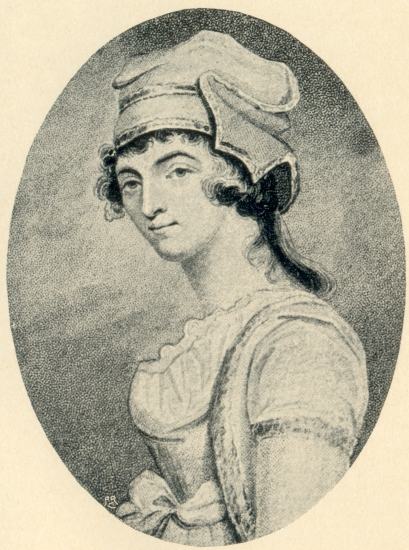
In the course of the year 1789, Mlle. Clairon found herself called up to face a rival influence. The eccentric and "infinitamente indiscreet,"[208] but charming and accomplished Elizabeth, Countess of Craven, descended upon Anspach. The countess had separated from her husband in 1780, since which she had spent the greater part of her time in wandering about the Continent. In the course of her travels, she had met the Margrave, whom she had known when she was a child, and who invited her to Anspach. She came, and her stay was a long one. She infused new life into that dull German Court; she organised a theatre in a disused coach-house, and wrote little plays for it; she had a garden laid out in the English style, under her direction, at the Margrave's palace of Triesdorf, near Anspach; she founded a little academy for the encouragement of literature and the arts, and found means to amuse even the unamusable Margravine. Finally, she stole away the heart of the Margrave from his grey-haired Egeria, and wrote to her husband, with whom she still corresponded, that she was to be "treated as a sister."
At length, Lady Craven left for Paris. Soon afterwards, the Margrave announced his intention of visiting the French capital; Mlle. Clairon decided to accompany him. In Paris, the Margrave favoured her with so little of his company that she felt constrained to inquire the reason.
The prince returned an evasive answer; Mlle. Clairon caused a watch to be kept upon his movements, and discovered the fatal truth. So long as the Margrave remained in Paris, the deceived sultana, by a great effort of will, succeeded "in concealing beneath a countenance always calm, and sometimes laughing, the rending tortures of mind and body." But when the prince returned to Anspach, she declined to follow him, and sent instead a long and reproachful letter, wherein she informed him that "his frenzied passion for a woman of whose character, unfortunately, he alone was ignorant, his indifference to public opinion, the license of his new morals, his want of respect for his age and his dignity, obliged her to see in him only one who had thrown aside all restraint and decency in compliance with the dictates of a depraved heart, or as one whose disordered intellect, while it excited pity, evinced also the necessity of restraint; that the veil was now lifted, and she knew herself never to have been anything but the hapless victim of his egotism and his divers caprices; and that, therefore, with infinite pain, she laid at his feet all the boons she had received from him, and bade him adieu ... adieu for ever."
And so ended the last romance of Mlle. Clairon, and the only souvenir of her seventeen years' residence at Anspach is a kind of fancy bread, which is called "Clairons Weck" unto this day.[209]
As for the faithless Margrave, he was too happy in the society of Lady Craven, who shortly afterwards took up her residence at Anspach, to care much what became of her predecessor in his affections; and so infatuated did he become with that lady that, on his wife's death in 1791, he married her. In the following year, the prince—in the face of an eloquent letter of remonstrance from Mlle. Clairon—sold his margravates of Anspach and Baireuth to the King of Prussia, and migrated, with his wife, to England, where he died in 1806. The Margravine survived her husband more than twenty years, and died, at Naples, in 1828.
In 1785, during one of the visits to Paris which she had paid in company with the Margrave, Mlle. Clairon had purchased a country-house at Issy, and it was here that she now took up her residence. She lived a very quiet life, receiving and visiting a few old friends, and occupying the rest of her time with collecting objects of natural history, which had always been one of her favourite occupations, and the writing of her Mémoires.
Madame Vigée Lebrun, the painter, who met Mlle. Clairon soon after her return to France, at the house of her former pupil, Larive, has left us the following impression of the famous tragédienne in her old age:—
"I had pictured to myself that she was very tall; and, on the contrary, she was very short and very thin; she held her head very erect, which gave her an air of dignity. I never heard any one speak with so much emphasis, for she retained her tragic tone and airs of a princess; but she gave me the impression of being clever and well informed. I sat beside her at table, and enjoyed much of her conversation. Larive showed her the greatest respect and attention."[210]
Early in the year 1792, Mlle. Clairon completed her Mémoires, which she entrusted to Henri Meister, the friend of Diderot and the Neckers, who was leaving Paris for Germany, on the condition, so she subsequently asserted, that they should not be given to the world until ten years after her death. One day, however, in 1798, she learned, to her astonishment, through an article in a Paris journal, that they had been published in Germany, whereupon she hurriedly brought out a French edition, bearing the title: Mémoires d'Hippolyte Clairon et Réflexions sur la déclamation théatrale.
These Mémoires, written in an absurdly solemn and grandiloquent style, even for the time, and "interspersed," says the admiring editor of the English edition, "with precepts of practical morality which would do honour to our greatest philosophers," reveal to us a very different Clairon from the Clairon of the police-reports and of the memoirs and correspondence of her contemporaries; but, unfortunately, there can be very little doubt which portrait comes nearer the truth. Partly, no doubt, for this reason, they had only a moderate success; and though several copies bear the words "Seconde édition" they were, as a matter of fact, not reprinted until 1822, when they appeared in the well-known Collection des Mémoires sur l'art dramatique. The most interesting part of the book, in our opinion, are the chapters which the actress devotes to reflections upon her art, some of which may still be read with profit by candidates for histrionic fame. But what aroused most attention at the time the work was published was the celebrated history of the lady's ghost—the spectre of a young Breton whom she had pitilessly left to die of love, and who had vowed on his death-bed to haunt her for the remainder of her life.
Never was there so persistent and vindictive an apparition—though the term apparition is perhaps a misnomer, as the shade of the departed never actually showed itself. It was perpetually visiting her at the most unexpected times and in the most unexpected places—at her petits soupers, while she was riding in her coach to shop in the Rue Saint-Honoré, and so forth. Sometimes its presence was announced by "a long-continued and piteous cry," which so terrified an elderly admirer who happened to be present on one occasion, that he "had to be conducted to his carriage more dead than alive";[211] sometimes by a loud report like that of a musket; at others by "a noise like the clapping of hands"; and finally, by "a celestial voice singing the most tender and pathetic airs."[212] No solution of these singular phenomena was ever forthcoming, though the assistance of the police was invoked in order to probe the mystery. But the most probable explanation is a little plot on the part of some friends of the young Breton to read the lady a much-needed lesson.
On her retirement from the stage, Mlle. Clairon had been in possession of a comfortable fortune, producing an income of some 18,000 livres; and though this had been considerably reduced by the financial jugglery of the Abbé Terrai, the loss had been subsequently repaired by the sale of her jewellery, art treasures, and natural history collection, which had realised 90,000 livres. In her old age, however, she fell into great poverty, though to attribute her financial losses to the Revolution—which swept away so many fortunes—as have several writers, would appear to be without justification, as on Fructidor 26, Year III., at a time when money was exceedingly scarce, we find her writing to a M. Pérignon, advocate, requesting him to find her a secure investment for a sum of 24,000 livres; while so late as October 9, 1801, when she made her will, she would appear, to judge by the various bequests she makes, to have been still in easy circumstances.[213]
On the other hand, there can be no question that between that date and her death, fifteen months later, she was reduced to great distress, as witness the following appeal addressed to Chaptal, the Minister of the Interior, and in response to which she received an order on the Treasury for 2000 livres:—
"CITIZEN MINISTER,—For a month past I have been vainly seeking a protector to bring me to your notice; but if it be true that you are of a generous disposition, it is to you alone that I should address myself. Seventy-nine years of age, almost in want of the necessaries of life, celebrated at one time by the possession of some talents, I wait at your door until you condescend to grant me a moment.
CLAIRON."[214]
In good truth, an object-lesson for the moralist to dilate upon! Clairon, the haughty, the incomparable Clairon, the idol of town and theatre; Clairon, to have met whom in society was the proudest boast of the braggart in Candide; Clairon, for whose smiles a King (according to Grimm) had sighed in vain, and a Serene Highness—not in vain; Clairon, whose classic features had been painted by Van Loo and sculptured by Lemoine; Clairon, in whose honour gold medals had been struck, and whose praises "bards sublime" had chanted—forced to beg her bread at the door of a Minister!
At the time when the above letter was written, the old actress had removed from Issy, and was living in the Rue de Lille with a Madame de la Rianderie,[215] the widow of an officer in the Gardes-Françaises. Here she was visited by Lemontey, who describes her as a little, withered old woman, feeble and sickly, but still retaining something of her majestic manner, and who spoke to him in a voice which had lost but little of its power and sweetness. Observing a little boy who had accompanied the historian, she motioned him to approach, saying: "Make that child come here. He will be very pleased to be able to say one day that he has seen and spoken to Mlle. Clairon."
Another of her visitors was the English actor John Kemble, to whom she recited a scene from Phèdre with a majesty and fire truly astonishing in one so old and frail.
Mlle. Clairon died on January 31, 1803, six days after completing her eightieth year.
Animated to the last by the pride which had dominated her whole life, Mlle. Clairon bequeathed to the nation her marble bust by Lemoine and the gold medal which Valbelle and Villepinte had caused to be struck in her honour; but, for some reason, these souvenirs were not accepted. The native town of the great actress showed itself less indifferent than the State, and placed a commemorative tablet on the house in which she had been born. In 1876, however, the house collapsed beneath the weight of years, and the tablet was buried under its ruins.[216]
The remains of Mlle. Clairon were interred in the cemetery of Vaugirard, where they remained until its suppression in April 1837, when, escorted by a deputation from the Comédie-Française, they were transferred to Père-Lachaise, and there re-interred, Samson pronouncing an éloge over the grave. In 1889, at the solicitation of M. Caille, an inhabitant of Condé, the sociétaires of the Comédie-Française decided that the tomb of the famous tragédienne should be completely restored, and voted for that purpose a sum of one thousand francs.
INDEX
A, B, C, D, E, F, G, H, I, J, K, L, M, N, O, P, Q, R, S, T, V, W, X, Z
A Actrice nouvelle, l', Poisson's, 151 Adrienne Lecouvreur, Scribe and Legouvé's, 129 and note, 182 note Aiguillon, Duc d', 163 Aiguillon, Duchesse, 319, 337 Aïssé, Mlle., 140, 180, 184 note, 186; (cited) 180-183, 188-190, 192 note Alexandre, Racine's, 26, 92 Allainval, Abbé d', 129; (cited) 134, 145, 199 Amours de Bastien et Bastienne, Justine Favart's performance in, 268 Amphitryon, Molière's, 49, 155 Andromaque, Racine's, 11 note, 93 Anne of Austria, Queen of France, 27 Anne Ivanovna, Duchess of Courland, 173, 174, 175 Anspach, Margrave of, his character and personal appearance, 340, 341; falls in love with Mlle. Clairon and invites her to Anspach, 341; "the sweetest and kindest of beings," 342; discards Mlle. Clairon for Lady Craven, 344-346 Anspach, Margravine of, 340, 341, 344, 345, 346. Antiochus et Cléopatre, Deschamps', 154 Argental, d', 164-168, 169, 193 note Ariane, Mlle. de Champmeslé's performance in, 99. Arles, Council of, excludes the actor from the Sacraments, 66, 67 Attila, Pierre Corneille's, 26, 97 note Aubry, Sebastian, 13 Augustus II., Elector of Saxony and King of Poland, 169, 170, 174, 176 Aunillon, Abbé, 179. Avare, Molière's, 78 B Bachaumont, (cited) 293 note, 328, 335 note, 337 note Bajazet, 98, 337. Balicourt, Mlle., 228 and note Barbier, (cited) 161, 213, 301 Barbier d'Aucour, 102 Bauffremont, Marquis de, 318 Baron, Michel, 56-58, 63, 75, 94, 147, 151, 152, 159 Bayle, 8, 41 Bazin, 9, 44 Beaumarchais, 325 Beaumenard, Mlle., mistress of Maurice de Saxe, 239, 243 note Beffara, 9, 15, 211 note Béjart, Armande, her marriage with Molière, 3; controversy concerning her parentage, 7-20; accompanies the Illustre Théâtre to the provinces, 20; her education, 21; her personal appearance, 22-25; her gifts as an actress, 25, 26; her début, 27; plays before the Court in the Impromptu de Versailles, 27; and during Les Plaisirs de l'Ile enchantée, 27-29; bears Molière a son, 27; her rendering of the part of Célimène in the Misanthrope, 29-31; other performances by her, 31, 32; her moral conduct considered, 32-40; charges brought against her in La Fameuse Comédienne, 40-48; temporarily separated from her husband, 48-54; her supposed liaison with Baron, 56-58; her platonic friendship with Pierre Corneille, 58, 59; birth of her second son, 60; endeavours to dissuade Molière from playing in the Malade imaginaire, 62; goes to find a priest to administer the last Sacraments to her husband, 63; her appeal to the Archbishop of Paris, 63, 64; her interview with Louis XIV. at Saint-Germain, 64; throws money among the crowd on the day of Molière's funeral, 71; causes a fire to be lighted on his grave, 72; conclusion as to her moral conduct, 72, 73; resumes her place in the company three days after her husband's death, 74 and note; secures the Théâtre Guénégaud, 77, 78; her adventure with Président Lescot, 79-82; libelled by Guichard, 82 and note; marries Guérin d'Estriché, 83, 84; her later years, 84, 85 Béjart, Bénigne Madeleine, 10, 19 Béjart, Geneviève, 7, 15 Béjart, Joseph pére, 3, 7, 9, 10 Béjart, Joseph fils, 4, 10, 15, 75 Béjart, Louis, 15 Béjart, Madeleine, her parentage, 34; becomes an actress, 4, 5; has a daughter by the Comte de Modène, 5, 6; commonly believed to be the mother of Armande Béjart, 7-10; and to have been the mistress of Molière, 11; hideous accusation of Montfleury, 11, 12; repeated by Guichard, Le Boulanger de Chalussay, and in La Fameuse Comédienne, 12-15; joins the Illustre Théâtre, 15; her talent as an actress and personal appearance, 16; question as to her relations with Molière considered, 17-20; promotes the marriage between Molière and Armande, 21, 22 Bellerose, 76 note Benoît (surgeon), his dispute with Dubois of the Comédie-Française, 328, 329 Bérénice, Racine's, 96, 97, 98 Bergheick, Comte de, lover of Mlle. Clairon, 281 Bernard, Samuel, 216 Bernhardt, Madame Sarah, 138 Berri, Duchesse de, 205 Berryer, Lieutenant of Police, 285, 304, 305, 306, 318 Besenval, Baron de, Mlle. Clairon's love-letters to him, 303 Bimorel, Madame de, 282, 283, 285 Blainville, expelled from the Comédie-Française, 329 Blondi, dancing-master, 206 Blot, 42 Boileau-Despréaux, 60, 71, 100, 103, 108, 109, 116; (cited) 102 Boileau-Puimorin, 60 Bossuet, denounces the plays of Molière, 70; his Maximes et réflexions sur la comédie, 119, 120 Botte de la Barondière, Père, insists on Brécourt renouncing the stage, 117 and note Bouillon (Louise Françoise de Lorraine), Duchesse de, enamoured of Maurice de Saxe, 179; her personal appearance, 179 note; accused by the Abbé Bouret of having engaged him to poison Adrienne Lecouvreur, 179-188; suspected of having caused the death of the actress, 188-190; consideration of this charge, 190, 191; discarded by the Comte de Clermont for Mlle. de Camargo, 213 Bouillon (Marie-Anne Mancini), Duchesse de, intrigues to ruin Racine's Phèdre, 103-105 Bourdaloue, Père, preaches against Tartuffe, 70; denounces the theatre, 120 Bouret, Abbé, accuses the Duchesse de Bouillon of having engaged him to poison Adrienne Lecouvreur, 179-184; sent to Saint-Lazare, 184; released, 184; rearrested, 185; persists in his accusation, 186; but finally recants, 187; set at liberty and disappears, 187 Bourgeois gentilhomme, Molière's, 23, 24, 97 note Bouteville, Duc de, 302 Bouty, Marie (mother of Mlle. de Champmeslé), 130 Boyer, Abbé, 92, 114, 115, 153 Brécourt, compelled by the curé of Saint-Sulpice to renounce his profession, 117 and note Breuze de la Martinière, 8 Brie, Mlle, de, joins the Illustre Théâtre, 17; becomes Molière's mistress, 17; resides in the Béjart's house, 48; resumes her intimacy with Molière, 55, 56; jealousy between her and Mlle. Molière, 73 Brizard, 330 Brossette, (cited) 17, 100 Brotok, Comte de, ruined by Mlle. Clairon, 303 By, Chevalier de, lover of Mlle. Clairon, 286 C Caffaro, Père, his Lettre d'un Théologien, in defence of the theatrical profession, 119, 120 Cahusac, (cited) 203 Calandrini, Madame, 180 Camargo, Marie-Anne de: see Cupis de Camargo Cartouche (brigand), 135 Cartouche, ou les voleurs, Le Grand's, 135 Casanova, (cited) 220 Castelnau, Marquis de, 265 Castil-Blaze, (cited) 200, 208 Champmeslé, Charles de: see Chevillet de Champmeslé Champmeslé, Marie de: see Chevillet de Champmeslé Chantilly, Mlle.: see Favart, Justine Chapelle, 42, 49-52, 53, 54, 71, 98 Chappuzeau, Samuel, (cited) 76 note, 77 Chardon, M. Henri, (cited) 4, 18, 19 Châteauroux, Duchesse de, 215, 289 Chevillet de Champmeslé, Charles, runs away from home to become an actor, 90, 91; marries Marie Desmares, 91; joins the Théâtre du Marais, 91; leaves it for the Hôtel de Bourgogne, 93; a complacent husband, 93; on the best of terms with his wife's admirers, 108; joins the Théâtre Guénégaud, 113; his Parisien, 113; singular incident connected with his death, 125, 126 Chevillet de Champmeslé, Marie, birth and parentage, 89; becomes an actress and makes her début at Rouen, 90; marries Charles de Champmeslé, 91; comes to Paris with her husband, 91; joins the Théâtre du Marais, 91; her first successes, 92; leaves the Marais for the Hôtel de Bourgogne, 93; her triumph as Hermione in Andromaque, 93; her gifts as an actress, 94, 95; her personal appearance, 95, 96; becomes the mistress of Racine, 96; her successes in Bérénice, 97; in Bajazet, 98; in Ariane, 99; in Mithridate, 99; in Iphigénie en Aulide, 100-102; in Phèdre, 106; her house "the rendezvous of all persons of distinction in both Court and town," 107; unfaithful to Racine, 107, 108; her relations with Charles de Sévigné, 108-110; liaison with the Comte de Clermont-Tonnerre, 111; discarded by Racine, 111; her impersonation of Queen Elizabeth in the Comte d'Essex, 113; joins the Théâtre Guénégaud, 113; one of the original sociétaires of the Comédie-Française, 113; secures her brother Nicolas's admission sans début, 114; later performances by her, 114-116; falls ill and retires from stage, 116; with difficulty induced to renounce her profession, 122; dies, 122; two letters of Racine on her death, 122, 123; her pupils, Mlles. Duclos and Charlotte Desmares, 123-125 Chevreuse, Duchesse de, 246, 247 Choiseul, Duc de, 327 Christian VII., King of Denmark, 337 Cindré, Marquis de, lover of Mlle. Clairon, 306 Circé, Thomas Corneille's, 78 Clairon, Mlle., her parentage, 276; her birth, 276, 277; comes with her mother to Paris, 277; her account of how she was led to become an actress, 278-281; makes her début at the Comédie-Italienne, 281; accepts an engagement at Rouen, 281; her life there, 282, 283; adventure with Gaillard de la Bataille, 283, 284; Histoire de Mademoiselle Cronel, dite Frétillon, 284, 285; her mother tries to coerce her into marriage, 285; "three rival warriors contending for her heart," 286; rejects the proposals of "my lord" Marlborough, 287; returns to Paris and joins the Opera, 287; leaves the Opera for the Comédie-Française, 288; her admission opposed by certain members of the troupe, 289; insists on making her début in the part of Phèdre, 289, 290; her brilliant success, 290, 291; her personal appearance, 291; her remarkable gifts as an actress, 293; testimony of Favart, 294; of Collé, 294, 295; of Hérault de Séchelles, 295; of Oliver Goldsmith, 295, 296; of Sturtz, 296-299; of Garrick, 299, 300; performances by her, 300, 301; her brilliant success as Aménaïde in Tancrède, 301; her lovers, 301-307; her liaison with Marmontel, 307-309; changes her style of acting, 309-313; brings about a reform in stage costume, 313-314; an indefatigable student of everything connected with her art, 314-316; continuing her career of gallantry, 317-318; conceives a genuine passion for the Comte de Valbelle, 318, 319; her social success, 319 and note; her portrait painted by Carle van Loo, 319 and note, 320; declines an offer to take up her residence at St. Petersburg, 320, 321; Garrick commissions an engraving of her "in all the attributes of Tragedy," 321; gold medal struck in her honour, 322; her pride and arrogance, 322, 323; has the interests of her profession sincerely at heart, 323, 324; endeavours to relieve the stage from the ban of the Church, 324; attacked by Fréron, in the Année littéraire, 324-328; l'affaire Dubois, 328-331; sent to For l'Évêque, 331, 332; her letter to Garrick, 332, 333; visits Voltaire at Ferney, 334, 335; enthusiastically acclaimed by the pit at Marseilles, 335; retires from the Comédie-Française, 335, 336; her life after her retirement, 336, 337; plays before the King of Denmark, 337, 338; and at Versailles, 338; her correspondence with her pupil Larive, 339, 340; accompanies the Margrave of Anspach to Germany, 341; her life at Anspach, 341-344; supplanted by Lady Craven in the affections of the Margrave, 344-346; takes up her residence at Issy, 346, 347; publication of her Mémoires, 347; her last years and death, 349-351; removal of her remains from Vaugirard to Père-Lachaise in 1837, 351, 352 Clavel, Adrienne Lecouvreur's letters to him, 142-145 Clement XI., Pope, declines to interfere between the Church and the theatrical profession, 121 note Clermont, Comte de, his character, 212; becomes the lover of Mlle. de Camargo, 213; can refuse her nothing, 214; insists on her quitting the stage, 214; appointed abbot of Saint-Germain-des-Prés, 215; installs Mlle. de Camargo at the Château de Berny, 215; discards her for Mlle. Le Duc, 216; presents his new enchantress with a magnificent equipage, 217, 218; makes Mlle. de Camargo an allowance, 220 Clermont-Tonnerre, Comte de, one of the admirers of Mlle. de Champmeslé, 107, 108, 111 Cochin, Charles Nicolas fils, his drawing of Justine Favart, 228 note Colbert, 17 note, 77 Collé, (cited) 152, 153, 216 and note, 252 note, 294, 295, 301, 314, 322 note Comédie-Française, its foundation, 113 Comte d'Essex, Thomas Corneille's, 153, 156 Conti, Prince de, 69 Coraline, Mlle., shocked at the conduct of Justine Favart, 256 Corneille, Pierre, 17, 26, 32 note, 58, 59, 96, 97 and note, 114, 131, 132, 266, 294 Corneille, Thomas, 78, 92, 112 Coulanges, Madame de, (cited) 99 Couvreur, Robert, father of Adrienne Lecouvreur, 130, 131 Couvrigny, Père de (chaplain to the Bastille), his letter to the Lieutenant of Police, 186 Coypel, Charles, his portrait of Adrienne Lecouvreur, 142-145 Crébillon père, 124, 145, 227, 294, 300, 321 and note Crébillon fils, 321 note Critique de l'École des femmes, Molière's, 27 Cupis de Camargo, Ferdinand Joseph de (father of Mlle. de Camargo), descended from "one of the noblest families in Rome," 199; gives his daughter lessons in dancing, 200; accompanies her to Rouen, 201; and to Paris, 202; exercises unsleeping vigilance over her, 208; his letter to Cardinal de Fleury after her elopement with the Comte de Melun, 209-211 Cupis de Camargo, Marie-Anne de, birth and parentage, 199, 200; her precocious talent, 200; sent to Paris to take lessons from Mlle. Prévost, 200; première danseuse at Brussels theatre, 201; goes to Rouen, 201; engaged at the Paris Opera, 201, 202; her triumphal début, 202 and note; her personal appearance, 202, 203; "abbreviates her skirts," 203, 204; triumphs over the intrigues of Mlle. Prévost and becomes queen of the Opera, 204-206; revolutionises the ballet, 206, 207; patronised by the Duchesse de Villars, 207; carried off by the Comte de Melun, 208-211; conceives "une belle passion" for the Marquis de Sourdis, 211, 212; becomes the mistress of the Comte de Clermont, 212-214; temporarily retires from the Opera, 214; does the honours of the Château de Berny, 215; discarded by the count for Mlle. Le Duc, 216; becomes the mistress of the Président de Rieux, 216, 217; receives a magnificent present, 217; breaks with the président and resumes her liaison with the Marquis de Sourdis, 218; returns to the Opera, 219; rivalry between her and Mlle. Sallé, 219; verses addressed to them by Voltaire, 219; makes her début as a singer, 220; definitely retires from the Opera, 220; her later years and death, 220, 221 Cupis de Camargo, Sophie de, 208, 209-211 D D——, Baron, lover of Adrienne Lecouvreur, 141 Dancourt, 135 Dangeville, Mlle., inspires Mlle. Clairon with a desire to become an actress, 278-280; finds it "impossible to live" with Mlle. Clairon, 323 Des Boulmiers, (cited) 171 Desheys introduces Mlle. Clairon to the Comédie-Italienne, 281 Deshoulières, Madame, intrigues against Racine, 103 Desmares, Charlotte, 114, 124, 125, 126 Desmares, Guillaume, father of Marie de Champmeslé, 89 Desmares, Marie: see Chevillet de Champmeslé, Marie Desmares, Nicolas, brother of Marie de Champmeslé, 89, 114, 126 Desmarets de Saint-Sorlin, 69 Desnoiresterres, Gustave, (cited) 229 note, 239, 240 note, 242 Des Œillets, Mlle., 93, 94, 98 Devineresse, La, 78 Diderot, 347 Don Garcie de Navarre, Molière's, 301 Don Juan, Molière's, 65, 78, 79 Donneau de Visé, 8, 27, 78, 79, 99 Dubois, Abbé, (cited) 106 Dubois (actor of the Comédie-Française), his dispute with the surgeon Benoît, 328; expelled from the Comédie, 329; temporarily reinstated, 329; Mlle. Clairon and four of her colleagues decline to act with him, 330; his partisans create a riot in the theatre, 330, 331; resigns his place, 334 Dubois, Mlle., 329, 330, 331 Duclos, Mlle., 123, 124, 125, 126 Du Deffand, Marquise, 319 Du Gué, Madame, invites Adrienne Lecouvreur to perform at her hôtel, 131-133 Du Maine, Duchesse, 158 Du Marsais, César, his "Bon, cela!" 148; gives Adrienne Lecouvreur lessons in elocution, 149 Dumas d'Aigueberre, (cited) 152, 153 Dumesnil, Marie Françoise, a worthy successor to Adrienne Lecouvreur, 275; her triumph in Mérope, 276; compared with Mlle. Clairon, 292, 293; preferred by Louis XV. to the latter, 338 Dumolard, (cited) 242 Du Parc, Mlle., rejects the advances of Molière, 17; and of Pierre Corneille, 58; confidante of Armande Béjart, 45; Racine "experiences with her a sentiment which has the dignity of love," 107 Duras, Duc de, 327, 335, 336 Duronceray, Justine: see Favart, Justine Duronceray, M. (father of Justine Favart), 228; a tool in the hands of Maurice de Saxe, 254-256, 258, 259, 261 Duronceray, Madame (mother of Justine Favart), 228 Du Rouvray, M., 283 E École des femmes, Molière's, 14, 33, 34 École des maris, Molière's, 33 Edwards, Mr. Sutherland, 43 note El Desden con el Desden, Moreto's, 28 Électre, Crébillon's, 145, 312 Électre, Longpierre's, 33 Électre, Voltaire's, 322 Elizabeth Petrovna, Czarina of Russia, wooed by Maurice de Saxe, 173-175; invites Mlle. Clairon to St. Petersburg, 320 Élomire hypocondre, Le Boulanger de Chalussay's, 13, 14 Elzevirs, the, print an edition of Élomire hypocondre, 14 Épinay, Madame d', 315 Eugène of Savoy, 135, 169 F Fameuse Comédienne, La, libel on Armande Béjart, 15, 21, 22, 25, 40-54, 56, 72, 73, 82, 84 Fausse Prude, La, 121 note Favart, Charles Nicolas Joseph, 272 Favart, Charles Paul, 225 and note Favart, Charles Simon, his early life, 225, 226; produces La Chercheuse d'esprit, 227; director of the Opéra-Comique, 227; engages Justine Duronceray, 228; marries her, 229; invited by Maurice de Saxe to accompany him to Flanders, 231; celebrates the Marshal's entry into Brussels, 233; his adventures in Flanders, 234, 235; announces in verse Maurice's intention to give battle, 237, 238; his account of the battle of Lawfeld, 244, 245; learns of his wife's misconduct with the Marshal, 245; takes her to Brussels, 246; his letter to her, 247; prosecuted by the proprietors of the Brussels theatre, at the instigation of the Marshal, 249; returns to Paris and persuades Justine to leave Maurice, 251; flies to Strasburg, 251; Justine's letter to him, 253, 254; refuses money offered him by the Marshal, 259; reduced to terrible straits, 265; returns to Paris, 265; his verses upon the death of Maurice de Saxe, 266; regards love as "the greatest of all evils," 267; tolerates his wife's liaison with the Abbé de Voisenon, 267; his later works, 267-272; his admiration for Mlle. Clairon's acting, 294 Favart, Justine, her parentage, 228; engaged at the Opéra-Comique, 228; makes her début, 229; her marriage with Favart, 229 and note, 230; her success in Les Vendanges de Tempé, 230; accompanies her husband to Flanders, 232; the object of a violent passion on the part of Maurice de Saxe, 239, 240; "possessed by the demon of conjugal love," 240; Maurice's letter to her, 240, 241; yields to the importunities of the Marshal, 242, 243 and note; refuses to continue the liaison, 244; confesses her misconduct to her husband, 245, 246; flies to Brussels, 246; Favart's letter to her, 247; continues her flight to Paris, 248; persuaded to resume her intimacy with the Marshal, 249, 250; again leaves him and declares that "her salvation is dearer to her than all the fortunes in the world," 250; her successful début at the Comédie-Italienne, 252; her letter to her husband in hiding at Strasburg, 253; her father a tool in the hands of Maurice de Saxe, 254-255; lettre de cachet issued against her, 255; leaves Paris to join her husband, 256; arrested, at the instigation of Maurice, and taken to Les Grands-Andelys, 257; her correspondence with her husband and Maurice de Saxe, 257-259; removed to a convent at Angers, 259; further correspondence with the Marshal, 259-262; exhorted by Mlle. Fleury to "become reasonable," 263; and by her sister-in-law, Marguerite Favart, to remain inflexible, 264, 265; terrified into submission to the Marshal, and is released, 265; returns to Paris, 265; her relations with the Abbé de Voisenon, 267; reappears at the Comédie-Italienne, 267; her extraordinary versatility, 268; strenuous for a reform in stage costume, 268; performances by her, 268-270; retires from the stage, 270; her last illness and death, 271 Femmes savantes, Molière's, 32 Fénelon, denounces the theatre, 120 Ferriol, Madame de, Adrienne Lecouvreur's letter to, 165-167, 169 Fête de Vénus, Marie de Champmeslé's appearance in, 92 Fils ingrats, Piron's, 155 Fléchier, denounces the theatre, 120 Flemming, Count, intrigues against Maurice de Saxe, 170, 176 Florentin, Le, Adrienne Lecouvreur's performances in, 155, 189 Floridor, 11; refused ecclesiastical burial, 70 Florimont, 55 Folleville, Président de, his affray with the Marquis de Cony, 282 Fonpré, Mlle., engages Adrienne Lecouvreur to play at Lille, 136 Fontaine, his portrait of Adrienne Lecouvreur, 137-139 Forcalquier, Madame de, 319 Fouché, Paul, (cited) 89 Fournier, Edouard, 9 Fréron, his attack upon Mlle. Clairon, 324-338 Fronsac, Duc de, lover of Mlle. Dubois, 329; interferes on behalf of her father, 329 G Gaboriau, Emile, (cited) 37, 43 note, 203, 206, 215 Gaillard de la Bataille, his adventure with Mlle. Clairon, 283, 284; his libel upon her, 284, 285 Galitzin, Princess, 319, 320 Garrick, Sturtz's letter to him, 296-299; his opinion of Mlle. Clairon's acting, 299; commissions Gravelot to engrave a design in honour of Mlle. Clairon, 321; her letter to him, 333; offers her a loan, 334 note Gaultier-Garguille, 4 and note Gaussin, Jeanne, 275, 292, 306 note Gautier, Mlle., 281, 285 Geoffroy (chemist), his report on the suspicious lozenges given to the Abbé Bouret, 184 note George Dandin, Molière's, 33, 35-37, 145 Gesvres, Duc de, 158, 289 Gesvres, Duchesse de, 158 Goldsmith, Oliver, (cited) 295, 296 Goncourt, Edmond de, 298 note, 318 Gozlan, M. Léon, (cited) 236, 240 Grandval, 180 note, 195, 280 Grimarest, (cited) 21, 43 note, 36, 53, 62 note Grimm, (cited) 203, 204, 247, 315 Gros-Guillaume, 4 and note Guénégaud, Théâtre, 76 and note, 77, 78, 79 Guérin d'Estriché, marries the widow of Molière, 83-85 Gueullette, M., (cited) 111 Guichard, attempts to poison Lulli, 12, 13; repeats the accusation of Montfleury against Molière, 13; accuses Mlle. Molière of immorality, 82 and note Guiche, Comte de, his supposed relations with Mlle. Molière, 45 and note, 46, 47, 51, 57 Guise, Duc de, 100 H Hardouin de Péréfixe, Archbishop of Paris, issues an order against Tartuffe, 70 Harlay de Chanvalon, Archbishop of Paris, his conduct in regard to the funeral of Molière, 63, 64, 65, 68 Hawkins, Mr. Frederick, (cited) 292 Henley, Mr. W. E., (cited) 37 Henrietta of England, Duchesse d'Orléans, 12, 27, 96, 97 Hérault (Lieutenant of Police), his conduct in l'affaire Bouret, 181, 182, 184 note, 187 Hermite, Jean Baptiste de l', 19 Hermite, Tristan de l', 19 Hervé, Marie (mother of the Béjarts), 1, 7-10, 20 Histoire de Mademoiselle Cronel, dite Frétillon, libel on Mlle. Clairon, 284, 285 Holstein, Princess of, 240 note, 242 Hôtel de Bourgogne, its amalgamation with the Théâtre Guénégaud, 84 Hugues de Giversac, d', admirer of Mlle. Clairon, 304 I Impromptu de l'hôtel de Condé, l', 11 Impromptu de Versailles, Molière's, 11, 27, 33, 34, 35 Innocent XII., Pope, 121 note Iphigénie en Aulide, Racine's, 100-102, 116 J Jal, Auguste, (cited) 8 note Journal de Police, (cited) 217, 218 Judith, Boyer's, 114-116 K Kemble, John, 351 Klinglin, Comte François de, his liaison with Adrienne Lecouvreur, 144, 145 Königsmark, Aurora von (mother of Maurice de Saxe), 169, 170, 174 L La Chalotais, Marquis de, 158, 163, 164, 168 La Fare, Marquis de, 107 La Fayette, Madame de, 103 La Fontaine, 16, 17 and note, 96, 107; (cited) 95, 106 La Grange, Charles: see Varlet de la Grange La Grange-Chancel, 116 La Guérault, Antoine, 89 La Harpe, 324, 325 La Janière, his reports to the Lieutenant of Police on Mlle. Clairon, 285, 286, 287, 301, 303 Lambert, Marquise de, 158, 160 La Morlière, 313 note La Motte, Mlle., 251, 252 Lancret, his portraits of Mlle. de Camargo, 221 Lang, Mr. Andrew, (cited) 10 Languet de Gergy (curé of Saint-Sulpice), his conduct in regard to the burial of Adrienne Lecouvreur, 192, 194 La Noue, 281, 285, 286, 289 La Paute, 101 note La Popelinière, 287, 302 Laporte, Abbé de, (cited) 93, 94 Larive, 339, 340, 342, 343, 347 Laroque, 93 Larroumet, M. Gustave, 129; (cited) 4, 15, 18, 19, 22, 29, 43, 44, 48, 49, 54, 62 note, 81, 111, 122, 123, 136, 138, 143, 157, 190 La Thorillière, 97 Lauraguais, Duc de, 289 Lauzun, Comte (afterwards Duc) de, his supposed liaison with Mlle. Molière, 45-47 Lawfeld, Battle of, 244, 245 Le Boulanger de Chalussay, his Élomire hypocondre, 13, 14 Le Brun, Père, denounces the theatre, 120 note Lecouvreur, Adrienne, her attraction for French writers, 129; her birth and parentage, 130; comes to Paris, 130; takes part in a performance, by children, at the hôtel of Madame du Gué, 131-133; and at the Temple, 133, 134; receives lessons from the actor Le Grand, 135, 136; accepts an engagement at Lille, 136; her career as a provincial actress, 136, 137; her portrait by Charles Coypel and Fontaine, 137-139; her beauty attested by her contemporaries, 139, 140; possesses a very susceptible nature, 140, 141; her early love affairs, 141, 142; her letters to the actor Clavel, 142-144; her liaison with the Comte de Klinglin, 144, 145; her children, 145; her brilliant début at the Comédie-Française, 145; her natural style of elocution the principal cause of her success, 146-148; her debt to César du Marsais, 148, 149; bitterly opposed by the champions of the old school of declamation, 149-151; her triumph assured by the support of Baron, 151, 152; her wonderful by-play, 152; contemporary criticisms of her acting, 152, 153; her faults as an actress, 153; her principal rôles in tragedy, 152, 153; quarrel between Voltaire and the Chevalier de Rohan in her dressing-room, 154, 155; does not excel in comedy, 155; her costumes, 155-157; her unique social position, 157-159; complains of the burden of her social duties, 159, 160; her favourite occupations, 160, 161; her reputed lovers, 161; her relations with Voltaire, 161, 162; resolved to abjure la vie passionnelle, 162, 163; rejects the advances of La Chalotais, 163, 164; the object of a violent passion on the part of d'Argental, 164, 165; her letter to his mother, Madame de Ferriol, 165-168; becomes the mistress of Maurice de Saxe, 171; secret of her devotion to him, 172; disposes of her jewels to assist him in his candidature for the throne of Courland, 175; unjustly accused by him of infidelity, 177; charge against the Duchesse de Bouillon of having attempted to poison her, 179-188; her last appearance on the stage, 188-190; her death, 190; the question of poison considered, 190, 191; the scandal of her burial, 191-195; her éloge written by Voltaire, 195, 196 Le Duc, Mlle., supplants Mlle, de Camargo in the affections of the Comte de Clermont, 216-218 Ledoux, plays a trick upon Président Lescot, 80-82 Le Grand, 134, 135 and note, 193 note Le Kain, 156, 292, 313 and note, 330, 336 note Lemaure, Mlle., 199 Lemontey, 129; (cited) 162, 172, 173 Lenclos, Ninon de, 108-111 Le Roy, Philippe, lover of Adrienne Lecouvreur, 141, 142 Lerys, François Joseph, father of Mlle. Clairon, 276 Le Sage, (cited) 115 Lescot, Président, his adventure with Mlle. Molière, 78-82 Loiseleur, M. Jules, 57; (cited) 9, 10, 15 Loret, 16 Loo, Jean Baptiste van, 137 Loo, Carle van, 300; his portrait of Mlle. Clairon, 319 note, 350 Louis XIII., 6, 19 Louis XIV., 12, 27, 64, 84, 114, 206 Louis XV., 338 Louis XVI., 325 note Löwendal, Maréchal, 231, 247, 265 Lulli, 12, 13, 75, 82 Luxembourg, Duc de, 302 M Machabées, Le Motte's, 123 Maintenon, Madame de, 121 note Malade imaginaire, Molière's, 32, 61-63, 71 Mariage forcé, Molière's, 29, 33, 35 Mariamne, Voltaire's, 154 Marie Leczinska, Queen of France, 154, 326 Mariette (danseuse), 204 Marlborough, Charles Spencer, Duke of, his propositions rejected by Mlle. Clairon, 287 and note Markheim, Mr. Gegg, (cited) 53, 54 Marmontel, 269; his relations with Mlle. Clairon, 307-313; assists in her apotheosis of Voltaire, 335; (cited) 243 note, 293 note, 336 Mars, Mlle., 30 Massillon, denounces the theatre, 120 Maugras, M. Gaston, (cited) 120 Maurepas, Comte de, 192 Maximes et refléxions sur la comédie, Bossuet's, 119 Mazarin, Cardinal, 68 Médecin malgré lui, Molière's, 29, 49 Médée, Longpierre's, 116, 300 Meister, Henri, 347 Mélicerte, Molière's, 49, 56, 85 Melun, Comte de, carries off Mlle. de Camargo, 208-211 Mercure de France, (cited) 24, 148, 152, 153, 155, 288, 301 Mercure galant, (cited) 25 Merlin, Père (curé of Saint-Sulpice), refuses ecclesiastical burial to Molière, 63, 68 Meusnier (police-inspector), 229, 255-256, 257; (cited) 214, 242, 253, 254, 265 Michelet, 139; (cited) 137, 138 Mignard, Pierre (painter), 53, 60 Misanthrope, Molière's, 29, 31, 33, 37-39, 53, 54, 55, 78 Mithridate, Racine's, 99, 100 Modène, Comte de, 5, 6, 7, 9, 18 Modène, Comtesse de, 5 and note, 9 Molé, 292, 330, 337 and note Molière, his marriage with Armande Béjart, 3; abominable charge brought against him by Montfleury père, 11, 12; the accusation repeated by Guichard in Élomire hypocondre and in La Fameuse Comédienne, 12-15; question of his relations with Madeleine Béjart considered, 15-20; becomes the lover of Mlle. de Brie, 17; allusions to his relations with his wife in his plays, 33-40; his jealousy, 40; separated from his wife, 48; supposed conversation with Chapelle at Auteuil, 49-55; resumes his liaison with Mlle. de Brie, 55; but still adores his wife, 55; reconciled to her, 55, 56; goes to reside in the Rue de Richelieu, 60; his health failing, 60, 61; insists on playing in Malade imaginaire, 62; his death, 62, 63; refused ecclesiastical burial, 63; compromise made, 64; effect of his Tartuffe upon the attitude of the Church to the theatre, 69, 70; his funeral, 70-72; not entirely blameless for his domestic unhappiness, 73, 74; his genius not fully appreciated by his contemporaries, 83 Molière, Madeleine, 85 Molière, Mlle.: see Béjart, Armande Monaco, Princesse de, 100 Montalant, M. de, marries Madeleine Molière, 85 Montausier, Duc de, 38 Montespan, Madame de, 105, 106, 212 Montfleury, père, his abominable charge against Molière, 11, 12, 13, 15, 18, 19, 40 Montfleury, fils, 11, 40 Monval, M. Georges, 130, 132, 163; (cited) 139, 193 and note Mort de Pompée, La, 156 Mounet-Sully, M., 138 Myesses, the Demoiselles, prosecute Favart, 249, 251 N Nantes, Mlle. de, 212 Navarre, Mlle. (mistress of Maurice de Saxe), 243 note, 307, 308 Necker, Madame, (cited) 270 Nicole, Père, denounces the theatre, 69 Noury, M., (cited) 90, 113 O Œdipe, Voltaire's, 189 Oligny, Mlle. d', 325 and note, 326 Orléans, Gaston, Duc d', 6 Orléans, Duchesse d' (Princess Palatine), 125, 213 Orléans, Regent d', 125, 213 Orphelin de la Chine, Voltaire's, 294, 295, 300, 314 P Paléologue, M. Maurice, (cited) 139, 140, 171, 172 Parabère, Comtesse de, 189 and note Parfaict, Brothers, 72; (cited) 25, 95, 111 Parisien, Charles de Champmeslé's, 84, 85, 113 Parmentier, 231, 235, 239 Peterborough, Earl of, 161 Peter the Great, Czar of Russia, 145 Phèdre, Pradon's, 103-105 Phèdre et Hippolyte, Racine's, 102-106, 112, 290, 291, 351 Piron, 158 Poisson, Mlle., (cited) 24, 25 Poisson, Philippe, satirises Adrienne Lecouvreur in l'Actresse nouvelle, 151 Polyeucte, Pierre Corneille's, 135, 136 Pompadour, Madame de, 214, 322 Pont-de-Veyle, Marquis de, 158 Préault (sculptor), 138 Préville, 292 Prévost, Mlle, (danseuse), gives lessons to Mlle. de Camargo, 200; intrigues against her, 202, 204; supplanted by her in the affections of the public, 204-206 Princesse d' Élide, Molière's, 28, 29, 45, 46 Prungent (intendant of the Duchess of Brunswick), 161 Psyché, 32 and note, 56, 57, 59, 60 Q Quinault, Jean Baptiste, 135 Quinaults, the, 150 and note Quinault-Dufresne, 180 note R Rachel, Mlle., 30, 129, 156 Racine, Jean, enraptured at Marie de Champmeslé's rendering of Hermione, 94; gives her lessons in elocution, 94, 95; makes her his mistress, 95; his dramatic duel with Pierre Corneille, 96-98; his Bajazet, 98; his Mithridate, 99; his Iphigénie en Aulide, 100-102; writes his Phèdre, 102, 103; the Duchesse de Bouillon and Madame Deshoulières persuade Pradon to enter the lists against him, 103; production of the two Phèdres, 104; discreditable tactics of Madame de Bouillon to ruin his play, 104, 105; he eventually triumphs, 105; character of his intimacy with Marie de Champmeslé, 107, 108; breaks off the connection, 111; probable reasons for his withdrawal from dramatic authorship, 111, 112 and note; his letter to his son, Louis Racine, on Mlle. de Champmeslé's death, 122, 123 Racine, Louis, 112 note, 122, 123; (cited) 94, 96 Régnier, 129; (cited) 138, 148, 150 Revel, Comte de, 107 Riccoboni, (cited) 147 Riccoboni, Madame, (cited) 338 Richelieu, Abbé de, his supposed liaison with Mlle. Molière, 44, 45, 46 Richelieu, Cardinal de, 58, 266 Richelieu, Duc de, 211, 329, 334, 336 Rieux, Président de, 216, 217, 218 Robinet, (cited) 29, 31, 60 Rohault (physician), 53 Rohan, Cardinal de, 82 Rohan, Chevalier de, his quarrel with Voltaire, 154, 155 Rotrou, Jean, 16 Roucoux, Battle of, 238 Roullé, Père, denounces Molière, 70 S Sainte-Beuve, 129, 179; (cited) 146, 190, 242 Saint-René Taillandier, M. de, (cited) 242, 266 note Saint-Marc (police-inspector), his reports to Berryer, 304-306 Sallé, Mlle., 219 Samson, 351 Saxe, Maurice, Maréchal de, his early life, 169, 170; comes to Paris, 170; his character, 170; becomes the lover of Adrienne Lecouvreur, 171, 172; her beneficial influence over him, 173; his candidature for the throne of Courland, 173-176; returns to Paris, 176, 177; unjustly accuses Adrienne Lecouvreur of infidelity, 177, 178; the object of an unrequited passion on the part of the Duchesse de Bouillon, 179, 180; present at Adrienne Lecouvreur's death, 191; unable to prevent the indignity offered to her remains, 194; invites Favart to accompany him to Flanders, 231; his entry into Brussels, 232-234; orders Favart to announce from the stage his intention to engage the enemy, 236-238; wins the Battle of Roucoux, 238; conceives a violent passion for Justine Favart, 240; his letter to her, 240, 241; steals Voltaire's verses, 241 and note; makes Justine his mistress, 242, 243 and note; discarded by her, 244; wins the Battle of Lawfeld, 244, 245; determined to recover his prey, 245; furious at Justine's escape, 247, 248; instigates the proprietors of the Brussels Theatre to prosecute Favart, 249; compels Justine to return to him, but loses her again, 250, 251; continues his persecution of her husband, 251, 252; persuades Justine's father to apply for a lettre de cachet against her, 254; causes her to be arrested and conveyed to Les Grands-Andelys, 257; his correspondence with her, 258-262; compels her to submit to him, 264, 265; his death, 266 and note; Marmontel's liberties with his seraglio, 307 Scanapiecq, Marie (mother of Mlle. Clairon), 276-281, 282, 284, 285 Schlegel, August Wilhelm von, (cited) 39, 135 Seine, Mlle., de, 150 Sévigné, Madame de, (cited) 59, 96, 98, 99, 108, 109, 110 Sévigné, Charles de, 107, 108-111 Sicilien, Molière's, 49 Siège de Calais, De Belloy's, 300, 328-331, 335 Soubise, Prince de, 302 Soulié, Eudore, 9, 15 Sourdis, Marquis de, 211, 212, 218 Sturtz, his letter to Garrick on Mlle. Clairon, 296-299 T Tallemant des Réaux, 16 Tancrède, Voltaire's, 301 Tartuffe, Molière's, 29, 65, 70, 155 Taschereau, M., 43 note Théâtre du Marais, its amalgamation with Molière's troupe, 77, 78 Thiériot, 161 Titon du Tillet, (cited) 72, 158 Tourelle (courtesan), personates Mlle. Molière, 80-81 Tribou (singer), 180 note Turlupin, 4 and note V Valbelle d'Oraison, Comte de, amant de cœur of Mlle. Clairon, 318, 319; offers to make her his wife and accompany her to Russia, 320; has a gold medal struck in her honour, 320; quarrels with her, 341 Varlet de la Grange, Charles, 73, 75, 76 and note, 78 Vestris, Madame, 171 note Vigée Lebrun, Madame, (cited) 347 Villars, Duchesse de, patronises Mlle. de Camargo, 207 Villeguillon, M. de, 317 Villepinte, M. de, 322, 351 Villeroi, Duchesse de, 332, 337 Voisenon, Abbé de, his relations with Justine Favart, 267; his bon mot at the first representation of Les Amours de Bastien et Bastienne, 268; overcomes Justine's unwillingness to renounce the theatre, 271; (cited) 265 Voltaire, production of his Mariamne, 154; his quarrel with the Chevalier de Rohan, 154, 155; indebted to Adrienne Lecouvreur for the favourable reception of his l'Indiscret, 155; his relations with Adrienne Lecouvreur, 161, 162; present at her death, 191; demands that an autopsy should be held, 191; refuses to believe that she was poisoned, 192 note; endeavours to bring about a revolt at the Comédie-Française, 195; his poem upon Adrienne's death, 195; writes her éloge, 195, 196; his verses to Mlles. Camargo and Sallé, 275; his Orphelin de la Chine, 294 and 314 and note; triumph of Mlle. Dumesnil in his Mérope, 176; success of his Tancrède, 301; his admiration of Mlle. Clairon's acting, 312; visited by Mlle. Clairon at Ferny, 334, 335; apotheosised by her and Marmontel, 335 note W Walpole, Horace, (cited) 336, 344 Würtemberg, Prince of, sups with Mlle. Gaussin, 306 note X Ximenès, Marquis de, lover of Mlle. Clairon, 317; his love killed by a bon mot, 317; his retort, 318 Z Zaïre, Voltaire's, Mlle. Gaussin's acting in, 275