WHEELS OF VARIOUS DEVICES, HORIZONTAL AND VERTICAL.
Reading edition
44. You will do well to remember that the remarks that I have already made, under other heads, concerning device are especially applicable to the subject of wheels. I am not giving you designs to lead you to suppose that this or that is the way of accomplishing any one object. There is no limit to the methods by which you may work out any plan, and this you will discover by degrees, as your knowledge of the art of pyrotechny grows riper, and your hands become more dexterous, and your manipulation consequently more easy.
94But in the outset of our subject, let me advise you not to attempt to make catherine-wheels—that is, those small spiral wheels which are made by the professionals to sell on the Fifth of November, and seem to be intended for little girls to fire. You have nothing to do with such pieces as these. Your object is to provide an exhibition, and you will find it worth your while to bear in mind that the fireworks made by professionals are of two kinds—those made for their retail business, which consists for the most part of small single pieces, and which are papered up very neatly for sale, and those which they prepare for their large exhibitions, and which are in many instances made in an entirely different way from the former. Catherine-wheels cannot, as far as I can see, be employed in combination, and on this account they can form no part of our present work. I am very ready to allow that, when properly made, they are very pretty little things, but, not being available for our immediate purpose, they must be passed over here. In case, however, any one of my readers may happen to be so prejudiced in their favour that he cannot consider his exhibition perfect without them, I may as well say that he can procure them of Mr. Darby quite as economically as he can make them himself, for the rolling and the filling of their cases involves an expenditure of time and the acquisition of a certain “knack,” which, when we consider that the wheel will only do one thing after all, seems like a wilful waste of such perseverance as might be directed much more profitably to some worthier object.
Now, the wheels of which I am about to treat are such as are made by tying on choked cases, filled with a strong composition, to frames of various forms, in such a manner that the recoil of the case during combustion shall have the effect of driving the wheel. The preparation of the composition for this purpose, and the making and filling the cases 95are exceedingly simple: and, in fact, the only part of wheel-making which requires any degree of nicety is the preparation of the woodwork; for, unless the framework of the wheel be tolerably well balanced, and made to run easily and smoothly on its axis, much of the intended effect of your piece will be lost.
But we had better begin with the cases and compositions, and then proceed to consider the various modes of combination in which they can be employed.
The cases that I use for wheel purposes are of two sizes only—the 2-oz. and the 1-oz. size; and of these two sizes, the one far most commonly useful is the 1-oz. Cases of the 2-oz. size are necessary only for large wheels, where a considerable weight of material has to be set in motion. I make both these sizes of cases of the same length—that is, about 5½ inches long.
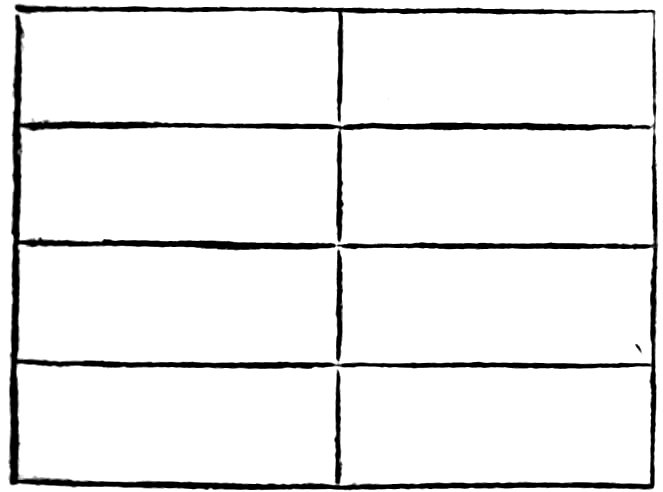
Fig. 56.
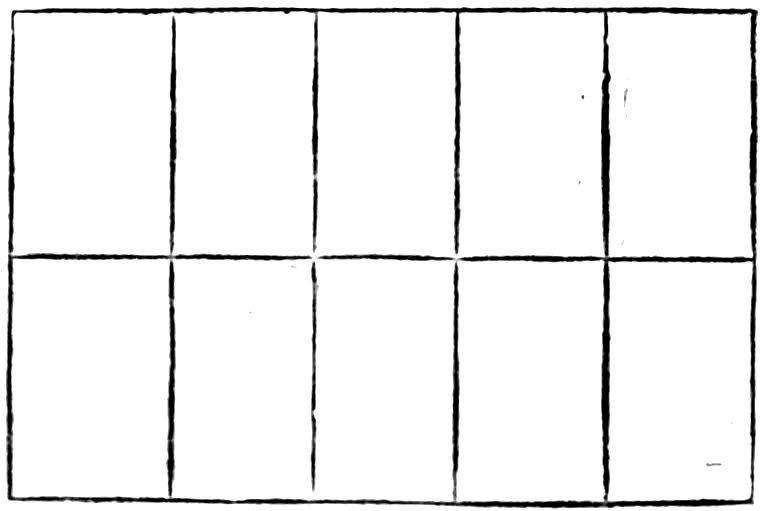
Fig. 57.
The paper for the 2-oz. wheel-cases is to be cut as follows:—Divide each sheet of 70-lb. brown paper into eight equal pieces (see fig. 56), and then divide each sheet of imperial board into ten equal strips. Then proceed to make your cases, pasting and rolling them in precisely the same manner as previously directed, taking especial care that the inner fold of the paper, which lies next the former, is thoroughly saturated with paste, so that it is not loose when 96the former is drawn out of the case. If this inner edge be left loose, the composition will get behind it, and, upon firing the case, will act as a quick-match, and infallibly burst the whole, and destroy your piece, and not only your piece of pyrotechny, but also your peace of mind; so do not fail to remember this hint.
Your 1-oz. cases for wheels must be made in the same manner, and with the same care. But your imperial board must be cut differently. Cut your 70-lb. paper in the same manner as directed above for 2-oz. cases—into eight equal strips—and your board into pieces of half that size—that is, into sixteen pieces. These divisions will give you cases quite thick enough for all purposes. Of course, each case is to consist of one piece of board and one strip of paper.
You will require no more tools for the filling of these cases than those already mentioned. The operations of choking and ramming are to be performed in the same manner as directed for cases of brilliant and Chinese fire, and the same blocks and nipples are to be employed.
We now come to the compositions with which the cases are to be filled. For these I give you several formulæ, in order that you may be able to vary your fires according to taste.
No. 1.
Meal-powder 16 parts.
Steel filings 4 „
This is the brilliant composition given in paragraph 41, which is used also for wheels with excellent effect.
WHITE FIRE.
No. 2.
Meal-powder 16 parts.
Sulphur 3 „
97Or,
No. 3.
Meal-powder 16 parts.
Nitre 4 „
Sulphur 2 „
Charcoal (No. 2) 2 „
Or,
No. 4.
Meal-powder 20 „
Charcoal (No. 2) 4 „
Or,
No. 5.
Meal-powder 16 „
Fine litharge 3 „
Or,
No. 6.
Meal-powder 40 „
Nitre 20 „
Sulphur 4 „
Charcoal 3 „
Bright steel filings 6 „
Litharge 2 „
Or,
No. 7.
Meal-powder 16 „
Nitre 2 „
Sulphur 2 „
Charcoal (No. 2) 2 „
Glass dust 2 „
Of the above compositions, Nos. 1, 2, and 4 will be found the most generally useful; and of these I prefer No. 4 for all ordinary purposes.
Remember that the compositions for wheel-cases are by far 98the strongest that are used in the whole range of pyrotechny, and that they must on that account be compressed very evenly and completely in the cases, or they will burn too rapidly, and explode when ignited.
You will find it very advisable to ram a small quantity of the preparatory composition, recommended in paragraph 40, into the cases before putting in the wheel-case composition which you have selected. The cases should be filled till the composition rises to about half-an-inch from their ends—that is, half-an-inch at the end of the case should be left unoccupied by the composition. They should be primed with wetted meal-powder as soon after they are filled as convenient, care being taken that the space which the point of the nipple occupied during the operation of ramming is filled up by the priming.

Fig. 58.
When the filling and priming of all your cases is accomplished, you will next have to cover them with paper which shall project about an inch beyond each end of the case. The object of this is to enable you to tie in the quick-match which is to connect one case with another. This operation is very easily performed. Cut some ordinary newspaper into strips wide enough to project an inch over each end of your case—that is, about eight inches wide—and long enough to go two or three times round the case. It will not be necessary to paste the newspaper strips all over. If they are pasted slightly at each end it will be quite enough. The paste at one end of the strip will stick it to the case, and that at the other end will fasten it down so as to prevent it from coming unrolled. The annexed sketch (fig. 58) will show you how the case ought to be covered.
99
COMMON SINGLE TRIANGLE WHEEL.
45. Now, the first form of wheel of which I shall speak is that usually known by the name of the “Common Single Triangle Wheel.” Its manufacture is very simple. Provide a piece of light beech wood, of hexagonal form, each of whose sides is two inches in length (fig. 59).
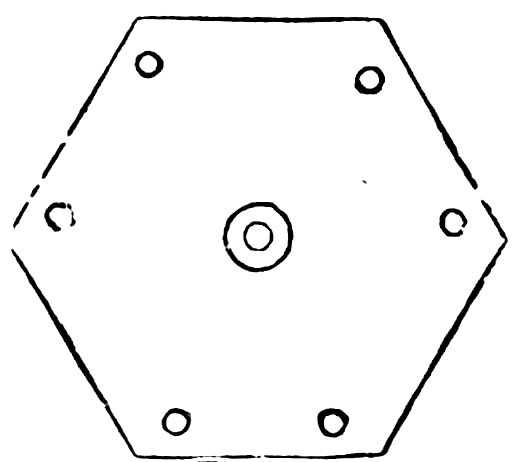
Fig. 59.
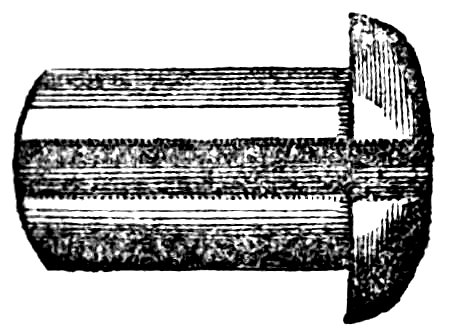
Fig. 60.
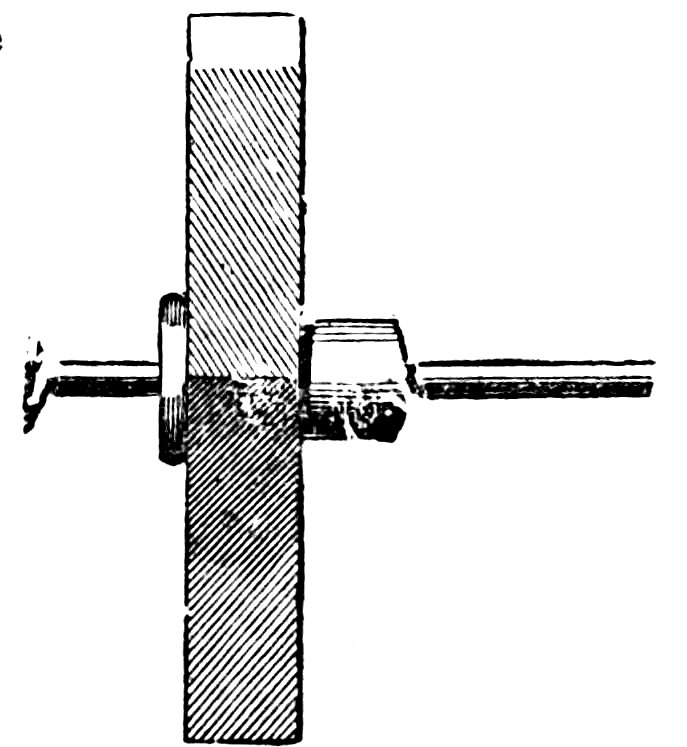
Fig. 61.
This hexagonal piece of wood may be about half-an-inch thick. Then bore through its true centre a hole about three-quarters of an inch in diameter, into which glue firmly a piece of wood turned or cut to the shape given in the drawing (fig. 60). Through this piece bore, in its exact centre, a hole about a quarter of an inch in diameter, and, when bored, burn it through with a piece of quarter inch iron rod, red hot. This is the hole through which the spindle is to pass which is to form the axle of the wheel. When the operation is finished, the side view of your framework will be like the accompanying sketch (fig. 61). The object of this centre is twofold; first, to obtain a greater steadiness in the motion of the wheel, by increasing the length of the hole through which the spindle runs; and, secondly, to keep the wheel, during its revolutions, from touching against the post into which the spindle is driven—a 100precaution never to be forgotten in the case of vertical wheels of all descriptions.
I must next suppose you to have three cases of the 1-oz. size ready filled and primed and papered. Before fastening these on your framework take especial care that the one which is to burn last has its end stopped up with some incombustible material. The best plan is to ram some powdered clay upon the composition before removing the case from the nipple, in the same manner as recommended for the ends of rockets. If some precaution of this kind be not taken, the fire issuing from the mouth of the first of your three cases will be communicated to the tail of the third, and thus bring your wheel to a most inglorious end.
Having, then, taken this precaution, proceed to tie on your cases to the edge of your wooden framework. This is easily done if you bore two holes, through which your string can pass, close to each of those sides of the frame on which the cases are to lie. A reference to the sketch of the framework (fig. 59) will show you where these holes should be made.
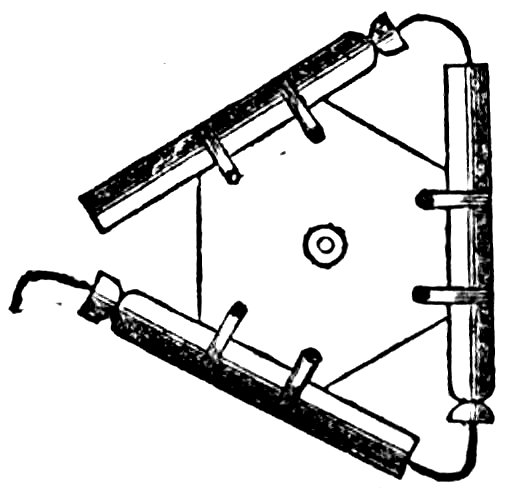
Fig. 62.
In tying on your cases, be quite sure that the mouths or choked ends of them lie all in the same direction, in such a manner that the tail of the first case reaches almost to the mouth of the second; the tail of the second to the mouth of the third; the tail of the third to the mouth of the first. When you have secured them firmly in their places with string, you can then proceed to connect them with quick-match—or clothe them, as it is called—so that when one case is burned out it will communicate its fire to the mouth of the next, and so on till they are all consumed.
101In cutting your quick-match, bear in mind that about an inch of the black match itself must project uncovered beyond each end of the paper tubes in which it burns. This is to insure its taking and communicating its fire. In the annexed sketch (fig. 63) you will see represented a piece of quick-match as it should be cut for connecting cases. At fig. 64 is represented a wheel-case, such as is to burn second in your single triangle, and has a piece of quick-match, like fig. 63, at each of its ends, to connect it with the first and third case on the wheel. You will observe that the newspaper which projected beyond the ends of the case is simply tied in tightly round the quick-match. You will, after a few trials, be able to get through this “clothing” operation very easily, and with no unnecessary wasting of quick-match.

Fig. 63.

Fig. 64.
The mouth of your first case may either be finished off with touch-paper, or may have a short piece of quick-match put into it, to be lighted with a portfire.
Your wheel is now completed and ready for firing. But I may as well suggest here that its beauty and effectiveness will be very much enhanced if the three cases on it be filled with different compositions. For instance, fill the case which is to burn first with composition No. 2; that which is to burn second with No. 4; and the third case with No. 1. This plan of varying the compositions, or any other that suggests itself, may be adopted in the case of all wheels. It is necessary, 102however, that you should be well acquainted with the character of each composition, in order that you may be able to produce the exact effect that you require at the right time.
Composition No. 1 gives only brilliant sparks, and must be prepared as shortly as possible before use.
Composition No. 2 will give a whitish circle of fire fringed with red sparks.
Composition No. 3 produces less white flame and more sparks than No. 2.
No. 4 is a sparkling composition; by far the best for general use, in my opinion.
No. 5 gives reddish sparks, which fly off in very straight lines from the wheel, and form rays, as it were.
No. 6 gives rays, brilliant sparks, and a centre circle of white fire.
No. 7 gives a moderately good centre, with drossy red sparks of a peculiar shape.
Those compositions which throw out the greatest number of sparks during combustion are the best for larger wheels, but will be found also very effective in the common single triangle.
Those which have a tendency to produce a flame, rather than a jet of sparks, are very effective as a variety for small wheels, but produce an effect comparatively poor when employed for those of greater dimensions.
For horizontal wheels, sparkling compositions alone are effective, because in them everything depends upon the form that the fire assumes in its outline, and not upon the shape of the wheel itself. Compositions which produce but few sparks would be entirely out of place if used to turn horizontal wheels.
103
DOUBLE TRIANGLE WHEELS.
46. I will now offer a few remarks with respect to the construction of the Double Triangle Wheel. This piece may be made by employing two hexagonal frames of wood of the same size, in a centre twice as long as that described in fig. 60. But it may also be made in such a framework as Mr. Darby will supply, which is a nave made of light wood, with six spokes, cut at their ends in such a manner as will allow the cases to be firmly attached. But whether you use the one form or the other, the principle is precisely the same, and the cases must be arranged as shown in the adjoining diagram (fig. 65).
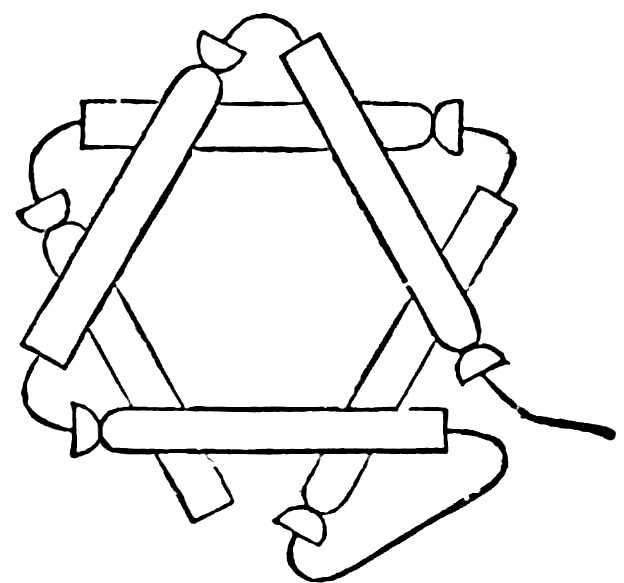
Fig. 65.
The performance of this wheel is, of course, the same as that of the single triangle wheel, and differs from it only in the matter of duration. But it must be borne in mind that a double triangle wheel, having six cases upon it, would be a very slow sample of pyrotechnic beauty if all these cases were filled with the same composition. It would, indeed, be a most meaningless performance. You must therefore take care that some variation is made, using at least two varieties of composition. You will then have an effective piece, capable of lasting a long time in proportion to its size.
VERTICAL WHEELS.
47. Leaving now the triangular form of wheels, we will pass on to those which are called Vertical. All triangle wheels are vertical wheels, but all vertical wheels are not 104triangular; it is of non-triangular vertical wheels that I am now about to speak. These are made with a nave, spokes, and felloe in the same manner as a carriage wheel. The cases may be fastened to the felloe, or the wheel may be made without a felloe, and the cases fastened, in any way that occurs to you, to the extremities of the spokes; either by nailing to their ends pieces of wood at right angles with the spokes, or by cutting a groove in the end of each spoke and tying a case into it with string. As long as the cases be properly arranged and secured firmly to the framework it matters very little which of the above plans is adopted. Select the plan which can most easily be carried out by the means that you have at command, and carry it out in the simplest possible way. Complications are not only unnecessary, but very likely to deprive your pieces of what would otherwise have been their complete success. The accompanying sketch (fig. 66) gives you a representation of another arrangement of six cases, which is, in my opinion, productive of a better effect than the double triangle. The wheel here represented is vastly improved by the addition of a coloured fire placed somewhere near its centre; but I have not yet given any directions or instructions for the preparation of colours for such a purpose, and the making of these additions must be reserved for its proper place.
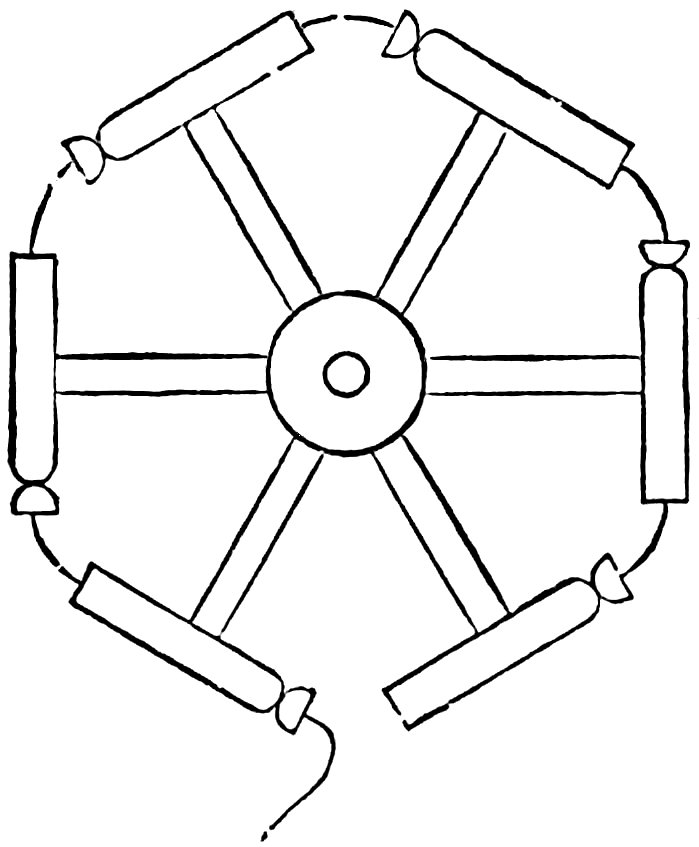
Fig. 66.
But perhaps the most satisfactory arrangement of six cases on a vertical wheel is that which the next sketch represents. 105By the plan adopted there—that of making the cases incline outwards—a much larger circle of fire is produced, and the general effect is considerably improved. It will be perceived that the mode of “clothing,” and tying on the cases, for all these different forms of wheels is the same, the only difference being in the shape of the framework. The cases may be fired singly or doubly in this wheel—that is, you may make them burn one at a time till all are consumed by putting the quick-match to them just as my sketch (fig. 67) represents, or you may connect with quick-match the first and fourth cases, so that these take fire simultaneously. By this arrangement the first and fourth cases will work together, the second and fifth, and the third and sixth. Of course the first and fourth cases are the only pair that need be connected by quick-match, for they will severally convey their fire to the second and fifth, and these to the third and sixth. The framework of this wheel may be made of deal or beech (the latter I should prefer) about three-eighths of an inch thick; the wheel altogether should be from 15 to 18 inches in diameter. It should by all means have some centre, like that described at fig. 60, to secure its steady and true movement. This wheel also will be vastly improved by the addition of a coloured fire to its centre.
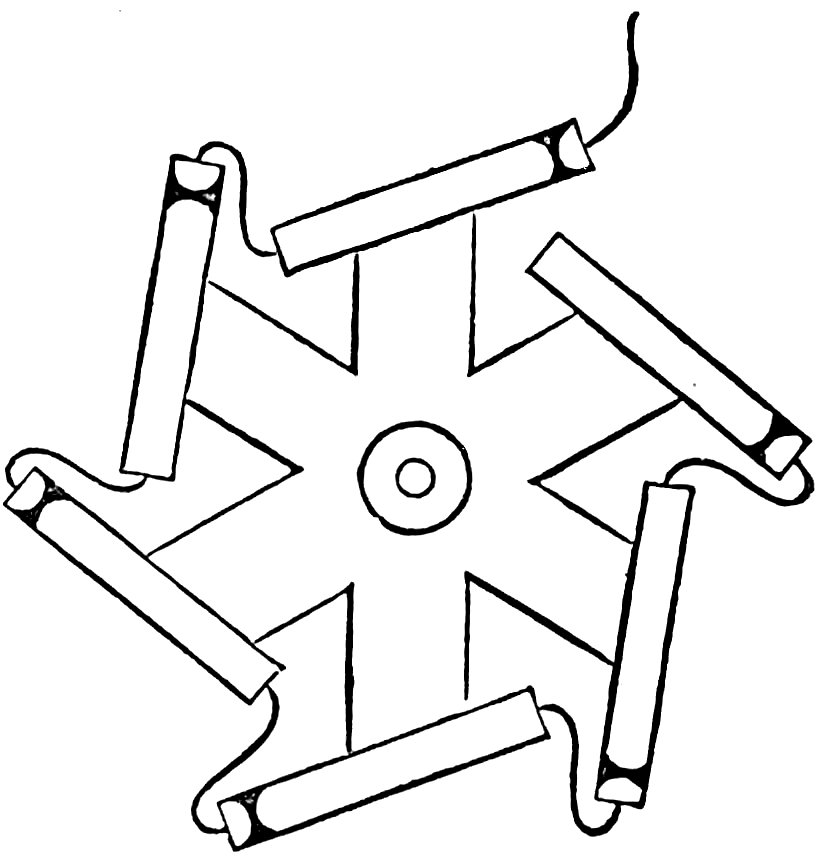
Fig. 67.
106We will now proceed to speak of
HORIZONTAL WHEELS.
48. These, like the vertical wheels, may be made of almost any shape or design. They have a hole bored in the exact centre of their nave, and up this hole the spindle passes on which they revolve.
The annexed fig. 68 gives you one of the simplest forms of the horizontal wheel. A wheel made according to this plan will require four wheel-cases and a case of Chinese fire long enough to last during the combustion of two of the wheel-cases. The quick-match is put to it in the following manner:—Simply connect the first and second wheel-cases by carrying a quick-match from the tail of the first to the mouth of the second. Then from the tail of the second carry two “leaders” (as these pieces of quick-match are called), one to the third wheel-case and the other to the perpendicular case of Chinese fire, which will thus be ignited at the same moment with the third wheel-case; and to complete the wheel carry a leader from the tail of the third to the mouth of the fourth case.
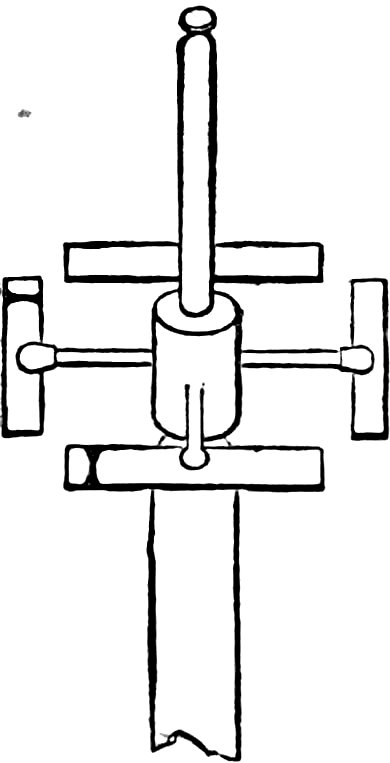
Fig. 68.
The case of Chinese fire which I should recommend you to make for this and for other horizontal wheels is one of the 2-oz. size, nine or ten inches in length, and filled with composition No. 4, given in paragraph 41. It is to be affixed to the wheel thus:—There must be a small projecting piece of wood left by the turner at the top of the nave of the wheel, about an inch in height and five-eighths of an inch in diameter, 107and if an inch of the case be left unoccupied by the composition at its unchoked end, this end can be squeezed over the wooden point mentioned above, or can be glued on to it if you think it desirable.
Another and very amusing variety of the horizontal wheel is that which my next illustration represents, and which is sometimes called the “capricious” wheel. This carries six wheel-cases and one Chinese fire case. The wheel-cases are arranged in the following manner:—All the cases are placed at an angle with the plane of the wheel’s revolution; the three upper ones have their mouths inclined upwards, the three lower ones downwards. Care of course must be taken that all the mouths, whether inclining upwards or downwards, be turned in the same direction. They are connected thus:—Make one of the lower cases the first to be fired; from the tail of this carry a leader to the nearest of the upper cases, which will then burn second; from the second carry a leader to another of the lower cases; then from this to another of the upper ones. From this fourth case carry three leaders—one to the remaining upper case, one to the remaining lower case, and one to the case of Chinese fire.
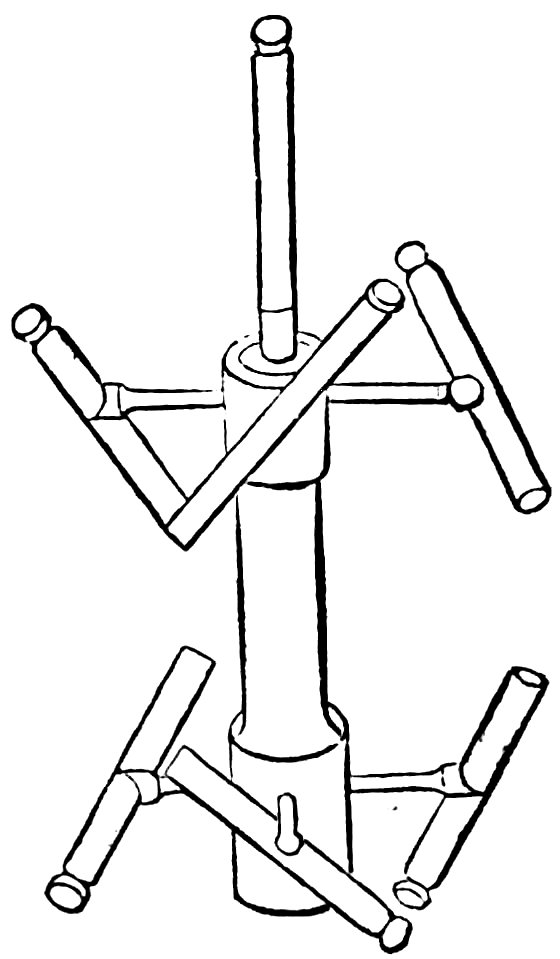
Fig. 69.
The effect of this wheel is exceedingly laughable. It does not revolve so rapidly as the simple horizontal wheel mentioned above, the cases of which are perfectly horizontal. The impression that its performance always gives one is, that it is determined to do something violent: that if one direction of 108fire will not answer it will try another. Each succeeding case sends it round more rapidly than the last, on account of the decreasing weight as the cases burn out; and if the two cases which are to burn with the case of Chinese fire be filled with composition No. 1, given in paragraph 44, the fury of the wheel will at the last seem to know no bounds.
It is necessary, however, to see that the hole into which the iron spindle is to pass is truly bored and is long enough, and that the spindle at the top of the post is straight and strong. This spindle should pass into the nave of the wheel five inches at least.
Let me press upon you one or two important hints. The case, or cases, that burn last on each wheel must always have their ends closed with clay, or some incombustible substance. If this advice be neglected your wheel is pretty certain to fail.
I have drawn at fig. 70, a fac-simile of the spindle which I use for all vertical wheels. It is made to screw into an iron which is represented at fig. 71, which iron is fixed by screws to my post in the manner shown at fig. 72. The post I employ stands about ten feet out of the ground. Into its top is driven another spindle, on which my horizontal wheels turn. Both these iron spindles should be made of quarter inch iron rod.
You will find the spindle drawn at fig. 70 very much more convenient than one simply driven into the post, and having a “nut” at its end to screw and unscrew; for it is more than probable that on a dark night, when you are taking down one wheel that has been fired, and putting up another, you will drop the “nut,” and feel considerably at a loss without it. And besides this, you can by this means always remove the spindle, and protect it from rust. Your post should be very steady.
109Mr. Darby will supply you with any frameworks of wheels, made to any pattern that you please.
I shall speak of some other wheels when we are sufficiently advanced in pyrotechnic proficiency to be able to attempt the manufacture of all their component parts.