TOURBILLONS—PLAIN AND BRILLIANT.
Reading edition
51. The tourbillon is a species of firework very ingeniously contrived to represent a spiral column of fire. Its performance is of short duration, but while it lasts it produces a very striking effect, and is, moreover, entirely different from any other pyrotechnic piece.
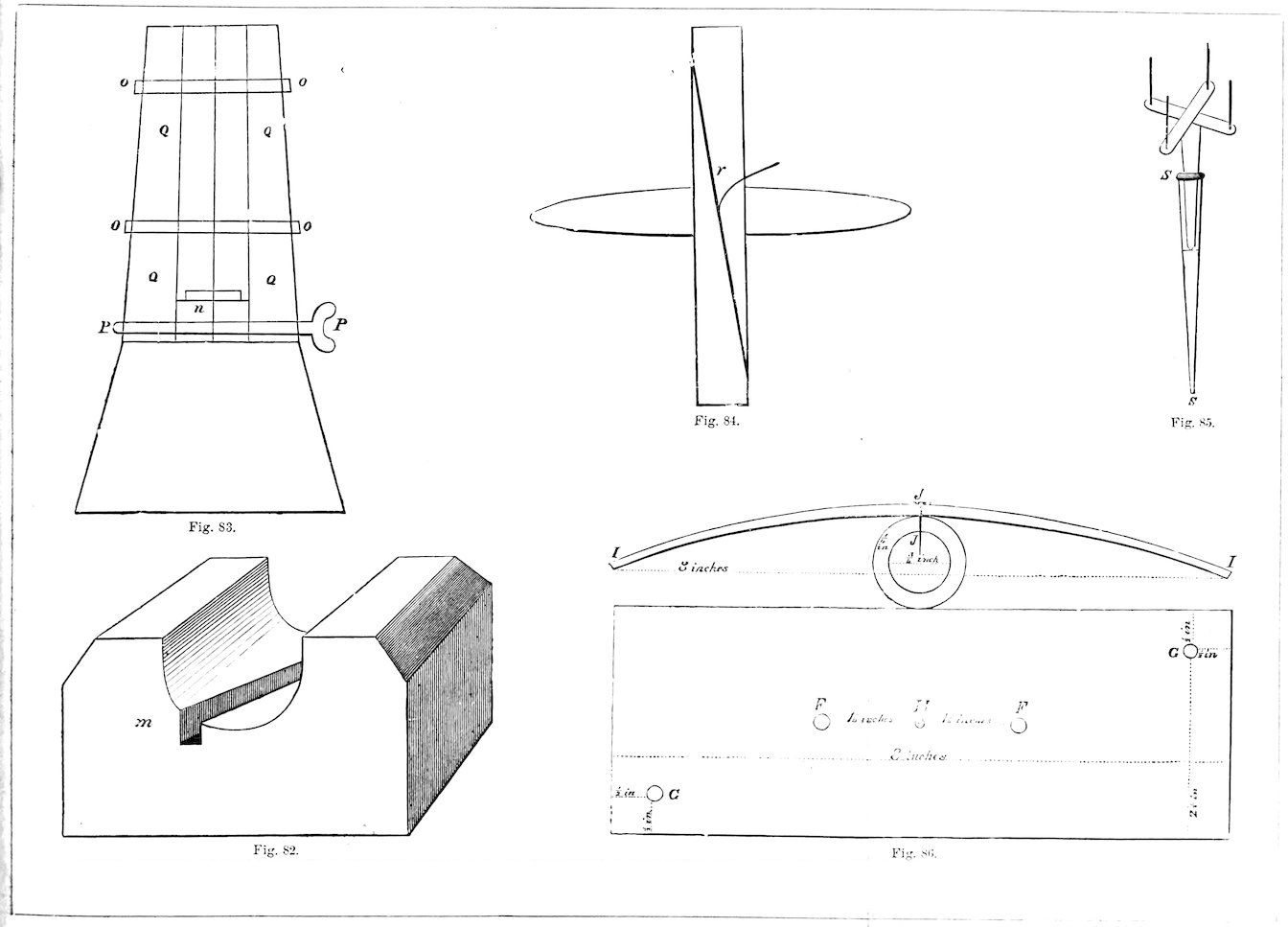
Fig. 82.—Block to receive the tourbillon while it is being bored. m—Groove in it to receive the quick-match. Fig. 83.—Block, with settle (n) over which tourbillons are rammed. Q Q Q Q—Wooden cylinder to enclose tourbillon case. O O O O—Iron rings to tighten cylinder. P P—Pin to pass through cylinder, and settle to connect them. Fig. 84.—Tourbillon complete, with stick attached. Fig. 85.—Revolving cradle from which tourbillons are fired. s—Iron spike, with tubular top, in which the cradle revolves. Fig. 86.—Metal tourbillon scale.
129The preparation of tourbillons requires a considerable degree of nicety and precision, for unless the several proportions of the piece be accurately preserved, the true and intended effect will certainly be lost, and the operator not merely lose a feature, but a very beautiful feature, in his exhibition.
Since, then, it is utterly impossible to prepare successful tourbillons by careless manipulation, and to hurry over any part of their manufacture without some deterioration to their performance, I must beg that my readers will carefully follow my directions in every particular. They will then be able to make these tourbillons as successfully as I do. But if they prefer to work out some principle of their own, they must not hold me responsible for its results.
For the benefit of those of my readers who may know little or nothing of what a tourbillon is, I will first endeavour to explain the principle upon which it is constructed, and then give in detail the various operations necessary for its completion.
A tourbillon consists of a stout case filled with a strong sparkling composition, and closed very tightly at both ends. In this case are bored four holes, at which the fire is to find vent. Two of these holes are made underneath the case; from these the fire issues in a downward direction, and gives the piece the power of ascending perpendicularly. The other two holes are made in opposite sides of the case near each end; the fire issuing from these causes the case to revolve in a horizontal direction while it is ascending.
Now, it will be obvious that to gain an exact counterbalancing of these two forces considerable care and precision will 130be necessary. In order to make my directions as clear as possible, I intend to speak only of one size of tourbillon. You may make them of any size, from the 1-oz. up to the ½-lb. size, if you please; but you will find it by far the most economical and certain plan to keep to one effective size, and thus avoid all confusion and expense arising from the multiplication of tools and measurements.
We must first of all know how to make the cases. These are to be of the quarter-pound size. You will derive little advantage from adopting a larger size than this, and you will find smaller sizes unworthy of such an exhibition as I trust you will be able to make by following my directions in these papers.
From each sheet of your 70-lb. brown paper you will only be able to cut two strips of sufficient width and length to make the ¼lb. tourbillon cases. These two strips are represented at A and B in the annexed diagram (fig. 80). These strips must be eight inches wide. Your sheets of paper measure about twenty-two inches on their short side; so that if A and B are eight inches wide, the remaining strip C will be only six inches wide, and useless, therefore, for tourbillon cases of our present size. But these spare strips are sure to prove useful for some purposes, and so no waste will be incurred.
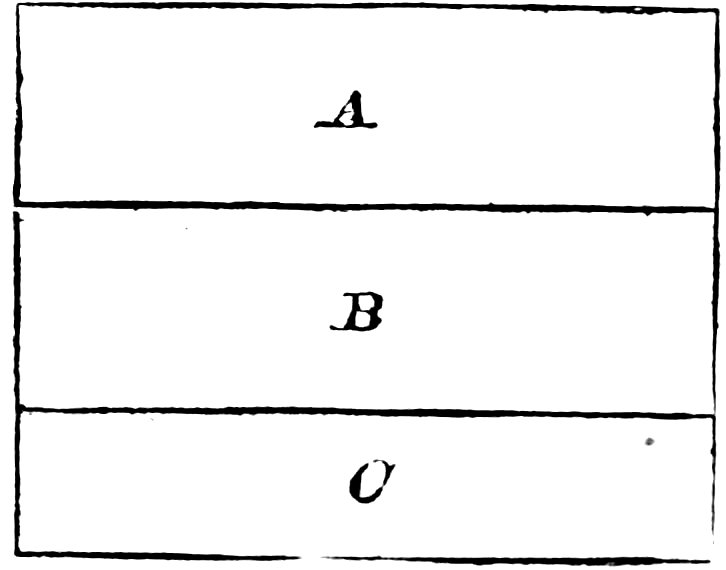
Fig. 80.
The imperial board for these cases must be cut as in the adjoining illustration. Each sheet of board will provide four strips of a size proper for our purpose, each of which will be eight inches wide and fourteen inches long. Those marked 131a b c d are intended to represent the pieces to be used (fig. 81). Those marked e e should be kept with the spare strip marked C in fig. 80, and will make you a good ¼lb. case for Chinese fire.
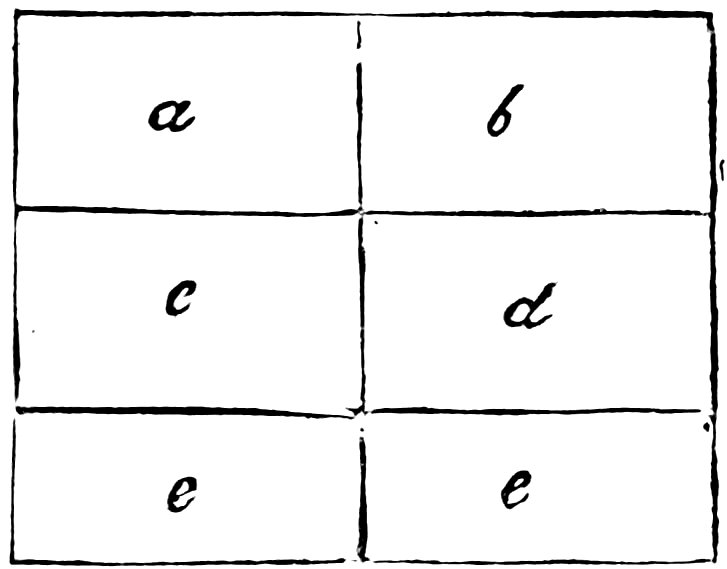
Fig. 81.
I will now suppose you to have divided your paper according to the above directions. In the next place you must paste both paper and board all over thoroughly. Brush some paste upon your ¼lb former (the one used for making rocket-cases, which is three-quarters of an inch in diameter), and then roll on your paper and board in the manner described at p. 77. Especial care must be taken that the innermost end of the strip of paper (that which lies next to the former) is so thoroughly saturated with paste that it cannot become separated or loose. If this precaution be not taken, some of the composition will, in the process of filling, drift behind it—will form a quick-match, as it were, inside your case, and will infallibly cause the tourbillon over which you have otherwise taken so much pains to vanish in a neat sharp report, and you will discover to your annoyance that in the place of a tourbillon you have only made an inferior kind of marroon.
Well, your cases are now made, and are eight inches in length, and three-quarters of an inch in their bore. Their external diameter will be found to be about one inch and an eighth.
We must next speak of the composition proper for filling tourbillons. For this purpose I employ the following formulæ, which I think will be found to answer well:—
132
No. 1.
FOR PLAIN TOURBILLONS.
Nitre 8 parts.
Meal-powder 16 „
Sulphur 4 „
Charcoal 4 „
The charcoal that I use in making up this formula is the same that I recommended for rocket purposes—that is, it should be partly fine and partly coarse. If the above composition be found too strong, more charcoal may be added until the desired strength be gained.
No. 2.
FOR BRILLIANT TOURBILLONS.
Meal-powder 16 parts.
Nitre 8 „
Sulphur 3 to 4 „
Charcoal (fine) 3 „
Steel filings 6 „
The effect produced by this composition is very good indeed, and in my hands leaves nothing to be desired. It is advisable not to fill the cases with composition No. 2 longer than necessary before use, as the steel is sure to become corroded to some extent, and then much of the brilliancy of the sparks is lost.
Some pyrotechnists use iron borings instead of steel filings for tourbillons. I cannot say that I have ever succeeded well with them. Iron particles will not work well in rapidly-revolving pieces, as far as my experience goes. They seem to me to become chilled too soon by their motion through the air, and produce hardly any scintillation. I, therefore, always use steel filings for all fireworks which are intended to 133revolve, and employ iron only in those that are stationary. Now, having prepared your composition, you will be ready to ram it into your cases. For this purpose you will require a simple piece of apparatus, which Mr. Newman will make for you at a small cost. You will find a drawing of it on my page of illustrations (fig. 83). It consists of a block of wood provided with a “settle,” on which one end of the tourbillon case is placed, and over which the composition is rammed. Then there is a wooden mould capable of inclosing the case and supporting it tightly and firmly while the operation of ramming is being performed. This mould consists of a hollow cylinder of wood pierced throughout, and of such a size in its bore as will just admit the tourbillon case. The mould is divided longitudinally in halves, and these halves are kept together by means of iron rings, which encircle the whole. You will find a full description given with the drawing.
In order to fill the cases, squeeze one end of one of them over the projecting piece at the top of the settle. Then fit on the two halves of the cylindrical mould, and drive down the iron rings until they are tight. The exterior of the cylinder is made to taper, in order that the rings may always fit tightly over it. And, lastly, put in the pin which secures the cylinder to the block and settle. You will now require a straight wooden drift, eight inches long (independently of its handle), and nearly three-quarters of an inch in diameter—one, in fact, that will pass easily into your tourbillon case. The tools you have already—viz., a scoop for the composition, a mallet, and the short solid drift which you used for driving in the clay over the composition in your quarter-pound rockets. First put into your tourbillon case as much clay as will, when rammed very hard, occupy three-eighths of an inch in the length of the case. The settle projects into the case 134about one-eighth of an inch, and thus half-an-inch at each end of the case is left for the purpose of insuring a very firm ending, which cannot be blown out by the combustion of the composition.
When the clay has been rammed in as tightly as possible, drive in the composition, a ladleful at a time, as uniformly as you can, until you have only half-an-inch at the upper end of the case unoccupied by it. Into this vacant space drive the same quantity of clay that you put into the lower end, and be sure that it is rammed in very firmly indeed.
The ramming of your tourbillon is now completed, but the most important part of its manufacture has yet to come. Open your penknife, and lay its blade on the table, back downwards and edge upwards. Place your filled tourbillon case across the edge of the knife, and find the exact central point at which it balances on it, and mark that point by making a hole there with a small bradawl. Now, having found the centre of its balance, you have next to mark the places at which the holes are to be made, and by far the best way to save yourself trouble in this respect, and to insure the proper marking out of all your tourbillons, is to follow my plan, which I am now about to describe. At fig. 86 I have drawn out for you a shape which you must get copied exactly in tin or zinc sheet. This piece of sheet metal, when bent into the form of a trough of such a size as to fit tightly round your tourbillon case, will give you the true position of the holes. In using it you will have to put the filled tourbillon case into it, and make pencil marks through the holes that correspond to those drawn in my sketch, and you will then have got over the entire difficulty. In the middle of the scale which I have drawn is one small hole marked H. This hole is to come exactly over the mark which you made with your bradawl at the balancing point, and if this be done all the rest must come right.
135Having thus marked the position of the holes, the next thing is to bore them. They should be as nearly as possible three-sixteenths of an inch in size. I use a large bradawl for boring the holes, and it is better to drive it into the case with a mallet than to work it in with the hand. It must not be driven in farther than necessary, the object being merely to make a clear hole through the case, and not to disturb the composition. If you drive in the bradawl with your mallet you will require a small block of wood with a groove cut in it, in which you can lay the case while making the holes. I have given you a sketch of such a block at fig. 82. If it is two inches square or rather more it will be quite large enough. You will find the block very useful afterwards in attaching the stick to the tourbillon.
The plan that I have given for the tin or zinc tourbillon scale, as I shall call it, is drawn out quarter size, and the dimensions, marked, so that no tinman can have any difficulty in copying it accurately. Your tourbillon case is 8 inches in length. Half-an-inch at each end is taken up by the clay endings, so that you have seven inches of composition in the case. The two extreme holes, which are on opposite sides of the case, are made at the ends of the composition. The fire issuing from these gives the tourbillon a horizontal revolution round its centre of balance. The two inner holes, which are on the under side of the case, should be the same distance from one another that they are from the extreme holes. The fire issuing from these gives the tourbillon its ascending power.
But we have now to connect all these holes with quick-match, in order that the composition may take fire at all the four points simultaneously. To do this, begin at one of the under holes (those marked F in the scale), and press into it the end of a piece of uncased quick-match, taking care that 136the match reaches the composition. Then carry the match on to the nearest side hole, and press it into it. Then carry on the quick-match over the upper side of the tourbillon to the side hole at the other end of the case, and press it in there; and, lastly, carry it on to the remaining under hole, and press it into it.
Having completed this operation, cut some strips of thin paper, about an inch wide, paste them well all over, and cover the quick-match with them, holes and all. A very little practice will enable you to adapt this pasted paper very neatly.
The tourbillon, if now ignited, will be sure to go somewhere, but probably not in the direction which we should like it to take. In order to regulate its flight we must do as we did with the rockets, adjust a stick to it, which shall have the effect of keeping its under side downwards, and so of compelling it to move upwards perpendicularly, if at all.
This stick is usually made of a curved shape in the manner represented at I I, in fig. 86. Those that I use I get from Mr. Darby; they are eight inches long, about an eighth of an inch thick, and are made of beech. There is a small hole in their centre through which a flat-headed nail is driven into the tourbillon at its balance point, which you marked with your bradawl. The stick must, of course, lie at right angles with the case in the manner represented at fig. 84. It is a very good plan to put a drop or two of glue at the point where the stick touches the case, as it will then be prevented from shifting its position.
In driving the nail through the stick into the tourbillon, make use of the block represented at fig. 82, having previously cut at the bottom of its rounded groove another small groove diagonally, so that when the tourbillon is lying upside down in the large groove, for the purpose of having the nail 137driven into it, the quick-match that extends across it may lie in the smaller groove, and may not be injured by being crushed, as would otherwise be the case.
The nails used should be about three-quarters of an inch long, and should have a smooth, flat head.
To fire the tourbillon, place it stick downwards on a level board, and see that it spins easily and freely on the head of the nail. Then with a portfire burn through the quick-match in the middle on the upper side. The tourbillon will make a few revolutions on the board before it begins to rise.
I have known several tourbillons fail, when I had reason to believe that there was nothing faulty in their make. They all behaved in the same unaccountable manner, jumping off the board and falling bottom upwards upon the ground. Of course, after this freak they could not right themselves. They appeared to sink into a kind of blustering, sulky fit, and when exhausted went out. Some time elapsed before I could assign any satisfactory cause for this remarkable behaviour, but at last I began to suspect the board on which the tourbillons were placed to fire them. It occurred to me that there was not room enough for the rush of fire from the under holes between the tourbillon and the board, that as soon as the fire had been conveyed to these under holes the force generated then and there was sufficient to throw the tourbillon over on its back, and thus effectually to prevent any further performance. Now this was by no means satisfactory, for if there is any single firework which requires care, exactness, and attention in its preparation, it is the tourbillon. I have often felt that I would much rather have a rocket than a tourbillon, for in the first place the latter takes much longer to make, and one feels that one should have some remuneration for one’s trouble; and in the next place a good tourbillon, though it is a species of firework not by any means 138so necessary to an exhibition as the rocket, is still one capable of producing a very unique and grand effect. I began to suspect that the board was the cause of my failure, and after a little consideration I came to the conclusions here enumerated:—
1st. That a board of proper size, shape, and level was a thing not always to be found when one wanted it, particularly if away from home.
2nd. That it was a very lumbering piece of luggage to carry with one when about to take an exhibition to a distance.
3rd. That, if warped by damp, or put out of its level in any way, it would be rather worse than useless.
4th. That something better might be contrived.
Whether I was right in blaming the poor board I do not know; but one thing is certain—that I have never, since the adoption of my new plan, had any failures at all with tourbillons.
I wanted something from which to fire the tourbillon which would leave it no excuse for turning on its back, which would be small and portable, and always ready for use.
I first made a brass cross of the shape and size indicated in fig. 87. In the ends of the arms I drilled holes, into which I soldered pieces of stout brass wire about two inches and a-half long. Thus a sort of cradle was formed like that which is represented at fig. 85 in the plate. The next thing to be done was to enable the cradle to revolve very easily. To do this I soldered on to the centre of the under side of the cross a piece of brass rod of the size generally used for stair-rods. This piece was about six inches in length, and was filed at its lower extremity to a point on which it might revolve. I thus had made a thing like that in fig. 88. Now all that I had to do was to get a piece of glass tubing, into which my piece of rod at a a would fit easily, and in which it would turn freely. This I did, 139and procured also a piece of iron rod half-an-inch in diameter and about eighteen inches long. I had this forged into a kind of spike point at its lower end, and filed at its other end, to pass about an inch into the brass tube, and then I had the tube and iron spike soldered together. This iron spike I press into the ground, taking care that it is upright, and then drop the brass rod which is soldered to the cradle into the brass tube at the top of the spike. The cradle will be found to revolve freely. In it I lay the tourbillon, with its stick downwards. When it is fired the holes at its sides are first ignited, and so its horizontal revolutions begin before any ascending power is given to it. The cradle of course revolves with it, and, if properly made, can offer no obstruction of any kind to its free play. But as soon as the fire is communicated to the lower holes, the force there developed will lift the tourbillon out of the cradle, and will send it on its upward flight.
My description of this little piece of apparatus may, perhaps, incline my readers to imagine that its manufacture is difficult. I can only assure them that it is not so, and that, if they will only give it a trial, they will be convinced of the advantages which it possesses over the old plan of the board. Probably some modification of its principle will occur to you which may render it still more easy to be made. The means at your own command are, after all, the best referees as to which is the shortest and readiest method of carrying out any plan. I have given you the method by which I obviated the difficulty that met me. I need only add that if you use the board I hope that your tourbillons will not disappoint you as mine did me.
Many persons make six holes in their tourbillons—four on the under side, and one at each end or opposite side. For my own part, I never could see the advantage of this plan. I 140have tried it and succeeded with it, but the effect has been always to convince me more firmly of the superiority of the four-hole system. I know one or two very successful pyrotechnists whose experiments have led them to the same conclusion.
It is possible to ram tourbillons without a cylindrical mould, but it is neither advisable nor convenient. The cases require some very substantial support while they are being filled, for the composition cannot easily be driven too hard. The cylindrical mould cannot be an expensive apparatus if made as I have suggested. Mr. Newman has such facilities for boring blocks of wood and turning them, that I strongly recommend you to get him to make you one, as it will considerably lighten the trouble of preparing tourbillons, besides giving them, when prepared, a much better chance of success.
I beg here to give my readers the size of 70-lb. paper and imperial board, that there may be no difficulty in knowing what to purchase. The sheets of 70-lb. brown paper and imperial board are of precisely the same size, which is 22½ × 29 inches.
I must conclude the subject of tourbillons with one hint. The person who fires a tourbillon with a portfire will generally fail to get a good view of its performance. The plan that I commonly adopt is to cut an inch of quick-match and twist some touch-paper round one end of it, and lay the other end next to the match on the tourbillon at the point r in fig. 84, pasting a piece of thin paper over it to secure it, and leaving its other end free, with the touch-paper round it.