FIVE-POINTED STAR.
Reading edition
69. The cases are made upon the same “former” on which the quarter-pound rocket-cases are rolled. They consist of a piece of 70-lb. brown paper and a piece of imperial board. The sheet of brown paper is cut into strips, as represented in the annexed diagram, by which it will be seen that each sheet furnishes enough paper for six cases. The imperial board should be divided, as shown in the following sketch, 112, into twelve equal strips—thus: so that two sheets of 70-lb. brown paper and one of imperial board will give material for one dozen cases for five-pointed stars. The paper and board must be well pasted, and the rolling board used unsparingly, as cases for this purpose cannot be too strong and hard.
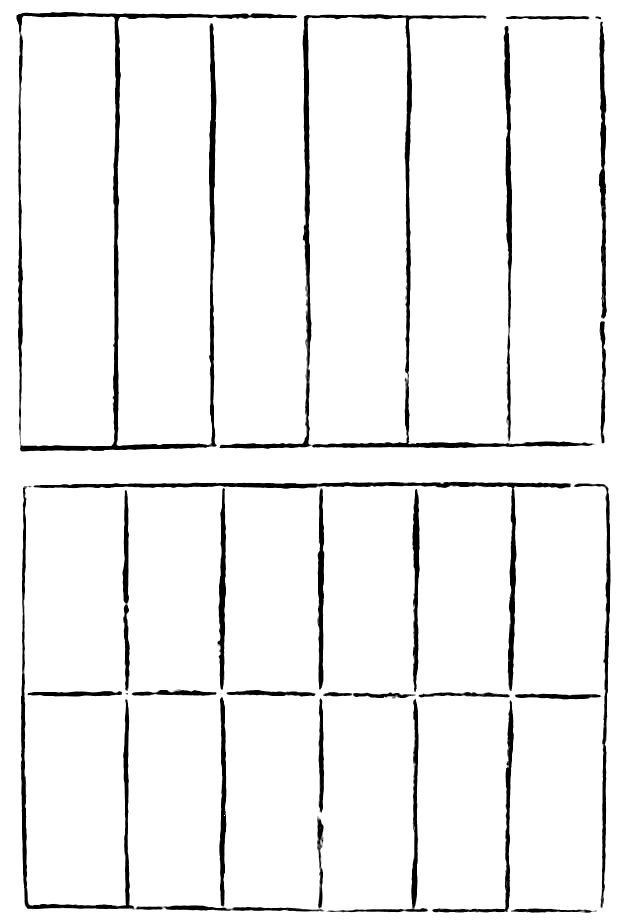
Fig. 112.
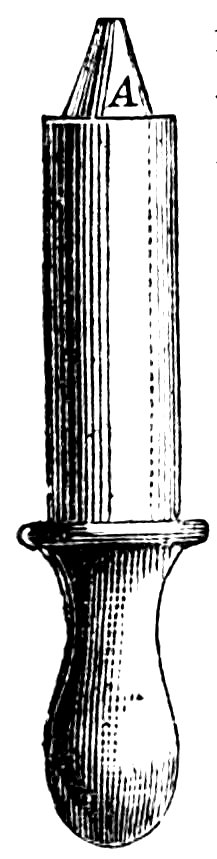
Fig. 113.
The common plan for filling these cases with composition is simply to put them on the same settle on which quarter-pound tourbillons are rammed, and to drive into the lower end of them about half-an-inch of clay, very solid, and to ram in the composition upon this until it rises to such a height 184as will enable the star to burn as long as the piece or pieces with which it has to keep time. But I think a much better plan is the following:—Procure a turned drift of box, or some hard wood, about five inches long in its straight part, with an end as represented at fig. 113. Put a ladleful of clay into the case when it is upon the settle (the ladle used for filling quarter-pound rockets is meant), and drive down the clay with the conical end of the drift, by which means you will have a hollow clay cone formed in the end of the case. Now ram in your composition, which may be made from either of the following formulas:—
FOR FIVE-POINTED STARS.
No. 1.
Nitre 16 parts.
Sulphur 6 „
Meal-powder 4 „
Antimony 2 „
No. 2.
Nitre 16 „
Sulphur 8 „
Meal-powder 6 „
Antimony 4 „
No. 3.
Nitre 16 „
Sulphur 8 „
Meal-powder 4 „
Antimony 3 „
It will be best to decide first of all which of these compositions you prefer, and to keep to that, remembering that five-pointed stars are never used singly, but only as parts of compound pieces, and that, in order to produce their proper 185effect, they ought to last just for a certain time and no longer. By keeping to one of the compositions given above, you will be able to time them better. I cannot give any directions for the quantity of composition to be driven in—this must depend entirely upon the part which it is intended that the stars should play in the piece for which they are made, and can be decided only by actual experiment. The composition will not require to be driven very hard.
You will by this time be beginning to wonder how a case filled in the manner described above is to make a five-pointed star. Well, there is no great difficulty in achieving this end. Provide yourself with a gimlet which will make a hole about one-eighth of an inch in diameter, or rather more; also with a pair of compasses the legs of which can be secured at certain distances from one another. Let the points of the compasses be exactly such a distance apart that they will represent one-fifth of the exterior circumference of the case—that is, so that they will exactly go round the case in five strides, finishing at the point from whence they started. When you have thus adjusted your compasses, make them perform their five-stage journey round that part of the case inside which is the hollow clay cone, about half-way between the point and base of the cone, and wherever the points of the compasses touch, there make a mark by pressing the point into the case. You will thus have divided the circumference of the case into five equal parts. Now at each mark made by the compasses bore a hole gently with your gimlet, which should be a sharp one, taking care that you only bore through the case and the clay, and disturb the composition as little as possible. In order to prime the case, fill the hollow at the end of it, which was occupied by the top of the settle, with wetted meal-powder, and when this is dry, pass across it a piece of bare quick-match, the ends of which should be long enough to be tucked 186into two of the gimlet-holes, and which will convey the fire from the priming to the composition inside the case. Then cut some pieces of thin paper (such as double crown) three inches wide, and long enough to go twice round the case, and paste one of these on the case just below the gimlet-holes, so that the paper covers up gimlet-holes, priming, match, and all, and projects an inch and a-half or thereabouts beyond the primed end of the case. This projecting paper serves to contain the end of the encased match which is to connect the five-pointed star with other pieces.
The best method of fixing these stars on the frames for which they are required is to have projecting from the frames wooden pegs of such a size that the unprimed end of the case can be squeezed tightly over them or glued on to them. I should have stated that when the proper amount of composition has been inserted, a little clay should be driven on the top of it for the sake of security, and there should be not less than three-quarters of an inch of unoccupied case beyond this clay. Into this unoccupied space the pegs mentioned above should be fixed.
Five-pointed star-cases must, of course, be placed horizontally, with their primed end towards the spectators; and when fired they will, or should, present an appearance of this kind, the burning composition protruding its tongues of white flame through the holes made by the gimlet.
In your anxiety not to disturb the composition with the gimlet, do not run into the other extreme, and leave the clay unbored. And see that there is sufficient clay beyond the point of the cone to prevent the combustion from finding vent there.
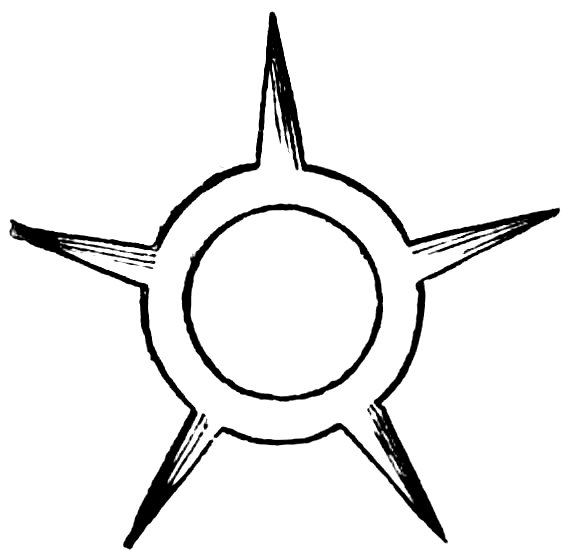
Fig. 114.
187The object of the conical clay head to the case is that the fire may not burn the holes larger. If the holes were simply bored through the paper case they would be burnt much larger than they were originally made. Nevertheless, if it be thought too troublesome to make the hollow clay cones, as I have suggested, a very fair five-pointed star may be made by driving in a flat end of clay, and boring just below it into the composition.
It is possible to make the cases for five-pointed stars of iron tubing, such as ordinary gas-tubing, about the same size in bore as the paper cases, the manufacture of which I have described above. Half-a-dozen iron cases, open at both ends, with the five holes drilled at equal distances round their circumference, and about an inch from the end, will be found very handy, because they are indestructible, can be used any number of times, and after use have only to be laid in hot water, and they can be washed as clean as when new. It will be necessary to tie something round the holes while the composition is being driven in. The ends, of course, are made with clay.
But let me here caution you to be very careful in the use of iron cases. If quicker compositions than those given above are employed, there is danger of the case being blown to pieces. If this should happen it would result in the most serious injury to any one who might be in its way. And therefore it will be advisable, if you think of using iron cases, to fire your experimental five-pointed star at a great distance from where you stand, taking care that no one is near it. It will probably go well; but there is a risk attending the use of iron cases which makes them less safe than those made of paper and board.
I trust that these directions will enable you to prepare a satisfactory five-pointed star.
188It now remains for me to furnish you with some designs for exhibition pieces, and to describe the manner in which they are to be made up.