LANCES—WHITE AND COLOURED.
Reading edition
49. We have now, in the course of our pyrotechnic investigations, arrived at a point where it becomes necessary to know something more than we have already learned about coloured fires. I have spoken hitherto only of those coloured compositions which are employed in the manufacture of rocket and Roman-candle stars. These compositions must for the most part be confined in their use to that purpose, because they are, in almost all cases, far too rapid in their combustion for the purposes of which I am now about to speak.
I now proceed to treat of Lances, white and coloured, for making up devices, such as names, crests, mottoes, wreaths, &c., &c.
Now, there are a great many formulæ given for compositions employed to decorate other fireworks, or to form designs of any kind in white or coloured fire, with which it may be advisable for my readers to be acquainted, in order that they may have the opportunity of selecting for themselves, and of providing themselves with, a colour of that particular shade and character which is best adapted for the working out of the design determined upon.
In the first place I will speak of those fireworks which are properly called “lances.” These are small cases, generally made about three-sixteenths of an inch in diameter, that is round a piece of glass or brass rod or tube of that size (tubes are always best for these small formers). The cases are about 110two or two and a-half inches long, with one end pinched or turned in. Two rounds of thin demy or double crown white paper, pasted, will give sufficient thickness and substance for the case. The cases, when dry, are to be filled with either of the following compositions by means of the funnel and wire apparatus illustrated at figs. 34 and 35:—
COMPOSITIONS FOR LANCES.
White.
No. 1.
Nitre 16 parts.
Sulphur 8 „
Meal-powder 6 „
Or,
No. 2.
Nitre 16 „
Sulphur 4 „
Meal-powder 6 „
Or,
No. 3.
Nitre 12 „
Sulphur 4 „
Sulphide of antimony 3 „
Or,
No. 4.
Nitre 72 „
Sulphur 18 „
Regulus of antimony 33 „
Realgar 1 part.
Shellac 1 „
111Or,
No. 5.
Nitre 96 parts.
Sulphur 24 „
Regulus of antimony 48 „
Realgar 6 „
Shellac 1 part.
These for the most part give a bluish-white flame, and when employed in cases of the size mentioned above, burn slowly, and will last as long as this species of firework is required to last.
Yellow.
No. 6.
Chlorate of potash 72 parts.
Oxalate of soda 60 „
Stearine 6 „
Sulphur 6 „
Or,
No. 7.
Chlorate of potash 40 „
Oxalate of soda 16 „
Shellac 8 „
Stearine 3 „
Green.
No. 8.
Chlorate of potash 60 „
Nitrate of baryta 41 „
Calomel 49 „
Powdered sugar 30 „
Shellac 1 part.
112Or,
No. 9.
Chlorate of potash 63 parts.
Nitrate of baryta 50 „
Calomel 50 „
Sugar 32 „
Shellac 1 part.
The green colour is never very decided when the compositions are employed in cases so small as those spoken of above. But by far the best composition to be used in these small cases is one containing a rather costly ingredient, which is the chlorate of baryta. The usual price of this salt is about 8s. per lb., or rather less. It gives a magnificent colour if it is pure, but if not, it is not worth buying. I give you the formulæ in which it may be employed, in case you should require a very brilliant emerald green in these small lances. They are—
No. 10.
Chlorate of baryta 18 parts.
Calomel 7 „
Shellac (very fine) 3 „
Or,
No. 11.
Chlorate of baryta 24 „
Stearine 3 „
Sugar (very fine) 1 part.
Compositions containing chlorate of baryta are perfectly safe where no sulphur is employed. The salt itself is not at all deliquescent. A very good formula besides the above is one containing three proportions of chlorate of baryta, and one of powdered sugar. We will next speak of RED LANCES.
113Red Lances.
No. 12.
Chlorate of potash 13 parts.
Nitrate of strontia 10 „
Calomel 8 „
Shellac 3 „
Dextrine 1 part.
Chertier’s copper 1 „
Or,
No. 13.
Chlorate of potash 12 parts.
Nitrate of strontia 12 „
Calomel 6 „
Shellac 4 „
Chertier’s copper 1 part.
Charcoal (fine) 1 „
A good rose-coloured fire may be produced by a composition containing the oxalate of strontia, which, though not to be met with everywhere, is a valuable salt on account of its extreme dryness and fineness. The formula given next has the merit of being rapid in its combustion. Should it be thought too quick, decrease the proportion of chlorate of potash, or increase that of calomel. The increase of calomel has the effect of deepening the colour, but, at the same time, of diminishing the reflective power of the light.
Rose-coloured Lances.
No. 14.
Chlorate of potash 24 parts.
Sulphur 2 „
Stearine 3 „
Oxalate of strontia 4 „
114This composition will remain good for any length of time, and has therefore a great advantage over those which contain the nitrate of strontia. And here I may as well remind you of the importance and necessity of having this latter salt perfectly dry and fine, otherwise you will be disappointed of your intended effect in the ordinary red-fire compositions.
For the blue lances you may use composition No. 8, given in paragraph 23.
But there are also two other formulæ which you will find very serviceable and effective:—
No. 15.
Chlorate of potash 32 parts
Chertier’s copper 12 „
Calomel 40 „
Sugar 25 „
Or,
No. 16.
Chlorate of potash 6 „
Chertier’s copper 1 part.
Calomel 5 parts.
Sugar 4 „
For the preparation of a purple fire for these little cases, you cannot do better than use that given for Purple Rocket Stars.
There are still two other colours which you may perhaps find useful and ornamental, and without which my list would not be complete. They are the violet and the lilac tints. The violet is at No. 17, and the lilac at No. 18:—
No. 17.
Chlorate of potash 26 parts.
Calomel 24 „
Carbonate of strontia 4 „
Chertier’s copper 3 „
Sugar 14 „
115Or,
No. 18.
Chlorate of potash 12 „
Prepared chalk 4 „
Sulphur 5 „
Calomel 3 „
Sulphide of copper 10 „
With regard to the use of sugar in pyrotechnic compositions it must be borne in mind that it is a substance which readily attracts damp, so that it must be kept in a closely-corked or stoppered bottle. It should be reduced to powder in a very dry mortar, and then sifted through very fine muslin, to fit it for pyrotechnic uses. And the mention of muslin here reminds me of a fact which experience has brought to light, and which you will find it highly convenient to remember. All those powdered salts and pyrotechnic ingredients which clog the meshes of a wire sieve will easily pass through a sieve made of muslin. For instance, powdered stearine, shellac, sugar, and the salts of strontia and baryta will be found to sift much more readily through muslin, provided the muslin be dry and clean. This will enable the amateur pyrotechnist to fit himself up with sieves of any fineness at a very small cost. He will require only a tin or zinc drum, about 6 inches in diameter, and 4 inches high, with a wire ring round each end. Over one of these ends he can stretch a piece of muslin of the required thickness, and fasten it with a strong elastic band. Or he may have a metal ring made large enough to fit over the muslin and round one end of the drum, which he can remove when a change of muslin is necessary. I do not by any means recommend this kind of sieve for sifting such things as meal-powder, charcoal, or sulphur; for I consider a receiver, made to fit on to the sieve, indispensable in the case of sifting these articles. The dust arising from this operation will 116otherwise find its way into your eyes, and nose, and clothes, and over everything in your room.
It is, perhaps, unnecessary for me to add that all the above compositions must be made up with the greatest exactness, and no ingredients must be used but such as are thoroughly dry and in the finest powder. The most successful pyrotechnists have never been able to produce proper effects, even with the purest and best materials and chemicals, unless those materials have been first reduced to the necessary state of fineness and dryness, and then mixed till they have become most intimately incorporated.
We will now suppose a sufficient number of these lances to be filled with the selected compositions. They must be primed precisely in the manner described under the head of “Golden Rains.” When finished they will be about two and a-half inches long, and about equal in size to an ordinary drawing-pencil.
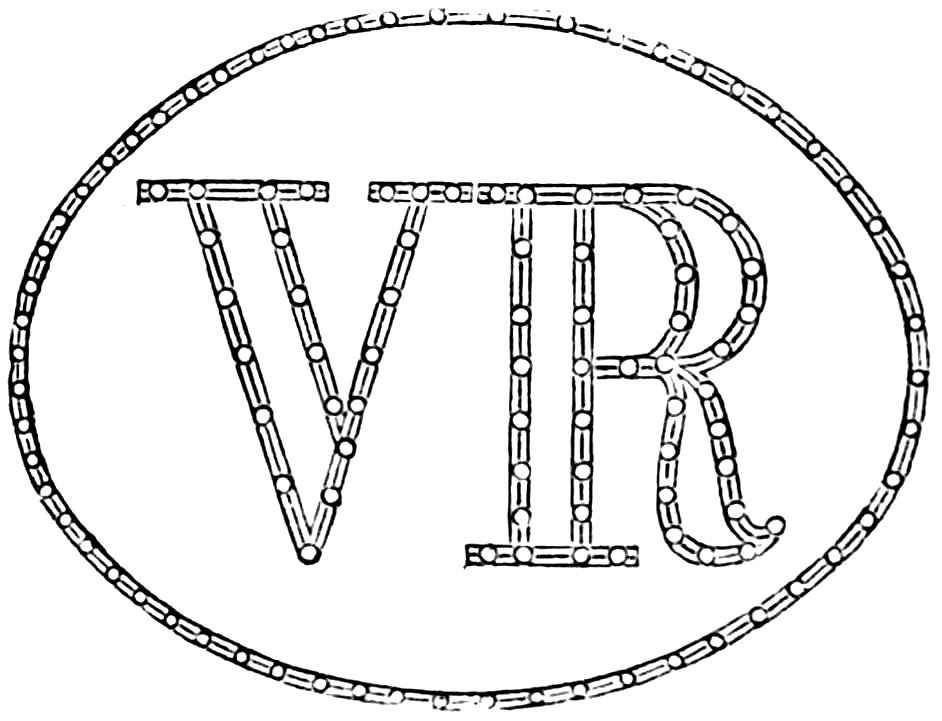
Fig. 73.
The first thing to be done is to decide upon your design. This, I presume, will not be very large. I need not furnish you with a series of suggestions for these designs, for the chance is, that, after all I can say, the one which you wish to execute will be one of your own conception, or at all events, one which you would rather carry out in your own way. But I give here a plain sample of the 117work (fig. 73), which is merely intended to make clearer my verbal directions. The letters should not be less than ten inches high.
In the first place you must either procure a board of sufficient size for your design, or you must make a wooden framework of the shape that you require. Suppose the design to be a V.R.: now either sketch this out upon one side of your board, or, if you wish to have it larger than a board will allow, make a plain rough framework describing the letters. When this is done, decide upon the distance at which you can place the lances one from another. This distance is generally about two inches, but no exact rule can be laid down, for so much depends upon the sort of design that you think of executing, and upon the scale of its size.
I will now suppose that you have your design carefully drawn upon the board or framework. Upon the outlines of your sketch make little pencil circles wherever you intend to place a lance; and, as far as it is possible, arrange that the lances shall be equidistant one from another. Of course the prime object of the arrangement must be to make the outline of the letters, figures, &c., as plain and bold as possible. Now with a centre-bit, or, what is better, a pin-bit, bore a hole about a quarter of an inch deep where your circles are pencilled. These holes must be of such a size that the closed ends of the lances will fit easily into them. When you have completed this operation, get either some glue or some of the mixture of size and red lead which I have recommended before; and when it is liquid, dip into it the closed end of each of the lances. Enough of the mixture will adhere to the lances to allow of their being secured firmly in the holes that you have bored. In a very short time all will be hard and dry, and you will then have a series of lances projecting at 118right angles with your board or framework, each having its mouth primed, and all being of the same length.
The only thing that remains now to be done is to clothe these primed mouths with quick-match. This is by no means difficult, but requires a certain amount of patience. Take a length of match in its case, and, having exposed one end of the black match itself, put a small pin through it into the priming of one of the lances. This will fasten it down, and at the same time will insure its ignition. Then lead the quick-match on to the next lance, cutting away with scissors a piece of the under side of its case, to allow the match in passing to touch its priming. Put a pin through the match into the priming of this lance also, and so on till all are clothed. If more of the casing of the match has been cut away than is necessary, it will be well to paste small strips of paper wherever this has happened, as any exposure of the black match will endanger the piece, rendering it liable to ignition from the sparks of other fireworks. This piece of caution must be carefully attended to, because lance-work is generally employed with the finale of an exhibition, when a great many pieces are going off at once, and when the effect of the whole may be easily spoiled by the untimely firing of one part.
The arrangement of colours in lance-work must, of course, be left entirely to the artist himself. It matters not what the arrangement is, if the colours be only properly contrasted. Remember that the most effective and striking contrasts are blue with yellow, red with green, purple with red, white with violet or red.
In the case of letters, or a monogram, a border of an oval or circular shape adds very much to the effect. This border should be of a different colour to that used for the letters, &c.
Lance-work is not very largely used in pyrotechnic exhibitions; 119one specimen of it in each display is quite as much as is generally seen. But it certainly is a pyrotechnic feature, and on that account must not be passed over. Lance-work is generally accompanied in its exhibition with Roman candles, or with some arrangement of gerbes to take off what would otherwise be its bare appearance. When introduced as a centre to some framework of sparkling fire it is very beautiful, particularly if colours be employed in it.
I need hardly add that when it is fired the framework is to be placed vertically, and the lances are to burn horizontally. It is a good plan to paint the framework black.