COLOURED LIGHTS.
Reading edition
50. We may now go on to deal with another branch of this part of our subject—viz., that which concerns the manufacture of coloured lights for illuminating wheels, or set-pieces, or any larger kind of firework. This species of colour is perhaps more useful in exhibition work than any single firework that can be named, for there are few set-pieces, or wheels, or designs of any pretensions to which these coloured lights cannot be adapted, and adapted, too, with a very enhancing effect.
Their preparation is exceedingly simple. They are generally made in two sizes only; these are the two-ounce and the one-ounce sizes. The cases are made of cartridge or foolscap paper and are about two inches long for the two-ounce size and one inch and three-quarters for the one-ounce size. Used-up copy-books furnish excellent paper for making these coloured light cases. Three or four rounds of the paper will give you ample thickness for the case. The paper should be pasted all the way along the strips. When the cases are thoroughly dry, ram into the bottom of them some dry powdered clay; this will make a close end, and will also 120furnish an incombustible part by which the case may be tied or fastened to its place. The clay is often rammed so as to fill the case nearly half-way up; but, of course, the space left for the composition will depend upon the length of time that you wish the colour to burn.
There is some exactness and nicety, besides a certain amount of actual experience, required for the proper adjustment of these colours to the cases in combination with which they are to burn. The coloured light should be under control, so that it makes its appearance and introduces its intended effect at the right time, and lasts only as long as it is required to last. I will now give a few formulæ for these larger coloured lights. These, if made up with ordinary care and their ingredients thoroughly mixed will produce magnificent colours, both as regards depth of tint and brilliancy of reflective power. The compositions given above for lances are for the most part of too rapid combustion to answer well in these larger and more open cases, but the following will be found to succeed admirably if the chemicals used be only pure and dry, and properly incorporated:—
WHITE LIGHTS FOR DECORATION.
No. 19.
Nitre 4 parts.
Sulphur 1 part.
Sulphide of antimony 1 „
Or,
No. 20.
Nitre 4 parts.
Sulphur 1 part.
Meal-powder 1 „
121These will give the ordinary bluish-white light, and compositions made from them will remain good for any length of time.
The yellow lights may be made from the formulæ given under the head of Lances.
The following will produce the green:—
No. 21.
Nitrate of baryta 80 parts.
Chlorate of potash 32 „
Sulphur 24 „
Calomel 16 „
Charcoal (fine) 3 „
Shellac 2 „
The drawback to all green colours burnt in cases is that the combustion of the case itself impairs to some extent the purity of the tint of the flame. Cases, therefore, which are to contain green fire must not be made unnecessarily thick. Composition No. 21 gives by far the best colour that I have yet seen for this purpose, and when contrasted with a good red is all that one need desire.
The two next compositions will furnish exceedingly beautiful red colours. It is best to make them up only a short time before using them, as their effect is much more brilliant when quite freshly mixed; and, besides, the nitrate of strontia becomes damp after a time, particularly in the autumn and winter months, in which case it will produce only the effect of disappointing you. The compositions are both perfectly safe, since they contain no sulphur, and are on that account entirely free from all liability to spontaneous combustion:—
122
Red Lights.
No. 22.
Chlorate of potash 32 parts.
Nitrate of strontia 48 „
Calomel 20 „
Shellac 12 „
Chertier’s copper 4 „
Charcoal (fine) 1 part.
Or,
No. 23.
Chlorate of potash 84 parts.
Nitrate of strontia 80 „
Calomel 51 „
Dextrine 22 „
Shellac 18 „
Chertier’s copper 4 „
Of these two formulæ, No. 22 is the one that I generally employ. It produces a very brilliant colour, which is almost scarlet, and forms, in my opinion, the best contrast both to the green and purple lights. No. 23 gives a deep rich crimson, which may also be found very effective occasionally. Dextrine, which enters into its composition, is always to be had in very fine powder, and therefore it will give you no trouble to bring it into the proper condition for use. It is very cheap, being sold generally at from 1s. to 1s. 6d. per pound. You will require only a very small quantity of it.
We now come to the last of our colours for making these decorating lights, and that is the purple.
123
Purple.
No. 24.
Chlorate of potash. 28 parts.
Chertier’s copper 28 „
Calomel 13 „
Shellac 8 „
Stearine 1 part.
Or,
No. 25.
Chlorate of potash 40 parts.
Calomel 28 „
Chertier’s copper 28 „
Dextrine 10 „
Stearine 3 „
No. 26.
Chlorate of potash 26 „
Chertier’s copper 24 „
Calomel 14 „
Shellac 7 „
All of these three formulæ produce good colours. I think that I am rather inclined to give the preference to No. 25, on account of the very effective contrast that it makes when employed to burn with the red at No. 22. These three colours are perfectly safe, for the same reason that I stated above when speaking of the red lights.
I trust that the formulæ which I have now given will be found to supply all that you will require in this department of pyrotechny. The compositions have all been used by me, and I can therefore speak from actual experience of their respective merits, and so you will be pleased to remember that if they do not succeed in your hands the fault will lie either in the condition, 124perhaps the impurity, of your chemicals, or in your own manipulation. I can answer for the receipts; all that is necessary on your part is a scrupulous attention to my directions.
And here let me put in a word of caution. Where you see “Red Lights, Green Lights, Purple Lights” written over the formulæ above, you are to remember distinctly that I use the word “LIGHTS” to distinguish this branch of pyrotechny, and these compositions, from those which I mean to treat of under the title of coloured “FIRES.” By coloured lights I mean small cases, of the 1 or 2-oz. size, filled with either of the above compositions from No. 19 to No. 26 inclusive. These compositions are not adapted for the purpose of producing coloured FIRES, such as are employed to light up gardens, avenues, buildings, &c. They are to be confined to their own use, which is the decoration of wheels, or of any large and complicated exhibition fireworks. For this purpose they will answer well, and for the other they will not answer at all. And having now explained the distinction between coloured LIGHTS and FIRES, I must ask my readers not to lay the blame upon me if, when employing my compositions for purposes for which they were never intended, they find they do not succeed.
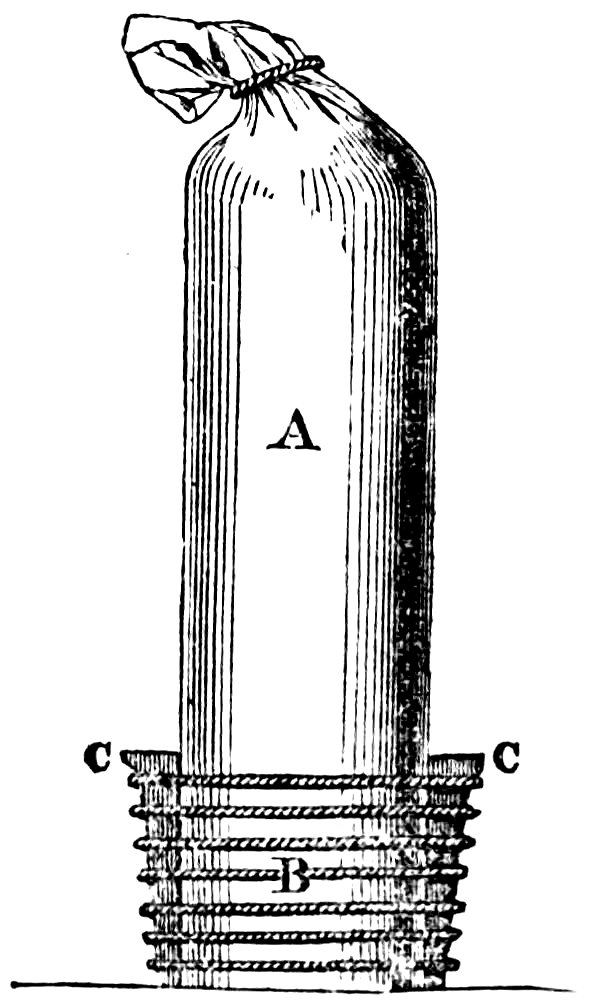
Fig. 74.
But we have still to speak of the way in which these coloured lights are to be fastened to the pieces which they are designed to decorate. The most common 125way of doing this is to drive a nail into the wooden framework of the piece at the place where you wish to place the coloured light, and to tie the case which contains it to this nail. Two nails, like “two heads,” are better than one, and the case may be secured as shown in the annexed sketch (fig. 74). A represents the coloured light case; B the string which is passed round its lower clayed end, by means of which it is secured to the two nails, C C, which are driven into the wooden framework. This mode of fastening is very simple and effective for attaching the coloured fire cases to the framework of a fixed piece. But in the case of a wheel, or any piece which has motion, it is, in my opinion, very desirable to give them a position like that of the wheel-cases—i.e., to let them revolve with their mouths in the opposite direction to that of the motion of the wheel. This is easily done, either by fastening them between the spokes of a large wheel, or, in the case of a small one, by driving in a longer nail than is necessary, and bending down the head of it in the desired direction, and fastening the coloured light case to this bent part (fig. 75).
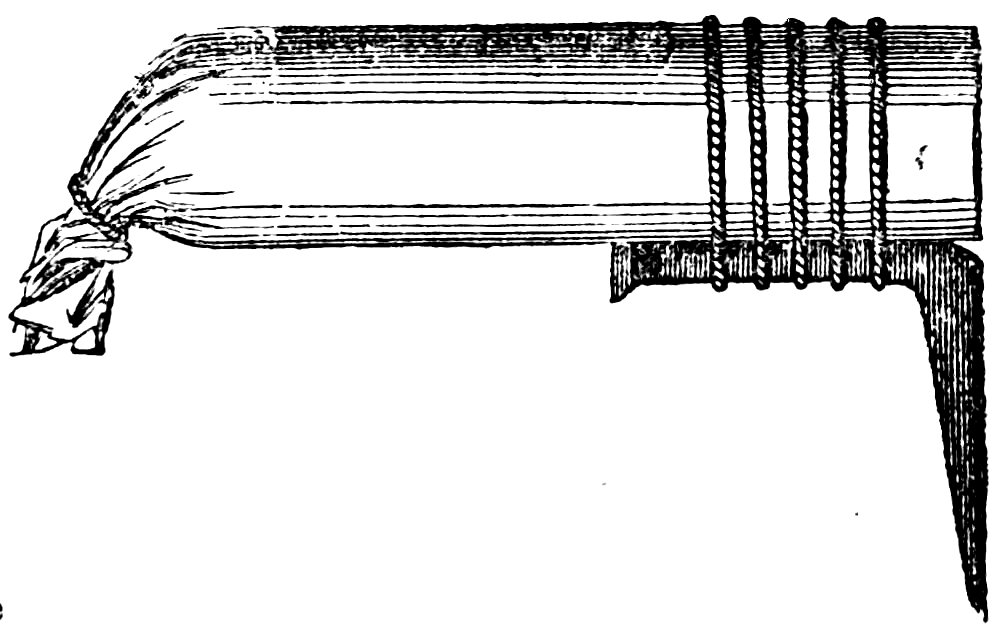
Fig. 75.
By this means you will have no difficulty in attaching these little decorations in any place, to any part of the framework of your piece, or in any direction. The object of turning the mouth away from the direction in which the piece moves is that the resistance offered by the air during its revolution 126may not interfere with the easy combustion of the coloured light.
But we have yet to say a few words about the filling these 1 or 2-oz. cases, and their priming.
The compositions used for this purpose do not require, it must be remembered, to be rammed into the cases; they only need be pressed in so firmly that their motion during combustion shall not shake them out. Of course they should be uniformly pressed in, and this is simply done by pressing in only a small quantity at a time.
With regard to their priming, this may be done in either of the following ways—by smearing into their mouths some wetted meal-powder, or, what is better, by pressing into their mouths a piece of quick-match, and then pressing a little of the coloured composition over that, and allowing the end of the match to project about half-an-inch. But in whatever way they are primed they must have two rounds of some thin paper pasted round their mouths, and projecting an inch or so beyond them, into which the leaders can be tied which are to connect them with the other cases of the piece.
In the case of small wheels, in which only one of these coloured light cases is to be employed, it will be advisable to fill it with compositions of different colours. Press in first enough red-light composition to fill one-third of the case; then enough purple to occupy another third, and fill the remainder of the case with green composition. By this means you will be able to vary your effects to any extent.
I now wish to give you directions for making a very beautiful and effective firework, in which these coloured lights play a prominent part. I must refer you to the page of illustrations which accompanies this paper, in order that you may have no difficulty in understanding the directions which I am now about to offer.
127In its general working the piece is very similar to that which I have described under the name of “Brilliant Wheel” at paragraph 43. But it is at the same time a great improvement upon the one there spoken of. Cut a piece of deal or beech board into the shape drawn at A A. (fig. 76). This should be at least half-an-inch in thickness, and not less than three feet in length. When you have shaped it as you intend to leave it, find its centre, the point at which it balances. Through this point bore a hole of such a size as will easily admit the iron spindle which screws into your firework post (fig. 70). At each end of this wooden frame place three wheel-cases, taking care that the position of the mouths of these cases is so arranged that their driving power shall all be in one direction. A quick-match leader is to be carried from the tail of the extreme case at each end to the mouth of the next, and then from the tail of these to the mouths of the third at each end.
Two more pieces of wood (represented at B B. fig. 76) will now be required, each about twelve inches long, five-eighths of an inch wide, and three-eighths of an inch thick. They must have a hole bored through them, into which a spindle or smooth round nail can pass easily. But this hole must not be in their centre; it should be bored about four inches from one end, which will leave eight inches on the other side of the hole. Through these holes drive a smooth round nail into the long framework of the piece, exactly half-way between its centre and the innermost wheel-cases. The object of hanging these two pieces not by their centre of balance is that one end being longer, and therefore heavier, than the other, may cause the pieces to fall round by their own weight, as the firework makes its revolutions. To these two pieces coloured lights are attached at each end in such a position that they shall project horizontally at right angles with the pieces B B. 128This will be seen clearly by reference to the drawing at C C. (fig. 77), which is intended to give you a side view of the same piece. It must not be forgotten that the satisfactory performance of this firework depends mainly upon the exactness and true adjustment of the woodwork. Unless the revolving pieces are neatly hung, and the balance of the main framework is true, you must not expect success.
The coloured lights may be arranged as follows:—A green and a red light on one of the revolving pieces, and a purple and red on the other. These coloured lights are all to be connected together and with the mouths of the two extreme wheel-cases by quick-match. It will be obvious, then, that the coloured lights must be so prepared as to last during the combustion of the three driving cases.
The drawing at (fig. 78) represents a rather better position for the wheel-cases than that given at (fig. 76).
The diagram (fig. 79) represents a wheel frame, to which are attached at f f f coloured lights. The position there indicated is a very good one for coloured lights when required for wheels of any such make as that in the drawing. You must not forget that they are all to be placed at different distances from the centre of the wheel. They may, of course, be made to play their part at any period of the wheel’s revolution. The coloured lights, for whose manufacture I have given directions above, are very valuable auxiliaries in nearly all exhibition pieces, and that we shall have occasion to call them in frequently to our aid as our practical pyrotechny becomes more advanced, and our enthusiasm in the art leads us to search for new combinations and effects.