MANUFACTURING.
Reading edition
ROCKETS.
3. Having now cleared our way of these necessary preliminaries, we may at once proceed to speak of the manufacture of Rockets; first, of what a rocket is, and then of how it is made. There is nothing like starting with a good distinct notion of what we have to make before we set to work to make it. It is said of a person who was asked by his friend to give him a logical definition of a house, that he at once replied that “it was a thing with a chimney;” which definition, being equally applicable to a moderator lamp and a steam-engine, can hardly be considered exhaustive in the case of a house; and, in like manner, if we start with the idea that a rocket is a thing that goes up in the air, we shall not have any very tangible model of rocket excellence before us as a guide in our work. It is, however, very true that some rockets which we see can only be properly and faithfully described as things which go up in the air, for they no more deserve the name of a rocket than does a child’s kite or a cock-sparrow, either of which would come equally well under the above definition. But let us see whether we can arrive at something a little more accurate. A rocket we will define as a species of firework which, when properly fastened to a stick of a certain size and weight suspended with its mouth downwards, and ignited, ascends into the air by the force of its own combustion, rises majestically to its proper height, throwing out, from the beginning to the end of its course, a rich and uniform tail of sparks, and at the extreme range of its flight giving birth to a cluster of stars, or shower of fiery rains, or other decorations, as they are called, which should burn long enough to be well seen, and not disappear almost at the moment of their appearance. This is what every rocket should be when fired; 16and let me beg of you not to stop short of attaining this excellence, for perseverance will give you experience, and with the aid of these two you need despair of nothing. When I had been puzzled and misled by all the books and information on the subject that I could procure, and had met with nothing but failure in all my attempts, I set myself to work to make my own experiments in a new direction, on the supposition that I understood, to a certain extent, the principle on which success depended. And well do I remember my delight at seeing a rocket of my own production scramble up into the air in a very undignified and disorderly manner, and there perform certain nervous evolutions which I will defy any pen to describe or pencil to depict. But although its performance was erratic and laughable, I had conquered; the key from that moment was in my own hands; and soon, after careful consideration and a few more experiments, I managed to produce a rocket of which I saw no reason to be ashamed.
I have stated above what appearance a good rocket should present to the eyes of a spectator when fired; I am now about to state what appearance it should present to its manufacturer before being fired—in fact, what it is that he has to make. It is a strong cylindrical case, made of pasted brown paper and imperial board, contracted near one of its ends in order to form a narrow aperture, and filled with a certain composition in such a manner that a long narrow cavity is left in its centre, extending almost throughout its whole length. This is what I shall call the rocket, for the ascending power lies solely in this part; the head, being an after-addition, will be spoken of it in its proper place, and not allowed to interfere here. In the annexed woodcut A A represents the exterior diameter of the case; B B, the interior diameter of the same; C C, the long cavity extending from the mouth up the centre of the composition, which cavity is called the 17“soul” of the rocket; D D D, the composition with which the remainder of the case is filled. The lower of the two C’s represents the mouth, or “choke” as it is called, at which all the combustion that goes on in the rocket has to find its vent. When a light is applied to the mouth of the rocket, the whole surface of the soul of the rocket is set on fire at once, and on this depends its power of ascent; for so large a quantity of fire having to make its escape through so narrow an aperture and meeting with considerable resistance from the external air, makes the rocket recoil in a direction opposite to that of its mouth, until all the combustible material which it contains is consumed. This is a broad outline of the principle upon which rockets ascend. It will be unnecessary for me to dive deeper into theories here, for I am sure that you will be anxious for me to come to practical details without further delay.
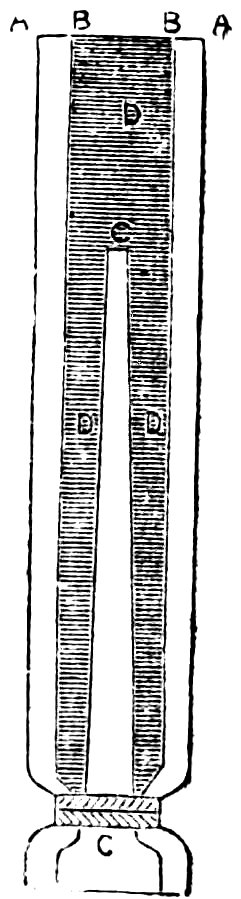
Fig. 1.
Among other things in my prefatory remarks I stated that firework-making need not be an expensive recreation, but you must bear in mind that nothing is easier than to make it expensive, and that we must adopt some strictly economical system of operation. Since rockets are the most scientific of all fireworks, and the apparatus necessary for making them is more costly than that for making any other kind of firework, we must do all that we can to bring their manufacture within reach of the amateur. There are many books, and I dare say many persons, that will tell you that you cannot hope to produce a good rocket unless you have a mould proper for the purpose made either of gun-metal or of some hard wood. I believe that I am right in telling you that 18such a piece of apparatus varies in cost from 3l. to 10l., but I also know that I am right in assuring you that a rocket, in every respect equal to many that are rammed in a mould, may be produced without this expensive luxury. I can only say that I never use a mould, and my belief is that the workmen employed by professional pyrotechnists are, for the most part, only too glad to dispense with its use, for it is of importance to them to ram the greatest possible number of rockets in a given time, and if they were to be delayed by having to unscrew and screw a mould before and after filling each case, half their time and its value would be lost to them. I use, and recommend you also to use, a simple steel spindle let firmly into a wooden block, and if your cases are made strongly enough you will be able to produce all that your ambition will picture to you by means of this inexpensive apparatus, and without the help of the mould.
But before we speak of the size and proportions of this spindle it will, of course, be necessary for us to determine the size of the rocket which we intend to produce. Now, the rocket that I recommend you to make, as being the most generally useful and economical, is that which the professionals call the ¼lb. rocket. You will bear in mind that this name is not intended to signify that the rocket when finished will weigh a quarter of a pound, but that its interior diameter is equal to the exterior diameter of a leaden ball weighing 4oz. You will find, I am sure, that the capabilities of this size of rocket, when properly made, will satisfy you for all ordinary purposes, and, taking this for granted, I shall now proceed to speak of this particular size only, in order to prevent the possibility of confusion.
ROCKET-CASES.
4. The first thing that you have to do is to make the case. 19Do not hurry over this part of the process, for more depends upon it than is generally supposed. It is made in the following manner:—Procure some imperial board (which is a kind of thin pasteboard made of two sheets of brown paper pasted and pressed together); also some stout Kentish brown paper of such a substance as will weigh 70-lb. per ream. Now fold a sheet of the imperial board down the middle of its length, thus:—
Cut it along this fold, then divide each of these halves crossways into five equal parts and cut them apart. Each sheet will thus furnish enough board for ten ¼lb. rocket-cases. This board is only made in one size. Now take a sheet of the 70-lb. brown paper, divide it into halves at its natural fold, and then divide each of these halves crossways into four strips. One of these, together with one of the strips of imperial board, will be sufficient to make one case. I have given you above the directions for cutting your paper and board without waste; you will, however, find it more convenient to buy them ready cut up; it will save you time and trouble, and will occupy much less space among your stores. They can be procured of Mr. W. H. Darby, 98, Regent Street, Lambeth, London, and he will supply them ready cut if you only state for what purpose they are intended.
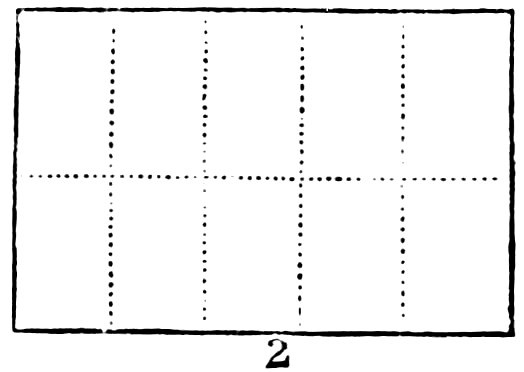
2
The “former,” on which the board and the paper are to be rolled, is simply a piece of brass tubing, about 12 in. long, and ¾in. in diameter. This you had better procure of the person whose name I shall mention presently, when I speak of apparatus, and to whom I recommend you as a maker of all pyrotechnic tools, except such things as the sieves, &c., above mentioned.
20I must not speak about the pasting and rolling of the cases until I have said a few words upon the subject of the paste itself. It is a great mistake to have your paste made thick; you will gain nothing by doing so, and you will find it very troublesome to use. It should be made of such a consistency as will admit of its being spread very readily upon the brown paper, &c., and by being tolerably fluid will saturate it much more thoroughly; and this, after all, is what you want to do, for the hardness of the finished cases depends far more upon the complete saturation of the paper than upon the thickness of the paste between its layers. The brush, which you will find convenient, is one about 2in. in diameter, and can be procured of Mr. Darby. Into each pint of paste, while boiling, put a large teaspoonful of powdered alum; this will have the effect of keeping your paste sweet and free from mouldiness for weeks, and will also prevent it from becoming watery, which it would otherwise do in a few days.
I will now suppose you to have your paper, imperial board, paste, and brush ready to hand. You will next require some kind of slab on which to paste and roll your cases. For this purpose I use one of the largest common roofing slates that can be procured: its size is 24 by 12in. This makes a cheap and very serviceable pasting slab if its surface be only moderately smooth.
Now we come to the actual rolling of the cases. First paste all over one side of one of the strips of 70-lb. brown paper; then take one of the strips of imperial board, and fold one end of it once round the brass tubular “former.” Hold this, thus folded, with your left hand, and paste over all the rest of the upper side of the strip with your right. Then roll it up, as straightly and as tightly as you can, till all but about 3 inches of it is wound upon the “former.” 21Upon these projecting 3 inches lay the end of the strip of brown paper, with its pasted side upwards, and then roll it till both board and paper are neatly and closely wound round the “former.” You will find at first a little difficulty in getting the strips to roll up straight, but a little practice will overcome this. You will now require what is called a “rolling board,” that is, a piece of common smooth deal board about 20 inches by 8 in size, with a wooden handle screwed on its upper side at one end (see fig. 3). Then with the left hand take hold of the end of the “former,” which projects out of the case, loosely, so as to allow it to revolve in the hand, and with the right hand roll case and “former” from one end of the slate slab to the other between it and the rolling board, pressing upon the latter, and using it as a carpenter does his “trying plane;” and by this means the same effect will be produced upon your newly-made case as is produced upon linen, &c., by a mangle. These directions read, no doubt, as if they belonged to some very complicated operation; but let me assure you that it is one far easier to perform than to describe. Some modification of this plan will in all probability suggest itself to your mind as an improvement upon it; for there are few people who do not after a few trials fall into some method of working which, besides answering their purpose, has the additional merit of being peculiar to themselves. I may as well mention here that the quickest way of making cases is to paste all your strips of paper and board before you begin to roll any of them, taking care not to paste that part of each strip of board which is to make the first turn round your “former.”
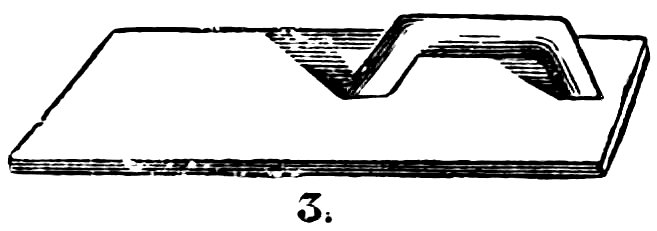
3.
22
7
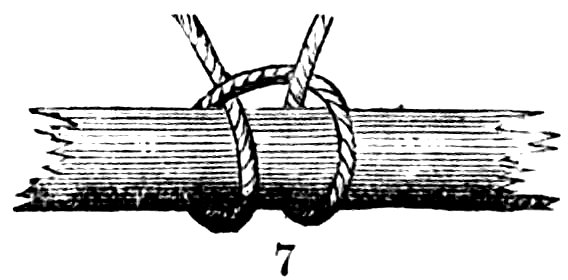
In the next place, when you have made as many cases as you require, the operation of “choking,” or forming their mouth and neck, remains to be done, and is to be accomplished in the following manner:—Procure some strong close string about one-eighth of an inch in diameter; take about one yard of this, and tie one end of it to a ring or nail which has been driven very tightly about 3 feet from the ground into a wall, beam, or tree, and the other end of this string tie firmly round a stout piece of stick or ruler about 18 inches long. Now take the round-ended drift (fig. 4), and insert this into one end of your cases till its rounded end appears about an inch from the other end, leaving, in fact, an inch at one end of the case unoccupied by the drift. Then take the little “choking piece” (fig. 5), and insert its metal point into the hollow end of the drift. This operation is illustrated at fig. 6. Now rub your string well over with yellow soap; the more thoroughly this is done the better. Then pass the stick or ruler between your legs in such a manner that by leaning backwards you can make the string very tight; but before tightening it give the soaped part of the string one turn round the part of the case marked e e (fig. 6), then by leaning backwards you will contract that part of the case until you leave an aperture only large enough to admit the point of the “choking piece.” As soon as this is done tie some string tightly round the neck thus formed, to prevent its becoming larger. The best knot for this purpose is the one given at fig. 7. Then, when you have drawn out your choking piece and drift, the proper name of which latter is “the setting-down piece,” your case must be put by to dry thoroughly before use. The apparatus given at fig. 8 is very convenient for choking cases quickly, and is given in case you should think 23it worth while to make such a thing. Any boy with a fair notion of carpentering would find no difficulty in making it. It is simply a string passed over a small wheel and fastened to a pedal which works on a hinge close to the ground. A glance at the diagram will show you that by putting your foot upon the pedal f the string may be drawn very tight. The case is choked at the point marked F. No choking can be done except while the cases are wet.
9
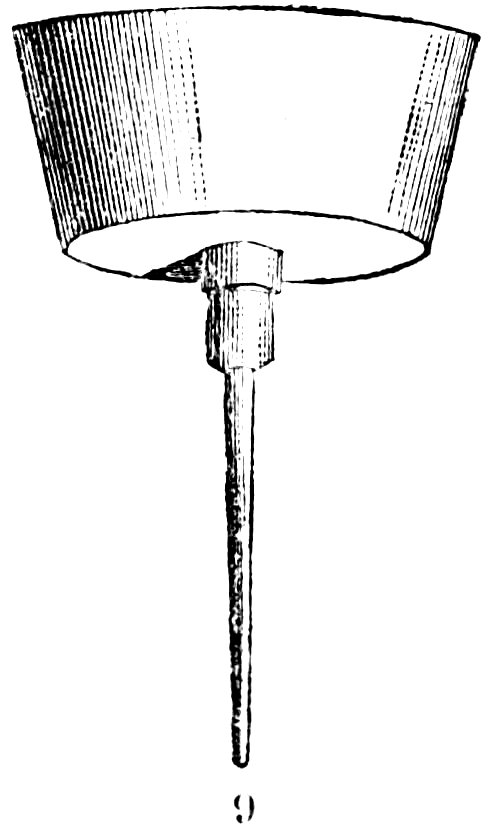
Now, supposing that you can do nothing else until your cases are dry, I will, meantime, introduce you to some of your tools. Fig. 9 represents the block and spindle over which your rockets are to be rammed. The case of the rocket is forced, mouth downwards, over this spindle by inserting into it the setting-down piece (fig. 4), which you have used before, and giving the handle of this some blows with the mallet (fig. 10). This operation has the effect of enlarging the choke to its proper size, and of making the mouth of the case very smooth and hard. The diagram (fig. 11), represents the steel spindle and nipple in its proper size. The part marked g g is driven into the wooden block which forms its foot. Fig. 12 represents the rocket-case driven down upon the nipple when ready to be filled with its composition. Figs. 13, 14, 15, are three drifts of different lengths, pierced so as to admit the steel spindle, and to be used for driving the composition into the cases round the spindle. They are used in the following manner:—A ladleful of the composition is put into 24the case, and then driven down with the longest of these drifts by the mallet; then another ladleful driven with the same. Then a shorter drift is taken for the next few ladlefuls; then the shortest, till the case is full up to the top of the spindle. Then the unpierced drift (fig. 15) is used to ram in some composition solid, and to drive some clay upon the top of this. This operation will be described much more minutely in its proper place. Fig. 17 represents the “former” on which the cases are rolled.
These tools may be procured at a very reasonable price of Mr. Newman, 4, Augustus Street, Regent’s Park, London.
Having made you slightly acquainted with the various tools and apparatus to be used in making and filling rocket-cases, it will now be necessary for me to say a few words about their size and proportion, for much will depend upon accuracy in this particular. I have given you a sketch of four drifts to be used in loading your cases with composition. The longest of these I shall call the first; and the shortest, which is the solid one, the fourth; this being the order in which you will have to use them. The measurements that I am now about to give have reference only to the straight part of the drifts, not taking their handles into consideration. The length of the first drift is 6 inches; second, 4½; third 3¼; fourth 2¾. The first three of these drifts are pierced or hollow, in order to admit the steel spindle over which the rocket is rammed. The first should be pierced to the length of 4 inches; second, 2½; third 1½.
Taking the exterior diameter of ¼ lb. rocket to be about 1 inch—and this measurement is near enough for our purpose—the former on which the cases are rolled should be ¾ of an inch in diameter, and the drifts about ¼ of an inch in diameter. The “former” should always be slightly larger in diameter than the drifts, because the paper that 25is rolled upon it is thoroughly wetted with the paste, and in drying will shrink a little; and, therefore, if your drifts be of the same size with your former, you will find considerable difficulty in getting them in and out of your cases; they ought to be a good easy fit. Twelve inches you will find a convenient length for your former.
In case you should wish to prepare rockets of other sizes, and in order that you may readily see the relative magnitude of cases of such sizes as are generally used in the art of pyrotechny, I here append a table:—Those which are called
1-oz. cases are about ½ inch bore.
2-oz. „ „ ⅝ „
¼ lb. „ „ ¾ „
½ lb. „ „ 1 „
In following the directions which I gave in my last paper for cutting up your imperial board and 70-lb. brown paper for rocket-cases, you will find that the case produced will not be a very stout one. Although I have made an excellent rocket in a case of such a thickness, you will, perhaps, find it advisable to use more paper and board, and prepare a thicker case. For this purpose cut your board in the manner that I have described before for your 70-lb. brown paper—that is, into eight equal strips—and then cut each of your sheets of brown paper lengthwise into four equal strips. By this plan you will be able to make very stout cases, which will not be at all liable to injury during ramming; and thus one sheet of board, with two of brown paper, will furnish eight ¼ lb. rocket-cases. You must bear in mind when choking them to contract the aperture till it is considerably smaller than you will eventually require it to be. The setting-down piece (fig. 4) has two uses: it is employed first in choking the case, and afterwards in driving or setting it down, when choked, over the steel 26spindle. The reason for driving the case thus down till the mouth is brought close to the nipple at the foot of the spindle is that the choke or aperture may thus be left of the proper size. This proper size is about two-fifths of the inner diameter of the case; and the aperture left immediately after choking should not be much more than one-fifth of the same inner diameter. The operation of “setting down” the cases is performed best, in my opinion, when they are perfectly dry and immediately before they are filled.
ROCKET COMPOSITION.
5. Now supposing your cases to be thoroughly dry and ready to be charged, the next thing that we must consider is the composition with which they are to be filled. Judging from the effect produced by rockets prepared by different makers, I should imagine that the formulas for their compositions are of almost endless variety. Some seem to prefer a very quick composition, which will raise the rocket to a great elevation in a very short time; others, one which will produce a large and rich tail of sparks not ascending so fast or so high. In my opinion, the mean between these two extremes is decidedly preferable: that which I aim at in rocket manufacture is to produce a very high, but not a very rapid, ascent; and when this my object has been properly gained, I have never had any fault to find with the tail of sparks which is thrown out. I may say, without any exaggeration, that I have experimented upon several hundreds of different compositions, varying first one ingredient and then another, increasing or decreasing them by very gradual steps, until I have come to the conclusion that the two following are the only ones worth retaining. But it must be remembered that it is not enough to have a good formula 27or two in order to be successful, for much will depend upon the manner in which, and the care with which, these are made up:—
No. 1.
Nitre 16 parts.
Sulphur 4 „
Charcoal 8 to 9 „
This, I believe, is a very old formula, and, provided the charcoal be properly prepared, may be found very useful and effective. I used this receipt for a long time, and thought it incapable of improvement, until, from a wish to try the effect of the addition of a little meal-powder, I came by chance upon the following, which I do not think can be surpassed:—
No. 2.
Nitre 16 parts.
Sulphur 3 „
Meal-powder 4 „
Charcoal 8 „
Now let me tell you that the success of rocket compositions depends upon two things—the intimate union of their ingredients, and the fineness or coarseness of the charcoal. Such charcoal as you can procure at a chemist’s ready pounded will be of no use whatever to you, for it is in far too fine a state of subdivision. You will require a much coarser charcoal for the most part, and one not of the same coarseness or fineness throughout. If you could make a mixture containing charcoal of three different degrees of fineness—the first moderately fine, the next in pieces of the size of grains of ordinary sporting gunpowder, and the third of the size of large poppy seeds—and take equal parts of each of these three you will find that you have a mixture very serviceable for rocket purposes. But you can procure of Mr. Darby, whom I have mentioned before, a mixed charcoal which will save 28you the trouble of sifting. I recommend you, however, to use no charcoal that will not pass readily through your 20-mesh mixer, for your object is not to have your charcoal in large pieces, but to have a certain proportion of it coarser than the rest. You will find that the larger your proportion of coarse charcoal is, the slower your composition will be, and, within certain limits, the more fine charcoal you employ, the quicker it will be. Now, as the sparks produced by coarse charcoal remain visible in the air much longer and are much larger, than those produced by fine charcoal, I think it advisable to employ a good proportion of the coarse and in order to make up the strength that the composition loses by this plan, I take a smaller proportion of sulphur, as you will see by comparing formulas Nos. 1 and 2, and at the same time add a certain quantity of meal-powder. All these ingredients may be procured of Mr. Darby. The mode of mixing them is as follows:—Weigh out your quantities of nitre, sulphur, and meal-powder, mix them well together, and pass them through your 40-mesh sifter. This you will have no difficulty in doing, because the condition in which you purchase them is one of fine powder; your meal-powder especially cannot be too finely sifted for this purpose. You will find it a great convenience to add to this mixture a few drops of methylated spirits of wine or gin—a very slight quantity will suffice to render it less dusty—but you must bear in mind that whenever either of these liquids is employed, the composition will be sure to rust the steel spindle around which it is driven, unless you take the precaution of rubbing it over with a little oil or grease after using and before putting it away. Next add your charcoal. Stir the whole together, and pass the mixture two or three times through your 20-mesh mixer; by this means it will be thoroughly incorporated and fit for use.
29
ROCKET RAMMING.
6. Now we come to the actual ramming of the rockets; and, unless you intend to be a great nuisance to your friends and neighbours, you had better not dream of performing this operation indoors, it being productive of much noise and jarring; and you will find that they will not take much interest in your pyrotechnic progress when they have been annoyed and deafened by your frantic efforts for their amusement. You had better choose, therefore, some place either out-of-doors, or in an outhouse, where you are not likely to be interrupted or interfered with; the outhouse, of course, will be preferable, because there you will not be exposed to wind and weather, the former of which, especially, is often a source of considerable inconvenience when working out-of-doors. But whatever place you decide upon, you must have a very solid block of some kind, which is better made either of wood or stone, and must be set upon, or let into, solid ground. I should think that you will find no difficulty in meeting with one, made of either of these materials, in any carpenter’s or builder’s yard; odd pieces of stone and timber which would answer your purpose may generally be procured for a few pence. The stone block which I use is about 12 + 8 + 8 inches. On your block I recommend you to put nothing but the wooden block into which your spindle is fixed. The composition which you are using should never be placed upon it, because it is sure to become to some extent unmixed by the concussion caused by the blows of your mallet, for the particles of any coarse ingredient which it contains will find their way to the surface. You will find it advisable to have your block, and the table on which your tools and composition are placed, of such a height from the 30ground that, in working, you need not stoop or put yourself into any uncomfortable attitude.
Next we have to consider what is the most convenient receptacle for your composition while your cases are being filled with it. I use a copper scoop capable of holding about 8 ounces of composition, made something like an open coal-scuttle in form, which I have always found very convenient, and which is represented in the annexed woodcut (fig. 17).
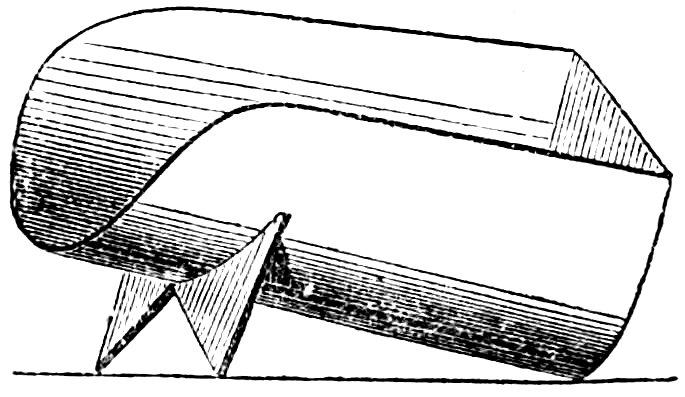
Fig. 17.
You will next require a small ladle made of thin copper or brass, of such a size that it will take up just as much composition as you should put into your case at a time, and will admit of being passed into the case. By means of this you will be able to drive in the composition very uniformly, for by giving a certain number of blows of a certain power to each ladleful, you can be sure of an equal compression throughout the length of the case. Such a ladle Mr. Newman will supply with your rocket tools, of the right size for filling ¼ lb. cases.
I will now suppose you to be ready at the ramming-block, with all your tools about you, your composition ready, and your case driven firmly down over your spindle. I strongly recommend a slight moistening of the composition as directed above before you begin to ram it. Now, taking the longest of the drifts (fig. 13) in your left hand, insert into the case when the first ladleful of composition has been put in. You are not to suppose that by “a ladleful” I mean as much composition as can be heaped up upon the ladle or scoop, but as much as will lie within it after you have passed the drift over its surface, and have levelled the 31composition to the height of its sides. To this first ladleful of composition give fourteen blows with the mallet: it is not necessary to exert much force in this operation, for the weight of the mallet will be nearly enough to do the work for you; and you will find that after each stroke the mallet will recoil with the blow to a point almost high enough to be the starting-point for the next stroke. Having given the proper number of blows, take another ladleful of composition, and when you have put it into the case, drive it down in the same manner as the former one with the same number of blows. Then for your third ladleful take the longest drift but one, which must be used for this and the following ladleful, giving to each of them sixteen blows. Then take the shortest hollow drift, and use this for as many ladlefuls as will make the composition rise to the top of the steel spindle, giving eighteen blows to each of them. Then by inserting the short, solid drift, you will be able to measure the distance between the top of the spindle and the top of the case. When you have taken this measurement, make a mark, on the outside of the case, which will show you how high the spindle rises on the inside. By adopting this plan, or any other that may occur to you as simple, you will always be able to ram the same quantity of solid composition above the spindle. This is really an important matter, and one on which depends mainly the beauty of your rocket’s performance when it reaches its greatest elevation in the air. There are great varieties of opinion as to what should be the quantity of composition rammed solid above the spindle, and it is a much more common matter to find too little than too much composition used for this purpose. The effect of using too little is, that the rocket does not fairly arrive at its turn before its stars or other decorations are thrown out. This, in my opinion, is a considerable fault; for it robs the rocket of a 32great deal of the elegance of its flight, and gives one the idea that it is in a hurry to get its work over. Nothing but actual experience and observation will enable any one to decide which he considers the proper quantity of solid composition. I consider the best length for this part of the rocket to be that of the exterior diameter of the case—that is, an inch or rather more for rockets of the ¼lb. size. Larger rockets, I have always found, do not require quite so much in proportion; smaller rockets rather more. You should give twenty blows with the mallet to each ladleful of this solid composition. I am well aware that this number of blows sounds like a great deal of hard work, but you may rest assured that these twenty blows, given as I have directed above, will occupy only five or six seconds of time, at the cost of very little exertion.
Having now completed the ramming of the composition into your case, you will next require some common potter’s clay in dry powder; this can be procured of Mr. Darby in a condition proper for use. Take half-a-ladleful of it, and ram it down very hard upon the top of the composition with the solid drift. This clay when thus compressed will form an end to your rocket nearly as hard as stone—not so hard, however, but that you can bore a hole through it about ⁵⁄₁₆ths of an inch in diameter, which will allow of the necessary connexion between the rammed composition and the stars or other contents of the head of your rocket. In the next place I will speak of the
PRIMING.
7. This may be done in two ways; for exhibition purposes I should merely put into the mouth of the rocket some meal-powder-paste made as follows:—Make a rather soft, but not too liquid paste, by moistening meal-powder with gum-water 33made of the strength of 2-oz. of gum-arabic to a pint of water. With the flattened end of a stick rub some of this paste into the cup formed at the choked end of the rocket, taking care that none of it is left in the choke or narrow aperture at which the fire from the rocket has to find vent; for, if any should remain there, the rocket when fired is almost certain to burst. Any of the paste that happens to be forced into this aperture may easily be taken out afterwards by means of a piece of wire or stout pin.
Your rocket is now finished as far as its ascending power is concerned.
ROCKET POT.
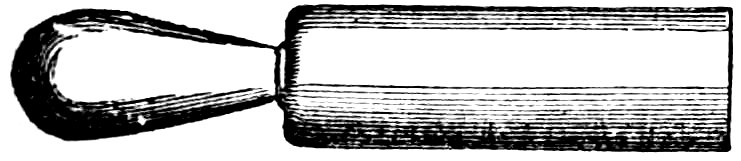
Fig. 18.—Pot-former.
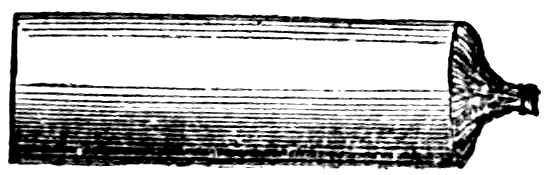
Fig. 19.—Rocket pot.
8. I will tell you my method of making the head, or pot as it is termed, of the rocket. You must have a piece of hard wood turned of a shape like that indicated in the following woodcut (fig. 18). The straight part of this should be about 4 inches long, and a shade larger in diameter than the exterior of your rocket-case—that is, about 1⅛ inch in diameter, if you adopt the method of cutting up your imperial board and 70-lb. brown paper given in this chapter. Now take some moderately thick brown paper, and cut it into strips about 5 inches in width and 8 in length; each of these strips will be long enough to go twice round the pot-former described above. When you have pasted as much of each strip as will not lie actually against the former, roll it up straightly and pinch in one end; you will thus have made a cylinder of paper (fig. 19) closed at one end, the other end of which will fit nicely over the clay end of 34your rocket. This is the pot of the rocket, which is to contain your stars, rains, &c.
ROCKET CONES.
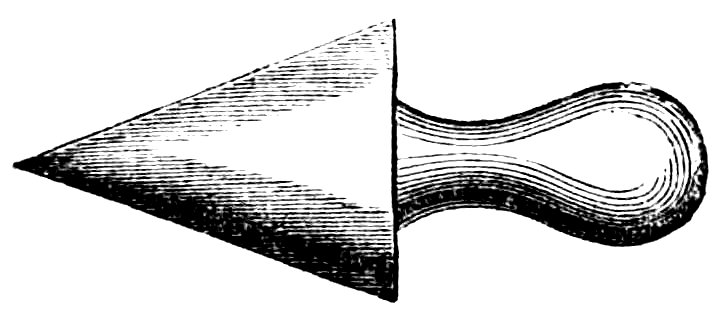
Fig. 20.—Cone-former.
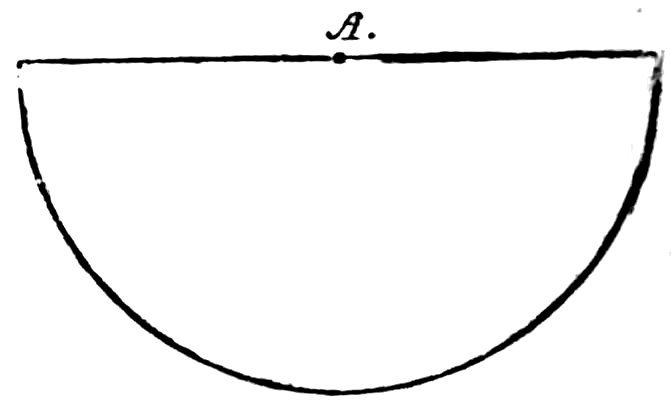
Fig. 21.—Paper for Cone.
9. You will next require a turned wooden former on which you can make paper cones of such a size at their base that they can be neatly pasted on to the top of your pots—that is, the base of these cones should have the same diameter as the pots. Although such conical caps are by no means necessary, yet they are a very great assistance to the rocket in its ascent, enabling it to rise with much less resistance through the air. The cone-former is represented in the annexed woodcut (fig. 20). To make these cones upon it, cut out as many circular pieces of brown paper as you require, the semi-diameter of which must be slightly greater than the height of the cones that you have to make. Then cut or tear these circles into halves and paste them on one side. Now place the first half-circle upon the former, pasted side outwards, taking care that the apex of the cone beat the point marked A in fig. 21. Then fold the brown paper neatly round the cone-former, and when you have made it to sit as closely to it as possible, proceed in the same manner with the other half-circle, putting it upon the first, pasted side inwards. The paper cones thus made must next be covered 35with one thickness of thin paper cut large enough to extend ½ an inch or rather more beyond the open end of the cone, and this projecting part, when notched all round with your scissors, can be pasted down round the top of the rocket pot. When this is done the pot will present the appearance of annexed illustration (fig. 22).
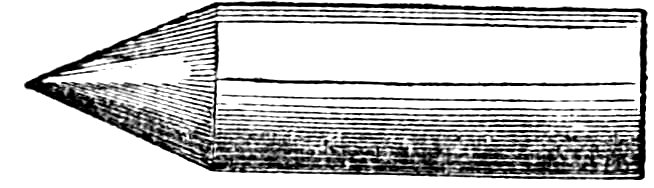
Fig. 22.—Pot, with Conical Cap.
ROCKET STARS.
10. When all the pasting that has been necessary in making the pots is thoroughly dry, the filling them with stars is all that remains to be done for the completion of the rocket. You will find that the ¼lb. rocket will carry an ounce of stars well. After weighing out your stars, then, into parcels of this weight, empty one of these parcels into each pot. You will next require some sort of powder to strew among the stars which shall have the effect of igniting them and at the same time of bursting the pot. I have always found meal-powder by itself to be too rapid in its explosion to convey the fire to all the stars; many of them are blown out of the pot, never taking fire at all. The mixture which I should recommend you to use is the following:—
Meal-powder 6 parts.
Fine charcoal 1 part.
Charcoal added to the meal-powder in the above proportion will render its combustion slow enough to light all the stars, without being too slow to burst the pot. Of this mixture take a ladleful (I mean the ladle which you use in filling your cases), and put it with the stars into the pot, which must now be securely glued over the clay end of the rocket-case.
36
ROCKET-STICK.
11. Lastly the rocket-stick remains to be considered. This appendage is used for the purpose of keeping the mouth of the rocket downwards, so that if it move at all its motion must be an upward one. The rule for telling whether the stick be of the proper weight or not is the following:—After having tied it on to the rocket in the manner indicated in the page of illustrations, ascertain whether it will balance if laid across the finger about 2 inches from the mouth of the rocket. If the stick forms an exact counterpoise to the rocket at this point, it will answer your purpose very well. The length of the stick which I use for ¼lb. rockets is 4 feet, and its size about ⅜ × ½ inch. The best wood for these sticks is American pine. It is very light, and should be free from knots. You will be able to procure them much cheaper of Mr. Darby, and much more uniform in their make, than of any carpenter. In some old treatises upon pyrotechny you will find recommended a tapering rocket-stick, to the large end of which the rocket is tied. I have never found any advantage which these sticks possess over those that are of one size throughout; and I think I may say that no professional pyrotechnist uses tapering rocket-sticks. On the annexed page of woodcuts (figs. 23 to 26) I have given you a sketch of the rings which I use, through which the rocket-stick must be passed, and from which the rocket is to be fired. These rings should be screwed into an upright post (fig. 27) standing 5 feet out of the ground; the upper ring near the top of the post, the lower about 3 feet from the ground. There is also a sketch (fig. 28) to show you how the rocket is to be suspended on this post.
I have stated above that there are two ways of priming rockets; the one used for exhibition purposes I have already 37described. Rockets thus primed are fired by applying a lighted portfire to their mouth. The other method I have found very convenient when making trials either of rockets or of stars, for it enables you to get some distance from the rocket-post before the rocket rises, and consequently to gain a much better view of the object of your experiment. It is done in the following manner:—Paste or tie a piece of touch-paper round the mouth of the rocket which shall project an inch or rather more beyond the mouth. Then take a piece of uncased quick-match about 2½ inches long, and put it into the soul of the rocket, leaving so much of it outside the choke as can be twisted into the projecting part of the touch-paper. If this is done so as to leave a short twist of touch-paper beyond that part which contains the quick-match, you will gain a short interval of time between the moment of lighting the rocket and that of its ascent.
You can procure of Mr. Darby the cases ready made, and, in fact, anything employed in firework manufacture; but I strongly recommend you to learn to make the cases yourself, as you will then be not only much more independent, but also much more economical in your work.
Let me recapitulate a little, and add a few hints to remind you of certain points important in rocket manufacture.
Do not hurry over any part of the work, either the making the cases or the composition, or the ramming of the rockets.
In moistening your composition with spirits of wine or gin, be careful to add very little of the liquid, and to stir the composition about very thoroughly until all the moisture that is present is very equally diffused.
Remember that the addition of nitre or meal-powder to your composition will render it more rapid in combustion; the addition of sulphur or charcoal more slow. By this means you can vary the strength of your rocket composition 38to any degree which proves successful or satisfactory in your hands.
By no means forget to bore a hole through the clay at the end of your rocket, and thus to form the communication with your stars.
Never allow your steel spindle to become rusty. Every coat of rust that you have to scour off from it diminishes the size of the spindle.
Remember that the work that is done neatest is always done best.
ROCKET STARS (How to Make).
12. By following a few simple directions for the manufacturing of these, you will be able to vary almost to any extent the heads of your rockets, and to produce combinations according to your taste and fancy.
The stars that are used as decorations to the different species of fireworks are of various kinds, sizes and shapes, according to the purpose for which they are intended.
1st. The ordinary rocket stars, which are called “brilliant” or “bright,” are made in small cubes. Their composition is moistened with gum-water, and while moist flattened to the thickness required. It is then scored or cut across with a knife, and allowed to dry. When dry it can be easily broken up into cubes at the places where it was divided by the knife. Tailed stars are also made in the same way and of the same size.
2nd. Roman candle stars are small cylinders of composition made of a size proportioned to that of the case out of which they are to be thrown.
3rd. Coloured rocket stars are made by driving the coloured composition, slightly moistened, into small cases, 39which go under the name of pill-box cases. If the star is to consist of one colour only, these pill-boxes are open at both ends, and a piece of quick-match is placed between the composition and the inside of the pill-box, and allowed to project about half-an-inch beyond each end of it. When fired, these stars burn at both ends at the same time, and so produce a great amount of fire in proportion to their size.
If it is required to make stars consisting of more than one colour (in which case they are called “changeable stars”), the pill-boxes are left open at one end only. The composition is thereby prevented from burning at more than one of its surfaces at a time. These stars generally contain two colours; the pill-boxes are half-filled with one coloured composition and the remaining space filled with another. These changeable stars burn much longer than the others, and therefore produce a more beautiful effect; but being larger they require to be used in larger rockets, the half-pound size being the smallest that is adapted for this purpose.
GOLDEN RAIN.
13. There is another and exceedingly beautiful decoration for rocket heads which is called golden rain. This is by no means a difficult thing to make. Some small paper cases are made, about 2 inches long and of the size of goosequills; these are filled with a sparkling composition and primed with wetted gunpowder. They are placed, mouth downwards, in the head of the rocket, and arranged in such a manner that they may all be ignited. At the bursting of the rocket, they will describe a series of beautiful ringlets of sparkling fire.
I have now enumerated as many different kinds of stars, 40&c., as will provide you with the means of producing any amount of variety. I now come to the details of the manufacture of these decorations. We will begin with the ordinary
BRILLIANT STARS.
14. First, let me impress upon you the necessity of seeing that all ingredients used in star compositions are in as fine a powder as possible. You cannot have them too fine or too well incorporated and mixed. The following is the formula which I employ for the
COMMON BRILLIANT STARS.
Nitre 16 parts
Sulphur 8 „
Sulphuret of antimony 4 „
Meal-powder 3 „
Let all these ingredients be in fine powder, and, having carefully weighed out the quantities, mix them thoroughly. Next, take some gum-water of the strength previously mentioned—viz., two ounces of gum-arabic dissolved in a pint of warm water. Spread your star composition upon a piece of zinc plate or slate, and add to it a little of the gum-water at a time, taking care to stir the composition about well till all the moisture is equally diffused through the whole. It is not necessary that this composition should be made wet, but only something like brown sugar in moistness, so that it will bind well when pressed together. When you think this is sufficiently done, roll or press the composition into a flat shape like a thick pancake, and make it as square, or, at all events, as rectangular, as possible. Its thickness should be about a quarter of an inch. You will find a large spatula a very convenient tool in this operation, both for flattening the cake of composition and for getting it into a 41convenient shape. Now take your spatula, and with it score the composition across both ways, so that you have it divided into a number of little cubes, fig. 30.
It may then be set aside to dry in a warm place; it will be forty-eight hours before it is fit for use in summer, and about a week in winter. When dry you will have no trouble in separating the cubes at the marks left by the spatula.
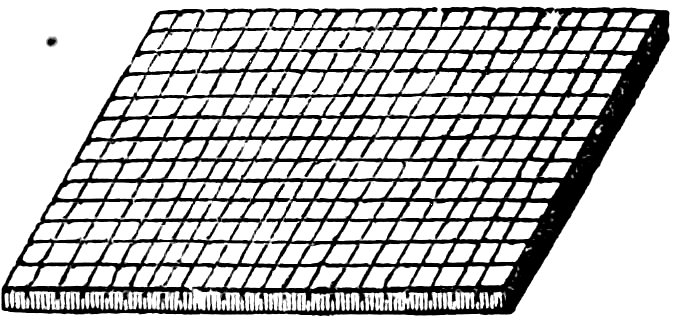
Fig. 30.
I may as well, however, introduce you to a simple piece of apparatus which will enable you to perform this operation much more comfortably and cleanly. I have a small wooden tray made of mahogany, six inches square, and three-quarters of an inch deep, inside measurements. Into this I place a flat piece of wood, which fits very easily into the tray, and is half-an-inch thick. This acts as a movable false bottom. It will be readily seen that when this false bottom is in the tray, placed upon the other bottom, the tray will be filled up so as to leave a depth of a quarter of an inch only unoccupied. This space I fill with the moistened star composition, having first rubbed the surface of the false bottom with soap to prevent any adhesion taking place between the composition and the wood. Having now pressed into the tray as much composition as will fill it to the height of its sides, I score it with the spatula as directed above. A large hole is made in the natural bottom of the tray, so that I can, by putting my fingers through it, raise the false bottom covered with stars out of the tray. I then place a piece of cardboard or zinc on the top of the stars and turn the false bottom upside down. The stars will be found to separate from the wood very easily, and may be left to 42dry on the zinc. The tray is then ready for another batch of stars.
The advantages of this plan are, that there is no trouble in getting the composition into a uniform, convenient shape and thickness; that the composition requires much less gum-water; and that, consequently, the process is a quicker and a cleaner one.
TAILED STARS.
15. The same plan may be adopted also for the making of tailed stars, with a slight variation which I now proceed to describe. These stars are not moistened with plain gum-water, but with a mixture of gum-water and linseed-oil. The gum-water should be of the strength given above, and should be made quite hot by placing the bottle which contains it in a jug of boiling water. When it is sufficiently hot, to every 8 ounces of gum-water add 1 ounce of linseed-oil. Shake the bottle till these are thoroughly mixed, and no oil can be seen. Use the moistening fluid, while hot, in the same manner as directed above for brilliant stars. The following is the composition for
TAILED STARS.
Nitre 16 parts.
Meal-powder 12 „
Antimony (sulphuret) 8 „
Fine charcoal 4½ „
Sulphur 4 „
If the above directions are carefully followed out, you will have some stars which are exceedingly beautiful in their effect, and by no means difficult to make. At its first appearance the star has nothing remarkable in it but the rapidity of its combustion. When this, however, is over, a 43kind of boiling lava is formed which remains red hot for a long time, and which, in its descent to the earth, takes the appearance of a glowing drop of golden fire, followed by a tail of sparks, remaining visible till it reaches the ground. I think the proportion of linseed-oil given above will not bear being altered without detriment to the performance of the stars. If less oil is used, the stars assume their tailed form sooner, and disappear sooner; if more, they will reach the earth before their principal and characteristic beauty is seen.
Both “brilliant” and “tailed stars” may be made in cubes whose sides are about a quarter of an inch. On account of the presence of the oil, “tailed stars” take a longer time to dry than “brilliant.” An advantage which they possess, besides that of superior beauty, is that they are much more sure of ignition than brilliant stars.
I may as well mention here that a tray for forming the stars, such as I have described above, and of the size given above, will contain about 8 or 9 ounces of composition at a time.
COLOURED STARS.
16. We now come to the very important subject of coloured stars. These require considerable care in their preparation, the beauty of their performance depending entirely upon the uniform fineness, the intimate union, and the dryness of their ingredients. If you wish to make these coloured stars with any degree of satisfaction to yourself, keep the various preparations which enter into their composition always ready for use—that is, in fine dry powder, preserved in well-corked or stoppered bottles. There is one chemical salt which requires 44especial care in keeping, on account of its deliquescent properties—that is, of its tendency to attract moisture from the air; and unless this salt, which is the nitrate of strontia, be thoroughly free from moisture when used, it will produce no effect at all, except a needless waste of chemicals. I must therefore tell you that the formulas which I am about to give you will fail most entirely in your hands, unless you are very particular in this matter of dryness. Over and over again have I been led to condemn formulas for coloured stars and fires as useless or imperfect, for the sole reason that I did not then know how their ingredients were to be handled, and what care was necessary for the production of their intended effect.
In the first place I strongly recommend you to attempt to make no coloured stars for rockets, except such as are made in the pill-box cases, of which I have spoken before. These pill-boxes are made in the following manner:—Procure a piece of straight iron rod, 12 inches long, and from three-eighths to half-an-inch in size; the usual size for this “former” is about seven-sixteenths of an inch. Now cut some cartridge paper into strips about 8 inches wide, and from 9 to 10 inches long; paste these strips all over, and roll them round the iron rod closely and neatly. When this is done, remove the case thus formed from the rod without tearing or breaking it, and set it aside to dry. When dry it will be very hard and stiff. It can then be cut, by means of a very sharp knife, into little lengths of half-an-inch each. These lengths are the open pill-boxes, into which your composition is to be rammed for coloured rocket stars.
In order to accomplish the filling of these cases with the least amount of trouble, procure a piece of stick, of a convenient length, and of such a size round that it will pass easily into the pill-boxes. Next take a small piece of quick-match, 45about 1½ inch long, and pass it through the pill-box in such a manner that it may project beyond each end about half-an-inch (see Fig. 31). You will be able to steady the pill-box while filling it by holding it by these two ends of quick-match. The composition pressed into these boxes is always slightly moistened; and by this means, when once dry, will not be liable to be shaken out again. In making, however, any trials of your coloured star compositions for your own satisfaction before making a large batch of stars, you had better press the composition in dry; by this means you will be able to see at once what their performance is worth.
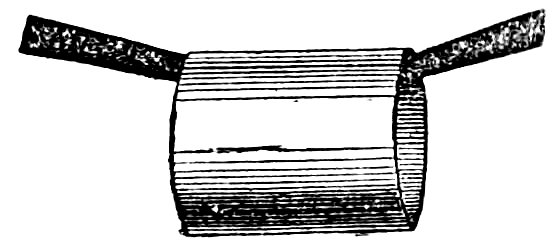
Fig. 31.
The fluid that I employ for moistening these coloured compositions is a solution of shellac in methylated spirits of wine. As shellac enters into the composition of many of these colours, it will not be necessary to make your solution a strong one. It should be of the thickness of the ordinary spirit varnishes, such as photographers use for coating their negative pictures. The exact strength is not a matter of any great importance, as long as you do not make the solution too rich in shellac; for by doing this you will impair the purity of your colour to some extent.
Remember that you must make these compositions wet. A very slight moistening is sufficient to make them bind well when pressed into their cases.
The first colour of which I shall speak will be the red, or crimson. It is in the preparation of this colour that you must be most careful about dryness.
46
CRIMSON STARS.
17. The composition which follows is, in my opinion, the best for
CRIMSON STARS.
Chlorate of potash 24 parts
Nitrate of strontia 32 „
Calomel 12 „
Sulphur 6 „
Shellac 6 „
Sulphide of copper 2 „
Charcoal (fine) 2 „
This composition gives a magnificent deep crimson when burnt at night. Do not be disappointed, if, in your experiments in the day-time, the colour should not appear very deep.
Remember that there are two kinds of colours in pyrotechny, and that beyond a certain point it is impossible to amalgamate their respective qualities. The first of these two kinds is the colour which has a considerable depth of tint, but which has not much reflective or illuminative power. The other kind is that which has a very decided, but not so deep, tint, and which is capable of surrounding itself with a luminous atmosphere of colour during its combustion—in fact, which has great brilliancy and power of illuminating objects. Now the last of these two kinds is the proper one to be employed for star purposes. We should never desire to produce a shower of dead-looking stars, however intense their colour might be. It is also an ascertained fact that the colour of stars always appears deeper when seen from a distance. Do not then be disappointed, I repeat, if the colour appears somewhat weak when you are making a trial of your composition just under your eyes in the day-time.
47Now, with regard to the crimson star composition above, remember that I only say that it is one that succeeds in my hands. You may, perhaps, think it too rapid in its combustion, in which case you can increase the proportion of calomel, or decrease that of the chlorate of potash. The calomel has the effect of deepening the colour, but at the same time of retarding the combustion, and of weakening the illuminative power. The shellac must be in as fine a powder as possible; it has the effect of producing a rich, thick flame, and also of rendering more sulphur unnecessary. It also enables the composition, after having been wetted with the above fluid, to harden into a mass tolerably impervious to moisture. The sulphide of copper is used for the purpose of giving a very slight bluish tint to the flame, and thereby of neutralising any yellow that might impair the purity of the crimson, arising from impurity of the chemicals.
You should keep all these ingredients ready powdered, dried, and sifted through your 40-mesh sifter; and then, when you require stars, you will having nothing to do but to weigh out the proportions given in the formula, and mix them on paper with a spatula. The more you handle the nitrate of strontia, or any composition containing it, the moister it will become, and the less effect it will produce. Therefore do not think of mixing the ingredients till you are ready to make your stars, and have a convenient, dry, warm place in which to stow them when made.
You can procure the things mentioned in the above receipt, and, in fact, those required for all the coloured compositions, of Mr. Darby, 98, Regent Street, Lambeth.
But, in case you may think it desirable to prepare and dry your nitrate of strontia yourself, I give you the following directions—
Procure a common earthenware pipkin, or, still better, a 48glazed iron frying-pan of a convenient size. Into this place your nitrate of strontia in rough crystals. One or two pounds will be sufficient to prepare at a time. Place the vessel on a clear fire, but do not make it too hot. There is not the slightest danger of explosion, as this salt cannot be induced to burn except in combination with other things. You must now boil, or rather stew, the crystals in their own water of crystallisation. The heat will soon cause them to run into a thick pulpy mass. When in this state, they must be constantly stirred, or upon the evaporation of the moisture they will resume a crystalline form. This you wish particularly to avoid, as your object is to get this mass into powder. Continue then to stir it with a stick or flat piece of wood until the moisture is driven off by the heat, and the salt remains in the condition of a white dry sand. A few trials will enable you to perform this operation in such a manner that after it the strontia will be ready at once for use. If, however, enough stirring did not take place, you will find some fused lumps among your dry preparations; these must be pounded in a mortar, and afterwards dried.
The operation described above is very simple, and does not take long to perform. No strontia can be used for coloured stars or fires unprepared. If, after keeping the dried nitrate of strontia for some time, you find that it is again becoming moist, it may be re-dried, either in the vessel used above, or in an open dish placed in a well-heated oven. This operation is proper also for the preparation of the nitrate of baryta.
For the solution of shellac you will find the following plan a convenient one:—Make a very strong solution of the resin in methylated spirit of wine, which shall be as thick as treacle. As you require your thinner solution for moistening coloured star compositions, dilute a portion of the thicker solution with the methylated spirit to the strength required.
49The sulphur used in all coloured compositions should be as free as possible from acid; otherwise, when mixed with chlorate of potash, it may be dangerous. If you have any doubt about it, wash the sulphur in a solution of common potash in water, and dry it gradually. The acid will be entirely neutralised by this plan. Never think of pounding sulphur and chlorate of potash together; they form a detonating compound which will explode with friction or percussion.
The compositions that I here give for colours are perfectly safe when made as I direct. I have made coloured stars from them, and placed these stars at the side of a fireplace till they have become so hot that I could not bear them in my hands, and I have subjected them to several tests, all of which they have stood well; and I think I may safely recommend them to you as not at all liable to spontaneous combustion or possessed of any dangerous quality. I must tell you, however, that they may be heated till they explode, but it is quite unnecessary and very foolish to expose them to any high temperature at all. In drying them, a good plan is to put them in front of a fire in a flat tin box, which will prevent any chance of their being ignited, and will at the same time keep them in a thoroughly dry atmosphere till they become perfectly hard. The box may be placed about two feet from the fire, so that it becomes moderately warm.
In filling the pill-boxes with composition, put a piece of quick-match through them, as directed above, and hold them by the two projecting ends of match. Let a short groove be cut in the side of the stick with which you press in the composition, large enough to allow it to pass the quick-match without injuring it.
50
ROSE-COLOURED STARS.
18. I now give you a composition for producing
ROSE-COLOURED STARS.
No. 2.
Chlorate of potash 20 parts.
Carbonate of strontia 8 „
Calomel 10 „
Shellac 2 „
Sulphur 3 „
Charcoal (fine) 1 part
The advantage of this composition is that it is not at all liable to suffer from damp in winter. The carbonate of strontia is a salt not deliquescent like the nitrate, and is, moreover, always to be had in a state of fine powder. The colour procured by the above formula is not so deep as that which the first composition will produce; but it is especially beautiful when contrasted with an intense blue. If its combustion should be thought too rapid, less of the chlorate of potash may be employed. It is to be moistened with the solution of shellac.
GREEN STARS.
19. Our next colour will be the green. I have especially observed that stars of this colour always appear far more intense when burning at a distance than when close to the spectator. The colour produced by the nitrate of baryta is never very deep where any great rapidity of combustion is required. It is, however, an exceedingly pretty tint, and is seen to its greatest advantage when used in contrast with a rich red. I employ the following formula for
51
GREEN ROCKET STARS.
No. 3.
Chlorate of potash 20 parts.
Nitrate of baryta 40 „
Calomel 10 „
Sulphur 8 „
Shellac 3 „
Charcoal (fine) 1 part.
Sulphide of copper 1 „
The composition made according to this formula will produce a colour which leaves nothing to be desired, if the several ingredients be only in fine powder, dry, and pure. It is not affected by moisture nearly so much as any composition containing nitrate of strontia. The shellac employed should be as fine as possible. And here let me remark that the reduction of shellac to powder is a process of itself; no coarsely-powdered shellac will answer your purpose. Mr. Darby will supply you with it in fine powder quite as cheaply as you can get it done elsewhere. Composition No. 3 is to be moistened with the solution of shellac. The sulphide of copper you may have some difficulty in procuring. You are sure, however, to meet with it at the shop of Messrs. Bolton and Co., 146, Holborn-Bars, London, but you must ask for the fused sulphide of copper, for there is a precipitated sulphide also, which is of no use to you. Do not use any of it that will not pass through your 40-mesh sifter. I add this ingredient rather as an improvement than as necessary to the composition. You may substitute for it, if you please, the preparation of copper which I am about to recommend in the composition for blue stars. If composition No. 3 should be thought too fierce, try the addition of a little more calomel.
52
PALE ROSE-COLOURED STARS.
20. The next formulas that I shall give are two which I have occasionally used and found effective. Their merit is that they possess a very intense illuminative power; their colour, however, is not so intense as that of those which I have already given. They have also the advantage of being very readily ignited, but care must be taken not to expose them to a high temperature in drying. The following are their formulas:—
PALE ROSE-COLOURED STARS.
No. 4.
Nitrate of strontia 8 parts.
Chlorate of potash 4 „
Sulphur 3 „
Sulphuret of antimony 2 „
Take especial care that the nitrate of strontia used in this formula be very dry.
21. PALE-GREEN STARS.
PALE-GREEN STARS.
No. 5.
Nitrate of baryta 16 parts.
Chlorate of potash 8 „
Sulphur 6 „
Antimony 3 „
The compositions made from both these formulas give a pale colour when seen close; but when falling from a rocket, and viewed at a distance, produce a very charming effect, particularly when contrasted one against the other. They must be moistened with the solution of shellac.
53
GOLDEN-YELLOW STARS.
22. The next colour that we will deal with is the yellow. The composition for this colour is a very satisfactory one, on account of its having no tendency to deterioration from damp. There are many formulas used for this colour directing the use of the nitrate of soda. This salt is, if anything, more difficult to keep dry than the nitrate of strontia. I therefore have abandoned it for another preparation, which I believe to be as effective and thoroughly permanent. I recommend the following for
GOLDEN-YELLOW STARS.
No. 6.
Chlorate of potash 20 parts.
Nitrate of baryta 30 „
Oxalate of soda 15 „
Sulphur 8 „
Shellac 4 „
If it be thought advisable to give the stars made from this formula a tailed appearance, add one part of fine charcoal. The composition is to be moistened with the shellac solution. The stars form a beautiful contrast with those of an intense blue.
BLUE STARS.
23. And now comes the last, and, in my opinion, the most beautiful colour of all. This is the blue. It has generally been considered a very dangerous colour, but the following formulas I have always found thoroughly safe:—
54
BLUE STARS.
No. 7.
Chlorate of potash 8 parts.
Sulphide of copper 6 „
Chertier’s copper 5 „
Sulphur 4 „
Or,
No. 8.
Chlorate of potash 12 „
Chertier’s copper 6 „
Sulphur 4 „
Calomel 1 part.
These formulas give a rather pale but very brilliant blue. The compositions have the advantage of being very readily ignited.
PURPLE STARS.
24. If a deeper blue is required, use the following, which I shall dignify by the name of
PURPLE STARS.
No. 9.
Chlorate of potash 16 parts.
Chertier’s copper 12 „
Calomel 8 „
Stearine 2 „
Sulphur 2 „
Shellac 1 part.
This gives the most intense blue that I have seen used in pyrotechny, and, with crimson or yellow stars, forms a truly magnificent contrast.
55Chertier’s copper is a preparation discovered by a Frenchman of that name, and particularly adapted to the requirements of the pyrotechnist. It is made as follows:—Take any quantity of common sulphate of copper (blue vitriol) and dissolve it in as little water as possible; then take an equal quantity by weight of chlorate of potash and dissolve it also in as little water as will hold it in solution. Mix these two solutions, and boil them gently over a clear fire until the moisture is nearly evaporated; then dry the green precipitate that remains by a gentle heat. When dry treat it with strong liquor ammoniæ till it changes to a deep blue colour; then let it dry very gradually in a warm place. If this operation be properly performed you will have a fine, very light blue powder, which is in reality a chlorate of potash with copper and ammonia. This is what I designate as Chertier’s copper. Messrs. Bolton and Co. will no doubt prepare it for you if you please.
The stearine employed in the above composition must be in fine powder. It is easily reduced to this state by being treated in the same way as camphor or spermaceti. If a few drops of spirits of wine are used with it, it can be powdered in a mortar.
Compositions Nos. 7, 8, and 9, must be moistened, NOT with the solution of shellac, but with the gum-water which have recommended to be used in making up the brilliant stars. Care, however, should be taken that for this purpose the gum-water has not become acid by long standing. A very little of the fluid will make the composition bind well, and will enable you to form from it stars of great tenacity and hardness.
I think now that want of variety is a thing that you can hardly complain of; but I must beg you to bear in mind the following particulars:—
56The stars of which I have at present spoken are only for rocket purposes; they are not to be used for Roman candles. Another plan is adopted with reference to these, and their preparation will be described in its proper place.
When these rocket stars are to be used some of the powder recommended before must be strewed among them; you can make that mixture weaker if you please, using one proportion of fine charcoal to five or even four of meal-powder.
The projecting ends of quick-match render these stars much more certain of ignition than the ordinary cubic stars.
It is advisable not to prepare your coloured stars until you are ready to use them, because, unless protected from damp in the most careful manner, they will lose some of their beauty, and you will thereby not be making the most of them. They may appear to you expensive things to prepare, but you must bear in mind that two or three rockets containing them are quite sufficient for any one exhibition such as I suppose you will be likely to give.
Remember that the red, green, and blue or purple stars may be used mixed with a very beautiful effect. The purple and golden, or purple and crimson, or rose, will also form excellent contrasts.
GOLDEN RAINS.
25. One species of rocket decoration, the manufacture of which I proposed to describe, remains yet to be considered. It is called Golden Rain, and with the details of its preparation we will conclude our subject of rocket-making.
57
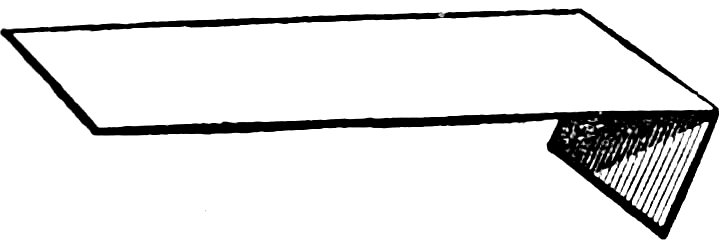
Fig. 32.
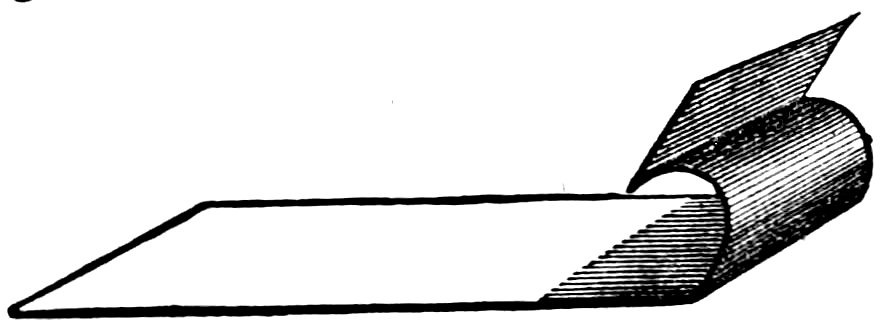
Fig. 33.
Golden rains are made in the following manner:—Procure a piece of brass rod (I always prefer brass for formers, because it is not liable to rust, as is iron or steel), the diameter of which is 3–16ths of an inch, or rather less. The length of the former may be from 6 to 8 inches. You will now require some thin brown or cartridge paper, of which to make your cases. Cut this paper into short strips, about 2 inches wide, and long enough, when wrapped round the former, to make a case whose external diameter should be a quarter of an inch, or rather more. The former should have a cup-shaped, hollow cut in one of its ends, into which the paper may be turned, to form a closed end to your little cases. Paste your strips of cartridge paper all over, and also rub some paste on the former. Now, having turned back one end of your strips—(figs. 32 and 33)—roll it round the former, beginning in the manner here sketched, so that, instead of rolling a single edge of paper round the former, you are rolling a double one. The advantages of this plan for making cases will be more easy for you to see than for me to describe. I may state, however, that you insure, by adopting it, a very close and even fit of the case to the former; you secure the inner edge of the paper from coming unfastened, and you are much more certain that your strips will roll up straightly. This plan may be adopted, if you please, for all cases. I think it is, on the whole, the safest and best. The paste which you rubbed on the former will enable you to draw it out from the case without tearing or injury. But before removing the former entirely, draw it out only so far as to leave its cupped end a quarter of an inch inside one of the ends of your case—so far, in fact, that a 58quarter of an inch of your case remains unoccupied by the former. Now pinch in the paper that projects beyond the former, and drive it down with a tap upon your pasting slab, so that the twisted end is pressed into the cup of the former. By this means you will have a neat and secure end to your cases, which may be dipped afterwards into warm size or glue. If a little red lead be mixed with this size, it will solidify much more rapidly. This dipping the ends of the cases into size should not be done until they are dry from the paste.
Now we come to the filling of these little cases; and for this purpose you will require a simple apparatus, known among pyrotechnists as “the funnel and wire.” The funnel is usually made of tin, and has at its mouth a short tube, about a quarter of an inch long, the exterior diameter of which is equal to the exterior diameter of your brass former, so that it will exactly fit into the mouth of your golden rain cases. The wire should be of steel, about 1–10th of an inch in diameter, and at least 6 inches long. For convenience in working, it should have a small wooden handle. The handles sold in the tool-shops for engravers’ tools will answer very well. This is the whole of the apparatus required for making golden rains.
The composition employed for filling the cases is the following:—
GOLDEN RAINS.
Meal-powder 6 parts.
Nitre 1 part.
Fine charcoal 2 parts.
Or,
Meal-powder 8 „
Fine charcoal 3 „
59Let these ingredients be very intimately mixed. When the composition is ready for use, place the tubular mouth of the funnel in the mouth of one of your little cases; and then put the wire, through the neck of the funnel, down to the bottom of the case. Next, half fill the funnel with one of the above compositions. Now, steadying the case with one hand, raise the wire a little by its handle, and drive it down again. Continue to repeat this operation, giving the wire a succession of short, rapid strokes. You may give about fifteen strokes in five seconds. Each time the wire is raised, a small quantity of the composition falls round it into the case, and the descent of the wire has the effect of driving the composition firmly and compactly into its place. When the case is charged, the funnel must be removed, and the space that was occupied by its nozzle filled with gunpowder paste—gunpowder, that is, or meal-powder moistened with gum-water. This will prevent the composition from being shaken out of the cases, and at the same time forms the best method of priming them. Take care that this paste is pressed well into the mouth of the cases, and fills them.
PORTFIRES.
26. The “funnel and wire” operation is one to which the pyrotechnist has recourse for many purposes, one of which I may as well mention here, as it may fairly be said to come under the head of rocket manufacture—I mean the preparation of portfires.
The portfires, used for firing rockets and fireworks, are generally made in the following manner:—The former for this purpose should be of brass, and not less than a quarter of an inch in diameter, and the wire for filling them not less than one-eighth of an inch. Portfire cases are usually made very thin, three rounds of such paper as that on which the 60Times is printed being quite sufficient. The cases are prepared in precisely the same manner as that described for golden rains, and are also primed in the same way. The following is the composition which I use for
PORTFIRES.
Nitre 6 parts
Sulphur 2 „
Meal-powder 1 part.
Portfires may be made of almost any size, according to the purpose for which they are intended. You will find three-eighths of an inch quite large enough for the inner diameter of any that you are likely to require. If they are to be used for firing exhibitions, you will find that 8 to 12 inches will be a convenient length. The funnel and wire apparatus is so cheaply made that you will be able to provide yourself with two or three sets of these tools, of different sizes, so as to answer any purpose.
We are thus brought to the conclusion of the subject of rockets and their accessories. I trust that I have made my method of operation sufficiently intelligible and plain. The main difficulty that meets any one who attempts to describe a delicate and particular system of working lies in the fact that when one is thoroughly conversant with his subject, particularly in all its minutiæ, he is very liable to overlook, or to treat as unimportant in his directions, some point because it appears trifling to him, and is never likely to be forgotten in his practice, the involuntary omission of which, however, may be a frequent cause of failure in the hands of others. I have tried throughout to evade any possibility of misunderstanding; and if I have been too diffuse, it has been solely from the desire to avoid that which has certainly been the fault of almost all the treatises on pyrotechny that 61I have seen, viz., indistinctness arising from insufficiency of detail.
Our next subject shall be that of