SECOND SERIES.
Reading edition
INTRODUCTORY.
Come again, and greet me as a friend, fellow-pilgrim upon life's highway, Leave awhile the hot and dusty road, to loiter in the greenwood of Reflection. Come unto my cool dim grotto, that is watered by the rivulet of truth, And over whose time-stained rock climb the fairy flowers of content; Here, upon this mossy bank of leisure fling thy load of cares, Taste my simple store, and rest one soothing hour.
Behold, I would count thee for a brother, and commune with thy charitable soul; Though wrapt within the mantle of a prophet, I stand mine own weak scholar. Heed no disciple for a teacher, if knowledge be not found upon his tongue; For vanity and folly were the lessons these lips untaught could give: The precious staple of my merchandise cometh from a better country, The harvest of my reaping sprang of foreign seed: And this poor pensioner of Mercy—should he boast of merit? The grafted stock,—should that be proud of apples not its own? Into the bubbling brook I dip my hermit shell; Man receiveth as a cup, but Wisdom is the river.
Moreover, for this fillagree of fancy, this Oriental garnish of similitude, Alas, the world is old,—and all things old within it: I walk a trodden path, I love the good old ways; Prophets, and priests, and kings have tuned the harp I faintly touch. Truth, in a garment of the past, is my choice and simple theme; No truth is new to-day: and the mantle was another's.
Still, there is an insect swarm, the buzzing cloud of imagery, Mote-like steaming on my sight, and thronging my reluctant mind; The memories of studious culling, and multiplied analogies of nature, Fresh feelings unrepressed, welling from the heart spontaneous, Facts, and comparisons, and meditative atoms, gathered on the heap of combination, Mingle in the fashion of my speech with gossamer dreams of Reverie. I need not beat the underwood for game; my pheasants flock upon the lawn, And gamboling hares disport fearless in my dewy field; I roam no heath-empurpled hills, wearily watching for a covey, But thoughts fly swift to my decoy, eager to be caught; I sit no quiet angler, lingering patiently for sport, But spread my nets for a draught, and take the glittering shoal; I chase no solitary stag, tracking it with breathless toil, But hunt with Aurung-zebe, and spear surrounded thousands.
What then,—count ye this a boast?—sweet charity, think it other, For the dog-fish and poisonous ray are captured in the mullet-haul: The crane and the kite are of my thoughts, alike with the partridge and the quail, And unclean meats as of the clean hang upon my Seric shambles. —How saith he? shall a man deceive, dressing up his jackal as a lion? Or colour in staid hues of fact the changing vest of falsehood?— Brother, unwittingly he may; doubtless, unwillingly he doth: For men are full of fault, and how should he be righteous? Carefully my garden hath been weeded, yet shall it be foul with thistle; My grapery is diligently thinned, and yet many berries will be sour: From my nets have I flung the bad away, to my small skill and caution; Yet may some slimy snake have counted for an eel. The rudder of Man's best hope cannot always steer himself from error; The arrow of Man's straightest aim flieth short of truth. Thus, the confession of sincerity visit not as if it were presumption: Nor own me for a leader, where thy reason is not guide.
OF CHEERFULNESS.
Take courage, prisoner of time, for there be many comforts, Cease thy labour in the pit, and bask awhile with truants in the sun; Be cheerful, man of care, for great is the multitude of chances, Burst thy fetters of anxiety, and walk among the citizens of ease: Wherefore dost thou doubt? if present good is round thee, It may be well to look for change, but to trust in a continuance is better; Whilst, at the crisis of adversity, to hope for some amends were wisdom, And cheerfully to bear thy cross in patient strength is duty. I speak of common troubles, and the petty plagues of life, The phantom-spies of Unbelief, that lurk about his outposts: Sharp suspicion, dull distrust, and sullen stern moroseness Are captains in that locust swarm to lead the cloudy host. Thou hast need of fortitude and faith, for the adversaries come on thickly, And he that fled hath added wings to his pursuing foes; Fight them, and the cravens flee; thy boldness is their panic; Fear them, and thy treacherous heart hath lent the ranks a legion: Among their shouts of victory resoundeth the wail of Heraclitus, While Democrite, confident and cheerful, hath plucked up the standard of their camp.
Not few nor light are the burdens of life; then load it not with heaviness of spirit; Sicknesses, and penury, and travail,—there be real ills enow: We are wandering benighted, with a waning moon; plunge not rashly into jungles, Where cold and poisonous damps will quench the torch of hope: The tide is strong against us; good oarsmen, pull or perish,— If your arms be slack for fear, ye shall not stem the torrent. A wise traveller goeth on cheerily, through fair weather or foul; He knoweth that his journey must be sped, so he carrieth his sunshine with him. Calamities come not as a curse,—nor prosperity for other than a trial; Struggle,—thou art better for the strife, and the very energy shall hearten thee. Good is taught in a Spartan school,—hard lessons and a rough discipline; But evil cometh idly of itself, in the luxury of Capuan holidays: And Wisdom will go bravely forth to meet the chastening scourge, Enduring with a thankful heart that punishment of Love.
There be three chief rivers of despondency: sin, sorrow, fear; Sin is the deepest, sorrow hath its shallows, and fear is a noisy rapid: But even to the darkest holes in guilt's profoundest river Hope can pierce with quickening ray, and all those depths are lightened. So long as there is mercy in a God, hope is the privilege of creatures, And so soon as there is penitence in creatures, that hope is exalted into duty. Verily, consider this for courage; that the fearful and the unbelieving Are classed with idolaters and liars, because they trusted not in God: For it is none other than selfish sin, a hard and proud ingratitude, Where seeming repentance is herald of despair, instead of hope's forerunner.
Moreover, in thy day of grief,—for friends, or fame, or fortune, Well I wot the heart shall ache, and mind be numbed in torpor; Let nature weep; leave her alone; the freshet of her sorrow must run off; And sooner will the lake be clear, relieved of turbid floodings. Yet see that her license hath a limit; with the novelty her agony is over; Hasten in that earliest calm, to tie her in the leash with Reason. For regrets are an enervating folly, and the season for energy is come, Yea rather, that the future may repair with diligence the ruins of the past.
Again, for empty fears, the harassings of possible calamity, Pray, and thou shalt prosper; trust in God, and tread them down. Yield to the phantasy,—thou sinnest; resist it, He will aid thee: Out of Him there is no help, nor any sober courage. Feeble is the comfort of the faithless, a man without a God; Who dare counsel such an one to fling away his fears? Fear is the heritage of him, a portion wise and merciful, To drive the trembler into safety, if haply he may turn and flee: Nevertheless, let him reckon an he will, that all be counteth casual May as well be for him as against him; dice have many sides: And, even as in ailments of the body, diseases follow closely upon dreads, So, with infirmities of mind, is fear the pallid harbinger of failure. It were wise to walk undaunted even in an accidental chaos, For the brave man is at peace, and free to get the mastery of circumstance. The stoutest armour of defence is that which is worn within the bosom, And the weapon that no enemy can parry, is a bold and cheerful spirit: Catapults in old war worked like Titans, crushing foes with rocks; So doth a strong-springed heart throw back every load on its assailants.
I went heavily for cares, and fell into the trance of sorrow; And behold, a vision in my trance, and my ministering angel brought it. There stood a mountain huge and steep, the awful Rock of Ages; The sun upon its summit, and storms midway, and deep ravines at foot. And, as I looked, a dense black cloud, suddenly dropping from the thunder, Filled, like a cataract with yeasty foam, a narrow smiling valley: Close and hard that vaporous mass seemed to press the ground, And lamentable sounds came up, as of some that were smothering beneath. Then, as I walked upon the mountain, clear in summer's noon, For charity I called aloud, Ho! climb up hither to the sunshine. And even like a stream of light my voice had pierced the mist; I saw below two families of men, and knew their names of old: Courage, struggling through the darkness, stout of heart and gladsome, Ran up the shining ladder which the voice of Hope had made; And tripping lightly by his side, a sweet-eyed helpmate with him, I looked upon her face to welcome pleasant Cheerfulness; And a babe was cradled in her bosom, a laughing little prattler, The child of Cheerfulness and Courage,—could his name be other than Success? So, from his happy wife, when they both stood beside me on the mountain, The fond father took that babe, and set him on his shoulder in the sunshine.
Again I peered into the valley, for I heard a gasping moan, A desolate weak cry, as muffled in the vapours. So down that crystal shaft into the poisonous mine I sped for charity to seek and save,—and those I sought fled from me. At length, I spied, far distant, a trembling withered dwarf Who crouched beneath the cloak of a tall and spectral mourner: Then I knew Cowardice and Gloom, and followed them on in darkness, Guided by their rustling robes and moans and muffled cries, Until in a suffocating pit the wretched pair had perished,— And lo, their whitening bones were shaping out an epitaph of Failure.
So I saw that despondency was death, and flung my burdens from me, And, lightened by that effort, I was raised above the world; Yea, in the strangeness of my vision, I seemed to soar on wings, And the names they called my wings were Cheerfulness and Wisdom.
OF YESTERDAY.
Speak, poor almsman of to-day, whom none can assure of a to-morrow, Tell out, with honest heart, the price thou settest upon yesterday. Is it then a writing in the dust, traced by the finger of idleness, Which Industry, clean housewife, can wipe away for ever? Is it as a furrow on the sand, fashioned by the toying waves, Quickly to be trampled then again by the feet of the returning tide? Is it as the pale blue smoke, rising from a peasant's hovel, That melted into limpid air, before it topped the larches? Is it but a vision, unstable and unreal, which wise men soon forget? Is it as the stranger of a night,—gone, we heed not whither? Alas! thou foolish heart, whose thoughts are but as these, Alas! deluded soul, that hopeth thus of Yesterday.
For, behold,—those temples of Ellora, the Brahmin's rock-built shrine, Behold—yon granite cliff, which the North Sea buffeteth in vain,— That stout old forest fir,—these waking verities of life, This guest abiding ever, not strange, nor a servant, but a son,— Such, O man, are vanity and dreams, transient as a rainbow on the cloud, Weighed against that solid fact, thine ill-remembered Yesterday.
Come, let me show thee an ensample, where Nature shall instruct us; Luxuriantly the arguments for truth spring native in her gardens. Seek we yonder woodman of the plain; he is measuring his axe to the elm, And anon the sturdy strokes ring upon the wintry air: Eagerly the village school-boys cluster on the tightened rope, Shouting, and bending to the pull, or lifted from the ground elastic; The huge tree boweth like Sisera, boweth to its foes with faintness,— Its sinews crack,—deep groans declare the reeling anguish of Goliath, The wedge is driven home,—and the saw is at its heart,—and lo, with solemn slowness, The shuddering monarch riseth from his throne,—toppled with a crash,—and is fallen!
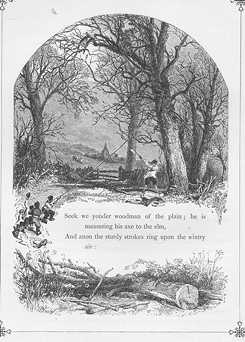
Now shall the mangled stump teach proud man a lesson: Now, can we from that elm-tree's sap distil the wine of Truth. Heed ye those hundred rings, concentric from the core, Eddying in various waves to the red bark's shore-like rim? These be the gatherings of yesterdays, present all to-day, This is the tree's judgment, self-history that cannot be gainsaid: Seven years agone there was a drought,—and the seventh ring is narrowed; The fifth from hence was half a deluge,—the fifth is cellular and broad. Thus, Man, thou art a result, the growth of many yesterdays, That stamp thy secret soul with marks of weal or woe: Thou art an almanack of self, the living record of thy deeds; Spirit hath its scars as well as body, sore and aching in their season: Here is a knot,—it was a crime; there is a canker,—selfishness; Lo, here, the heart-wood rotten; lo, there, perchance, the sap-wood sound. Nature teacheth not in vain; thy works are in thee, of thee; Some present evil bent hath grown of older errors: And what if thou be walking now uprightly? Salve not thy wounds with poison, As if a petty goodness of to-day hath blotted out the sin of yesterday: It is well, thou hast life and light; and the Hewer showeth mercy, Dressing the root, pruning the branch, and looking for thy tardy fruits; But, even here as thou standest, cheerful belike and careless, The stains of ancient evil are upon thee, the record of thy wrong is in thee: For, a curse of many yesterdays is thine, many yesterdays of sin, That, haply heeded little now, shall blast thy many morrows.
Shall then a man reck nothing, but hurl mad defiance at his Judge, Knowing that less than an Omnipotent cannot make the has been, not been? He ought,—so Satan spake; he must,—so Atheism urgeth; He may,—it was the libertine's thought; he doth,—the bad world said it. But thou of humbler heart, thou student wiser for simplicity, While Nature warneth thee betimes, heed the loving counsel of Religion. True, this change is good, and penitence most precious; But trust not thou thy change, nor rest upon repentance: For all we are corrupted at the core, smooth as surface seemeth; What health can bloom in a beautiful skin, when rottenness hath fed upon the bones? And guilt is parcel of us all; not thou, sweet nursling of affection, Art spotless, though so passing fair,—nor thou, mild patriarch of virtue.
Behold then the better Tree of Life, free unto us all for grafting, Cut thee from the hollow root of self, to be budded on a richer Vine. Be desperate, O man, as of evil, so of good; tear that tunic from thee; The past can never be retrieved, be the present what it may. Vain is the penance and the scourge, vain the fast and vigil: The fencer's cautious skill to-day, can this erase his scars? It is Man's to famish as a faquir, it is Man's to die a devotee, Light is the torture and the toil, balanced with the wages of Eternity: But, it is God's to yearn in love, on the humblest, the poorest, and the worst, For He giveth freely, as a king, asking only thanks for mercy. Look upon this noble-hearted Substitute; seeing thy woes, He pitied thee, Bowed beneath the mountain of thy sin, and perished,—but for Godhead; There stood the Atlas in his power, and Prometheus in his love is there, Emptying on wretched men the blessings earned from Heaven: Put them not away, hide them in thy heart, poor and penitent receiver, Be gratitude thy counseller to good, and wholesome fear unto obedience; Remember, the pruning-knife is keen, cutting cankers even from the vine; Remember, twelve were chosen, and one among them liveth—in perdition.
Yea,—for standing unatoned, the soul is a bison on the prairie, Hunted by those trooping wolves, the many sinful yesterdays: And it speedeth a terrified Deucalion, flinging back the pebble in his flight, The pebble that must add one more to those pursuing ghosts. O man, there is a storm behind should drive thy bark to haven; The foe, the foe is on thy track, patient, certain, and avenging; Day by day, solemnly, and silently, followeth the fearful past,— His step is lame, but sure; for he catcheth the present in eternity: And how to escape that foe, the present-past in future? How to avert that fate, living consequence of causes unexistent?— Boldly we must overleap his birth, and date above his memories, Grafted on the living Tree, that WAS before a yesterday: No refuge of a younger birth than one that saw creation Can hide the child of time from still condemning Yesterday. There, is the Sanctuary-city, mocking at the wrath of thine Avenger, Close at hand, with the wicket on the latch; haste for thy life, poor hunted one! The gladiator, Guilt, fighteth as of old, armed with net and dagger; Snaring in the mesh of yesterdays, stabbing with the poignard of to-day: Fly, thy sword is broken at the hilt; fly, thy shield is shivered; Leap the barriers, and baffle him: the arena of the past is his. The bounds of Guilt are the cycles of Time: thou must be safe within Eternity; The arms of God alone shall rescue thee from Yesterday.
OF TO-DAY.
Now, is the constant syllable ticking from the clock of time, Now, is the watchword of the wise, Now, is on the banner of the prudent. Cherish thy to-day and prize it well, or ever it be gulphed into the past, Husband it, for who can promise, if it shall have a morrow? Behold, thou art,—it is enough; that present care be thine; Leave thou the past to thy Redeemer, entrust the future to thy Friend; But for To-day, child of man, tend thou charily the minutes, The harvest of thy yesterday, the seed-corn of thy morrow.
Last night died its day; and the deeds thereof were judged: Thou didst lay thee down as in a shroud, in darkness and death-like slumber: But at the trumpet of this morn, waking the world to resurrection, Thou didst arise, like others, to live a new day's life: Fear, lest folly give thee cause to mourn its passing presence, Fear, that to-morrow's sigh be not, would God it had not dawned!
For, To-day the lists are set, and thou must bear thee bravely, Tilting for honour, duty, life, or death without reproach: To-day, is the trial of thy fortitude, O dauntless Mandan chief; To-day, is thy watch, O sentinel; To-day, thy reprieve, O captive: What more? To-day is the golden chance wherewith to snatch fruition,— Be glad, grateful, temperate: there are asps among the figs. For the potter's clay is in thy hands,—to mould it or to mar it at thy will, Or idly to leave it in the sun, an uncouth lump to harden.
O bright presence of To-day, let me wrestle with thee, gracious angel, I will not let thee go, except thou bless me; bless me, then, To-day: O sweet garden of To-day, let me gather of thee, precious Eden; I have stolen bitter knowledge, give me fruits of life To-day: O true temple of To-day, let me worship in thee, glorious Zion; I find none other place nor time, than where I am To-day: O living rescue of To-day, let me run into thee, ark of refuge: I see none other hope nor chance, but standeth in To-day: O rich banquet of To-day, let me feast upon thee, saving manna; I have none other food nor store, but daily bread To-day!
Behold, thou art pilot of the ship, and owner of that freighted galleon, Competent, with all thy weakness, to steer into safety or be lost: Compass and chart are in thy hand: roadstead and rocks thou knowest; Thou art warned of reefs and shallows; thou beholdest the harbour and its lights. What? shall thy wantonness or sloth drive the gallant vessel on the breakers? What? shall the helmsman's hand wear upon the black lee shore? Vain is that excuse; thou canst escape: thy mind is responsible for wrong: Vain that murmur; thou mayst live: thy soul is debtor for the right. To-day, in the voyage of thy life down the dark tide of time, Stand boldly to thy tiller, guide thee by the pole-star, and be safe; To-day, passing near the sunken rocks, the quicksands and whirlpools of probation, Leave awhile the rudder to swing round, give the wind its heading, and be wrecked.
The crisis of man's destiny is Now, a still recurring danger; Who can tell the trials and temptations coming with the coming hour? Thou standest a target-like Sebastian, and the arrows whistle near thee; Who knoweth when he may be hit? for great is the company of archers. Each breath is burdened with a bidding, and every minute hath its mission; For spirits, good and bad, cluster on the thickly-peopled air: Sin may blast thee, grace may bless thee, good or ill this hour: Chance, and change, and doubt, and fear, are parasites of all. A man's life is a tower, with a staircase of many steps, That, as he toileth upward, crumble successively behind him: No going back; the past is an abyss; no stopping, for the present perisheth; But ever hasting on, precarious on the foothold of To-day; Our cares are all To-day; our joys are all To-day; And in one little word, our life, what is it, but—To-day?
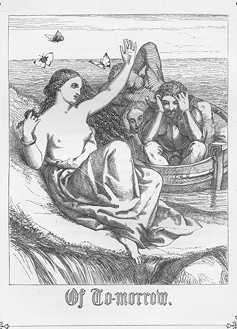
OF TO-MORROW.
There is a floating island, forward on the stream of time, Buoyant with fermenting air, and borne along the rapids; And on that island is a siren, singing sweetly as she goeth, Her eyes are bright with invitation, and allurement lurketh in her cheeks; Many lovers, vainly pursuing, follow her beckoning finger, Many lovers seek her still, even to the cataract of death. To-morrow is that island, a vain and foolish heritage, And, laughing with seductive lips, Delusion hideth there: Often the precious present is wasted in visions of the future, And coy To-morrow cometh not with prophecies fulfilled.
There is a fairy skiff, plying on the sea of life, And charitably toiling still to save the shipwrecked crews; Within, kindly patient, sitteth a gentle mariner, Piloting, through surf and strait, the fragile barks of men: How cheering is her voice, how skilfully she guideth, How nobly leading onward yet, defying even death! To-morrow is that skiff, a wise and welcome rescue, And, full of gladdening words and looks, that mariner is Hope: Often, the painful present is comforted by flattering the future, And kind To-morrow beareth half the burdens of To-day.
To-morrow, whispereth weakness: and To-morrow findeth him the weaker; To-morrow, promiseth conscience; and behold, no To-day for a fulfilment. O name of happy omen unto youth, O bitter word of terror to the dotard, Goal of folly's lazy wish, and sorrow's ever-coming friend; Fraud's loophole,—caution's hint,—and trap to catch the honest,— Thou wealth to many poor, disgrace to many noble, Thou hope and fear, thou weal and woe, thou remedy, thou ruin, How thickly swarms of thought are clustering round To-morrow! The hive of memory increaseth, to every day its cell; There is the labour stored, the honey or corruption; Each morn the bees fly forth, to fill the growing comb, And levy golden tribute of the uncomplaining flowers: To-morrow is their care; they toil for rest to-morrow; But man deferreth duty's task, and loveth ease to-day.
To-morrow, is that lamp upon the marsh, which a traveller never reacheth; To-morrow, the rainbow's cup, coveted prize of ignorance; To-morrow, the shifting anchorage, dangerous trust of mariners; To-morrow, the wrecker's beacon, wily snare of the destroyer. Reconcile convictions with delay, and To-morrow is a fatal lie; Frighten resolutions into action, To-morrow is a wholesome truth: I must, for I fear To-morrow; this is the Cassava's food; Why should I? let me trust To-morrow,—this is the Cassava's poison.
Lo, it is the even of To-day,—a day so lately a To-morrow; Where are those high resolves, those hopes of yesternight? O faint fond heart, still shall thy whisper be, To-morrow, And must the growing avalanche of sin roll down that easy slope? Alas, it is ponderous, and moving on in might, that a Sisyphus may not stop it; But haste thee with the lever of a prayer, and stem its strength To-day: For its race may speedily be run, and this poor hut, thyself, Be whelmed in death and suffocating guilt, that dreary Alpine snow-wreath.
Pensioner of life, be wise, and heed a brother's counsel; I also am a beadsman, with scrip and staff as thou: Wouldest thou be bold against the past, and all its evil memories, Wouldest thou be safe amid the present, its dangers and temptations, Wouldest thou be hopeful of the future, vague though it be and endless? Haste thee, repent, believe, obey! thou standest in the courage of a legion. Commend the Past to God, with all its irrevocable harm, Humbly, but in cheerful trust, and banish vain regrets; Come to Him, continually come, casting all the Present at His feet, Boldly, but in prayerful love, and fling off selfish cares; Commit the Future to His will, the viewless fated future; Zealously go forward with integrity, and God will bless thy faith. For that, feeble as thou art, there is with thee a mighty Conqueror, Thy Friend, the same for ever, yesterday, to-day, and to-morrow; That Friend, changeless as eternity, Himself shall make thee friends Of those thy foes transformed, yesterday, to-day, and to-morrow.
OF AUTHORSHIP.
Great is the dignity of Authorship: I magnify mine office; Albeit in much feebleness I hold it thus unworthily. For it is to be one of a noble band, the welfare of the world, Whose haunt is on the lips of men, whose dwelling in their hearts, Who are precious in the retrospect of Memory, and walk among the visions of Hope, Who commune with the good for everlasting, and call the wisest, brother, Whose voice hath burst the Silence, and whose light is flung upon the Darkness, —Flashing jewels on a robe of black, and harmony bounding out of chaos,— Who gladden empires with their wisdom, and bless to the farthest generation, Doers of illimitable good, gainers of inestimable glory!— We speak but of the Magnates, we heed none humbler than the highest, We take no count of sorry scribes, nor waste one thought upon the groundlings; Our eyes are lifted from the multitude, groping in the dark with candles, To gaze upon that firmament of praise, the constellated lamps of learning. Ever-during witnesses of Mind, undisputed evidence of Power, Goodly volumes, living stones, build up their author's temple; Though of low estate, his rank is above princes,—though needy, he hath worship of the rich, When Genius unfurleth on the winds his banner as a mighty leader. Just in purpose, and self-possessed in soul, lord of many talents, The mental Crœsus goeth forth, rejoicing in his wealth; Keen and clear perception gloweth on his forehead like a sunbeam, He readeth men at a glance, and mists roll away before him; The wise have set him as their captain, the foolish are rebuked at his presence, The excellent bless him with their prayers, and the wicked praise him by their curses; His voice, mighty in operation, stirreth up the world as a trumpet, And kings account it honour to be numbered of his friends.
Rare is the worthiness of authorship: I justify mine office; Albeit fancies weak as mine credit not the calling. For it addeth immortality to dying facts, that are ready to vanish away, Embalming as in amber the poor insects of an hour; Shedding upon stocks and stones the tender light of interest, And illumining dark places of the earth, with radiance of classic lustre. It hath power to make past things present, and availeth for the present in the future, Delivering thoughts, and words, and deeds, from the outer darkness of oblivion. Where are the sages and the heroes, giants of old time?— Where are the mighty kings, that reigned before Agamemnon?— Alas they lie unwept, unhonoured, hidden in the midnight: Alas, for they died unchronicled: their memorial perished with them. Where are the nobles of Nineveh, and mitred rulers of Babylon? Where are the lords of Edom, and the royal pontiffs of Thebais? The golden Satrap, and the Tetrarch,—the Hun, and the Druid, and the Celt? The merchant princes of Phœnicia, and the minds that fashioned Elephanta? Alas, for the poet hath forgotten them; and lo! they are outcasts of Memory; Alas, that they are withered leaves, sapless and fallen from the chaplet of fame. Speak, Etruria, whose bones be these, entombed with costly care,— Tell out, Herculaneum, the titles that have sounded in those thy palaces,— Lycian Xanthus, thy citadels are mute, and the honour of their architects hath died; Copan and Palenque, dreamy ruins in the West, the forest hath swallowed up your sculptures; Syracuse,—how silent of the past!—Carthage, thou art blotted from remembrance! Egypt, wondrous shores, ye are buried in the sand-hills of forgetfulness! Alas,—for in your glorious youth Time himself was young, And none durst wrestle with that Angel, iron-sinewed bridegroom of Space; So he flew by, strong upon the wing, nor dropped one failing feather, Wherewith some hoary scribe might register your honour and renown. Beyond the broad Atlantic, in the regions of the setting sun, Ask of the plume-crowned Incas, that ruled in old Peru,— Ask of grand Caziques, and priests of the pyramids in Mexico,— Ask of a thousand painted tribes, high nobility of Nature, Who, once, could roam their own Elysian plains, free, generous, and happy, Who, now, degraded and in exile, having sold their fatherland for nought, Sink and are extinguished in the western seas, even as the sun they follow,— Where is the record of their deeds, their prowess worthy of Achilles, Nestor's wisdom, the chivalry of Manlius, the native eloquence of Cicero, The skill of Xenophon, the spirit of Alcibiades, the firmness of a Maccabæan mother, Brotherly love that Antigone might envy, the honour and the fortitude of Regulus? Alas, their glory and their praise have vanished like a summer cloud; Alas! that they are dead indeed; they are not written down in the Book of the living.
High is the privilege of Authorship: I purify mine office; Albeit earthy stains pollute it in my hands. For it is to the world a teacher and a guide, Mentor of that gay Telemachus; Warning, comforting, and helping,—a lover and friend of Man. Heaven's almoner, Earth's health, patient minister of goodness, With kind and zealous pen, the wise religious blesseth: Nature's worshipper, and neophyte of grace, rich in tender sympathies, With kindled soul and flashing eye, the poet poureth out his heartful: Priest of truth, champion of innocence, warder of the gates of praise, Carefully with sifting search laboureth the pale historian: Error's enemy, and acolyte of science, firm in sober argument, The calm philosopher marshalleth his facts, noting on his page their principles. These pour mercies upon men; and others, little less in honour, By cheerful wit and graphic tale refreshening the harassed spirit. But, there be other some beside, buyers and sellers in the temple, Who shame their high vocation, greedy of inglorious gain; There be, who fabricating books, heed of them meanly as of merchandise; And seek nor use, nor truth, nor fame, but sell their minds for lucre: O false brethren! ye wot indeed the labour, but are witless of the love; O lying prophets, chilled in soul, unquickened by the life of inspiration!— And there be, who, frivolous and vain, seek to make others foolish, Snaring youth by loose sweet song, and age by selfish maxim; Cleverly heartless, and wittily profane, they swell the river of corruption: Brilliant satellites of sin,—my soul, be not found among their company. And there be, who, haters of religion, toil to prove it priestcraft, Owning none other aim nor hope, but to confound the good: Woe unto them! for their works shall live; yea, to their utter condemnation: Woe! for their own handwriting shall testify against them for ever.
Pure is the happiness of Authorship: I glorify mine office; Albeit lightly having sipped the cup of its lower pleasures. For it is to feel with a father's heart, when he yearneth on the child of his affections; To rejoice in a man's own miniature world, gladdened by its rare arrangement. The poem, is it not a fabric of mind? we love what we create: That choice and musical order,—how pleasant is the toil of composition! Yea, when the volume of the universe was blazoned out in beauty by its Author, God was glad, and blessed His work; for it was very good. And shall not the image of his Maker be happy in his own mind's doing, Looking on the structure he hath reared, gratefully with sweet complacence? Shall not the Minerva of his brain, panoplied and perfect in proportions, Gladden the soul and give light unto the eyes, of him the travailing parent? Go to the sculptor, and ask him of his dreams,—wherefore are his nights so moonlit? Angel faces, and beautiful shapes, fascinate the pale Pygmalion: Go to the painter, and trace his reveries,—wherefore are his days so sunny? Choice design, and skilful colouring, charm the flitting hours of Parrhasius: Even so, walking in his buoyancy, intoxicate with fairy fancies, The young enthusiast of authorship goeth on his way rejoicing: Behold,—he is gallantly attended; legions of thrilling thoughts Throng about the standard of his mind, and call his Will their captain; Behold,—his court is as a monarch's; ideas, and grand imaginations Swell, with gorgeous cavalcade, the splendour of his Spiritual State; Behold,—he is delicately served: for oftentimes, in solitary calmness, Some mental fair Egeria smileth on her Numa's worship; Behold,—he is happy; there is gladness in his eye, and his heart is a sealed fountain, Bounding secretly with joys unseen, and keeping down its ecstasy of pleasure!
Yea: how dignified, and worthy, full of privilege and happiness, Standeth in majestic independence the self-ennobled Author! For God hath blessed him with a mind, and cherished it in tenderness and purity, Hath taught it in the whisperings of wisdom, and added all the riches of content: Therefore, leaning on his God, a pensioner for soul and body, His spirit is the subject of none other, calling no man Master. His hopes are mighty and eternal, scorning small ambitions: He hideth from the pettiness of praise, and pitieth the feebleness of envy. If he meet honours, well; it may be his humility to take them: If he be rebuked, better; his veriest enemy shall teach him. For the master-mind hath a birthright of eminence; his cradle is an eagle's eyrie: Need but to wait till his wings are grown, and Genius soareth to the sun: To creeping things upon the mountain leaveth he the gradual ascent, Resting his swiftness on the summit only for a higher flight. Glad in clear good-conscience, lightly doth he look for commendation; What, if the prophet lacketh honour? for he can spare that praise: The honest giant careth not to be patted on the back by pigmies; Flatter greatness, he brooketh it good-humouredly: blame him,—thou tiltest at a pyramid: Yet, just censure of the good never can he hear without contrition; Neither would he miss one wise man's praise, for scarce is that jewel and costly: Only for the herd of common minds, and the vulgar trumpetings of fame, If aught he heedeth in the matter, his honour is sought in their neglect. Slender is the marvel, and little is the glory, when round his luscious fruits The worm and the wasp and the multitude of flies are gathered as to banquet; Fashion's freak, and the critical sting, and the flood of flatteries he scorneth; Cheerfully asking of the crowd the favour to forget him: The while his blooming fruits ripen in richer fragrance, A feast for the few,—and the many yet unborn,—who still shall love their savour.
So then, humbly with his God, and proudly independent of his fellows, Walketh, in pleasures multitudinous, the man ennobled by his pen: He hath built up, glorious architect, a monument more durable than brass; His children's children shall talk of him in love, and teach their sons his honour: His dignity hath set him among princes, the universe is debtor to his worth, His privilege is blessing for ever, his happiness shineth now, For he standeth of that grand Election, each man one among a thousand, Whose sound is gone out into all lands, and their words to the end of the world!
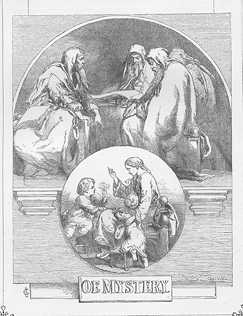
OF MYSTERY.
All things being are in mystery; we expound mysteries by mysteries; And yet the secret of them all is one in simple grandeur: All intricate, yet each path plain, to those who know the way; All unapproachable, yet easy of access, to them that hold the key: We walk among labyrinths of wonder, but thread the mazes with a clue; We sail in chartless seas, but behold! the pole-star is above us. For, counting down from God's good will, thou meltest every riddle into Him, The axiom of reason is an undiscovered God, and all things live in His ubiquity: There is only one great secret; but that one hideth everywhere; How should the infinite be understood in Time, when it stretcheth on ungrasped for ever? Can a halting Œdipus of earth guess that enigma of the universe? Not one: the sword of faith must cut the Gordian knot of nature.
God, pervading all, is in all things the mystery of each; The wherefore of its character and essence, the fountain of its virtues and its beauties. The child asketh of its mother,—Wherefore is the violet so sweet? The mother answereth her babe,—Darling, God hath willed it. And sages, diving into science, have but a profundity of words; They track for some few links the circling chain of consequence, And then, after doubts and disputations, are left where they began, At the bald conclusion of a clown, things are because they are. Wherefore are the meadows green, is it not to gratify the eye? But why should greenness charm the eye? such is God's good will. Wherefore is the ear attuned to a pleasure in musical sounds, And who set a number to those sounds, and fixed the laws of harmony? Who taught the bird to build its nest, or lent the shrub its life, Or poised in the balances of order the power to attract and to repel? Who continueth the worlds, and the sea, and the heart, in motion? Who commanded gravitation to tie down all upon its sphere?— For, even as a limestone cliff is an aggregate of countless shells, One riddle concrete of many, a mystery compact of mysteries, So God, cloud-capped in immensity, standeth the cohesion of all things, And secrets, sublimely indistinct, permeate that Universe, Himself; As is the whole, so are the parts, whether they be mighty or minute, The sun is not more unexplained than the tissue of an emmet's wing.
Thus then, omnipresent Deity worketh His unbiassed mind, A mind, one in moral, but infinitely multiplied in means: And the uniform prudence of His will cometh to be counted law, Till mutable man fancieth volition stirring in the potter's clay: God, a wise father, showeth not His reasons to His babes; But willeth in secresy and goodness: for causes generate dispute: Then we, His darkling children, watch that invariable purpose, And invest the passive creature with its Maker's energy and skill: Therefore, they of old time stopped short of God in idols, Therefore, in these latter days, we heed not the Jehovah in His works. Mystery is God's great name; He is the mystery of goodness: Some other, from the hierarchs of heaven, usurped the mystery of sin. God is the King, yea even of Himself; He crowned Himself with holiness; The burning circlet of iniquity another found and wore. God is separate, even from His attributes; but He willed eternally the good; Therefore freely, though unchangeably, is wise, righteous, and loving: But ambition, open unto angels, saw the evil, flung aside from the beginning, It was Lucifer that saw, and nothing loathed those black unclaimed regalia, So he coveted and stole, to be counted for a king, antagonist of God, But when he touched the leprous robes, behold! a cheated traitor.
For self-existence, charactered with love, with power, wisdom, and ubiquity, Could not dwell alone, but willed and worked creation. Thus, in continual exhalation, darkening the void with matter, Sprang from prolific Deity the creatures of His skill. And beings living on His breath, were needfully less perfect than Himself, Therefore less capable of bliss, whereat His benevolence was bounded; So, to make the capability expand, intensely progressive to eternity, He suffered darkness to illustrate the light, and pain to heighten pleasure: To heap up happiness on souls He loved, allowed He sin and sorrow, And then to guilt and grief and shame, He brought unbidden amnesty: Sinless, none had been redeemed, nor wrapt again in God: Sorrowless, no conflict had been known, and Heaven had been mulcted of its comfort: Yea, with evil unexhibited, probationary toils unfelt, Men had not appreciated good, nor angels valued their security. Herein, to reason's eye, is revealed the mystery of goodness, Blessing through permitted woe, and teaching by the mystery of sin.
O Christian, whose chastened curiosity loveth things mysterious, Accounting them shadows and eclipses of Him the one great light, Look now, satisfied with faith, on minds that judge by sense, And, dull from contemplating matter, take small heed of spirit. Toiling feebly upward, their argument tracketh from below, They catch the latest consequent, and prove the nearest cause: What is this? that a seed produced a seed, and so for a thousand seasons; Ascend a thousand steps, thy ladder leaveth thee in air: Thou canst not climb to God, and short of Him is nothing; There is no cause for aught we see, but in His present will. Begin from the Maker, thou carriest down His attributes to reptiles, The sharded beetle and the lizard live and move in Him: Begin from the creature, corruption and infirmity mar thy foolish toil, Heap Ossa on Olympus, how much art thou nearer to the stars? It is easy running from a mountain's top down to the valleys at its foot, But difficult and steep the laborious ascent, and feebly shalt thou reach it: Yet man, beginning from himself, that first deluding mystery, Hopeth from the pit of lies to struggle up to truth; So, taxing knowledge to its strength, he pusheth one step further, And fancieth complacently that much is done by reaching a remote effect: Then he maketh answer to himself, as a silly nurse to her little one, Evading, in a mist of words, hard things he cannot solve; Till, like an ostrich in the desert, he burieth his head in atoms, Thinking that, if he is blind, no sun can shine in heaven.
Therefore cometh it to pass, that an atheist is ever the most credulous, Snatching at any foolish cause, that may dispel his doubts; And, even as it were for ridicule, a spectacle for men and angels, The captious and cautious unbeliever is of all men weakest to believe: Cut from the anchorage of God, his bark is a plaything of the billows; The compass of his principle is broken, the rudder of his faith unshipped: Chance and Fate, in a stultified antagonism, govern all for him; Truth sprang from the conflict of falsities, and the multitude of accidents hath bred design! Where is the imposture so gross, that shall not entrap his curiosity? What superstition is so abject, that it doth not blanch his cheek? Whereof can he be sure, with whom Chaos is substitute for Order? How should his silly structure stand, a pyramid built upon its apex?— Yea, I have seen grey-headed men, the bastard slips of science, Go for light to glow-worms, while they scorn the sun at noon: Men, who fear no God, trembling at a gipsy's curse, Men, who jest at revelation, clinging to a madman's prophecy!
There is a pleasing dread in the fashion of all mysteries, For hope is mixed therein and fear; who shall divine their issues? Even the orphan, wandering by night, lost on dreary moors, Is sensible of some vague bliss amidst his shapeless terrors; The buoyancy of instant expectation, spurring on the mind to venture, Overbeareth, in its energy, the cramp and the chill of apprehension. There is a solitary pride, when the heart, in new importance, Writeth gladly on its archives, the secrets none other men have seen: And there is a caged terror, evermore wrestling with the mind, When crime hath whispered his confession, and the secrets are written there in blood: The village maiden is elated at the tenderly confided tale: The bandit's wife with sickening fear guessed the premeditated murder: The sage, with triumph on his brow, hideth up his deep discovery; The idlest clown shall delve all day, to find a hidden treasure.
For mystery is man's life; we wake to the whisperings of novelty: And what, though we lie down disappointed? we sleep, to wake in hope. The letter, or the news, the chances and the changes, matters that may happen, Sweeten or embitter daily life with the honey-gall of mystery. For we walk blindfold,—and a minute may be much,—a step may reach the precipice; What earthly loss, what heavenly gain, may not this day produce? Levelled of Alps and Andes, without its valleys and ravines, How dull the face of earth, unfeatured of both beauty and sublimity: And so, shorn of mystery, beggared in its hopes and fears, How flat the prospect of existence, mapped by intuitive foreknowledge. Praise God, creature of earth, for the mercies linked with secresy, That spices of uncertainty enrich the cup of life; Praise God, His hosts on high, for the mysteries that make all joy; What were intelligence with nothing more to learn, or heaven, in eternity of sameness?
To number every mystery were to sum the sum of all things: None can exhaust a theme, whereof God is example and similitude. Nevertheless, take a garland from the garden, a handful from the harvest, Some scattered drops of spray from the ceaseless mighty cataract. Whence are we,—whither do we tend,—how do we feel, and reason? How strange a thing is man, a spirit saturating clay! When doth soul make embryos immortal,—how do they rank hereafter,— And will the unconscious idiot be quenched in death as nothing? In essence immaterial, are these minds, as it were, thinking machines? For, to understand may but rightly be to use a mechanism all possess, So that in reading or hearing of another, a man shall seem unto himself To be recollecting images or arguments, native and congenial to his mind: And yet, what shall we say,—who can arede the riddle? The brain may be clockwork, and mind its spring, mechanism quickened by a spirit.
Who so shrewd as rightly to divide life, instinct, reason; Trees, zoophytes, creatures of the plain, and savage men among them? Hath the mimosa instinct,—or the scallop more than life,— Or the dog less than reason,—or the brute-man more than instinct? What is the cause of health,—and the gendering of disease? Why should arsenic kill, and whence is the potency of antidotes? Behold, a morsel,—eat and die; the term of thy probation is expired: Behold, a potion,—drink and be alive; the limit of thy trial is enlarged. Who can expound beauty? or explain the character of nations? Who will furnish a cause for the epidemic force of fashion? Is there a moral magnetism living in the light of example? Is practice electricity?—Yet all these are but names. Doth normal Art imprison, in its works, spirit translated into substance, So that the statue, the picture, or the poem, are crystals of the mind? And doth Philosophy with sublimating skill shred away the matter, Till rarefied intelligence exudeth even out of stocks and stones?
O Mysteries, ye all are one, the mind of an inexplicable Architect Dwelleth alike in each, quickening and moving in them all. Fields, and forests, and cities of men, their woes and wealth and works, And customs, and contrivances of life, with all we see and know, For a little way, a little while, ye hang dependent on each other, But all are held in one right-hand, and by His will ye are. Here is an answer unto mystery, an unintelligible God, This is the end and the beginning, it is reason that He be not understood. Therefore it were probable and just, even to a man's weak thinking, To have one for God who always may be learnt, yet never fully known: That He, from whom all mysteries spring, in whom they all converge, Throned in His sublimity beyond the grovellings of lower intellect, Should claim to be truer than man's truest, the boasted certainty of numbers, Should baffle his arithmetic, confound his demonstrations, and paralyse the might of his necessity, Standing supreme as the mystery of mysteries, everywhere, yet impersonate, Essential One in three, essential Three in one!
OF GIFTS.
I had a seeming friend;—I gave him gifts, and he was gone: I had an open enemy;—I gave him gifts, and won him: Common friendship standeth on equalities, and cannot bear a debt; But the very heart of hate melteth at a good man's love: Go to, then, thou that sayest,—I will give and rivet the links: For pride shall kick at obligation, and push the giver from him. The covetous spirit may rejoice, revelling in thy largess, But chilling selfishness will mutter,—I must give again: The vain heart may be glad, in this new proof of man's esteem, But the same idolatry of self abhorreth thoughts of thanking.
Nevertheless, give; for it shall be a discriminating test Separating honesty from falsehood, weeding insincerity from friendship. Give, it is like God; thou weariest the bad with benefits: Give, it is like God; thou gladdenest the good by gratitude. Give to thy near of kin, for providence hath stationed thee his helper: Yet see that he claim not, as his right, thy freewill offering of duty. Give to the young, they love it; neither hath the poison of suspicion Spoilt the flavour of their thanks, to look for latent motives. Give to merit, largely give; his conscious heart will bless thee: It is not flattery, but love,—the sympathy of men his brethren. Give, for encouragement in good; the weak desponding mind Hath many foes, and much to do, and leaneth on its friends. Yet heed thou wisely these; give seldom to thy better; For such obtrusive boon shall savour of presumption; Or, if his courteous bearing greet thy proffered kindness, Shall not thine independent honesty be vexed at the semblance of a bribe? Moreover, heed thou this; give to thine equal charily, The occasion fair and fitting, the gift well chosen and desired: Hath he been prosperous and blest? a flower may show thy gladness; Is he in need? with liberal love, tender him the well-filled purse: Disease shall welcome friendly care in grapes and precious unguents; And where a darling child hath died, give praise, and hope, and sympathy. Yet once more, heed thou this; give to the poor discreetly, Nor suffer idle sloth to lean upon thy charitable arm: To diligence give, as to an equal, on just and fit occasion; Or he bartereth his hard-earned self-reliance for the casual lottery of gifts. The timely loan hath added nerve, where easy liberality would palsy; Work and wages make a light heart; but the mendicant asked with a heavy spirit. A man's own self-respect is worth unto him more than money, And evil is the charity that humbleth, and maketh man less happy.
There are who sow liberalities, to reap the like again; But men accept his boon, scorning the shallow usurer: I have known many such a fisherman lose his golden baits: And oftentimes the tame decoy escapeth with the flock. Yea, there are who give unto the poor, to gain large interest of God,— Fool,—to think His wealth is money, and not mind: And haply after thine alms, thy calculated givings, The hurricane shall blast thy crops, and sink the homeward ship; Then shall thy worldly soul murmur that the balances were false, Thy trader's mind shall think of God,—He stood not to His bargain!
Give, saith the preacher, be large in liberality, yield to the holy impulse, Tarry not for cold consideration, but cheerfully and freely scatter. So, for complacency of conscience, in a gush of counterfeited charity, He that hath not wherewith to be just, selfishly presumeth to be generous: The debtor, and the rich by wrong, are known among the band of the benevolent; And men extol the noble hearts, who rob that they may give. Receivers are but little prone to challenge rights of giving, Nor stop to test, for conscience-sake, the righteousness of mammon: And the zealot in a cause is a receiver, at the hand which bettereth his cause; And thus an unsuspected bribe shall blind the good man's judgment: It is easy to excuse greatness, and the rich are readily forgiven: What, if his gains were evil, sanctified by using them aright? O shallow flatterer, self-interest is thy thought, Hopeless of partaking in the like, thou too wouldst scorn the giver.
Money hath its value; and the scatterer thereof his thanks: Few men, drinking at a rivulet, stop to consider its source. The hand that closeth on an alm, be it for necessities or zeal, Hath small scruple whence it came: Vespasian rejoiceth in his tribute. Therefore have colleges and hospitals risen upon orphans' wrongs, Chapels and cathedrals have thriven on the welcome wages of iniquity, And fraud, in evil compensation, hath salved his guilty conscience, Not by restoring to the cheated, but by ostentatious giving to the grateful.
So, those who reap rejoice; and reaping, bless the sower: No one is eager to discover, where discovery tendeth unto loss: Yet, if knowledge of a theft make gainers thereby guilty, Can he be altogether innocent, who never asked the honesty of gain? Therefore, O preacher, zealous for charity, temper thy warm appeal,— Warning the debtor and unjustly rich, they may not dare to give: To do good is a privilege and guerdon: how shouldst thou rejoice If ill-got gifts of presumptuous fraud be offered on the altar? The question is not of degrees; unhallowed alms are evil; Discourage and reject alike the obolus or talent of iniquity.
Yet more, be careful that, unworthily, thou gain not an advantage over weakness, Unstable souls, fervent and profuse, fluttered by the feeling of the moment; For eloquence swayeth to its will the feeble and the conscious of defect: Rashly give they, and afterward are sad,—a gift that doubly erred. It was the worldliness of priestcraft that accounted alms-giving for charity; And many a father's penitence hath steeped his son in penury; Yet, considered he lightly the guilt of a death-bed selfishness That strove to take with him, for gain, the gold no longer his; So he died in a false peace, and dying robbed his kindred; The cunning friar at his side having cheated both the living and the dead.
Charity sitteth on a fair hill-top, blessing far and near, But her garments drop ambrosia, chiefly, on the violets around her: She gladdeneth indeed the map-like scene, stretching to the verge of the horizon, For her angel face is lustrous and beloved, even as the moon in heaven: But the light of that beatific vision gloweth in serener concentration The nearer to her heart, and nearer to her home,—that hill-top where she sitteth: Therefore is she kind unto her kin, yearning in affection on her neighbours, Giving gifts to those around, who know and love her well. But the counterfeit of charity, an hypocrite of earth, not a grace of heaven, Seeketh not to bless at home, for her nearer aspect is ill-favoured: Therefore hideth she for shame, counting that pride humility, And none of those around her hearth are gladdened by her gifts: Rather, with an overreaching zeal, flingeth she her bounty to the stranger, And scattered prodigalities abroad compensate for meanness in her home: For benefits showered on the distant shine in unmixed beauty, So that even she may reap their undiscerning praise: Therefore native want hath pined, where foreign need was fattened; Woman been crushed by the tyrannous hand that upheld the flag of liberality; Poverty been prisoned up and starved, by hearts that are maudlin upon crime; And freeborn babes been manacled by men, who liberate the sturdy slave.
Policy counselleth a gift, given wisely and in season, And policy afterwards approveth it, for great is the influence of gifts. The lover, unsmiled upon before, is welcome for his jewelled bauble; The righteous cause without a fee, must yield to bounteous guilt: How fair is a man in thine esteem, whose just discrimination seeketh thee, And so, discerning merit, honoureth it with gifts! Yea, let the cause appear sufficient, and the motive clear and unsuspicious, As given to one who cannot help, or proving honest thanks, There liveth not one among a million, who is proof against the charm of liberality, And flattery, that boon of praise, hath power with the wisest.
Man is of three natures, craving all for charity; It is not enough to give him meats, withholding other comfort: For the mind starveth, and the soul is scorned, and so the human animal Eateth his unsatisfying pittance, a thankless heartless pauper: Yet would he bless thee and be grateful, didst thou feed his spirit, And teach him that thine alms-givings are charities, are loves: —I saw a beggar in the street, and another beggar pitied him; Sympathy sank into his soul, and the pitied one felt happier: Anon passed by a cavalcade, children of wealth and gaiety; They laughed, and looked upon the beggar, and the gallants flung him gold; He, poor spirit-humbled wretch, gathered up their givings with a curse, And went—to share it with his brother, the beggar who had pitied him!
OF BEAUTY.
Thou mightier than Manoah's son, whence is thy great strength, And wherein the secret of thy craft, O charmer charming wisely?— For thou art strong in weakness, and in artlessness well skilled, Constant in the multitude of change, and simple amidst intricate complexity. Folly's shallow lip can ask the deepest question, And many wise in many words should answer, what is beauty?— Who shall separate the hues that flicker on a dying dolphin, Or analyse the jewelled lights that deck the peacock's train, Or shrewdly mix upon a palette the tints of an iridescent spar, Or set in rank the wandering shades about a watered silk?
For beauty is intangible, vague, ill to be defined; She hath the coat of a chameleon, changing while we watch it. Strangely woven is the web, disorderly yet harmonious, A glistering robe of mingled mesh, that may not be unravelled. It is shot with heaven's blue, the soul of summer skies, And twisted strings of light, the mind of noonday suns, And ruddy gleams of life, that roll along the veins, A coat of many colours, running curiously together. There is threefold beauty for man; twofold beauty for the animal; And the beauty of inanimates is single: body, temper, spirit. Multiplied in endless combination, issue the changeable results; Each class verging on the other twain, with imperceptible gradation; And every individual in each having his propriety of difference, So that the meanest of creation bringeth in a tribute of the beautiful. Yea, from the worst in favour shineth out a fitness of design, The patent mark of beauty, its Maker's name imprest. For the great Creator's seal is set to all His works; Its quarterings are Attributes of praise, and all the shield is Beauty: So, that heraldic blazon is Creation's common signet; And the universal family of life goeth in the colours of its Lord: But each one, as a several son, shall bear those arms with a difference; Beauty, various in phase, and similar in seeming oppositions. The coins of old Rome were struck with a diversity for each, Barely two be found alike, in every Cæsar's image: So, note thou the seals, ranged round the charters of the Universe, The finger of God is the stamp upon them all, but each hath its separate variety.
Beauty, theme of innocence, how may guilt discourse thee? Let holy angels sing thy praise, for man hath marred thy visage. Still the maimed torso of a Theseus can gladden taste with its proportions; Though sin hath shattered every limb, how comely are the fragments! And music leaveth on the ear a memory of sweet sounds; And broken arches charm the sight with hints of fair completeness. So, while humbled at the ruin, be thou grateful for the relics; Go forth, and look on all around with kind uncaptious eye: Freely let us wander through these unfrequented ways, And talk of glorious beauty, filling all the world.
For beauty hideth everywhere, that Reason's child may seek her, And having found the gem of price, may set it in God's crown. Beauty nestleth in the rosebud, or walketh the firmament with planets, She is heard in the beetle's evening hymn, and shouteth in the matins of the sun; The cheek of the peach is glowing with her smile, her splendour blazeth in the lightning, She is the dryad of the woods, the naiad of the streams; Her golden hair hath tapestried the silkworm's silent chamber, And to her measured harmonies the wild waves beat in time; With tinkling feet at eventide she danceth in the meadow, Or, like a Titan, lieth stretched athwart the ridgy Alps; She is rising, in her veil of mist, a Venus from the waters,— Men gaze upon the loveliness,—and lo, it is beautiful exceedingly; She, with the might of a Briareus, is dragging down the clouds upon the mountain,— Men look upon the grandeur,—and lo, it is excellent in glory. For I judge that beauty and sublimity be but the lesser and the great, Sublime, as magnified to giants, and beautiful, diminished into fairies. It were a false fancy to solve all beauty by desire, It were a lowering thought to expound sublimity by dread. Cowardly men with trembling hearts have feared the furious storm, Nor felt its thrilling beauty; but is it then not beautiful? And careless men, at summer's eve, have loved the dimpled waves; O that smile upon the seas,—hath it no sublimity? Dost thou nothing know of this,—to be awed at woman's beauty? Nor, with exhilarated heart, to hail the crashing thunder? Thou hast much to learn, that never found a fearfulness in flowers; Thou hast missed of joy, that never basked in beauties of the terrible.
Show me an enthusiast in aught; he hath noted one thing narrowly, And lo, his keenness hath detected the one dear hiding place of beauty: Then he boasteth, simple soul, flattered by discovery, Fancying that no science else can show so fair and precious: He hath found a ray of light, and cherisheth the treasure in his closet, Mocking at those larger minds, that bathe in floods of noon; Lo, what a jewel hath he gotten,—this is the monopolist of beauty,— And lightly heeding all beside, he poured his yearnings thitherward: Be it for love, or for learning, habit, art, or nature, Exclusive thought is all the cause of this particular zeal. But like intensity of fitness, kind and skilful beauty, So pleasant to his mind in one thing, filleth all beside: From the waking minute of a chrysalis, to the perfect cycle of chronology, From the centipede's jointed armour to the mammoth's fossil ribs, From the kingfisher's shrill note, to the cataract's thundering bass, From the greensward's grateful hues, to the fascinating eye of woman, Beauty, various in all things, setteth up her home in each, Shedding graciously around an omnipresent smile.
There is beauty in the rolling clouds, and placid shingle beach, In feathery snows, and whistling winds, and dun electric skies; There is beauty in the rounded woods, dank with heavy foliage, In laughing fields, and dinted hills, the valley and its lake; There is beauty in the gullies, beauty on the cliffs, beauty in sun and shade, In rocks and rivers, seas and plains,—the earth is drowned in beauty.
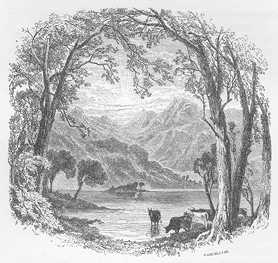
Beauty coileth with the watersnake, and is cradled in the shrewmouse's nest, She flitteth out with evening bats, and the soft mole hid her in his tunnel; The limpet is encamped upon the shore, and beauty not a stranger to his tent; The silvery dace and golden carp thread the rushes with her: She saileth into clouds with an eagle, she fluttereth into tulips with a humming bird; The pasturing kine are of her company, and she prowleth with the leopard in his jungle.
Moreover, for the reasonable world, its words, and acts, and speculations, For frail and fallen manhood, in his every work and way, Beauty, wrecked and stricken, lingereth still among us, And morsels of that shattered sun are dropt upon the darkness. Yea, with savages and boors, the mean, the cruel, and besotted, Ever in extenuating grace hide some relics of the beautiful. Gleams of kindness, deeds of courage, patience, justice, generosity, Truth welcomed, knowledge prized, rebukes taken with contrition, All, in various measure, have been blest with some of these, And never yet hath lived the man, utterly beggared of the beautiful.
Beauty is as crystal in the torchlight, sparkling on the poet's page; Virgin honey of Hymettus, distilled from the lips of the orator; A savour of sweet spikenard, anointing the hands of liberality; A feast of angels' food set upon the tables of religion. She is seen in the tear of sorrow, and heard in the exuberance of mirth; She goeth out early with the huntsman, and watcheth at the pillow of disease. Science in his secret laws hath found out latent beauty, Sphere and square, and cone and curve, are fashioned by her rules: Mechanism met her in his forces, fancy caught her in its flittings, Day is lightened by her eyes, and her eyelids close upon the night.
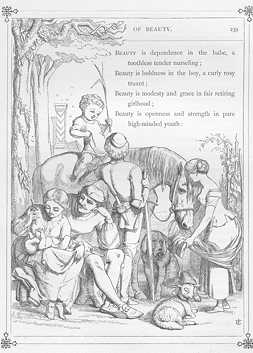
Beauty is dependence in the babe, a toothless tender nurseling; Beauty is boldness in the boy, a curly rosy truant; Beauty is modesty and grace in fair retiring girlhood; Beauty is openness and strength in pure high-minded youth: Man, the noble and intelligent, gladdeneth earth with beauty, And woman's beauty sunneth him, as with a smile from heaven.
There is none enchantment against beauty, Magician for all time, Whose potent spells of sympathy have charmed the passive world: Verily, she reigneth a Semiramis; there is no might against her; The lords of every land are harnessed to her triumph. Beauty is conqueror of all, nor ever yet was found among the nations That iron-moulded mind, full proof against her power. Beauty, like a summer's day, subdueth by sweet influences; Who can wrestle against Sleep?—yet is that giant, very gentleness.
Ajax may rout a phalanx, but beauty shall enslave him single-handed; Pericles ruled Athens, yet he is the servant of Aspasia: Light were the labour, and often-told the tale, to count the victories of beauty,— Helen, and Judith, and Omphale, and Thais, many a trophied name. At a glance the misanthrope was softened, and repented of his vows, When Beauty asked, he gave, and banned her—with a blessing; The cold ascetic loved the smile that lit his dismal cell, And kindly stayed her step, and wept when she departed; The bigot abbess felt her heart gush with a mother's feeling, When looking on some lovely face beneath the cloister's shade; Usury freed her without ransom; the buccaneer was gentle in her presence; Madness kissed her on the cheek, and Idiotcy brightened at her coming: Yea, the very cattle in the field, and hungry prowlers of the forest With fawning homage greeted her, as Beauty glided by. A welcome guest unbidden, she is dear to every hearth; A glad spontaneous growth of friends is springing round her rest: Learning sitteth at her feet, and Idleness laboureth to please her, Folly hath flung aside his bells, and leaden Dulness gloweth; Prudence is rash in her defence; Frugality filleth her with riches; Despair came to her for counsel; and Bereavement was glad when she consoled; Justice putteth up his sword at the tear of supplicating beauty, And Mercy, with indulgent haste, hath pardoned beauty's sin.
For beauty is the substitute for all things, satisfying every absence, The rich delirious cup to make all else forgotten: She also is the zest unto all things, enhancing every presence, The rare and precious ambergris, to quicken each perfume. O beauty, thou art eloquent; yea, though slow of tongue, Thy breast, fair Phryne, pleaded well before the dazzled judge: O beauty, thou art wise; yea, though teaching falsely, Sages listen, sweet Corinna, to commend thy lips; O beauty, thou art ruler; yea, though lowly as a slave, Myrrha, that imperial brow is monarch of thy lord; O beauty, thou art winner; yea, though halting in the race, Hippodame, Camilla, Atalanta,—in gracefulness ye fascinate your umpires; O beauty, thou art rich; yea, though clad in russet, Attalus cannot boast his gold against the wealth of beauty; O beauty, thou art noble; yea, though Esther be an exile, Set her up on high, ye kings, and bow before the majesty of beauty!
Friend and scholar, who, in charity, hast walked with me thus far, We have wandered in a wilderness of sweets, tracking beauty's footsteps: And ever as we rambled on among the tangled thicket, Many a startled thought hath tempted further roaming: Passion, sympathetic influence, might of imaginary haloes,— Many the like would lure aside, to hunt their wayward themes. And, look you!—from his ferny bed in yonder hazel coppice, A dappled hart hath flung aside the boughs and broke away; He is fleet and capricious as the zephyr, and with exulting bounds Hieth down a turfy lane between the sounding woods; His neck is garlanded with flowers, his antlers hung with chaplets, And rainbow-coloured ribbons stream adown his mottled flanks: Should we follow?—foolish hunters, thus to chase afoot,— Who can track the airy speed and doubling wiles of Taste?
For the estimates of human beauty, dependent upon time and clime, Manifold and changeable, are multiplied the more by strange gregarious fashion: And notable ensamples in the great turn to epidemics in the lower, So that a nation's taste shall vary with its rulers. Stern Egypt, humbled to the Greek, fancied softer idols; Greece, the Roman province, nigh forgat her classic sculpture; Rome, crushed beneath the Goth, loved his barbarian habits; And Alaric, with his ruffian horde, is tamed by silken Rome. Columbia's flattened head, and China's crumpled feet,— The civilized tapering waist,—and the pendulous ears of the savage,— The swollen throat among the mountains, and an ebon skin beneath the tropics,— These shall all be reckoned beauty: and for weighty cause. First, for the latter: Providence in mercy tempereth taste by circumstance, So that Nature's must shall hit her creature's liking; Second, for the middle: though the foolishness of vanity seek to mar proportion, Still, defects in those we love shall soon be counted praise; Third, for the first: a chief, and a princess, maimed or distorted from the cradle Shall coax the flattery of slaves to imitate the great in their deformity: Hence groweth habit: and habits make a taste, And so shall servile zeal deface the types of beauty. Whiles Alexander conquered, crookedness was comely: And followers learn to praise the scars upon their leader's brow. Youth hath sought to flatter age by mimicking grey hairs; Age plastereth her wrinkles, and is painted in the ruddiness of Youth. Fashion, the parasite of Rank, apeth faults and failings, Until the general Taste depraved hath warped its sense of beauty.
Each man hath a measure for himself, yet all shall coincide in much; A perfect form of human grace would captivate the world: Be it manhood's lustre, or the loveliness of woman, all would own its beauty, The Caffre and Circassian, Russians and Hindoos, the Briton, the Turk and Japanese. Not all alike, nor all at once, but each in proportion to intelligence, His purer state in morals, and a lesser grade in guilt: For the high standard of the beautiful is fixed in Reason's forum, And sins, and customs, and caprice, have failed to break it down: And reason's standard for the creature pointeth three perfections, Frame, knowledge, and the feeling heart, well and kindly mingled; A fair dwelling, furnished wisely, with a gentle tenant in it,— This is the glory of humanity: thou hast seen it seldom.
There is a beauty for the body; the superficial polish of a statue, The symmetry of form and feature delicately carved and painted. How bright in early bloom the Georgian sitteth at her lattice, How softened off in graceful curves her young and gentle shape: Those dark eyes, lit by curiosity, flash beneath the lashes, And still her velvet cheek is dimpled with a smile. Dost thou count her beautiful?—even as a mere fair figure, A plastic image, little more,—the outer garb of woman: Yea,—and thus far it is well; but Reason's hopes are higher,— Can he sate his soul on a scantling third of beauty?
Yet is this the pleasing trickery, that cheateth half the world, Nature's wise deceit to make up waste in life; And few be they that rest uncaught, for many a twig is limed; Where is the wise among a million, that took not form for beauty? But watch it well; for vanity and sin, malice, hate, suspicion, Louring as clouds upon the countenance, will disenchant its charms. The needful complexity of beauty claimeth mind and soul, Though many coins of foul alloy pass current for the true: And albeit fairness in the creature shall often co-exist with excellence, Yet hath many an angel shape been tenanted by fiends. A man, spiritually keen, shall detect in surface beauty Those marring specks of evil which the sensual cannot see; Therefore is he proof against a face, unlovely to his likings, And common minds shall scorn the taste, that shrunk from sin's distortion.
There is a beauty for the reason; grandly independent of externals, It looketh from the windows of the house, shining in the man triumphant. I have seen the broad blank face of some misshapen dwarf Lit on a sudden as with glory, the brilliant light of mind: Who then imagined him deformed? intelligence is blazing on his forehead, There is empire in his eye, and sweetness on his lip, and his brown cheek glittereth with beauty: And I have known some Nireus of the camp, a varnished paragon of chamberers, Fine, elegant, and shapely, moulded as the master-piece of Phidias,— Such an one, with intellects abased, have I noted crouching to the dwarf, Whilst his lovers scorn the fool, whose beauty hath departed!
And there is a beauty for the spirit; mind in its perfect flowering, Fragrant, expanded into soul, full of love and blessed. Go to some squalid couch, some famishing death-bed of the poor; He is shrunken, cadaverous, diseased;—there is here no beauty of the body: Never hath he fed on knowledge, nor drank at the streams of science, He is of the common herd, illiterate;—there is here no beauty of the reason: But lo! his filming eye is bright with love from heaven, In every look it beameth praise, as worshipping with seraphs; What honeycomb is hived upon his lips, eloquent of gratitude and prayer,— What triumph shrined serene upon that clammy brow, What glory flickering transparent under those thin cheeks,— What beauty in his face!—Is it not the face of an angel?
Now, of these three, infinitely mingled and combined, Consisteth human beauty, in all the marvels of its mightiness: And forth from human beauty springeth the intensity of Love; Feeling, thought, desire, the three deep fountains of affection. Son of Adam, or daughter of Eve, art thou trapped by nature, And is thy young eye dazzled with the pleasant form of beauty? This is but a lower love; still it hath its honour; What God hath made and meant to charm, let not man despise. Nevertheless, as reason's child, look thou wisely farther, For age, disease, and care, and sin, shall tarnish all the surface: Reach a loftier love: be lured by the comeliness of mind,— Gentle, kind, and calm, or lustrous in the livery of knowledge. And more, there is a higher grade; force the mind to its perfection— Win those golden trophies of consummate love: Add unto riches of the reason, and a beauty moulded to thy liking, The precious things of nobler grace that well adorn a soul; Thus, be thou owner of a treasure, great in earth and heaven, Beauty, wisdom, goodness, in a creature like its God.
So then, draw we to an end; with feeble step and faltering, I follow beauty through the universe, and find her home Ubiquity: In all that God hath made, in all that man hath marred, Lingereth beauty, or its wreck, a broken mould and castings. And now, having wandered long time, freely and with desultory feet, To gather in the garden of the world a few fair sample flowers, With patient scrutinizing care let us cull the conclusion of their essence, And answer to the riddle of Zorobabel, Whence the might of beauty?
Ugliness is native unto nothing, but an attribute of concrete evil; In everything created, at its worst, lurk the dregs of loveliness: We be fallen into utter depths, yet once we stood sublime, For man was made in perfect praise, his Maker's comely image: And so his new-born ill is spiced with older good, He carrieth with him, yea to crime, the withered limbs of beauty. Passions may be crooked generosities; the robber stealeth for his children; Murder was avenger of the innocent, or wiped out shame with blood. Many virtues, weighted by excess, sink among the vices; Many vices, amicably buoyed, float among the virtues. For, albeit sin is hate, a foul and bitter turpitude, As hurling back against the Giver all His gifts with insult, Still when concrete in the sinner, it will seem to partake of his attractions, And in seductive masquerade shall cloak its leprous skin; His broken lights of beauty shall illumine its utter black, And those refracted rays glitter on the hunch of its deformity.
Verily the fancy may be false, yet hath it met me in my musings, (As expounding the pleasantness of pleasure, but no ways extenuating licence,) That even those yearnings after beauty, in wayward wanton youth, When, guileless of ulterior end, it craveth but to look upon the lovely, Seem like struggles of the soul, dimly remembering pre-existence, And feeling in its blindness for a long-lost god, to satisfy its longing; As if the sucking babe, tenderly mindful of his mother, Should pull a dragon's dugs, and drain the teats of poison. Our primal source was beauty, and we pant for it ever and again; But sin hath stopped the way with thorns; we turn aside, wander, and are lost.
God, the undiluted good, is root and stock of beauty, And every child of reason drew his essence from that stem. Therefore, it is of intuition, an innate hankering for home, A sweet returning to the well, from which our spirit flowed, That we, unconscious of a cause, should bask these darkened souls In some poor relics of the light that blazed in primal beauty, And, even like as exiles of idolatry, should quaff from the cisterns of creation Stagnant draughts, for those fresh springs that rise in the Creator.
Only, being burdened with the body, spiritual appetite is warped, And sensual man, with taste corrupted, drinketh of pollutions: Impulse is left, but indiscriminate; his hunger feasteth upon carrion; His natural love of beauty doateth over beauty in decay. He still thirsteth for the beautiful; but his delicate ideal hath grown gross, And the very sense of thirst hath been fevered from affection into passion. He remembereth the blessedness of light, but it is with an old man's memory, A blind old man from infancy, that once hath seen the sun, Whom long experience of night hath darkened in his cradle recollections, Until his brightest thought of noon is but a shade of black.
This then is thy charm, O beauty all pervading; And this thy wondrous strength, O beauty, conqueror of all: The outline of our shadowy best, the pure and comely creature, That winneth on the conscience with a saddening admiration: And some untutored thirst for God, the root of every pleasure, Native to creatures, yea in ruin, and dating from the birthday of the soul. For God sealeth up the sum, confirmed exemplar of proportions, Rich in love, full of wisdom, and perfect in the plenitude of Beauty.
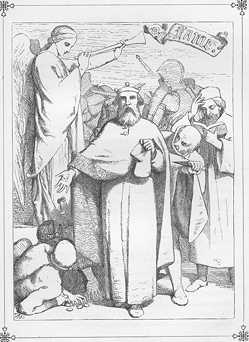
OF FAME.
Blow the trumpet, spread the wing, fling thy scroll upon the sky, Rouse the slumbering world, O Fame, and fill the sphere with echo! —Beneath thy blast they wake, and murmurs come hoarsely on the wind, And flashing eyes and bristling hands proclaim they hear thy message: Rolling and surging as a sea, that upturned flood of faces Hasteneth with its million tongues to spread the wondrous tale; The hum of added voices groweth to the roaring of a cataract, And rapidly from wave to wave is tossed that exaggerated story, Until those stunning clamours, gradually diluted in the distance, Sink ashamed, and shrink afraid of noise, and die away. Then brooding Silence, forth from his hollow caverns, Cloaked and cowled, and gliding along, a cold and stealthy shadow, Once more is mingled with the multitude, whispering as he walketh, And hushing all their eager ears, to hear some newer Fame. So all is still again; but nothing of the past hath been forgotten; A stirring recollection of the trumpet ringeth in the hearts of men: And each one, either envious or admiring, hath wished the chance were his To fill as thus the startled world with fame, or fear, or wonder. This lit thy torch of sacrilege, Ephesian Eratostratus; This dug thy living grave, Pythagoras, the traveller from Hadës; For this, dived Empedocles into Etna's fiery whirlpool; For this, conquerors, regicides, and rebels, have dared their perilous crimes. In all men, from the monarch to the menial, lurketh lust of fame: The savage and the sage alike regard their labours proudly: Yea, in death, the glazing eye is illumined by the hope of reputation, And the stricken warrior is glad, that his wounds are salved with glory.
For fame is a sweet self-homage, an offering grateful to the idol, A spiritual nectar for the spiritual thirst, a mental food for mind, A pregnant evidence to all of an after immaterial existence, A proof that soul is scatheless, when its dwelling is dissolved. And the manifold pleasures of fame are sought by the guilty and the good: Pleasures, various in kind, and spiced to every palate: The thoughtful loveth fame as an earnest of better immortality, The industrious and deserving, as a symbol of just appreciation, The selfish, as a promise of advancement, at least to a man's own kin, And common minds, as a flattering fact that men have been told of their existence.
There is a blameless love of fame, springing from desire of justice, When a man hath featly won and fairly claimed his honours: And then fame cometh as encouragement to the inward consciousness of merit, Gladdening by the kindliness and thanks, wherewithal his labours are rewarded. But there is a sordid imitation, a feverish thirst for notoriety, Waiting upon vanity and sloth, and utterly regardless of deserving: And then fame cometh as a curse; the fire-damp is gathered in the mine: The soul is swelled with poisonous air, and a spark of temptation shall explode it.
Idle causes, noised awhile, shall yield most active consequents, And therefore it were ill upon occasion to scorn the voice of rumour. Ye have seen the chemist in his art mingle invisible gases; And lo, the product is a substance, a heavy dark precipitate: Even so fame, hurtling on the quiet with many meeting tongues, Can out of nothing bring forth fruits, and blossom on a nourishment of air. For many have earned honour, and thereby rank and riches, From false and fleeting tales, some casual mere mistake; And many have been wrecked upon disgrace, and have struggled with poverty and scorn, From envious hints and ill reports, the slanders cast on innocence. Whom may not scandal hit? those shafts are shot at a venture: Who standeth not in danger of suspicion? that net hath caught the noblest. Cæsar's wife was spotless, but a martyr to false fame; And Rumour, in temporary things, is gigantic as a ruin or a remedy: Many poor and many rich have testified its popular omnipotence, And many a panic-stricken army hath perished with the host of the Assyrians.
Nevertheless, if opportunity be nought, let a man bide his time; So the matter be not merchandise nor conquest, fear thou less for character. If a liar accuseth thee of evil, be not swift to answer; Yea, rather give him license for awhile; it shall help thine honour afterward: Never yet was calumny engendered, but good men speedily discerned it, And innocence hath burst from its injustice, as the green world rolling out of Chaos. What, though still the wicked scoff,—this also turneth to his praise; Did ye never hear that censure of the bad is buttress to a good man's glory? What, if the ignorant still hold out, obstinate in unkind judgment,— Ignorance and calumny are paired; we affirm by two negations: Let them stand round about, pushing at the column in a circle, For all their toil and wasted strength, the foolish do but prop it. And note thou this; in the secret of their hearts, they feel the taunt is false, And cannot help but reverence the courage, that walketh amid calumnies unanswering: He standeth as a gallant chief, unheeding shot or shell; He trusteth in God his Judge: neither arrows nor the pestilence shall harm him.
A high heart is a sacrifice to Heaven: should it stoop among the creepers in the dust, To tell them that what God approved, is worthy of their praise? Never shall it heed the thought; but flaming on in triumph to the skies, And quite forgetting fame, shall find it added as a trophy. A great mind is an altar on a hill: should the priest descend from his altitude, To canvass offerings and worship from dwellers on the plain? Rather, with majestic perseverance will he minister in solitary grandeur, Confident the time will come, when pilgrims shall be flocking to the shrine. For fame is the birthright of genius; and he recketh not how long it be delayed; The heir need not hasten to his heritage, when he knoweth that his tenure is eternal. The careless poet of Avon, was he troubled for his fame, Or the deep-mouthed chronicler of Paradise, heeded he the suffrage of his equals? Mæonides took no thought, committing all his honours to the future, And Flaccus, standing on his watch-tower, spied the praise of ages.
Smoking flax will breed a flame, and the flame may illuminate a world; Where is he who scorned that smoke as foul and murky vapour? The village stream swelled to a river, and the river was a kingdom's wealth, Where is he who boasted he could step across that stream? Such are the beginnings of the famous: little in the judgment of their peers, The juster verdict of posterity shall fix them in the orbits of the Great. Therefore dull Zoilus, clamouring ascendant of the hour, Will soon be fain to hide his hate, and bury up his bitterness for shame: Therefore mocking Momus, offended at the footsteps of Beauty, Shall win the prize of his presumption, and be hooted from his throne among the stars. For, as the shadow of a mountain lengtheneth before the setting sun, Until that screening Alp have darkened all the canton,— So, Fame groweth to its great ones; their images loom longer in departing; But the shadow of mind is light, and earth is filled with its glory.
And thou, student of the truth, commended to the praise of God, Wouldst thou find applause with men?—seek it not, nor shun it. Ancient fame is roofed in cedar, and her walls are marble; Modern fame lodgeth in a hut, a slight and temporary dwelling: Lay not up the treasures of thy soul within so damp a chamber, For the moth of detraction shall fret thy robe, and drop its eggs upon thy motive; Or the rust of disheartening reserve shall spoil the lustre of thy gold, Until its burnished beauty shall be dim as tarnished brass; Or thieves, breaking through to steal, shall claim thy jewelled thoughts, And turn to charge the theft on thee, a pilferer from them!
There is a magnanimity in recklessness of fame, so fame be well deserving, That rusheth on in fearless might, the conscious sense of merit: And there is a littleness in jealousy of fame, looking as aware of weakness, That creepeth cautiously along, afraid that its title will be challenged. The wild boar, full of beechmast, flingeth him down among the brambles; Secure in bristly strength, without a watch, he sleepeth: But the hare, afraid to feed, croucheth in its own soft form; Wakefully with timid eyes, and quivering ears, he listeneth. Even so, a giant's might is bound up in the soul of Genius, His neck is strong with confidence, and he goeth tusked with power: Sturdily he roameth in the forest, or sunneth him in fen and field, And scareth from his marshy lair a host of fearful foes. But there is a mimic Talent, whose safety lieth in its quickness, A timorous thing of doubling guile, that scarce can face a friend: This one is captious of reproof, provident to snatch occasion, Greedy of applause, and vexed to lose one tittle of the glory. He is a poor warder of his fame, who is ever on the watch to keep it spotless; Such care argueth debility, a garrison relying on its sentinel. Passive strength shall scorn excuses, patiently waiting a re-action, He wotteth well that truth is great, and must prevail at last; But fretful weakness hasteth to explain, anxiously dreading prejudice, And ignorant that perishable falsehood dieth as a branch cut off.
Purity of motive and nobility of mind shall rarely condescend To prove its rights, and prate of wrongs, or evidence its worth to others. And it shall be small care to the high and happy conscience What jealous friends, or envious foes, or common fools may judge. Should the lion turn and rend every snarling jackal, Or an eagle be stopt in his career to punish the petulance of sparrows? Should the palm-tree bend his crown to chide the briar at his feet, Nor kindly help its climbing, if it hope, and be ambitious? Should the nightingale account it worth her pains to vindicate her music, Before some sorry finches, that affect to judge of song? No: many an injustice, many a sneer, and slur, Is passed aside with noble scorn by lovers of true fame: For well they wot that glory shall be tinctured good or evil, By the character of those who give it, as wine is flavoured by the wineskin: So that worthy fame floweth only from a worthy fountain, But from an ill-conditioned troop the best report is worthless. And if the sensibility of genius count his injuries in secret, Wisely will he hide the pains a hardened herd would mock: For the great mind well may be sad to note such littleness in brethren, The while he is comforted and happy in the firmest assurance of desert.
Cease awhile, gentle scholar;—seek other thoughts and themes; Or dazzling Fame with wildfire light shall lure us on for ever. For look, all subjects of the mind may range beneath its banner, And time would fail and patience droop, to count that numerous host. The mine is deep, and branching wide,—and who can work it out? Years of thought would leave untold the boundless topic, Fame. Every matter in the universe is linked in suchwise unto others, That a deep full treatise upon one thing might reach to the history of all things: And before some single thesis had been followed out in all its branches, The wandering thinker would be lost in the pathless forest of existence. What were the matter or the spirit, that hath no part in Fame? Where were the fact irrelevant, or the fancy out of place? For the handling of that mighty theme should stretch from past to future, Catching up the present on its way, as a traveller burdened with time. All manner of men, their deeds, hopes, fortunes, and ambitions, All manner of events and things, climate, circumstance, and custom, Wealth and war, fear and hope, contentment, jealousy, devotion, Skill and learning, truth, falsehood, knowledge of things gone and things to come, Pride and praise, honour and dishonour, warnings, ensamples, emulations, The excellent in virtues, and the reprobate in vice, with the cloud of indifferent spectators,— Wave on wave with flooding force throng the shoals of thought, Filling that immeasurable theme, the height and depth of Fame. With soul unsatisfied and mind dismayed, my feet have touched the threshold, Fain to pour these flowers and fruits an offering on that altar: Lo, how vast the temple,—there are clouds within the dome! Yet might the huge expanse be filled, with volumes writ on Fame.
OF FLATTERY.
Music is commended of the deaf:—but is that praise despised? I trow not: with flattered soul the musician heard him gladly. Beauty is commended of the blind:—but is that compliment misliking? I trow not: though false and insincere, woman listened greedily. Vacant Folly talketh high of Learning's deepest reason: Is she hated for her hollowness?—learning held her wiser for the nonce. The worldly and the sensual, to gain some end, did homage to religion: And the good man gave thanks as for a convert, where others saw the hypocrite.
Yet none of these were cheated at the heart, nor steadily believed those flatteries; They feared the core was rotten, while they hoped the skin was sound: But the fruits have so sweet fragrance, and are verily so pleasant to the eyes, It were an ungracious disenchantment to find them apples of Sodom. So they laboured to think all honest, winking hard with both their eyes; And hushed up every whisper that could prove that praise absurd: They willingly regard not the infirmities that make such worship vain, And palliate to their own fond hearts the faults they will not see. For the idol rejoiceth in his incense, and loveth not to shame his suppliants, Should he seek to find them false, his honours die with theirs: An offering is welcome for its own sake, set aside the giver, And praise is precious to a man, though uttered by the parrot or the mocking-bird.