Chapter X · ORPHIC MYSTERIES. (continued 2)
Reading edition
Virgil first enumerates all the heavy agricultural implements: the ploughshare’s heavy strength, the slow rolling waggons, the irksome weight of the mattock, and next he notes
‘Slight wares entwined of wicker work that Celeus made for man, Frames of arbutus wood compact, Iacchus’ mystic fan.’
If we were left with Virgil only we should conclude that the fan was a fan, i.e. a thing with which to cause wind, to ventilate[1322], and, as it was an instrument of Demeter, we should further suppose that this fan was used for ventilating, for winnowing her corn. We should still be left with two unanswered questions: (1) ‘why was a winnowing fan, a thing in constant use in everyday life, “mystic”?’ and (2) ‘how had the winnowing fan of the corn-goddess become the characteristic implement of the wine-god?’ These two difficulties presented themselves to the mind of Servius, and he attempts to answer them after his kind. He does not fairly face the problem, but he tells us everything he can remember that anybody has said about or around the matter. His confused statement is so instructive it must be quoted in full:
‘The mystic fan of Iacchus, that is the sieve (cribrum) of the threshing-floor. He calls it the mystic fan of Iacchus, because the rites of Father Liber had reference to the purification of the soul, and men were purified through his mysteries as grain is purified by fans. It is because of this that Isis is said to have placed the limbs of Osiris, when they had been torn to pieces by Typhon, on a sieve, for Father Liber is the same person, he in whose mysteries the fan plays a part, because as we said he purifies souls. Whence also he is called Liber, because he liberates, and it is he who, Orpheus said, was torn asunder by the Giants. Some add that Father Liber was called by the Greeks Liknites. Moreover the fan is called by them liknon, in which he is said to have been placed directly after he was born from his mother’s womb. Others explain its being called ‘mystic’ by saying that the fan is a large wicker vessel in which peasants, because it is of large size, are wont to heap their first-fruits and consecrate it to Liber and Libera. Hence it is called “mystic”.’
If by ‘mystic’ is meant hopelessly and utterly unintelligible, the fan of Iacchos certainly justifies its name. Servius leaves us with a ‘vannus’ that is at once a sieve, a winnowing fan and a fruit basket, with mysterious contents that are at once a purified soul, an infant and a dismembered Dionysos, leaves us also with no clue to any possible common factor that might explain all three uses and their symbolism.
To solve the problems presented by Servius it is necessary briefly to examine the evidence of classical authors as to the process of winnowing and the shape of winnowing fans[1323]. So far we have assumed that a winnowing fan is a basket, but when we turn to Homer we are confronted by an obvious difficulty.
It happens by an odd chance that we know something of the shape of the instrument for winnowing used in Homeric days. It was a thing so shaped that by a casual observer it could be mistaken for an oar. Teiresias[1324] in Hades foretells to Odysseus what shall befall him after the slaying of the suitors: he is to go his way carrying with him a shapen oar, until he comes to a land where men have no knowledge of sea-things, and a sign shall be given to him where he is to abide. Teiresias thus instructs him:
‘This token manifest I give, another wayfarer Shall meet thee and shall say, on thy stout shoulder thou dost bear A winnowing fan, that day in earth plant thou thy shapen oar And to Poseidon sacrifice a bull, a ram, a boar.’
The word used is not liknon; it is ἀθηρηλοιγός, chaff-destroyer, but none the less it is clear that the ancient instrument of winnowing was, roughly speaking, shaped like an oar[1325]; confusion between the two was possible. Such an instrument might well be called a fan, and of some such shape must have been the primitive winnower. It is obviously quite a different thing from the liknon of the reliefs, the fruit basket. A thing shaped like an oar would not be easily carried on the head, nor would it suggest itself as a convenient cradle for a baby.
The way in which this primitive winnowing fan was used is clear from another Homeric passage[1326]. In the fray of battle the Achaeans are white with falling dust, just as
‘When in the holy threshing floors away the wind doth bear The chaff, when men are winnowing. She of the golden hair Demeter with the rushing winds the husk from out the grain Divideth, and the chaff-heaps whiten and grow amain.’
The wind is the natural winnower, but man can help the wind by exposing the mixed chaff and grain. This he throws up on the winnowing fan against the wind, the wind blows away the chaff and the heavier grain falls to the ground. The best instrument with which to do this is naturally an oar-like pole, broadened at the end to serve as a shovel. Such an instrument was the πτύον or winnowing fan:
‘As when from a broad winnowing fan, in a great threshing floor, The pulse and black-skinned beans leap out the whistling wind before Sped by the winnower’s swinging, so the bitter arrow flew From Menelaos glancing far nor pierced his corslet through[1327].’
Here the joint work of the wind and the human winnower is clearly shown.
A basket of the shape of an old-fashioned coal-scuttle could be used to scoop up the grain and toss it against the wind. It would not be so convenient as the oar-shaped winnowing fan, because the labourer would have to stoop to shovel up the grain, but it would hold more grain and would serve the second purpose of an ordinary basket and of a child’s cradle. Primitive man is not averse to these economies.
The liknon and the vannus alike begin as winnowing fans and end as baskets for corn or fruit. The liknon of the Hellenistic reliefs and the vannus of Virgil are made of wicker-work; the fan of Homer shaped like an oar was made of sterner stuff, probably of wood. This may be gathered from a pathetic fragment of the Proteus of Aeschylus[1328] where some one tells of
‘The piteous dove who feeding beats and breaks Her hapless breast amid the winnowing fans.’
The winnowing fan is essentially and necessarily an instrument of Demeter. This Virgil knew, though he knew also that it had passed into the service of Iacchos. Theocritus[1329] at the end of his harvest Idyll prays
‘O once again may it be mine to plant The great fan on her corn-heap, while she stands Smiling, with sheaves and poppies in her hands.’
The ‘great fan’ here, as the word πάξαιμι ‘fix’ or ‘plant’ shows, must have been the oar-shaped fan, not the basket. The basket, the light thing of osier carried on the head, is mainly characteristic of Dionysos. An epigram in the Anthology[1330] enumerates the various instruments of the worship of Bacchus, the rhombos, the fawn-skin, the cymbals, the thyrsos, and
‘The timbrel lightly carried with its deep and muttering sound, The liknon often borne aloft on hair with fillet bound.’
We have then, it is clear, two implements in use in ancient days for winnowing; distinct in shape and made of different materials. The ‘chaff-consumer’ of Homer, called also a ptuon, made of wood and later of iron, is an oar-shaped implement with a long handle; the liknon proper, the vannus of Vergil, is a shovel-shaped basket made of wicker work. The only factor common to the two is that they are both winnowers. There the resemblance ends. The ptuon remained a simple agricultural tool, the liknon, the winnow-corb, became ‘mystic’ because of its function as a purifier and because of its second use as a cradle for the mystery-babe. In it was carried the phallos, the symbol of life; hence it was reverently veiled. The confusion between the two is entirely caused by our modern terminology, which uses the word ‘fan’ to translate both λίκνον, ‘winnow-corb,’ and πτύον, ‘winnow-fork’ or ‘shovel.’ The religion of Dionysos, and with it the Orphic mysteries, adopted the liknon, the winnow-corb, and left the ptuon, the winnow-shovel, to Demeter.
The diverse shapes of the liknon have been discussed at length because they are of vital importance for the understanding of Orphic mysteries and Orphic mysticism. The shift from winnowing fan to fruit basket marks the transition from agriculture to vine culture, from Demeter to Bacchus, and the connecting link is Bromios. The vine-growers have no use for the winnowing fork but they were once grain-growers, and they keep the liknon-basket in their worship.
Moreover, and this is the most curious and conclusive evidence, though they have turned their winnowing fans into fruit-baskets, they by an instructive and half unconscious confusion take over from the winnowing fan its proper symbolism and apply it to the fruit-basket.
The winnowing fan symbolized purification; as the husk is separated from the grain so is evil winnowed away from good; it mattered little whether the separation was effected by an actual fan (πτύον) or by a sieve (κόσκινον)[1331]. Plato[1332], whose mind was charged with Orphism, knew that all purification is discernment, separation, from the outward cleansing of the body to that innermost purification which is ‘the purging away by refutation of all prejudice and vain conceit within the soul.’ We have kept among our sacraments the outward washing with water, but we have lost the lovely and more intimate symbolism of the liknon. Yet we still remember that ‘His fan is in his hand and he will throughly purge his floor.’
The symbolism of the basket of first-fruits was quite other; it was the sign of plenty, of new life, of the birth of fruits and children. But the Orphic cannot forget purification; his fusion of new and old is at the back of all his confused mysticism that baffled Servius. The fan he knows symbolizes purification, but the basket is the cradle of the new-born Liknites. He sees in a flash how he can connect the two. Was not the child torn asunder? is it not that divine dismembered life by which all men are purged and consecrated and born anew? It even seems to him full of a wondrous significance that this divine dismembered life should be carried on the head, the seat of the divine reason, and he invents a story of a nymph, with an old Satyr name, Hippa[1333], who carried the liknon on her head and symbolized the soul. Charged with all this symbolism we cannot wonder that the liknon as fan for winnowing, as sieve for sifting, as basket for first-fruits, as cradle for a child, was, as Harpocration[1334] tells, ‘serviceable for every rite of initiation, for every sacrifice.’
The rite in which the liknon was used, and that a rite of supreme importance for the understanding of Orphic mysteries, has been reserved to the end—the rite of marriage.
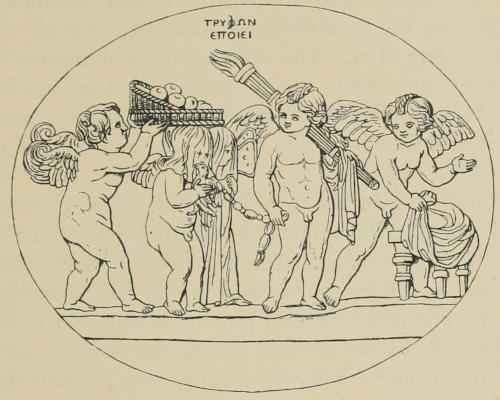
Fig. 154.
On the engraved gem[1335] in fig. 154, signed by the artist Tryphon, the scene represented is the marriage, or possibly the initiation and marriage ceremonies in one, of Eros and Psyche. The subject is of course mythological, but none the less is it a transcript of actual usage. Eros and Psyche, both closely veiled, are led by a sacred fillet in the hand of the Eros who bears the nuptial torch. Another Eros to the right unveils a seat or couch. Over the veiled heads of bride and groom a third Eros holds the liknon full of fruits.
That the liknon was carried at marriage ceremonies is known also from literary sources. Plutarch[1336] says it was the custom at Athens at marriages that a boy both whose parents were alive should carry a liknon full of loaves and then pronounce the words ‘Bad have I fled, better have I found.’ The fact that the boy must have both parents alive, i.e. that he should be uncontaminated by any contact however remote with the unlucky spirits and influences of the dead, shows clearly that here again the carrying of the liknon was a fertility charm, a charm to induce the birth of children and all natural wealth and increase. In a marriage rite the symbolism of Liknites, of fruit and child, could not be forgotten. The scholiast to Kallimachos[1337] says ‘in old days they were wont to lull babies to sleep in likna as an omen for wealth and fruits,’ and Servius says, as already noted (p. 528), it was the custom to do this the moment the child was born.
But the liknon in the marriage rite became not merely a fertility charm but the symbol of spiritual grace. This is clear from the words of Suidas[1338]. The boy, he says, carried branches of acanthus and acorns as well as loaves. If Suidas is right, these ruder natural products were only present as being earlier first-fruits before man made loaves of corn, but Suidas says he carried them and pronounced the formulary signifying as in a riddle the change to what is better, for the wreath of oak and acanthus signified what was bad. It was this mysticizing of everyday things that irritated the plain man, that seemed to him at once foolish and pretentious; this it was that raised Demosthenes to his angry protest: ‘You bid your mystics,’ he says to Aeschines[1339], ‘when you have daubed them with mud and purified them with clay, say “Bad have I fled, better have I found,” pluming yourself that no one has ever before uttered such words, you,’ he goes on, ‘who are kistophoros and liknophoros.’ Had not every plain man pronounced the words at his marriage and meant by them—increase of income and family?
The ‘mystic fan of Iacchos’ was used in marriage rites. This brings us face to face with the question—did Orphic mysteries include a mystic marriage[1340]? The Orphics worshipped, as has been seen (p. 499), both Mother and Son; they mysticized the birth of the Son; did they look back before the birth and mysticize the marriage of the Mother? On a priori grounds we should expect they did. A religion based on the belief of possible union with the divine had everything to gain from the symbolism of marriage. Happily we are not left to a priori speculation; we have positive evidence that Dionysiac mysteries contained a sacred marriage and that Orphics mysticized it.
The Sacred Marriage.
By a most unhappy chance our main evidence as to the Sacred Marriage of the mysteries comes to us from the Christian Fathers; their prejudiced imaginations see in its beautiful symbolism only the record of unbridled license. We may and must discredit their unclean interpretations, but we have no ground for doubting the substantial accuracy of their statements as to ritual procedure. They were preaching to men who had been initiated in the very mysteries they describe, and any mis-statement as to ritual would have discredited their teaching.
Clement[1341] in his ‘Exhortation’ wishes to prove the abominable wickedness of Zeus and says that he became the husband of his daughter in the form of a snake. He adds: ‘The token of the Sabazian mysteries is the snake through the bosom, and this snake gliding through the bosom of the initiated is the proof of the license of Zeus.’ Arnobius[1342] too holds that the ceremony of the snake is but a witness against Zeus. He adds the important detail that the snake was of gold. It was let down into the bosom and taken away from below. The gold snake is in itself evidence of the simple symbolic innocence of the rite.
The snake ceremony of Sabazios is of course the relic of a very primitive faith, of the time when the snake was the god. We are reminded of the story told of Philip of Macedon (p. 398) and his fear that Olympias was the bride of a divine snake. As civilization advanced the sacred marriage would take a purely human form.
Clement[1343] again gives invaluable evidence. Happily he has preserved for us the symbols or tokens of initiation into the mysteries of the Great Mother in her Asiatic form as Cybele. ‘The symbols,’ he says, in his gross and ignorant blasphemy, ‘will abundantly excite your laughter, though on account of the exposure you will not be in laughing condition: I have eaten from the timbrel, I have drunk from the cymbal, I have carried the kernos, I have gone down into the bridal chamber.’ The first three tokens are, as has been already shown (p. 155), practically identical with the tokens of Eleusis and relate to the solemn partaking of first-fruits; the last is a manifest avowal of a Sacred Marriage. The word παστός[1344] here used means bridal chamber or bridal bed. It is roughly the equivalent of θάλαμος, and like it had a hieratic as well as a secular use. The houses of the gods are built after the pattern of the dwellings of men.
It is curious and interesting to find that a παστάς, a bridal chamber, existed in the sanctuary of the Great Mother at Phlya. The anonymous author of the Philosophoumena[1345] or ‘Refutation of all Heresies’ tells us the Bacchic rites of Orpheus ‘were established and given to men at Phlya in Attica before the establishment of the Eleusinian rite of initiation.’ These rites were those of her called the Great One. At Phlya there was a bridal chamber (παστάς) and on the chamber were paintings, existing to the author’s own time, representing the whole semblance of what has been described. On the subject of the many representations Plutarch wrote in his ten books against Empedokles. Unhappily the treatise by Plutarch is lost and the author of the Philosophoumena only describes one painting, which will be discussed later (Chap. XII.) in relation to the theogony of Orpheus. At present it is important to note the one fact that in a primitive home of Orphism there was a sacred bridal chamber. In such a chamber must have been enacted a mimetic marriage.
Nor was it only at Phlya that a marriage chamber existed and a marriage ceremonial was enacted. At Athens itself was such a chamber, and our evidence for its existence is no less an authority than Aristotle[1346]. In his discussion of the official residences of the various archons he notes that in past days the King Archon used to live in a place called the Boukolion near to the Prytaneion, ‘And the proof of this is that to this day the union and marriage of the wife of the King Archon with Dionysos takes place there.’
In a place called the ‘cattle shed’ the Queen Archon was married to Dionysos. The conjecture lies near to hand that in bygone days there was a marriage to a sacred bull. We are reminded that the worshipper of Sabazios was said to ‘herd’ the god (p. 420). Be that as it may, at the festival of the Anthesteria the Queen Archon was ‘given in marriage’ to Dionysos, and from the author of the Speech against Neaira[1347] we learn how dread and sacred was the rite.
The mother of Neaira, a base-born alien, had on behalf of the city performed the ‘unspeakable sacrifice’; she had seen what none but an Athenian woman might see; she had entered where none but the Queen Archon might enter; she had heard what none might hear; she had administered the oath to her celebrants, fourteen in number, one for each of the altars of Dionysos, administered it on the sacred baskets before they touched the holy things. The oath was written on a stone stele set up by the altar in the ancient sanctuary of Dionysos in the marshes, opened but once in the year at the festival of the marriage. It was set there in secret because it was too holy to be read by the many; the letters were dim with age; so the orator called for the sacred herald and bade him read it that the court might hear how ‘holy and pure and ancient were its prescriptions.’
The Oath of the Celebrants.
‘I fast[1348] and am clean and abstinent from all things that make unclean and from intercourse with man and I celebrate the Theoinia and the Iobaccheia to Dionysos in accordance with ancestral usage and at the appointed times.’
Unhappily though we have the oath of purity we know nothing definite of either the Theoinia or the Iobaccheia[1349]. Only this much is certain, a sacred marriage was enacted by a woman high-born and blameless, and that marriage was a mystery.
At Athens Dionysos is bridegroom, not new-born child. This is one of the shifts from Son to Father that constantly occur in Greek mythology. The Christian Fathers see in it evidence of incest, but the horrid supposition is wholly gratuitous. It has been shown in detail (p. 260) that the Mother and the Maid are two persons but one god, are but the young and the old form of a divinity always waxing and waning. It is the same with the Father and the Son; he is one but he reflects two stages of the same human life. We are perplexed because both Father and Son in the religion of Dionysos take on many names: Sabazios, Dionysos, Bacchos, Iacchos, Zagreus. Each reflects some special function, but each is apt to be both Father and Son. The Romans in their dull way, with little power for intense personification, leave the simple truth more manifest. Libera the Mother has a Son Liber, a child, but even with them the inevitable confusion arises, the child Liber grows up and becomes ‘Father Liber.’
Another bridal chamber in the cult of Dionysos remains to be noted, and one of special significance. On his way from Sekyon to Phlius Pausanias[1350] came to a grove called Pyraea. In it there was a sanctuary of Demeter the Protectress and of Kore. ‘Here the men celebrate a festival by themselves, and they give up the place called the Bridal Chamber (Νυμφῶνα) to the women for their festival. Of the images of Dionysos and Demeter and Kore in the Bridal Chamber the faces only are visible.’ Here, as manifestly at Athens, the marriage service of Dionysos was accomplished by women; the men leave them alone with their god. If any one, Pentheus-like, charges these holy women with license, this plain primitive prescription refutes his impiety.
From the evidence of Aristotle and Pausanias we may be sure that the marriage rites, so grossly libelled by Christian Fathers, were not the products of their own imaginations. Their wilful misunderstanding is an ugly chapter in the history of human passion and prejudice. Now and again, when they seek an illustration for their own mysteries, they confess that the pagan mysteries of marriage were believed by the celebrants to be spiritual. Epiphanios[1351] says ‘some prepare a bridal chamber and perform a mystic rite accompanied by certain words used to the initiated, and they allege that it is a spiritual marriage’; and Firmicus[1352] by a happy chance records the social formularies. ‘Not only words,’ he says, ‘but even nuptial rites occur in their sacred mysteries, and the proof of this is the greeting in which the mystae hail those just initiated by the name of “brides”:
“A light upon the shining sea— The Bridegroom and his Bride”.’
A mimetic marriage was, it is clear, an element in the rites of Dionysos and an element mysticized by the Orphics. Equally clear is it that in the ceremony of waking Liknites and in the story of Zagreus we have as another element the birth of a child. At present we have no evidence of definite connection between the two. At Athens in the Boukolion we have a marriage rite but no birth rite, at Delphi in the waking of Liknites we have a birth but no marriage. When the mysteries at Eleusis are examined we find, as will shortly be seen, that the two rites—the marriage and the birth—were in close and manifest connection.
Orphic elements in Eleusinian Ritual.
The question may fairly be asked—are we entitled to use evidence drawn from Eleusinian mysteries to elucidate Orphic ceremonial? or in other words have we any clear evidence that the worship of Dionysos in the form known as ‘Orphic’ came to Eleusis and modified the simple rites of the Mother and the Maid?
These simple rites have been already examined. It has been shown from the plain evidence of the Eleusinian ‘tokens’ that the rites of Eleusis were primarily rites of a harvest festival, that the ceremonies consisted of elaborate purification and fasting, followed by the removal of the taboo on first-fruits, and the consequent partaking of the sacred kykeon and the handling of certain sacred objects. I have advisedly devoted no separate chapter to the Eleusinian Mysteries because all in them that was not a primitive harvest festival, all or nearly all their spiritual significance, was due to elements borrowed from the cult of Dionysos. We have now obtained some notion, fairly clear if fragmentary, of the contents of Orphic and Dionysiac rites; we have examined the Omophagia of Crete, the Liknophoria of Delphi and the Sacred Marriage of Athens and Phlya, and we are able to begin the enquiry as to whether and how far these rites are part of the ritual of Eleusis.
Before attempting to answer this question it may be well to resume briefly the literary evidence for the affiliation of Dionysos to the Eleusinian goddesses. The actual fact of his presence at Eleusis must be established before we consider the extent and nature of his influence on Eleusinian rites.
a. Iacchos at Eleusis.
Dionysos at Eleusis is known by the title of Iacchos. The locus classicus for Iacchos of the mysteries is of course the chorus of the Mystae in the Frogs of Aristophanes[1353]:
Chorus (unseen). Iacchus, O Iacchus! Iacchus, O Iacchus! Xanthias. That’s it, sir. These are the Initiated Rejoicing somewhere here, just as he told us. Why, it’s the old Iacchus hymn that used To warm the cockles of Diagoras! Dionysus. Yes, it must be. However, we’d best sit Quite still and listen, till we’re sure of it. Chorus. Thou that dwellest in the shadow Of great glory here beside us, Spirit, Spirit, we have hied us To thy dancing in the meadow! Come, Iacchus; let thy brow Toss its fruited myrtle bough; We are thine, O happy dancer; O our comrade, come and guide us! Let the mystic measure beat: Come in riot fiery fleet; Free and holy all before thee, While the Charites adore thee, And thy Mystae wait the music of thy feet! Xanthias. O Virgin of Demeter, highly blest, What an entrancing smell of roasted pig! Dionysus. Hush! hold your tongue! Perhaps they’ll give you some. Chorus. Spirit, Spirit, lift the shaken Splendour of thy tossing torches! All the meadow flashes, scorches: Up, Iacchus, and awaken! Come, thou star that bringest light To the darkness of our rite, Till thine old men dance as young men, dance with every thought forsaken Of the dulness and the fear Left by many a circling year: Let thy red light guide the dances Where thy banded youth advances To be joyous by the blossoms of the mere!
The lovely hymn to Iacchos, as choragos of the mystae of Demeter, is speedily followed by a second hymn[1354] to the goddess herself—the Fruit-bearer:
One hymn to the Maiden; now raise ye another To the Queen of the Fruits of the Earth. To Demeter the Corn-giver, Goddess and Mother, Make worship in musical mirth.
The blend of the smell of roast pork and the odour of mystic torches, of buffoonery and ecstasy, is the perfect image of the fusion of old and new.
In the ritual hymn of Delphi, already noted (p. 417), Dionysos, who in the proœmium is addressed by his titles as god of a cereal drink, as Bromios and Braites, is when he leaves Parnassos and comes to Eleusis hailed by his new name Iacchos[1355]:
‘With thy wine cup waving high, With thy maddening revelry, To Eleusis’ flowery vale Comest thou—Bacchos, Paean, hail! Thither thronging all the race Come, of Hellas, seeking grace Of thy nine-year revelation, And they called thee by thy name, Loved Iacchos, he who came To bring salvation, And disclose His sure haven from all mortal woes.’
Sophocles[1356] in the Antigone invokes the god of many names for the cleansing of sin-stricken Thebes, but being an Athenian he remembers the god of the mysteries of Eleusis:
‘Thou of the Many Names, delight and wonder Of the Theban bride, Child of the pealing thunder, Thou who dost rule over Italia’s pride And at Eleusis in Deo’s bosom wide Dwellest, Deo, she the mother of all, Bacchos, Bacchos, on thee we call.’
Bacchos at Thebes, but, when the poet remembers the nocturnal rites of the mysteries, the name Iacchos comes irresistibly back:
‘Thou who dost lead the choir Of stars aflame with fire, Of nightly voices King, Of Zeus offspring, Appear, O Lord, with thine attendant maids The Thyiades, Who mad and dancing through the long night chant Their hymn to thee, Iacchos, Celebrant.’
For Iacchos at the Eleusinian mysteries we are not left to the evidence of poetry alone. Herodotus[1357] tells how, when Attica was being laid waste by Xerxes, Dicaeus, an exile, happened to be with Demaratus, a Lacedaemonian, in the Thriasian plain. They saw a great cloud of dust coming from Eleusis, so great that it seemed to be caused by thirty thousand men. They were wondering at the cloud, and they suddenly heard a sound, and the sound seemed to Dicaeus to be ‘the mystic Iacchos.’ Demaratos did not know about the sacred rites at Eleusis, and he asked what it might be that they heard. Dicaeus, who took the sound to be of ill omen to the Persians, explained it as follows: ‘The Athenians celebrate this festival every year to the Mother and the Maiden, and any Athenian or other Greek who wishes is initiated, and the sound that you hear is the cry “Iacchos,” which they raise at this feast.’
The account is interesting because it shows that ‘the Iacchos’ was a ritual cry, one easily recognizable by an Athenian, just as now-a-days we should recognize Alleluia or Hosanna. That the mysteries at Eleusis were still in the main of local import is clear from the fact that a Spartan did not recognise the cry.
Iacchos gave his name to one of the days of the Eleusinian mysteries—the 20th of Boedromion (Sept., Oct.). On this day he was taken from his sanctuary in Athens, the Iaccheion, and escorted in solemn procession to Eleusis. Plutarch[1358], in commenting on lucky and unlucky days, says he is aware that unlucky things sometimes happen on lucky days: for the Athenians had to receive a Macedonian garrison ‘even on the 20th of Boedromion, the day on which they lead forth the mystic Iacchos.’
Iacchos then was the name by which Dionysos was known at Eleusis, his mystery name par excellence for Athens. It is important to note what special form of the god the name expressed.
Strabo[1359] says vaguely, ‘they call Dionysos, Iacchos, and the spirit (δαίμονα) who is leader of the mysteries of Demeter’; but vagueness is pardonable in the particular connection in which he speaks, as he is concerned to show the general analogy of all orgiastic rites. Mythologists have too readily concluded that Iacchos is a vague title denoting a sort of ‘genius of the mysteries,’ and ‘the mystic Iacchos’ has come to mean anything and nothing in particular.
But Suidas[1360] is quite precise; he notes that Iacchos means ‘a certain day,’ ‘a certain song,’ but he puts, first and foremost, what is the root idea of Iacchos, he is ‘Dionysos at the breast.’ Iacchos at Eleusis is not the beer-god, not the wine-god, but the son-god, ‘child of Semele, the wealth-giver[1361],’ the same as Liknites, ‘He of the cradle,’ whom, year by year on Parnassos, the Thyiades wakened to new life (p. 402).
Iacchos had his sanctuary at Athens and was received as a guest at Eleusis. Never, so far as we know, had he temple precinct or shrine at Eleusis, and his name occurs very rarely in inscriptions. He is a god made by the Athenians in their own image; they were guests at Eleusis, so their god was a guest. He is as it were a reflection of the influence of Athens at Eleusis.
Another point must be noted. Zagreus, it has been seen, is a god of ritual rather than poetry, Iacchos is of poetry rather than ritual, of poetry touched and deepened by mysticism. He is just so much of the religion of Dionysos as the imaginative Athenian can face. We never hear that Iacchos was a bull, there is no legend that he was torn to pieces. Sophocles[1362], the most orthodox of poets, knows he has horns, but he sends his horned Iacchos to dwell in fabulous Nysa,
‘Where no shrill voice doth sound of any bird,’
and for the rest he is compact of torchlight and dancing.
The learned Nonnus[1363], who is steeped in Orphism and a most careful ritualist, seems to hit the mark when he makes Iacchos the latest born of the divine Bacchic incarnations. According to Nonnus, Iacchos is the child of Aura by Bacchus, and is presented by his father to Athene, and Athene adopted him, and gave him the breast that before him none but Erechtheus had sucked. Here we have a manifest reminiscence of Iacchos as ‘Dionysos at the breast.’ Nonnus goes on to say how the nymphs, the Bacchae of Eleusis, received the new-born child with dance and song, and they hymned first Zagreus son of Persephone, next Bromios son of Semele, and third in order Iacchos.
So shadowy, so poetical are the associations that cluster round the name Iacchos, that, if Iacchos were our only evidence of Dionysos at Eleusis, I should be inclined to believe his influence was in the main late and literary. It is to ritual we must look for evidence more substantial.
It is perhaps worth noting that Pausanias[1364], in mentioning a trivial ritual taboo, notes that it is common to the mysteries of Eleusis and the teaching of Orpheus. He is speaking of the temple of the Bean-Man (Cyamites), but is uncertain of the origin of the name and cult, and knows he is treading on delicate ground, so he contents himself with saying darkly, ‘Whoever has seen the rite at Eleusis, or has read what are called the sayings of Orpheus, knows what I mean.’ More than once, in examining a sanctuary of Demeter or Kore, he stops to note that local tradition attributed its foundation to Orpheus. Thus at Sparta[1365] he saw a temple of Kore the Saviour, and ‘some say Orpheus the Thracian made it, but others Abaris who came from the Hyperboreans.’ Here the diverse tradition is unanimous as to Northern influence. The Lacedaemonians believed, he says, that Orpheus taught them to worship Demeter of the Underworld, but Pausanias himself thinks that they, like other people, got it from Hermione[1366]. No great importance can be attached to these floating traditions, but they serve to show that popular belief connected the worship of the Mother and the Maid with Orpheus and the North. We are inclined to connect the rise of their worship exclusively with Eleusis, so that local tradition to the contrary is of some value.
But the real substantial evidence as to the presence and influence of Orphic rites and conceptions at Eleusis is drawn from the Eleusinian ceremonial itself. Of the three main Orphic mysteries examined, the Omophagia, the Liknophoria, and the Sacred Marriage, two, the Liknophoria and the Sacred Marriage, are known with absolute certainty to have been practised at Eleusis.
The first and perhaps the most profound and characteristic of Orphic rites, the Omophagia, is wholly absent[1367]. The reason is not far to seek. The Omophagia, deep though its spiritual meaning was, is in its actual ritual savage and repulsive. We have seen a rite closely analogous practised by primitive nomadic Arabs. The cultus at Eleusis is, as has already been shown, based on agricultural conditions; the emergence of Eleusis was primarily due to the fertile Rarian corn plain. A god who comes to Eleusis, who is affiliated by this agricultural people, will shed the barbarous side of his worship, and develope only that side of his nature and ritual that is consonant with civilized life. A god can only exist so long as he is the mirror of the people who worship him. Accordingly we find, as might be expected, that it is the Dionysos of agriculture, and of those marriage rites that go with agriculture, who is worshipped at Eleusis, worshipped with the rites of the Liknophoria and of the Sacred Marriage.
b. The Liknophoria at Eleusis.
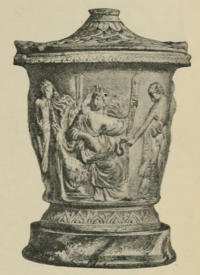
Fig. 155.
The Liknophoria as an element in the rites at Eleusis is clearly shown in the monument reproduced in figs. 155-157. The design forms the decoration of a cinerary urn[1368] (fig. 155) found in a grave near a Columbarium on the Esquiline Hill. The scenes represented are clearly rites of initiation. In fig. 156 we see Demeter herself enthroned; about her is coiled her great snake caressed by the initiated mystic[1369]. To the left stands a female torch-bearer; she is probably Persephone. This scene represents the final stage of initiation (ἐποπτεία), where the epoptes is admitted to the presence and converse of the goddesses.
The remainder of the design (fig. 157) is occupied by two preliminary ceremonies of purification, the sacrifice of the ‘mystic ’ pig already discussed (p. 152) and the liknon ceremonial. It is on this last that attention must be focussed. The candidate is seated on a low seat (θρόνος); his right foot rests on a ram’s head which doubtless stands for the ‘fleece of purification’ (p. 24); he is veiled and in his left hand carries a torch; above his head a priestess holds a liknon. It is remarkable that the liknon in this representation, unlike those previously discussed, contains no fruits. This can scarcely, I think, be accidental. When the artist wishes to show fruits in a sacred vessel, he is quite able to do so, as is seen in the dish of poppy heads held by the priest to the right, where perspective is violated to make the content clear. The absence of the fruits is best, I think, explained on the supposition that the liknon is by this time mysticized. It is regarded as the winnowing fan, the ‘mystic fan of Iacchos,’ rather than as the basket of earth’s fruits. It is held empty over the candidate’s head merely as a symbol of purification. This explanation is the more probable, if the scene be, as is generally supposed, a representation of Eleusinian mysteries, but of Eleusinian mysteries held not at Eleusis but at Alexandria. The vertical corn-ears on the head of Demeter, the fringed garment of the youth who handles the snake, and the scale pattern that decorates the cover of the urn itself (fig. 155), all find their closer analogies in Egyptian rather than indigenous Greek monuments.
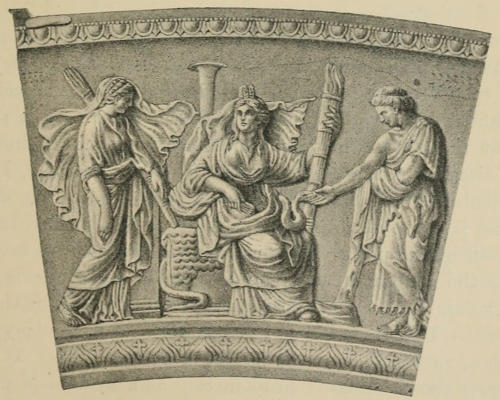
Fig. 156.
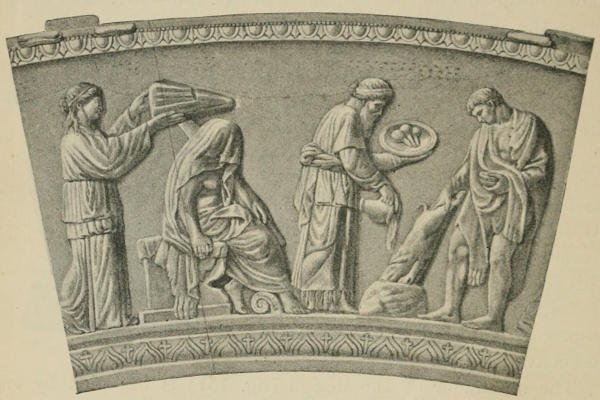
Fig. 157.
A Liknophoria, it is clear, was part of Eleusinian ritual. But the question naturally arises—did not Dionysos borrow the liknon from Demeter rather than Demeter from Dionysos? It is almost certain that he did not. Dionysos was worshipped as Liknites at Delphi before he came to Eleusis. Moreover, in the Eleusinian ‘tokens’ the confession is not ‘I have carried the liknon,’ but ‘I have carried the kernos.’ That Kernophoria and Liknophoria were analogous ceremonies, both being the carrying of first-fruits, is possible; that they were identical is improbable. Dionysos borrowed the liknon from his own mother, not from her of Eleusis.
Far more complete and satisfactory is the evidence for the Sacred Marriage and the Birth of the holy child. These were as integral a part of the mysteries of Eleusis as of the rites of Sabazios and Dionysos.
c. The Sacred Marriage and the Sacred Birth at Eleusis.
Iacchos, we have seen, was defined as the child Dionysos ‘at the breast,’ but for any ceremony of his birth or awakening under the name of Iacchos we look in vain. Iacchos is Athenian; no one ventured to say he was born at Eleusis, but by a most fortunate chance the record is left us of another Mother and Son at Eleusis, and we know too that the marriage of this Mother and the birth of this Son were the central acts, the culmination, of the whole ritual of its mysteries. We owe this knowledge to the anonymous treatise which has already furnished the important details as to the Mysteries of Phlya.
The author of the Philosophoumena[1370] is concerned to prove that the heretical sect of the Naassenes got their doctrine from ceremonials practised by the Phrygians. The Phrygians, the Naassene says, assert that god is ‘a fresh ear of grain reaped.’ He then goes on to make a statement to us of supreme importance. ‘And following the Phrygians the Athenians, when they initiate at the Eleusinian rites, exhibit to the epoptae the mighty and marvellous and most complete epoptic mystery, an ear of grain reaped in silence. And this ear of grain the Athenians themselves hold to be the great and perfect light that is from that which has no form, as the Hierophant himself, who is not like Attis, but who is made a eunuch by means of hemlock and has renounced all carnal generation, he, by night at Eleusis, accomplishing by the light of a great flame the great and unutterable mysteries, says and cries in a loud voice “Holy Brimo has borne a sacred Child, Brimos,” that is, the mighty has borne the mighty; and holy, he (i.e. the Naassene) says, is the generation that is spiritual, that is heavenly, that is from above, and mighty is he so engendered.’
The evidence of the writer of the Philosophoumena is indefeasible, not indeed as to the mystical meaning either he or the Naassene he quotes attached to the rites, but as to the rites themselves. He describes the rites only to discredit them and he quotes an actual ritual formulary. We may take it then as certain that to the epoptae at Eleusis was shewn as the supreme revelation a ‘fresh ear reaped’ and that by night there was declared to these epoptae the birth of a sacred Child: ‘Unto us a Child is born, unto us a Son is given.’ The close conjunction in which the two rites are placed makes it highly probable, though not absolutely certain, that the one, the human birth, was but the anthropomorphic form of the other, that in fact we have here the drama of Liknites, child and fruit, reenacted; the thought is the same as that expressed by the vase-painter (fig. 153) where the new-born child rises out of the cornucopia of fruits. And last it is highly satisfactory to learn, and that from the mouth of a Christian writer, that the birth and the begetting were symbolical. The express statement that the Hierophant partook of some drug compelling abstinence cannot have been invented[1371].
The author of the Philosophoumena says nothing of the Sacred Marriage, though from the birth of the holy Child it might be inferred. The confession ‘I have gone down into the bridal chamber’ is one of the ‘tokens’ of the mysteries of the Great Mother, but we cannot certainly say that it was a ‘token’ at Eleusis; neither Clement nor Firmicus nor Arnobius includes it in his enumeration. We cannot therefore assert that each mystic at Eleusis went through a mimetic marriage, but we do know that the holy rite was enacted between the hierophant and the chief priestess of Demeter. Asterius[1372], speaking of the various procedures of initiation at Eleusis, asks—‘is there not there the descent into darkness and the holy congress of the hierophant and the priestess, of him alone and her alone?’
Lucian[1373] adds incidental testimony. In his account of the doings of the false prophet Alexander he describes how the impostor instituted rites that were a close parody of those at Eleusis, and he narrates the details of the blasphemous travesty. Among the mimetic performances were not only the Epiphany and Birth of a god but the enactment of a Sacred Marriage. All preliminaries were gone through, and Lucian says that but for the abundance of lighted torches the marriage rite would actually have been consummated. The part of the hierophant was taken by the false prophet himself. A short time after the parody of the marriage ceremony he came in wearing the characteristic dress of the hierophant, and, amid a deep silence, announced in the usual loud voice ‘Hail, Glykon,’ and ‘some fellows attending him, Paphlagonians, wearing sandals and smelling of garlic and supposed to be Eumolpidae and Kerykes, cried in answer “Hail, Alexander.”’
Lucian’s account of this scurrilous travesty is not pleasant reading, but it serves one important end—it enables us to put together the two rites, the Sacred Marriage and the Birth of the holy Child; but for Lucian the sequence must have remained conjectural. We may now be certain that in silence, in darkness and in perfect chastity the Sacred Marriage was first enacted, and that immediately after the Hierophant came forth, and, standing in a blaze of torchlight, cried aloud that the supreme mystery was accomplished, ‘Holy Brimo has borne a sacred Child, Brimos.’
The Sacred Marriage[1374] formed part of the ritual of Eleusis, as it formed part of the Orphic mysteries of Sabazios and the Great Mother, but the further question arises—was this Sacred Marriage indigenous at Eleusis or did it, like the religion of Dionysos, come from the North? Was Brimo only a title of the Eleusinian Demeter? This it would seem was the view of Clement[1375] who is not strong in ethnography, but it can I think be shown that Clement was wrong. Brimo is a form of the Great Mother who is also the Maid, but she is a Northern not an Eleusinian form. This is clearly evidenced by what we know of her apart from the mysteries.
d. Thessalian influence at Eleusis. Brimo.
Of Brimos we know nothing save as the mystery child; he is the attributive son marking by identity of name the function of his mother. Brimo we know as an underworld goddess, and, a fact all important for the argument, she comes from Pherae in Thessaly.
In the Alexandra of Lycophron Cassandra thus addresses her mother Hecuba[1376]:
‘Mother, unhappy mother, not untold Shall be thy fame, for Brimo, Perses’ maid, The Threefold One, shall for her ministrant Take thee, to fright men with dire sounds at night, Yea such as worship not with torchlit rites The images of her who Strymon holds, Pherae’s dread goddess leaving unassoiled.’
For once Lycophron is intelligible; Hecuba is to be transformed into a hound of the triple Hecate, Thessalian goddess of the underworld, and Brimo is but her other name: she is the Thessalian Kore. The mystic child at Eleusis was born of a maiden; these ancients made for themselves the sacred dogma, ‘A virgin shall conceive and bear a son.’ It was left to Christian fathers, blending the motherhood of Demeter with the virgin mother and the parentage of Zeus, things they did not and would not understand, to make of the sacred legend a story of vile human incest.
Brimo, though we find her, in late times, in the very heart of the mysteries, belongs with her hell-hounds to a couche of mythology obviously primitive. To the popular mind of the uninitiated she lapsed into mere bogeydom. Lucian[1377] in his Oracle of the Dead brings her in with the rest of the comic horrors of Hades. When the underworld decree is passed the magistrates of Hades record their votes, the populace holds up its hands, ‘Brimo snorts approval, Cerberus yelps his aye.’
But Apollonius Rhodius[1378], writing of things Thessalian, and by natural temper inclined always to the serious and beautiful, knows of Brimo as terrible and magical, but yet as the Nursing Mother (Kourotrophos). When Medea is about to pluck the awful underworld root for the undoing of Jason,
‘Seven times bathed she herself in living founts, Seven times called she on Brimo, she who haunts The night, the Nursing Mother. In black weed And murky gloom she dwells, Queen of the dead.’
And the scholiast commenting on the passage says she is Hecate, ‘whom sorceresses were wont magically to induce (ἐπάγεσθαι); and they called her Brimo because of the terror and horror of her; and she sent against men the apparitions called Hekataia; and she was wont to change her shape, hence they called her Empusa.’ He goes off into fruitless etymology but drops by the way a suggestion that may contain some truth, that the name Brimo is connected with ὄβριμος ‘raging,’ the epithet of another Thracian, Ares.
Brimo then, some said, meant the Mighty, some the Angry One. The two, for minds obsessed by the atmosphere of ‘aversion,’ are not far apart: the Angry-Raging One is own sister to the Angry Demeter, Demeter Erinys. But by their Angry name it is not well to address the gods, lest by sympathetic magic you rouse the very anger you seek to allay. Brimo may well have been one of the Silent Names.
Brimo is Thessalian, and Thessalian often spells ‘later Thracian.’ Brimo is near akin to the Mother Kotys, the mystery goddess of the Thracians, but we cannot say that she is herself certainly Thracian. For definite evidence of a Thracian element at Eleusis we must look to its chief hereditary priesthood, the family from which the Hierophant was taken, the Eumolpidae.
e. Thracian influence at Eleusis. Eumolpos.
The Eumolpidae must also be the keystone of any contention as to Thracian influence at Eleusis, and fortunately we are fairly well informed as to their provenance.
Sophocles[1379] in the Oedipus Coloneus makes the chorus sing:
‘O to be there Upon the sea shore, where, Ablaze with light, The Holy Ones for mortals their dread rite Nurse, and on mortal lips the golden key Is set of celebrant Eumolpidae.’
The scholiast[1380] asks the very pertinent question—‘Why in the world have the Eumolpidae presidency over the rites, when they are foreigners?’ He proceeds as usual to make several puzzled and contradictory suggestions. Perhaps the reason is that it was Eumolpos, son of Deiope daughter of Triptolemos, who first instituted the mysteries at Eleusis, and not the Thracian, and this was the view taken by Istros in his book on ‘Things out of Order,’ or perhaps Akesidorus was right; his theory was that the Eumolpos who founded the rites was fifth in descent from the first Eumolpos.
Unpleasant facts are always apt to be classed as ‘Things out of Order.’ Facts are facts, but Order is what you happen to like yourself. The simple fact cheerfully accepted at Eleusis was that the Eumolpidae were Thracians, but the Athenians did not like the Thracians, so when they came to Eleusis they proceeded to get the unpalatable fact into ‘order.’ One of two things must be done, either the Eumolpidae, whose respectability was above impeachment, must be provided with a new and local parentage, they must be affiliated to Triptolemos, or the old parentage must be removed to a safe and decorous antiquity. Few people feel very acutely about what happened five generations ago.
But all the time historians knew perfectly well what really had happened, and Akesidorus proceeds to state it quite simply: ‘Tradition says that Eleusis was first inhabited by an autochthonous population, and then by those Thracians who came with Eumolpos to help in the war against Erechtheus.’ He lets out at last what was at the bottom of the whole complication, a fight between Eleusis and Athens and a contingent of Thracian auxiliaries. The war had been internecine, for the legend says the single combat between Erechtheus and Eumolpos ended in the death of both. Athens ultimately emerged to political supremacy, but Eleusis, to which Eumolpos first brought his rites, maintained her religious hegemony. Athens did what she could. She even built herself an Eleusinion and instituted Lesser Mysteries; there was much to-ing and fro-ing of sacred objects, the ἱερά are brought from Eleusis and Iacchos makes a return visit, but the actual final initiation takes place at Eleusis and the chief celebrant is still to all time a Thracian Eumolpid[1381].
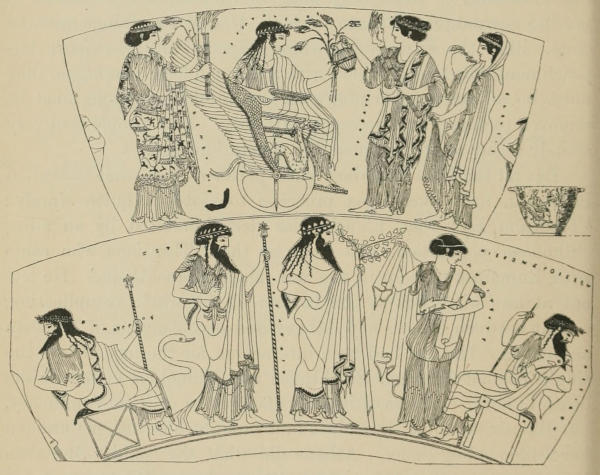
Fig. 158.
Art is not without its evidence as to Eumolpos at Eleusis. The simple vase-painter is untroubled by the Eleusinian blend of Dionysos and Demeter, and the Thracian origin of Eumolpos. On the kotyle in fig. 158, signed by the potter Hieron, and now in the British Museum[1382], he has brought together in friendly comradeship a group of Eleusinian personages, some of the ancient local stock, some of the northern immigrants. All the figures are carefully inscribed, so that there is no question of doubtful interpretation. On the obverse, and plainly occupying the central important place, the young local hero Triptolemos starts in his winged chariot to carry his ears of corn to the world. Demeter in her splendid robe stands behind him, and ‘Pherophatta’ pours out the farewell cup. Triptolemos was, as has already been noted (p. 273), originally a local king; it may be he became young out of complimentary rivalry with the child Iacchos. Behind ‘Pherophatta’ stands a nymph whom, but for the inscription, we should not have dared to name, ‘Eleusis.’ Beneath one handle, looking back at the group of local divinities, is the seated Eumolpos, and near him is a great swan—for Eumolpos is the sweet singer. He is the Thracian warrior when he fights Erechtheus, but here he holds the sceptre as priestly king; he is, Thracian-fashion, compounded of Ares and Orpheus. The centre of this reverse picture is occupied by the Thracian Dionysos, with his great vine branch, and behind him comes his father Zeus, with thunderbolt and sceptre. Dionysos a full-grown man, not babe, balances Triptolemos. Eumolpos is vis à vis to Poseidon, with whom he had close relations. Amphitrite completes the picture, a veritable little manual of the mythology of Eleusis.
f. The Delphic Dionysos at Eleusis and Agrae.
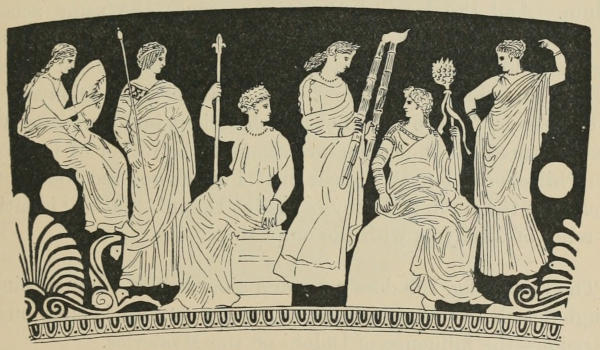
Fig. 159.
Another class of vase-paintings, in date nearly a century later than that of Hieron, bring before us Dionysos at Eleusis, but they depict him as an incomer, not from Thrace, but from the half-way station of Delphi. A polychrome vase of the 4th century B.C., formerly in the Tyskiewicky Collection[1383] (fig. 159), puts the matter very clearly. The central figure is Demeter, crowned and sceptred, sitting on an altar-like throne. To the right is Kore with her torches. She turns towards Dionysos. He too is seated, as becomes a god, and he holds his thyrsos. He is seated, but on what a throne! He is seated on the omphalos. To the ancient mind no symbolism could speak more clearly; Dionysos is accepted at Eleusis; he has come from Delphi and brought his omphalos with him. We are apt to regard the omphalos as exclusively the property of Apollo, and it comes as something of a shock to see Dionysos seated quietly upon it. We have already (p. 320) seen that Apollo took it from Ge, took the ancient symbol of Mother Earth and made it his oracular throne; but at Delphi men knew that it had another and earlier content. It was the tomb of the dismembered Dionysos. The tradition that Dionysos was buried at Delphi is recorded again and again by lexicographers, Christian Fathers, and Byzantine historians; but the common source of their information seems to be the Atthis of Philochoros (3rd cent. B.C.). Cedrenus[1384], in his history of the whole world, tells the story of how Dionysos was chased from Boeotia, and ended his days at Delphi, ‘and the remains of him are buried there in a coffin (ἐν σορῷ). And his gear is hung up in the sanctuary, as the learned Demarchus says in his history of him. And the learned Philochoros gives the same account in his exposition about Dionysos himself; his tomb is to be seen near the gold Apollo. It may be conjectured that there is a sort of basis on which he writes “Here lies the dead Dionysos the son of Semele”.’ We need not attach serious importance to what is ‘conjectured,’ as the conjecture seems to be rather of Cedrenus than Philochoros, but it is clear that Philochoros recorded a tradition that the tomb of Dionysos was at Delphi. Tatian[1385] identifies the tomb of Dionysos with the omphalos.
The vase in fig. 159 does not stand alone. The Ninnion pinax[1386], though details in its interpretation remain obscure, is clear on this one point—the influence of Delphi on the Mysteries.
In the discussion of this difficult and important monument I shall confine myself to such points as seem to me certain and immediately relevant. The inscription at the base tells us that it was dedicated by a woman ‘Ninnion’ to the ‘Two Goddesses.’ The main field of the pinax is occupied by two scenes, occupying the upper and lower halves, and divided, according to the familiar convention of the vase-painter, into two parts by an irregular white line, indicating the ground on which the figures in the upper part stand. In each of these two parts some of the figures, distinguished by their larger size, are divine, e.g. the seated goddesses to the right; others, of smaller stature, are human. Among the human figures in both the upper and lower row one is marked out by the fact that she carries on her head a kernos (see p. 159). She is a dancing Kernophoros[1387]. She is the principal figure among the worshippers, and she can scarcely be other than Ninnion[1388], who dedicated the pinax. In a word, Ninnion, in her votive offering, dedicates the representation of one, and certainly an important, element in her own initiation, her Kernophoria.
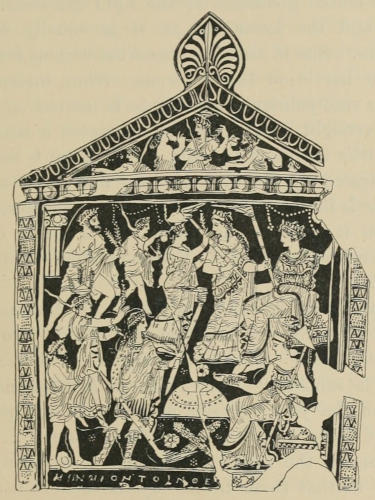
Fig. 160.
Of this initiation why does she give a twofold representation? The answer, once suggested, is simple and convincing. Each and every candidate was twice initiated, once in the spring, at Agrae, in the Lesser Mysteries; once in the autumn, at Eleusis, in the Greater Mysteries. The scene in the lower half is the initiation at Agrae, that in the upper half the initiation at Eleusis. It is the scene in the lower half that specially concerns us.
The two seated goddesses to the right are clearly the ‘Two Goddesses,’ and the lower one is, it is equally evident, the younger, Kore. She is seated in somewhat curious fashion on the ground; near her is an empty throne. Some interpreters have said that the vase-painter meant her to be seated on the throne, but by an oversight drew in her figure seated a little above it. But the artist’s intention is quite clear. Kore is seated on the ground, indicated by the curved white line beneath her. The empty throne is intentional and emphatic. Demeter, who should be seated on it, who in the upper tier is seated on a throne precisely identical, is absent. A vase-painter could not speak more clearly.
The explanation is again as simple as illuminating. The lower tier represents the initiation of Ninnion into the Lesser Mysteries at Agrae. These were sacred to Persephone, not Demeter. The scholiast[1389] on the Plutus of Aristophanes says: ‘In the course of the year two sets of mysteries are performed to Demeter and Kore, the Lesser and the Greater ... the Greater were of Demeter, the Lesser of Persephone her daughter.’ He further tells us that these Lesser Mysteries were a sort of pre-purification (προκάθαρσις) for the Greater, and that they were founded later than the great Eleusinian Mysteries, tradition said, in order that Herakles might be initiated. To these statements Stephen[1390] of Byzantium adds an important fact: ‘the Lesser Mysteries performed at Agra or Agrae were,’ he says, ‘an imitation of what happened about Dionysos.’
With these facts in our minds we are able to interpret the lower row of figures. Kore alone receives the mystic Ninnion, and Dionysos himself acts as Dadouchos. That the figure holding the torches is a god is clear from his greater stature, and, if a god, he can be none other than Dionysos, who, as Iacchos, led the mystics in their dance. Dionysos has come from Delphi and brought his great white omphalos[1391], his Delphic grave, with him. Below it are depicted two of the bundles of myrtle twigs, which are frequently the emblems of initiation, and which bore the name of ‘Bacchoi[1392].’
This interpretation is confirmed when we turn to the upper tier. ‘Ninnion,’ having been initiated by Dionysos into the mysteries at Agrae, which he shared with Kore, now comes for the Greater Mysteries to Eleusis. Kore herself brings her mystic, and leads her into the presence of Demeter enthroned. The scene is the telesterion of Eleusis marked by two columns, which, be it noted, extend only half-way down the pinax. In the Lesser Mysteries, a later foundation, Dionysos shares the honours with Kore; in the Greater and earlier to the end he is only a visitant.
The direct influence of Delphi on Eleusis as evidenced by these vases, and by many inscriptions, may have been comparatively late, but in a place to which Eumolpos had already brought the worship of Dionysos it would have easy access. At home Delphi became in the lapse of time more and more ‘all for Apollo,’ but abroad, as Athens, Eleusis, and Magnesia testify, she remembered sometimes to promote the worship of a god greater than Apollo, a god who was before him, and who never ceased, even at Delphi, to be his paredros, Dionysos.
Both on the kotylos of Hieron (fig. 158) and on the Tyskiewicky vase (fig. 159) Dionysos at Eleusis is represented as a full-grown man, not as a mystery babe. This fact is highly significant. The son has ceased to be a child, and growing to maturity forgets his relation to his mother. In the old Thracian religion, preserved in its primitive savagery in Asia Minor, the Mother, by whatever name she be called, whether Kotys or Kybele or Rhea or the Great Mother, is the dominant factor; the Son is, as is natural in a matriarchal civilization, at first but the attribute of motherhood. When a cult is mainly in the hands of primitive women they will tend to keep their male god in the only condition they can keep him, i.e. as child. But if that cult is to advance with civilization, if the god is to have his male worshippers, he must grow to be a man; and as the power of the Son waxes and he becomes more and more the Father, the power of the Mother wanes, and she that was the Great Mother sinks to be Semele the thunder-stricken. If we bear in mind the old principle that man makes the gods in his own image, that a god only is because he reflects the life of his worshipper, the constant shift of Dionysos from child to full-grown man, from Son of his Mother to Son of his Father, becomes intelligible, nay more, necessary.
In all probability the development of Dionysos from child to man was helped and precipitated by his appropriation of the vine—a spirit of intoxication will be worshipped by man as much and perhaps more than by women. But the interesting thing about Dionysos is that, develope as he may, he bears to the end, as no other god does, the stamp of his matriarchal origin. He can never rid himself of the throng of worshipping women, he is always the nursling of his Maenads. Moreover the instruments of his cult are always not his but his mother’s. It is not enough to say that all orgiastic cults have analogies, nor, as is usually maintained, that the worship of Kybele came in classical times from Asia Minor, and was contaminated with that of Dionysos. All this is true, but the roots of the analogy lie deeper down. The Mother and the Son were together from the beginning. Brimos never came to Eleusis without Brimo. Demeter at Eleusis did not borrow her cymbals from Rhea; she had her own, and Dionysos shared them. Pindar knows it, if only half consciously:
‘Or this, O Thebes, thy soul hath for its pride, That Dionysos thou to birth didst bring, Him of the flowing hair, who sits beside Deo for whom the brazen cymbals ring.’
Strabo[1393], as we have already seen (p. 375), knew that the orgies of Thrace and Phrygia and Crete were substantially the same, that Kuretes and Satyrs and Korybants, attendants on the Son, are also satellites of the Mother—and he cites Euripides[1394]. The Bacchae never forget that their worship is of the Mother as of the Son:
‘But the Timbrel, the Timbrel is another’s, And away to Mother Rhea it must wend; And to our holy singing from the Mother’s The mad Satyrs carried it, to blend In the dancing and the cheer Of our third and perfect Year; And it serves Dionysos in the end!’
But the modern mind, obsessed and limited by a canonical Olympus, an Olympus which is ‘all for the Father,’ has forgotten the Great Mother, robbed the Son of half his grace, and left him desolate of all kinship save adoption.
It is not hard to see why at Eleusis the mother of Dionysos should fade into obscurity, fade so all but entirely that save for the one mention in the Philosophoumena we should have had no certainty of the birth of the holy child. Eleusis, before the coming of Eumolpos and Dionysos, had its Mother-goddess Demeter, and she would not lightly brook a rival. The old matriarchal couple, the Mother and the Maid, who though they were two persons were yet but one goddess, had for their foster-child now one local hero, now another, now Demophon, now and chiefly Triptolemos. At the coming of the northern Mother and Son, of Brimo and Brimos or Semele and Dionysos, matters had to be adjusted between the immigrant and the indigenous divinities. The northern Mother fades almost wholly, but in the Mysteries her Thessalian name is still proclaimed aloud. The attributive child Brimos is merged, partly in the Athenian Iacchos, partly in the local hero Triptolemos, who, to meet him half way, descended from his high estate as local chieftain to become a beautiful boy in a chariot drawn by snakes.
The hopeless fusion and confusion is well evidenced by monuments like the relief from Eleusis[1395] in fig. 161. Here are the Mother and the Maid, the Mother with her sceptre, the Maid with her torch, and between them is a boy, their nursling. Is he Triptolemos, is he Iacchos? The question may be asked, learned monographs may be and have been written in favour of either name, but it is a question that can never certainly be answered. He is the young male divinity of Eleusis, the nursling of the goddesses; beyond that we cannot go.
The rite of the Sacred Marriage and the Birth of the Holy Child have been considered in detail because they were, I believe, the central mystery. Asterius[1396], in his ‘Encomium on the Blessed Martyrs’ already cited, protests against the Eleusinian Mysteries as the head and front of heathen idolatry and speaks of the Sacred Marriage as its crowning act. ‘Are not the Mysteries at Eleusis the chief act of your worship and does not the Attic people and the whole land of Hellas assemble that it may accomplish a rite of folly? Is there not there performed the descent into darkness, the venerated congress of the Hierophant with the priestess, of him alone with her alone? Are not the torches extinguished and does not the vast and countless assemblage believe that in what is done by the two in darkness is their salvation?’
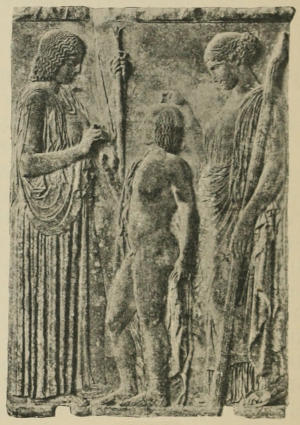
Fig. 161.
Making all allowance for the fact that Christian Fathers naturally focus their attention on rites they chose to regard as immoral, it is yet abundantly clear that at Eleusis the Marriage and the Birth were the culminating ritual acts, acts by which union with the divine, the goal of all mystic ceremonial, was at first held to be actually effected, later symbolized. Preceded by rites of purification such as the Liknophoria, amplified, emphasized by endless subordinate scenes, reenacted in various mythological forms, as e.g. in the rape of Persephone, they yet remained at Eleusis, at Samothrace and elsewhere, the cardinal mysteries. Man makes the rites of the gods in the image of his human conduct. The mysteries of these man-made gods are but the eternal mysteries of the life of man. The examination of endless various and shifting details would lead us no further.
Before we leave the Sacred Marriage, an ethnographical point of some interest remains to be considered.
g. Cretan influence on the mysteries at Eleusis.
In Crete we found the Omophagia and the Mother, but no marriage rite, and yet there is evidence that makes it highly probable that Demeter and her marriage developed in Crete and came thence to Eleusis.
Such is the tradition of the Homeric Hymn[1397]:
‘Dos is the name that to me my holy mother gave, And I am come from Crete across the wide sea-water wave.’
This may be a mere chance pirate legend, but such legends often echo ethnographical fact.
Again at the close of the Hymn[1398] the poet seems to remember the island route by which Demeter passed to Thessaly:
‘Goddess who holdst the fragrance of Eleusis in thy hands, Mistress of rocky Antron and Paros’ sea-girt strand, Lady revered, fair Deo, gift-giver year by year, Thou and thy fair Persephone, to us incline thine ear.’
Whether Demeter brought her daughter from Crete must remain for the present unconsidered; but from mythology, not ritual, we learn that in Crete she had a Sacred Marriage. Calypso, recounting the tale of ancient mortal lovers of whom the gods were jealous, says[1399]:
‘So too fair-haired Demeter once in the spring did yield To love, and with Iasion lay in a new-ploughed field. But not for long she loved him, for Zeus high overhead Cast on him his white lightning and Iasion lay dead.’
It is one of the lovely earth-born myths that crop up now and again in Homer, telling of an older simpler world, of gods who had only half emerged from the natural things they are, real earth-born flesh and blood creatures, not splendid phantoms of an imagined Olympic pageant. To smite and slay these primitive divinities of the order he supersedes, Zeus is always ready with his virtuous thunderbolt.
Hesiod[1400], if later in date, is almost always earlier in thought than Homer. He knows of the Marriage and knows that it was in Crete:
‘Demeter brought forth Ploutos; a glorious goddess she, And yet she loved Iasion, a mortal hero he. In Crete’s rich furrows lay they; glad and kindly was the birth Of him whose way is on the sea and over all the Earth. Happy, happy is the mortal who doth meet him as he goes, For his hands are full of blessings and his treasure overflows.’
Theocritus[1401] knows that this Marriage of Iasion was a Mystery:
‘Oh, happy, happy, in his changeless fate, Endymion dreaming; happy, Love, and great Iasion, who won the mystic joy That ye shall never learn, Unconsecrate!’
Hesiod is all husbandman; he knows of no mystery child[1402], only of the old agricultural mimetic rite and the child who is the fruits of the earth and of the sea. Zeus with his thunder has not yet come to make of innocent bliss a transgression. Hesiod might have written the ancient tag preserved for us by his scholiast[1403]:
‘Ah for the wheat and barley, O child Ploutos.’
The writer of the Homeric Hymn[1404] is altogether Zeus-ridden, hence many of the anomalies and absurdities of the tale he so beautifully tells; he is Homeric in his aloofness from things primitive, he is also Orphic in his emphasis on the spiritual bliss of the initiated and in his other-worldliness. He is concerned to show their future weal rather than their present wealth:
‘Blessed is he among men who is given these rites to know, But the uninitiate man, the man without, must go To no such happy lot when dead in the dusk below.’
And yet, so strong is the ancient agricultural tradition and association of the rites that the primitive sacred child of Crete, the Wealth-god, reemerges[1405] almost automatically at the close, though in half abstracted fashion, born of heaven not earth:
‘Then when the goddess all things had ordered of her grace, She fared to high Olympus, their great assembly place. There do they dwell with Father Zeus, who thunders through the sky, Holy and reverend are their names, and great his earthly joy Whom they vouchsafe to love. Above all mortals is he blest, Swiftly they send to his great home Ploutos to be his guest.’
The mimetic marriage of Crete, a bit of sympathetic magic common to many primitive peoples, became a cardinal mystic rite. Diodorus[1406] in a very instructive passage tells us that in Crete ‘mysteries’ were not mysterious, and we shall not, I think, be far wrong if we suppose that the Cretan non-mysterious form was the earlier. After discussing Cretan mythology he says: ‘The Cretans in alleging that they from Crete conferred on other mortals the services of the gods, sacrifices and rites appertaining to mysteries, bring forward this point as being to their thinking the principal piece of evidence. The rite of initiation, which is perhaps the most celebrated of all, is that which is performed by the Athenians at Eleusis, and the rite at Samothrace and that in Thrace among the Cicones, the country of Orpheus, inventor of rites, all these are imparted as mysteries, whereas in Crete at Cnossos the custom from ancient times was that these rites should be communicated openly and to all, and things that among the other peoples were communicated in secrecy among the Cretans no one concealed from any one who wished to know.’
The Cretans, like most patriots, went a little too far. The gods had not left themselves without witness among other peoples till they, the elect Cretans, started on their missionary enterprise. But, as regards certain mystery rites, as regards two of those discussed in detail, the Omophagia and the Sacred Marriage, may not their statement have been substantially true? Before the downward movement of Dionysos from the North, may there not have been an upward movement of (shall we say) Orpheus from the South? May not the Orphic mysteries of the Mother have started, or at least fully developed, in matriarchal Crete[1407], Crete that was to the end ‘of the Mother,’ that refused even in her language to recognize the foolish empty patriarchalism, ‘Father-land’? In Crete the discoveries of Mr Arthur Evans have shown us a splendid and barbarous civilization, mature, even decadent, before the uprising of Athens. From Crete to Athens came Epimenides, who is but a quasi-historical Orpheus, and with him he brought rites of cleansing. In Cretan ‘Mycenaean’ civilization[1408] and only there, is seen that strange blend of Egyptian and ‘Pelasgian’ that haunted Plutarch and made him say that Osiris was one with Dionysos, Isis with Demeter.
Diodorus, quoting the local tradition, knows the very route by which the rites of Crete went northward, by way of the islands, by Samothrace home of the mysteries, up to the land of the Cicones. There, it would seem, Orpheus the sober met the raging wine-god, there the Maenads slew him, and repented and upraised his sanctuary. Thence the two religions, so different yet so intimately fused, came down to Greece, a conjoint force, dominant, irresistible. Mysticism and ‘Enthusiasm’ are met together, and, for Greek religion, the last word is said.
Orpheus for all his lyre-playing is a priest or rather a ‘religious.’ Dionysos is, at least as we know him at Athens, less priest than artist. Most primitive religions have δρώμενα, but from the religion of Dionysos sprang the drama. The analogy between δρώμενα, things done, actions, and δρᾶμα, a Thing Acted in the stage sense, has been often observed, but the problem still remains—why was the transition effected in the religion of Dionysos and in his only, why have Athene and Zeus and Poseidon no drama, only δρώμενα?
h. The Drama of Dionysos and the δρώμενα of Eleusis.
The question would not be raised here but that the answer I would suggest comes mainly from religion, and some stages of the transition are, I believe, to be found in the ritual of Eleusis.
Epic, lyric and dramatic poetry succeed each other in our handbooks and our minds in easy and canonical fashion. Lyric poetry asks no explanation, or finds it instantly in our common human egotism. But we are apt to forget that from the epos, the narrative, to the drama, the enactment, is a momentous step, one, so far as we know, not taken in Greece till after centuries of epic achievement, and then taken suddenly, almost in the dark, and irrevocably. All we really know of this momentous step is that it was taken some time in the sixth century B.C. and taken in connection with the worship of Dionysos. Surely it is at least possible that the real impulse to the drama lay not wholly in ‘goat-songs’ and ‘circular dancing places’ but also in the cardinal, the essentially dramatic, conviction of the religion of Dionysos, that the worshipper can not only worship, but can become, can be, his god[1409]. Athene and Zeus and Poseidon have no drama because no one, in his wildest moments, believed he could become and be Athene or Zeus or Poseidon. It is indeed only in the orgiastic religions that these splendid moments of conviction could come, and, for Greece at least, only in an orgiastic religion did the drama take its rise.
In the rites at Eleusis of which most details are known we have the very last stage of the development before the final step was actually taken, we have δρώμενα on the very verge of drama.
Late authors in describing the Eleusinian rites use constantly the vocabulary of the stage. Take the account of Psellus[1410], whose testimony has been too much neglected. Psellus is recording ‘what the Greeks believe about demons’ and he passes from theology to ritual. ‘Yes and the mysteries of these (demons), as for example those of Eleusis, enact the double story of Deo or Demeter and her daughter Pherephatta or Kore. As in the rite of initiation love affairs are to take place, Aphrodite of the Sea is represented as uprising. Next there is the wedding rite for Kore. And the initiated sing as an accompaniment “I have eaten from the timbrel, I have drunk from the cymbals, I have carried the kernos, I have gone down into the bridal chamber.” Then also they enact the birth-pains of Deo. At least there are cries of entreaty of Deo, and there is the draught of gall and the throes of pain. After these there is a goat-legged mime because of what Zeus did to Demeter. After all this there are the rites of Dionysos and the cista and the cakes with many bosses and the initiated to Sabazios and the Klodones and Mimallones who do the rites of the Mother and the sounding cauldron of Thesprotia and the gong of Dodona and a Korybas and a Koures, separate figures, mimic forms of demons. After this is the action of Baubo[1411].’
Psellus shows us the sacred pantomime in full complexity. From other sources we know that it was not all dumb-show, that other words were spoken besides the confession of the ‘tokens.’ Galen[1412] when he is urging his readers to attend to natural science no less than theology says: ‘Lend me then your whole attention even more than you did supposing you were initiated in the Eleusinian and Samothracian mysteries or any other holy rite and gave yourself up wholly to the things done and the things spoken by the Hierophants.’
The fashion in which the ‘things spoken’ supplemented and helped out the ‘things done’ comes out very clearly in the curious fictitious legal case which occurs among the collection of rhetorical exercises made by Sopater[1413]. A young man dreams that he is initiated, and sees the ‘things done.’ He recounts the ‘things done’ to an initiated friend and asks if they correspond to the actual Eleusinian rite. The friend nods assent. Is the friend guilty of impiety, i.e. has he revealed the ‘things done’ to one uninitiated? No, argues the initiated man, for the dreamer was really initiated by the goddesses themselves; only one thing was lacking to him, he had not heard the voice of the hierophant so as to understand clearly the sense of the symbols uttered by him. The symbols uttered must have been words corresponding to, explanatory of, the things done, dark enough no doubt, but felt to be illuminating. The Hierophant acted as sacred showman to the pantomime. Here we have brought into close, inevitable conjunction the narrative element of the epos and the action element of the drama. We have all the apparatus of the stage, the appearances and disappearances, the dancing and the singing, the lights, the voices and the darkness. Religion gave all the circumstances and the scenery, religion woke the instinct of intense impersonation, some genius made the dumb figures speak themselves and tragedy was born.
Dionysos gave men tragedy to gladden and to greaten their toilsome life on earth. His other great gift was, as has been already shown, the hope that by attaining divinity they would as a necessary consequence attain immortality. To the dim forecast of some sort of after guerdon that Demeter gave, he brought something as near conviction as the human mind can get. Plutarch[1414] writes to his wife when they have lost their little girl, who was so like the father and so dear to the mother, and he bids her remember both her traditional faith and ‘the mystic symbols of the rites of initiation to Dionysos.’ These, he says, will prevent her from thinking that the soul suffers nothing after death, that it ceases to be. He reads into these rites of course his own Platonism; they teach him that the soul is like a bird caught in a cage, caught and recaught ever in new births, that the evil of old age is not its wrinkles and grey hairs but, hardest thing of all, the dimness and staleness of the soul to the memory of things ‘there’ not here; and the soul that leaves the body soon is not cramped and bent but only softly and pliantly moulded and soon shakes its mane and is free, just as fire that is quenched and relighted forthwith flames and sparkles anew. The customs of his country forbade him to make libations for children, and he reads into the old barbarous convention, based on the harmlessness of the child-ghost, the doctrine that children have no part in earth and earthly things, but have passed straightway to a better and more divine fate. Still in the mystic symbols of Dionysos he sees only what was there implicit if only in dim fashion.
It has been thought that the rites of Eleusis and other Orphic mysteries contained among these ‘things done’ mimetic presentations of a future life, a sort of revelation and instruction for the conduct of the soul in the world below. Elements of this kind, it will later be seen, may easily have been interpolated from Egypt, but for Eleusis we have no certain evidence. The best witness to the faith of the Orphic as to the future life are his own confessions buried with him in his tomb, inscribed happily for us on imperishable gold, and to this witness we must now turn.