CRITICAL APPENDIX ON THE ORPHIC TABLETS.
Reading edition
I. The Petelia Tablet.
Found in excavations near Petelia, S. Italy: now in the British Museum. Kaibel, CIGIS, No. 638. Cf. Comparetti, J.H.S. III. p. 112.
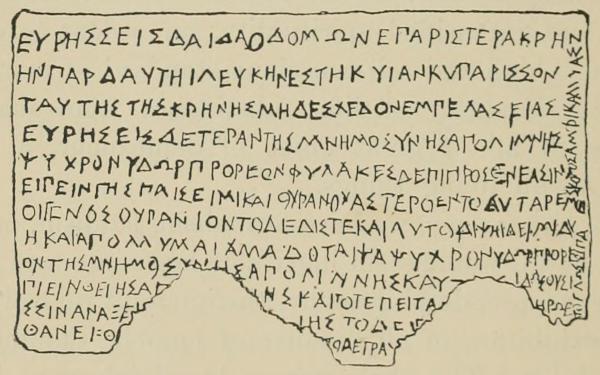
ΕΥΡΗΣΣΕΙΣ Δ’ ΑΙΔΑΟ ΔΟΜΩΝ ΕΠ’ ΑΡΙΣΤΕΡΑ ΚΡΗΝΗΝ, ΠΑΡ Δ’ ΑΥΤΗΙ ΛΕΥΚΗΝ ΕΣΤΗΚΥΙΑΝ ΚΥΠΑΡΙΣΣΟΝ· ΤΑΥΤΗΣ ΤΗΣ ΚΡΗΝΗΣ ΜΗΔΕ ΣΧΕΔΟΝ ΕΜΠΕΛΑΣΕΙΑΣ. ΕΥΡΗΣΕΙΣ Δ’ ΕΤΕΡΑΝ ΤΗΣ ΜΝΗΜΟΣΥΝΗΣ ΑΠΟ ΛΙΜΝΗΣ ΨΥΧΡΟΝ ΥΔΩΡ ΠΡΟΡΕΟΝ, ΦΥΛΑΚΕΣ Δ’ ΕΠΙΠΡΟΣΘΕΝ ΕΑΣΙΝ ΕΙΠΕΙΝ· ΓΗΣ ΠΑΙΣ ΕΙΜΙ ΚΑΙ ΟΥΡΑΝΟΥ ΑΣΤΕΡΟΕΝΤΟΣ, ΑΥΤΑΡ ΕΜΟΙ ΓΕΝΟΣ ΟΥΡΑΝΙΟΝ· ΤΟΔΕ Δ’ ΙΣΤΕ ΚΑΙ ΑΥΤΟΙ· ΔΙΨΗΙ Δ’ ΕΙΜΙ ΑΥΗ ΚΑΙ ΑΠΟΛΛΥΜΑΙ· ΑΛΛΑ ΔΟΤ’ ΑΙΨΑ ΨΥΧΡΟΝ ΥΔΩΡ ΠΡΟΡΕΟΝ ΤΗΣ ΜΝΗΜΟΣΥΝΗΣ ΑΠΟ ΛΙΜΝΗΣ ΚΑΥΤ<ΟΙ ΣΟ>Ι ΔΩΣΟΥΣΙ ΠΙΕΙΝ ΘΕΙΗΣ ΑΠ<Ο ΛΙΜΝ>ΗΣ ΚΑΙ ΤΟΤ’ ΕΠΕΙΤ’ Α<ΛΛΟΙΣΙ ΜΕΘ’> ΗΡΩΕΣΣΙΝ ΑΝΑΞΕΙΣ ····· ΙΗΣ ΤΟΔΕ ····· ΘΑΝΕΙΣΘ ···· ······· ΤΟΔΕΓΡΑΨ ····· ···· ΓΛΩΣΕΙΠΑ (?) ··· ΣΚΟΤΟΣ ΑΜΦΙΚΑΛΥΨΑΣ
‘Thou shalt find to the left of the House of Hades a Well-spring, And by the side thereof standing a white cypress. To this Well-spring approach not near. But thou shalt find another by the Lake of Memory, Cold water flowing forth, and there are Guardians before it. Say: “I am a child of Earth and of Starry Heaven; But my race is of Heaven (alone). This ye know yourselves. And lo, I am parched with thirst and I perish. Give me quickly The cold water flowing forth from the Lake of Memory.” And of themselves they will give thee to drink from the holy Well-spring, And thereafter among the other Heroes thou shalt have lordship....’
Kaibel (l.c.) says “pertinet lammina, ut nunc apparet, ad saeculum iii vel summum iv ante Chr. n.” It had formerly been supposed to be much later. He confidently attributes the accompanying tablet (No. V.) to the fourth century, and this one seems to me to be quite as early or earlier. It is altogether more carefully written, which detracts from its appearance of age. The use of the diphthong ου for instance, where No. V. has ο, is probably a sign of careful writing, not of lateness. The letters are very well formed and early in shape. Subscript ι is never neglected. Elision only once (εἰμὶ αὔη) and then, it would seem, of set purpose to avoid ambiguity. Weight must also be allowed to the completeness and accuracy with which the text of the “ancient Orphic poem” (see below on No. V.) is given, with no compendia or corruptions. The dialect, also, is pure literary epic; i.e., one may presume, the pure dialect of the “ancient poem” itself, with no admixture of local forms such as have crept by process of time into the formulae on the other tablets. The double σ of εὑρήσσεις in l. 1 may indeed be dialectical; cf. ἀσστεροβλῆτα, Δεσσποίνας in V., but that scarcely affects the main impression.
II. Three tablets from Crete (Eleuthernae?) now in the National Museum at Athens.
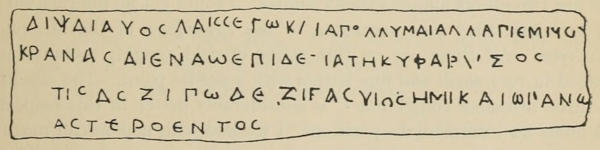
A. Length 55 mm.; breadth 7 mm.
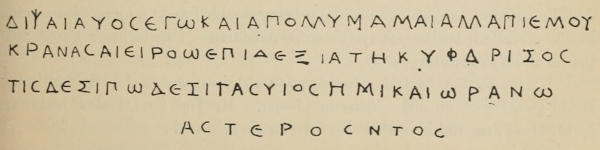
B. Length 62 mm.; breadth 8 mm.
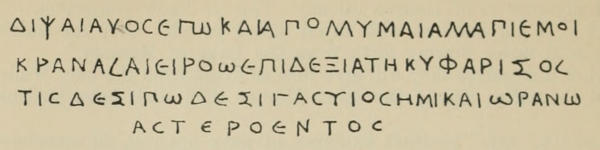
C. Length 56 mm.; breadth 10 mm.
The general formula represented by these tablets is:
Δίψαι αὖος ἐγὼ καὶ ἀπόλλυμαι—Ἀλλὰ πίε μμου Κράνας αἰερόω [or αἰενάω] ἐπὶ δεξιὰ, τῆ κυφάρισος. Τίς δ’ ἔσι;..................... πῶ δ’ ἔσι;...Γᾶς υἱὸς ἠμὶ καὶ ὠρανῶ ἀστερόεντος.
‘I am parched with thirst and I perish.—Nay, drink of Me, The well-spring flowing for ever on the Right, where the Cypress is. Who art thou?.................. Whence art thou?—I am son of Earth and of Starry Heaven.’
Tablet C was published, with some inaccuracies, by M. Joubin in Bull. de Corr. Hell. xvii. p. 122, where it is said to have been found at Eleuthernae in Crete. I subjoin an account of the three tablets kindly sent by Mr Marcus Tod, Assistant Director of the British School at Athens, to whom are also due the above fac-similes.
“The inscription is at present in the Ethnikon Mouseion here, and along with it are two others almost exactly similar. I could get no information about them, save that they also, according to the Εὑρετήριον of the Museum, are ‘from Crete.’ All three are on thin strips of gold, roughly rectangular, and are traced in very small and fine letters with a needle point. The execution is in all three instances rough, but C is considerably better in this respect than A; B holds an intermediate position. I worked with a powerful magnifying glass, and in most cases am quite sure of my readings even where I differ from Bull. Corr. Hell.”
Notes: l. 1. What comes between αὖος and ἐγὼ in A, Mr Tod cannot decipher. Was it αὖος written twice?
πιε μοι C: πιε μου B (and C, according to Joubin). I had conjectured from Joubin’s reading πίε μμου, the initial μ being doubled as in ἐνὶ μμεγάροισιν, etc., in the so-called Aeolic poetry (Cretan = Arcadian = ‘Urgriechisch’), and this proves to be the reading of A.
l. 2. αιειροω C and B. Joubin gave αἰεὶ ῥέω: αιεναω A. Evidently the Doric genitive of an adj. αἰέροος or αἰέναος. Mr Tod (and I also) had conjectured αἰὲ ῥέω, and he would also take αἰενάω as a verb.
τῆ κυφάρισος: sc. ἐστί.
As to the metre and reading of the last line, see below p. 672.
III. Timpone Grande Tablet (a).
A thin rectangular slip of gold, like the others, found in a large tomb in the commune of Corigliano-Calabro, S. Italy. (Published in the Atti d. R. Accad. dei Lincei, Serie III. 1878-79; Memorie, p. 328: cf. Kaibel, CIGIS, 642.) The fac-simile that follows was kindly furnished by Prof. Comparetti.
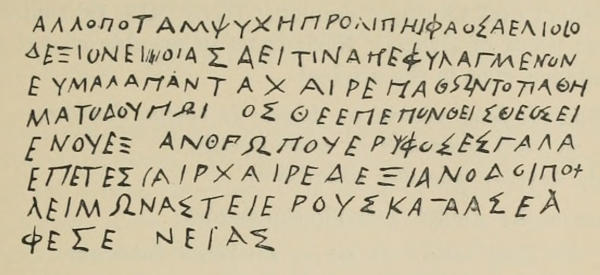
Ἀλλ’ ὁπόταμ ψυχὴ προλίπηι φάος ἀελίοιο δεξιὸν ἐν̣·οιας δ̣ειτινα ............πεφυλαγμένον εὖ μάλα πάντα. Χαῖρε παθὼν τὸ πάθημα, τόδ’ οὔπω π̣ρ̣όσθε ἐπεπόνθεις. θεὸς ἐγένου ἐξ ἀνθρώπου. ἔρυφος ἐς γάλα ἔπετες. χαῖρε, χαῖρε, δεξιὰν ὁδοιπορ<ῶν> λειμῶνάς τε ἱεροὺς κατά <τ’> ἄ<λ>σεα Φεσε<φο>νείας.
‘But so soon as the Spirit hath left the light of the sun, To the right................................. of Ennoia Then must man..............being right wary in all things. Hail, thou who hast suffered the Suffering. This thou hadst never suffered before. Thou art become God from Man. A kid thou art fallen into milk. Hail, hail to thee journeying on the right......... ... Holy meadows and groves of Phersephoneia.’
l. 2. The reading is doubtful. The strip of gold has been folded over and over, making eight little divisions by vertical lines and four by horizontal. The curious thing is that in some cases the fold has been allowed for in the writing, in others not. For instance, the first vertical fold would cut, as a rule, the seventh or eighth letter from the beginning. A large space has been left for it between ἐξ and ἀνθρώπου in line 5 (the gold is worn into a little hole at this point, and may have been somehow injured before the writing was made); and in lines 1, 3, 4 and 7 the letters successfully dodge it. But the χ of χαῖρε is half obliterated, and the letter following ε in l. 2 is lost in a mass of crumpled gold. It might be ΕΙΟΙΑΣ = ἠοίας, supposing a space to be vacant in the crumple, as between ἐξ and ἀνθρώπου. But ΕΝΟΙΑΣ is the most probable, standing presumably for ΕΝΝΟΙΑΣ. The following word has generally been read as ΔΕΙ, though ΑΕΙ is equally probable.
l. 3. τόδ’ οὔπω: τό τ’ οὔπω coni. Kaibel.
ἐγένου. The γ is clear.
As to the interpretation of l. 2, we may accept Kaibel’s judgment: “videtur versus ex duobus coaluisse: nam hoc quoque carmen ex antiquiore archetypo derivatum est.” But any attempt to restore the original “carmen antiquum” is utterly uncertain. How uncertain, it may be worth while illustrating from a parallel instance.
There is a small oval Christian amulet (CIGIS 2413, 18) containing verses from an elegiac poem of Gregory Nazianzene in an abbreviated form. One passage, for instance, runs in the original
Χριστὸς ἄναξ κέλεταί σε φυγεῖν ἐς λαῖτμα θαλάσσης ἠὲ κατὰ σκοπέλων ἠὲ συῶν ἀγελήν, ὡς Λεγεῶνα πάροιθεν ἀτάσθαλον.
This appears on the amulet (I divide the words):
Χσ ἄναξ κέλετέ σε φυγε͂ν ἐσ λε͂τμα θαλάσσης ὲ ὰ σκοπέλων ὲ συῶ ἀὴν ὡ εενα πάροι ἀτάσθαλον.
The accented letter alone, or the first and last, or a group of letters in the middle are made to stand for a word. On this principle we might find in ΔΕΙΤΙΝΑ
Δεξιόν, Ἐννοίας Δ̣ε̣σποί̣νας ὕδατ̣ι̣ λίμν̣α̣ς
or various other formulae built up in the same manner. (I mark the letters which occur, not those which are omitted.)
But, is this the process that has taken place at all? The same amulet, a few lines earlier, in place of
φεῦγ’ ἀπ’ ἐμῶν μελέων, φεῦγ’ ἀπ’ ἐμοῦ βιότου, κλώψ, ὄφι, πῦρ, βελιάρ, κακίη, μόρε
gives
φεῦγ’ ἀπ’ ἐμῶν μελέων ψόφι πῦρ βελιάρ κακίη μόρε
through mere lipography, the writer’s eye having wandered from φ to ψ.
On this principle we may here be dealing with an original such as
Δεξιόν, Ἐννοίας ἀεί τινα ποσσὶ φέρεσθαι χριμπτόμενον κρανᾶς, πεφυλαγμένον εὖ μάλα πάντα.
Such conjectures are merely illustrative. The basis of sound conclusion seems to be that we have here fragments of formulae, not a complete sentence. (See below p. 672.)
The word δεξιὸν must, I think, certainly bear its ordinary meaning “right,” “on the right”: cf. l. 6 δεξιὰν ὁδοιπορῶν, and, for the syntax, δεξιὸς ἀίξας ὑπὲρ ἄστεος Ω 320; ὧδε κατάστας, δεξιὸς, ἀθανάτοις θεοῖσιν ἐπευχόμενος Theogn. 943. “On the right, by the Spring of Ennoia” means, perhaps “by the Spring of Thought issuing from the Lake of Memory.”
Such a sense would suit the doctrines of tablets I. and II., and might even help to explain the origin of Dante’s Eunoë. (Professor Comparetti, who takes δεξιὸν in the metaphorical prose sense of “clever,” considers the introduction of such a word to be due to Euripidean or sophistic influence.)
IV. Timpone Grande Tablet (b).
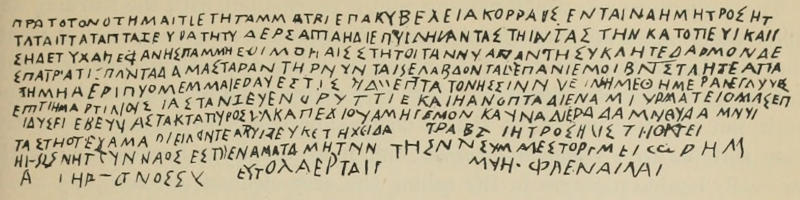
Prof. Comparetti examined the tablet when it was discovered in 1879, and reported (Notizie d. Scavi, 1880, p. 328) that it contained names of divinities belonging to the Orphic theology. Of these he then read Protogonos, Gê, Pammêtor, Kybelê, Korê, Dêmêtêr and Tychê. For his later results we must await his publication and discussion of the new fac-simile which, by his kindness, is reproduced above. Prof. Diels published the tablet with a full discussion in 1902 (Ein Orphischer Demeter-Hymnus, Festschrift Theodor Gomperz, p. 1). He also with great kindness has allowed his photographs of the tablet to be used for the purposes of the present book.
I examined the tablet itself in the Naples Museum and was able here and there to make out a few more letters than Prof. Diels; but, as it evidently did not contain any special Orphic doctrines, and was besides very trying to the eyes, I did not attempt a complete transcript. This note is based chiefly on Prof. Comparetti’s fac-simile.
That the tablet is unintelligible as it stands, no one will deny. It seems indeed to belong to that class of magical or cryptic writings in which, as Wünsch puts it, “singulari quadam scribendi ratione id agitur ne legi possint.”
Prof. Diels, however, did not view it in this light. He adopted the hypothesis that the tablet was the simple and bonâ fide work of an Apulian engraver who knew very little Greek, but was copying a Greek original which already contained various readings. He often got his letters down in the wrong order; often mistook one letter for another; often tried to correct his mistakes by repeating words or syllables.
Much of this seems perfectly true. Cf. for transpositions ισελαβροντα = ἐλασίβροντα, ρσαπια = σάραπι, πτεν αματα = πέντ’ ἄματα, μαιτιετη = μητίετα, οσειιταιν = ὁσίη παῖς (?).
Confusions: τλταιτταταπτα Ζεῦ (= πάντοπτα? or ἄττα, ἰᾶτα written backward?), so παννυανταντης, if that is what is written, must be an attempt to get some word right by repeated correction.
Ignorance of Greek: Ηανοπτα = Πανόπτα, επιτιημαρ = ἑπτῆμαρ are typical, but the above transpositions and confusions point to the same conclusion. On the other hand, there is knowledge of the Greek alphabet, as is shown by the varying shapes of many letters, e.g. δ, ρ [sometimes R], π [sometimes P], and the use of compendia: cf. especially the curious compounds with Ν.
Prof. Diels, however, goes a good deal further than this. He attempts to shew that the original from which the tablet is copied is a Hymn to Demeter, written in hexameters; and he proceeds to its conjectural reconstruction—while observing that “Niemand die Unsicherheit der Ergänzung verkennen oder die Barbarei der Formen beanstanden wird.”
The conjecture was worth making, and is carried out with the learning and ability which mark all Prof. Diels’s work. So it is less surprising than it would otherwise be, to find the tablet described by scholars[1634], without further qualification, as a Demeter-hymnus! But it remains a highly improbable hypothesis, not only because of the violent changes necessary to get any consecutive sense suitable to a Demeter-hymnus, but more definitely because among the few really legible passages in the tablet, the very clearest are certainly not in dactylic metre; νυξὶν ἢ μεθ’ ἡμέραν, ἰητρὸς Ἥλιε, εὔκλητε δαῖμον. True, there are fragments also which seem dactylic; ῥεῦμ’ ἄστακτα πυρός, Νίκαις ἠδὲ Τύχαις ἐφάνης παμμήδεσι Μοίραις(?). But this need not surprise us. The words of a charm, for instance, are sometimes found set in the midst of a hexameter verse; cf. the Tanagra Tablet in Wünsch, App. CIA, Praef. p. viii:
Ἑρμῆν κικλήσκω χθόνιον (καταδίδημι Διονυσίαν) καὶ Φερσεφόνηαν. (δῆσαι Διονυσίας γλῶσαν κτλ.)
This parallel would account easily for all the hexameter fragments that we have in this tablet.
On the other hand, the strange corruptions and repetitions of the tablet are more than can be explained by the mere ignorance of a copy-maker. They are not indeed similar to the rows of abracadabra-like syllables found in magical papyri (cf. Dieterich, Abraxas, p. 178 θηθουθη ααθω αθηρουωραμια θαρ μιγαρναχφουρι κτλ.) but they do bear a fairly close resemblance to some of the cryptic curses, in which, as said above, the writing is deliberately confused by transpositions and the like, so as to be unintelligible. Cf. Wünsch, 110:
ΠΡΩΤΟΝΩΣΠΕΡΤΑΥΤΑΑΝΑΤΙ ΟΤΩΣΚΑΙΤΟΣΑΓΟΡΑΙΑΣΠΡΩΤΟ ΝΑΝΑΤΙΑΕΗΑΠΑΤΑΚΑΙΗΜΑΙΟΙΤΟΙΣΤΟΙΣΤΙΜΑΤΙ ΙΤΑΤΟΠΩΑΕ ΤΟΙΠΑΡΑΠΡΩΤΟΙΟΤΟΚΑΙΟΤΟΠΩΛΟΤΙΚΑΝΔΕΚΑΙΑΥΤΟΣΚΑΙΤΗΤΗΧΝΗ
(Πρῶτον ὥσπερ ταῦτα ... οὕτως καὶ ὁ Ἀρισταγόρας ... then at the end καταδέω (?) αὐτοὺς καὶ τὴν τέχνην.)
ΤΟΣΑΓΟΡΑΙΑΣ = ὁ Ἀρισταγόρας is just like what we find in our tablet, and examination will show many other resemblances.
I have here attempted no reconstruction. I have merely copied the inscription and tried to collect such intelligible words or phrases as presented themselves at once or were to be reached by very slight emendations. The result so obtained is a patchwork of a few ritual phrases and fragmentary formulae; rows of titles of gods, heroes and daemons, including possibly Phanes and certainly Rhadamanthys; and lastly, an unintelligible residuum.
The whole seems to be a charm of some kind, concerned with healing and fasting. I can find no signs of its being a curse; nor indeed was gold, unless I am mistaken, used for writing curses. The long lists of titles of gods can be paralleled in abundance from magical inscriptions and papyri.
Transcript:
ΠΡΩΤΟΤ̣ΟΝΟΤΗΜΑΙΤΙΕΤΗΓΑΜΜΑΤΡΙΕΠ̣ΑΚΥΒΕΛΕΙΑΚΟΡΡΑΟΣΕΝΤΑΙΝΔΗΜΗΤΡΟΣΗΤ̣ | ΤΛΤΑΠ̣ΤΑΤΑΠΤΑΖΕΥΙ̣ΑΤΗΤΥΔΕΡΣΑΠΙΑΗΔΙΕΠΥΡ̣Α̣Υ̣ΗΙ̣ΑΝΤΑΣΤΗΙ̣ΑΝΤΑΣΤΗΝΚΑΤΟΤΙΕΝ̣ΙΚΑΙΙ ΣΗΔΕΤΥΧΑΙ̣Τ̣ΕΦΑΝΗΣΠΑΜΜΗ·ΕΟ̣ΙΜΟΙΡΑΙΣΣΤΗΤΟΙΓΑΝΝΥΑΝ̣ΑΝΤΗΣΥΚΛΗΤΕΔΑΙΜΟΝΔΕ ΣΠΑΤΡΙΑΤΙ·ΠΑΝΤΑΔΑΜΑΣΤΑΡ̣ΑΝΤΗΡΝΥΝΤΑΙΣ̣ΕΛΑΒΡΟΝΤΑΔΕΠΑΝΙΕΜΟΙΒΝ̣Τ̣ΣΤΛΗΤΕΑΠΑ ·ΤΗΜΗΑΕΡΙΠΥΟΜΕΜΜΑΙΕΡ̣ΑΥΕΣΤΙΣ··Δ·ΕΠ̣ΤΑΤΟΝΗΣΣΙΝΝΥΞ̣ΙΝΗΜΕΘΗΜΕΡΑΝΕΓΩ̣··· ΕΠΙΤΙΗΜΑΡΤΙΝ̣Ν̣·Σ·ΙΑΣΤΑΝΖΕΥΕΝΟΡΥΤΤΙΕΚΑΙΗΑΝΟΠΤΑΔΙΕΝΑΜΙΝ̣Α̣Μ̣ΑΤΕΙΟΜ̣ΑΣΕΠ ·ΠΙΔΥΣΕ̣Ι̣·ΕΡ̣ΕΥΜ̣ΑΣΤΑΚΤΑΠΥΡΟΣ·ΛΚΑΠΕΔΙΟΝ̣ΑΜΗΓΕΜΟΝΚΑΝ̣ΝΑΔΙΕΡΑΔΑΜΑ̣ΝΘΥΔΑΜΝΥΙ ΤΑΣΤΗΟΤΕΞ̣ΑΜΑΡ̣Ι̣Ε···ΝΤΕΑΡΓ̣ΙΖΕΥΚΕΤΗΞ̣ΕΙΔΑ···ΤΡΑΒ̣··ΙΗΤΡΟΣΗ̣ΛΙΣ̣ΤΙ̣Ι̣ΟΝ̣Τ̣ΕΙ ΗΙ·ΩΣΝΗΓ̣Σ̣ΥΝΝΑΟΣΕΣΠΤ̣ΕΝΑΜΑΤΑΜΗΤΗ̣Ν··ΤΗΣΝΝΣΥΜΜΕΣΤΟΡΕ̣ΜΕ··ΩΡΗΜ̣ ·Α····ΗΡ̣···ΝΟΣΣ·····ΕΥ̣ΤΟΛΑΕΡΤΑΙ· ΜΥΗ·ΦΑΕΝΑΙΝ̣ΑΙ
Πρωτόγ̣ονε̣ Γῆ Μητίετα παμματριεί̣α (?) Κυβελεία Κόρρα, ὁσίη π̣αῖς̣ (?) Δήμητρος ηταται (?) παταπτα (= παντόπτα?) Ζεῦ Ἰάτη, τὺ δὲ Σάραπι (?) Ἥλιε πυραύη φανταστὴ φ̣ανταστὴ ἑκατο··ιε (?) Νίκα ἴση δὲ Τύχα· ἴτε Φάνης πάμμησ̣τ̣οι Μοῖραι [or Νίκαις ἠδὲ τύχαις ἐφάνης παμμήδ̣ε̣σι Μοίραις] Στῆτοι (?) παντανυσταὶ (?) εὔκλητε Δαῖμον δέσπο̣τα Ἰάτη (?) παντο̣δάμαστα παντήρνυντα (= παντοκράτυντα?) ἐλασίβροντα δρ̣επάνιε (?)·····τλητέα πάντη. Μὴ ἀέρι πύωμ’ ἔμ μο̣ι ἐπ̣αύης, (?) τίσω····ἑπτατόνηστιν. Νυξὶν ἢ μεθ’ ἡμέραν ἐγὼ····ἑπτῆμαρ τὴ̣ν νηστιαστὺ̣ν (?) Ζεῦ ἐνορύττιε καὶ π̣ανόπτα δῖε ναματιαῖε (?)···ἐκ̣πιδύσετε ῥεῦμ’ ἄστακτα πυρὸς···καπ πεδίον (?)···ἡγεμὸν·····δῖε Ῥαδάμανθυ·······ἑξᾶμαρ·····Ζεῦ···Δά<μα>τρα···ἰητρὸς Ἥλιε (?)············ὡς <ἂ>ν ἡ σύνναος πέντ’ ἄματα μὴ·········συμμηστόρε (?)···ωρην···················
One might translate tentatively: “O First-Born, Earth, Counsellor, All-Motherly, Cybelean, Kora, Holy Child of Demeter (?) ..., All-Seeing Zeus, Healer, and thou Sarapis, Sun, Fire-Kindler, Maker-of-Appearances, Far-Seeing (??)
Victory and equal Fortune; come ye, Phanes, All-Counselling Fates (or With victories and Fortunes thou didst appear, with the All-Devising Fates)
Stayers (?), All-Accomplishers (?), Well-named Daemon, Master, Healer (?), All-Subduer, All-Controller, Driver of Thunder, Sickle-Bearer (?), ... to be endured in all wise. That thou mayest not with vapour make to burn a tumour in me (??) ... I will pay ... sevenfold fasting. In the nights or after daybreak I ... for seven days the fasting.
Zeus Penetrator (?) and All-seeing, Divine, Ruler of Streams, ... ye will make to spring a stream not in drops of fire....
Plain ... guide ... Divine Rhadamanthys ... for six days.... Zeus ... Demeter ... Healer, Sun ... that She sharing the Shrine for five days may not....”
V., VI. and VII. The Compagno Tablets.
Published Notizie degli Scavi, 1880. Cf. Kaibel, CIGIS, 481, a, b, c. These three tablets were found on the estate of the Baron Compagno, near Naples, not far from the Timpone Grande. The tablets were close to the hand of the skeleton in each case.
V. Compagno Tablet (a).
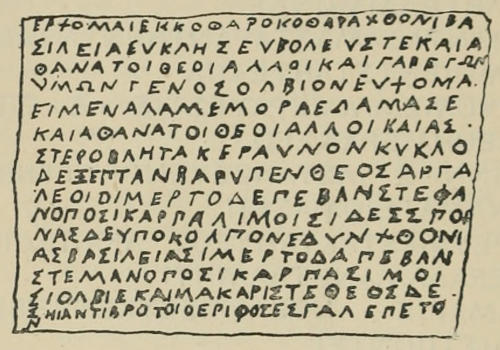
ΕΡΧΟΜΑΙ ΕΚ ΚΟΘΑΡΟν, ΚΟΘΑΡΑ ΧΘΟΝΙ<ων>; ΒΑΣΙΛΕΙΑ, ΕΥΚΛΗΣ ΕΥΒΟΛΕΥΣ ΤΕ ΚΑΙ ΑΘΑΝΑΤΟΙ ΘΕΟΙ ΑΛΛΟΙ. ΚΑΙ ΓΑΡ ΕΓΩΝ ΥΜΩΝ ΓΕΝΟΣ ΟΛΒΙΟΝ ΕΥΧΟΜΑ<ι>; ΕΙΜΕΝ, ΑΛΑ ΜΕ ΜΟΡΑ ΕΔΑΜΑΣΕ ΚΑΙ ΑΘΑΝΑΤΟΙ ΘΕΟΙ ΑΛΛΟΙ ········ ΚΑΙ ΑΣΣΤΕΡΟΒΛΗΤΑ ΚΕΡΑΥΝΟΝ. ΚΥΚΛΟ Δ’ ΕΞΕΠΤΑΝ ΒΑΡΥΠΕΝΘΕΟΣ ΑΡΓΑΛΕΟΙΟ· ΙΜΕΡΤΟ Δ’ ΕΠΕΒΑΝ ΣΤΕΦΑΝΟ ΠΟΣΙ ΚΑΡΠΑΛΙΜΟΙΣΙ· ΔΕΣΣΠΟΙΝΑΣ ΔΕ ΥΠΟ ΚΟΛΠΟΝ ΕΔΥΝ ΧΘΟΝΙΑΣ ΒΑΣΙΛΕΙΑΣ ΙΜΕΡΤΟ Δ’ ΑΠΕΒΑΝ ΣΤΕΜΑΝΟ ΠΟΣΙ ΚΑΡΠΑΣΙΜΟΙΣΙ. ΟΛΒΙΕ ΚΑΙ ΜΑΚΑΡΙΣΤΕ, ΘΕΟΣ Δ’ ΕΣΗΙ ΑΝΤΙ ΒΡΟΤΟΙΟ. ΕΡΙΦΟΣ ΕΣ ΓΑΛ’ ΕΠΕΤΟΝ.
Kaibel remarks with regard to these three documents: “Fuit aliquando Saeculo Quarto antiquius apud Sybaritas carmen, quod Orphico, ut ita dicam, dicendi genere conceptum lamminis aureis inscriptum defunctorum corporibus imponi solebat, quo ipsi vitae ante actae quasi testimonio fidei deorum inferorum commendarentur. Quod carmen cum in usum sepulcrorum saepius describeretur, sensim corrumpebatur et in brevius redigebatur, omissis aliis, aliis additis, pluribus denique mutatis, ut tamen primaria indoles non oblitteraretur. Tria nunc exempla inventa sunt.... Antiquius primum est, quod ad IV a. Chr. n. saeculum referri iubet ipsa ratio orthographica (ΚΥΚΛΟ, ΙΜΕΡΤΟ, ΣΤΕΦΑΝΟ) sed haud ita multo recentiora reliqua duo, quod docet scripturae genus simillimum.”
The letters are ancient and well formed, approaching more closely to those of fourth and fifth century inscriptions than to the papyrus of, say, Timotheus.
l. 1. The form κοθαρός is dialectical. It occurs in Elean and Thurian inscriptions, e.g. the Heraclean Tables. Contrast this peculiarity with the style of Tablet I.
I punctuate after κοθαρῶν: “I come from the Pure, O Pure Queen,” not “Pure I come from the Pure, O Queen.” The rhythm of the line points strongly to this. Only by a definite system of punctuation, such as did not exist in ancient Greek, could you in such a sentence make a reader pause elsewhere than in the natural pause of the metre. The sense is: “I come from the Orphically-initiated, O Queen of the Orphically-initiated.”
3, 4, 5, 8. εἶμεν, Μο͂ρα (= Μοῖρα: cf. the next tablet), ἀσστεροβλῆτα, Δεσσποίνας are all dialectical forms.
7 and 9. Observe the difference of reading. V. 9 is wrong in στεμάνο and καρπασίμοισι, so ἀπεβαν, in itself an interesting variant, must be suspected to be mere mistake also.
VI. Compagno Tablet (b).
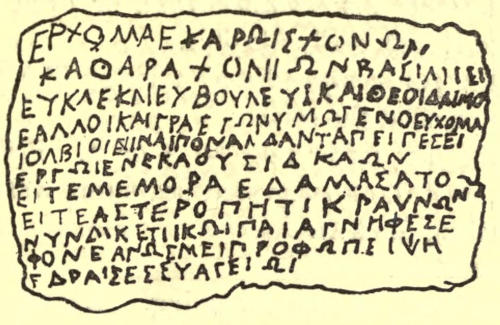
ΕΡΧΟΜΑ Ε ΚΑΡΩΙΣ ΧΟΝΩΝ ΚΑΘΑΡΑ ΧΟΝΙΩΝ ΒΑΣΙΛΗΕΙ ΕΥΚΛΕ ΚΑΙ ΕΥΒΟΥΛΕΥΙ ΚΑΙ ΘΕΟΙ <και> ΔΑΙΜΟΝΕ<ϲ> ΑΛΛΟΙ ΚΑΙ ΓΡΑ ΕΓΩΝ ΥΜΩ ΓΕΝΟ ΕΥΧΟΜΑΙ ΟΛΒΙΟΙΝ Ε̣ΙΝΑΙ ΠΟΝΑΝ̣ Δ ΑΝΤΑΠΕΙΓ̣ΕΣΕΙ ΕΡΓΩΙ ΕΝΕΚΑ ΟΥΣ̣Ι Δ<ι>ΚΑΩΝ ΕΙΤΕ ΜΕ ΜΟΡΑ ΕΔΑΜΑΣΑΤΟ ΕΙΤΕ ΑΣΤΕΡΟΠΗΤΙ Κ<ε>ΡΑΥΝΩΝ ΝΥΝ Δ ΙΚΕΤΙ ΙΚΩΙ ΠΑΙ̣ ΑΓΝΗν ΦΕΣΕΦΟΝΕΑΝ ΩΣ ΜΕΙ ΠΡΟΦΩ ΠΕΙΨΗ Ε̣ΔΡΑΙ̣Σ ΕΣ ΕΥΑΓΕΙΩΙ
1. Κ may be compendium for ΚΘ; ΙΣ seems to be a mistake for Ν.
3. ΕΙΝΑΙ either begun per compendium and then written in full, or else the Ν of ολβιον is compounded with the Ε. Cf. the next tablet.
4. Sc. ποινὰν δ’ ἀνταπέτεισ’ ἔργων ἕνεκ’ οὐχὶ δικαίων.
6, 7. Sc.
Νῦν δ’ ἱκέτης ἵκω παρ’ ἁγνὴν (or ἀγαυὴν?) Φερσεφόνειαν ὡς με πρόφρων πέμψῃ ἕδρας ἐς εὐαγέων.
VII. Compagno Tablet (c).
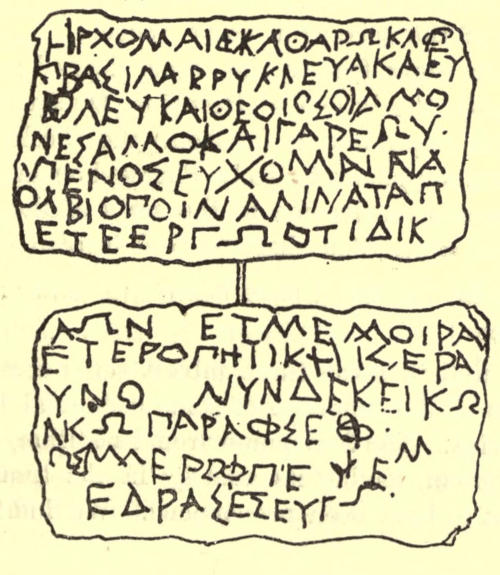
ΕΡΧΟΜΑΙ Ε ΚΑΘΑΡΩ ΚΑ Ο ΒΑΣΙΛΕΑΕ̣ Ε̣ΥΚΛΕ<ΥΑ> ΚΑ ΕΥΒΟΛΕΥ ΚΑΙ ΘΕΟΙ ΟΣΟΙ ΔΜΟΝΕΣ ΑΛΛΟ ΚΑΙ ΓΑΡ ΕΩ ΥΩ̣ ΓΕΝΟΣ ΕΥΧΟΜΑΙ ΕΙΝΑΙ ΟΛΒΙΟ ΠΟΙΝΑΝ ΝΑΤΑΠΕΤΕ ΕΡΓΩ ΟΤΙ ΔΙΚΑΩΝ ΕΤ ΜΕ ΜΟΙΡ·······ΑΣΤΕΡΟΠΗΤΙ <ΚΑ̣Ι> ΚΕΡΑΥΝΟ ΝΥΝ ΔΕ ΚΕ ΙΚΩ ΛΚΩ ΠΑΡΑ ΦΣΕΦ ΩΣ ΜΕ ΡΟΦ ΠΕΨΕ Μ ΕΔΡΑΣ ΕΣ ΕΥΓΩ

1. Perhaps ΕΚΚΑΘΑΡΩ, a double Κ being written per compendium.
ΚΑ apparently ΚΑΘΡΟ per compendium, or even καθαρά. The letter given as Ο is more like Π, but really illegible.
After ΒΑΣΙΛΕΑ (ΕΑ per compendium) a letter like Ε or R. The name Eukles seems to have puzzled the scribe.
2. ΕΥΚΛΕΥΛ. The last letter may be Α or Λ. Probably there is some confused dittography, as if the Ε suggested beginning ΕΥΚΛΕ again.
ΟΣΟΙ seems miswriting for ΚΑΙ.
3. ΥΩ or ΥΜ: uncertain.
Εἶναι per compendium: cf. the foregoing. Kaibel says of (b) and (c): “Haec duo carmina videntur ex communi archetypo esse descripta non solum quod inter se magis similia sunt quam utrumque primo, sed etiam propterea quod eadem ligatura in utroque verba ὄλβιον εἶναι scripta sunt.”
4. Or ΝΑΤΑΠΕΤΕΙΣ ΡΓΩ for ἀνταπέτεισ’.
5. ΕΤ: perhaps compendium for εἴτε.
The Σ of ἀστεροπῆτι is like Ε. Before κεραυνο͂ there seems to be καὶ by dittography.
The general formulae represented by the three tablets together, may be translated:
‘Out of the Pure I come, Pure Queen of Them Below, And Eukles and Eubouleus, and other Gods and Daemons: For I also avow me that I am of your blessed race. And I have paid the penalty for deeds unrighteous, Whether it be that Fate laid me low or the Gods Immortal Or ... with star-flung thunderbolt. I have flown out of the sorrowful weary Wheel; I have passed with eager feet to the Circle desired; I have sunk beneath the bosom of Despoina, Queen of the Underworld; I have passed with eager feet to (or from) the Circle desired; And now I come a suppliant to Holy Phersephoneia That of her grace she receive me to the seats of the Hallowed.— Happy and Blessèd One, thou shalt be God instead of Mortal.’
(The prose formula: ‘A kid I have fallen into milk’: is once inserted in the midst of the poem.)
To sum up, we find in these three tablets some common characteristics. They all show traces of the influence of some colloquial Italian dialect. The form κοθαρὸς is Thurian. The free omission and addition of final Ν is probably another Italian symptom, having its analogy in the treatment of final M in Latin. It seems not to have been pronounced. We find ΥΜΩ (ὑμῶν), ΠΡΟΦΩ (πρόφρων), ΑΓΝΗ (ἁγνὴν), ΕΥΑΓΕΙΩ (εὐαγεῶν) and vice versâ ΚΡΑΥΝΩΝ (κεραυνῷ). There is the same uncertainty about Ι following another vowel: we have ΕΡΧΟΜΑ, ΜΕΙ (με), ΙΚΩΙ. The writer of (b), and perhaps of (c) also, did not understand what words he was writing. One could be more sure about (c) if it were not that some of his most glaring apparent mistakes prove on examination to be compendiary forms and possibly accurate.
But another form of compendiary writing occurs, I think, in all of these tablets, and is of more interest.
There is a sentence which appears in (c) as
ΕΤ ΜΕ ΜΟΙΡ············ΑΣΤΕΡΟΠΗΤΙ (ΚΑΙ) ΚΕΡΑΥΝΟ.
Evidently not a complete sentence, any more than it is a complete verse, but a beginning and end with the middle omitted.
In (b) we have it a little fuller.
ΕΙΤΕ ΜΕ ΜΟΡΑ ΕΔΑΜΑΣΑΤΟ····ΕΙΤΕ ΑΣΤΕΡΟΠΗΤΙ ΚΡΑΥΝΩΝ.
This, with a little necessary emendation, might seem to be a complete sentence, as indeed Kaibel takes it, were it not for a fuller version still in (a).
ΑΛΑ ΜΕ ΜΟΡΑ ΕΔΑΜΑΣΕ ΚΑΙ ΑΘΑΝΑΤΟΙ ΘΕΟΙ ΑΛΛΟΙ ·······ΚΑΙ ΑΣΣΤΕΡΟΒΛΗΤΑ ΚΕΡΑΥΝΟΝ.
This fuller and correcter version is obviously incomplete, both in sense and in metre. The conclusion seems to be that we have in all three cases a confessedly incomplete collection of words, standing for a complete and well-known formula. The words seem to be from the beginning and end of the sentences. It is as though, in a community accustomed to the Anglican Church service, we found, first: “When the wicked man his soul alive.” Second, and deceptively complete in appearance: “When the wicked man shall save his soul alive.” Third, fuller and betraying its incompleteness: “When the wicked man turneth from save his soul alive.”
Instances of this sort of abbreviation can be found in most liturgies, though of course in modern times we should put dots to mark the gap in the middle. But it is certainly not common on Greek inscriptions. Ordinary abbreviations are common enough—Θ Κ = Θεοὶ Καταχθόνιοι, δμονες = δαίμονες, and the like. And there is the system, if system it can be called, illustrated by the quotation from Gregory Nazianzene in the note on Tablet III. The case most closely resembling the present that is known to me is that of the Cyprian Curses, published by Miss Macdonald in the Proceedings of the Soc. Bibl. Archaeology, 1890, p. 160 sqq. Cf. Wünsch, Append. CIA, Praef. p. xviii sqq. They are prayers to all Ghosts and Daemons to hamper and paralyse and “take away the θυμὸς from” some adversary, of whom the writer is in mortal fear. They begin with metrical formulae.
The first starts:
ΟΙΚΑΤΑΓΗΝΚΔΜΟΝΕΣΟΙ ΚΠΑΤΕΡΕΣΠΑΤΕΡΩΝΚΜΗΤΕΡΕ ΟΙΚΟΙΤΙΝΕΣΕΝΘΑΔΕΚΕΙΣΘΕΚΟΙΤΙΝΕΣ ΘΕΘΥΜΟΝΑΠΟΚΡΑΔΙΗΣΠΟΛΥΚΗΔΕΑ ΟΝΤΕΣ
Another, No. IV.:
ΑΤΑ—ΓΗΝΚΔΜΟΝΕΣΟΙΤΕΣΤΕΚ ΩΝΚΜΗΤΕΡΕΣΑΝΤΙΕΝΙΡΟΙΑΝΔΡΙΟΙ ΝΕΣΤΙΝΕΣΕΣΤΕΚΟΙΤΙΝΕΣΕΝΘΑ ΕΑ
These seem to represent two very similar formulae. The first will run:
Δαίμονες οἱ κατὰ γῆν καὶ δαίμονες οἵτινες ἔστε, καὶ Πατέρες πατέρων καὶ Μητέρες ἀντιένειροι (?), χοἵτινες ἐνθάδε κεῖσθε καὶ οἵτινες ἔνθα καθῆσθε, ......................................................... θυμὸν ἀπὸ κραδίης πολυκηδέα πρόσθε λαβόντες.
The other:
Δαίμονες οἱ κατὰ γῆν καὶ δαίμονες οἵτινες ἔστε, καὶ Πατέρες πατέρων καὶ Μητέρες ἀντιένειροι, ..................... ἄνδριοι ἠδὲ γύναιοι, δαίμονες οἵτινες ἔστε καὶ οἵτινες ἐνθάδε κεῖσθε ......................................................... <θυμὸν ἀπὸ κραδίης> πολυκηδέα <πρόσθε λαβόντες.>
The reconstruction of the verses is helped out by several other smaller fragments. I have followed, with slight variations, Dieterich and Wünsch.
Now here we find several points closely reminding us of the Compagno Tablets. (1) The different documents are all quoting the same magical poem. (2) Since the prayer is a prayer to take away somebody’s θυμός, and otherwise weaken and paralyse him, I think we may conclude that the line θυμὸν ἀπὸ κραδίης πολυκηδέα πρόσθε λαβόντες (λιπόντες is added as a v. l. in one only of the fragments) is the final line of the prayer. “Do this, that, and the other, having first taken away the hurtful spirit out of his heart.”
(3) The second tablet (No. IV.) gives a half line ἄνδριοι ἠδὲ γύναιοι, for which there is no place, and which therefore shows the incompleteness of a formula which, as written in No. I., might have seemed complete, exactly like καὶ ἀθάνατοι θεοὶ ἄλλοι in Compagno (a).
There is possibly a case of the same phenomenon in the Eleuthernae tablets (II.). There is one place at the end where the metre is broken. It may be the full formula contained a series of questions, beginning with Τίς δ’ ἔσι; and ending with Πῶ δ’ ἔσι;—Γᾶς υἱὸς ἠμὶ καὶ ὠρανῶ ἀστερόεντος. If there were only one tablet containing the formula, one would prefer to suppose that Τίς δ’ ἔσι; πῶ δ’ ἔσι; was mere dittography, a scribe having first written the phrase slightly wrong and then re-written it right without deleting the first version. But this hypothesis becomes more difficult when there are three tablets differing in several particulars but agreeing in this unmetrical double question.
In any case, it would probably be wisest to regard the tablets as each consisting of a series of formulae, mostly in verse but some in prose, some apparently complete, others compendiary.
VIII. The Tablet of Caecilia Secundina.
A thin gold tablet (75 mm. by 24 mm. in size) found in Rome about the year 1899, probably in one of the ancient tombs on the Ostia Road; now in the British Museum. The script, though generally clear, is peculiar. The form of ε (cf. ευκλεεσευ in line 2) is new to me, but in general the writing is like that of a cursive papyrus of Roman times. Prof. Comparetti, who has published and discussed the tablet in Atene e Roma, LIV. and LV. (1903), considers it certainly later than the Herculanean papyri, and would place it in the second century or possibly the first, A.D.
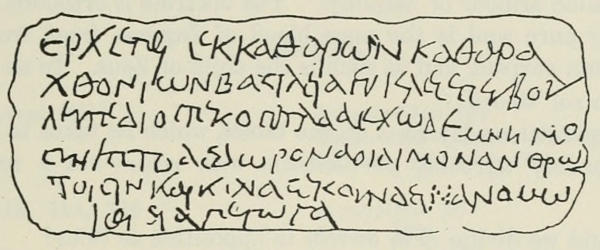
I read it thus:
ἔρχεται ἐκ καθαρῶν, καθαρὰ χθονίων βασίλεια, Εὔκλεες Εὐβουλεῦ τε. Διὸς τέκος, ὅπλα δ’ ἔχ’ ὧδε Μνημοσύνης, (τὸ δὲ δῶρον ἀοίδιμον ἀνθρώποισιν) Καικιλία Σεκουνδεῖνα, νόμῳ αἰεὶ ἀπαγωγά.
‘She comes from the Pure, O Pure Queen of those below And Eukles and Eubouleus.—Child of Zeus, receive here the armour Of Memory, (’tis a gift songful among men) Thou Caecilia Secundina, in due rite to avert evil for ever.’
v. 2. Probably Εὔκλεες as Comparetti: not εὔκλεέ τ’. The rest of this line is certain as far as Διὸς τέκος: after that, I make out οπλαδεχωδε, the first δ being (cf. that in τόδε below) very like α, and the ο not well finished. Repeated examination of the tablet has confirmed my belief that these are the inscribed letters; and I may add that Dr A. S. Murray and Mr Cecil Smith, as well as Dr Hartwig, who formerly possessed the tablet, all independently read the same.
Taking these letters as they stand, we may obtain sense, grammar and metre by dividing ὅπλα δ’ ἔχ’ ὧδε: “Have here the armour of Memory,” and I believe that this interpretation, though curious, is right. The change to the second person and the imperative addressed to the Soul are just like phrases in the other tablets: ὄλβιε καὶ μακάριστε, ἀλλὰ πίε μου, κτλ. The peculiar use of ὅπλα, to which I can find nothing quite similar in our fragments of Orphic literature, has its exact parallel in St Paul’s repeated metaphors ὅπλα δικαιοσύνης (Rom. vi. 12; 2 Cor. vi. 7), ὅπλα φωτός (Rom. xiii. 2). The “armour of Mnemosyne” to an Orphic would probably bear just the same shade of meaning as the “armour of light” to a Christian. Lethe was the Orphic “Darkness.” The use of ὧδε might be paralleled by Homer’s πρόμολ’ ὧδε, and the scholiasts have remarked long since that in the later Epic language ὧδε was used more freely than in Homer. The Cyprian Curses just quoted give ὑμεῖς οἱ ὧδε κείμενοι.
A further question here suggests itself. Who is the Διὸς τέκος? Eubouleus, by a straining of the identifications of mythologers, might claim the title; and it would save trouble, no doubt, to admit his claim. But apart from the unfair advantage which this would give him over Eukles, a comparison of the phrases applied to the pure soul in the other tablets (θεὸς ἐγένου, ὑμῶν γένος ὄλβιον εὔχομαι εἶναι, etc.) suggests that “Child of Zeus” is vocative. “Child of Zeus, receive here thine armour of Memory.” The doctrine is orthodox in Orphism; the completely pure soul is the pure blood of Zagreus, freed from the dross of charred Titan corpses, and as such is the child of Zeus. In an earlier stage it was Γᾶς παῖς καὶ Ὠρανῶ.
(Prof. Comparetti reads απλαα on the tablet, which he takes to be a mistake for ἁπαλὰ “tender,” agreeing per sensum with τέκος—not a very fortunate conjecture.)
v. 3. Should we divide τὸ δὲ or τόδε in apposition to ὅπλα?
v. 4. Scanned, apparently, Σ’κουνδεῖνα: such licenses are of course common. The last three words, forming l. 6 on the tablet, are difficult. The line begins with a vertical bar, like Ι, which in a document of an earlier time one would certainly take for the final Ι of ΝΟΜΩΙ. Then follows αι ει; the gap in the middle of the word would be less, if the bottom of the ε were visible. After this I make out the letters απαγωγα, apparently the n. pl. of a word ἀπαγωγὸς, “calculated to avert” opposed to ἐπαγωγὸς, “calculated to induce” magic influences. Mr Cecil Smith agrees with this reading. Prof. Comparetti, having only the photograph to work from, read [ἀ]ιεὶ διαγεγῶσα, “having always lived lawfully.”
The “armour of Memory,” the “gift songful among men,” is firstly perhaps the spiritual gift, and then in a secondary sense the actual tablet which both symbolises and preserves from oblivion Cecilia’s claims to immortality; and does so in song.
Caecilia Secundina is not otherwise known, but must have belonged in some way to the clan of Caecilii Secundi. She would thus be connected with the Younger Pliny, whose name before his adoption was Publius Caecilius Secundus.