Chapter VI · THE MAKING OF A GODDESS. (continued 2)
Reading edition
Homer himself was dimly haunted by the memory of days when Hera was no wife, but Mistress in her own right. Otherwise, unless the poet was the lowest of low comedians, what means her ceaseless turbulence and the unending unseemly strife between the Father of Gods and Men and the woman he cannot even beat into submission? What her urgent insistent tyranny over Herakles whom Zeus loves yet cannot protect? Is the tyrannous mistress really made by the Greek housewife even of Homeric days in her own image? The answer is clear: Hera has been forcibly married, but she is never really wife, and a wife’s submission she leaves to the shadowy double of Zeus, who echoed his nature and (significant fact) took his name, she who was the real Achaean patriarchal double—Dione[819].
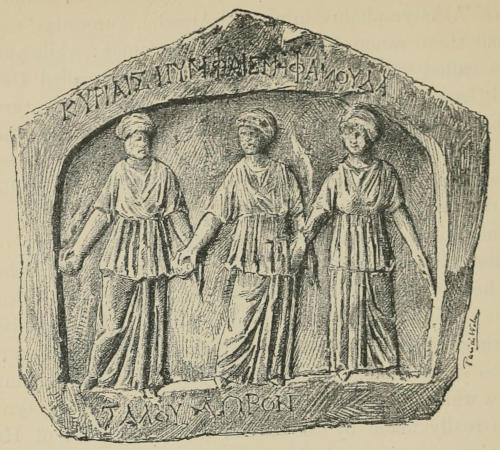
Fig. 90.
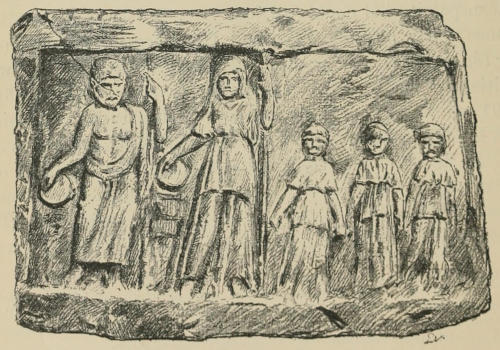
Fig. 91.
Once fairly married, Zeus and Hera became Sharers of one Altar (ὁμοβώμιοι), and against the conjunction the older women divinities are but too often powerless. In the designs[820] in figs. 90 and 91 we have a curious instance of the ruthless fashion in which the Olympian pair extrude the objects of an ancient local cult. In fig. 90 we have a votive relief to the Nymphs of the familiar type: three maiden figures linked together. That the figures are Nymphs is certain, for above is the inscription, ‘To the Mistress Nymphs (Κυρίαις Νύμφαις).’ The relief, one of a large series found together at Orochák and now in the local Museum at Sofia, is of late Roman style. The design in fig. 91 shows a theological shift. The two dominant Olympians, of large stature to mark their supremacy, occupy the forefront; they hold each an expectant phiale for libations; to them only is sacrifice to be made. It is they who hold the sceptres. Humbly in the background, minished and all but effaced, are the three ancient Maidens. The local peasant is conservative[821], and we may hope they too had their meed of offering.
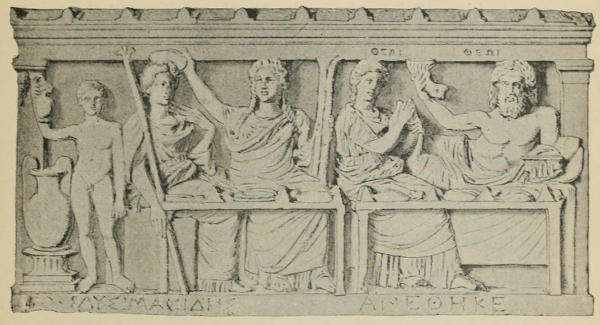
Fig. 92.
The intrusion of Zeus[822] and Hera on the local cultus of the Nymphs brings to mind a story preserved by Diogenes Laertius[823] in his Life of Epimenides. Theopompus in his ‘Wonderful Things’ told how when Epimenides was preparing the sanctuary of the Nymphs a voice was heard from heaven saying, ‘Epimenides, not of the Nymphs, but of Zeus.’ Perhaps Epimenides went further than the orthodox Olympian religion could tolerate in the matter of the revival of ancient cults. To him, as has been already seen (p. 241), was credited the founding of the sanctuary of the Semnae; he introduced ceremonies of purification brought from Crete, and wholly alien to Olympian ritual. It was time for Zeus to reassert himself.
The conflict of theological conceptions is very clearly seen in the design in fig. 92, from a votive relief[824] found at Eleusis and now in the National Museum at Athens. The general type of the design, which belongs to the class known in English as ‘Funeral Banquets,’ will be discussed more in detail later, when we come to hero-worship. For the present it is enough to note that on the left side of the relief we have the two Goddesses of Eleusis, the old matriarchal couple, seated side by side as equals, on the right a patriarchal couple, man and wife, the man reclining at the banquet and holding a great rhyton, the wife submissively seated by his side. In naming them it is safest at present not to go beyond what is written. The artist has inscribed over their heads the non-committal words, ‘To the God,’ and ‘To the Goddess.’
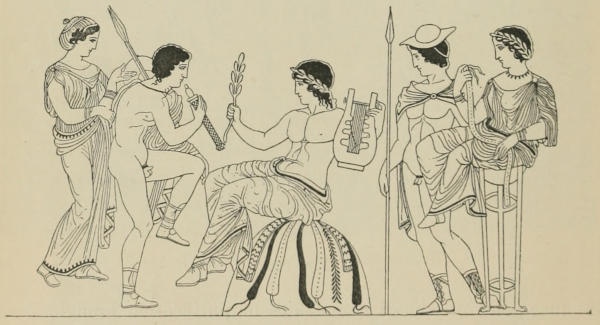
Fig. 93.
It was not only the Olympian Father Zeus who victoriously took over to himself the cult of the Earth-Mother and the Earth-Maidens. Even more marked is the triumph of the Olympian Son, Apollo[825]. The design in fig. 93 is from a rather late red-figured amphora in the Naples Museum[826]. A wayfarer, possibly Orestes, has come to Delphi to consult the god; he finds him seated on the very omphalos itself, holding the laurel and the lyre in his hands. So Hermes found him in the prologue to the Ion of Euripides[827]:
‘To Delphi, where Phoebus, on earth’s mid navel o’er the world Enthronèd, weaveth in eternal song The sooth of all that is or is to be.’
The vase-painter knows quite well that it is really a priestess who utters the oracles. Only a priestess can mount the sacred tripod, and he paints her so seated, the laurel wreath on her head and the sacred taenia in her hand, but he knows also that Apollo is by this time Lord of All.
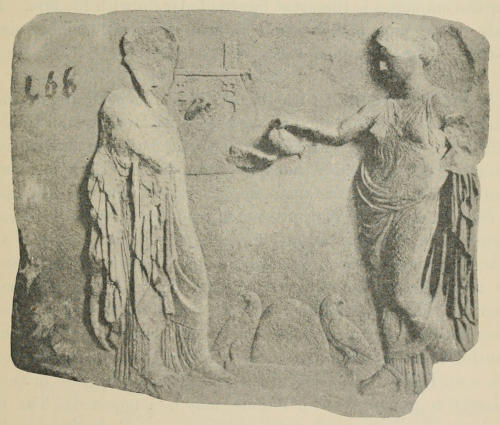
Fig. 94.
In the Eumenides of Aeschylus, where the contest is between the old angry ghosts, the Erinyes envisaged as merely the spirits of the blood feud, and the mild and merciful god, our sympathies are at least in part with the new-comer. But even here, so stately and yet so pitiful are the ancient goddesses that our hearts are sore for the outrage on their order. And on the vase-painting, when we remember that the omphalos is the very seat and symbol of the Earth-Mother[828], that hers was the oracle and hers the holy oracular snake that Apollo slew, the intrusion is hard to bear.
The triumph of the Olympian order is still more clearly presented in the design in fig. 94, from a votive relief[829] in the local Museum at Sparta. The centre of the design is occupied by the omphalos on a low basis. It looks very humble and obscure. At either side of it are perched new guardians, the great eagles of Olympian Zeus. The story[830] said that starting from either end of the world they met at Pytho, at the omphalos. The birds were variously said to be swans or eagles. Neither swans nor eagles have anything to do with the Earth-goddess; they are Ouranian eagles for Zeus or swans for Apollo, and, standing over the omphalos, they mark the dominion of the Father and the Son. But the artist has uttered his meaning still more emphatically. Towering over the omphalos is the great figure of Apollo with his lyre. He holds out a cup, and libation to him is poured by his sister Artemis. The Olympian victory is complete.
So far we have dealt with the Making of a goddess; we have seen one woman-form take various shapes as Mother and Maiden, as duality and trinity; we have seen these shapes crystallize into Olympian divinities as Athene, as Aphrodite, as Hera, and as it were resume themselves again into the great monotheistic figure of Venus Genetrix. We have noted evidence, very scattered and fragmentary, of earlier animal forms of the goddess as bird and snake. But it has been obvious enough that the weak point in the argument is just this transitional phase. The goddesses, when they first come into our ken, are goddesses, fully human and lovely in form, figures whose lineaments have been fixed and beautified by art, and of mythological rather than of ritual content. In a word links are wanting in the transition from ghost or snake or bogey to goddess. Two reasons may be suggested. The full development of the women divinities seems to have been earlier accomplished, the sublimation earlier complete, and hence the early phases of that development are more effaced; and next these goddess figures became more completely material for poetic treatment. In the Making of a god we catch in some figures the process at an earlier stage, and many missing links in the passage from ghost and snake to Olympian will thereby become manifest.