Chapter VIII · DIONYSOS. (continued 2)
Reading edition
Julian is not precise in his discrimination between the various edible grasses. His epigram is headed, ‘To wine made of barley (κριθῆς)’; the god, he says, smacks of spelt (τράγος), he is wheat-born (πυρογενῆ) and he is of oats (βρόμος). It matters to Julian nothing, nor is it to our argument of first importance, of what particular cereal this new-old Dionysos is made. The point is that it is of some cereal, not of the grape. The god is thus seen to be son of Semele, Earth-goddess in her agricultural aspect as Demeter, Corn-Mother. We shall later (p. 518) see that he was worshipped with service of the winnowing-fan, and we shall further see that, when he-of-the-cereal-intoxicant became he-of-the-wine-of-grapes, the instrument that had been a winnowing-fan became a grape-basket.
The possibility of this simple origin of Bromios grows when we consider another epithet of the god. In the Paean to Dionysos recently discovered at Delphi[1062] there occurs the title hitherto unexplained—Braites. The hymn opens thus with a string of cultus epithets:
‘Come, O Dithyrambos, Bacchos, come, Euios, Thyrsos-Lord, Braites, come, Bromios, come, and coming with thee bring Holy hours of thine own holy spring.’
Nowhere else does the title Braites occur; but the hymn, as an actual ritual composition, inscribed and set up at Delphi, is an important source. Braites has been explained as the Breaker or Striker, but this is scarcely a happy epithet for the Spring-god. In the light of Bromios it may be suggested that the epithet is connected with the late Latin word braisum, which means ‘grain prepared for the making of the beer braisum[1063].’ Braites would then like Bromios be an epithet derived from a cereal intoxicant.
An examination of the title Sabazios leads to results more certain and satisfactory. The name Sabazios has a more foreign sound than Dionysos, even than Bromios. Sabazios was never admitted even to the outskirts of Olympus. In the time of Demosthenes[1064] his rites were regarded by the orthodox as foreign, outrageous, disreputable. One of the counts in the unmannerly attack of Demosthenes on Aeschines is that Aeschines had been instructed by his mother in mysteries and rites that were certainly those of Sabazios, that having performed various degrading ceremonials he ‘led those admirable thiasoi about the streets, they being crowned with fennel and poplar, and gesticulated with great red snakes, waving them over his head and shouting Euoi Saboi.’ The Saboi were the worshippers of Sabazios as the Bacchae of Bacchos. Of course Demosthenes is grossly unjust. The ceremonies of Sabazios could be closely paralleled by the perfectly orthodox ritual of Dionysos, but they passed under another name, were not completely canonical, and above all things were still realized as foreign. That pious men of good repute might quietly worship Sabazios is clear from the account of the ‘Superstitious Man’ in Theophrastos[1065]. Against his moral character nothing can be urged, but that he was a little over-zealous, and ‘whenever he chanced to see a red snake he would invoke Sabazios.’
Down to Christian days the snake was an important feature in the cult of Sabazios. Clement and Arnobius[1066] both state that one of the ‘tokens’ of the mysteries of Sabazios was ‘the god (gliding) through the bosom.’ The snake was of course associated also with Dionysos—he may have inherited it from the earlier god—but his more characteristic vehicle was the bull. Sabazios seems always to have been regarded as more primitive and savage than Dionysos. Diodorus[1067], puzzled by the many forms of Dionysos, says: ‘Some people fable that there was another Dionysos very much earlier in date than this one, for they allege that there was a Dionysos born of Zeus and Persephone, the one called by some Sabazios, whose birth and sacrifices and rites they instance as celebrated by night and in secret on account of shameless ceremonies attending them.’ These last words probably refer to the mystic marriage of the god with the initiated (p. 535).
The symbolism of the snake has already (p. 326) been discussed. A god whose vehicle was the snake would find easy affiliation in Greece, where every dead hero was a snake.
Sabazios is left unsung by tragic poets, but the realism of comedy reflects the popular craze for semi-barbarian worship. The temper of Demosthenes was not, if Strabo[1068] be right, characteristically Athenian. ‘As in other matters,’ Strabo says, ‘the Athenians were always hospitable to foreign customs, so with the gods. They adopted many sacred customs from abroad and were ridiculed in comedies for doing so, and this especially as regards Phrygian and Thracian rites. Plato mentions the Bendidean, and Demosthenes the Phrygian, rites in his accusation against Aeschines and his mother on the count that Aeschines joined his mother in her rites and went about in a thiasos and cried aloud Euoi Saboi and Hyes Attes, for these cries are of Sabazios and the Mother.’
It is then to comedy, to Aristophanes, that we owe most of our references to Sabazios, hints of his real character and his inner kinship with Dionysos. In an untranslateable pun in the Birds[1069] he tells us that Sabazios is a Phrygian, and from the Lysistrata[1070] we learn that his worship was orgiastic and much affected by women. The ‘deputation man’ exclaims:
‘Has the wantonness of women then blazed up, Their tabourings, Sabazios all about, Their clamour for Adonis on the roofs?’
But most instructive of all is the mention of Sabazios in the opening of the Wasps[1071]. The two slaves Sosias and Xanthias are watching over their master Bdelycleon. They know he is a dangerous monster and they ought to keep awake.
‘Xan. I know, but I do want a little peace. Sos. Well, chance it then. Some sweet and drowsy thing Is falling drop by drop upon my eyes. Xan. What? Are you clean mad or a Korybant? Sos. No, a sleep holds me from Sabazios. Xan. And I too herd the same Sabazios. Just now a very Mede of a nodding sleep Came down and made an onset on my eyes.’
Sabazios is here clearly not so much the god of ecstasy and orgy as of compelling irresistible sleep. And why? A late historian gives the simple answer.
Ammianus Marcellinus[1072] tells us that, when the Emperor Valens was besieging Chalcedon, the besieged by way of insult shouted to him ‘Sabaiarius.’ He adds in explanation ‘sabaia is a drink of the poor in Illyria made of barley or corn turned into a liquor.’ ‘Sabaiarius’ is then ‘Beer-man,’ beer-drinker or brewer. S. Jerome, himself a Dalmatian, says in his commentary on Isaiah[1073] that ‘there is a sort of drink made from grain and water, and in the provinces of Dalmatia and Pannonia it is called, in the local barbarian speech, sabaium.’ To the wine-drinker the beer-drinker seemed a low fellow. Wine was in itself a rarer, finer beverage, probably at first more expensive. Even to-day in some parts of beer-drinking Germany to drink beer at the solemn midday dinner is almost a vulgarity. Sabazios, god of the cheap cereal drink, brings rather sleep than inspiration.
The testimony of Sabazios is now added to that of Bromios and Braites. Separately the conjectured etymology of each epithet might fall far short of conviction, but the cumulative force of the three together offers evidence that seems conclusive.
A fourth link in the chain still remains. The emperor Julian’s third pun τράγος, goat, and τράγος, spelt, has yet to be considered:
‘He smells of nectar like a god, you smack of goats and spelt.’
The word τράγος is usually rendered ‘goat,’ and the meaning ‘spelt’ ignored. There is of course a reference to the time-honoured jest about the animal, but that the primary reference is to grain, not the goat, is clear from the words that immediately follow:
‘For lack of grapes from ears of grain your countryman the Celt Made you.’
In translating I have therefore used both the meanings; the formal pun is untranslateable.
It is an odd fact that the ancients seem to have called certain wild forms of fruits and cereals by names connecting them with the goat[1074]. The reason is not clear, but the fact is well-established. The Latins called the wild fig caprificus; Pausanias expressly tells us that the Messenians gave to the wild fig-tree the name τράγος, goat. Vines, when they ran wild to foliage rather than fruit, were said τραγᾶν. I would conjecture that the inferior sort of spelt called τράγος, goat, owes its name to this unexplained linguistic habit. It is even possible that the beard with which spelt is furnished may have helped out the confusion. Tragedy I believe to be not the ‘goat-song,’ but the ‘harvest-song’ of the cereal τράγος, the form of spelt known as ‘the goat.’ When the god of the cereal, Bromios-Braites-Sabazios, became the god of the vine, the fusion and confusion of τραγῳδία, the spelt-song, with τρυγῳδία, the song of the winelees[1075], was easy and indeed inevitable. The τραγῳδοί, the ‘beanfeast-singers,’ became τρυγῳδοί or ‘must-singers.’
The difficulties in the way of the canonical etymology of tragedy are acknowledged to be great[1076]. In discussing the Satyrs it has already been shown that the primitive followers of Dionysos are mythologically conceived of not as goat-men, but as horse-men. The primitive ‘goat-song,’ we are asked to believe, was sung by a chorus of horse-men. The case in fact stands thus. We are confronted on the one hand by the undoubted fact that on countless vase-paintings of the fifth and fourth centuries B.C. the attendants of Dionysos are horse-men, while goat-men attend the Earth-goddess (p. 277); on the other hand we have the supposed fact that tragedy is the goat-song. But this supposed fact is merely an etymological assumption. If another etymology be found for tragedy, the whole discrepancy disappears. Such an etymology is, I think, offered by τράγος ‘spelt,’ with the further advantage that it contains in itself a hint of how the goat misunderstanding arose.
A fragment of Aeschylus cited, but I think erroneously, as evidence of a goat chorus remains to be examined. In a lost tragedy[1077] a Satyr on the stage sees for the first time fire just given to mortals, and he runs to kiss her as though she were a beautiful maiden. Prometheus warns him: if you do this
‘You’ll be a goat mourning his beard.’
The passage is used as evidence for the goat form and dress of the Satyric chorus. Surely such an inference is needless; the point of the jest is the morals and manners of the Satyr. To reconstruct a goat-chorus out of a casual joke is labour in vain.
We have then found four several titles, Bromios, Braites, Sabazios and tragedy, for which the supposition of a cereal drink affords a simple, satisfactory explanation. It remains to show that, though the words bromos, braisum, sabaia and tragos have become to us dim and almost forgotten in the lapse of time, a cereal drink such as they imply was widely in use in ancient days, and that among Northern nations.
The history of fermented drink in Europe seems to have been briefly this. Never, so far back as we can look into mythology, was miserable man without some rudimentary means of intoxication. Before he had advanced to agriculture he had a drink made of naturally fermented honey, the drink we now know as mead, which the Greeks called μέθυ or μέθη. The epithet ‘sweet’ which they constantly apply to wine surprises us, but as a characteristic of ‘mead’ it is natural enough. This mead made of honey appears in ancient legends. When Zeus would intoxicate Kronos he gave him not wine, Porphyry[1078] says, for wine was not, but a honey-drink to darken his senses. Night says to Zeus:
‘When prostrate ’neath the lofty oaks you see him Lie drunken with the work of murmuring bees, Then bind him,’
and again Plato[1079] tells how when Poros falls asleep in the garden of Zeus he is drunk not with wine but with nectar, for wine was not yet. Nectar, the ancient drink of the gods, is mead made of honey; and men know this, for they offer to the primitive earth-god libations of honey (μελίσπονδα). The gods like their worshippers knew the joys of intoxication before the coming of the grape-Dionysos. Plutarch[1080] says mead (μέθυ) was used as a libation before the appearance of the vine, and ‘even now those of the barbarians who do not drink wine drink honey-drink’ (μελίτειον). The nephalia are but intoxicants more primitive than wine.
Next in order came the drinks made of cereals fermented, the various forms of beer and crude malt spirit. These gave to the Thracian Dionysos his names Bromios, Braites, Sabazios, but they never seem to have found a real home in Greece. Mention of them occurs in classical writers, but they are always named as barbarian curiosities, as drinks in use in Thrace, Armenia, Egypt, but never like mead even in primitive times the national drink of Hellas. Isis in Egypt is addressed as not only Our Lady of Bread but also Our Lady of Beer[1081], but Bromios when he comes to Greece forgets the oats from which he sprang.
The first beer was probably a very rude product, like the drink mentioned by Xenophon[1082] as still in use among the Armenians of his day; the grain was pounded and allowed to ferment with the grains still floating about in the drinking-cups. The Lithuanians in the Middle Ages are said to have made their beer over-night and drunk it next morning[1083]. Beer of this primitive kind was best sucked up through a pipe. Archilochus[1084] alludes to the practice:
‘As through a reed Phrygian and Thracian men Suck up their brew.’
The name given to the drink, βρῦτον, means simply something brewed or fermented. Aeschylus[1085] in his Lykurgos makes some one, probably Lykurgos the Thracian, drink βρῦτον:
‘Thereat he drank the bruton and waxed strong And boasted thus within the hero’s halls.’
Athenaeus, in the passage in which he quotes Archilochus, cites quite a number of authorities about the making of these rude cereal drinks. According to Hellanicus in his Origins, bruton could be made also of roots. ‘Some people,’ he says, ‘drink bruton made of roots as the Thracian drink is made of barley.’ Hecataeus in his Journey round Europe notes that the Paeonians drank bruton made from barley and an admixture of millet and endive.
Another name for this drink made from grain was zythos. Diodorus[1086] draws a lamentable picture of the straits to which the peoples of Gaul were put because ‘from the excessive cold and intemperate character of the climate, the land could not bring forth either wine or oil. Bereft of these products the Gauls make of barley the drink that is called zythos; they likewise wash out their honeycombs with water and use the rinsings. They had only imported wine, but to this they were excessively addicted (κάτοινοι), they drank it intemperately and either fell asleep dead drunk or became stark mad.’ Here we have the living historical prototype of the Centaurs, the uncivilized men who cannot support the taste of wine, the lamentable story of imported intoxicants told in all ages all the world over.
The number of primitive beers—cervisia, korma, sabaia, zythos—is countless and it would be unprofitable to discuss them in detail. All have this in common, and it is sufficient for our purpose, that they are spirituous drinks made of fermented grain, they appear with the introduction of agriculture, they tend to supersede mead, and are in turn superseded by wine. To put it mythologically the worship of Bromios, Braites and Sabazios pales before the Epiphany of Dionysos. Sabazios is almost wholly left behind, a foreigner never naturalized[1087]. Bromios is transformed beyond recognition; to the old name is given a new meaning, a new etymology.
It is important to note that had there been only Sabazios, had Bromios never emerged from himself, both would probably have remained in Thracian obscurity. The Thracians never conquered Greece; there was, therefore, no historical reason why their god should impose himself. His dominance is unquestionably due to the introduction and rapid spread of the vine. Popular tradition enshrined as it usually does a real truth—the characteristic gift (χάρις) of Dionysos by which he won all hearts was wine, wine made not of barley but of the juice of the grape. A new, incoming plant attaches itself to the local divinity, whoever and whatever he be. The olive attached itself to Athene who was there before its coming, and by the olive the prestige of Athene was sensibly increased; but the olive, great glory though it was and though a Sophocles sang its praises, had never the divine omnipotence of the vine. Olive oil over all the countries of Southern Europe supplanted the other primitive grease, butter[1088]. Butter is hard to keep fresh in hot countries, as every traveller finds to his cost in Italy and Greece to-day. But the supersession of butter by oil was a quiet, unnoticed advance, not a triumphant progress like the Coming of the Vine.
We are now at last in a position to say what was the characteristic essence of the worship of Dionysos. The fact however repugnant must be fairly faced. This essence was intoxication. But by the very nature of primitive thought this essence was almost instantly transformed into something more, something deeper and higher than mere physical intoxication. It was intoxication thought of as possession. The savage tastes of some intoxicant for the first time, a great delight takes him, he feels literally a new strange life within him. How has it come about? The answer to him is simple. He is possessed by a god (ἔνθεος), not figuratively but literally and actually: there is a divine thing within him that is more than himself, he is mad, but with a divine madness. All intense sorrow or joy is to him obsession, possession. When in the Hippolytus[1089] the chorus see Phaedra distraught with passion, instinctively they ask:
‘Is this some spirit, O child of man, Doth Hecate hold thee perchance or Pan, Doth She of the Mountains work her ban Or the dread Corybantes bind thee?’
They utter not poetical imagery but a real belief.
To what beautiful imaginations, to what high spiritual vision this Bacchic cult of intoxication led will best be considered when we come to speak of Orpheus. For the present some other primitive elements in Dionysiac worship remain to be considered, elements essential to the understanding of his cult.
Dionysos the Tree-God (Dendrites).
Intoxication is of the essence of the god Dionysos, it is the element that marks him out from other gods, it is the secret of his missionary impulse; but to suppose that it exhausts his content would be a grave misunderstanding. There go to his making not only this distinctive element of intoxication but certain other primitive factors common to the gods of other peoples.
Thinking people even in antiquity, when the study of comparative mythology scarcely existed, were struck by analogies between Dionysos and other divinities. Plutarch, who thought much, if somewhat vaguely, on religious matters, was very sensible of this. In the enlightened and instructive parallel that he draws[1090] between Osiris and Dionysos, he sees that Dionysos like the gods of many other peoples is a god who in some sense embodies the life of nature that comes and goes with the seasons, dies and rises again with the fruits of the earth. In a passage full of insight he draws attention to the analogies of the diverse cults he had observed. ‘The Phrygians think that the god is asleep in the winter, and is awake in summer, and at the one season they celebrate with Bacchic rites his goings to bed and at the other his risings up. And the Paphlagonians allege that in the winter he is bound down and imprisoned and in the spring he is stirred up and let loose.’ The passage and others that will later be quoted are as it were a forecast of the whole comparative method.
The truth that Dionysos, like many another god, was a god of the impulse of life in nature was not only apprehended by the philosopher, it was also evidenced in cultus. This is seen very clearly in two popular phases of the worship of Dionysos, his worship as a tree-god and his worship as a bull.
The vine is a tree; but Dionysos is Dendrites, Tree-god, and a plant-god in a far wider sense. He is god of the fig-tree, Sykites; he is Kissos, god of the ivy; he is Anthios, god of all blossoming things; he is Phytalmios, god of growth. In this respect he differs scarcely at all from certain aspects of Poseidon, or from the young male god of Attica and the Peloponnese, Hermes. Probably this aspect of the god, at once milder and wider, was always acceptable in Southern Greece and made his affiliation with the indigenous Hermes an easy matter. This affiliation is clearly shown by the fact that in art Hermes and Dionysos appear, as they were worshipped in cultus, as herms; the symbol of both as gods of fertility is naturally the phallos. The young Dionysos, a maturer Liknites, is not distinguishable from Hermes.
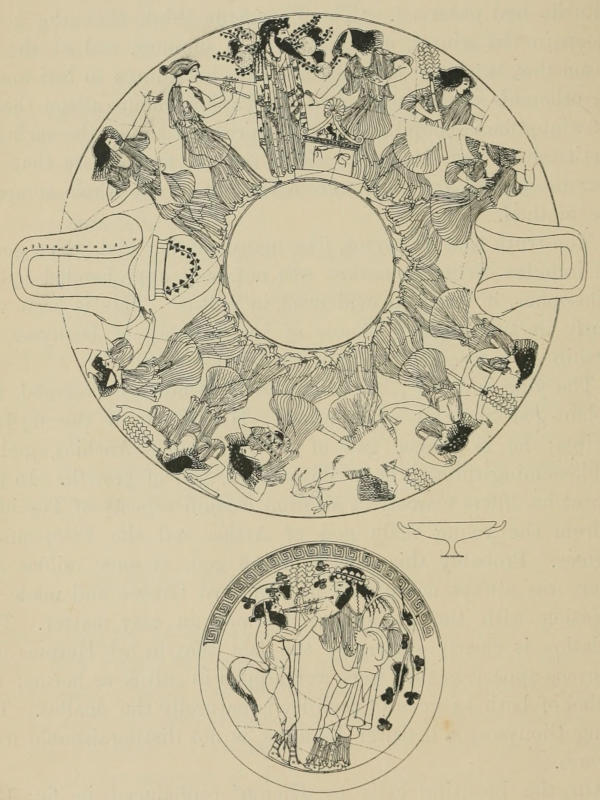
Fig. 132.
On the beautiful cylix by Hieron[1091] reproduced in fig. 132, perhaps the most exquisite thing that ancient ceramography has left us, this affiliation is clearly shown. In the centre design Dionysos is all vine-god. He holds a great vine-branch in his left hand, in his right his own sceptre the thyrsos; his worshipper is a horse-Satyr piping on the double flutes. But on the exterior of the cup, a scene of cultus rather than mythology, he is of wider import, he is Dendrites. The god round whom the lovely Maenads dance in circle is a rude pillar or plank draped with a splendid ritual garment. It is a primitive herm decorated with great bunches of grapes, but also with ivy sprigs and honeycombs and a necklace of dried figs, such as the Greek peasant now-a-days takes with him for food on a journey. He is god of all growing things, of every tree and plant and natural product, and only later exclusively of the vine. He takes to himself ivy and pine and honeycomb. The honey-drink he supersedes, yet honey is sacred to him. Only the olive he never takes, for Athene had it already. Ivy especially was sacred to him; his Maenads chewed ivy leaves[1092] for inspiration, as the Delphic prophetess chewed the bay. Pliny[1093] says: ‘Even to this day ivy is used to decorate the thyrsos of the god and the helmets and shields used by the peoples of Thrace in their rites,’ and this ritual ivy is remembered by Dionysos when he comes to Thebes[1094]:
‘I cry to Thebes to waken, set her hands To clasp my wand, mine ivied javelin, And round her shoulders hang my wild fawn-skin.’
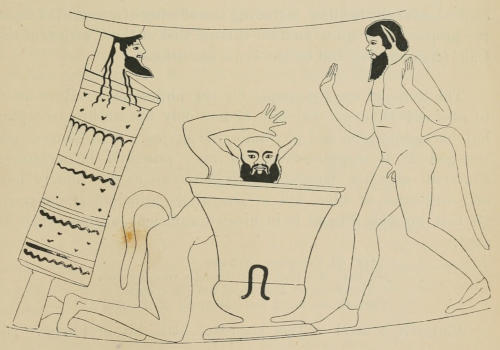
Fig. 133.
Very primitive in form but wholly of the vine-god is the xoanon on a krater in the Campana collection of the Louvre[1095] (fig. 133). The image of the god is a column treated as a herm, and reminds us that Dionysos was called by the name Perikonios, He-about-the-pillar. The two representations in figs. 133 and 132 are characteristically different. The rude Satyrs have but one way of worshipping their god, they fall upon the wine-cup; the Maenads, worshipping the god of life, bend in ritual ecstasy to touch the earth, mother of life; the wine-jar in Hieron’s vase is present as a symbol, but the Maenads revel aloof.
The worship of the tree-god was probably indigenous in Thrace long before the coming of the vine. We have evidence that it lingered on there down to Roman times. An inscription on a cippus recently discovered in a mosque at Eski Djoumi[1096] and now in the museum at Saloniki affords curious evidence. The cippus marked the grave of a priestess of Dionysos. Her name is lost, but the word priestess (ἱερεία) is followed by two characteristically Bacchic epithets, θύσα and εὐεία. She is priestess of the thiasos of the ‘Carriers of the Evergreen Oak’ (πρινοφόροι), and she leaves to her guild certain property in vineyards. If they do not fulfil the conditions of the bequest, including the offering of a wreath of roses, the property is to go to another thiasos, that of the ‘Carriers of the Oak’ (Δροιοφόροι), and on the same conditions.
The tree-god was too simple for the philosopher. He wanted to abstract Dionysos, rid him of not only his anthropomorphic but his zoomorphic and phytomorphic shapes. Still he used the tree-god as a stepping-stone to his ‘principle of moisture.’ Plutarch[1097] says the Greeks regard Dionysos as not merely lord and originator of wine, but of the whole principle of moisture. Of this, he adds, Pindar is in himself sufficient witness when he says:
‘Of all the trees that are He hath his flock, and feedeth root by root, The Joy-god Dionysos, the pure star That shines amid the gathering of the fruit.’
Plutarch is fond of this beautiful little bit of Pindar. He quotes it again in his Symposiacs[1098]. A friend who is a farmer objects that Plutarch has shut out his calling from the worship of the Muses, whereas he had hoped that at least Thalia, goddess of increase, might be his to worship. Plutarch says the charge is not a just one, for farmers have Dendrites, He-of-the-Trees, and Anesidora, She-who-sends-up-gifts; and then he quotes his favourite passage. Pindar is of course no evidence for a Principle of Moisture. Neither poets nor primitive people use any such philosophical jargon; but all the world over primitive man did and still does welcome the coming and lament the going of the something or someone who makes the trees and plants to grow and beasts and man to bring forth. Later, though they are little the wiser as to what that something is, they will call it the ‘Principle of Moisture,’ or if they are poets Love or Life.
The ‘Principle of Moisture’ was in fashion among theologists long before Plutarch. In the Bacchae of Euripides the new wine of the religion of Dionysos has to be poured into some very old bottles. Teiresias in a typically orthodox fashion, characteristic of the timid and kindly priest all the world over, tries to water it down with weak rationalism. Dionysos, he urges, is not new at all, he is very old, as old and respectable as Demeter herself; she is the Principle of Dryness, he of Moisture, nothing could be more safe and satisfactory. He thus instructs honest Pentheus[1099]:
‘Two spirits there be, Young prince, that in man’s world are first of worth. Demeter one is named. She is the Earth— Call her what name thou wilt!—who feeds man’s frame With sustenance of things dry. And that which came Her work to perfect, second, is the Power From Semele born. He found the liquid shower Hid in the grape[1100].’
This is the rationalism not of the poet Euripides, but of the priest Teiresias. This is clear, for the poet in the next line breaks clean away from the tiresome Dryness and Moisture and is gone to the magic of sleep and the blood of the God outpoured.
Plutarch quotes Pindar as authority for the Principle of Moisture, and undoubtedly the sap of trees and plants sacred to Dionysos may have helped out the abstraction. But, had Plutarch known it, the notion is associated not so much with Dendrites, the Tree-God, as with a figure perhaps still more primitive, Dionysos the Bull.
Dionysos the Bull-God.
Dionysos Dendrites is easy to realize; he is but a step back from the familiar, canonical Vine-god. The Bull-god Dionysos is harder to accept because we have lost the primitive habit of thinking from which he sprang. The Greeks themselves suffered the like inconvenience. They rapidly advanced to so complete an anthropomorphism that in Periclean Athens the dogma of the Bull-incarnation was, we cannot doubt, a stumbling-block, a faith as far as possible put out of sight.
The particular animal in which a god is incarnate depends of course on the circumstances of the worshippers. If he is in a land lion-haunted his god will be apt to take shape as a lion; later the lion will be his attendant, his servitor. Lions attend the Mountain-Mother of Asia Minor, guard her as has been seen (p. 265) in heraldic fashion, draw her chariot, watch her throne[1101]. In like manner Dionysos, son of Semele, who is but one form of the same Earth-Mother, has a chariot drawn by lions (fig. 123), and sometimes, though not so frequently as his Mother, an attendant lion.
In the vase-painting in fig. 134 from an amphora in the British Museum[1102] Dionysos, with kantharos and great spreading vine, stands between two great prophylactic eyes. A little lion looks up at him, dog-like, adoring his master. On the reverse Hephaistos with his mallet carries the vine in token of the power of the god. The lion in this picture is losing his reality, because the lion has ceased to be a dominant terror in Greece. The god of a civilized, agricultural people must reincarnate himself in other animal shapes, in the Snake, in the Kid, most of all in the Bull. The Bull-god may have been too savage for Periclean Athens, but Euripides must have found him in full force in Macedonia. To a people of goat-herds like the Arcadians the goat is the impersonation of life and generation; to a people of cow-herds the bull is the more potent and splendid vehicle. In the Bacchae there are Snake-Epiphanies, Lion-Epiphanies, but first and foremost Bull-Epiphanies. At the mystery of the Birth[1103]
‘A Horned God was found And a God with serpents crowned.’
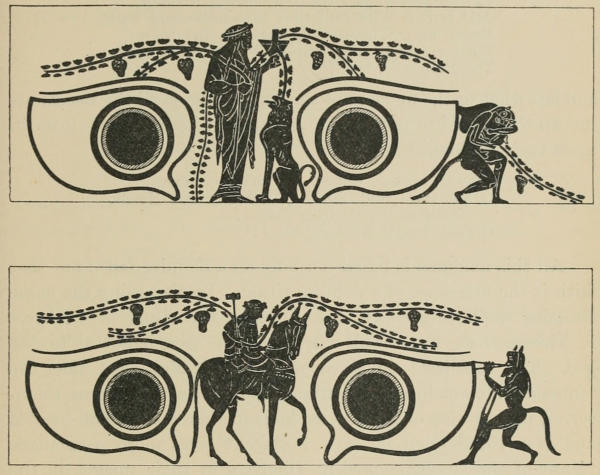
Fig. 134.
In the supreme Orphic mystery, to be discussed later (p. 483), the worshipper before he became ‘Bacchos’ ate the raw flesh of a bull, and, probably in connection with this sacrament, the Bull form of the god crystallized into a mystery dogma. When Pentheus has imprisoned the ‘Bacchos’ he finds in the manger not the beautiful stranger but a raging bull; the hallucination was doubtless bred of ancient faith and ritual. Again when in the Bacchae[1104] Dionysos leads him forth enchanted to his doom on Cithaeron, Pentheus in his madness sees before him strange sights:
‘Yea and mine eye Is bright! Yon sun shines twofold in the sky, Thebes twofold and the Wall of Seven Gates, And is it a Wild Bull this, that walks and waits Before me? There are horns upon thy brow! What art thou, man or beast? For surely now The Bull is on thee!’
and last when at the moment of their uttermost peril the Bacchants invoke their Lord to vengeance, the ancient incarnations loom in upon their maddened minds[1105]:
‘Appear, appear, whatso thy shape or name, O Mountain Bull, Snake of the Hundred Heads, Lion of the Burning Flame! O God, Beast, Mystery, come!’
All this madness is based not only on a definite faith, but that faith is the utterance of a definite ritual. In discussing the name Bromios we have seen (p. 415) that in the ritual of Dionysos in Thrace there were ‘bull-voiced mimes’ who bellowed to the god. The scholiast[1106] on Lycophron’s Alexandra says that the ‘women who worshipped Dionysos Laphystios wore horns themselves, in imitation of the god, for he is imagined to be bull-headed and is so represented in art.’ Plutarch[1107] gives more particulars. ‘Many of the Greeks represent Dionysos in their images in the form of a bull, and the women of Elis in their prayers invoke the god to come to them with his bull-foot, and among the Argives there is a Dionysos with the title Bull-born. And they summon him by their trumpets out of the water, casting into the depths lambs to the Door-keeper; they hide their trumpets in their thyrsoi, as Socrates has told in his treatise on the Hosioi.’ A bull-god is summoned and he emerges from water.
It will later (p. 496) be seen to what strange theological uses the Orphics put their bull and lion and snake-shaped Epiphanies; for the present it must be noted how near akin these were to the shapes that the Southern Greeks gave to their own indigenous gods. Zeus and Athene and even Poseidon had, by the fifth century B.C., become pure human shapes, but the ministrants of Poseidon at Cyzicus were down to the time of Athenaeus known as Bulls[1108], and lower divinities like rivers still kept their bull shape, witness the pathetic story of Deianeira and Acheloüs[1109]:
‘A river was my lover, him I mean Great Acheloüs, and in threefold form Wooed me, and wooed again; a visible bull Sometimes, and sometimes a coiled gleaming snake, And sometimes partly man, a monstrous shape Bull-fronted, and adown his shaggy beard Fountains of clear spring water glistening flowed.’
In those old divine days a wooer might woo in a hundred shapes, and a maiden in like fashion might fly his wooing. It is again Sophocles[1110] who tells us of the marriage of Pentheus:
‘The wedlock of his wedding was untold, His wrestling with the maiden manifold.’
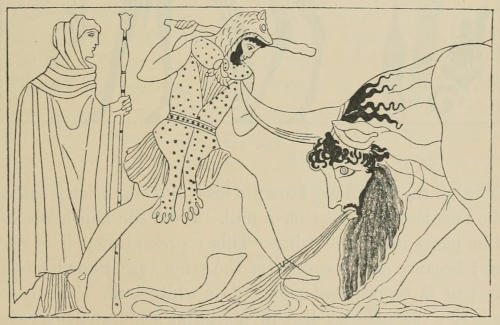
Fig. 135.
The red-figured vase-painting in fig. 135 looks almost like an illustration of the Trachiniae[1111]. Here is the monster; but he is man-fronted, his body that of a bull, and from his mouth flows the water of his own stream Acheloüs. Herakles is about to break off his mighty horn, the seat of his strength; Deianeira stands by unmoved. With odd insistence on his meaning the vase-painter draws in a horn parallel with the stream to show that the stream is itself a cornucopia of growth and riches. The vase-painting is many years earlier than the play of Sophocles.
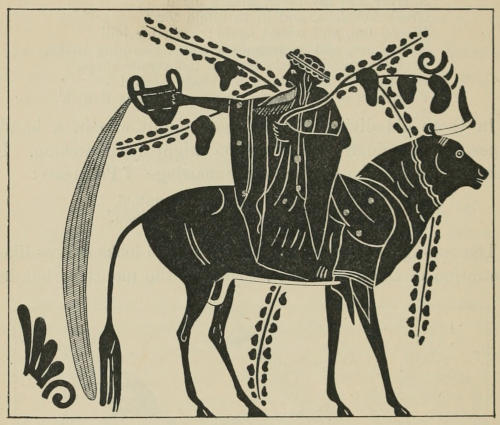
Fig. 136.
I know of no instance where an actual bull-Dionysos is represented on a vase-painting, but in the design in fig. 136 from an amphora[1112] in the Würzburg Museum his close connection is indicated by the fact that he rides on a bull. From the kantharos in his hand he pours his gift of wine. This representation is of special interest because on the reverse of the same vase Poseidon holding his trident is represented riding on a white bull. This looks as though the vase-painter had in his mind some analogy between the two divinities of moisture and growth.
With the bull-Poseidon and the bull river-god at hand, the assimilation of the bull-shaped Dionysos would be an easy task, the more as he was god of sap and generation and life, as well as of wine. Water and wine were blended in theology as in daily life, and the Greeks of the South lent the element of water.
Dionysos then by his tree-shape and his bull-shape is clearly shown to be not merely a spirit of intoxication, but rather a primitive nature god laid hold of, informed by a spirit of intoxication. Demeter and Kore are nature-goddesses, they have their uprisings and down-goings, but to the end they remain sedate and orderly. Dionysos is as it were the male correlative of Kore, but informed, transfigured by this new element of intoxication and orgy.
This double nature of the god finds expression in one of his titles, the cultus epithet of Dithyrambos, and it is only by keeping his double aspect clearly in mind that this difficult epithet can at all be understood.
Dithyrambos and the Dithyramb.
The title Dithyrambos given to Dionysos and the Dithyramb, the song sung in his honour, must be considered together, in fact this title like ‘Iacchos’ seems to have arisen out of the song.
The epithet Dithyrambos was always regarded by the Greeks themselves as indicating and describing the manner of the birth of the god. Disregarding the quantity of the vowel i in Di they believed it to be derived from Δῐ and θύρα, double door, and took it to mean ‘he who entered life by a double door,’ the womb of his mother and the thigh of his father. This was to them the cardinal ‘mystery’ of the birth. So much is clear from the birth-song of the chorus in the Bacchae[1113]:
‘Acheloüs’ roaming daughter, Holy Dirce, virgin water, Bathed he not of old in thee The Babe of God, the Mystery? When from out the fire immortal To himself his God did take him, To his own flesh, and bespake him: “Enter now life’s second portal, Motherless mystery; lo I break Mine own body for thy sake, Thou of the Two-fold Door, and seal thee Mine, O Bromios”—thus he spake— “And to this thy land reveal thee.”’
Dithyrambos was ‘he of the miraculous birth,’ Liknites conceived mystically. The mistaken etymology need not make us distrust the substantial truth of the tradition.
As Dithyrambos is the Babe mystically born, so the Dithyramb was uniformly regarded as the Song of the Birth. Plato states this, though somewhat tentatively, in the Laws[1114]. When discussing various kinds of music he says: ‘Another form of song, the Birth of Dionysos called, I think, the dithyramb.’
It has already been seen that Dionysos as the principle of life and generation was figured as a bull, it is therefore no surprise to learn from Pindar[1115] that the Dithyramb ‘drives’ the bull:
‘Whence did appear the Charites who sing To Dionyse their king The dithyramb, the chant of Bull-driving?’
The Charites here halt half-way between ritual and poetry. They are half abstract rhythmical graces, half the Charites of an actual cult. The song of invocation to the Bull sung by the women of Elis has been already noted. It is the earliest Dithyramb preserved, and happily in his Greek Questions Plutarch[1116] has left us a somewhat detailed account. He asks, ‘Why do the women of Elis summon Dionysos in their hymns to be present with them with his bull-foot?’ He goes on to give the exact words of the little ritual hymn:
Hero, Dionysos, come To thy temple-home Here at Elis, worshipful We implore thee With thy Charites adore Thee, Rushing with thy bull-foot, come! Noble Bull, noble Bull.’
The fact that ‘Hero’ precedes ‘Dionysos’ in the invocation makes it tempting to conjecture that we have here a superposition of cults, that the women of Elis long before the coming of Dionysos worshipped a local hero in the form of a bull and that Dionysos affiliated his cult; but another possibility is perhaps more probable, that Hero is in the hymn purely adjectival. It has already been shown that the word meant to begin with only ‘strong’ and then ‘strong one.’
The mention of the Charites is important. They are the givers of increase (p. 298), who naturally attend the coming of the life-god; they seem here analogous to the nurses of Dionysos, the sober form of his Maenads. They attend alike his coming and his birth.
In the Delphic Paean (p. 417), where the birth of Dionysos in the spring is celebrated, the title Dithyrambos[1117] is first and foremost, before Bacchos, Euios, Braites and Bromios:
‘Come, O Dithyrambos, Bacchos, come, Euios, Thyrsos-Lord, Braites, come, Bromios, come, and coming with thee bring Holy hours of thine own holy spring. Evoe, Bacchos, hail, Paean, hail, Whom in sacred Thebes the mother fair, She, Thyone, once to Zeus did bear. All the stars danced for joy. Mirth Of mortals hailed thee, Bacchos, at thy birth.’
The new-born god is Dithyrambos, and he is born at the resurrection of earth in the spring-time.
The epithet Paean, belonging to Apollo, is here given to Dionysos. At the great festival of the finishing of the temple all is to be harmony and peace; theology attempts an edifying but impossible syncretism. Nothing in mythology is more certain than that the Paean and the Dithyramb were to begin with poles asunder, and it is by the contrast between them that we best understand not only the gist of the Dithyramb itself but the significance of the whole religion of Dionysos.
The contrast between Apollo and Dionysos, Paean and Dithyramb, has been sharply and instructively drawn by Plutarch, himself a priest at Delphi. The comparison instituted by Plutarch between the rites of Osiris and those of Dionysos has been already noted (p. 402). In the discourse about Isis and Osiris[1118], it will be remembered, Plutarch says ‘the affair about the Titans and the Night of Accomplishment accords with what are called in the rites of Osiris “Tearings to pieces,” Resurrections, Regenerations. The same,’ he adds, ‘is true about rites of burying. The Egyptians show in many places burial chests of Osiris, and the Delphians also hold that the remains of Dionysos are deposited with them near to the place of the oracle, and the Consecrated Ones (ὅσιοι) perform a secret sacrifice in the sanctuary of Apollo what time the Thyiades awaken Liknites.’ In a word, at Delphi there were rites closely analogous to those of Osiris and concerned with the tearing to pieces, the death and burial of the god Dionysos, and his resurrection and re-birth as a child.
In another discourse (On the Ei at Delphi) Plutarch[1119] tells us that these ceremonials were concerned with the god as Dithyrambos, that the characteristic of the Dithyramb was that it sang of these mutations, these re-births, and that it was thereby marked off sharply from the Paean of Apollo. The passage is so instructive both as to the real nature of Dionysos and as reflecting the attitude of an educated Greek towards his religion that it must be quoted in full. Plutarch has been discussing and contrasting Dionysos and Apollo apropos of the worship of Dionysos at Delphi, a worship every detail of which he must certainly have known. Dionysos, he says, has just as much to do with Delphi as Apollo himself, a statement rather startling to modern ears. Then he begins to work out the contrast between the two gods after the philosophic fashion of his day. Apollo is the principle of simplicity, unity and purity, Dionysos of manifold change and metamorphosis. This is the esoteric doctrine known to experts, cloaked from the vulgar. Among these experts (σοφώτεροι) were probably, as will be seen later (p. 463), Orphic theologians. He goes on to tell how these esoteric doctrines were expressed in popular ritual. He of course inverts the natural order of development. He believes that the doctrine known only to the few gave rise to a ritual intended to express it in popular terms for the vulgar; whereas of course in reality the ritual existed first and was then by the experts made to bear a mystical meaning. Bearing this proviso in mind Plutarch’s account is full of interest. ‘These manifold changes that Dionysos suffers into winds and water and earth and stars and the births of plants and animals they enigmatically term “rending asunder” and “tearing limb from limb”; and they call the god Dionysos and Zagreus and Nyktelios and Isodaites, and tell of certain Destructions and Disappearances and Resurrections and New-Births which are fables and riddles, appertaining to the aforesaid metamorphoses. And to him (i.e. Dionysos) they sing dithyrambic measures full of sufferings and metamorphosis, which metamorphosis has in it an element of wandering and distraction. For “it is fitting,” as Aeschylus says, that “the dithyramb of diverse utterance should accompany Dionysos as his counterpart, but the ordered Paean and the sober Muse should attend Apollo.” And artists in sculpture represent Apollo as ever young and ageless, but Dionysos they represent as having many forms and shapes. In a word, they attribute to the one uniformity and order and an earnest simplicity, but to the other a certain incongruousness owing to a blend made up of sportiveness and excess and earnestness and madness. They invoke him thus:
“Euios, thou Dionysos, who by the flame of thy rite Dost women to madness incite.”’
Plutarch goes on to tell of the division of the ritual year at Delphi between Apollo and Dionysos. Apollo as incoming conqueror has taken the larger and the fairer portion.
‘And since the time of the revolutions in these changes is not equal, but the one which they call Satiety is longer, and the other which they call Craving is shorter, they observe in this matter a due proportion. For the remainder of the year they use the Paean in their sacrificial ceremonies, but at the approach of winter they wake up the Dithyramb and make the Paean cease. For three months they invoke the one god (Dionysos) in place of the other (Apollo), as they hold that in respect to its duration the setting in order of the world is to its conflagration as three to one.’
Plutarch’s use of technical terms, e.g. conflagration (ἐκπύρωσις), betrays that he is importing into his religious discussion philosophic speculations, and especially those of Heraclitus. Into these it is unnecessary to follow him; the important points that emerge for the present argument are that the Dithyramb was a ritual song sung in the winter season, probably at festivals connected with the winter solstice, of an orgiastic character and dealing with the god as an impersonation of natural forces, dealing with his sufferings, his death and resurrection, and as such contrasted with the sober simple Paean. In a word the Dithyramb, and with it the title Dithyrambos, resume the two factors that we have detected in the religion of Dionysos, the old spirit of life and generation, and the new spirit of intoxication.
It remains to enquire if any light can be thrown on the difficult etymology[1120] of the word.
The popular etymology, that saw in Dithyrambos the god-of-the-double-door, is of course impossible. Dithyrambos, all philologists agree, cannot etymologically be separated from its cognate thriambos, which gave to the Latins their word triumphus. The word thriambos looks as if it were formed on the analogy of iambos. It may be that Suidas[1121] among his many confused conjectures as to the meaning of the word throws out accidentally the right clue. He says ‘they call the madness of poets thriasis.’ May not thriambos mean the mad inspired orgiastic measure? The first syllable with its long i may possibly be referred to the root Δι already discussed under Diasia (p. 23). At a time when in etymology the length of syllables was wholly disregarded the Δι in Διός might help out the confusion, and last some brilliant theologian intent on edification thought of the double doors. Mythology has left us dim hints as to the functions of certain ancient maiden prophetesses at Delphi called Thriae. May they not have been the Mad Maidens who sang the mad song, the thriambos?
Of the Thriae we are told by Philochoros[1122] that they were nymphs of Parnassos, nurses of Apollo. Save for this mention we never hear that Apollo had any nurses, he was wholly the son of his father. Is it not more probable that they were nurses of Dionysos?
The account of these mysterious Thriae given in the Homeric Hymn[1123] to Hermes is strange and suggestive. Hermes is made to tell how his first gift of prophecy came not from Zeus, but from three maiden prophetesses:
‘For there are sisters born, called Thriae, maiden things, Three are they and they joy them in glory of swift wings. Upon their heads is sprinkled fine flour of barley white, They dwell aloof in dwellings beneath Parnassos’ height. They taught me love of soothsaying, while I my herds did feed, Being yet a boy. Of me and mine my father took no heed. And thence they flitted, now this way, now that, upon the wing, And of all things that were to be they uttered soothsaying. What time they fed on honey fresh, food of the gods divine, Then holy madness made their hearts to speak the truth incline, But if from food of honeycomb they needs must keep aloof Confused they buzz among themselves and speak no word of sooth.’
The Thriae are nurses like the Maenads, they rave in holy madness (θυΐουσιν) like the Thyiades, but their inspiration is not from Bacchos, the wine-god, not even from Bromios or Sabazios or Braites, the beer-gods; it is from a source, from an intoxicant yet more primitive, from honey. They are in a word ‘Melissae,’ honey-priestesses, inspired by a honey intoxicant; they are bees, their heads white with pollen; they hum and buzz, swarming confusedly. The honey service of ancient ritual has already been noted (p. 91), and the fact that not only the priestesses of Artemis at Ephesus were ‘Bees,’ but also those of Demeter, and, still more significant, the Delphic priestess herself was a Bee. The oracle of the Bessi (p. 370) was delivered by a priestess, and the analogy with Delphi is noted by Herodotus; may not the priestess of the Bessi have also been a Bee? The Delphic priestess in historical times chewed a laurel leaf, but when she was a Bee surely she must have sought her inspiration in the honeycomb.
With all these divine associations about the bee, a creature wondrous enough in nature, it is not surprising that she was figured by art as a goddess and half human. In fig. 137 we have such a representation[1124], a woman with high curled wings and a bee body from the waist downwards. The design is from a gold embossed plaque found at Camiros.
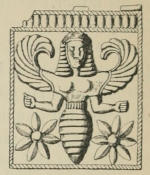
Fig. 137.
When Euripides would tell of the dread power of Aphrodite haunting with her doom all living things, Aphrodite who was heir to all the sacred traditions of the Earth-Mother, the image of the holy bee comes to his mind charged with mysterious associations half lost to us. He makes the chorus of maidens in the Hippolytus sing[1125]:
‘O mouth of Dirce, O god-built wall That Dirce’s wells run under; Ye know the Cyprian’s fleet foot-fall, Ye saw the heavens round her flare When she lulled to her sleep that Mother fair Of Twy-born Bacchus and crowned her there The Bride of the bladed thunder, For her breath is on all that hath life, and she floats in the air Bee-like, death-like, a wonder.’
The thriambos[1126] was then, if this conjecture be correct, the song of the Thriae or honey-priestesses, a song from the beginning like the analogous Dithyramb confused, inspired, impassioned. The title Dithyrambos through its etymology and by its traditional use belonged to Dionysos, conceived of in his twofold aspect as the nature-god born anew each year, the god of plants and animals as well as of human life, and also as the spirit of intoxication. It remains to ask what was the significance of such a god to the Greeks who received him as an immigrant from the North. How far did they adopt and how far modify both elements in this strange and complex new worship?
First, what significance had Dionysos to the Greeks as a nature-god, in his animal and vegetable forms as bull and tree?
Long before the coming of Dionysos the Greeks had nature-gods: they had Demeter goddess of the corn, they had Poseidon Phytalmios god of the growth of plants, they had the Charites givers of all increase. But it should be distinctly noted that all these and many another nature-god had passed into a state of complete anthropomorphism. They represent human rather than merely physical relations, they have cut themselves as far as possible loose from plant and animal nature. Demeter is far more mother than corn. Hermes is the young man in his human splendour, and spite of his Herm-form and phallic worship has well nigh forgotten that he was once a spirit of generation in flocks and plants. Athene, like her mother the earth, had once for her vehicle a snake (p. 306), but she has waxed in glory till she comes to be a motherless splendour born of the brain of Zeus, an incarnate city of Athens. These magnificent Olympians have shed for ever the slough of animal shapes. Dionysos came to Greece at an earlier stage of his development when he was still half bull half tree, and this earlier stage was tolerated, even welcomed, by a people who had themselves outgrown it.
It is not hard to see how this came to be. Man when he worships a bull or a tree has not, even to himself, consciously emerged as human. He is still to his own thinking brother of plants and animals. As he advances he gains but also loses, and must sometimes retrace his steps. The Greeks of the sixth century B.C. may well have been a little weary of their anthropomorphic Olympians, tired of their own magnified reflection in the mirror of mythology, whether this image were distorted or halo-crowned. They had taken for their motto ‘Know Thyself,’ but at the fountain of self-knowledge no human soul has ever yet quenched its thirst. With Dionysos, god of trees and plants as well as human life, there came a ‘return to nature,’ a breaking of bonds and limitations and crystallizations, a desire for the life rather of the emotions than of the reason, a recrudescence it may be of animal passions. Nowhere is this return to nature more clearly seen than in the Bacchae[1127] of Euripides. The Bacchants leave their human homes, their human work and ordered life, their looms and distaffs, and are back with the wild things upon the mountains. In token of this their hair flows loose, they clothe themselves with the skin of beasts, they are girt with snakes, and crowned with ivy and wild briony, and leaving their human babes they suckle the young of wolves and deer[1128]:
‘And one a young fawn held, and one a wild Wolf-cub, and fed them with white milk and smiled In love, young mothers with a mother’s breast, And babes at home forgotten.’
Euripides, it may be, utters his own longing to be free from the tangle and stress of things human, but it is into the mouths of the chorus of Maenads that he puts the lovely song[1129]:
‘Will they ever come to me, ever again, The long, long dances, On through the dark till the dim stars wane? Shall I feel the dew on my throat and the stream Of wind in my hair? Shall our white feet gleam In the dim expanses? O feet of a Fawn to the greenwood fled, Alone in the grass, and the loveliness; Leap of the Hunted, no more in dread, Beyond the snares and the deadly press. Yet a voice still in the distance sounds, A voice and a fear and a haste of hounds, O wildly labouring, fiercely fleet, Onward yet by river and glen— Is it joy or terror ye storm-swift feet?— To the dear lone lands untroubled of men, Where no voice sounds, and amid the shadowy green The little things of the woodland live unseen.’
Nor is it only that the Maenads escape from their humanity to worship on the mountain, they find there others, a strange congregation, that worship with them[1130]:
‘There Through the appointed hour, they made their prayer And worship of the Wand, with one accord Of heart, and cry “Iacchos, Bromios, Lord, God of God born!” And all the mountain felt And worshipped with them; and the wild things knelt, And ramped and gloried, and the wilderness Was filled with moving voices and dim stress.’
This notion of a return to nature[1131] is an element in the worship of Dionysos so simple, so moving and in a sense so modern that we realize it without effort. It is harder to attain to anything like historical sympathy with the second element—that of intoxication.
It is not easy to deal with the worship of Dionysos without rousing in our own minds an instinctive protest. Intoxication to us now-a-days means not inspiration but excess and consequent degradation; its associations are with crime, with the slums, with hereditary disease, with every form of abuse that abases man, not to the level of the beasts but far beneath them.
In trying to understand how the Greeks felt towards Dionysos we must bear in mind one undoubted fact. The Greeks were not as a nation drunkards. Serious excess in drink is rare among southern nations, and the Greeks were no exception to the general rule. When they came in contact with northern nations like the Thracians, who drank deep and seriously, they were surprised and disgusted.
Of this we have ample evidence, much of it drawn from the discussion in the Deipnosophistae of Athenaeus[1132] on Wine and Wine-cups. The general tone of the discourse, while it is strongly in favour of drinking, is averse to drunkenness. ‘The men of old time were not wont to get drunk.’ The reason given is characteristically Greek; they disliked the unbridled license that ensued. It was well said by the inventors of proverbs, ‘Wine has no rudder.’ Plato[1133] in the sixth book of the Laws said it was unfitting for a man to drink to the point of drunkenness, except on the occasions of festivals of that god who was the giver of wine. An occasional and strictly defined license under the sanction of religion is widely different from a general habit of intemperance. In the first book of the Laws[1134], in speaking of various foreign nations Northern and Oriental, e.g. Celts, Iberians, Thracians, Lydians and Persians, he says ‘nations of that sort make a practice of drunkenness.’
The Greek habit of drinking was marked off from that of the Thracians by two customs, they drank their wine in small cups and they mixed it freely with water. One of the guests in Athenaeus remarks[1135] that it is worth while enquiring whether the men of old times drank out of large cups. ‘For,’ he adds, ‘Dicaearchus the Messenian, the disciple of Aristotle, in his discourse on Alcaeus says they used small cups and drank their wine mixed with much water.’ He goes on to cite a treatise ‘On Drunkenness’ by Chamaeleon of Heracleia, in which Chamaeleon stated not only that the custom of using large cups was a recent one but that it was imported from the barbarians. Imported indeed but never really naturalized, for he goes on to say, ‘They being devoid of culture rush eagerly to excess in wine and provide for themselves all manner of superfluous delicacies.’ It is clear that in respect of wine and food as of everything else the Greek was in the main true to his motto ‘Nothing too much.’ Drunkenness was an offence in his eyes against taste as well as morals.
Large drinking cups were a northern barbarian characteristic[1136]; they were made originally of the huge horns of the large breed of cattle common in the North, they were set in silver and gold, and later sometimes actually made of precious metals and called rhyta. Chamaeleon goes on to say, ‘in the various regions of Greece neither in works of art nor in poems shall we find any trace of a large cup being made save in such as deal with heroes.’ That to the dead hero was allowed even by the Orphics the guerdon of ‘eternal drunkenness’ will be seen later (Chap. XI.), but the living hero only drank of large cups of unmixed wine out of ceremonial courtesy to the Northerner. Xenophon in the seventh book of the Anabasis describes in detail the drinking festival given by the Thracian Seuthes. When the Greek general and his men came to Seuthes they embraced first and then according to the Thracian custom horns of wine were presented to them. In like manner the Macedonian Philip pledged his friends in a horn of wine. It was from silver horns that the Centaurs drank (p. 386). A flatterer and a demagogue might drink deep for his own base purposes. Of the arch-demagogue Alcibiades Plutarch[1137] says: ‘At Athens he scoffed and kept horses, at Sparta he went close-shaved and wore a short cloak and washed in cold water, in Thrace he fought and drank.’ War and drink, Ares and Dionysos, have been in all ages the chosen divinities of the Northerner. Diodorus[1138] in speaking of ceremonial wine-drinking makes a characteristically Greek statement: ‘They say that those who drink at banquets when unmixed wine is provided invoke the Good Genius, but when after the meal wine is given mixed with water they call on the name of Zeus the Saviour; for they hold that wine drunk unmixed produces forms of madness, but that when it is mixed with the rain of Zeus the joy of it and the delight remain, and the injurious element that causes madness and license is corrected.’ The Good, or perhaps we ought to call him ‘Wealthy,’ Spirit is the very essence of the old wine-god of Thrace and Boeotia; the blending with the rain of Zeus is the taking of it over to the mildness and temperance of the Greek character.
Excess was rare among the southern Greeks, and, even when they exceeded, because they were a people of artists they euphemized. No one but a Greek could have conceived the lovely little vase-painting from an oinochoë in the Boston Museum of Fine Arts[1139] in fig. 138. A beautiful maiden is the centre of the scene. She is a worshipper of Dionysos. In her left hand is a tall thyrsos and she holds the cup of Dionysos, the kantharos, in her right. It is empty, and she seems to ask the Satyr who stands before her to refill it from his oinochoë. But he will not, she has had too much already. Over her beautiful head, slightly inclined as if in weariness, is inscribed—and who but a Greek would have dared to write it?—her name ‘Kraipale.’ Behind her comes a kindly sober friend bearing in her hand a hot drink, smoking still, to cure her sickness.
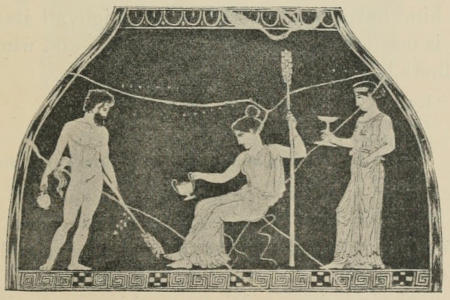
Fig. 138.
Perhaps because the extreme of drunkenness, its after degradation and squalid ugliness, was rare among the Greeks, they were better able to realize that in its milder forms it lent lovely motives for art. Wine by the release it brings from self-consciousness unslacks the limbs and gives to pose and gesture the new beauty of abandonment. Degas has dared to seize and fix for ever the beauty he saw in that tragedy of degradation—a woman of the people besotted by absinthe. The peeping moralist that lurks in most of us intrudes to utter truth beside the mark and say that she is wicked. To the Greek artist there was no such extreme issue between art and morality. To him, whether poet or vase-painter, to drink and fall asleep was if not a common at least a beautiful experience, one he painted on many a vase and sang in many a song. A festival without the grace and glory of wine would to him have been shorn of well nigh all its goodliness. On this it is needless to insist. To him peace and wine and sleep are playfellows loving and lovely[1140]:
‘Eyelids closed and lulled heart deep In gentle, unforbidden sleep, Street by street the city brims With lovers’ feasts and burns with lovers’ hymns.’
Another point remains to be noted. Not only did the Greeks mix their Thracian wine with water, tempering the madness of the god, but they saw in Dionysos the god of spiritual as well as physical intoxication. It cannot be forgotten that the drama sprang from the religion of Dionysos; his nurses are not only Maenads, they are Muses; from him and him only comes the beauty and magic of their song:
‘Hail Child of Semele, only by thee Can any singing sweet and gracious be.’
The contrast between sheer Thracian madness and the Athenian notion of inspiration is very clearly seen in the two figures of Dionysos as represented on the two vase-paintings in fig. 139 and fig. 140, vase-paintings roughly contemporaneous, the first in the style of Hieron, the second in that of Brygos. In fig. 139 from a red-figured stamnos[1141] in the British Museum we have the Thracian Dionysos drunk with wine, a brutal though still splendid savage; he dances in ecstasy brandishing the fawn he has rent asunder in his madness. In the second picture[1142] (fig. 140), a masterpiece of decorative composition, we have Dionysos as the Athenian cared to know him. The strange mad Satyrs are twisted and contorted to make exquisite patterns, they clash their frenzied crotala and wave great vine branches. But in the midst of the revel the god himself stands erect. He holds no kantharos, only a great lyre. His head is thrown back in ecstasy; he is drunken, but with music, not with wine.
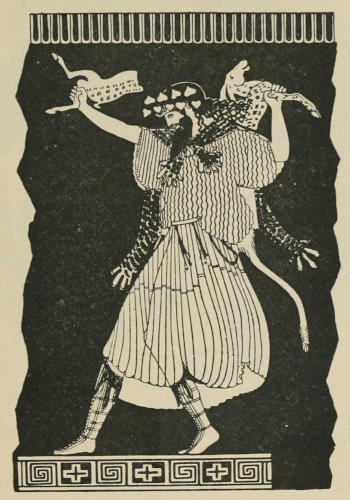
Fig. 139.
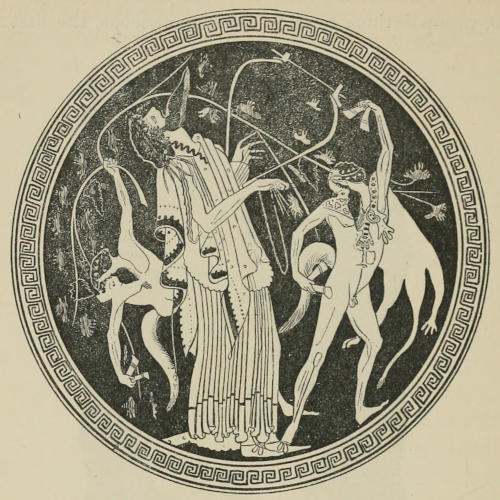
Fig. 140.
Again, with the Maenad worshippers there is the same transformation.
The delicate red-figured kotylos[1143] in fig. 141 from the National Museum in Athens is like a little twofold text on the double aspect of the worship of Dionysos. On the obverse is a Maenad about to execute her old savage ritual of tearing a kid asunder. In a moment she will raise her bent head and chant[1144]:
‘O glad, glad on the Mountains To swoon in the race outworn, When the holy fawn-skin clings And all else sweeps away, To the joy of the quick red fountains, The blood of the hill-goat torn, The glory of wild-beast ravenings Where the hill-top catches the day, To the Phrygian, Lydian mountains ’Tis Bromios leads the way.’
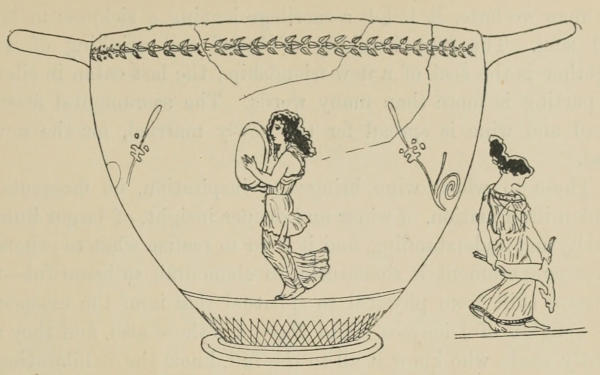
Fig. 141.
On the reverse for counterpart is a sister Maenad. She dances in gentle ecstasy, playing on her great timbrel. She is all for the service of the Muses, and she might sing[1145]:
‘But a better land is there Where Olympus cleaves the air, The high still dell, where the Muses dwell, Fairest of all things fair. O there is Grace, and there is the Heart’s Desire, And peace to adore thee, thou Spirit of guiding Fire.’
There are some to whom by natural temperament the religion of Bromios, son of Semele, is and must always be a dead letter, if not a stumbling-block. Food is to such a troublesome necessity, wine a danger or a disgust. They dread all stimulus that comes from without, they would fain break the ties that link them with animals and plants. They do not feel in themselves and are at a loss to imagine for others the sacramental mystery of life and nutrition that is accomplished in us day by day, how in the faintness of fasting the whole nature of man, spirit as well as body, dies down, he cannot think, he cannot work, he cannot love, how in the breaking of bread, and still more in the drinking of wine, life spiritual as well as physical is renewed, thought is re-born, his equanimity, his magnanimity are restored, reason and morality rule again. But to this sacramentalism of life most of us bear constant, if partly unconscious, witness. We will not eat with the man we hate, it is felt a sacrilege leaving a sickness in body and soul. The first breaking of bread and drinking of wine together is the seal of a new friendship; the last eaten in silence at parting is more than many words. The sacramental feast of bread and wine is spread for the newly married, for the newly dead.
Those to whom wine brings no inspiration, no moments of sudden illumination, of wider and deeper insight, of larger human charity and understanding, find it hard to realize what to others of other temperament is so natural, so elemental, so beautiful—the constant shift from physical to spiritual that is of the essence of the religion of Dionysos. But there are those also, and they are saintly souls, who know it all to the full, know the exhilaration of wine, know what it is to be drunken with the physical beauty of a flower or a sunset, with the sensuous imagery of words, with the strong wine of a new idea, with the magic of another’s personality, yet having known, turn away with steadfast eyes, disallowing the madness not only of Bromios but of the Muses and of Aphrodite. Such have their inward ecstasy of the ascetic, but they revel with another Lord, and he is Orpheus.