SEVENTH SESSION.
Reading edition
Dr. Cyrus Northrop, President Emeritus Minnesota University, presided.
Chairman Northrop—The Congress will be led in prayer by the Rev. Dr. S. M. Neel, pastor of the Central Presbyterian Church of Kansas City.
INVOCATION.
Our Father, Who art in heaven, we recognize Thy hand in every good. We are dependent upon the bounties of Thy providence, and we invoke Thy blessing upon these Thy servants, as they have met together to consider the best interests that manifest Thy love and Thy goodness to the children of men. Thou hast taught us if any man lack wisdom, let him ask of God, Who giveth liberally unto all men and upbraideth not. We pray Thee that Thou wilt give us wisdom to guide us in this Congress, that we advise those ways and means that shall be productive of the interests of our fellow men in their various avocations, especially to those who are called to labor and till the soil, and may Thy blessing rest upon them and Thy providence be about us, sending the rain and the sunshine in season, and that men may look up to Thee with thankful, grateful hearts, and serve Thee honestly and sincerely, and finally meet Thee in richest reward in the world to come, and the glory shall be Thine forever, Amen.
Chairman Northrop—My instructions were to start the Congress at 9 o’clock, but it did not seem possible to do that. So I have compromised by starting it half way between 9 and 9:30. The regular order of business probably cannot be pursued at this moment. Is Mr. George W. Bailey of Missouri in the room?
If Mr. Bailey will come to the platform he may have the ear of the Congress for five minutes. Mr. Bailey, Deputy State Game and Fish Commissioner of Missouri.
Mr. Bailey—I was highly pleased with the remarks of the gentleman Monday evening from New York on the conservation of wild life in that state, and again yesterday we enjoyed another treat from a gentleman representing the Audubon Society of the Empire State.
The protection of song and insectivorous birds in this rich agricultural land of the Middle West deserves more than a passing notice from this great Congress.
That the destruction of song and insectivorous birds means the increase of pests, so destructive to fruit and grain crops, is acknowledged by the best informed farmers of the day. And what a great pleasure it was to hear reports like those from the gentlemen representing the State of New York.
Here in Missouri we have had some trouble in getting the attention of farmers to this important subject, but they are beginning to realize that the insect-destroying bird is one of the best assets to the farmer.
The present Game Department of Missouri has never cost the tax payers of the state one penny, but the revenue for the protection of game is obtained from hunters’ licenses, paid into the State Treasurer’s office.
In North Central Missouri I have organized districts in several counties for the protection of prairie chicken and quail, and in these localities the farmers refuse to permit the destruction of these birds out of season, and we have now more than fifteen hundred prairie chickens absolutely protected, and the farmers will remember that in many neighborhoods of the state during the past season the grasshoppers were very destructive to late corn, and, as a proof of the usefulness of the wild birds, there was no complaint of the grasshoppers from the farmers in the localities where the prairie chicken, quail and other insectivorous and song birds are so well protected.
Through the efforts of our efficient Game and Fish Commissioner, Hon. Jesse A. Tolerton, the Chinese pheasant has been introduced in many counties of Missouri, and has proven a very great destroyer of insects, and especially so to the hated potato bug.
Some time ago I read an article in the Dallas News saying that the boll weevil had cost the State of Texas $20,000,000 in the last few years, and the editor called attention to the fact that the boll weevil never appeared until after the target gun in the hands of the vicious and ignorant had so wantonly destroyed wild bird life in that state.
Ladies and gentlemen, this is a startling statement, but true, and what an object lesson for the great subject of bird conservation.
Chairman Northrop—In the absence of the gentlemen who were upon the regular program, will you indulge me for a moment or two while I say something? In the papers in the South there has been for some time special notice of the fact that a few years ago a small cotton crop yielded to the cotton planter $240,000,000 more than the larger cotton crop which succeeded, and the lesson sought to be taught is that the products shall be kept down as low as is necessary to secure the highest prices, and to that end if a large amount of cotton has been raised a considerable portion shall be kept out of the market until the prices rise to fifteen cents a pound, and then brought forward as fast as the market will take it. There is some disposition among the wheat farmers to keep back their wheat until the market is high enough to enable them to get the best prices. There is nothing wrong in the farmer doing that, and securing the best price he can, because the cotton and the wheat are not ultimately lost. At some time or other they come into human use. But there is another department in which the same process does not meet with the same results. I refer to that most important and, as it seems to me, growing important department, fruits of all kinds in the United States. We talk about the high price of living, and the price is high. Anything which will relieve the demand upon the most common necessaries of life will tend to lower the cost of living. Anything that we can introduce and make a common article of food for a large portion of the people to take the place of beefsteak is a blessing to the country, and we are receiving into this country hundreds of thousands of immigrants at the present time, many of them—perhaps most of them—coming from countries where the practice is to live largely on fruits—the Italians and others. Now, you are conserving the resources of the country, and how are we conserving our resources in the matter of fruits? Why, there are millions of dollars’ worth of fruits that are permitted to perish every year in order that the price of fruit may be kept up to a certain grade all over the country, and the consequence is that this million dollars worth of fruit that might feed the people, or might take the place of some other more important food in some way, is all lost to the country. What is the use of conserving the fertility of the soil if we are going to have our soil so fertile that we can raise $50,000,000 worth of fruit and let $40,000,000 perish, in order that for the ten millions we might get the price of the forty millions? Some way ought to be provided by which the fruit that is raised in this country shall be made available for food. I do not ask that anything will be done that will interfere with the prosperity of the fruit raiser. But that he shall raise a large amount of fruit and then have it made impossible to put upon the market more than a quarter of his product, and have that fruit maintain in price the same standard that the whole of it would, is a wrong, it seems to me, to the people of this country, and a detriment to its welfare. What we want is to feed people comfortably and at the lowest rate that is consistent with existing conditions.
There is nothing that would contribute more to the health of our people in a large way than increasing to a very considerable extent the use of fruit. So many persons use things that are not really advantageous to health. Fruit would be invaluable, and we are raising millions of bushels of apples and kindred things that never come to the use of man, but are permitted to perish. The same is true of peaches in many cases, and with cherries in some states. It is remarkably true of apples. Those states on the Pacific Coast, Washington and Oregon, and the region round about there, are raising apples that are astonishing in quantity and quality, and they are preparing to produce a great many more. It will be of the greatest value to the people of this country if we can get them. Twenty years ago it was doubtful whether Minnesota could ever raise apples. We have apples by the thousands of bushels this year all around Minnesota.
Notwithstanding, green apples in the market when I left home were $1.50 a bushel. That is not necessary. It ought to be so that the laborer, the man who works with his hands, can have fruit. God has given us a country that will yield almost everything. It will yield fruit in tremendous quantities, and the people will eat it if they can get it. What is the trouble? Why should three-fourths of the crop rot on the ground, while only one-fourth gets to market and brings the price that the whole should command? You see my point. It is not to interfere with the man who raises apples. I want him to get his full reward. But it is that this magnificent product with which God has favored us shall be utilized for the needs of this country, for their good, and for the removal of the stress in the demand for various other products, which are now at a price that is not within the reach of many people. We are met for the interests of people in general, for the good of mankind. No man liveth to himself; no man dieth to himself. If there is not grass enough and food enough to keep alive the cattle of the country, and a man has a thousand tons of hay, do you think he has the right to burn up 999 tons, and then ask for the remaining ton the price of the thousand? Has a man a right to destroy what is necessary for the lives of his fellow men, when it is needed for those lives (cries of “no!”) simply in order that by having only a part he may get the reward of the whole? I say no. We have to look for something besides ourselves.
It is not merely a matter of how much money goes into my pocket and how little comes out. It is a matter of whether I am doing my part in this world to make the world what it ought to be, and my fellow man just as comfortable and happy as I can. (Applause) (Good!) I have got to do it whether I am a farmer or anybody else. We have to so use what we have that it may benefit others as well as ourselves. I am not proposing any plan. I do not know what plan should be proposed. But, ladies and gentlemen, what I want is to see the products of the earth utilized for the support of men and women and children. And I want some way to be provided by which the magnificent products of our orchards may be carried all over the country, and the people may eat and enjoy them and live, and the returns to the producer of that fruit be all that they could ask. Can you help to secure this result in some way in the coming years? It is not secured as it ought to be at the present time. (Applause)
I resign the chair to President Wallace.
President Wallace—I am very much obliged to Mr. Northrop for taking charge of the meeting in my absence. I have been down to meet Mr. Bryan. (Applause) I have persuaded him to put off his speech until 8 o’clock this evening. (Applause) Mr. Bryan will talk on a subject entirely in harmony with the spirit and purpose of this convention.
Delegate A. W. Stubbs—I have talked with a number of delegates from the country and understand that many of them have made arrangements to leave the city before 8 o’clock this evening, and I know it would be exceedingly gratifying to them to have Mr. Bryan here for a few moments some time. Do you suppose that could be arranged?
President Wallace—Yes, sir; he will be here and you can get to see him.
Delegate Stubbs—We want to hear him.
President Wallace—You may have a chance to hear him. We have a strong program; we keep the best to the last (applause), but we want you to assist us in putting through this program so that every man who comes here and says something can be heard. We will appreciate it, and push it through and just as fast as we can. Now, let me ask whether Mr. Curtis Hill is present? He is to address us on good roads. He is the State Highway Engineer of Missouri. What other matters have we to come before the Congress? The next speaker is Mr. White. He is not here, but he will be here in a little while. We will take up the call of the states. We do not care about resources or coal mines, but we want to know what you have done in your state for conservation, and what you intend to do, dead earnest, honor bright, what you intend to do.
Recording Secretary Gipe—Oregon (no response); Texas; Utah; Vermont; Virginia; West Virginia; Wisconsin; Wyoming. We have a request, Mr. President, from the chairman of the Arkansas delegation to be heard. They were not here when their names were called.
President Wallace—I take pleasure in introducing to you Mr. F. M. Filson, president Missouri State Association of Assistant Postmasters, who will talk to you for five minutes.
[Mr. Filson’s paper is in Supplementary Proceedings.]
President Wallace—Gentlemen: One reason for bringing this meeting to Kansas City was that we might get the voice from the South. Mr. Knapp, who has charge of the demonstration work in the South, was to be here, but cannot come because of illness, and his place will be taken by Professor W. J. Spillman of the Department of Agriculture, who will talk to you about fifteen or twenty minutes. Professor Spillman is engaged in the same work.
Prof. Spillman—I regret very much that Dr. Knapp could not be here himself.
He is in charge of the farmers’ coöperative demonstration work in the South. It has been suggested that I take his place upon the program. I cannot tell you of his work. The Secretary of Agriculture has asked me to develop similar line of work in the Northern states, and we are now laying plans for its development. I want to discuss a few of the problems that strike me very forcibly in my study of agriculture in this country.
Several years ago I spent two weeks in visiting the more successful farmers in the New England states. I visited ten farmers in that two weeks, and made a careful study of their methods. I want to say that while we usually speak of the worked-out, bleak hills of New England, that I found as good farming there on a few farms as I have found anywhere in the United States. And one thing which struck me very forcibly, indeed, was that the oldest boy or young man I saw on any of those ten farms was fifteen years old, and the youngest man I saw was forty years old. A short time after that I had the pleasure of addressing the Vermont State Dairymen’s Association. There were a thousand farmers there, and in that assembly there were six who were under forty years of age. I asked those people where their young men and older boys were. They said they had gone to the city. Why have they gone to the city? Because they think they can better their condition there. Is that true? “Well, we suppose it is. Most of them are doing better in the city than they did on the farm.” I said, “They are wise boys then, to go where they can do better.” I would advise anybody to do that. The statistics of agriculture in the New England states show that between 1880 and 1900, a twenty-year period, there was a decrease of 30.1 per cent in the area of improved farm land, in New England, a decrease of one-third practically. During the period of 1890 to 1900, there was a decrease of 10 per cent in the rural population in New England as a whole. Since that time there has been a decrease in the rural population of practically all of the states north of the cotton belt and east of the great plains.
SOME STARTLING CONDITIONS.
During the last ten years there was a heavy decrease in the rural population of the state of Missouri, which I claim as my birthplace. Why is that? There are several reasons. One is that farmers are using more farm machinery today than they used to use, and they do not need as many men to man the farms as they formerly needed. Another reason is, many of the farms are not as well managed now as they were before because of the scarcity of labor, and they are not so profitable. But on the whole farms are more profitable now than they were ten years ago. There has been a ten per cent increase in the yield of farm crops in the United States in the last ten years. These conditions have brought about a movement which we have heard a great deal of in the papers recently, the back to the farm movement. Now, I am a farmer myself. I own a beautiful little farm down in the southwest corner of this state. I expect to be there next week picking my seed corn, and I am in full sympathy with every effort to develop agriculture and to improve the lot of the farmer, but I am not in sympathy with the efforts to make a wholesale migration of city people to the farm. I do not believe that is the solution of the question. In the first place we have on the farms of this country already children growing up who are getting the proper training to be farmers, aside from the schools they go to. Unfortunately our country schools teach them everything except farming. And as far as the farm experience is concerned those are the people who ought to be our farmers of the future. The city man has too much to learn. It takes too long to get adjusted when he goes to the land. We have recently made a careful study of several hundred city men who have gone out to settle on ten and twenty-acre farm tracts. And I want to say unreservedly that these men have made failures as farmers, and practically every one of them has his farm for sale at less than he paid for it. There are a few exceptions to that, but they are mighty few. I believe the solution of the problem of populating our farms is to keep a proper proportion of our farm boys and girls on the farm. (Applause)
I wouldn’t keep all of them on the farm. Why? Because they are not needed there. If they were all kept on the farm, in a short while there would be overproduction in agricultural products in this country. I want to see enough of them, and some of the very best of them, kept to man the farms in this country, and at the same time I want to see a small proportion, the proper proportion of those young men do what they have always done, go to the city and take the lead in every line of human activity. (Applause) I one time made the assertion before a body of scientists that there was something in the life of the farm that had a higher pedagogical value, higher educational value than the best city schools had to give. (Applause) I was called down hard for that statement, by a city scientist. Then I went to work to find out whether I was correct. I looked up the history of the Presidents of the United States, and I found that 92 per cent of them were born and raised on the farm; there are only 36 per cent of our population live on the farm—a little more than their share of presidents. Then I wrote letters to the governors of every state in this Union asking them if they were brought up on the farm; 91.4 per cent of them wrote back and said that they were farmer boys. Why is it that farmer boys become governors? It is because of something in their early training. We know it cannot be the country school, because that is a thing to speak of with a blush, generally speaking. What is it then? I asked those men. I said, “If the country life is advantageous to the growing boy, tell me why you think it is.” President Lucien Tuttle, of the Boston & Maine Railway, New England, gave me this answer—(which seemed to be the answer that most of them gave)—“When I was a boy on the farm by the time I was 12 years of age I was buying and selling cattle and feeding stock and taking care of them. I learned a sense of responsibility, and I never forgot it.”
I believe that the opportunity of putting responsibility on the farm boy is the most important feature of his education. I am confident that is correct. (Applause) We want a proper proportion of the farm boys and farm girls to remain on the farm and become farmers that are a credit to the Nation.
THE INCREASE IN LAND VALUES.
Let me tell you another reason why I want that rather than see city people go to the land. Land is going to become high-priced in this country in the very near future. The value of the land in the United States in the last ten years increased from twenty billion dollars to forty billion dollars. What made that? Was it increase in income from the land? No. Was it increase in the intrinsic value of that land for farming purposes? No. It was increase in the demand and decrease in the supply of free land. That is what did it. We only have to go across the Atlantic ocean to find farm land selling at from two to six hundred dollars an acre. Why? Because it is comparatively limited. There is no free land for sale. As long as a man could homestead 160 acres of good land in Missouri, Iowa, Illinois, no farm land in America could be worth more than $100 per acre. But that day has past. We are now to have high-priced land. I want to see the boys who inherit that land live on it and run it. (Applause) I would much rather see that than to see the boy who owns that farm, or will own it, go to the city and become a street car driver and rent his farm to some fellow who will become a tenant. I want to see the American farms, so far as possible, peopled by those who own the land, who can hold up their heads and look any man in the face and say, “I am a landed proprietor, a free born citizen in a free land,” a thing which the tenant farmer can’t always do.
A Delegate—How to keep the boys on the farm is what we want to know.
Prof. Spillman—That is what I was coming to in just a minute. Let me tell you what I have to say on that subject. There are lots of men in this audience that have left the farm. Why did you leave it? Because you thought you could do better, didn’t you?
A Delegate—Exactly.
Prof. Spillman—That is it. Now, let us face the thing as it is. You left the farm because you thought you could do better elsewhere. Now, there is only one way to keep a sensible young man on the farm. You can keep a blockhead there perhaps some other way, but a sensible young man can be kept there in only one way, and that is to make it advantageous for him to stay there. You insult his intelligence when you ask him to stay at a disadvantage. (Applause) How are we going to make it advantageous for that boy to stay there? Well, I think I know how that can be done. We have tremendous agencies in this country at work learning how farming ought to be done. We have agricultural colleges, teaching young men, but one thing I want to impress upon you is that in order for the agricultural college to reach and affect every farmer in America, it would be necessary to graduate every year in agriculture alone 4,000 men in every college in the country. You know that they cannot reach that, and the function of the agricultural college is to prepare leaders and teachers and as many farmers as possible, but not all farmers.
The agricultural college of Kansas cannot graduate 4,000 men a year in agriculture. Kansas is a pretty liberal state in the matter of education, but I do not think she would want to go into her pocket deep enough to provide educational facilities at Manhattan for that many men. I would like to see her do it, but I do not think she can. Now, we must reach the farmer in other ways. These institutions have learned a tremendous amount. They have discovered the principles in fertilization of the soil; they have worked out thoroughly the principles of feeding live stock, so that today it is practically reduced to an exact science. They have worked out methods of selecting seed corn. How many farmers in Missouri plant carefully prepared seed corn? You ought to do it. I have just two minutes to tell you the gist of the scheme.
The President of the United States the other night told you that he was willing to approve the appropriation of a million dollars to begin a work of carrying to the farmer what the scientists already know. Let me add to that, that some of the most important work these men are to do will be to carry to those farmers what that farmer knows. I know farmers at whose feet I would be willing to sit for weeks, and I have done so, and I have learned more from the men whose farms I have studied than I ever learned from anybody else. But those men had worked out the methods of putting into practice what the agricultural scientist knows. We propose to put in every county in the United States a man to carry on an investigation of the work of the successful farmers and find out how they do it. A man who will investigate local agricultural problems and become an agricultural adviser of the farmers in these counties. (Applause) We are going to take the best men we can get. Most of them will be men who cannot afford to take the positions, men who are already making more than $1,500 or $2,000 a year on their own farms. Most of them will be young men, and the others, who, if they were a little older, would be doing the same thing. Now, my time is up, and I just want to add in ten seconds that we propose to join the state and the county and all divide the expense of establishing this system all over the United States for you.
President Wallace—I will now introduce to you, and it gives me great pleasure, Mrs. E. R. Weeks of the National Congress of Mothers and Parent Teachers’ Association, who will speak to you for five minutes only. (Applause)
Mrs. Weeks—I told you to make it three minutes.
The National Congress of Mothers reports here, not because it has a committee on conservation, but because it is an association organized for conservation, the conservation of the home and the child.
When we gave the call for our first convention in 1897 a whirlwind of protest swept over the land, that mothers should be called from their homes and children to attend a convention, and the press, from one end of the land to the other, ridiculed us as a lot of old maids and childless married women.
Today the press is our best friend, and we have taught the world that a mother can not live for her home and children in the best way unless she takes into her thought and work all other homes and children. The wives and daughters of the land have learned through us that a woman’s duty lies along the avenues by which she may bring into the home the best from the outside world. We conserve the home and child by our work in promoting the creation of juvenile courts, both in this country and abroad, and by sending to this convention as delegates our chairman of that committee, Judge Benjamin Lindsey. We organize parents’ and teachers’ meetings in city and rural schools, and to make these meetings possible we have a committee on good roads for country children’s welfare.
As a conservation congress for child welfare, we offer you, gentlemen, our experience and our organization in any efforts which you may put forth for the betterment of childhood whether in city or country. (Applause)
President Wallace—I take pleasure in introducing to you Congressman Fred S. Jackson, former Attorney General of Kansas.
Mr. Jackson—As soils may be exhausted, it is even possible to exhaust the conservation of soils—by discussion. We have listened to several papers, each of which has been not only intensely interesting but exhaustive on the subject of restoring and conserving exhausted soils. I may be pardoned, therefore, in asking your attention to another great national subject of conservation; that of conserving our lives and millions of property from loss by fire. This subject has been already partially discussed, before this Congress, through and by means of a report of the National Board of Fire Underwriters, a national organization of fire insurance companies.
This report, though good in the main, is one-sided. It calls attention to the public duty of citizens in general in preventing fire losses. We desire by means of a national investigation under national supervision to remind insurance companies of certain of their own public duties, relative to the causes of fire losses.
All agree that these losses are enormous and when compared with that of any other country are excessive and abnormal. In the last decade the amount of property insured has doubled and in spite of a campaign for fire prevention by the insurance companies, fire losses have also doubled.
This disappointing result has led many of the best informed insurance experts of the country to conclude that the real “bug under the chip” in our fast increasing excessive and abnormal fire losses is the insurance rate, for which our insurance companies are responsible.
I hold no brief in this matter against the insurance companies. I became interested in the subject merely as a state officer in an attempt to enforce state laws and to secure state supervision of rates in the interest of the public. Such laws are now in force in at least four states of the Union, and are sustained by our courts on the theory of the state’s right to protect the life and property of the citizens against loss from fire.
POWELL EVANS’ VIEWS.
The importance of this subject has not been better or more strongly stated than by Mr. Powell Evans, of Philadelphia, one of the leading business men of the country, who spoke before this Congress in its first session, in May, 1908. In a recent magazine article, Mr. Evans says:
Fire waste in the United States and Canada is about ten times that of western Europe. It averages broadly $250,000,000 yearly with $150,000,000 added expense for protective measures imperatively demanded by this great, continuous, and increasing loss.
The 1910 fire waste would pay the total interest-bearing debt of the country in four years; or would build the Panama Canal in less than two years. In other terms, it exceeds the combined cost of the United States Army and Navy and the interest on the National debt; or nearly equals the combined annual failure and pension payments in the United States; or exceeds the combined United States gold and silver production and Post Office Department receipts—these all annual figures.
It represents about 40 per cent of either the total unused United States government receipts or total expenditures, or the net earnings of American railways; it represents about 80 per cent of either the United States Internal Revenue receipts or the United States Customs or the interest paid on the railways in the country. It exceeds the combined annual value of wheat, hay, oats, and rye crops, and is twice that of the cotton crop. It costs about $30,000 for each hour in the Year, or $500 for each minute. It costs, moreover, more than 1,500 lives and 5,000 serious injuries annually.
If all buildings burned last year in the United States were placed together on both sides of a street, they would make an avenue of desolation reaching from Chicago to New York, and although one seriously injured person were rescued every thousand feet, at every three-quarters of a mile a man, woman, or child would nevertheless be found burned to death.
This fire loss averages three dollars per capita in America each year as against thirty cents in Europe. It is absolute loss, and not ever transferrence of value. It positively does no good to anyone. About two-thirds of this waste in life and property in this country could easily be avoided by means similar to those employed in western Europe, where the loss is about one-tenth of ours.
INSURANCE COMPANIES IN CONTROL.
Let me now tax your attention with a consideration a little more in detail of the part played by the insurance system and the rate in the fire waste of the country.
By common consent the control of fire has been left almost entirely to the care of the fire insurance company. The average man considers that the company pays the loss and suffers loss in the payment. In his opinion the company is impelled by fear of loss to exact a high state of efficiency from all engaged in stopping loss, and that it is also in position to know what ought to be done at any time to prevent loss or strengthen the forces that fight fire. From the point of view of the average man, to pay the insurance premium is to discharge his whole duty as a citizen. All else is a detail of the business of fire insurance and none of his business.
The prevalence of this conception of the interest of the fire insurance company explains the apathy of the public and prominence of the company in all questions of public safety against fire. Nevertheless, it is a misconception, and until the public bestirs itself in its own behalf, fire waste will never be subdued. While the company pays the loss, payment is made out of a fund taken from the public in advance. This premium fund covers not only the loss but about as much more in addition for the use and profit of the company. Up to the limit of price that the public will stand for, the higher the losses, the more the premiums and profits to be collected by the company. Thus the doubling of the loss, in the face of a ten-year campaign for reduction led by underwriters, is not the reflection on the leadership that it seems. If losses doubled, so also did premiums and profits.
The actual control of the situation lies with the insurance rate. However, the companies may protest and exhort, little will be doing unless their admonitions find concrete embodiment in the rate. It was the rate that doubled premiums during the last ten years, and it was the rate which maintained the conditions of risk implicated in doubling the losses. It is axiomatic that premiums cannot be doubled unless losses double, and that losses will not double unless there is hazard to produce them. A true rate could have been promulgated ten years ago, which would have sent much hazard to the discard as no longer profitable and much of the subsequent loss would not have transpired. But premiums would have suffered a like shrinkage.
Mr. Evans’ address before the first Conservation Congress, to which I have already referred, became the basis of an official utterance by the National Board of Underwriters, and the public therefore must regard him as a creditable witness.
INSURANCE RATES.
Here is what he says of the part of the insurance companies and insurance rates in this great national calamity:
The world’s insurance bill is the measure of its fire waste. In the United States insurance costs, on the average, about 1 per cent of the policy value or one dollar per one hundred, with three dollars per capita fire waste; whereas, in western Europe insurance costs on the average one-tenth of one per cent of the policy value or ten cents per hundred, with thirty cents per capita fire waste.
The sound rule follows that, as fire waste is reduced, the cost of insurance automatically falls in proportion, and from this cause only. Insurance is not a commodity in the usual term; it is a tax which distributes the fire waste of the country over its population. It is fundamentally a nation-wide average. About one-half of all insurance premiums collected are returned to the insured for fire losses, and the remaining one-half goes for expense and profits in the insurance business. Unduly numerous or large fires, or conflagrations, swell the total waste bill, and automatically rates rise everywhere within the national boundaries, until the half of all collections is great enough to pay these losses. Every inhabitant of the country contributes an average share of these insurance bills; higher rents, clothing, and food bills; and through them higher credit rates and interest on loans. No one can escape. In the aggregate, it can safely be said that every workman pays this three dollars yearly for every member of his family, through either one or all of these channels.
The insurance interests have limited influence; no power other than imposing a high rate; and are in a measure, because of their own commercial interest, indifferent to present fire waste. It would appear to the layman at first glance that less fire waste would be welcome to the insurance business, yet the insurance influence is far from making a united effort to reduce it. So long as an insurance company does not have to pay out more than fifty per cent of its premiums for fire loss the unit profit is good. Therefore one-half of a high rate nets a greater final profit than the same proportion of a low one. Hence the automatic yard-stick rate schedule which companies apply to any property, which totals up the final rate in each case—having regard to the building, contents, and location (exposure hazard). This might result in a premium as low as ten cents on new mills, and stores (not contents); or as high as ten dollars per one hundred dollars on Southern wood-working mills. Many insurance managers actually prefer the higher rate and risk as making higher possible earnings for the company and permitting a higher absolute payment to the broker, thus enabling the manager to produce a larger net annual profit, and to interest and hold a better line of brokers through whom to distribute his contracts of insurance.
The broker, who gets from ten per cent to thirty per cent of the premium, objects even less to the higher rate—although, as we have seen, it inevitably means higher risk and more chance of fire, and in fact more fire waste; so the destruction continues.
There’s a siamese twinship between premiums and losses that forbids a knockout. Packing houses afford an apt illustration of the control of the situation wielded by the insurance rate. Public attention was attracted last winter by a large loss in the Chicago stockyards which was accompanied by the death of many firemen. This loss involves a paradox which few observed. Why should appliances which would have prevented this loss and catastrophe be absent in the congested Chicago yards, and yet present in similar outlying plants owned by the same men? No spot on earth needs precaution against fire more than the Chicago stockyards, and in none is there a more profitable opening for investment in the means of safety.
SAFETY NOT SOUGHT FOR ITS OWN SAKE.
The answer lies in the fact that safety is not sought for its own sake by the average business man. From the small dealer to the board of trustees of a great university, no more is appropriated for safety against fire than will pan out profit from the insurance rate. The rate makes safety pay in the outlying packing house and makes hazard pay in Chicago, and the packers are governed accordingly. Inquiry would probably develop that competitive conditions made a reasonable rate possible in the locations where the plants have been made safe, whereas, in the Chicago yards, competition does not operate and the rate is made by a board having only commissions at stake.
How is this rate, so loaded with import to life and property, made? This question assumed prominence when regulation of rates was undertaken by certain states. Inquiries conducted by these states show that rate-making is neither what it purports to be nor what the public imagines. What it purports to be is indicated by the title given to schedules promulgated by associated insurance companies for the formation of rates throughout the West, namely, an “Analytical System for the Measurement of Relative Fire Hazard.” It is claimed to be a system of measurement. Something scientific, accurate and just is indicated by this title. The public accepts the schedule at the valuation fixed by the title, and believes that back of its provisions is a great fund of digested information bearing upon every angle of the problem. It suggests information collected by the companies with infinite patience and given freely, so that the making of rates might be done with exact justice to all, charging to none the burden that rightfully should be borne by another. What rate-making really is may be inferred from the inquiry of Missouri as to the reasonableness of the important schedule filed under the rating law of that state for the formation of rates for fireproof buildings and contents. Some knowledge of premiums and losses in this class of property is clearly essential for the making of reasonable rates.
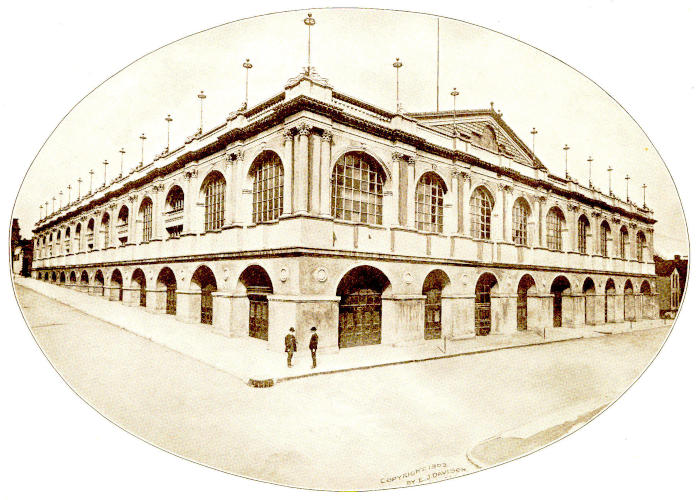
Convention Hall, Kansas City, where the Third National Conservation Congress was held
WHAT WAS ASKED OF COMPANIES.
The companies were first asked by the Insurance Department of Missouri to furnish their experience in fireproof buildings and contents. Companies like the Aetna, Hartford, Home and Royal replied that they had never kept a tabulation of this nature and were unable to furnish any information which would show what premiums and losses might be expected from such property. It was explained by these companies that it was their custom, in keeping track of bakeries, for example, to class together those of ordinary construction, improved construction and fireproof construction.
No useful information could be gleaned from such a source, and the experts who prepared the schedule were called to the witness stand and requested to justify their handiwork. It appeared on examination, however, that the provisions of this schedule were prepared without one iota of information showing what premiums and losses had been experienced in this class of property. It was not known whether the rates formerly used had proved unduly profitable or unprofitable, nor was it known with certainty whether the new rates would increase or diminish the premium charge as a whole.
All classes of property receive this arbitrary treatment. In none are statistics kept to show whether the schedule is producing too much or too little revenue in comparison with the losses. It is admitted that many classes pay too much, while others are being carried at a loss, but no schedule is made to rectify this abuse, although the schedule purports to be a system of measurement.
The companies do not keep faith with the public. We are promised that greater care to avoid fire will reduce the loss and lead to lower rates. But the rating system is conducted so that the public will neither know its just due nor receive it, except by resort to other forms of insurance. When some organized industry undertakes self-insurance, ratemakers soon find that conditions have improved and that reductions are in order.
It is evident, however, that the end of this system of false measurement is near. Four states are regulating rates under laws which call for rates in reasonable relation to losses, and the sustaining of the constitutionality of such regulation by the lower courts makes similar legislation certain in practically all states. There is urgent need, therefore, for accurate knowledge on all matters which affect the rate of burning in the several classes of property. This knowledge does not exist. It must be acquired by study of data yet to be gathered. The data in the hands of the companies is worthless. It has been gathered by plain business men engaged in the insurance business, and, whatever the purpose of the compilation, it certainly has had no reference to the formation of reasonable rates.
NEED FOR FEDERAL INVESTIGATION.
Faulty treatment, and not incurability, is indicated by the persistence of the high level of destruction by fire in this country. The treatment is vague and characterized by irresponsibility. Diagnosis is wholly lacking; the location of the trouble is not known, and the remedies are applied haphazard in ignorance of the possible effect. No person connected with the treatment has a definite result to produce, or is even asked to prove that any result has been produced. The premiums and losses are reported in bulk to each state. The summation of these reports into one huge total constitutes all that is done by the insurance company or the insurance rater or the public to discover the workings of this great waste.
Such blind methods can accomplish nothing. Risks must be enumerated. Those in need of treatment must be singled out and something economically appropriate be prescribed for each. To find out where and how effort can be put forth to economic advantage—to define what can be done wisely by the class and individual to reach the low economic level of loss—to keep watch of results and register the efficiencies of fire alarms, fire patrols, fire departments and fire resistants—these are details which must be wrought out before fire waste can be attacked with definite aim and for the perfecting of which the Federal investigation and bureau is proposed.
The states appeal to the Federal Government to standardize the schedule for the formation of rates so that it shall become a true measure of the conditions to which it is applied. Leaving this measurement to the dictates of the “best underwriting judgment” has proved a costly error to the people. The underwriter escapes the common lot; the cost of his “error,” with a substantial addition for his profit, is borne by the people.
When the fog that envelops this waste shall become dispersed by the Federal analysis, the way to its speedy removal will become clearly visible to the individual states.
I lay no claim to originality in the presentation of this subject. I have given you facts and for the most part the comparisons and expressions of the experts who compiled these facts. They are original only in the sense that the testimony of witnesses recited in a brief or argument in a trial are original.
I have asked the assistance of the Congress of the United States to secure an investigation of this important subject to the end that power may be added to the arms of the states to restore natural conditions as to fire losses in our modern business world.
President Wallace—You will now hear the great highway engineer of Missouri, Hon. Curtis Hill, on the subject of how good roads help the farmer.
Mr. Hill—Mr. Chairman, Ladies and Gentlemen: There is no question but that we have been making as much progress in road work during the last few years as we have and as we are in other lines of work, and still in many places we are not making the progress that we road-making enthusiasts, and I might say road cranks, would like to see made. Still I do not believe that we can now apply to our highways over the large part of the Mississippi and Missouri valleys that little poem which, or a few verses of which, Robert Burns is said to have written upon his arrival at a little town in Scotland, illustrating that the highways of Scotland at one time were not much better than they are today of Missouri, I might say. Speaking of those highways, he left two verses, which run something like this:
I am now arrived, thanks to the gods, Over pathways rough and muddy; A certain sign that making roads Is not these people’s study. And though I am not with Scripture crammed, I am sure the Bible says That you people shall be damned Unless you mend your ways.
Now, how good roads help the farmer must always include others, and it can be best discussed in a short discussion, in a general way under two heads. First, transportation systems, and the importance of our social conditions. Referring to Robert Burns in Scotland, you will see that the road question has been hammered upon for years and years. Man has been considering it as a means, and as one means of transportation. Now, in fact man has been forever trying to overcome gravitation, from the first load that a man carried on his back, or put upon the back of a pack animal, he has been endeavoring to lighten his burdens by overcoming the laws of gravitation. And so it has been through all history. The galley, the sail boat, the steamship, automobile, and air-ship. The good roads is one line in the endeavor to overcome the laws of gravitation and to make easier one method of transportation. Transportation charges have entered more into the cost of living than any other one item. Food, clothing, building material, all the staple necessities of life have had to pay the freight. The freight is deducted from or added to the price of the article which forms the basis of the price which the producer receives or the consumer pays. The man who produces the commodity, or he who settles the bill, pays the freight. Neither the producer nor the consumer has gained by a high cost of transportation. The question of good roads is therefore at the present time one of the most vital with which we have to deal. There is no one internal improvement so absolutely necessary and essential to a state’s progress and prosperity as the betterment of the highways. (Applause) Good highways are necessary to a state’s progress and prosperity, as well as that of a community, because they involve the transportation problem. With transportation is involved the problem of life, the cost and pleasures of living, exchange of commodities, valuation of property and the social and moral and educational conditions. The problem of life is a study closely linked with the problem of transportation.
Our very existence as a social and commercial body as a state is dependent upon transportation to such an extent that without easy, quick and economic means of transportation we must rank as a second, third or fourth class state. The greatest assets of the most substantial nations are transportation and agriculture, neither one of which can be fully developed without the other. The transportation of the bulk of agricultural shipments begins at the farm when the raw material is hauled over the country roads. This country road is the farmer’s own road, which leads to the collecting points of transportation by rail and water, and over which he reaches his market. It is used one hundred times to every other time for all other means of transportation. The good road permits the farmer to watch his markets and not the road. Many a farmer markets his grain at harvest time because it is a season of good roads, at a less price than he would by storing the grain until the markets are better and less glutted, and when he would have more leisure time for hauling it to the market. The good road permits him to haul double the load that he would over a poor one, and he is thus enabled to move his crop in one-half the time. This, figuratively speaking, picks up the producer and sets him down one-half the distance closer to his market. You all know that distance in this age is measured in time and not in miles. The country road is the people’s own road, their own means of transportation, and it is the only transportation system that is owned, operated and controlled by the people themselves.
It is at the same time the most neglected system of transportation in the United States, and the most expensive over which to transport our produce, owing largely to this neglect. Many a pound of freight originating upon a farm, or destined to a farm, moves over a common country road at a cost three times as high as it would be if the road were first class. Often the haul between the farm and the railroad costs more than the remainder of the journey, and the railroad or any other means of rail transportation cannot be expected to reach every man’s farm, and it becomes necessary to provide means for transporting the commodities to the railroad. The wagon road then becomes a system of transportation, just as a line of boats or a railroad is a system of transportation. Water and rail are the means for long distance transportation; highways for local exchange. The highway serves the purpose for local transportation, and is a connecting link for local traffic with the railroads. The condition of this connecting link or highway may make transportation reasonable or costly. Too frequently, as I said before, the haul over the highway is the most expensive part of farm transportation. It requires a tractive force of 125 pounds per ton upon an ordinary country earth road, and only sixty pounds upon a rock road. The cost of transportation by water and rail seldom exceeds one cent per ton mile. That upon a good road is from seven to ten cents per ton mile. Upon our ordinary country highway, half kept roads, it is from twenty cents up to anything, depending upon the condition of the road. The railroad will haul a bushel of your grain thirty miles as cheaply as the farmer can bring it one mile. If the farmer is situated a few miles out of town on poor roads, the railroads will haul the produce and the commodities to cities like Kansas City rather, and the return merchandise from that city as cheaply as the farmer can haul it to and from the railroad and to the farm. Now this high cost of transportation can be decreased by increasing the size of the load. This can be done by improving the road surface. The high cost of transportation is not altogether due to the railroad. Good wagon roads are just as important a factor in the reduction of this high cost of transportation as are low rates by water or rail.
By social conditions, in my opening remarks, I meant the pleasures of community life, the exchange of visits and social courtesies, neighborhood gatherings, social association, fellowship, and the home, the school and the church. The roads should be built for some of the pleasures and comforts of life as well as for their pecuniary interest. It has been said that the pecuniary benefits of good roads sink into insignificance when compared with their social, moral and educational advantages. Man after all is only a social being, and is influenced by his surroundings. The maintenance of a seat of learning, or of a good church in and by a neighborhood has its influence upon the people of that community. The maintenance of anything tending towards better living has a good influence. The maintenance of a good road or improved road has a good influence by permitting easier intercourse between the people of country communities, between rural and urban population, and unifies social and commercial interests. The rural mail delivery is one of the greatest means of education today. Good roads facilitate rural mail delivery, and therefore tend to improve educational conditions. The improvement of our roads would also facilitate the central high school idea for country districts, for while our roads are not an impassable barrier in all of the districts, in some they are, and in many they are obstacles. If our country churches are to be supplied with good pastors and our country schools with able teachers, better libraries and other facilities, it must be by the support of greater wealth therefor, by the consolidation of the districts being possible only where good roads exist, where people can be easily and safely transported. The schools and the churches in many sections of our best land have a decayed, run-down, neglected appearance. Churches which are practically abandoned certain seasons of the year because of the condition of the roads, country schools not accessible in seasons of bad roads, little children plodding through mud and water and compelled to sit all day in the school room with wet feet and damp clothing—this may not apparently affect the children today, but for all the parents know it may be instrumental in undermining otherwise strong constitutions and laying up many aches and pains for future life. As someone has appropriately asked, “Why should a Christian people have heathen roads and a civilized people barbarous ones?” One thought which possibly you have heard brought out time and time again at these congresses for several years is that the trend of population has been from the farms to the cities and the towns. A large part of the best blood and sinew of the country has been trying to get away from the farm. If this continues, it is going to sap the farm industry of its best blood and its best energy. There is something wrong today with our country conditions, when so many of our best farmers leave the farms and seek homes elsewhere in order to give their families better social and educational advantages and when so many of the brightest youths from the country become discouraged with country life and endeavor to escape from the farm. A fair percentage of the men and women, boys and girls must be kept on the farm. This can be done by making farm life worth living. Good roads will help to do it. Will the best, most progressive farm ever be developed without these young men and women, boys and girls to grow into intelligent farmers? Will the increased yield per acre by means of better farming become fully effectual without bettering the means for marketing that yield? Can you incite better farming and maintain a higher order of intelligence and social conditions in country life without easy means of communication? Can country life be supplied with the necessary association and good fellowship, without good roads?
In conclusion, Mr. Chairman, let me state that I do not contend that good roads is the whole solution for happiness and prosperity of country life, but I do contend that a very necessary and important part of it is the relation which our public roads bear to our social and moral and our educational life. The home and the school are the nucleus around which our social life exists, and this is especially true of country life.
Neglect your public road conditions and you will not only neglect your transportation facilities, but you will neglect your social and your educational environments.
The articles that we eat and wear must come from the farm, and the growth and the development of agriculture and the life connected therewith, no matter how we may view this question of the development of the farm, the betterment of life and the development of the country community life, its transportation, exchange of commodities, the basis upon which it rests will be found a question of good roads. No proposition for the betterment of country conditions, no proposition for the good country life is an assured success until good roads are assured. It all rests upon the question of transportation, and communication, and the basis of transportation is the public wagon road. (Applause)
Professor Condra—I beg leave to submit the report of the committee on credentials.
The Chair announces the appointment of the following committee on credentials:
Prof. Geo. E. Condra, of Nebraska.
Dr. H. E. Barnard, of Indiana.
Mr. Ralph H. Faxon, of Kansas.
Mr. E. T. Allen, of Oregon.
Mr. W. E. Barns, of Missouri.
President Wallace—If you want to get the proceedings of the Congress, which will be worth their weight in gold, give your name and a dollar to the secretary.
Professor Condra—I move that the report be received and the committee discharged.
President Wallace—We will now hear the Hon. J. B. White, of Kansas City, who will tell us what he knows about lumber in Europe.
Mr. White—In Europe the experience of more than a hundred years in forest management has resulted in a more or less scientific and practical policy, although it cannot be said that a well defined, universal policy has yet obtained. This is largely due to conditions of ownership, with consequent variance in ideas as applying to various local conditions, as well as the difference in necessities and financial ability of individual owners to carry out in successful practice the best approved methods. Hence there is a growing tendency towards greater governmental control, whereunder the most economic working system, suited to different conditions of soil, climate and kind of forestry, would be intelligently considered and properly installed.
In the German Empire 47 per cent of the entire forest area is privately owned, and 32 per cent by the state, 19 per cent by institutions, communities and associations, and 21 per cent by the crown. Thirty-three per cent is hardwood and 67 per cent conifers. They are now cutting about their annual growth, taking an average of hardwood and conifers.
Austria-Hungary exports more lumber than any other nation in the world. It covers 46,500,000 acres, or a little over 30 per cent of the total land area. In Austria the forests are composed principally of conifers, spruce, pine and fir, only 15 per cent of the acreage being of hardwood. Sixty-one per cent is in the hands of private owners, and one-half of this, or 30 per cent of the entire forest, in the hands of small owners. The state owns less than 11 per cent of the forests; the balance belongs to churches and communities. The average yearly growth of all the Austrian forests is said to be about forty-two cubic feet per acre, or an annual growth of about 1,100,000,000 cubic feet. They are now cutting annually 250,000,000 cubic feet more than this, or 20 per cent faster than it is growing. This excess of cut, over the growth, will in large measure regulate itself, as the increasing demand makes the industry more profitable and encourages the planting of greater forest area.
In Hungary about 75 per cent of the total forest area is oak, beech, maple and other hardwood species, and only 25 per cent of conifers. The annual yield of conifers is about fifty-eight cubic feet per acre, and that of oak about forty-one cubic feet per acre. Thus the conifers yield the largest percentage of commercial lumber and are most valuable as a crop because of more rapid growth, and because of their larger demand for building purposes. Sixty per cent of the total acreage in Hungary is private forests, about 18 per cent is state forest, and 22 per cent communal and church forests. The annual cut in Hungary is estimated to be less than the annual growth.
England has not until very recently deemed forestry profitable, preferring to buy her supply. Of her 3,000,000 acres of woodlands, mostly devoted to parks and the chase, the state only owns 2 per cent. France has 24,000,000 acres of forest, or 18 per cent of its land area, of which only 12 per cent of its wooded area belongs to the state.
Switzerland has about 25 per cent of her total area under forest. The Zurich forest, known as the Sihlwald, containing 2,760 acres, is 85 per cent hardwood, and is worked on a rotation period of 100 to 110 years. The forest director claims an annual growth for the Zurich forest of sixty-five cubic feet per acre, while the general average of all the forests is only fifty cubic feet per acre. This means the entire growth—wood, poles, limbs and all. Only 40 per cent of the total cut is saw timber for building purposes. The net income from this forest for the past twenty-five years has been from $4.00 to $7.00 per acre, not including interest charges. It was $4.40 in 1890 and $7.69 in 1907. This forest has its own mills and saves all profits.
In Switzerland one pays taxes when the crop is harvested. In Germany and Austria the method of taxation varies in different states, but laws are always favorable to encourage private forestry. In some cases one pays no taxes for twenty years. Then one begins to thin out the poles for use of telegraph and telephone companies, etc., and get a revenue, and leaving a stand in destructive forestry which, when sixty years old, will yield in many cases 20,000 feet of lumber, board measure, per acre. In fact, the average is 4,190 cubic feet per acre of timber and fuel, which, according to values prevailing in England and Germany, amounts to about $200.00 per acre.
CUTTING METHODS IN EUROPE.
It was pointed out to us that mixed growth or conservative forestry is expensive. The most economical and profitable plan is the destructive method. That is, a forest is planted and grown like any other crop, and whenever interest, carrying charges and total cost meet the market value at age and time of greatest profit, then trees are cut and they are all about of a size. The entire acreage is cut clean and the cost of logging is cheap. Trees are again planted and another crop grown. Under the old plan of conservation of mixed growth and mixed sizes, or the shelter-wood system, not as much can be grown per acre, and the cost of logging out the large trees is vastly more expensive, and damage is done to other timber in falling them, while in the destructive method all is taken and a large crop harvested. It is nice to view these stands of timber in strips, side by side, ranging in years from baby trees to stands of ten, twenty, thirty, forty, fifty and up to sixty and eighty years of age, when they are ready to be harvested.
In growing forests in Europe, lands that are better adapted for agriculture are not used. The degree of utility is considered. And in determining the value of a forest property, one has to figure compound interest, as the crop may not be harvested and the capital returned for sixty or eighty years. Because of absolute protection from forest fires, capital is regarded as safe, and investors in forests are satisfied with a low rate. As an investment, forests require less labor than other crops, if one practices the most economical method of what is called destructive forestry. In times of temporary high prices, one can take advantage of the situation and harvest more than the annual growth, and can then wait and let the trees grow when prices are low, and this is the usual practice. The rate of interest generally charged to the forests, and compounded, is sometimes determined by rate yielded by government securities, which is usually about 2½ per cent.
THE ROTATION METHOD.
It has been ascertained by careful observations that Scotch pine (which grows rapidly, like our short leaf yellow pine) yields, on medium soil in every sixty-year rotation in best quality of location, 5,255 cubic feet per acre, of which an average of 565 cubic feet have been removed in thinning as the forest has been growing, figuring the thinning out being done on an average of about every ten years, leaving at the end of sixty years an average of 4,690 cubic feet per acre. If allowed to remain, this has increased in ten years to 5,250 cubic feet per acre, besides 536 cubic feet that have been profitably taken out in thinning in the last ten years, leaving at seventy years 5,250 cubic feet. Now in the next ten years there will profitably be taken an average of 493 cubic feet in thinning as against the 536 cubic feet taken out the ten years before, leaving at the end of eighty years standing on each acre an average amount of 5,720 cubic feet per acre.
These interesting results follow: With average values of lumber products as in the year 1910, an eighty-year rotation period with Scotch pine would pay 2½ per cent compound interest on soil value of $97.00 per acre. With a ninety-year rotation period it would pay this interest rate on land worth only $94.00 per acre. On a seventy-year rotation period it would pay such interest rate on land worth $94.60 per acre, and on sixty-year rotation it would pay such rate of interest on land worth $85.00 per acre. This shows that the maximum profits at this low rate of interest come from cutting the forests at eighty years’ growth. The greater the variation from this eighty-year period the less favorable the financial results. The maximum age for hardwood trees for best profit is said to be rotation periods of about 100 years with a low rate of interest suited to the safety of the investment. These statistics were prepared by Sir William Schlich, professor of forestry at the University of Oxford, and published by him this year, and are undoubtedly reliable.
But it is safer to figure at a compound interest rate of 4 per cent. A high rate of interest demands a low value of soil, and vice versa. And as Sir William points out, the value is, however, not in inverse proportion to the rate of interest, as the value of the soil rises more rapidly than the interest falls. Under a low rate of interest, the expectation value of soil culminates later than under a high rate of interest. So that under a 2½ per cent interest rate, the timber could stand about eighty years; under a 3 per cent rate, about seventy years, and under a 4 per cent rate it should be cut every sixty years. Or, to further illustrate, if a party is satisfied with 2½ per cent compound interest on his investment in European forestry, he could pay $97.00 per acre for his land, and must cut it at eighty years of age.
If he desires 3 per cent interest he must not pay over $55.50 per acre, and must cut his timber when seventy years of age. And if he demands 4 per cent interest rate he cannot pay quite $15.00 per acre for his soil, and must cut his trees when sixty years old.
PERIODS OF PINE TREE GROWTH.
Now this is the best than can be done in Europe (which, according to statistics, is 37 per cent above the average yield), with the best results as to soil and favorable location, with low-priced labor, with most favorable consideration by the government as to taxation, and with the most approved economical methods, where the limbs and twigs are sold for fuel, and forest products are fully 50 per cent higher than they are in the United States. So it is fairly well established that from sixty to eighty years is the most profitable rotation period for growing Scotch pine forests in Europe. The higher the rate of interest demanded, the shorter the rotation.
With advancing age the value of the stumpage increases so that the value of the soil for forestry becomes nearly positive. But in time a maximum is reached, and it falls again. This maximum, with 2½ per cent money, is eighty years growth, and with 4 per cent money only sixty years growth. The value of the soil under a very brief rotation would be negative, so that the yield might not even cover the cost of harvesting. And under a very long rotation, the value of the soil would again become negative, because it could not stand the compound interest and other expenses for an excessively long term of years.
It follows that the expenses during the early part of the rotation affects the expectation value disastrously, for compound interest is running against this expense for a long term of years, lessened only by sale of the thinnings in about ten-year periods. Of course a sudden and heavy increase in the value of stumpage, at any given period after trees are large enough to cut, may create a second maximum, differing from the normal average because of an unexpectedly great demand, causing an abnormally and temporarily high price. But the cost one has to pay for the soil is really the true value, chiefly determined by its value for ordinary purposes of agriculture; and as trees will thrive on land not so well suited for farm crops, such lands are nearly always selected for forestry. But if the soil can be more profitably used for agriculture in the examples just mentioned, then the increased value will enter into the account to change the length period of rotation of forest crop. And where the acreage is not stocked to its full capacity (on account of poor soil, or for any other reason), the rotation, for which the highest probable value of the growing stock is obtained, can, as Sir William states, only be determined by experimental calculations based on these special cases.
THE YIELD OF FORESTS.
But this method of calculation is absolutely logical, and shows under the most normal conditions what we can expect, and it has been proved by experience. The abnormal conditions that may occasionally present themselves are governed by these same financial methods of reasoning, differing only in degree of application, by reason of change of basic conditions in each special case. A normal yield is what the forest can permanently be depended upon to produce. It is a permanent interest investment of greater or lesser rate, where the principal will never be returned, while the land is kept in forest crops. These figures are based upon the best yields in the clear cutting of destructive forest system, which, as has been stated, is 37 per cent above the average. But the principle of calculation applies equally as well in the shelter-wood system of different age trees; but the average volume per tree in each age class in the latter system has to be taken into consideration. On the whole, it has been admitted by the best foresters that the system of clear cutting, then pulling the stumps, fallowing or planting other crops for a couple of years, and replanting again, gives the best financial results.
So much for European forestry. Now how will this system apply to us, under our conditions of taxation, high-priced labor, and low-priced forest products, and considering the fact that there is little or no demand for the thinnings until large enough for telegraph poles, and no market for the tops and necessary waste in manufacturing? We are lacking in statistics, because we have not sufficient experience along the lines of growing new forests, at either private or public expense. But we are soon to be interested in what it will cost to reforest and grow commercial timber in the United States. And surely our present supply of old growth timber from 150 to 300 years old is worth more than the cost of growing timber sixty to eighty years old. The United States owns in national forests 192,931,197 acres. The state forest reserves of 3,253,185 acres, the national parks of 4,562,265 acres, and the Indian forests of approximately 10,000,000 acres, make the total of public forests over 210,000,000 acres. Chief Forester Graves estimates the area of private forests as over three times that of the public forests, and containing five times the timber that is on the public lands.
The countries whose wood exports exceed their imports are: Austria-Hungary, Canada, Sweden, Russia, Finland, the United States of America, Norway, Bosnia-Herzgovina, Roumania, and Japan. The countries whose wood imports exceed their exports are: The United Kingdom, Germany, France, Belgium, Spain, Italy, Holland, Denmark, Switzerland, Australian colonies, China, Greece, West Indies, Bulgaria, Servia, and British possessions in Africa.
CONDITIONS TO BE CONSIDERED.
The climate and other conditions in some countries render them not so well adapted to growing trees as for growing other crops; and they find it more profitable to exchange their products for the wood products of other countries that either have a present surplus, or whose climate, soil and land values enable them to grow trees at lower cost. This is true with the different states in our own country. Illinois and Iowa, for instance, will never grow what timber they require. They can more profitably grow corn, and exchange for lumber products with those states which have low-priced and mountainous land with plenty of moisture, so that trees will grow twice as fast as in those prairie states where land is very expensive and climate not so well adapted. Trees will be grown here, as in Europe, where they can be grown cheapest, and they will be harvested at an age which will bring the greatest net profit. The market price of the product will be finally and surely governed by the cost of growth and manufacture, insurance, and risk, and the price of money used in the business.
If the Government of the United States itself can get money at 2½ per cent, as it can, while private owners have to pay 5 per cent or 6 per cent, then it follows that the states and the Government can, for this very important reason alone, grow commercial trees cheaper than private individuals, and can remove the maximum rotation period to a more mature age, giving better lumber from older trees at the same cost at which private owners would have to furnish poorer lumber, because coming from younger trees. But the people pay the cost, whatever it may be, whether the Government or private interests grow the trees. The consumer is interested that they be grown as cheaply as possible. It is likely true here, as in Europe, that forestry will be a more general success with private owners, if they are in some important methods placed under the practical rules of government forestry. It will be found here, as over there, that private forests will not prove so generally productive, or, as a rule, so economically administered, as the government or state forests under the management of expert foresters. And parenthetically, is it not equally true that many farms and farmers would be better off if directed by government or state experts?
In Europe they have no forest losses from fire for the reason that fires are prevented from starting. The railroad locomotive has been the cause of most forest fires in the West, and I observe that these Western roads are now equipping hundreds of their locomotives with spark arresters, so as to prevent the starting of these fires in the future. United States Chief Forester Graves very truly says: “Private owners do not practice forestry for one or more of three reasons: First, the risk of fire; second, burdensome taxation; third, low price of products.” Forester E. T. Allen has pointedly said: “Forest protection is the cheapest form of prosperity insurance a timbered state can buy.” It is not the present generation so much as it is the future generations that will be affected disastrously by our neglect. The principles of agriculture, horticulture, forestry, and the science of conservation of soil and trees, and of life itself, should be taught in our public schools.
THE EXAMPLE OF DENMARK.
In Denmark, a country which fifty years ago was one of the poorest in Europe, they have erected a statue to Captain Dalgas, who reforested Denmark and changed a desert heath into a rich farming country. So now Denmark is said to be, according to its size, one of the most prosperous nations in the world. It was the patriotism and inspiration of Captain Dalgas that enthused the citizens. He lectured to the people, and talked to the children in the schools, and made converts everywhere. He gave all he had, and begged and pleaded against doubt and opposition of the most discouraging character, until success crowned his efforts. He will be loved and his memory cherished by all the people of Denmark through all future years as one who saved the nation. In many vital respects, for energy and self-sacrifice, his work reminds us of our Gifford Pinchot.
We are, as a nation, too young to understand the dangers before us; for we are just emerging from a condition of burning log heaps to make farms, from a condition of too much timber for a small population to a condition of too little timber for a large population. Yet we have enough if we will now conserve and reforest. Our ancestors did the best they could under conditions and the light that they had—what now seems waste, had then no market and was unavoidable. As a nation we are proud of our past and we should also be more proud of what we expect to become. As was said not long ago by one of our greatest statesmen, “Conservation of our resources does not mean that we shall become great in the present at the expense of the future, but that we shall show ourselves truly great by striving to make the Nation’s future as great as the present.” (Applause)
President Wallace—The committee on nominations is ready to make its report.
Mr. Baker—Pursuant to an announcement made from the stage at the opening of the afternoon session of the Congress this day, the members of the nominating committee met in room 775, Baltimore Hotel, at 3:00 p. m., and unanimously nominated the following officers for election for the ensuing year:
President, J. B. White.
Secretary, Thomas R. Shipp.
Treasurer, D. Austin Latchaw.
Recording Secretary, James C. Gipe.
The report is signed by the following nominating committee: Mr. B. N. Baker, Baltimore, Md.; Major E. G. Griggs, Tacoma, Wash.; Mr. A. B. Farquhar, York, Pa.; Mr. H. C. Wallace, Des Moines, Ia.; Mr. Henry S. Graves, Washington, D. C.; Mr. G. E. Condra, Lincoln, Nebr.
President Wallace—You have heard the nominations. Is there a motion made to accept and approve the report of the committee?
Delegate Baker—I move that the report be accepted.
Motion was duly seconded and, on being put to vote, was carried.
President Wallace—I want to thank members of the Congress for their kindness to me. And I am going to make a confession now. I have been running a bluff on you, for I never in my life presided over any convention or association of more than thirty persons, and it is only by the marvelous patience that this Congress has shown and its endurance that I have been enabled to carry it through. I thank you, and I want to say that I do not believe the mantle could have fallen on a better man than Mr. J. B. White. (Applause)
President White—I hope the election has been fair, if there has been an election. Has there?
Mr. Wallace—Yes, sir, there has been an election and you are president.
President White—Has the committee reported?
Mr. Wallace—It has, and reported in favor of you, Mr. Shipp, Mr. Latchaw and Mr. Gipe.
President White—This is a great honor, and I appreciate it very much, more than I can tell. I have been in politics before tonight, but not in this way. I will have to tell a short story. It will take less time to tell it than it did for the events to transpire. I have got to tell it straight because I see Governor Stone of Pennsylvania watching me. I was a candidate one time when I thought it was necessary for someone to represent some good principles. I published a newspaper. I owned a farm and a small saw mill, and I was nominated because I was a granger and because I had the reputation of being a laborer. I got the nomination of the Democratic party of my state, and the nomination of the National Greenback and Labor party of my county. Then the Prohibitionists met. They were not quite sure about me as a Prohibitionist, but they said that they would support me, and they would not put any ticket in the field against me. So that I had the endorsement of the Prohibitionists, the Greenbackers, the Labor party, and the Democratic party, but I did not have the Republican party because there was another man running in that party, and I had to have one opponent. The fight waxed warm. I drove all over the county, to every school house; I met the people, kissed all the babies in the county, and I was elected by a very large majority. It was not quite unanimous, but it was very large. This appears to be unanimous. And the next day after the election a gentleman came down from the township, I think, of Limestone, up above Warren on the Allegheny river. He came to see me, and said “I see you are elected.” “Yes,” I said, “I understand I am. It is very gratifying as it has been a very hard campaign.” “I came down to see Davis, the treasurer of this campaign fund,” he said. “Davis is in Warren,” I told him. “Well, I stopped off at Warren on the way down to see him and Davis was not to home. I spent $30.00 in this campaign and Davis said to come right down after election and get my money. I thought maybe you could pay it. You are elected, and I come down to see you.” “Let us see, what did you spend that money for? How did you spend it?” I asked. “Well,” he said, “I told Davis I could carry Limestone Township. The way I done it was that I went and bought a ten-gallon keg of whisky, and I got down by the ferry. The lumberman and tie markers from up in that township had to go across the ferry. On the other side I put the keg of whisky in the ferry house. Every man that came along I says, ‘Come on, boys,’ and they came in to get their ferry tickets. And I says, ‘Here, have a drink,’ and I gave them a drink, and I gave them your ticket. I says, ‘Here is a ticket for White; go right over on the other side and vote, and then when you come back come in and get another drink.’ They went right, every one of them, and voted, and they were so anxious to come back and get another drink that they never stopped to talk with anybody. And that is the way we carried Limestone Township solid for you.”
I said, “Well, that is very gratifying, but you know, of course, I am somewhat of a candidate on the Prohibition ticket. I think you had better see Davis about this.” “Well, yes,” he says, “that is all right, I know; I knew you was a candidate also on the Democratic ticket, and I thought you might pay this out of Democratic money.” (Applause) So I think probably Davis fixed it without my knowledge. I will ask the retiring president to introduce to this audience Prof. Hopkins.
Mr. Wallace—Permit me to say that Prof. Hopkins has done a wonderful work in the State of Illinois, and I have asked him to present the results of that work, or to tell us about worn-out soils. If your soils out in Kansas are not worn out, they will be unless you mend your ways. Now you want to listen to Professor Cyril G. Hopkins of the University of Illinois. (Applause)
Professor Hopkins—As agriculture is the basis of all industry, so the fertility of the soil is the basic support of every form of agriculture. Without productive land there could be no American agriculture and no American prosperity. The most important material problem of the United States is to restore, to increase, and to permanently maintain the fertility and productive power of our farm lands. In comparison with this problem others fade almost to insignificance; and we do well to pause in the rush and hurry of our business life, to measure the agricultural record of the past and to consider the possibilities of the future.
I come before this National Congress of patriotic, progressive and influential men and women, not to present theories or opinions, but facts and data, which deserve and should command your immediate serious consideration and your subsequent persistent and effective action.
Intelligent optimism is right and admirable, but blind bigotry paraded as optimism is dangerous and condemnable. “Truth, crushed to earth, shall rise again; the eternal years of God are hers”; and this Congress has before it the duty and the right to uncover the facts, to face the truth, and to plan intelligently for the solution of this mighty problem.
That vast areas of land once cultivated with profit in the original thirteen states now lie agriculturally abandoned is common knowledge; and that the farm lands of the great corn belt and wheat belt of the North Central states are even now undergoing the most rapid soil depletion ever witnessed is known to all who possess the facts.
WHAT CROP STATISTICS SHOW.
The crop statistics of the United States now cover two twenty-year periods, and half a decade on the next. A comparison of these two periods shows the average acre yield in the United States to have increased only one bushel for wheat and one-half bushel for rye; while corn decreased one and one-half bushels and potatoes decreased seven bushels per acre. These crops constitute the basis of our human foods, even our supply of meat being largely dependent upon the corn crop. Thus, in spite of the vast areas of new land put under cultivation during the last twenty years, and in spite of the improvements in dredge ditching and tile drainage, in seed, and in implements and methods of cultivation, the average acre yield shows little or no increase. In striking contrast the census returns show an increase in the population of contiguous continental United States from thirty-eight million to ninety-two million people during the last forty years; and in spite of the fact that to feed our rapidly increasing population we have extended our area of cultivated crops beyond the humid and far into the semi-arid regions, and in spite of reducing our corn exports from 213 million to thirty-eight million bushels and our wheat exports from thirty-four to twelve million bushels during the last decade, nevertheless the most common topic discussed in recent years is the high cost of plain living in these United States.
These are American facts; and, while there need be no sensation, there is need for sense in their consideration. A few people can live on blind optimism or hot air, but something more substantial will be required to feed the progeny of ninety-two millions, and added millions of immigrants. It is said that the high civilization of the ancient Mediterranean countries went down into the Dark Ages with laughter—Dark Ages which covered the face of the earth for a thousand years and which still exist for most of our own Aryan race in Russia and in India, where more people are hungry day by day, and year by year, than the total population of the United States.
The problem which now confronts America is nothing less than the maintenance of prosperity for ourselves and of civilization for our children; for civilization depends upon education, and only a prosperous nation can afford the general education of its people. Poverty is at once helpless, and soon ignorant and indolent. An impoverished people cannot have adequate schools or schooling.
No greater problem ever confronted any nation than now confronts the United States, but the solution is plain: In a word, we must increase production and limit reproduction, especially the reproduction of the unfit. To solve half of the problem is not sufficient; and, in passing, I must emphasize the fact that, with the most practical scientific systems of farming applied to all the farm lands of the United States, there is still somewhere a limit to the highest possible production of food and clothing materials in this country; but there is no limit to the reproduction and increase of population except the starvation limit, already reached in Russia, India and China; unless the public sentiment of this Nation, in these times of education and general intelligence, will support the inauguration and enforcement of legal laws based upon the established natural laws of heredity.
Just and adequate legislation should be enacted by the Nation for the better control of immigration, and by the states for preventing the reproduction of every form of degeneracy, whether revealed by insanity, criminality, idiocy, deformity, or beggary. Half of all the state revenue is already required in many cases for the support of the non-productive degenerate classes, upon whose reproduction there is still no check in most states.
CROP YIELDS CAN BE DOUBLED.
That we can double the crop yields of the United States is not a prediction, but a fact. To say that millions of acres of abandoned farm lands in the older states can be restored and increased in productivity far above the present average for the $200.00 corn belt lands is merely to speak the truth. To accomplish these objects requires, first of all, that agricultural ignorance shall be replaced with agricultural intelligence in the minds of the people of influence in this nation.