RESOLUTIONS OF THE THIRD NATIONAL CONSERVATION CONGRESS.
Reading edition
The third National Conservation Congress, made up of delegates from all sections and nearly every state and territory of the United States, met at the call of a great moral issue, now in session assembled in the city of Kansas City and State of Missouri, does hereby adopt and solemnly declare the following platform of opinion and conclusion concerning the inherent rights of the people of the United States:
Heartily accepting the spirit and intent of the Constitution and adhering to the principles laid down by Washington and Lincoln, we declare our conviction that we live under a government of the people, by the people, and for the people; and we repudiate any and all special or local interests or platforms or policies in conflict with the inherent rights and sovereign will of our people.
Recognizing the natural resources of the country as the prime bases of property and opportunity, we hold the rights of the people in these resources to be natural and inherent, and justly inalienable and indefeasible; and we insist that the resources should and shall be developed, used, and conserved in ways consistent both with current welfare and with the perpetuity of our people.
We commend the efficient work of the federal forest service, and particularly urge upon Congress the need for more liberal financial provision for protection of the national forests from fire, and the desirability of making the army available without delay whenever needed to supplement such protection.
We also appreciate the forestry progress being made by many states, believing it not only the function, but the duty of the state to safeguard its forest resources by liberal appropriation for fire prevention; by acquisition and conservative management of state owned forest lands; by encouraging the practice of private forestry on timber lands and wood lots in every way, especially through reform in forest taxation; and by providing for the educational work necessary to secure all these ends.
We commend the increasing effort at better forest management and protection by timber owners themselves, and urge upon all such the study and emulation of the several coöperative systems for this purpose.
We urge the coöperation of public and private educational authorities in instilling the principles of forest economics in the minds of the young of today, who will be the doers of tomorrow.
We are in sympathy with the policy of establishing public parks to be used for the benefit of the people forever, including localities of scenic, scientific or historic interest, by states and by the National Government, and we cite as an example the Mammoth Cave of Kentucky, one of the wonders of the world; we recommend this policy to obviate the danger of such national heirlooms being held permanently in private ownership and subordinated to private interest rather than the public good.
Recognizing the 900,000,000 acres of well-watered arable land in this country as the chief source of food and clothing for our people, we hold that these lands should be guarded as a natural heritage to be kept in sacred trust for our children and our children’s children; that they should be safe-guarded from loss through natural agencies and negligent or thriftless use; that they should be protected from monopoly and private or corporate rapacity; that they should be so cultivated and improved that they may pass to each coming generation with increased fertility and productivity; and that they should forever be used as sites for homes in which the strength and spirit of the Nation may be conserved for the general welfare of mankind.
Approving the withdrawal of public lands pending classification, and the separation of surface rights from mineral, forests, and water rights, including water-power sites, we recommend legislation for the classification and leasing for grazing purposes all unreserved lands suitable chiefly for this purpose, subject to the rights of homesteaders and settlers, or the acquisition thereof under the land laws of the United States; and we hold that arid and non-irrigable public grazing lands should be administered by the Government in the interest of small stockmen and homeseekers until they have passed into the possession of actual settlers.
We favor the repeal of the commutation clause of the Homestead Law, and the disallowance of homestead entries on land chiefly valuable for its timber at time of filing.
We hold that mineral deposits underlying public lands should be transferred to private ownership only by long-time leases with revaluation at stated periods, such leases to be in amounts and subject to such regulations as to prevent monopoly and needless waste; and that in case of doubt as to the availability of such mineral deposits, or while they are waiting exploitation, surface rights to the land should be transferred by lease only under such conditions as to promote development and protect public interest.
Since all successful conservation effort must follow ascertained fact, we agree (1) that there should be in each commonwealth an active conservation commission or equivalent organization; and (2) that such commission should use, and strive ever to coördinate, all agencies, state or national, which have for their object the discovery of exact data and the ascertainment of scientific information in reference to all natural resources and conditions in each of the several states and in the country at large.
We hold that phosphate deposits underlying the public lands should be safe-guarded for the American people by appropriate legislation, and that export of phosphates and other natural and manufactured fertilizing material should be limited and regulated by law.
Realizing that the productivity of our soil depends on water supply; that one of the chief losses to the farm is destructive soil erosion; that the freshets and floods due to storm and thaw waters are destructive of property and even of life; and knowing through experience in this and other countries that the waste and destruction due to unregulated run-off are largely susceptible to control by appropriate agricultural methods, we hold that the aim of every farmer should be to make his farm take care of the water naturally reaching it; we also hold that allowing ordinary storm waters to carry silt and sand from farms into neighboring streams and rivers works a public injury which may be prevented by appropriate legislation.
Realizing that the strength of the Nation will ever lie in the multiplication of homes on the land up to its full capacity, we approve the successful efforts of the Federal Government to provide for such homes through irrigation of the more arid portions of the country; we endorse and commend the Reclamation Service, and urge its continuance with such increased means as may be found needful; and we urge the immediate extension of the same policy to the drainage of swamp and overflow lands, to be carried forward so far as appropriate through coöperation between state and federal agencies.
We recommend the early opening of the coal fields and other resources of Alaska belonging to the people of the United States, for industrial and commercial purposes, on a system of leasing, national ownership to be retained pending such development of that portion of our territory as to permit the creation of states within its area; and as a means of promoting industry and commerce in Alaska we approve the construction of necessary highways, railways, and terminal facilities by the National Government.
Realizing that the prosperity of the country and its suitability for homes must always depend largely on transportation facilities, we recommend extension of the good roads movement until every community is provided with safe and easy ways to schools, churches and markets; and in developing the necessary road systems, we favor coöperation between townships, counties, states, and the federal government in such manner as to secure the greatest benefits to the entire country at the minimum cost.
Realizing that the current cost of railway transportation is apparently exorbitant, amounting to about $2,750,000,000 annually, equivalent to a tax of $150 per family (or one-third the cost of living) or an impost of over $5 on each acre of improved land in the United States, we urge on the Federal Government appraisal of railway property and such investigation and supervision of railway business as will insure protection of the public interests; and to this end we recommend enlargement of the powers of the Interstate Commerce Commission.
As a means of reducing the cost of living and promoting the general welfare, we favor the establishment of a parcels post.
Realizing that products of the soil on which our people depend for food and clothing are sometimes diverted from the most direct lines leading from producer to consumer for speculative purposes, and that they are made the basis for gambling transactions, we hold that all dealing in futures and gambling operations involving foodstuffs and materials for clothing are a public injury, and recommend investigation of the matter by authority of the Federal Congress; and in case our judgment is sustained by such investigation, we demand the enactment of law by the Federal Congress prohibiting the sale of these necessaries of life by men or interests who do not own them at the time of such sale, under penalties including imprisonment at least for any second offense.
Since noxious insects and plants, including weeds, are a source of public injury, we urge appropriate state and federal legislation tending to their extermination; and we commend the development of that public spirit finding expression from time to time in communities and states in crusades against insect and plant pests in the public interest.
Recognizing in coöperative enterprises an effective means of conserving human energy and increasing the efficiency of our soils in feeding our people cheaply, and thereby affording means for the development of equal opportunity for all, we approve and commend such coöperative organization among our producers and consumers as will tend to promote economy and prevent waste in handling the necessaries of life.
Realizing that the interests of our citizens, our states, and our Nation are identical, and impressed by the success which has attended coöperation between state institutions and the Federal Government, we favor continuation and extension of such coöperation as a highly efficient means of promoting the general welfare.
Impressed by immeasurable benefits derived by our people from the work of the United States Department of Agriculture in promoting the use and conservation of our soil and its products, we endorse and commend that department; we strongly urge on Congress increased appropriation for its necessary work; and we recommend the enactment of such state and federal legislation as will enable the state colleges of agriculture and experiment stations to maintain in every agricultural county a capable field demonstrator to aid farmers in practical application of newly acquired agricultural knowledge.
Since all successful conservation effort must follow ascertained fact, we agree (1) that there should be in each commonwealth an active conservation commission or equivalent organization; and (2) that such commission should use and strive ever to coördinate all agencies, state or national, which have for their object the discovery of exact data and the ascertainment of scientific information in reference to all natural resources and conditions in each of the several states and in the country at large.
Recognizing the waters of the country as a great national resource, we approve and endorse the opinion that all the waters belong to all the people, and hold that they should be administered in the interests of all the people.
Realizing that all parts of each drainage basin are related and interdependent, we hold that each stream should be regarded and treated as a unit from its source to its mouth; and since the waters are essentially mobile and transitory and are generally interstate, we hold that in all cases of divided or doubtful jurisdiction the waters should be administered by coöperation between state and federal agencies.
Recognizing the interdependence of the various uses of the waters of the country, we hold that the primary uses are for domestic supply and for agriculture through irrigation or otherwise, and that the uses for navigation and for power, in which water is not consumed, are secondary; and we commend the modern view that each use of the waters should be made with reference to all other uses for the public welfare in accordance with the principle of the greatest good to the greatest number for the longest time.
Viewing adequate and economical transportation facilities as among the means of conservation, and realizing that the growth of the country has exceeded the development of transportation facilities, we approve the prompt adoption of a comprehensive plan for developing navigation throughout the rivers and lakes of the United States, proceeding in the order of their magnitude and commercial importance.
Recognizing the vast economic benefits to the people of water power derived largely from interstate and source streams no less than from navigable rivers, we favor public control of water power development; we deny the right of state or federal governments to continue alienating or conveying water by granting franchises for the use thereof in perpetuity; and we demand that the use of water rights be permitted only for limited periods, with just compensation in the interests of the people.
We demand the maintenance of a federal commission empowered to deal with all uses of the waters and to coördinate these uses for the public welfare in coöperation with similar commissions or other agencies maintained by the states.
We recognize the great service that has been, and can be, rendered in the conservation of our mineral resources, by developing and mining in large units with adequate capital, and approve the encouragement of such development under proper regulation.
We heartily approve of the work of the United States Government in improving sanitary conditions and in lowering the death rates of Cuba, the Philippine Islands, and the Canal Zone. We are especially pleased that in 1911 the National Government, through its wise provisions for the maneuver division of the United States Army operating in western Texas, demonstrated that the achievements in health and life security found possible in Cuba, the Philippine Islands, and the Canal Zone, are possible with Americans on American soil. We therefore call on our municipal, state, and national governments, to accomplish these same results for the people of the United States.
Our National Government in the Canal Zone of Panama has demonstrated that Caucasians, properly directed, can work in the tropics without loss of efficiency, and we express our opinion that this is one of the monumental discoveries of the age.
The Hook Worm Commission is demonstrating another possibility in increasing efficiency; and we endorse the efforts of this commission, and all other efforts, governmental and extra-governmental, for increasing human efficiency through promotion of physical welfare, and call on our governments—municipal, state, and national—to increase their activities along these lines.
We favor a child welfare bureau under, and as a part of, each municipal and state government.
Inasmuch as nearly all the states and most of the cities have health departments as coördinate branches of administrative work, we endorse the plan of bringing together as a department of health the various human health activities of the United States Government as a coördinate branch of its administrative work, divorced from the impediment of being a part of other administrative work of entirely different character and conducted for entirely different purposes; this in order that the efficiency of the service may be increased to a point in some degree commensurate with its importance.
We protest against the present neglect of health, life security, and work for physical efficiency by the municipal, state and national governments, and we ask that they be given that study and care that have proven so broad an economy in the case of live stock and farm crops.
We are of opinion that municipal, state, and national governments should pass proper laws, and provide proper means of enforcement of such laws that there may be prevented, (1) blindness, (2) birth accidents, (3) infant mortality, (4) labor by immature children, (5) communicable diseases of children, (6) occupational diseases, (7) occupational accidents, and especially mine and transportation accidents, (8) communicable diseases of adults, (9) bad ventilation, and (10) physical inefficiency.
We deplore the practice of disposing of sewage and manufacturing waste by dumping it into the streams, lakes, and coastal waters of the Nation, thereby polluting the chief sources of water for drinking and domestic purposes, destroying fish and crustacean life, rendering the waters obnoxious to sight and smell, and losing beyond hope of recovery vast quantities of elements essential to plant life.
We earnestly advocate the employment by communities and manufacturing concerns of such methods of sewage disposal as will render their waste products innocuous to health and utilize them in the restoration of soil fertility, and to this end we urge the enactment by states of stream-pollution laws, and by the Federal Government of such legislation as will prevent the pollution of interstate and coastal waters.
Deeply concerned at the rapid disappearance of wild life from the continent of North America and the large economic loss that the continued destruction of that life is bound to entail, we call upon the people of America to adopt more stringent measures to stop the excessive killing of birds, quadrupeds and fish, and to enact more drastic and far-reaching laws for the protection of the remnant from the extermination that threatens it.
We realize that the tremendous importance of our fishery resources is underestimated, and that this great asset is threatened with serious diminution. We urge upon Congress and the states to provide more liberally for fish propagation and preservation, in the interest of the conservation of this food source so important at present and vital for the future.
The problem of the preservation of migratory birds, fishes and quadrupeds is interstate; therefore, we emphatically endorse the resolution of the second National Conservation Congress to the effect that the National Government supplement the laws of the states with comprehensive national laws for the protection of migratory animals.
The losses of life and property from fire in the United States are enormous and abnormal, amounting to 1,500 human lives annually, and with the cost of prevention to nearly $400,000,000 of property, or ten times that of any other civilized country of the world. Such losses may be largely prevented by economical treatment, and we recommend to the Congress of the United States a national investigation of this subject under government supervision, the collection, classification and analysis of data concerning the causes of such fire losses, and the relation of fire insurance rates thereto, to the end that a permanent department of government be established to collect and furnish to the United States and the people thereof reliable information in relation to life and property losses and practical means for their prevention.
The children of the United States are recognized as the most precious resource of this Nation, and the Federal Bureau of Education as the best agency for collecting, publishing and distributing educational information throughout the country. We therefore urge that national appropriations for studying problems involving the welfare of the Nation’s school children be made comparable in amount with those annually made for studying problems involving the welfare and conservation of the Nation’s material resources.
In a system of free schools all the children should be trained for good citizenship and for the useful industries; owing to the rapidly changing and increasingly complex social and economic condition in all sections of the Union, our public schools should make ample provision for instructing the youth of the land in the more important occupations in which our people are engaged, and the parents and teachers should counsel together to determine if possible for what vocation each child is best adapted. We recommend that the schools should be so organized and conducted that the great purposes for which this Congress exists may be realized through the work and lives of men and women who have been trained in health, home-making, citizenship, and industry.
We urge upon all who are concerned with the actual work of conservation, whether in the state or Nation, that they secure quickly as possible through unprejudiced scientific investigation exact knowledge concerning our various resources and the conditions which affect their development, and we urge that all constructive conservation policies be based upon such exact information.
As this notable Congress draws to a close we, the delegates, desire to express our hearty appreciation of the many courtesies and the warm hospitality extended to us by the citizens of the city and state in which we are assembled. We desire, especially, to proffer warm thanks to His Excellency Herbert S. Hadley, Governor of Missouri, and to Honorable Darius A. Brown, Mayor of Kansas City, for their words of welcome, borne out later by actions.
We desire also to express a special acknowledgment of the courtesy, energy and ability and good will of the Commercial Club of Kansas City, as manifested particularly by its accomplished president, Mr. J. C. Lester, and its highly capable secretary, Mr. E. M. Clendening. We appreciate our obligation, too, to the local board of managers, and to Chairman Neal, for their efficient service.
We also acknowledge a debt to the clergy of Kansas City for their coöperation in several sessions and for the spirit emanating from them which has done so much to temper and ennoble the deliberations of the Congress.
We, the delegates, desire also to express appreciation of the devotion, eminent fairness, tireless energy, and endless good humor of retiring President Wallace; we acknowledge no less indebtedness to the highly efficient chairman of the executive committee, Mr. John B. White, now president of the Congress.
We also note our debt to the efficient executive secretary of the Congress, Mr. Thomas R. Shipp, without whose untiring efforts the Congress would have fallen short in the accomplishment of duty; and we appreciate, too, the efficiency of Recording Secretary Gipe.
We desire to signalize our appreciation of the notably efficient service of our worthy sergeant-at-arms, Colonel John I. Martin, who has not only maintained perfect order under trying circumstances, but has smoothed the practical working of the Congress by his courtesy and good humor.
Finally, we acknowledge a special obligation to the press of Kansas City for the notably full and fair reports of our proceedings from day to day, and in equal degree for the preliminary publicity which contributed so much to the success of this Congress.
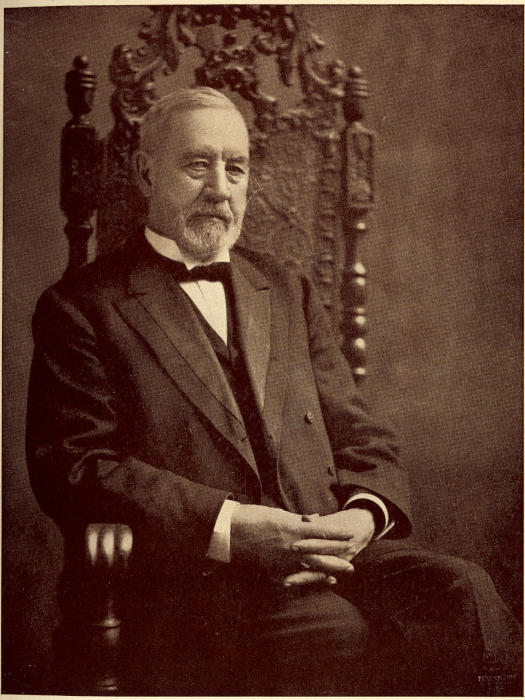
Dr. Henry Wallace, President 1910-11