SECOND SESSION.
Reading edition
At 2 o’clock in the afternoon President Wallace called the Congress to order.
President Wallace—The Congress will come to order, and the Divine blessing will be invoked by Rev. Dr. R. M. Kerr, pastor First United Presbyterian church of Kansas City.
INVOCATION.
Our Father and our God, we pause at the opening of this meeting this afternoon to ask Thy blessing upon the National Conservation Congress in this and its other sessions, in all of its undertakings. We are asking of Thee the wisdom that is beyond the mind of man, and we come only to Thee. We are dealing with affairs of national interest and import, and we dare not come to any one but Thee, because we believe that in Thy power this land has been made, and in Thy Providence it has been discovered. And that our forefathers in Thy fear have established a nation which has often realized Thy signal blessing. We would recognize Thee as the God, and the giver of every good and perfect gift. Thou hast locked up in the mountains, hidden away in the soil of this country those elements that have made possible our material welfare and prosperity. We ask Thee this afternoon that Thou wilt grant unto the officers of this Congress, unto these its delegates and all of the people in this land interested in these problems the wisdom that will rightly enable us to appreciate Thy gifts, and rightly conserve them, to use them for the greatest good of the greatest number concerned. And we ask for Thy blessing to be upon our President, and his cabinet; upon the legislative bodies, state and national, upon all the courts of this land, that as the people of this country through these officers are striving to enact and execute just laws, they may do so in Thy fear, and that the righteousness of a Christian civilization may become more and more a reality. We would pray today that Thy material blessings to us have chief value in relation to human life and human deeds, and human development, and may the conservation movement that is on foot in this country always be broad enough and high enough to include the conservation of human life, the integrity of manhood, the virtue of womanhood, and the beauty and the innocence and the true worth of child life. We believe that these blessings will mean the highest good to our beloved country, and mean the advancement of Thy kingdom here in this earth, and we ask these favors through Jesus Christ, our Lord. Amen.
President Wallace—I take great pleasure, Ladies and Gentlemen, in announcing Governor Hadley of Missouri as the presiding officer this afternoon. Governor Hadley. (Applause)
Governor Hadley—Mr. Chairman and Members Of the Congress: I was selected to preside this afternoon in the expectation that this afternoon would be distinguished by a conference of governors. I say distinguished advisedly, because nowadays when governors confer there is distinction to be passed around on all present, and some for others. However, there were a number of governors here yesterday who were unexpectedly called out of the city, but who will return during the sessions of the Congress. There are some who will be present who have not yet arrived, and consequently it has been decided by the officers in charge of this Congress that upon this afternoon prior to the address of Judge Lindsay, there will be a call of the states, upon which call the representatives of the various states who are here, other than the governors, will speak for a few moments in reference to the general question of conservation in their respective states, and the conference of the governors will be held later. After this call of the states you will have the pleasure, I understand, of listening to the address by Judge Lindsay. In calling for the representatives of the several states, those who are here representing the governor, or those who may have been selected by the delegates from any one of the states to speak in reference to the situation in their state relating to the general policy of conservation will arise, and either speak from the floor, or come forward to the platform. The representatives of the press, whose requests are always entitled to consideration, if not to be followed, request that the representatives come forward so that their names and their remarks can both be heard and preserved. I will now ask the secretary to proceed with the call of the roll.
Recording Secretary Gipe—Alabama. Is there a representative from Alabama present? (No response) Arizona. (No response) Arkansas. (No response) California.
Chairman Hadley—Mr. J. C. Baumgartner of the State of California will speak for that state.
[Mr. Baumgartner’s speech will be found in the supplementary proceedings at back of book.]
Chairman Hadley—I am certain we are all glad to know that though California may be a little short upon water, it is not short on good society, the possibility of good development. The secretary will proceed with the call of the states. The secretary calls my attention to the fact that the number of the states makes it necessary to somewhat limit the statements from each, and they will be limited to five minutes. The chairman, however, has a slow watch, so govern yourselves accordingly.
Recording Secretary Gipe—The next state on the roll is Colorado.
Chairman Hadley—Is the State of Colorado represented here?
Recording Secretary Gipe—Connecticut. (No response) Delaware. (No response) District of Columbia. (No response) Florida.
Chairman Hadley—Is the representative of the State of Florida in the hall? Go ahead.
Recording Secretary Gipe—Georgia.
Professor E. L. Worsham, of Georgia—I am not the speaking representative from Georgia, but I will make a brief report as to what conservation is doing in that section of the United States, or what we are doing along conservation lines. I regret very much indeed to see so many vacant seats in the audience from the states to the far south. This is a very busy time with the people in the south, as most of you know, and there are a great many conservationists who would like very much indeed to be present at this meeting, and I think it is safe to say that the fact that they are not here does not mean that the South is not interested in conservation, and that they are not doing something along those lines. Mr. Chairman, and gentlemen, it is true, however, that the people of the southern states are not quite as active in the conservation movement as the people of the North and West, and why, I cannot see, because there is no doubt but that in the beginning God smiled more sweetly on this section than on any other section of the American continent. He did more for those people than all the rest. He endowed us with resources more wonderful than those of any of the other sections of the United States. Those good people have gone on from time to time not realizing what these resources meant, until they are gradually passing out of their hands. I cannot speak for other states, but for Georgia, Mr. President, I want to say that we have enough water to supply California, and a good many other Western states. That is the least of all of our troubles. As to water power, we have water power enough running waste to run every spindle in the southern states. It is simply awaiting the hand of the developer, and we want to see it properly developed, and not gobbled up as it has been done in many of the western states. This is one of the big problems that the State of Georgia has on its hands today. It is a natural section for manufacturing interests of all kinds, and you can get the cheapest power on earth on account of this wonderful water power that is stored up in its mountains.
We have coal enough to run Georgia and California a thousand years. We have rich stores of iron that run higher in per cent of iron than those of the Birmingham district, and very few people know its value. I understand the State of Georgia supplies three-fourths of the asbestos output of the United States. Our marble speaks for itself in monuments like that beautiful capital of Minnesota. Our granite speaks for itself in buildings like the federal building in San Antonio, Texas, and other buildings which I could point out. Our rich stores of bauxite many of you know about, but, there are numerous other things of this kind, Mr. Chairman, which I could mention, but I don’t care to dwell on them at this time. The main thing that we are here to discuss is the conservation of soil fertility, the conservation of agricultural resources. We of the South are an agricultural section. You take away from us our agriculture, and while we are rich in minerals and various other things, in a measure we would be helpless. It is the only spot on earth, you might say, that has a monopoly on the greatest crop on earth, and that is the cotton crop. This I consider by far the most interesting, the most valuable phase of conservation. The people of the South, while their soil is extremely fertile, or was in the beginning, have allowed the rain to wash it down in the valleys, and it has washed into the sea. They had thousands and thousands of acres of land that would produce anywhere from 25 to 100 bushels of corn per acre, and from one to four bales of cotton per acre, if it was simply cared for in a proper way. I have visited the spot which holds the record for the greatest cotton yield on earth, which produced four bales per acre. In the beginning it was the poorest, reddest soil you ever saw in your life. It was taken over by a man who knew his business, and in the course of three or four years he had it up to a point where it produced almost anything. And there is another thing, Mr. Chairman, we have a section there that will produce almost anything under the sun in the way of crops. There is only one other state in the union that can compare with Georgia in that respect, and that is California, and, as the gentleman has just stated, they have not water. Our sections, from blue grass to oranges, will produce all of the various things in between.
Mr. Chairman, we of the South have got the biggest problem on earth to solve, as I see the problem. The problem of conservation of soil fertility, the conservation of agricultural resources in general, are undoubtedly among the important questions confronting this Congress, but we have the biggest part of that problem. Why? It is because of the much discussed negro problem of the South. There are a thousand and one solutions of this offered, but the question remains unsolved, and will pass on to future generations. As long as we have the negro we are deprived of having other classes of labor, which you have here in the North. (Applause) Because of his presence, we, of the South, are dependent on the negro, and he knows it. We have got to get along in the very best way we can, but we need a better class of labor. I don’t know what we are going to do. That is the reason that this is such a grave matter to the people of the South. Mr. Chairman, I see I am taking up too much time here, but I do want to get back to Georgia, and the part she is playing in conservation. (Cries of Go on. Go on.)
Since the Congress met one year ago, at St. Paul, the South has had a conservation congress, and I think I can say that it was a success. There are a number of speakers on this program that were there and noted the interest that was manifest in this meeting. Following that meeting the Georgia Conservation Association was organized, and it is taking up a number of these problems which we are so anxious to solve. The president is a distinguished man in Georgia, Judge John C. Hart. He is a man who went before the Supreme Court of the United States and presented on behalf of the State of Georgia one of the most famous cases in its history. The State of Georgia filed an injunction against an immense copper plant in the northern part of the state, which was responsible for a great deal of destruction of property, of vegetation in general. This company had, at an expense of millions of dollars, put in this plant, and I understand it is the largest of its kind in the world. At that time copper was the plant’s main output and the state filed an injunction requiring these people to consume the fumes that were destroying vegetation. The case was carried to the Supreme court, and the injunction sustained, and at a cost of five millions of dollars the Ducktown copper plant put in a consumer from which they produced sulphuric acid, and, today, it is one of the largest sulphuric acid plants in the world. There is one of the solutions to the problem which your able president presented this morning in the fact that you have, throughout the West, as well as the South, to fertilize. Georgia, as a result of that injunction, saved two million dollars last year in its fertilizer bill. The representative of the State of Georgia Conservation Association framed a bill creating a state conservation board, not a commission, but a board that was to be created by special act, taking up all lines of conservation. This bill was unanimously passed by the senate, and unanimously recommended by the committee of the house, and will come up for passage at the next session of the legislature.
We passed a bill protecting bird life, and wild life generally in the state, a very strict law, which we have needed for many years. The state, as a result of the conservation work, has enacted a drainage bill, which, I think, will result in great good to the people in the southeastern part, in the drainage of swamp lands, which will make perhaps the greatest agricultural land on earth.
Mr. Chairman, I cannot go into details on any of these problems. Other states in the union, every state in the union has agencies working for conservation. In the first plant, the United States Department of Agriculture is working wonderful results in the different states, along lines of agriculture. The state colleges of agriculture are doing great work; the experiment stations are doing great work; the various state departments of agriculture are doing great work, but there is a certain class of work which these agencies cannot do. There is a great work for the independent organizations, such as the State Conservation Association in the different states, and I would urge each state that has not organized to get busy at once, and begin to take up these problems. (Applause)
Chairman Hadley—Instead of a statement of the resources and developments in the various states, I would suggest that this call of the roll is particularly designed to accomplish a statement of what is being done by public or official organizations in dealing with the question of conservation in the several states. I think it is a very satisfactory indication of the modern trend of conservation that this work is now being done by the people of the several states instead of the national government. It is an indication that the people do not intend that their state governments shall sink to a lower level of efficiency. They intend to exercise every power which they possess under the federal constitution.
Recording Secretary Gipe—Idaho.
Chairman Hadley—I have the pleasure to introduce to you Mrs. Holland C. Day, who will speak for and represent Idaho.
[Mrs. Day’s paper will be found in Supplementary Proceedings.]
Chairman Hadley—I am very glad indeed in listening to the interesting speech of Mrs. Day to note what a serious attraction a state might have for a woman by reason of having woman suffrage and caused her to transfer her allegiance to the Governor of Idaho. I would suggest, however, that she should not, in her enthusiasm for the horticultural possibilities of the State of Idaho, forget that she still belongs to a state that is distinguished as the state of the “Big Red Apple.”
Mrs. Day—I will also say that the female suffrage movement is going right straight along in Missouri. (Applause)
Chairman Hadley—I do not want to start a discussion right now. This, being a conservation congress, is a peace conference. I will now call on Col. Isham Randolph, who will speak for the State of Illinois.
[Col. Randolph’s speech will be found in Supplementary Proceedings.]
Chairman Hadley—I am certain that every person interested in the general question of Conservation, and particularly the state ownership of its water power, is interested in Colonel Randolph’s statement as to what they are doing in the State of Illinois. And I know that all of you, and all other friends of Conservation, will be glad to have Colonel Randolph convey to Governor Deneen the best wishes of the Congress. I would suggest that on account of the fact that there are a number of speakers, and Judge Lindsay, whom you are all anxious to hear, that the speakers will please confine their statements to the official activities of their various states in dealing with this question of Conservation.
Recording Secretary Gipe—Indiana.
Chairman Hadley—Mr. Harry Everitt Barnard, chemist Indiana state board of health and state food commissioner, will speak for Indiana. I now have the pleasure of introducing to you Mr. Barnard.
[Mr. Barnard’s speech will be found in Supplementary Proceedings.]
Recording Secretary Gipe—I have a telegram from the Mexican Ambassador:
“Washington, D. C.—Accept sincere thanks for kind invitation. Regret exceedingly that official duties here prevent me from accepting hospitality; would thank you greatly for minutes of meeting. Gilberto Crespo, Mexican Ambassador.”
The next state is Iowa.
Chairman Hadley—I would suggest that the representatives of the several states yet to be called come up on the platform.
I have the pleasure of introducing to you Mr. Thomas H. MacBride, who will speak for the state of Iowa. Mr. MacBride. (Applause)
[Mr. MacBride’s paper is to be found in Supplementary Proceedings.]
Chairman Hadley—I am certain that the representatives of all of the states present appreciate Mr. MacBride’s not speaking of the resources of the state he represents; although he did plead guilty to having a legislature up there, which practically all the representatives of the other states have to plead guilty to.
Recording Secretary Gipe—Kansas.
A. W. Stubbs (Kansas City, Kansas)—Missouri has elected from our state, a native of our state as its mayor, and has also elected a native of our state as its governor, and Kansas has therefore as its representative, to speak for it, a most distinguished educator, formerly of Missouri, now president of the state agricultural college. Kansas has elected today Professor Waters as representative of that delegation, as president. And we would like to hear from him.
Chairman Hadley—During the sessions of this convention you will have the pleasure of listening at length to a paper by Dr. Waters, but at this time, on the call of the roll of the states, Kansas has selected him to speak for her, and I am advised that during his short residence of a little over one year in that state he has learned to speak the Kansas language. (Applause)
[Dean Water’s paper will be found in Supplementary Proceedings.]
Chairman Hadley—I am glad to see that Dean Waters with a few slight and one noticeable amendments is able to effectively use the speech he used to use about the State of Missouri when he lived here, and spoke to the State of Kansas.
Recording Secretary Gipe—Kentucky.
Chairman Hadley—I have the pleasure to introduce to you Col. M. H. Crump, of Bowling Green, Kentucky.
Col. Crump—Mr. Chairman. I am simply here this evening to say that the president of the University of Kentucky is not here. He will be here tonight, and I will state that he will tell you tomorrow what we are attempting to do in Kentucky. We started the conservation movement there some thirty years ago with Professor Shaler of Harvard, when he was state geologist. He wrote the first paper I know of in attempting to take care of forestry. It is found in his report of 1873, about the time I came to the state. We are, through the university, through the state colleges, and through the geological survey, making some efforts along that line, and we are doing all the state can do in that way. But there is a subject there that we think is too large for the state to undertake. I picked up a circular when I came in here, which says that an effort is being made to take care of and preserve the forests, and the soil at the head of the Green river. This paper states that some 32,000 acres of timber land, 2,000 of which is virgin forest, the last of a great forest which once covered the Green river, and in the center of which is Mammoth Cave, we ask that the Nation come forward and help to take care of that, because it is too large for Kentucky, and heretofore nothing has been too large for Kentucky to do. (Applause) That is all I have to say. (Applause)
Recording Secretary Gipe—Louisiana.
Chairman Hadley—Mr. Fred J. Grace will speak for Louisiana.
[Mr. Grace’s paper is to be found in Supplementary Proceedings.]
Chairman Hadley—I know that all true conservationists will be glad to know that Louisiana is looking after the conservation of her shrimps and oysters, and we will all be glad to hear whether Maryland is interested in her terrapin and canvas backs.
Secretary Gipe—The next state is Maryland.
Chairman Hadley—I have the pleasure of introducing Hon. Bernard N. Baker, president of the first Conservation Congress. (Applause)
Mr. Baker—Fellow delegates. I will only detain you a few minutes. I know you are all waiting to hear Judge Lindsay. The governor limited us to what we were doing to preserve the oyster. Maryland is doing her duty in that respect, and if you will do your part, we shall all enjoy them in using the oyster when it is opened. I know you want to hear Judge Lindsay, and I am going to only speak a word. I thank you for this, and we will wait for Judge Lindsay.
Fred J. Breeze of Indiana—I move that the report on the call of the states be laid over until tomorrow.
The motion was duly seconded.
Chairman Hadley—I think the Chair will declare that motion carried, and on tomorrow morning where there is an order on the program for the response of chairmen of organizations concerned in conservation there will be statements of the representatives of the several states. It is important in the consideration of this question that we should not lose sight of the fact that conservation is a means and not an end, and the real end is the formation and promotion of the happiness and welfare and prosperity of the people. Consequently the most important question of conservation is the question of the conservation of human health and life. There are various phases of this question before the American people today that are of commanding importance; the immense toll that modern industry makes upon its workers amounts to ten every sixty seconds; the number of deaths from unhealthful occupations has presented a record as tragic as any that was ever written in times of war. There is another phase of this question, of conservation of human life, in the manner in which society deals with its deficient and dependents. Any system devised for the prosecution of crime and the protection of society against its enemies that deals only with the question of punishment and revenge is a mistaken system, and does not accomplish anything of permanent results in its benefits to society. They talk of the system in the conduct of penitentiaries and jails and eleemosynary institutes, but unless they send those they heal out into the world better men, women or children, physically, intellectually or morally than when they received them, that system is a mistaken and misguided one. One of the most distinguished representatives of a modern system in the enforcement of our criminal law for the conservation of human life and character is a man who I now have the pleasure of introducing to you, Judge Ben Lindsay, of the State of Colorado, and of the City of Denver, (Applause) who will speak on the subject of the “Country Child vs. the City Child.” Hon. Ben B. Lindsay.
Judge Lindsay—Governor Hadley and delegates, ladies and gentlemen: I am sure it is a great honor to have the privilege of appearing here at this National Conservation Congress to consider some phases of the problem of the child. I do not know whether at past congresses the subject of the child has had a part in the program, but I do know that upon this occasion I feel a great deal as I think a particular boy friend of mine must have felt once in a little episode that happened in my own court nearly ten years ago. We found that when we made an appeal to the loyalty, even of the street boy, the state might find a helper and defender instead of an enemy. I recall when a certain policeman could not capture a certain little rascal of the streets. He went by the nickname of “Moochy.” He came in one day to say to me that another little imp of Satan, as he was supposed to be, by the name of “Mickey,” knew where “Moochy” was, and if he could enlist the services of “Mickey” in the capture of “Moochy” he thought he might save this little citizen. It was with some difficulty that I had to explain to “Mickey” that we were trying to save “Moochy,” in order to get him to tell me where “Moochy” was. When he found we had come to save, to help, and not to hurt, that loyalty for his chum turned to loyalty to the state, and he said, “Judge, I know where the kid is, and I will get him.” In about fifteen minutes down in the wing of a cheap theater in our town there was a howl and a growl that somewhat disconcerted the audience. And when they investigated they found it was “Micky” pinching “Moochey,” as he called it. With some difficulty my little gamin friend succeeded in getting the delinquent to the court house, coming in to say to me with more or less disgust, “that the kid didn’t seem to want to be saved nohow.” A newspaper reporter happened to come along to write a story based upon this episode, to be called “The Pinching of Moochey by Mickey.” It was not complete, in his estimation, without a picture of the two, and he lined them up outside to take their pictures, when “Mickey” balked. He would not stand to have his picture taken. And I was somewhat puzzled, for I rather feared the outcome of this situation when “Mickey” came in followed by the newspaper reporter, to explain. He said, “Do you tinks I want to get my pictur took wid de little giek,” as he pointed to “Moochy” outside? “No,” he said, “I don’t; I got out of his class two years ago.” Then he said, as he pointed to the newspaper man, “If that guy wants to take my picture let him take it alongside of you, put both in together, and I don’t kick.”
CHILDREN, THE BIGGEST CROP.
When the Conservation Congress wanted to put the child in its work I am certain I am not going to kick, but I am here to avail myself, as best I can of this honor and this privilege. For after all this conference has needed no apologies for including in its proceedings the problem of the child, for there is not any problem that does not, in a measure, have some bearing, some relation to the home and the child in the home. These children are our best and our biggest crop. Without a proper conservation of their welfare there will never be anything else worth conserving.
There should be a bond of sympathy between the problem of the child and the conservation of our natural resources because of the rather interesting fact that the systematic work being developed for both has had most of its growth and development during the past decade, and when the history of the first ten years of the twentieth century shall be finally written the two great revivals recorded will be those concerning conservation and the child. It becomes more apparent each year that the children are the most important factors in whatever the future may hold in store for us.
Another significant fact is that the growth of popular interest in the problems of the children has been almost identical with the amazing growth of urban population for the past two decades.
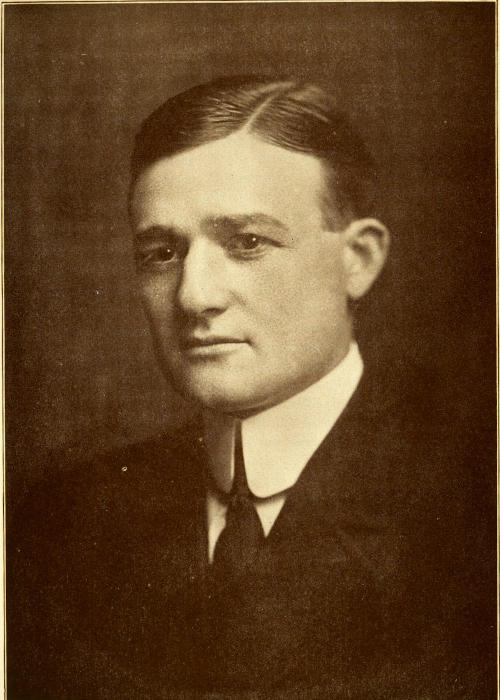
Prof. E. Lee Worsham, Chairman of the Executive Committee
CONGESTION PROBLEMS.
The cry of “Back to the soil”; the stimulus given by the conservation movement and the various activities that have grown out of it to promote the pleasures, advantages and opportunities of farm life together with all the modern inventions, telephones, electric light, rural mail delivery, the trolley, good roads and the automobile, I am sorry to say have not served to check the onward march to the cities. The proportion of our people living in rural districts declined from 63.9 per cent in 1890 to 53.7 per cent in 1910, and our experts in social economy assure us that in all probability much more than half of our population will be residents of urban communities before 1920. In many of the older states beyond the eastern center of population more than 90 per cent of all the people live in cities and towns with a population of more than 2,500. During the past decade alone, according to the census of 1910, the increase in the urban population of the entire country has been at the rate of 34.9 per cent as against only 11.1 per cent of the rural population. In six states this increase of urban population as against rural population has been over 100 per cent, and while not one state has failed to show a large increase of urban population, the increase of rural population has been negligible in many states and has actually shown a considerable decrease in seven states. Unless some new and unexpected change shall come it is reasonable to assume that the next generation will find more than half the children of this country in urban communities. There is a temptation to follow that diversity afforded by a subject like that assigned me, which may lead us more into the pleasantries that are supposed to be a part of the life of all country boys. The field, the farm, the orchard, the meadows, the babbling brooks; those recollections recalled in the rhymes of a Riley from the jam and the pies over to old Aunt Mary’s, to the joys of the old swimming hole or of these fall days when the frost is on the pumpkin and the fodder’s in the shock. The pity of it is that most of these legends of the country boy are too much legend and too little reality. If it were not so we can scarcely account for the growing disposition of country boys to flock to the city. I regret to say that I believe that the call to the city that is reaching the country boys of the Nation will prove to be more effective than any call to the country or “back to the soil” movement that has so far been inaugurated. One of the chief complaints we hear on every hand among the farmers of this country is the difficulty of the problem of farm labor and the indisposition of the boys and young men in any such numbers as there should be to become interested in the farm. I remember listening to the almost pathetic story of one farmer of the Northwest, who told me that every one of his five sons had gone to the city, and he had been unable to induce one of them to remain. He said they either complained of the hardships and the lack of opportunity, or pined for the excitement, pleasure and possibilities of the city. The very advantages that we had hoped would make farm life more attractive to the youth of the Nation is also proving to be one of the factors that would seem to emphasize its monotony. The daily newspapers, the magazines, the trolley cars and automobiles and good roads are bringing the youth in such complete touch with the city that instead of promoting that satisfaction and contentment with the country as we had expected these city advantages would do, it often has just the reverse effect. I am not prepared to say that these modern conveniences upon which we depended so much in the “back to the soil” movement will not in the end increase rather than decrease the numbers of country boys. I recently visited a city of about three thousand population in one of the most rural of states. What did I find? It has its moving picture shows along its Great White Way, limited to two or three blocks, with a roller skating rink, dance hall, and other forms of excitement and amusement—almost a perfect miniature of the larger city. The fact that the youth of the farming community, through trolley cars and automobiles, had convenient access to the city, where before it would have been more difficult, I was assured only whetted the desire in the country boy for the city life. It would seem then that we are booked for disappointment in the hope that the extension of city conveniences to the farm is going to increase the rural population and therefore the number of country children.
COUNTRY AND CITY BOYS.
But except as it shall present difficulties in the growth and evolution of modern civilization, I am not sure whether this condition, if it be the condition, need be viewed with any great alarm. There is a gregarious and sheep-like tendency in mankind to flock together. The phenomenon presented by urban and rural growth must be a natural one or it would not be so. It is simply presenting in the course of its natural growth an occasional difficulty in the body politic as we have an occasional disease in the growing body of the individual. It becomes our duty then, in the one case just as much as in the other, to remedy the difficulty, to direct the growth along natural and wholesome lines, and this calls for work and coöperation among those factors that have to do with the life of the city or country boy—home, school, neighborhood, church and state.
It follows then that our difficulties, as they must develop from time to time, will be with the city rather than the country boy. This is not because the country boy is inherently any different from the city boy—don’t forget that—any better or any worse, nor in my judgment because he is capable of greater possibilities. It is rather because of the environment and condition under which a great number of our boys must in the future development of this country necessarily be reared. I once attended a powwow of some Indian chiefs in North Dakota. There was present old John Grass, the successor of Sitting Bull, and Red Tomahawk, the slayer of the same old chief. I asked these Indian chiefs about Indian children in their primitive days, in the days of the real country and the wilderness. Did they lie? Did they steal? These chiefs assured me that such things were practically unknown among Indian boys in the days of their own childhood which was before the white man came. “But,” said one of the chiefs, “when white man come Indian boy he steal, lie just like white boy.”
I asked one of these Indian chiefs why it was that in their primitive state stealing was unknown among Indian boys—and surely they were the original country boys. The old chief grunted and a smile actually lit up that otherwise stolid Indian face as he replied: “It is very simple, there wasn’t anything to steal. The child’s wants were few and he had what he wanted.” Neither was there any poverty, any crime. This virtue of the original country boy in America was acclaimed without a taint of pharisaism. For it was admitted that the honest little savage was no better than his dishonest little progeny. It was rather a problem of condition, of occasion, of environment, than one of inherent viciousness. The wants of the little savage were few and generously supplied by nature. There was no temptation, no occasion to steal.
This fact no more favors savagery than it disproves the advantages of civilization. It is the law of nature that men should multiply and populate the earth, and the instinct among the greater numbers to flock together in cities is precisely the same as it was in the days of savagery when smaller numbers flocked together in smaller groups more widely distributed. We must meet the change by doing two things:
HOW TO MEET THE CHANGES.
First. Perfect our system of education. We need to improve our methods of moral training. We must more and more develop heart and conscience that our children may be equipped for moral as well as industrial efficiency. Boys need strength, but most of all the strength that comes from within; self-control, self-restraint; a yielding of more obedience to authority and respect for law and the rights of others.
Second. The application of a system of real justice among men which means an industrial, social and economic world in which every man shall really have an opportunity to develop the best that is in him, and be assured that he shall reap the joys, rewards and profits to be derived from his own honest toil.
This means that the boy to keep pace with our modern civilization must be better supplied with certain opportunities that are now largely denied him.
New conditions necessarily create new problems. It is the law of growth and development. Since these new conditions are to be found principally in the cities, and since most of the boys who need our attention and interest are in the cities, it follows that the problem of the child is largely the problem of the city. But as the country becomes more closely in touch with the city and many of its difficulties reach into the life of the country boy, we will also in time find the difficulties of the one are the difficulties of the other.
Whatever the city does for the child is done for the community as a whole, for the child cannot profit without equal profit directly or indirectly inuring to the entire community. It is difficult to put any limit on the duty of the community to the child. It is coextensive with that of the parent, if there be no parent, or if the parent be helpless, or the child suffers from the parent’s neglect. This duty of the community, once recognized and accepted, is bound to be extended until indeed the community shall become one great family possessing some of the attributes, duties and responsibilities for the child that in original country life were limited to the particular family or family group of the child. The first general and accepted duty of the community towards the child was its education. Then came the demand for playgrounds, natatoriums, baths, trade schools, recreation centers, medical inspection, visiting nurses, dental clinics, and finally the school free restaurant. That is as sure to come within the next ten years as the playground and the recreation center has come in the past ten years. In a word, there is absolutely nothing that the child needs which the parent for any fair reason cannot furnish, which it is not the duty of the community to supply. This is so because it is simply the struggle of the state for itself. The child is the state; when the child is neglected the state is neglected; when the child suffers the state suffers; when the child is lost the state is lost. To say that the child is the chief asset of the state is undoubtedly true, but it is short of the real truth. The child is the state. It is, therefore, futile to oppose the movement going on in this country for the conservation of childhood on the ground that it is paternal. If there is anything in the scriptural injunction that “A little child shall lead them,” it is surely making itself felt at this period of our civilization. If we would conserve the real interests of the children of the Nation, we have simply got to be paternal. The state has got to be the over-parent. It cannot escape if it would; it would not escape if it could.
PALLIATIVES AND CURES.
The last decade of agitation in behalf of the boys of the city was for what is becoming more and more to be regarded as the palliatives. We first asked for playgrounds only in certain bad neighborhoods, on the theory that the children in that neighborhood were bad. We know now that the children were no different from other children, and if they need playgrounds, then all children need playgrounds, whether they be country children or city children. The play instinct needs to be wisely directed as much in one child as in another—in the country as truly as in the city.
We first asked for child labor law forbidding children to work in certain industries, and we are realizing more and more that it is not a good thing for the Nation to draw on the manhood of tomorrow by sacrificing the childhood of today. (Applause) The recent report of the National Bureau of Labor on juvenile delinquency and its relation to employment makes perfectly clear the extra hazards and dangers to which children are subjected from being too early forced into economic competition with men. It demonstrates the necessity for not only more stringent child labor laws, but the better enforcement of those we have. It explodes the idea that the working boy and girl under 16 years of age is freer from dangers of delinquency than the non-working child. It would seem indeed that the playing child in the street is much less likely to go wrong there than while engaged in those occupations in which they are mostly employed.
From what is undoubtedly a very thorough investigation and study of 4,839 cases of delinquents (of whom 561 were girls and 4,278 were boys), we have carefully worked out for us interesting tables showing 2,416 working as against 1,862 non-working delinquent boys, and 251 working as against 210 non-working delinquent girls, or a total number of 2,767 working delinquent children as against 2,072 non-working delinquent children. Added to these interesting figures is the further fact that the ratio of working delinquents is very much larger than the non-working in all these cities, varying in different cities from three to ten times as great as the non-working, with the disproportion even more striking among the girls, making it perfectly clear, as one chapter of the report concludes, “that putting children to work prematurely is not an effective method of training them for good citizenship.”
THE VALUE OF THE REPORT.
Another interesting fact brought out by the report is that the repeaters or recidivists (those apprehended for the second to the tenth offense as carefully tabulated in the report) are to be found mostly among the working children with the proportions much larger among the younger working children between 9 and 14 years of age. Up to this point the scale in this respect constantly ascends, beginning to descend as the working age approaches maturity.
The report is unusually fair in making every possible concession to a variety of details and difficulties that might discredit its conclusions; but even with all such concessions there isn’t any room to dispute its final demonstration that working children not only contribute more in actual numbers but in an alarmingly larger proportion than do the non-workers to the criminal classes, and among repeaters or recidivists the same condition is even more marked. No such interesting or reliable set of tables has ever yet been added to the literature on this subject. It forces upon us the idea that the virtues necessary to good citizenship are not so much inherited as they are to be acquired. It follows that we are doing hideous injustice to our children in unnecessarily subjecting them to temptations which their untrained, immature souls are not yet able to withstand. These temptations naturally enough are greatest among the six groups of working boys who furnish the most delinquents. They are well known to juvenile court officers. These six groups represent the six classes of occupations yielding the greatest number of delinquents out of the total number investigated. Proportionately they are, delivery and errand boys 491, or 20.3 per cent; news-boys and bootblacks 449, or 18.6 per cent; office boys 46, or 1.9 per cent; street vendors 66, or 2.7 per cent; telegraph messengers 73, or 3 per cent; employed in amusement resorts 51, or 2.1 per cent; or a total of 2,416, more than one-half of the total number of 4,278 cases of delinquent boys investigated. The greatest proportion of offenses among the boys are of course larceny. This one offense constitutes more than half of all the offenses reported. Putting these immature souls to work simply violates the supplication of the Christian’s prayer “lead us not into temptation, but deliver us from evil.” The temptation of dishonesty constantly besets the working child, much more than the non-working child. The results shown are rather to be expected. The next in order of popular offenses are incorrigibility and disorderly conduct, terms so indefinite as to frequently include larceny. Truancy appears only in the cases of 185, and begging in the cases of only seven. Every juvenile officer will appreciate the more than probable accuracy of these tables, for, with one or two exceptions of minor importance, they are confirmed by their common experience, for which heretofore reliable tables are rather scarce.
A FALLACY EXPLODED.
The tabulations concerning the parental condition of the delinquents show equally creditable work. They are interesting as exploding another popular fallacy (which indeed was long since exploded by Miss Jane Addams and other champions of child labor laws) that most of the working children were sons and daughters of widows. Only 419 boys or 17.3 per cent of the entire number investigated were sons of widows, and only 185, or 8.7 per cent, were orphans; while 1,318, or more than one-half of the entire number, had both parents living. And again, curiously enough, the tables show that proportionately the great majority of these delinquent boys, employed or unemployed, came from average good homes. Seventy-six and two-tenths per cent of the delinquent working boys are recorded as coming from “fair or good homes,” and 71.6 per cent of the working and non-working boys (that is, of the total number of delinquents) enjoy the same favorable conditions in so far as their homes are concerned. The results seem to prove what has often been emphasized by juvenile officers, that a good home is not as complete a guarantee of a good boy or girl as it would seem we ought to be entitled to expect. The influences of the home—while of course the most important influence and the one that counts most—is by no means the only influence under which a child is placed, especially in that kind of city life that has come to this country only in the past fifty years and which in every particular is to become more terrific in the next fifty years, unless there be some unexpected changes. It is furnishing in many respects a new kind of environment under which most of our children are expected to be reared. It means we have got to make war against the street, the conditions, the environment, the causes, if we are to perform our full measure of duty to our children.
Forty-four and seven-tenths per cent of the delinquent boys are children of native born parents as against fifty-five and three-tenths per cent of foreign born parents. Considering the far greater ratio of native born parents, this clearly indicates that there is less control over their children by foreign than by native parents.
But I do not wish to be misunderstood. I firmly believe in work even in childhood. By this, I mean the right kind of work. It is not so much a question of work as the amount of work, the kind of work and the conditions under which that work is performed. This need not lessen our belief in happiness in childhood. I want to say very candidly, that there are a great number of children in this country from fourteen years of age upward about whom I feel more alarmed at their failure to do or to know how to do any kind of useful work than of any possibility of their being overworked.
THE DANGER OF IDLENESS.
In our zeal for the protection of our boys subjected to extreme or unnatural conditions, we must not lose sight of the dangers and difficulties of idleness. There are thousands of boys in the cities of this country who, if not employed at some useful thing, are generally on the streets or in the alleys in the downtown public pool rooms and bowling alleys, engaged not always in wholesome play, but too often in idling, cigarette smoking and dirty story telling, with absolutely no thought of work or the serious side of life. They are too constantly occupied with thoughts of “having a good time,” and some rather perverted notions of what a good time is. Too many of our boys especially reach the age of moral and legal responsibility without the slightest conception of work. They are too often more concerned as to how much they earn than how well they do their work. In dealing with a certain class of youth in the juvenile court, I say without hesitation that the most hopeless fellow in the world is the boy who will not work—the boy who has not learned how to work, or the value and importance of work. There is always hope for the boy who works, especially the boy who likes to work. I believe in the “strenuous life,” and I think its importance should be taught our boys and girls at an early age. There are too many young people in this country looking for “the life of ignoble ease.” I can say all of this to persons sincerely interested in the protection of the children from degradation or unnatural labor, and yet not be understood as depreciating the importance of wise child labor laws and their rigid enforcement for the protection of the children of the Union. But we must be careful, in doing this, never to underestimate the importance of work—the right kind of work, a certain amount of work—in the life of every child, and especially that teaching which inculcates good impressions in the life of every child as to the necessity and importance of labor. On the other hand, my experience is that most boys will work if given any kind of an encouraging opportunity. The lack of a chance is often responsible for idleness. At least 90 per cent of our boys and girls are forced out of the grammar school to fight the battles of life. They must have a chance to earn a living under such reasonably favorable conditions as not to destroy all chance of happiness or else they must become idlers and loafers. My own experience is that our common school education too often fails to equip them for earning more than the most scanty wages. An opportunity between the sixth and eighth grades in our city schools for children of the toiling masses to learn some kind of useful trade or valuable work with the hands—to learn to do what their fathers do—is a reform in our educational system which the champions of child labor must, in my opinion, espouse if they would round out a systematic and consistent plan of battle in this fight for the salvation of the children.
PLACES FOR THE BOYS.
I want to see the time come in this country when a boy of fourteen years of age up may be a valuable help to the plumber, the carpenter or the printer at a decent wage, instead of going to the messenger service and the street. I do not believe that juvenile labor should trespass upon the legitimate occupations of men and women, but we must equip these children for some kind of industrial efficiency and usefulness, or enlarge our reformatories and prisons for their care and maintenance. One of the saddest things in my experience as judge of the juvenile court has been the little fellows who have requested me to send them to the reform school in order that they might learn a trade. The principal of a school once said to me: “Judge, why don’t you send that boy to the reform school so that he can learn a trade?” On behalf of the boy, I replied: “In God’s name, why don’t you people on the Board of Education give him an opportunity to learn a trade at home?”
I ask you, is it fair, just or decent that in most of the cities of this country an American boy has no opportunity to learn a trade, to capacitate himself for joyous, useful work with his hands, unless he commits a crime? And yet, I am compelled to say to you, that such is the condition in a very large section of this country.
But there are wonderful changes just ahead of us in our educational system. These changes are bound to come if we are to make progress, and we are making progress.
If the Nation is to do its real duty to its boys—whether they be city boys or country boys, its children, city children or country children—it should pass the bill that has for the last six years been repeatedly offered in Congress providing for the establishment of a children’s bureau in the Department of Commerce and Labor.
CHILDREN VERSUS ANIMALS.
It is a kind of protection that is sadly needed in this country, and especially from the government we need a systematic scheme of national investigation of all matters pertaining to the welfare of children and child life. It would in no manner interfere with the activities and agencies provided by the states but, on the contrary, through the help and assistance that would come from the national government, do much to strengthen all such agencies. Such a bureau would be of equal if not superior importance to those now existing in several of the departments. For instance, the Department of Agriculture, where we have a bureau of animal industry, plant industry, of soils, of chemistry, and the like. The Government spends annually millions of dollars investigating the diseases of animals, the inspection of cattle, hogs, sheep, etc., and the results obtained by the able experts are published and circulated generously to the farmers and stock raisers of the country. The work of these bureaus has more than justified the expenditure of money by the Government. If we have a somewhat analogous bureau dealing with the welfare of the child life of the Nation, it would be doing no more for them than we are now doing for cattle and hogs. We have no right to neglect the child crop of this country. It is scarcely necessary to repeat that it is our most valuable crop, for there are born every year in this country over two million children. What the state is, what the Nation is ten, twenty, or thirty years from now depends not so much on our business, our ranches, our great industries, as upon the kind of men we have directing the great industries, the business, the farms, the ranches of this country, and what these men are then depends upon how well we care for our children now. If there are diseases among the cattle of the Nation, or decrease in some of the staple cereal crops of the Nation, the Government immediately becomes interested and its investigators and experts are busy everywhere to ascertain the causes, to furnish the remedies, to coöperate with the people for the protection of the material wealth of the Nation. Now, the child crop of the Nation is not to be measured in dollars and cents for as important as such a standard may be it is insufficient to furnish a scale for measuring the value of soul stuff. Yet if there is a large increase in infant mortality, of the dependency or delinquency of the childhood of the Nation, there is no bureau under the Federal Government that is even required to become interested in the matter. And, indeed, there are very few states that provide sufficient and adequate agencies to carry on the work that must be done if we are true to our children. It is freely admitted that of the 300,000 little children—out of the 2,000,000 born annually—that die annually, one-half of the deaths are preventable by the knowledge and application of preventive measures. If through the dissemination of proper information about children, such as is disseminated concerning cattle, an appreciable per cent of these children could be saved as they certainly would be saved, such a bureau would more than justify its establishment.
SOME PRACTICAL EXPERIMENTS.
I remember recently, when the Children’s bill in England was being considered, receiving a letter, I think, from one of the under secretaries, to get certain facts, and it was simply impossible to provide the information that was needed and expected that this Government could furnish; and I, as a judge of one of the courts of this country dealing with children, felt very much embarrassed that we could not say that our Government was able to furnish such information.
We have found, in our efforts to help these 100,000 children annually that are dependent or delinquent, that nothing is so important as facts. In my humble judgment—I may be wrong, and that is just why we want a bureau of this kind, in order that I may know and you may know whether I am right or wrong—in my judgment there are 100,000 children, dependent and delinquent, coming to the courts of this country every year, and that means 1,600,000 children coming to the courts of this Nation in every generation of childhood. Is this great government of ours, with sufficient facts already gathered in this imperfect way to demonstrate the necessity, going to neglect this opportunity of spreading useful information concerning the children of this country?
I recall a certain city in which I asked the chief of police how many children had been in jail that year. He said 100. When we investigated the records, we found there were 650 boys alone brought to the jail in that city of less than 200,000 people. In another city I asked the jailer how many boys had been in jail, he said five or six hundred. When we investigated the records, we found there were 4,000 arrests in that city among the boys alone under twenty years of age and over 2,000 brought to the jail were under seventeen years of age.
But finally any work for children of the city or country must bring us face to face with many of the social, economic, industrial and political conditions that concern us as a people. There is no real problem of the child that is not also the problem of the parent. We cannot do our duty toward the children of this Nation without attacking the conditions that deform the lives of the children. This must take us so far afield that I do not dare attempt to follow now lest it take me so far beyond the immediate scope of this paper as to find for it no satisfactory ending.
The fight for the childhood of today is the fight for the parenthood of tomorrow, the manhood of tomorrow; it is after all the supreme battle for the country, the city, the state, for justice for all men and women, and that means a day of better things, a happier country, a more perfect civilization; the dawn of a tomorrow, a new day, a new time in which the scriptural promise shall be more than fulfilled, for the little child shall lead, shall teach, shall save the world.
Chairman Hadley—The audience will remain seated a moment. There are a few more of the states that will be called, and as it is necessary for me to attend to some official duties, President Wallace will now take charge of the meeting.
President Wallace—The Congress is not yet adjourned, and we have some good things in store. Please come to order as soon as possible. I wish to announce Hon. B. A. Fowler, president of the National Irrigation Congress, of Phoenix, Arizona, as chairman of the committee on resolutions. Now, we want every state that has not appointed a committeeman on resolutions to do so at once, and report to the clerk, and Mr. Fowler will announce when and where that committee will meet.
Another thing. Any of you that have resolutions will please turn them in to that committee at the time and place of meeting. The committee will consider the resolutions and present them and their final report on next Wednesday. It is to be regretted that many of the governors could not be here this afternoon, but some of them have sent representatives.
President Wallace—I have the pleasure of introducing to you Mr. D. M. Neill, representing the governor of Minnesota.
[Mr. Neill’s paper will be found in Supplementary Proceedings.]
President Wallace—The Honorable George Coupland of Nebraska is here as its representative, and has been asked to speak next. Mr. Coupland.
[Mr. Coupland’s paper is to be found in Supplementary Proceedings.]
President Wallace—When this meeting adjourns, which will be at 5 o’clock sharp, it will adjourn to meet at 8 this evening, and will be presided over by Hon. B. A. Fowler, the president of the National Irrigation Congress. Mr. Condra has an announcement to make.
Professor Condra—I wish to announce a meeting of the credential committee as soon as I leave the stage about ten minutes to 5. Another announcement: There are about a hundred state conservation commissioners present, and they will meet in the white room at the Baltimore Hotel tomorrow morning at 9 o’clock for a conference.
President Wallace—This Congress intended to get Hon. Woodrow Wilson of New Jersey to address us. He was unable to come, but has sent a representative, Mr. Edward A. Stevens, Commissioner of Public Roads, and he will be heard as soon as the secretary makes some announcements, which will close the program for this afternoon.
After announcements by Secretary Gipe, President Wallace continued: We will now hear from the representative of Hon. Woodrow Wilson, Mr. Stevens. (Applause)
Mr. Stevens—Mr. Chairman, Ladies and Gentlemen: I did not come prepared to represent the Governor of New Jersey, or to make a speech. That had been entrusted, I believe, to somebody better fitted than myself. I find in the West the State of New Jersey is considered and known for its mitigation of corporations which do not meet the approval of the United States Supreme Court. But it is not that industry I wish to interest you in, or in fact any New Jersey industry. All I can do today is to give a slight enumeration of the work being done in one of the smallest and most densely populated states of the Union. We have commissions or officers in charge of the following branches of conservation work: Forestry; the oyster industry; the conservation of flowing water; the geological survey of the state (which is one of the most complete and most accurate yet carried out by any state of the Union); of agriculture; of public roads; of inland waterways; the regulation of public utilities; the watching over health by the State Board of Health, and also special institutions for the care of tuberculosis, of epileptic and feeble-minded children. We have a fish and game commission, because with us the ocean furnishes a vast source of wealth in its fisheries. We have besides that a commission for the regulation of factory labor, and especially for the regulation of child labor, for children in New Jersey cannot enter into work without passing an examination and without special permits. I am sorry that I cannot do much more than merely enumerate the branches of activity which the state is undertaking. I am only familiar with one of them, that is public road building. If I can be of any service in that technical line to this Congress I hope I will be considered at its disposal. (Applause)
President Wallace—Prof. F. W. Rane, State Forester, will speak for the State of Massachusetts.
[Prof. Rane’s paper is to be found in Supplementary Proceedings.]
President Wallace—The Congress now stands adjourned until 8 o’clock, when the conference of the states will be resumed. We will meet tomorrow morning at 9:30 promptly.