FOURTH SESSION.
Reading edition
President Wallace—The Congress will come to order and be opened with prayer by the Rt. Rev. Dr. E. R. Hendrix, of Kansas City, Bishop of the Methodist Episcopal Church (South).
INVOCATION.
Let us pray. Oh, God, our Heavenly Father, we bless Thee that Thou hast been made known unto us as a God that works, and that Thy Son coming into the world, declared, “My Father worketh even until now, and I work.” We know that the gods of the heathen do not work. They idle, they quarrel, they dishonor the very name of a god, and a decent man is better than any of the false gods. But our God is revealed to us as one ever employed, active mind, best and highest motives, noblest, most wide-reaching plans, and honors man greatly by making him a fellow worker. Grant unto us the wisdom to work together with God. Give breadth of view, give clearness of perception of what needs to be done. Give responsibility to the best motives, and give plans that are as wide-reaching as the great plans of God. Upon this Congress, upon all its methods and its plans, grant Thy richest blessing, our Father. We ask in the name of Christ our Savior. Amen.
Recording Secretary Gipe—A great number of states have not yet reported their members to the committee on resolutions. I ask for the names of the various states now, and let the chairman of the delegation kindly rise, and give me the name, as I call the state in order that the chairman of that committee may immediately assemble these gentlemen to get to work at once. Alabama; Arizona; Arkansas; Delaware; Florida——this is for the committee on resolutions. There is a delegate here from Florida. Georgia; Idaho; Indiana——
H. E. Barnard of Lafayette—I have not the report from Kansas.
Delegate Potter—Kansas is here in force, but her officers are out on committees. As they come in we will see that you have the names.
Recording Secretary Gipe—Do you know who was elected as a member of the resolution committee from Kansas?
Delegate Potter—I was—Thos. W. Potter from Peabody.
Recording Secretary Gipe—Kentucky is here. Louisiana; Maine; Maryland; Massachusetts.
A Delegate—William P. Wharton, of Massachusetts.
Recording Secretary Gipe—Michigan—Is Michigan here? This is the committee on resolutions; we want your member from Michigan, please.
A Delegate—He has not turned up yet.
Recording Secretary Gipe—Will you not kindly see that the Michigan delegation meets at once and names its member for the committee on resolutions? The next is Minnesota.
A. W. Guthridge, Minnesota.
Recording Secretary Gipe—Missouri; Montana; Nevada; New Hampshire; New Jersey—New Jersey is represented. New Mexico; New York; North Carolina—they are represented. North Dakota; Oregon.
F. J. Kinney, Oregon.
Pennsylvania—Dr. Henry S. Drinker, president of the University of Pennsylvania, and delegate from Pennsylvania.
Recording Secretary Gipe—Rhode Island; South Carolina; South Dakota; Tennessee; Texas—J. B. Smith, of Texas. Utah; Vermont; Virginia; Washington—Everitt Gregg. West Virginia; Wisconsin; Wyoming.
President Wallace—Mr. Fowler, the chairman of the committee on resolutions, would like to make an announcement.
Mr. Fowler—Mr. President and Delegates: I hope you all realize what the work of the committee on resolutions may be. Many states have been called here this morning and no names have been given and no one has responded. This is a conservation congress. There are representatives here from these states, from every state I trust in the Union, and there is not a state in the Union that is not interested in the question of conservation. I hope then that the delegates from every state will see to it that a good man is upon this committee on resolutions. The committee is not near full. Many states are not represented, and you must remember, my friends, that the work of the committee on resolutions is the crystallization of the work of this Congress, and the resolutions speak for the Congress, and speak for all the states of this great Union; hence, we must have some one represent every state. I have had some experience with resolution committees in other congresses, and many of you have had the same, and you know that it is a working committee. It is the committee that is compelled to sacrifice about everything else after the work of the committee begins. Consequently, we want working men upon this committee on resolutions, men who are willing to give their time and make a few sacrifices of their own pleasures and own enjoyment during the rest of the sessions of the Congress until the work of the committee is done and the resolutions presented to the Congress. (Applause)
Recording Secretary Gipe—Is Prof. Condra of Nebraska here? If so, he will kindly come to the platform.
Sergeant-at-arms—Ladies and Gentlemen: President Wallace desires me to make this announcement: “Cincinnati, Ohio, September 26, 1911. President Conservation Congress, Kansas City, Missouri. Will arrive on Alton, 7:45 tomorrow morning.—W. J. Bryan.” (Applause)
President Wallace—I would like to make one suggestion. We are going to be very short of time. We are now coming to the call of states. We want every state to be heard from, but we want you to confine yourselves to five minutes, and to tell us, not what your resources are, not what you are going to do (applause), but tell us what you actually are doing in the way of conservation. If you have a conservation association, as you ought to have in every state, tell us about it, or anything that bears upon it. Boil it down to five minutes. We will ring the bell on you if you don’t stop at the end of five minutes.
Recording Secretary Gipe—I understand that some of the states reported last night while you were at the dinner given to the President, and I hope, that since I do not have the names of those states, that the gentlemen will advise me when I call the roll. We do not want any duplicates. The next state is Maine. The next is Mississippi. Is Dr. Lowe in the room to respond for Mississippi? Missouri?
President Wallace—I now introduce to you Mr. George B. Logan, secretary of the Missouri Waterways Commission, who will speak for Missouri. We will hear from him for five minutes.
Mr. Logan—The Missouri Waterways Commission was created by an act of the General Assembly in 1909. This act provided for a commission of five members, who were to investigate “the various problems associated with the navigable waterways of the state and the reclamation of land subject to overflow; the construction of levees; the benefits to be derived from proposed navigable waterways, and the reclamation of lands subject to overflow or inundation.” The result of these investigations, together with all obtainable statistics, was to be reported to the succeeding General Assembly. The commission was allowed $5,000 as expenses. None of the members were to be compensated for their services.
At the time the Missouri Waterways Commission presented its statement to the Second Annual Conservation Congress, the report which was last January submitted to our legislature had been prepared. The commission was very successful in obtaining information of a detailed nature pertaining to conservation of the state’s resources, and from this information extremely valuable statistics have been compiled and were included in the report transmitted to the General Assembly.
Because of the small amount of funds, the commission was forced to do almost all of its investigating by correspondence, inasmuch as original research was not possible, and they were gratified to find a widespread interest in the state which caused its correspondents to answer promptly and fully. The investigations were conducted under four heads into which the subject of water conservation in this state seems to be naturally divided. The uses of the water being in the order of importance: First, water supply in which the water is consumed in maintaining life; second, agriculture in which the water is consumed in the growing of the crops yielding food and other necessaries of life; third, power in which the water is employed in aid of, or as a substitute for, human labor, and is not consumed; and fourth, navigation in which the water is used for commerce and is not consumed.
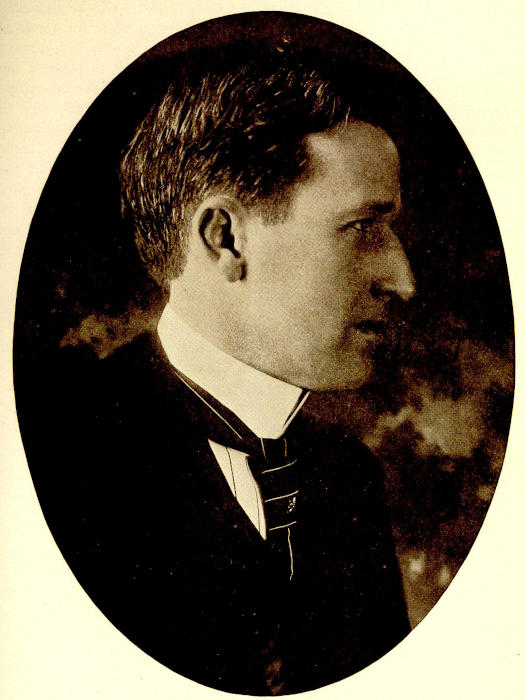
Hon. Herbert S. Hadley, Governor of Missouri
Strauss Studio, St. Louis. Mo.
WATER SUPPLY.
Under the first head the commission delved deeply into the sources of the state’s water supply, consisting of rainfall and watershed drainage. From this point of beginning, the commission went into the question of water supply of the various municipalities, considering the character of the water used, the state in which it was used, and the available quantity.
In the conservation of human life, which is the ultimate end of all conservation, the commission felt that nothing was more important than the securing of a permanent and proper water supply for the inhabitants of the state. Sixty-five communities in the state have been investigated, and from the findings presented to the General Assembly the commission hopes that much needed and beneficial legislation will result. As was to be expected, the investigations of these communities showed conclusively that the community water supply is nearly everywhere closely involved with community sewage disposal. The legislature will be asked to pass such laws as will encourage or compel municipalities to dispose of their sewage as not to endanger the lives of their own inhabitants, or of those who by geographical location are forced to have the same source of water supply.
AGRICULTURE.
While the quantity of rainfall remains approximately the same from year to year, the effects on the soil, and the subsequent benefits resulting to the soil from the rainfall, change materially. By improper methods of agriculture, hillsides and slopes have been denuded of trees and pasturage with the result that the soil on the hillsides is no longer absorptive, and the rain falling thereon is lost to it. This is especially true in this climate where a very large percentage of the annual rainfall comes in hard or excessive rains, taxing the absorptive capacity of any soil to its fullest extent. By proper education and agitation it is hoped that this natural fact will be borne in mind by the agriculturists of the state who have it in their power to be leaders in this work of conservation.
The converse of the problem of too little water is found in Southeast Missouri, where a very great area is burdened with an excess of water. The solution of this problem has been drainage which is being accomplished by drainage districts organized either in the county or circuit courts. Already 1,271,470 acres have been thoroughly drained and will be valuable agricultural land as soon as the heavy timber is cleared off. The average cost of drainage has been approximately $5.00 per acre, which is paid in small annual installments. The increase of the value of the land thus drained has been many hundred per cent, while the benefit to the health conditions has been great. Drainage is being fostered and encouraged by the state authorities, and as fast as the necessity for working laws is shown, these laws are forthcoming from the General Assembly. There is need for further drainage, but the energy and enterprise of the people in the communities where it is needed will probably suffice for the solving of this problem in the future as it has in the past.
NAVIGATION.
Missouri is blessed with magnificent opportunities for vast conservation of transportation cost, by reason of the presence on and within her borders, of the two greatest rivers of this country. Accepting the figures of unofficial investigators, the commission has estimated that the demand for water traffic indicates that the through freight movements between St. Louis and Kansas City alone would amount to four hundred and sixty-eight thousand tons annually, while that through the Mississippi in and out of St. Louis would reach a million or more tons. The surplus products of the soil and mines of this state aggregate fully ten million tons. If even forty per cent of these products could be moved by water at the large water cost of one-quarter that of rail transportation, the aggregate saving to the producers would amount to $11,250,000.00. This saving, or the adding to the wealth of the state, is too important to be disregarded.
The commission feels that the sentiment among this state’s law-makers is already strongly in favor of coöperating with the National Government in any systematic effort to permanently improve our waterways.
WATER POWER.
From the investigations conducted under this head the commission believes that herein lies one of the greatest and least understood of the state’s natural resources. Only ninety-nine water power sites are in use, and one hundred and twenty-three formerly in use have been abandoned. The abandonment is due chiefly to two causes: First, economic conditions in agriculture have so changed that there is no longer need of a manufacturing or consuming point at the place of production. It is more profitable to ship the products of the soil and buy whatever flour, meal and sugar is necessary than to have these small quantities ground at local mills. Hence, grist mills and sugar cane mills have disappeared. The second cause for abandonment of water power sites is the failure of the streams, due, as mentioned above, to the changed soil conditions. However, the advance in electro-mechanical appliances has created new uses and put a new value on water power sites. The point of application of the power may now be many miles from its point of generation. Sites abandoned years ago have “come back” and have greatly enhanced in value. Properly exploited, the value of resources in this state is incalculable. One of the chiefest aims of the commission in its present work is to sufficiently impress upon the people and upon the General Assembly the great value of this natural resource. While more expensive to produce, undoubtedly the greatest latent power in the state is in the Missouri River. The commission has planned to investigate in detail some site on the river which has the most natural advantages and using this as an illustration to demonstrate what can be done in this state.
At the recent session of our Legislature the report of the commission covering these topics, giving in detail the information meagerly outlined above, was presented to the General Assembly and copies of this report were widely distributed throughout the state. The $5,000 appropriation for four years has increased to $17,000 for two years. The resignation of members and political differences arising outside of the commission have temporarily impaired and hindered the work of the commission.
However, since the presenting of its last report the commission has put in the time of its executives in bringing up to date and supplementing the statistics gathered the preceding year. Practically nothing is now lacking in the figures concerning community water supply, water works and sewage disposal. Pending the beginning of actual engineering investigation of a water power site, the commission has studied the water power laws of all the states of the Union to the end that accurate information may be presented to the General Assembly when legislation in this state on these subjects is asked for. The delays and petty hindrances touched upon are undoubtedly temporary, and with the very recent completion of the personnel of the commission we have great hopes and expectations for the work which may be done in the cause of conservation during the coming year.
During the reading of a list of telegrams, Mr. W. A. Beard of Sacramento, California, assumed the Chair as temporary chairman.
Temporary Chairman Beard—The secretary will continue the call of the roll of states.
Recording Secretary Gipe—Montana; Nevada; New Hampshire; New Mexico; New York; North Carolina; North Dakota; Ohio.
President Wallace—I now introduce to you Mr. C. P. Dyar of Marietta, Ohio, who will speak for Ohio.
Mr. Dyar—I have no speech to make. Ohio simply sends greetings to this Congress, and wishes it Godspeed and a large measure of success in the work before it. Ohio has always been a great conservation state throughout its entire history; it has had presidential, gubernatorial and senatorial timber, and other minor political timber, sufficient for the entire consumption of the United States. Ohio felicitates her sister states on the scope and energy of this movement and she voices the hope that has been expressed in this meeting, that the lesson of the parable of the talents shall not be forgotten, that conservation shall not be interpreted to mean simply to save, but development through wise use, which creates wealth, not only for the present, but future generations.
Recording Secretary Gipe—Oklahoma.
President Wallace—I have the pleasure of introducing Mr. Milton Brown, who will speak for Oklahoma.
[Mr. Brown’s paper will be found in Supplementary Proceedings.]
Chairman Beard—We are getting down to business this morning, and I think we are getting the meat out of the cocoanut. These addresses have been directly to the point. I now have the pleasure of introducing a representative of the State of Pennsylvania, Mr. A. B. Farquhar.
Mr. Farquhar—Pennsylvania is a state of such gigantic resources it would take all the rest of our session to begin to describe them, a good portion of it, and tell what we are trying to do to conserve them. It is only within the last month or two we created a state branch of the National Conservation Association, and they wanted me to be its president, I suppose because I have been interested in conservation for about twenty years past, and was a director in the National Association.
[Mr. Farquhar’s paper is in the Supplementary Proceedings.]
Chairman Beard—We will now listen to Dr. Henry S. Drinker, president of Lehigh University.
Dr. Drinker—It would seem that this third National Conservation Congress in ordering its deliberations cannot do so more wisely than in giving heed to the closing words of President Taft’s luminous address at St. Paul last year, when he said:
“I am bound to say that the time has come for a halt in general rhapsodies over conservation, making the word mean every known good in the world; for after the public attention has been aroused, such appeals are of doubtful utility and do not direct the public to the specific course that the people should take, or have their legislators take, in order to promote the cause of conservation. The rousing of emotions on a subject like this, which has only dim outlines in the minds of the people affected, after a while ceases to be useful, and the whole movement will, if promoted on these lines, die for want of practical direction and of demonstration to the people that practical reforms are intended.... I beg of you, therefore, in your deliberations and in your informal discussions, when men come forward to suggest evils that the promotion of conservation is to remedy that you invite them to point out the specific evils and the specific remedies; that you invite them to come down to details in order that their discussions may flow into channels that shall be useful rather than into periods that shall be eloquent and entertaining without shedding real light on the subject. The people should be shown exactly what is needed in order that they make their representatives in Congress and the State Legislatures do their intelligent bidding.”
It would seem well for us here to take account of stock of what has been done, of the agencies that have been utilized and of those that have been neglected, as well as to exchange views as to what we think that others, or the interests we individually represent, should do.
I have the honor of representing Pennsylvania as a state, and the Lehigh University as an educational organization deeply interested in the promotion of the cause of forestry and of conservation in general. We have an efficient and active forestry association. Pennsylvania, as we all know, has been, and is, famed for her deposits of iron and coal, and for her pre-eminence in the iron and steel industries. The resources in these directions are so great that it would be wearying to attempt even to inflict on you a summary of them in these short talks, but what the state has learned in conservation of mineral resources is of direct and pregnant interest. Forty years ago the movement for stopping the waste in coal was begun at the organization at Wilkes-Barre, Pennsylvania, in 1871, of the American Institute of Mining Engineers, an institution whose membership now runs into the thousands and whose influence for good is world-wide. As a young engineer I had the privilege of attending that meeting. Among the things done a committee was appointed to study the question of waste in the mining, preparation and transportation of coal. This committee was followed by, and, in fact, incited the appointment by the Pennsylvania Legislature of a coal waste commission, which made a valuable and exhaustive report, and we thus see that in one phase of conservation, and a very important one, that of mining, our engineers have been doing their duty, and that forty years ago work in conservation was being done to which the public is only just awakening. Our government officials are doing most intelligent and good work in pointing out the way.
Perhaps one of the best summaries of this great conservation question now before our people, and in which the engineering profession is so interested, and in regard to which our mining profession has so great a duty to perform, was given by Dr. C. W. Hayes, Chief Geologist of the United States Geological Survey, in an address some time ago at the University of Chicago, when he defined conservation as “Utilization with a maximum efficiency and a minimum waste,” and said:
The reform that is needed throughout the country as a whole must gain its motive power not from sporadic instances where true business methods prevail, or from the well-intentioned enthusiasm of the few, but from the well-informed intelligence of the many. The campaign for conservation must be one of education.
There appears to be an unfortunate confusion in the minds of certain advocates of conservation. They have apparently confused conservation of natural resources with destruction of the trusts, and the mixture has resulted in pure demagoguery.... Anyone who has studied conditions attending the development of mineral deposits must have been impressed by the fact that those deposits held by large companies are being developed and utilized with a view to prevention of waste, in accordance with the principles of conservation, to a much greater extent than are the deposits held by small companies or by individuals.
I was much struck, as I think we all were yesterday, by the statement of our President followed by that of the chairman of the executive committee, that at this Congress we were to discuss conservation without any infusion of politics, and I take it that we use the word “politics” in its broadest sense, and are to see how we can best use capital and labor, and intelligently directed industry, all to the common end of the promotion of conservation; and that we can and will recognize what I have quoted above from the Chief Geologist of the United States Geological Survey in regard to the proper recognition and utilization of capital in conservation as highly important.
In the report of the National Conservation Commission, made through President Roosevelt to Congress in January, 1909, Mr. J. A. Holmes (now director of the United States Bureau of Mines), in reporting on our mineral resources, said:
In considering the conservation of resources, it should be held in mind that:
(1) The present generation has the power and the right to use efficiently so much of these resources as it needs.
(2) The Nation’s needs will not be curtailed; these needs will increase with the extent and diversity of its industries, and more rapidly than its population.
(3) The men of this generation will not mine, extract, or use, these resources in such manner as to entail continuous financial loss to themselves in order that something be left for the future. There will be no mineral industry without profits.
In his message to Congress, 1910, President Taft, speaking of the anti-trust law, said:
It was not to interfere with a great volume of capital which, concentrated under one organization, reduced the cost of production, and made its profit thereby, and took no advantage of its size by methods akin to duress to stifle competition with it. I wish to make this distinction as emphatic as possible, because I conceive that nothing could happen more destructive to the prosperity of this country than the loss of that great economy in production which has been and will be effected in all manufacturing lines by the employment of large capital under one management. I do not mean to say that there is not a limit beyond which the economy of management by the enlargement of plant ceases; and where this happens and combination continues beyond this point the very fact shows intent to monopolize and not to economize.
Let us consider these questions as business men, weighing the good as well as the evil that the different powers can afford that bear on conservation, and utilizing and encouraging all that will promote the great ends which the conservation movement was started to serve.
President Wallace—It was expected that the National Grange would be represented on this platform. Neither the president nor the gentleman whom he recommended could come. I have therefore taken the privilege of appointing Mr. B. G. Holden of Iowa, who will give us an address this morning, not on the Grange itself, but on the Grange and other movements that tend to the uplift that we stand for. We will now hear Mr. Holden, who is the evangel of the corn gospel in all these inner states. We will hear him for half an hour.
Mr. Holden—Mr. Chairman, Ladies and Gentlemen, Members of this Congress: You came here to listen to the great people of this country, and you are anxious to hear them, so I will take just as little time as possible, for I have already been warned by the president that I must be brief. I have laid my paper upon the table, and I am going to forget all I can and say the rest to you. I am going to be something like the Irishman who was painting a fence. He was working as hard as he could putting on the paint. A neighbor Irishman came along down the street and said, “Pat, what are you hurrying so for?” Pat kept right on putting on the paint. And he said, “Begorra, I am trying to get my job done before my paint runs out.” I am trying to get through before my paint runs out this morning.
SOCIAL LIFE ON THE FARM.
To conserve humanity—to make humanity worth more to itself; to direct human forces so that each person wastes the least possible energy, and accomplishes the greatest good for himself and for others—this is the most vital problem before our country today.
No nation can long remain great whose rural people are oppressed, or for any reason have degenerated.
It was Goldsmith who said:
Ill fares the land to hastening ills a prey, Where wealth accumulates and men decay; A bold peasantry, their country’s pride, When once destroyed can never be supplied.
It is not that country life on the farm is bad in the United States, for it is not, but it can be greatly improved, and in my opinion it is the greatest question before the Nation today. I am sure that when history is finally written it will place foremost among the many good things that President Roosevelt did, the inaugurating of the Country Life Movement. Three things are necessary: First, and most essential, is an awakened and serious interest on the part of the rural people themselves; second, there must be encouragement by both the nation and the states in the way of better laws and financial aid; third, there must be leadership—men and women who are willing to devote their lives to this great work.
Just how is this work of bettering country life to be worked out? In my opinion it must be done largely by the following agencies now in existence:
First. The church, and allied organizations, such as Y. M. C. A., Boy Scouts, etc. Second. The schools, libraries and county superintendents. Third. The Grange, farmers’ clubs, and other organizations of the kind which have for their main object the betterment of farm life educationally and socially.
THE GRANGE AND THE FARMERS’ CLUB.
The president has asked me to put particular emphasis on the Grange and farmers’ clubs as factors in the improvement of the social life of the farm. It is my opinion that one of the most important steps in this great forward movement, especially in the corn belt, is the organization of granges and farmers’ clubs in every community. There is need of a tremendous awakening to the importance of organization as a means of agricultural advancement. The effect of these organizations on the community is most remarkable. Men and women in such communities grow up with strong attachments not only for the business of farming and home-making, but for the people of the community in which they live. They remain on the farm instead of moving into town or out of the state. But these organizations do more than this. They furnish exactly the social and educational advantages so much needed by the rural communities. They enable young men and women to discover themselves and their powers of usefulness to humanity.
Michigan has nearly nine hundred such organizations, most of them granges, with a membership of 70,000. In each of the forty agricultural counties there is an average of twenty-five live, active organizations. New York granges have a total membership of 90,000. Quebec has nearly six hundred clubs with more than 55,000 members. In strong contrast to this, the corn belt, peculiarly and above all else agricultural, has but a few dozen such organizations scattered throughout the entire area.
President Roosevelt, in his address at the Michigan Agricultural College, said:
Farmers must learn the vital need of coöperation with one another. It is only through such combination that American farmers can develop to the full their economic and social power. Combination of this kind has in Denmark, for instance, resulted in bringing the people back to the land, and has enabled the Danish peasant to compete, in extraordinary fashion, not only at home but in foreign countries, with all rivals.
Few people in the West realize what a tremendous influence the grange and agricultural clubs of the eastern and middle states have exercised on national legislation directly affecting the agricultural and social conditions of farmers. As an illustration, attention is called to the following laws which either had their origin in the granges and clubs or were enacted largely through their initiative: The Department of Agriculture; the position of Secretary of Agriculture in the cabinet was created; the state experiment stations established; free rural mail delivery provided for; the Grout Pure Food Bill, the Sherman anti-trust regulations, the Interstate Commerce Act, the Denatured Alcohol Bill and the Postal Savings Bank Bills all now enacted into laws.
These organizations through their lecturers, legislative and promotional committees are exerting a tremendous influence in moulding public opinion and crystallizing it into definite form for new laws.
These associations are now urging the election of United States senators by popular vote, national aid for establishing agricultural high schools and the introduction of agricultural and domestic science into the rural schools; the establishment of the parcels post, postal telegraph and telephone service; and national and state aid for highway improvement.
While these influences have been great beyond calculation, yet by far the greatest effect has been in the betterment of the social and intellectual conditions in the home and in the community.
Mr. G. A. Gigault, the Minister of Agriculture, Province of Quebec, in a letter to the writer makes the following statement:
The Province has today 591 farmers’ clubs. Among the members of these associations are to be found the persons the most devoted to and interested in the development of our agricultural resources. Most of the agricultural improvements of such locality are due to the initiative of the officers and members of the clubs. In every new locality where farmers’ clubs have been organized, a butter or cheese factory has been erected and other improvements have been made. This organization causes progressive ideas to pervade everywhere, as well as contributing towards the betterment of agricultural methods.
The movement will undoubtedly assume widely different forms in different communities, ranging from local institutes, men’s clubs, women’s study clubs and reading circles on the one hand, to agricultural clubs and granges on the other. It is to be hoped that this latter form of organization (granges and clubs) will predominate, for it is only when the entire home is represented that we find the highest standards and the greatest progress in the community.
THE PLAN OF RURAL CLUBS.
The plan of operation with which I am most familiar is as follows: The membership is made up of twelve to fifteen families. The meetings are generally held every two weeks in the homes of the various members of the organization or in halls built for this purpose. During the winter months the meetings are held during the day, the program beginning about 10 A. M. At 12:30 tables of planks or boards are prepared on which the lunch is spread. Every family brings a basket of provisions. The family in whose home the meeting is held is not allowed under any circumstances to prepare a dinner, excepting to possibly furnish some coffee, popcorn, etc., as this would be a serious burden. When the picnic lunch is over, some of the little tots are boosted up on a box or chair, or on the table, to speak a piece or sing a song; thus every member of the family has a part in the meeting.
These organizations are nerve centers of progress. They develop, they educate, they push their members out of the old into the new and better ways. They set their members, young and old alike, to studying their business. This means interest in the daily work, a love for the farm life and the home life. This means a useful and happy life. It means intelligence. It means freedom from drudgery, for drudgery is “labor without thought.”
This meeting together, talking together, working together, and acting together for mutual protection and improvement brings us nearer to the great law of “loving our neighbors as ourselves.” To know that others are depending upon us, have faith in us, love us, and hope for us, is a tower of strength, of courage and of happiness.
It is not my purpose to criticise our school system. However, our rural schools can and must be improved and redirected. They do not meet rural needs. They do not interest the boy and girl in the things of the farm and home. Frequently the teachers are town girls without farm experience or sympathy. The farm children must either go without high school training or get it in the town or city. Our present system educates away from the business of agriculture instead of towards it.
THE PRACTICAL SIDE OF THINGS.
The following axioms will aid us in a clearer understanding of the failures of the present system and the remedies:
1. Education is that which trains or fits for the duties of life. To illustrate, let me ask what are to be the duties of our girls? Ninety-nine per cent of them must make homes, cook, sew, scrub and nurse. How much are our rural schools doing to equip our girls for this greatest of all duties, home-making?
2. The whole boy should be trained, not simply his head.
3. We should teach in terms of the child’s life and surroundings—things that concern him and his home. He will then be interested and will like his work, will put the best he has into his work. But instead of teaching in terms of the boy’s lifework, our schools teach in terms of brick pavement, bank notes, yards of cloth, foreign exchange, partial payments, etc., etc.
4. Boys and girls should be taught to think in terms of action, of accomplishment. There is a more or less well founded prejudice that our high school and college graduates are impractical and theoretical. They have not been dealing with the real problems of life. At any rate, few of these graduates return to the farm. The agricultural colleges are helping some through their short course schools, farmers’ institutes, literature sent out, etc., but it is a mere drop in the bucket. What we really need is a system of schools suited to rural conditions. We must pay better prices for teachers. This will be done gladly when the school sends back each night to the home boys and girls better fitted for their work and interested in it. Teachers must be especially trained for the rural schools. They must live in the community and be a part of it, helping Saturdays and Sundays to guide, direct and stimulate. Not only this, but the farm boys and girls must get their high school work under agriculture and not city conditions and surroundings. In other words, we must have rural high schools within the reach of every boy and girl on the farm. These schools should become the social and educational center of the rural community.
It is true that the rural church has exercised great influence upon the people of the country socially and morally, helping to create and maintain good standards of life, but it has not kept pace with progress in other lines. It does not measure up to its great opportunity. There must be put into it not only more vitality and life, but there must be a new and broader attitude towards life. The rural church must be as broad as the rural community in which it exists, interesting itself in every question which concerns the life of the people.
THE MINISTER’S DUTY.
The minister, like the teacher, must teach in terms of the life work of the people. The minister should be interested in agriculture, not only interested in agriculture, but should really know something about it as well as other questions which concern the community. The minister of the future will be required to take a course in agriculture along with his theological work. He must, like the teacher, be specially trained for his rural work. The field and opportunity of the rural minister is as broad as humanity itself. The minister should help the teacher in her work. He should help organize granges and farmers’ clubs and be an active member. He should help with their short courses and farmers’ institutes. He should help with the county Y. M. C. A. work and the Boy Scouts’ work.
Think of the service a minister can render a rural community, by organizing and directing the amusements and sports of the neighborhood. If he could not direct them in person he could help the boys select a capable, wholesome leader. He could develop or work out in time a plan by which, during a part of the year at least, the boys would be given one-half day every two weeks for baseball and other sports.
As it now is the country boys have no intelligent leadership. While the pastor is preaching a sermon to a small audience in the church the boys have joined the little clique and are taking their first lessons in card playing, smoking, etc.
The pastor must be a leader or he will accomplish but little. One of the things he should do is to clean up around the church, mow the weeds, repair the fence, set out shade trees and put some pictures on the walls of the church. The pastor should live in the community and become a part of it in every way.
What we need is a rural society that belongs distinctly to the country. Its schools, its churches, its clubs and its amusements must be so directed and organized as to meet the real needs of the people who live in the country.
Many illustrations can be given of the splendid work now being done in various localities and sections of the United States. I wish I might tell you of the work which some of our ministers and their country churches are doing. Men like Rev. M. B. McNutt of Plainfield, Ill., Rev. Clair S. Adams of Bement, Ill., Rev. C. S. Lyles of Logan, Iowa, and many others.
It is remarkable what some of our county superintendents like Miss Jessie Field of Page County, Iowa, have done and are doing through the schools for better agriculture, better homes and better citizenship. There are the rural high schools such as the one at Albert Lea, Minn. How I wish I could tell you of the county Y. M. C. A. work which Mr. Fred Hansen of Iowa is doing with the boys; how he has organized them into clubs and is directing not only their religious work, but also their amusements and sports, and even has them studying corn, stock and other agricultural subjects.
The Country Life Commission has done a great work, but the movement has only begun. We must have more state “Country Life Commissions.” There must be national and state aid so that the commissions can bring to the people the knowledge of what has been accomplished in the various localities throughout the country.
President Wallace—Be patient a moment, and please come to order. We have two splendid speeches to be delivered this morning and I am very sorry to announce that Mr. Barrett of the Farmers’ Union, who intended to be here, cannot be here on account of sickness in his family. We will hear a gentleman for five minutes who is about to leave for Europe and must speak now or not at all.
Recording Secretary Gipe—I would like to announce that Mr. R. A. Long will speak as the representative of the wholesale lumber dealers and yellow pine manufacturers.
Mr. Long—I understand that Mr. Wallace said that I expected to leave for Europe. I am not going to Europe and have no thought of going to Europe. Permit me to suggest this: it is rather an imposition upon you and embarrassing to me to be called on so short a notice to speak in the midst of men who have carefully prepared papers, and yet I want to suggest to you some thoughts that occurred to me, that were put into my mind by the last speaker. We are having many important problems before us at this time. The problems before this Congress are certainly most important and have to do with the people of today and of the future. We are to have in this city within a few weeks another convention not pertaining to the conservation of the soil or water, or the forest, but to a conservation that has to do with men, and I am wondering whether or not this audience is going to place more stress upon the problems that are involved in this Congress, or the problems that are involved in the one to be held a few weeks hence. That problem has to do with men and religion, and in my judgment no problem on the face of the earth will have more to do with the conservation of all the problems of life, this man and religion forward movement, and I trust that the men and women—(applause) I only have five minutes, don’t disturb me—and I trust that the men and women involved in these problems will see to it that these teams which commence the first of October and continue throughout the winter until May of next year are supported with their means and with their presence. The gentleman who just took his seat stated that he would like to preach a sermon on what the preacher ought to do with reference to the child life. I would like to have each of you assembled here this morning ask yourself the question, and answer it if you please, what are you doing in your own home. What are you doing, what is the example that you are setting your children? Sunday morning I imagine the large majority of you, instead of going to the Sunday School and setting an example to your children in order that they may follow out the life this gentlemen speaks of that you ought to live, are remaining at home and reading your newspapers. Bear in mind, my dear friends, fathers and mothers, the school teacher or preacher cannot do that which you ought to do for yourselves. And I want to speak this word on behalf the preachers of our land: when they stand up in the pulpit, when they beseech us to do the things we ought to do, and then we fail to rally to their support, ought we to censure them? Ought we rather not engage with him arm in arm in this great conflict, that has to do with the elevation of mankind, rather than stand aloof and say we want to preach to the preachers? I want you to ask yourselves that question, whether or not you stand arm in arm with your preachers, and carry on that conflict that has to do with the uplift of mankind all over the world. How much time have I got? I cannot take the time to talk about the other problems which I had in mind, connected with the timber interests of this country. But I want to say this to you, that the forests of this country ought to be taken care of better than they are. The reason why the forests are not being conserved better than they are is because of the extremely low price of lumber compelling us who manufacture lumber to leave twenty per cent of the trees in the woods because we cannot get price enough out of it to pay for the labor to produce it, and the transportation, to say nothing about the logs. And so long as we have intense legislation, leading almost to persecution against the interests, even getting together and talking over the problems pertaining to their industry, so long will the price of lumber be so low as to prevent us from bringing in at least twenty per cent of these trees, thereby prolonging our forests to an almost indefinite period.
President Wallace—We will now have an address by the Hon. W. A. Beard of Sacramento, California. I have asked him to prepare an address on the subject of “Coöperation,” one of the most important subjects that can secure our attention. He will speak a half hour and no more.
Mr. Beard—Coöperation, as your chairman has said, is a very hard term. It is so hard that I have found it difficult to determine the particular phase of the subject which should be presented for your consideration. I believe I was expected to talk on coöperation among farmers, but upon careful consideration I was impressed with the fact that coöperation among farmers is fundamentally the same thing as among persons engaged in any other pursuit.
It has seemed to me that what should come out of this Congress is not an exhortation, addressed either to farmers or to any other class of citizens, but a careful and complete statement of the facts—a review of the progress made in coöperative development and a discussion of the principles underlying successful coöperation. I shall speak, therefore, of this movement.
I refer, of course, to coöperation in business. By this term, I mean the growth of coöperative societies in which individuals are associated for mutual benefits and mutual profit. The ideal society is one in which the benefits and profits are distributed equitably among the members in proportion to their respective interests.
Coöperation is little understood by the great majority of our citizens; the full measure of its possibilities is comprehended by comparatively few. Because there have been many and conspicuous failures, and because abuses have marked the administration of some so-called coöperative societies, the average citizen is disposed to regard coöperation as an impractical dream, and in consequence, the really excellent progress is being made in the face of distrust that should be removed.
A knowledge of the facts will dispel this impression. Coöperation is a demonstrated success. The movement is a world movement. Coöperative societies are doing business successfully in every civilized country on earth. In this country they are doing business in almost every state. Everywhere the coöperative society, properly conducted, contributes to the material welfare of its members; in most places it is an important factor in social and moral advancement.
The modern coöperative movement commenced less than a century ago and began to assume importance about 1840. The earliest beginnings of coöperative business enterprises as we know them were the establishment of a little store at Rochdale, England, in 1844, and the founding of a coöperative credit society in Germany in 1849. The pioneer in agricultural coöperation was the rural credit society of Germany, the first of which was organized in 1862.
I mention these dates because they were the starting points from which has grown, in the comparatively brief period of sixty-five years, a vast web of coöperative enterprises encircling the earth.
SMALL BEGINNINGS LEAD TO LARGE SUCCESSES.
Each of the movements began in the smallest way. The German credit societies, both rural and urban, were founded for the purpose of providing credit to men who had no security to offer beyond their collective honesty, industry and business ability. The purpose was to help the very poor, and the success attained is attested by the comparative prosperity of German artisans and farmers, and by the present vast extent of the coöperative banking system. The Rochdale society was organized by ten poor weavers with a cash capital of twenty-eight pounds sterling, and from it has grown the great system of coöperative distribution of Great Britain.
THE COÖPERATIVE BANKS OF EUROPE.
The coöperative credit society, or bank, is the most common form of coöperation on the continent of Europe. Following the success of the system in Germany, it has been introduced, in varying forms and with varying degrees of success, in nearly all of the countries of continental Europe, rural banks usually preponderating in numbers and in importance. There are coöperative rural banks in Italy, France, Russia, Switzerland, Belgium, Holland, Austria and the Balkan states, also in Ireland, India and Japan. They have been introduced into Canada, and one such bank has recently been established in the United States.
Mr. Henry W. Wolff, in “People’s Banks,” says, “The year 1849 saw opened two vastly different roads to wealth—the California gold fields and the principles of coöperative banking.”
The advantages of the coöperative bank lie in the fact that it is operated in the interest of the borrowers and its sole purpose is to provide cheap credit. The members are the managers, the borrowers and the recipients of the profits.
It is estimated by competent authority that there are forty thousand of these banks in existence, with a total of more than three million members and assets worth more than a billion dollars.
In Germany more than one-half of the independent agriculturists are members of these banks.
Altogether there are 24,000 coöperative agricultural societies in Germany, of which about eighty per cent are federated in one great organization, and all of which are closely associated with the rural coöperative banks to which they owe their origin.
THE ROCHDALE SOCIETY OF ENGLAND.
The society formed at Rochdale, England, was wholly different from the credit organizations of Germany, which it preceded. Its purpose was not to provide credit, but to furnish the necessaries of life at low cost. Unlike the German societies, which were started by philanthropists for the benefit of the poor, the Rochdale society was started by the poor themselves. The mite of capital employed at the outset was secured by saving of two pence weekly from a starvation wage. Even this small saving meant sacrifice to the Rochdale pioneers, but it paid, for out of it has grown a great system that provides the British workman of today with all he requires at wholesale and manufacturer’s prices.
LARGEST BUSINESS IN THE WORLD.
The Coöperative Wholesale Societies Limited, of London, England, is said to be the largest business concern in the world. In 1908 it did a business of 570 million dollars. It is the central federation of the coöperative retail associations, one of which is in almost every village and town in England. It is a producer, manufacturer and shipper, as well as merchant. It owns plantations in various parts of the world; it sails its own ships; its chain of purchasing depots encircles the globe; it manufactures almost every article of household use and supplies the wants of more than eight million people. It is purely coöperative, all of its profits being distributed among the consumers in proportion to their purchases.
We of America pride ourselves on the giant enterprises on this side of the Atlantic. Even while we condemn the systems which have made them possible, we marvel at the genius of the captains of industry and finance who have built them. Yet here is a concern, said to do a business four times greater than the Steel Trust, which is without a captain of industry, a great financier or a merchant prince. It is a product of a system, one of the best features of which is that it does not concentrate great wealth in the hands of a few.
WHERE COÖPERATION IS A NATIONAL TRAIT.
Agricultural coöperation finds its most complete development in Denmark. Almost every Danish farmer is a member of one or more coöperative societies. Coöperation is almost a national trait. So general is the use of coöperative methods in Denmark that some one has said when a Dane wishes to buy or sell anything his first impulse is to form a society to do it.
Yet coöperation is of comparatively recent growth in Denmark. There have been coöperative stores since 1866, but it was not until 1881 that the first coöperative dairy was established, while bacon curing and egg societies date from 1887 and 1895, respectively.
There are more than a thousand coöperative dairies in Denmark; there are five hundred egg societies, and numerous other coöperative producing and selling price associations. Eighty-three per cent of the cows milked in 1909 were in coöperative dairies; 66 per cent of the bacon was cured in coöperative factories.
The coöperative societies are thoroughly organized into federations, and the whole business of production and sale is systematized. The federations exercise the closest supervision over production. High standards of excellence are required and long lists of rules are rigidly enforced. A bad egg is occasion for a fine in a Danish egg society—and there are no bad eggs in Denmark.
In the twenty-five years from 1881 to 1906, Danish exports increased from $11,840,000 to $77,800,000. Behind these figures is a story of a nation’s progress from poverty to prosperity, a progress in which coöperation has been the principal and dominating factor.
THE COÖPERATIVE PRINCIPLE AMPLY DEMONSTRATED.
To tell, even in merest outline, of the successful coöperative movements of Europe would require more time than is at my disposal. I have cited these because they are the most conspicuous and far-reaching, and because they afford three wholly separate and distinct and entirely different demonstrations of the correctness of the coöperative principle. Coöperation in Europe has been in most cases the resort of dire necessity. It does not follow, however, that coöperation can be successful only under circumstances of poverty and want. If it will raise men from poverty to a competence, it will add to the prosperity of the already prosperous.
RISE OF COÖPERATION IN AMERICA.
The coöperative movement in this country began to assume importance about 1850. Prior to this time there had been many associations for the advancement of various interests, but these were, as a rule, educational in purpose. Real progress in business coöperation began after the close of the Civil War, and may best be described as a series of great movements in which the farmers were usually the principal actors. These culminated in the Grange movement of the early seventies in which millions of farmers, united in a great national society, undertook to revolutionize the existing economic system by taking over to themselves the functions of middleman, merchant, baker and manufacturer, and to form a great agricultural trust that would dictate the price of farm products and combat growing railroad and other monopolies.
THE GREATEST REVOLT IN HISTORY.
This was probably the greatest revolt of farmers in the history of the world. It is simply astounding to read of the enterprises, colossal in the aggregate, that were launched. Millions were invested in banks, stores, warehouses, implement and other factories, railroads and selling agencies, nearly all of which collapsed within a few years leaving only experience and deficits behind. Of those that survived, the greater part soon adopted the methods, aims and purposes of ordinary corporations. Here and there, however, a coöperative enterprise continued to live, and some of these are doing business to this day.
Following the Grange movement came a number of state, interstate, and national organizations, which grew steadily more political in their aims until they culminated in the Farmers’ Alliance and People’s Party. The adoption of the main planks of these by then older political organizations marked the close of an epoch in agricultural agitation and opened the way for a more strictly economic development of the coöperative idea.
THE FIRST GUN IN A GREAT FIGHT.
While the great movements of the twenty-year period between 1870 and 1890 did not accomplish all that was expected of them, they did accomplish much. They were the pioneers in organized opposition to the growth of monopoly in this country. The organization of the Grange was the firing of the first big gun in the fight against special privilege, a fight which will go on until equal privilege prevails.
The Grange has never ceased to be an active factor in agricultural affairs. It has been a principal agent in the development of agricultural education and in the improvement of agricultural practice, a strong local force in country life, and a constant factor in the later growth of coöperative endeavor.
PROGRESS OF PAST TWENTY YEARS.
Since the period of great organizations, the coöperative movement has attracted less attention, but has accomplished more in the world of business. The results are manifested principally in three classes of coöperative enterprise, stores, marketing associations, building and loan associations. Other forms of these societies that are making progress include industrial plants, supply societies and insurance associations. The coöperative credit society that has attained such proportions in Europe is practically unknown here, but there seems to be an excellent field for it, especially in the South.
In all branches of coöperative activity in this country there is a lamentable lack of coördination. The stores are as a rule isolated from each other or associated in small groups, and they lose the advantage gained by the British societies from the concentration of their wholesale business. The marketing associations are for the most part separate, although there has been some movement toward federation in certain lines.
MOVING ALONG RIGHT LINES.
While federation would, in most cases, work to mutual advantage if well managed, the fact that such federations are rare does not argue against the associations or the movement of which they are a part. On the contrary, it is to the advantage of the coöperative movement that it is developing for the most part in small units, each of which must learn to stand on its own bottom. Federation, with its great advantages, will come when coöperation in this country is ripe for it.
According to a recent bulletin of the International Institute of Agriculture, this country leads all others in coöperative marketing. Coöperative dairies exist in every state where dairying is an important industry; there are six hundred in Minnesota, three hundred in Wisconsin. There are about sixteen hundred warehouses in the grain belt. There are marketing associations in almost every important fruit district. There are insurance societies in many states, coöperative associations for handling cotton and tobacco. Coöperative irrigation has proven so successful in the West that Uncle Sam is building irrigation systems to be operated coöperatively and private capital is doing likewise, some of the largest private projects selling the water system with the land with coöperative ownership and operation by the farmers as the ultimate aim.
The largest and most comprehensive farmers’ society is the Farmers Educational and Coöperative Union, a national organization which follows more nearly than any other now in active existence the early idea of development by propaganda. It has branches in twenty-five states and a total membership of about 3,000,000 persons. It is especially strong in the South, where it operates 2,000 cotton warehouses and 6,000 cotton gins. In other sections it owns and operates large numbers of grain warehouses, also fruit handling and marketing agencies, coal mines, fertilizer factories and numerous other enterprises.
THE CALIFORNIA FRUIT GROWERS’ EXCHANGE.
We have in California what is probably the largest and most successful coöperative association of producers engaged in marketing a single line of production. This is the California Fruit Growers’ Exchange. It maintains what is said to be the most efficient selling organization in the world, having agents in all of the principal cities and many of the smaller points of the United States, also at important centers in Europe. It handles now about 75 per cent of the orange and lemon crop of California and returns to its members, after deducting all expenses, more than $20,000,000 a year. It has been in business several years and is a demonstrated success in every particular. It has standardized the fruit pack of the state, reducing packing and marketing costs and increased selling values to the growers, and freed the citrus fruit growers from the exactions of the fruit marketing companies.
The exchange is purely coöperative. It is organized under the corporation laws of California with a capital stock of $10,000, but no dividends are paid on this stock and no assessments levied. Money for operating expenses is secured by levying an assessment on the growers at the beginning of the season in proportion to the estimated crop of each. When the crop is sold the proceeds, less the expenses actually incurred and paid, are paid to the growers.
The organization consists of a central exchange, which is the marketing concern, sixteen district exchanges and 104 local associations. The locals elect the directors of the district exchanges, which in turn elect the directors of the central body. The fruit is gathered and packed by the local associations, which are independent units and usually own their packing houses. It is shipped through the district exchange. The routing and sale is in the hands of the central exchange.
It is worthy of especial note that the California Fruit Growers’ Exchange has succeeded by the merit of its business methods. It does not now and it never has had a monopoly of the California crop. It began with less than a third of the crop, and for some years handled less than half of it. It now ships about 75 per cent of the oranges and lemons grown in the state.
It should also be stated in this connection that there are a large number of men in the business of growing fruit in California, who have had extensive business experience before becoming tillers of the soil. They were not afraid to unite, not afraid to adopt modern business methods, not afraid to pay large salaries for the skill necessary to succeed. I understand that the manager’s salary is upward of $10,000 a year.
Viewed in the large, the coöperative movement in America is making rapid strides. It is handicapped by lack of knowledge of coöperative methods, and by lack of adequate laws governing the organization and conduct of societies.
The most crying need is a more widespread knowledge among coöperators themselves of the true principles of coöperation. There are hundreds of so-called societies in which coöperation is by the many for the benefit of the few. In some instances they are actually controlled by the concerns which buy their products; in many more an excessive profit is secured by a small coterie, usually in the form of dividends on stock.
Stock dividends are the rock on which many promising coöperative efforts come to grief. It has been customary in many states to organize under the corporation laws, the members taking stock. Where no restrictions are placed upon the number of shares which one person may hold, or upon the dividends that may be paid, the tendency is for the stock to concentrate in a few hands, when dividends on stock are likely to be more sought than profits for members. I know of instances where so-called coöperative enterprises have paid as high as thirty per cent per annum in dividends to a small ring of stockholders.
A CALL FOR CONSTRUCTIVE STATESMANSHIP.
Where special statutes are enacted providing for the formation of coöperative societies, there is often a lack of wise restrictions in the interests of the average member. The laws are sometimes excellent in what they permit coöperators to do but inadequate in what they require them to do. The enactment of laws adequately fostering coöperative enterprises and safeguarding the interests of the coöperators calls for the best constructive statesmanship of the Nation.
Among the provisions that should be inserted in every state law authorizing the formation of coöperative associations are the following:
That no person shall hold more than a stated number of shares of a stated aggregate value.
That dividends on stock shall be limited to a fair interest return.
That all profits, in excess of interest on capital and such reserve as is deemed necessary, shall be distributed equitably among members in accordance with business done or work performed.
That an annual report be made to the Secretary of State showing the nominal and paid-up capital, the assets and liabilities, the dividends paid on stock, the profits and how they are distributed.
That the word “coöperative” shall be made a part of the name of any concern licensed to do business under the provisions of this act.
That all concerns doing business in the state at time of this enactment which use the word “coöperative” in their titles shall be required to reorganize under this act or change their name.
A great stride forward will have been made when in every state of the Union there are laws requiring the equitable distribution of the profits of coöperative endeavor, control of societies by members, publicity of all important acts, and confining the use of the word “Coöperative” to concerns that meet these requirements.
Good laws alone will not solve the problem. Some associations are eminently successful under the ordinary corporation laws, some will fail under any legal system that can be devised. The successful conduct of a coöperative society requires intelligence, business capacity and honesty. I know of no plan of coöperation that is “fool proof” nor do I know of any legal safeguards that will render it safe from those whose methods are of the dark lantern and the jimmy.
WHAT A COÖPERATIVE SOCIETY IS NOT.
The coöperative society in its best sense is not a revolt against oppression or unjust exactions. It is a business system. Its purpose is the promotion of the three big “Es”: economy, efficiency and elimination of waste.
Coöperation is not a cure-all; it will not solve every problem; it will not solve any problem unless it is handled properly and wisely.
Successful coöperation does not mean monopoly. Few attempts by coöperators to monopolize their product have been successful; I know of none that have been successful for an extended period.
Coöperation is not communism. It does not mean collective ownership of property, but collective activity by individual owners of property.
A coöperative society resembles a corporation in that the capital and services of a number of persons are united for the purpose of carrying on a business. It differs from the corporation in two very important particulars as follows: First, the recruit in a coöperative enterprise is the man and not the dollar; second, the purpose of the coöperative society is not to build a profitable business, but to add to the profit of the individual businesses of its members.
CAUSES OF FAILURE.
Failures in coöperative enterprises have usually been due to too much confidence and too little actual knowledge of the business undertaken. Men engaged in production have undertaken the business of distribution on a large scale without any previous knowledge of distributive methods. In many cases coöperators have expected too much and have been dissatisfied with moderate returns; in others there have been no returns because the business was neither well conceived nor well conducted. In many instances success at the outset has led to unwarranted expansion that spelled disaster. Personal likes and dislikes and petty jealousies have led to disruption; a good manager has been discharged to make room for a favorite of a dominant faction, or a poor manager has been retained because the membership did not know he was a failure. There is a strong tendency among coöperators to resent high salaries, and low grade managers are often the result. Members are frequently disloyal and weaken the society by doing a portion or all of their business with its rivals. Members of marketing associations frequently coöperate as some men pray—only in times of impending disaster.
A coöperative enterprise, to be successful, must be one for which there is a place and an opportunity. Sound business judgment must characterize its management. There must be a responsible head and a definite policy. The manager must be capable and experienced and the one test of his work must be the results he is able to show. There must be a system of accounting that will show these results in detail. Dependence for success must be upon the merits of the methods employed, never upon the mere right of coöperators to do their own business in their own way. Most important of all, the membership must be intelligent and willing, on occasion, to suffer temporary loss for the greater gain to be secured by loyalty to the concern. It must be borne in mind that a coöperative enterprise in entering a competitive field has got to compete, and its strength lies in the loyalty of its membership.
SHOULD BE TAUGHT IN THE SCHOOLS.
The American people need to be educated regarding the principle and practice of coöperation. It should be taught in the schools, especially in the agricultural schools, as it is now in some of the agricultural schools of Europe. There should be state and national conventions for the discussion of coöperative principles and methods. There should be organizations of coöperators for the consideration of mutual problems and mutual interests. Every great library contains the history of all of the coöperative movements down to the present time, and the experience of the world is available to those who will use it.
What Americans most need is the coöperative point of view. We are accustomed to extravagance and speculation, but the time is at hand when we must practice the virtues of economy. We have been a nation of individualists, each sufficient unto himself; we must learn to unite with our fellows and consider their welfare as a part of our own.
Do we need coöperation? Consider the wide margin between the price on the farm and at the kitchen door! Consider the difference in cost between the boot at the factory and on your foot! Consider the enormous wastes and duplications of our system of distribution! Consider the fortunes that have been amassed by the concentration of profits that would have been widely diffused under coöperation!
We complain of the concentration of capital in the hands of a few; here is a system of business that will keep the profits of the people’s business in the people’s pockets where they belong.
We are concerned about the resources of Alaska lest they pass into the control of trusts and syndicates and serve to enrich a few at the expense of the many, as well we may be; but here is a wealth more vast, a tangible, visible, present wealth, many times greater than that of all the mines and forests of the Territory of Alaska, that is slipping through our fingers day by day and accumulating in the coffers of those who already have too much. The American citizen everywhere is paying a tribute from which there is but one avenue of escape—the adoption of coöperative methods of doing business.
During the reading of Mr. Beard’s paper Mr. J. B. White assumed the Chair.
Chairman White—Mr. B. A. Fowler, chairman of the resolution committee, desires to make an announcement.
Mr. Fowler—Members of the resolutions committee having been selected, the first meeting of the committee will now be held, and I invite the members selected for that committee to meet in the room back of the platform. This meeting will be for the organization of the committee, and I suggest to the chairman that if nothing has been said on that particular point, this a working committee, and you get results. Those of you who have resolutions to present should present them at the earliest possible moment. I will leave to you the lateness of the hour when they may be presented, but it would seem as if they all ought to come in to the committee some time today. I also suggest that anybody who desires to present a resolution should not send it up to the committee unsigned, and in the crudest sort of way; but that you prepare your resolution as you would like to have it presented, sign your name and send it to the committee.
President Wallace—If I were the chairman of the committee I would not consider any resolution offered after this evening. It is unfair to the committee to throw resolutions at them at the last moment. Now, we must have a report of this committee the first thing after dinner tomorrow. Therefore, get your resolutions in.
We want the members of the committee on resolutions to go up to this room at once.
Gentlemen, we will now hear an address from Mr. Herbert Quick, of Madison, Wisconsin, editor of the Farm and Fireside of Springfield, Mass., on the subject, “The Farmer and the Railroads.”
Mr. Herbert Quick—Ladies and Gentlemen of the Congress: It is rather a difficult task which has been assigned to me, that of following such men as have spoken in the last two or three addresses, and that, too, at a time of day when the imperative calls of bodily sustenance begin to make themselves manifest. I cannot undertake to emulate in the matter of interest, in the matter of inspiration, any of these gentlemen who have just preceded me and addressed you. It is utterly impossible to be very interesting with reference to the subject of the railroads and the farmer unless you trench on the subject of politics, and they are barred here; therefore, ladies and gentlemen, I beg leave to be dull in my talk to you today, very dull indeed. I am, however, hopeful of giving you something to think about with reference to the very important matters of the relation between the railroad and the farmer.
The relations between the farmers and the railroads are not always amicable, but they are always close. When capital was first solicited for the building of our railways the capital that responded was in large measure that of the farmers. Enterprise came from the cities, but before it could successfully appeal to the bond market, it was obliged to show something in the way of local aid. The history of railway exploitation in the Mississippi Valley, and in the whole country at the period of most rapid development in railway building has not yet, so far as I am aware, been adequately written. When it is written, it will show an astonishing array of facts relating to the extent to which the farmers of the land really built the railways—by stock subscriptions, by votes of aid, by donations of right-of-way, and by outright gifts of cash. And a depressing phase of the story will be the tales of bonds issued and upheld by the courts, although no railway was ever built, and of the almost automatic manner in which the farmer’s interests were closed out by receiverships. During the time when investments in railway buildings were uncertain, donations of public lands, gifts of rights-of-way, and votes of bond issues in the way of local aid gave them standing in the money markets. So to a great extent, the farmers built the railways—and were then neatly beaten out of their interests.
That, however, is not the story of the farmers of today and the railways of today. It belongs to the past. Our task relates to the future. In that future, the relations between the railways and the farmers must continue to be close, whether they are amicable or not. The two parties belong to each other. One cannot exist without the other. When the farmers succeed in wresting a good crop from the earth, stocks go up in Wall street. A hot wind in Montana affects Great Northern and Northern Pacific on ’Change; and when the railway fails to furnish cars for the carrying of the crop, that failure affects the notes of the farmer at the bank. For better or for worse, the farmers and the railways are irrevocably wedded. A little careful and dispassionate consideration of their marital relations may assist in the maintenance of that peace which is necessary to happiness—and as a mere outline of the broader principles governing such consideration, this address has been prepared.
The great railway men of the United States have always felt the burden of a duty towards the farmers, even when denying any legal claim back of it. Fifteen years or so ago an enthusiastic believer in the semi-arid West worked out a plan for moisture-conserving farming—one of the greatest steps in conservation ever taken in this country. The management of the Northern Pacific helped him educate the farmers in the principles of his science. The managements of the Chicago, Milwaukee and St. Paul, the Soo Line and the B. & M. in Nebraska also gave him assistance. They foresaw the development which would come to Montana, Nebraska, the Dakotas and all the semi-arid country if “dry farming”, as it has come to be called, could be made to succeed. They saw a duty to the stockholders—saw it clearly; and I believe there was not lacking to their vision a glimpse of the duty they owed to the Nation through ministration to the prosperity of its farmers.
HOW THE RAILROADS LEARNED.
The management of the Great Northern, though since enthusiastic, could at that early time see nothing in the Campbell method of farming to enlist its sympathy or its dollars, nor could the Northwestern line, though both of these systems ran through hundreds of miles since reduced to the settled state through dry farming. But at that very time Mr. Hill was showing his interest in agriculture through the introduction of improved breeds of livestock along the lines of his system. And the Northwestern officials withheld their aid from Campbell, because it was believed on their part that it was better to leave the semi-arid regions in the condition of unbroken prairie from which they might receive trainloads of cattle, than to encourage its opening to an agriculture which was likely to be unsuccessful. Perhaps that was the controlling opinion in Great Northern circles, too. In any case, the railways were exerting an almost monarchical power over farming in their spheres of influence. Nothing, it seems to me, more clearly shows the power of the railways over farms and farming, than these instances of both action and inaction at the critical stage of development. We do not see it so plainly in regions long settled and in agricultural equilibrium, but the power is always there and always exerted for all that.
Beginning, so far as I am informed, with Mr. Hill’s livestock activities, and the aid of Mr. J. W. Kendrick to the great dry farming movement, railway aid to agriculture has grown to a fashion. The Pennsylvania maintains its demonstration farms on Long Island; the New York Central strives to bring back to their old-time headship in farming the Empire State’s half-abandoned farms. Scarcely a railway system can be mentioned which has not run its educational trains for the purpose of bringing agricultural science into touch with the farmers along its line. “Dairy specials,” “corn specials,” “bacon specials,” “fruit specials,” and dozens of other special trains have moved leisurely from station to station with agricultural lecturers aboard and cars fitted up as laboratories and auditoriums for the farmers. These are sure to be increasingly frequent as the demand grows on the part of farmers for accurate and authoritative teaching, and as the railway officials come to understand that the most profitable thing to sow along the line is knowledge, and that nothing gives such profitable crops as science. The great Burlington system now hires one of the noted agricultural experts of the world to work with the farmers, and another eminent agricultural college professor has gone into the service of that system which, while it may not reign, rules over the industrial destinies of “The Rock Island States of America.” The railroads everywhere, are doing excellent work in educating the farmers. This work is wise, and is sure to bring the results the railroads desire. The introduction of good agricultural methods, like the implanting of truth in any form, is one of those germinal acts that go on of their own accord when once the initial impulse is given. Dry farming will be practiced centuries hence better than now, and the Northern Pacific will carry its tonnage.
THE DOMINANCE OF TONNAGE.
But all these fine things have been done and are still being done with a eye single to tonnage. The railway officials who are doing them would strenuously deny any other motive than that of filling trains with agricultural produce. “What justification,” says the old-fashioned stockholder at the annual meeting, “can be given for using money of the railway for such new-fangled flub-dub as this special train filled with college professors and farmers?” “It’s a cold business proposition,” says the general manager. “If we can get the farmers to grow steers that will weigh a ton as against the present ones that weigh a thousand pounds, our livestock tonnage is doubled, and at the expense of a few special trains and an agricultural department, we obtain on the present lines all the results of a greater mileage. Better agriculture means more freight. That’s the justification, and the only one. It’s a plain business proposition!”
We may trust the enlightened selfishness of good business to push this sort of activity to the limit of its profit; and it is a fine thing to think that the railways cannot benefit themselves by spreading the light of agricultural science without benefiting the farmers and the whole nation. Favors of this sort bless him that receives quite as much as him that gives. But does the duty of the railway end with tonnage? Can we ask the railways to do anything for the farms and the farmers beyond the things which mediately or immediately will fill trains of cars with profitable freight? In the great task of conservation do the railways owe any duty to the farms beyond what they are now performing? This phase of the subject has yet to be worked out.
SOME HISTORIC PHRASES.
A few striking phrases have thrown on the screen of history the views of the generation of railway men who denied, and some of them still deny, anything in the way of duty of the sort hinted at. Some of these may be apocryphal utterances, but they tell the truth for all that. It is recorded that a Louisville & Nashville official, on being asked whether or not the people on his lines had any alternative other than to pay what the railway exacted, answered, “Yes! They can walk!” The historic Vanderbilt aphorism is “The public be damned!” It has been related of Jay Gould that his cynical rule for the making of rates on agricultural produce was that the farmers should always be allowed to retain enough for seed. Such opinions as these were the prevailing ones until recently. They were based on the view that the railways were purely private things. Under their sway railway men claimed the right to decide what cities should flourish and what decline, where towns should be built and where not, what shippers should be prosperous and what fail. They claimed these rights and they exercised them. To men of that school the things I shall say will seem like nonsense. They do not see that the control of the highways of a nation carries with it the rulership of the people; or if they do see it, they refuse to recognize the right of the people to say how that rulership shall be exercised, how long it shall continue, and when it shall end. And this is the lesson of the present and the immediate future for the railroads of America. A railway official is of right a public official, and he is nothing else. His duties to his stockholders are important and call upon him for scrupulous fidelity, but they are subject to his duties to the public. For on the highways depend the welfare of the whole people; the stockholders are a part only of the people; and the whole is greater than any part. In the last analysis, the stockholders and bondholders of the railways must come to a realization of the fact that they have placed their interests in the keeping of the people of the Nation, and that their profits must depend on the sense of justice of that people. Fortunately, there is no reason to expect from the people the slightest failure to respect the real rights of capital. But that modifications of railway policy are likely to be insisted upon, is not only likely, but inevitable. These modifications will be along the line of revisions of rates, the adoption of the principle that the railway must be used as a tool in the development of the Nation along rational and just lines, and not arbitrary ones, and in the conservation of the national resources—among which one of the most important, if not the most important, is the fertility of the soil.
RATES AND LIVING COST.
First, as to rates. There has been a good deal written of late for the purpose of securing for the railways an acquittal of every charge that has been or ever can be brought against them of having anything to do with the increased cost of living. Inasmuch as the cost of transportation is a part of the cost of every article consumed, freight rates may, and doubtless do, conceal much that makes for high prices. A Johns Hopkins professor says: “The claim of the railroads that the rates on foodstuffs are not high enough to enter as a factor in fixing the selling price is fully substantiated by the dealers in such products.” And again the same authority says: “The average weight of a carload of food products is 30,000 pounds. If the freight on such a carload be $300 the rate per pound would be only one cent, and there is scarcely a commodity upon which a freight rate of one cent per pound makes any difference in the selling price.”
When one considers the staples on which a cent a pound constitutes from six to twenty per cent of the selling price, these extremely sweeping statements must be admitted to need a lot of verification. Those who feel most keenly the pinch of high prices live mostly on things which sell at from four to twenty cents a pound—of which price an average of a cent a pound freight is a considerable increase. But the efforts mentioned have not been confined to arguments of the sort above quoted. We are called upon to believe not only that no appreciable freight charge is added to the burdens of the consumer, but that nothing worth mentioning is deducted as freight from the prices to the producer. We thus have the great incomes of the railroads very neatly palmed and effectually concealed somewhere between the professor of economics and the Secretary of Agriculture. For Secretary Wilson asserts that:
With approximate accuracy it has been determined that when the farmer receives 50 per cent of the consumer’s price, the freight charge on butter is about 0.5 of 1 per cent of the consumer’s price; eggs, 0.6 of 1 per cent; apples, 6.8 per cent; beans, 2.4 per cent; potatoes, 7.4 per cent; grains of all sorts, 3.8 per cent; hay, 7.4 per cent; cattle and hogs, 1.2 per cent; live poultry, 2.2 per cent; wool, 0.3 of 1 per cent.
These things are very convincing. And they are, no doubt, reliable as to averages. The trouble with them is that they are averages, and that they have the merits and defects of averages. One of the defects is that they do not tell the real truth. I have in mind a farmer living at New Rockford, North Dakota. He grows wheat as his staple crop, and about the only crop upon which it is at all safe to depend. His task is to help feed the world. As this is written, his wheat is worth in New York, if for export, a dollar a bushel, if for milling in this country two cents more. In addition to the cost of handling, the New Rockford farmer must submit to a deduction of twenty-four cents per bushel in price for freight to New York if for export, and of twenty-six cents if for domestic use. Something like 35 to 40 per cent of his returns is deducted for freight. It may satisfy the city consumer of bread to be told that this freight does not add “materially” to the cost of his living, but the New Rockford farmer is stubborn, and merely because his freight charge is a third or more of his returns, he is not mollified by Secretary Wilson’s statement that all grains “on the average” get to market with a deduction for transportation of three and eight-tenths per cent. In Johns Hopkins and at Washington, the freight charge may not amount to much. It is far otherwise at New Rockford.
A North Dakota station and a low grade staple are selected for the purpose of putting a finger on the point where the railways and the farmers clash crucially. They clash thus in the heart of the continent where distances to market are long, where there has been no rate structure fixed under competition, and where the farm produces in the main cheap and heavy staples. Whether grain, hay, root crops, or live stock, the case is the same—prices at the railway station are reduced to the point of vanishing profits by freight charges; and the cost of living on the farm is proportionately increased by the same agency.
HOW TO DEVELOP THE REMOTE PARTS.
The greatest transportation fact faced by the American people is the problem of developing the remote parts of the continent under conditions which are new to the experience of the human race. In the past mankind has been content to develop its great civilization near waterways. The sites of Egypt, Greece, Rome, Phoenicia and Carthage were determined by ease of transportation. Whether or not it is possible for the interior of the North American continent to be fully developed industrially by land carriage only is a question which is as yet an open one. It is safe to say that such development cannot take place without the adoption by the railways of some new transportation principles, applied for the express purpose of national welfare. And if the only alternative—the building of a national system of waterways—be resorted to, the aid of the railways must still be demanded if success is to be attained.
Rates as a deduction from the income of the farmer are even on the face of the averages quoted, considerable; but in the interior and on things produced at a close margin of profit, they are decisive of the matter of agricultural prosperity. On butter they are so inconsiderable as a proportion that the output of Dakota creameries has not infrequently gone on the market under conditions which enabled the Western butter-maker to pay his entire freight bill with the difference in his favor in the matter of quality. On eggs the burden of freight is similarly light. But on potatoes the freight is, according to the figures of the Secretary of Agriculture, 7.4 per cent of the consumer’s price, or about fifteen per cent of the farmers’ returns, as a national average. It is quite clear that the Montana or Nebraska potato grower must often find the freight, over the great distances to market, decisive of the question of profit or no profit. An acre of onions takes the labor of two or three persons a good part of the season. The cultivation is largely done with hand tools manipulated while the worker kneels and bends his body to the ground. His produce should be about a carload. If on this he pays the railways $300 freight it is a not inconsiderable contribution on the part of one gardener and one acre of land to the transportation system of the Nation.
Just what is included in these professorial and secretarial calculations is not quite clear. The word “freight” may or may not include such items as the charges for refrigeration and of refrigerator car companies, fast freight lines and the like, and until we know as to these items, we are unable to decide on the worth of the statistics. But one item of expense which through the policy of the railway companies the farmers are obliged to pay is clearly not included—I refer to the charges of the express companies.
The railways of the United States have enormously retarded the agricultural development of the country, and added to the expense of living, by permitting the lodgment in our transportation system of that industrial parasite, the express company. Just what are the financial inter-relations which have contributed to the willingness of the railways to allow parcels carriage to pass from their hands, while sufficiently obvious in a general way, cannot now be detailed. The glaring fact is that the express companies, save for certain services which they have, in violation of the criminal law, usurped from the postal system, perform absolutely no functions which do not properly belong to the railways, and no functions which the railways of other lands do not assume. Every dollar of the huge profits which the express companies make is a burden upon industry which is unnecessary and unjust. But instead of seeking to remedy or lessen this burden, the railways pursue the policy of making it greater. They practically abandon the field of parcels carriage to the express companies. They allow their agents everywhere to work for the express companies on commission, so that their wages are increased as express business increases, while their interest in the growth of railway business is reduced to a minimum by the receipt from the railway of only a small fixed salary. Thus the railways not only turn over to the express companies the parcels business, but saddle on that business, and on the shippers by express, a good deal of the burden of their own payroll.