FIFTH SESSION.
Reading edition
Recording Secretary Gipe—Will the Congress please come to order. The Rev. Dr. George Hamilton Combs will pronounce the invocation.
INVOCATION.
Almighty God, our Heavenly Father, we thank Thee for this world in which we live; for its beauty, for its adaptation to our needs, for the skies that arch it over, for the grass beneath our feet, for the seasons with their lessons, for all the wonderful stories of life. Thou hast made it for man and Thou art in it now. Help us to realize that this world is instinct with Thy life, and may we see and hear God, not only in the skies and in the singing of the stars, but in the humbler things beneath us, and in that stiller music of all growing things. May we seek this priceless heritage, may we preserve this good world unimpaired, handing it down enriched and beautified, to our children, those who shall come after. We thank Thee for this Congress and for the great purposes and ideals for which it stands, and upon the men and women gathered here we pray Thy blessing, upon their homes while they are absent, that their children, their wives, their all, may be defended from harm. Upon them, in their deliberations here, grant that in wisdom they may plan and in strength they may execute, and that they may have a vision, not only of the day, but of the years that shall come after. We thank Thee for this good work, and oh, do Thou help us that we forget not that while in the pursuit of this material good we do err; that after all and that above all the riches of our people are not in the mines, in its fertile fields, in its forests, but in its men and in its women, and so send us the greater harvest, not merely of corn and wheat, but of charity, of goodness, of the great and patient fidelities of life, and help us all to live that we shall have advanced at least a little the coming of the day when righteousness shall cover the earth even as the waters cover the sea. And so upon this earth of ours may God’s sovereign will be done even as it is in Heaven. Amen.
Recording Secretary Gipe—I am asked by Mr. Baker, the chairman of the committee on nominations, to announce that a meeting of that committee will be held at 3 o’clock this afternoon at room 775 of the Baltimore Hotel. I now have the honor to present Governor R. S. Vessey of South Dakota, who will address the Congress and remain in the Chair after he has finished that address. Governor Vessey of South Dakota. (Applause)
Governor Vessey—Mr. Chairman, Ladies and Gentlemen of the Conservation Congress: I have no set speech to make this afternoon, and I think, if I remember aright, the president said we would be permitted to talk five minutes on what we have done in our state in regard to conservation. So I just want to enumerate a few things that we have done up in our new state, practically only of age, twenty-one years old, in the past half a dozen years. We have reclaimed, by drainage, several hundred thousand acres, and we are reclaiming by irrigation something like a quarter of a million of acres, and nearly one-half of that is a Federal enterprise. We are in all parts of the western part of the state planting newer and similar individual irrigation plants that will develop a large part of the state. We have in the past been endeavoring to conserve the fertility of our soils. We are endeavoring to conserve manhood and womanhood by making them more efficient in the great agricultural work, by sending out into their community and out in their neighborhoods teachers along the line of agricultural and domestic science, and other matters pertaining to make the home more efficient and more modern. We believe that the time is coming, and that very soon, when every rural district will have a social and educational center for the upbuilding of that community. And when that is done, I look to see the day when the people will not, as soon as they have accumulated some wealth, move into the city for the purpose of giving their children an education, largely so they may enter vocations in life other than the farm life. We believe also that the heart should be educated the same as the mind. A committee of educators in our state has reported, not only along this line, favorably, but they have compiled a text-book and are introducing it into our schools, and we expect that our teachers will be trained along the lines of giving to our students ethical as well as material education. So that we can, at the same time we are improving the mind, build a character that will mean more to us in the future than the accumulation of dollars and cents. We have, I think, a progressive state, and we want to create conditions so that people from the further East and the more congested centers of population will find a haven of rest and a place where they can come and not only better their financial condition but better their social condition as well. I appreciate very much indeed having this opportunity of saying these few words in the interest of the conservation of our resources. I think that we have been looking so long upon the land that has been turned over to us by the United States Government, as something that is only for use for our own material well-being. We are beginning to learn that we are only here for a short time, and that if we are going to be honest with those that are coming after us, that it is our duty not to rob that soil, but to turn that soil over to our children, and from them to their children’s children, in just as good a state of fertility as it comes to us in its virgin state. And when we do not do this, we are robbing our posterity of something future generations are entitled to, that they are just as much entitled to as they are to our good name. And this, I believe, is a wonderful revelation. And it seems to be taking all over the country, to know that in farming a section of land that I have an obligation to those who may farm it a hundred years from now, and that it should be my intention, that it is my duty, and I am under obligations to keep that in just as good state of fertility when I leave it as it is when I take the responsibility of taking the products that are needed to sustain life from that land. It is a pleasure to meet the people of this Congress, the Third Conservation Congress. Now we will listen to the further program by the secretary.
President Wallace—I have great pleasure in reading to this Congress a letter from a man you have heard about, commonly known as “Teddy.” (Applause. Hurrah for Teddy.) I wrote him a month ago and asked him to address this Congress. He declined to do so, but I would not accept his declination. Then I had a letter from him, a personal letter, which I did not care to read to this Congress without his permission. Unfortunately, I do not have it here, but expect to get it this afternoon or tomorrow from my office in Des Moines. So I will simply read you the letter giving permission to read another letter which I do not have, but you shall have if I get it in time. Here is the letter:
My Dear Mr. Wallace: I greatly wish I could attend the Congress. You are very welcome to read as much of my letter as you desire, or as much of this letter as you desire. I most emphatically believe that there is no movement in our country at the present time of such importance as the developing of a higher country life. This was the object of the Country Life Commission which I established. What we need most is good citizenship; that is, a good family life, a high quality of individual manhood and womanhood; and above all things, we need these in the country districts, for in the long run every nation’s welfare must primarily depend upon the welfare of those who till the soil. The man is greater than his work. The farm can only be made what it should be by paying chief attention to the securing of the right man and woman on the farm. To develop soil fertility, we must develop rural manhood and rural womanhood. We must have a social life on the farm far better worth living than such life has been in the immediate past. Pray accept my heartiest sympathy and good will. Very sincerely yours,
Theodore Roosevelt.
(Applause)
Recording Secretary Gipe—We are now going to have brief reports from some of the national organizations. Mr. W. E. Mullin of New York will report for the National Board of Fire Underwriters.
Mr. Mullin—Mr. Chairman, Ladies and Gentlemen: The National Board of Fire Underwriters has been interested for many years in every element of conservation. They believe in the conservation of the soil, the conservation of the waterways, the conservation of the mines, the conservation of childhood and the conservation of our homes. We believe in everything that savors of practical conservation, but they are specially concerned in the conservation of our utilized forces.
[Mr. Mullin’s paper in full will be found in Supplementary Proceedings.]
President Wallace—I must ask a favor. I will not ask the Congress to listen to more than three-minute speeches on these reports, and I wish all the speakers to understand that when that bell rings it is time for them to quit. They must learn to boil down. (Applause) As I said before, we do not care about the resources of your states. We can read that in books. We want to know what you have done in the way of conservation. You can say all you ought to say in three minutes. Moody used to say that a man had no business to pray more than three minutes, that he could ask the Lord all he really wanted in three minutes, and then it was time to quit. (Applause)
I take pleasure now in introducing Major E. G. Griggs, president of the National Lumbermen’s Manufacturers’ Association, who will give the report for that association.
[Mr. Griggs’ paper is in Supplementary Proceedings.]
Chairman Vessey—We will now hear from Mr. W. J. Rushton, of the American Association of Refrigeration. I have pleasure in introducing him to you.
[Mr. Rushton’s paper will be found in Supplementary Proceedings.]
Chairman Vessey—We will now hear a report from Hon. E. T. Allen, Forester for Western Forestry and Conservation Association, entitled, “Private Conservation on the Pacific Coast.”
Mr. Allen—The Western Forestry and Conservation Association, for which I report, is a league or alliance of a dozen coöperative forest fire associations maintained by timber owners in the Pacific forest states: Montana, Idaho, Washington, Oregon and California.
These five states contain over half the standing timber in the United States. Already furnishing a fifth of the Nation’s lumber, they constitute its great remaining storehouse of future supply. In other words, they contain the mature timber which must bear the burden of bridging national shortage until an adequate new crop is ripe. Because of climatic conditions and rapid growing species, they also contain the deforested land which, by reason of adaptability, most demands encouragement to produce this new crop, to which you must turn in the future for timber as you do to this region for iron and to the South for cotton. This is why you are directly and vitally interested in what every agency is doing to protect and foster these forests of the West.
Believe as you may concerning division of responsibility between state and nation, or policies of controlling the development of natural resources; but never forget that the forest ranger is actually on the job, saving the forests for the rest of us to talk about. If he had not been there for the last ten years, the national forests would be mostly old burns not worth arguing about. We want more, not fewer, of him, and we want Congress to spend more money to hire him and build trails for him to use.
The states, too, are waking up, but progress in this direction seems slow when we consider that of the tremendously important forest resources in the West the majority is in private hands, and that it is the attitude of the commonwealth that governs the ability of the private owner to manage it to best advantage for all concerned.
All these conditions I have hinted at—failure by Congress to give the forest service adequate funds, slow awakening of state responsibility, and realization that the Pacific Coast is both the last and the most promising field of forest industry—have inspired the most vigorous and efficient private movement for forest conservation ever known—the allied coöperative associations of timber owners in the Pacific Northwest. They fully realize that the control of such a stupendous community resource entails grave responsibilities; that their ownership is largely a public trust and that they must account for their stewardship. They also know that no new fields remain and that this is by no means inexhaustible; that to avoid heavy loss they must guard the forests they have, and to perpetuate their business they must have new ones coming on. Self-interest, more potent than philanthropy, demands abandonment of the wasteful methods prevalent in the past history of their industry.
With this new point of view, the Northwestern lumberman, far from being an element requiring regulation by the public in the interest of forest preservation, has become the leader in reform. It has been chiefly through his aggressive campaigning that state laws have been improved, bearing as rigidly on the careless member of his own brotherhood as upon anyone else. He gives his financial support to educational work directed at both lumbermen and public. He hires professional foresters to help him try such better management as conditions will permit. But particularly, through coöperative associations, he has taken the lead in fire prevention. And admitting his motive to be largely selfish, the benefit to the consumer is none the less. To the man who needs lumber, to keep it from burning up is conservation that counts.
After so much preamble you may wonder what we have actually to report; what we can offer in the way of results. Here are some of them: Last year was one of the worst for forest fires in American history. Loss of life and property was terrific. But the private protective systems allied with the Western Forestry and Conservation Association carried safely through the season fully 16,000,000 acres of forest, containing at least the stupendous amount of 300 billion feet of timber. They kept the loss of private timber in Idaho, Washington and Oregon, the three states hardest hit, down to one-fourth of one per cent. How did they do this? By raising and spending $700,000 for patrol and fire fighting, and actually extinguishing 5,580 fires.
It was a telegram from the president of the Western Forestry and Conservation Association, with the standing of our work behind it, that caused the ordering out of the United States Army to assist the undermanned forest service on the national forests.
This year’s records are not compiled, but will be quite as interesting. Through their alliance the associations turned to account every lesson each learned in 1910, and spread increased patrols equipped with new advantages of perfected organization, telephone and trail systems, supply storage, and automobile and motorcycles where these could be used. Organization permitted close and systematic coöperation with state and federal forces. Every association ranger served as a police officer and one Washington association alone got over thirty convictions. Offending lumbermen were made the first examples. Hundreds of fires were extinguished but not one was allowed to become serious in 1911.
Our association serves as the one and only common meeting ground for all agencies for forest protection, including state and federal as well as private fire officials, and employs a trained forester to collect and disseminate for all information that will assist in solving problems of reforestation, legislation, education and like matters demanding expert knowledge or central facilities. It thus had the chief responsibility for forest legislation in several Western states last winter and did more than had been done in all preceding Legislatures.
It has published the first comprehensive book on reforestation and forest management in the West ever issued, now used as a text-book by the Forest Service and forestry schools.
It furnishes all newspapers in the Northwest with regular bulletins throughout the fire season, not only giving reliable news but keeping the necessity and method of precautionary measures before the public.
It issues hundreds of thousands of fire circulars and stickers, with a highly perfected system for putting them where they will count. This year, with the aid of state authorities, it put an illustrated folder with simple questions and answers on forest protection in the hands of every school child in the Pacific Northwest, an enterprise requiring the printing and complicated distribution of thousands of pounds of material.
It furnishes state officials and others with practically all the mottoes and catchy material used for posters and other publicity matter in the West. It has even placed this kind of thing in the time folders of every railroad traversing our forest regions.
I cannot take your time to recite the many other activities of our coöperative movement, but these will indicate its scope and method. The Northwestern timber owner is doing his part to protect your resources that he holds in trust. If Congress, state and public will do as much, you have little to fear.
Chairman Vessey—I now take pleasure in introducing Mr. Ferdinand G. Schwedtman of St. Louis, chairman of the delegation of manufacturers of the U. S. A. I have the honor to present him to you.
[Mr. Schwedtman’s paper is to be found in Supplementary Proceedings.]
Chairman Vessey—The next speaker is William Edward Coffin of New York, vice-president of the Camp Fire Club of America.
[Mr. Coffin’s paper is in Supplementary Proceedings.]
Chairman Vessey—I wish to introduce Dr. George W. Field, representing the National Audubon Society.
[Dr. Field’s paper will be found in Supplementary Proceedings.]
Chairman Vessey—Is Mr. McBrien, representing the National Educational Association, here?
Is Mr. Edward R. Taylor, representative of the Electrochemical Society, here?
Mr. Taylor—It is my pleasure to represent the American Electrochemical Society. There are ten thousand chemists in the United States. They are largely concerned in the working out of economic problems and the best utilization of all substances capable of adding to our material prosperity. Many of these chemists are members of the American Chemical Society, the American Electrochemical Society, the American Institute of Chemical Engineers, and the Society of Chemical Industry, all of which societies are deeply interested in the best conservation of our natural resources and are in full sympathy with the objects of this Congress.
Chairman Vessey—We will next hear the president of the Iowa Federation of Women’s Clubs. Is Mrs. M. H. Weller present? Those who have papers that will take five or ten minutes to read can just speak on a short synopsis of their papers, and have the papers filed. They will be able to say more, so that the people will understand it better than if they only read part of the paper.
Mrs. Weller was not present.
Chairman Vessey—Is Mrs. Carl Vrooman, representing the D. A. R., here?
I am very much pleased to present her to you. (Applause)
Mrs. Vrooman—Mr. President, Ladies and Gentlemen: I feel weighted with a heavy weight of responsibility, as I am here to represent 77,000 Daughters of the American Revolution in general, but the chairman of the conservation committee of this organization in particular—a woman who has, I venture to say, done more for the cause of conservation than any other woman of our day—I was about to say than almost any man—since she is the very proud mother of Mr. Gifford Pinchot.
This society of women, “federated and organized”—to quote Mr. Pinchot, “spells only another name for the highest form of conservation, that of vital force and intellectual energy.” These 77,000 women do indeed represent a perfect Niagara of splendid ability and force—enough, if intelligently harnessed and directed, to furnish the motive power to keep revolving all the wheels of progress in this country.
But to revert from what we might do and ought to do in general, to what we have done and intend to do in particular, for conservation, a remark made by the Right Honorable John Burns of England, concerning the American people, might apply perhaps with equal force to our two-year-old conservation committee: “The American people,” said Mr. Burns, “is a very young colt in a very large field.”
The very able first chairman of this committee, Mrs. Amos Draper, inaugurated and carried on during the first year a most energetic campaign, a report of which you had submitted at the last Conservation Congress in St. Paul. The next year, however, illness compelled her resignation, when Mrs. Orton, of Cleveland, O., whose work in behalf of children is well known, took the chairmanship for the ensuing six months, during which time the committee concentrated its chief energies in efforts to help secure legislation for the protection and conservation of that greatest asset the Nation has—its children.
Now that we are standing well on our feet, a committee with Mrs. Pinchot at our head, with over one hundred women on the National Committee, representing each state, and a state chairman for every state, with every chapter represented on the state conservation committee, we hope we have the country well honeycombed with women who will take an active and intelligent interest in conservation. And aided and abetted by the National Conservation Association, which has promised to furnish us with all the ammunition we need, we intend to carry on an aggressive warfare, or, to speak less militantly, an active campaign of education. For we feel, in the words of our President General, that women today—even without any articulate voice in the councils of state—without the vote that so many are striving for, and think is essential—women today, when thoroughly aroused and awake to their present unquestioned opportunities and responsibilities, as well as to their problematical rights, can wield an incalculable influence, and become most potent and resistless factors for good in helping create a healthy public sentiment—in stimulating to higher activity that organ of the body politic (so often prone to paralysis) known as the civic conscience.
But since education, like charity, should begin at home, we intend, first of all, to educate ourselves. And, for this purpose, a number of our members have come from different parts of the country to attend this Congress and learn all we can about this problem of conservation.
We are glad to know that an officer of this association has written such a capital book on conservation, and we shall make it a point to advertise Mr. Price’s book, “The Land We Live In,” among the women of the country.
We hope soon to have a department on current conservation news in our D. A. R. Magazine, giving every month items of conservation interest, which can be supplied later to the local papers.
We expect also to have something to say about the importance of teaching conservation in the public schools—not necessarily as a part of the curriculum, for children are fairly swamped these days with a surfeit of extra studies—but we do feel that conservation as opposed to wastefulness everywhere (especially in the form of domestic economy) should be emphasized and inculcated as are other virtues—such as truth, patriotism, obedience.
Conservation in the kitchen is one of the most important problems in American life, and I believe I am safe in saying that that modern knight errant, Dr. Wiley, and his board of conservation of human health by means of pure food, has the enthusiastic and whole-hearted support of every one of our 77,000 daughters to a unit.
I should like to say in passing that another man we are behind—heart and soul in his fearless fight with the beast in our modern jungle—is that man who has made it his business and his mission to reclaim not waste lands, but waste lives—that great-hearted champion of the children, and of the people—Judge Ben Lindsey, first citizen of Denver and one of the first citizens of the United States.
I am aware that this is far from being an orthodox report, as it is more prospective than retrospective, and deals rather with what we intend to do than what we have already done, but we are drinking in so much inspiration here, and getting so many new ideas, that next year you may expect from us a bona fide report, fairly bristling with businesslike facts and statistics.
May I say just one more word? In addition to this definite program of tangible things we want to carry out, we pledge you something else, which, although it cannot be weighed and measured and appraised at its face value, after all may be as worth while as the sum total of what we actually achieve in a concrete way, and that is our unswerving loyalty to the spirit of what this association stands for—to put it rather pompously—our moral backing and support in this business you have undertaken to help conserve the best interests of our country—a business in which we have no intention of being altogether “silent partners,” although we are women!
We may not, it is true, formulate any new policies for you, or launch any issues, or make any very original contributions to your program, but there is one thing women can bring into a movement of this kind, and that is—to use a very much overworked word—“atmosphere.” Even if women don’t dig down into the earth—even if we daughters don’t actually dig down into the earth, like you horny-handed sons of toil—women may yet bring with them, when they put their hearts, as well as their hands, into a thing, an atmosphere that, like the air and sunshine, is absolutely indispensable to a good crop, to a bountiful harvest, an atmosphere that makes ideas sprout and grow, and ideals expand and develop and take deeper root in the subsoil of the masculine mind!
So, then, we bring today to this Congress our heartfelt sympathy with its ideals—a sympathy that is born of a certain intuitive perception we have—not by any means of all the intricate problems involved in this question of conservation—but a perception of the principles which are at stake, and we promise you our whole-hearted allegiance to those principles, as well as our contagious enthusiasm, in this splendid crusade, to conserve not only the vast natural resources of this country, on which depends our national prosperity, but those ideals of public as well as of private morality, which we realize we must sacrifice for, and defend and conserve and make to prevail, if, in the words of the Athenians, which might well be the motto of the Apostles of American Conservation, “we would transmit our fatherland not only not less but better and greater than it was transmitted to us.”
Delegate Baumgartner of California—I want to extend a vote of thanks on behalf of the entire audience by your leave, to the Lord High Chancellor of the Bell for not having rung it on the last speaker. All in favor of the motion say aye. Carried unanimously.
Mr. T. L. McBrien—A while ago my name was called to speak for the committee representing the National Educational Association. I would like to say that the committee of five representing the National Educational Association met and unanimously selected Professor J. M. Greenwood to speak for our association. We want to call attention to the fact that he is the senior in educational work, having been thirty-eight years at the head of the Kansas City schools, and there is no other who has such a record.
Chairman Vessey—We have a request from the National Educational Association that it be represented by Mr. Greenwood. Shall we hear from Prof. Greenwood now, or go on with the program?
(Cries of “Hear him now.”)
Chairman Vessey—Prof. Greenwood.
Professor Greenwood—I would suggest you go on with the regular order of business.
(Cries of “Greenwood! Greenwood!”)
Professor Greenwood—Ladies and Gentlemen: The National Educational Association of the United States is the largest educational association in the world. The last session held in San Francisco enrolled 18,000 teachers from all parts of our country, and at the Boston session in 1905 there were 35,000 teachers in attendance. This organization represents in the broadest way the interests of the children of our country, and for more than fifty years it has been endeavoring to solve the great problems confronting our people. It represents the people of the South, of the North, of the East and of the West, and it has been one of the most important factors in bringing our people closely together when they were divided, not only by armies facing each other when homes were destroyed, but sadness was at every fireside. This was the organization that immediately after the Civil war brought our men and women who are working for the interests of our entire Nation together. This organization is represented here by a representative from the State of Arkansas, and by one from the State of Nebraska, and by one from the great State of Iowa, and by another one from the State of Kansas, and by another from the State of Missouri, and we have got to be shown. Mr. President, we will draft and submit a resolution to your committee at the proper time. There are just three things, it seems to me, that a public speaker who comes upon the platform ought to know—what to say, how to say it, and when to quit. (Applause)
Chairman Vessey—We will now present on the regular program Dr. Frederick B. Mumford, dean of the University of Missouri, at Columbia.
Dr. Mumford—Ladies and Gentlemen: The limits of the time allowed for this subject are such that I shall have no time for the general subject of conservation. I hope, therefore, you will bear with me through this paper. I will confine myself somewhat closely to it, because in so doing I will say what I want to say in the shortest possible time.
[Dr. Mumford’s paper will be found in Supplementary Proceedings.]
Chairman Vessey—Next on the program is Mrs. Harriet Wallace Ashby of Des Moines, on the subject, “The Farmer’s Wife.” I have the pleasure of presenting to you Mrs. Ashby. (Applause)
Mrs. Ashby—The conservation movement, of which this National Conservation Congress is the exponent, has for its object the transmission of our natural resources, unimpaired, to posterity.
Any movement for the promotion of the farmer’s interest must, if it is to be a success, receive the support not only of the farmer, but also of the farmer’s wife. The first problem of the farmer is how to increase farm products through better farming; the first problem of the farmer’s wife is how to improve the condition of the farm home. The mistakes of the husband in his sphere during one season may be corrected in the next; the mistakes made by the wife in rearing her children are never entirely corrected.
Believing as I do, that the great problems of farm life as they pertain to us wives and mothers can only be solved through coöperation and organized effort, I wish to advocate the union of farmers’ wives in country women’s clubs with the object of breaking up the monotonous routine of farm life and for the discussion of anything and everything pertaining to the betterment of farm home.
The salvation of most families depends on the mother; she is the one who does so much to make for the happiness, health and long life of her family. The health of any mother is liable to fail under her responsibilities; the farm mother is especially subject to physical breakdown, for she not only bears the responsibility of rearing her family, but she also shares the anxieties of her husband if, as should always be the case, the farmer’s wife is his business partner and assistant farm manager.
The farmer’s wife is a most important factor in the conservation of the soil, for she will in a large measure determine the efficiency of the farmer. Then, too, the attitude of the wife towards the farm, and her success in making a happy farm home largely determine whether or not the country boy remains on the farm.
The average country boy is devoted to his mother. How that mother would like to clear the obstacles from his track, and to give him the best the world affords. If the mother feels that the farm offers no future for her boy, the chances are the farm will lose the boy. The training which the boy reared in the city must secure before he can be an efficient farm worker, and for which he must spend time, money and enthusiasm, is the very training which the country boy absorbs from his infancy, and which makes him the most valuable tiller of the soil.
The farmer’s wife has for so many years taken no thought for herself that her now misguided conscience reproaches her if she leaves home when there is work to be done, to attend a club meeting, or if she spends ever so small a sum of money to save herself. A neighborhood club with its exchange of experiences with labor saving tools will teach the folly of expending strength and energy when by spending a little money to secure convenience and ease in work, the farm mother may be conserved to her family, and continue to be a help in the busy world. All farm women have, in a large degree, the same experiences, and therefore they can and should help each other. They should meet to discuss problems of mutual interest; they should organize country clubs with the object of securing the best conditions in their home life; of broadening the outlook of the home; of encouraging a social spirit and of elevating the character of farm life.
THE FARMER’S DAY’S WORK.
One of the most vital problems with which the farmer’s wife has to do is how to shorten the farmer’s workday. The practice of working from sun up to nightfall and afterwards doing the chores is driving the boys from the farm. If all the farmers in a neighborhood would quit work in time for a 6 o’clock supper, a long stride would be taken towards making the farm home an ideal home. Most business men’s work closes with the day, but how about the farmer and his family? When townspeople are at leisure our husbands and sons are milking the cows, bedding the horses, and doing the rest of the chores. They wear overalls so many hours of the week that they are not entirely at ease in other clothes. They are too tired to keep up their interest in the outside world, frequently falling to sleep over the newspaper. Indeed, to bed is about the only place this exhausted man of the early evening is fit to go, for a tired man is not a social creature.
Washing dishes after a late supper with a nodding husband in the next room and your nearest neighbor from a quarter to a mile away does not foster love for the farm. It need not be wondered at that we are insisting that the farm day must be shortened and some time be given to the development of the mental and spiritual, as well as the physical side of the family.
You may remember how the little waif, Glory Maguire, as she looked through the windows at rich children’s parties use to lament: “Oh, the good times going on in the world, and me not in them!” We farmers’ wives want some of the good times that are going on in the world for our children; we want a social center; a club room where neighborhood gatherings can be held. We want a neighborhood library, a live church and an up-to-date school. If our children are to be more than little animals, they must go to church and Sabbath school; they must have a well ventilated, well lighted school room and an experienced teacher.
Men and women of mature judgment are placed at the head of town schools, where suitable courses of instruction and the most approved methods are pursued. The graded school teacher refers any case of insubordination, any report of vulgarity, any question of discipline, to her superintendent, yet these same teachers have been required to take months of training and practicing on country pupils before they were permitted to teach in town under a superintendent.
The country schools should have trained teachers; teachers of sound judgment in understanding the nature of the child and tact in dealing with him. A live, progressive teacher in every country neighborhood is often the little leaven which “leaveneth the whole lump.” We need fewer classes in the country schools; the long study periods are productive of inattention and mischief. If a child is permitted to spend this study time in idling and reading inferior fiction, he loses the power of concentration on his lessons and his taste for solid reading.
We need a well selected library planned for systematic reading; we need recitation benches and desks which will not produce spinal troubles. We need attractive school rooms, better furniture, good pictures and instructive maps. Part of the returns of the farm invested in the school is one of the farmer’s best investments, for all the improvements in the condition of farm life must come through education. Many helpful innovations on the farm have come about through a discussion of what the child learned at school.
We also need better playground facilities. Thousands of country children don’t know how to play. When they are at school there is nothing to play with; when they are at home there are chores, unending chores, to be done.
There is work right here for country women’s clubs to do in supplying the school grounds with tennis, croquet, and any other equally Wholesome and good sports which children can enjoy. Hence we must plan to meet and discuss our mutual problems. We need the stimulating influence which an exchange of ideas and the enthusiastic coöperation of club membership bring. We can accomplish much by the concerted effort which can only follow a reasonable getting together on the part of the farmers’ wives. Working the handle of a dry pump won’t bring results that a little priming brings. Women won’t attend a club unless they get results; they must have something to help them through the week—reading courses, and a study program, as well as the social half hour. We should study dietetics and learn how to balance the day’s food; to provide such articles as will feed as well as fill the family stomach. Man must eat to live, but he need not eat nearly so much if we give him the right kinds of food. The more we study our business, the more attractive it becomes; when we cease studying it, we lose interest in our work. So country women are organizing clubs for discussion and study. When a club is conducted in an orderly manner, and every member made to feel personally responsible for its success, when its membership is small enough to seem like a big family, yet large enough to gain and hold interest of the members, it will work a revolution in a country neighborhood. Wherever a country women’s club has been organized, the women report that it gives them new energy for their home work. Out of a small club at Adair, Iowa, have grown so many smaller clubs that a joint picnic of the members and friends brought out a crowd of nearly 1,000 persons. These ladies have issued a cook book, with the proceeds from which they are enlarging their sphere of usefulness.
Another club, the Daughters of Ceres, at Bedford, Iowa, issues a calendar for the year’s work, which compares favorably with the work of any club. Country women’s clubs are usually short of money, and difficulty is sometimes experienced in securing books for study. Would it not be well for every state to supply a reading course for farmers’ wives after the example of the Cornell Reading Course? If the Government would send out a bulletin containing the essential rules of order for country clubs it would be a great help in conducting meetings. A meeting must be regarded seriously and conducted with dignity to get the best results. A little time and money expended in helping the women is well spent. When Secretary Shaw lived in Iowa he owned a number of farms. It was his practice to give to his tenants’ wives pure bred cocks and turkey toms. A neighbor remonstrated with him, saying: “You are making our tenants’ wives discontented. We cannot afford to give away pure bred poultry.” Secretary Shaw replied: “When I help the women with their poultry, I always get my rent.”
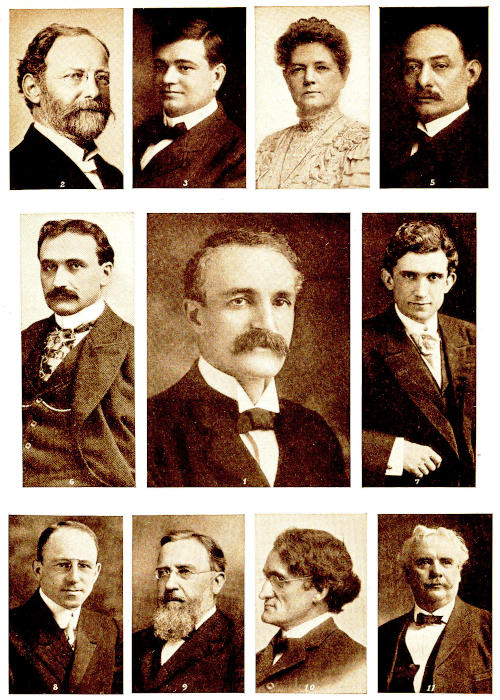
1. Gifford Pinchot, Executive Committee, 1911-12. 2. George C. Pardee, Executive Committee, 1910-11-12. 3. Henry D. Hardtner, Vice-President, 1909-1912. 4. Mrs. Philip N. Moore, Executive Committee, 1909-12. 5. Walter H. Page, Executive Committee, 1910-12. 6. D. Austin Latchaw, Treasurer. 7. Thomas R. Shipp, Executive Secretary. 8. James C. Gipe, Recording Secretary. 9. A. B. Farquhar, Vital Resources, 1911-12. 10. L. H. Bailey, Chairman Lands Committee, 1911-12. 11. W J McGee, Chairman National Parks Committee, 1911-12.
FARM ORGANIZATION.
The organization of the farmers has long been the end desired by those who are seeking to promote the country’s welfare. By reason of all his previous years of training when he has been acting on his own judgment, and working alone, the farmer is not accustomed to organized effort, and does not fully recognize its value; hence the influence of his wife in this matter is of special help. The farmer knows if he leaves home for any length of time that weeds spring up, fences fall down, cattle get off their feed and cows fail in their milk. Hence he stays at home year in and year out getting deeper and deeper in the rut unless educational and social privileges are brought to him. This the women can and will do. Through the united efforts of the women the farmer is going to think less of his taxes and more of his schools; he is going to be one of an army of country men united to secure conservation of the soil through longer leases, conservation of the child through better educational facilities; conservation of the wife through the relaxation of meeting with those of her own sex, and shall I not add: conservation of the few hard-earned dollars in the purse by parcels post? The farmer’s wife, in order to conserve to the fullest extent the best interests of the farm, must be filled with the conviction that farming is the most honorable of any pursuit for a man and is a career worthy of his best endeavors and not merely a makeshift until something better offers. Such a woman will impress upon her children the thought that no calling or profession is so worthy of their best efforts; she will see to it that the books and papers that come into the family are those that treat farming and the farmer with respect. No one thing probably has had a more invidious influence in creating a desire among farm boys to leave the farm than the funny papers and cartoons which make the farmer the butt of their jokes, portraying him as the victim of the gold brick agent and picturing him with the vacant look and gaping mouth of an imbecile.
Cato, the Censor, lived at a time when Rome was at its height as a military power. He had held nearly all of the great offices under the Roman republic, yet in his old age he left this record, that: “No occupation was so worthy of the dignity of a man as that of farming,” holding that: “Farming makes the bravest men, and thoughts.” The farmer’s wife should use her influence to see that this kind of literature is kept before her children in the farm home, in the curriculum of the school, and in the school library.
In the time at my disposal I have been able to only hint at a few of the very many and diverse problems, as well as opportunities which belong to our women of the farm. I have tried to view them as a wife and mother of the soil, where, indeed, my life is cast, and my energies have been engrossed. I have endeavored to advance no fine spun theories, but to suggest a solution which can be and is being worked out today in many localities. That these and similar organizations are bound to come in abundance and that they will work untold good to the cause of conservation I fully believe. Once the farm wives of our country are adequately organized there is no divining the power for good that they may wield. There is an old saying: “Unless a man’s mother ordains him for the ministry, he won’t make a good preacher.” When a boy’s mother ordains him for the farm there will be no lack of good farmers. (Applause)
Chairman Vessey—I now have the pleasure of introducing to you Mrs. Matthew T. Scott, President General of the Daughters of the American Revolution, who will talk to you in regard to the “Farmer’s Wife.” (Applause)
Mrs. Scott—I have crossed the continent to be present today because of my interest in the farm and the farmer’s wife—the class to which I am proud to belong.
We have considered here every interest of conservation in creation—vegetable, animal and mineral, and now come to conservation of the farmer’s wife, the greatest issue before this Congress.
In the consideration of that problem which so far has baffled the masculine intelligence, i. e., that of keeping the younger generation on the farm, the key to the situation unquestionably is held by the farmer’s wife.
The call of the country rings out from garden, from forest and stream, from acres of golden grain, and tonics pure from Nature’s own laboratory. Back of all of this is the farmer’s wife, who by making the farm home attractive and interesting is the magnet which draws the boy and girl back to the farm, from the allurements and disappointments of city life. The farmer’s wife is no longer the isolated being of years ago—but with her free rural delivery, and the country’s network of trolleys for her convenience—good roads, and with the use of modern machinery, a large degree of leisure to give to her social life, music and books, are now at her command. If she succeeds in making life on the farm attractive, if she is able to add the distinctively feminine touch of home charm to the freedom and zest of country life, who can doubt that this great problem of retaining the farmer boys on the farm will be solved?
It is the farmer’s wife also, and she chiefly, who can enforce the only education that is worth while—that is real and true, that education which builds character, which educates not the intellect alone, but at the same time the conscience and the will; an education that means justice and truth and purity in this selfish work-a-day world. Moreover, few farmers succeed whose wives do not do their part to see to it that both ends meet. It is the wife of the farmer who sees where the waste and loss are eating into the profits of the farm. It is the housewife as a rule who has ideas of thrift in farm management and who, if she has the chance, will contribute more than is often realized to make the farm a business success.
Upon the farmer’s wife largely rests this great responsibility, and in this great work, with the help of the noble army of quiet, intelligent, capable farmers’ wives, we hope to develop the most splendid crop known on this fertile continent—the boys and girls, the youth of the land. Largely is this work the prerogative of the farmer’s wife amid the stress and strain which absorb the energies of modern masculine business life.
Another duty which devolves upon the farmer’s wife is to exert her influence and teaching to train her boys so that they will see to it when they are voters that in these days of political chicanery and corruption that only honest men and true are sent to Legislatures, to Congress, and the United States Government, to make the laws that are to govern this, the greatest Nation on the face of the earth.
Sociologists and agricultural professors can aid the farmer’s wife in her work, but, after all, it is upon her shoulders that the responsibility of success or failure in this great task must ultimately rest.
Today the great difficulty is that the farmer’s wife is trying heroically to fulfill the double functions—that of assistant economic producer and of housewife, mother and the organizer and inspirer of the happier and higher activities and diversions of country life.
To free the wife from the burden of money making and educate her in the more difficult and equally important task of home-making and the development of the finer and more humane and more enjoyable aspects of country life, these are the problems we must help her solve and she will do the rest.
An old Frenchman once said that farming was the only profession in which a man works in a relationship of direct partnership with God. The ministry might object to the words “only profession,” but the fact is certainly patent that in more than any ordinary occupation of life, do we coöperate day and night with the sun, and the wind and the rain, and all the other forces of Nature and of Nature’s God, and I believe that for women today there is no profession more alluring, healthful, or lucrative than that of scientific agriculture. If I had my life to live over I would enter as a student one of our great agricultural universities. I would familiarize myself with the work of experiment stations, learn to test soils, know the elements best suited to and most needed by the different stratas of earth. I would master the secrets of fertilization, which have for a thousand years made sections of the old world productive without exhaustion. I would inform myself as to the value and methods of rotation of crops, the value of dairy and cattle raising on the farm. I would also inform myself of the comparative cost of nitrogen drawn from the air in the form of leguminous crops, which imprison the nitrogen in the soil, and the cost of commercial nitrogen, and their comparative values.
I would learn the need of phosphate or potassium as applied to different soils and the comparative value of tested fertilizers. We have already an aristocracy of herds—cattle, horses and swine, but I would undertake the breeding of an aristocracy of seed corn and oats and alfalfa.
Oh! they are great the possibilities of woman on the farm—if she would only take advantage of them. (Applause)
Chairman Wallace—We will now proceed with the call of the states, and these organizations who wish to report.
Delegate C. J. Dillon of Manhattan, Kan.—Can’t we give five minutes more to discussion by the ladies? We have a lady here I wish to propose, who has been working in this same line for years, and I would like to have you hear from her.
Chairman Vessey—Send her up to the platform, please.
Mr. Dillon—I am glad to introduce to you Miss Frances Brown of Kansas, who has been in active work along the lines of organization of farmers’ wives. (Applause)
A Delegate—Have her come down on the front platform.
President Wallace—She has a pretty good voice, and I think if you will be quiet you can hear her.
Miss Brown—The first speaker on this subject this afternoon outlined so ably and so well the needs of the farmer’s wife that it will be my pleasure in just a very few minutes to tell you how we at the Agricultural College in Kansas have tried to meet these needs of the farmers’ wives. We have looked over the field as well as we could, and we saw that in the very first instance the first thing for us to do was to correct, as far as possible, the errors of those who had gone before us. And so while it is only morning yet in Kansas, and the department as organized is only two years old, we went out into the organization that had already existed in Kansas and began to do work on these subjects that pertained to the commonest things of life, the very household, taking up for our very first work a sort of reformatory movement on the subject of bread and bread making. Then we spread that same movement before the Farmers’ Institutes, and by visiting every one of the institutes and meetings that we could, we saw that the cause of dissatisfaction on the farm lay largely in the fact that there are not the conveniences in the farm home that we find in the town, and that was the cause of the exodus from the farm to the town. So we have begun a campaign for the country homes, and our women in the institutes are so anxious that they ask us to help them effect an organization which we call an Auxiliary to the Farmers’ Institutes. Of these during the last year we have twenty organizations, with a membership of 500, whose women have been studying the cost of putting in plants for heating and lighting and bringing water into the homes, and taking care of the waste from the home. Now we are getting letters every day from farm homes where they are actually making use of some one of these various systems.
The next step was to take care of the younger members of the farm home, and so we had to get something ready that could be used in the public schools, as well as in the home itself. We have what you may be more or less familiar with under the title of the Girls’ Home Economic Clubs, by which we reach the girls through the printed page. These printed papers are gotten up so that girls from ten to fifteen years of age can master them perfectly. They are on the subjects that we need every day, first, cooking, because you know that while man can live without poetry, music and art, he cannot live without cooks, so we are going to begin raising each one to be a cook for the future. We have these courses in cooking out all over the state, not only being used by the individual girls in the farm home, but being taken up by the public schools where the towns or the communities are too poor to afford a department in domestic science and art. During the past year 2,300 girls took lessons either in cooking or sewing or both from this department at the college, and already, as the new schools are opening, letters are pouring in every day asking for more of that work in the various sections of the state. Moreover, during the last year, due to these efforts, seventy-five high schools put domestic science or art or both into their systems where it had not existed before. Wishing to utilize or bring together the organization that already existed instead of forming new organizations, we have been getting together a course of domestic lessons, or demonstrations, if you please to call them so, that can be used by the women’s clubs that are already organized in the state. That course is almost completed; and when we have that finished, we hope to see every single organization of the women in the state adopting part or all of it, not because they need it so much, because women that have time for clubs, have more or less leisure through their added efficiency. But it will mean that they are still thoughtful along these lines, and that their efforts are going to be with us in spreading this gospel of good housekeeping throughout the state.
Now, we have a big work yet before us. We are not going to stop. We are going to work at every single channel that we have opened, and we are going to open as many new ones as can be helped, until every roof in Kansas covers a harmonious home where we will find every single thing that will tend to the highest efficiency and the needs of every member of the family in that home. I thank you. (Applause)
Chairman Wallace—I know I voice the feeling of this audience when I say we have already highly enjoyed these addresses from the ladies this afternoon. The executive committee of this association has some business that you must transact, and the report will now be read by Mr. J. B. White, the chairman of the executive committee.
Mr. White—The executive committee met this morning and adopted the following resolutions:
In view of the very effective help which the national organizations have given the Conservation Congress and the conservation movement in general, the members of the executive committee of the Third National Conservation Congress feel that the national organizations should have more adequate representation. Therefore, at a meeting of the executive committee of the Congress today, it was decided unanimously to recommend that the constitution be amended so as to provide for an advisory board to be made up of representatives of the national organizations which have appointed conservation committees.
To this end the executive committee respectfully begs leave to submit the following amendment to Article 5, Section 3, of the Constitution of the Conservation Congress, by adding the following:
“An advisory board, consisting of one person from each national organization having a conservation committee, shall be created to act for that Congress and during the interval before the next succeeding Congress. The board shall report to and coöperate with the executive committee.”
The executive committee is also of opinion that the scope of the work of the permanent committees of the Congress should be extended so as to cover a larger field. The present sub-committees are those on forests, waters, land, mineral and vital resources.
The committee, therefore, recommends that the constitution of the Conservation Congress be amended as follows:
Article 5, Section 5. The committee on vital resources shall consist of members, each selected with the view to becoming chairman of the sub-committee and that six sub-committees be created subordinate to the committee on vital resources as follows: Food, homes, child life, education, civics, general (including wild life, domesticated animals and cultivated plants). The chairman of each committee, with the approval of the chairman of the executive committee, shall be authorized to appoint as members of these sub-committees, such members as in their judgment will best accomplish the object sought.
Delegate Bruce Dodson of Kansas City—I move that the report of the executive committee be received.
Delegate Wm. H. Dye of Indianapolis—I second the motion.
Chairman Vessey—All in favor of them will say aye. Contrary minded. The amendments are adopted.
Mr. White—Mr. President, we invite all those who are here and are delegates of the different national associations that have conservation committees to come on the platform, that they may choose their representatives, if possible, and confer with the executive committee immediately after adjournment.
President Wallace—What now is the pleasure of the Congress? We have filled up the program of today. I take pleasure in introducing Miss Mame E. Weller of Nathan, Iowa, of the conservation committee of the Iowa Federation of Women’s Clubs.
Miss Weller—I bring greetings from the Federated Club women of Iowa, who today stand ready to help in all lines of conservation.
We have been and are working for the conservation of child life, health and happiness. We have done much toward procuring sanitation in schools, and especially pure drinking water. We are trying to have our bird laws enforced and shall petition our Legislature at its next session to prohibit spring shooting of ducks and all shore birds, who are our sanitary commissioners of lake, shore and stream borders.
We have caused many hundreds of trees to be planted in Iowa, and the coming year we are to work for state control of the banks of our streams and shores of our lakes.
We have done much to prevent the wanton mutilation of trees and destruction of our wayside trees by telephone companies. Yet much remains to be done. We have in Iowa a statute that exempts from taxation almost entirely all woodlands, native or planted, when kept and used for timber purposes only.
President Wallace—We expected until today to have a paper or address by Dr. Knapp of Washington, D. C., but I am very sorry to say that he cannot come, but the Department of Agriculture has a gentleman that can take his place, and I would suggest that Dr. W. J. Spillman come forward and tell us about the wonderful demonstration work that is going on in the South.
Is Dr. Spillman in the audience? If not, we would be glad to hear from Mr. F. A. Guthrie, a member of the Congress representing the city of St. Paul, Minn. Five minutes, and then I promise you we will adjourn.
Mr. Guthrie—As indicated in the announcement, my work is on a line somewhat different from almost anything that has been presented. In connection with charitable and correctional institutions, we have found that it is necessary to go to the country. This presentation this afternoon relates to charitable and correctional work. The dreariness of the country home is very important and has to do with most of that which we have to treat. The national conferences on this matter have come to the conclusion that it is necessary for leaders in the country to engage some person specially qualified to advance social interests, to organize country meetings of various kinds, or organize musical entertainments, organize social entertainments, and organize educational work. We present that to the national conference as something to which we will have to come in order to bring about agreeable healthy country life, a life which gives joy in living, as was presented by the President at the opening. I thank you.
President Wallace—We are ready to entertain a motion to adjourn. Ladies and Gentlemen, remember that the meeting is at 8 o’clock sharp. We are to have a great program tonight. Mrs. Moore, Dr. Wilson, and Dr. Wiley.
The Congress stands adjourned until 8 o’clock this evening.